Electrical Works – House Wiring & Cables
S.Sudha Velan B.E (Civil)
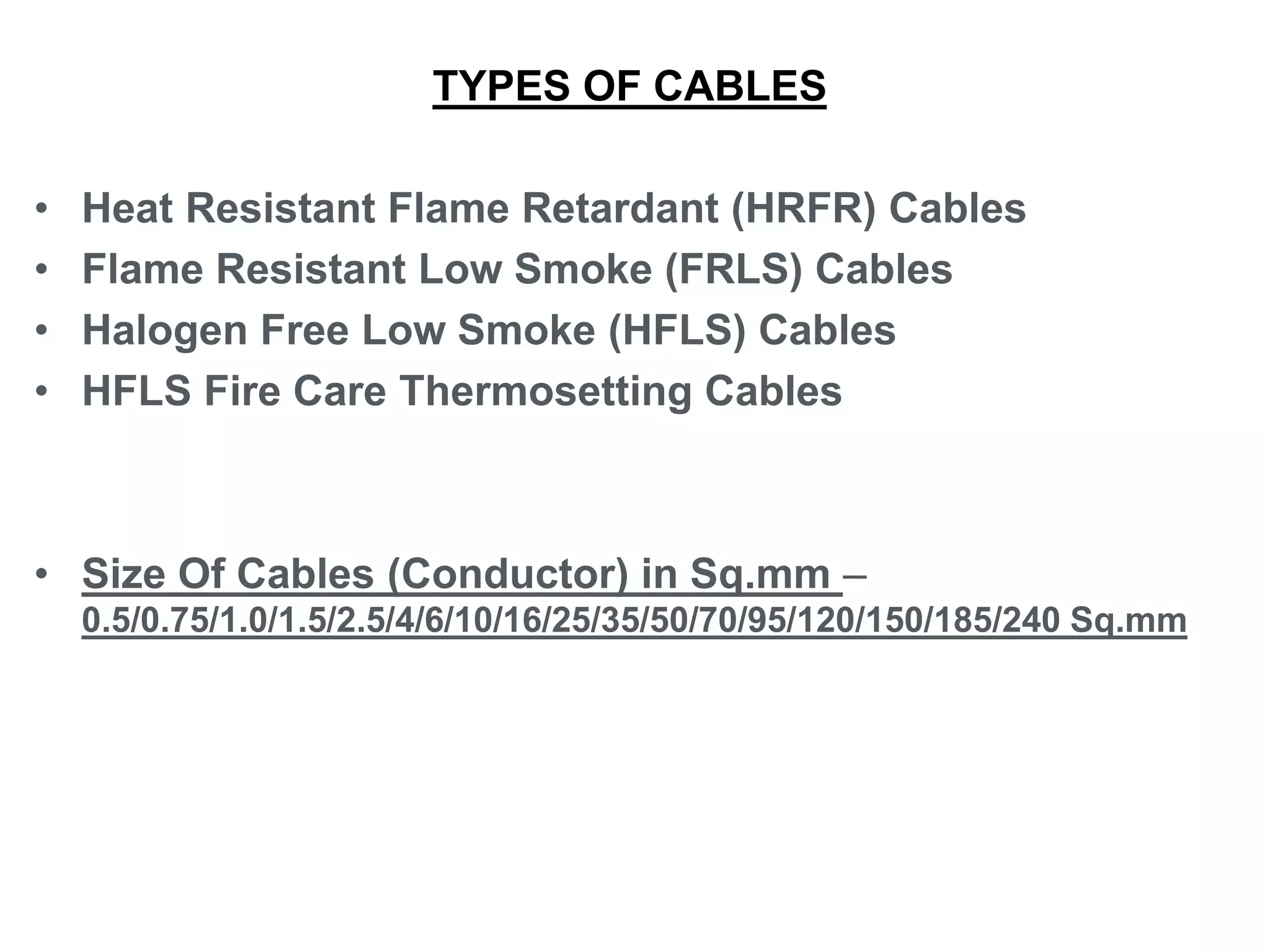
TYPES OF CABLES
• Heat Resistant Flame Retardant (HRFR) Cables
• Flame Resistant Low Smoke (FRLS) Cables
• Halogen Free Low Smoke (HFLS) Cables
• HFLS Fire Care Thermosetting Cables
• Size Of Cables (Conductor) in Sq.mm –
0.5/0.75/1.0/1.5/2.5/4/6/10/16/25/35/50/70/95/120/150/185/240 Sq.mm
Heat Resistant Flame Retardant
(HRFR)
Halogen Free Low Smoke Cables
(HFLS)
Halogen Free Low Smoke Cables
(HFLS)
PVC Cable
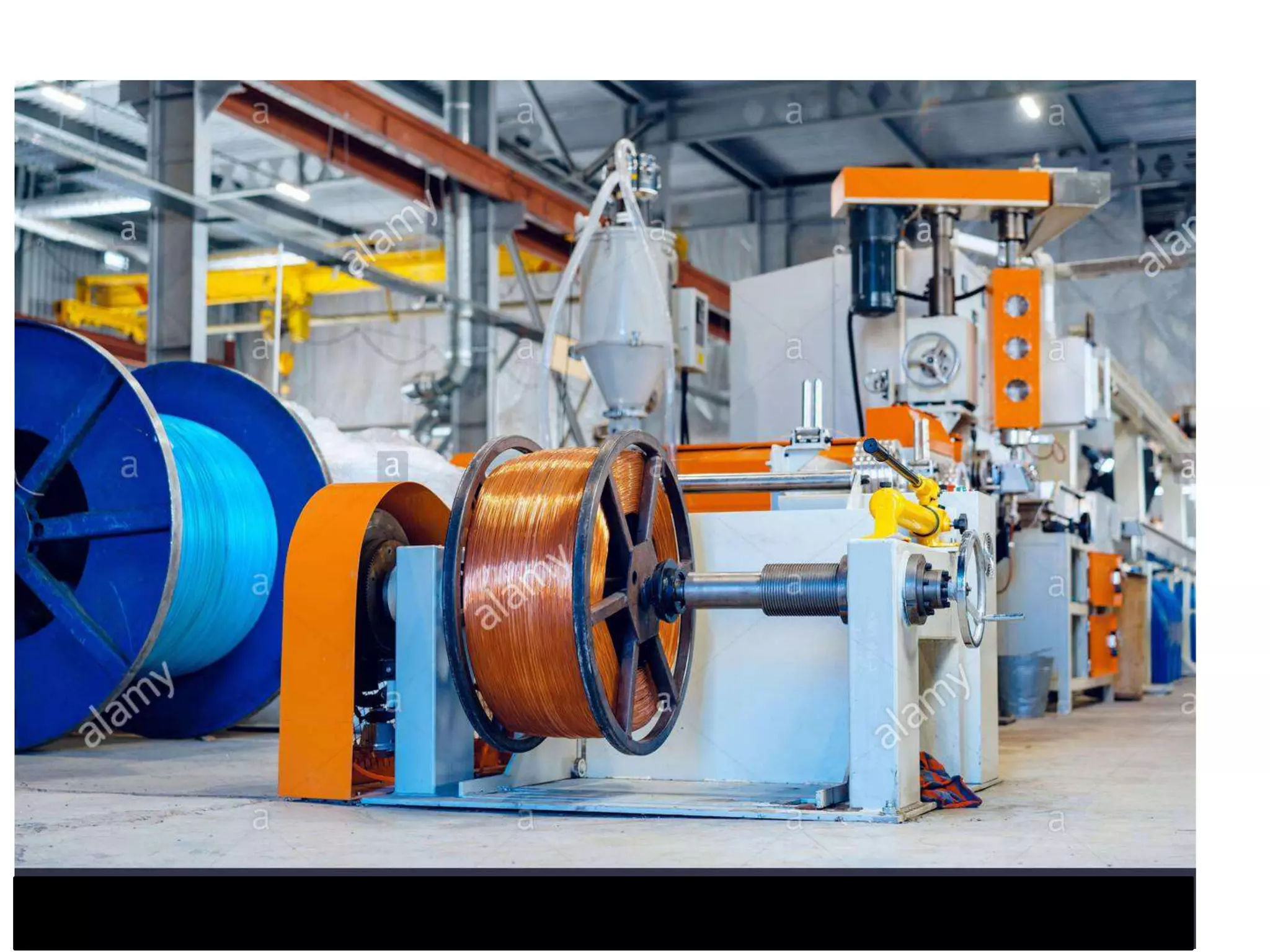
Cables Manufacturing Process
• Twin and Earth (1) – This is the most common cable used in
domestic electrical installations, it is a flat grey thermo-
plastic sheathed cable
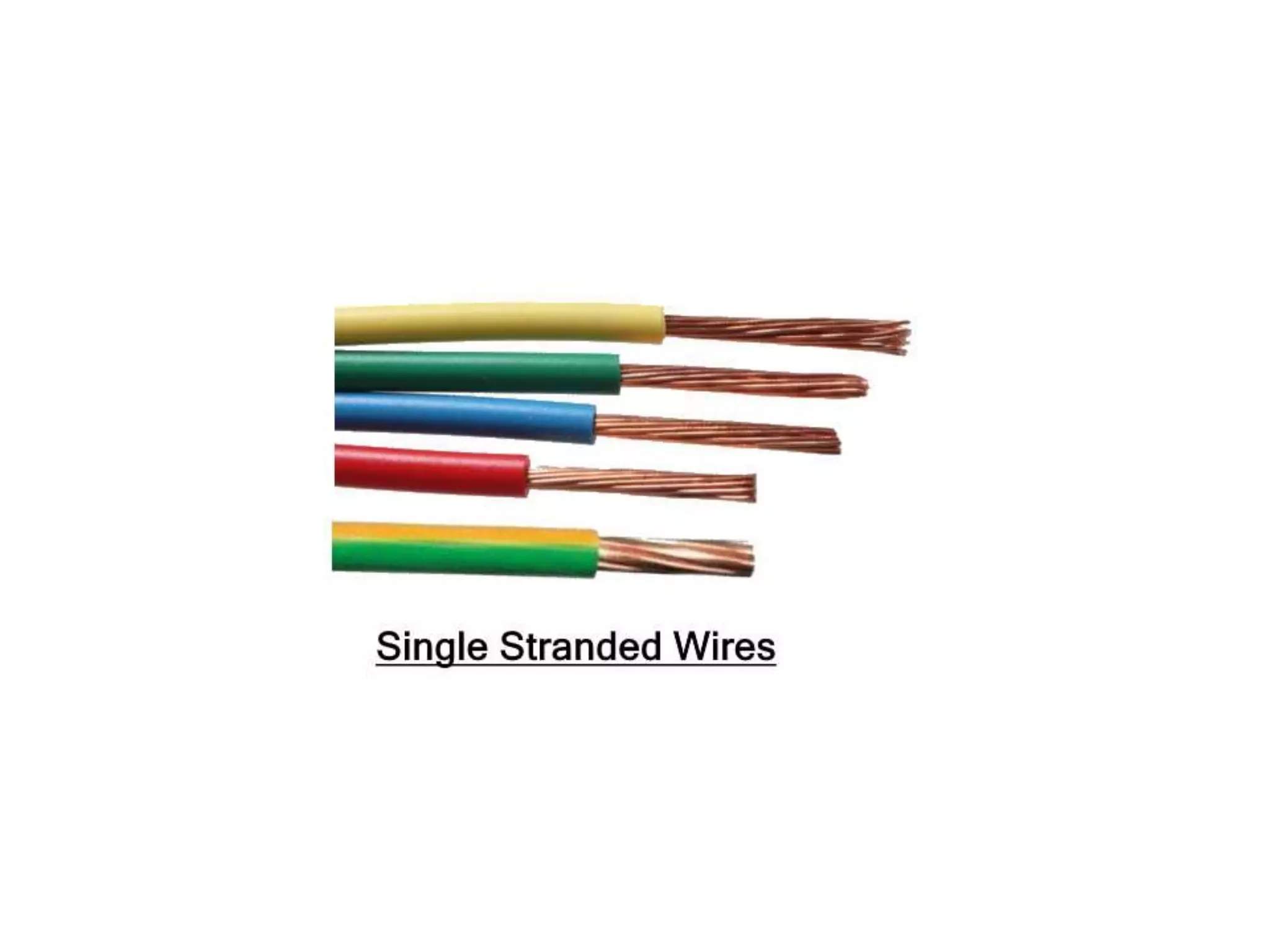
• Flex (2) – A flexible cable that has a soft rubber or
thermoplastic outer sheath and individually insulated
conductors inside it. Each individual conductor is made up of
very fine strands of copper to allow the cable to repeatedly
flex.
• SWA (3) – Steel Wire Armour, this is a cable that is
surrounded by a layer of armour made up of steel wire, it is
generally used where the cable requires a high degree of
protection.
• LSHF (4) – Low Smoke Halogen Free cable is a cable with a
particular type of insulation that is designed so that it emits a
small amount of smoke and zero halogen when exposed to
fire or heat.
Insulation For Electric Cables
• The insulation consists of placing an insulating coating
on the conductor to prevent current leakage.
Thermoplastic Insulation
• PVC: Polyvinyl chloride
• Z1: Polyolefins
• PE: Linear polyethylene
• PU: Polyurethane
Thermosetting Insulation
• EPR: Ethylene Propylene
• XLPE: Crosslinked Polyethylene
• EVA: Ethyl Vinyl Acetate
• SI: Silicone
• PCP: Neoprene
• SBR: Natural Rubber
THERMOPLASTIC INSULATION
• A material which will soften, flow, when subjected to
sufficient heat and pressure. These compounds are heated
and extruded over conductor. Likewise, the insulation on the
finished product can be re-melted or soften if exposed to
heat.
• Easy to manufacture
• Normally less expensive
• No cure required
• Will melt when subjected to heat
• Can be extruded in very thin walls
HERMOSETTING INSULATION
• A material which will not soften, flow, when subjected to
heat and pressure. Once extruded over conductor,
these compounds will not re-melt, however, they can be
burnt or deteriorate due to heat.
• Will harden and age when overheated
• Forgiving when exposed to overloads
• Better low temperature properties
• Higher temperature potential
• Usually more expensive
• Requires a cure process when extruded
Components - Electrical
Cable
•Conductor: which channels
the flow of electricity
•Insulation: it covers and
contains the electric flow in
the conductor.
•Auxiliary
elements: protect the cable
and guarantee its longevity.
•Outer sheath: covers all the
mentioned materials
protecting them from the
outside.
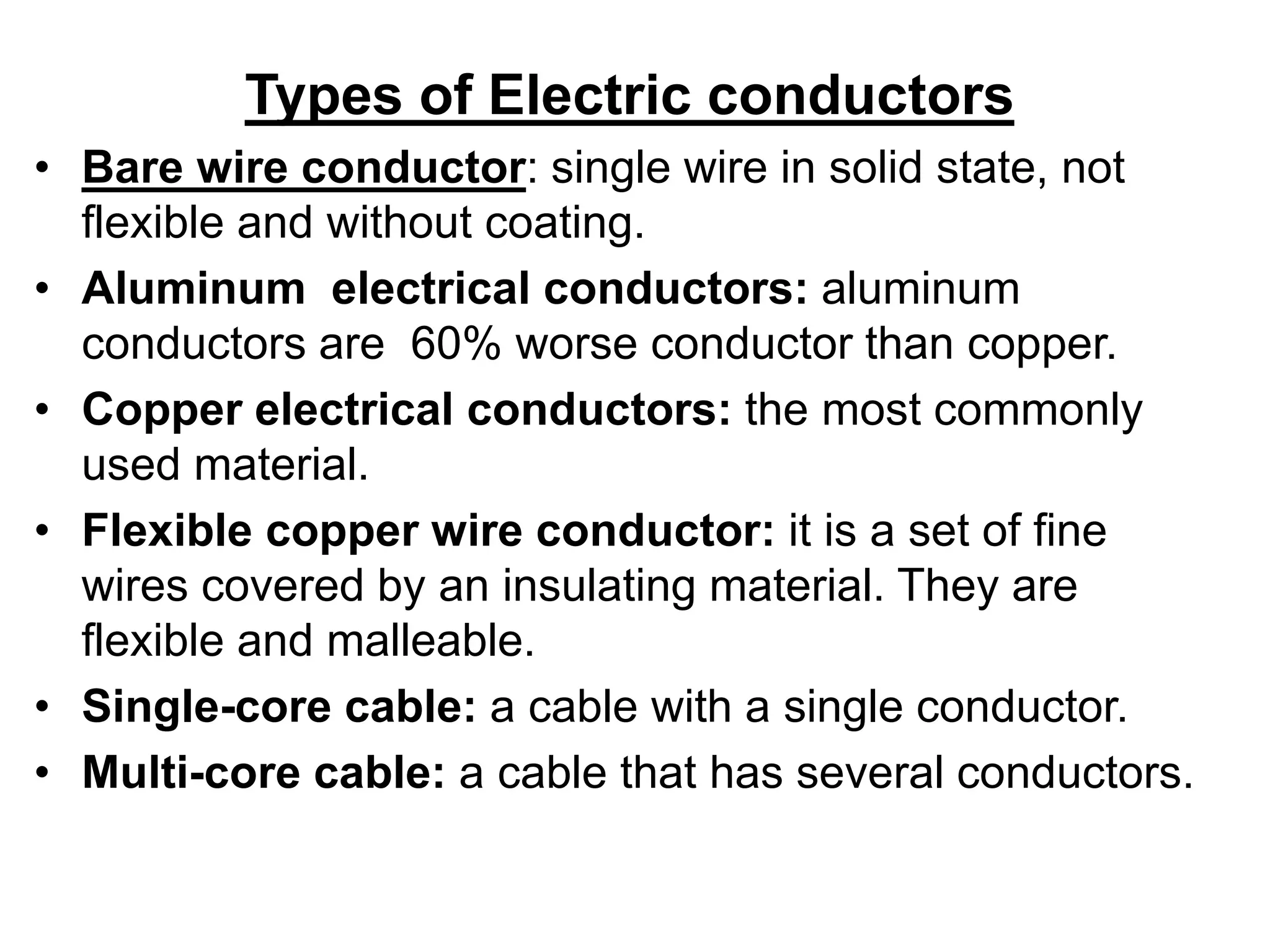
Types of Electric conductors
• Bare wire conductor: single wire in solid state, not
flexible and without coating.
• Aluminum electrical conductors: aluminum
conductors are 60% worse conductor than copper.
• Copper electrical conductors: the most commonly
used material.
• Flexible copper wire conductor: it is a set of fine
wires covered by an insulating material. They are
flexible and malleable.
• Single-core cable: a cable with a single conductor.
• Multi-core cable: a cable that has several conductors.
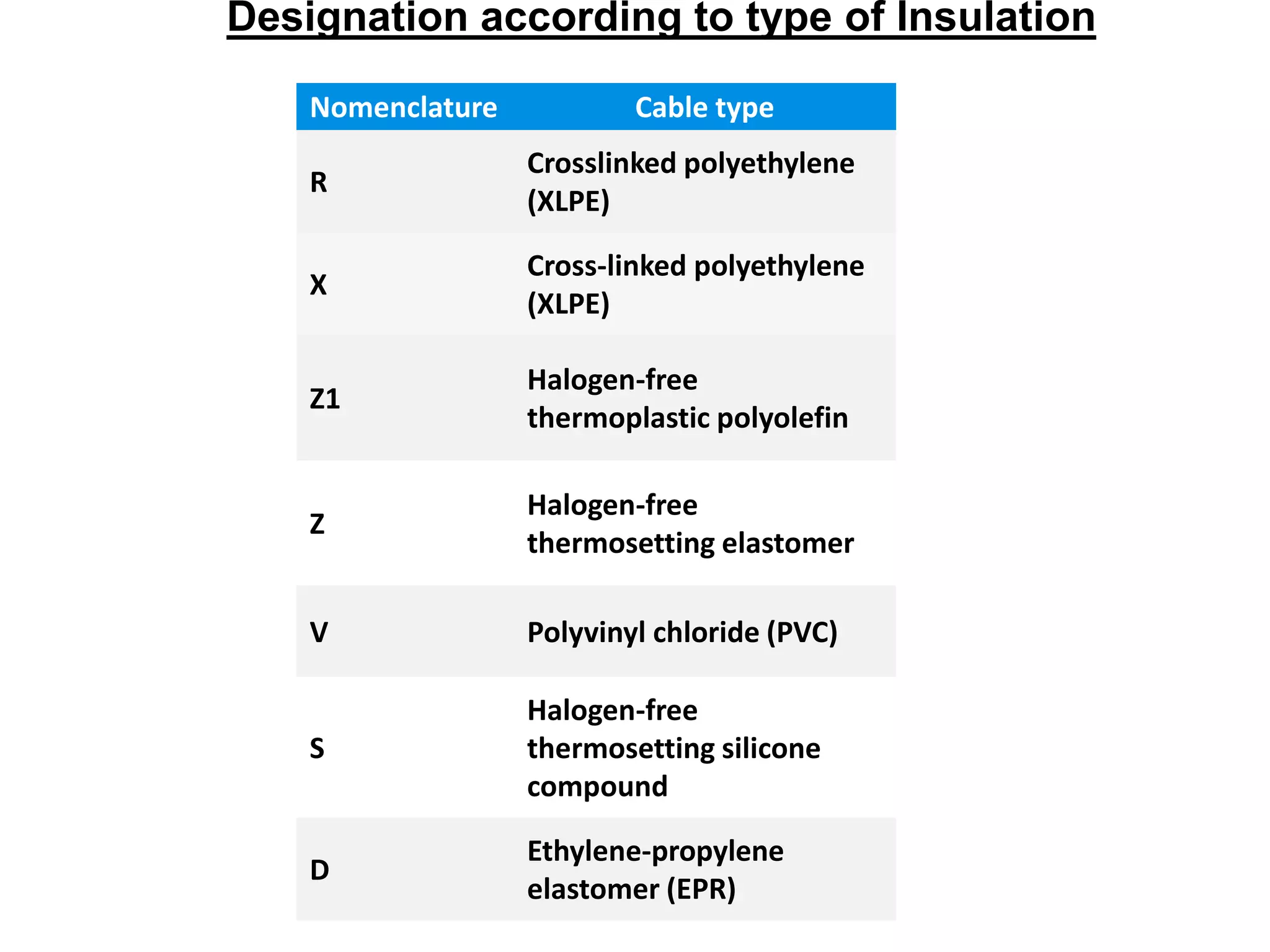
Nomenclature of Electrical Cables
Nomenclature Cable type
R
Crosslinked polyethylene
(XLPE)
X
Cross-linked polyethylene
(XLPE)
Z1
Halogen-free
thermoplastic polyolefin
Z
Halogen-free
thermosetting elastomer
V Polyvinyl chloride (PVC)
S
Halogen-free
thermosetting silicone
compound
D
Ethylene-propylene
elastomer (EPR)
Designation according to type of Insulation
Nomenclature Cable type
C3
Copper wire screen,
helically arranged
C4
Copper shield in the
form of a braid, on
the assembled
insulated conductors.
V
Polyvinyl chloride
(PVC)
Z1
Halogen-free
thermoplastic
polyolefin
Screen designation, Interior lining, Armature seat
Nomenclature Cable type
F
Steel strapping
arranged in a helical
pattern.
FA
Aluminium strapping
arranged in a helical
pattern
FA3
Longitudinally
corrugated
aluminium strip
M Steel wire crown
MA
Aluminium wire
crown
Designation of the different types of Armor
nomenclature Cable type
V
Polyvinyl chloride
(PVC)
Z1
Halogen-free
thermoplastic
polyolefin
Z
Halogen-free
thermosetting
elastomer
N
Vulcanized
chlorinated polymer
Designation of the outer sheath
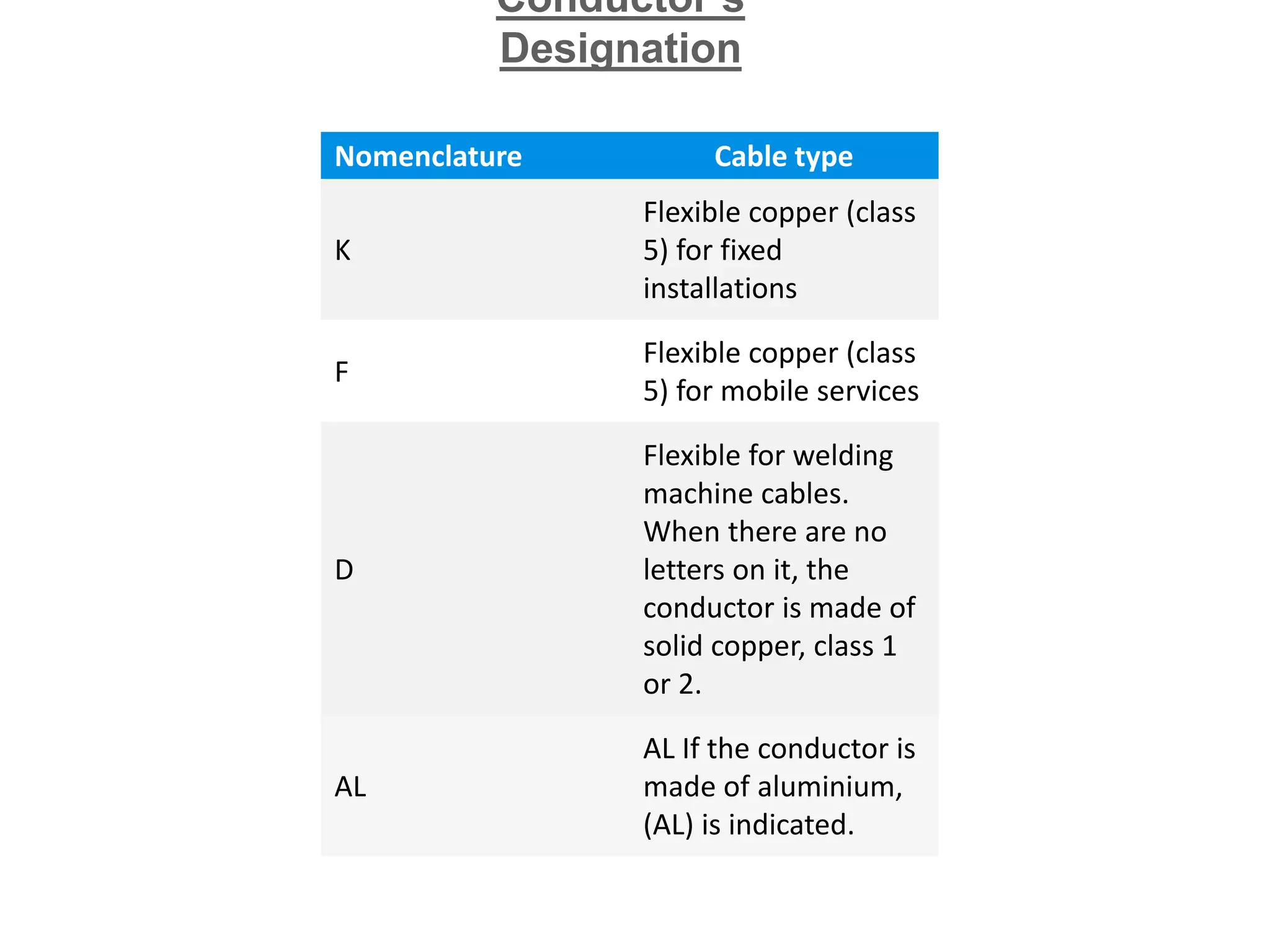
Nomenclature Cable type
K
Flexible copper (class
5) for fixed
installations
F
Flexible copper (class
5) for mobile services
D
Flexible for welding
machine cables.
When there are no
letters on it, the
conductor is made of
solid copper, class 1
or 2.
AL
AL If the conductor is
made of aluminium,
(AL) is indicated.
Conductor’s
Designation
Nomenclature Cable type
nGS
Number and cross-
section of wires, in
mm2 , with
Yellow/Green
conductor
nxS
Number and cross-
section of
conductors, in mm2 ,
without conductor
Yellow/Green
Explanation of the Number of Conductors
Electrical Wires Colour Code
Units of Measurement
• Ohms – An Ohm is the electrical unit used for measuring
resistance; its symbol is Ω.
• Watt – This is a unit of power and is denoted by use of the
letter W.
• Voltage – Voltage is the difference in electrical potential
between two different points, it can be thought of as
electrical pressure, and it is denoted by the letter V or U.
• Amperes – This is the term used to describe the flow of
electrical current, it is denoted by the letter A.
• AC- Alternating Current is an electric current which
reverses direction periodically. AC current is the way that
electricity is distributed through the power network in the
UK.
• DC – Direct Current is an electric current that travels in
only one direction, this is the type of current that a battery
produces.
Type test of electrical power cable.
1. Persulphate test (for copper)
2. Annealing test (for copper)
3. Tensile test (for Aluminium)
4. Wrapping test (for Aluminium)
5. Conductor resistance test (for all)
6. Test for thickness of insulation (for all)
7. Measurement of overall diameter (where specified) (for all)
Tests for Insulation and Sheath
1. Tensile strength and elongation at break
2. Ageing in air oven
3. Ageing in air bomb
4. Ageing in oxygen bomb
5. Hot set
6. Oil resistance
7. Tear resistance
8. Insulation resistance
9. High voltage (water immersion) test
10.Flammability test (only for SE-3, SE-4)
11.Water abortion test (for insulation)
Cable Cold Bend Testing
Cable Insulation Resistance Testing
Vertical Flame Testing for Cables
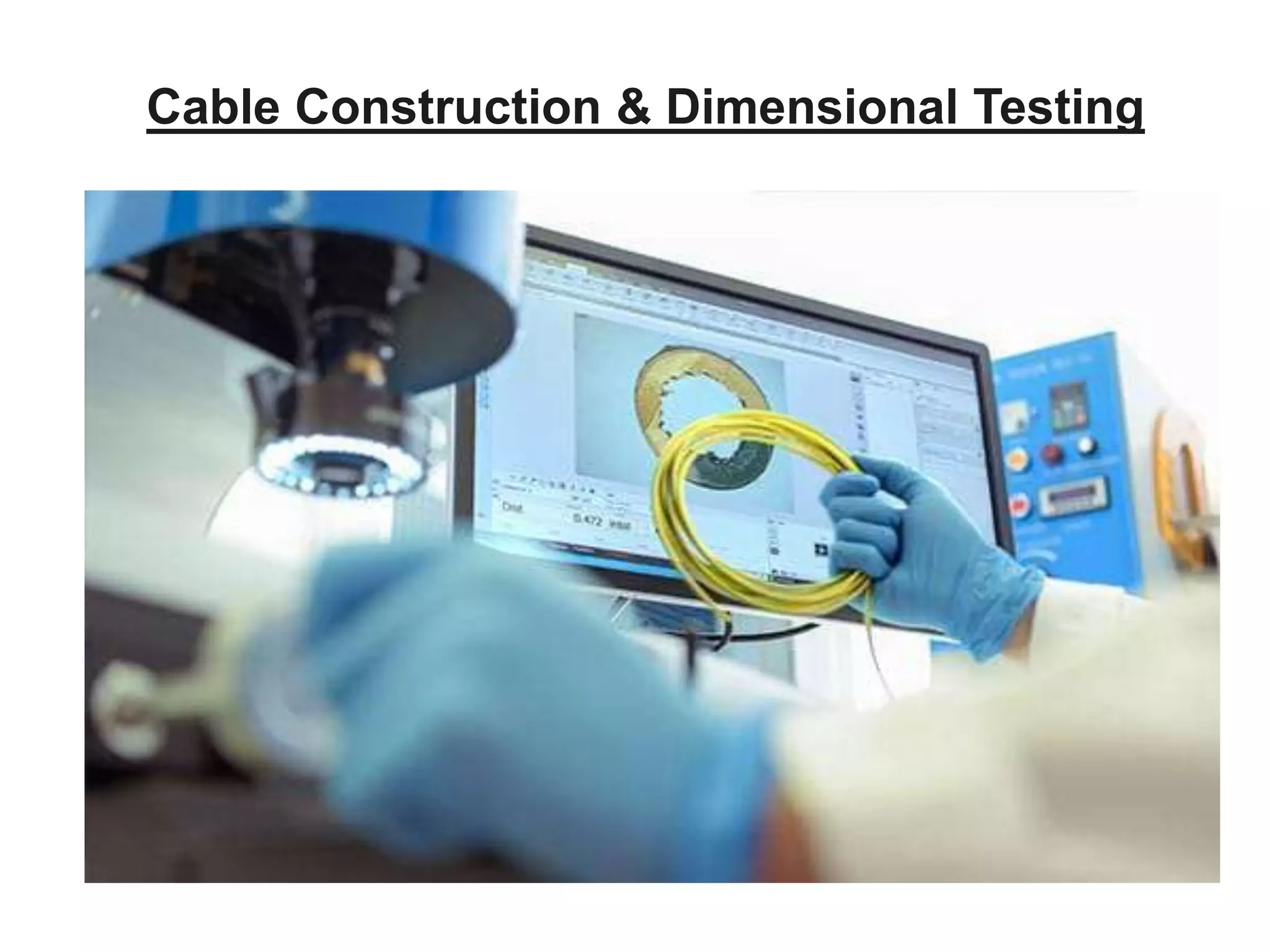
Cable Construction & Dimensional Testing
Cable Hot Set Testing for Cross-Linked Materials
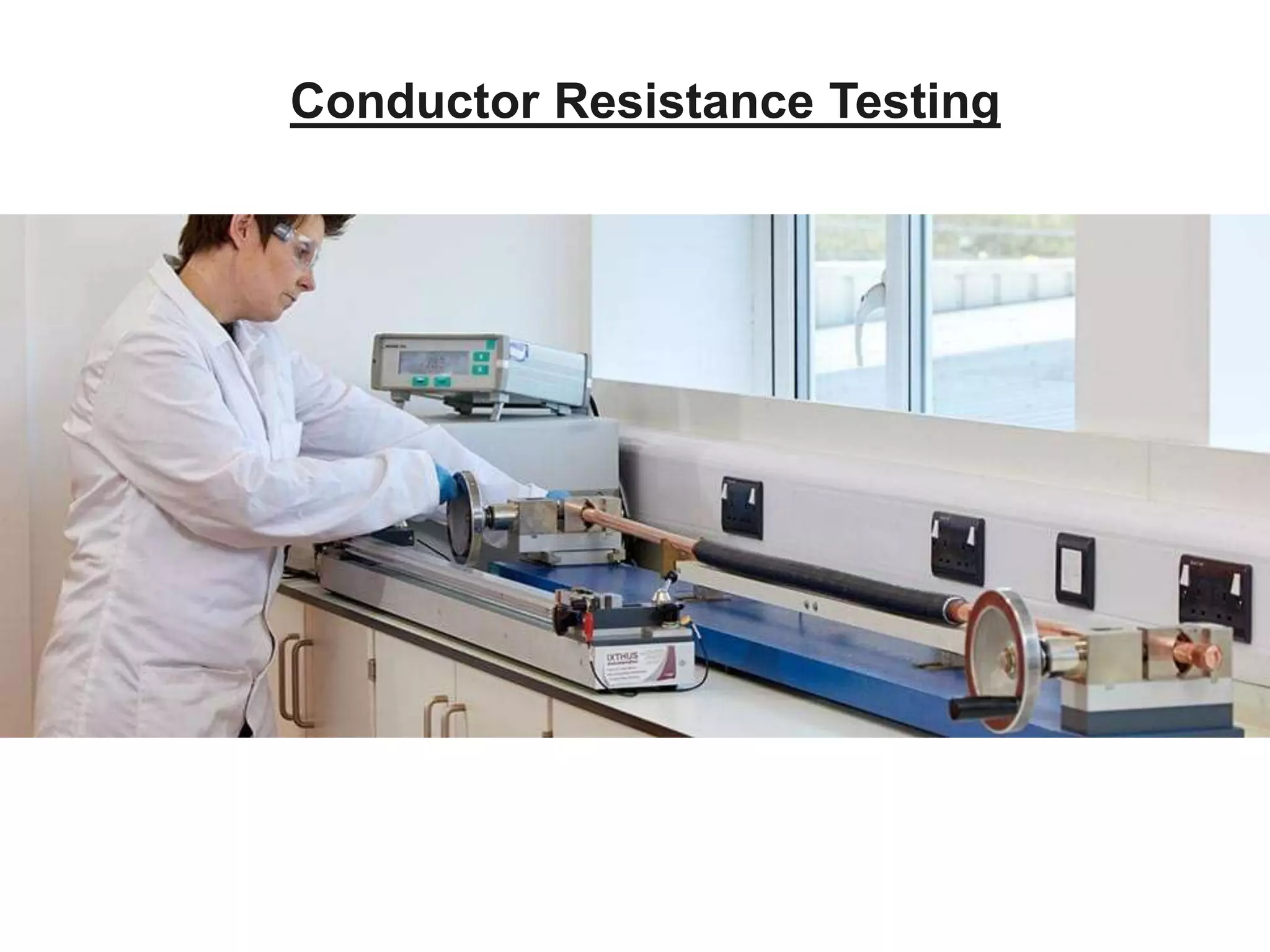
Conductor Resistance Testing
Tensile & Elongation Measurement for Cable Insulation
Materials
Very Low Frequency testing for Medium Voltage and High Voltage
cables
Shrinkage Tests for Cable
Insulation
Thanks & Regards
S.Sudha Velan

Electrical Works – House Wiring & Cables

  • 1.
    Electrical Works –House Wiring & Cables S.Sudha Velan B.E (Civil)
  • 2.
    TYPES OF CABLES •Heat Resistant Flame Retardant (HRFR) Cables • Flame Resistant Low Smoke (FRLS) Cables • Halogen Free Low Smoke (HFLS) Cables • HFLS Fire Care Thermosetting Cables • Size Of Cables (Conductor) in Sq.mm – 0.5/0.75/1.0/1.5/2.5/4/6/10/16/25/35/50/70/95/120/150/185/240 Sq.mm
  • 3.
    Heat Resistant FlameRetardant (HRFR)
  • 4.
    Halogen Free LowSmoke Cables (HFLS)
  • 5.
    Halogen Free LowSmoke Cables (HFLS) PVC Cable
  • 7.
  • 10.
    • Twin andEarth (1) – This is the most common cable used in domestic electrical installations, it is a flat grey thermo- plastic sheathed cable • Flex (2) – A flexible cable that has a soft rubber or thermoplastic outer sheath and individually insulated conductors inside it. Each individual conductor is made up of very fine strands of copper to allow the cable to repeatedly flex. • SWA (3) – Steel Wire Armour, this is a cable that is surrounded by a layer of armour made up of steel wire, it is generally used where the cable requires a high degree of protection. • LSHF (4) – Low Smoke Halogen Free cable is a cable with a particular type of insulation that is designed so that it emits a small amount of smoke and zero halogen when exposed to fire or heat.
  • 11.
    Insulation For ElectricCables • The insulation consists of placing an insulating coating on the conductor to prevent current leakage. Thermoplastic Insulation • PVC: Polyvinyl chloride • Z1: Polyolefins • PE: Linear polyethylene • PU: Polyurethane Thermosetting Insulation • EPR: Ethylene Propylene • XLPE: Crosslinked Polyethylene • EVA: Ethyl Vinyl Acetate • SI: Silicone • PCP: Neoprene • SBR: Natural Rubber
  • 12.
    THERMOPLASTIC INSULATION • Amaterial which will soften, flow, when subjected to sufficient heat and pressure. These compounds are heated and extruded over conductor. Likewise, the insulation on the finished product can be re-melted or soften if exposed to heat. • Easy to manufacture • Normally less expensive • No cure required • Will melt when subjected to heat • Can be extruded in very thin walls
  • 13.
    HERMOSETTING INSULATION • Amaterial which will not soften, flow, when subjected to heat and pressure. Once extruded over conductor, these compounds will not re-melt, however, they can be burnt or deteriorate due to heat. • Will harden and age when overheated • Forgiving when exposed to overloads • Better low temperature properties • Higher temperature potential • Usually more expensive • Requires a cure process when extruded
  • 15.
    Components - Electrical Cable •Conductor:which channels the flow of electricity •Insulation: it covers and contains the electric flow in the conductor. •Auxiliary elements: protect the cable and guarantee its longevity. •Outer sheath: covers all the mentioned materials protecting them from the outside.
  • 16.
    Types of Electricconductors • Bare wire conductor: single wire in solid state, not flexible and without coating. • Aluminum electrical conductors: aluminum conductors are 60% worse conductor than copper. • Copper electrical conductors: the most commonly used material. • Flexible copper wire conductor: it is a set of fine wires covered by an insulating material. They are flexible and malleable. • Single-core cable: a cable with a single conductor. • Multi-core cable: a cable that has several conductors.
  • 17.
  • 18.
    Nomenclature Cable type R Crosslinkedpolyethylene (XLPE) X Cross-linked polyethylene (XLPE) Z1 Halogen-free thermoplastic polyolefin Z Halogen-free thermosetting elastomer V Polyvinyl chloride (PVC) S Halogen-free thermosetting silicone compound D Ethylene-propylene elastomer (EPR) Designation according to type of Insulation
  • 19.
    Nomenclature Cable type C3 Copperwire screen, helically arranged C4 Copper shield in the form of a braid, on the assembled insulated conductors. V Polyvinyl chloride (PVC) Z1 Halogen-free thermoplastic polyolefin Screen designation, Interior lining, Armature seat
  • 20.
    Nomenclature Cable type F Steelstrapping arranged in a helical pattern. FA Aluminium strapping arranged in a helical pattern FA3 Longitudinally corrugated aluminium strip M Steel wire crown MA Aluminium wire crown Designation of the different types of Armor
  • 21.
    nomenclature Cable type V Polyvinylchloride (PVC) Z1 Halogen-free thermoplastic polyolefin Z Halogen-free thermosetting elastomer N Vulcanized chlorinated polymer Designation of the outer sheath
  • 22.
    Nomenclature Cable type K Flexiblecopper (class 5) for fixed installations F Flexible copper (class 5) for mobile services D Flexible for welding machine cables. When there are no letters on it, the conductor is made of solid copper, class 1 or 2. AL AL If the conductor is made of aluminium, (AL) is indicated. Conductor’s Designation
  • 23.
    Nomenclature Cable type nGS Numberand cross- section of wires, in mm2 , with Yellow/Green conductor nxS Number and cross- section of conductors, in mm2 , without conductor Yellow/Green Explanation of the Number of Conductors
  • 27.
  • 28.
    Units of Measurement •Ohms – An Ohm is the electrical unit used for measuring resistance; its symbol is Ω. • Watt – This is a unit of power and is denoted by use of the letter W. • Voltage – Voltage is the difference in electrical potential between two different points, it can be thought of as electrical pressure, and it is denoted by the letter V or U. • Amperes – This is the term used to describe the flow of electrical current, it is denoted by the letter A. • AC- Alternating Current is an electric current which reverses direction periodically. AC current is the way that electricity is distributed through the power network in the UK. • DC – Direct Current is an electric current that travels in only one direction, this is the type of current that a battery produces.
  • 29.
    Type test ofelectrical power cable. 1. Persulphate test (for copper) 2. Annealing test (for copper) 3. Tensile test (for Aluminium) 4. Wrapping test (for Aluminium) 5. Conductor resistance test (for all) 6. Test for thickness of insulation (for all) 7. Measurement of overall diameter (where specified) (for all)
  • 30.
    Tests for Insulationand Sheath 1. Tensile strength and elongation at break 2. Ageing in air oven 3. Ageing in air bomb 4. Ageing in oxygen bomb 5. Hot set 6. Oil resistance 7. Tear resistance 8. Insulation resistance 9. High voltage (water immersion) test 10.Flammability test (only for SE-3, SE-4) 11.Water abortion test (for insulation)
  • 31.
  • 32.
  • 33.
  • 34.
    Cable Construction &Dimensional Testing
  • 35.
    Cable Hot SetTesting for Cross-Linked Materials
  • 36.
  • 37.
    Tensile & ElongationMeasurement for Cable Insulation Materials
  • 38.
    Very Low Frequencytesting for Medium Voltage and High Voltage cables
  • 39.
    Shrinkage Tests forCable Insulation
  • 42.