Course Scope
It covers all types of power cables, from
wiring and flexible cables for general
use to distribution, and transmission. It
includes information on materials,
design principles, installation and
standards, and it contains extensive
tables of data on commonly used cable
types.
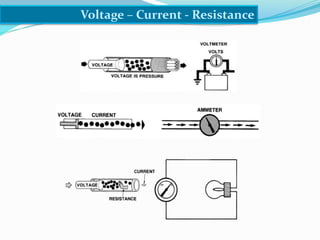
Voltage – Current - Resistance
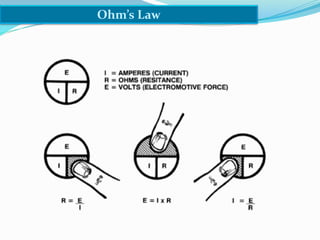
Ohm’s Law
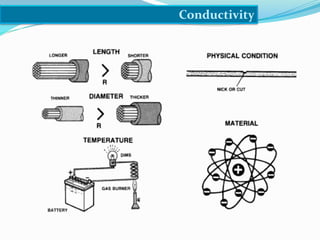
Conductivity
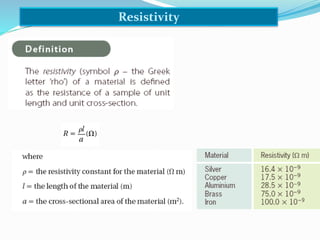
Resistivity
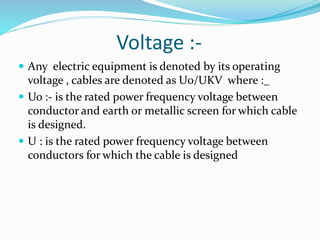
Voltage :-
 Any electric equipment is denoted by its operating
voltage , cables are denoted as U0/UKV where :_
 Uo :- is the rated power frequency voltage between
conductor and earth or metallic screen for which cable
is designed.
 U : is the rated power frequency voltage between
conductors for which the cable is designed
 For example : Saying 0.6/1 (1.2) Kv cable means that
 Uo (Phase voltage) = 0.6 Kv
 U ( Line voltage) = 1 Kv
 Cable is defined by its line voltage as when saying 15
kv cables we mean 8.7/15 Kv
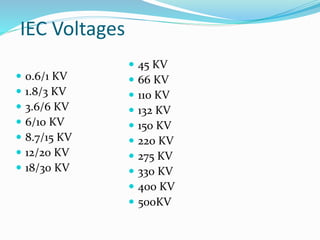
IEC Voltages
 45 KV
 66 KV
 110 KV
 132 KV
 150 KV
 220 KV
 275 KV
 330 KV
 400 KV
 500KV
 0.6/1 KV
 1.8/3 KV
 3.6/6 KV
 6/10 KV
 8.7/15 KV
 12/20 KV
 18/30 KV
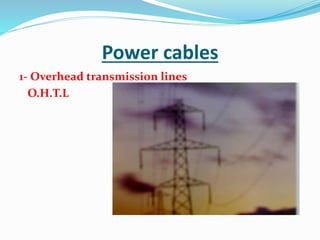
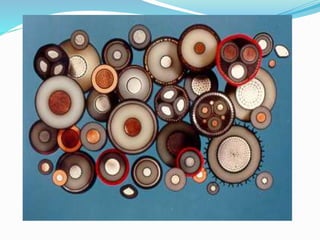
Power cables
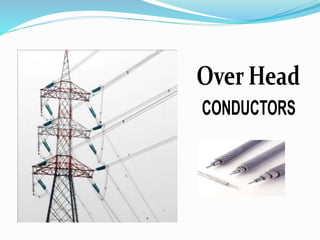
1- Overhead transmission lines
O.H.T.L
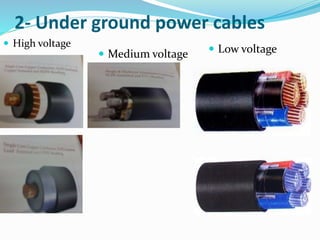
 Low voltage
2- Under ground power cables
 Medium voltage
 High voltage
Types of overhead conductors
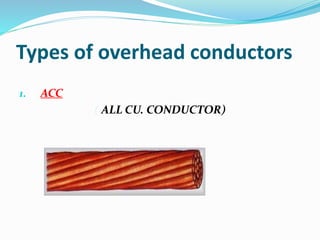
1. ACC
( ALL CU. CONDUCTOR)
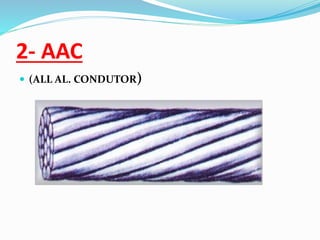
2- AAC
 (ALL AL. CONDUTOR)
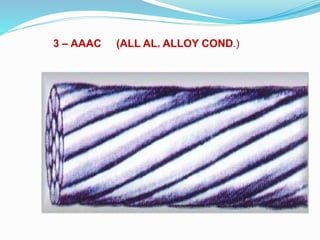
3 – AAAC (ALL AL. ALLOY COND.)
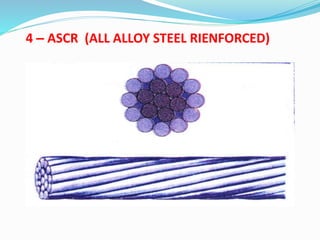
4 – ASCR (ALL ALLOY STEEL RIENFORCED)
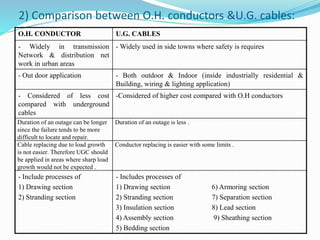
2) Comparison between O.H. conductors &U.G. cables:
O.H. CONDUCTOR U.G. CABLES
- Widely in transmission
Network & distribution net
work in urban areas
- Widely used in side towns where safety is requires
- Out door application - Both outdoor & Indoor (inside industrially residential &
Building, wiring & lighting application)
- Considered of less cost
compared with underground
cables
-Considered of higher cost compared with O.H conductors
Duration of an outage can be longer
since the failure tends to be more
difficult to locate and repair.
Duration of an outage is less .
Cable replacing due to load growth
is not easier. Therefore UGC should
be applied in areas where sharp load
growth would not be expected .
Conductor replacing is easier with some limits .
- Include processes of
1) Drawing section
2) Stranding section
- Includes processes of
1) Drawing section 6) Armoring section
2) Stranding section 7) Separation section
3) Insulation section 8) Lead section
4) Assembly section 9) Sheathing section
5) Bedding section
LOW VOLTAGE
CABLES
Voltage Grades of L.V. Cables:
 300/500 V [Both sheath & non-sheath cable (insulated
wires)]
 450/750 V [non-sheathed cables (insulated wires)]
 600/1000 V or 0.6/1 kV (Sheathed cables)
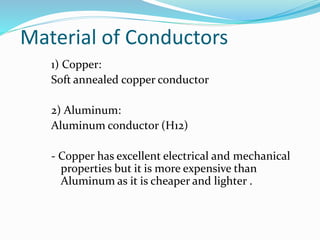
Material of Conductors
1) Copper:
Soft annealed copper conductor
2) Aluminum:
Aluminum conductor (H12)
- Copper has excellent electrical and mechanical
properties but it is more expensive than
Aluminum as it is cheaper and lighter .
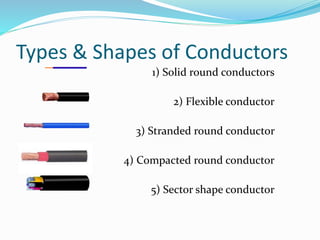
Types & Shapes of Conductors
1) Solid round conductors
2) Flexible conductor
3) Stranded round conductor
4) Compacted round conductor
5) Sector shape conductor
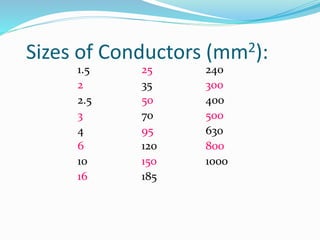
Sizes of Conductors (mm2):
1.5 25 240
2 35 300
2.5 50 400
3 70 500
4 95 630
6 120 800
10 150 1000
16 185
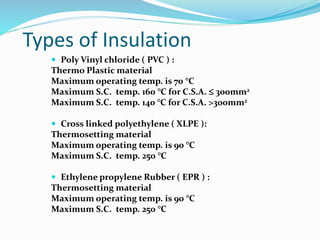
Types of Insulation
 Poly Vinyl chloride ( PVC ) :
Thermo Plastic material
Maximum operating temp. is 70 °C
Maximum S.C. temp. 160 °C for C.S.A.  300mm2
Maximum S.C. temp. 140 °C for C.S.A. >300mm2
 Cross linked polyethylene ( XLPE ):
Thermosetting material
Maximum operating temp. is 90 °C
Maximum S.C. temp. 250 °C
 Ethylene propylene Rubber ( EPR ) :
Thermosetting material
Maximum operating temp. is 90 °C
Maximum S.C. temp. 250 °C
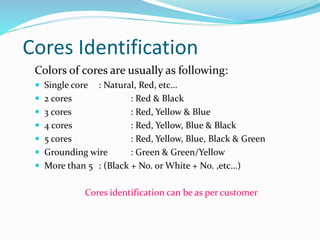
Cores Identification
Colors of cores are usually as following:
 Single core : Natural, Red, etc…
 2 cores : Red & Black
 3 cores : Red, Yellow & Blue
 4 cores : Red, Yellow, Blue & Black
 5 cores : Red, Yellow, Blue, Black & Green
 Grounding wire : Green & Green/Yellow
 More than 5 : (Black + No. or White + No. ,etc…)
Cores identification can be as per customer
Assembly Process
 The insulated cores assembly together with suitable lay
length (right hand).
 Polypropylene filler (if necessary) to fill the space
between cores to make the assembled shape round .
 Then wrapped with suitable tape to form a compact
round cable
Bedding Process
 The main function of the Bedding is to give
mechanical protection for insulation in case of
armored cables only.
 Material :
Extruded poly vinyl chloride ( PVC ) when there is
higher mechanical hazard we use polyethylene ( PE )
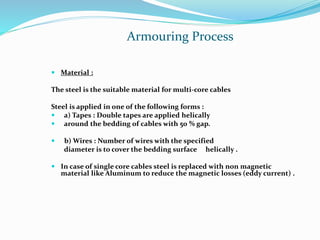
Armouring Process
 The Armouring is used as mechanical
protection for direct burial cables.
 It is used as an earthing conductor in some
Networks .
 Material :
The steel is the suitable material for multi-core cables
Steel is applied in one of the following forms :
 a) Tapes : Double tapes are applied helically
 around the bedding of cables with 50 % gap.
 b) Wires : Number of wires with the specified
diameter is to cover the bedding surface helically .
 In case of single core cables steel is replaced with non magnetic
material like Aluminum to reduce the magnetic losses (eddy current) .
Armouring Process
Sheath Process
 It is outer jacket of the cable , its main function is mechanical
protection.
 Material :
Poly Vinyl Chloride (PVC) , When there is higher mechanical
hazard we can use Polyethylene (PE)
 colour: Black or as per customer requirements
 Special characteristics may be included such as:
Anti-Termite resistant
Oil resistant
Chemical resistant
Acids & Alkaline resistant … etc.
In case of mechanical hazard we can use
polyethylene materials such as
 High Density Polyethylene [HDPE]
 Medium Density Polyethylene [MDPE]
 Linear Low Density Polyethylene [LLDPE]
STANDARDS
 IEC :International Electro technical commission
 BS : British standard institution
 VDE : Verband Deutshcke Electroteche
 NEMA : National Electrical Manufactures association
 UL : Under writer Laboratory
 ICEA : Insulated cable Engineers Association
 HD : Harmonised Document
STANDARDS
 IEC 60227 : Polyvinyl chloride insulated cables of rated voltage up to and
including 450/750 V
 IEC 60228 : Conductors of insulated cables.
 IEC 60502-1 : Cables for rated voltages of 1Kv (( Um =1.2 kV ) and
3 kV (Um =3.6kV)
 BS 6004 : Electric cables - PVC insulated, non-armoured cables for
voltages up to and including 450/750 V, for electric power,
lighting and internal wiring
 BS 7889 : Electric cables - Thermosetting insulated, un-armoured
cables for a voltage of 600/1000 V
 BS 6346 : 600/1000 V and 1900/3300 V armoured electric cables having
PVC insulation.
 BS 5467 : 600/1000 V and 1900/3300 V armoured electric cables having
thermosetting insulation.
SPECIFICATION
 Standard
 Type of conductor
 Size of conductor
 Number of cores
 Description (CU/XLPE/SWA/PVC)
 Customer special requirement

Cable Course.pptx

  • 2.
    Course Scope It coversall types of power cables, from wiring and flexible cables for general use to distribution, and transmission. It includes information on materials, design principles, installation and standards, and it contains extensive tables of data on commonly used cable types.
  • 3.
    Voltage – Current- Resistance
  • 4.
  • 5.
  • 6.
  • 7.
    Voltage :-  Anyelectric equipment is denoted by its operating voltage , cables are denoted as U0/UKV where :_  Uo :- is the rated power frequency voltage between conductor and earth or metallic screen for which cable is designed.  U : is the rated power frequency voltage between conductors for which the cable is designed
  • 8.
     For example: Saying 0.6/1 (1.2) Kv cable means that  Uo (Phase voltage) = 0.6 Kv  U ( Line voltage) = 1 Kv  Cable is defined by its line voltage as when saying 15 kv cables we mean 8.7/15 Kv
  • 9.
    IEC Voltages  45KV  66 KV  110 KV  132 KV  150 KV  220 KV  275 KV  330 KV  400 KV  500KV  0.6/1 KV  1.8/3 KV  3.6/6 KV  6/10 KV  8.7/15 KV  12/20 KV  18/30 KV
  • 10.
    Power cables 1- Overheadtransmission lines O.H.T.L
  • 11.
     Low voltage 2-Under ground power cables  Medium voltage  High voltage
  • 14.
    Types of overheadconductors 1. ACC ( ALL CU. CONDUCTOR)
  • 15.
    2- AAC  (ALLAL. CONDUTOR)
  • 16.
    3 – AAAC(ALL AL. ALLOY COND.)
  • 17.
    4 – ASCR(ALL ALLOY STEEL RIENFORCED)
  • 18.
    2) Comparison betweenO.H. conductors &U.G. cables: O.H. CONDUCTOR U.G. CABLES - Widely in transmission Network & distribution net work in urban areas - Widely used in side towns where safety is requires - Out door application - Both outdoor & Indoor (inside industrially residential & Building, wiring & lighting application) - Considered of less cost compared with underground cables -Considered of higher cost compared with O.H conductors Duration of an outage can be longer since the failure tends to be more difficult to locate and repair. Duration of an outage is less . Cable replacing due to load growth is not easier. Therefore UGC should be applied in areas where sharp load growth would not be expected . Conductor replacing is easier with some limits . - Include processes of 1) Drawing section 2) Stranding section - Includes processes of 1) Drawing section 6) Armoring section 2) Stranding section 7) Separation section 3) Insulation section 8) Lead section 4) Assembly section 9) Sheathing section 5) Bedding section
  • 19.
  • 20.
    Voltage Grades ofL.V. Cables:  300/500 V [Both sheath & non-sheath cable (insulated wires)]  450/750 V [non-sheathed cables (insulated wires)]  600/1000 V or 0.6/1 kV (Sheathed cables)
  • 21.
    Material of Conductors 1)Copper: Soft annealed copper conductor 2) Aluminum: Aluminum conductor (H12) - Copper has excellent electrical and mechanical properties but it is more expensive than Aluminum as it is cheaper and lighter .
  • 22.
    Types & Shapesof Conductors 1) Solid round conductors 2) Flexible conductor 3) Stranded round conductor 4) Compacted round conductor 5) Sector shape conductor
  • 23.
    Sizes of Conductors(mm2): 1.5 25 240 2 35 300 2.5 50 400 3 70 500 4 95 630 6 120 800 10 150 1000 16 185
  • 24.
    Types of Insulation Poly Vinyl chloride ( PVC ) : Thermo Plastic material Maximum operating temp. is 70 °C Maximum S.C. temp. 160 °C for C.S.A.  300mm2 Maximum S.C. temp. 140 °C for C.S.A. >300mm2  Cross linked polyethylene ( XLPE ): Thermosetting material Maximum operating temp. is 90 °C Maximum S.C. temp. 250 °C  Ethylene propylene Rubber ( EPR ) : Thermosetting material Maximum operating temp. is 90 °C Maximum S.C. temp. 250 °C
  • 25.
    Cores Identification Colors ofcores are usually as following:  Single core : Natural, Red, etc…  2 cores : Red & Black  3 cores : Red, Yellow & Blue  4 cores : Red, Yellow, Blue & Black  5 cores : Red, Yellow, Blue, Black & Green  Grounding wire : Green & Green/Yellow  More than 5 : (Black + No. or White + No. ,etc…) Cores identification can be as per customer
  • 26.
    Assembly Process  Theinsulated cores assembly together with suitable lay length (right hand).  Polypropylene filler (if necessary) to fill the space between cores to make the assembled shape round .  Then wrapped with suitable tape to form a compact round cable
  • 27.
    Bedding Process  Themain function of the Bedding is to give mechanical protection for insulation in case of armored cables only.  Material : Extruded poly vinyl chloride ( PVC ) when there is higher mechanical hazard we use polyethylene ( PE )
  • 28.
    Armouring Process  TheArmouring is used as mechanical protection for direct burial cables.  It is used as an earthing conductor in some Networks .
  • 29.
     Material : Thesteel is the suitable material for multi-core cables Steel is applied in one of the following forms :  a) Tapes : Double tapes are applied helically  around the bedding of cables with 50 % gap.  b) Wires : Number of wires with the specified diameter is to cover the bedding surface helically .  In case of single core cables steel is replaced with non magnetic material like Aluminum to reduce the magnetic losses (eddy current) . Armouring Process
  • 30.
    Sheath Process  Itis outer jacket of the cable , its main function is mechanical protection.  Material : Poly Vinyl Chloride (PVC) , When there is higher mechanical hazard we can use Polyethylene (PE)  colour: Black or as per customer requirements  Special characteristics may be included such as: Anti-Termite resistant Oil resistant Chemical resistant Acids & Alkaline resistant … etc.
  • 31.
    In case ofmechanical hazard we can use polyethylene materials such as  High Density Polyethylene [HDPE]  Medium Density Polyethylene [MDPE]  Linear Low Density Polyethylene [LLDPE]
  • 32.
    STANDARDS  IEC :InternationalElectro technical commission  BS : British standard institution  VDE : Verband Deutshcke Electroteche  NEMA : National Electrical Manufactures association  UL : Under writer Laboratory  ICEA : Insulated cable Engineers Association  HD : Harmonised Document
  • 33.
    STANDARDS  IEC 60227: Polyvinyl chloride insulated cables of rated voltage up to and including 450/750 V  IEC 60228 : Conductors of insulated cables.  IEC 60502-1 : Cables for rated voltages of 1Kv (( Um =1.2 kV ) and 3 kV (Um =3.6kV)  BS 6004 : Electric cables - PVC insulated, non-armoured cables for voltages up to and including 450/750 V, for electric power, lighting and internal wiring  BS 7889 : Electric cables - Thermosetting insulated, un-armoured cables for a voltage of 600/1000 V  BS 6346 : 600/1000 V and 1900/3300 V armoured electric cables having PVC insulation.  BS 5467 : 600/1000 V and 1900/3300 V armoured electric cables having thermosetting insulation.
  • 34.
    SPECIFICATION  Standard  Typeof conductor  Size of conductor  Number of cores  Description (CU/XLPE/SWA/PVC)  Customer special requirement

Editor's Notes

  • #4 The drift of electrons within a conductor is known as an electric current, measured in amperes and given the symbol I . For a current to continue to flow, there must be a complete circuit for the electrons to move around. If the circuit is broken by opening a switch, for example, the electron flow and therefore the current will stop immediately. To cause a current to flow continuously around a circuit, a driving force is required, just as a circulating pump is required to drive water around a central heating system. This driving force is the electromotive force (emf). Each time an electron passes through the source of emf, more energy is provided to send it on its way around the circuit. An emf is always associated with energy conversion, such as chemical to electrical in batteries and mechanical to electrical in generators. The energy introduced into the circuit by the emf is transferred to the load terminals by the circuit conductors. The potential difference (p.d.) is the change in energy levels measured across the load terminals. This is also called the volt drop or terminal voltage, since emf and p.d. are both measured in volts. Resistance every circuit offers some opposition to current fl ow, which we call the circuit resistance , measured in ohms (symbol Ω ), to commemorate the famous German physicist Georg Simon Ohm, who was responsible for the analysis of electrical circuits.
  • #5 In 1826, Ohm published details of an experiment he had done to investigate the relationship between the current passing through and the potential difference between the ends of a wire. As a result of this experiment, he arrived at a law, now known as Ohm’s law, which says that the current passing through a conductor under constant temperature conditions is proportional to the potential difference across the conductor.
  • #7 The resistance or opposition to current fl ow varies for different materials, each having a particular constant value. If we know the resistance of, say, 1 m of a material, then the resistance of 5 m will be fi ve times the resistance of 1 m.