Motor Current Signature Analysis
By
Ankit Singh Basera
1
Introduction
2
Introduction
• Electrical Signature Analysis (ESA) concept originates from early 1970s and was first
proposed for use in nuclear power plants for inaccessible motors and motors placed in
hazardous areas
• ESA is useful for analysing not only electrical induction motors, but also generators, power
transformers as well as other electric equipment.
• Most popular of these techniques are: Current Signature Analysis (CSA), Voltage Signature
Analysis (VSA), Extended Park’s Vector Approach (EPVA) and Instantaneous Power
Signature Analysis (IPSA)
3
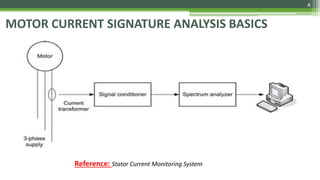
MOTOR CURRENT SIGNATURE ANALYSIS BASICS
Reference: Stator Current Monitoring System
4
MOTOR CURRENT SIGNATURE ANALYSIS BASICS
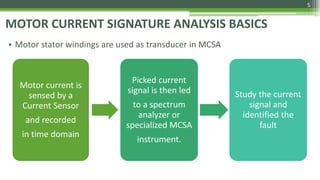
• Motor stator windings are used as transducer in MCSA
Motor current is
sensed by a
Current Sensor
and recorded
in time domain
Picked current
signal is then led
to a spectrum
analyzer or
specialized MCSA
instrument.
Study the current
signal and
identified the
fault
5
Fault Detection Techniques Used in MCSA
1) FAST FOURIER TRANSFORM
2) INSTANTANEOUS POWER FFT
3) WAVELET ANALYSIS
4) PARK’S VECTOR APPROACH
5) ARTIFICIAL INTELLIGENCE
6
Faults That Can Be Detected With MCSA
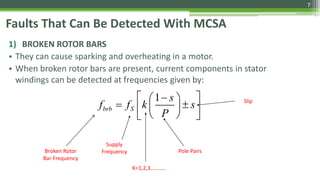
1) BROKEN ROTOR BARS
• They can cause sparking and overheating in a motor.
• When broken rotor bars are present, current components in stator
windings can be detected at frequencies given by:
1
brb S
s
f f k s
P
   
   
  
Broken Rotor
Bar Frequency
Supply
Frequency Pole Pairs
Slip
K=1,2,3………..
7
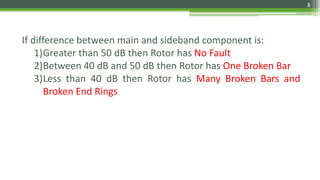
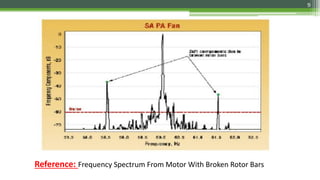
If difference between main and sideband component is:
1)Greater than 50 dB then Rotor has No Fault
2)Between 40 dB and 50 dB then Rotor has One Broken Bar
3)Less than 40 dB then Rotor has Many Broken Bars and
Broken End Rings
8
Reference: Frequency Spectrum From Motor With Broken Rotor Bars
9
Faults That Can Be Detected With MCSA
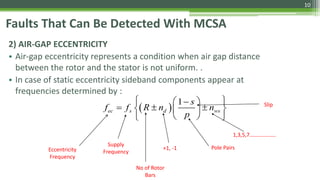
2) AIR-GAP ECCENTRICITY
• Air-gap eccentricity represents a condition when air gap distance
between the rotor and the stator is not uniform. .
• In case of static eccentricity sideband components appear at
frequencies determined by :
Eccentricity
Frequency
Supply
Frequency
Pole Pairs
Slip
No of Rotor
Bars
 
1
ec s d ws
s
f f R n n
p
  
    
  
+1, -1
1,3,5,7……………….
10
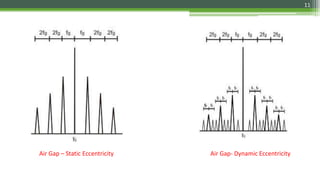
Air Gap – Static Eccentricity Air Gap- Dynamic Eccentricity
11
Faults That Can Be Detected
With MCSA
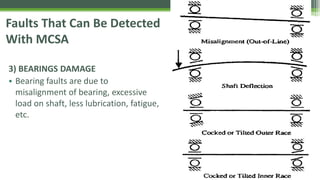
3) BEARINGS DAMAGE
• Bearing faults are due to
misalignment of bearing, excessive
load on shaft, less lubrication, fatigue,
etc.
12
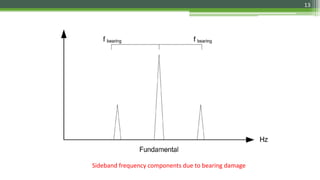
Sideband frequency components due to bearing damage
13
Faults That Can Be Detected With MCSA
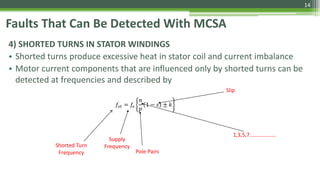
4) SHORTED TURNS IN STATOR WINDINGS
• Shorted turns produce excessive heat in stator coil and current imbalance
• Motor current components that are influenced only by shorted turns can be
detected at frequencies and described by
Shorted Turn
Frequency
Supply
Frequency
Pole Pairs
Slip
1,3,5,7……………….
𝑓𝑠𝑡 = 𝑓𝑠
𝑛
𝑝
1 − 𝑠 ± 𝑘
14

Motor Current Signature Analysis

  • 1.
    Motor Current SignatureAnalysis By Ankit Singh Basera 1
  • 2.
  • 3.
    Introduction • Electrical SignatureAnalysis (ESA) concept originates from early 1970s and was first proposed for use in nuclear power plants for inaccessible motors and motors placed in hazardous areas • ESA is useful for analysing not only electrical induction motors, but also generators, power transformers as well as other electric equipment. • Most popular of these techniques are: Current Signature Analysis (CSA), Voltage Signature Analysis (VSA), Extended Park’s Vector Approach (EPVA) and Instantaneous Power Signature Analysis (IPSA) 3
  • 4.
    MOTOR CURRENT SIGNATUREANALYSIS BASICS Reference: Stator Current Monitoring System 4
  • 5.
    MOTOR CURRENT SIGNATUREANALYSIS BASICS • Motor stator windings are used as transducer in MCSA Motor current is sensed by a Current Sensor and recorded in time domain Picked current signal is then led to a spectrum analyzer or specialized MCSA instrument. Study the current signal and identified the fault 5
  • 6.
    Fault Detection TechniquesUsed in MCSA 1) FAST FOURIER TRANSFORM 2) INSTANTANEOUS POWER FFT 3) WAVELET ANALYSIS 4) PARK’S VECTOR APPROACH 5) ARTIFICIAL INTELLIGENCE 6
  • 7.
    Faults That CanBe Detected With MCSA 1) BROKEN ROTOR BARS • They can cause sparking and overheating in a motor. • When broken rotor bars are present, current components in stator windings can be detected at frequencies given by: 1 brb S s f f k s P            Broken Rotor Bar Frequency Supply Frequency Pole Pairs Slip K=1,2,3……….. 7
  • 8.
    If difference betweenmain and sideband component is: 1)Greater than 50 dB then Rotor has No Fault 2)Between 40 dB and 50 dB then Rotor has One Broken Bar 3)Less than 40 dB then Rotor has Many Broken Bars and Broken End Rings 8
  • 9.
    Reference: Frequency SpectrumFrom Motor With Broken Rotor Bars 9
  • 10.
    Faults That CanBe Detected With MCSA 2) AIR-GAP ECCENTRICITY • Air-gap eccentricity represents a condition when air gap distance between the rotor and the stator is not uniform. . • In case of static eccentricity sideband components appear at frequencies determined by : Eccentricity Frequency Supply Frequency Pole Pairs Slip No of Rotor Bars   1 ec s d ws s f f R n n p            +1, -1 1,3,5,7………………. 10
  • 11.
    Air Gap –Static Eccentricity Air Gap- Dynamic Eccentricity 11
  • 12.
    Faults That CanBe Detected With MCSA 3) BEARINGS DAMAGE • Bearing faults are due to misalignment of bearing, excessive load on shaft, less lubrication, fatigue, etc. 12
  • 13.
    Sideband frequency componentsdue to bearing damage 13
  • 14.
    Faults That CanBe Detected With MCSA 4) SHORTED TURNS IN STATOR WINDINGS • Shorted turns produce excessive heat in stator coil and current imbalance • Motor current components that are influenced only by shorted turns can be detected at frequencies and described by Shorted Turn Frequency Supply Frequency Pole Pairs Slip 1,3,5,7………………. 𝑓𝑠𝑡 = 𝑓𝑠 𝑛 𝑝 1 − 𝑠 ± 𝑘 14