Electrical SafetyElectrical Safety
Prepared by
Vima Mali
Electrical Shock
An electrical shock is experience when a
current flow through the body.
The shock occurs when any part of your
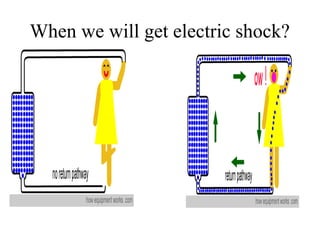
body completes a circuit.
The maximum current that the human body
can withstand for a short time i.e not more
than 25milliseconds for 30mA.
High voltages increase shock injuries
because a higher voltage produces a
greater current.
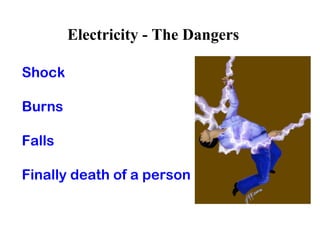
Electricity - The Dangers
Shock
Burns
Falls
Finally death of a person
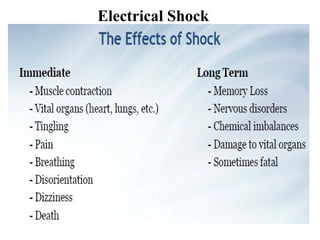
Electrical Shock
The response to electric shock
could range from a faint tingling
sensation to death.
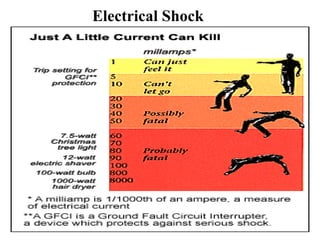
We can perceive a current
as low as 1 milliamp.
At 5 mA you will feel a slight shock. Änd
it is a “let go current”.
Electrical Shock
“Can’t Let Go” Current
10 mA to 30 mA
Painful shock
and sustained
muscle contraction.
Electrical Shock
Electrical Shock
Electrical Shock
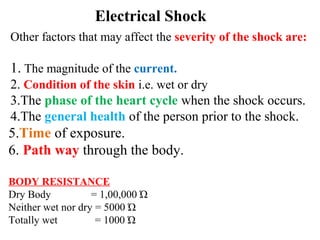
Other factors that may affect the severity of the shock are:
1. The magnitude of the current.
2. Condition of the skin i.e. wet or dry
3.The phase of the heart cycle when the shock occurs.
4.The general health of the person prior to the shock.
5.Time of exposure.
6. Path way through the body.
BODY RESISTANCE
Dry Body = 1,00,000 Ώ
Neither wet nor dry = 5000 Ώ
Totally wet = 1000 Ώ
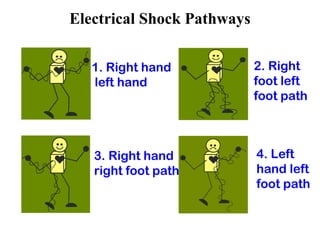
Electrical Shock Pathways
4. Left
hand left
foot path
3. Right hand
right foot path
2. Right
foot left
foot path
1. Right hand
left hand
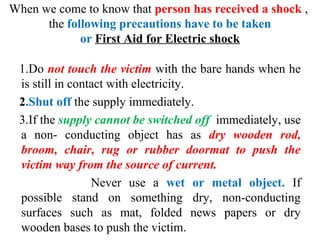
When we come to know that person has received a shock ,
the following precautions have to be taken
or First Aid for Electric shock
1.Do not touch the victim with the bare hands when he
is still in contact with electricity.
2.Shut off the supply immediately.
3.If the supply cannot be switched off immediately, use
a non- conducting object has as dry wooden rod,
broom, chair, rug or rubber doormat to push the
victim way from the source of current.
Never use a wet or metal object. If
possible stand on something dry, non-conducting
surfaces such as mat, folded news papers or dry
wooden bases to push the victim.
4. Once the victim is free, check his breathing pulse. If
they have stopped or dangerously slow, initiate
artificial breathing, threat third degree burns and get
emergency health care.
When breathing is re-established,
treat the victim for shock by elevating the feet and
cover the body with a blanket.
PREVENTION OF SHOCKS (OR) ELECTRICAL
HAZARDS
The following precautions may be take to prevent persons from
getting shocks in the homes:
1. Care must be taken to see that ground points are
properly provided to all the sockets to which electrical
appliances are connected.
2. Proper earthing has to be provided periodically the
earthing resistance has be checked to see that it does not
exceed 3 to 5Ώ.
3. Install ground fault interrupts(GFCIs) in wall outlets
located in bothroom, kitchens, basements, garages and
outdoor boxes.
4. Cover all electrical sockets with plastic safety caps
i.e proper insulation.
5. Replacement of damaged parts immediately.
6. Discouraging the permanent use of extension cords.
7.Completely avoiding spilling of water or chemical
near electrical apparatus.
GROUNDING
(EARTHING)
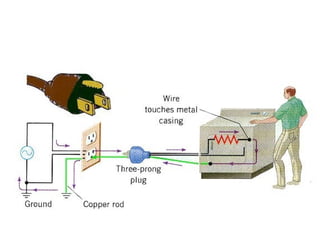
When we will get electric shock?
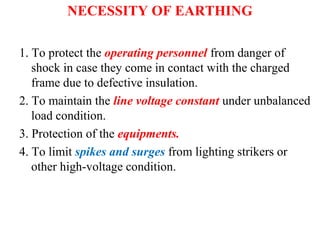
NECESSITY OF EARTHING
1. To protect the operating personnel from danger of
shock in case they come in contact with the charged
frame due to defective insulation.
2. To maintain the line voltage constant under unbalanced
load condition.
3. Protection of the equipments.
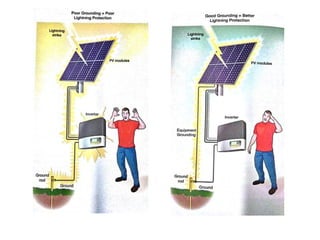
4. To limit spikes and surges from lighting strikers or
other high-voltage condition.
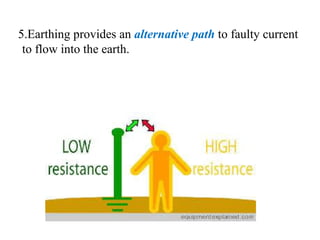
5.Earthing provides an alternative path to faulty current
to flow into the earth.
GROUNDING
The process of connecting the metallic frame (i.e.
non-current carrying part) of electrical equipment or
some electrical part of the system (e.g. neutral point
in a star-connected system, one conductor of the
secondary of a transformer etc.) to earth (i.e. soil) is
called grounding or Earthing.
Grounding or earthing may be classified as:
• Equipment grounding
• System grounding
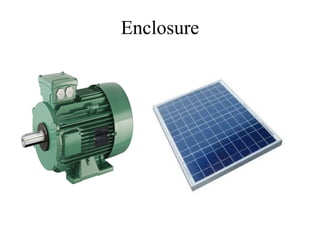
Enclosure
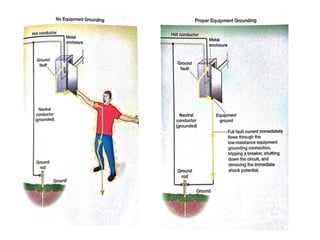
EQUIPMENT GROUNDING
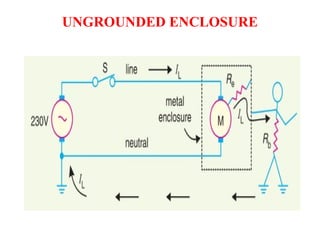
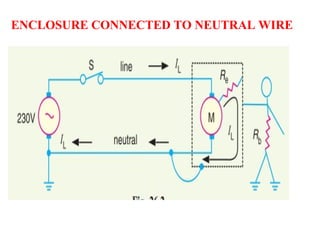
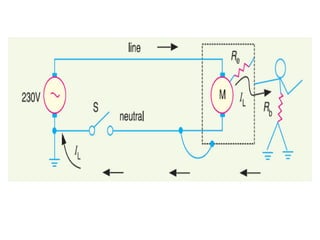
The process of connecting non-current-carrying metal parts
(i.e. metallic enclosure) of the electrical equipment to earth
(i.e. soil) in such a way that in case of insulation failure, the
enclosure effectively remains at earth potential is called
equipment grounding.
(i) Ungrounded enclosure
(ii) Enclosure connected to neutral wire
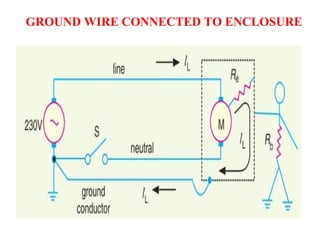
(iii) Ground wire connected to enclosure
There can be three scenarios:
UNGROUNDED ENCLOSURE
ENCLOSURE CONNECTED TO NEUTRAL WIRE
GROUND WIRE CONNECTED TO ENCLOSURE
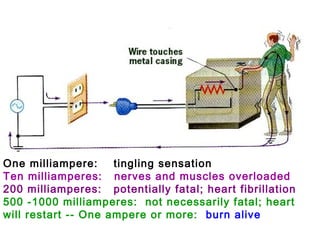
Improperly Grounded Appliance with Short
One milliampere:    tingling sensation
Ten milliamperes:   nerves and muscles overloaded
200 milliamperes:   potentially fatal; heart fibrillation
500 -1000 milliamperes:  not necessarily fatal; heart
will restart -- One ampere or more:  burn alive
Grounded Appliance
                                                           
            
PROTECTIVE DEVICES
 Protection for electrical installation must be provided
in the event of faults such as short circuit, overload
and earth faults.
 The protective circuit or device must be fast acting and
isolate the faulty part of the circuit immediately.
 It also helps in isolating only the required part of the
circuit without affecting the remaining circuit.
PROTECTIVE DEVICES
The following devices are usually used to provide
the necessary protection
1.Fuses
2.Miniature circuit breakers (MCB)
OTHER PROTECTION
1.Earth leakage circuit breakers (ELCB)
2. Relays
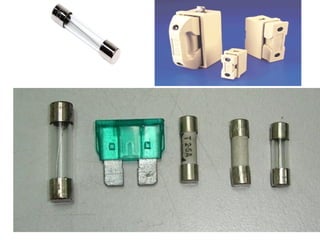
FUSES
 The fuse was invented in the year 1880.
 Fuse is defined as a safety device(simple protective
device) used in any electrical installation, which forms
the weakest link between the supply and the load.
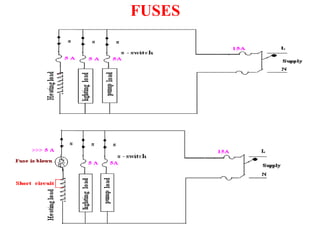
 For interrupting the current in the circuit under overload
or fault conditions.
 It is a short length of wire made of lead / tin /alloy of
lead and tin/ zinc having a low melting point.
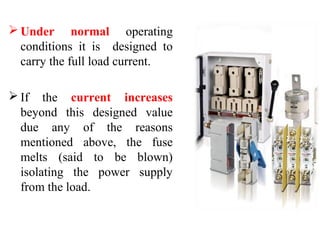
 Under normal operating
conditions it is designed to
carry the full load current.
 If the current increases
beyond this designed value
due any of the reasons
mentioned above, the fuse
melts (said to be blown)
isolating the power supply
from the load.
FUSES
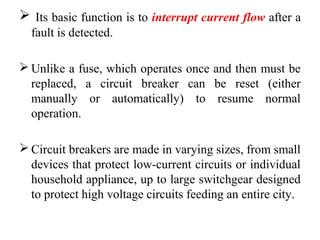
MINIATURE CIRCUIT BREAKER(MCB)
 Nowadays we more commonly use miniature circuit
breaker or MCB in low voltage electrical network instead
of fuse.
 A circuit breaker is an automatically operated electrical
switch designed to protect an electrical circuit from
damage caused by excess current, typically resulting from
an overload or short circuit.
 Its basic function is to interrupt current flow after a
fault is detected.
 Unlike a fuse, which operates once and then must be
replaced, a circuit breaker can be reset (either
manually or automatically) to resume normal
operation.
 Circuit breakers are made in varying sizes, from small
devices that protect low-current circuits or individual
household appliance, up to large switchgear designed
to protect high voltage circuits feeding an entire city.
ADVANTAGES OF MCB
1. It automatically switches off the electrical circuit
during abnormal condition.
2. Another advantage is, as the switch operating knob
comes at its off position during tripping, the faulty
zone of the electrical circuit can be easily be
identified.
But in case of fuse, fuse wire should be
checked by opening fuse grip or cutout from fuse
base, for confirming the blow of fuse wire.
3.Quick restoration of supply can not be possible
in case of fuse as because fuses have to be
rewirable or replaced for restoring the supply.
But in the case of MCB, quick
restoration is possible by just switching on
operation.
EARTH-LEAKAGE CIRCUIT BREAKER(ELCB)
An Earth-leakage circuit breaker (ELCB) is a safety
device used in electrical installations with high Earth
impedance to prevent shock.
It detects small stray voltages on the metal
enclosures of electrical equipment, and interrupts the
circuit if a dangerous voltage is detected.
None of the protection devices like MCB, Fuse
etc. can protect the human life against electric
shocks or avoid fire due to leakage current.
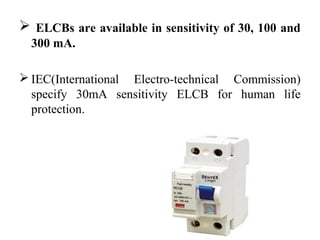
 ELCBs are available in sensitivity of 30, 100 and
300 mA.
 IEC(International Electro-technical Commission)
specify 30mA sensitivity ELCB for human life
protection.
RELAYS
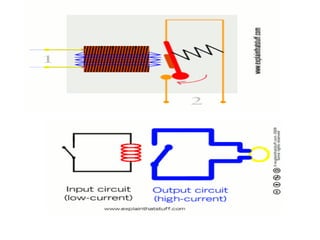
A relay is usually an electromechanical device that is
actuated by an electrical current. The current flowing in
one circuit causes the opening or closing of another
circuit.
The heart of a relay is an electromagnet (a coil of wire
that becomes a temporary magnet when electricity
flows through it).
APPLICATIONS OF RELAYS
In the home, relays are used in refrigerators,
washing machines and dishwashers, and heating
and air-conditioning controls.
MULTIMETER
A multimeter or a multitester is also known as a
VOM (Volt-Ohm-Milliammeter), is an electronic
measuring instrument that combines several
measurement functions in one unit.
USES OF MULTIMETER
1.For measurement of DC current & DC voltages.
2.For measurement of AC current & AC voltages.
3.For measurement of resistance.
4.Time and Frequency measurement.

Electrical safety

  • 1.
  • 2.
    Electrical Shock An electricalshock is experience when a current flow through the body. The shock occurs when any part of your body completes a circuit. The maximum current that the human body can withstand for a short time i.e not more than 25milliseconds for 30mA. High voltages increase shock injuries because a higher voltage produces a greater current.
  • 3.
    Electricity - TheDangers Shock Burns Falls Finally death of a person
  • 4.
    Electrical Shock The responseto electric shock could range from a faint tingling sensation to death. We can perceive a current as low as 1 milliamp. At 5 mA you will feel a slight shock. Änd it is a “let go current”.
  • 5.
    Electrical Shock “Can’t LetGo” Current 10 mA to 30 mA Painful shock and sustained muscle contraction.
  • 6.
  • 7.
  • 8.
    Electrical Shock Other factorsthat may affect the severity of the shock are: 1. The magnitude of the current. 2. Condition of the skin i.e. wet or dry 3.The phase of the heart cycle when the shock occurs. 4.The general health of the person prior to the shock. 5.Time of exposure. 6. Path way through the body. BODY RESISTANCE Dry Body = 1,00,000 Ώ Neither wet nor dry = 5000 Ώ Totally wet = 1000 Ώ
  • 9.
    Electrical Shock Pathways 4.Left hand left foot path 3. Right hand right foot path 2. Right foot left foot path 1. Right hand left hand
  • 10.
    When we cometo know that person has received a shock , the following precautions have to be taken or First Aid for Electric shock 1.Do not touch the victim with the bare hands when he is still in contact with electricity. 2.Shut off the supply immediately. 3.If the supply cannot be switched off immediately, use a non- conducting object has as dry wooden rod, broom, chair, rug or rubber doormat to push the victim way from the source of current. Never use a wet or metal object. If possible stand on something dry, non-conducting surfaces such as mat, folded news papers or dry wooden bases to push the victim.
  • 11.
    4. Once thevictim is free, check his breathing pulse. If they have stopped or dangerously slow, initiate artificial breathing, threat third degree burns and get emergency health care. When breathing is re-established, treat the victim for shock by elevating the feet and cover the body with a blanket.
  • 12.
    PREVENTION OF SHOCKS(OR) ELECTRICAL HAZARDS The following precautions may be take to prevent persons from getting shocks in the homes: 1. Care must be taken to see that ground points are properly provided to all the sockets to which electrical appliances are connected. 2. Proper earthing has to be provided periodically the earthing resistance has be checked to see that it does not exceed 3 to 5Ώ. 3. Install ground fault interrupts(GFCIs) in wall outlets located in bothroom, kitchens, basements, garages and outdoor boxes.
  • 13.
    4. Cover allelectrical sockets with plastic safety caps i.e proper insulation. 5. Replacement of damaged parts immediately. 6. Discouraging the permanent use of extension cords. 7.Completely avoiding spilling of water or chemical near electrical apparatus.
  • 14.
  • 15.
    When we willget electric shock?
  • 16.
    NECESSITY OF EARTHING 1.To protect the operating personnel from danger of shock in case they come in contact with the charged frame due to defective insulation. 2. To maintain the line voltage constant under unbalanced load condition. 3. Protection of the equipments. 4. To limit spikes and surges from lighting strikers or other high-voltage condition.
  • 17.
    5.Earthing provides analternative path to faulty current to flow into the earth.
  • 18.
    GROUNDING The process ofconnecting the metallic frame (i.e. non-current carrying part) of electrical equipment or some electrical part of the system (e.g. neutral point in a star-connected system, one conductor of the secondary of a transformer etc.) to earth (i.e. soil) is called grounding or Earthing. Grounding or earthing may be classified as: • Equipment grounding • System grounding
  • 19.
  • 20.
    EQUIPMENT GROUNDING The processof connecting non-current-carrying metal parts (i.e. metallic enclosure) of the electrical equipment to earth (i.e. soil) in such a way that in case of insulation failure, the enclosure effectively remains at earth potential is called equipment grounding. (i) Ungrounded enclosure (ii) Enclosure connected to neutral wire (iii) Ground wire connected to enclosure There can be three scenarios:
  • 21.
  • 22.
  • 24.
  • 27.
    Improperly Grounded Appliancewith Short One milliampere:    tingling sensation Ten milliamperes:   nerves and muscles overloaded 200 milliamperes:   potentially fatal; heart fibrillation 500 -1000 milliamperes:  not necessarily fatal; heart will restart -- One ampere or more:  burn alive
  • 28.
  • 29.
    PROTECTIVE DEVICES  Protectionfor electrical installation must be provided in the event of faults such as short circuit, overload and earth faults.  The protective circuit or device must be fast acting and isolate the faulty part of the circuit immediately.  It also helps in isolating only the required part of the circuit without affecting the remaining circuit.
  • 30.
    PROTECTIVE DEVICES The followingdevices are usually used to provide the necessary protection 1.Fuses 2.Miniature circuit breakers (MCB) OTHER PROTECTION 1.Earth leakage circuit breakers (ELCB) 2. Relays
  • 32.
    FUSES  The fusewas invented in the year 1880.  Fuse is defined as a safety device(simple protective device) used in any electrical installation, which forms the weakest link between the supply and the load.  For interrupting the current in the circuit under overload or fault conditions.  It is a short length of wire made of lead / tin /alloy of lead and tin/ zinc having a low melting point.
  • 33.
     Under normaloperating conditions it is designed to carry the full load current.  If the current increases beyond this designed value due any of the reasons mentioned above, the fuse melts (said to be blown) isolating the power supply from the load.
  • 34.
  • 35.
  • 36.
    MINIATURE CIRCUIT BREAKER(MCB) Nowadays we more commonly use miniature circuit breaker or MCB in low voltage electrical network instead of fuse.  A circuit breaker is an automatically operated electrical switch designed to protect an electrical circuit from damage caused by excess current, typically resulting from an overload or short circuit.
  • 37.
     Its basicfunction is to interrupt current flow after a fault is detected.  Unlike a fuse, which operates once and then must be replaced, a circuit breaker can be reset (either manually or automatically) to resume normal operation.  Circuit breakers are made in varying sizes, from small devices that protect low-current circuits or individual household appliance, up to large switchgear designed to protect high voltage circuits feeding an entire city.
  • 38.
    ADVANTAGES OF MCB 1.It automatically switches off the electrical circuit during abnormal condition. 2. Another advantage is, as the switch operating knob comes at its off position during tripping, the faulty zone of the electrical circuit can be easily be identified. But in case of fuse, fuse wire should be checked by opening fuse grip or cutout from fuse base, for confirming the blow of fuse wire.
  • 39.
    3.Quick restoration ofsupply can not be possible in case of fuse as because fuses have to be rewirable or replaced for restoring the supply. But in the case of MCB, quick restoration is possible by just switching on operation.
  • 40.
    EARTH-LEAKAGE CIRCUIT BREAKER(ELCB) AnEarth-leakage circuit breaker (ELCB) is a safety device used in electrical installations with high Earth impedance to prevent shock. It detects small stray voltages on the metal enclosures of electrical equipment, and interrupts the circuit if a dangerous voltage is detected. None of the protection devices like MCB, Fuse etc. can protect the human life against electric shocks or avoid fire due to leakage current.
  • 41.
     ELCBs areavailable in sensitivity of 30, 100 and 300 mA.  IEC(International Electro-technical Commission) specify 30mA sensitivity ELCB for human life protection.
  • 42.
    RELAYS A relay isusually an electromechanical device that is actuated by an electrical current. The current flowing in one circuit causes the opening or closing of another circuit. The heart of a relay is an electromagnet (a coil of wire that becomes a temporary magnet when electricity flows through it).
  • 44.
    APPLICATIONS OF RELAYS Inthe home, relays are used in refrigerators, washing machines and dishwashers, and heating and air-conditioning controls.
  • 45.
  • 46.
    A multimeter ora multitester is also known as a VOM (Volt-Ohm-Milliammeter), is an electronic measuring instrument that combines several measurement functions in one unit. USES OF MULTIMETER 1.For measurement of DC current & DC voltages. 2.For measurement of AC current & AC voltages. 3.For measurement of resistance. 4.Time and Frequency measurement.

Editor's Notes

  • #3 Give a common example of each situation.
  • #4 Note that the word electrocution usually means death.
  • #5 Give a common example of each situation.
  • #6 Explain that experienced electricians who sometimes must deal with live wires always use the back of their hands to move the wires. If a current were present, the contracting muscles would cause the hand to pull away from the wire. Demonstrate this with your hand and some object representing a wire.
  • #7 Explain that experienced electricians who sometimes must deal with live wires always use the back of their hands to move the wires. If a current were present, the contracting muscles would cause the hand to pull away from the wire. Demonstrate this with your hand and some object representing a wire.
  • #10 The path of the current will determine which tissue will be damaged. Touch potential, 2. Step potential, 3 and 4 Touch/step potential Discuss the circumstances in which each of these pathways could occur. Ask which could have the most severe results. Explain that this is why it is strongly recommended that people working with exposed parts of electrical machines should work with only one of their hands. The best way to do this is to keep your left hand in your pocket. This is because if both hands make contact with the wrong surfaces, the current flows through the body from one hand to the other. This can lead the current to pass through the heart. If the current passes from one hand to the feet (No. 3), little current will probably pass through the heart.
  • #35 Electrical fires are different than other fires. Because water conducts electricity, throwing water on an electrical fire can cause the fire to get larger and can electrocute you.