 Common Voltages for Residential and
Industrial Applications
◦ 120V, 240V, 480V
 High Voltage – voltages exceeding 600V
 Low Voltage – voltages between 24V – 600V
 Safety Low Voltage – voltages lower than 24V
 The extent of electrical injury is determined by:
◦ Amount of current that passes through your body
◦ The path it takes
◦ The length of time you are in contact with the current
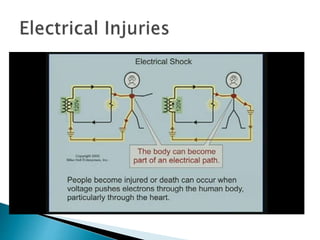
 Electrical shock occurs when your body becomes
part of an electrical circuit
◦ Contact with both the hot (L1&L2) conductors at the
same time
◦ Contacting a current-carrying conductor and ground
◦ Contacting hot equipment body and ground
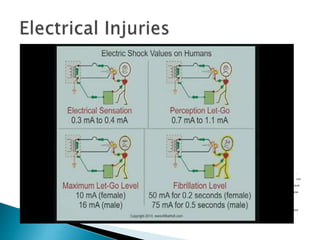
 Effects of electric current through the human
body
 1mA or less – no sensation, not felt
 1-8mA - shock is felt but not painful
 8-15mA - painful shock but muscular
control not lost
 15-20mA - painful, muscular control is lost
 20-50mA - painful, severe muscular
contractions
 50-200mA - possible ventricular
fibrillation,muscular contraction, nerve damage
 Over 200mA - severe burns and severe
muscular contractions
 Shock Current
Path
◦ Why have it a
ground free lines?
 Effects of electric current through the human body
◦ 1mA or less – no sensation, not felt
◦ 1-8mA - shock is felt but not
painful
◦ 8-15mA -
painful shock but muscular control
not
lost
◦ 15-20mA - painful, muscular control
is lost
◦ 20-50mA - painful, severe muscular
contractions
◦ 50-200mA - possible ventricular
fibrillation,
muscular contraction, nerve damage
◦ Over 200mA - severe burns and severe
muscular
contractions
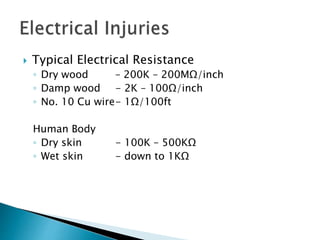
 Typical Electrical Resistance
◦ Dry wood – 200K – 200MΩ/inch
◦ Damp wood - 2K – 100Ω/inch
◦ No. 10 Cu wire- 1Ω/100ft
Human Body
◦ Dry skin - 100K – 500KΩ
◦ Wet skin - down to 1KΩ
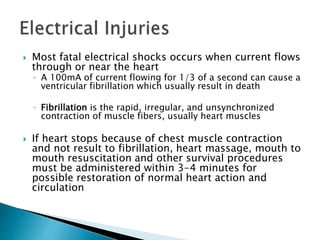
 Most fatal electrical shocks occurs when current flows
through or near the heart
◦ A 100mA of current flowing for 1/3 of a second can cause a
ventricular fibrillation which usually result in death
◦ Fibrillation is the rapid, irregular, and unsynchronized
contraction of muscle fibers, usually heart muscles
 If heart stops because of chest muscle contraction
and not result to fibrillation, heart massage, mouth to
mouth resuscitation and other survival procedures
must be administered within 3-4 minutes for
possible restoration of normal heart action and
circulation
 Effects of non-lethal amounts of current
passing through the body
◦ Mild tingling sensation
◦ Severe pain
◦ Muscle contraction
◦ Burns
◦ Internal hemorrhage – internal bleeding
◦ Respiratory problems
◦ Secondary accidents – mauntog dahil sa gulat
 Rescue and first aid measures:
◦ Do not touch the victim when while he is still in
contact with the current.
◦ Shut-off power or push the victim with a dry non
conductive material
◦ Call medical assistance immediately
 Avoid contact with energized circuits.
◦ Insulate / isolate current carrying parts of an electric
tool/equipment by rubber or plastic
◦ Wires with damaged insulation should be replaced. For
temporary repair, wrapped with electrical tape
◦ Shut-off power/de-energized circuit involve during
maintenance, repair, set-up or any servicing done on
electrically powered devices
◦ Since it may not always possible to de-energize all nearby
circuits, you should know which circuit is energized and not
before starting the job. If possible, place a rubber/plastic
shield over around exposed energized parts.
◦ Make sure you know what is behind/under the material you
are drilling or cutting with a power tool. Consult an
electrical blue print to verify or consult electrical
department to be sure no wiring is near where you must
drill/cut.
 Electrical circuits are designed to operate below or at the
maximum rated current levels
◦ Overcurrent condition – when the maximum current of the circuit
is exceeded by overloading the circuit or having a short circuit
between two live conductors
 Fuses and Circuit Breakers – safety devices used for
overcurrent protection. They open the circuit once
overloads and short circuit occurs.
◦ Blown fuse / tripped circuit breaker indicates overcurrent occurs
and something is wrong in the circuit.
◦ Do not attemp to re-energize circuit unless the problem is
corrected
◦ Electrical problem correction should be done only by a trained
personnel
◦ Fuses and circuit breakers are not protection for shocks because
they only react at the current above its rating, and they do not
react quickly enough.
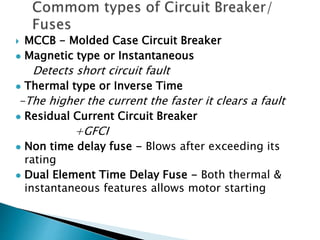
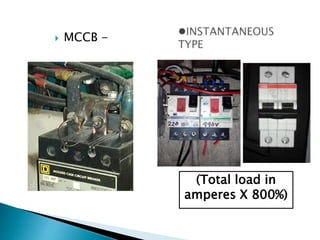
 MCCB - Molded Case Circuit Breaker
 Magnetic type or Instantaneous
Detects short circuit fault
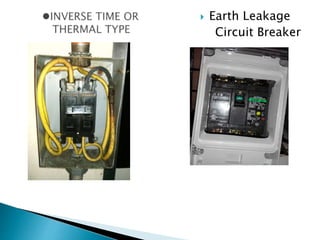
 Thermal type or Inverse Time
-The higher the current the faster it clears a fault
 Residual Current Circuit Breaker
+GFCI
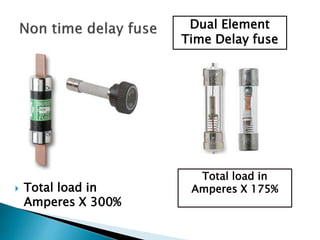
 Non time delay fuse - Blows after exceeding its
rating
 Dual Element Time Delay Fuse - Both thermal &
instantaneous features allows motor starting
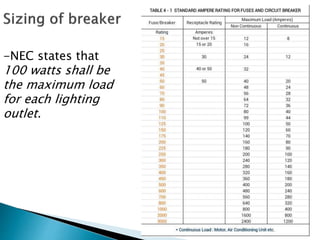
 MCCB -
(Total load in
amperes X 800%)
 Earth Leakage
Circuit Breaker
 Total load in
Amperes X 300%
Dual Element
Time Delay fuse
Total load in
Amperes X 175%
-NEC states that
100 watts shall be
the maximum load
for each lighting
outlet.
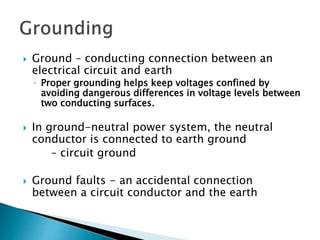
 Ground – conducting connection between an
electrical circuit and earth
◦ Proper grounding helps keep voltages confined by
avoiding dangerous differences in voltage levels between
two conducting surfaces.
 In ground-neutral power system, the neutral
conductor is connected to earth ground
– circuit ground
 Ground faults - an accidental connection
between a circuit conductor and the earth
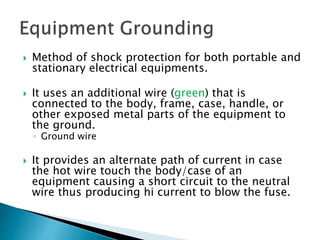
 Method of shock protection for both portable and
stationary electrical equipments.
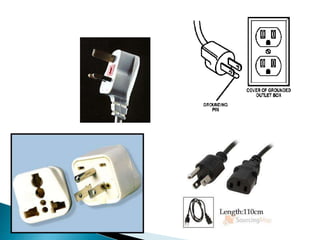
 It uses an additional wire (green) that is
connected to the body, frame, case, handle, or
other exposed metal parts of the equipment to
the ground.
◦ Ground wire
 It provides an alternate path of current in case
the hot wire touch the body/case of an
equipment causing a short circuit to the neutral
wire thus producing hi current to blow the fuse.
 GROUND FAULT CIRCUIT INTERRUPTER (GFCI)
◦ Detects an imbalance current between
hot and neutral conductor.
When imbalance occurs, it immediately
opens the circuit before the fault current
can reach the hazardous level
◦ Reacts only to ground faults but
not to short circuit.
 Flammable materials and explosive
atmosphere exist.
◦ Wirings are explosion proof
◦ Uses safety low voltage (24V and below)
◦ Equipments are explosion proof capable of
containing an explosion within itself
 Should always have equipment grounding
 Usually uses double insulation
◦ Additional, independent insulation
◦ Plastic housing / inner lining with metal exteriors
 Consider all electrical circuits ENERGIZED
AND DANGEROUS until you are certain you
are not.
 Check your work area for wet surfaces
 Do not wear rings, watches and other metal
jewelry items when working near electrical
circuits
 Do not use metal ladders or uninsulated
metal tools and hand lamps
 Use only EXPLOSION PROOF tools, lamps, and
equipments in hazardous locations
 Shut off and lock out power before repairing a
circuit, either electrical or mechanical repair near
energized circuit
 Examine all electrical tools and equipments for
any signs of damage or deterioration
 Do not energize or deenergize any electrical
circuits unless:
◦ You are authorized to do so
◦ You are familiar with the circuit controls and you know
what is connected in the circuit.
◦ All other workers are in danger unless they have been
specifically notified when power is about to be turned
on/off.
 System ground resistance - from all neutral points to
earth ground
◦ Not exceeding 25 ohms
◦ Should be check annually
 Equipment ground resistance - from all exposed
non-current-carrying metal parts to earth ground
◦ Not exceeding 25 ohms
◦ Should be check annually
 Insulation resistance between two hot conductor
◦ 50 Mega ohms
 Insulation resistance between hot and neutral
conductor, and hot and green conductor
◦ 50 Mega ohms
 GFCI
◦ Should be check also annually for good operation
◦ Test button is pressed and reset when functioning properly.
 Service Entrance
◦ Check the voltage, conductors, insulation, terminations, to assure
they there are no cracks, burns, or any sign of damage
 Distribution panel
◦ Check circuit breaker for any build up of dirt or surface
contamination
◦ Check circuit breakers for crack terminals
◦ Exercise circuit breakers by performing several operation on
switch handle
◦ Check fuse terminals, and holder for discoloration caused by heat.

ELECTRICAL SAFETY for Electrical practitioner.pptx

  • 2.
     Common Voltagesfor Residential and Industrial Applications ◦ 120V, 240V, 480V  High Voltage – voltages exceeding 600V  Low Voltage – voltages between 24V – 600V  Safety Low Voltage – voltages lower than 24V
  • 3.
     The extentof electrical injury is determined by: ◦ Amount of current that passes through your body ◦ The path it takes ◦ The length of time you are in contact with the current  Electrical shock occurs when your body becomes part of an electrical circuit ◦ Contact with both the hot (L1&L2) conductors at the same time ◦ Contacting a current-carrying conductor and ground ◦ Contacting hot equipment body and ground
  • 4.
     Effects ofelectric current through the human body  1mA or less – no sensation, not felt  1-8mA - shock is felt but not painful  8-15mA - painful shock but muscular control not lost  15-20mA - painful, muscular control is lost  20-50mA - painful, severe muscular contractions  50-200mA - possible ventricular fibrillation,muscular contraction, nerve damage  Over 200mA - severe burns and severe muscular contractions
  • 5.
     Shock Current Path ◦Why have it a ground free lines?
  • 6.
     Effects ofelectric current through the human body ◦ 1mA or less – no sensation, not felt ◦ 1-8mA - shock is felt but not painful ◦ 8-15mA - painful shock but muscular control not lost ◦ 15-20mA - painful, muscular control is lost ◦ 20-50mA - painful, severe muscular contractions ◦ 50-200mA - possible ventricular fibrillation, muscular contraction, nerve damage ◦ Over 200mA - severe burns and severe muscular contractions
  • 7.
     Typical ElectricalResistance ◦ Dry wood – 200K – 200MΩ/inch ◦ Damp wood - 2K – 100Ω/inch ◦ No. 10 Cu wire- 1Ω/100ft Human Body ◦ Dry skin - 100K – 500KΩ ◦ Wet skin - down to 1KΩ
  • 8.
     Most fatalelectrical shocks occurs when current flows through or near the heart ◦ A 100mA of current flowing for 1/3 of a second can cause a ventricular fibrillation which usually result in death ◦ Fibrillation is the rapid, irregular, and unsynchronized contraction of muscle fibers, usually heart muscles  If heart stops because of chest muscle contraction and not result to fibrillation, heart massage, mouth to mouth resuscitation and other survival procedures must be administered within 3-4 minutes for possible restoration of normal heart action and circulation
  • 10.
     Effects ofnon-lethal amounts of current passing through the body ◦ Mild tingling sensation ◦ Severe pain ◦ Muscle contraction ◦ Burns ◦ Internal hemorrhage – internal bleeding ◦ Respiratory problems ◦ Secondary accidents – mauntog dahil sa gulat
  • 11.
     Rescue andfirst aid measures: ◦ Do not touch the victim when while he is still in contact with the current. ◦ Shut-off power or push the victim with a dry non conductive material ◦ Call medical assistance immediately
  • 12.
     Avoid contactwith energized circuits. ◦ Insulate / isolate current carrying parts of an electric tool/equipment by rubber or plastic ◦ Wires with damaged insulation should be replaced. For temporary repair, wrapped with electrical tape ◦ Shut-off power/de-energized circuit involve during maintenance, repair, set-up or any servicing done on electrically powered devices ◦ Since it may not always possible to de-energize all nearby circuits, you should know which circuit is energized and not before starting the job. If possible, place a rubber/plastic shield over around exposed energized parts. ◦ Make sure you know what is behind/under the material you are drilling or cutting with a power tool. Consult an electrical blue print to verify or consult electrical department to be sure no wiring is near where you must drill/cut.
  • 13.
     Electrical circuitsare designed to operate below or at the maximum rated current levels ◦ Overcurrent condition – when the maximum current of the circuit is exceeded by overloading the circuit or having a short circuit between two live conductors  Fuses and Circuit Breakers – safety devices used for overcurrent protection. They open the circuit once overloads and short circuit occurs. ◦ Blown fuse / tripped circuit breaker indicates overcurrent occurs and something is wrong in the circuit. ◦ Do not attemp to re-energize circuit unless the problem is corrected ◦ Electrical problem correction should be done only by a trained personnel ◦ Fuses and circuit breakers are not protection for shocks because they only react at the current above its rating, and they do not react quickly enough.
  • 14.
     MCCB -Molded Case Circuit Breaker  Magnetic type or Instantaneous Detects short circuit fault  Thermal type or Inverse Time -The higher the current the faster it clears a fault  Residual Current Circuit Breaker +GFCI  Non time delay fuse - Blows after exceeding its rating  Dual Element Time Delay Fuse - Both thermal & instantaneous features allows motor starting
  • 15.
     MCCB - (Totalload in amperes X 800%)
  • 16.
  • 17.
     Total loadin Amperes X 300% Dual Element Time Delay fuse Total load in Amperes X 175%
  • 18.
    -NEC states that 100watts shall be the maximum load for each lighting outlet.
  • 19.
     Ground –conducting connection between an electrical circuit and earth ◦ Proper grounding helps keep voltages confined by avoiding dangerous differences in voltage levels between two conducting surfaces.  In ground-neutral power system, the neutral conductor is connected to earth ground – circuit ground  Ground faults - an accidental connection between a circuit conductor and the earth
  • 20.
     Method ofshock protection for both portable and stationary electrical equipments.  It uses an additional wire (green) that is connected to the body, frame, case, handle, or other exposed metal parts of the equipment to the ground. ◦ Ground wire  It provides an alternate path of current in case the hot wire touch the body/case of an equipment causing a short circuit to the neutral wire thus producing hi current to blow the fuse.
  • 22.
     GROUND FAULTCIRCUIT INTERRUPTER (GFCI) ◦ Detects an imbalance current between hot and neutral conductor. When imbalance occurs, it immediately opens the circuit before the fault current can reach the hazardous level ◦ Reacts only to ground faults but not to short circuit.
  • 23.
     Flammable materialsand explosive atmosphere exist. ◦ Wirings are explosion proof ◦ Uses safety low voltage (24V and below) ◦ Equipments are explosion proof capable of containing an explosion within itself
  • 24.
     Should alwayshave equipment grounding  Usually uses double insulation ◦ Additional, independent insulation ◦ Plastic housing / inner lining with metal exteriors
  • 25.
     Consider allelectrical circuits ENERGIZED AND DANGEROUS until you are certain you are not.  Check your work area for wet surfaces  Do not wear rings, watches and other metal jewelry items when working near electrical circuits  Do not use metal ladders or uninsulated metal tools and hand lamps  Use only EXPLOSION PROOF tools, lamps, and equipments in hazardous locations
  • 26.
     Shut offand lock out power before repairing a circuit, either electrical or mechanical repair near energized circuit  Examine all electrical tools and equipments for any signs of damage or deterioration  Do not energize or deenergize any electrical circuits unless: ◦ You are authorized to do so ◦ You are familiar with the circuit controls and you know what is connected in the circuit. ◦ All other workers are in danger unless they have been specifically notified when power is about to be turned on/off.
  • 27.
     System groundresistance - from all neutral points to earth ground ◦ Not exceeding 25 ohms ◦ Should be check annually  Equipment ground resistance - from all exposed non-current-carrying metal parts to earth ground ◦ Not exceeding 25 ohms ◦ Should be check annually  Insulation resistance between two hot conductor ◦ 50 Mega ohms  Insulation resistance between hot and neutral conductor, and hot and green conductor ◦ 50 Mega ohms
  • 28.
     GFCI ◦ Shouldbe check also annually for good operation ◦ Test button is pressed and reset when functioning properly.  Service Entrance ◦ Check the voltage, conductors, insulation, terminations, to assure they there are no cracks, burns, or any sign of damage  Distribution panel ◦ Check circuit breaker for any build up of dirt or surface contamination ◦ Check circuit breakers for crack terminals ◦ Exercise circuit breakers by performing several operation on switch handle ◦ Check fuse terminals, and holder for discoloration caused by heat.