Electrical Safety AwarenessTraining 2
Principles:
1. This training is to inform all participants of the
potential hazards of working with or near
energized electrical equipment.
2. This is basic information, provided to keep
employees safe.
3. The focus is on recognizing, avoiding and
reporting electrical hazards.
“Basic Electrical Safety Training”
3.
Electrical Safety AwarenessTraining 3
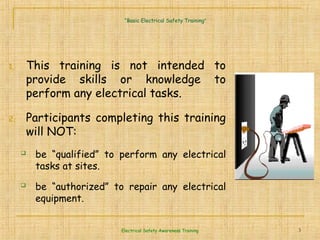
1. This training is not intended to
provide skills or knowledge to
perform any electrical tasks.
2. Participants completing this training
will NOT:
be “qualified” to perform any electrical
tasks at sites.
be “authorized” to repair any electrical
equipment.
“Basic Electrical Safety Training”
4.
Electrical Safety AwarenessTraining 4
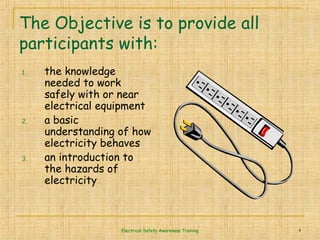
The Objective is to provide all
participants with:
1. the knowledge
needed to work
safely with or near
electrical equipment
2. a basic
understanding of how
electricity behaves
3. an introduction to
the hazards of
electricity
5.
Electrical Safety AwarenessTraining 5
Participants completing this
training will be able to:
1. Recognize real or
potential electrical
hazards
2. Avoid personal injury
and prevent others from
being injured
3. Report emergencies and
unsafe electrical
conditions
Electrical Safety AwarenessTraining 7
Electricity Is All Around Us
We all use electrical
devices every day.
Some may present
safety hazards.
To be safe, we must
properly handle all
electrical devices.
8.
Electrical Safety AwarenessTraining 8
Conductor: Anything through which electrical current
can flow easily; water, metal, the earth,
the human body
Insulator: Non-conductors, things that resist the flow of
electrical current; dry wood, glass, ceramic, dry
concrete, fiberglass
Basic Electrical Terms
9.
Electrical Safety AwarenessTraining 9
How Electricity Behaves
Voltage does not flow, only
current flows.
Voltage pushes Current flows
10.
Electrical Safety AwarenessTraining 10
Current cannot flow unless there is a complete
circuit (return path) to the power source.
How Electricity Behaves
Gen
switch
Gen
switch
Switch is open Switch is closed
e
e
11.
Electrical Safety AwarenessTraining 11
If more than one path is present,
the current will divide itself among
the paths.
How Electricity Behaves
Gen
e e
12.
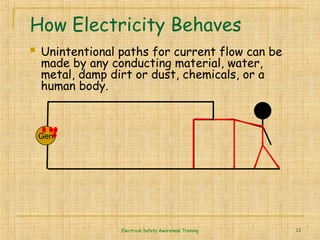
Electrical Safety AwarenessTraining 12
Unintentional paths for current flow can be
made by any conducting material, water,
metal, damp dirt or dust, chemicals, or a
human body.
How Electricity Behaves
Gen
e e e
e
13.
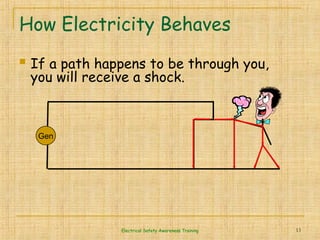
Electrical Safety AwarenessTraining 13
How Electricity Behaves
If a path happens to be through you,
you will receive a shock.
Gen
Electrical Safety AwarenessTraining 15
Shock Hazard
An electric shock is electrical
current flowing through the body.
Electrical current always follows the
path of least resistance. In the body
that is:
Blood vessels, nerves, heart, kidneys,
brain, etc.
Shocks can cause internal burns,
tissue and organ damage.
16.
Electrical Safety AwarenessTraining 16
Have you ever been shocked?
If so, the sensation you felt was current flow
17.
Electrical Safety AwarenessTraining 17
1. Approved Devices
Using only “approved” devices.
UL in the USA
CSA in Canada
CE in the EU
Most countries have similar rating
organizations
Preventing Electrical Shocks
18.
Electrical Safety AwarenessTraining 18
2. Good Working Order
Use only electrical equipment or
devices that are in “good” condition.
Clean & Dry
Water contributes to many electrical shock
incidents
Intact, no cracks or holes in the case
Power cord is in good condition
No worn spots or cracked insulation
Regularly inspected
19.
Electrical Safety AwarenessTraining 19
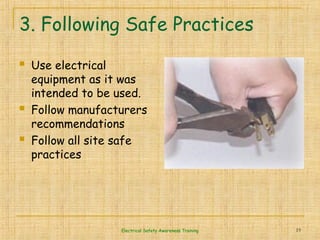
3. Following Safe Practices
Use electrical
equipment as it was
intended to be used.
Follow manufacturers
recommendations
Follow all site safe
practices
20.
Electrical Safety AwarenessTraining 20
4. Avoid and Report Hazards
If you encounter an electrical hazard:
1. Stay away from the hazard
2. Take steps to keep others away
3. Report the hazard
21.
Electrical Safety AwarenessTraining 21
21
Grounding
Grounding creates a low-
resistance path from a tool
to the earth to disperse
unwanted current.
When a short or lightning
occurs, energy flows to the
ground, protecting you from
electrical shock, injury and
death.
22.
Electrical Safety AwarenessTraining 22
Call for help immediately.
Stand by to warn others.
Do not touch or approach!
Do not become an additional
casualty!
Wait for qualified personnel
to arrive.
Responding to an Electrical Emergency
If you encounter a person who appears injured or
unconscious, and may be in contact with an electrical
circuit:
23.
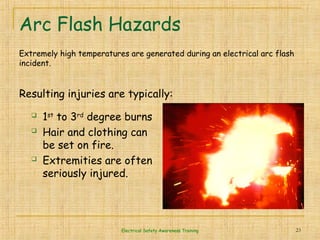
Electrical Safety AwarenessTraining 23
Arc Flash Hazards
1st
to 3rd
degree burns
Hair and clothing can
be set on fire.
Extremities are often
seriously injured.
Extremely high temperatures are generated during an electrical arc flash
incident.
Resulting injuries are typically:
24.
Electrical Safety AwarenessTraining 24
Blast Hazard
If a severe electrical arc fault
occurs, there is a risk of Blast as
well as Flash.
Extreme heat is generated very
quickly during such an event, and
the rapidly expanding gases can
create an explosion.
The pressure wave can be strong
enough to knock people down and
destroy equipment.
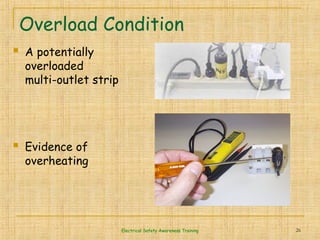
Electrical Safety AwarenessTraining 26
Overload Condition
A potentially
overloaded
multi-outlet strip
Evidence of
overheating
27.
Electrical Safety AwarenessTraining 27
Damaged Power Cords
Worn or cut cords
Ungrounded power
cords
Careless routing of
power cords that
could lead to damage
28.
Electrical Safety AwarenessTraining 28
Moisture Hazards
Power cords and
cord connections
must be kept dry.
29.
Electrical Safety AwarenessTraining 29
Exposed Equipment
MCC compartments
must not be left
open
Holes from removed
conduits must be
closed.
30.
Electrical Safety AwarenessTraining 30
“Temporary Wiring” Violates the
National Electrical Code
“The code does not authorize
temporary violations of the code.”
Electrical Safety AwarenessTraining 32
Electrical Protective Devices
Fuses & Circuit Breakers
Fuses and circuit breakers are over-current
devices
When there is too much current:
Fuses melt
Circuit breakers trip open
33.
Electrical Safety AwarenessTraining 33
Ground Fault Circuit Interrupters
GFCI’s must be
used to insure
that workers
using portable
tools are fully
protected from
shock hazards.
34.
Electrical Safety AwarenessTraining 40
Birds on a Wire
“Why don’t these birds
get shocked?”
They are contacting
only one wire
(and not ground)
There is no return
path to the source
Electrical Safety AwarenessTraining 42
Summary
How do we stay
safe?
1. Recognize hazards
2. Avoid hazards
3. Report hazards
Editor's Notes
#4 By “with” we mean operate devices or equipment that use electrical power.
#6 In the previous slide we clarified that the Earth or Ground is part of the circuit path for most electrical services.
These bird are contacting the voltage, but are not experiencing an current flow.
“Voltage does not flow, current flows.” Current is what you feel when you’re shocked.
#8 Voltage does not flow.
Impedance is the total opposition to current flow in A.C. Circuits.
Short circuits usually cause the circuit protective device (fuse or CB) to open
#9 To be safe, electrical devices and equipment must be kept clean and dry. Water, chemicals, dust and dirt in electrical devices can cause early failure, shock hazards, fires and explosions.
#10 To be safe, electrical devices and equipment must be kept clean and dry. Water, chemicals, dust and dirt in electrical devices can cause early failure, shock hazards, fires and explosions.
#11 To be safe, electrical devices and equipment must be kept clean and dry. Water, chemicals, dust and dirt in electrical devices can cause early failure, shock hazards, fires and explosions.
#12 To be safe, electrical devices and equipment must be kept clean and dry. Water, chemicals, dust and dirt in electrical devices can cause early failure, shock hazards, fires and explosions.
#13 To be safe, electrical devices and equipment must be kept clean and dry. Water, chemicals, dust and dirt in electrical devices can cause early failure, shock hazards, fires and explosions.
#14 We will explain each of these hazards in turn.
#15 Electrical shocks result whenever a person becomes part of an electrical circuit. The effect of the shock is relative to the actual current that flowed through the person, the time duration of the shock, and the path through the persons body that the current followed.
#17 Approved devices are those that carry the approval of a legally recognized testing laboratory.
COUNTRY-NATIONAL CERTIFICATION BODIES Austria OVE, Australia QAS, Belgium CEBEC, Canada CSA Inter. ULC, China CCEE, Czech Republic EZU, Denmark DEMKO, Finland FIMKO, France LCIE, Germany VDETUV, RhTUV, Greece ELOT, Hungary MEEI, India BISSTQC, Ireland NSAI, Israel SII, Italy IMQ S.p.A., Japan IECEE-JP JETJQATUVRh JP, Korea IECEE-KR, Netherlands KEMA, Norway NEMKO, Poland PCBCBBJ-SEPPREDOM-OBR, Russian Federation GOST Re, Singapore PSB, Slovakia EVPU, Slovenia SIQ, South Africa SABS, Spain AENOR, Sweden SEMKO, Switzerland SEV, Turkey TSE, United Kingdom BEABBSIASTA.
#18 Power tools and portable appliances must be inspected and tested on a regular basis.
#19 This person is deliberately removing the ground prong from a plug. This should never be done!
Unqualified persons have done this in years past to allow connecting to a two prong receptacle.
Ungrounded two prong receptacles have been code violations for over 25 years, and are only found in the oldest of buildings.
Today, unqualified persons do this to operate faulty equipment without tripping GFCI’s.
#20 Notify the department that owns the equipment.
Notify the ESO or a safety resource.
#21 Notify the department that owns the equipment.
Notify the ESO or a safety resource.
#22 How do you report emergencies at this site? What number do you call?
Do you have an in house response team?
#23 Arc Flashes occur when there is a phase to ground or phase to phase fault. These usually last only a few milli-seconds, but generate extreme heat. The flash intensity is relative to the AFI (available fault current). Faults in small branch receptacle circuits will usually generate sparks and a flash, the fault pictured is typical of the energy level found in a common 480V industrial Motor Control Center. Note that this photo shows both flash and blast. This is the hazard level that LVQ technicians are trained to avoid and protect themselves from.
#24 Note in the photo that the left and right sides of the box are bent outward. This box experienced an arc flash and blast fault that deformed the walls and literally blew the door off it’s hinges. The operator’s hand was severely broken in the incident.
#26 Overloaded cords will overheat and can cause fires. Connecting too many devices to an extension cord or receptacle can cause overloading. Causing more current to flow than a cord or circuit is designed to carry or supply, will cause an overload condition. Even slight overloading over a period of time can cause similar damage.
#31 Not only improperly, but illegally stored. The yellow lines mark a storage free area, NOT a storage area.
#32 Not only improperly, but illegally stored. The yellow lines mark a storage free area, NOT a storage area.
#40 In the previous slide we clarified that the Earth or Ground is part of the circuit path for most electrical services.
These bird are contacting the voltage, but are not experiencing an current flow.
“Voltage does not flow, current flows.” Current is what you feel when you’re shocked.
#41 In the previous slide we clarified that the Earth or Ground is part of the circuit path for most electrical services.
These bird are contacting the voltage, but are not experiencing an current flow.
“Voltage does not flow, current flows.” Current is what you feel when you’re shocked.