

Presented By:
K.Shamili
1702-13-886-005
Department Of Pharmaceutics
Under The Guidance Of:
Dr.Jagadeesh Induru M.Pharm ,M.B.A, PhD
Mrs. Tripti Suxena M.Pharm
1
2
Introduction
Types of current
Dangers of electricity to the living tissue
Electric shock
Conditions that effect the shock
Saving the electrified person
Protection against electrical hazards
Electric hazard control
Things to be avoided
Safety measures
Regular safety Inspection
References
An electrical hazard can be defined as
- adangerouscondition whereaworker could makeelectrical contact
with energized equipment or aconductor, and from which theperson
may sustain an injury from shock
Thelaw requiressafework practices. Under
theOccupational Health and Safety Act
and Regulationsfor Construction Projects,
employers, supervisors, and workerseach
havelegal responsibilitiesto ensurethat work
isbeing carried out in asafemanner.
3
Electrical hazards are caused by
❑ Theimproper useof machinery or apparatus
❑ Theimproper useof electrical outlets
❑ Theimproper useof electrical equipment, such ascablesand power
cords
❑ Theimproper maintenanceof apparatus, outlets, and electrical
equipment
Basically, electrical hazards can be categorized into three
types. Thefirst and most commonly recognized hazard iselectrical
shock. Thesecond typeof hazard iselectrical burnsand the third is
theeffectsof blastswhich includepressureimpact, flying particles
from vaporized conductors
4
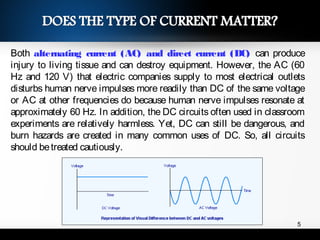
Both alternating current (AC) and direct current (DC) can produce
injury to living tissue and can destroy equipment. However, the AC (60
Hz and 120 V) that electric companies supply to most electrical outlets
disturbs human nerve impulses more readily than DC of the same voltage
or AC at other frequencies do because human nerve impulses resonate at
approximately 60 Hz. In addition, the DC circuits often used in classroom
experiments are relatively harmless. Yet, DC can still be dangerous, and
burn hazards are created in many common uses of DC. So, all circuits
should betreated cautiously.
5
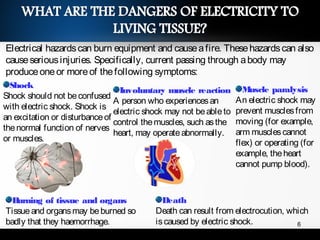
Electrical hazardscan burn equipment and causeafire. Thesehazardscan also
causeseriousinjuries. Specifically, current passing through abody may
produceoneor moreof thefollowing symptoms:
Shock
Shock should not beconfused
with electric shock. Shock is
an excitation or disturbanceof
thenormal function of nerves
or muscles.
Involuntary muscle reaction
A person who experiencesan
electric shock may not beableto
control themuscles, such asthe
heart, may operateabnormally.
Muscle paralysis
An electric shock may
prevent musclesfrom
moving (for example,
arm musclescannot
flex) or operating (for
example, theheart
cannot pump blood).
Burning of tissue and organs
Tissueand organsmay beburned so
badly that they haemorrhage.
Death
Death can result from electrocution, which
iscaused by electric shock. 6
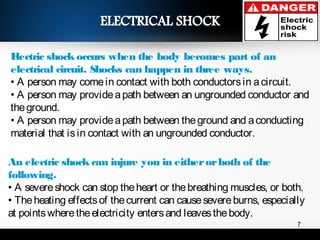
Electric shock occurs when the body becomes part of an
electrical circuit. Shocks can happen in three ways.
• A person may comein contact with both conductorsin acircuit.
• A person may provideapath between an ungrounded conductor and
theground.
• A person may provideapath between theground and aconducting
material that isin contact with an ungrounded conductor.
An electric shock can injure you in eitherorboth of the
following.
• A severeshock can stop theheart or thebreathing muscles, or both.
• Theheating effectsof thecurrent can causesevereburns, especially
at pointswheretheelectricity entersand leavesthebody.
7
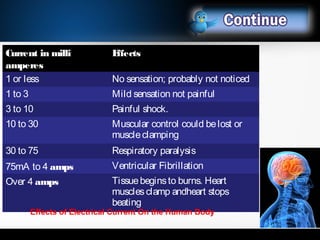
Current in milli
amperes
Effects
1 or less No sensation; probably not noticed
1 to 3 Mild sensation not painful
3 to 10 Painful shock.
10 to 30 Muscular control could belost or
muscleclamping
30 to 75 Respiratory paralysis
75mA to 4 amps Ventricular Fibrillation
Over 4 amps Tissuebeginsto burns. Heart
musclesclamp andheart stops
beating
Effects of Electrical Current On the Human Body
8
CURRENTPATHTHROUGHTHEBODY
Electric shocksarelesssevereif thecurrent path doesnot include
vital organs.
 LENGTHOFTIMETHEELECTRIC SHOCKACTS ON THE
BODY
Theduration of theelectric shock effectstheextent of injury the
longer theduration of theelectric shock on thebody, thegreater
risk of severeinjury. In addition, theelectric shock can influence
theduration of exposureif avictim cannot let go of theconductor
of electricity that iscausing theelectric shock becauseof lossof
voluntary musclecontrol
9
❑ LOCATION ON THEBODY OFTHEELECTRICALCONTACT
An electric shock that startsat afinger and exitsthrough thegrounded
elbow on the same arm will do less damage than an electric shock that starts
at afinger and exitsthrough thevictim’sgrounded feet.
The latter scenario is more dangerous because more tissue is affected and
thepath of current iscloser tointernal organs.
Current can burn vital organs even if the current does not pass through
thosevital organs.
This type of damage may occur externally because of arcing or thermal
contact (avital organ isnear tissuethat isexperiencing electric shock).
10
11
❑ SKIN RESISTANCE
Theresistanceof thebody greatly affectstheseverity of theelectric
shock.
Human tissue has very low resistance because the cellular fluid in
tissueisagood conductor of electricity.
However, dry skin has very high resistance where as Resistance of
wet skin islow.
Skin resistanceiseven lower than theresistanceof wet skin if acut
or deep abrasion ispresent.
The exposure of moist and deeper skin layers increases the severity
of injury that results from theelectric shock.
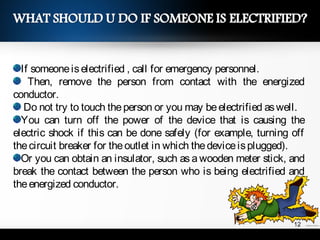
If someoneiselectrified , call for emergency personnel.
Then, remove the person from contact with the energized
conductor.
Do not try to touch theperson or you may beelectrified aswell.
You can turn off the power of the device that is causing the
electric shock if this can be done safely (for example, turning off
thecircuit breaker for theoutlet in which thedeviceisplugged).
Or you can obtain an insulator, such as a wooden meter stick, and
break the contact between the person who is being electrified and
theenergized conductor.
12
After theperson who issuffering from electric shock hasbeen
removed from thesourceof theshock, check to seeif thisperson is
having breathing problemsor isexperiencing ventricular fibrillation.
Artificial respiration or cardiopulmonary resuscitation should be
performed on theperson who experienced electric shock, if necessary.
Also, useblanketsto keep theperson warm.
Although a person who is electrified may appear unharmed, call
emergency personnel because this person may have suffered internal
injuries, such asburnsto organsduring theelectric shock.
13
Most electrical accidentsresult from oneof thefollowing three
factors:
• unsafeequipment or installation,
• unsafeenvironment, or
• unsafework practices.
Somewaysto prevent theseaccidentsarethrough theuseof
insulation, guarding, grounding, electrical protectivedevices, and
safework practices.
14
Insulators such as glass, mica, rubber, or plastic used to coat metals and
other conductors help stop or reduce the flow of electrical current. This helps
prevent shock, fires, and short circuits. To be effective, the insulation must be
suitable for the voltage used and conditions such as temperature and other
environmental factors like moisture, oil, gasoline, corrosive fumes, or other
substancesthat could causetheinsulator to fail
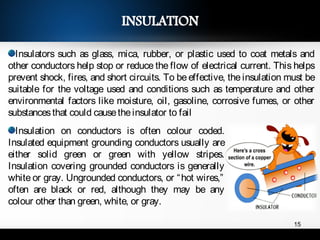
Insulation on conductors is often colour coded.
Insulated equipment grounding conductors usually are
either solid green or green with yellow stripes.
Insulation covering grounded conductors is generally
white or gray. Ungrounded conductors, or “hot wires,”
often are black or red, although they may be any
colour other than green, white, or gray.
15
Grounding a tool or electrical system means intentionally creating a
low resistancepath that connectsto theearth.
This prevents the buildup of voltages that could cause an electrical
accident.
Grounding is normally a secondary protective measure to protect
against electric shock. It does not guarantee that you won’t get a shock
or beinjured or killed by an electrical current.
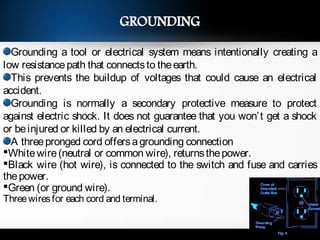
A threepronged cord offersagrounding connection
Whitewire(neutral or common wire), returnsthepower.
Black wire (hot wire), is connected to the switch and fuse and carries
thepower.
Green (or ground wire).
Threewiresfor each cord and terminal.
16
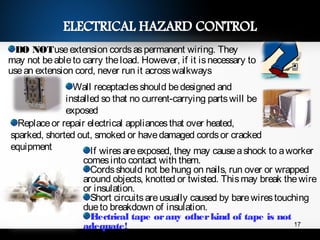
DO NOTuseextension cordsaspermanent wiring. They
may not beableto carry theload. However, if it isnecessary to
usean extension cord, never run it acrosswalkways
Wall receptaclesshould bedesigned and
installed so that no current-carrying partswill be
exposed
Replaceor repair electrical appliancesthat over heated,
sparked, shorted out, smoked or havedamaged cordsor cracked
equipment If wiresareexposed, they may causeashock to aworker
comesinto contact with them.
Cordsshould not behung on nails, run over or wrapped
around objects, knotted or twisted. Thismay break thewire
or insulation.
Short circuitsareusually caused by barewirestouching
dueto breakdown of insulation.
Electrical tape orany otherkind of tape is not
adequate! 17
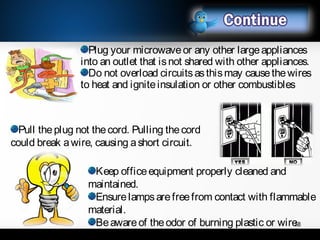
Pull theplug not thecord. Pulling thecord
could break awire, causing ashort circuit.
Plug your microwaveor any other largeappliances
into an outlet that isnot shared with other appliances.
Do not overload circuitsasthismay causethewires
to heat and igniteinsulation or other combustibles
Keep officeequipment properly cleaned and
maintained.
Ensurelampsarefreefrom contact with flammable
material.
Beawareof theodor of burning plastic or wire.18
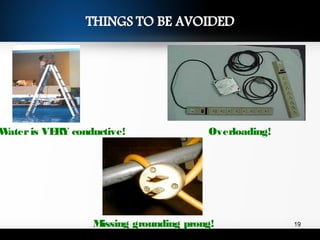
Wateris VERY conductive! Overloading!
Missing grounding prong! 19
Missing outlet cover!
Electrical tape is not a fix! Damaged casing!
20
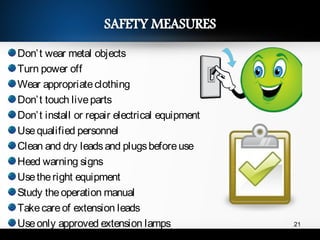
Don’t wear metal objects
Turn power off
Wear appropriateclothing
Don’t touch liveparts
Don’t install or repair electrical equipment
Usequalified personnel
Clean and dry leadsand plugsbeforeuse
Heed warning signs
Usetheright equipment
Study theoperation manual
Takecareof extension leads
Useonly approved extension lamps 21
Electrical equipment should bechecked each timebefore
usefor defects
If not tagged or thetag isout of datethen report it and
placeit out of service
22
The key messages are…
Therisk of electric shock from correctly installed and maintained
power sourcesisnegligible, provided that sensibleprecautionsare
taken by theoperator and correct work proceduresarefollowed
Ensurethat theright person iscarrying out electrical work
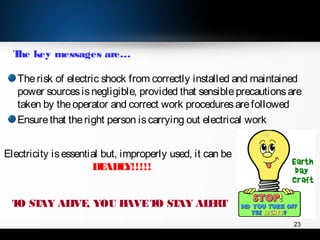
Electricity isessential but, improperly used, it can be
DEADLY!!!!!
TO STAY ALIVE, YOU HAVETO STAY ALERT
23
http://www.ihsa.ca/resources/health_safety_manual/pdfs/hazards/Electricity.pdf
https://www.osha.gov/Publications/3075.html
go.hrw.com/resources/go_sc/gen/HS2LMR07.PDF
https://www.osha.gov/dte/grant_materials/.../electrical_english_r6.pdf
https://www.lanl.gov/.../electrical/.../elec_hazard_awareness_study_guide.
..
24
25

Electrical hazards and their preventions

  • 1.
    Presented By: K.Shamili 1702-13-886-005 Department OfPharmaceutics Under The Guidance Of: Dr.Jagadeesh Induru M.Pharm ,M.B.A, PhD Mrs. Tripti Suxena M.Pharm 1
  • 2.
    2 Introduction Types of current Dangersof electricity to the living tissue Electric shock Conditions that effect the shock Saving the electrified person Protection against electrical hazards Electric hazard control Things to be avoided Safety measures Regular safety Inspection References
  • 3.
    An electrical hazardcan be defined as - adangerouscondition whereaworker could makeelectrical contact with energized equipment or aconductor, and from which theperson may sustain an injury from shock Thelaw requiressafework practices. Under theOccupational Health and Safety Act and Regulationsfor Construction Projects, employers, supervisors, and workerseach havelegal responsibilitiesto ensurethat work isbeing carried out in asafemanner. 3
  • 4.
    Electrical hazards arecaused by ❑ Theimproper useof machinery or apparatus ❑ Theimproper useof electrical outlets ❑ Theimproper useof electrical equipment, such ascablesand power cords ❑ Theimproper maintenanceof apparatus, outlets, and electrical equipment Basically, electrical hazards can be categorized into three types. Thefirst and most commonly recognized hazard iselectrical shock. Thesecond typeof hazard iselectrical burnsand the third is theeffectsof blastswhich includepressureimpact, flying particles from vaporized conductors 4
  • 5.
    Both alternating current(AC) and direct current (DC) can produce injury to living tissue and can destroy equipment. However, the AC (60 Hz and 120 V) that electric companies supply to most electrical outlets disturbs human nerve impulses more readily than DC of the same voltage or AC at other frequencies do because human nerve impulses resonate at approximately 60 Hz. In addition, the DC circuits often used in classroom experiments are relatively harmless. Yet, DC can still be dangerous, and burn hazards are created in many common uses of DC. So, all circuits should betreated cautiously. 5
  • 6.
    Electrical hazardscan burnequipment and causeafire. Thesehazardscan also causeseriousinjuries. Specifically, current passing through abody may produceoneor moreof thefollowing symptoms: Shock Shock should not beconfused with electric shock. Shock is an excitation or disturbanceof thenormal function of nerves or muscles. Involuntary muscle reaction A person who experiencesan electric shock may not beableto control themuscles, such asthe heart, may operateabnormally. Muscle paralysis An electric shock may prevent musclesfrom moving (for example, arm musclescannot flex) or operating (for example, theheart cannot pump blood). Burning of tissue and organs Tissueand organsmay beburned so badly that they haemorrhage. Death Death can result from electrocution, which iscaused by electric shock. 6
  • 7.
    Electric shock occurswhen the body becomes part of an electrical circuit. Shocks can happen in three ways. • A person may comein contact with both conductorsin acircuit. • A person may provideapath between an ungrounded conductor and theground. • A person may provideapath between theground and aconducting material that isin contact with an ungrounded conductor. An electric shock can injure you in eitherorboth of the following. • A severeshock can stop theheart or thebreathing muscles, or both. • Theheating effectsof thecurrent can causesevereburns, especially at pointswheretheelectricity entersand leavesthebody. 7
  • 8.
    Current in milli amperes Effects 1or less No sensation; probably not noticed 1 to 3 Mild sensation not painful 3 to 10 Painful shock. 10 to 30 Muscular control could belost or muscleclamping 30 to 75 Respiratory paralysis 75mA to 4 amps Ventricular Fibrillation Over 4 amps Tissuebeginsto burns. Heart musclesclamp andheart stops beating Effects of Electrical Current On the Human Body 8
  • 9.
    CURRENTPATHTHROUGHTHEBODY Electric shocksarelesssevereif thecurrentpath doesnot include vital organs.  LENGTHOFTIMETHEELECTRIC SHOCKACTS ON THE BODY Theduration of theelectric shock effectstheextent of injury the longer theduration of theelectric shock on thebody, thegreater risk of severeinjury. In addition, theelectric shock can influence theduration of exposureif avictim cannot let go of theconductor of electricity that iscausing theelectric shock becauseof lossof voluntary musclecontrol 9
  • 10.
    ❑ LOCATION ONTHEBODY OFTHEELECTRICALCONTACT An electric shock that startsat afinger and exitsthrough thegrounded elbow on the same arm will do less damage than an electric shock that starts at afinger and exitsthrough thevictim’sgrounded feet. The latter scenario is more dangerous because more tissue is affected and thepath of current iscloser tointernal organs. Current can burn vital organs even if the current does not pass through thosevital organs. This type of damage may occur externally because of arcing or thermal contact (avital organ isnear tissuethat isexperiencing electric shock). 10
  • 11.
    11 ❑ SKIN RESISTANCE Theresistanceofthebody greatly affectstheseverity of theelectric shock. Human tissue has very low resistance because the cellular fluid in tissueisagood conductor of electricity. However, dry skin has very high resistance where as Resistance of wet skin islow. Skin resistanceiseven lower than theresistanceof wet skin if acut or deep abrasion ispresent. The exposure of moist and deeper skin layers increases the severity of injury that results from theelectric shock.
  • 12.
    If someoneiselectrified ,call for emergency personnel. Then, remove the person from contact with the energized conductor. Do not try to touch theperson or you may beelectrified aswell. You can turn off the power of the device that is causing the electric shock if this can be done safely (for example, turning off thecircuit breaker for theoutlet in which thedeviceisplugged). Or you can obtain an insulator, such as a wooden meter stick, and break the contact between the person who is being electrified and theenergized conductor. 12
  • 13.
    After theperson whoissuffering from electric shock hasbeen removed from thesourceof theshock, check to seeif thisperson is having breathing problemsor isexperiencing ventricular fibrillation. Artificial respiration or cardiopulmonary resuscitation should be performed on theperson who experienced electric shock, if necessary. Also, useblanketsto keep theperson warm. Although a person who is electrified may appear unharmed, call emergency personnel because this person may have suffered internal injuries, such asburnsto organsduring theelectric shock. 13
  • 14.
    Most electrical accidentsresultfrom oneof thefollowing three factors: • unsafeequipment or installation, • unsafeenvironment, or • unsafework practices. Somewaysto prevent theseaccidentsarethrough theuseof insulation, guarding, grounding, electrical protectivedevices, and safework practices. 14
  • 15.
    Insulators such asglass, mica, rubber, or plastic used to coat metals and other conductors help stop or reduce the flow of electrical current. This helps prevent shock, fires, and short circuits. To be effective, the insulation must be suitable for the voltage used and conditions such as temperature and other environmental factors like moisture, oil, gasoline, corrosive fumes, or other substancesthat could causetheinsulator to fail Insulation on conductors is often colour coded. Insulated equipment grounding conductors usually are either solid green or green with yellow stripes. Insulation covering grounded conductors is generally white or gray. Ungrounded conductors, or “hot wires,” often are black or red, although they may be any colour other than green, white, or gray. 15
  • 16.
    Grounding a toolor electrical system means intentionally creating a low resistancepath that connectsto theearth. This prevents the buildup of voltages that could cause an electrical accident. Grounding is normally a secondary protective measure to protect against electric shock. It does not guarantee that you won’t get a shock or beinjured or killed by an electrical current. A threepronged cord offersagrounding connection Whitewire(neutral or common wire), returnsthepower. Black wire (hot wire), is connected to the switch and fuse and carries thepower. Green (or ground wire). Threewiresfor each cord and terminal. 16
  • 17.
    DO NOTuseextension cordsaspermanentwiring. They may not beableto carry theload. However, if it isnecessary to usean extension cord, never run it acrosswalkways Wall receptaclesshould bedesigned and installed so that no current-carrying partswill be exposed Replaceor repair electrical appliancesthat over heated, sparked, shorted out, smoked or havedamaged cordsor cracked equipment If wiresareexposed, they may causeashock to aworker comesinto contact with them. Cordsshould not behung on nails, run over or wrapped around objects, knotted or twisted. Thismay break thewire or insulation. Short circuitsareusually caused by barewirestouching dueto breakdown of insulation. Electrical tape orany otherkind of tape is not adequate! 17
  • 18.
    Pull theplug notthecord. Pulling thecord could break awire, causing ashort circuit. Plug your microwaveor any other largeappliances into an outlet that isnot shared with other appliances. Do not overload circuitsasthismay causethewires to heat and igniteinsulation or other combustibles Keep officeequipment properly cleaned and maintained. Ensurelampsarefreefrom contact with flammable material. Beawareof theodor of burning plastic or wire.18
  • 19.
    Wateris VERY conductive!Overloading! Missing grounding prong! 19
  • 20.
    Missing outlet cover! Electricaltape is not a fix! Damaged casing! 20
  • 21.
    Don’t wear metalobjects Turn power off Wear appropriateclothing Don’t touch liveparts Don’t install or repair electrical equipment Usequalified personnel Clean and dry leadsand plugsbeforeuse Heed warning signs Usetheright equipment Study theoperation manual Takecareof extension leads Useonly approved extension lamps 21
  • 22.
    Electrical equipment shouldbechecked each timebefore usefor defects If not tagged or thetag isout of datethen report it and placeit out of service 22
  • 23.
    The key messagesare… Therisk of electric shock from correctly installed and maintained power sourcesisnegligible, provided that sensibleprecautionsare taken by theoperator and correct work proceduresarefollowed Ensurethat theright person iscarrying out electrical work Electricity isessential but, improperly used, it can be DEADLY!!!!! TO STAY ALIVE, YOU HAVETO STAY ALERT 23
  • 24.
  • 25.