Page 1
Unit 1
Electrical Theory
Page 2
AC
• Battery symbol is used as a
generic symbol for any DC
voltage source
• The circle with the wavy line
inside is the generic symbol
for any AC voltage source
Page 3
Generation of AC
• Simpler Design
• Naturally
Produced
• No brushes for
Motor
• Greater Reliability
• Low Cost
Page 4
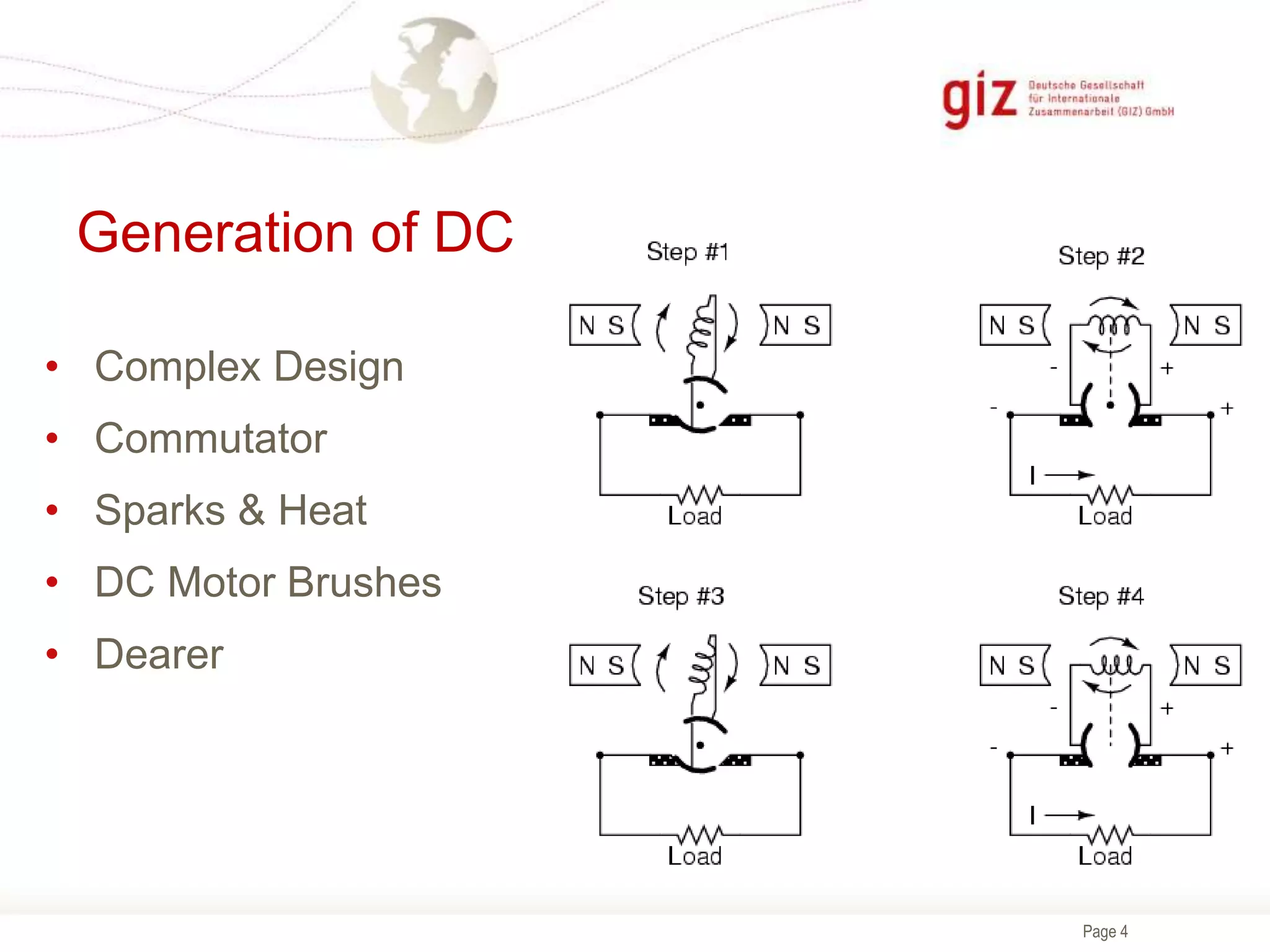
Generation of DC
• Complex Design
• Commutator
• Sparks & Heat
• DC Motor Brushes
• Dearer
Page 5
Why AC? Why NOT DC?
Page 6
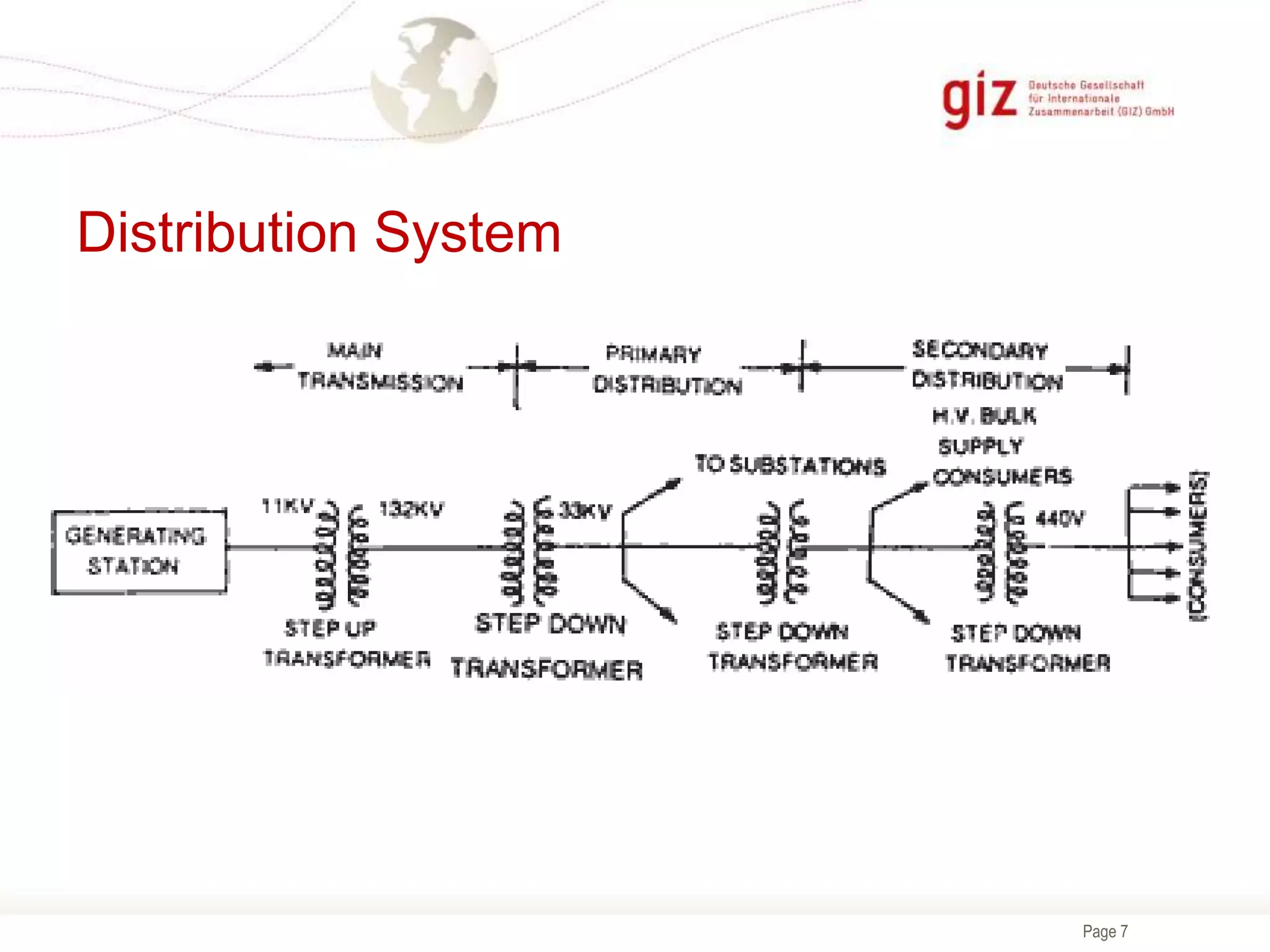
Distribution System
Page 7
Distribution System
Page 8
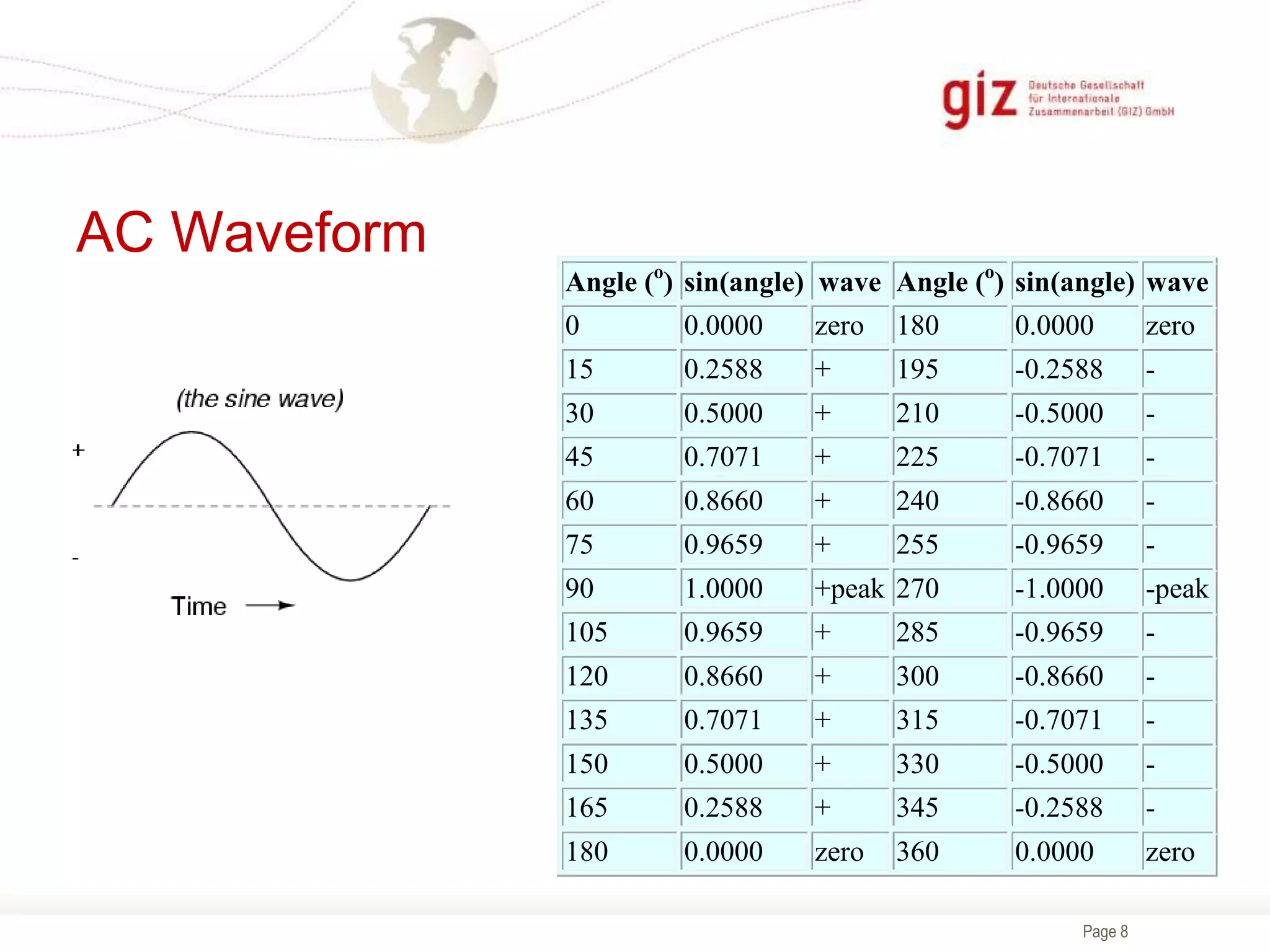
AC Waveform
Angle (o
) sin(angle) wave Angle (o
) sin(angle) wave
0 0.0000 zero 180 0.0000 zero
15 0.2588 + 195 -0.2588 -
30 0.5000 + 210 -0.5000 -
45 0.7071 + 225 -0.7071 -
60 0.8660 + 240 -0.8660 -
75 0.9659 + 255 -0.9659 -
90 1.0000 +peak 270 -1.0000 -peak
105 0.9659 + 285 -0.9659 -
120 0.8660 + 300 -0.8660 -
135 0.7071 + 315 -0.7071 -
150 0.5000 + 330 -0.5000 -
165 0.2588 + 345 -0.2588 -
180 0.0000 zero 360 0.0000 zero
Page 9
AC Waveform
Page 10
AC Measurement
Page 11
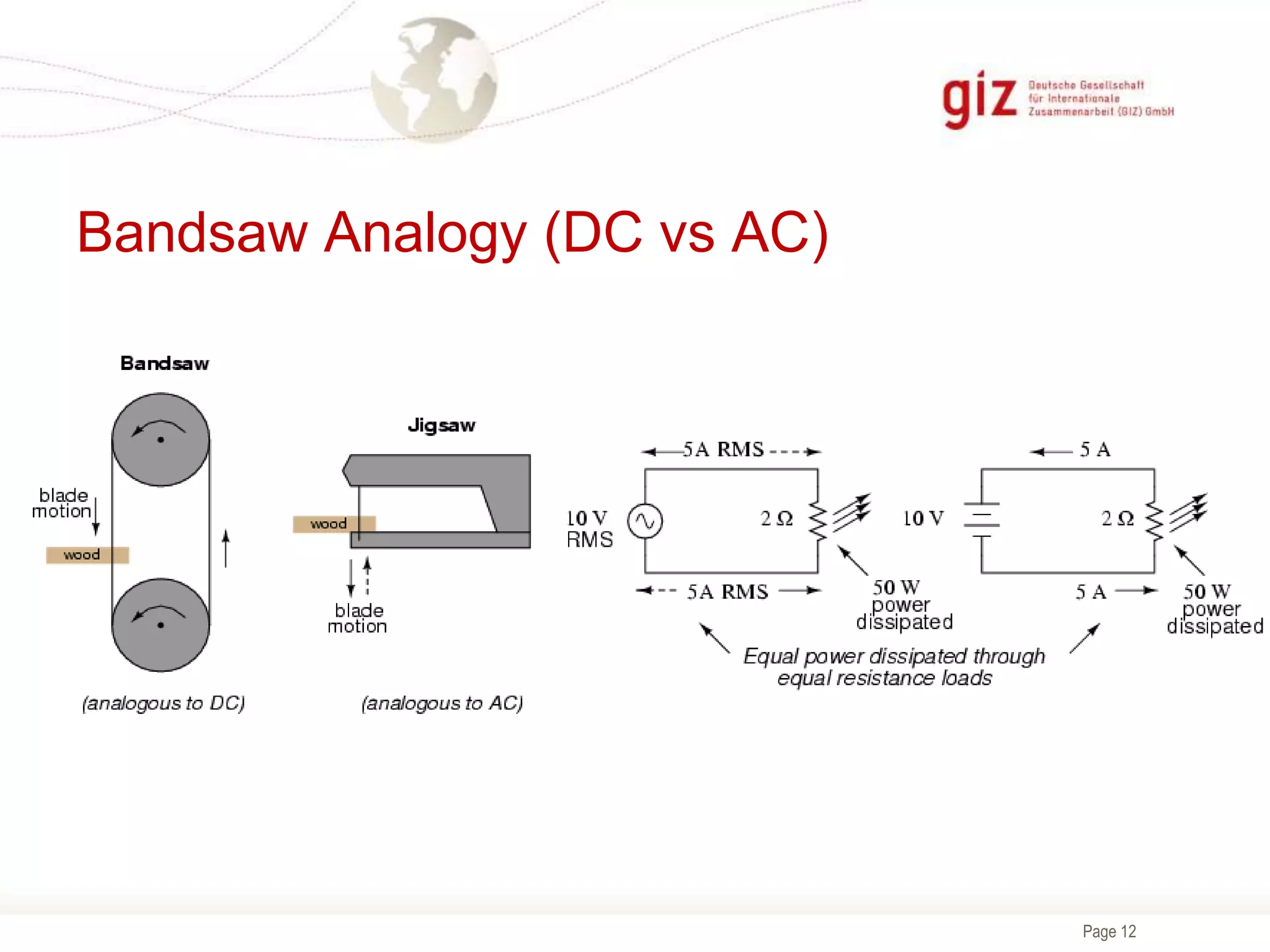
RMS?????
• An AC measurement based on work performed by a
waveform is not the same as that waveform's “average” value
• The power dissipated by a given load (work performed per
unit time) is not directly proportional to the magnitude of either
the voltage or current impressed upon it
• Power is proportional to the square of the voltage or current
applied to a resistance (P = E2/R, and P = I2R)
• Method of deriving an aggregate value for waveform
amplitude is based on the waveform's ability to do useful work
when applied to a load resistance
Page 12
Bandsaw Analogy (DC vs AC)
Page 13
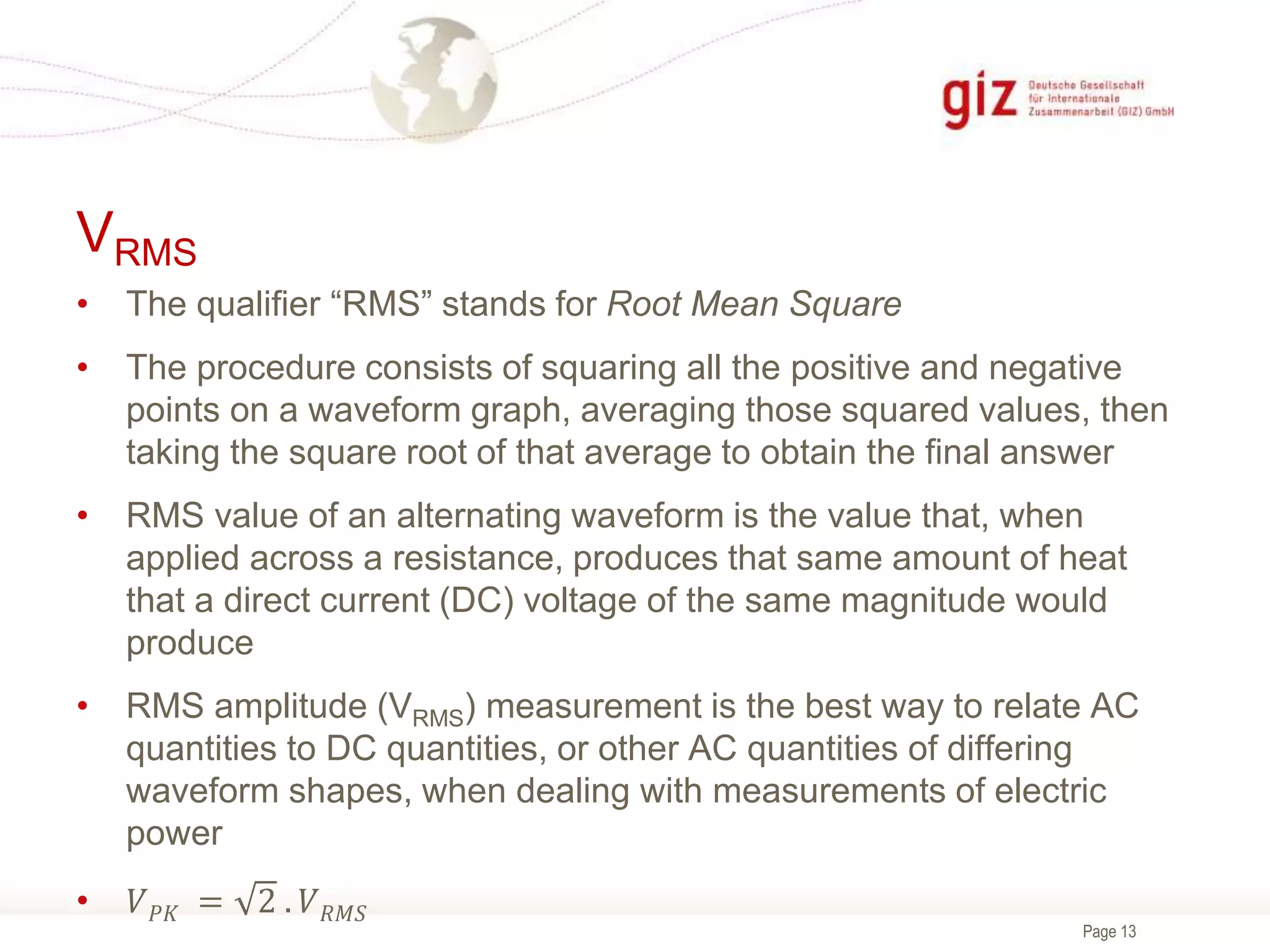
VRMS
• The qualifier “RMS” stands for Root Mean Square
• The procedure consists of squaring all the positive and negative
points on a waveform graph, averaging those squared values, then
taking the square root of that average to obtain the final answer
• RMS value of an alternating waveform is the value that, when
applied across a resistance, produces that same amount of heat
that a direct current (DC) voltage of the same magnitude would
produce
• RMS amplitude (VRMS) measurement is the best way to relate AC
quantities to DC quantities, or other AC quantities of differing
waveform shapes, when dealing with measurements of electric
power
• 𝑉𝑃𝐾 = 2 . 𝑉𝑅𝑀𝑆
Page 14
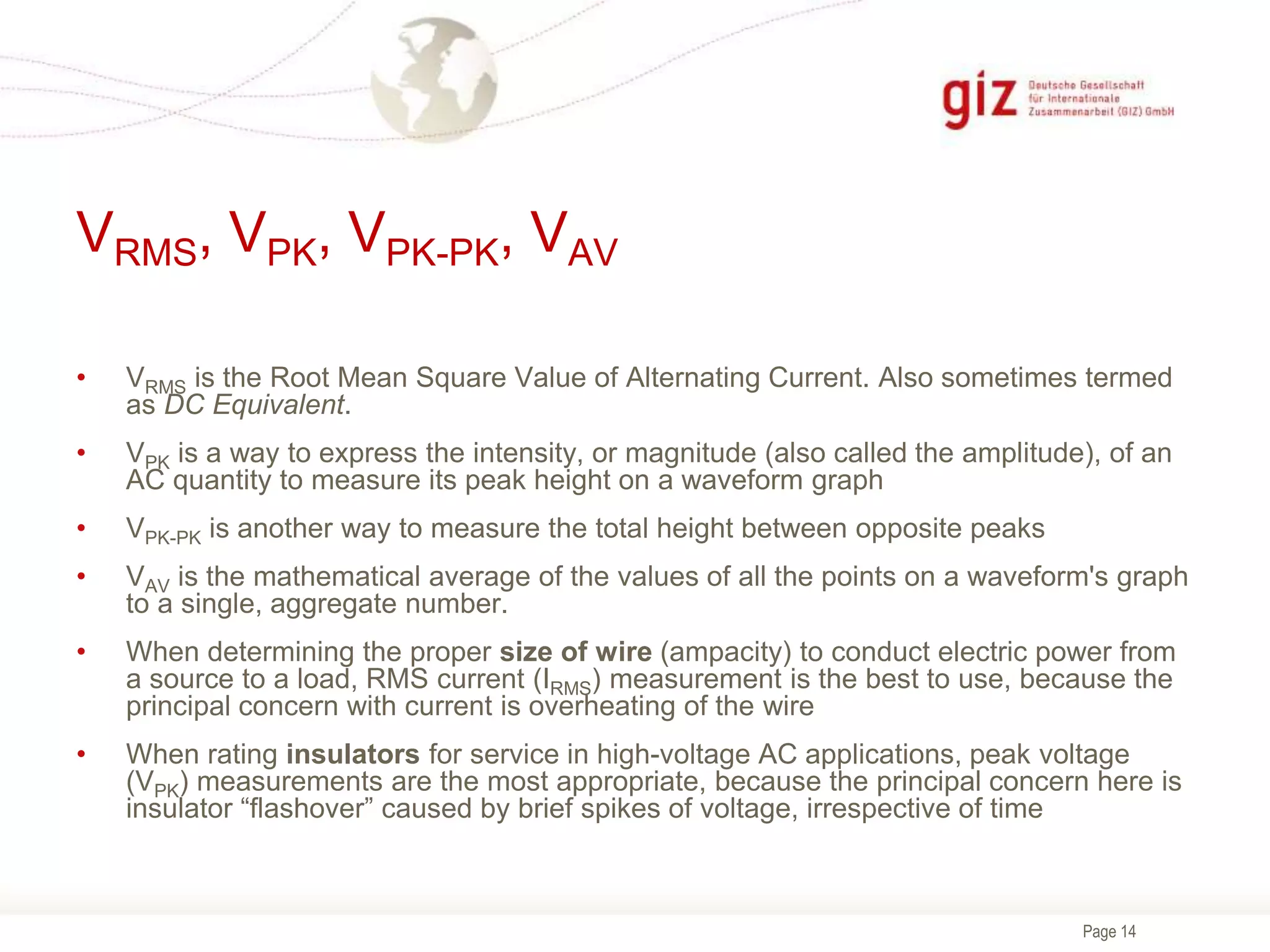
VRMS, VPK, VPK-PK, VAV
• VRMS is the Root Mean Square Value of Alternating Current. Also sometimes termed
as DC Equivalent.
• VPK is a way to express the intensity, or magnitude (also called the amplitude), of an
AC quantity to measure its peak height on a waveform graph
• VPK-PK is another way to measure the total height between opposite peaks
• VAV is the mathematical average of the values of all the points on a waveform's graph
to a single, aggregate number.
• When determining the proper size of wire (ampacity) to conduct electric power from
a source to a load, RMS current (IRMS) measurement is the best to use, because the
principal concern with current is overheating of the wire
• When rating insulators for service in high-voltage AC applications, peak voltage
(VPK) measurements are the most appropriate, because the principal concern here is
insulator “flashover” caused by brief spikes of voltage, irrespective of time
Page 15
Derive VRMS
𝑉𝑅𝑀𝑆 =
1
𝜋 2 0
𝜋
2
𝑉𝑃𝐾 sin 𝜃 2 . 𝜕𝜃
𝑉𝑅𝑀𝑆 =
2. 𝑉𝑃𝐾
2
𝜋
𝜃
2
−
1
4
sin 2 − 𝜃 0
𝜋/2
𝑉𝑅𝑀𝑆 =
2 𝑉𝑃𝐾
√𝜋
𝜋 2
2
−
1
4
sin 𝜋 −
0
2
−
1
4
sin 0
𝑉𝑅𝑀𝑆 =
2𝑉𝑃𝐾
𝜋
𝜋
4
− 0 − 0 − 0
𝑉𝑅𝑀𝑆 =
2𝑉𝑃𝐾
𝜋
.
𝜋
2
=
1
2
𝑉𝑃𝐾
VRMS =
1
2
. 𝑉𝑃𝐾
VRMS = 0.707 . 𝑉𝑃𝐾
Page 16
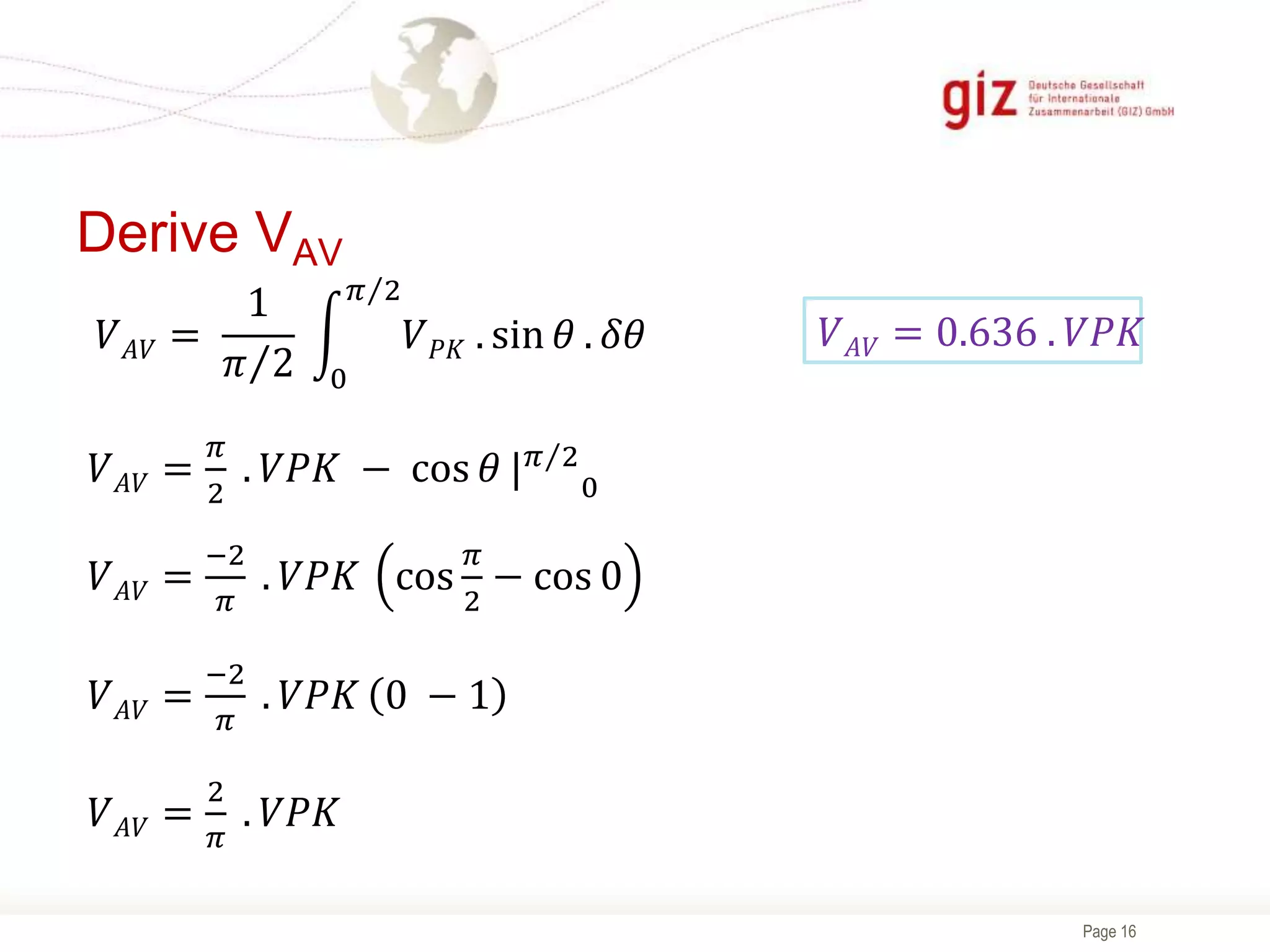
Derive VAV
𝑉𝐴𝑉 =
1
𝜋 2 0
𝜋 2
𝑉𝑃𝐾 . sin 𝜃 . 𝛿𝜃
𝑉𝐴𝑉 =
𝜋
2
. 𝑉𝑃𝐾 − cos 𝜃 |𝜋 2
0
𝑉𝐴𝑉 =
−2
𝜋
. 𝑉𝑃𝐾 cos
𝜋
2
− cos 0
𝑉𝐴𝑉 =
−2
𝜋
. 𝑉𝑃𝐾 0 − 1
𝑉𝐴𝑉 =
2
𝜋
. 𝑉𝑃𝐾
𝑉𝐴𝑉 = 0.636 . 𝑉𝑃𝐾
Page 17
Proof of Derivation
Angle (o) sin(angle) wave Angle (o) sin(angle) wave
0 0.0000 zero 180 0.0000 zero
15 0.2588 + 195 -0.2588 -
30 0.5000 + 210 -0.5000 -
45 0.7071 + 225 -0.7071 -
60 0.8660 + 240 -0.8660 -
75 0.9659 + 255 -0.9659 -
90 1.0000 +peak 270 -1.0000 -peak
105 0.9659 + 285 -0.9659 -
120 0.8660 + 300 -0.8660 -
135 0.7071 + 315 -0.7071 -
150 0.5000 + 330 -0.5000 -
165 0.2588 + 345 -0.2588 -
180 0.0000 zero 360 0.0000 zero
Description
Full
Cycle
Qtr Cycle
Sum 1719.1 429.8
Count 28.0 7.0
Mean (Avg
Voltage)
61.4 61.4
Sum of Squares 139995.5 34998.9
Mean of Squares 4999.8 4999.8
Root of Mean of
Squares
70.7 70.7
Page 18
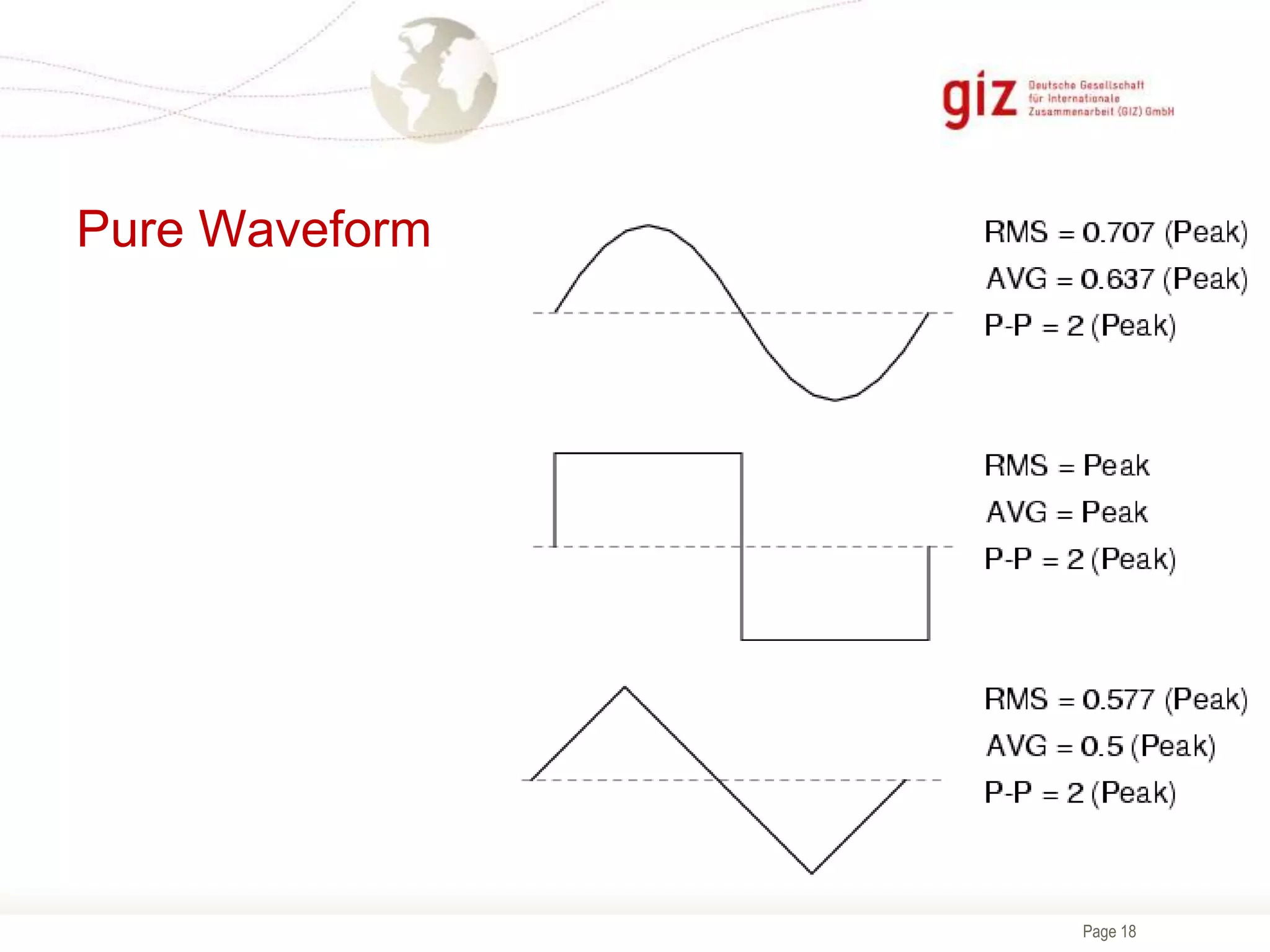
Pure Waveform
Page 19
Additional Information
• The conversion constants shown here for peak, RMS, and average
amplitudes of sine waves, square waves, and triangle waves hold
true only for pure forms of these wave shapes
• The crest factor of an AC waveform, is the ratio of its peak (crest)
value divided by its RMS value
• The form factor of an AC waveform is the ratio of its RMS value
divided by its average value
• The amplitude of an AC waveform is its height as depicted on a
graph over time
Page 20
Three Phase Advantages
• The horsepower rating of three phase motors and the KVA
rating of three phase transformers are 150% greater than
single phase motors or transformers of similar frame size
• The power delivered by a single phase system pulsates and
falls to zero. The three phase power never falls to zero. The
power delivered to three phase system is the same at any
instant. This produces superior characteristics for three-phase
motors
• A three phase system needs three conductors, however each
conductor is only 75% the size of equivalent KVA rated single
phase conductors
Page 21
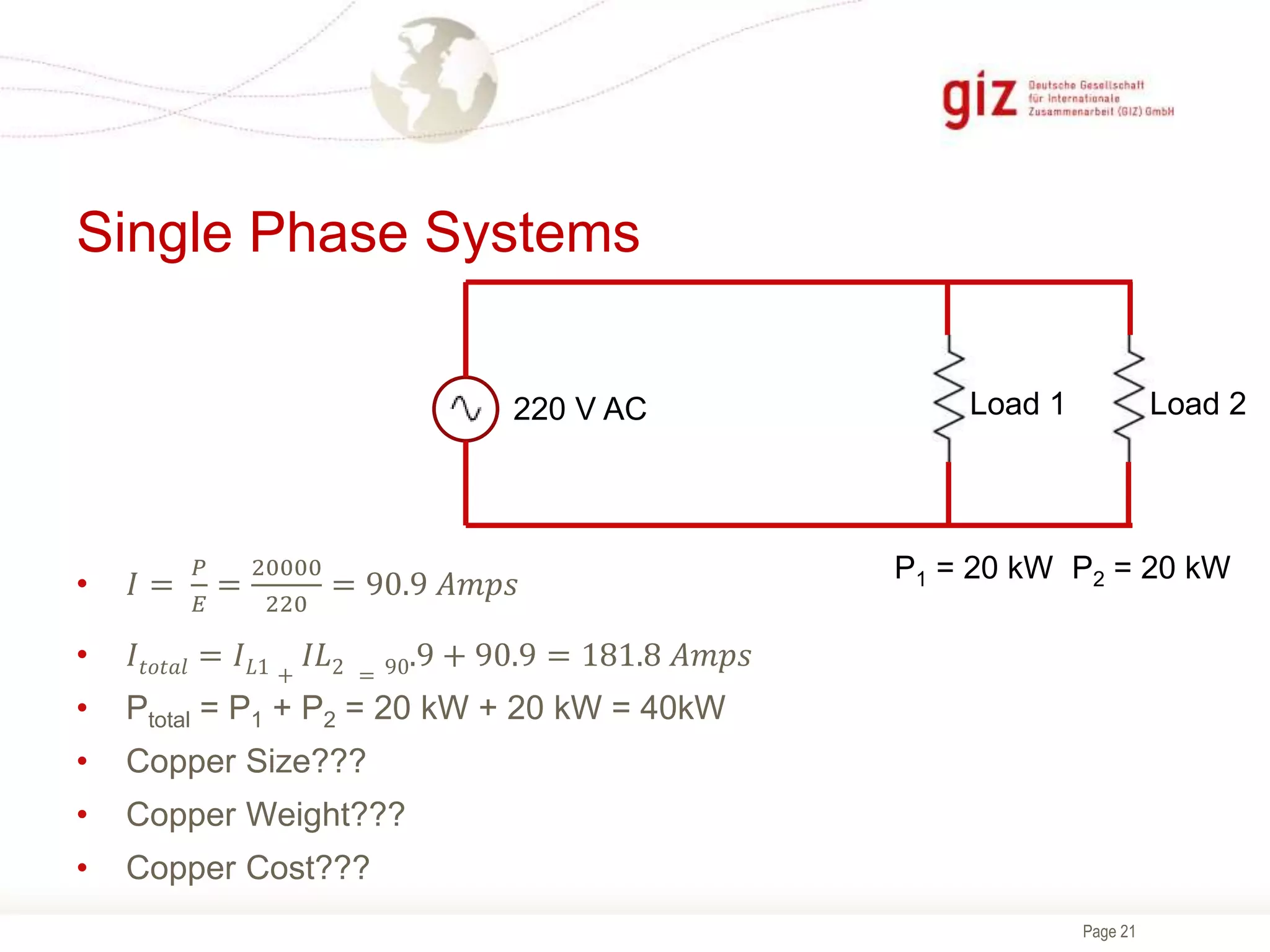
Single Phase Systems
P1 = 20 kW P2 = 20 kW
Load 1 Load 2
220 V AC
• 𝐼 =
𝑃
𝐸
=
20000
220
= 90.9 𝐴𝑚𝑝𝑠
• 𝐼𝑡𝑜𝑡𝑎𝑙 = 𝐼𝐿1 +
𝐼𝐿2 = 90.9 + 90.9 = 181.8 𝐴𝑚𝑝𝑠
• Ptotal = P1 + P2 = 20 kW + 20 kW = 40kW
• Copper Size???
• Copper Weight???
• Copper Cost???
Page 22
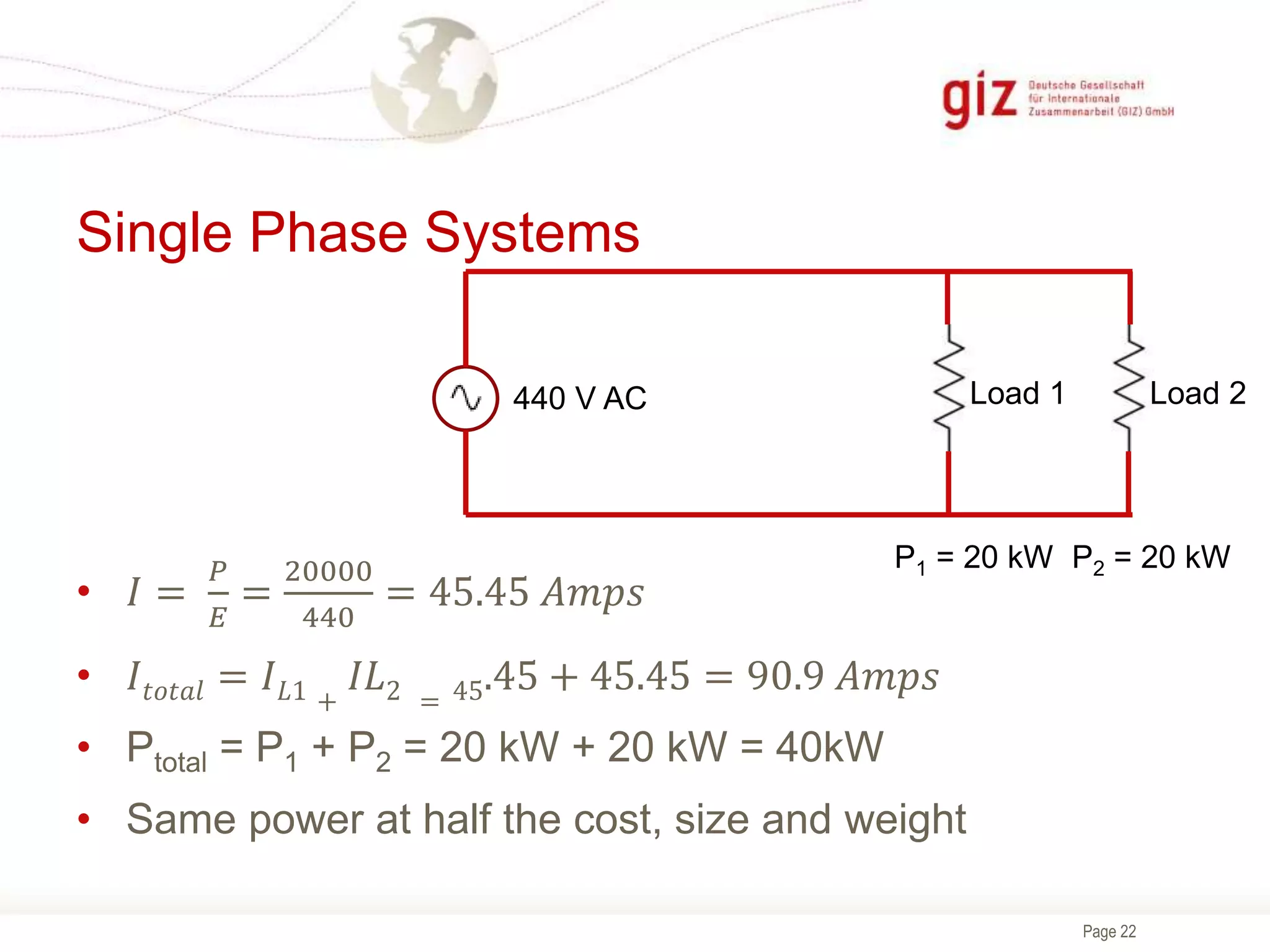
Single Phase Systems
Load 1 Load 2
P1 = 20 kW P2 = 20 kW
440 V AC
• 𝐼 =
𝑃
𝐸
=
20000
440
= 45.45 𝐴𝑚𝑝𝑠
• 𝐼𝑡𝑜𝑡𝑎𝑙 = 𝐼𝐿1 +
𝐼𝐿2 = 45.45 + 45.45 = 90.9 𝐴𝑚𝑝𝑠
• Ptotal = P1 + P2 = 20 kW + 20 kW = 40kW
• Same power at half the cost, size and weight
Page 23
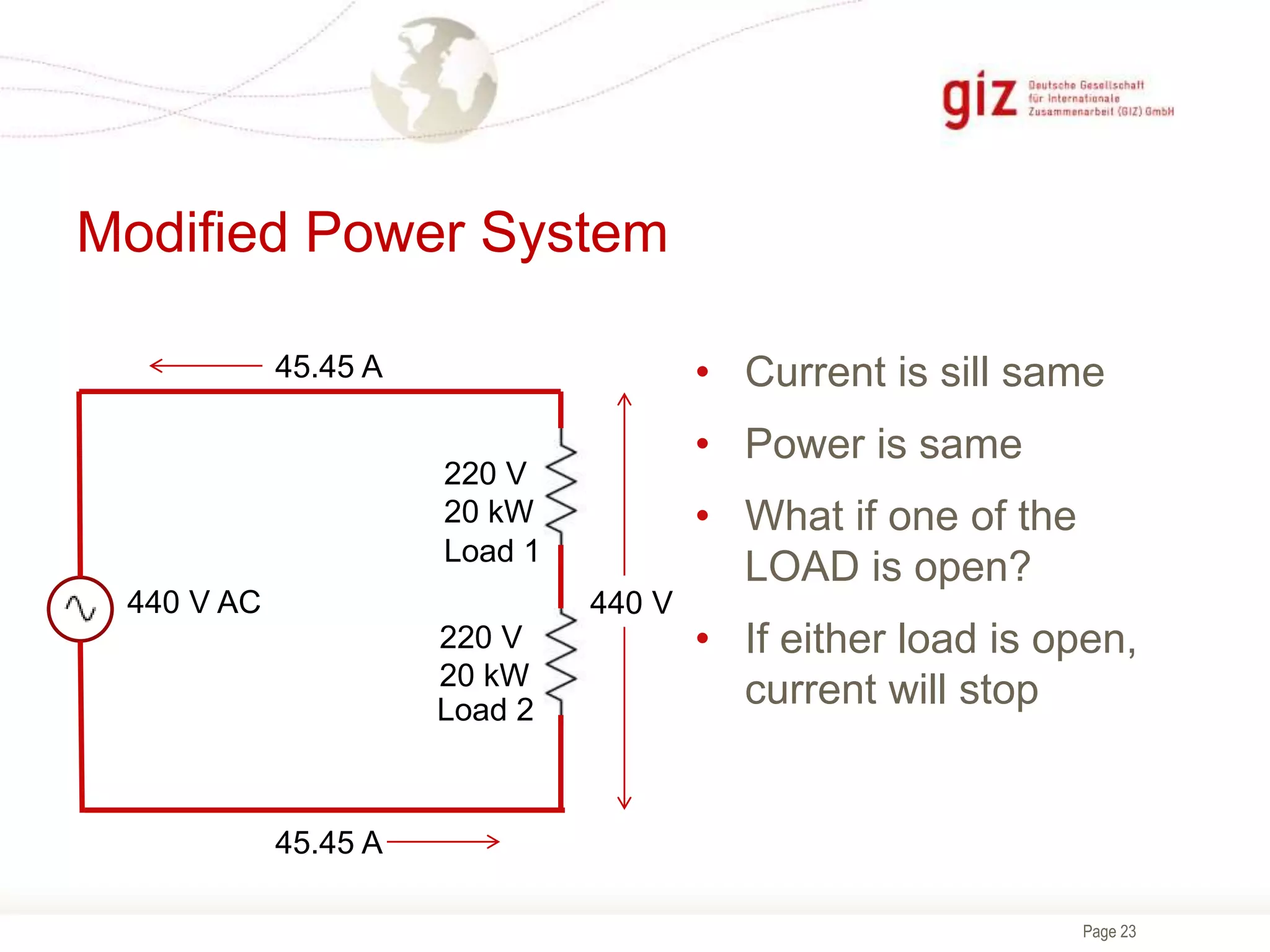
Modified Power System
• Current is sill same
• Power is same
• What if one of the
LOAD is open?
• If either load is open,
current will stop
Load 1
Load 2
220 V
20 kW
220 V
20 kW
440 V AC
45.45 A
45.45 A
440 V
Page 24
Split-Phase System
• More efficient
• More Safe
Load 1
Load 2
220 V
20 kW
220 V
20 kW
220 V AC
45.45 A
45.45 A
440 V
220 V AC
0 A
Page 25
TRIGONOMETRY FUNCTION
θ 𝟎° 𝟑𝟎° 𝟒𝟓° 𝟔𝟎° 𝟗𝟎°
sin 𝜃 0
1
2
1
2
3
2
1
cos 𝜃 1
3
2
1
2
1
2
0
θ 𝟗𝟎° 𝟏𝟐𝟎° 𝟏𝟑𝟓° 𝟏𝟓𝟎° 𝟏𝟖𝟎°
sin 𝜃 1
3
2
1
2
1
2
0
cos 𝜃 0 −
1
2
−
1
2
−
3
2
− 1
Page 26
Complex Numbers
• Z = x + jy
• Z - is the Complex
Number representing the
Vector
• x - is the Real part or the
Active component
• y - is the Imaginary part
or the Reactive component
• j - is defined by −1
Page 27
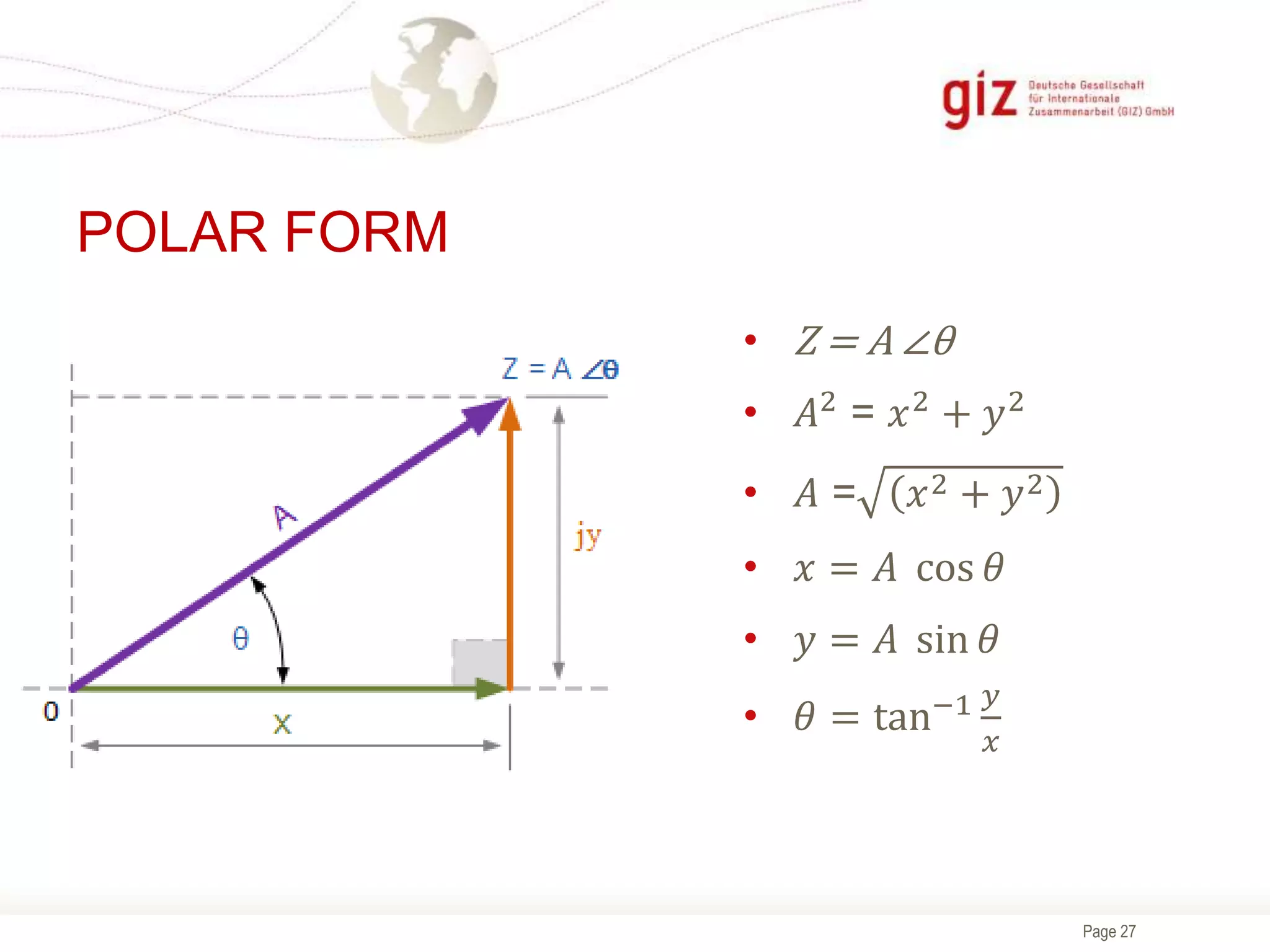
POLAR FORM
• Z = A ∠θ
• 𝐴2 = 𝑥2 + 𝑦2
• 𝐴 = 𝑥2 + 𝑦2
• 𝑥 = 𝐴 cos 𝜃
• 𝑦 = 𝐴 sin 𝜃
• 𝜃 = tan−1 𝑦
𝑥
Page 28
Converting Polar to Complex
• Given 6 ∠ 30 o
• 6 ∠ 30 o= 𝑥 + 𝑗𝑦
• 𝑥 = 𝐴 cos 𝜃, 𝑦 = 𝐴 sin 𝜃
• 6 ∠ 30 o= 6 cos 𝜃 + 𝑗6 sin 𝜃
• 6 ∠ 30 o= 6 cos 30° + 𝑗6 sin 30°
• 6 ∠ 30 o= (6 x 0.866) + j (6 x 0.5)
• 6 ∠ 30 o= 5.2+ j3
Page 29
Converting Complex to Polar
• Given 5.2+ j3
• 5.2+ j3 = A ∠θ
• A = 5.22 + 32
• A = 6
• 𝜃 = tan−1 𝑦
𝑥
• 𝜃 = tan−1 3
5.2
= 30 O
• 5.2+ j3 = 6 ∠30 o
Page 30
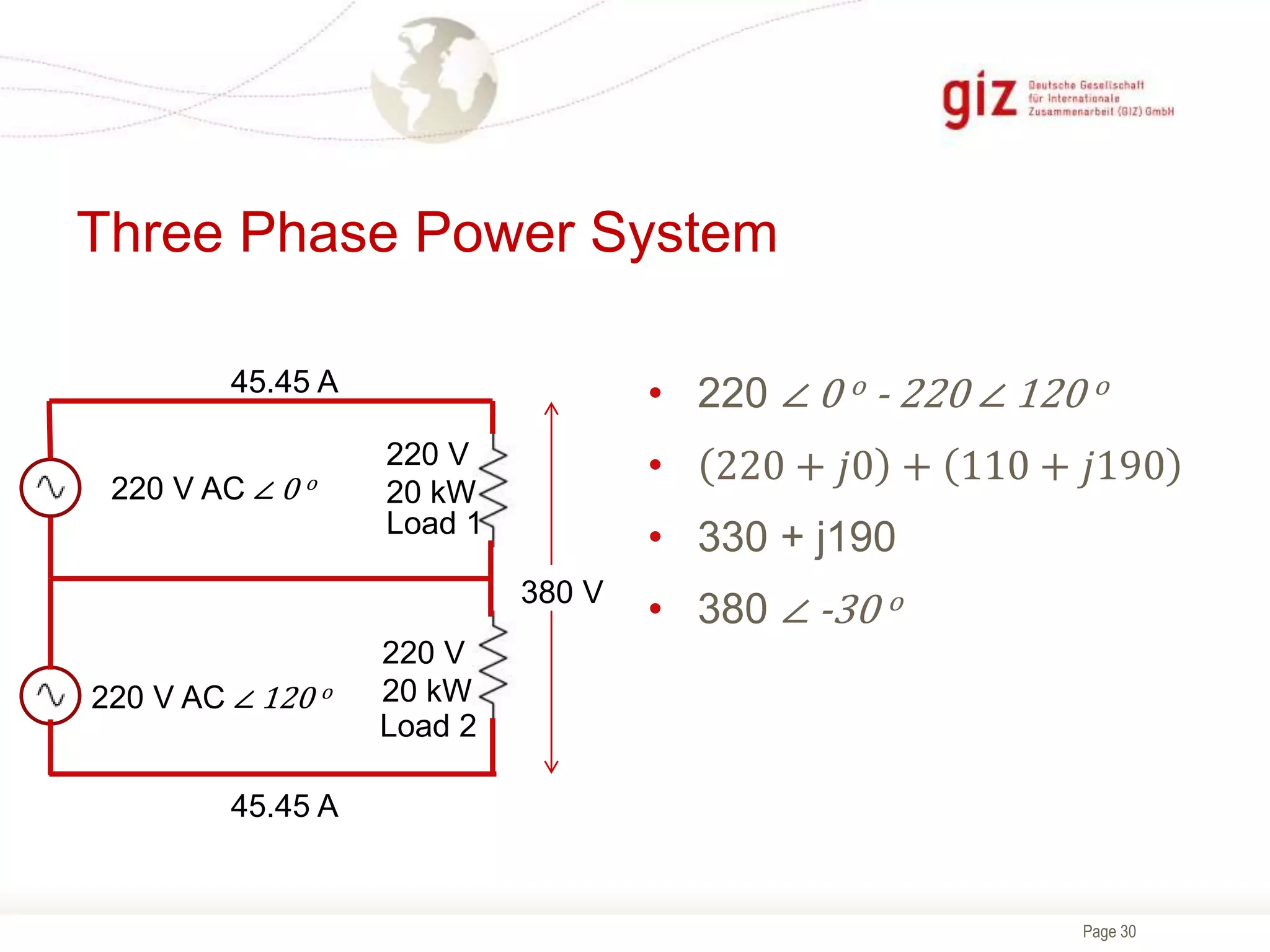
Three Phase Power System
• 220 ∠ 0 o - 220 ∠ 120 o
• 220 + 𝑗0 + 110 + 𝑗190
• 330 + j190
• 380 ∠ -30 o
Load 1
Load 2
220 V
20 kW
220 V
20 kW
220 V AC ∠ 120 o
45.45 A
45.45 A
380 V
220 V AC ∠ 0 o
Page 31
Three Phase Power System
• The 3rd wire carries
current
• Therefore, we could have
a voltage source on the
3rd wire also
• Thus achieving a 3 phase
power systems
Load 1
Load 2
220 V
20 kW
220 V
20 kW
220 V AC ∠ 120 o
45.45 A
45.45 A
440 V
0 A
220 V AC ∠ 240 o
220 V AC ∠ 0 o
Page 32
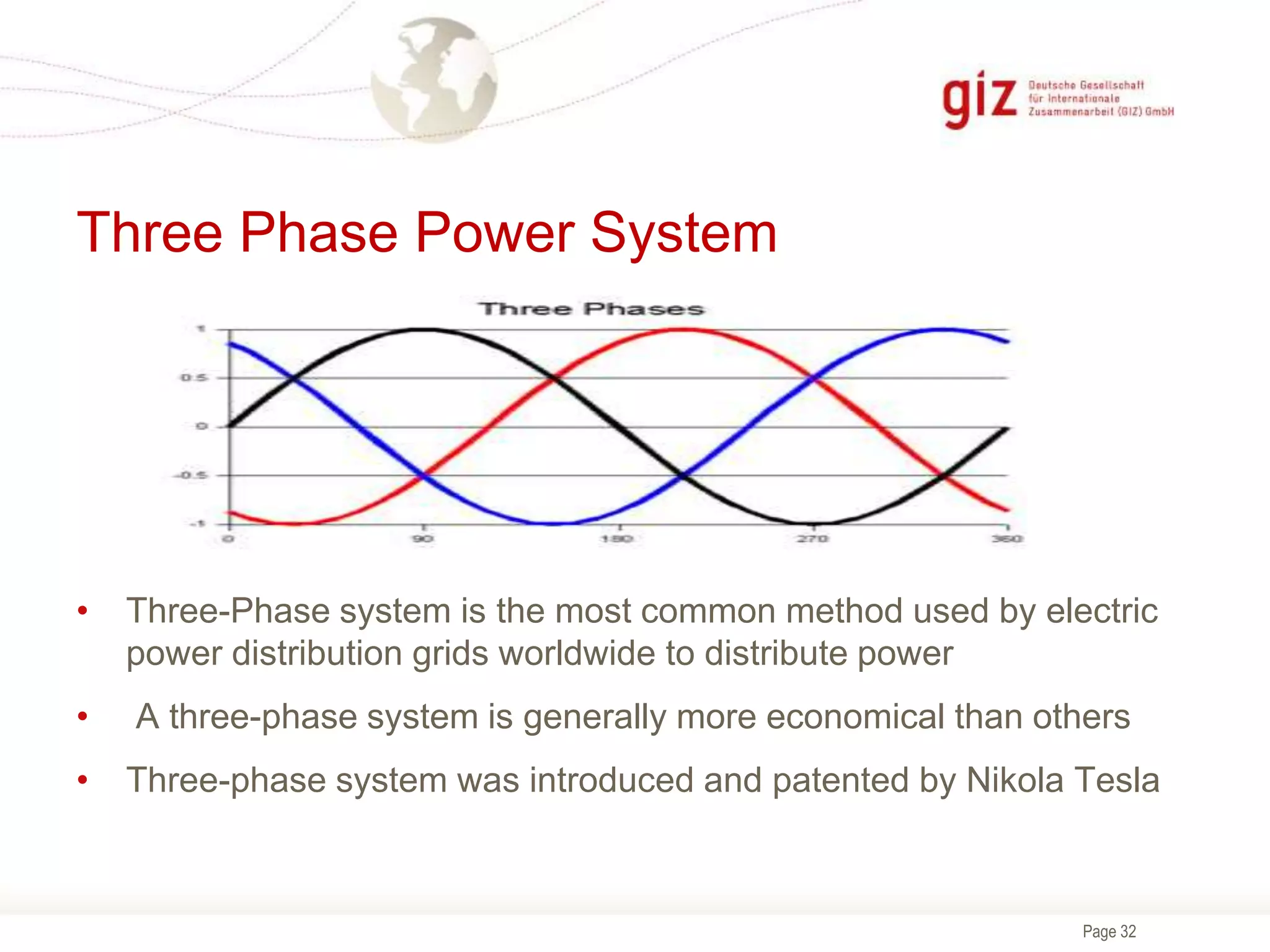
Three Phase Power System
• Three-Phase system is the most common method used by electric
power distribution grids worldwide to distribute power
• A three-phase system is generally more economical than others
• Three-phase system was introduced and patented by Nikola Tesla
Page 33
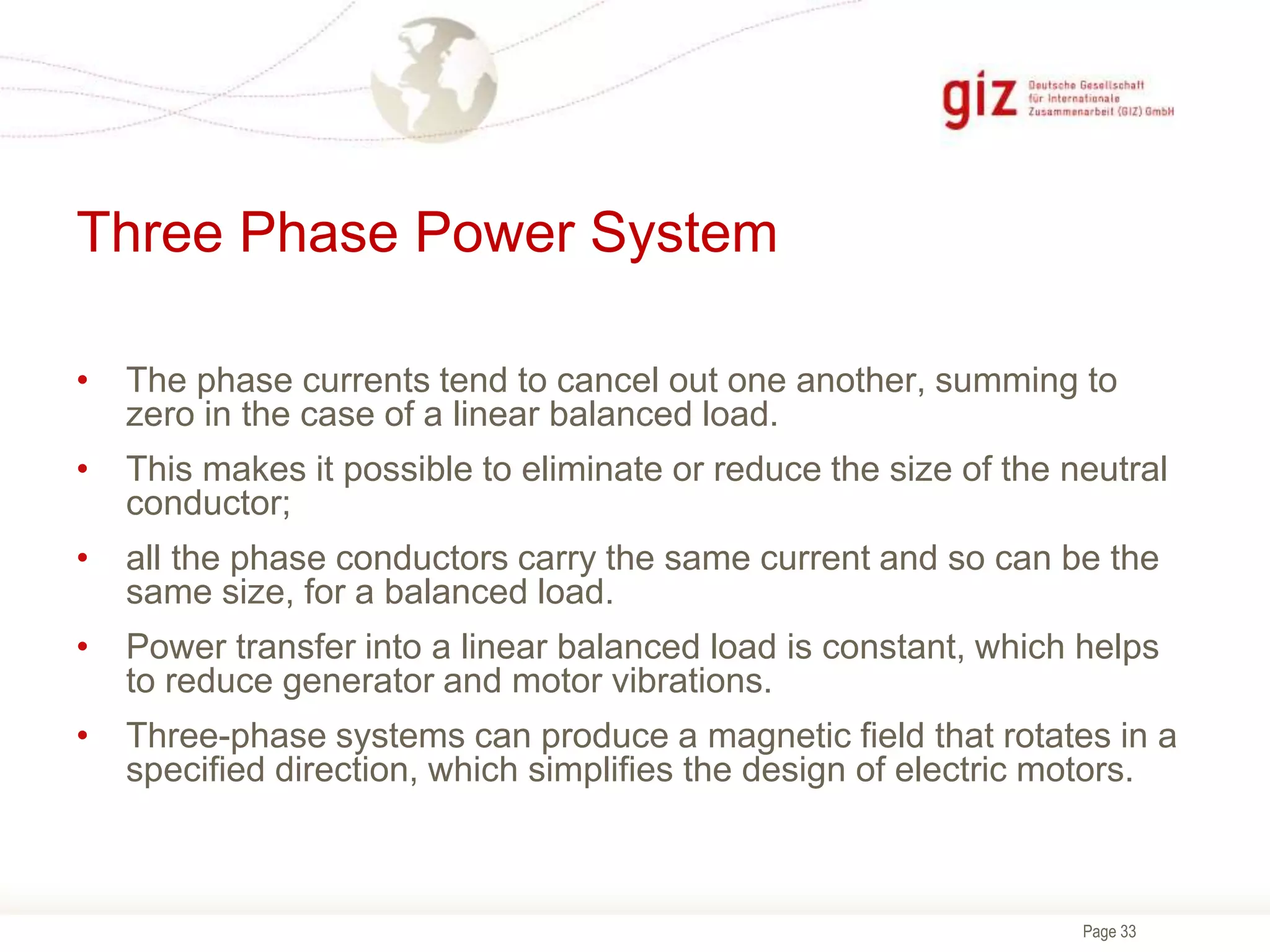
Three Phase Power System
• The phase currents tend to cancel out one another, summing to
zero in the case of a linear balanced load.
• This makes it possible to eliminate or reduce the size of the neutral
conductor;
• all the phase conductors carry the same current and so can be the
same size, for a balanced load.
• Power transfer into a linear balanced load is constant, which helps
to reduce generator and motor vibrations.
• Three-phase systems can produce a magnetic field that rotates in a
specified direction, which simplifies the design of electric motors.
Page 34
Y and Δ Connection
Page 35
Y and Δ Connection
STAR(Υ) DELTA (Δ)
IL = IPH IL = 3. IPH
VL = 3. VPH
VL = VPH
TOTAL POWER = 3. VL.IL TOTAL POWER = 3. VL.IL
Page 36
Where Does that 3 Come From
• Va = VPH ∠ 0 o; Vb = VPH ∠ -120 o; Vc = VPH ∠ -240 o
• Vab = Va - Vb
• VL = VPH ∠ 0 o - VPH ∠ -120 o
• VL = VPH (1 - 1 ∠ -120 o)
• VL = VPH {1 - (cos 120 o - jsin 120 o)}
• VL = VPH {1 - [(-
1
2
)- j(
3
2
)]}
• VL = VPH {1 - [(-
1
2
)+j (
3
2
)]}
• VL = VPH {
3
2
+j
3
2
} = VPH
𝟑
𝟐
+ VPH
𝟑
𝟐
Page 37
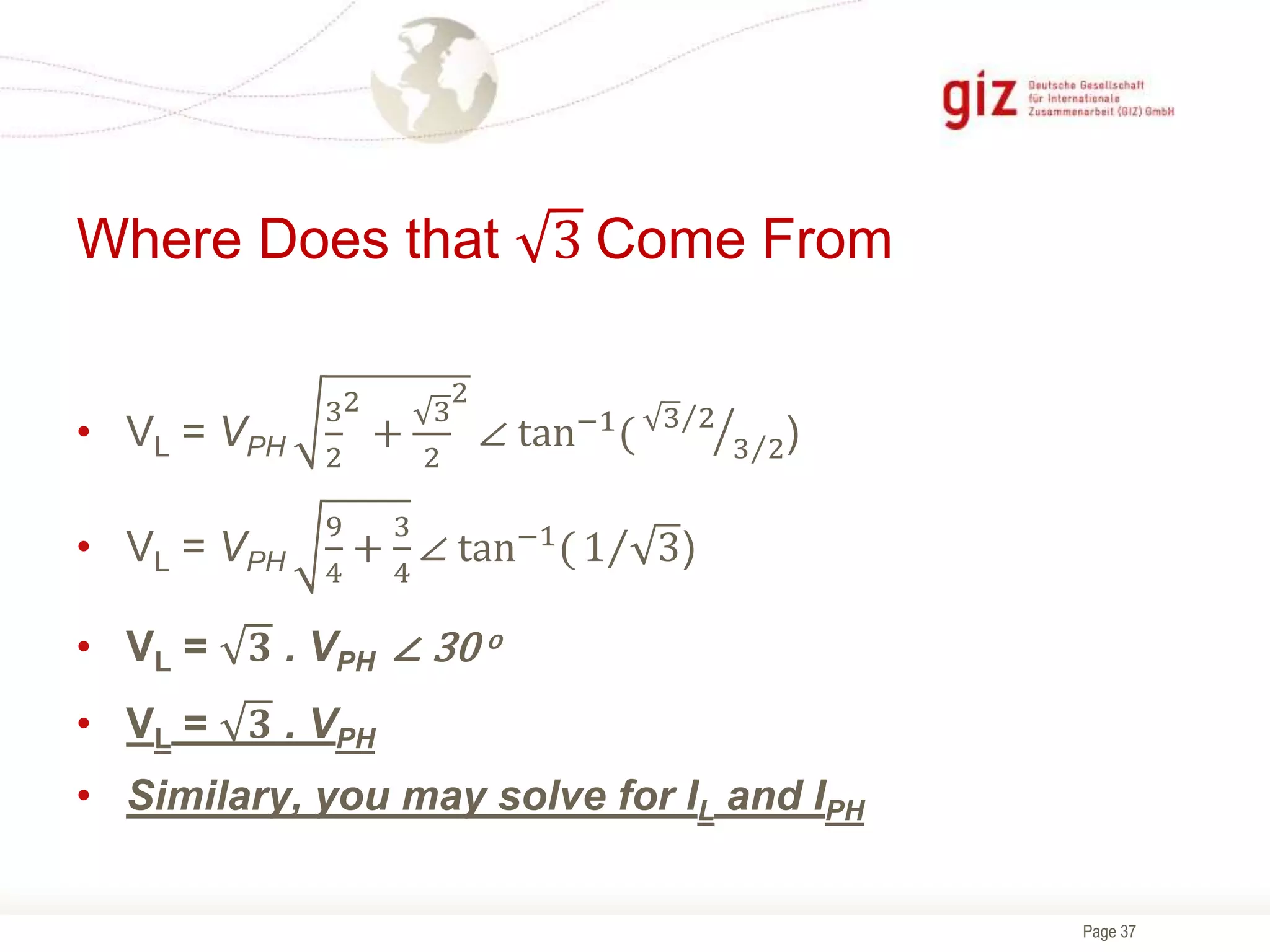
Where Does that 3 Come From
• VL = VPH
3
2
2
+
3
2
2
∠ tan−1
( 3 2
3 2)
• VL = VPH
9
4
+
3
4
∠ tan−1( 1 3)
• VL = 𝟑 . VPH ∠ 30 o
• VL = 𝟑 . VPH
• Similary, you may solve for IL and IPH
Page 38
Terms and Naming Conventions
• Phase: Describes or pertains to one element or device in a load, line, or source. It is simply a "branch" of the
circuit and could look something like this .
• Line : Refers to the "transmission line" or wires that connect the source (supply) to the load. It may be modeled as
a small impedance (actually 3 of them), or even by just a connecting line.
• Neutral: The 4th wire in the 3-phase system. It's where the phases of a Y connection come together.
• Phase Voltages & Phase Currents: The voltages and currents across and through a single branch (phase) of the
circuit. Note this definition depends on whether the connection is Wye or Delta!
• Line Currents :The currents flowing in each of the lines (Ia, Ib, and Ic). This definition does not change with
connection type.
• Line Voltages :The voltages between any two of the lines (Vab, Vbc, and Vca). These may also be referred to as
the line-to-line voltages. This definition does not change with connection type.
• Line to Neutral Voltage: The voltages between any lines and the neutral point (Va, Vb, and Vc). This definition
does not change with connection type, but they may not be physically measureable in a Delta circuit.
• Line to Neutral Current: Same as the line currents (Ia, Ib, and Ic).
Page 39
Thank you!
company presentation 2012
27/09/2021

Electrical engg material

  • 1.
  • 2.
    Page 2 AC • Batterysymbol is used as a generic symbol for any DC voltage source • The circle with the wavy line inside is the generic symbol for any AC voltage source
  • 3.
    Page 3 Generation ofAC • Simpler Design • Naturally Produced • No brushes for Motor • Greater Reliability • Low Cost
  • 4.
    Page 4 Generation ofDC • Complex Design • Commutator • Sparks & Heat • DC Motor Brushes • Dearer
  • 5.
    Page 5 Why AC?Why NOT DC?
  • 6.
  • 7.
  • 8.
    Page 8 AC Waveform Angle(o ) sin(angle) wave Angle (o ) sin(angle) wave 0 0.0000 zero 180 0.0000 zero 15 0.2588 + 195 -0.2588 - 30 0.5000 + 210 -0.5000 - 45 0.7071 + 225 -0.7071 - 60 0.8660 + 240 -0.8660 - 75 0.9659 + 255 -0.9659 - 90 1.0000 +peak 270 -1.0000 -peak 105 0.9659 + 285 -0.9659 - 120 0.8660 + 300 -0.8660 - 135 0.7071 + 315 -0.7071 - 150 0.5000 + 330 -0.5000 - 165 0.2588 + 345 -0.2588 - 180 0.0000 zero 360 0.0000 zero
  • 9.
  • 10.
  • 11.
    Page 11 RMS????? • AnAC measurement based on work performed by a waveform is not the same as that waveform's “average” value • The power dissipated by a given load (work performed per unit time) is not directly proportional to the magnitude of either the voltage or current impressed upon it • Power is proportional to the square of the voltage or current applied to a resistance (P = E2/R, and P = I2R) • Method of deriving an aggregate value for waveform amplitude is based on the waveform's ability to do useful work when applied to a load resistance
  • 12.
  • 13.
    Page 13 VRMS • Thequalifier “RMS” stands for Root Mean Square • The procedure consists of squaring all the positive and negative points on a waveform graph, averaging those squared values, then taking the square root of that average to obtain the final answer • RMS value of an alternating waveform is the value that, when applied across a resistance, produces that same amount of heat that a direct current (DC) voltage of the same magnitude would produce • RMS amplitude (VRMS) measurement is the best way to relate AC quantities to DC quantities, or other AC quantities of differing waveform shapes, when dealing with measurements of electric power • 𝑉𝑃𝐾 = 2 . 𝑉𝑅𝑀𝑆
  • 14.
    Page 14 VRMS, VPK,VPK-PK, VAV • VRMS is the Root Mean Square Value of Alternating Current. Also sometimes termed as DC Equivalent. • VPK is a way to express the intensity, or magnitude (also called the amplitude), of an AC quantity to measure its peak height on a waveform graph • VPK-PK is another way to measure the total height between opposite peaks • VAV is the mathematical average of the values of all the points on a waveform's graph to a single, aggregate number. • When determining the proper size of wire (ampacity) to conduct electric power from a source to a load, RMS current (IRMS) measurement is the best to use, because the principal concern with current is overheating of the wire • When rating insulators for service in high-voltage AC applications, peak voltage (VPK) measurements are the most appropriate, because the principal concern here is insulator “flashover” caused by brief spikes of voltage, irrespective of time
  • 15.
    Page 15 Derive VRMS 𝑉𝑅𝑀𝑆= 1 𝜋 2 0 𝜋 2 𝑉𝑃𝐾 sin 𝜃 2 . 𝜕𝜃 𝑉𝑅𝑀𝑆 = 2. 𝑉𝑃𝐾 2 𝜋 𝜃 2 − 1 4 sin 2 − 𝜃 0 𝜋/2 𝑉𝑅𝑀𝑆 = 2 𝑉𝑃𝐾 √𝜋 𝜋 2 2 − 1 4 sin 𝜋 − 0 2 − 1 4 sin 0 𝑉𝑅𝑀𝑆 = 2𝑉𝑃𝐾 𝜋 𝜋 4 − 0 − 0 − 0 𝑉𝑅𝑀𝑆 = 2𝑉𝑃𝐾 𝜋 . 𝜋 2 = 1 2 𝑉𝑃𝐾 VRMS = 1 2 . 𝑉𝑃𝐾 VRMS = 0.707 . 𝑉𝑃𝐾
  • 16.
    Page 16 Derive VAV 𝑉𝐴𝑉= 1 𝜋 2 0 𝜋 2 𝑉𝑃𝐾 . sin 𝜃 . 𝛿𝜃 𝑉𝐴𝑉 = 𝜋 2 . 𝑉𝑃𝐾 − cos 𝜃 |𝜋 2 0 𝑉𝐴𝑉 = −2 𝜋 . 𝑉𝑃𝐾 cos 𝜋 2 − cos 0 𝑉𝐴𝑉 = −2 𝜋 . 𝑉𝑃𝐾 0 − 1 𝑉𝐴𝑉 = 2 𝜋 . 𝑉𝑃𝐾 𝑉𝐴𝑉 = 0.636 . 𝑉𝑃𝐾
  • 17.
    Page 17 Proof ofDerivation Angle (o) sin(angle) wave Angle (o) sin(angle) wave 0 0.0000 zero 180 0.0000 zero 15 0.2588 + 195 -0.2588 - 30 0.5000 + 210 -0.5000 - 45 0.7071 + 225 -0.7071 - 60 0.8660 + 240 -0.8660 - 75 0.9659 + 255 -0.9659 - 90 1.0000 +peak 270 -1.0000 -peak 105 0.9659 + 285 -0.9659 - 120 0.8660 + 300 -0.8660 - 135 0.7071 + 315 -0.7071 - 150 0.5000 + 330 -0.5000 - 165 0.2588 + 345 -0.2588 - 180 0.0000 zero 360 0.0000 zero Description Full Cycle Qtr Cycle Sum 1719.1 429.8 Count 28.0 7.0 Mean (Avg Voltage) 61.4 61.4 Sum of Squares 139995.5 34998.9 Mean of Squares 4999.8 4999.8 Root of Mean of Squares 70.7 70.7
  • 18.
  • 19.
    Page 19 Additional Information •The conversion constants shown here for peak, RMS, and average amplitudes of sine waves, square waves, and triangle waves hold true only for pure forms of these wave shapes • The crest factor of an AC waveform, is the ratio of its peak (crest) value divided by its RMS value • The form factor of an AC waveform is the ratio of its RMS value divided by its average value • The amplitude of an AC waveform is its height as depicted on a graph over time
  • 20.
    Page 20 Three PhaseAdvantages • The horsepower rating of three phase motors and the KVA rating of three phase transformers are 150% greater than single phase motors or transformers of similar frame size • The power delivered by a single phase system pulsates and falls to zero. The three phase power never falls to zero. The power delivered to three phase system is the same at any instant. This produces superior characteristics for three-phase motors • A three phase system needs three conductors, however each conductor is only 75% the size of equivalent KVA rated single phase conductors
  • 21.
    Page 21 Single PhaseSystems P1 = 20 kW P2 = 20 kW Load 1 Load 2 220 V AC • 𝐼 = 𝑃 𝐸 = 20000 220 = 90.9 𝐴𝑚𝑝𝑠 • 𝐼𝑡𝑜𝑡𝑎𝑙 = 𝐼𝐿1 + 𝐼𝐿2 = 90.9 + 90.9 = 181.8 𝐴𝑚𝑝𝑠 • Ptotal = P1 + P2 = 20 kW + 20 kW = 40kW • Copper Size??? • Copper Weight??? • Copper Cost???
  • 22.
    Page 22 Single PhaseSystems Load 1 Load 2 P1 = 20 kW P2 = 20 kW 440 V AC • 𝐼 = 𝑃 𝐸 = 20000 440 = 45.45 𝐴𝑚𝑝𝑠 • 𝐼𝑡𝑜𝑡𝑎𝑙 = 𝐼𝐿1 + 𝐼𝐿2 = 45.45 + 45.45 = 90.9 𝐴𝑚𝑝𝑠 • Ptotal = P1 + P2 = 20 kW + 20 kW = 40kW • Same power at half the cost, size and weight
  • 23.
    Page 23 Modified PowerSystem • Current is sill same • Power is same • What if one of the LOAD is open? • If either load is open, current will stop Load 1 Load 2 220 V 20 kW 220 V 20 kW 440 V AC 45.45 A 45.45 A 440 V
  • 24.
    Page 24 Split-Phase System •More efficient • More Safe Load 1 Load 2 220 V 20 kW 220 V 20 kW 220 V AC 45.45 A 45.45 A 440 V 220 V AC 0 A
  • 25.
    Page 25 TRIGONOMETRY FUNCTION θ𝟎° 𝟑𝟎° 𝟒𝟓° 𝟔𝟎° 𝟗𝟎° sin 𝜃 0 1 2 1 2 3 2 1 cos 𝜃 1 3 2 1 2 1 2 0 θ 𝟗𝟎° 𝟏𝟐𝟎° 𝟏𝟑𝟓° 𝟏𝟓𝟎° 𝟏𝟖𝟎° sin 𝜃 1 3 2 1 2 1 2 0 cos 𝜃 0 − 1 2 − 1 2 − 3 2 − 1
  • 26.
    Page 26 Complex Numbers •Z = x + jy • Z - is the Complex Number representing the Vector • x - is the Real part or the Active component • y - is the Imaginary part or the Reactive component • j - is defined by −1
  • 27.
    Page 27 POLAR FORM •Z = A ∠θ • 𝐴2 = 𝑥2 + 𝑦2 • 𝐴 = 𝑥2 + 𝑦2 • 𝑥 = 𝐴 cos 𝜃 • 𝑦 = 𝐴 sin 𝜃 • 𝜃 = tan−1 𝑦 𝑥
  • 28.
    Page 28 Converting Polarto Complex • Given 6 ∠ 30 o • 6 ∠ 30 o= 𝑥 + 𝑗𝑦 • 𝑥 = 𝐴 cos 𝜃, 𝑦 = 𝐴 sin 𝜃 • 6 ∠ 30 o= 6 cos 𝜃 + 𝑗6 sin 𝜃 • 6 ∠ 30 o= 6 cos 30° + 𝑗6 sin 30° • 6 ∠ 30 o= (6 x 0.866) + j (6 x 0.5) • 6 ∠ 30 o= 5.2+ j3
  • 29.
    Page 29 Converting Complexto Polar • Given 5.2+ j3 • 5.2+ j3 = A ∠θ • A = 5.22 + 32 • A = 6 • 𝜃 = tan−1 𝑦 𝑥 • 𝜃 = tan−1 3 5.2 = 30 O • 5.2+ j3 = 6 ∠30 o
  • 30.
    Page 30 Three PhasePower System • 220 ∠ 0 o - 220 ∠ 120 o • 220 + 𝑗0 + 110 + 𝑗190 • 330 + j190 • 380 ∠ -30 o Load 1 Load 2 220 V 20 kW 220 V 20 kW 220 V AC ∠ 120 o 45.45 A 45.45 A 380 V 220 V AC ∠ 0 o
  • 31.
    Page 31 Three PhasePower System • The 3rd wire carries current • Therefore, we could have a voltage source on the 3rd wire also • Thus achieving a 3 phase power systems Load 1 Load 2 220 V 20 kW 220 V 20 kW 220 V AC ∠ 120 o 45.45 A 45.45 A 440 V 0 A 220 V AC ∠ 240 o 220 V AC ∠ 0 o
  • 32.
    Page 32 Three PhasePower System • Three-Phase system is the most common method used by electric power distribution grids worldwide to distribute power • A three-phase system is generally more economical than others • Three-phase system was introduced and patented by Nikola Tesla
  • 33.
    Page 33 Three PhasePower System • The phase currents tend to cancel out one another, summing to zero in the case of a linear balanced load. • This makes it possible to eliminate or reduce the size of the neutral conductor; • all the phase conductors carry the same current and so can be the same size, for a balanced load. • Power transfer into a linear balanced load is constant, which helps to reduce generator and motor vibrations. • Three-phase systems can produce a magnetic field that rotates in a specified direction, which simplifies the design of electric motors.
  • 34.
    Page 34 Y andΔ Connection
  • 35.
    Page 35 Y andΔ Connection STAR(Υ) DELTA (Δ) IL = IPH IL = 3. IPH VL = 3. VPH VL = VPH TOTAL POWER = 3. VL.IL TOTAL POWER = 3. VL.IL
  • 36.
    Page 36 Where Doesthat 3 Come From • Va = VPH ∠ 0 o; Vb = VPH ∠ -120 o; Vc = VPH ∠ -240 o • Vab = Va - Vb • VL = VPH ∠ 0 o - VPH ∠ -120 o • VL = VPH (1 - 1 ∠ -120 o) • VL = VPH {1 - (cos 120 o - jsin 120 o)} • VL = VPH {1 - [(- 1 2 )- j( 3 2 )]} • VL = VPH {1 - [(- 1 2 )+j ( 3 2 )]} • VL = VPH { 3 2 +j 3 2 } = VPH 𝟑 𝟐 + VPH 𝟑 𝟐
  • 37.
    Page 37 Where Doesthat 3 Come From • VL = VPH 3 2 2 + 3 2 2 ∠ tan−1 ( 3 2 3 2) • VL = VPH 9 4 + 3 4 ∠ tan−1( 1 3) • VL = 𝟑 . VPH ∠ 30 o • VL = 𝟑 . VPH • Similary, you may solve for IL and IPH
  • 38.
    Page 38 Terms andNaming Conventions • Phase: Describes or pertains to one element or device in a load, line, or source. It is simply a "branch" of the circuit and could look something like this . • Line : Refers to the "transmission line" or wires that connect the source (supply) to the load. It may be modeled as a small impedance (actually 3 of them), or even by just a connecting line. • Neutral: The 4th wire in the 3-phase system. It's where the phases of a Y connection come together. • Phase Voltages & Phase Currents: The voltages and currents across and through a single branch (phase) of the circuit. Note this definition depends on whether the connection is Wye or Delta! • Line Currents :The currents flowing in each of the lines (Ia, Ib, and Ic). This definition does not change with connection type. • Line Voltages :The voltages between any two of the lines (Vab, Vbc, and Vca). These may also be referred to as the line-to-line voltages. This definition does not change with connection type. • Line to Neutral Voltage: The voltages between any lines and the neutral point (Va, Vb, and Vc). This definition does not change with connection type, but they may not be physically measureable in a Delta circuit. • Line to Neutral Current: Same as the line currents (Ia, Ib, and Ic).
  • 39.
    Page 39 Thank you! companypresentation 2012 27/09/2021

Editor's Notes

  • #4 Theoritically if you think generation of AC is the easiest. Simply place a rotating magnet between coils and that’s it
  • #22 Copper size = ¼ inch Copper weight = 2.5 kg per meter (approx) Copper Cost = Surely high
  • #23 Reduced to half