No. 1
KGTTI PRESENTATION
DC generators
The dc generator Converts the mechanical
energy to electrical energy
No. 2
KGTTI PRESENTATION
GENARATOR PRINCIPLE
The energy conversion is based on the principle of the production of
motionally induced e.m.f. As seen from fig above whenever a conductor cuts
magnetic flux, induced e.m.f. is produced in it according to Faraday’s Laws of
Electromagnetic Induction which circulates a current if the conductor circuit
is closed and the direction of induced current can be obtained by using
Fleming Right Hand Rule
No. 3
KGTTI PRESENTATION
FLEMINGS RIGHT HAND RULE
This rule states : "Hold out the right hand with the fore finger, middle finger and
thumb at right angle to each other.
 The forefinger represents the direction of field,
 The thumb points in the direction of motion or applied force,
 Then the middle finger points in the direction of the induced current
No. 4
KGTTI PRESENTATION
WORKING PRINCIPLE – DC GENERATOR
No. 5
KGTTI PRESENTATION
• Rectangular loop of conductor is ABCD which rotates inside the magnetic
field about its own axis ab.
• When the loop rotates from its vertical position to its horizontal position, it
cuts the flux lines of the field
• AB and CD of the loop cut the flux lines there will be an e.m.f induced in
these both of the sides (AB & BC) of the loop
• The direction of the current can be determined by Fleming's right hand Rule
WORKING PRINCIPLE – DC GENERATOR
No. 6
KGTTI PRESENTATION
• if we apply this right hand rule, we will see at this horizontal position of the
loop, electric current will flow from point A to B and on the other side of
the loop current will flow from point C to D
• If we allow the loop to move further, it will come again to its vertical
position
• Now upper side of the loop will be CD and lower side will be AB (just
opposite of the previous vertical position)
• At this position the tangential motion of the sides of the loop is parallel to
the flux lines of the field
WORKING PRINCIPLE – DC GENERATOR
No. 7
KGTTI PRESENTATION
• Hence there will be no question of flux cutting and consequently there will
be no current in the loop
• If the loop rotates further, it comes to again in horizontal position
• AB side of the loop comes in front of N pole and CD comes in front of S
pole, i.e. just opposite to the previous horizontal position as shown in the
figure beside
• Here the tangential motion of the side of the loop is perpendicular to the
flux lines, hence rate of flux cutting is maximum here and according to
Fleming’s right hand rule, at this position current flows from B to A and on
other side from D to C
WORKING PRINCIPLE – DC GENERATOR
No. 8
KGTTI PRESENTATION
COMMUTATOR
No. 9
KGTTI PRESENTATION
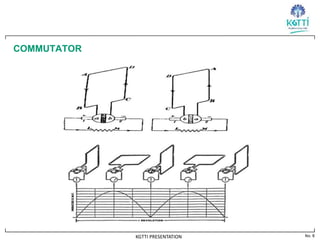
• It is seen that in the first half of the revolution current flows always along
ABLMCD i.e. brush no 1 in contact with segment a
• In the next half revolution, in the figure the direction of the induced
current in the coil is reversed
• But at the same time the position of the segments a and b are also
reversed which results that brush no 1 comes in touch with that segment b
• Hence, the current in the load resistance again flows from L to M
• The wave form of the current through the load circuit is as shown in the
figure. This current is unidirectional
COMMUTATOR

Dc gen

  • 1.
    No. 1 KGTTI PRESENTATION DCgenerators The dc generator Converts the mechanical energy to electrical energy
  • 2.
    No. 2 KGTTI PRESENTATION GENARATORPRINCIPLE The energy conversion is based on the principle of the production of motionally induced e.m.f. As seen from fig above whenever a conductor cuts magnetic flux, induced e.m.f. is produced in it according to Faraday’s Laws of Electromagnetic Induction which circulates a current if the conductor circuit is closed and the direction of induced current can be obtained by using Fleming Right Hand Rule
  • 3.
    No. 3 KGTTI PRESENTATION FLEMINGSRIGHT HAND RULE This rule states : "Hold out the right hand with the fore finger, middle finger and thumb at right angle to each other.  The forefinger represents the direction of field,  The thumb points in the direction of motion or applied force,  Then the middle finger points in the direction of the induced current
  • 4.
    No. 4 KGTTI PRESENTATION WORKINGPRINCIPLE – DC GENERATOR
  • 5.
    No. 5 KGTTI PRESENTATION •Rectangular loop of conductor is ABCD which rotates inside the magnetic field about its own axis ab. • When the loop rotates from its vertical position to its horizontal position, it cuts the flux lines of the field • AB and CD of the loop cut the flux lines there will be an e.m.f induced in these both of the sides (AB & BC) of the loop • The direction of the current can be determined by Fleming's right hand Rule WORKING PRINCIPLE – DC GENERATOR
  • 6.
    No. 6 KGTTI PRESENTATION •if we apply this right hand rule, we will see at this horizontal position of the loop, electric current will flow from point A to B and on the other side of the loop current will flow from point C to D • If we allow the loop to move further, it will come again to its vertical position • Now upper side of the loop will be CD and lower side will be AB (just opposite of the previous vertical position) • At this position the tangential motion of the sides of the loop is parallel to the flux lines of the field WORKING PRINCIPLE – DC GENERATOR
  • 7.
    No. 7 KGTTI PRESENTATION •Hence there will be no question of flux cutting and consequently there will be no current in the loop • If the loop rotates further, it comes to again in horizontal position • AB side of the loop comes in front of N pole and CD comes in front of S pole, i.e. just opposite to the previous horizontal position as shown in the figure beside • Here the tangential motion of the side of the loop is perpendicular to the flux lines, hence rate of flux cutting is maximum here and according to Fleming’s right hand rule, at this position current flows from B to A and on other side from D to C WORKING PRINCIPLE – DC GENERATOR
  • 8.
  • 9.
    No. 9 KGTTI PRESENTATION •It is seen that in the first half of the revolution current flows always along ABLMCD i.e. brush no 1 in contact with segment a • In the next half revolution, in the figure the direction of the induced current in the coil is reversed • But at the same time the position of the segments a and b are also reversed which results that brush no 1 comes in touch with that segment b • Hence, the current in the load resistance again flows from L to M • The wave form of the current through the load circuit is as shown in the figure. This current is unidirectional COMMUTATOR