CIRCUITS
• Draw and interpret circuit diagrams containing
cells, batteries, power supplies, generators,
potential dividers, switches, resistors (fixed
and variable), heaters, thermistors (NTC
only), light dependent resistors (LDRs),
lamps, motors, ammeters, voltmeters,
magnetising coils, transformers, fuses,
relays, and know how these components behave
in the circuit
Power supplies
• Cells, batteries, power supplies
and generators all supply
current to the circuit
Resistors
• Potential dividers, fixed and
variable resistors, thermistors
and light-dependent resistors
(LDRs) are all used to control
current
Meters
• Ammeters and voltmeters
are used to measure the
current and potential
difference
• Ammeters are always
connected in series whilst
voltmeters are always
connected in parallel
Electromagnetic Components
• Magnetising coils, relays and
transformers use
electromagnetic effects
• Relays use a small current in
one circuit to switch on a much
larger current in another
• Transformers 'step up' and 'step
down' current and potential
difference
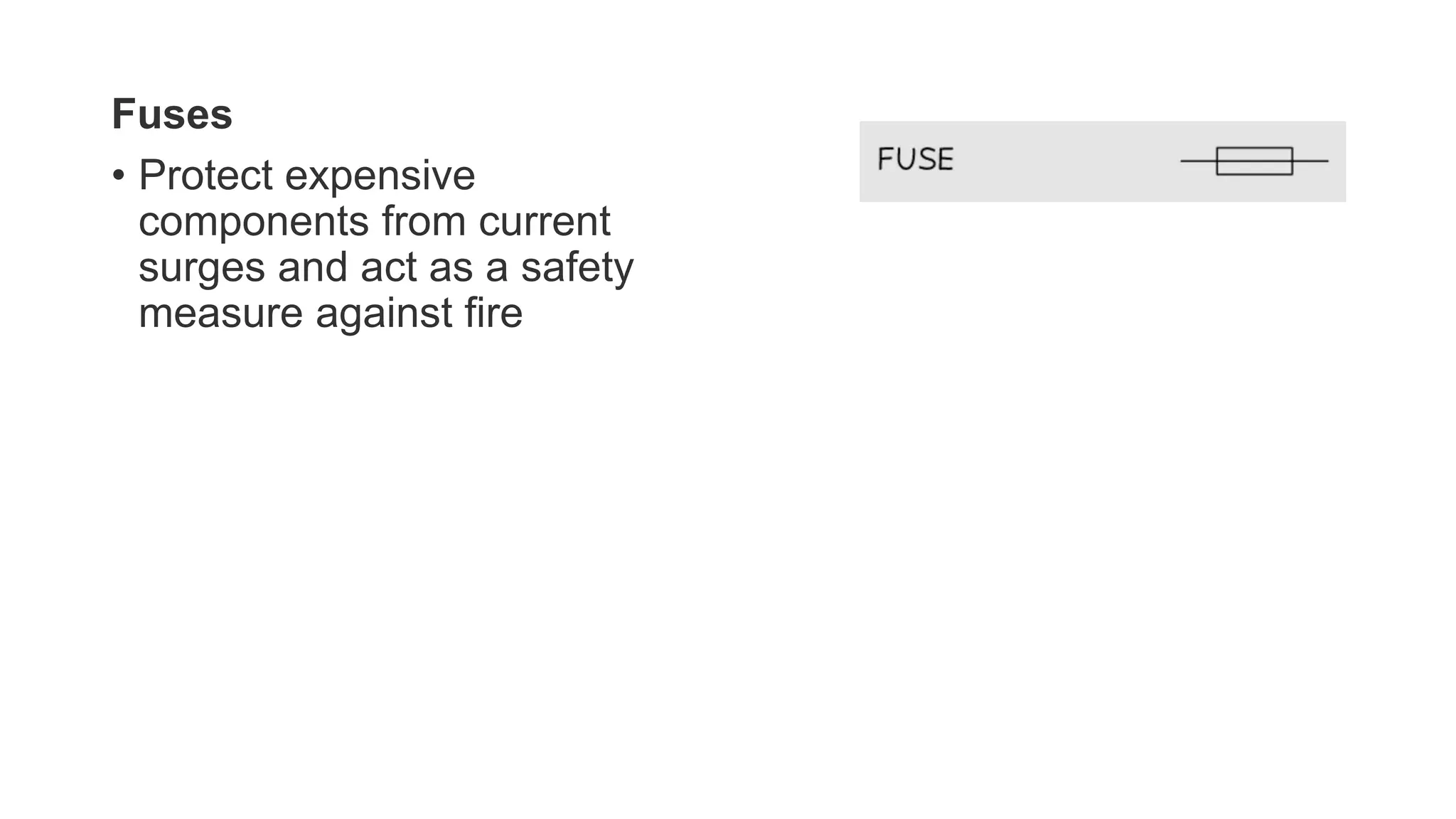
Fuses
• Protect expensive
components from current
surges and act as a safety
measure against fire
• Draw and interpret circuit diagrams containing
diodes and light-emitting diodes (LEDs), and
know how these components behave in a circuit
A diode is a component that only allows a current in one
direction
• (Note: diodes are occasionally drawn with a horizontal line
running through the middle of them)
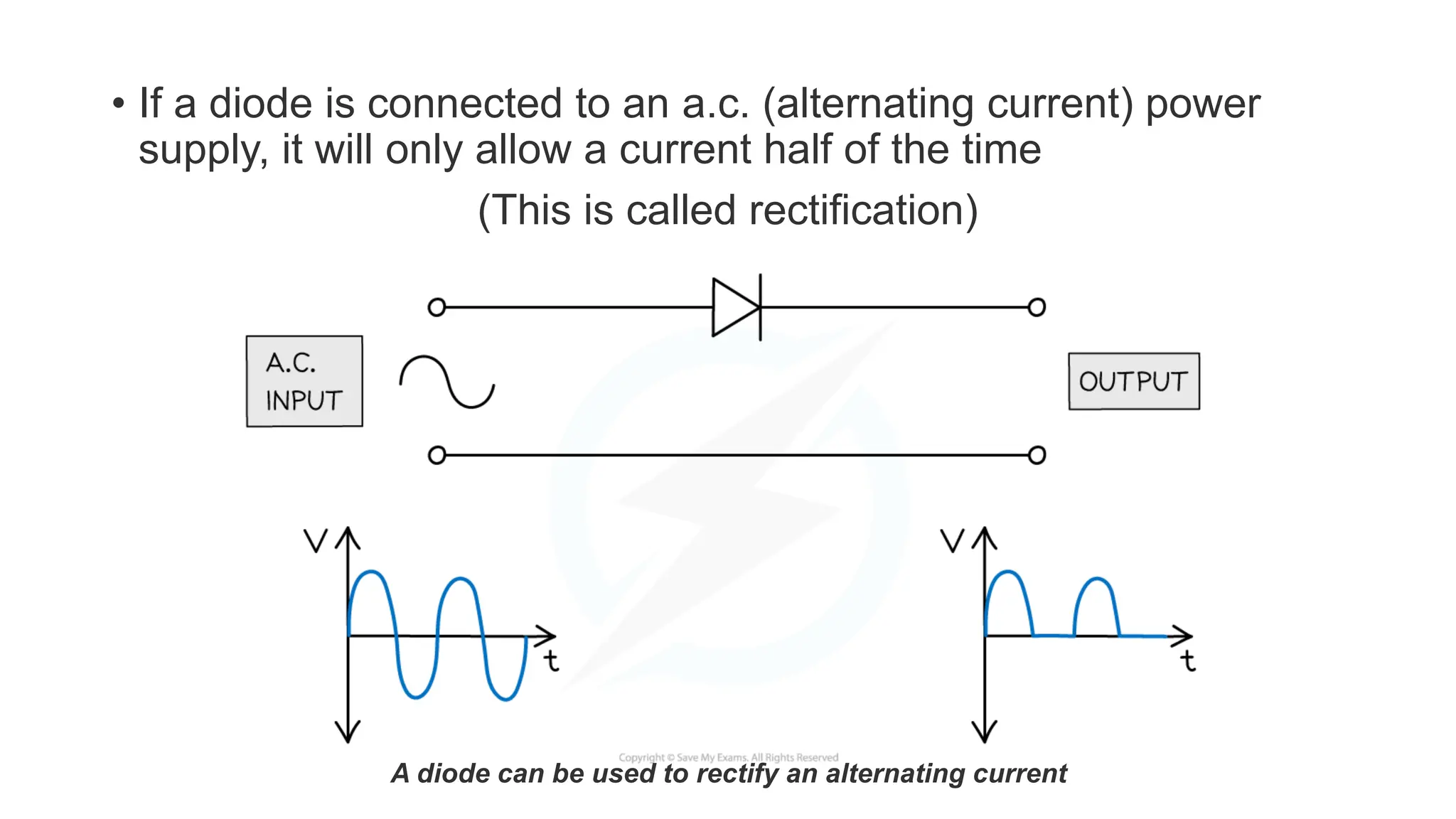
• If a diode is connected to an a.c. (alternating current) power
supply, it will only allow a current half of the time
(This is called rectification)
A diode can be used to rectify an alternating current
Resistance in a Light-Dependent Resistor
• A light-dependent resistor (LDR) is
a non-ohmic conductor and
sensory resistor
• Its resistance automatically
changes depending on the light
energy falling onto it (illumination)
• As the light intensity increases,
the resistance of an
LDR decreases
Graph of light intensity and resistance for an LDR
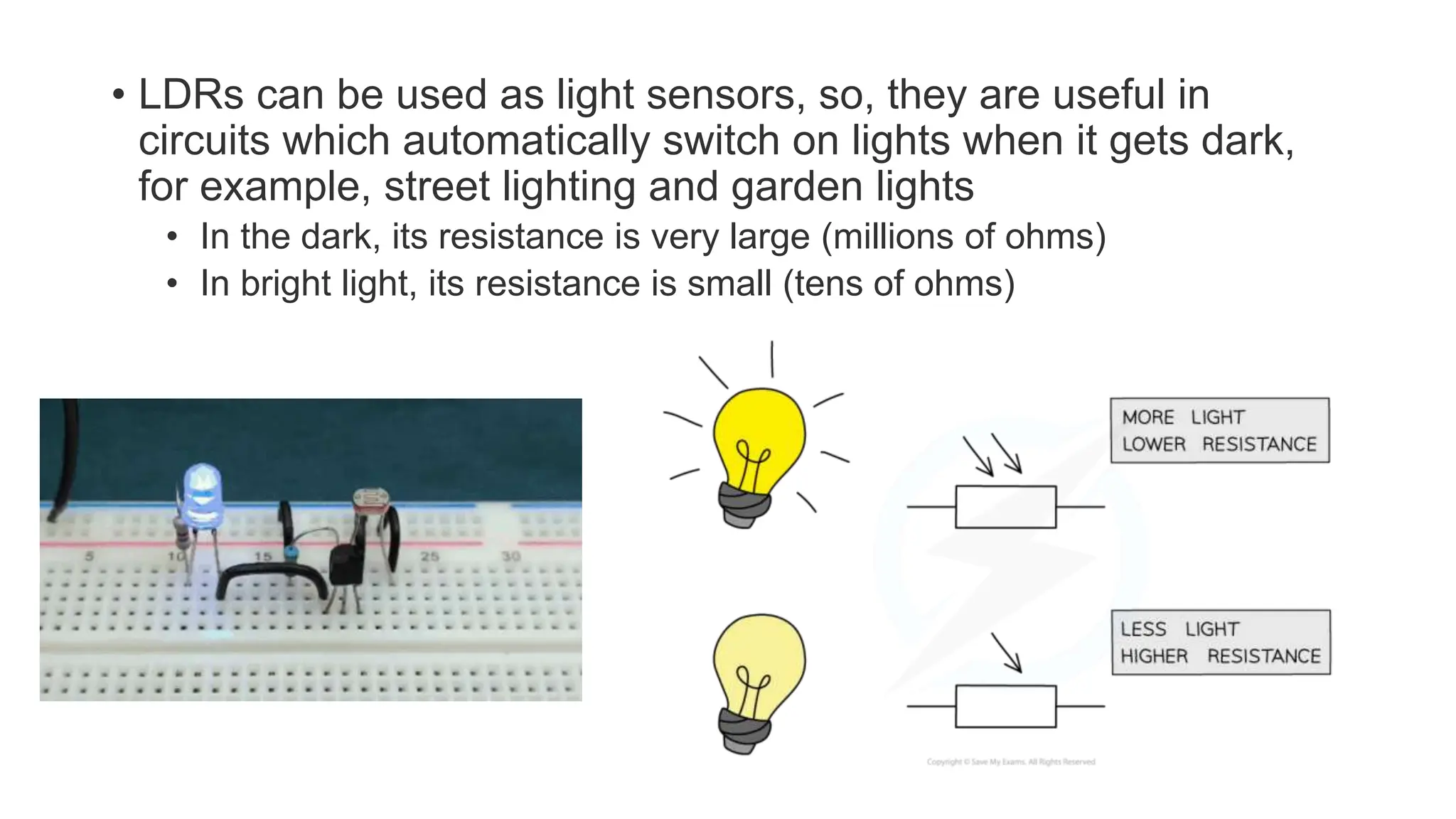
• LDRs can be used as light sensors, so, they are useful in
circuits which automatically switch on lights when it gets dark,
for example, street lighting and garden lights
• In the dark, its resistance is very large (millions of ohms)
• In bright light, its resistance is small (tens of ohms)
Resistance in a Thermistor
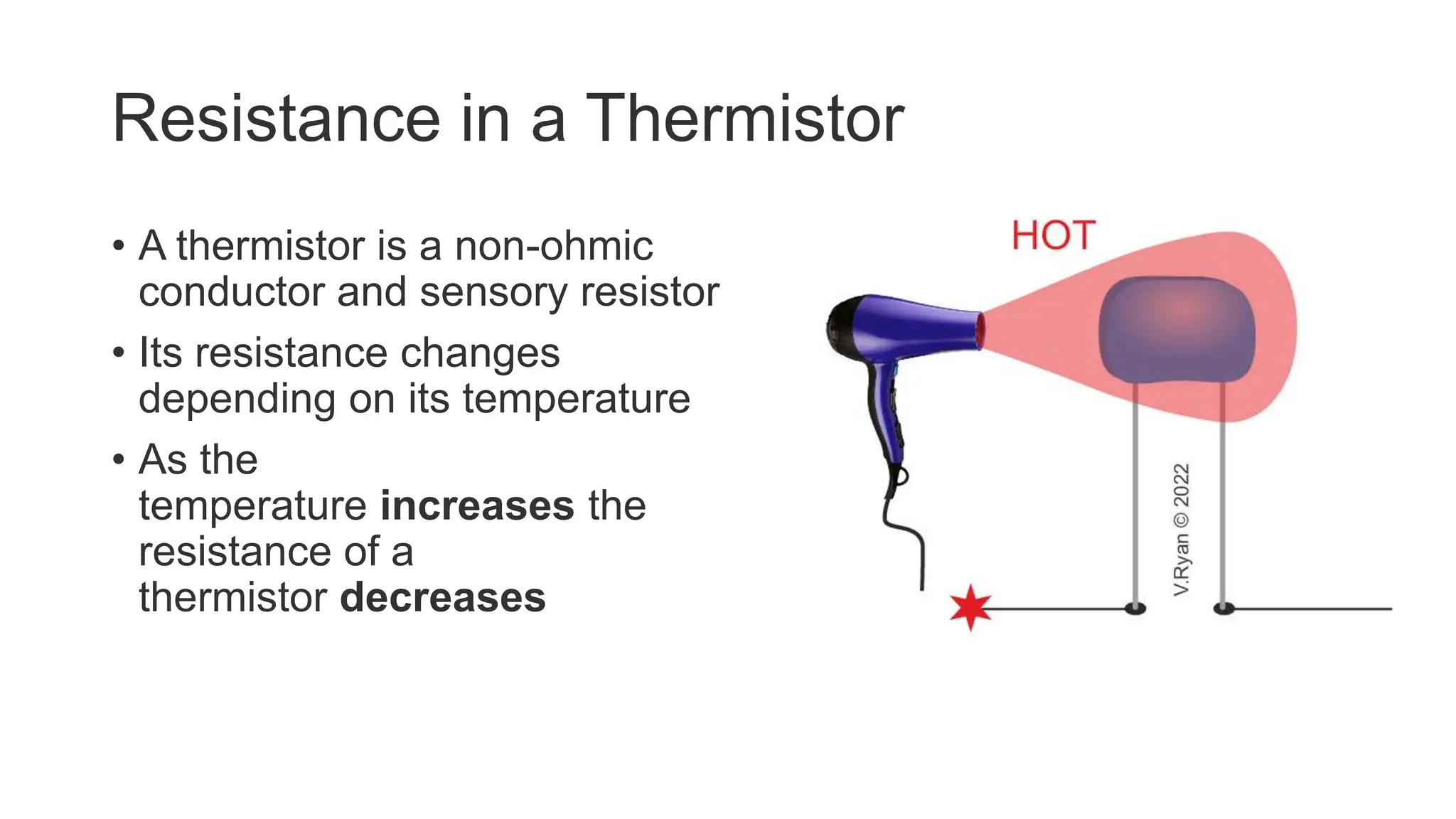
• A thermistor is a non-ohmic
conductor and sensory resistor
• Its resistance changes
depending on its temperature
• As the
temperature increases the
resistance of a
thermistor decreases
Graph of temperature and resistance for a thermistor
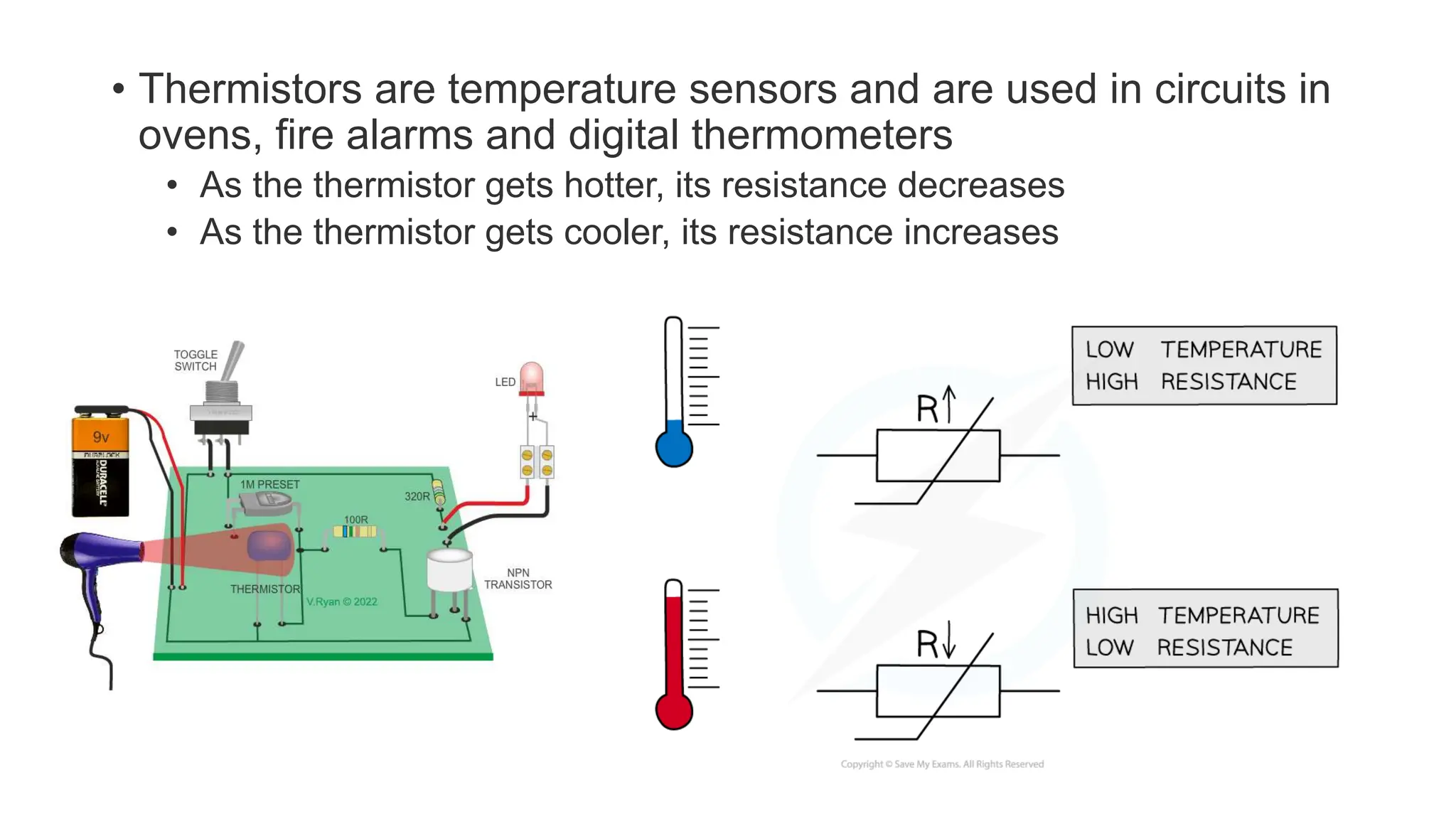
• Thermistors are temperature sensors and are used in circuits in
ovens, fire alarms and digital thermometers
• As the thermistor gets hotter, its resistance decreases
• As the thermistor gets cooler, its resistance increases
• Know how to construct and use series
and parallel circuits
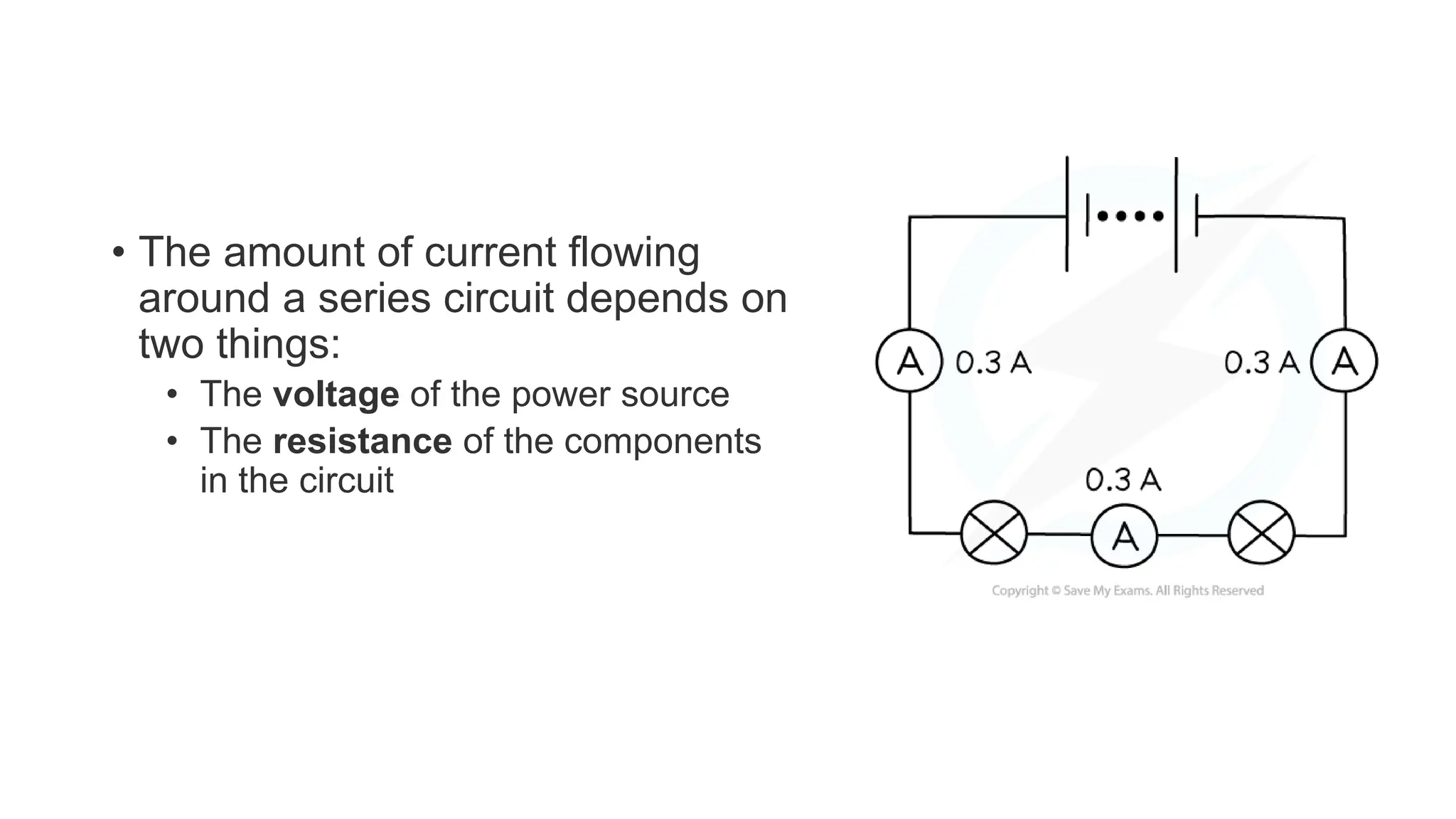
• In a series circuit, the current is
the same value at any point
• This is because the number of
electrons per second that passes
through one part of the circuit is
the same number that passes
through any other part
• This means that all components
in a closed-loop have the same
current
• The amount of current flowing
around a series circuit depends on
two things:
• The voltage of the power source
• The resistance of the components
in the circuit
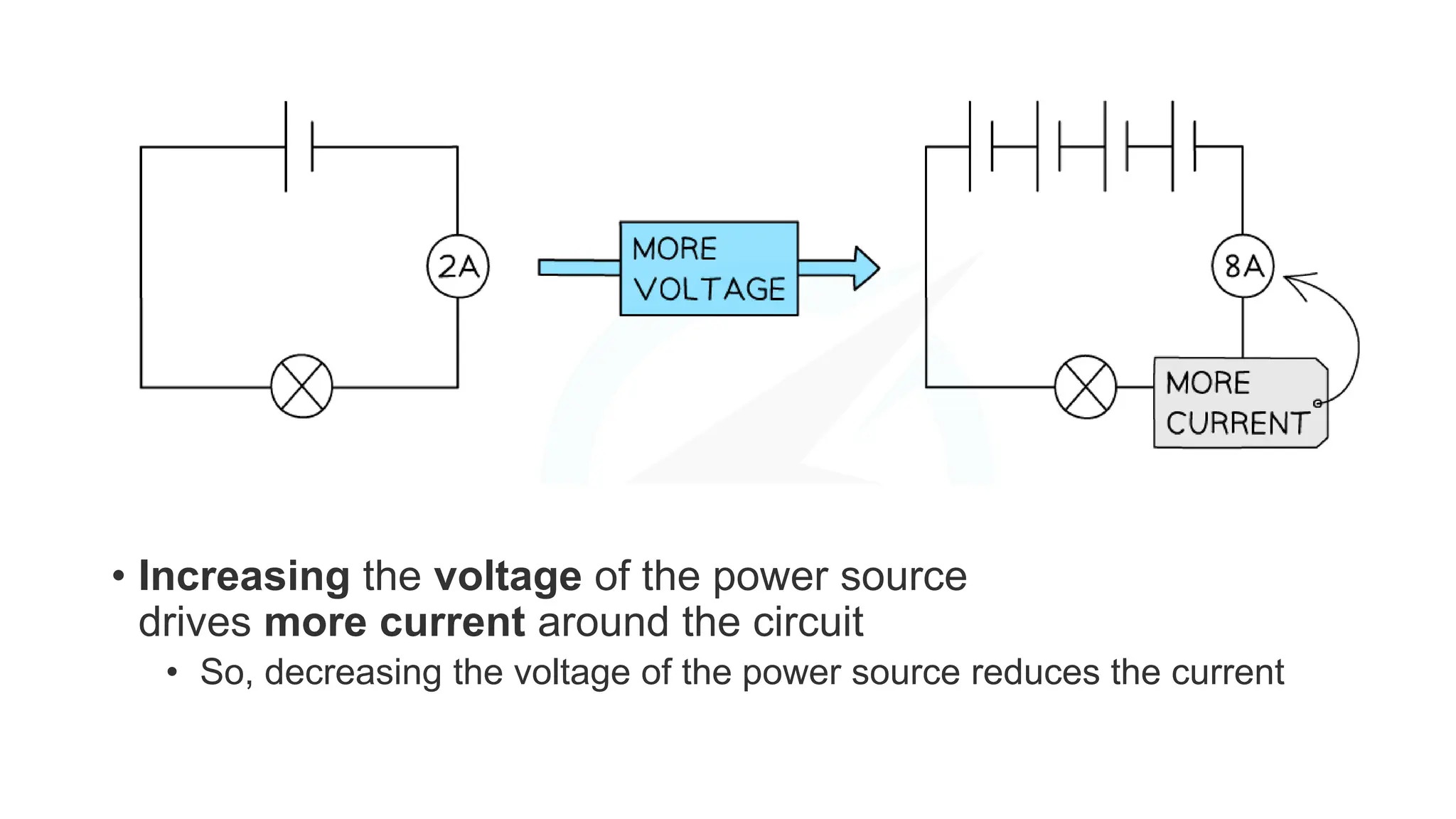
• Increasing the voltage of the power source
drives more current around the circuit
• So, decreasing the voltage of the power source reduces the current
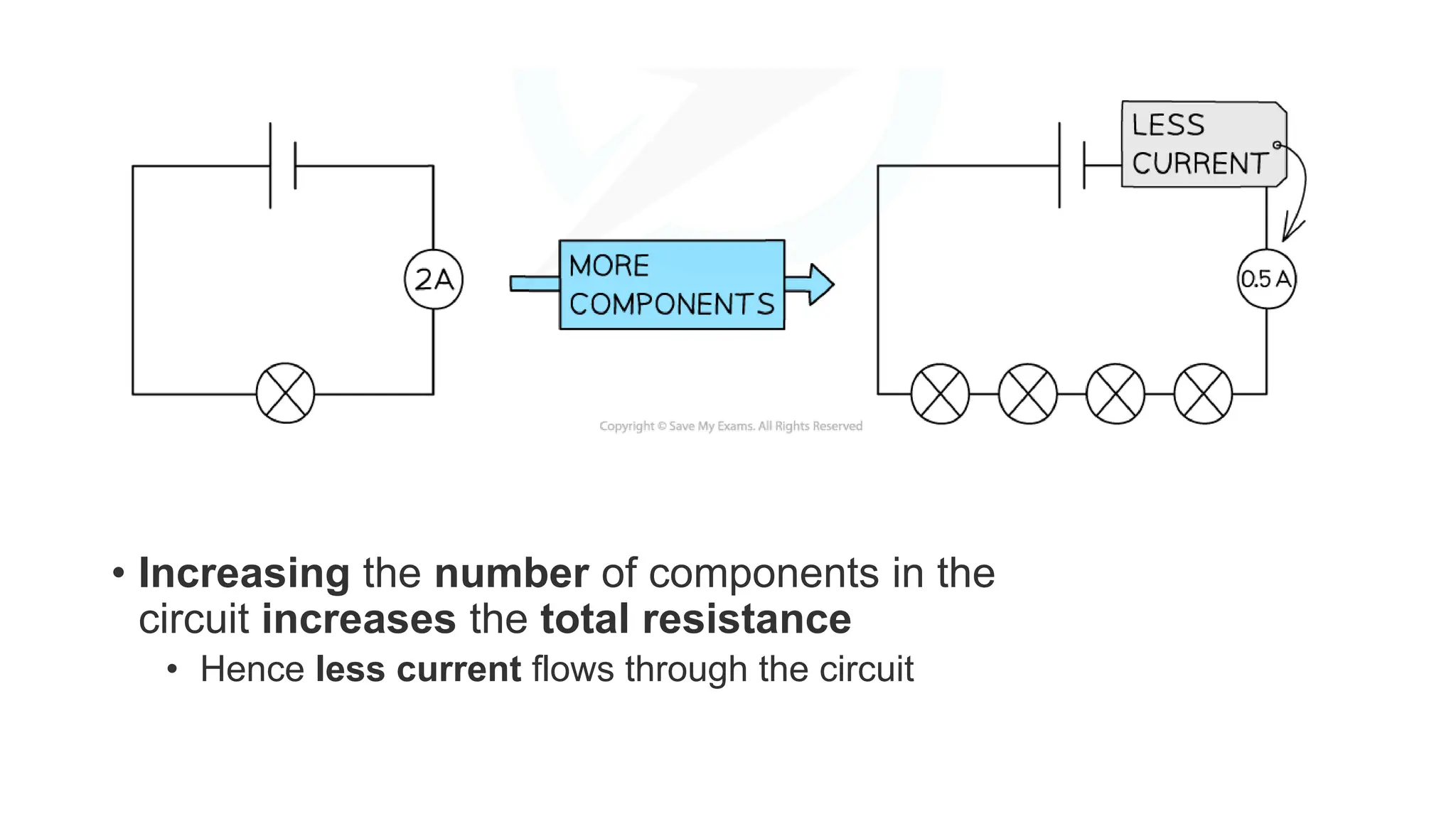
• Increasing the number of components in the
circuit increases the total resistance
• Hence less current flows through the circuit
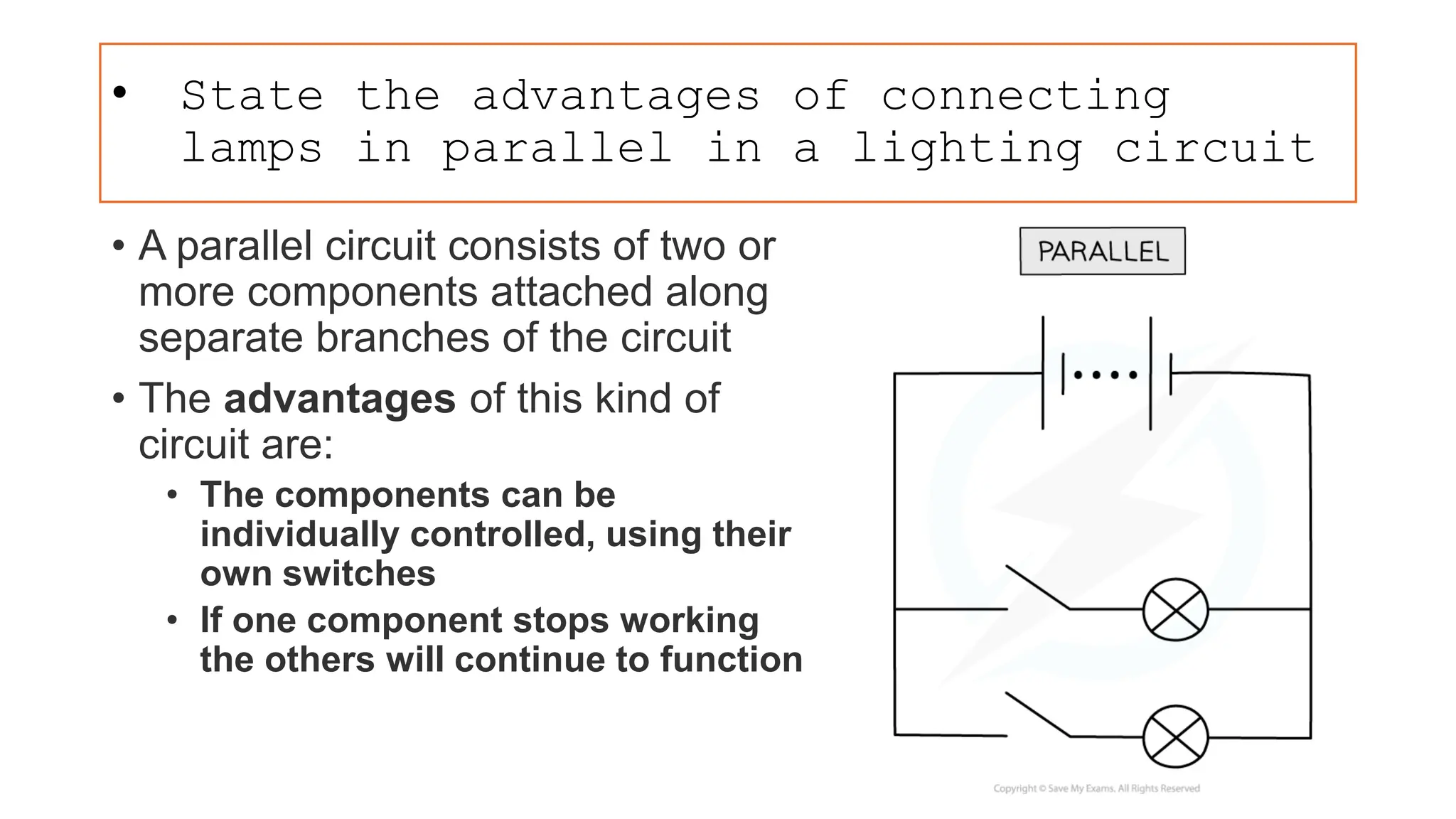
• State the advantages of connecting
lamps in parallel in a lighting circuit
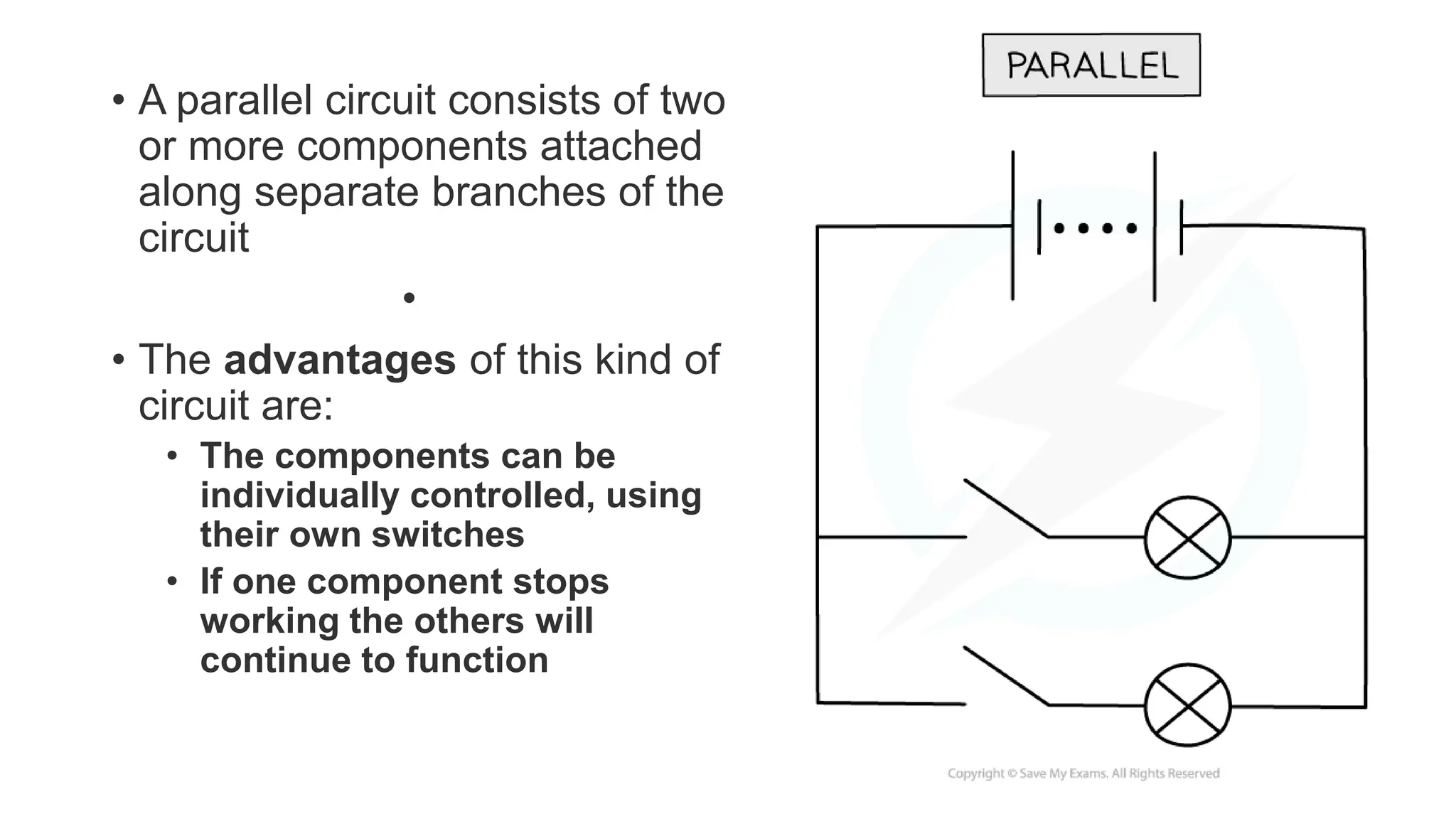
• A parallel circuit consists of two or
more components attached along
separate branches of the circuit
• The advantages of this kind of
circuit are:
• The components can be
individually controlled, using their
own switches
• If one component stops working
the others will continue to function
• In a parallel circuit, the current
splits up - some of it going one
way and the rest going the other
• This means that the current in each
branch will be smaller than the
current from the power supply
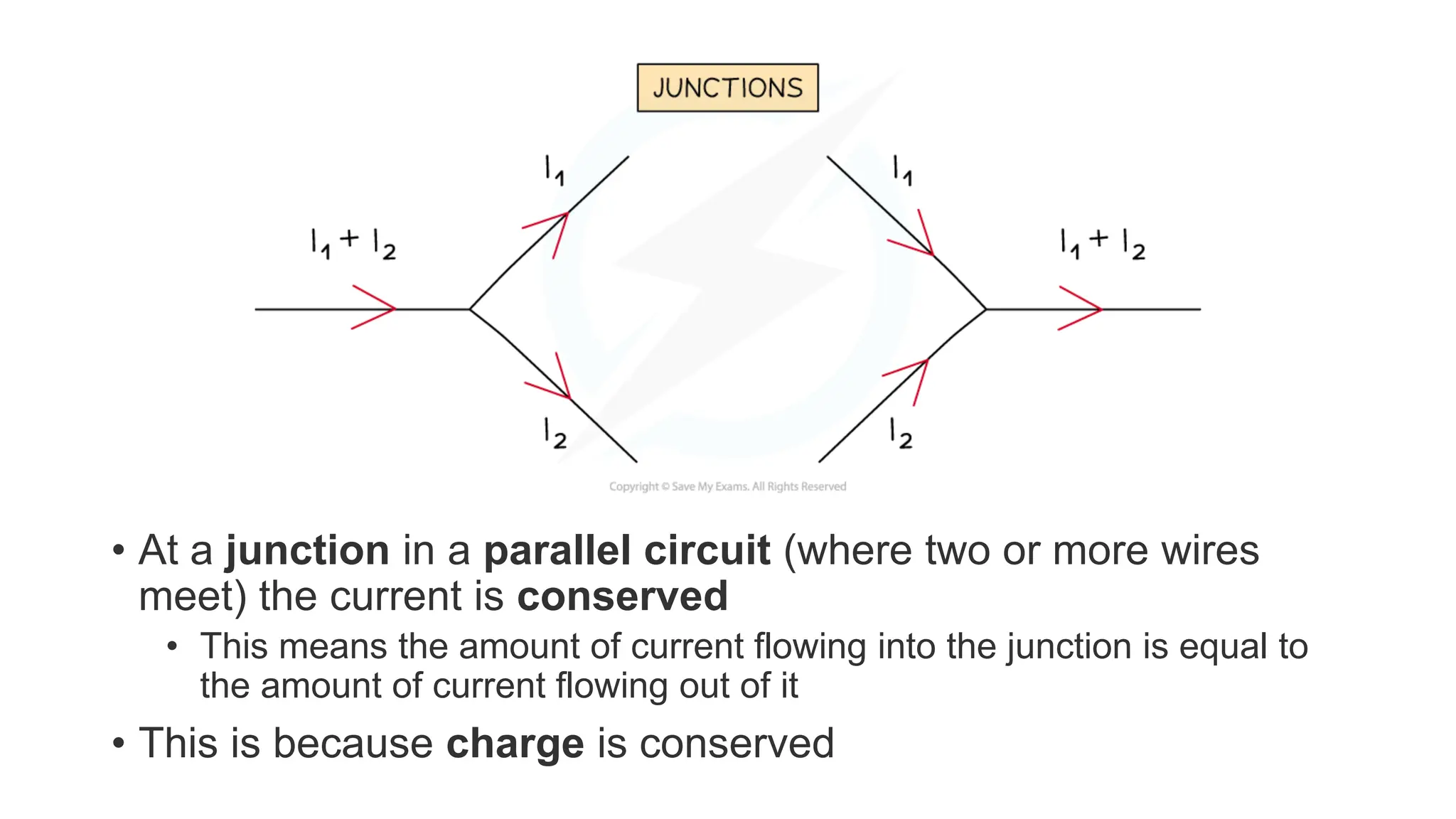
• At a junction in a parallel circuit (where two or more wires
meet) the current is conserved
• This means the amount of current flowing into the junction is equal to
the amount of current flowing out of it
• This is because charge is conserved
• Note that the current does not always split equally – often there
will be more current in some branches than in others
• The current in each branch will only be identical if the resistance of
the components along each branch are identical
• Know that the p.d across an electrical
conductor increases as its resistance
increases for a constant current
Potential Difference in Series Circuits
• When several cells are connected together in series, their
combined EMF is equal to the sum of their individual EMFs
The total EMF of these cells is equal to the sum of their individual
EMFs
• In a series circuit, the sum of potential
differences across the components is
equal to the total EMF of the power
supply
In a series circuit the
components share the EMF of
the power supply
• A parallel circuit consists of two
or more components attached
along separate branches of the
circuit
•
• The advantages of this kind of
circuit are:
• The components can be
individually controlled, using
their own switches
• If one component stops
working the others will
continue to function
• The potential
difference across each
component connected in
parallel is the same
• This is the opposite of the
current, which is different in each
branch
• Describe the action of a variable
potential divider
Variable Potential Dividers
• When two resistors are connected
in series, the potential difference
across the power source is shared
between them
A potential divider splits the potential
difference of a power source between two
• The potential difference across
each resistor depends upon its
resistance:
• The resistor with the largest
resistance will have a greater
potential difference than the other
one
• If the resistance of one of the resistors
is increased, it will get a greater share
of the potential difference, whilst the
other resistor will get a smaller
share A potential divider splits the potential
difference of a power source between two
components
• A potentiometer is a single component that (in its simplest form)
consists of a coil of wire with a sliding contact, midway along it
• The sliding contact has the effect of separating the
potentiometer into two parts – an upper part and a lower part –
both of which have different resistances
Moving the slider (the arrow in the diagram) changes
the resistances (and hence potential differences) of
the upper and lower parts of the potentiometer
• Recall and use the equation for two
resistors used as a potential divider
R1/R2 = V1/ V2
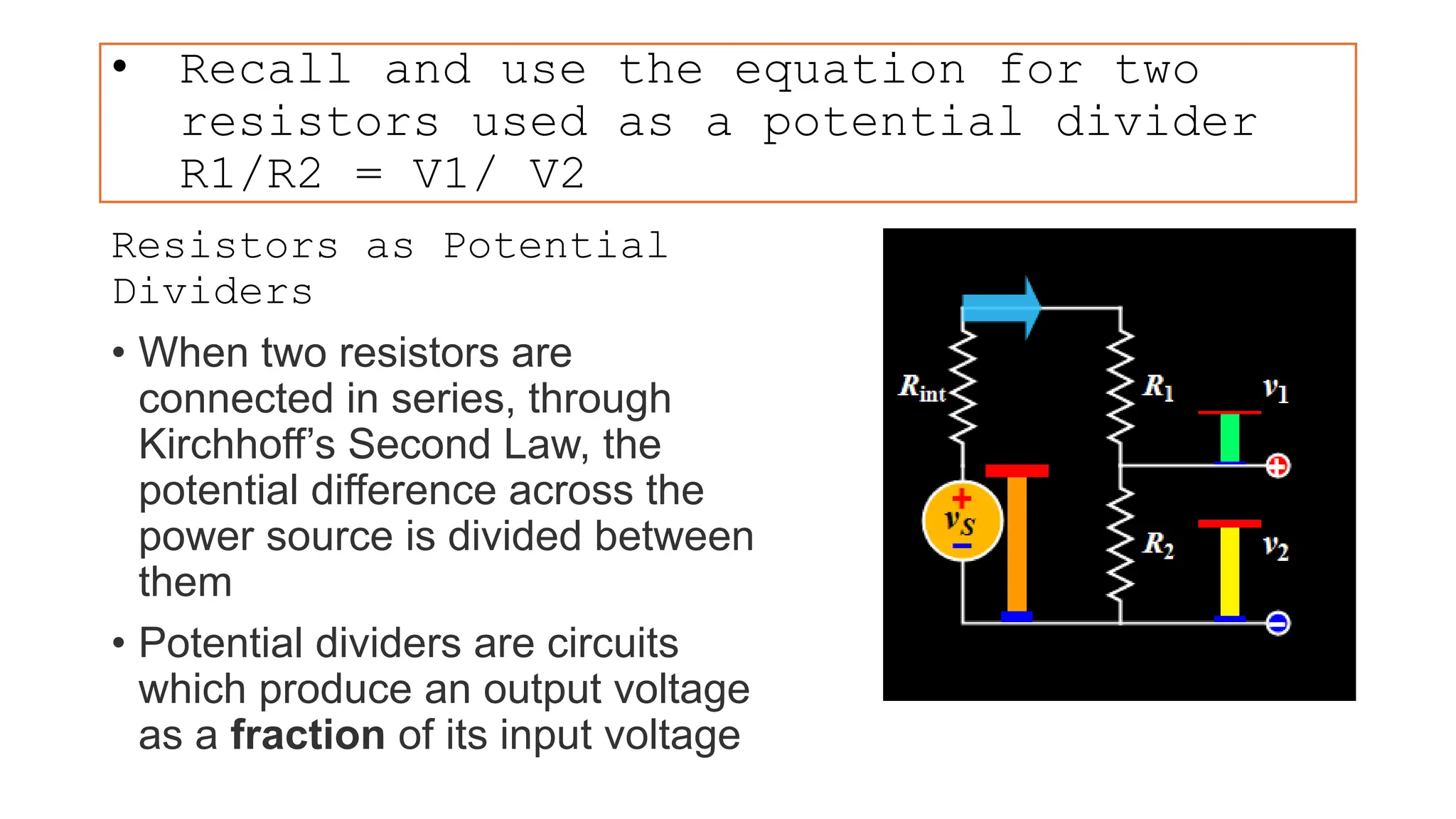
Resistors as Potential
Dividers
• When two resistors are
connected in series, through
Kirchhoff’s Second Law, the
potential difference across the
power source is divided between
them
• Potential dividers are circuits
which produce an output voltage
as a fraction of its input voltage
• Potential dividers have two
main purposes:
• To provide a variable
potential difference
• To enable a specific
potential difference to be
chosen
• To split the potential
difference of a power source
between two or more
components
• Potential dividers are used widely in volume controls and
sensory circuits using LDRs and thermistors
• The input voltage Vin is
applied to the top and
bottom of the series
resistors
• The output voltage Vout is
measured from the centre
to the bottom of resistor R2
• The potential
difference V across each
resistor depends upon its
resistance R:
• The resistor with the largest
resistance will have a greater
potential difference than the
other one from V = IR
• If the resistance of one of the
resistors is increased, it will get
a greater share of the potential
difference, whilst the other
resistor will get a smaller share
• In potential divider circuits, the
p.d across a component is
proportional to its resistance
from V = IR
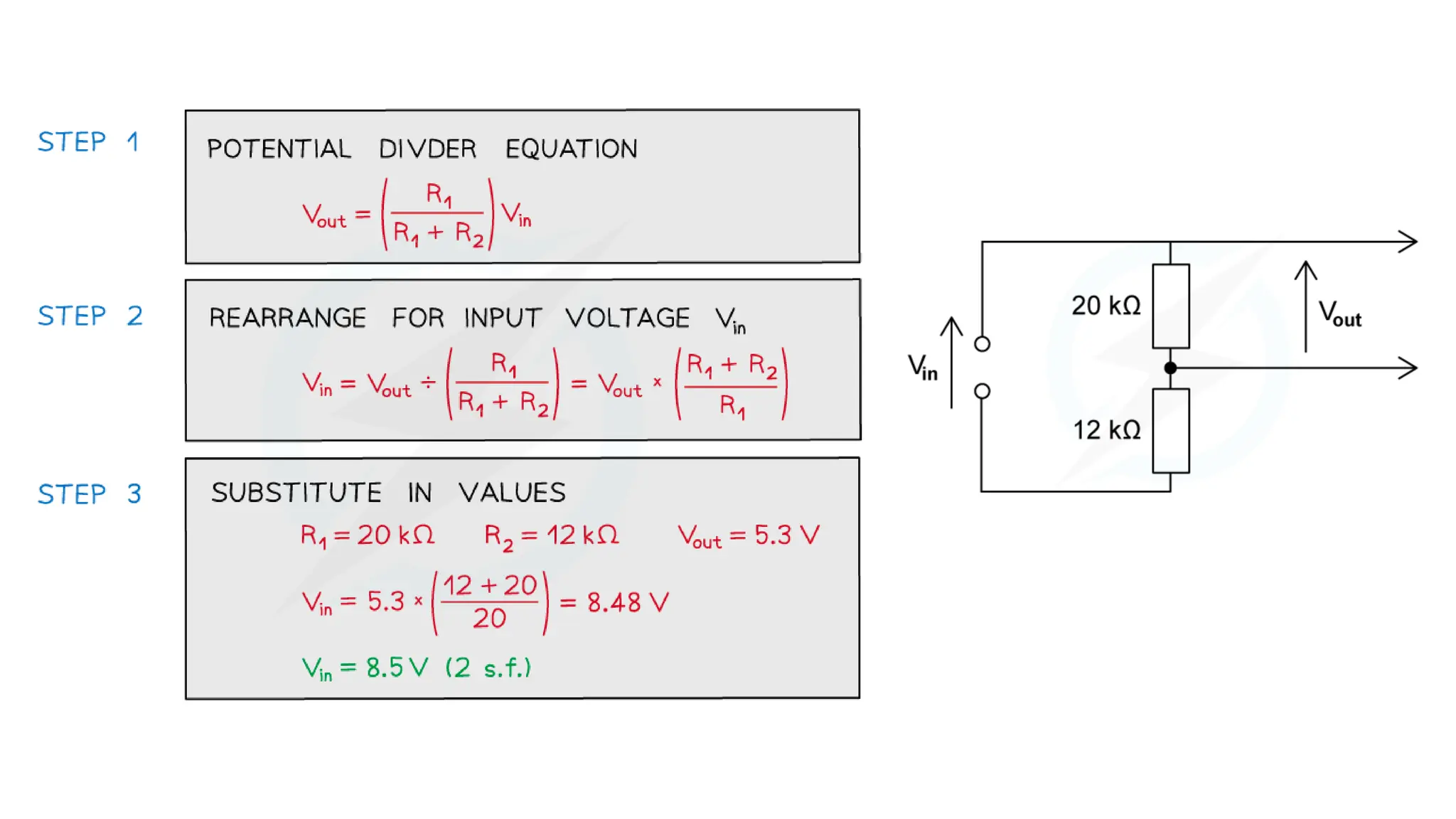
Worked example
The circuit is designed to
light up a lamp when the
input voltage exceed a
preset value.
It does this by comparing
Vout with a fixed reference
voltage of 5.3 V.
Vout is equal to 5.3
Calculate the input voltage
Vin.
• Understand that electric circuits transfer
energy from a source of electrical energy,
such as an electrical cell or mains supply, to
the circuit components and then into the
surroundings
Energy Transfer in
Electrical Circuits
• As electricity passes around a
circuit, energy is transferred from
the power source to the various
components (which may then
transfer energy to the
surroundings)
• As charge passes through the
power supply it is given energy
• As it passes through each
component it loses some energy
(transferring that energy to the
• Different domestic appliances transfer energy from batteries,
such as a remote control
• Most household appliances transfer energy from the AC mains
• This can be to the kinetic energy of an electric motor. Motors
are used in:
• Vacuum cleaners - to create the suction to suck in dust and dirt off
carpets
• Washing machines - to rotate the drum to wash (or dry) clothes
• Refrigerators - to compress the refrigerant chemical into a liquid to
reduce the temperature
• Or, in heating devices. Heating is used in:
• Toasters - to toast bread
• Kettles - to boil hot water
• Radiators - hot water is pumped from the boiler so the radiator can
heat up a room
• Everyday appliances transfer electrical energy from the mains
to other forms of energy in the appliance
• For example, in a heater, this will transfer electrical energy into
a thermal energy store
• The amount of
energy an appliance
transfers depends
on:
• How long the
appliance is
switched on for
• The power of the
appliance
• Recall and use the equation for
electrical power P=IV
• In mechanics, power P is defined as the rate of doing work
• The potential difference is the work done per unit charge
• Current is the rate of flow of charge
• Therefore, the electrical power is defined as the rate of change
of work done:
• The work done is the energy transferred so the power is
the energy transferred per second in an electrical component
• The power dissipated (produced) by an electrical device can
also be written as
• Using Ohm's Law V = IR to rearrange for either V or I and
substituting into the power equation, means power can be
written in terms of resistance R
• This means for a given resistor if the current or
voltage doubles the power will be four times as great.
• Which equation to use will depend on whether the value of current or
voltage has been given in the question
• Recall and use the equation for
electrical energy E=IVt
• Rearranging the energy and power equation, the energy can be
written as:
• Where:
• E = energy transferred (J)
• V = potential difference (V)
• I = current (A)
• t = time (s)
• Appliances are given
power ratings, which tell
consumers:
• The amount of energy
transferred (by electrical
work) to the device
every second
• This energy is commonly
measured in kilowatt-
hour (kW h), which is
then used to calculate the
cost of energy used
• Define the kilowatthour (kW h) and calculate
the cost of using electrical appliances where
the energy unit is the kW h
• The Kilowatt Hour (kWh)
• Energy usage in homes and businesses is calculated and
compared using the kilowatt hour
• The kilowatt hour is defined as:
A unit of energy equivalent to one kilowatt of power
expended for one hour
Calculating with kWh
• The kilowatt hour can also be defined using an equation:
• Where
• E = energy (kWh)
• P = power (kW)
• t = time (h)
• This equation is unusual because S.I. unit are not used, both energy and power
are × 103, and time is in hours, not seconds
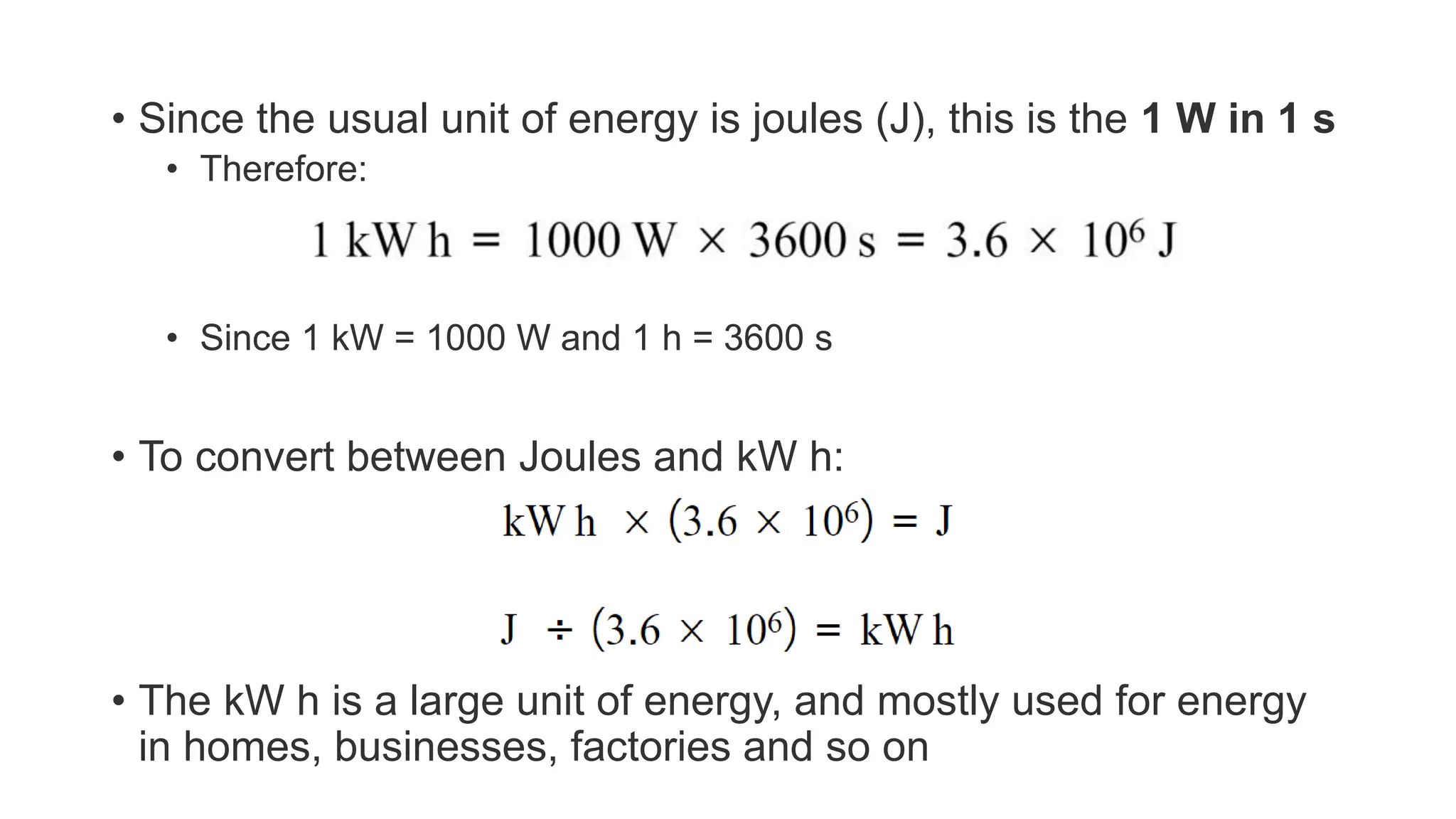
• Since the usual unit of energy is joules (J), this is the 1 W in 1 s
• Therefore:
• Since 1 kW = 1000 W and 1 h = 3600 s
• To convert between Joules and kW h:
• The kW h is a large unit of energy, and mostly used for energy
in homes, businesses, factories and so on
• State the hazards of: (a) damaged insulation
(b) overheating cables (c) damp conditions
(d) excess current from overloading of plugs,
extension leads, single and multiple sockets
when using a mains supply
• Mains electricity is potentially lethal –
potential differences as small as 50
volts can pose a serious hazard to
individuals
Common hazards include:
• Damaged Insulation – If someone touches an exposed piece of wire,
they could be subjected to a lethal shock
• Overheating of cables – Passing too much current through too small
a wire (or leaving a long length of wire tightly coiled) can lead to the
wire overheating. This could cause a fire or melt the insulations,
exposing live wires
• Damp conditions – If moisture comes into contact with live wires, the
moisture could conduct electricity either causing a short circuit within a
device (which could cause a fire) or posing an electrocution risk
• Excess current from overloading of plugs, extension leads, single
and multiple sockets when using a mains supply - If plugs or
sockets become overloaded due to plugging in too many components
the heat created can cause fires
• Know that a mains circuit consists of a live
wire (line wire), a neutral wire and an earth
wire and explain why a switch must be
connected to the live wire for the circuit to
be switched off safely
• Mains electricity is the electricity
generated by power stations and
transported around the country
through the National Grid
• Everyone connects to the mains when
plugging in an appliance such as a
phone charger or kettle
• Mains electricity is an alternating current (a.c.) supply
• In the China, the domestic electricity supply has a frequency of 50
Hz and a potential difference of about 230 V
• A frequency of 50 Hz means the direction of the current changes back and
forth 50 times every second
• Mains electricity, being an alternating current, does not have
positive and negative sides to the power source
• The equivalent to positive and negative are called live and neutral and
these form either end of the electrical circuit
• Explain why the outer casing of an electrical
appliance must be either non-conducting
(double insulated) or earthed
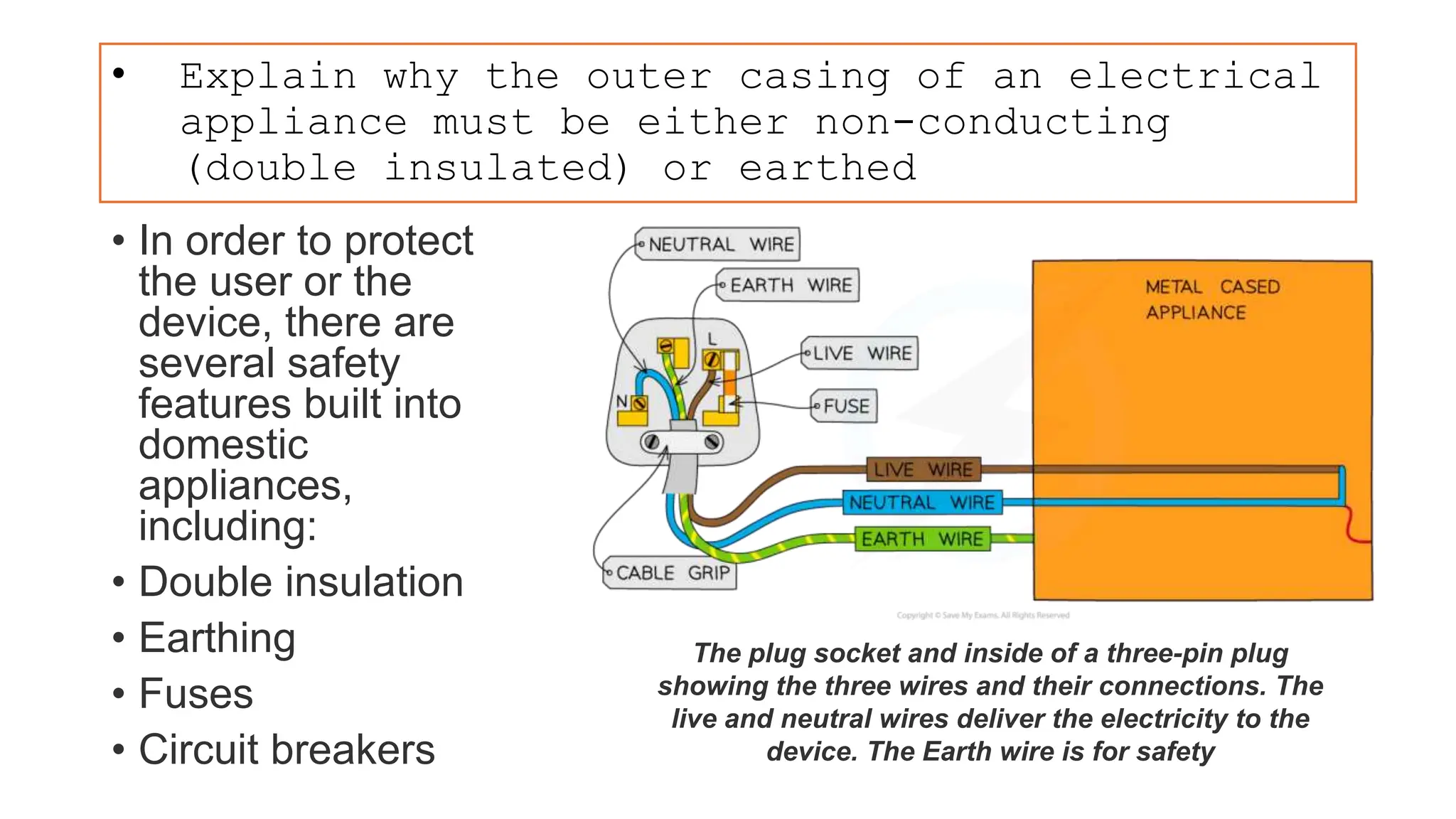
• In order to protect
the user or the
device, there are
several safety
features built into
domestic
appliances,
including:
• Double insulation
• Earthing
• Fuses
• Circuit breakers
The plug socket and inside of a three-pin plug
showing the three wires and their connections. The
live and neutral wires deliver the electricity to the
device. The Earth wire is for safety
Insulation & Double Insulation
• The conducting part of a wire is
usually made of copper or some
other metal
• If this comes into contact with a
person, this poses a risk of
electrocution
• For this reason, wires are
covered with an insulating
material, such as rubber
• Some appliances do not have
metal cases and so there is no
risk of them becoming electrified
• Such appliances are said to
be double insulated, as they
have two layers of insulation:
• Insulation around the wires
themselves
• A non-metallic case that acts as a
second layer of insulation
• Double insulated appliances do
not require an earth wire or have
been designed so that the earth
wire cannot touch the metal
casing
Earthing
• Many electrical appliances
have metal cases
• This poses a potential safety
hazard:
• If a live wire (inside the
appliance) came into contact
with the case, the case would
become electrified and anyone
who touched it would risk being
electrocuted
• The earth wire is an additional
safety wire that can reduce this
risk
• If this happens:
• The earth wire provides a low
resistance path to the earth
• It causes a surge of current in
the earth wire and hence also in
the live wire
• The high current through the fuse
causes it to melt and break
• This cuts off the supply of
electricity to the appliance,
making it safe
• State that a fuse without an earth wire
protects the circuit and the cabling
for a double-insulated appliance
Fuses & Trip Switches
• A fuse is a safety device designed to cut off the flow of
electricity to an appliance if the current becomes too
large (due to a fault or a surge)
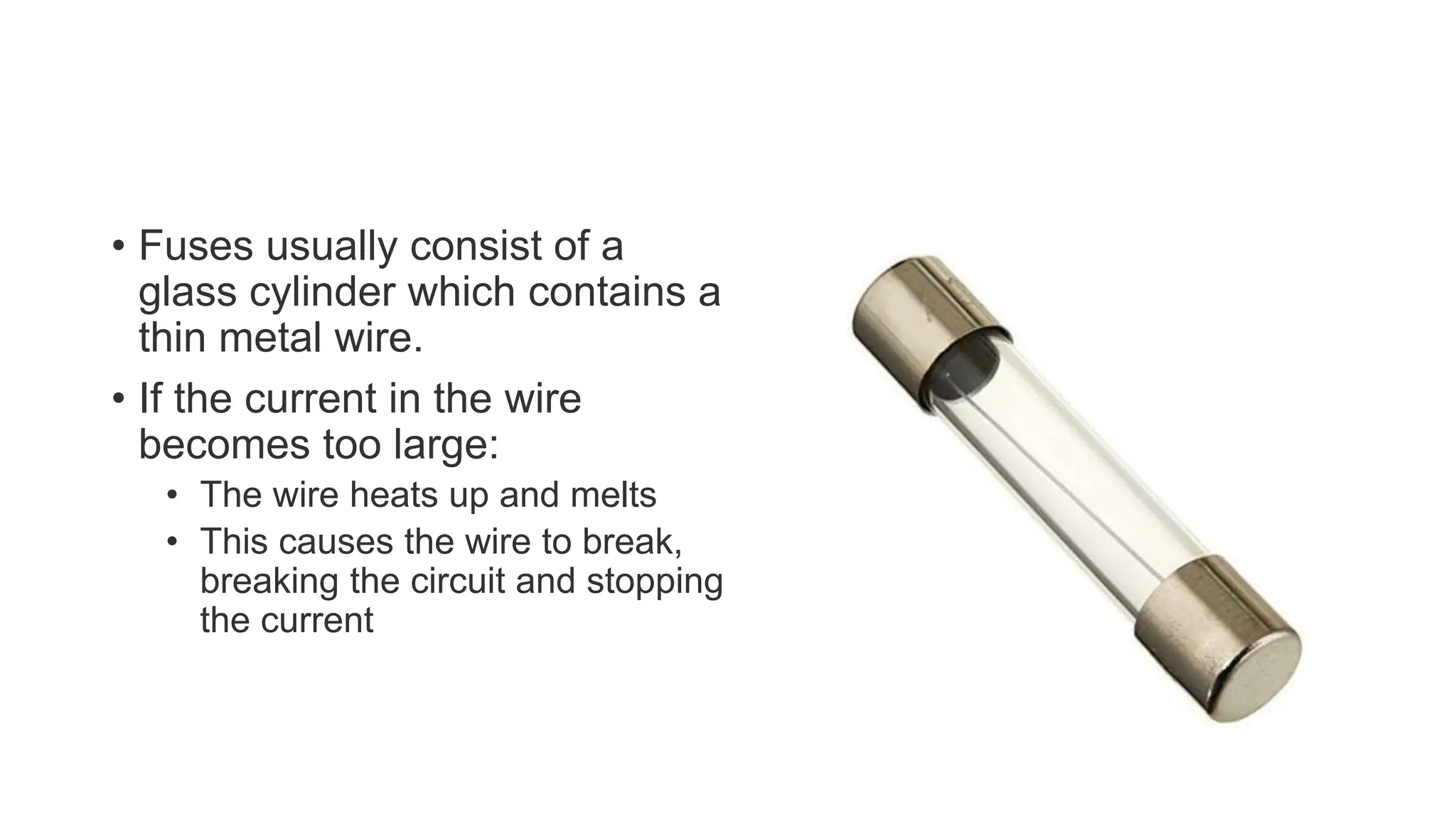
• Fuses usually consist of a
glass cylinder which contains a
thin metal wire.
• If the current in the wire
becomes too large:
• The wire heats up and melts
• This causes the wire to break,
breaking the circuit and stopping
the current
• Explain the use and operation of trip
switches and fuses and choose appropriate
fuse ratings and trip switch settings
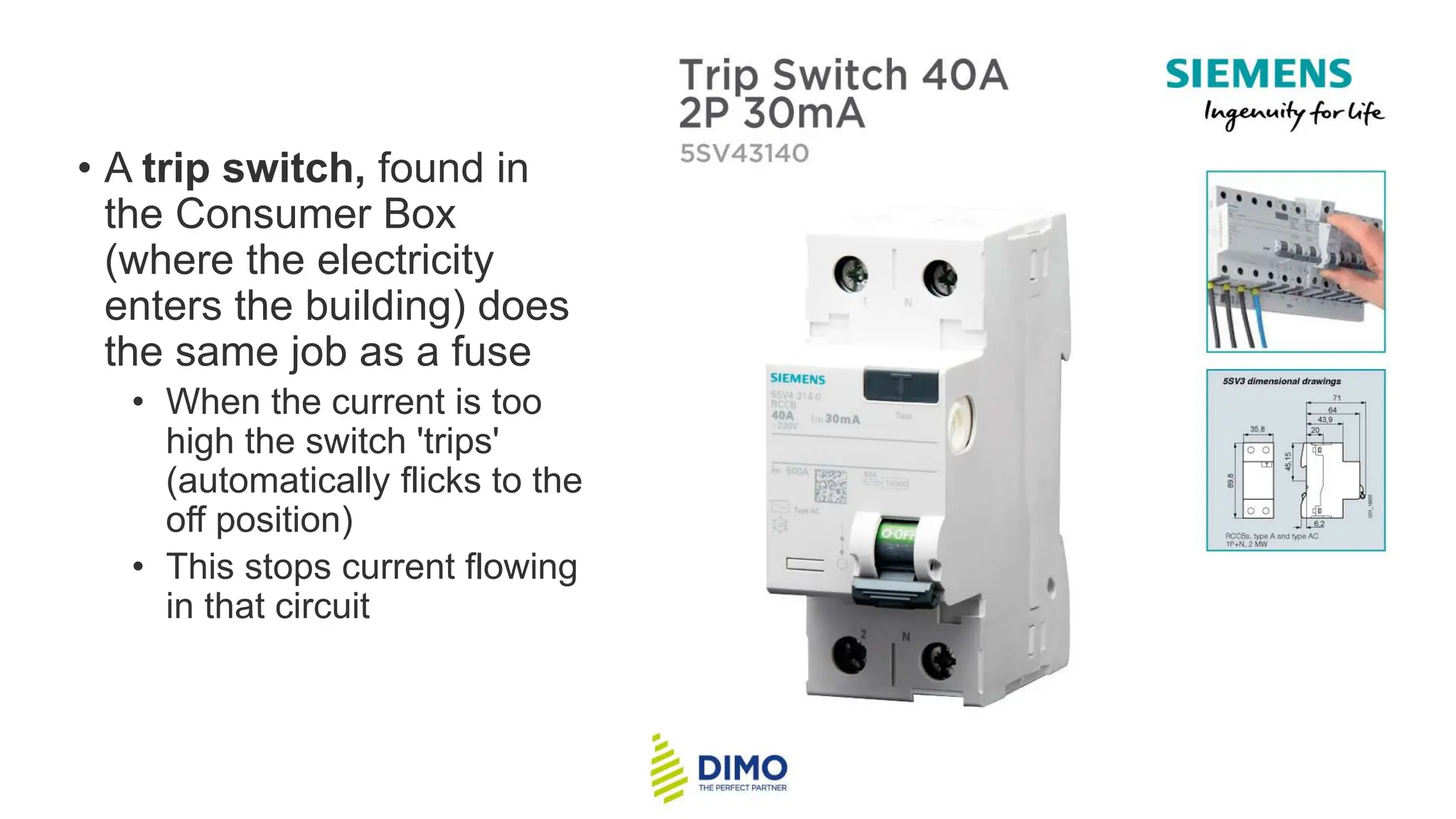
• A trip switch, found in
the Consumer Box
(where the electricity
enters the building) does
the same job as a fuse
• When the current is too
high the switch 'trips'
(automatically flicks to the
off position)
• This stops current flowing
in that circuit
Choosing Which Fuse to Use
• Fuses come in a variety of sizes (typically 3A, 5A and 13A) -
in order to select the right fuse for the job, you need to know
how much current an appliance needs
• If you know the power of the appliance (along with mains
voltage), the current can be calculated using the equation:
• The fuse should always have a current rating that is higher than
the current needed by the appliance, without being too high -
always choose the next size up
• Example:
• Suppose an appliance uses 3.1 amps
• A 3 amp use would be too small - the fuse would blow as soon as the
appliance was switched on
• A 13 amp fuse would be too large - it would allow an extra 10 amps to
pass through the appliance before it finally blew
• A 5 amp fuse would be an appropriate choice, as it is the next size up

electrical circuits for igcse physics students

  • 1.
  • 2.
    • Draw andinterpret circuit diagrams containing cells, batteries, power supplies, generators, potential dividers, switches, resistors (fixed and variable), heaters, thermistors (NTC only), light dependent resistors (LDRs), lamps, motors, ammeters, voltmeters, magnetising coils, transformers, fuses, relays, and know how these components behave in the circuit
  • 3.
    Power supplies • Cells,batteries, power supplies and generators all supply current to the circuit
  • 4.
    Resistors • Potential dividers,fixed and variable resistors, thermistors and light-dependent resistors (LDRs) are all used to control current
  • 5.
    Meters • Ammeters andvoltmeters are used to measure the current and potential difference • Ammeters are always connected in series whilst voltmeters are always connected in parallel
  • 6.
    Electromagnetic Components • Magnetisingcoils, relays and transformers use electromagnetic effects • Relays use a small current in one circuit to switch on a much larger current in another • Transformers 'step up' and 'step down' current and potential difference
  • 7.
    Fuses • Protect expensive componentsfrom current surges and act as a safety measure against fire
  • 9.
    • Draw andinterpret circuit diagrams containing diodes and light-emitting diodes (LEDs), and know how these components behave in a circuit A diode is a component that only allows a current in one direction • (Note: diodes are occasionally drawn with a horizontal line running through the middle of them)
  • 10.
    • If adiode is connected to an a.c. (alternating current) power supply, it will only allow a current half of the time (This is called rectification) A diode can be used to rectify an alternating current
  • 11.
    Resistance in aLight-Dependent Resistor • A light-dependent resistor (LDR) is a non-ohmic conductor and sensory resistor • Its resistance automatically changes depending on the light energy falling onto it (illumination) • As the light intensity increases, the resistance of an LDR decreases
  • 12.
    Graph of lightintensity and resistance for an LDR
  • 13.
    • LDRs canbe used as light sensors, so, they are useful in circuits which automatically switch on lights when it gets dark, for example, street lighting and garden lights • In the dark, its resistance is very large (millions of ohms) • In bright light, its resistance is small (tens of ohms)
  • 15.
    Resistance in aThermistor • A thermistor is a non-ohmic conductor and sensory resistor • Its resistance changes depending on its temperature • As the temperature increases the resistance of a thermistor decreases
  • 16.
    Graph of temperatureand resistance for a thermistor
  • 17.
    • Thermistors aretemperature sensors and are used in circuits in ovens, fire alarms and digital thermometers • As the thermistor gets hotter, its resistance decreases • As the thermistor gets cooler, its resistance increases
  • 18.
    • Know howto construct and use series and parallel circuits • In a series circuit, the current is the same value at any point • This is because the number of electrons per second that passes through one part of the circuit is the same number that passes through any other part • This means that all components in a closed-loop have the same current
  • 19.
    • The amountof current flowing around a series circuit depends on two things: • The voltage of the power source • The resistance of the components in the circuit
  • 20.
    • Increasing thevoltage of the power source drives more current around the circuit • So, decreasing the voltage of the power source reduces the current
  • 21.
    • Increasing thenumber of components in the circuit increases the total resistance • Hence less current flows through the circuit
  • 22.
    • State theadvantages of connecting lamps in parallel in a lighting circuit • A parallel circuit consists of two or more components attached along separate branches of the circuit • The advantages of this kind of circuit are: • The components can be individually controlled, using their own switches • If one component stops working the others will continue to function
  • 23.
    • In aparallel circuit, the current splits up - some of it going one way and the rest going the other • This means that the current in each branch will be smaller than the current from the power supply
  • 24.
    • At ajunction in a parallel circuit (where two or more wires meet) the current is conserved • This means the amount of current flowing into the junction is equal to the amount of current flowing out of it • This is because charge is conserved
  • 25.
    • Note thatthe current does not always split equally – often there will be more current in some branches than in others • The current in each branch will only be identical if the resistance of the components along each branch are identical
  • 26.
    • Know thatthe p.d across an electrical conductor increases as its resistance increases for a constant current Potential Difference in Series Circuits • When several cells are connected together in series, their combined EMF is equal to the sum of their individual EMFs The total EMF of these cells is equal to the sum of their individual EMFs
  • 27.
    • In aseries circuit, the sum of potential differences across the components is equal to the total EMF of the power supply In a series circuit the components share the EMF of the power supply
  • 28.
    • A parallelcircuit consists of two or more components attached along separate branches of the circuit • • The advantages of this kind of circuit are: • The components can be individually controlled, using their own switches • If one component stops working the others will continue to function
  • 29.
    • The potential differenceacross each component connected in parallel is the same • This is the opposite of the current, which is different in each branch
  • 30.
    • Describe theaction of a variable potential divider Variable Potential Dividers • When two resistors are connected in series, the potential difference across the power source is shared between them A potential divider splits the potential difference of a power source between two
  • 31.
    • The potentialdifference across each resistor depends upon its resistance: • The resistor with the largest resistance will have a greater potential difference than the other one • If the resistance of one of the resistors is increased, it will get a greater share of the potential difference, whilst the other resistor will get a smaller share A potential divider splits the potential difference of a power source between two components
  • 32.
    • A potentiometeris a single component that (in its simplest form) consists of a coil of wire with a sliding contact, midway along it • The sliding contact has the effect of separating the potentiometer into two parts – an upper part and a lower part – both of which have different resistances Moving the slider (the arrow in the diagram) changes the resistances (and hence potential differences) of the upper and lower parts of the potentiometer
  • 33.
    • Recall anduse the equation for two resistors used as a potential divider R1/R2 = V1/ V2 Resistors as Potential Dividers • When two resistors are connected in series, through Kirchhoff’s Second Law, the potential difference across the power source is divided between them • Potential dividers are circuits which produce an output voltage as a fraction of its input voltage
  • 34.
    • Potential dividershave two main purposes: • To provide a variable potential difference • To enable a specific potential difference to be chosen • To split the potential difference of a power source between two or more components
  • 35.
    • Potential dividersare used widely in volume controls and sensory circuits using LDRs and thermistors
  • 36.
    • The inputvoltage Vin is applied to the top and bottom of the series resistors • The output voltage Vout is measured from the centre to the bottom of resistor R2
  • 37.
    • The potential differenceV across each resistor depends upon its resistance R: • The resistor with the largest resistance will have a greater potential difference than the other one from V = IR • If the resistance of one of the resistors is increased, it will get a greater share of the potential difference, whilst the other resistor will get a smaller share • In potential divider circuits, the p.d across a component is proportional to its resistance from V = IR
  • 38.
    Worked example The circuitis designed to light up a lamp when the input voltage exceed a preset value. It does this by comparing Vout with a fixed reference voltage of 5.3 V. Vout is equal to 5.3 Calculate the input voltage Vin.
  • 40.
    • Understand thatelectric circuits transfer energy from a source of electrical energy, such as an electrical cell or mains supply, to the circuit components and then into the surroundings Energy Transfer in Electrical Circuits • As electricity passes around a circuit, energy is transferred from the power source to the various components (which may then transfer energy to the surroundings) • As charge passes through the power supply it is given energy • As it passes through each component it loses some energy (transferring that energy to the
  • 42.
    • Different domesticappliances transfer energy from batteries, such as a remote control • Most household appliances transfer energy from the AC mains • This can be to the kinetic energy of an electric motor. Motors are used in: • Vacuum cleaners - to create the suction to suck in dust and dirt off carpets • Washing machines - to rotate the drum to wash (or dry) clothes • Refrigerators - to compress the refrigerant chemical into a liquid to reduce the temperature
  • 43.
    • Or, inheating devices. Heating is used in: • Toasters - to toast bread • Kettles - to boil hot water • Radiators - hot water is pumped from the boiler so the radiator can heat up a room
  • 44.
    • Everyday appliancestransfer electrical energy from the mains to other forms of energy in the appliance • For example, in a heater, this will transfer electrical energy into a thermal energy store
  • 45.
    • The amountof energy an appliance transfers depends on: • How long the appliance is switched on for • The power of the appliance
  • 46.
    • Recall anduse the equation for electrical power P=IV • In mechanics, power P is defined as the rate of doing work • The potential difference is the work done per unit charge • Current is the rate of flow of charge • Therefore, the electrical power is defined as the rate of change of work done:
  • 47.
    • The workdone is the energy transferred so the power is the energy transferred per second in an electrical component • The power dissipated (produced) by an electrical device can also be written as
  • 48.
    • Using Ohm'sLaw V = IR to rearrange for either V or I and substituting into the power equation, means power can be written in terms of resistance R • This means for a given resistor if the current or voltage doubles the power will be four times as great. • Which equation to use will depend on whether the value of current or voltage has been given in the question
  • 49.
    • Recall anduse the equation for electrical energy E=IVt • Rearranging the energy and power equation, the energy can be written as: • Where: • E = energy transferred (J) • V = potential difference (V) • I = current (A) • t = time (s)
  • 50.
    • Appliances aregiven power ratings, which tell consumers: • The amount of energy transferred (by electrical work) to the device every second • This energy is commonly measured in kilowatt- hour (kW h), which is then used to calculate the cost of energy used
  • 51.
    • Define thekilowatthour (kW h) and calculate the cost of using electrical appliances where the energy unit is the kW h • The Kilowatt Hour (kWh) • Energy usage in homes and businesses is calculated and compared using the kilowatt hour • The kilowatt hour is defined as: A unit of energy equivalent to one kilowatt of power expended for one hour
  • 52.
    Calculating with kWh •The kilowatt hour can also be defined using an equation: • Where • E = energy (kWh) • P = power (kW) • t = time (h) • This equation is unusual because S.I. unit are not used, both energy and power are × 103, and time is in hours, not seconds
  • 53.
    • Since theusual unit of energy is joules (J), this is the 1 W in 1 s • Therefore: • Since 1 kW = 1000 W and 1 h = 3600 s • To convert between Joules and kW h: • The kW h is a large unit of energy, and mostly used for energy in homes, businesses, factories and so on
  • 54.
    • State thehazards of: (a) damaged insulation (b) overheating cables (c) damp conditions (d) excess current from overloading of plugs, extension leads, single and multiple sockets when using a mains supply • Mains electricity is potentially lethal – potential differences as small as 50 volts can pose a serious hazard to individuals
  • 56.
    Common hazards include: •Damaged Insulation – If someone touches an exposed piece of wire, they could be subjected to a lethal shock • Overheating of cables – Passing too much current through too small a wire (or leaving a long length of wire tightly coiled) can lead to the wire overheating. This could cause a fire or melt the insulations, exposing live wires • Damp conditions – If moisture comes into contact with live wires, the moisture could conduct electricity either causing a short circuit within a device (which could cause a fire) or posing an electrocution risk • Excess current from overloading of plugs, extension leads, single and multiple sockets when using a mains supply - If plugs or sockets become overloaded due to plugging in too many components the heat created can cause fires
  • 57.
    • Know thata mains circuit consists of a live wire (line wire), a neutral wire and an earth wire and explain why a switch must be connected to the live wire for the circuit to be switched off safely • Mains electricity is the electricity generated by power stations and transported around the country through the National Grid • Everyone connects to the mains when plugging in an appliance such as a phone charger or kettle
  • 58.
    • Mains electricityis an alternating current (a.c.) supply • In the China, the domestic electricity supply has a frequency of 50 Hz and a potential difference of about 230 V • A frequency of 50 Hz means the direction of the current changes back and forth 50 times every second
  • 59.
    • Mains electricity,being an alternating current, does not have positive and negative sides to the power source • The equivalent to positive and negative are called live and neutral and these form either end of the electrical circuit
  • 60.
    • Explain whythe outer casing of an electrical appliance must be either non-conducting (double insulated) or earthed • In order to protect the user or the device, there are several safety features built into domestic appliances, including: • Double insulation • Earthing • Fuses • Circuit breakers The plug socket and inside of a three-pin plug showing the three wires and their connections. The live and neutral wires deliver the electricity to the device. The Earth wire is for safety
  • 61.
    Insulation & DoubleInsulation • The conducting part of a wire is usually made of copper or some other metal • If this comes into contact with a person, this poses a risk of electrocution • For this reason, wires are covered with an insulating material, such as rubber
  • 62.
    • Some appliancesdo not have metal cases and so there is no risk of them becoming electrified • Such appliances are said to be double insulated, as they have two layers of insulation: • Insulation around the wires themselves • A non-metallic case that acts as a second layer of insulation • Double insulated appliances do not require an earth wire or have been designed so that the earth wire cannot touch the metal casing
  • 63.
    Earthing • Many electricalappliances have metal cases • This poses a potential safety hazard: • If a live wire (inside the appliance) came into contact with the case, the case would become electrified and anyone who touched it would risk being electrocuted • The earth wire is an additional safety wire that can reduce this risk
  • 64.
    • If thishappens: • The earth wire provides a low resistance path to the earth • It causes a surge of current in the earth wire and hence also in the live wire • The high current through the fuse causes it to melt and break • This cuts off the supply of electricity to the appliance, making it safe
  • 65.
    • State thata fuse without an earth wire protects the circuit and the cabling for a double-insulated appliance Fuses & Trip Switches • A fuse is a safety device designed to cut off the flow of electricity to an appliance if the current becomes too large (due to a fault or a surge)
  • 66.
    • Fuses usuallyconsist of a glass cylinder which contains a thin metal wire. • If the current in the wire becomes too large: • The wire heats up and melts • This causes the wire to break, breaking the circuit and stopping the current
  • 67.
    • Explain theuse and operation of trip switches and fuses and choose appropriate fuse ratings and trip switch settings
  • 68.
    • A tripswitch, found in the Consumer Box (where the electricity enters the building) does the same job as a fuse • When the current is too high the switch 'trips' (automatically flicks to the off position) • This stops current flowing in that circuit
  • 69.
    Choosing Which Fuseto Use • Fuses come in a variety of sizes (typically 3A, 5A and 13A) - in order to select the right fuse for the job, you need to know how much current an appliance needs • If you know the power of the appliance (along with mains voltage), the current can be calculated using the equation:
  • 70.
    • The fuseshould always have a current rating that is higher than the current needed by the appliance, without being too high - always choose the next size up • Example: • Suppose an appliance uses 3.1 amps • A 3 amp use would be too small - the fuse would blow as soon as the appliance was switched on • A 13 amp fuse would be too large - it would allow an extra 10 amps to pass through the appliance before it finally blew • A 5 amp fuse would be an appropriate choice, as it is the next size up