


Educ 203A-School Administration
FORMAL STRUCTURES IN
SCHOOL
MARITES M. CUYOS, MBM
Discussant
Terminal Objective:
At the end of the session, the participants
will be able to explain the roles and
responsibilities of every employee, from the
top level to a staff member.
Enabling Objectives:
1. Identify the Formal Structure of School
2. Determine the roles and responsibilities of
every employee, from the top level to a
staff member.
3. Assess the participant’s role as
administrator.
❑ Schools are formal organizations with many of the same
characteristics as bureaucratic organizations.
❑ Max Abbott (1965a, p. 45), for example, using the
characteristics of the Weberian model developed earlier in
this chapter, has concluded: “The school organization as we know
it today . . . can accurately be described as a highly
developed bureaucracy.
❑ As such, it exhibits many of the characteristics and employs
many of the strategies of the military, industrial, and
governmental agencies with which it might be
compared.”
❑ The bureaucratic model is the one that many school
administrators adopt, and this may explain why the model can be
used to analyze behavior in schools
❑ One of the earliest systematic attempts to measure
bureaucratization
❑ Hall’s (1962) development of an organizational inventory to
measure six central characteristics of bureaucratic structure:
(1) hierarchy of authority, (2) specialization,
(3) rules for incumbents (i.e., those
assuming an organizational role), (4)
procedure specifications, (5) impersonality,
and (6) technical competence.
Hall on Bureaucratic Structure
1) Hierarchy of Authority - This characteristic is demonstrated by the
typical organizational chart which graphically defines and clarifies the various
lines of authority and channels of communication present in school systems.
1) Specialization - Differences in activities are recognized and specific duties
are assigned to an individual (or group of individuals) depending on his training
or expertise. Therefore these specialized tasks are carried out by personnel who
have full knowledge of the special problems involved.
1) Rules for incumbents - those assuming an organizational role; a system
of rules covering the rights and duties of positional incumbents. The organization
uses rules to exert control.
1) Procedure specifications - Specialists do the work. Also, the
organization divides employees into units based on the type of work they do or the
skills they possess.
Six Central Characteristics of Bureaucratic Structure
5) Impersonality (in the application of rules) -
Bureaucratic organizations treat all employees equally. They also treat all
customers equally and do not allow individual differences to influence
them. Impersonality takes personal feelings out of professional
situations.
5) Technical Competence - Selection and promotion of employees
are based on the technical competence of employees. Training is also
provided to familiarize the employees with the rules and administrative
procedures of the organization.
Six Central Characteristics of Bureaucratic Structure
❑ D. A. MacKay (1964) - Subsequently adapted and modified the
organization inventory in his study of bureaucratization of schools. He
measured bureaucratic patterns in schools, using the school
organizational inventory (SOI).
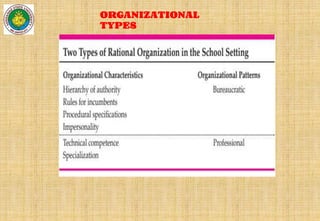
❑ Kolesar, 1967; Isherwood and Hoy, 1973; Abbott and
Caracheo, 1988 - The interrelationships of these bureaucratic
characteristics of schools also have been explored empirically. Studies
indicate that there are two relatively distinct patterns of rational
organization rather than one completely integrated bureaucratic pattern.
ORGANIZATIONAL
TYPES
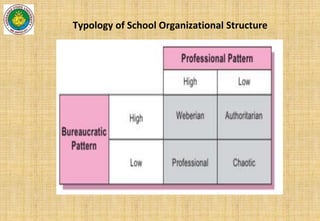
Typology of School Organizational Structure
❑ Paul Adler and Bryan Borys (1996) offer a possible solution as
they interpret formalization as an organizational technology
and identify two types of formalization—enabling and
coercive.
❑ Hoy and Sweetland (2000, 2001) formulation of enabling
and hindering formalization to examine the structure of
schools.
Hoy and Sweetland on Structure
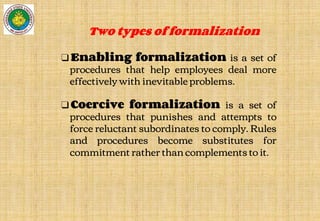
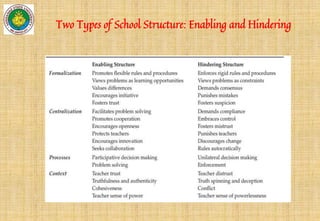
❑Enabling formalization is a set of
procedures that help employees deal more
effectively with inevitable problems.
❑Coercive formalization is a set of
procedures that punishes and attempts to
force reluctant subordinates to comply. Rules
and procedures become substitutes for
commitment rather than complements to it.
Two types of formalization
Hierarchy of Authority of Organizations
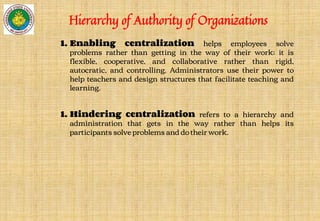
1. Enabling centralization helps employees solve
problems rather than getting in the way of their work; it is
flexible, cooperative, and collaborative rather than rigid,
autocratic, and controlling. Administrators use their power to
help teachers and design structures that facilitate teaching and
learning.
1. Hindering centralization refers to a hierarchy and
administration that gets in the way rather than helps its
participants solve problems and do their work.
Enabling School Structure
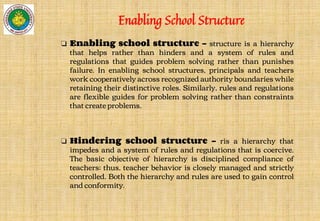
❏ Enabling school structure - structure is a hierarchy
that helps rather than hinders and a system of rules and
regulations that guides problem solving rather than punishes
failure. In enabling school structures, principals and teachers
work cooperatively across recognized authority boundaries while
retaining their distinctive roles. Similarly, rules and regulations
are flexible guides for problem solving rather than constraints
that create problems.
❏ Hindering school structure - ris a hierarchy that
impedes and a system of rules and regulations that is coercive.
The basic objective of hierarchy is disciplined compliance of
teachers; thus, teacher behavior is closely managed and strictly
controlled. Both the hierarchy and rules are used to gain control
and conformity.
ACTIVITY 1: Give two or
three examples of your
principal’s behavior that you
consider to be enabling, that is,
behavior that supports teachers’
attempts to improve teaching
and learning. Now, identify
several rules that hinder or
punish teachers.
MINDFUL SCHOOLS
❏ One goal of all school administrators should be to make their
schools mindful (Hoy, 2003).
❏ Weick and Sutcliffe (2001) first introduced the notion of
mindfulness to organizations as they studied high-reliability
organizations. They found five processes that promoted
mindfulness in organizations: (1) preoccupation with
failure, (2) reluctance to simplify
interpretations, (3) sensitivity to basic
operations, (4) commitment to resilience, and
(5) deference to expertise.
Enabling and Mindful School Structures
❏ Enabling and mindful structures are
complementary; they are not the same,but they have much in
common.
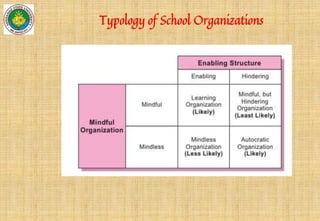
❏ Mindful organizations have a preoccupation with
failure, a resiliency, and sensitivity to the unexpected that some
enabling structures may lack. Yet, mindfulness and enabling
structures go together (Gage, 2004).
Typology of School Organizations
ACTIVITY 2: How
mindful is your principal?
How successful is the
principal in managing the
unexpected? Examples? How
resilient is your school in
responding to failure and
disappointment? Give some
examples.
Two Types of School Structure: Enabling and Hindering
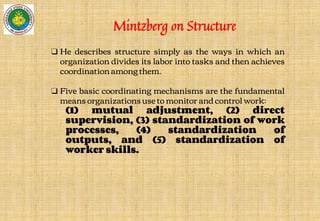
❑ He describes structure simply as the ways in which an
organization divides its labor into tasks and then achieves
coordination among them.
❑ Five basic coordinating mechanisms are the fundamental
means organizations use to monitor and control work:
(1) mutual adjustment, (2) direct
supervision, (3) standardization of work
processes, (4) standardization of
outputs, and (5) standardization of
worker skills.
Mintzberg on Structure
Coordinating Mechanisms
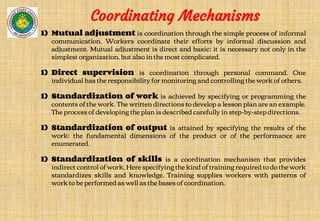
1) Mutual adjustment is coordination through the simple process of informal
communication. Workers coordinate their efforts by informal discussion and
adjustment. Mutual adjustment is direct and basic; it is necessary not only in the
simplest organization, but also in the most complicated.
1) Direct supervision is coordination through personal command. One
individual has the responsibility for monitoring and controlling the work of others.
1) Standardization of work is achieved by specifying or programming the
contents of the work. The written directions to develop a lesson plan are an example.
The process of developing the plan is described carefully in step-by-step directions.
1) Standardization of output is attained by specifying the results of the
work; the fundamental dimensions of the product or of the performance are
enumerated.
1) Standardization of skills is a coordination mechanism that provides
indirect control of work. Here specifying the kind of training required to do the work
standardizes skills and knowledge. Training supplies workers with patterns of
work to be performed as well as the bases of coordination.
Five Basic Parts of Organization
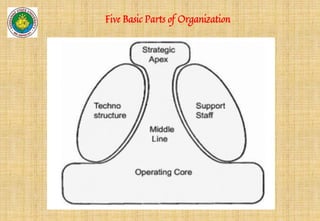
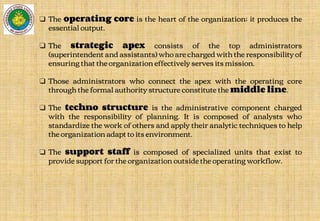
❑ The operating core is the heart of the organization; it produces the
essential output.
❑ The strategic apex consists of the top administrators
(superintendent and assistants) who are charged with the responsibility of
ensuring that the organization effectively serves its mission.
❑ Those administrators who connect the apex with the operating core
through the formal authority structure constitute the middle line.
❑ The techno structure is the administrative component charged
with the responsibility of planning. It is composed of analysts who
standardize the work of others and apply their analytic techniques to help
the organization adapt to its environment.
❑ The support staff is composed of specialized units that exist to
provide support for the organization outside the operating workflow.
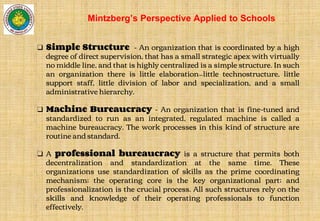
❑ Simple Structure - An organization that is coordinated by a high
degree of direct supervision, that has a small strategic apex with virtually
no middle line, and that is highly centralized is a simple structure. In such
an organization there is little elaboration—little technostructure, little
support staff, little division of labor and specialization, and a small
administrative hierarchy.
❑ Machine Bureaucracy - An organization that is fine-tuned and
standardized to run as an integrated, regulated machine is called a
machine bureaucracy. The work processes in this kind of structure are
routine and standard.
❑ A professional bureaucracy is a structure that permits both
decentralization and standardization at the same time. These
organizations use standardization of skills as the prime coordinating
mechanism; the operating core is the key organizational part; and
professionalization is the crucial process. All such structures rely on the
skills and knowledge of their operating professionals to function
effectively.
Mintzberg’s Perspective Applied to Schools
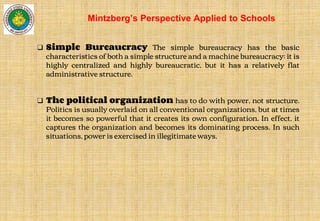
❑ Simple Bureaucracy The simple bureaucracy has the basic
characteristics of both a simple structure and a machine bureaucracy: it is
highly centralized and highly bureaucratic, but it has a relatively flat
administrative structure.
❑ The political organization has to do with power, not structure.
Politics is usually overlaid on all conventional organizations, but at times
it becomes so powerful that it creates its own configuration. In effect, it
captures the organization and becomes its dominating process. In such
situations, power is exercised in illegitimate ways.
Mintzberg’s Perspective Applied to Schools
❑ Think of your school.
❑ Give a specific example of the
following coordination
mechanisms: mutual adjustment,
direct supervision, standardization
of work, standardization of output
and standardization of skills which
of these means of coordination is
most prevalent in your school?
Are any absent?
❑ Evaluate the overall practices of
coordination.
❑ What would you change if you
Cuyos, Marites-Formal-Structure-in-School.pptx

Cuyos, Marites-Formal-Structure-in-School.pptx

  • 1.
    Educ 203A-School Administration FORMALSTRUCTURES IN SCHOOL MARITES M. CUYOS, MBM Discussant
  • 2.
    Terminal Objective: At theend of the session, the participants will be able to explain the roles and responsibilities of every employee, from the top level to a staff member. Enabling Objectives: 1. Identify the Formal Structure of School 2. Determine the roles and responsibilities of every employee, from the top level to a staff member. 3. Assess the participant’s role as administrator.
  • 3.
    ❑ Schools areformal organizations with many of the same characteristics as bureaucratic organizations. ❑ Max Abbott (1965a, p. 45), for example, using the characteristics of the Weberian model developed earlier in this chapter, has concluded: “The school organization as we know it today . . . can accurately be described as a highly developed bureaucracy. ❑ As such, it exhibits many of the characteristics and employs many of the strategies of the military, industrial, and governmental agencies with which it might be compared.” ❑ The bureaucratic model is the one that many school administrators adopt, and this may explain why the model can be used to analyze behavior in schools
  • 4.
    ❑ One ofthe earliest systematic attempts to measure bureaucratization ❑ Hall’s (1962) development of an organizational inventory to measure six central characteristics of bureaucratic structure: (1) hierarchy of authority, (2) specialization, (3) rules for incumbents (i.e., those assuming an organizational role), (4) procedure specifications, (5) impersonality, and (6) technical competence. Hall on Bureaucratic Structure
  • 5.
    1) Hierarchy ofAuthority - This characteristic is demonstrated by the typical organizational chart which graphically defines and clarifies the various lines of authority and channels of communication present in school systems. 1) Specialization - Differences in activities are recognized and specific duties are assigned to an individual (or group of individuals) depending on his training or expertise. Therefore these specialized tasks are carried out by personnel who have full knowledge of the special problems involved. 1) Rules for incumbents - those assuming an organizational role; a system of rules covering the rights and duties of positional incumbents. The organization uses rules to exert control. 1) Procedure specifications - Specialists do the work. Also, the organization divides employees into units based on the type of work they do or the skills they possess. Six Central Characteristics of Bureaucratic Structure
  • 6.
    5) Impersonality (inthe application of rules) - Bureaucratic organizations treat all employees equally. They also treat all customers equally and do not allow individual differences to influence them. Impersonality takes personal feelings out of professional situations. 5) Technical Competence - Selection and promotion of employees are based on the technical competence of employees. Training is also provided to familiarize the employees with the rules and administrative procedures of the organization. Six Central Characteristics of Bureaucratic Structure
  • 7.
    ❑ D. A.MacKay (1964) - Subsequently adapted and modified the organization inventory in his study of bureaucratization of schools. He measured bureaucratic patterns in schools, using the school organizational inventory (SOI). ❑ Kolesar, 1967; Isherwood and Hoy, 1973; Abbott and Caracheo, 1988 - The interrelationships of these bureaucratic characteristics of schools also have been explored empirically. Studies indicate that there are two relatively distinct patterns of rational organization rather than one completely integrated bureaucratic pattern.
  • 8.
  • 9.
    Typology of SchoolOrganizational Structure
  • 10.
    ❑ Paul Adlerand Bryan Borys (1996) offer a possible solution as they interpret formalization as an organizational technology and identify two types of formalization—enabling and coercive. ❑ Hoy and Sweetland (2000, 2001) formulation of enabling and hindering formalization to examine the structure of schools. Hoy and Sweetland on Structure
  • 11.
    ❑Enabling formalization isa set of procedures that help employees deal more effectively with inevitable problems. ❑Coercive formalization is a set of procedures that punishes and attempts to force reluctant subordinates to comply. Rules and procedures become substitutes for commitment rather than complements to it. Two types of formalization
  • 12.
    Hierarchy of Authorityof Organizations 1. Enabling centralization helps employees solve problems rather than getting in the way of their work; it is flexible, cooperative, and collaborative rather than rigid, autocratic, and controlling. Administrators use their power to help teachers and design structures that facilitate teaching and learning. 1. Hindering centralization refers to a hierarchy and administration that gets in the way rather than helps its participants solve problems and do their work.
  • 13.
    Enabling School Structure ❏Enabling school structure - structure is a hierarchy that helps rather than hinders and a system of rules and regulations that guides problem solving rather than punishes failure. In enabling school structures, principals and teachers work cooperatively across recognized authority boundaries while retaining their distinctive roles. Similarly, rules and regulations are flexible guides for problem solving rather than constraints that create problems. ❏ Hindering school structure - ris a hierarchy that impedes and a system of rules and regulations that is coercive. The basic objective of hierarchy is disciplined compliance of teachers; thus, teacher behavior is closely managed and strictly controlled. Both the hierarchy and rules are used to gain control and conformity.
  • 14.
    ACTIVITY 1: Givetwo or three examples of your principal’s behavior that you consider to be enabling, that is, behavior that supports teachers’ attempts to improve teaching and learning. Now, identify several rules that hinder or punish teachers.
  • 15.
    MINDFUL SCHOOLS ❏ Onegoal of all school administrators should be to make their schools mindful (Hoy, 2003). ❏ Weick and Sutcliffe (2001) first introduced the notion of mindfulness to organizations as they studied high-reliability organizations. They found five processes that promoted mindfulness in organizations: (1) preoccupation with failure, (2) reluctance to simplify interpretations, (3) sensitivity to basic operations, (4) commitment to resilience, and (5) deference to expertise.
  • 16.
    Enabling and MindfulSchool Structures ❏ Enabling and mindful structures are complementary; they are not the same,but they have much in common. ❏ Mindful organizations have a preoccupation with failure, a resiliency, and sensitivity to the unexpected that some enabling structures may lack. Yet, mindfulness and enabling structures go together (Gage, 2004).
  • 17.
    Typology of SchoolOrganizations
  • 18.
    ACTIVITY 2: How mindfulis your principal? How successful is the principal in managing the unexpected? Examples? How resilient is your school in responding to failure and disappointment? Give some examples.
  • 19.
    Two Types ofSchool Structure: Enabling and Hindering
  • 20.
    ❑ He describesstructure simply as the ways in which an organization divides its labor into tasks and then achieves coordination among them. ❑ Five basic coordinating mechanisms are the fundamental means organizations use to monitor and control work: (1) mutual adjustment, (2) direct supervision, (3) standardization of work processes, (4) standardization of outputs, and (5) standardization of worker skills. Mintzberg on Structure
  • 21.
    Coordinating Mechanisms 1) Mutualadjustment is coordination through the simple process of informal communication. Workers coordinate their efforts by informal discussion and adjustment. Mutual adjustment is direct and basic; it is necessary not only in the simplest organization, but also in the most complicated. 1) Direct supervision is coordination through personal command. One individual has the responsibility for monitoring and controlling the work of others. 1) Standardization of work is achieved by specifying or programming the contents of the work. The written directions to develop a lesson plan are an example. The process of developing the plan is described carefully in step-by-step directions. 1) Standardization of output is attained by specifying the results of the work; the fundamental dimensions of the product or of the performance are enumerated. 1) Standardization of skills is a coordination mechanism that provides indirect control of work. Here specifying the kind of training required to do the work standardizes skills and knowledge. Training supplies workers with patterns of work to be performed as well as the bases of coordination.
  • 22.
    Five Basic Partsof Organization
  • 23.
    ❑ The operatingcore is the heart of the organization; it produces the essential output. ❑ The strategic apex consists of the top administrators (superintendent and assistants) who are charged with the responsibility of ensuring that the organization effectively serves its mission. ❑ Those administrators who connect the apex with the operating core through the formal authority structure constitute the middle line. ❑ The techno structure is the administrative component charged with the responsibility of planning. It is composed of analysts who standardize the work of others and apply their analytic techniques to help the organization adapt to its environment. ❑ The support staff is composed of specialized units that exist to provide support for the organization outside the operating workflow.
  • 24.
    ❑ Simple Structure- An organization that is coordinated by a high degree of direct supervision, that has a small strategic apex with virtually no middle line, and that is highly centralized is a simple structure. In such an organization there is little elaboration—little technostructure, little support staff, little division of labor and specialization, and a small administrative hierarchy. ❑ Machine Bureaucracy - An organization that is fine-tuned and standardized to run as an integrated, regulated machine is called a machine bureaucracy. The work processes in this kind of structure are routine and standard. ❑ A professional bureaucracy is a structure that permits both decentralization and standardization at the same time. These organizations use standardization of skills as the prime coordinating mechanism; the operating core is the key organizational part; and professionalization is the crucial process. All such structures rely on the skills and knowledge of their operating professionals to function effectively. Mintzberg’s Perspective Applied to Schools
  • 25.
    ❑ Simple BureaucracyThe simple bureaucracy has the basic characteristics of both a simple structure and a machine bureaucracy: it is highly centralized and highly bureaucratic, but it has a relatively flat administrative structure. ❑ The political organization has to do with power, not structure. Politics is usually overlaid on all conventional organizations, but at times it becomes so powerful that it creates its own configuration. In effect, it captures the organization and becomes its dominating process. In such situations, power is exercised in illegitimate ways. Mintzberg’s Perspective Applied to Schools
  • 26.
    ❑ Think ofyour school. ❑ Give a specific example of the following coordination mechanisms: mutual adjustment, direct supervision, standardization of work, standardization of output and standardization of skills which of these means of coordination is most prevalent in your school? Are any absent? ❑ Evaluate the overall practices of coordination. ❑ What would you change if you