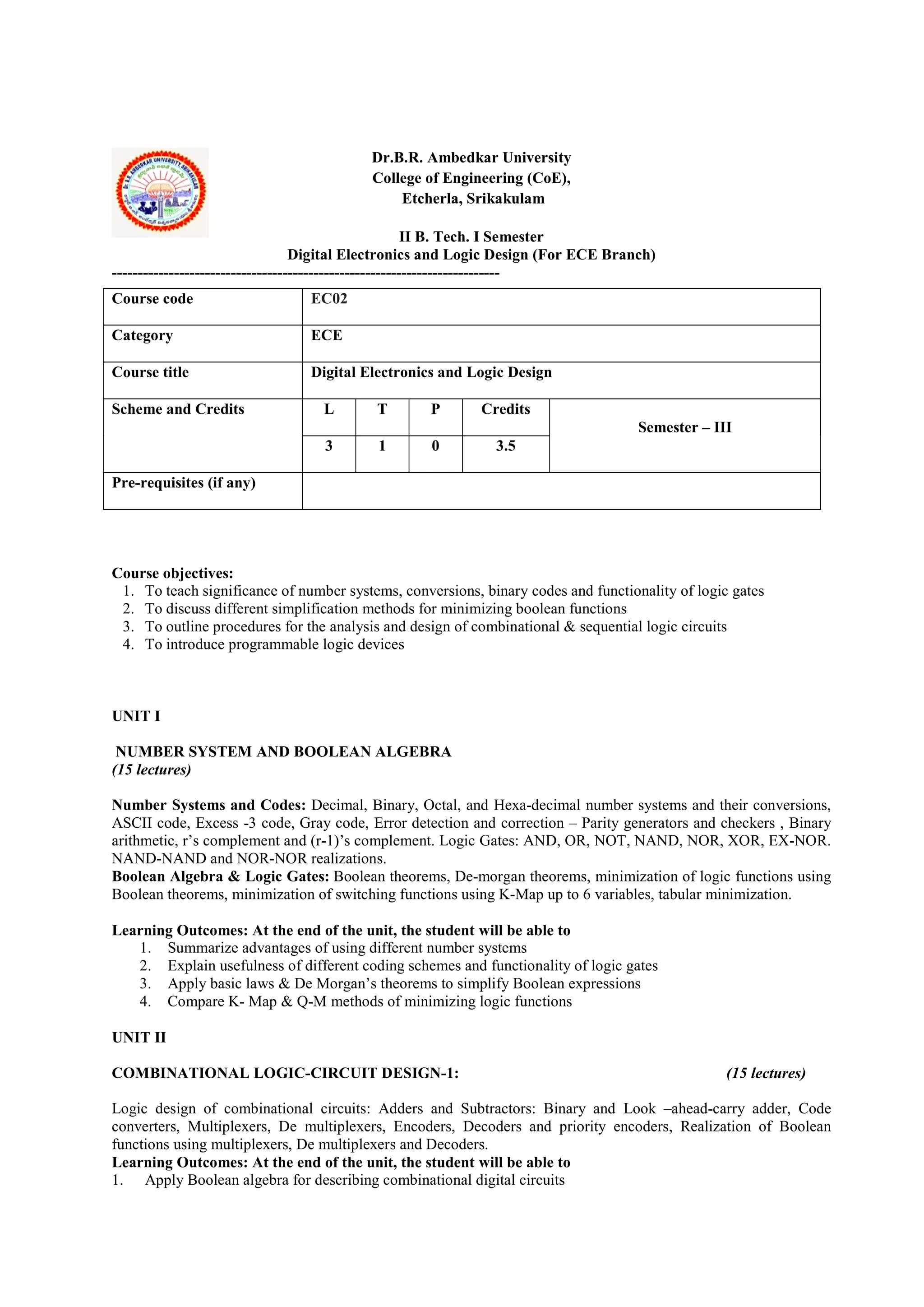
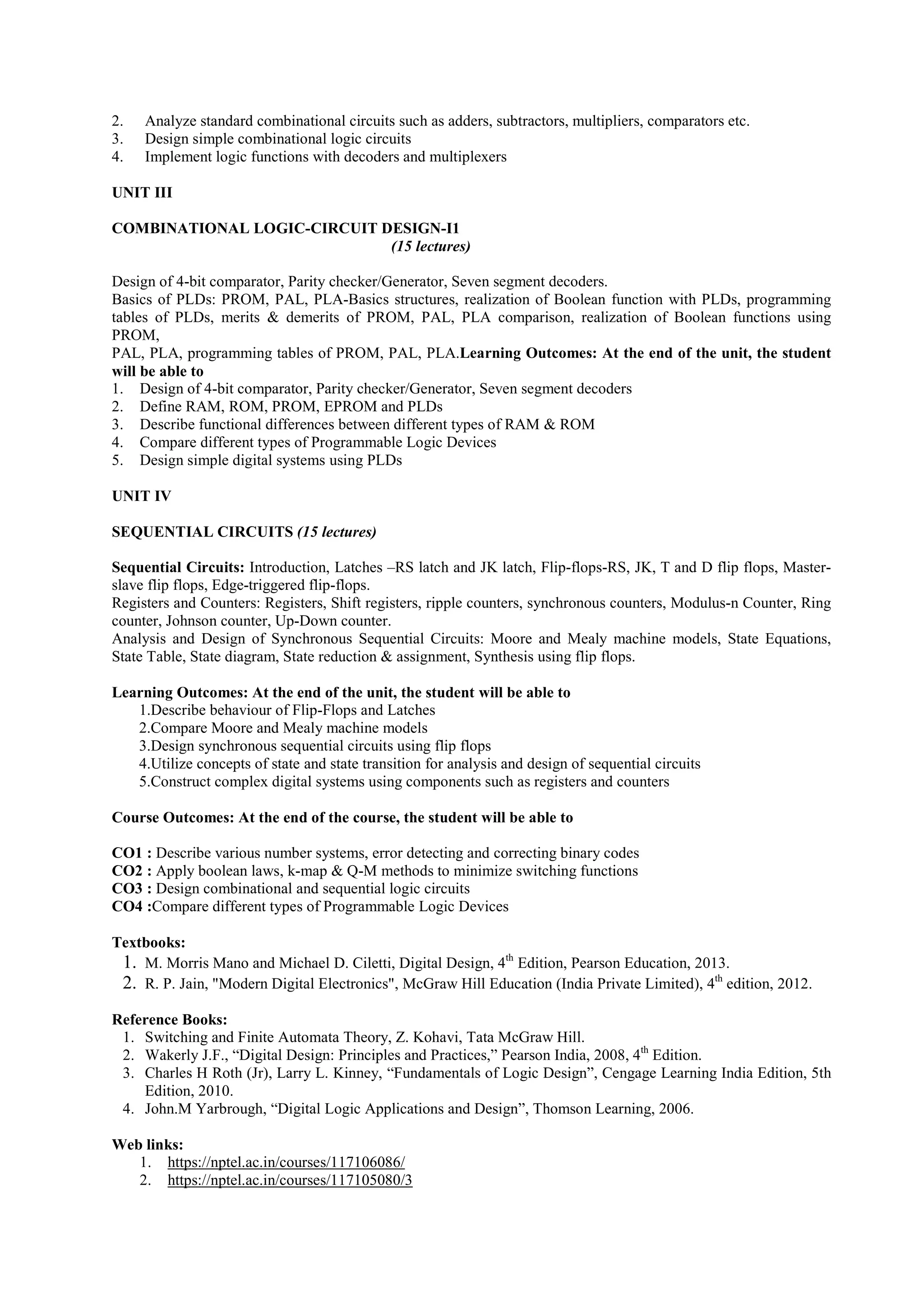
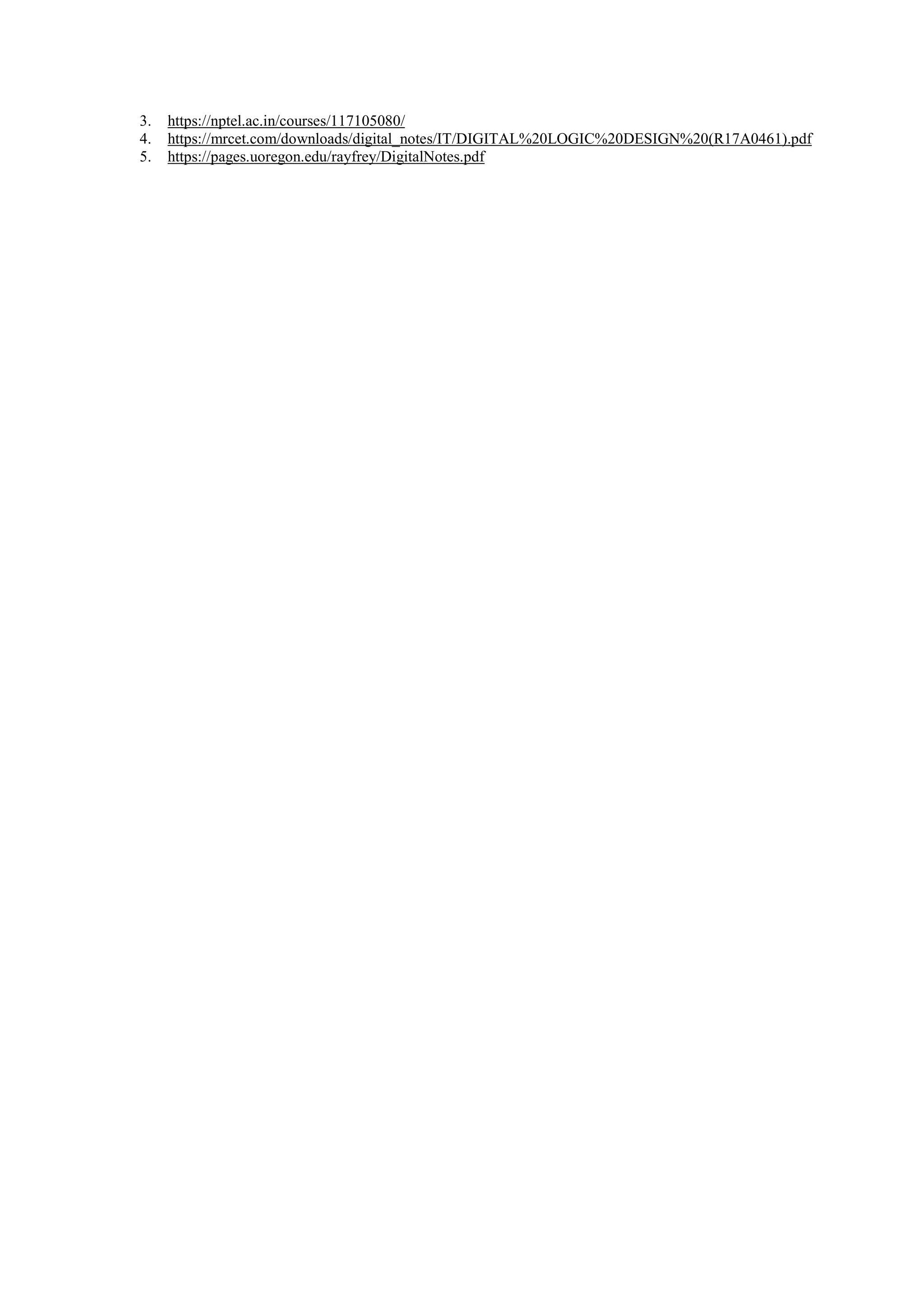
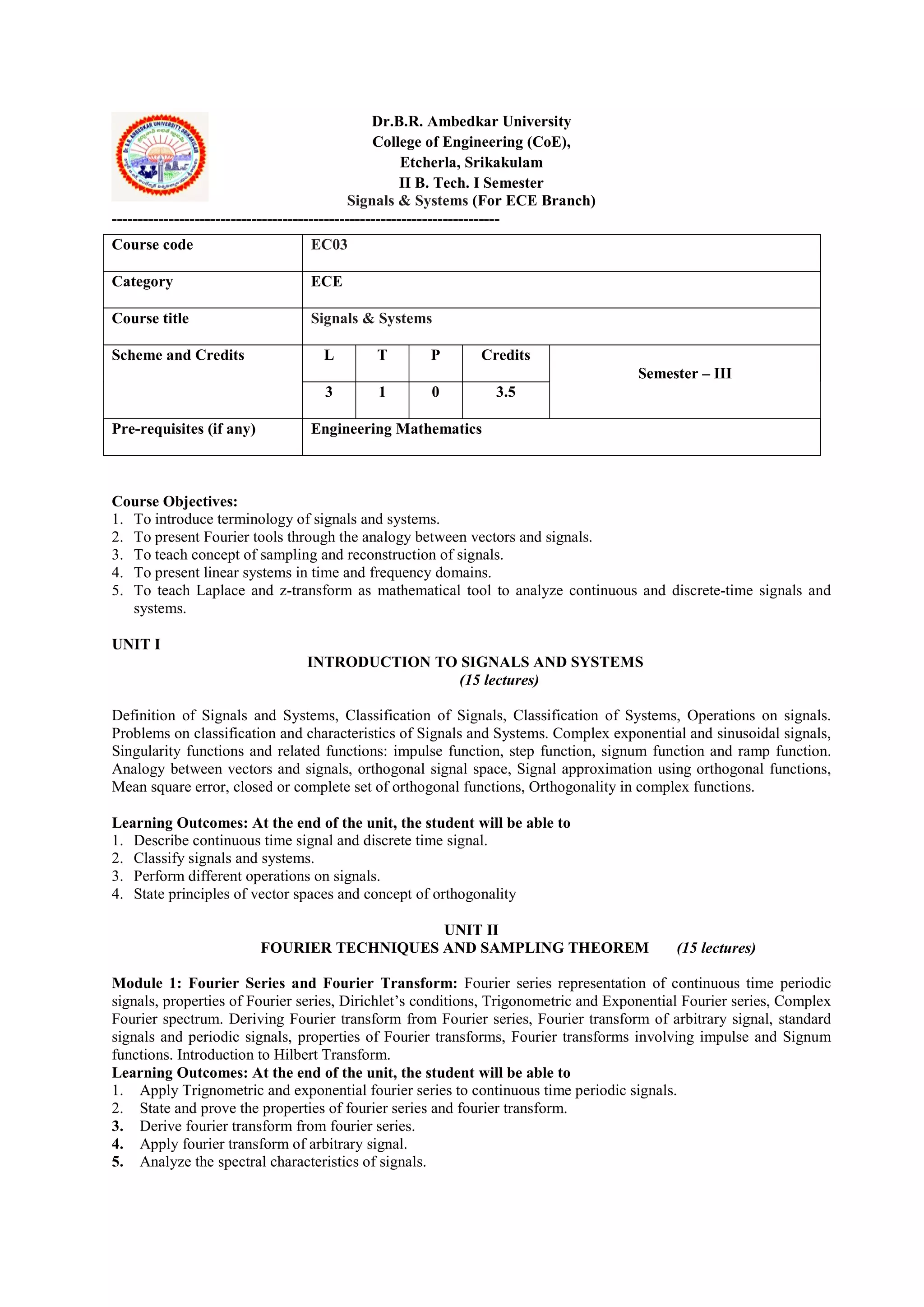
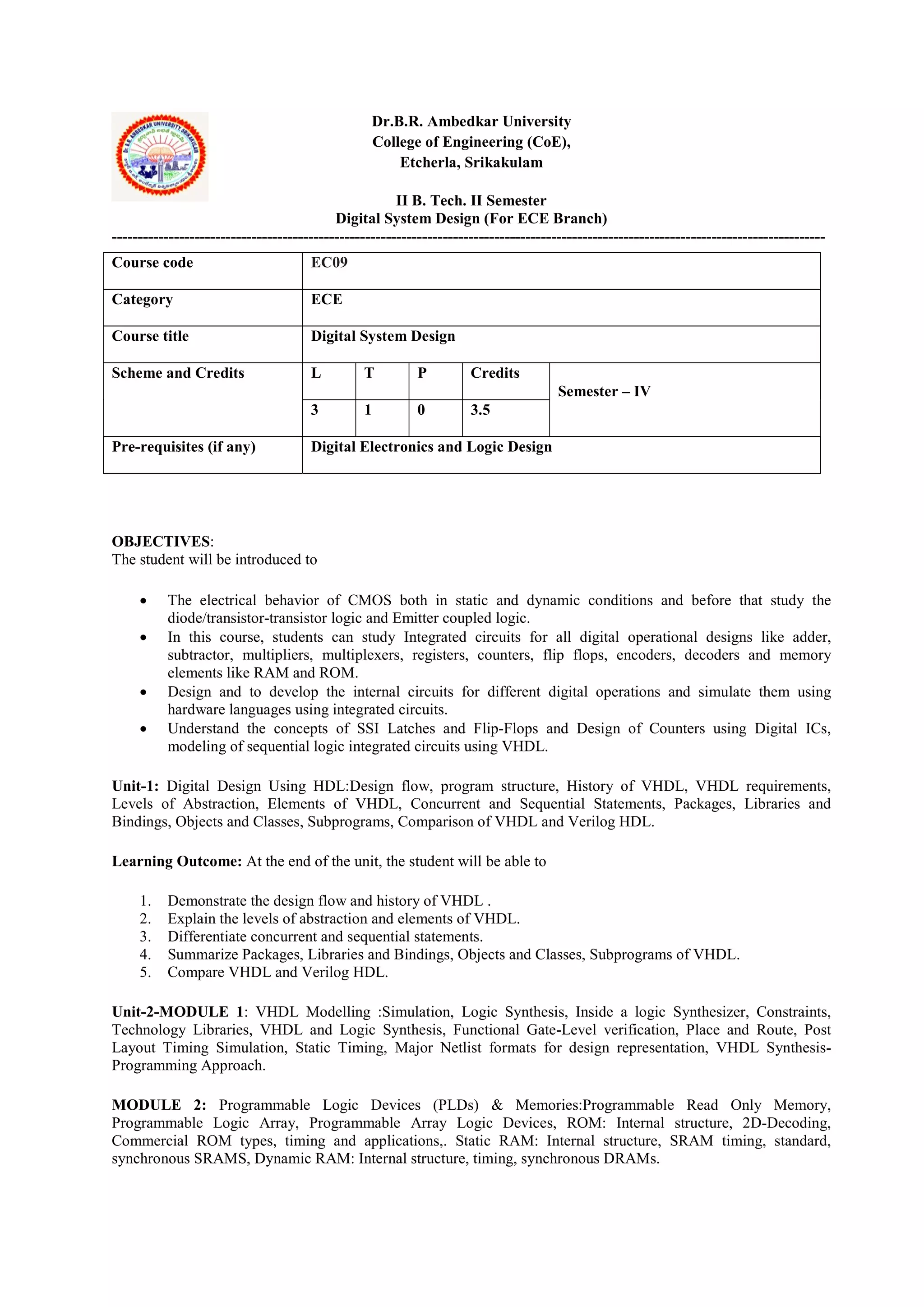
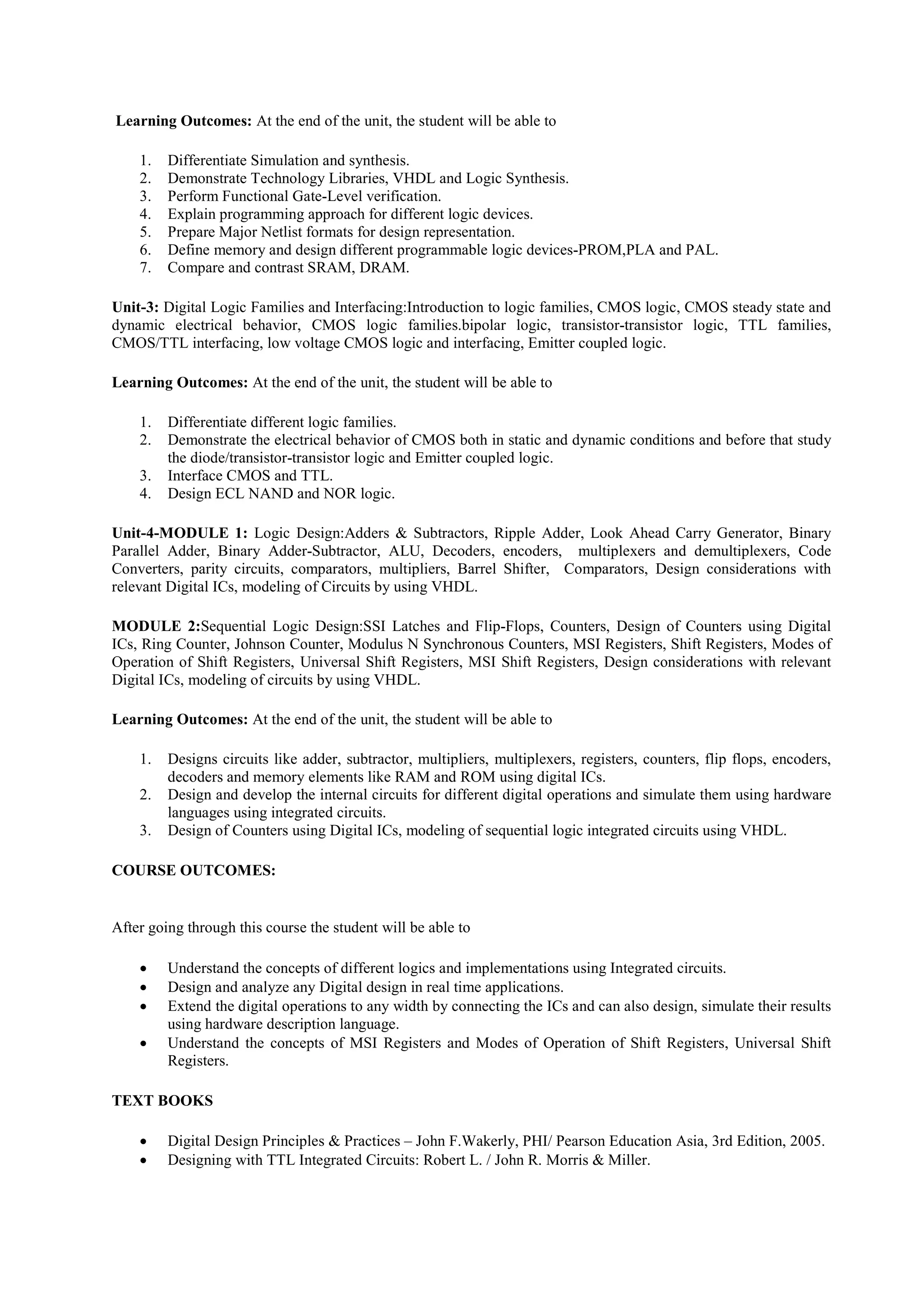
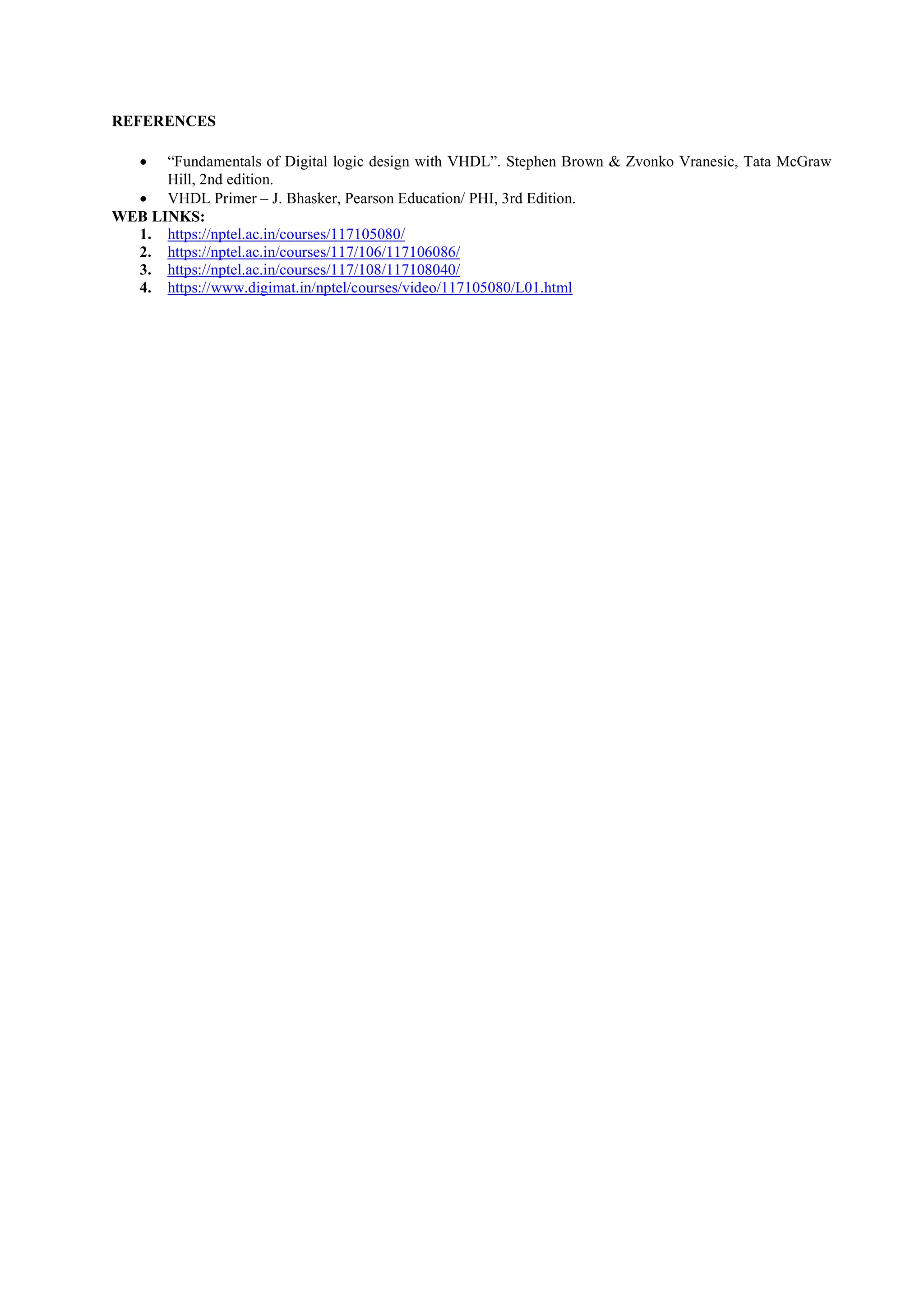
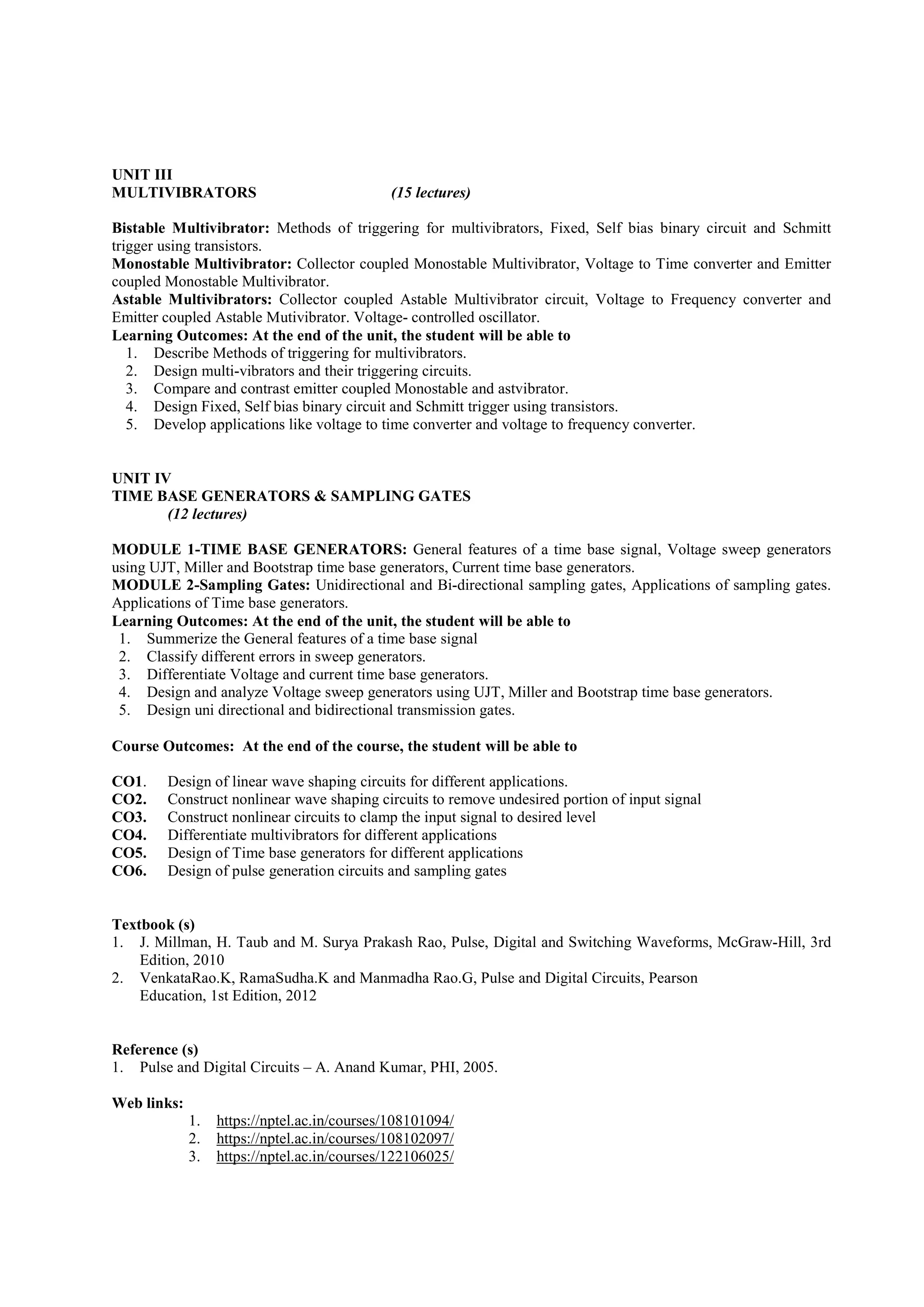
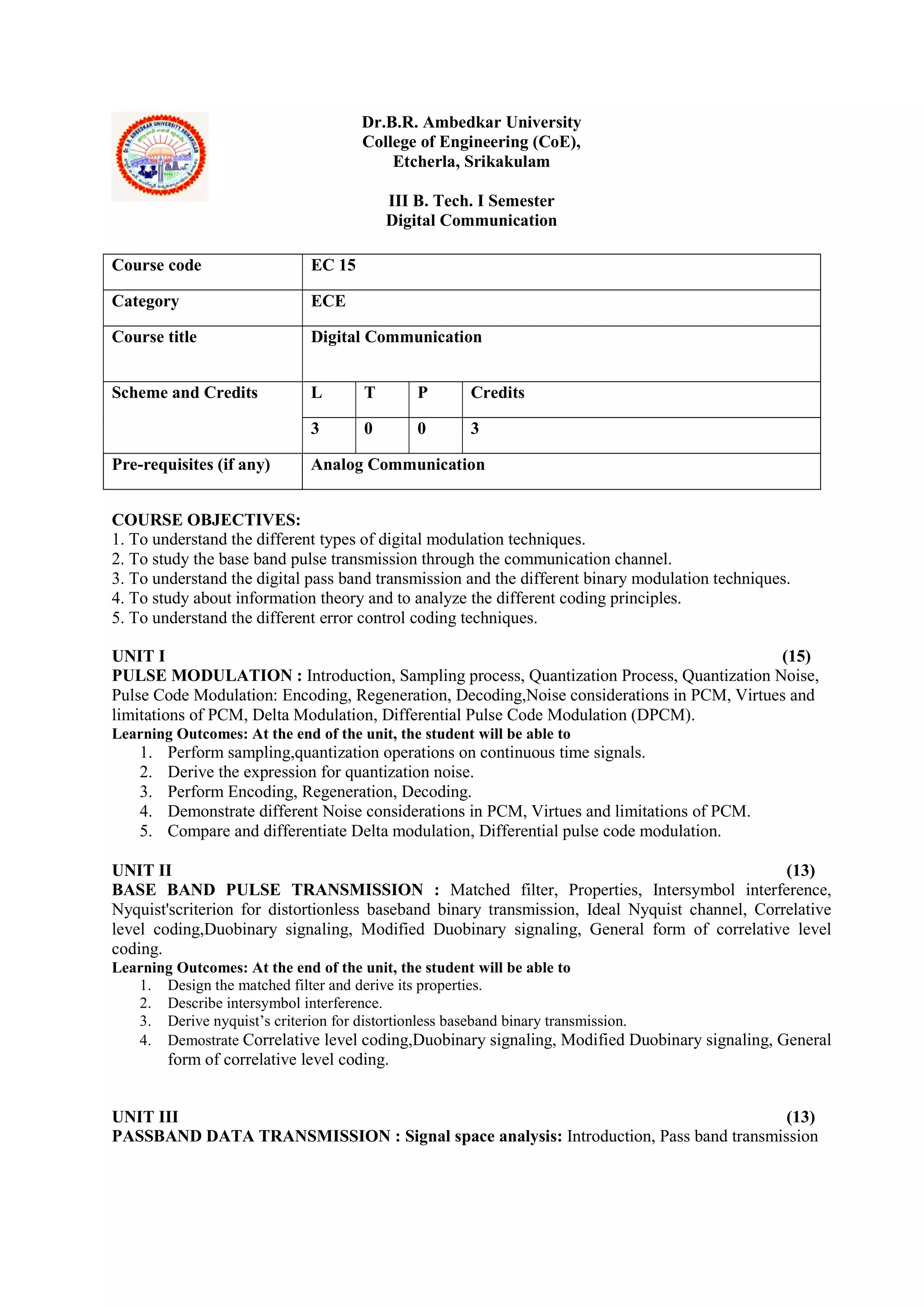
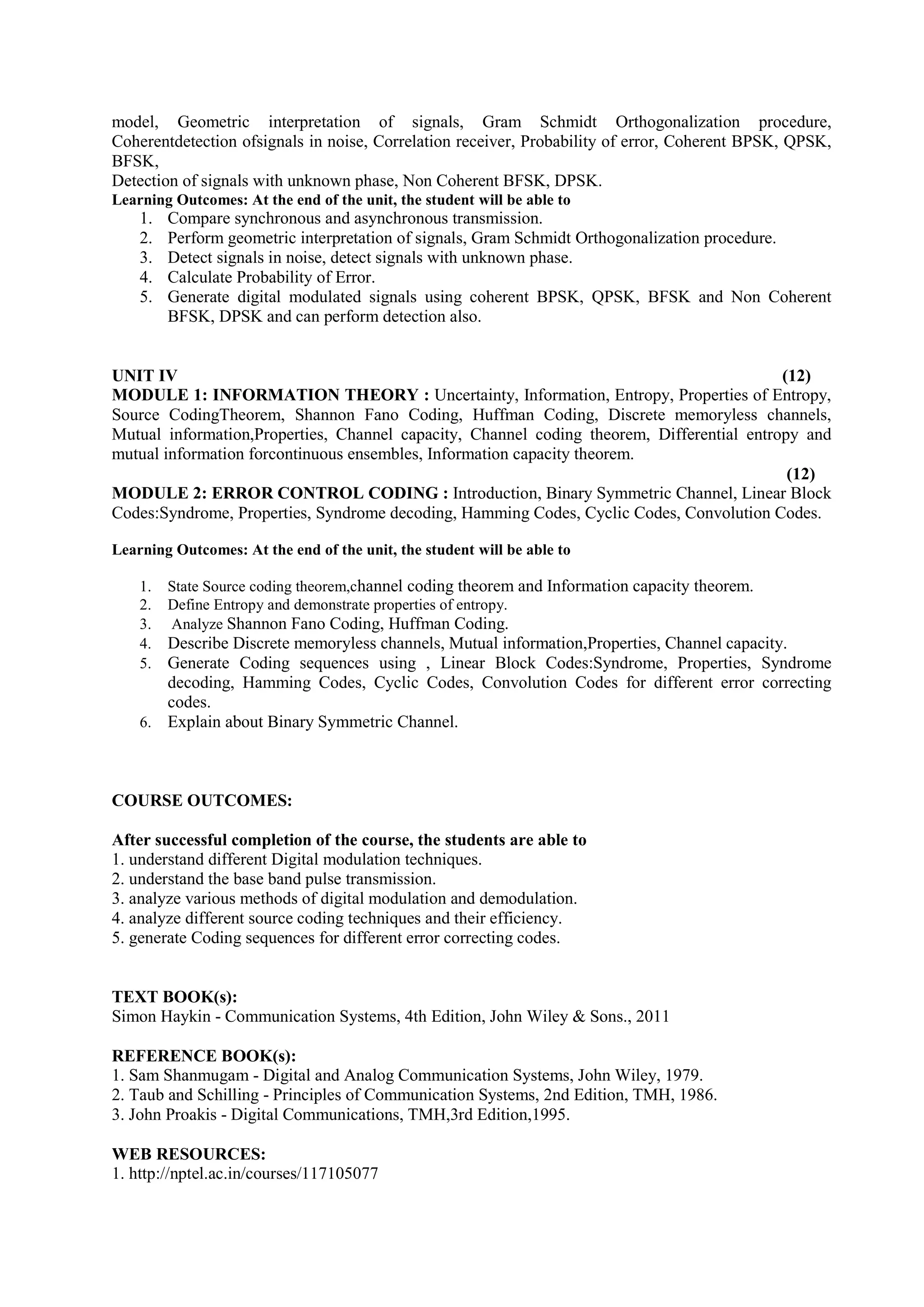
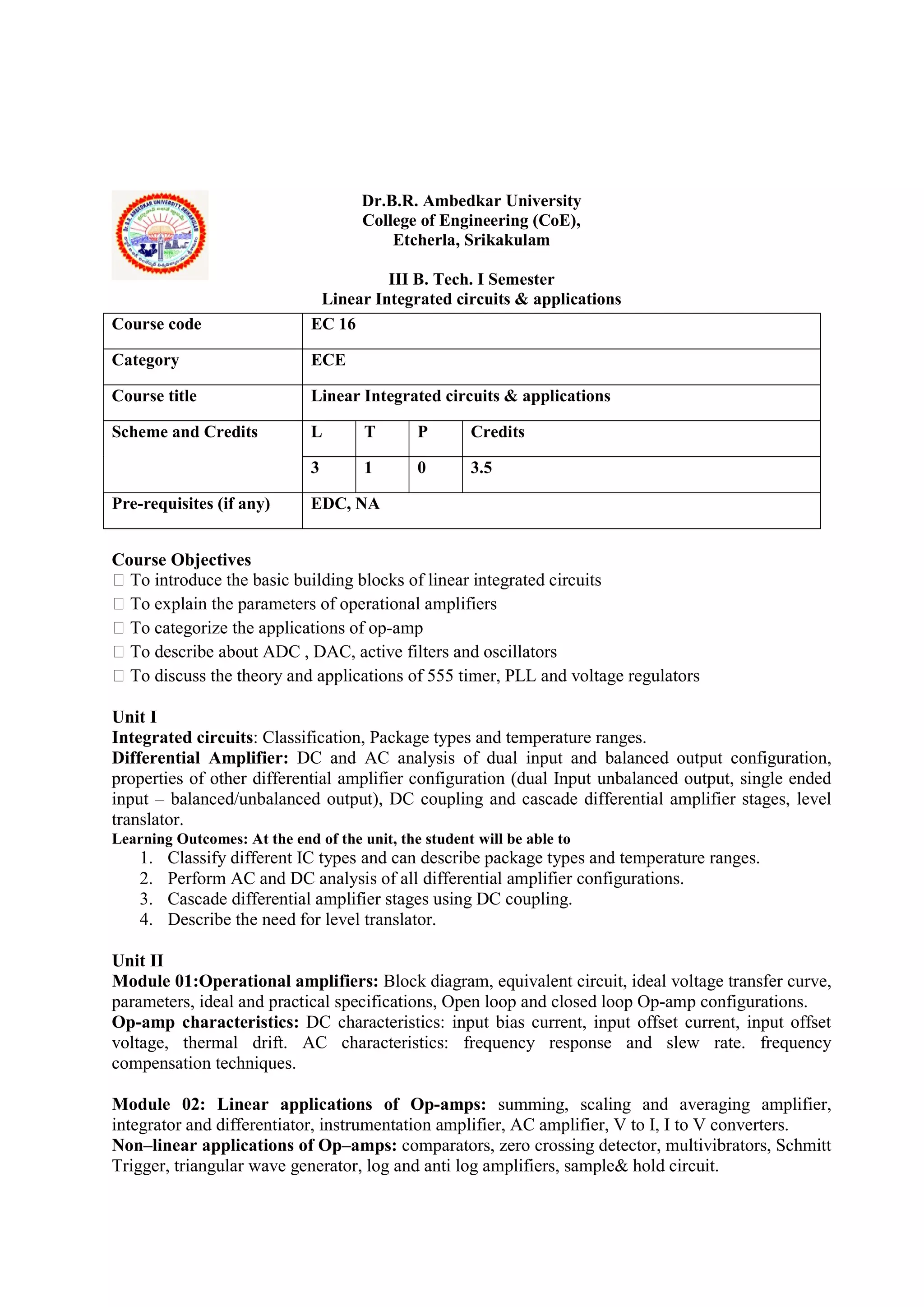
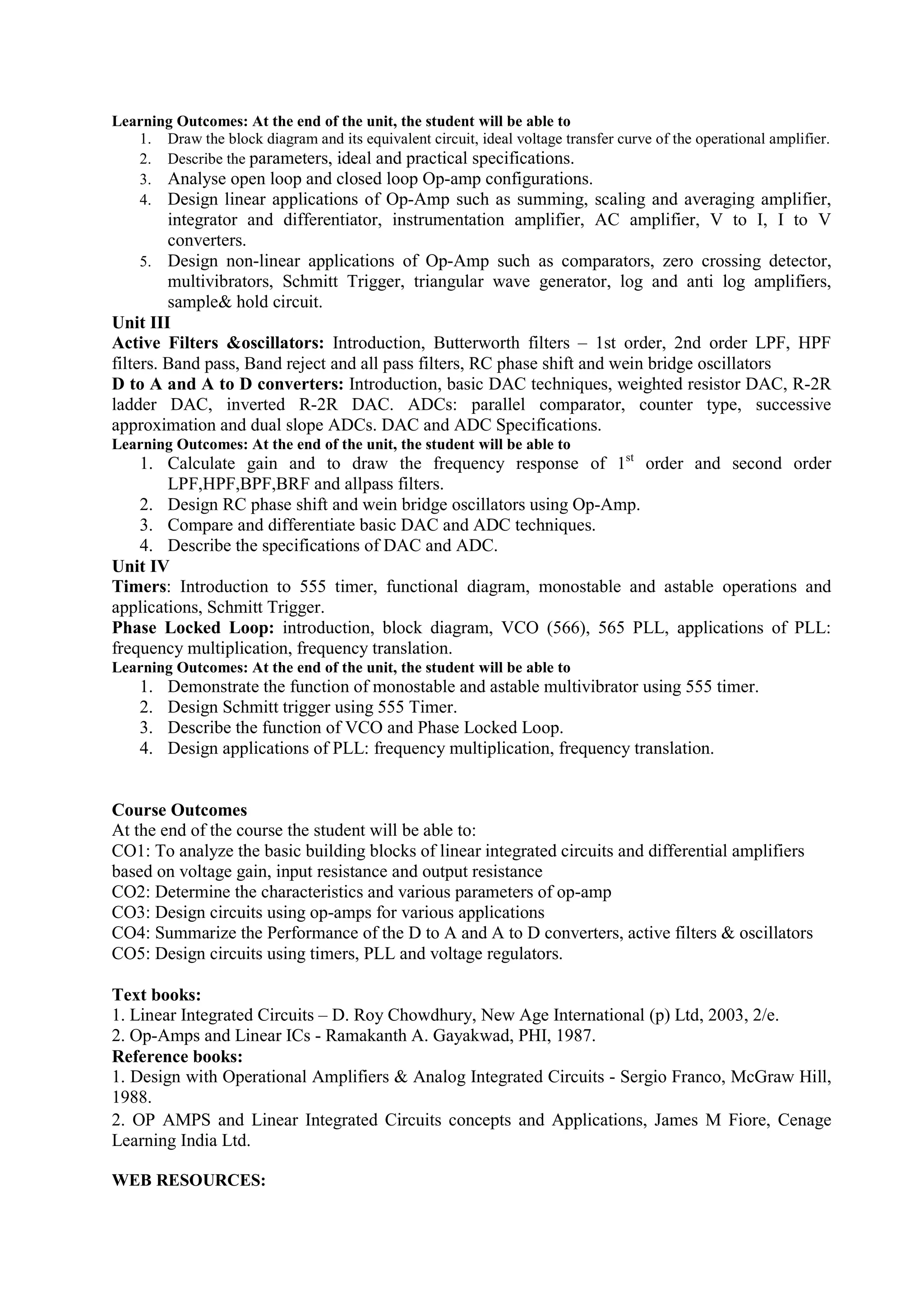
COURSE STRUCTURE
AND
DETAILED SYLLABUS
ELECTRONICS & COMMUNICATION ENGINEERING
For
B.TECH. FOUR YEAR DEGREE PROGRAMME (Applicable for the batches admitted from
2019 - 2020)
COLLEGE OF ENGINEERING
Dr. B.R. AMBEDKAR UNIVERSITY, SRIKAKULAM
Etcherla-532410
DR.B.R. AMBEDKAR UNIVERSITY
COLLEGE OF ENGINEERING
Etcherla, Srikakulam
VISION
To impart, disseminate and translate professional education by creating technocrats who can
address the needs of society through inventions and innovations.
MISSION
To educate and enlighten the students from all over India, especially those from rural areas, and
improve the living standards of their families and industry with social responsibility
DEPARTMENT OF ELECTRONICS AND COMMUNICATION ENGINEERING
VISION
To metamorphose the young students into responsible engineers, researchers, and entrepreneurs
by providing skill set and emerge as centre of excellence in the field of ECE that indulge in
providing innovative solutions to societal needs.
MISSION
1. To disseminate quality technical education and professional ethics for life.
2. Strengthen the skill set of students through curricular, co-curricular & extra-curricular
activities.
3. To equip the students with vigorous fundamentals to enable them for continuing their
higher education.
4. To pursue research in intra and inter discipline to serve the societal needs.
5. To promote spirit of entrepreneurship among the students.
SWOC Analysis :
Strengths:
1. Good team spirit among faculty.
2. Faculty present papers at national and international level journals.
3. Information about department activities is being published yearly.
4. Lesson plan with predefined activities is prepared before starting of the course.
5. Has ISO Certification
Weaknesses:
1. Lack of regular faculty in the department.
2. R&D facilities need to be enhanced.
3. Inadequate industry Institute Interaction.
4. Most of the students are from rural areas, they are lagging behind in Communication skills.
5. Less number of Ph.D holders.
Opportunities:
1. Participation of students in many co-curricular and extra curricular activities in the
campus can improve the communication skills and leadership qualities.
2. Optimum opportunities from industries.
3. Faculties are allowed to upgrade the skills by attending Faculty Development Programs
and workshops
4. Flexible curriculum.
Constraints:
1. Facing high competition from various NBA & NAAC accredited private engineering colleges
around the campus.
2. To get 100% placement
3. To make every student Industry engineer.
Strategic plans:
1. To acquire the job opportunities from private sector college is planning to sign MoU with
MNCs and industries.
2. To improve the communication skills of the student, skill development course is planned to
be a part of the curriculum.
3. Encourage faculty to continue their higher studies.
4. Promote research and encourage creativity & invention. Initiatives
5. Conduct seminars, workshops & Guest lectures regularly.
6. Enhance of library’s impact as an academic partner by maintaining a library with state-of-
the art facilities
Short term goals:
 To conduct faculty development programs regularly for skill upgradation.
 To establish well equipped laboratories
 To conduct summer short-term training programs for technicians to widen their knowledge
on the latest trends and developments in the field of Electronics and communication
Engineering
 Continue to organize annual student level seminars/paper presentations/project exhibitions/
Symposiums.
 College with rural roots excels in games and shall strive to produce national level players in
four years.
Long term Goals:
 To be recognized as the best department in terms of research and innovation.
 To develop consultancy for various industries
 To establish and strengthen Industry-Institute interaction and be industry solution
providers.
 To strive hard to meet the social, ecological and ethical needs of the region.
 To establish State of the art research facilities in the department.
 To produce entrepreneurs
PROGRAMME EDUCATIONAL OBJECTIVE(PEOs)
PEO1:To make the students capable to design and analyze the electronic circuits by acquiring
the knowledge in mathematics and basic science.
PEO2:To apply basic and advanced technical knowledge and skills as electronics and
communication engineers to solve the societal and organizational problems.
PEO3:To pursue the advanced degrees in the chosen field of electronics & communication
engineering and practice lifelong independent learning and the graduates shall succeed in
getting engineering positions with electronics and communication design, manufacturing
industries or in software and hardware industries in private or government sectors.
PEO4:To produce graduates with ethical and moral values and also, with good communication
skills, work effectively on team-based projects, become entrepreneurs.
PROGRAMME OUTCOMES (POs)
Engineering Graduates will be able to:
1. Engineering Knowledge: Apply the knowledge of mathematics, science, engineering
fundamentals, and an engineering specialization to the solution of complex engineering
problems.
2. Problem Analysis: Identify, formulate, review research literature, and analyze complex
engineering problems reaching substantiated conclusions using first principles of mathematics,
natural sciences, and engineering sciences.
3. Design/Development of Solutions: Design solutions for complex engineering problems and
design system components or processes that meet the specified needs with appropriate
consideration for the public health and safety, and the cultural, societal, and environmental
considerations.
4. Conduct Investigations Of Complex Problems: Use research-based knowledge and
research methods including design of experiments, analysis and interpretation of data, and
synthesis of the information to provide valid conclusions.
5. Modern Tool Usage: Create, select, and apply appropriate techniques, resources, and
modern engineering and IT tools including prediction and modelling to complex engineering
activities with an understanding of the limitations.
6. The Engineer and Society: Apply reasoning informed by the contextual knowledge to assess
societal, health, safety, legal and cultural issues and the consequent responsibilities relevant to
the professional engineering practice.
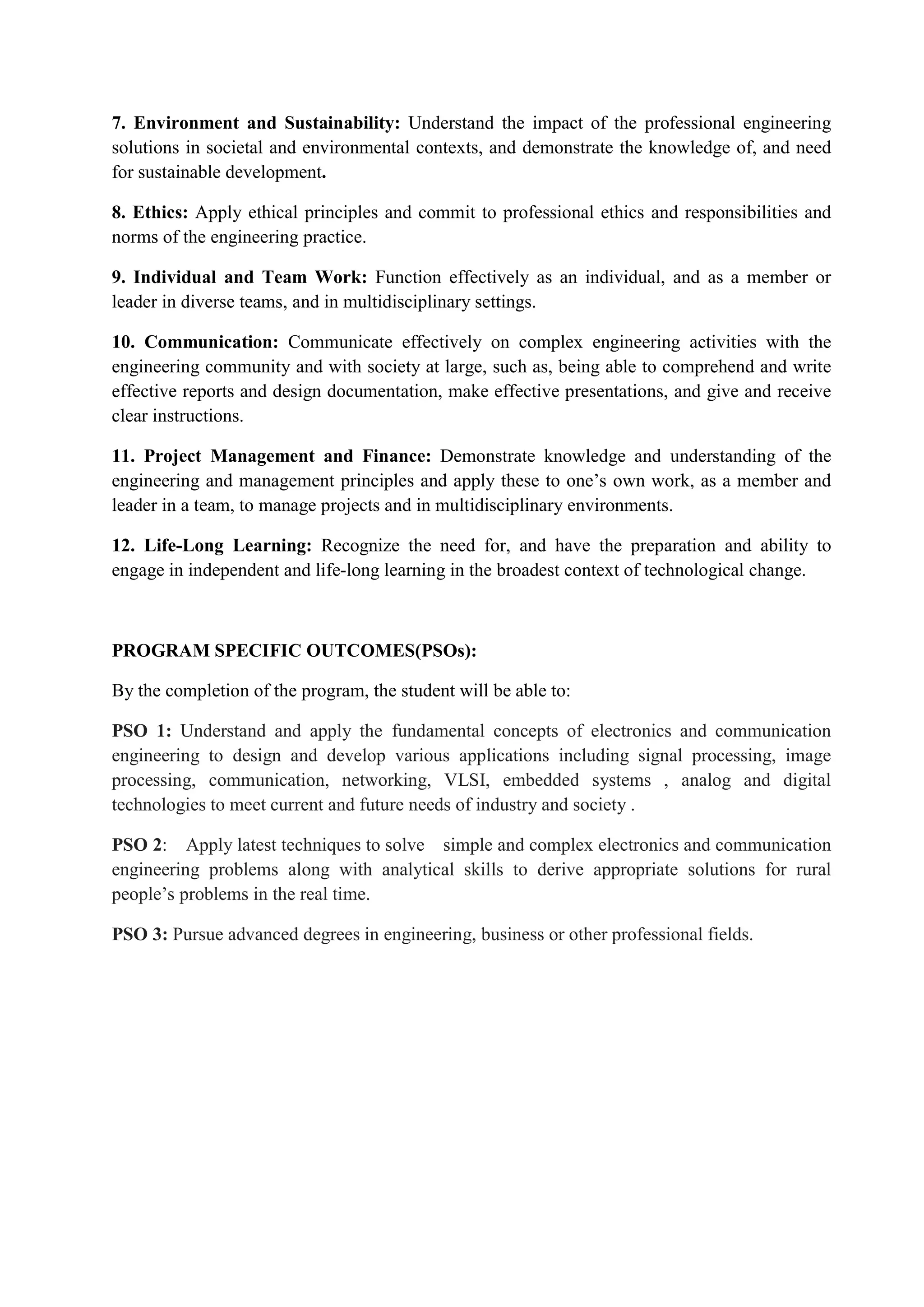
7. Environment and Sustainability: Understand the impact of the professional engineering
solutions in societal and environmental contexts, and demonstrate the knowledge of, and need
for sustainable development.
8. Ethics: Apply ethical principles and commit to professional ethics and responsibilities and
norms of the engineering practice.
9. Individual and Team Work: Function effectively as an individual, and as a member or
leader in diverse teams, and in multidisciplinary settings.
10. Communication: Communicate effectively on complex engineering activities with the
engineering community and with society at large, such as, being able to comprehend and write
effective reports and design documentation, make effective presentations, and give and receive
clear instructions.
11. Project Management and Finance: Demonstrate knowledge and understanding of the
engineering and management principles and apply these to one’s own work, as a member and
leader in a team, to manage projects and in multidisciplinary environments.
12. Life-Long Learning: Recognize the need for, and have the preparation and ability to
engage in independent and life-long learning in the broadest context of technological change.
PROGRAM SPECIFIC OUTCOMES(PSOs):
By the completion of the program, the student will be able to:
PSO 1: Understand and apply the fundamental concepts of electronics and communication
engineering to design and develop various applications including signal processing, image
processing, communication, networking, VLSI, embedded systems , analog and digital
technologies to meet current and future needs of industry and society .
PSO 2: Apply latest techniques to solve simple and complex electronics and communication
engineering problems along with analytical skills to derive appropriate solutions for rural
people’s problems in the real time.
PSO 3: Pursue advanced degrees in engineering, business or other professional fields.
College Of Engineering
Dr.B.R.Ambedkar University
Model Curriculum For
Undergraduate Degree Courses in Engineering & Technology
ELECTRONICS & COMMUNICATION ENGINEERING
Chapter -1
General, Course structure & Theme
&
Semester-wise credit distribution
A. Definition of Credit:
1 Hr. Lecture (L) per week 1 credit
1 Hr. Tutorial (T) per week 0.5 credit
1 Hr. Practical (P) per week
2 Hours Practical(Lab)/week
0.5 credit
1 credit
B. Range of credits-A range of credits from 150 to 160 for a student to be eligible to get Under
Graduate degree in Engineering. A student will be eligible to get Under Graduate degree with
Honours or additional Minor Engineering; if he/she completes an additional 20 credits. These
could be acquired through MOOCs.
C. Structure of Undergraduate Engineering program:
S.
No
Category Credit Breakup
for ECE students
1 Humanities and Social Sciences including Management
courses
6*
2 Basic Science courses 22.5*
3 Engineering Science courses including workshop, drawing,
basics of electrical/mechanical/computer etc
14*
4 Professional core courses 77*
5 Professional Elective courses relevant to chosen
specialization/branch
12*
6 Open subjects – Electives from other technical and /or
emerging Subjects
8*
7 Project work, seminar and internship in industry or elsewhere 11*
8 Mandatory Courses [Environmental Sciences, Induction
Program, Indian Constitution, Essence of Indian Knowledge
Tradition]
2*
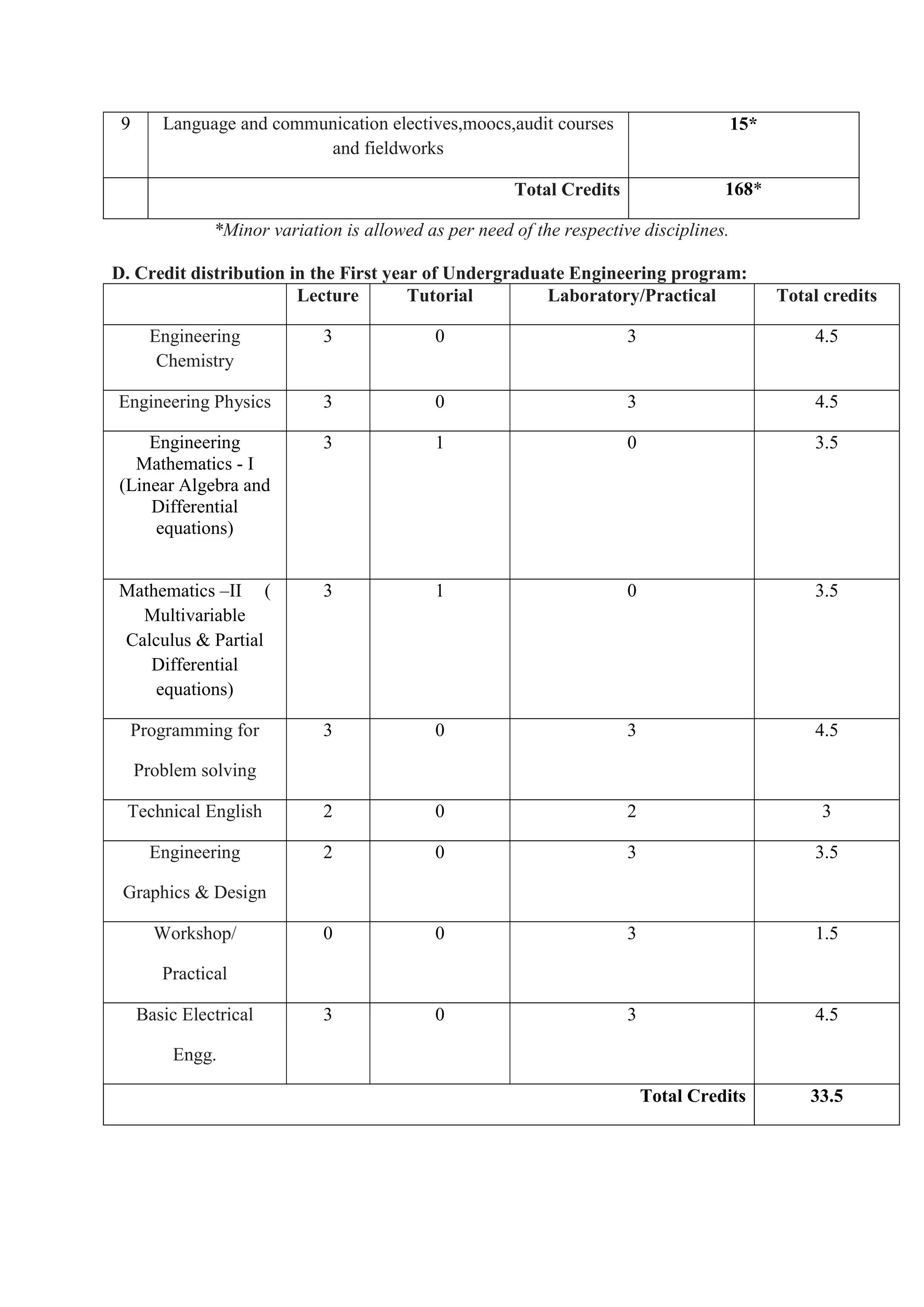
9 Language and communication electives,moocs,audit courses
and fieldworks
15*
Total Credits 168*
*Minor variation is allowed as per need of the respective disciplines.
D. Credit distribution in the First year of Undergraduate Engineering program:
Lecture Tutorial Laboratory/Practical Total credits
Engineering
Chemistry
3 0 3 4.5
Engineering Physics 3 0 3 4.5
Engineering
Mathematics - I
(Linear Algebra and
Differential
equations)
3 1 0 3.5
Mathematics –II (
Multivariable
Calculus & Partial
Differential
equations)
3 1 0 3.5
Programming for
Problem solving
3 0 3 4.5
Technical English 2 0 2 3
Engineering
Graphics & Design
2 0 3 3.5
Workshop/
Practical
0 0 3 1.5
Basic Electrical
Engg.
3 0 3 4.5
Total Credits 33.5
E. Course code and definition:
Course code Definitions
BSC Basic Science Courses
ESC Engineering Science Courses
HSMC Humanities and Social Sciences including Management courses
PCC Professional core courses
CEC Core Elective courses
OEC Open Elective courses
MC Mandatory courses
PROJ Project
F. HUMANITIES AND SOCIAL SCIENCES INCLUDING MANAGEMENT COURSES
Sl.
No
Code
No.
Course Title Hours per week Credits
Lecture Tutorial Practical
1 HSMC
101
Technical English 2 0 0 2
2 HSMC
102
Technical English
Lab
0 0 2 1
3 HSMC
103
Constitution of
India
1 0 0 1
4 HSMC
301
Humanities 2 0 0 2
Total Credits 6
G. BASIC SCIENCE COURSE [BSC]
Sl.
N
o
Code
No.
Course Title Hours per week Credit
s
Lectur
e
Tutoria
l
Practic
al
1 BSC10
1
Engineering Mathematics - I (Linear
Algebra and Differential equations)
3 1 3 3.5
2 BSC10
2
Engineering Chemistry 3 0 0 3
BSC10
3
Engineering Chemistry Lab 0 0 3 1.5
3 BSC10
4
Engineering Physics 3 0 0 3
4 BSC10
5
Mathematics –II ( Multivariable
Calculus & Partial Differential equations)
3 1 0 3.5
5 BSC10
6
Engineering Physics Lab Environmental
Science
0 0 3 1.5
6 BSC10
7
Environmental Science 1 0 0 1
7 BSC20
1
Mathematics –III ( COMPLEX
VARIABLE,PROBABILITY&STATISTI
CS)
3 1 0 3.5
8 BSC20
2
Life sciences for Engineers 2 0 0 2
Total Credits 22.5
H. ENGINEERING SCIENCE COURSE [ESC]
Sl.
No
Code
No.
Course Title Hours per week Total
Credits
Lecture Tutorial Practical
1 ESC 101 Engineering Graphics & Design 2 0 3 3.5
2 ESC 102 Programming for Problem
Solving
3 0 0 3
3 ESC 103 Basic Electrical Engineering 3 0 0 3
4 ESC 104 Programming for Problem
Solving lab
0 0 3 1.5
5 ESC 105 Basic Electrical Engineering lab 0 0 3 1.5
6 ESC 106 Engineering workshop lab 0 0 3 1.5
Total 14
I. PROFESSIONAL CORE COURSES:
S.No Course
Code
Course Title L T P Credits Preferred
Semester
1 EC01 Electronic Devices
and Circuits
3 1 0 3.5 III
2 EC02 Digital Electronics
& Logic Design
3 1 0 3.5 III
3 EC03 Signals & Systems 3 1 0 3.5 III
4 EC04 Network Theory 3 1 0 3.5 III
5 EC05 Electronic Devices
and Circuits Lab
0 0 3 1.5 III
6 EC06 Digital Electronics
& Logic Design
Lab
0 0 3 1.5 III
7 EC07 Analog
communication
3 0 0 3 IV
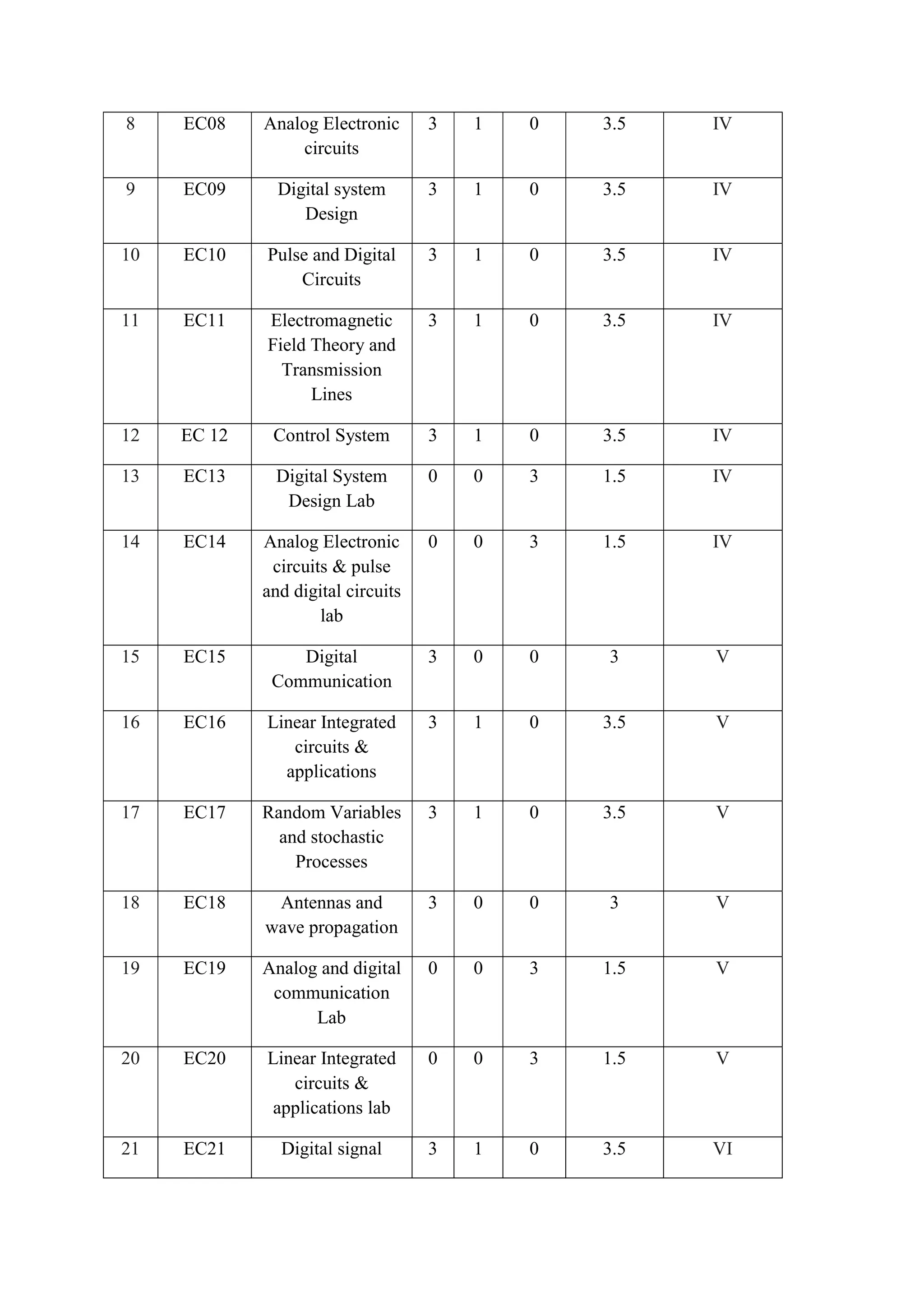
8 EC08 Analog Electronic
circuits
3 1 0 3.5 IV
9 EC09 Digital system
Design
3 1 0 3.5 IV
10 EC10 Pulse and Digital
Circuits
3 1 0 3.5 IV
11 EC11 Electromagnetic
Field Theory and
Transmission
Lines
3 1 0 3.5 IV
12 EC 12 Control System 3 1 0 3.5 IV
13 EC13 Digital System
Design Lab
0 0 3 1.5 IV
14 EC14 Analog Electronic
circuits & pulse
and digital circuits
lab
0 0 3 1.5 IV
15 EC15 Digital
Communication
3 0 0 3 V
16 EC16 Linear Integrated
circuits &
applications
3 1 0 3.5 V
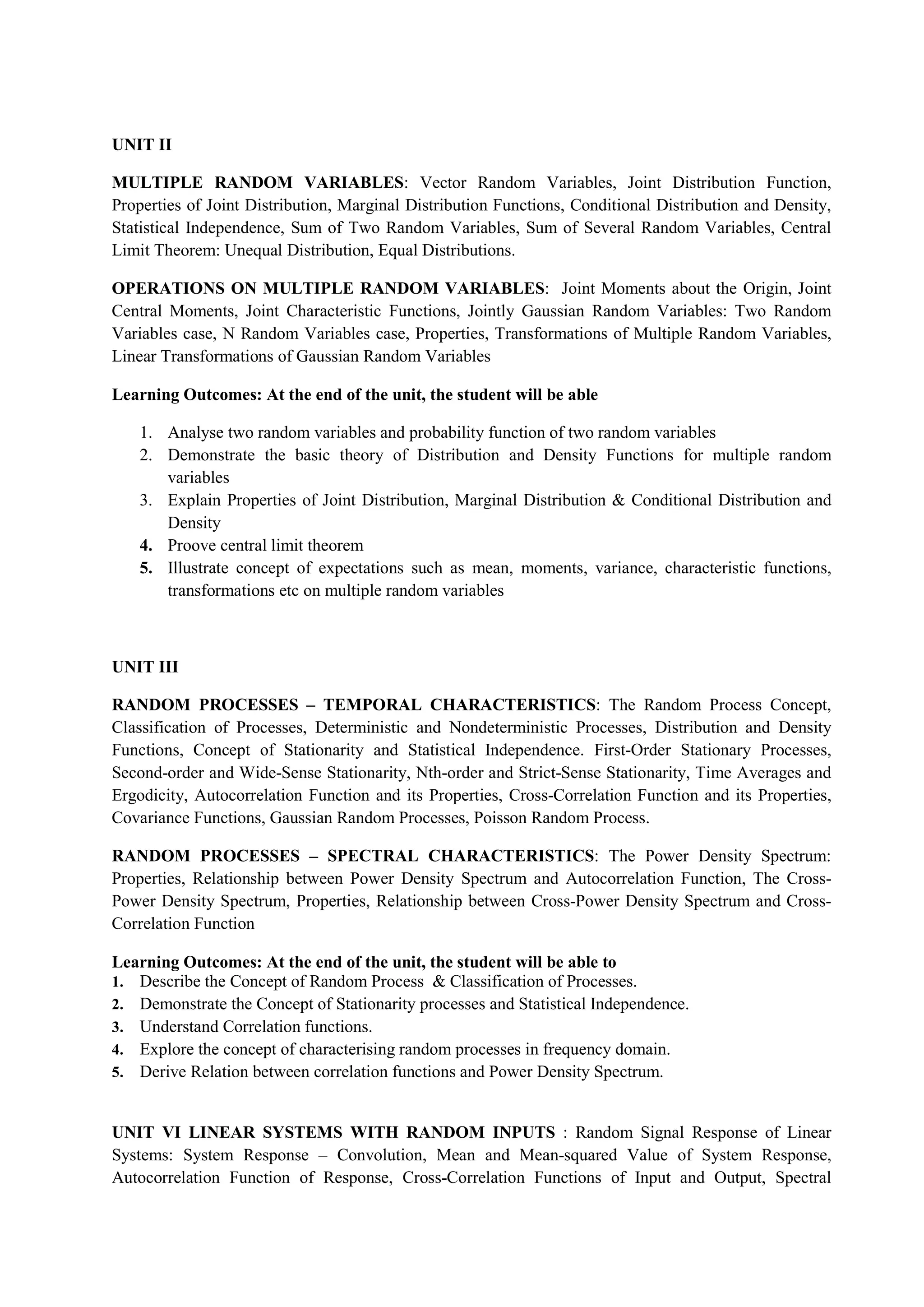
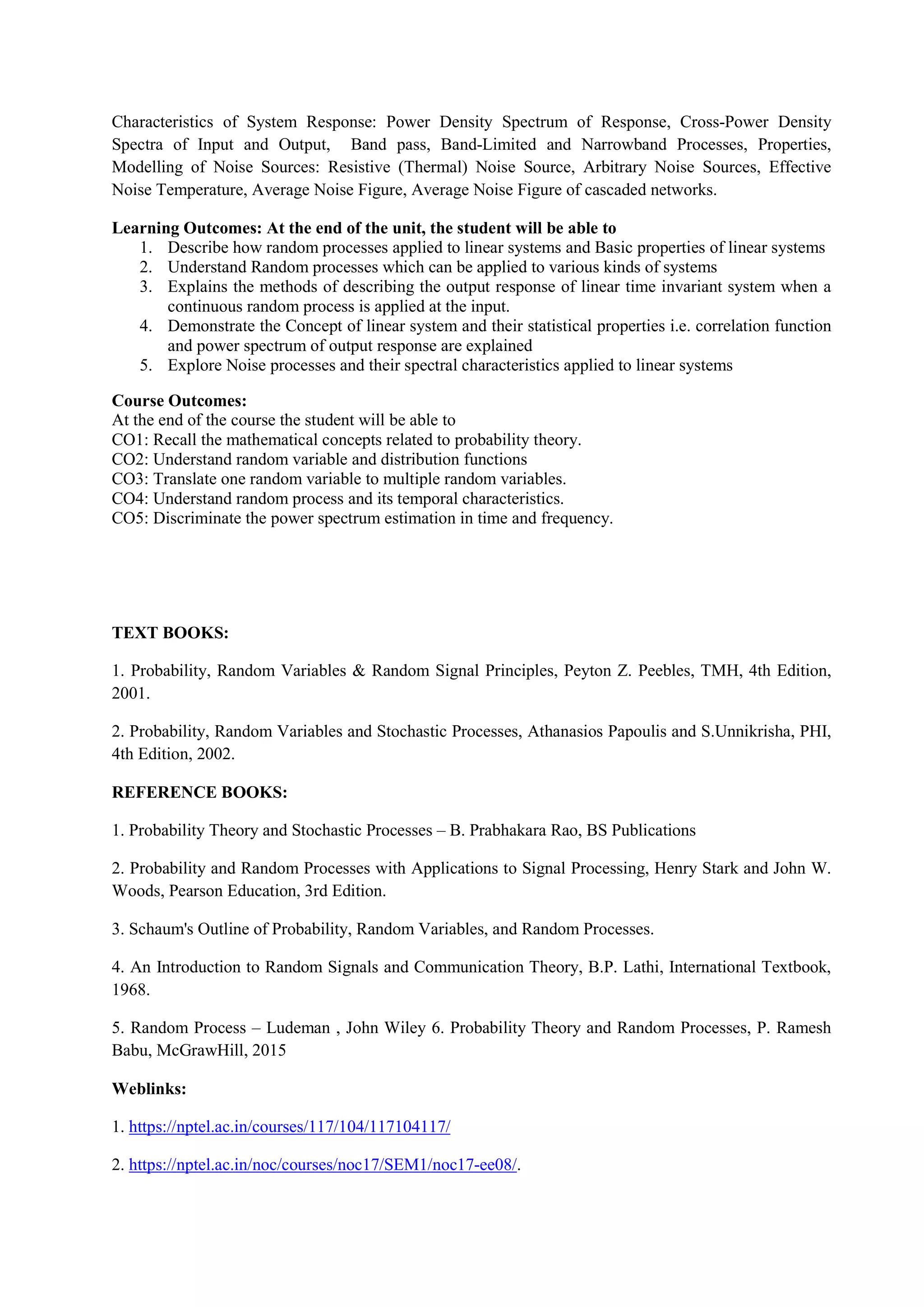
17 EC17 Random Variables
and stochastic
Processes
3 1 0 3.5 V
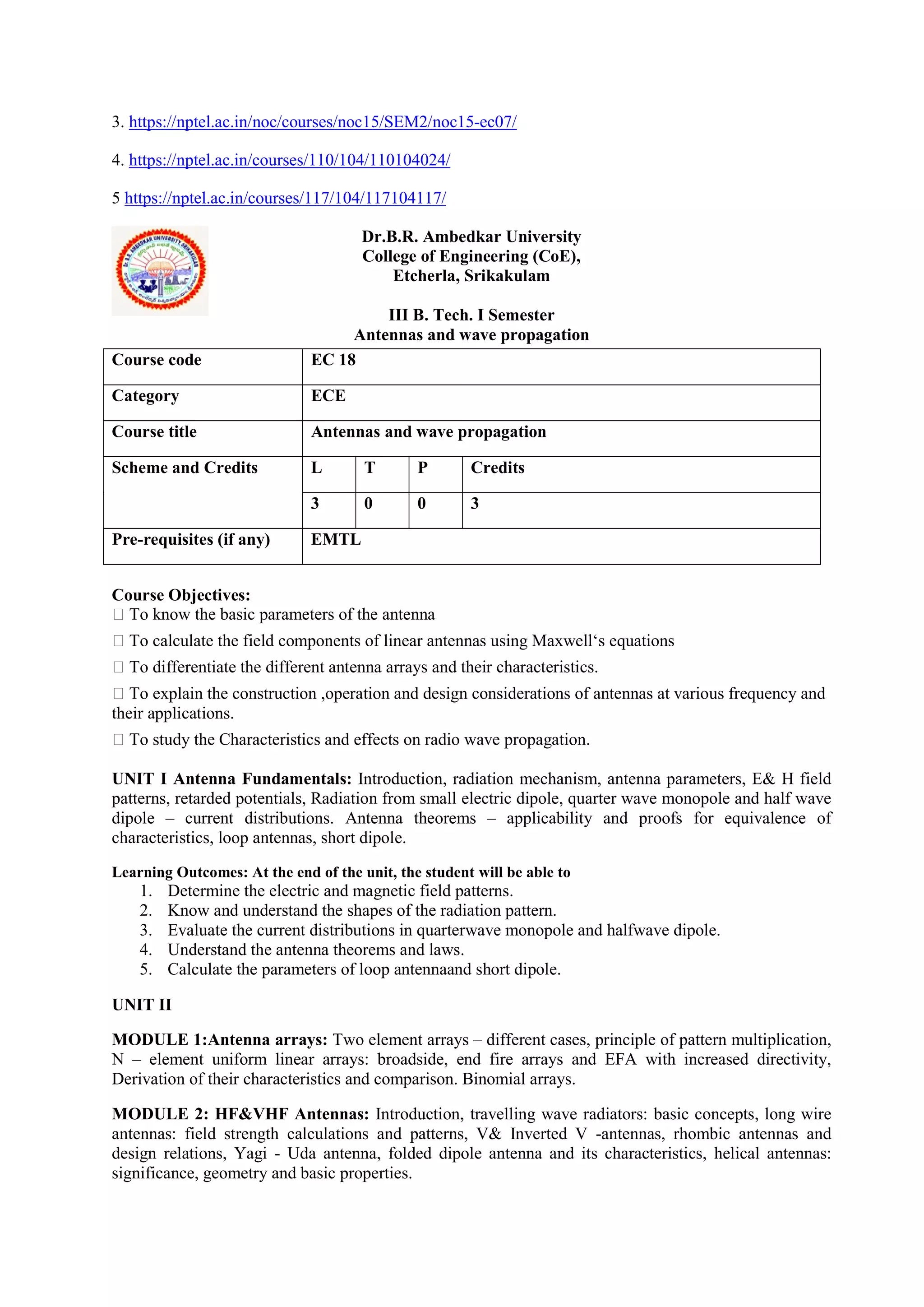
18 EC18 Antennas and
wave propagation
3 0 0 3 V
19 EC19 Analog and digital
communication
Lab
0 0 3 1.5 V
20 EC20 Linear Integrated
circuits &
applications lab
0 0 3 1.5 V
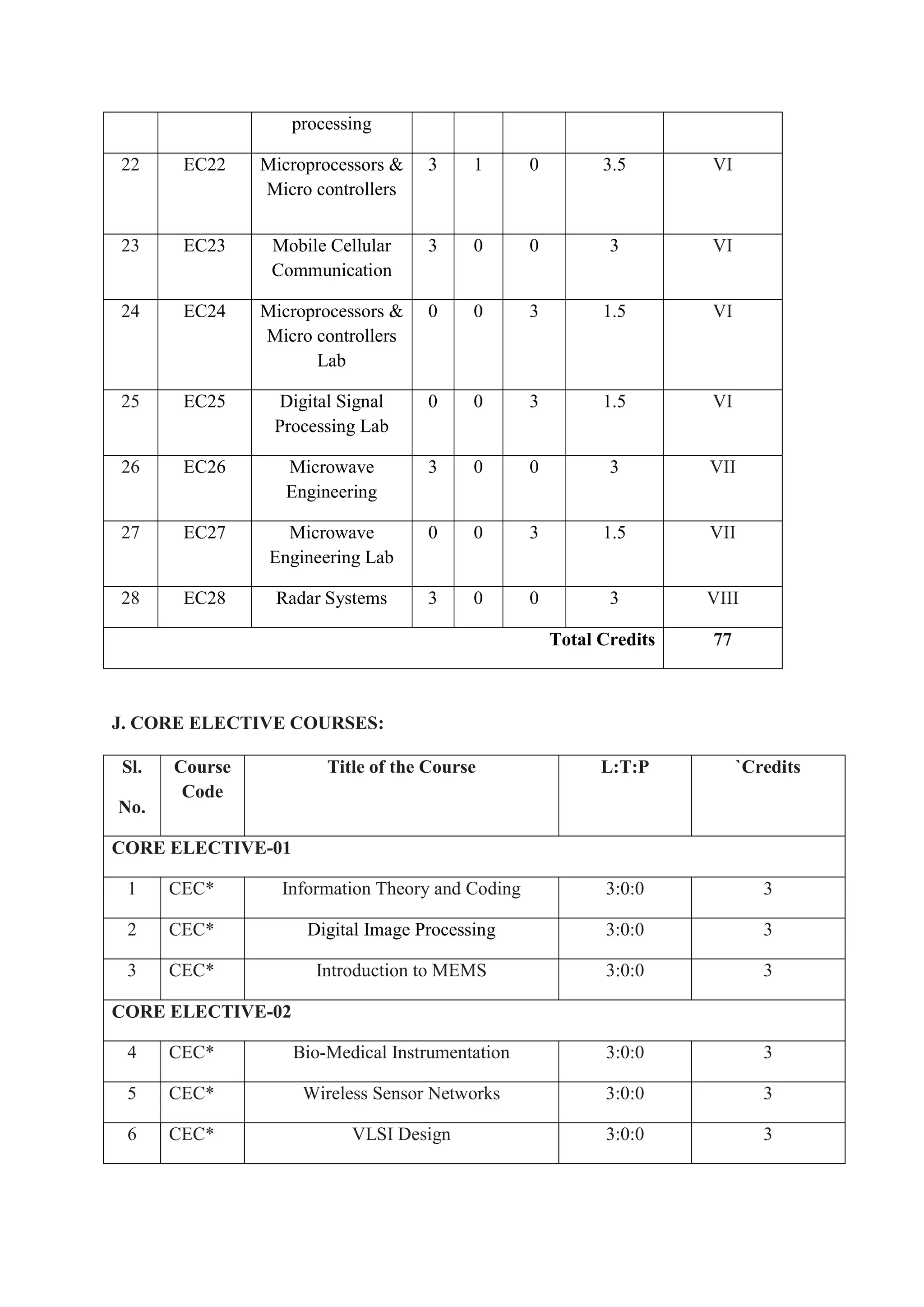
21 EC21 Digital signal 3 1 0 3.5 VI
processing
22 EC22 Microprocessors &
Micro controllers
3 1 0 3.5 VI
23 EC23 Mobile Cellular
Communication
3 0 0 3 VI
24 EC24 Microprocessors &
Micro controllers
Lab
0 0 3 1.5 VI
25 EC25 Digital Signal
Processing Lab
0 0 3 1.5 VI
26 EC26 Microwave
Engineering
3 0 0 3 VII
27 EC27 Microwave
Engineering Lab
0 0 3 1.5 VII
28 EC28 Radar Systems 3 0 0 3 VIII
Total Credits 77
J. CORE ELECTIVE COURSES:
Sl.
No.
Course
Code
Title of the Course L:T:P `Credits
CORE ELECTIVE-01
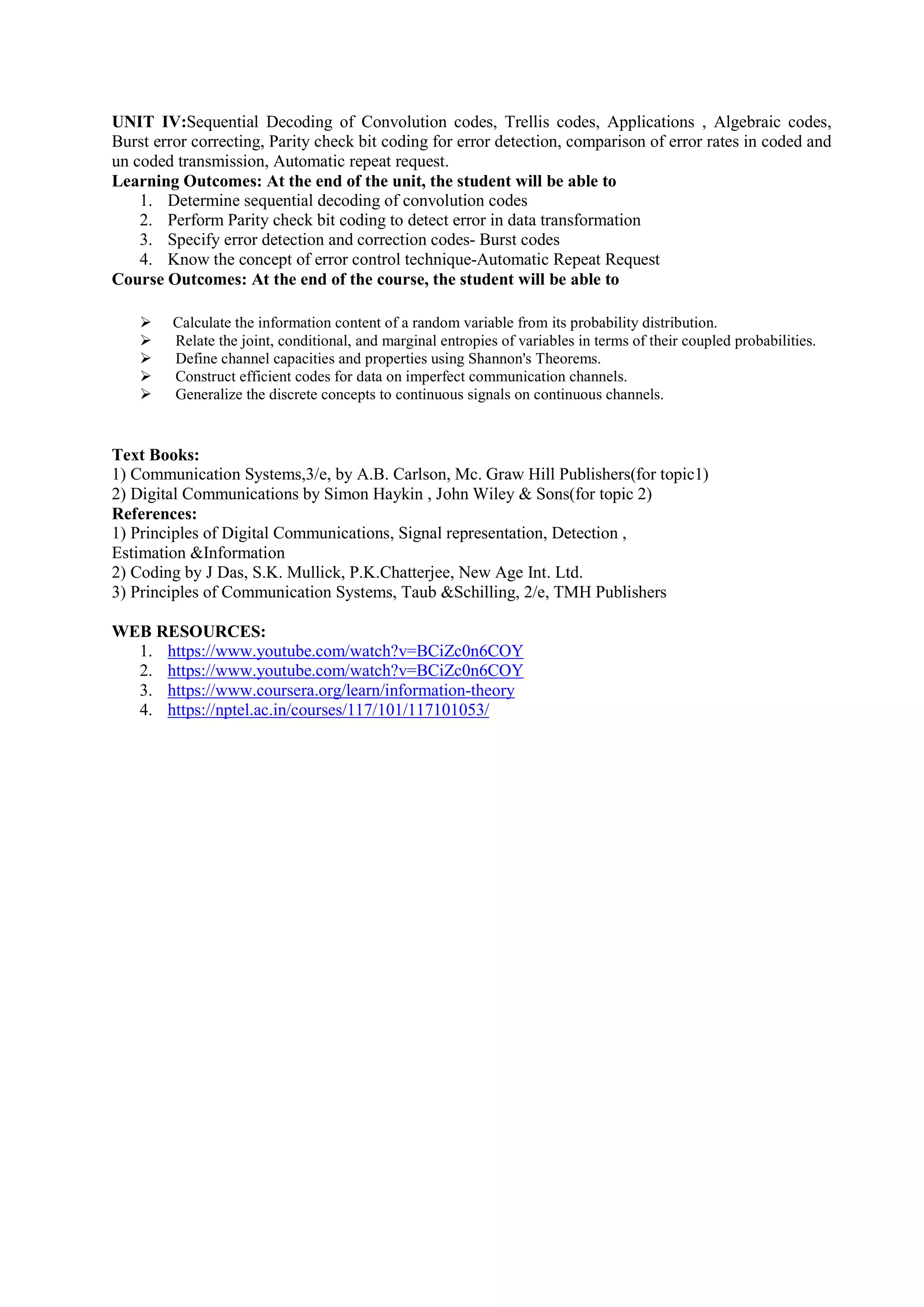
1 CEC* Information Theory and Coding 3:0:0 3
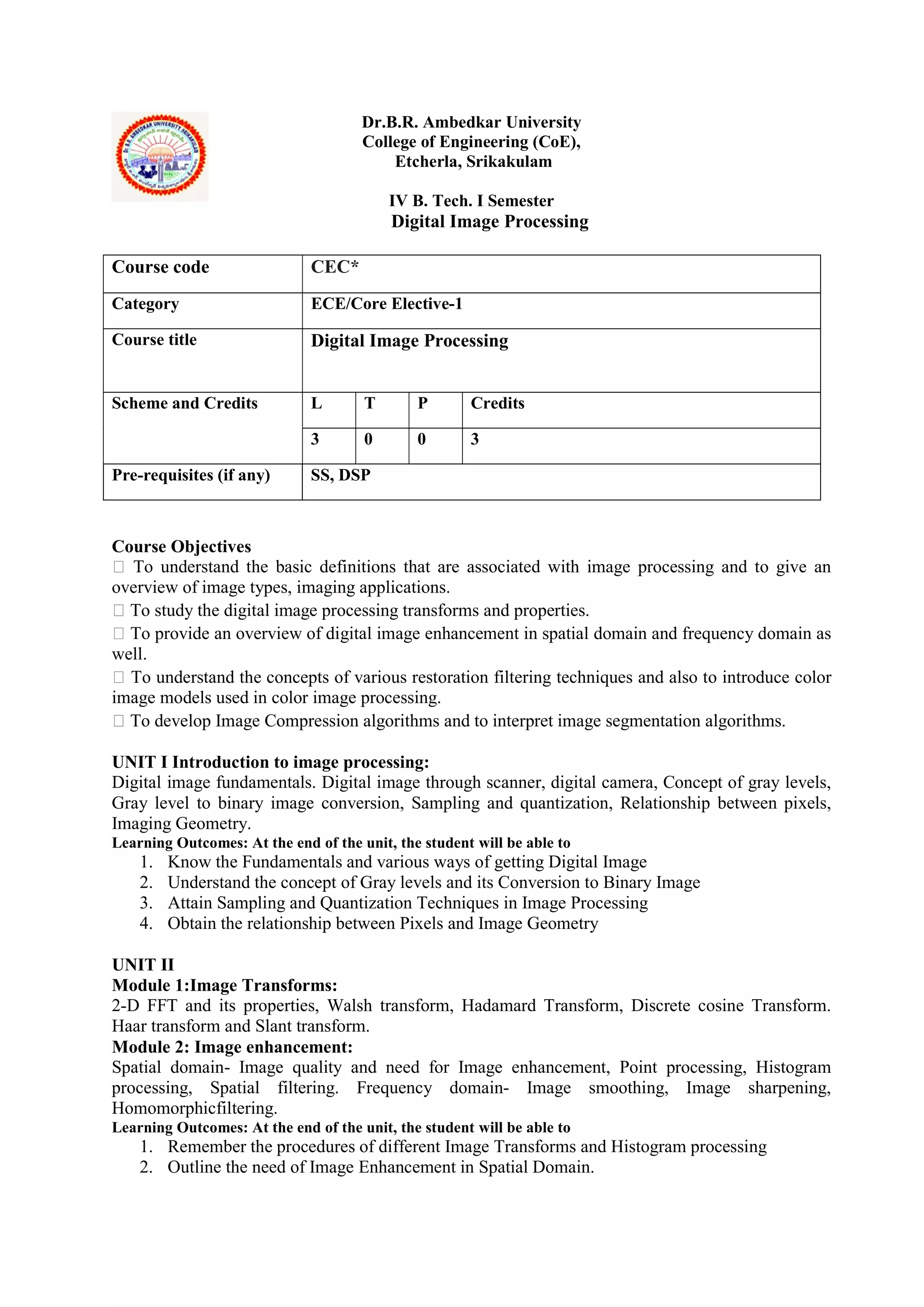
2 CEC* Digital Image Processing 3:0:0 3
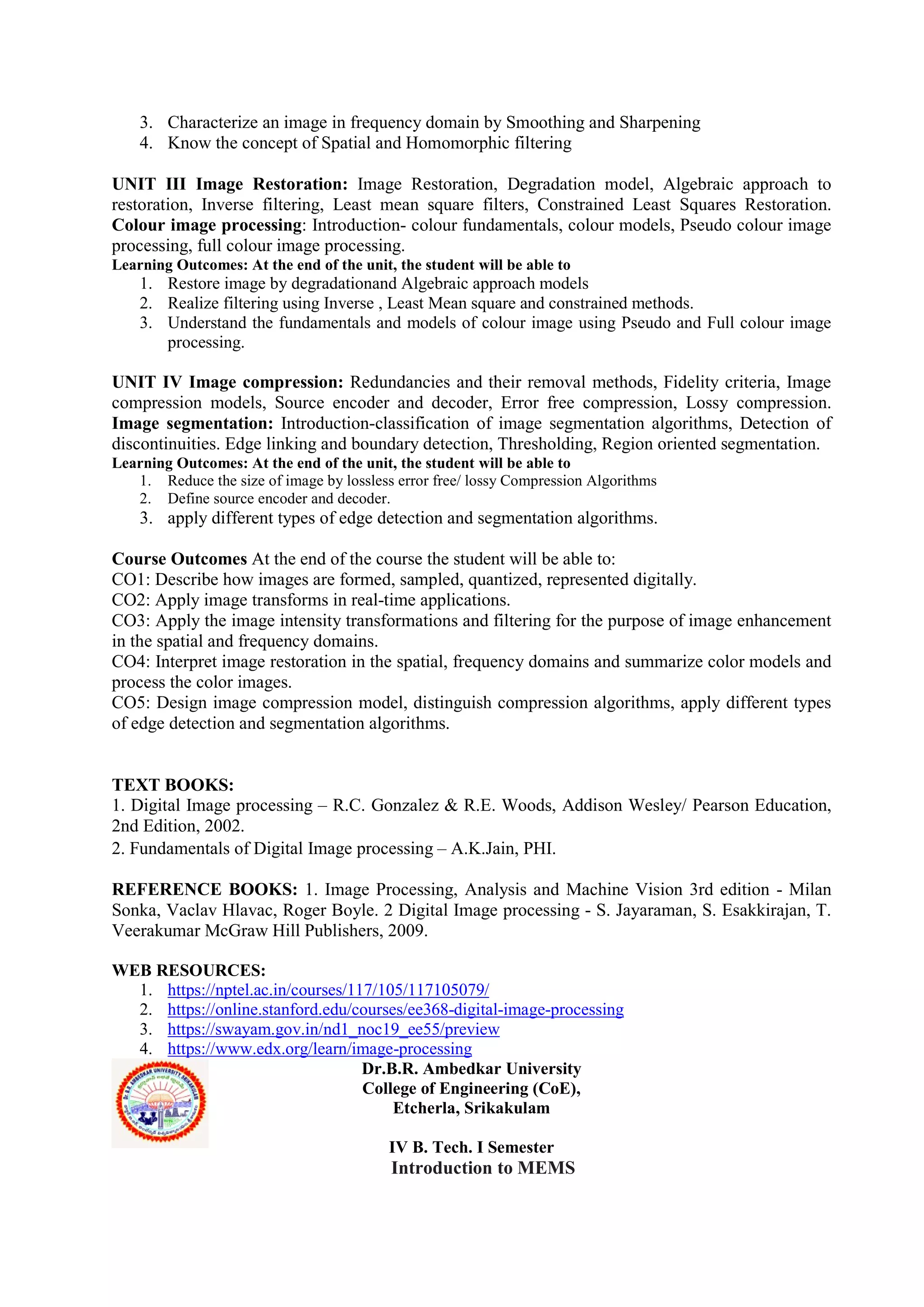
3 CEC* Introduction to MEMS 3:0:0 3
CORE ELECTIVE-02
4 CEC* Bio-Medical Instrumentation 3:0:0 3
5 CEC* Wireless Sensor Networks 3:0:0 3
6 CEC* VLSI Design 3:0:0 3
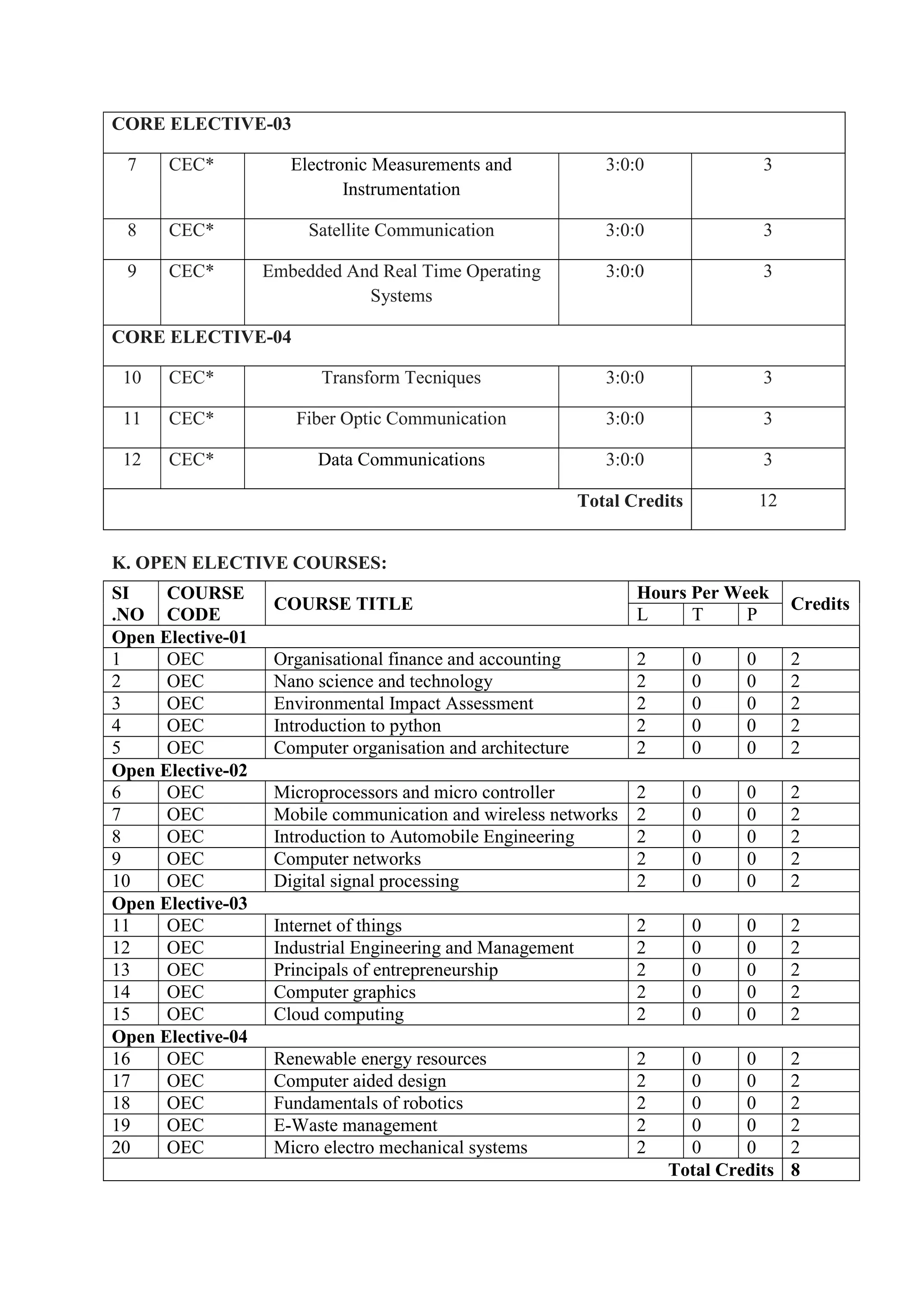
CORE ELECTIVE-03
7 CEC* Electronic Measurements and
Instrumentation
3:0:0 3
8 CEC* Satellite Communication 3:0:0 3
9 CEC* Embedded And Real Time Operating
Systems
3:0:0 3
CORE ELECTIVE-04
10 CEC* Transform Tecniques 3:0:0 3
11 CEC* Fiber Optic Communication 3:0:0 3
12 CEC* Data Communications 3:0:0 3
Total Credits 12
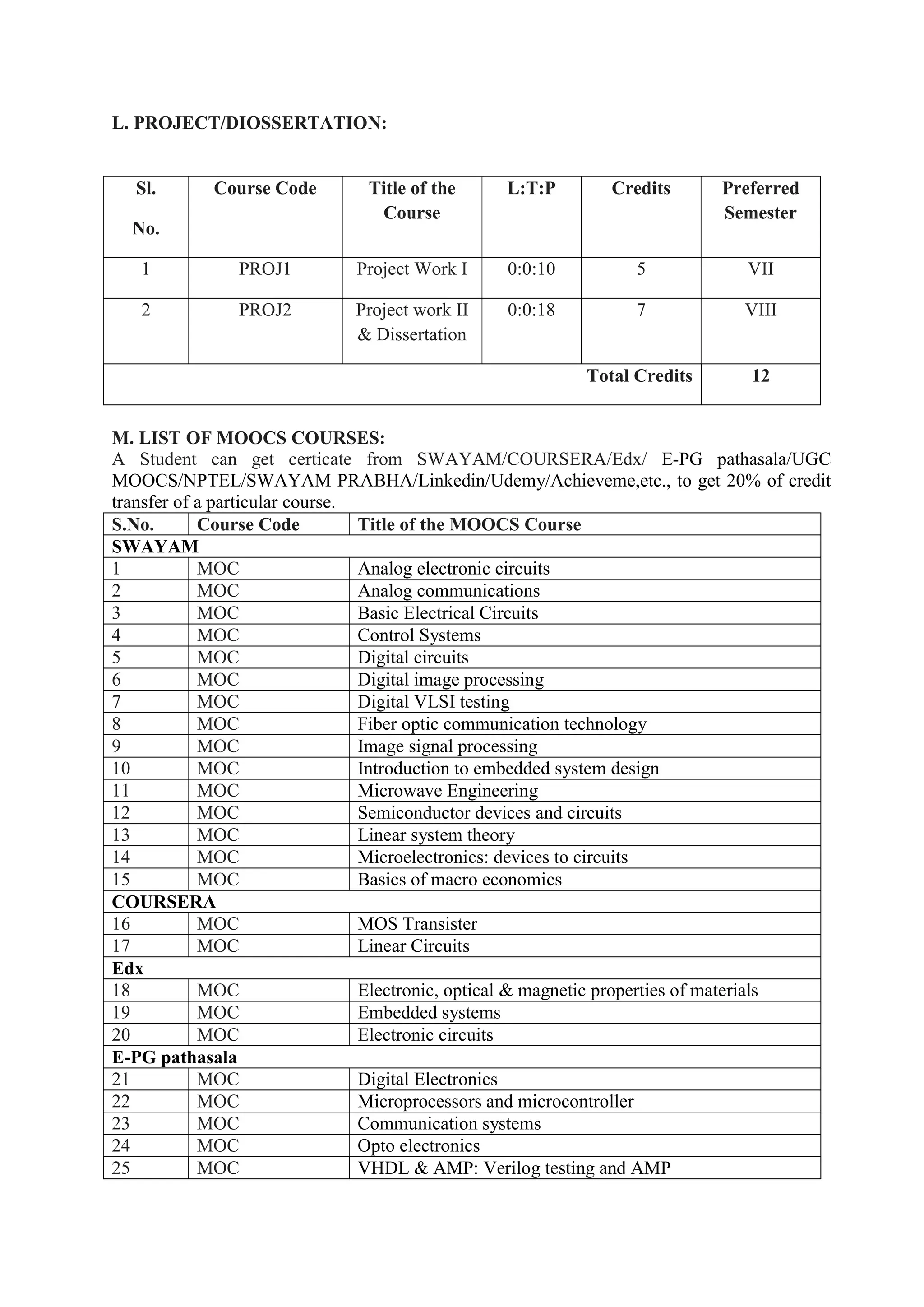
K. OPEN ELECTIVE COURSES:
SI
.NO
COURSE
CODE
COURSE TITLE
Hours Per Week
Credits
L T P
Open Elective-01
1 OEC Organisational finance and accounting 2 0 0 2
2 OEC Nano science and technology 2 0 0 2
3 OEC Environmental Impact Assessment 2 0 0 2
4 OEC Introduction to python 2 0 0 2
5 OEC Computer organisation and architecture 2 0 0 2
Open Elective-02
6 OEC Microprocessors and micro controller 2 0 0 2
7 OEC Mobile communication and wireless networks 2 0 0 2
8 OEC Introduction to Automobile Engineering 2 0 0 2
9 OEC Computer networks 2 0 0 2
10 OEC Digital signal processing 2 0 0 2
Open Elective-03
11 OEC Internet of things 2 0 0 2
12 OEC Industrial Engineering and Management 2 0 0 2
13 OEC Principals of entrepreneurship 2 0 0 2
14 OEC Computer graphics 2 0 0 2
15 OEC Cloud computing 2 0 0 2
Open Elective-04
16 OEC Renewable energy resources 2 0 0 2
17 OEC Computer aided design 2 0 0 2
18 OEC Fundamentals of robotics 2 0 0 2
19 OEC E-Waste management 2 0 0 2
20 OEC Micro electro mechanical systems 2 0 0 2
Total Credits 8
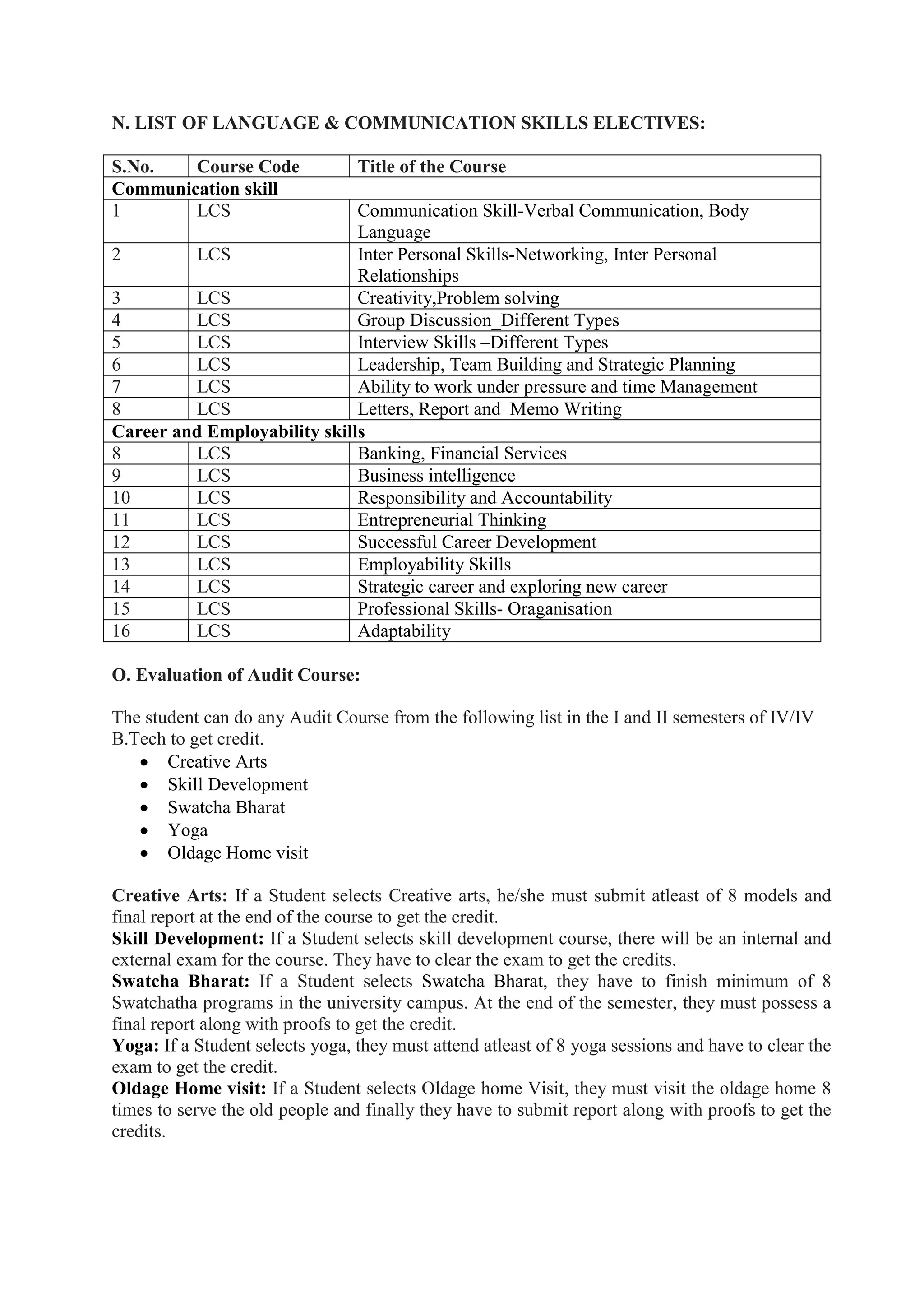
L. PROJECT/DIOSSERTATION:
Sl.
No.
Course Code Title of the
Course
L:T:P Credits Preferred
Semester
1 PROJ1 Project Work I 0:0:10 5 VII
2 PROJ2 Project work II
& Dissertation
0:0:18 7 VIII
Total Credits 12
M. LIST OF MOOCS COURSES:
A Student can get certicate from SWAYAM/COURSERA/Edx/ E-PG pathasala/UGC
MOOCS/NPTEL/SWAYAM PRABHA/Linkedin/Udemy/Achieveme,etc., to get 20% of credit
transfer of a particular course.
S.No. Course Code Title of the MOOCS Course
SWAYAM
1 MOC Analog electronic circuits
2 MOC Analog communications
3 MOC Basic Electrical Circuits
4 MOC Control Systems
5 MOC Digital circuits
6 MOC Digital image processing
7 MOC Digital VLSI testing
8 MOC Fiber optic communication technology
9 MOC Image signal processing
10 MOC Introduction to embedded system design
11 MOC Microwave Engineering
12 MOC Semiconductor devices and circuits
13 MOC Linear system theory
14 MOC Microelectronics: devices to circuits
15 MOC Basics of macro economics
COURSERA
16 MOC MOS Transister
17 MOC Linear Circuits
Edx
18 MOC Electronic, optical & magnetic properties of materials
19 MOC Embedded systems
20 MOC Electronic circuits
E-PG pathasala
21 MOC Digital Electronics
22 MOC Microprocessors and microcontroller
23 MOC Communication systems
24 MOC Opto electronics
25 MOC VHDL & AMP: Verilog testing and AMP
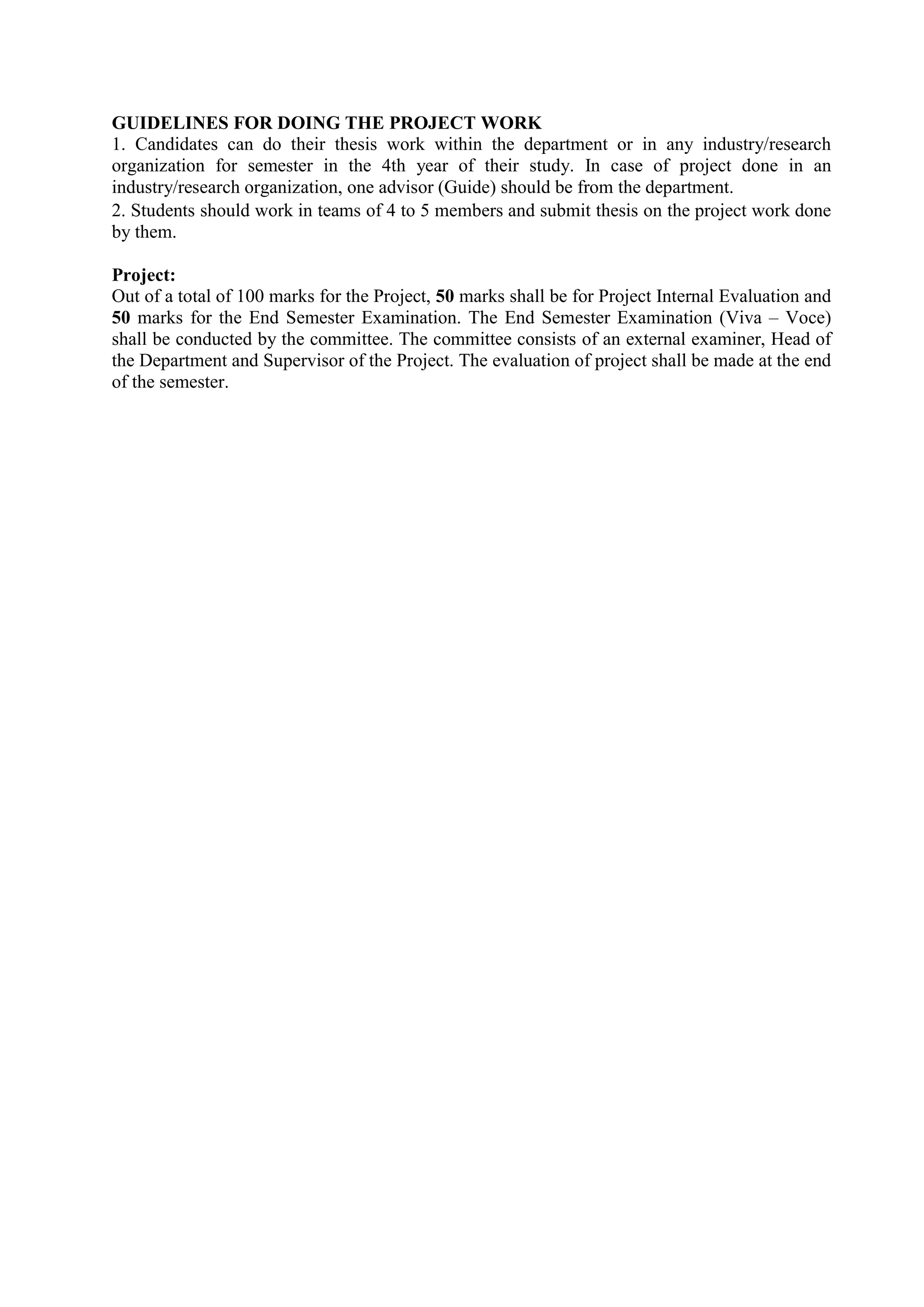
N. LIST OF LANGUAGE & COMMUNICATION SKILLS ELECTIVES:
S.No. Course Code Title of the Course
Communication skill
1 LCS Communication Skill-Verbal Communication, Body
Language
2 LCS Inter Personal Skills-Networking, Inter Personal
Relationships
3 LCS Creativity,Problem solving
4 LCS Group Discussion_Different Types
5 LCS Interview Skills –Different Types
6 LCS Leadership, Team Building and Strategic Planning
7 LCS Ability to work under pressure and time Management
8 LCS Letters, Report and Memo Writing
Career and Employability skills
8 LCS Banking, Financial Services
9 LCS Business intelligence
10 LCS Responsibility and Accountability
11 LCS Entrepreneurial Thinking
12 LCS Successful Career Development
13 LCS Employability Skills
14 LCS Strategic career and exploring new career
15 LCS Professional Skills- Oraganisation
16 LCS Adaptability
O. Evaluation of Audit Course:
The student can do any Audit Course from the following list in the I and II semesters of IV/IV
B.Tech to get credit.
 Creative Arts
 Skill Development
 Swatcha Bharat
 Yoga
 Oldage Home visit
Creative Arts: If a Student selects Creative arts, he/she must submit atleast of 8 models and
final report at the end of the course to get the credit.
Skill Development: If a Student selects skill development course, there will be an internal and
external exam for the course. They have to clear the exam to get the credits.
Swatcha Bharat: If a Student selects Swatcha Bharat, they have to finish minimum of 8
Swatchatha programs in the university campus. At the end of the semester, they must possess a
final report along with proofs to get the credit.
Yoga: If a Student selects yoga, they must attend atleast of 8 yoga sessions and have to clear the
exam to get the credit.
Oldage Home visit: If a Student selects Oldage home Visit, they must visit the oldage home 8
times to serve the old people and finally they have to submit report along with proofs to get the
credits.
GUIDELINES FOR DOING THE PROJECT WORK
1. Candidates can do their thesis work within the department or in any industry/research
organization for semester in the 4th year of their study. In case of project done in an
industry/research organization, one advisor (Guide) should be from the department.
2. Students should work in teams of 4 to 5 members and submit thesis on the project work done
by them.
Project:
Out of a total of 100 marks for the Project, 50 marks shall be for Project Internal Evaluation and
50 marks for the End Semester Examination. The End Semester Examination (Viva – Voce)
shall be conducted by the committee. The committee consists of an external examiner, Head of
the Department and Supervisor of the Project. The evaluation of project shall be made at the end
of the semester.
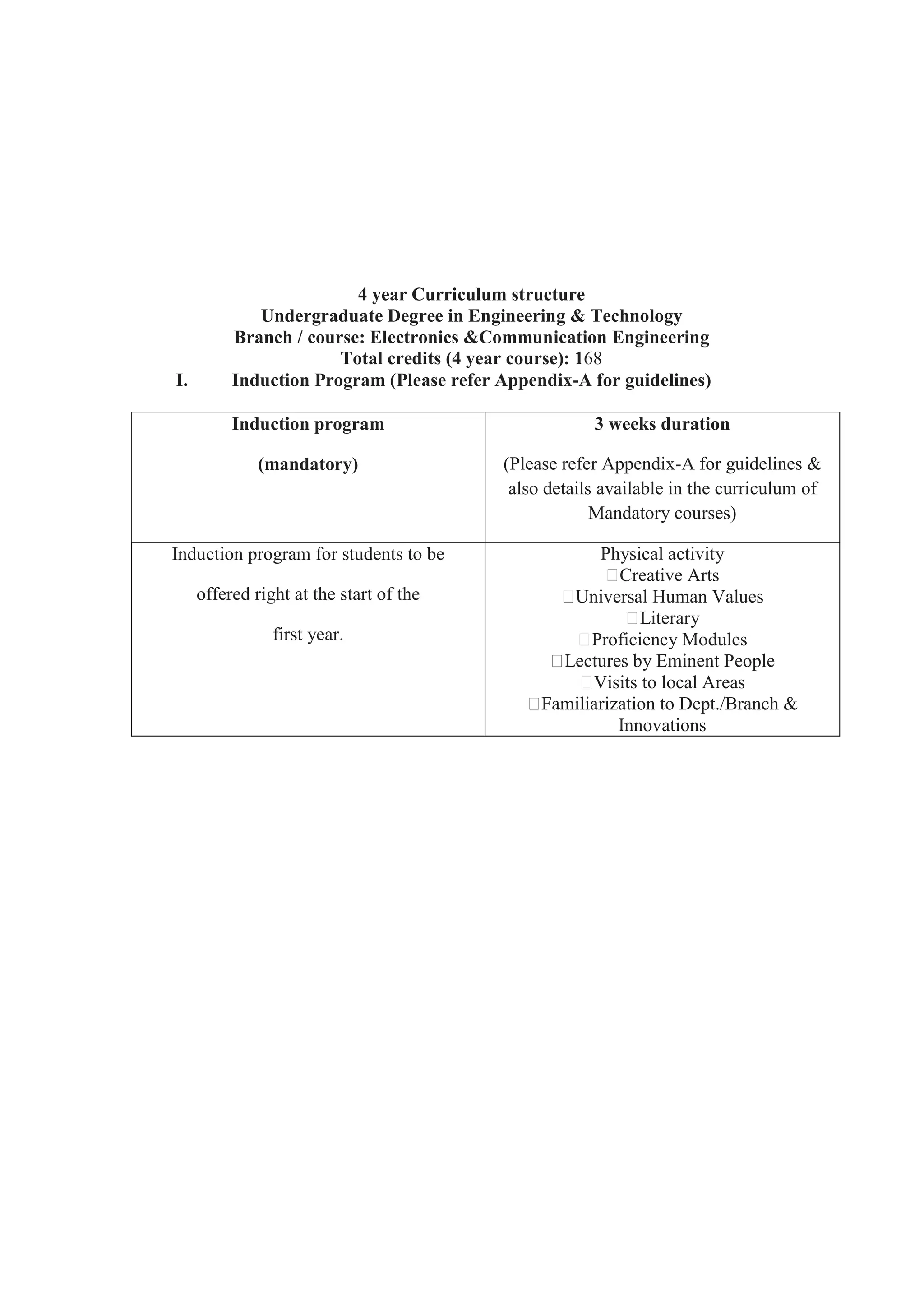
4 year Curriculum structure
Undergraduate Degree in Engineering & Technology
Branch / course: Electronics &Communication Engineering
Total credits (4 year course): 168
I. Induction Program (Please refer Appendix-A for guidelines)
Induction program
(mandatory)
3 weeks duration
(Please refer Appendix-A for guidelines &
also details available in the curriculum of
Mandatory courses)
Induction program for students to be
offered right at the start of the
first year.
Physical activity
Creative Arts
Universal Human Values
Literary
Proficiency Modules
Lectures by Eminent People
Visits to local Areas
Familiarization to Dept./Branch &
Innovations
Semester-wise structure of curriculum
[L= Lecture, T = Tutorials, P = Practicals & C = Credits]
Semester I (First year] Curriculum
Branch/Course: Electronics & Communication Engineering
SI
.NO
COURSE
CODE
COURSE TITLE HOURS
PER
WEEK
CREDITS
L T P
1 HSMC101 Technical English 2 0 0 2
2 BSC101 Engineering Mathematics
- I (Linear Algebra and
Differential equations)
3 1 0 3.5
3 BSC102 Engineering Chemistry 3 0 0 3
4 ESC101 Engg. Graphics & Design 2 0 3 3.5
5 HSMC102 Technical English Lab 0 0 2 1
6 BSC103 Engineering Chemistry
Lab
0 0 3 1.5
7 AC01 Audit Courses:
 Creative Arts
 Skill Development
 Swatcha Bharat
 Yoga
 Oldage Home visit
1
Total Credits
15.5
Semester II (First year] Curriculum
Branch/Course: Electronics & Communication Engineering
SI
.N
O
COURS
E
CODE
COURSE TITLE HOURS
PER
WEEK
CREDIT
S
L T P
1 BSC104 Engineering Physics 3 0 0 3
2 BSC105 Mathematics –II (
Multivariable Calculus &
Partial Differential
equations)
3 1 0 3.5
3 ESC102 Programming for problem
solving
3 0 0 3
4 ESC103 Basic Electrical Engineering 3 0 0 3
5 BSC106 Engineering Physics Lab 0 0 3 1.5
6 ESC104 Programming for problem
solving Lab
0 0 3 1.5
7 ESC105 Basic Electrical Engineering
Lab
0 0 3 1.5
8 ESC106 Engineering workshop Lab 0 0 3 1.5
9 HSMC1
03
Conmstitution of India 1 0 0 1
10 BSC107 Environmental Science 1 0 0 1
11 AC 02 Audit Courses:
 Creative Arts
 Skill
Development
 Swatcha Bharat
 Yoga
 Oldage Home
visit
1
Total Credits 21.5
Semester III (Second year] Curriculum
Branch/Course: Electronics & Communication Engineering
SI
.N
O
COURS
E
CODE
COURSE TITLE HOURS
PER
WEEK
CREDITS
L T P
1 EC01 Electronic Devices
and Circuits
3 1 0 3.5
2 EC02 Digital Electronics &
Logic Design
3 1 0 3.5
3 EC03 Signals & Systems 3 1 0 3.5
4 EC04 Network Theory 3 1 0 3.5
5 BSC201 Mathematics –III (
COMPLEX
VARIABLE,PROBA
BILITY&STATISTI
CS)
3 1 0 3.5
6 BSC202 Life Sciences for
engineers
2 0 0 2
7 EC05 Electronic Devices
and Circuits Lab
0 0 3 1.5
8 EC06 Digital Electronics &
Logic Design Lab
0 0 3 1.5
9 LCS 01 Language &
Communication skills
Elective
- - 2 1
10 MOC 01 MOOCS - - 2 1
11 FW 01 Field works/ Society
engagement/
university social
responsibility
- - 3 1.5
Total credits 26
Semester IV (Second year] Curriculum
Branch/Course: Electronics & Communication Engineering
SI
.N
O
COURS
E
CODE
COURSE TITLE HOURS
PER
WEEK
CREDIT
S
L T P
1 EC07 Analog communication 3 0 0 3
2 EC08 Analog Electronic circuits 3 1 0 3.5
3 EC09 Digital system Design 3 1 0 3.5
4 EC10 Pulse and Digital Circuits 3 1 0 3.5
5 EC11 Electromagnetic Field
Theory and Transmission
Lines
3 1 0 3.5
5 EC 12 Control System 3 1 0 3.5
6 EC13 Digital System Design
Lab
0 0 3 1.5
7 EC14 Analog Electronic circuits
& pulse and digital
circuits lab
0 0 3 1.5
8 LCS 02 Language &
Communication skills
Elective
- - 2 1
9 MOC 02 MOOCS - - 2 1
Total Credits 25.5
Semester V (Third year] Curriculum
Branch/Course: Electronics & Communication Engineering
SI
.N
O
COURS
E
CODE
COURSE TITLE HOURS
PER
WEEK
CREDITS
L T P
1 EC15 Digital
Communication
3 0 0 3
2 EC16 Linear Integrated
circuits &
applications
3 1 0 3.5
3 EC17 Random Variables
and stochastic
Processes
3 1 0 3.5
4 EC18 Antennas and wave
propagation
3 0 0 3
5 OEC* Open Elective-1 2 0 0 2
6 EC19 Analog and digital
communication Lab
0 0 3 1.5
7 EC20 Linear Integrated
circuits &
applications lab
0 0 3 1.5
8 LCS 03 Language &
Communication skills
Elective
0 0 2 1
9 MOC 03 MOOCS 0 0 2 1
10 FW 02 Field works/ Society
engagement/
university social
responsibility
0 0 3 1.5
Total credits 21.5
Semester VI (Third year] Curriculum
Branch/Course: Electronics & Communication Engineering
SI
.N
O
COURS
E
CODE
COURSE TITLE HOURS
PER
WEEK
CREDITS
L T P
1 EC21 Digital signal processing 3 1 0 3.5
2 EC22 Microprocessors & Micro
controllers
3 1 0 3.5
3 EC23 Mobile Cellular
Communication
3 0 0 3
4 OEC* Open Elective-2 2 0 0 2
5 HSMCs3
01
Humanities I 2 0 0 2
6 EC24 Microprocessors & Micro
controllers Lab
0 0 3 1.5
7 EC25 Digital Signal Processing
Lab
0 0 3 1.5
8 LCS 04 Language &
Communication skills
Elective
0 0 2 1
9 MOC 04 MOOCS 0 0 2 1
Total credits 19
Semester VII (Fourth year] Curriculum
Branch/Course: Electronics & Communication Engineering
SI
.N
O
COURS
E
CODE
COURSE TITLE HOURS
PER
WEEK
CREDITS
L T P
1 EC26 Microwave Engineering 3 0 0 3
2 ECEL* Core Elective-1 3 0 0 3
3 ECEL* Core Elective-2 3 0 0 3
4 OEC* Open Elective-3 2 0 0 2
5 EC27 Microwave Engineering
Lab
0 0 3 1.5
6 ECP1 Project Stage-1 0 0 10 5
7 LCS 05 Language &
Communication skills
Elective
0 0 2 1
8 FW 03 Field works/ Society
engagement/ university
social responsibility
0 0 3 1.5
Total Credits
20
Semester VIII (Fourth year] Curriculum
Branch/Course: Electronics & Communication Engineering
SI
.N
O
COURS
E
CODE
COURSE TITLE HOURS PER
WEEK
CREDITS
L T P
1 EC28 Radar Systems 3 0 0 3
2 ECEL* Core Elective-3 3 0 0 3
3 ECEL* Core Elective-4 3 0 0 3
4 OEC* Open Elective-4 2 0 0 2
5 ECP1 Project Stage-II 0 0 14 7
6 LCS 06 Language &
Communication skills
Elective
0 0 2 1
Total Credits 19
EVALUATION PROCESS:
The evaluation process for the subjects are mentioned below:
SUBJECT INTERNAL EXTERNAL TOTAL
THEORY 30 70 100
LABORATORY 50 50 100
Semester I (First year] Curriculum
Branch/Course: Electronics and Communication Engineering
Dr.B.R. Ambedkar University
College of Engineering (CoE),
Etcherla, Srikakulam
I B.Tech. I Semester
TECHNICAL ENGLISH
(COMMON TO ALL BRANCHES)
Course code HSMC101
Category HUMANITIES AND SOCIAL SCIENCES
Course title
TECHNICAL ENGLISH
Scheme and Credits
L T P Credits
Semester –I
2 0 0 2
Pre-requisites (if any)
COURSE OBJECTIVES
1. Make the students to be familiar with good English to get command over written English skills and to avoid
mistakes while they are writing or speaking something.
2. The student can be able to Analyze and Participate in discussion and Communicate ideas effectively and
Present ideas coherently within a stipulated time.
3. The student will acquire basic proficiency in English including reading and listening comprehension, writing
and speaking skills.
4. The student will get effective communication skills in English and become most important to the students to
flourish in their careers.
5. To train the students to equip themselves with the necessary skills required for effective communication in
English thereby enabling them to get a good placement immediately after the completion of their
undergraduate courses.
6. To understand, enjoy and appreciate a wide range of texts representing different cultures ways of living
7. Narrate simple experiences, describe objects and people, report events to peers
UNIT - I
COMMUNICATION & VOCABULARY BUILDING (10Lectures)
1.1 Communication Meaning, Definition and importance of communication Process of communication, types of
communication, levels of communication, barriers to effective communication, technical communication, meaning,
origin and development of technical communication, features of technical communication, difference between
technical and general writing.
1.2 The concept of Word Formation , Root words from foreign languages and their use in English.
1.3 Acquaintance with prefixes and suffixes from foreign languages in English to form derivatives,
1.4 Synonyms, antonyms, and standard abbreviations.
1.5 Morphism: Affixes, Vocabulary, Types of words, one word substitutions, Homophones
1.6 Intensive and extensive reading – Units I, II, III, from the prescribed text book ‘Orient Black Swan Pvt. Ltd. 2018’.
Learning outcomes
1. The Student will be able to understand the communication and its importance
2. The Student will be able to speak intelligibly
3. The Student will be able to find the difference between technical and general writing
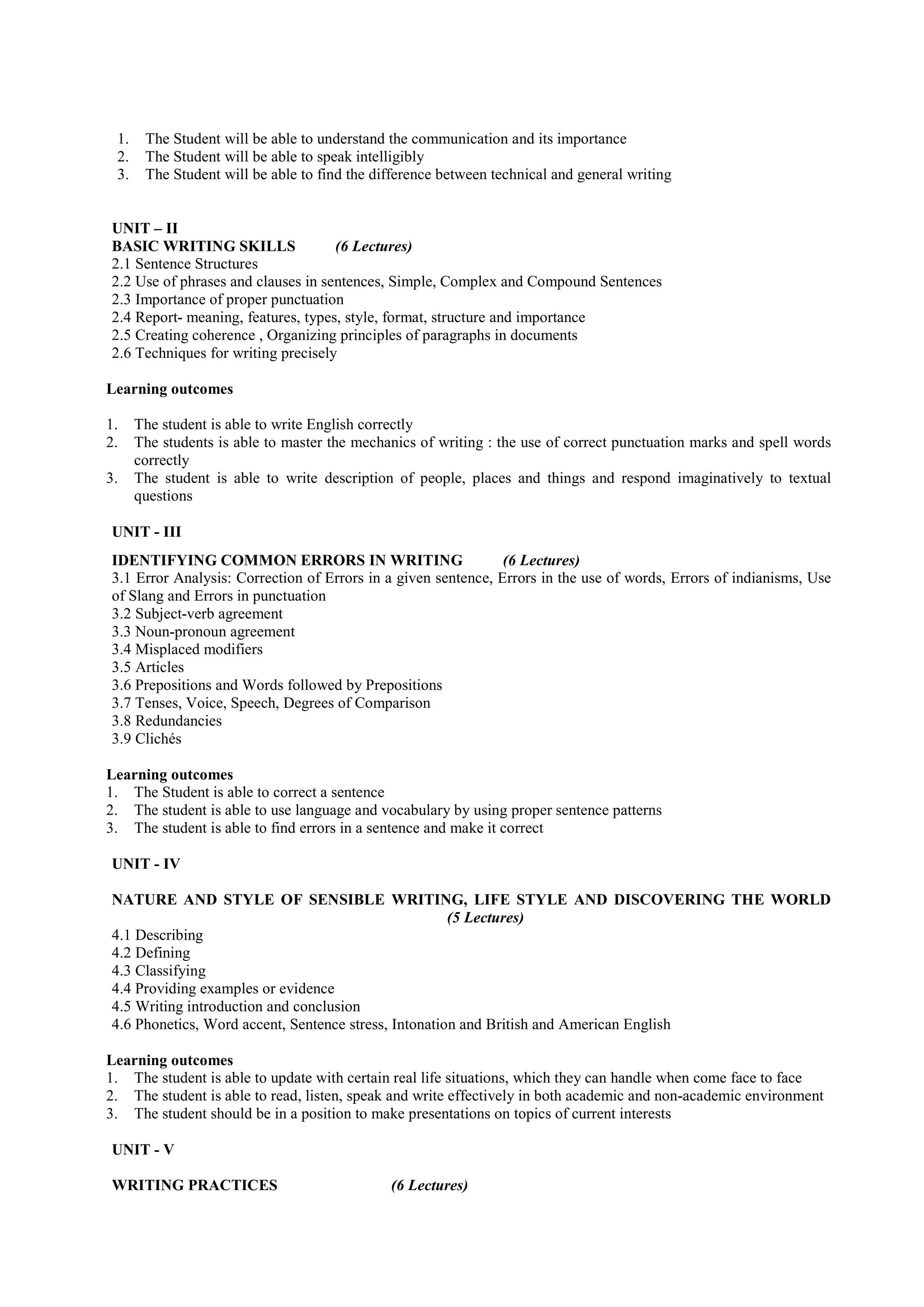
UNIT – II
BASIC WRITING SKILLS (6 Lectures)
2.1 Sentence Structures
2.2 Use of phrases and clauses in sentences, Simple, Complex and Compound Sentences
2.3 Importance of proper punctuation
2.4 Report- meaning, features, types, style, format, structure and importance
2.5 Creating coherence , Organizing principles of paragraphs in documents
2.6 Techniques for writing precisely
Learning outcomes
1. The student is able to write English correctly
2. The students is able to master the mechanics of writing : the use of correct punctuation marks and spell words
correctly
3. The student is able to write description of people, places and things and respond imaginatively to textual
questions
UNIT - III
IDENTIFYING COMMON ERRORS IN WRITING (6 Lectures)
3.1 Error Analysis: Correction of Errors in a given sentence, Errors in the use of words, Errors of indianisms, Use
of Slang and Errors in punctuation
3.2 Subject-verb agreement
3.3 Noun-pronoun agreement
3.4 Misplaced modifiers
3.5 Articles
3.6 Prepositions and Words followed by Prepositions
3.7 Tenses, Voice, Speech, Degrees of Comparison
3.8 Redundancies
3.9 Clichés
Learning outcomes
1. The Student is able to correct a sentence
2. The student is able to use language and vocabulary by using proper sentence patterns
3. The student is able to find errors in a sentence and make it correct
UNIT - IV
NATURE AND STYLE OF SENSIBLE WRITING, LIFE STYLE AND DISCOVERING THE WORLD
(5 Lectures)
4.1 Describing
4.2 Defining
4.3 Classifying
4.4 Providing examples or evidence
4.5 Writing introduction and conclusion
4.6 Phonetics, Word accent, Sentence stress, Intonation and British and American English
Learning outcomes
1. The student is able to update with certain real life situations, which they can handle when come face to face
2. The student is able to read, listen, speak and write effectively in both academic and non-academic environment
3. The student should be in a position to make presentations on topics of current interests
UNIT - V
WRITING PRACTICES (6 Lectures)
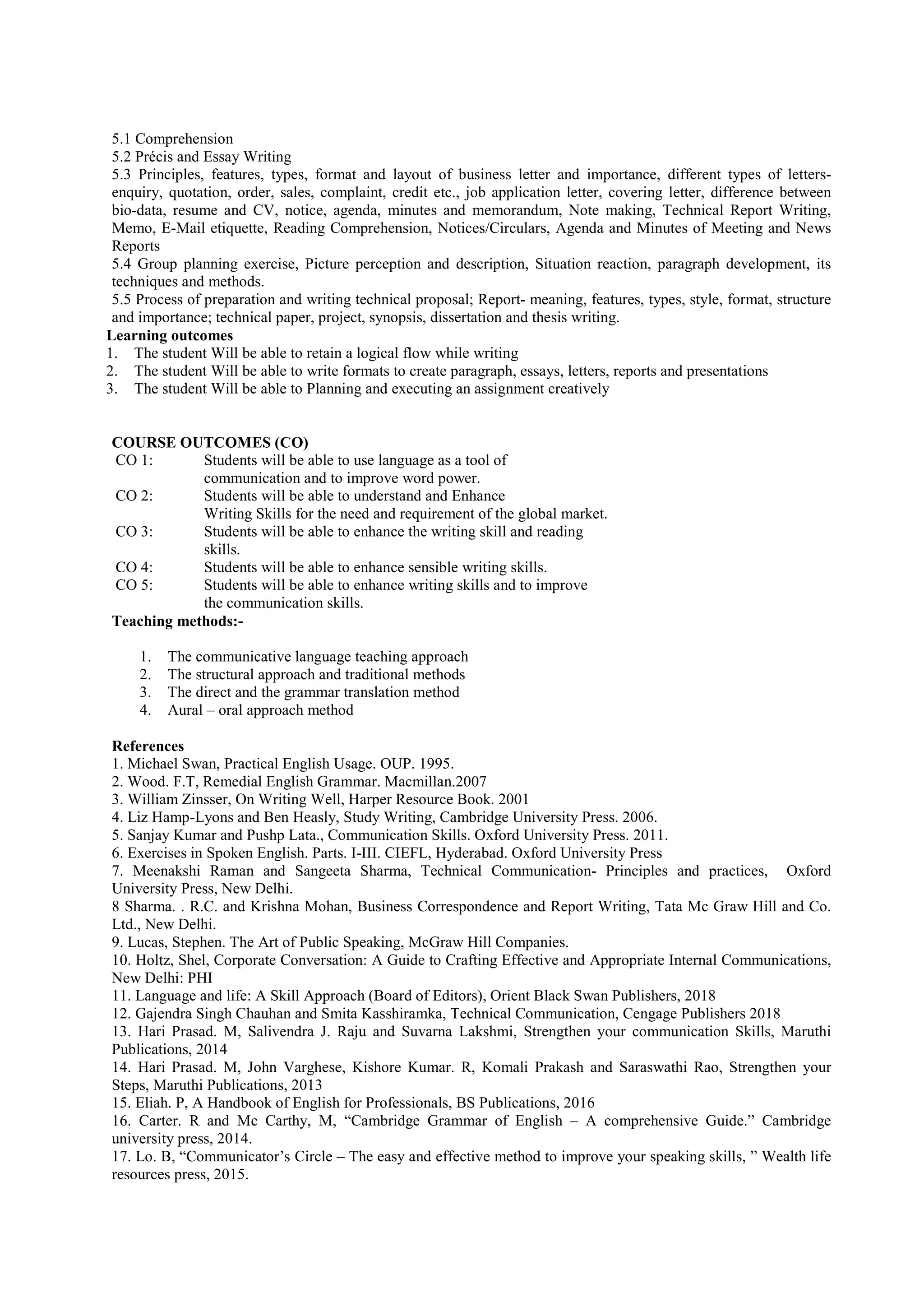
5.1 Comprehension
5.2 Précis and Essay Writing
5.3 Principles, features, types, format and layout of business letter and importance, different types of letters-
enquiry, quotation, order, sales, complaint, credit etc., job application letter, covering letter, difference between
bio-data, resume and CV, notice, agenda, minutes and memorandum, Note making, Technical Report Writing,
Memo, E-Mail etiquette, Reading Comprehension, Notices/Circulars, Agenda and Minutes of Meeting and News
Reports
5.4 Group planning exercise, Picture perception and description, Situation reaction, paragraph development, its
techniques and methods.
5.5 Process of preparation and writing technical proposal; Report- meaning, features, types, style, format, structure
and importance; technical paper, project, synopsis, dissertation and thesis writing.
Learning outcomes
1. The student Will be able to retain a logical flow while writing
2. The student Will be able to write formats to create paragraph, essays, letters, reports and presentations
3. The student Will be able to Planning and executing an assignment creatively
COURSE OUTCOMES (CO)
CO 1: Students will be able to use language as a tool of
communication and to improve word power.
CO 2: Students will be able to understand and Enhance
Writing Skills for the need and requirement of the global market.
CO 3: Students will be able to enhance the writing skill and reading
skills.
CO 4: Students will be able to enhance sensible writing skills.
CO 5: Students will be able to enhance writing skills and to improve
the communication skills.
Teaching methods:-
1. The communicative language teaching approach
2. The structural approach and traditional methods
3. The direct and the grammar translation method
4. Aural – oral approach method
References
1. Michael Swan, Practical English Usage. OUP. 1995.
2. Wood. F.T, Remedial English Grammar. Macmillan.2007
3. William Zinsser, On Writing Well, Harper Resource Book. 2001
4. Liz Hamp-Lyons and Ben Heasly, Study Writing, Cambridge University Press. 2006.
5. Sanjay Kumar and Pushp Lata., Communication Skills. Oxford University Press. 2011.
6. Exercises in Spoken English. Parts. I-III. CIEFL, Hyderabad. Oxford University Press
7. Meenakshi Raman and Sangeeta Sharma, Technical Communication- Principles and practices, Oxford
University Press, New Delhi.
8 Sharma. . R.C. and Krishna Mohan, Business Correspondence and Report Writing, Tata Mc Graw Hill and Co.
Ltd., New Delhi.
9. Lucas, Stephen. The Art of Public Speaking, McGraw Hill Companies.
10. Holtz, Shel, Corporate Conversation: A Guide to Crafting Effective and Appropriate Internal Communications,
New Delhi: PHI
11. Language and life: A Skill Approach (Board of Editors), Orient Black Swan Publishers, 2018
12. Gajendra Singh Chauhan and Smita Kasshiramka, Technical Communication, Cengage Publishers 2018
13. Hari Prasad. M, Salivendra J. Raju and Suvarna Lakshmi, Strengthen your communication Skills, Maruthi
Publications, 2014
14. Hari Prasad. M, John Varghese, Kishore Kumar. R, Komali Prakash and Saraswathi Rao, Strengthen your
Steps, Maruthi Publications, 2013
15. Eliah. P, A Handbook of English for Professionals, BS Publications, 2016
16. Carter. R and Mc Carthy, M, “Cambridge Grammar of English – A comprehensive Guide.” Cambridge
university press, 2014.
17. Lo. B, “Communicator’s Circle – The easy and effective method to improve your speaking skills, ” Wealth life
resources press, 2015.
18. Thomson, AJ Martinet, AV (2017), “A practical English Grammar Exercises ” , Oxford university Press.
19. Krishnaswamy. N and Sriraman. T, “Current English for Colleges”, Macmillan India Ltd., Madras, 2005.
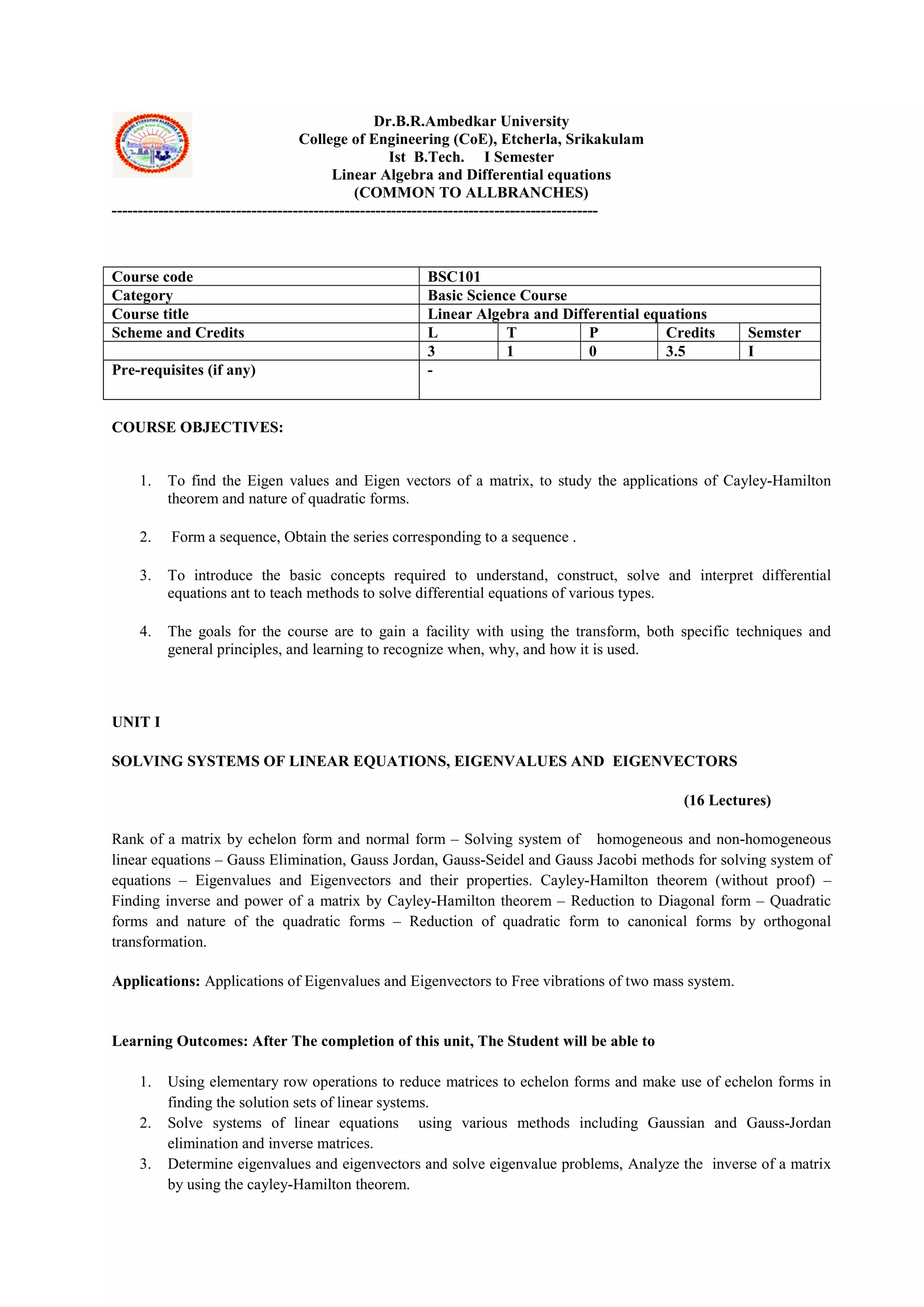
Dr.B.R.Ambedkar University
College of Engineering (CoE), Etcherla, Srikakulam
Ist B.Tech. I Semester
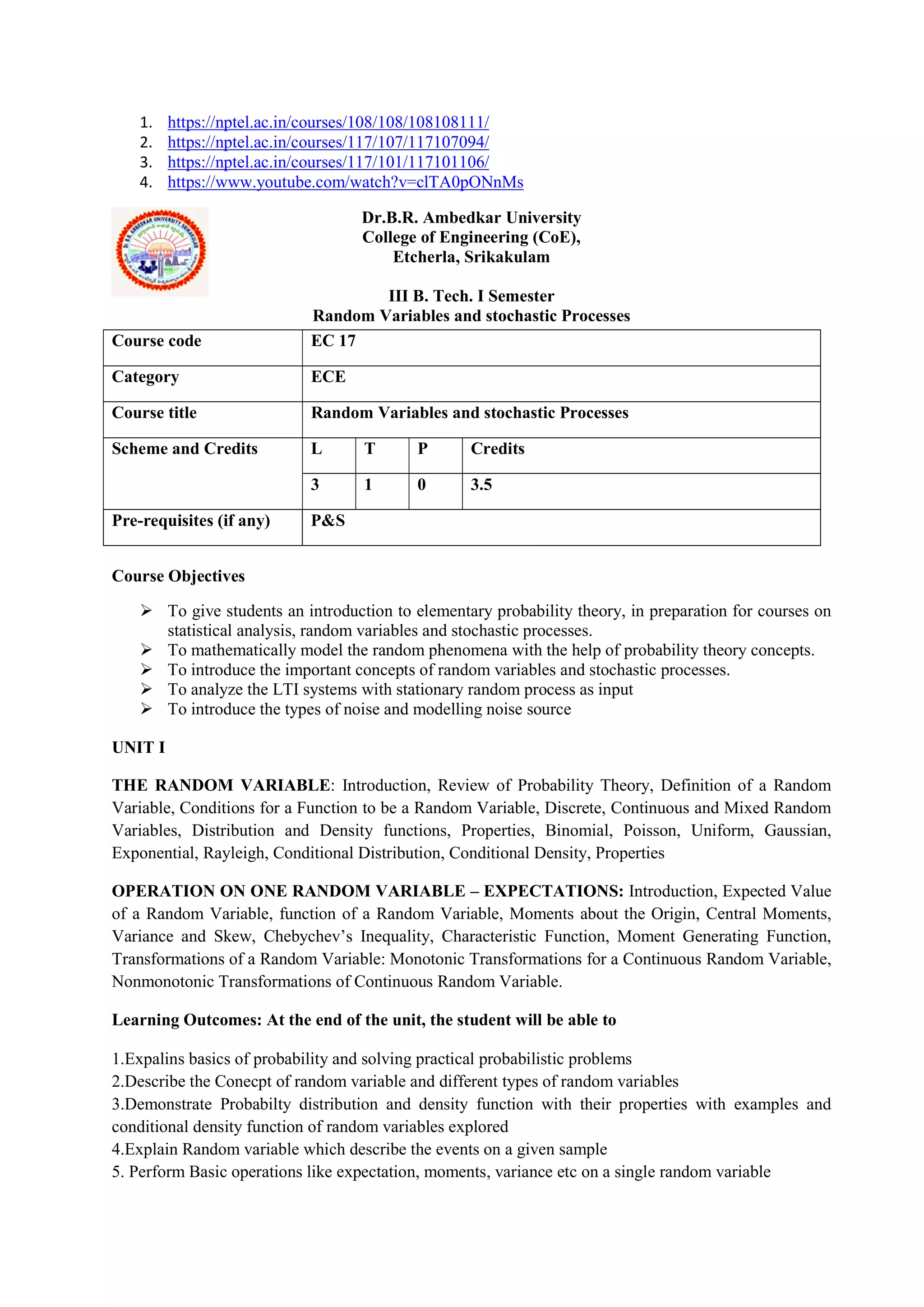
Linear Algebra and Differential equations
(COMMON TO ALLBRANCHES)
----------------------------------------------------------------------------------------------
COURSE OBJECTIVES:
1. To find the Eigen values and Eigen vectors of a matrix, to study the applications of Cayley-Hamilton
theorem and nature of quadratic forms.
2. Form a sequence, Obtain the series corresponding to a sequence .
3. To introduce the basic concepts required to understand, construct, solve and interpret differential
equations ant to teach methods to solve differential equations of various types.
4. The goals for the course are to gain a facility with using the transform, both specific techniques and
general principles, and learning to recognize when, why, and how it is used.
UNIT I
SOLVING SYSTEMS OF LINEAR EQUATIONS, EIGENVALUES AND EIGENVECTORS
(16 Lectures)
Rank of a matrix by echelon form and normal form – Solving system of homogeneous and non-homogeneous
linear equations – Gauss Elimination, Gauss Jordan, Gauss-Seidel and Gauss Jacobi methods for solving system of
equations – Eigenvalues and Eigenvectors and their properties. Cayley-Hamilton theorem (without proof) –
Finding inverse and power of a matrix by Cayley-Hamilton theorem – Reduction to Diagonal form – Quadratic
forms and nature of the quadratic forms – Reduction of quadratic form to canonical forms by orthogonal
transformation.
Applications: Applications of Eigenvalues and Eigenvectors to Free vibrations of two mass system.
Learning Outcomes: After The completion of this unit, The Student will be able to
1. Using elementary row operations to reduce matrices to echelon forms and make use of echelon forms in
finding the solution sets of linear systems.
2. Solve systems of linear equations using various methods including Gaussian and Gauss-Jordan
elimination and inverse matrices.
3. Determine eigenvalues and eigenvectors and solve eigenvalue problems, Analyze the inverse of a matrix
by using the cayley-Hamilton theorem.
Course code BSC101
Category Basic Science Course
Course title Linear Algebra and Differential equations
Scheme and Credits L T P Credits Semster
3 1 0 3.5 I
Pre-requisites (if any) -
UNIT II
SEQUENCES, SERIES AND MEAN-VALUE THEOREMS (10 Lectures)
Mean Value Theorems (without proofs): Rolle’s mean value theorem – Lagrange’s mean value theorem – Cauchy’s
mean value theorem – Taylor’s and Maclaurin’s theorems with remainders.
Sequences and Series: Convergences and divergence – Ratio test – Comparison tests – Integral test – Cauchy’s
root test – Alternate series – Leibnitz’s rule.
Learning Outcomes: After The completion of this unit, The Student will be able to
1. Understand the consequences of Rolle’s theorem and the mean value theorem for differentiable functions.
2. Using various convergence tests (geometric series test, divergence test, integral test, comparison tests,
alternating series tests, ratio test, root test) to determine convergence or divergence of series.
3. To Define the Taylor series and Maclaurin series generated by a function at a point.
UNIT III
DIFFERENTIAL EQUATIONS OF FIRST ORDER AND HIGHER ORDER
(12 Lectures)
Linear differential equations – Bernoulli’s equations – Exact equations and equations reducible to exact form. Non-
homogeneous equations of higher order with constant coefficients – with non-homogeneous term of the type eax
,
sin ax, cos ax, polynomials in xn
, eax
V(x) and xn
V(x) – Method of Variation of parameters.
Applications: Electrical circuits (RC, RL, RLC circuits)
Learning Outcomes: After The completion of this unit, The Student will be able to
1. Determine the general or complete solution for second order linear ODE’s with constant coefficients.
2. Understand the linear differential equations and Bernouli’s differential equations of first order and its
solutions.
3. Using the method of variation of parameters to find solution of higher order linear differential equations
with variable coefficients.
UNIT –IV
LAPLACE TRANSFORMS (10 Lectures)
Laplace transforms of standard functions – Shifting theorems – Transforms of derivatives and integrals – Unit step
function – Dirac’s delta function – Inverse Laplace transforms – Convolution theorem (with out proof).
Applications: Solving ordinary differential equations (initial value problems) using Laplace transform.
Learning Outcomes: After The completion of this unit, The Student will be able to
1. Using Laplace Transforms to determine general or complete solutions to linear ordinary differential equations.
2. Determine Laplace Transforms and inverse Laplace Transforms of various functions, Apply the Convolution
theorem to obtain inverse Laplace Transforms.
3. Know the use of Laplace transform in system modelling, digital signal processing, process control, solving
Boundary value problems.
COURSE OUTCOMES: Upon successful completion of this course, the student should be able to :
CO:1 Use computational techniques and algebraic skills essential for the study of systems of linear equations,
matrix algebra, vector spaces, eigenvalues and eigen vectors.
CO:2 Locate sequence and series comprising convergence sequences, upper and lower limits, study in applications
of the Mean value theorem and Taylors theorem.
CO:3 Know how to find the solutions of certain linear differential equations with variables coefficients.
How to apply linear differential equations to RC, RCL and RL circuits.
CO:4 Analize and solve engineering problems by using Laplace transforms.
Text Books:
1. B. S. Grewal, Higher Engineering Mathematics, 43rd
Edition, Khanna Publishers.
2. B. V. Ramana,Higher Engineering Mathematics, 2007 Edition, Tata Mc. Graw Hill Education.
Reference Books:
1. Erwin Kreyszig, Advanced Engineering Mathematics, 10th
Edition, Wiley-India.
2. Joel Hass, Christopher Heil and Maurice D. Weir, Thomas calculus, 14th
Edition, Pearson.
3. Lawrence Turyn, Advanced Engineering Mathematics, CRC Press, 2013.
4. Srimantha Pal, S C Bhunia, Engineering Mathematics, Oxford University Press.
E-RESOURCES AND OTHER DIGITAL MATERIAL :
[1]. www.nptel videos.com/mathematics/ (Math Lectures from MIT,Stanford,IIT’S)
[2]. nptel.ac.in/courses/122104017
[3]. nptel.ac.in/courses/111105035
[4]. Engineering Mathematics Open Learning Project. www.3.ul.ie/~mlc/support/Loughborough%20website/
[5]. www.nptel videos.com/mathematics/ (Math Lectures from MIT,Stanford,IIT’S)
[6]. nptel.ac.in/courses/122104017
Dr.B.R. Ambedkar University
College of Engineering (CoE),
Etcherla, Srikakulam
I B.Tech. I Semester
Engineering Chemistry
(COMMON TO ALL BRANCHES)
---------------------------------------------------------------------------
Course code BSC102
Category Basic Science Course
Course title Engineering Chemistry (Concepts in Chemistry for Engineering)
Scheme and Credits L T P Credits
Semester –I
3 0 0 3
Pre-requisites (if any)
COURSE OBJECTIVES:
The basic objective of Engineering Chemistry is to educate the students about the chemical aspects of
engineering and to provide leadership in advanced studies of engineering, in industry, academia and government. The
objective of the Engineering Chemistry is to acquaint the students with the basicphenomenon/conceptsofchemistry
which thestudentwill faceinindustryandEngineeringfield. Thestudentwith theknowledge ofthe basic chemistry, will
understand and explain scientifically the various
chemistryrelatedproblemsintheindustry/engineeringfield.Thestudentwillabletounderstandthenewdevelopmentsandb
reakthroughsefficientlyinengineeringandtechnology.Theintroductionofthelatest (R&D
oriented)topicswillmaketheengineeringstudent upgradedwiththenewtechnologies.
1. To appreciate the need and importance of engineering chemistry for industrial and domestic use.
2. To gain the knowledge on existing and future upcoming materials used in device fabrication.
3. To impart basic knowledge related to material selection and the techniques for material analysis.
4. To provide an insight into latest (R&D oriented)topics, to enable theengineeringstudent upgrade the
existingtechnologies and pursue further research.
5. To enhance the thinking capabilities in line with the modern trends in engineering and technology.
UNIT-I
MODULE-1
ATOMIC AND MOLECULAR STRUCTURE
(6 Lectures)
Molecular orbitals of diatomic molecules - Energy level diagrams of diatomic. Pi-molecular orbitals of butadiene
and benzene and aromaticity. Crystal field theory and the energy level diagrams for transition metal ions and their
magnetic properties. Band structure of solids and the role of doping on band structures.
Learning Outcomes:By the completion of this module, the student will able to:
1. Solve quantitative chemistry problems and demonstrate reasoning clearly and completely and integrate
multiple ideas in the problem solving process.
2. Relate and explain the model chemical and physical processes at the molecular level in order to explain
macroscopic properties.
3. Choose the rules of electron filling in atoms and writes the electronic configuration of atoms.
4. Recognize the importance of Band theory in explaining the structure of solids.
MODULE-2
PERIODIC PROPERTIES (4 Lectures)
Effective nuclear charge, penetration of orbitals, variations of s, p, d and f orbital energies of atoms in the periodic
table, electronic configurations, atomic and ionic sizes, ionization energies, electron affinity and electronegativity,
polarizability, oxidation states, coordination numbers and geometries.
Learning Outcomes:At the completion of this module, the student will able to
1. Summarize the concept of grouping elements based on their properties.
2. Recognise the periodic laws and explains the importance of atomic number, electronic configuration and
periodic classification.
3. Predict s, p, d and f block elements and orbital energies.
4. Identify the periodic trends in physical and chemical properties of elements.
5. Combine the periodic trends, the relation between chemical reactivity.
MODULE-3: NANOTECHNOLOGY (4 Lectures)
CONTENTS : Nanomaterials– Properties of nanomaterials –Engineering applications
Learning Outcomes:At the completion of this module, the student will able to
1. Explain the fundamental principles of nanotechnology and their application to biomedical engineering.
2. Design processing conditions to engineering functional nanomaterials.
3. Apply and transfer interdisciplinary systems engineering approaches to the field of bio and nanotechnology
projects.
UNIT-II
MODULE-1
THERMODYNAMICS (4 Lectures)
Thermodynamic functions: energy, entropy and free energy. Free energy and emf. Electrode potentials - Nernst
equation and applications. Galvanic cells - Electrochemical series- Primary, Secondary and Fuel Cells.
Learning Outcomes:At the completion of this module, the student will able to
1. Identifythe basic concepts of Thermodynamics.
2. Restate definition of system, surroundings, closed and open systems, extensive and intensive properties.
3. Calculate entropy, internal energy and emf and derive Nernst Equation.
4. Explain fundamental thermodynamic properties.
5. Use the Primary and Secondary, Fuels cells in engineering processes.
MODULE-2
CORROSION (8 Lectures)
Causes and effects of corrosion – theories of corrosion (dry/ chemical and wet / electrochemical corrosion) –
Factors effecting corrosion – Corrosion control methods – Cathode protection – Sacrificial Anodic, Impressed
current methods – Surface coating – Methods of application on metals (Hot dipping Galvanizing, Tinning,
Cladding, Electroplating, Electroless plating)
Learning Outcomes:At the completion of this module, the student will able to
1. Understand various corrosion processes, protection methods and materials selection with practical
examples.
2. Evaluate if corrosion can occur under specific operating conditions in a given equipment or construction.
3. Determine the probable corrosion type, estimate the corrosion rate and propose the most reasonable
protection method as regards safety, price and environmental considerations.
4. Perform troubleshooting and select corrosion monitoring methods
MODULE-3
FUELS (6 Lectures)
Coal – Proximate and ultimate analysis – Numerical problems based on analysis – Calorific value (Bomb
Calorimeter) – HCV and LVC - Refining – Cracking – Petrol – Diesel – Octane and Cetane numbers - Knocking
and anti- knocking, Synthetic Petrol ( Fisher-Tropsph Method).
Learning Outcomes:At the completion of this module, the student will able to
1. Outline the impact of different fuels and their properties
2. Summarise the chemistry of coal and its analysis for ranking
3. Describe the fractional distillation of crude oil explain where the main fractions of crude oil (refinery gas,
light gasoline, naphtha, kerosene, gas oil and residue fractions) are produced on the fractionating column
4. Understand Knocking and anti knocking properties of Petrol and Diesel
5. Use Fisher – Tropsph method for the manufacture of Synthetic Petrol
UNIT-III
MODULE-1
TYPES OF ORGANIC REACTIONS (4 lectures)
Introduction to reactions involving substitution, addition, elimination, oxidation, reduction, cyclization and ring
openings.
Learning Outcomes:At the completion of this module, the student will able to
1. Understand the differences in several Organic reactions and their mechanisms.
2. Associate different types of bonds of carbon in its hybrid orbitals.
3. Interpret the concept of polarization of a bond with electronegativity.
MODULE-2
INTRODUCTION TO STEREO CHEMISTRY
4 lectures)
Structural isomers and stereoisomers, configurations and symmetry and chirality, enantiomers, diastereomers,
optical activity.
Learning Outcomes:At the completion of this module, the student will able to
1. Draw all the Structural and stereoisomers of organic compounds like diastereomers, enantiomers, meso
compounds and centres of symmetry.
2. Recognise and discuss the stereoisomers of chiral compounds that do not contain a stereogenic carbon centre
and assign the configuration of the stereoisomers.
3. Calculate optical purity and enantiomeric excess.
.
MODULE-3
HIGH POLYMERS (4 Lectures)
Types of Polymerization – Stereo Polymers – Physical and mechanical properties of polymers – Plastics –
Thermoplastics and thermo setting plastics – Compounding and Fabrication of plastics – preparation and
properties of Polyethylene, PVC and Bakelite –Rubber, Natural Rubber and Elastomers – Vulcanization – Styrene
butadiene rubber – Thiokol rubber – applications - Fiber reinforced plastics – Biodegradable polymers –
Conducting polymers.
Learning Outcomes:At the completion of this module, the student will able to
1. Identify the repeating units of particular polymers and specify the isomeric structures which can exist for
those units.
2. Indicate the properties of polymeric materials that can be exploited by a product designer.
3. Describe the role of rubber-toughening in improving the mechanical properties of polymers.
4. Use different polymeric plastics in engineering applications.
5. Evaluate the use of Biodegradable and conducting polymers.
UNIT-IV
MODULE-1
WATER TECHNOLOGY (5 Lectures)
Determination of hardness of water by EDTA method – Potable water – Municipal water treatment - Sterilization
and Disinfection – Boiler feed water – Boiler troubles – Priming and foaming, scale and sludge formation,
corrosion, caustic embrittlement, turbine deposits – Softening of water – Lime soda, Zeolite process – Ion
exchange process- Desalination of brakish water –Reverse osmosis and Electro Dialysis.
Learning Outcomes:At the completion of this module, the student will able to
1. Describe the properties of water that make it an ideal solvent for both domestic and industrial applications.
2. Evaluate the importance of water in all engineering streams.
3. Explain the relevance of water’s unusual properties for living systems.
4. Understand the quality of water for engineering applications.
5. Explain the nature of acids and bases, and their relationship to the pH scale.
6. Use different water softening techniques for purification of water.
COURSE OUTCOMES
After the completion of the course, the learner will be able to:
CO1 :Analyse microscopic chemistry in terms of atomic and molecular orbitals and energy level diagrams and
periodic properties.
CO2 : Acquire Basic knowledge of Nano chemistry to appreciate its applications in the field of Medicine, data
storage devices and electronics.
CO3:Rationalise bulk properties and processes using thermodynamic considerations and the causes of corrosion,
its consequences and mitigation.
CO4: Explain the properties of fuels, separation techniques of natural gas and crude oil along with their potential
applications.
CO5: Describe the need and importance of Organic reactions in engineering design and manufacture, the
importance of structural and stereo isomeric compounds engineering.
CO6: Equipped with basic knowledge of polymer reinforced composites, Biodegradable polymers and Conducting
Polymers.
CO7: Differentiate hard and soft water, solve the related numerical problems on water purification and its
significance in industry and daily life and Predict the importance of water in engineering and technology.
Text Books:
1. Jain and Jain (Latest Edition), Engineering Chemistry, Dhanpat Rai Publishing company Ltd.,
2. N. Y. S. Murthy, V. Anuradha, K. RamaRao, “A Text Book of Engineering Chemistry” Maruthi Publications.
3. C. Parameswara Murthy, C. V. Agarwal, Adhra Naidu (2006) Text Book of Engineering Chemistry, B. S.
Publications.
4. B. Sivasankar (2010), Engineering Chemistry, McGraw-Hill companies.
5. Ch. Venkata Ramana Reddy and Rama devi (2013), Engineering Chemistry, Cengage Learning.
6. University chemistry, by B. H. Mahan
7. Chemistry: Principles and Applications, by M. J. Sienko and R. A. Plane
8. Engineering Chemistry (NPTEL Web-book), by B. L. Tembe, Kamaluddin and M. S. Krishnan
9. Physical Chemistry, by P. W. Atkins
10. Organic Chemistry: Structure and Function by K. P. C. Volhardt and N. E. Schore, 5th Edition
http://bcs.whfreeman.com/vollhardtschore5e/default.asp
Reference Books:
1. S. S. Dara (2013) Text Book of Engineering Chemistry, S. Chand Technical Series.
2. K. Sesha Maheswaeamma and Mridula Chugh (2013), Engineering Chemistry, Pearson Publications.
3. R. Gopalan, D. Venkatappayya, Sulochana, Nagarajan (2011), Text Book of Engineering Chemistry, Vikas
Publications.
4. B. Viswanathan and M. Aulice Scibioh (2009), Fuel cells, Principals and applications.
e-Resources:
a) Concerned Website links:
1)https://books.google.co.in/books?isbn=0070669325 (Engineering chemistry by Sivasankar).
2) https://www.youtube.com/watch?v=yQUD2vzfgh8 (Hot dipping Galvanization).
3)https://archive.org/stream/VollhardtOrganicChemistryStructureFunction6th/Vollhardt_Organic
_Chemistry_Structure_Function_6th_djvu.txt.
b) Concerned Journals/Magazines links:
1) http://americanhistory.si.edu/fuelcells/sources.htm (Fuel Cell Information Sources)
2) https://www.abctlc.com/downloads/courses/WaterChemistry.pdf (Water Chemistry)
c) NPTEL Videos:
1) nptel.ac.in/courses/113108051/ (corrosion & electrochemistry web course)
2) https://www.youtube.com/watch?v=V7-8EOfZKeE (Stereochemistry)
d) Web links:
1. https://www.btechguru.com/courses--nptel--chemistry-and-biochemistry-video-lecture--cbc.html
2. chem.tufts.edu
3. www.chem1.com
4. https://ocw.mit.edu/courses/chemistry/
5. https://www.coursera.org/browse/physical-science-and-engineering/chemistry
Dr.B.R. Ambedkar University
College of Engineering (CoE),
Etcherla, Srikakulam
I B. Tech. I Semester
Engineering Graphics &Design
(Common for CSE, ECE, ME)
---------------------------------------------------------------------------
COURSE OBJECTIVES:
The objective of this course is
 To introduce the students to the “universal language of Engineers” for effective communication through
drafting exercises of geometrical solids.
 To familiarize the students in basic concept and necessity of conic sections, projections and developments of
objects.
 To develop the imagination and drafting skills of students and let them understand the internal features of the
object.
 To instruct the utility of drafting & modelling packages in orthographic and isometric drawings.
 To train the students in utilizing the 2D and 3D modelling packages and also make them practice to draw civil
and mechanical drawings using various software.
UNIT-I
MODULE- 1
INTRODUCTION TO ENGINEERING DRAWING
Principles of Engineering Graphics and their significance, usage of drawing instruments, lettering,
Scales – Plain, Diagonal and Vernier Scales;
Conic sections including the Rectangular Hyperbola (General method only); Cycloid, Epicycloid, Hypocycloid
and Involute
MODULE- 2 ORTHOGRAPHIC PROJECTIONS
Principles of Orthographic Projections-Conventions - Projections of Points
Projection of lines inclined to both the planes;
Projections of planes inclined to both the planes - Auxiliary Planes – auxiliary views
Learning Outcomes:
At the end of this unit the student will be able
 To have good lettering skills which are required in drawings.
 To use the knowledge of scales in drawings
Course code ESC 101
Category ME
Course title Engineering Graphics& Design
Scheme and Credits L T P Credits
Semester – I
2 0 3 3.5
Pre-requisites (if any)
 To construct the various curves in conic sections
 To differentiate between First angle and third angle projections
 To draw orthographic projections of points, lines, planes and also its auxiliary views.
UNIT – II
MODULE -1 PROJECTIONS OF REGULAR SOLIDS, ITS SECTIONAL VIEWS AND
DEVELOPMENTS
Projection of regular solids such as Prism, Cylinder, Pyramid, Cone – Auxiliary Views
Sections and Sectional views of Regular solids.
Development of surfaces of Right Regular Solids - Prism, Pyramid, Cylinder and Cone
MODULE -2 ISOMETRIC PROJECTIONS AND FLOOR PLAN
Principles of Isometric projection, Isometric Scale, Isometric Views, Isometric Views of lines, Planes, Simple
and compound Solids
Conversion of Isometric Views to Orthographic Views and Vice-versa.
Floor plans that include: windows, doors, and fixtures such as WC, bath, sink, shower, etc. objects from industry
and dwellings (foundation to slab only)
Learning Outcomes:
At the end of this unit the student will be able
 To draw the orthographic projections and sectional views of regular solids.
 To construct the development of surfaces and isometric projections of regular solids.
 To sketch the floor plan of any building including all the amenities like windows, doors, fixtures etc.,
UNIT – III
MODULE- 1
INTRODUCTION TO COMPUTER GRAPHICS AND
CUSTOMISATION OF DRAWING
Demonstrating knowledge of the theory of CAD software such as The Menu bar, Toolbars (Standard, Object
Properties, Draw, Modify and Dimension), Drawing Area (Background, Crosshairs, Coordinate System), Dialog
boxes and windows, Shortcut menus, The Command Line (where applicable), The Status Bar, Different methods
of zoom as used in CAD, Select and erase objects
Set up of the drawing page and the printer, including scale settings, Setting up of units and drawing limits; ISO
and ANSI standards for coordinate dimensioning and tolerancing; Orthographic constraints, Snap to objects
manually and automatically; Setting up and use of Layers, layers to create drawings, Create, edit and use
customized layers; Changing line lengths through modifying existing lines (extend/lengthen); Printing documents
to paper using the print command, Producing drawings by using various coordinate input entry methods to draw
straight lines, Applying various ways of drawing circles;
MODULE- 2 ANNOTATIONS, ORTHOGRAPHIC PROJECTIONS USING CAD
Applying annotations to drawings and applying orthographic projection techniques
Planar projection theory including sketching of perspective, isometric, auxiliary, and section views using CAD
software. Drawing sectional views of composite right regular geometric solids and project the true shape of the
sectioned surface using CAD. Isometric Views of lines, Planes, Simple and compound Solids Spatial visualization
exercises. Applying Dimensioning and scales to objects, Multi views of dwelling;
Learning Outcomes:
At the end of this unit the student will be able
 To demonstrate various commands which are used to draw drawings in AUTOCAD.
 To apply layers, annotations, dimensions and scales to objects/drawings in AUTOCAD.
 To handle and become familiar with AutoCad 2-D drawings.
 To draw the orthographic projections of points, lines, planes and solids in AUTOCAD.
 To construct the sectional and isometric views of solids in AUTOCAD
UNIT- IV
MODULE -1
INTRODUCTION TO SOLID MODELLING
Introduction to Parametric and non-parametric solid, surface, and wireframe models.
Use of solid-modelling software for creating associative models at the component and assembly levels.
Geometry and topology of engineered components: creation of engineering models and their presentation in
standard 2D blueprint form and as 3D wire-frame and shaded solids; meshed topologies for engineering analysis
and tool-path generation for component manufacture; geometric dimensioning and tolerance
MODULE -2
INTRODUCTION TO BUILDING INFORMATION MODELLING
Floor plans that include windows, doors, and fixtures such as WC, bath, sink, shower, etc. and applying colour
coding according to building drawing practice; Drawing sectional elevation showing foundation to ceiling.
Introduction to Building Information Modelling (BIM).
Learning Outcomes:
At the end of this unit the student will be able
 To have knowledge on parametric and non-parametric solids.
 To differentiate between topology and geometry of engineered components and various types of models
 To draw the floor plan using AUTOCAD software
 To understand the basics of Building Information Modelling
Course Outcomes (COs):
At the end of the course the student will be able to
CO 1: Apply BIS standards and conventions while drawing lines, printing letters and showing dimensions and
also construct scales and conic sections
CO 2: Classify the systems of projection with respect to the observer, object and the reference planes and
Construct the orthographic views of points, lines, planes and solids with respect to the reference planes.
CO 3: Analyse the internal details of an object through sectional views and develops surfaces of right regular
solids and isometric views of lines, planes, solids in relation with orthographic views
CO 4: Use various commands that required to sketch drawings in the software like AutoCAD and CATIA and
construct 2D (orthographic) and 3D (isometric) views in CAD environment
CO 5: Draw floor plan in AUTOCAD and also develops an idea about Solid Modelling and Building Information
Modelling
Suggested Text Books:
1. Bhatt N.D., Panchal V.M. & Ingle P.R., (2014), Engineering Drawing, Charotar Publishing House
2. Shah, M.B. & Rana B.C. (2008), Engineering Drawing and Computer Graphics, Pearson Education
3. Agrawal B. & Agrawal C. M. (2012), Engineering Graphics, TMH Publication
Reference books:
1. Narayana, K.L. & P Kannaiah (2008), Text book on Engineering Drawing, Scitech Publishers
2. (Corresponding set of) CAD and CATIA Software Theory and User Manuals
Weblinks:
1. https://nptel.ac.in/courses/112104172/1
2. https://nptel.ac.in/courses/112103019/3
3. https://nptel.ac.in/courses/112103019/6
4. https://nptel.ac.in/courses/112103019/14
5. https://nptel.ac.in/courses/112103019/19
6. https://nptel.ac.in/courses/112103019/22
7. http://www.me.umn.edu/courses/me2011/handouts/drawing/blanco-tutorial.html
Dr.B.R. Ambedkar University
College of Engineering (CoE),
Etcherla, Srikakulam
I B.Tech. I Semester
PROFESSIONAL COMMUNICATION LAB
(COMMON TO ALL BRANCHES)
Course code HSMC102
Category HUMANITIES AND SOCIAL SCIENCES
Course title
Technical English Lab
Scheme and Credits
L T P Credits
Semester –I
0 0 2 1
Pre-requisites (if any)
Course Objectives:
1. To impart to the learner the skills of Grammar as well as communication through
listening, speaking, reading and writing including soft i.e. life skills.
2. To impart oral communication skills building up in a careful way
3. To enable students to listen and understand english when someone speaks
4. To produce correct sounds, stress patterns and intonation
Unit I : Listening and speaking skills. To impart verbal and non verbal communication skills through the
following
a) Phonetics - Phonetic Transcriptions, Vocal Practice, JAM- Just a minute, Reading comprehension, Dialog
writing, Dialects in NAE-North American English
b) Dialogues and body language
c) Interviews and Group discussions
d) Debate and Elocution
Learning outcomes:-
1. Student will be able to communicate in English
2. Student will be able to express his thoughts in English
3. Student will be able to face Group Discussion, Debate and Elocution
Unit II : Reading and writing skills. To impart reading and writing skills through the following.
a) Career skills like application for a job, Resume preparation, Covering letter and Email writing, Etiquette.
b) Office and Business drafting like circular, notice, Memo, Inquiry letter, order letter, complaint letter, leave
letter and report writing.
c) Case writing
d) Summarizing and Abstracting.
e) Intensive reading: Prose- 03 Nos. and Poetry- 03 Nos.
f) Extensive Reading: Shakespeare Drama/ Novel, Jane Austin Novel and A P J Kalam’s My Journey.
Learning outcomes:-
1. Student will be able to make formal communication
2. Student will be able to read novels and poems
3. Student will be able to apply literary terminology for Narrative, poetic and dramatic Genres
Unit III: Oral Skills.
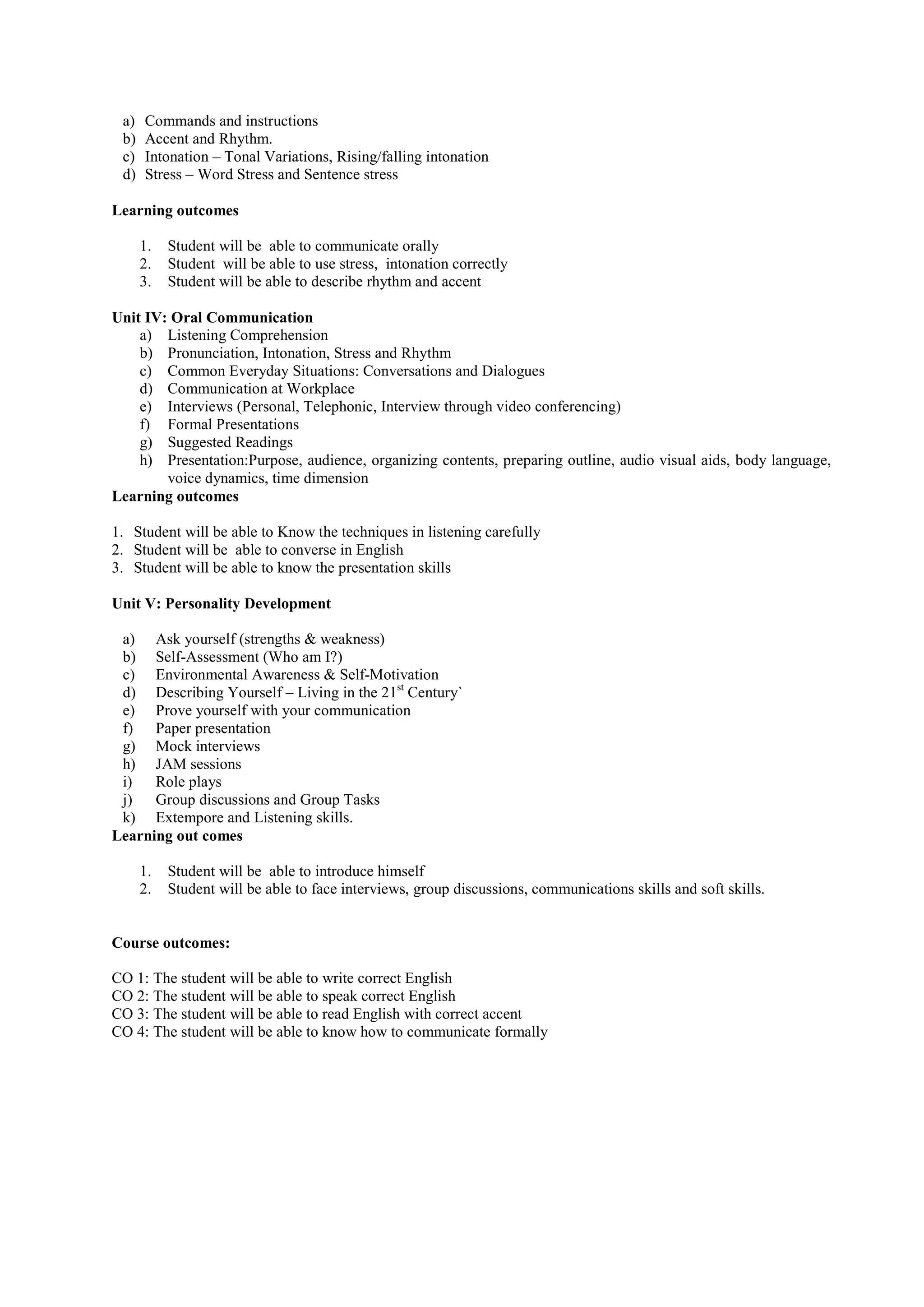
a) Commands and instructions
b) Accent and Rhythm.
c) Intonation – Tonal Variations, Rising/falling intonation
d) Stress – Word Stress and Sentence stress
Learning outcomes
1. Student will be able to communicate orally
2. Student will be able to use stress, intonation correctly
3. Student will be able to describe rhythm and accent
Unit IV: Oral Communication
a) Listening Comprehension
b) Pronunciation, Intonation, Stress and Rhythm
c) Common Everyday Situations: Conversations and Dialogues
d) Communication at Workplace
e) Interviews (Personal, Telephonic, Interview through video conferencing)
f) Formal Presentations
g) Suggested Readings
h) Presentation:Purpose, audience, organizing contents, preparing outline, audio visual aids, body language,
voice dynamics, time dimension
Learning outcomes
1. Student will be able to Know the techniques in listening carefully
2. Student will be able to converse in English
3. Student will be able to know the presentation skills
Unit V: Personality Development
a) Ask yourself (strengths & weakness)
b) Self-Assessment (Who am I?)
c) Environmental Awareness & Self-Motivation
d) Describing Yourself – Living in the 21st
Century`
e) Prove yourself with your communication
f) Paper presentation
g) Mock interviews
h) JAM sessions
i) Role plays
j) Group discussions and Group Tasks
k) Extempore and Listening skills.
Learning out comes
1. Student will be able to introduce himself
2. Student will be able to face interviews, group discussions, communications skills and soft skills.
Course outcomes:
CO 1: The student will be able to write correct English
CO 2: The student will be able to speak correct English
CO 3: The student will be able to read English with correct accent
CO 4: The student will be able to know how to communicate formally
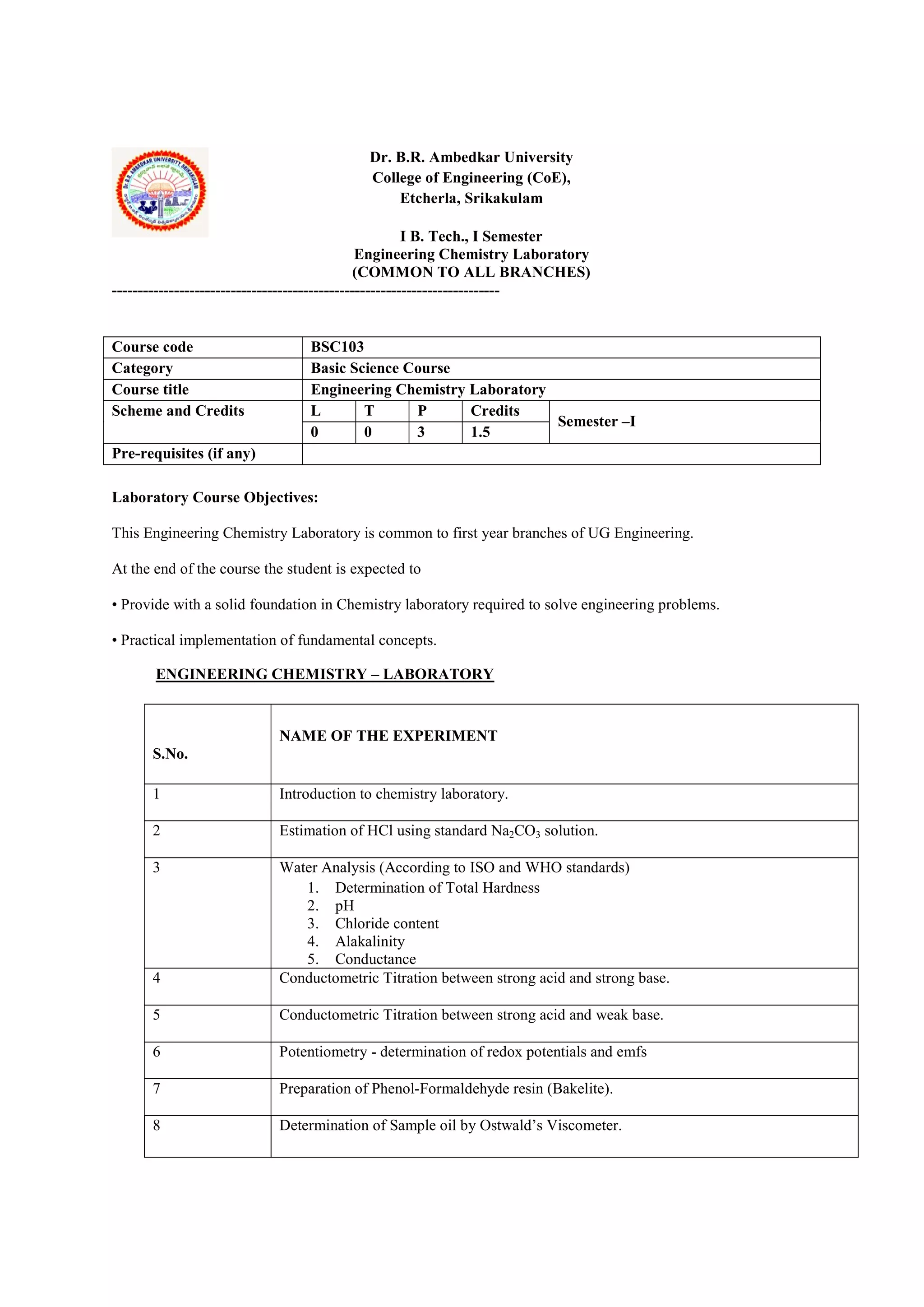
Dr. B.R. Ambedkar University
College of Engineering (CoE),
Etcherla, Srikakulam
I B. Tech., I Semester
Engineering Chemistry Laboratory
(COMMON TO ALL BRANCHES)
---------------------------------------------------------------------------
Laboratory Course Objectives:
This Engineering Chemistry Laboratory is common to first year branches of UG Engineering.
At the end of the course the student is expected to
• Provide with a solid foundation in Chemistry laboratory required to solve engineering problems.
• Practical implementation of fundamental concepts.
ENGINEERING CHEMISTRY – LABORATORY
Course code BSC103
Category Basic Science Course
Course title Engineering Chemistry Laboratory
Scheme and Credits L T P Credits
Semester –I
0 0 3 1.5
Pre-requisites (if any)
S.No.
NAME OF THE EXPERIMENT
1 Introduction to chemistry laboratory.
2 Estimation of HCl using standard Na2CO3 solution.
3 Water Analysis (According to ISO and WHO standards)
1. Determination of Total Hardness
2. pH
3. Chloride content
4. Alakalinity
5. Conductance
4 Conductometric Titration between strong acid and strong base.
5 Conductometric Titration between strong acid and weak base.
6 Potentiometry - determination of redox potentials and emfs
7 Preparation of Phenol-Formaldehyde resin (Bakelite).
8 Determination of Sample oil by Ostwald’s Viscometer.
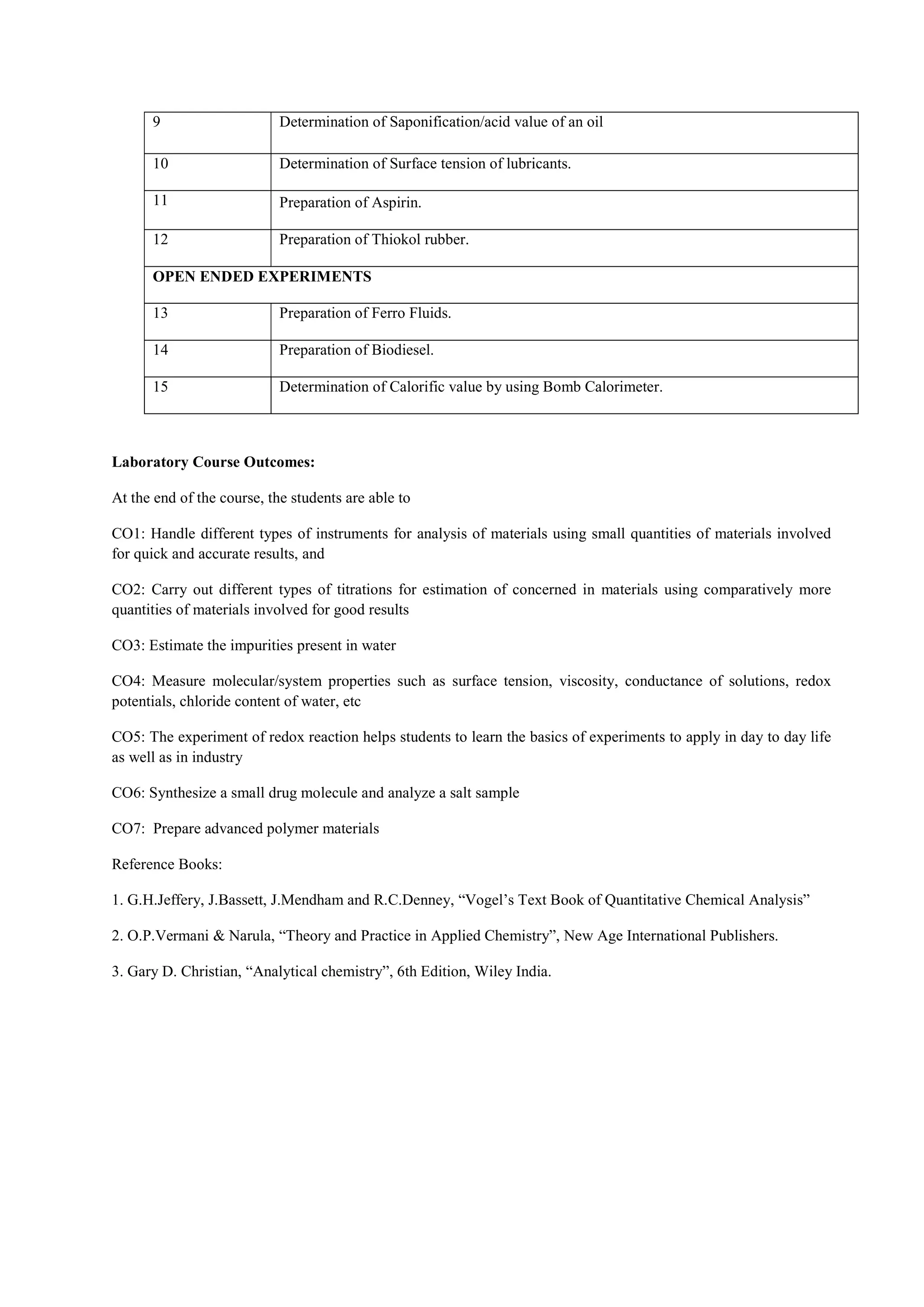
Laboratory Course Outcomes:
At the end of the course, the students are able to
CO1: Handle different types of instruments for analysis of materials using small quantities of materials involved
for quick and accurate results, and
CO2: Carry out different types of titrations for estimation of concerned in materials using comparatively more
quantities of materials involved for good results
CO3: Estimate the impurities present in water
CO4: Measure molecular/system properties such as surface tension, viscosity, conductance of solutions, redox
potentials, chloride content of water, etc
CO5: The experiment of redox reaction helps students to learn the basics of experiments to apply in day to day life
as well as in industry
CO6: Synthesize a small drug molecule and analyze a salt sample
CO7: Prepare advanced polymer materials
Reference Books:
1. G.H.Jeffery, J.Bassett, J.Mendham and R.C.Denney, “Vogel’s Text Book of Quantitative Chemical Analysis”
2. O.P.Vermani & Narula, “Theory and Practice in Applied Chemistry”, New Age International Publishers.
3. Gary D. Christian, “Analytical chemistry”, 6th Edition, Wiley India.
9 Determination of Saponification/acid value of an oil
10 Determination of Surface tension of lubricants.
11 Preparation of Aspirin.
12 Preparation of Thiokol rubber.
OPEN ENDED EXPERIMENTS
13 Preparation of Ferro Fluids.
14 Preparation of Biodiesel.
15 Determination of Calorific value by using Bomb Calorimeter.
Semester II (First year] Curriculum
Branch/Course: Electronics and Communication Engineering
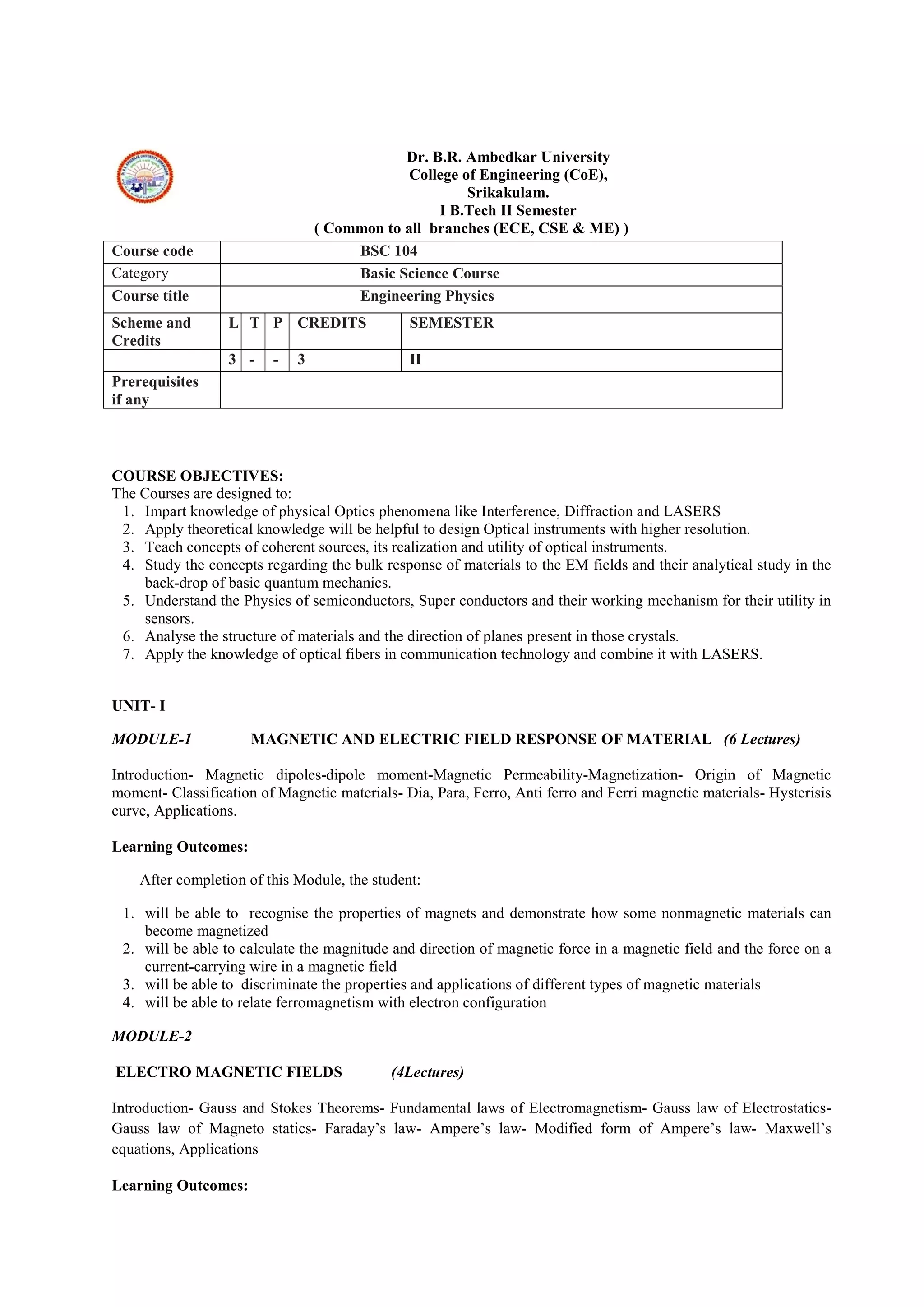
Dr. B.R. Ambedkar University
College of Engineering (CoE),
Srikakulam.
I B.Tech II Semester
( Common to all branches (ECE, CSE & ME) )
COURSE OBJECTIVES:
The Courses are designed to:
1. Impart knowledge of physical Optics phenomena like Interference, Diffraction and LASERS
2. Apply theoretical knowledge will be helpful to design Optical instruments with higher resolution.
3. Teach concepts of coherent sources, its realization and utility of optical instruments.
4. Study the concepts regarding the bulk response of materials to the EM fields and their analytical study in the
back-drop of basic quantum mechanics.
5. Understand the Physics of semiconductors, Super conductors and their working mechanism for their utility in
sensors.
6. Analyse the structure of materials and the direction of planes present in those crystals.
7. Apply the knowledge of optical fibers in communication technology and combine it with LASERS.
UNIT- I
MODULE-1 MAGNETIC AND ELECTRIC FIELD RESPONSE OF MATERIAL (6 Lectures)
Introduction- Magnetic dipoles-dipole moment-Magnetic Permeability-Magnetization- Origin of Magnetic
moment- Classification of Magnetic materials- Dia, Para, Ferro, Anti ferro and Ferri magnetic materials- Hysterisis
curve, Applications.
Learning Outcomes:
After completion of this Module, the student:
1. will be able to recognise the properties of magnets and demonstrate how some nonmagnetic materials can
become magnetized
2. will be able to calculate the magnitude and direction of magnetic force in a magnetic field and the force on a
current-carrying wire in a magnetic field
3. will be able to discriminate the properties and applications of different types of magnetic materials
4. will be able to relate ferromagnetism with electron configuration
MODULE-2
ELECTRO MAGNETIC FIELDS (4Lectures)
Introduction- Gauss and Stokes Theorems- Fundamental laws of Electromagnetism- Gauss law of Electrostatics-
Gauss law of Magneto statics- Faraday’s law- Ampere’s law- Modified form of Ampere’s law- Maxwell’s
equations, Applications
Learning Outcomes:
Course code BSC 104
Category Basic Science Course
Course title Engineering Physics
Scheme and
Credits
L T P CREDITS SEMESTER
3 - - 3 II
Prerequisites
if any
After completion of this Module, the student:
1. will be able to analyse the basic theorems relating both Electric and Magnetic fields.
2. will be able to Apply the different laws of electromagnetism in real life practices.
3. will be able to associate Maxwell's equations in solving different problems of Physics will be able to calculate
the magnitude and direction of magnetic force in a magnetic field and the force on a current-carrying wire in a
magnetic field
MODULE-3 SUPERCONDUCTIVITY ( 6 Lectures)
Introduction- Critical parameters-general properties- Meissner’s effect-Isotopic effect- Type- 1 and Type-2-
Superconductors- BCS theory- Flux quantization- DC and AC Josephson effects- Applications
Learning Outcomes:
After completion of this Module, the student:
1. will be able to identify the meanings of the newly defined (emboldened) terms and symbols, and use them
appropriately.
2. will be able to summarize perfect conduction and perfect diamagnetism, and give a qualitative description of
the Meissner effect.
3. will be able to demonstrate how a persistent current can be used to estimate an upper limit on the resistivity of
a superconductor, and perform calculations related to such estimates.
4. will be able to explain why the magnetic flux through a superconducting circuit remains constant, and
describe applications of this effect
5. will be able to illustrate where ever superconductivity can be applied in real life at present.
UNIT- II
MODULE-1 WAVE OPTICS( 7 Lectures)
Huygen’s Principle- Superposition of waves and Interference of light- Young’s double slit experiment- Newton’s
rings -Michelson’s Interferometer - Fraunhofer Diffraction due to single slit- The Rayleigh criterion for resolution-
Diffraction gratings and their resolving power.
Learning Outcomes:
After completion of this Module, the student:
1. will be able to Define diffraction and gain an understanding of its occurrences.
2. will be able to demonstrate the diffraction effects observed in a single slit and relate to Rayleigh criterion
and optical resolution.
3. will be able to illustrate thin film interference.
4. will be able to Explain and employ diffraction gratings.
5. will be able to operate the Michelson's Interferometer.
6. will be able to solve fundamental numerical calculations to solve physical optics problems related to waves,
interference and diffraction phenoneoma.
MODULE-2 COHERENT OPTICS ( 7 Lectures)
Introduction- Coherent sources- Characteristics- Spontaneous and Stimulated emissions- Einstein’s coefficients-
Pumping Schemes- Three and Four level lasers- Ruby Laser- He-Ne laser, Applications
Learning Outcomes:
After completion of this Module, the student:
1. will be able to design a laser source.
2. will be able to relate different pumping schemes to different types of lasers.
3. will be able to Record and analyse experimental findings through written laboratory reports
4. will be able to operate various types of lasers and use them for different purposes.
5. will be able to distinguish the spontaneous and stimulated emissions.
UNIT- III
MODULE-1 WAVE NATURE OF PARTICLES &SCHRODINGER’S EQUATION(5 lectures)
Introduction to Quantum Mechanics- Wave nature of particles- Time-dependent and time- independent
Scrodinger’s wave equations for wave function, Particle in a one- dimensional box- Uncertainity principle.
Learning Outcomes:
After completion of this Module, the student:
1. will be able to interpret the mathematical formulations of quantum mechanics.
2. will be able to relate the Schrodinger equations for solving simple configurations.
3. will be able to predict the behaviour of an electron in a bounded potential.
MODULE-2 FIBER OPTICS ( 5 Lectures)
Introduction-Principle of Optical fibers- Acceptance angle and Acceptance cone- Numerical Aperture-Types of
Optical fibers ( refractive Index)- Block diagram of Optical fiber communication, Applications.
Learning Outcomes:
After completion of this Module, the student:
1. will be able to prepare an optical fiber transmission link using block diagram.
2. will be able to develop elements of an optical fiber transmission link, block diagram.
3. will be able to demonstrate the total internal reflection, acceptance angle, numerical aperture and evolution of
fiber optic systems.
4. will be able to List optical fiber communication, applications.
5. will be able to Contrast and compare single mode and multimode fibers.
UNIT- IV
MODULE-1
BAND THEORY OF SOLIDS ( 6 Lectures)
Free electron theory of metals- Fermi level- Density of states- Bloch’ theorem for particles in periodic potential,
Kronig- Penney Model - origin of energy bands in solids.
Learning Outcomes:
After completion of this Module, the student:
1. will be able to Classify solids on the basis of band theory and to calculate conductivity of semiconductors
2. will be able to analyse the characteristics and theories in materials in terms of crystal structures, charge
carriers and energy bands.
3. will be able to determine the physical characteristics such as electronic structure and optical and transport
properties, and current-voltage characteristics of Metals
MODULE-2
STRUCTURE OF MATERIALS ( 5 Lectures)
Introduction- Space lattice- Basis- Unit cell- Lattice parameters- Bravais lattices- Crystal systems- Structure and
Packing fractions of SC, BCC and FCC lattices.
Learning Outcomes:
After completion of this Module, the student:
1. will be able to construct a model of the atomic structure of solids.
2. will be able to explain the basic concepts that are used to describe the structure and physical properties of
crystalline substances
3. will be able to demonstrate SC, BCC and FCC lattice structures.
MODULE-3X-RAY DIFFRACTION ( 4 Lectures)
Introduction- Direction of planes in crystals- Miller indices- Separation between successive (h k l) planes- Bragg’s
law of XRD.
Learning Outcomes:
After completion of this Module, the student:
1. will be able to Define concepts such as lattice, point and space groups
2. will be able to evaluate some problems using Bragg’s Law and explain its relation to crystal structure
3. will be able to Identify and describe different diffraction methods
4. will be able to Interpret X-ray and electron diffraction patterns
5. will be able to discuss about the orientation of crystal planes in different solids by using Miller indices.
MODULE-4 SEMICONDUCTOR PHYSICS
(6 Lectures)
Introduction- Intrinsic and Extrinsic Semiconductors- Carrier concentration- equation of conductivity- Drift and
Diffusion currents- Einstein’s equation- Hall Effect- Direct and Indirect band gap semiconductors.
Learning Outcomes:
After completion of this Module, the student:
1. will be able to have knowledge about the physics of semiconductor materials.
2. will be able to distinguish various properties of semiconductor materials using mathematical equations.
3. will be able to compare the properties of n-type and p-type semiconductors.
4. will be able to compute the forbidden band gap of semiconductors.
5. will be able to relate the fermi energy level and carrier density in n-type and p-type semiconductors.
COURSE OUTCOMES (CO’S):
CO1: Ability to improve problem solving methods this will help them in
trouble- shooting.
CO2 : Ability to design /construct some of the instrument and enhancing
resolution for its Operation .
CO3: Recall fundamental knowledge of materials and to optimize the utility
of Materials.
CO4: Ability to understand the orientation of atomic planes and their
arrangements within a crystal.
CO 5:Evaluate the working of electrical/electronic gadgets and to design
electrical/electronic gadgets using certain materials
CO6: Explain quantum picture of sub-atomic world and electron response,
which will help them to work with various electronic devices.
CO7 :Explain the properties of Superconductors and apply them in
fabricating instruments used in medicine
Text books:
1. ‘ Solid State Physics’ by A.J.Dekker ( Mc Millan India Ltd.
2. ‘A text book of Engineering Physics’ by M.N. Avadhanulu and P.G. Kshirasagar ( S. Chand Publications)
3. ‘ Engineering Physics’ by M.R. Srinivasan ( New age International Publishers)
Reference books:
1. ‘Introduction to Solid State Physics’ by Charles Kittle ( Willey India Pvt. Ltd).
2. ‘ Applied Physics’ by T. Bhimasenkaram (BSP BH publications)
3. ‘ Applied Physics’ by Arumurugam ( Anuradha Agencies)
4. ‘ Engineering Physics’ by Palanisamy ( Scitech Publications)
5. ‘ Engineering Physics’ by D.K. Bhattacharya ( Oxford University Press)
6. ‘ Engineering Physics’ by Mani Naidu S ( Pearson Publications)
7. ‘ Engineering Physics’ by Sanjay D. Jain and Girish. G. Sahasrabudha ( University Press)
8. ‘ Engineering Physics’ by B. K. Pandey and S. Chaturvedi ( Cengege Learning)
Web links:
1. https://ocw.mit.edu/courses/physics/
2. hyperphysics.phy-astr.gsu.edu/
3. Physics World | Physics news
4. EdX | Online Physics Courses
5. Physics Forums | Physics Forum
Web vedios:
1. Fundamentals of Physics with Ramamurti Shankar - YouTube
2. AP Physics Essentials - YouTube
3. https://www.youtube.com/channel/...
Dr.B.R.Ambedkar University
College of Engineering (CoE), Etcherla, Srikakulam
Ist B.Tech. II Semester
Mathematics –II (Multivariable Calculus & Partial Differential equations)
(COMMON TO ALL BRANCHES)
----------------------------------------------------------------------------------------------
UNIT-I
PARTIAL DIFFERENTIATION (12 Lectures)
Introduction – Homogeneous function – Euler’s theorem – Total derivative – Chain rule – Jacobian – Functional
dependence – Taylor’s and Mc Laurent’s series expansion of functions of two variables.
Applications: Maxima and Minima of functions of two variables without constraints and Lagrange’s method (with
constraints).
Learning Outcomes: After The completion of this unit, The Student will be able to
1. Evaluate partial derivatives, including higher order derivatives.
2. Apply the chain rule to partial differentiation.
3. Use lagranges mulpilers to solve constrained optimization problems.
UNIT-II
MULTIPLE INTEGRALS AND SPECIAL FUNCTIONS (12 Lectures)
Double and Triple integrals – Change of order of integration – Change of variables.
Applications: Finding Areas and Volumes.
Introduction to Improper Integrals-Beta and Gamma functions- Properties - Relation between Beta and Gamma
functions- Evaluation of improper integrals.
Learning Outcomes: After The completion of this unit, The Student will be able to
1. Evaluate Triple integrals and use them to find volumes in rectangular, cylindrical and spherical
coordinates.
2. To Analyse the problems by using the methods of special functions.
3. Understand integral calculus and special functions of various Engineering problem and to Known the
Applications of some basic mathematical methods.
UNIT –III
VECTOR CALCULUS (12 Lectures)
Vector Differentiation: Gradient – Directional derivative – Divergence – Curl – Scalar Potential.
Vector Integration: Line integral – Work done – Area – Surface and volume integrals – Vector integral theorems:
Greens, Stokes and Gauss Divergence theorems (without proof).
Learning Outcomes: After The completion of this unit, The Student will be able to
Course code BSC105
Category Basic Science Course
Course title Mathematics –II ( Multivariable Calculus & Partial
Differential equations)
Scheme and Credits L T P Credits Semster
3 1 0 3.5 II
Pre-requisites (if any) -
1. Memorize definition of directional derivative and gradient and illustrate geometric meanings with the aid of
sketches.
2. Explain concept of a vector integration a plane and in space.
3. Calculate directional derivatives and gradients.
Unit –IV
PDE OF FIRST AND SECOND ORDER(12 Lectures)
Formation of partial differential equations by elimination of arbitrary constants and arbitrary functions –Solutions
of first order linear (Lagrange) equation and nonlinear (standard types) equations-Method of separation of
Variables-solutions of linear partial differential equations with constant coefficients – RHS term of the type
n
m
by
ax
y
x
by
ax
by
ax
e ),
cos(
),
sin(
, 


.
Learning Outcomes: After The completion of this unit, The Student will be able to
1. classify partial differential equations and transform to canonical form and Solve linear partial differential
equations of both first and second order.
2. Apply for partial derivative equations techniques to predict the behavior of certain Phenomena.
3. Exact information from partial derivatives modles in order to interpret reality.
COURSE OUT COMES:
Upon successful completion of this course, the student should be able to
CO-1: To find maxima and minima, criotical points and inflection points of functions and to determine the
concarity of curves.
CO-2: Acquire the knowledge of evaluation of multiple integrals and finding areas enclosed by the plane curves.
Find volumes of solids and evaluate integrals using operators on scalar and vector point functions. Apply Green’s,
Stokes and Gauss’s divergence theorems in evaluation of surface and volume integrals.
CO-3: Vector Calculus motivates the study of vector differentiation and integration in two and three dimensional
spaces, it is widely accepted as a prerequisite in various fields of science and engineering.
CO-4: Solve field problems in engineering involving PDEs, They can also formulate.
Text Books:
1. B. S. Grewal, Higher Engineering Mathematics, 43rd
Edition, Khanna Publishers.
2. B. V. Ramana,Higher Engineering Mathematics, 2007 Edition, Tata Mc. Graw Hill Education.
Reference Books:
3. Erwin Kreyszig, Advanced Engineering Mathematics, 10th
Edition, Wiley-India.
4. Joel Hass, Christopher Heil and Maurice D. Weir, Thomas calculus, 14th
Edition, Pearson.
5. Lawrence Turyn, Advanced Engineering Mathematics, CRC Press, 2013.
6. Srimantha Pal, S C Bhunia, Engineering Mathematics, Oxford University Press.
Dr.B.R. Ambedkar University
College of Engineering (CoE),
Etcherla, Srikakulam
II B. Tech. I Semester
Programming for Problem Solving (Common to All Branches)
---------------------------------------------------------------------------
Course Objectives
1. To provide the student with the necessary skills to write and debug programs using the C programming language
2. To provide coverage of basic structure and major modules of C programming language
3. To provide the solution for various problems using the Control Structures of C language
4. To Design programs involving arrays.
5. Implement modularity and code reusability concepts using functions.
7. To read and write C program that uses pointers, structures.
UNIT-I
Introduction to Programming (8 lectures)
Introduction to components of a computer system (disks, memory, processor, where a program is stored and
executed, operating system, compilers etc.).
Idea of Algorithm: steps to solve logical and numerical problems. Representation of Algorithm: Flowchart/Pseudo
code with examples.
From algorithms to programs; source code, variables (with data types) variables and memory locations, Syntax and
Logical Errors in compilation, object and executable code
Learning outcomes:
1. Introduction of components of computer system
2. Representation of the algorithms for problem solving
3. Understand the flow algorithms to programs.
UNIT-II
Arithmetic expressions, precedence, arrays and basic algorithms (15 lectures)
Conditional Branching and Loops, Writing and evaluation of conditionals and consequent branching, iteration and
loops, Arrays (1-D, 2-D), Character arrays and Strings, String handling functions, Functions (including using built
in libraries), Parameter passing in functions, call by value, passing arrays to functions: idea of call by reference.
Course code ESC 102
Category Engineering Science
Course title Programming for Problem Solving
Scheme and Credits L T P Credits
3 0 0 3
Pre-requisites (if any)
Learning outcomes:
1. Apply the conditional branching and loops for problem solving.
2. Understand the concepts Arrays, character arrays, Strings and String handling function.
3. Illustrates the concepts functions.
UNIT-III
Function recursion and basic algorithms (11 lectures)
Recursion, as a different way of solving problems. Example programs, such as Finding Factorial, Fibonacci series
etc. Basic Algorithms: Searching, Basic Sorting Algorithms: Bubble, Insertion and Selection, Quick sort and Merge
Sort, Program function for all searching and sorting. Finding roots of equations, notion of order of complexity
through example programs (no formal definition required).
Learning outcomes:
1. Apply the recursion techniques on the problem solving.
2. Understand the Searching techniques.
3. Understand the basic sorting techniques.
UNIT-IV
Structure & pointers (9 lectures)
Structures, Defining structures and Array of Structures, idea of pointers, defining pointers, use of pointers in self-
referential structures, notion of linked list (no implementation), dynamic memory allocation.
Learning outcomes:
1. Illustrates the concepts structures and array of structures.
2. Understand the concept pointers and self referential structures.
3. Understand the Dynamic memory allocation.
Suggested Text Books:
(i) Byron Gottfried, Schaum’s Outline of Programming with C, McGraw-Hill
(ii) E. Balaguruswamy, Programming in ANSI C, Tata McGraw-Hill Suggested
Course Outcomes:
CO1: To formulate simple algorithms for arithmetic and logical problems.
CO 2: To translate the algorithms to programs (in C language).
CO 3: To test and execute the programs and correct syntax and logical errors.
CO 4: To implement conditional branching, iteration and recursion.
CO 5: To decompose a problem into functions and synthesize a complete program using divide and conquer
approach.
CO 6: To use arrays, pointers and structures to formulate algorithms and programs.
CO 7: To apply programming to solve matrix addition and multiplication problems and searching and sorting
problems.
CO 8:To apply programming to solve simple numerical method problems, namely rot finding of function,
differentiation of function and simple integration.
Reference Books:
(i) Brian W. Kernighan and Dennis M. Ritchie, The C Programming Language, Prentice Hall of India
Web links:
1. https://www.youtube.com/watch?v=siKFFOW2gw&list=PLVlQHNRLflP8IGz6OXwlV_lgHgc72aXlh
2. https://www.youtube.com/watch?v=-CpG3oATGIs
3. https://www.youtube.com/watch?v=S47aSEqm_0I&list=PLeCxvb23g7hrw27XlekHtfygUTQ0TmFfP
4. https://www.youtube.com/watch?v=XTiIiILOY8&list=PLJvIzs_rP6R73WlvumJvCQJrOY3U5zq1j
5. https://www.youtube.com/watch?v=c5gg9F8h8Fw&list=PLl0JwcpTmtfce7rrsxTt0QgTs6ZVtdxLp
6. https://www.youtube.com/watch?v=atfNaIY9WbQhttps://www.programiz.com/c-programming
7. https://www.programiz.com/c-programming/library-function
8. https://www.programiz.com/c-programming/examples
Dr.B.R. Ambedkar University
College of Engineering (CoE), Etcherla, Srikakulam
I B. Tech. II Semester
BASIC ELECTRICAL ENGINEERING
----------------------------------------------------------------------------------------------------
Course code ESC103
Category Engineering Science Course
Course title BASIC ELECTRICAL ENGINEERING
Scheme and Credits L T P Credits
Semester –II
3 0 0 3
Pre-requisites (if any) Engineering Physics
Course objectives:
The student will be introduced to
1. Basics of electric circuits.
2. DC and AC electrical circuit analysis.
3. Working principles of transformers and electrical machines.
4. Impart knowledge on electrical installation
UNIT I
D.C. CIRCUITS (12 lectures)
Electrical circuit elements (R, L and C), voltage and current sources, Kirchoff current and voltage laws, analysis of
simple circuits with dc excitation. Star delta conversion, Mesh and Nodal Analysis, Superposition, Thevenin
Theorem, Norton Theorem, Maximum power Transfer Theorem
Learning outcomes:
1. Recall Kirchoff laws
2. Analyze simple electric circuits with DC excitation
3. Apply network theorems to simple electrical circuits
UNIT II
A.C. CIRCUITS (12 lectures)
Representation of sinusoidal waveforms, peak and Rms values, phasor representation, real power, reactive power,
apparent power, power factor, Analysis of single-phase ac circuits consisting of R, L, C, RL, RC, RLC
combinations, Three phase balanced circuits
Learning outcomes:
1. Analyze single phase AC circuits consisting of series RL - RC - RLC combinations
2. Analyze three phase balanced star and delta connected circuits.
UNIT III
ELECTRICAL MACHINES (16 lectures)
Working principle of DC Generator and Motor ,EMF Equation, Construction and working of a three-phase
induction motor, Losses and efficiency. Working principle of a transformer, Ideal and Practical Transformer,
losses in transformers, regulation and efficiency.
Learning outcomes:
1. Illustrate the constructional details and principle of operation of a DC and AC machines.
2. Identify losses, efficiency and parameters of a 3-phase induction motor
3. Explain the constructional details and operating principle of transformer
4. Identify losses, efficiency and parameters of a transformer
UNIT IV
ELECTRICAL INSTALLATION (12 lectures)
Electrical Installations : Components of LT Switchgear: Switch Fuse Unit (SFU), MCB, ELCB, MCCB, Types of
Wires and Cables, Earthing. Types of Batteries, Important Characteristics for Batteries. Elementary calculations for
energy consumption, power factor improvement and battery backup.
Learning outcomes:
1. Illustrate the components of low voltage Switchgear
2. Outline the batteries along with its types
Course Outcomes:
At the end of this course, students will able
CO 1: Analyze simple electric circuits with DC and AC excitations
CO 2: Evaluate the performance of a transformer
CO 3:Illustrate the constructional details and principle of operation of a DC and AC machines
CO 4:Illustrate the components of low voltage Switchgear And MCB
Text books:
1. D.P. Kothari and I. J. Nagrath, “Basic Electrical Engineering”, Tata McGraw Hill, 2010.
2. D.C. Kulshreshtha, “Basic Electrical Engineering”, McGraw Hill, 2009.
3. RamanaPilla, M. Surya Kalavathi and G.T.ChandraSekhar, Basics of Electrical Engineering, 1st Ed., S. Chand
& Company Ltd, 2018
Reference books:
1. E. Hughes, “Electrical and Electronics Technology”, Pearson, 2010.
2. V. Mittle& Arvind Mittal, Basic Electrical Engineering, TMH.
3. L.S. Bobrow, “Fundamentals of Electrical Engineering”, Oxford University Press, 2011.
4. E. Hughes, “Electrical and Electronics Technology”, Pearson, 2010.
5. V.D. Toro, “Electrical Engineering Fundamentals”, Prentice Hall India, 1989.
Web links:
1. https://nptel.ac.in/courses/108108076/
2. https://onlinecourses.nptel.ac.in/noc18_ee14/
3. https://nptel.ac.in/noc/individual_course.php?id=noc18-ee14
4. https://easyengineering.net/basic-electrical-engineering-by-wadhwa/
5. http://www.opentextbooks.org.hk/system/files/export/9/9648/pdf/Fundamentals_of_Electrical_Engineerin
g_I_9648.pdf
Dr.B.R. Ambedkar University
College of Engineering (CoE), Etcherla, Srikakulam
I B. Tech. II Semester
CONSTITUTION OF INDIA
(COMMON TO ALL BRANCHES)
-------------------------------------------------------------------------------------------------------
Course title CONSTITUTION OF INDIA (COI)
Category Credit Course (CC)
Course code HSMC103
Specialization Common to All
Scheme and Credits L T P Credits Semester - II
1 - - 1
Pre-requisites(if
any)
COURSE OBJECTIVES:
1. The primary objective of ensuring social, economic and political justice.
2. Liberty equality, and fraternity which the constitution seeks to secure for the people of India.
3. The objective of the course is to provide and understanding of the state, how it works through its main organs.
4. The main objective of this course primacy of politics and political process the concept of sovereignty and its
changing contours in a globalized world.
UNIT-I
FRAMING OF INDIAN CONSTITUTION
Module-1
SALIENT FEATURES OF THE CONSTITUTION (3 Lectures)
Formation of constituent assembly- Re assembled on constitution assembly- Preparation of constitution-
Functioned number of committees – Approvel of constitution- India became a Republic.
Learning Outcomes:At the completion of this module, the student will able to
1. Understand constitutional Assembly was assembled on 9th
December 1946
2. Explain constitution of India came in to force on 26th
January 1950
3. Understand constitution tooks 2 years 11 months 18 days to frame the constitution of India.
Module-2
PREAMBLE OF CONSTITUTION OF INDIA
(2 Lectures)
Preamble contains constitutional values – Sovereignty – Socialism- Secularism- Democracy –Justic – Liberity-
Equality-Fraternity.
Learning Outcomes:At the completion of this module, the student will able to
1. Understand the power of a country to control its own Government it is sovereignty.
2. Describe Socialism Principles.
3. Students will be able to explain system of secularism.
4. Students will be able to understand Democracy is a system of government where the citizens exercise power
by voting and Justice is nothing but people behave that is fair , equal and balanced for everyone.
UNIT-II
FUNDAMENTAL RIGHTS
Module-1
BASIC INFORMATION OF FUNDAMENTAL RIGHTS (4 Lectures)
Right to equality (Article 14-18)-Right to Freedom (Article 19-22)-Right to against Exploitation (Article 23-24)-
Right to freedom of Religion(Article 25-28)-Cultural and Educational Rights (Article 29-30)-Right to
Constitutional Remedies (Article 32).
Learning Outcomes:At the completion of this module, the student will able to
1. Understand equality before law according to under Article 14.
2. Explain protection of life and personal liberty according Article 21
3. Understand Right to against Exploitation under Article 23 and 24
4. Describe cultural and Educational rights Article 29 and 30
Module-2 DIRECTIVE PRINCIPLES OF STATE POLICY (3Lectures)
Socialist principles (Article 38,39,39A,41,42,43,43A,and 47)-Gandhi an Principles (Article 40,43,43B,46,47,48)-
Liberal principles (Article 44,45,48 ,48A, 49, 50, 51) – Difference betweenFundamental rights and directive
principles.
Learning Outcomes:At the completion of this module, the student will able to
1. Understand state provides free and compulsory education between age group 6 -14 years of children according to
Article 45
2.Understand protection of National monuments according to Article 49
3. Explain equal pay for equal work according to Article 39
4.Understand promotionof international peace and security for international law according to Article 51
Module-3
FUNDAMENTAL DUTIES (2 Lectures)
Respect the national flag and national Anthem- To follow the noble ideals which inspired our national struggle for
freedom-Protect sovereign, unity, integrity- to promote harmony and the spirit of common brother hood.To value
and preserve the rich heritage of our composite culture – To protect natural environment-to develop scientific
temper- safeguard public property- rises to higher level of endeavour and achievement.
Learning Outcomes:At the completion of this module, the student will able to
1. Understand respect the constitution the national flag and national anthem.
2. Explain need of protection of natural environment including forests, lakes, Rivers and wild Life.
3. Evaluate develop scientific temper.
UNIT-3
STRUCTURE OF THE UNION GOVERNMENT
Module-1
UNION EXECUTIVE (6 Lectures)
President- powers and functions of president- Appointmenof the president – Term length – DutyOf the president –
Legislative powers – Executive powers- Judicial Powes of president – Appointment powers of president –
Financial powers of the president- Diplomatic powers of thepresident – Pardoning powers of the president-
Emergency powers of the president- vice president- Qualifications of vice president- status of vice president-
Election of vice president- oath of vice president Term of Vice president – Powers and functions Vice president-
Removal of Vice president of india- Council of ministers- Different rank of council ministers- Prime minister-
Appointment of Prime Minister- Postion of primeminister powers and functions of prime minister- compensation
and other benefits of prime minister.
Learning Outcomes:At the completion of this module, the student will able to
1.Understad All the Ministers including prime minister all appointed by president
2.Explain Military powers of president
3.Discribe appointment process of president
4.Explain Qualifications of vice-president
5.Understand different ranks of ministers
6.Understand the primeMinister is generally the leader of majority party or alliance
Module-2
UNION LEGISLATURE (3 Lectures)
Loksabha-Term of the house-Qualifications of Loksabha members- Powers of Loksabha-officers of Loksabha-
sessions of parliament- Rajyasabha-Qualifications of Rajyasabha members-powers of Rajyasabha-officers of
Rajyasabha
Learning outcomes: At the completion of this module, the student will able to
1. Explain basic structure of Parliament
2. Understand different qualifications of Lok sabha members
3. Explain Legislative powers of Lok sabha
4. Understand Vice President of India is a Chairman of Rajya Sabha
5. Explain Legislative and Executive powers of Rajya Sabha
Module-3
JUDICIARY (3Lectures)
Supreme court- Qualifications of Judges-Appointment of Judges- Tenure of Judges- Salaries of Judges-
Jurisdiction of Supreme court- Judicial review
Learning Outcomes: At the completion of this module, the student will able to
1. Understand importance of Judiciary
2. Explain the functions of Supreme court
3. Describe the jurisdiction of Supreme court
4. Explain Judicial review of Supreme court
UNIT-IV
STRUCTURE OF THE STATE GOVERNMENT
Module-1
STATEEXECUTIVE (3Lectures)
Governor-Appointment- term-qualifications-oath-Powers and functions- Executive- Legislative- appointing
powers- Judicial powers-Chief Minister-Eligibility- elections-oath-Resignation-Remuneration- Council of
Ministers
Learning Outcomes:At the completion of this module, the student will able to
1. Understand Governor was appointed by President of India
2. Explained Executive and Legislative powers of Governor
3. Understand the Chief Minister is the leader of Majority party or alliance
4. Describe oath of Chief Minister.
Module-2
STATE LEGISLATURE (3Lectures)
Legislative Assembly-qualifications of members-Officers- term- Powers-Legislative council- qualifications of
members- Term-Powers
Learning Outcomes:At the completion of this module, the student will able to
1. Understand different qualifications of members of Legislative Assembly
2. Evaluate term of Legislative Assembly
3. Explain Executive and Legislative powers of Legislative assembly
4. Understand term of Legislative council it is permanent house
5. Explain different powers of Legislative council
Module-3 JUDICIARY (4Lectures)
High court- qualification of Judges-tenure-salaries-Powers and functions of High court- Subordinate Courts-
district courts-Appointment of district judge-Qualification-Powers and functions of Subordinate courts
Learning Outcomes: At the completion of this module, the student will able to
1. Explain qualifications of High court judge
2. Evaluate powers of high court
3. Understand qualifications of District judge
4. Explain powers of Subordinate courts
COURSEOUTCOMES:
After the completion of the course, the learner will be able to:
CO-1:Understand briefly about Indian Constitution
CO-2 : Evaluate Basic need of fundamental rights and directive principles for equal justice.
CO-3: Know fundamental values, the Philosophy, ethos of the constitution in Preamble.
CO-4 : Describe need and importance of Judiciary and different types of courts.
CO-5 : Understand Administrative process of Executive legislative and Judiciary system
REFERENCE BOOKS:
1. Introduction to Constitution of India- D.D. Basu Lexis Nelus
2. The Constitution of India, P.M.Bhakshi-Universal law
3. Madhav Khosala, the Indian Constitution, Oxford Univesity Press, New Delhi-2012
4. Brij Kishor- Sharma- Introduction to the Indian Constitution, PH 1, New Delhi latest Edition
Dr.B.R. Ambedkar University
College of Engineering (CoE),
Etcherla, Srikakulam
I B.Tech., I Semester
Environmental Science
(COMMON TO ALL BRANCHES)
---------------------------------------------------------------------------
Course Code BSC107
Category Basic Science Course
Course Title Environmental Science
Specialization Common to All
Scheme and Credits L T P Credits Semester - II
1 - - 1
Pre-requisites (if any) Knowledgeto conserve Natural Resources and to control
Environmental Pollution
Course Objectives:
1. Environmental Studies segments academic understanding and respond to the variety of changes humans have
wrought in our world.
2. Students in Environmental Studies are motivated by concern for welfare of the many human and non-human
communities that shape this planet.
3. The Environmental Studies Program actively cultivates reflective response about those communities.
4. Ensures programmatic learning to address environmental problems.
5. The student will become familiar with the Earth’s and other geographical functionalities (ecosystems and
biogeochemical cycles), their functions and how they are affected by human activity (population growth, air,
water and soil pollution, ozone depletion, global warming, solid waste disposal).
6. Students will learn about different systems of human society and ecology become part of learning.
UNIT-I
MODULE-1 MULTIDISCIPLINARY NATURE OF ENVIRONMENTAL STUDIES
( 2 Lectures )
Definition, Scope and Importance – Stockholm and Rio Summit–Global Environmental Challenges: Global
warming and climate change, acid rains, ozone layer depletion, population growth and explosion, effects. Role of
information Technology in Environment and human health.
Learning Outcomes:At the completion of this module, the student will able to
4. Find an interdisciplinary approach to complex environmental problems using basic tools of the natural and
social sciences including geosystems, biology, chemistry, economics, political science and international
processes and can give the scope of Environmental science.
5. Explains global environmental challenges along with Stockholm and Rio Summit.
6. Recognize the importance of Role of information Technology in Environment and human health.
MODULE-2
ECOSYSTEMS (2 Lectures)
Concept of an ecosystem. - Structure and function of an ecosystem. - Producers, Consumers and decomposers. -
Energy flow in the ecosystem - Ecological succession. - Food chains, food webs and ecological pyramids. -
Introduction, types, characteristic features, structure and function of Forest ecosystem, Grassland ecosystem, Desert
ecosystem, Aquatic ecosystems.
Learning Outcomes:At the completion of this module, the student will able to
5. Construct a glossary of scientific terms in Ecology and Ecosystem
6. Present an overview of diversity of life forms in different ecosystems.
7. Explain the concept of Ecological succession
8. Draw a food chain, food web and food pyramid of the study area.
UNIT II
MODULE-1
NATURAL RESOURCES (4 Lectures)
Natural resources and associated problems Forest resources – Use and over – exploitation, deforestation – Timber
extraction – Mining, dams and other effects on forest and tribal people.
Water resources – Use and over utilization of surface and ground water – Floods, drought, conflicts over water,
dams – benefits and problems.
Mineral resources: Use and exploitation, environmental effects of extracting and using mineral resources.
Food resources: World food problems, changes caused by non-agriculture activities-effects of Modern agriculture,
fertilizer-pesticide problems, water logging, salinity
Energy resources: Growing energy needs, renewable and non-renewable energy sources use of alternate energy
sources.
Land resources: Land as a resource, land degradation, Wasteland reclamation, man induced Landslides, soil
erosion and desertification.
Role of an individual in conservation of natural resources. Equitable use of resources for sustainable lifestyles.
Learning Outcomes:At the completion of this module, the student will able to
1. Appreciate the ethical, cross-cultural, and historical context of environmental issues and the links between
human and natural systems.
2. Anticipate, analyze and evaluate natural resource issues and opportunities, explaining the ecological, economic,
and social consequences of natural resource actions at various scales and over time.
3. Characterize natural resources and be able to quantify at least one of these resources.
4. Envision desired future conditions in an area to achieve a set of natural resource-related objectives, prescribe
management actions needed to achieve those objectives, and evaluate success of these actions.
UNIT-III
MODULE-1 BIODIVERSITY AND ITS CONSERVATION (2 Lectures)
Definition: genetic, species and ecosystem diversity- classification - Values of biodiversity: consumptive use,
productive use, social-Biodiversity at national and local levels. India as a mega-diversity nation - Hot-sports of
biodiversity - Threats to biodiversity: habitat loss, man-wildlife conflicts. - Endangered and endemic species of
India.
Conservation of biodiversity: In situ, Ex situ conservation.
Learning Outcomes:At the completion of this module, the student will able to
1. Articulate the reason for the striveness of the society to conserve biodiversity.
2. Identify key threats to biodiversity.
3. Evaluate which management options are likely to be effective for conserving biodiversity in different settings.
4. Develop appropriate policy options for conserving biodiversity in different settings.
MODULE-2 ENVIRONMENTAL POLLUTION
(2 Lectures)
Definition, Cause, effects and control measures of Air pollution.
Water pollution, Soil pollution, Noise pollution, Nuclear hazards. Role of an individual in
prevention of pollution. - Pollution case studies.
Learning Outcomes:At the completion of this module, the student will able to
1. Predict the Cause and effects of various Environmental Pollutions on human health.
2. Design various Pollution control measures.
3. Identify the Role of an individual in prevention of Pollution.
MODULE-3
SOLID WASTE MANAGEMENT (1 Lectures)
Sources, classification, effects and control measures of urban and industrial solid wastes. Consumerism and waste
products.
Learning Outcomes:At the completion of this module, the student will able to
6. Identify the sources and effects of urban and industrial solid waste materials.
7. Indicate the control measures of solid wastes.
3. Consumerism and waste products.
UNIT-IV
MODULE-1
SOCIAL ISSUES AND THE ENVIRONMENT
(2 Lectures)
Urban problems related to energy -Water conservation, rain water harvesting-Resettlement and rehabilitation of
people; its problems and concerns.
Learning Outcomes:At the completion of this module, the student will able to
5. Evaluate the Urban problems related to energy.
6. Explain the relevance of water’s unusual properties for living systems.
7. Use the modern techniques for rain water harvesting.
8. Appreciate the resettlement and rehabilitation of people.
MODULE-2 ENVIRONMENTAL ETHICS (2 Lectures)
Issues and possible solutions. Environmental Protection Act -Air (Prevention and Control of Pollution) Act. –Water
(Prevention and control of Pollution) Act -Wildlife Protection Act -Forest Conservation Act-Issues involved in
enforcement of environmental legislation. -Public awareness.
Environmental Management: Impact Assessment and its significance various stages of EIA, preparation of EMP
and EIS, Environmental audit.
Learning Outcomes:At the completion of this module, the student will able to
6. Articulate and critically reflect on a variety of ethical perspectives on environmental issues.
7. Demonstrate an understanding of different ethical views regarding human responsibility for their
environment and the aggregations of species that inhabit it.
8. Predict the importance of EIA, EIS and Environmental audit.
MODULE-3 ECOTOURISM (2 Lectures)
The student should submit a report individually on any issues related to Environmental Studies course and make a
power point presentation.
Learning Outcomes: At the completion of this module, the student will able to
5. Identify and manage for ecological impacts to soil, water, vegetation, and wildlife resulting from recreation
and tourism development.
6. Understand ecological impacts and ecotourism management approaches in a variety of ecosystems under
diverse landowners.
7. Analyze the environmental and social consequences of ecotourism management strategies and decisions;
use management tools to reduce visitor related impacts that occur in ecotourism areas (impacts of outdoor
recreation include impacts to soil, vegetation, water, wildlife, air, sound scape, night sky, historical/cultural
resources, visitor experiences, and facilities/services).
COURSEOUTCOMES:
After the completion of the course, the learner will be able to:
CO-1 Describe and analyze the current national and global environmental problems; looking at the science behind
them, the economics involved, and the policies regarding them by understanding the purpose of Rio summit and
Stockholm conference and also the management of Ecosystem and its importance.
CO-2Understand the naturalresourcesandtheirimportanceforthesustenanceofthelifeandrecognizethe need to
conservethe natural resources.
CO-3 Summarize theconcept ofbiodiversityofIndiaandthethreatstobiodiversity,andconservationpracticesto
protect the biodiversity and can identify the causes and effects of various pollutions and their abatement and
also can experiment with various Solid wastes.
CO-4 Expertise with Social Issues related issues and Environmental ethics and can communicate integrated
perspectives on complex environmental problems in the form of written and oral argument to both professional
and lay audiences.
Text Books:
1. Environmental Studies by R. Rajagopalan, 2nd
Edition, 2011, Oxford University Press.
2. A Textbook of Environmental Studies by Shaashi Chawla, TMH, New Delhi
3. Environmental Studies by P.N. Palanisamy, P. Manikandan, A. Geetha, and K. Manjula Rani; Pearson
Education, Chennai
Reference Books:
1. Text Book of Environmental Studies by Deeshita Dave & P. Udaya Bhaskar, Cengage Learning.
2. Environmental Studies by K.V.S.G. Murali Krishna, VGS Publishers, Vijayawada
3. Environmental Studies by Benny Joseph, Tata McGraw Hill Co, New Delhi
4. Environmental Studies by Piyush Malaviya, Pratibha Singh, Anoop singh: Acme Learning, New Delhi.
Web Links:
1.https://www.coursera.org/browse/physical-science-and-engineering/environmental- science-and-sustainability
2. https://www.edx.org/course/subject/environmental-studies
Dr. B.R. Ambedkar University
College of Engineering (CoE),
Etcherla, Srikakulam.
Engineering Physics Laboratory
[Common to all branches (ECE, CSE & ME) ]
Course code BSC106
Category Basic Science Course
Course title Engineering Physics (Lab)
Scheme and Credits L T P CREDITS
SEMESTER-II
-- -- 3 1.5
LEARNING OBJECTIVES:
After the completion of this laboratory experiments, The student will develop
1. An ability to apply knowledge of mathematics, science, and
engineering
2. An ability to design and conduct experiments, as well as to
analyze and interpret data
3. An ability to design a engineering system, component, or process
4. An ability to function on multi-disciplinary teams
5. An ability to identify, formulates, and solves engineering problems
6. An ability to exhibit the professional and ethical responsibility
7. An ability to communicate effectively
Expt.
No.
Name of the
Expt.
Aim Branch
I Newton’s Rings
To determine the Radius of Curvature of Plano - Convex
Lens by forming Newton’s rings.
Optics
II
Diffraction
Grating
To determine the wavelength of a source-Diffraction
Grating-Normal incidence
III
Interference
Fringe’s
To determine the thickness of a thin object using parallel
interference fringes
IV
Torsional
Pendulum
Determination of Rigidity modulus of a material
Mechanics
V
Compound
Pendulum
Determination of Acceleration due to Gravity and Radius of
Gyration
VI
Melde’s
Experiment
To determine the frequency of vibrations in both Transverse
and Longitudinal modes
Waves and
Oscillations
VII Sonometer To Verify the laws of vibrations in stretched strings
VIII
Volume
Resonator
To determine the velocity of sound
IX
LCR Series
Resonance
To determine the frequency of a given LCR circuit in Series
connection.
EM Theory
X
Stewart Gee’s
Expt.
To determine the Magnetic field along the axis of a current
carrying coil by using Stewart and Gee’s apparatus
XI P-n Diode
To Study the I/V Characteristics of a given Semiconductor
diode
Semiconductor
Physics
XII Zener Diode To study the I/V characteristics of Zener diode
XIII
Energy Gap
expt.
To determine the Energy Band gap of a given
Semiconductor p - n junction diode
XIV Hall Effect To determine the Hall coefficient in semiconductors
Course Outcomes (CO’s):
At the end of the course, the students are able to
CO 1: Evaluate the physical constants
CO 2: Ability to understand the I-V characteristics of zener and semiconductor diodes.
CO 3: Study the resonance effect in LCR circuits.
CO 4: Develop basic knowledge on utilization of optical instruments
CO 5: Ability to understand the properties of materials (both optical and mechanical).
CO 6: Ability to acquire knowledge on the behaviour of EM fields.
CO 7: Develop knowledge on the type of waves produced and their behaviour in different cases.
REFERENCE Books:
1. Engineering Physics Lab Manual by Dr.Y. Aparna & Dr.K.Venkateswarao (V.G.S.Book links)
2. Physics Practical Manual, Lorven Publications.
Web links:
www.vlabs.co.in
Dr.B.R. Ambedkar University
College of Engineering (CoE),
Etcherla, Srikakulam
I B. Tech. II Semester
Course Objectives:
1. To learn to solve problems related to Numerical Representation using Computer Programming
2. To learn to solve problems related to Number Theory using Computer Programming
3. To learn to solve problems related to Strings using Computer Programming.
4. To learn to solve problems related to Recursion using Computer Programming.
5. To learn to solve problems related to Advanced Arithmetic using Computer Programming
6. To learn to solve problems related to Number Theory using Computer Programming
Detailed content:
1: Familiarization with programming environment
2: Simple computational problems using arithmetic expressions
3: Problems involving if-then-else structures
4: Iterative problems e.g., sum of series
5: 1D Array manipulation
6: Matrix problems,
7: String operations
8: Simple functions
9: Programming for solving Numerical methods problems
10: Recursive functions.
11: Pointers
12: Finding roots of quadratic equation
13: structures
14: Array of structures.
15: Dynamic memory allocation functions
Course outcomes:
CO1: To formulate the algorithms for simple problems.
CO2: To translate given algorithms to a working and correct program.
CO3: To be able to correct syntax errors as reported by the compilers.
CO4: To be able to identify and correct logical errors encountered at run time.
CO5: To be able to write iterative as well as recursive programs.
CO6: To be able to represent data in arrays, strings and structures and manipulate them through a program.
CO7: To be able to declare pointers of different types and use them in defining self-referential structures.
Course code ESC 104
Category CSE, ECE & MECH
Course title Programming for Problem Solving Lab
Scheme and Credits L T P Credits
0 0 3 1.5
Pre-requisites (if any)
Web links:
1. http://en.wikipedia.org/wiki/Numerical_integration
2. http://en.wikipedia.org/wiki/Numerical_analysis
3. https://www.includehelp.com/c-programming-examples-solved-c-programs.aspx
4. https://www.slideshare.net/manjurkts/c-programming-lab-manual-18cpl17
Virtual lab links:
1. http://cse02-iiith.vlabs.ac.in/exp1/index.html
2. http://cse02-iiith.vlabs.ac.in/exp2/index.html
3. http://cse02-iiith.vlabs.ac.in/exp4/index.html
4. http://cse02-iiith.vlabs.ac.in/exp3/index.html
5. http://cse02-iiith.vlabs.ac.in/exp5/index.html
6. http://cse02-iiith.vlabs.ac.in/exp6/index.html
7. http://cse02-iiith.vlabs.ac.in/exp7/index.html
8. http://cse02-iiith.vlabs.ac.in/exp8/index.html
9. http://cse02-iiith.vlabs.ac.in/exp9/index.html
Dr.B.R. Ambedkar University
College of Engineering (CoE),
Etcherla, Srikakulam
I B. Tech. II Semester
BASIC ELECTRICAL ENGINEERING LAB
(COMMON TO ECE&CSE)
---------------------------------------------------------------------------
Course code ESC105
Category Basic Science Course
Course title BASIC ELECTRICAL ENGINEERING LAB
Scheme and Credits L T P Credits
Semester –II
0 0 3 1.5
Pre-requisites (if any)
Course Objectives:
The student will be introduced to
1. To get an exposure to common electrical components and their ratings.
2. To make electrical connections by wires of appropriate ratings.
3. To understand the usage of common electrical measuring instruments.
4. To empower students to determine the parameters of DC and AC machines by performing experiments on
these machines
5. To understand the basic characteristics of transformers.
LIST OF EXPERIMENTS
1. Conduct an Experiment to Verify Ohm’s law and Measurement Cold Resistance using Filament Lamp.
2. Verification of KCL and KVL.
3. State and Verify the Superposition Theorem.
4. State and Verify the Thevenin’s and Norton’s Theorems
5. Transient Response of RLC Resonant circuit.
6. Measurement of Voltage,Current and Power using One Watt meter method.
7. Conduct Swinburne’s Test on a DC Machine.
8. Brake Test on DC Series Motor.
9. Load Characteristics of DC Self excited Shunt Generator.
10. OC&SC Tests on Single phase Transformer.
11. Alternator Regulation by EMF method.
12. Load Test on 3Phase Squirrel cage Induction Motor.
13. OCC Characteristics of DC Separately excited Generator.
14. Calibration of UPF Wattmeter using Phantom Loading.
15. Brake Test on DC Shunt Motor.
Course Outcomes:
At the end of course, the student will be able to
1. Analyze the performance characteristics of RLC circuits and verify circuit theorems with AC and DC
excitation.
2. Measure the 3-Phase power by one Watt meter method for balanced loads and calibration of UPF
Wattmeter by phantom loading.
3. Study and performance characteristics of DC Shunt Generator and Predetermine the efficiency of DC
Shunt and series Machines.
4. Study the performance characteristics of three phase induction motor and pre-determine the regulation of
alternator.
5. Predetermine the losses in the transformers.
Reference books:
1. “Basic Electrical Engineering” by Mehta V K and Mehta Rohit
2. “Basic Electrical Engineering” by Nagrath, I and Kothari
3. “Basic Electrical Engineering” by Mittle, V and Arvind Mittle
4. “Basic Electrical Engineering” by T K Nagsarkar and M S Sukhija
Web links:
1. https://www.iitk.ac.in/new/basic-electrical-sciences-laboratory
2. https://www.slideshare.net/TimmalapurChandrappa/basic-electrical-lab-manual-vtu
3. https://www.youtube.com/watch?v=GeET9Z1dbnA
4. https://www.youtube.com/watch?v=6edIbxHk8Vk&list=PLZCm_tO8GYcRyqk2Kp-gZhTs1Z8m8K66p
5. https://www.youtube.com/watch?v=wWbCVRqSuYo
Dr.B.R. Ambedkar University
College of Engineering (CoE),
Etcherla, Srikakulam
II B. Tech. II Semester
Engineering Workshop Lab (for ME, CSE, ECE)
----------------------------------------------------------------------------
Course code ESC 106
Category ME
Course title Engineering Workshop Lab
Scheme and
Credits
L T P Credits Semester – II
0 0 3 1.5
Pre-requisites (if
any)
Course Objectives:
 To provide the students hands on experience to make different joints in trades carpentry, fitting and sheet
metal work with corresponding hand tools.
 To provide the students hands on experience to make different connections in house wiring with hand tools
like cutting pliers ,tester ,lamps& lamp holders etc .
LIST OF EXPERIMENTS:
Minimum three experiments should be conducted from each trade.
1. CARPENTRY
To make the following jobs with hand tools
a) Lap joint
b) Lap Tee joint
c) Dove tail joint
d) Mortise & Tenon joint
e) Cross-Lap joint
2. FITTING
a) Square fit
b) V-shape fit
c) Semi-circle fit
d) Hexagon
e) Rectangular fit
3. TIN SMITHY.
a) Rectangular Tray
b) Triangular Tray
c) Pipe Joint
d) Funnel
e) Rectangular Scoop
4. HOUSE WIRING
a) To connect one lamp with one switch
b) To connect two lamps with one switch
c) To connect a fluorescent tube
d) Stair case wiring
e) Go down wiring
Course Outcomes:
At the end of course, the student will be able to
1. Study and practice on tools and their operations
2. Identify and apply suitable tools for manufacturing components using workshop trades including carpentry,
fitting, tin smithy.
3. Practice on manufacturing of components using workshop trades including carpentry, fitting, tin smithy
4. Apply basic electrical engineering knowledge for house wiring practice
Text Books:
1. “Elements of Workshop Technology” by S.K.Choudhury , A.K.Choudhury .
2. “Workshop Technology” by B.S.Raghuwanshi Dhanpat Rai&Co.
3. “Manufacturing Engineering and Technology” 4th
edition by Kalpakjian S. and Steven S.Schmid.
Reference Books:
1. Workshop Technology by Virender Narula , S.K.Kataria & Sons Publishers.
2. Manufacturing Processes by S.K.Sharma, Savita Sharma
Virtual lab links
1. http://msvs-dei.vlabs.ac.in/
Weblinks:
1. https://nptel.ac.in/courses/112107145/4
2. https://nptel.ac.in/courses/112107144/
3. https://nptel.ac.in/courses/112107144/5
4. https://nptel.ac.in/courses/112107144/10
5. https://nptel.ac.in/courses/112107144/16
6. https://nptel.ac.in/courses/112107144/21
7. https://nptel.ac.in/courses/112107144/29
Semester III (Second year] Curriculum
Branch/Course: Electronics and Communication Engineering
Dr.B.R. Ambedkar University
College of Engineering (CoE),
Etcherla, Srikakulam
II B. Tech. I Semester
Electronic Devices and Circuits (For ECE Branch)
---------------------------------------------------------------------------
Course Objectives:
1. To review the semiconductor physics
2. To impart knowledge on the operation of semiconductor devices like diodes & Transistors.
3. To learn the principle of operation of special semiconductor devices.
4. To discuss the applications of different electronic devices and simple circuits.
UNIT I
SEMICONDUCTORS–DIODES (12 lectures)
Review of semiconductor Physics – mobility, conductivity in n- and p–type semiconductors, Mass Action Law,
Fermi level in intrinsic and extrinsic semiconductors, Effect of temperature on Fermi level, Diffusion and Carrier
Lifetime, continuity equation, Hall Effect, Formation of PN junction, open-circuited p-n junction, Energy band
diagram of PN diode, PN diode: Forward bias and Reverse bias, Volt-ampere characteristics of p-n diode,
Temperature dependence on VI characteristics, Transition and Diffusion capacitances, Avalanche breakdown and
Zener breakdown.
Learning Outcomes: At the end of the unit, the student will be able to
1. Summerize the concepts of semiconductor physics.
2. Compare intrinsic and extrinsic semiconductors.
3. Demonstrate the formation of PN junction , open circuited p-n junction.
4. Plot the V-I characteristics of PN junction diode.
5. Differentiate Avalanche breakdown and Zener breakdown.
UNIT II
BJT–BIASING (15 lectures)
BJT: Junction transistor, Transistor current components, Transistor as an amplifier, Relation between α, β and γ,
Input and Output characteristics of Common Base and Common Emitter configurations, Punch through, Ebers-moll
model.
BJT biasing: Need for biasing, DC and AC load lines, Stabilization factors: S, S', S'', Fixed bias, Collector to base
bias, Self bias techniques for stabilization, Compensation techniques, Thermal run away, Thermal stability.
Learning Outcomes: At the end of the unit, the student will be able to
Course code EC01
Category ECE
Course title Electronic Devices and Circuits
Scheme and Credits L T P Credits
Semester – III
3 1 0 3.5
Pre-requisites (if any) Engineering physics
1. Describe junction transistor and transistor current components.
2. Derive the relationbetween α, β and γ
3. Draw the input and output characteristics of CB and CE configurations.
4. Explain the need for biasing.
5. Examine how transistor acts as amplifier.
6. Design biasing circuit to maintain the transistor stability.
UNIT III
JFET & SPECIAL SEMICONDUCTOR DEVICES (15 lectures)
JFET: Qualitative and Quantitative discussion on JFET characteristics, FET biasing, MOSFET characteristics:
Enhancement mode and depletion mode, FET parameters, FET as VVR, Comparison between FET and BJT,
Comparison between JFET and MOSFET
SPECIAL DIODES: Characteristics and Applications of Zener diode, Tunnel Diode, Varactor Diode, Schottky
diode, LED, photo diode, UJT, SCR.
Learning Outcomes: At the end of the unit, the student will be able to
1.Plot the JFET, MOSFET characteristics.
2.Demonstrate the operation of enhancement mode and depletion mode FET.
3.Draw the characteristics of tunnel diode with the help of energy band diagrams.
4.Design biasing circuit for FET.
5.Explain the operation of special diodes.
UNIT IV
RECTIFIERS, FILTERS AND REGULATORS (15 lectures)
Half wave rectifier, full wave rectifier, Harmonic components in a rectifier circuit, Inductor filter, Capacitor filter,
L-section filter, π -section filter, Multiple L section and Multiple π section filter, and comparison of various filter
circuits in terms of ripple factors. Basic Regulator Circuit, Series voltage regulator, Shunt regulator, Short circuit
protection, Current Limiting, Specifications of Voltage Regulator Circuits. Design of regulator using Zener diode
and Transistors.
Learning Outcomes: At the end of the unit, the student will be able to
1. Differentiate have wave and full wave rectifiers.
2. Calculate ripple factor for both half wave and full wave rectifiers.
3. Compare various types of filters in terms of ripple factor.
4. Demonstrate the operation of different types of regulators- series voltage regulator, shunt voltage regulator.
5. Use Zener diode as Voltage regulator.
Course Outcomes:
At the end of the semester, the student will be able to
CO1 : Explain the properties of semiconductor materials in the formation of PN diode and Zener diode.
CO2 : Classify the V-I characteristics of CB & CE configurations.
CO3 : Design various biasing circuits to achieve the required stability in transistor amplifiers.
CO4 : Illustrate the operation of FETs and special diodes for different applications.
CO5 : Design half wave, full wave rectifiers with and without filters for different applications.
CO6: Design regulated power supply using Zener diode and transistors
Text Books:
1. J.Millman, C.C.Halkias, Electronic Devices and Circuits, Tata McGraw Hill, 2017
2. Robert L. Boylestad and Louis Nashelsky, Electronic Devices and Circuits Theory, Pearson/Prentice Hall, 11th
Edition, 2015
3. A.Salivahanan, N.Suresh Kumar, A.Vallavaraj, Electronic Devices and Circuits, Tata McGraw-Hill, Second
Edition, 2008.
4. K.Venkata Rao, K. Rama Sudha, Electronic Devices and Circuits, McGraw Hill, 1st Edition, 2015
Reference Books:
1. Visvesvara Rao, K. Bhaskara Rama Murty, K. Raja Rajeswari, P.Chalam Raju Pantulu, Electronic Devices and
Circuits, Pearson Education, 2nd Edition, 2007.
2. S.G.Burns and P.R.Bond, Principles of Electronic Circuits, Galgotia Publications, 2nd Edition, 1998.
3. Millman and Grabel, Microelectronics, Tata McGraw Hill, 7thEdition.
4. P. John Paul, Electronic Devices and Circuits, New Age International publishers, 2007.
5. T.F. Bogart Jr., J.S. Beasley and G.Rico, Electronic Devices and Circuits, Pearson Education, 6th Ed, 2004
Web links:
1. https://nptel.ac.in/courses/117103063/
2. https://nptel.ac.in/courses/122106025/2
3. https://onlinecourses.nptel.ac.in/noc18_ee32/preview
4. https://mrcet.com/downloads/digital_notes/EEE/EDC%20Lecture%20Notes.pdf
5. https://www.iare.ac.in/sites/default/files/lecture_notes/IARE_ECE_EDC%20NOTES.pdf
6. http://www.freebookcentre.net/electronics-ebooks-download/Electronic-Devices-and-Circuits-(PDF-
313p).html
Dr.B.R. Ambedkar University
College of Engineering (CoE),
Etcherla, Srikakulam
II B. Tech. I Semester
Digital Electronics and Logic Design (For ECE Branch)
---------------------------------------------------------------------------
Course objectives:
1. To teach significance of number systems, conversions, binary codes and functionality of logic gates
2. To discuss different simplification methods for minimizing boolean functions
3. To outline procedures for the analysis and design of combinational & sequential logic circuits
4. To introduce programmable logic devices
UNIT I
NUMBER SYSTEM AND BOOLEAN ALGEBRA
(15 lectures)
Number Systems and Codes: Decimal, Binary, Octal, and Hexa-decimal number systems and their conversions,
ASCII code, Excess -3 code, Gray code, Error detection and correction – Parity generators and checkers , Binary
arithmetic, r’s complement and (r-1)’s complement. Logic Gates: AND, OR, NOT, NAND, NOR, XOR, EX-NOR.
NAND-NAND and NOR-NOR realizations.
Boolean Algebra & Logic Gates: Boolean theorems, De-morgan theorems, minimization of logic functions using
Boolean theorems, minimization of switching functions using K-Map up to 6 variables, tabular minimization.
Learning Outcomes: At the end of the unit, the student will be able to
1. Summarize advantages of using different number systems
2. Explain usefulness of different coding schemes and functionality of logic gates
3. Apply basic laws & De Morgan’s theorems to simplify Boolean expressions
4. Compare K- Map & Q-M methods of minimizing logic functions
UNIT II
COMBINATIONAL LOGIC-CIRCUIT DESIGN-1: (15 lectures)
Logic design of combinational circuits: Adders and Subtractors: Binary and Look –ahead-carry adder, Code
converters, Multiplexers, De multiplexers, Encoders, Decoders and priority encoders, Realization of Boolean
functions using multiplexers, De multiplexers and Decoders.
Learning Outcomes: At the end of the unit, the student will be able to
1. Apply Boolean algebra for describing combinational digital circuits
Course code EC02
Category ECE
Course title Digital Electronics and Logic Design
Scheme and Credits L T P Credits
Semester – III
3 1 0 3.5
Pre-requisites (if any)
2. Analyze standard combinational circuits such as adders, subtractors, multipliers, comparators etc.
3. Design simple combinational logic circuits
4. Implement logic functions with decoders and multiplexers
UNIT III
COMBINATIONAL LOGIC-CIRCUIT DESIGN-I1
(15 lectures)
Design of 4-bit comparator, Parity checker/Generator, Seven segment decoders.
Basics of PLDs: PROM, PAL, PLA-Basics structures, realization of Boolean function with PLDs, programming
tables of PLDs, merits & demerits of PROM, PAL, PLA comparison, realization of Boolean functions using
PROM,
PAL, PLA, programming tables of PROM, PAL, PLA.Learning Outcomes: At the end of the unit, the student
will be able to
1. Design of 4-bit comparator, Parity checker/Generator, Seven segment decoders
2. Define RAM, ROM, PROM, EPROM and PLDs
3. Describe functional differences between different types of RAM & ROM
4. Compare different types of Programmable Logic Devices
5. Design simple digital systems using PLDs
UNIT IV
SEQUENTIAL CIRCUITS (15 lectures)
Sequential Circuits: Introduction, Latches –RS latch and JK latch, Flip-flops-RS, JK, T and D flip flops, Master-
slave flip flops, Edge-triggered flip-flops.
Registers and Counters: Registers, Shift registers, ripple counters, synchronous counters, Modulus-n Counter, Ring
counter, Johnson counter, Up-Down counter.
Analysis and Design of Synchronous Sequential Circuits: Moore and Mealy machine models, State Equations,
State Table, State diagram, State reduction & assignment, Synthesis using flip flops.
Learning Outcomes: At the end of the unit, the student will be able to
1.Describe behaviour of Flip-Flops and Latches
2.Compare Moore and Mealy machine models
3.Design synchronous sequential circuits using flip flops
4.Utilize concepts of state and state transition for analysis and design of sequential circuits
5.Construct complex digital systems using components such as registers and counters
Course Outcomes: At the end of the course, the student will be able to
CO1 : Describe various number systems, error detecting and correcting binary codes
CO2 : Apply boolean laws, k-map & Q-M methods to minimize switching functions
CO3 : Design combinational and sequential logic circuits
CO4 :Compare different types of Programmable Logic Devices
Textbooks:
1. M. Morris Mano and Michael D. Ciletti, Digital Design, 4th
Edition, Pearson Education, 2013.
2. R. P. Jain, "Modern Digital Electronics", McGraw Hill Education (India Private Limited), 4th
edition, 2012.
Reference Books:
1. Switching and Finite Automata Theory, Z. Kohavi, Tata McGraw Hill.
2. Wakerly J.F., “Digital Design: Principles and Practices,” Pearson India, 2008, 4th
Edition.
3. Charles H Roth (Jr), Larry L. Kinney, “Fundamentals of Logic Design”, Cengage Learning India Edition, 5th
Edition, 2010.
4. John.M Yarbrough, “Digital Logic Applications and Design”, Thomson Learning, 2006.
Web links:
1. https://nptel.ac.in/courses/117106086/
2. https://nptel.ac.in/courses/117105080/3
3. https://nptel.ac.in/courses/117105080/
4. https://mrcet.com/downloads/digital_notes/IT/DIGITAL%20LOGIC%20DESIGN%20(R17A0461).pdf
5. https://pages.uoregon.edu/rayfrey/DigitalNotes.pdf
Dr.B.R. Ambedkar University
College of Engineering (CoE),
Etcherla, Srikakulam
II B. Tech. I Semester
Signals & Systems (For ECE Branch)
---------------------------------------------------------------------------
Course Objectives:
1. To introduce terminology of signals and systems.
2. To present Fourier tools through the analogy between vectors and signals.
3. To teach concept of sampling and reconstruction of signals.
4. To present linear systems in time and frequency domains.
5. To teach Laplace and z-transform as mathematical tool to analyze continuous and discrete-time signals and
systems.
UNIT I
INTRODUCTION TO SIGNALS AND SYSTEMS
(15 lectures)
Definition of Signals and Systems, Classification of Signals, Classification of Systems, Operations on signals.
Problems on classification and characteristics of Signals and Systems. Complex exponential and sinusoidal signals,
Singularity functions and related functions: impulse function, step function, signum function and ramp function.
Analogy between vectors and signals, orthogonal signal space, Signal approximation using orthogonal functions,
Mean square error, closed or complete set of orthogonal functions, Orthogonality in complex functions.
Learning Outcomes: At the end of the unit, the student will be able to
1. Describe continuous time signal and discrete time signal.
2. Classify signals and systems.
3. Perform different operations on signals.
4. State principles of vector spaces and concept of orthogonality
UNIT II
FOURIER TECHNIQUES AND SAMPLING THEOREM (15 lectures)
Module 1: Fourier Series and Fourier Transform: Fourier series representation of continuous time periodic
signals, properties of Fourier series, Dirichlet’s conditions, Trigonometric and Exponential Fourier series, Complex
Fourier spectrum. Deriving Fourier transform from Fourier series, Fourier transform of arbitrary signal, standard
signals and periodic signals, properties of Fourier transforms, Fourier transforms involving impulse and Signum
functions. Introduction to Hilbert Transform.
Learning Outcomes: At the end of the unit, the student will be able to
1. Apply Trignometric and exponential fourier series to continuous time periodic signals.
2. State and prove the properties of fourier series and fourier transform.
3. Derive fourier transform from fourier series.
4. Apply fourier transform of arbitrary signal.
5. Analyze the spectral characteristics of signals.
Course code EC03
Category ECE
Course title Signals & Systems
Scheme and Credits L T P Credits
Semester – III
3 1 0 3.5
Pre-requisites (if any) Engineering Mathematics
Module 2: Sampling Theorem: Graphical and analytical proof for Band Limited Signals, impulse sampling,
sampling with zero order Hold, Nyquist criterion, Reconstruction of signal from its samples, effect of under
sampling – Aliasing, Introduction to Band Pass sampling.
Learning Outcomes: At the end of the unit, the student will be able to
1. Describe fundamentals of sampling (impulse modulation), including the implications of the sampling theorem.
2. State and prove Sampling theorem for band limited signals.
3. Illustrate signal sampling and its reconstruction.
4. Demonstrate the effect of under sampling.
UNIT III
ANALYSIS OF LINEAR SYSTEMS (15 lectures)
Linear system, impulse response, Response of a linear system, Linear time invariant (LTI) system, Linear time
variant (LTV) system, Convolution: time domain, frequency domain and Graphical representation. Transfer
function of a LTI system. Filter characteristics of linear systems. Distortion less transmission through a system,
Signal bandwidth, system bandwidth, Ideal LPF, HPF and BPF characteristics, Causality and Poly-Wiener criterion
for physical realization.
Cross-correlation and auto-correlation of functions, properties of correlation function, Energy density spectrum,
Parseval’s theorem, Power density spectrum, Relation between auto correlation function and energy/power spectral
density function. Relation between convolution and correlation.
Learning Outcomes: At the end of the unit, the student will be able to
1.Compare and contrast the systems in time and frequency domain
2. Differentiate Linear time variant and linear time invariant system.
3. Apply convolution to continuous time signals.
4. Draw the charactersitics of ideal LPF, HPF, BPF.
5. Demonstrate Causality and Poly-Wiener criterion for physical realization
6.Derive relationship between bandwidth and rise time.
7.Detectperiodic signals in the presence of noise by correlation and Extract of signal from noise by filtering.
8.Determine relation between auto-correlation and Power density spectrum
UNIT IV
TRANSFORM TECHNIQUES (15 lectures)
Module 1:Review of Laplace transforms, Partial fraction expansion, Inverse Laplace transform, Concept of region
of convergence (ROC) for Laplace transforms, constraints on ROC for various classes of signals, Properties of
L.T’s.
Learning Outcomes: At the end of the unit, the student will be able to
● Apply laplace transform techniques to analyze continuous-time signals and systems.
● Evaluate response of linear systems to known inputs by using Laplace transforms.
● State and prove properties of laplace transform.
● Demonstrate the Concept of region of convergence (ROC) for Laplace transforms.
Module 2:Discrete time signal representation using complex exponential and sinusoidal components, Concept of
Z- Transform of a discrete sequence. Distinction between Laplace, Fourier and Z-transforms. Region of
convergence in Z-Transform, constraints on ROC for various classes of signals, Inverse Z-transform, properties of
Z-transforms.
Learning Outcomes: At the end of the unit, the student will be able to
1.Apply Z-transform techniques to analyze discrete-time signals and systems
2.Evaluate response of digital systems to known inputs by using Z-transforms.
3.State and prove properties of Z- transform.
4.Demonstrate the Concept of region of convergence (ROC) for Z-transforms.
Course Outcomes: At the end of the course, the student will be able to
CO1 : List different types of signals and systems
CO2 : Identify system properties based on impulse response and Fourier analysis
CO3 : Apply sampling theorem to convert continuous-time signals to discrete-time signal and reconstruct back
CO4 : Classify systems based on their properties and determine the response of LTI system using convolution
.Discuss relationships among the various representations of LTI systems
Text Books:
1. B.P. Lathi, Signals, Systems & Communications, BS Publications, 2003.
2. A.V. Oppenheim, A.S. Willsky and S.H. Nawab, Signals and Systems PHI, 2nd Edition. 2009.
Reference Books:
1. Simon Haykin and Van Veen, Signals & Systems, Wiley, 2nd Edition.
2. John G. Proakis, Dimitris G. Manolakis, Digital Signal Processing, Principles, Algorithms,and Applications, 4
th Edition, PHI, 2007.
3. BP Lathi, Principles of Linear Systems and Signals Oxford University Press, 2015.
Web links:
1. https://onlinecourses.nptel.ac.in/noc19_ee07/preview
2. https://nptel.ac.in/courses/108104100/
3. https://nptel.ac.in/courses/117104074/
4. https://lecturenotes.in/subject/36/signals-and-systems-ss
5. https://ocw.mit.edu/resources/res-6-007-signals-and-systems-spring-2011/lecture-notes/
6. http://www.eng.ucy.ac.cy/cpitris/courses/ece623/notes/SignalsAndSystems.pdf
Dr.B.R. Ambedkar University
College of Engineering (CoE),
Etcherla, Srikakulam
II B. Tech. I Semester
Network Theory
(For ECE Branch)
---------------------------------------------------------------------------
Course Objectives:
1. To impart knowledge on applying theorems, mesh & nodal analysis techniques for solving electrical circuits
2. To educate selecting appropriate and relevant technique for solving the electrical circuits under different
conditions
3. To introduce Z, Y, ABCD, h parameters and network functions for describing two port networks.
4. To describe characteristics and design of various types of passive filters
UNIT I
NETWORK THEOREMS (15 lectures)
Superposition theorem, Thevenin’s & Norton’s theorems, Maximum power transfer theorem, Reciprocity theorem,
as applied to AC Circuits, Node and Mesh Analysis, Analysis with dependent current and voltage sources, Duality
and dual networks.
Learning Outcomes: At the end of the unit, the student will be able to
1. Outline different network theorems
2. Solve the electrical circuits using different network theorems
3. Find the maximum power transfer to the load
4. Solve electric circuits using mesh and nodal analysis techniques
5. Outline the significance of duality and dual networks
UNIT 2
TIME AND FREQUENCY DOMAIN ANALYSIS OF ELECTRICAL CIRCUITS
s
Solution of first and second order differential equations for Series and parallel R-L, R-C, R-L-C circuits, initial and
final conditions in network elements, forced and free response, time constants, steady state and transient state
response.
Review of Laplace Transform, Analysis of electrical circuits using Laplace Transform for standard inputs,
convolution integral, inverse Laplace transform, transformed network with initial conditions.
Learning Outcomes: At the end of the unit, the student will be able to
1. Explain behavior of circuit elements under switching conditions
2. Represent network elements in s-domain
3. Evaluate initial and final conditions in RL, RC and RLC circuits
4. Analyze transient and steady state response of RL, RC & RLC circuits in time and frequency domains
Course code EC04
Category Basic Science Course
Course title Network Theory
Scheme and Credits L T P Credits
Semester – III
3 1 0 3.5
Pre-requisites (if any) Basic Electrical Engineering
UNIT 3
TWO PORT NETWORKS AND NETWORK FUNCTIONS (15 lectures)
Network functions of one and two ports, Poles and Zeros, Networks of different kinds, Necessary conditions for
driving point and transfer functions.
Two Port Networks, impedance parameters, admittance parameters, transmission line parameters, hybrid
parameters, relationship between parameters, interconnections of two port networks
Learning Outcomes: At the end of the unit, the student will be able to
1. Find transfer function and driving point immittance function for ladder and non-ladder networks.
2. Find the poles and zeros of a network function and explain their significance
3. Compute two port network parameters such as Z, Y, ABCD and h parameters for given electrical network
4. Relate different two port network parameters
UNIT 4
FILTERS (15 lectures)
Filters: Filter fundamentals, constant k type low pass and high pass filter, m derived filter, low pass and high pass
m - derived filters, Band pass and band stop filters, half section, terminating half section.
Learning Outcomes: At the end of the unit, the student will be able to
1. Explain cut off frequency, pass band and stop band of a filter
2. Analyze constant K-type and m-derived type low pass and high pass filters
3. Outline the limitations of constant K-type filters
4. Design filters for given specifications
Course Outcomes:
At the end of this course, students will demonstrate the ability to
CO 1: Solve DC and AC electrical circuits using theorems, mesh and nodal analysis techniques
CO 2: Analyze transient and steady state behavior of RL, RC & RLC circuits in time and frequency domains
CO 3: Utilize Z, Y, ABCD and h parameters for analyzing two port circuit behavior
CO 4:Design filters for given specifications
Text Books:
1. Van, Valkenburg.; “Network analysis”; Prentice hall of India, 2000
2. Sudhakar A., Shyammohan, S. P.; “Circuits and Network”; Tata McGraw-Hill New Delhi, 2013
Reference Books :
1. A William Hayt, “Engineering Circuit Analysis” 8th Edition, McGraw-Hill Education
2. RamanaPilla, “Network Analysis and Synthesis” Universities Press, 1st
edition 2019.
Web links:
1. https://nptel.ac.in/courses/108102042/
2. https://nptel.ac.in/courses/106105154/2
3. https://ocw.mit.edu/courses/electrical-engineering-and-computer-science/6-061-introduction-to-electric-
power-systems-spring-2011/readings/MIT6_061S11_ch1.pdf
4. https://www.tutorialspoint.com/network_theory/network_theory_tutorial.pdf
Dr.B.R.Ambedkar University
College of Engineering (CoE), Etcherla, Srikakulam
Ist B.Tech. II Semester
Engineering Mathematics III
Complex Variables and Statistical Methods
(COMMON TO ECE and ME))
----------------------------------------------------------------------------------------------
COURSE OBJECTIVES:The objective of this course is to familiarize the students aimed at
1. To study the analytic, Harmonic functions and cauchys integral formula, cauchys Theorem
2. To study Taylors and Laurent series ,Residue and residues theorem.
3. Use the basic probability rules, including additive and multiplicative laws, using the terms, independent
and mutually exclusive events.
4. Fostering understanding through real-world statistical applications. Test the equality of means and
equality of variances, analyze the testing of hypothesis.
UNIT-I:
Functions of a complex variable and Complex integration: (12 hrs)
Introduction – Continuity – Differentiability – Analyticity – Properties – Cauchy-Riemann equations in Cartesian
and polar coordinates (without proof) – Harmonic and conjugate harmonic functions – Milne – Thompson method.
Complex integration: Line integral – Cauchy’s integral theorem – Cauchy’s integral formula – Generalized integral
formula (all without proofs).
Learning Outcomes: After The completion of this unit, The Student will be able to:
1. Explain the fundamental concepts of complex analysis and their role in modern mathematics.
2. Demonstrate accurate and efficient use of complex analysis techniques.
3. Apply problem-solving using complex analysis techniques applied to diverse situations in physics,
engineering and other mathematical contexts.
UNIT-II:
Series expansions and Residue Theorem: (10 hrs)
Radius of convergence – Expansion in Taylor’s series, Maclaurin’s series and Laurent series.
Types of Singularities: Isolated – pole of order m – Essential singularity – Residues – Residue theorem ( without
proof) – Evaluation of real integral of the type (i) ∫ 𝑓(𝑠𝑖𝑛𝜃, 𝑐𝑜𝑠𝜃)𝑑𝜃 (ii) ( )
f x dx


 .
Learning Outcomes: After The completion of this unit, The Student will be able to:
1. Find parameterizations of curves and compute line integrals directly.
2. Determine whether given functions have anti derivatives, logarithms, and nth root.
3. Use the residue theorem to compute several kinds of real integrals.
Course code BSC201
Category Basic Science Course
Course title Mathematics –III ( COMPLEX
VARIABLE,PROBABILITY&STATISTICS)
Scheme and Credits L T P Credits Semster
3 1 0 3.5 III
Pre-requisites (if any) -
UNIT – III:
PROBABILITY AND DISTRIBUTIONS (10 hrs)
Review of probability and Baye’s theorem – Random variables – Discrete and Continuous random variables –
Distribution function – Mathematical Expectation and Variance – Binomial, Poisson, Uniform and Normal
distributions.
Learning Outcomes:
After The completion of this unit, The Student will be able to:
1. Recognize the Discrete Random variable, basic probability axioms and rules and the moments of discrete
and continuous random variables. Know the application of addition, multiplication and Baye’s theorems.
2. Apply distributions in practical problems.
3. As well As be familiar with common named discrete and continuous random variables.
UNIT – IV:
SAMPLING THEORY & HYPOTHESIS TEST (16 HRS)
Introduction – Population and samples – Sampling distribution of Means and Variance (definition only) – Central
limit theorem (without proof) – Introduction to t,
2
 and F-distributions – Point and Interval estimations –
Maximum error of estimate.
Introduction – Hypothesis – Null and Alternative Hypothesis – Type I and Type II errors – Level of significance –
One tail and two-tail tests – Tests concerning one mean and two means (Large and Small samples) – Tests on
proportions.
Learning Outcomes: Upon successful completion of this course, the student should be able to:
1. Compute and interpret coefficients in a linear regression analysis.
2. Test the equality of means, equality of variances.
3. Analyze the testing of hypothesis.
Text Books:
1. B. S. Grewal, Higher Engineering Mathematics, 43rd
Edition, Khanna Publishers.
2. Miller and Freund’s, Probability and Statistics for Engineers, 7/e, Pearson, 2008.
Reference Books:
1. S. C. Gupta and V. K. Kapoor, Fundamentals of Mathematical Statistics, 11/e, Sultan Chand & Sons
Publications, 2012.
2. Jay l. Devore, Probability and Statistics for Engineering and the Sciences, 8th
Edition, Cengage.
3. Shron L. Myers, Keying Ye, Ronald E Walpole, Probability and Statistics Engineers and the Scientists,
8th
Edition, Pearson 2007.
4. Sheldon, M. Ross, Introduction to probability and statistics Engineers and the Scientists, 4th
Edition,
Academic Foundation, 2011
5. S. Ponnusamy and H. Silverman, Complex variables with Applications, (2006) Birkhanser, Bostan.
COURSE OUTCOMES:
CO:1 Identify and construct complex differentiable functions.
CO:2 Use the general Cauchy integral theorem and formula.
CO:3 To understand the concept of probability and its computation. To use the distributions for solving business
problems.
CO:4To study the correlation which is a technique used to quantify the association between two variables and to
evaluate rank correlation, and distinguish between the null and alternative hypotheses. To learn application of the
five-step critical value test procedure for test of hypotheses concerning large and small samples.
TEXT BOOKS:
1.Complex varaiables and statistical methods . Dr. T.K.V.Iyengar S.Chand publication.
2.Probability and Statistics . Dr. T.K.V.Iyengar S.Chand publication.
References:
(i) Erwin Kreyszig, Advanced Engineering Mathematics, 9th Edition, John Wiley & Sons, 2006.
(ii) P. G. Hoel, S. C. Port and C. J. Stone, Introduction to Probability Theory, Universal Book Stall, 2003 (Reprint).
(iii) S. Ross, A First Course in Probability, 6th Ed., Pearson Education India, 2002.
(iv) W. Feller, An Introduction to Probability Theory and its Applications, Vol. 1, 3rd Ed., Wiley, 1968.
(v) N.P. Bali and Manish Goyal, A text book of Engineering Mathematics, Laxmi Publications, Reprint, 2010.
(vi) B.S. Grewal, Higher Engineering Mathematics, Khanna Publishers, 35th Edition, 2000.
(vii) Veerarajan T., Engineering Mathematics (for semester III), Tata McGraw-Hill, New Delhi, 2010.
Dr.B.R. Ambedkar University
College of Engineering (CoE),
Etcherla, Srikakulam
II B.Tech. I Semester
Life Sciences for Engineers
(COMMON TO ALL BRANCHES)
---------------------------------------------------------------------------
Course code BSC202
Category Basic Science Course
Course title Life Sciences for Engineers
(Concepts in Biology for Engineering)
Scheme and
Credits
L T P Credits
Semester –III
2 0 0 2
Pre-requisites
(if any)
COURSE OBJECTIVES:
1. To appreciate the need and importance of life sciences along with other Basic Sciences for engineering
applications.
2. To provide a comprehensive education in biology that stresses scientific reasoning and problem solving
across the spectrum of disciplines within biology.
3. To impart basic knowledge related to material selection and the techniques for material analysis.
4. To show how natural selection ultimately underpins all biological processes and how evolution has
generated biological diversity.
5. To explain the living world in terms of scientific principles and appreciating all organisms which
behave indifferent ways.
UNIT-I
MODULE-1 INTRODUCTION (2 Lectures)
Bring out the fundamental differences between science and engineering by drawing a comparison between eye and
camera, Bird flying and aircraft. Mention the most exciting aspect of biology as an independent scientific
discipline. The need to study biology and the biological observations of 18th
Century that lead to major discoveries.
Examples from Brownian motion and the origin of thermodynamics by referring to the original observation of
Robert Brown and Julius Mayor. These examples will highlight the fundamental importance of observations in any
scientific inquiry.
Learning Outcomes:By the completion of this module, the student will be able to:
1. Find the need of biological study in 18th
century for major discoveries.
2. Relate and explain the biological actions with technical applications.
3. Choose the rules of Brownian motion and the origin of thermodynamics.
4. Recognize the most exciting aspect of biology as an independent scientific discipline.
MODULE-2
CLASSIFICATION (3 Lectures)
Hierarchy of life forms at phenomenological level. Classification based on (a) cellularity- Unicellular or
multicellular (b) ultrastructure- prokaryotes or eucaryotes. (c) energy and Carbon utilization -Autotrophs,
heterotrophs, lithotropes (d) Ammonia excretion – aminotelic, uricoteliec, ureotelic (e) Habitata- acquatic or
terrestrial (e) Molecular taxonomy- three major kingdoms of life. Model organisms for the study of biology come
from different groups. E.coli, S.cerevisiae, D. Melanogaster, C. elegance, A. Thaliana, M. musculus
Learning Outcomes:At the completion of this module, the student will able to
1. Summarize the concepts of morphological, biochemical or ecological.
2. Recognise the Hierarchy of life forms at phenomenological level of classification.
3. Predict various organisms comes under different category based on classification..
4. Identify the Model organisms for the study of biology come from different groups.
MODULE-3:
GENETICS (4 Lectures)
Purpose: To convey that “Genetics is to biology what Newton’s laws are to Physical Sciences”
Mendel’s laws, Concept of segregation and independent assortment. Concept of allele. Gene mapping, Gene
interaction, Epistasis. Meiosis and Mitosis. Passage of genetic material from parent to offspring. Concepts of
recessiveness and dominance. Concept of mapping of phenotype to genes. Single gene disorders in humans. The
concept of complementation using human genetics.
Learning Outcomes:At the completion of this module, the student will be able to
1. Explain the fundamental principles Mendel’s laws, Concept of segregation and independent assortment.
2. Design processing conditions to engineering functional concepts related to biology.
3. Apply and transfer interdisciplinary systems engineering approaches to the field of bio and technology
projects.
UNIT-II
MODULE-1 BIOMOLECULES (4 Lectures)
Molecules of life. Monomeric units and polymeric structures. Sugars, starch and cellulose. Amino acids and
proteins. Nucleotides and DNA/RNA. Two carbon units and lipids.
Learning Outcomes:At the completion of this module, the student will be able to
1. Identifythe basic concepts of Bio Molecules.
2. Explain fundamental molecules of life.
3. Use the monomeric and polymerinc molecules in difference biological actions.
MODULE-2 ENZYMES (4 Lectures)
Enzymology: Enzyme catalyzed reactions. Enzyme classification. Mechanism of enzymatic action. Examples.
Enzyme kinetics and kinetic parameters. RNA catalysis.
Learning Outcomes:At the completion of this module, the student will be able to
1. Understand various Enzymatic processes with examples.
2. Find different varieties of Enzymes.
3. Know the mechanism of Enzymatic actions.
UNIT-III
MODULE-1 INFORMATION TRANSFER
(4 lectures)
Molecular basis of information transfer. DNA as a genetic material. Hierarchy of DNA structure- from single
stranded to double helix to nucleosomes. Concept of genetic code. Universality and degeneracy of genetic code.
Complementation and recombination of gene.
Learning Outcomes:At the completion of this module, the student will be able to
1. Understand the molecular basis of coding and decoding genetic information.
2. Know the Universality and degeneracy of genetic code.
3. Interpret the concept of Complementation and recombination of gene.
UNIT-IV
MODULE-1 MACROMOLECULAR ANALYSIS (5 Lectures)
Proteins- structure and function. Hierarch in protein structure. Primary secondary, tertiary and quaternary
structure. Proteins as enzymes, transporters, receptors and structural elements.
Learning Outcomes:At the completion of this module, the student will be able to
1. Identify the biological processes at the reductionistic level.
2. Describe the structure and functions of Protiens.
3. Use different Proteins as enzymes, transporters, receptors and structural elements.
MODULE-2 METABOLISM (4 Lectures)
Thermodynamics as applied to biological systems. Exothermic and endothermic versus endergonic and exergoinc
reactions. Concept of Keq and its relation to standard free energy. Spontaneity. ATP as an energy currency.
Breakdown of glucose to CO2 + H2O (Glycolysis and Krebs cycle) and synthesis of glucose from CO2 and H2O
(Photosynthesis). Energy yielding and energy consuming reactions. Concept of Energy Charge.
Learning Outcomes:At the completion of this module, the student will able to
9. Explain the fundamental principles of energy transactions in physical andbiological world.
10. Describe the Concept of Keq and its relation to standard free energy.
11. Evaluate the ATP as an energy currency.
12. Understand the Breakdown of glucose and synthesis of glucose.
13. Explain the Concept of Energy Charge.
MODULE-3 MICROBIOLOGY (4 Lectures)
Concept of single celled organisms. Concept of species and strains. Identification and classification of
microorganisms. Microscopy. Ecological aspects of single celled organisms. Sterilization and media compositions.
Growth kinetics.
Learning Outcomes:At the completion of this module, the student will be able to
1. Describe the Concept of single celled organisms.
2. Identify the Ecological aspects of single celled organisms.
3. Use different Sterilization and media compositions.
4. Explain about Growth kinetics.
COURSE OUTCOMES
After the completion of the course, the learner will be able to:
CO1 :Describe how biological observations of 18th Century that lead to major discoveries.
CO2 :Convey that classification per se is not what biology is all about but highlight theunderlying criteria, such as
morphological, biochemical and ecological.
CO3:Highlight the concepts of recessiveness and dominance during the passage of geneticmaterial from parent to
offspring.
CO4:Convey that all forms of life have the same building blocks and yet the manifestationsare as diverse as one
can imagine.
CO5:Classify enzymes and distinguish between different mechanisms of enzyme action.
CO6:Identify DNA as a genetic material in the molecular basis of information transfer.
CO7:Analyse biological processes at the reductionistic level
References:
1) Biology: A global approach: Campbell, N. A.; Reece, J. B.; Urry, Lisa; Cain, M,L.; Wasserman, S. A.;
Minorsky, P. V.; Jackson, R. B. Pearson Education Ltd
2) Outlines of Biochemistry, Conn, E.E; Stumpf, P.K; Bruening, G; Doi, R.H., John Wiley and Sons
3) Principles of Biochemistry (V Edition), By Nelson, D. L.; and Cox, M. M.W.H. Freeman and Company
4) Molecular Genetics (Second edition), Stent, G. S.; and Calender, R.W.H. Freeman and company, Distributed by
Satish Kumar Jain for CBS Publisher
5) Microbiology, Prescott, L.M J.P. Harley and C.A. Klein 1995. 2nd edition Wm, C. Brown Publishers
e-Resources:
a) Concerned Website links:
1) WWW Virtual Library Biosciences
2) http://www.scicentral.com/B-02bios.html
3) http://scienceresearch.com/scienceresearch/
b) Concerned Journals/Magazines links:
1. http://www.reading.ac.uk/library/eresources/databases/lib-medline.aspx
2. https://www.reading.ac.uk/library/eresources/ejournals/lib-sciencedirect.aspx
3. https://www.reading.ac.uk/library/eresources/databases/lib-scopus.aspx
4.https://www.reading.ac.uk/library/eresources/databases/lib-web-of-science.aspx
c) NPTEL Videos:
1) https://nptel.ac.in/courses/122103039/
2) https://nptel.ac.in/noc/individual_course.php?id=noc17-ge04
d) Web links:
1. https://search.credoreference.com/
2. https://login.ezproxy01.rhul.ac.uk/login?qurl=http%3a%2f%2facademic.eb.com%2f
3. https://onlinelibrary.wiley.com/doi/book/10.1002/047001590X
4. https://ocw.mit.edu/courses/chemistry/
5. https://www.coursera.org/browse/physical-science-and-engineering/chemistry
Dr.B.R. Ambedkar University
College of Engineering (CoE),
Etcherla, Srikakulam
II B. Tech. I Semester
Electronic Devices and Circuits Lab (For ECE Branch)
---------------------------------------------------------------------------
Course Objectives
1. To measure the voltage, current and frequency using CRO.
2. To observe experimentally the V-I characteristics of PN junction diode, zener diode, LED & SCR.
3. To calculate the ripple factor and efficiency of half wave and full wave rectifiers with and without filter.
4. To observe experimentally the V-I characteristics of BJT in CB,CE and CC configuration.
5. To observe experimentally the V-I characteristics and transfer characteristics of JFET.
LIST OF EXPERIMENTS:
PART A: (Only for viva voce Examination)
1. Identification and specifications of R, L, C Components (Colour Codes)
2. Identification and utility of bread boards.
3. Study and operation of voltmeters and ammeters and multimeters (Analog and Digital)
4. Study and operation of function generators and regulated power supplies.
5. Identification, Specifications and Testing of Active Devices: Diodes, BJTs, JFETs, LEDs, SCR and UJT.
PART B: (For Laboratory examination)
1. Study of cathode ray oscilloscope (CRO). (Measurement of voltage, current and frequency using cathode ray
oscilloscope).
2. PN Junction diode forward and reverse bias characteristics.
3. Zener diode characteristics.
4. Light Emitting Diode Characteristics.
5. SCR Charecteristics.
6. Half Wave Rectifier with Filter .
7. Half Wave Rectifier without filter.
8. Full Wave Rectifier with filter.
9. Full Wave Rectifier without filter
10. Transistor CB characteristics (Input and Output).
11. Transistor CE characteristics (Input and Output).
12. Transistor CC characteristics (Input and Output).
13. JFET characteristics. (Drain).
14. JFET transfer Charecteristics.
15. Transistor as a switch
Note: A minimum of 10(Ten) experiments have to be performed and recorded by the candidate to attain eligibility
for Semester End Practical Examination.
Course code EC05
Category ECE
Course title Electronic Devices and Circuits Lab
Scheme and Credits L T P Credits
Semester – III
0 0 3 1.5
Pre-requisites (if any)
Course Outcomes
At the end of the course the student will be able to:
1. Determine the voltage, current and frequency using CRO.
2. Draw the characteristics of PN Diode and Zener Diode.
3. Explain the characteristics of transistor in CB, CE and CC configurations.
4. Compute the V-I characteristics and transfer characteristics of JFET.
Reference Books:
1. J.Millman, C.C.Halkias, Electronic Devices and Circuits, Tata McGraw Hill, 2017
2. Robert L. Boylestad and Louis Nashelsky, Electronic Devices and Circuits Theory, Pearson/Prentice Hall, 11th
Edition, 2015
3. A.Salivahanan, N.Suresh Kumar, A.Vallavaraj, Electronic Devices and Circuits, Tata McGraw-Hill, Second
Edition, 2008.
4. K.VenkataRao, K. Rama Sudha, Electronic Devices and Circuits, McGraw Hill, 1st Edition, 2015
Web links:
1. https://nptel.ac.in/courses/122106025/2
2. https://nptel.ac.in/courses/117103063/
3. https://onlinecourses.nptel.ac.in/noc18_ee32/preview
4. https://eceschool.blogspot.com/p/ece-labs-viva-questions-and-answers.html
5. http://www.srmuniv.ac.in/sites/default/files/downloads/EC1009_electron_devices.pdf
Virtual lab links:
1. http://vlabs.iitkgp.ernet.in/be/
2. http://vlabs.iitkgp.ernet.in/be/exp1/index.html
3. http://vlabs.iitkgp.ernet.in/be/exp2/index.html
4. http://vlabs.iitkgp.ernet.in/be/exp3/index.html
5. http://vlabs.iitkgp.ernet.in/be/exp5/index.html
6. http://vlabs.iitkgp.ernet.in/be/exp6/index.html
7. http://vlabs.iitkgp.ernet.in/be/exp7/index.html
8. http://vlabs.iitkgp.ernet.in/be/exp10/index.html
9. http://vlabs.iitkgp.ernet.in/be/exp11/index.html
Dr.B.R. Ambedkar University
College of Engineering (CoE),
Etcherla, Srikakulam
II B. Tech. I Semester
Digital Electronics & Logic Design Lab (For ECE Branch)
---------------------------------------------------------------------------
Course Objectives:
1. Verify the truth tables of logic gates
2. Design and verify the operation of combinational circuits.
3. Design and verify the operation of sequential circuits
4. Verify the operation of Shift registers and Johnson/ring counter
List of Experiments (At least twelve experiments are to be done) :
1. Verification of logic Gates
2. Half &Full Adder, Half Subtractor
3. Binary parallel Adder & Subtractor
4. Encoder and Decoder
5. Multiplexer and Demultiplexer
6. Comparators
7. Excess-3 to BCD & Vice Versa Code Converter
8. Flip-Flops
9. Shift Registers-SISO, PIPO
10. Shift Registers-SIPO, PISO
11. Asynchronous UP/DOWN counter
12. Universal shift register
13. Arithmetic and Logic Unit
14. Ring Counter
15. Jhonson Counter
Note: A minimum of 12(Twelve) experiments have to be performed and recorded by the candidate to attain
eligibility for Semester End Practical Examination.
Course Outcomes:
At the end of the course the student will be able to:
1. Distinguish logic gates for design of digital circuits
2. Design different types of Combinational logic circuits
3. Analyze the operation of flip-flops
4. Apply knowledge of flip-flops in designing of Registers and Counters
Reference Books:
1. M. Morris Mano and Michael D. Ciletti, Digital Design, 4th
Edition, Pearson Education, 2013.
2. R. P. Jain, "Modern Digital Electronics", McGraw Hill Education (India Private Limited), 4th
edition,
2012.
Course code EC06
Category ECE
Course title Digital Electronics & Logic Design Lab
Scheme and Credits L T P Credits
Semester – III
0 0 3 1.5
Pre-requisites (if any) -
3. Switching and Finite Automata Theory, Z. Kohavi, Tata McGraw Hill.
4. Wakerly J.F., “Digital Design: Principles and Practices,” Pearson India, 2008, 4th
Edition.
5. Charles H Roth (Jr), Larry L. Kinney, “Fundamentals of Logic Design”, Cengage Learning India Edition,
5th Edition, 2010.
6. John.M Yarbrough, “Digital Logic Applications and Design”, Thomson Learning, 2006.
Web links:
1. https://nptel.ac.in/courses/117105080/
2. https://nptel.ac.in/courses/117106086/
3. https://www.javatpoint.com/digital-electronics-interview-questions
4. https://electricvlab.com/downloads/VTU-Logic-Design-10ESL38-Manual.pdf
Virtual lab links:
1. http://vlabs.iitkgp.ernet.in/dec/#
2. http://vlabs.iitkgp.ernet.in/dec/exp1/index.html
3. http://vlabs.iitkgp.ernet.in/dec/exp2/index.html
4. http://vlabs.iitkgp.ernet.in/dec/exp3/index.html
5. http://vlabs.iitkgp.ernet.in/dec/exp4/index.html
6. http://vlabs.iitkgp.ernet.in/dec/exp5/index.html
7. http://vlabs.iitkgp.ernet.in/dec/exp6/index.html
8. http://vlabs.iitkgp.ernet.in/dec/exp7/index.html
9. http://vlabs.iitkgp.ernet.in/dec/exp8/index.html
10. http://vlabs.iitkgp.ernet.in/dec/exp9/index.html
11. http://vlabs.iitkgp.ernet.in/dec/exp10/index.html
Semester IV (Second year] Curriculum
Branch/Course: Electronics and Communication Engineering
Dr.B.R. Ambedkar University
College of Engineering (CoE),
Etcherla, Srikakulam
II B. Tech. II Semester
Analog Communication (For ECE Branch)
---------------------------------------------------------------------------
Course Objectives: Students will learn
1. The fundamentals of basic communication system
2. Different angle modulation schemes with different generation and detection methods.
3. The functions of different components of transmitters and receivers.
4. Different pulse modulation schemes with different generation and detection methods.
UNIT I
Linear Modulation Systems:(12 lecture hours)
INTRODUCTION : Introduction to communication system, Need for modulation, Frequency Division
Multiplexing , Amplitude Modulation, Definition, Time domain and frequency domain description, single tone
modulation, power relations in AM waves, Generation of AM waves, square law Modulator, Switching modulator,
Detection of AM Waves; Square law detector, Envelope detector.
DSB MODULATION : Double side band suppressed carrier modulators, time domain and frequency domain
description, Generation of DSBSC Waves, Balanced Modulators, Ring Modulator, Coherent detection of DSB-SC
Modulated waves, COSTAS Loop.
SSB MODULATION : Frequency domain description, Frequency discrimination method for generation of AM
SSB Modulated Wave, Time domain description, Phase discrimination method for generating AM SSB Modulated
waves. Demodulation of SSB Waves, Vestigial side band modulation: Frequency description, Generation of VSB
Modulated wave, Time domain description, Envelope detection of a VSB Wave pulse Carrier, Comparison of AM
Techniques, Applications of different AM Systems.
Learning Outcomes: At the end of the unit, the student will be able to
1. Demonstrate the need for modulation.
2. Compare and contrast different modulation systems.
3. Perform time domain and frequency domain analysis of AM,AM-DSB, SSB.
4. Generate AM, DSB-SC, SSB_SC modulated signlas and detect message from the modulated waves.
Course code EC07
Category ECE
Course title Analog Communication
Scheme and Credits L T P Credits
Semester – IV
3 0 0 3
Pre-requisites (if any) Electronic devices and circuits, Signals and systems
UNIT II (12 lectures)
Angle Modulation Systems:
ANGLE MODULATION : Basic concepts, Frequency Modulation: Single tone frequency modulation, Spectrum
Analysis of Sinusoidal FM Wave, Narrow band FM, Wide band FM, Constant Average Power, Transmission
bandwidth of FM Wave - Generation of FM Waves, Direct FM, Detection of FM Waves: Balanced Frequency
discriminator, Zero crossing detector, Phase locked loop, Comparison of FM & AM.
Learning Outcomes: At the end of the unit, the student will be able to
1. Differentiate AM, FM modulation schemes.
2. Genereate FM waves using direct and indirect methods.
3. Detect message from modulated waves using zero crossing detector, PLL.
UNIT III (12 lectures)
Module 01:
NOISE : Noise in Analog communication System, Noise in DSB& SSB System Noise in AM System, Noise in
Angle Modulation System, Threshold effect in Angle Modulation System, Pre-emphasis & de-emphasis
Module 02: Radio Transmitters and Receivers :
TRANSMITTERS : Radio Transmitter - Classification of Transmitter, AM Transmitter, Effect of feedback on
performance of AM Transmitter, FM Transmitter – Variable reactance type and phase modulated FM Transmitter,
frequency stability in FM Transmitter.
RECEIVERS : Radio Receiver - Receiver Types - Tuned radio frequency receiver, Superhetrodyne receiver, RF
section and Characteristics - Frequency changing and tracking, Intermediate frequency, AGC, FM Receiver,
Comparison with AM Receiver, Amplitude limiting.
Learning Outcomes: At the end of the unit, the student will be able to
1. Calculate figure of merit for different modulation systems so that, can analyze noise in AM, FM systems.
2. Design Pre-emphasis and De-emphasis systems.
3. Classify radio transmitters.
4. Demonstrate the effect of feedback on performance of AM transmitters.
5. Design different radio receivers.
UNIT IV
PULSE MODULATION : Time Division Multiplexing, Types of Pulse modulation, PAM (Single polarity, double
polarity) PWM: Generation & demodulation of PWM, PPM, Generation and demodulation of PPM.
Learning Outcomes: At the end of the unit, the student will be able to
1. Compare TDM, FDM techniques.
2. Generate and demodulate PAM,PWM,PPM.
Course Outcomes:
At the end of this course, students will demonstrate the ability to
CO1: Analyze and compare different analog modulation schemes for their efficiency and
Bandwidth
CO2: Performance analysis of various parameters about Angle modulation and its spectral characteristics
CO3: Analyze the behavior of a communication system in the presence of noise
CO4: Investigate pulsed modulation system and analyze their system performance
CO5: Analyze different digital modulation schemes and can compute the bit error performance
Text Books:
1. Haykin S., "Communications Systems", John Wiley and Sons, 2001.
2. Proakis J. G. and Salehi M., "Communication Systems Engineering", Pearson Education,
2002.
3. Taub H. and Schilling D.L., "Principles of Communication Systems”, Tata McGraw Hill,
2001.
4. Wozencraft J. M. and Jacobs I. M., ``Principles of Communication Engineering'',John Wiley,1965.
Reference Books:
1. Modern Digital and Analog Communication Systems, B. P. Lathi (2nd Edition).
2. Communication systems, R.P.Singh and S.D.Sapre 2nd edition TMH 2008
3. Electronic Communications Modulation and Transmission, Robert J. Schoenbeck, PHI N. Delhi, 1999.
Web links:
1. https://nptel.ac.in/courses/117101051/
2. https://onlinecourses.nptel.ac.in/noc18_ee26/preview
3. https://nptel.ac.in/courses/108102096/
4. https://nptel.ac.in/courses/117105143/
5. https://www.academia.edu/8767678/Introduction_to_Analog_and_Digital_Communications_2nd_Edition
_An_-_Simon_Haykin
Dr.B.R. Ambedkar University
College of Engineering (CoE),
Etcherla, Srikakulam
II B. Tech. II Semester
Analog Electronic Circuits (For ECE Branch)
---------------------------------------------------------------------------
Course Objectives: The students will learn
1. DC and AC models of semiconductor devices and usefulness of the devices for various applications like
amplifiers, oscillators etc.
2. Operation and design of multistage amplifier for a given specification.
3. Operation and design of transformer coupled various types of power amplifier circuits.
4. The effects of negative feedback on amplifier circuits.
UNIT I
LOW FREQUENCY AMPLIFIERS (15 lectures)
h-parameter representation of a transistor, Analysis of single stage transistor amplifier using h-parameters: voltage
gain, current gain, input impedance and output impedance of CE, CB, and CC amplifiers using exact and
approximate analysis. Miller’s and Dual of Miller’s theorem.Analysis of single stage FET amplifiers - voltage gain,
input impedance and output impedance of CS, CG, and CD amplifiers.
Learning Outcomes: At the end of the unit, the student will be able to
1. Represent the transistor with h-parameter model.
2. Perform analysis of single stage amplifier using h-parameters.
3. Calculate voltage gain, current gain, input impedance and output impedance of CE, CB, CC amplifiers.
4. Analyze FET amplifiers.
UNIT II
HIGH FREQUENCY AND MULTI STAGE AMPLIFIERS (15 lectures)
Hybrid-π CE transistor Model, Determination of Hybrid-πConductances, CE Short Circuit Current Gain,Parameters
of fβand fT, Current Gain with resistance load using approximate analysis, Gain Bandwidth product, Emitter
follower at high frequencies. Methods of Inter Stage Coupling, Frequency response of RC coupled CE and CS
amplifiers. n–Stage Cascaded Amplifier, Low frequency analysis of High Input Resistance Transistor Circuits-
Darlington pair,Cascode amplifier, CE-CC Amplifiers. Variation of hybrid- π parameters with voltage, current and
temperature, Frequency response of single stage CB,CC and JFET amplifiers and its gains at low and high
frequency.
Learning Outcomes: At the end of the unit, the student will be able to
1. Draw the high frequency model of CE transistor and can analyze it.
2. Determine Hybrid-πConductances.
3. Derive the CE short circuit current gain , fβand fT, Current Gain with resistance load using approximate
analysis, Gain Bandwidth product.
4. Analyze RC coupled CE and CS amplifier.
Course code EC08
Category ECE
Course title Analog Electronic Circuits
Scheme and Credits L T P Credits
Semester – IV
3 1 0 3.5
Pre-requisites (if any) Electronic devices and circuits
5. Design High Input Resistance Transistor Circuits-Darlington pair,Cascode amplifier, CE-CC Amplifiers.
6. Plot Frequency response of single stage CB,CC and JFET amplifiers and its gains at low and high
frequency.
UNIT III
FEEDBACK AMPLIFIERS AND OSCILLATORS (15 lectures)
MODULE 1-FEEDBACK AMPLIFIERS:Concept of feedback, effect of negative feedback on the amplifier
Characteristics. Feedback Amplifier Topologies. Method of Analysis of Voltage Series, Current Series, Voltage
Shunt and Current Shunt feedback Amplifiers, Design considerations.
MODULE 2-OSCILLATORS:Condition for oscillations, LC Oscillators–Hartley and Colpitts oscillators, RC
Oscillators - RC Phase Shiftand Wein bridge Oscillators, Frequency and amplitude Stability of Oscillators, Crystal
Oscillators.Clapp oscillator, Tuned collector oscillator
Learning Outcomes: At the end of the unit, the student will be able to
1. Demonstrate Concept of feedback, effect of negative feedback on the amplifier Characteristics.
2. Summerise Feedback Amplifier Topologies.
3. Perform analysis of negative feedback amplifiers.
4. Classify oscillators based on components used, frequency of operation.
5. Derive the frequency of oscillation of different oscillators likeLC Oscillators–Hartley and Colpitts oscillators,
RC Oscillators - RC Phase Shiftand Wein bridge Oscillators
UNIT IV
POWER AMPLIFIERS AND TUNED AMPLIFIERS (15 lectures)
MODULE 1- POWER AMPLIFIERS :Class A Power Amplifier, Maximum Value of Efficiency of Class A
Amplifier, Transformer Coupled Amplifier, Push Pull Amplifier, Complimentary Symmetry Circuits (Transformer
Less Class B PowerAmplifier), Phase Inverters, Class–C amplifier, Class D Operation, Heat Sinks.
MODULE 2- TUNED AMPLIFIERS :Tuned amplifiers, Quality factor of a tank circuit, Single Tuned Capacitive
Coupled Amplifier, CE Double Tuned Amplifier, Stagger tuned amplifiers, Synchronous tuned amplifiers and
application of Tuned Amplifiers. Single tuned transformed coupled amplifier, stability of tuned amplifiers.
Learning Outcomes: At the end of the unit, the student will be able to
1. Differentiate different types of power amplifiers in terms of efficiency and Q-point.
2. Derive efficiency of Class A, Transformer Coupled Amplifier, Push Pull Amplifier, Complimentary
Symmetry Circuits (Transformer Less Class B PowerAmplifier)
3. Calculate quality factor of a tank circuit.
4. Design Single Tuned Capacitive Coupled Amplifier, CE Double Tuned Amplifier, Stagger tuned
amplifiers, Synchronous tuned amplifiers.
5. Summerise application of Tuned Amplifiers.
Course Outcomes: At the end of the course, the student will be able to
CO1: Implement single stage amplifiers at low and high frequencies using transistors and FETs
CO2: Implement multistage amplifiers at low and high frequencies using transistors and FETs
CO3: Illustrate feedback amplifiers for different applications
CO4: Design sinusoidal Oscillators for a specified frequency
CO5: Design power amplifier for different applications
CO6: Assess tuned amplifiers for communication systems
Textbooks:
1. J.Millman, C.C.Halkias and Chetan D Parikh, Integrated Electronics, 2ndEdition, Tata McGraw Hill, 2017
2. K.Venkata Rao, K.Rama Sudha, Electronic Devices and Circuits, McGraw Hill, Ist Edition, 2015
3. Theodore F. Bogart Jr., J.S. Beasley and G. Rico, Electronic Devices and Circuits, Pearson Edition,6th Edition,
2004
Reference Books:
1. Robert L. Boylestad and Louis Nashelsky, Electronic Devices and Circuits Theory,
Pearson/Prentice Hall, 11th Edition, 2015
2. M.H. Rashid, Thomson , Micro Electronic Circuits: Analysis and Design, PWS Publishers,1999
3. B. Visvesvara Rao, K. Raja Rajeswari, P. Chalam Raju Pantulu , K. Bhaskara Rama Murty,
Electronic Circuit Analysis, Pearson Education Ist Edition, 2012
4. Donald A. Neaman, Electronic Circuit Analysis and Design Mc Graw Hill, 2ndEdition, 2001
5. Sedra A.S. and K.C. Smith , MicroElectronic Circuits , Oxford University Press, 5thEdition, 2009
Web links:
1. https://nptel.ac.in/courses/108102095/
2. https://onlinecourses.nptel.ac.in/noc18_ee45/course
3. https://nptel.ac.in/courses/117101106/
4. https://nptel.ac.in/downloads/117101106/
5. http://www.electronics.teipir.gr/personalpages/papageorgas/download/2/shmeiwseis/ELECTRONIC_CO
MPONENTS/varistor/Analog_Electronics.pdf
Dr.B.R. Ambedkar University
College of Engineering (CoE),
Etcherla, Srikakulam
II B. Tech. II Semester
Digital System Design (For ECE Branch)
------------------------------------------------------------------------------------------------------------------------------------------
OBJECTIVES:
The student will be introduced to
 The electrical behavior of CMOS both in static and dynamic conditions and before that study the
diode/transistor-transistor logic and Emitter coupled logic.
 In this course, students can study Integrated circuits for all digital operational designs like adder,
subtractor, multipliers, multiplexers, registers, counters, flip flops, encoders, decoders and memory
elements like RAM and ROM.
 Design and to develop the internal circuits for different digital operations and simulate them using
hardware languages using integrated circuits.
 Understand the concepts of SSI Latches and Flip-Flops and Design of Counters using Digital ICs,
modeling of sequential logic integrated circuits using VHDL.
Unit-1: Digital Design Using HDL:Design flow, program structure, History of VHDL, VHDL requirements,
Levels of Abstraction, Elements of VHDL, Concurrent and Sequential Statements, Packages, Libraries and
Bindings, Objects and Classes, Subprograms, Comparison of VHDL and Verilog HDL.
Learning Outcome: At the end of the unit, the student will be able to
1. Demonstrate the design flow and history of VHDL .
2. Explain the levels of abstraction and elements of VHDL.
3. Differentiate concurrent and sequential statements.
4. Summarize Packages, Libraries and Bindings, Objects and Classes, Subprograms of VHDL.
5. Compare VHDL and Verilog HDL.
Unit-2-MODULE 1: VHDL Modelling :Simulation, Logic Synthesis, Inside a logic Synthesizer, Constraints,
Technology Libraries, VHDL and Logic Synthesis, Functional Gate-Level verification, Place and Route, Post
Layout Timing Simulation, Static Timing, Major Netlist formats for design representation, VHDL Synthesis-
Programming Approach.
MODULE 2: Programmable Logic Devices (PLDs) & Memories:Programmable Read Only Memory,
Programmable Logic Array, Programmable Array Logic Devices, ROM: Internal structure, 2D-Decoding,
Commercial ROM types, timing and applications,. Static RAM: Internal structure, SRAM timing, standard,
synchronous SRAMS, Dynamic RAM: Internal structure, timing, synchronous DRAMs.
Course code EC09
Category ECE
Course title Digital System Design
Scheme and Credits L T P Credits
Semester – IV
3 1 0 3.5
Pre-requisites (if any) Digital Electronics and Logic Design
Learning Outcomes: At the end of the unit, the student will be able to
1. Differentiate Simulation and synthesis.
2. Demonstrate Technology Libraries, VHDL and Logic Synthesis.
3. Perform Functional Gate-Level verification.
4. Explain programming approach for different logic devices.
5. Prepare Major Netlist formats for design representation.
6. Define memory and design different programmable logic devices-PROM,PLA and PAL.
7. Compare and contrast SRAM, DRAM.
Unit-3: Digital Logic Families and Interfacing:Introduction to logic families, CMOS logic, CMOS steady state and
dynamic electrical behavior, CMOS logic families.bipolar logic, transistor-transistor logic, TTL families,
CMOS/TTL interfacing, low voltage CMOS logic and interfacing, Emitter coupled logic.
Learning Outcomes: At the end of the unit, the student will be able to
1. Differentiate different logic families.
2. Demonstrate the electrical behavior of CMOS both in static and dynamic conditions and before that study
the diode/transistor-transistor logic and Emitter coupled logic.
3. Interface CMOS and TTL.
4. Design ECL NAND and NOR logic.
Unit-4-MODULE 1: Logic Design:Adders & Subtractors, Ripple Adder, Look Ahead Carry Generator, Binary
Parallel Adder, Binary Adder-Subtractor, ALU, Decoders, encoders, multiplexers and demultiplexers, Code
Converters, parity circuits, comparators, multipliers, Barrel Shifter, Comparators, Design considerations with
relevant Digital ICs, modeling of Circuits by using VHDL.
MODULE 2:Sequential Logic Design:SSI Latches and Flip-Flops, Counters, Design of Counters using Digital
ICs, Ring Counter, Johnson Counter, Modulus N Synchronous Counters, MSI Registers, Shift Registers, Modes of
Operation of Shift Registers, Universal Shift Registers, MSI Shift Registers, Design considerations with relevant
Digital ICs, modeling of circuits by using VHDL.
Learning Outcomes: At the end of the unit, the student will be able to
1. Designs circuits like adder, subtractor, multipliers, multiplexers, registers, counters, flip flops, encoders,
decoders and memory elements like RAM and ROM using digital ICs.
2. Design and develop the internal circuits for different digital operations and simulate them using hardware
languages using integrated circuits.
3. Design of Counters using Digital ICs, modeling of sequential logic integrated circuits using VHDL.
COURSE OUTCOMES:
After going through this course the student will be able to
 Understand the concepts of different logics and implementations using Integrated circuits.
 Design and analyze any Digital design in real time applications.
 Extend the digital operations to any width by connecting the ICs and can also design, simulate their results
using hardware description language.
 Understand the concepts of MSI Registers and Modes of Operation of Shift Registers, Universal Shift
Registers.
TEXT BOOKS
 Digital Design Principles & Practices – John F.Wakerly, PHI/ Pearson Education Asia, 3rd Edition, 2005.
 Designing with TTL Integrated Circuits: Robert L. / John R. Morris & Miller.
REFERENCES
 “Fundamentals of Digital logic design with VHDL”. Stephen Brown & Zvonko Vranesic, Tata McGraw
Hill, 2nd edition.
 VHDL Primer – J. Bhasker, Pearson Education/ PHI, 3rd Edition.
WEB LINKS:
1. https://nptel.ac.in/courses/117105080/
2. https://nptel.ac.in/courses/117/106/117106086/
3. https://nptel.ac.in/courses/117/108/117108040/
4. https://www.digimat.in/nptel/courses/video/117105080/L01.html
Dr.B.R. Ambedkar University
College of Engineering (CoE),
Etcherla, Srikakulam
II B. Tech. II Semester
Pulse & Digital circuits (For ECE Branch)
---------------------------------------------------------------------------
Course objective:
1. To Introduce the students the Linear and Non-linear wave shaping circuits, Switching Characteristics of diode
and transistor.
2. To analyze different types of Multi vibrators and their design procedures.
3. To design Time-base Generators.
4. To impart knowledge on Sampling Gates.
UNIT I
LINEAR WAVE SHAPING CIRCUITS (9 lectures)
High pass, low pass RC circuits, their response for sinusoidal, step, pulse, square, ramp and Exponential inputs.
RC/RL network as differentiator and integrator, attenuators, RLC circuits, Double differentiator.
Learning Outcomes: At the end of the unit, the student will be able to
1. Analyze the RC high pass and low pass circuits for sinusoidal, step, pulse, square, ramp and Exponential
inputs.
2. Plot the frequency response of different filters like high pass and low pass RC circuits.
3. Find tilt and rise time for high pass and low pass filters respectively.
4. Design low pass filter as integrator and high pass filter as differentiator.
UNIT II
NON LINEAR WAVE SHAPING CIRCUITS(12 lectures)
Diode clippers, Transistor clippers, clipping at two independent levels, Transfer characteristics of clippers, Emitter
coupled clipper, Clamping operation, clamping circuits using diode with different inputs, Clamping circuit
theorem, practical clamping circuits, Application of Clippers & Clampers, The Double differentiator as a
Comparator.
Diode as a switch, piecewise linear diode characteristics, Transistor as a switch, Breakdown voltage consideration
of transistor, Design of transistor switch, transistor-switching times.
Learning Outcomes: At the end of the unit, the student will be able to
1. Design Diode clippers, Transistor clippers to remove unwanted parts from the input signal.
2. Draw the transfer characteristics of clippers, Emitter coupled clipper.
3. Construct clampers to restore the DC values.
4. State and prove the clamping circuit theorem.
5. Design The Double differentiator as a Comparator.
6. Summerize the applications of clipper and clamper.
7. Design diode and transistor as a switch.
Course code EC10
Category ECE
Course title Pulse and Digital circuits
Scheme and Credits L T P Credits
Semester – IV
3 0 0 3
Pre-requisites (if any) Electronic devices and circuits
UNIT III
MULTIVIBRATORS (15 lectures)
Bistable Multivibrator: Methods of triggering for multivibrators, Fixed, Self bias binary circuit and Schmitt
trigger using transistors.
Monostable Multivibrator: Collector coupled Monostable Multivibrator, Voltage to Time converter and Emitter
coupled Monostable Multivibrator.
Astable Multivibrators: Collector coupled Astable Multivibrator circuit, Voltage to Frequency converter and
Emitter coupled Astable Mutivibrator. Voltage- controlled oscillator.
Learning Outcomes: At the end of the unit, the student will be able to
1. Describe Methods of triggering for multivibrators.
2. Design multi-vibrators and their triggering circuits.
3. Compare and contrast emitter coupled Monostable and astvibrator.
4. Design Fixed, Self bias binary circuit and Schmitt trigger using transistors.
5. Develop applications like voltage to time converter and voltage to frequency converter.
UNIT IV
TIME BASE GENERATORS & SAMPLING GATES
(12 lectures)
MODULE 1-TIME BASE GENERATORS: General features of a time base signal, Voltage sweep generators
using UJT, Miller and Bootstrap time base generators, Current time base generators.
MODULE 2-Sampling Gates: Unidirectional and Bi-directional sampling gates, Applications of sampling gates.
Applications of Time base generators.
Learning Outcomes: At the end of the unit, the student will be able to
1. Summerize the General features of a time base signal
2. Classify different errors in sweep generators.
3. Differentiate Voltage and current time base generators.
4. Design and analyze Voltage sweep generators using UJT, Miller and Bootstrap time base generators.
5. Design uni directional and bidirectional transmission gates.
Course Outcomes: At the end of the course, the student will be able to
CO1. Design of linear wave shaping circuits for different applications.
CO2. Construct nonlinear wave shaping circuits to remove undesired portion of input signal
CO3. Construct nonlinear circuits to clamp the input signal to desired level
CO4. Differentiate multivibrators for different applications
CO5. Design of Time base generators for different applications
CO6. Design of pulse generation circuits and sampling gates
Textbook (s)
1. J. Millman, H. Taub and M. Surya Prakash Rao, Pulse, Digital and Switching Waveforms, McGraw-Hill, 3rd
Edition, 2010
2. VenkataRao.K, RamaSudha.K and Manmadha Rao.G, Pulse and Digital Circuits, Pearson
Education, 1st Edition, 2012
Reference (s)
1. Pulse and Digital Circuits – A. Anand Kumar, PHI, 2005.
Web links:
1. https://nptel.ac.in/courses/108101094/
2. https://nptel.ac.in/courses/108102097/
3. https://nptel.ac.in/courses/122106025/
4. https://mrcet.com/downloads/digital_notes/ECE/II%20Year/Pulse%20and%20Digital%20Circuits.
pdf
Dr.B.R. Ambedkar University
College of Engineering (CoE),
Etcherla, Srikakulam
II B. Tech. II Semester
Electromagnetic Field Theory and Transmission Lines (For ECE Branch)
---------------------------------------------------------------------------
Course Objectives:
1. To introduce the fundamentals of static and time varying electromagnetic fields.
2. To teach problem solving in Electromagnetic fields using vector calculus.
3. To demonstrate the wave concept with the help of Maxwell’s equations.
4. To introduce concepts of polarization
5. To teach reflection and refraction of electromagnetic waves
UNIT I
ELECTROSTATICS (15 lectures)
Coulomb’s Law, Electric Field Intensity – Fields due to Different Charge Distributions, Electric Flux Density,
Gauss Law and Applications, Electric Potential, Relations Between E and V, Maxwell’s Two Equations for
Electrostatic Fields, Energy Density, Convection and Conduction Currents, Dielectric Constant, Isotropic and
Homogeneous Dielectrics, Continuity Equation, Relaxation Time, Poisson’s and Laplace’s Equations, Capacitance
– Parallel Plate, Coaxial, Spherical Capacitors, Illustrative Problems.
Learning Outcomes: At the end of the unit, the student will be able to
1. Understand basic laws of static electric field
2. Derive the Maxwell’s equations for electrostatic fields
3. Solve problems applying laws of electrostatics
UNIT II
MODULE 1: MAGNETO STATICS (15 lectures)
Biot-Savart Law, Ampere’s Circuital Law and Applications, Magnetic Flux Density, Maxwell’s Two Equations for
Magneto static Fields, Magnetic Scalar and Vector Potentials, Forces due to Magnetic Fields, Ampere’s Force Law,
Inductances and Magnetic Energy, Illustrative Problems.
Learning Outcomes: At the end of the unit, the student will be able to
1. Understand basic laws of static magnetic field
2. Derive the Maxwell’s equations for magnetic fields
Course code EC11
Category ECE
Course title Electromagnetic Field Theory and Transmission Lines
Scheme and Credits L T P Credits
Semester – IV
3 0 1 3.5
Pre-requisites (if any) Engineering Mathematics
3. Solve problems applying laws of magnetostatics
MODULE 2:MAXWELL’S EQUATIONS (TIME VARYING FIELDS) (15 lectures)
Faraday’s Law and Transformer e.m.f, Inconsistency of Ampere’s Law and Displacement Current Density,
Maxwell’s equations for time varying fields, Maxwell’s Equations in Different Final Forms and Word Statements.
Boundary Conditions of Electromagnetic fields: Dielectric-Dielectric and Dielectric-Conductor Interfaces,
Illustrative Problems.
Learning Outcomes: At the end of the unit, the student will be able to
1. Derive the Maxwell’s equations for electromagnetic fields
2. Apply the boundary conditions of electromagnetic fields at the interface of different media
Unit III
EM WAVE CHARACTERISTICS – I & II(12 lectures)
Module 1: Wave Equations for Conducting and Perfect Dielectric Media, Uniform Plane Waves – Definition, All
Relations between E & H, Sinusoidal Variations, Wave Propagation in Lossless and Conducting Media,
Conductors & Dielectrics – Characterization, Wave Propagation in Good Conductors and Good Dielectrics,
Polarization, Illustrative Problems.
Learning Outcomes: At the end of the module, the student will be able to
1. Understand concept of wave propagation through the Maxwell’s equations
2. Derive wave equations for different media
3. Explain concept of polarization of electromagnetic wave
Module 2: Reflection and Refraction of Plane Waves – Normal and Oblique Incidences, for both Perfect Conductor
and Perfect Dielectrics, Brewster Angle, Critical Angle and Total Internal Reflection, Surface Impedance, Poynting
Vector, and Poynting Theorem – Applications, Power Loss in a Plane Conductor, Illustrative Problems.
Learning Outcomes: At the end of the module, the student will be able to
1. Understand principles of reflections and refraction for different incidences
2. State concept of power flow using Poynting vector
3. Calculate Brewster angle, power flow, surface impedance
UNIT IVGuided waves and Transmission Lines (15 lectures)
MODULE 01:Guided Waves : Parallel Plane Waveguides: Introduction, TE, TM, TEM Modes - Concepts and
Analysis, Cut-off Frequencies, Velocities, Wavelengths, Wave Impedances. Attenuations Factor – Expression for
TEM Case. Related Problems.
Module 02: Transmission Lines - I : Types, Parameters, Transmission Line Equations, Primary & Secondary
Constants, Expressions for Characteristic Impedance, Propagation Constant, Phase and Group Velocities, Infinite
Line Concepts, Losslessness/Low Loss Characterization, Distortion – Condition for Distortionlessness and
Minimum Attenuation, Loading - Types of Loading. Related Problems.
Transmission Lines – II : Input Impedance Relations, SC and OC Lines, Reflection Coefficient, VSWR. UHF
Lines as Circuit Elements; λ/4, λ /2, λ/8 Lines – Impedance Transformations. Smith Chart – Configuration and
Applications, Single and Double Stub Matching. Related Problems.
Course Outcomes:At the end of the course, the student will be able to
CO1: Explain basic laws of electromagnetic fields and know the wave concept
CO2: Solve problems related to electromagnetic fields
CO3: Analyze electric and magnetic fields at the interface of different media
CO4: Derive Maxwell’s equations for static and time varying fields
CO5: Perform Analogy between electric and magnetic fields
Text Books:
1. Matthew N.O. Sadiku, “Elements of Electromagnetics”, Oxford Univ. Press, 4th ed., 2008.
2. William H. Hayt Jr. and John A. Buck, “Engineering Electromagnetics”, TMH, 7th ed., 2006.
Reference Books:
1. John D. Krauss, “Electromagnetics”, McGraw- Hill publications.
2. Electromagnetics, Schaum’s outline series, Second Edition, Tata McGraw-Hill publications, 2006.
3. E.C. Jordan and K.G. Balmain, “Electromagnetic Waves and Radiating Systems”, PHI, 2nd 4. Edition, 2000.
Web links:
1. https://nptel.ac.in/courses/108104087/
2. https://nptel.ac.in/courses/115101005/
3. https://nptel.ac.in/downloads/115101005/
4. http://www.mso.anu.edu.au/~geoff/HEA/EM_Theory.pdf
5. http://textofvideo.nptel.ac.in/108104087/lec1.pdf
Dr.B.R. Ambedkar University
College of Engineering (CoE),
Etcherla, Srikakulam
II B. Tech. II Semester
Control Systems (For ECE Branch)
------------------------------------------------------------------------------------------------------------------------------------------
OBJECTIVES:
The student will be introduced to
1. This course introduces the concepts of feedback and its advantages to various
control systems.
2. The performance metrics to design the control system in time-domain and
frequency domain are introduced.
3. Control systems for various applications can be designed using time-domain
and frequency domain analysis.
4. In addition to the conventional approach, the state space approach for the
analysis of control systems is also introduced.
Unit I
Mathematical Models of Physical Systems
Concepts of Control Systems-Open Loop and closed loop control systems, Classification of control systems,
Transfer function, Modeling of Electric systems, Translational and rotational mechanical systems, Block diagram
reduction Technique, Signal flow graphs, Effects of feedback
Learning Outcomes: At the end of the unit, the student will be able to
1. To learn the mathematical modeling of physical systems and to use block diagram
2.Algebra and signal flow graph to determine overall transfer function.
3. To study the characteristics of the given system in terms of the transfer function
and introducing various approaches to reduce the overall system for necessary
analysis.
Unit II
Time Domain Analysis
Standard test signals, Time response of first and second order systems, time domain specifications, characteristic
Equation, Static error constants, Effects of P, PI, PD and PID controllers, Concept of stability, Routh-Hurwitz
stability criterion, Difficulties and limitations in RH stability criterion, Root locus concept, construction of root loci
Learning Outcomes: At the end of the unit, the student will be able to
1. To analyze the time response of first and second order systems and improvement of
Performance by proportional plus derivative and proportional plus integral controllers.
2. To investigate the stability of closed loop systems using Routh’s stability criterion and
Course code EC12
Category ECE
Course title Control Systems
Scheme and Credits L T P Credits
Semester – IV
3 0 0 3
Pre-requisites (if any) Network Theory
The analysis by root locus method.
Unit III
Frequency Domain Analysis
Frequency response characteristics, Frequency domain specifications, Time and frequency domain parameters
correlations, Bode plot, transfer function from the Bode plot, Stability Analysis using Bode Plot, Polar Plot and
Nyquist’s stability criterion.
Learning Outcomes: At the end of the unit, the student will be able to
1. To present the Frequency Response approaches for the analysis of linear time
Invariant (LTI) systems using Bode plots, polar plots and Nyquist stability criterion.
2. To discuss basic aspects of design and compensation of linear control systems using
Bode plots.
Unit IV
State Space Analysis
Concepts of state, state space modeling of physical systems, Representation of state space model in different
canonical forms, Transfer function and state space model correlations, Solution of state equations, State Transition
Matrix and it’s Properties, Basic concept of Controllability and Observability.
Learning Outcomes: At the end of the unit, the student will be able to
1. Ability to formulate state models and analyze the systems. To present the concepts of
Controllability and Observability.
Course Outcomes
1. Develop mathematical models of control systems in continuous time
2. Outline the system using block diagram and signal flow graph techniques
3. Analyze the transient and steady state performances of a control system
4. Contrast the stability of a system using time domain and frequency domain techniques
5. Develop different compensators and controllers in time/frequency domain
6. Illustrate state space modelling and compute the controllability and observability for the given system
Textbook (s)
1. I.J. Nagrath and M. Gopal, “Control Systems Engineering” New Age International (P) Limited, 6th
Edition, 2015.
2. K. Alice Mary and P. Ramana, “Control Systems”, Universities Press (India) Pvt. Ltd., 1st
Edition, 2016.
3. Katsuhiko Ogata, “Modern Control Engineering”, Prentice Hall of India Pvt. Ltd., 4th
Edition, 2006.
Reference (s)
1. Smarajit Ghosh, “Control Systems”, Pearson Education, 2nd
Edition, 2012.
2. Benjamin C. Kuo, “Automatic Control Systems”, John Wiley & Sons, 9th
Edition, 2011.
3. Mario E. Salgado, Graham C. Goodwin, Stefan F. Graebe, “Control Systems Design”, Pearson Education
India; 1st
Edition, 2015.
Dr.B.R. Ambedkar University
College of Engineering (CoE),
Etcherla, Srikakulam
II B. Tech. II Semester
Digital System Design Lab (For ECE Branch)
---------------------------------------------------------------------------
COURSE OBJECTIVES:
1. To Verify the functionality of the IC in the given application using VHDL Programming.
List of Experiments:
1. Realization of Logic Gates
2. 3 to 8 Decoder- 74138
3. 8*1 Multiplexer-74151 and 2*1 De-multiplexer-74155
4. 4-Bit Comparator-7485
5. D Flip-Flop- 7474
6. Decade Counter- 7490
7. 4 Bit Counter-7493
8. Shift Register-7495
9. Universal shift register-74194/195
10. Ram (16*4)-74189 (read and write operations)
11. ALU
Note: A minimum of 10(Ten) experiments have to be done and recorded by the candidate to attain eligibility for
Semester End Practical Examination.
COURSE OUTCOMES:
After successful completion of the course, the students are able to
1. Simulate all the combinational Logic circuits using Xilinx software.
2. Simulate all the sequential Logic circuits using Xilinx software.
TEXT BOOKS
 Digital Design Principles & Practices – John F.Wakerly, PHI/ Pearson Education Asia, 3rd Edition, 2005.
 Designing with TTL Integrated Circuits: Robert L. / John R. Morris & Miller.
Course code EC13
Category ECE
Course title Digital System Design Lab
Scheme and Credits L T P Credits
Semester – IV
0 0 3 1.5
Pre-requisites (if any) Digital Electronics and Logic Design Slab
REFERENCES
 “Fundamentals of Digital logic design with VHDL”. Stephen Brown & Zvonko Vranesic, Tata McGraw
Hill, 2nd edition.
 VHDL Primer – J. Bhasker, Pearson Education/ PHI, 3rd Edition.
WEB LINKS:
1. http://kgr.ac.in/beta/wp-content/uploads/2018/09/DICA-Lab-Manual.pdf
2. http://www.faadooengineers.com/threads/3910-Digital-IC-Application-Viva-Questions-Notes-
PDF-Download
3. http://www.anuraghyd.ac.in/ece/labs/
4. http://mictech.ac.in/23-ece/271-dsd-dica-lab-ece-r13
Dr.B.R. Ambedkar University
College of Engineering (CoE),
Etcherla, Srikakulam
II B. Tech. II Semester
Analog Electronic Circuits & Pulse and digital Circuits Lab (For ECE Branch)
---------------------------------------------------------------------------
COURSE OBJECTIVES:
1. To obtain the frequency responses of amplifier configurations like CE (Common Emitter), CS
(Common Source), a cascaded RC coupled amplifier
2. To Design RC phase shift oscillator, Colpitts oscillator.
3. To design a class A power amplifier.
4. To Design of low pass and high pass filter for different time constants.
5. To Examine the operation of clippers and clampers.
6. To Analysis of logic gates and sampling gates.
List of Experiments:
Part-A
1. Frequency Response of Common Emitter Amplifier.
2. Darlington Pair amplifier.
3. Two Stage RC-Coupled Amplifier.
4. Voltage Shunt Feedback Amplifier.
5. Current Series Feedback Amplifier.
6. RC Phase Shift Oscillator/ Wien bridge Oscillator.
7. Hartley Oscillator / Colpitts Oscillator.
8. Complementary Symmetry Class-B Push-pull Amplifier.
Part-B
1. Linear wave shaping.
2. Non Linear wave shaping – Clippers / Clampers.
3. Transistor as a switch.
4. Sampling Gates.
5. Astable Multivibrator.
6. Monostable Multivibrator.
7. Bistable Multivibrator.
8. Schmitt Trigger.
Course code EC14
Category ECE
Course title Analog Electronic Circuits & Pulse and digital Circuits Lab
Scheme and Credits L T P Credits
Semester – IV
0 0 3 1.5
Pre-requisites (if any) Electronic devices and circuits lab
Note: A minimum of 12(Twelve) experiments have to be performed (Minimum of 6 experiments from each part)
and recorded by the candidate to attain eligibility for Semester End Practical Examination.
COURSE OUTCOMES:
After successful completion of the course, the students are able to
1. Find Band Width, input impedance and output impedances of CE (Common Emitter), RC coupled amplifiers.
2. Find the frequency response of voltage shunt amplifiers
3. Design RC phase Shift oscillators, Colpitts oscillators Class B complementary symmetry power amplifier.
4. Design linear and non-linear wave shaping circuits.
5. Demonstrate the operation of logic gates and sampling gates.
6. Analyze multivibrators and its applications.
Reference Books:
1. J.Millman, C.C.Halkias and Chetan D Parikh, Integrated Electronics, 2ndEdition, Tata McGraw Hill, 2017
2. K.VenkataRao, K.RamaSudha, Electronic Devices and Circuits, McGraw Hill, Ist Edition, 2015
3. Theodore F. Bogart Jr., J.S. Beasley and G. Rico, Electronic Devices and Circuits, Pearson Edition,6th Edition,
2004
4. J. Millman, H. Taub and M. Surya PrakashRao, Pulse, Digital and Switching Waveforms, McGraw-Hill, 3rd
Edition, 2010
5. VenkataRao.K, RamaSudha.K and ManmadhaRao.G, Pulse and Digital Circuits, Pearson
Education, 1st Edition, 2012
Web links:
1. https://nptel.ac.in/courses/122106025/15
2. https://onlinecourses.nptel.ac.in/noc18_ee45/preview
3. https://eceschool.blogspot.com/2017/04/electronic-circuit-analysis-lab-viva.html
4. http://svcetedu.org/wp/Uploads/ECE/pdclab1.pdf
5. https://studentboxoffice.in/jntuh/notes/pulse-and-digital-circuits/283
Dr.B.R. Ambedkar University
College of Engineering (CoE),
Etcherla, Srikakulam
I B. Tech. II Semester
Basic Electronic Engineering (For Mechanical Engineering Branch)
-------------------------------------------------------------------------------------------------------------------------------------
Course Objectives:
1. To provide an overview of electronic device components to Mechanical engineering students.
2. To familiarize the students with digital electronics.
3. To understand the operation of semiconductor devices.
4. To introduce the concept of op-amp.
5. To introduce the basic electronic communication system.
UNIT I
SEMICONDUCTOR DEVICES AND APPLICATIONS (15 lectures)
Introduction to P-N junction Diode and V-Icharacteristics, Half wave and Full-wave rectifiers, capacitor filter.
Zener diode and itscharacteristics,Zener diode as voltage regulator. Introduction to BJT, its input-output and
transfer characteristics, BJT as a single stageCE amplifier, frequency response and bandwidth.
Learning Outcomes: At the end of the unit, the student will be able to
1. Demonstrate the operation of PN junction diode and BJT.
2. Plot V-I characteristics of Semiconductor devices like PN junction diode, Zener diode, BJT.
3. Differentiate half wave and full wave rectifiers.
4. Design Zener diode as voltage regulator.
5. Design BJT as a single stageCE amplifier.
6. Calculate bandwidth of CE amplifiers from frequency response.
UNIT II
OPERATIONAL AMPLIFIER AND ITS APPLICATIONS (15 lectures)
Introduction to operational amplifiers, Op-amp parameters, Op-amp in open loop configuration, op-amp with
negative feedback, study ofpractical op-amp IC 741, inverting and non-inverting amplifier applications: summing
and differenceamplifier, unity gain buffer, comparator, integrator and differentiator.
Timing Circuits and Oscillators: RC-timing circuits, IC 555 and its applications as astable and mono-stable
multi-vibrators, positive feedback, Barkhausen's criteria for oscillation, R-C phase shiftand Wein bridge oscillator.
Learning Outcomes: At the end of the unit, the student will be able to
1. Describe the basic blocks of operational amplifier.
2.Summerise the op-amp parameters.
3.Demonstrate the concept of Op-amp in open loop configuration, op-amp with negative feedback.
Course code ESC201
Category Engineering Science
Course title Basic Electronic Engineering
Scheme and Credits L T P Credits
Semester – III
3 1 0 3.5
Pre-requisites (if any)
4.Design inverting and non-inverting amplifier applications: summing and differenceamplifier, unity gain buffer,
comparator, integrator and differentiator.
5.Design different timing circuits and oscillators using operational amplifier.
6.Design IC 555 as monostable and astable multivibrators.
UNIT III
DIGITAL ELECTRONICS FUNDAMENTALS (15 lectures)
Difference between analog and digital signals, Boolean algebra,Basic and Universal Gates, Symbols, Truth tables,
logic expressions, Logic simplification using K-map, half and full adder/subtractor, multiplexers, de-multiplexers,
flip-flops, Block diagram of microprocessor/microcontroller and their applications.
Learning Outcomes: At the end of the unit, the student will be able to
1.Differentiate analog and digital signals.
2.Understand logic gates, flip flop as a building block of digital systems.
3.Simplify the logic expression using Boolean algebra and K-Map.
4.Design different combinational and sequential logic circuits like half and full adder/subtractor, multiplexers, de-
multiplexers, flip-flops, shiftregisters.
5.Explain the operation of microprocessor/microcontroller.
UNIT IV
ELECTRONIC COMMUNICATION SYSTEMS (15 lectures)
The elements of communication system, IEEE frequency spectrum, Transmission media: wired and wireless, need
of modulation, AM and FM modulation schemes, Mobile communication systems: cellular concept and block
diagram of GSM system.
Learning Outcomes: At the end of the unit, the student will be able to
1.Illustrate the electronic communication system and need for modulation.
2.Understand the IEEE frequency spectrum.
3.Compare wired and wireless transmission media.
4.Explain the operation of GSM system.
5.Differentiate different modulation schemes AM and FM.
Course Outcomes:
At the end of this course, students will demonstrate the ability to
CO1: Understand the principles of semiconductor devices and their applications.
CO2: Design an application using Operational amplifier and also understand the working of timing circuits and
oscillators.
CO3:Design different logic circuits using logic gates and also Design and analyse different reisters using Flip-
Flops. CO4: Learn the basics of Electronic communication system.
Text /Reference Books:
1. Floyd ,” Electronic Devices” Pearson Education 9th edition, 2012.
2. R.P. Jain , “Modern Digital Electronics”, Tata Mc Graw Hill, 3rd Edition, 2007.
3. Frenzel, “Communication Electronics: Principles and Applications”, Tata Mc Graw Hill, 3rd
Edition, 2001
4. Roy chowdary, “Linear integrated circuits”, 2nd
edition,New age international publisher.
Web links:
1. https://nptel.ac.in/courses/117103063/
2. https://onlinecourses.nptel.ac.in/noc18_ee26/preview
3. https://nptel.ac.in/courses/117106086/
4. https://nptel.ac.in/courses/117105080/3
5. https://nptel.ac.in/courses/117107094/
Dr.B.R. Ambedkar University
College of Engineering (CoE),
Etcherla, Srikakulam
I B. Tech. II Semester
Basic Electronic Engineering Lab (For CSE)
---------------------------------------------------------------------------
Course Objectives
1. To measure the voltage, current and frequency using CRO.
2. To observe experimentally the V-I characteristics of PN junction diode, zener diode, LED & SCR.
3. To calculate the ripple factor and efficiency of half wave and full wave rectifiers with and without filter.
4. To observe experimentally the V-I characteristics of BJT in CB,CE configuration.
5. Verify the truth tables of logic gates
6. Design and verify the operation of combinational circuits.
7. Design and verify the operation of sequential circuits
LIST OF EXPERIMENTS:
PART A:
1. Study of cathode ray oscilloscope (CRO). (Measurement of voltage, current and frequency using cathode
ray oscilloscope).
2. PN Junction diode forward and reverse bias characteristics.
3. Zener diode characteristics.
4. Half Wave Rectifier with and withoutFilter .
5. Full Wave Rectifier with filterand without Filter.
6. Transistor CB characteristics (Input and Output).
7. Transistor CE characteristics (Input and Output).
PART B:
1. Verification of logic Gates
2. Half &Full Adder, Half Subtractor
3. Encoder and Decoder
4. Multiplexer and Demultiplexer
5. Flip-Flops
6. Shift Registers-SISO, PIPO
Note: A minimum of 5 (Five)experiments from each part have to be performed and recorded by the candidate to
attain eligibility for Semester End Practical Examination.
Course Outcomes
At the end of the course the student will be able to:
1. Determine the voltage, current and frequency using CRO.
Course code ESC202
Category Engineering Science
Course title Basic Electronic Engineering Lab
Scheme and Credits L T P Credits
Semester – III
0 0 3 1.5
Pre-requisites (if any)
2. Draw the characteristics of PN Diode and Zener Diode.
3. Explain the characteristics of transistor in CB, CE and CC configurations.
4. Distinguish logic gates for design of digital circuits
5. Design different types of Combinational logic circuits
6. Analyze the operation of flip-flops
7. Apply knowledge of flip-flops in designing of Registers and Counters
Reference Books:
1. J.Millman, C.C.Halkias, Electronic Devices and Circuits, Tata McGraw Hill, 2017
2. Robert L. Boylestad and Louis Nashelsky, Electronic Devices and Circuits Theory, Pearson/Prentice Hall, 11th
Edition, 2015
3. A.Salivahanan, N.Suresh Kumar, A.Vallavaraj, Electronic Devices and Circuits, Tata McGraw-Hill, Second
Edition, 2008.
4. K.VenkataRao, K. Rama Sudha, Electronic Devices and Circuits, McGraw Hill, 1st Edition, 2015
5. M. Morris Mano and Michael D. Ciletti, Digital Design, 4th
Edition, Pearson Education, 2013.
6. R. P. Jain, "Modern Digital Electronics", McGraw Hill Education (India Private Limited), 4th
edition,
2012.
7. Switching and Finite Automata Theory, Z. Kohavi, Tata McGraw Hill.
8. Wakerly J.F., “Digital Design: Principles and Practices,” Pearson India, 2008, 4th
Edition.
7. Charles H Roth (Jr), Larry L. Kinney, “Fundamentals of Logic Design”, Cengage Learning India Edition,
5th Edition, 2010.
8. John.M Yarbrough, “Digital Logic Applications and Design”, Thomson Learning, 2006.
Web links:
1. https://nptel.ac.in/courses/122106025/2
2. https://nptel.ac.in/courses/117103063/
3. https://onlinecourses.nptel.ac.in/noc18_ee32/preview
4. https://eceschool.blogspot.com/p/ece-labs-viva-questions-and-answers.html
5. http://www.srmuniv.ac.in/sites/default/files/downloads/EC1009_electron_devices.pdf
6. https://nptel.ac.in/courses/117105080/
7. https://nptel.ac.in/courses/117106086/
8. https://www.javatpoint.com/digital-electronics-interview-questions
9. https://electricvlab.com/downloads/VTU-Logic-Design-10ESL38-Manual.pdf
Virtual lab links:
1. http://vlabs.iitkgp.ernet.in/be/
2. http://vlabs.iitkgp.ernet.in/be/exp1/index.html
3. http://vlabs.iitkgp.ernet.in/be/exp2/index.html
4. http://vlabs.iitkgp.ernet.in/be/exp3/index.html
5. http://vlabs.iitkgp.ernet.in/be/exp5/index.html
6. http://vlabs.iitkgp.ernet.in/be/exp6/index.html
7. http://vlabs.iitkgp.ernet.in/be/exp7/index.html
8. http://vlabs.iitkgp.ernet.in/be/exp10/index.html
9. http://vlabs.iitkgp.ernet.in/be/exp11/index.html
10. http://vlabs.iitkgp.ernet.in/dec/#
11. http://vlabs.iitkgp.ernet.in/dec/exp1/index.html
12. http://vlabs.iitkgp.ernet.in/dec/exp2/index.html
13. http://vlabs.iitkgp.ernet.in/dec/exp3/index.html
14. http://vlabs.iitkgp.ernet.in/dec/exp4/index.html
15. http://vlabs.iitkgp.ernet.in/dec/exp5/index.html
16. http://vlabs.iitkgp.ernet.in/dec/exp6/index.html
17. http://vlabs.iitkgp.ernet.in/dec/exp7/index.html
18. http://vlabs.iitkgp.ernet.in/dec/exp8/index.html
19. http://vlabs.iitkgp.ernet.in/dec/exp9/index.html
Semester V (Third year] Curriculum
Branch/Course: Electronics & Communication Engineering
Dr.B.R. Ambedkar University
College of Engineering (CoE),
Etcherla, Srikakulam
III B. Tech. I Semester
Digital Communication
COURSE OBJECTIVES:
1. To understand the different types of digital modulation techniques.
2. To study the base band pulse transmission through the communication channel.
3. To understand the digital pass band transmission and the different binary modulation techniques.
4. To study about information theory and to analyze the different coding principles.
5. To understand the different error control coding techniques.
UNIT I (15)
PULSE MODULATION : Introduction, Sampling process, Quantization Process, Quantization Noise,
Pulse Code Modulation: Encoding, Regeneration, Decoding,Noise considerations in PCM, Virtues and
limitations of PCM, Delta Modulation, Differential Pulse Code Modulation (DPCM).
Learning Outcomes: At the end of the unit, the student will be able to
1. Perform sampling,quantization operations on continuous time signals.
2. Derive the expression for quantization noise.
3. Perform Encoding, Regeneration, Decoding.
4. Demonstrate different Noise considerations in PCM, Virtues and limitations of PCM.
5. Compare and differentiate Delta modulation, Differential pulse code modulation.
UNIT II (13)
BASE BAND PULSE TRANSMISSION : Matched filter, Properties, Intersymbol interference,
Nyquist'scriterion for distortionless baseband binary transmission, Ideal Nyquist channel, Correlative
level coding,Duobinary signaling, Modified Duobinary signaling, General form of correlative level
coding.
Learning Outcomes: At the end of the unit, the student will be able to
1. Design the matched filter and derive its properties.
2. Describe intersymbol interference.
3. Derive nyquist’s criterion for distortionless baseband binary transmission.
4. Demostrate Correlative level coding,Duobinary signaling, Modified Duobinary signaling, General
form of correlative level coding.
UNIT III (13)
PASSBAND DATA TRANSMISSION : Signal space analysis: Introduction, Pass band transmission
Course code EC 15
Category ECE
Course title Digital Communication
Scheme and Credits L T P Credits
3 0 0 3
Pre-requisites (if any) Analog Communication
model, Geometric interpretation of signals, Gram Schmidt Orthogonalization procedure,
Coherentdetection ofsignals in noise, Correlation receiver, Probability of error, Coherent BPSK, QPSK,
BFSK,
Detection of signals with unknown phase, Non Coherent BFSK, DPSK.
Learning Outcomes: At the end of the unit, the student will be able to
1. Compare synchronous and asynchronous transmission.
2. Perform geometric interpretation of signals, Gram Schmidt Orthogonalization procedure.
3. Detect signals in noise, detect signals with unknown phase.
4. Calculate Probability of Error.
5. Generate digital modulated signals using coherent BPSK, QPSK, BFSK and Non Coherent
BFSK, DPSK and can perform detection also.
UNIT IV (12)
MODULE 1: INFORMATION THEORY : Uncertainty, Information, Entropy, Properties of Entropy,
Source CodingTheorem, Shannon Fano Coding, Huffman Coding, Discrete memoryless channels,
Mutual information,Properties, Channel capacity, Channel coding theorem, Differential entropy and
mutual information forcontinuous ensembles, Information capacity theorem.
(12)
MODULE 2: ERROR CONTROL CODING : Introduction, Binary Symmetric Channel, Linear Block
Codes:Syndrome, Properties, Syndrome decoding, Hamming Codes, Cyclic Codes, Convolution Codes.
Learning Outcomes: At the end of the unit, the student will be able to
1. State Source coding theorem,channel coding theorem and Information capacity theorem.
2. Define Entropy and demonstrate properties of entropy.
3. Analyze Shannon Fano Coding, Huffman Coding.
4. Describe Discrete memoryless channels, Mutual information,Properties, Channel capacity.
5. Generate Coding sequences using , Linear Block Codes:Syndrome, Properties, Syndrome
decoding, Hamming Codes, Cyclic Codes, Convolution Codes for different error correcting
codes.
6. Explain about Binary Symmetric Channel.
COURSE OUTCOMES:
After successful completion of the course, the students are able to
1. understand different Digital modulation techniques.
2. understand the base band pulse transmission.
3. analyze various methods of digital modulation and demodulation.
4. analyze different source coding techniques and their efficiency.
5. generate Coding sequences for different error correcting codes.
TEXT BOOK(s):
Simon Haykin - Communication Systems, 4th Edition, John Wiley & Sons., 2011
REFERENCE BOOK(s):
1. Sam Shanmugam - Digital and Analog Communication Systems, John Wiley, 1979.
2. Taub and Schilling - Principles of Communication Systems, 2nd Edition, TMH, 1986.
3. John Proakis - Digital Communications, TMH,3rd Edition,1995.
WEB RESOURCES:
1. http://nptel.ac.in/courses/117105077
2. http://www.ece.utah.edu/~npatwari/ece5520/lectureAll.pdf
3. https://www.youtube.com/watch?v=2KvK8hPN_uc
4. https://www.youtube.com/watch?v=qQcpnmJNluU
Dr.B.R. Ambedkar University
College of Engineering (CoE),
Etcherla, Srikakulam
III B. Tech. I Semester
Linear Integrated circuits & applications
Course Objectives
 To introduce the basic building blocks of linear integrated circuits
 To explain the parameters of operational amplifiers
 To categorize the applications of op-amp
 To describe about ADC , DAC, active filters and oscillators
 To discuss the theory and applications of 555 timer, PLL and voltage regulators
Unit I
Integrated circuits: Classification, Package types and temperature ranges.
Differential Amplifier: DC and AC analysis of dual input and balanced output configuration,
properties of other differential amplifier configuration (dual Input unbalanced output, single ended
input – balanced/unbalanced output), DC coupling and cascade differential amplifier stages, level
translator.
Learning Outcomes: At the end of the unit, the student will be able to
1. Classify different IC types and can describe package types and temperature ranges.
2. Perform AC and DC analysis of all differential amplifier configurations.
3. Cascade differential amplifier stages using DC coupling.
4. Describe the need for level translator.
Unit II
Module 01:Operational amplifiers: Block diagram, equivalent circuit, ideal voltage transfer curve,
parameters, ideal and practical specifications, Open loop and closed loop Op-amp configurations.
Op-amp characteristics: DC characteristics: input bias current, input offset current, input offset
voltage, thermal drift. AC characteristics: frequency response and slew rate. frequency
compensation techniques.
Module 02: Linear applications of Op-amps: summing, scaling and averaging amplifier,
integrator and differentiator, instrumentation amplifier, AC amplifier, V to I, I to V converters.
Non–linear applications of Op–amps: comparators, zero crossing detector, multivibrators, Schmitt
Trigger, triangular wave generator, log and anti log amplifiers, sample& hold circuit.
Course code EC 16
Category ECE
Course title Linear Integrated circuits & applications
Scheme and Credits L T P Credits
3 1 0 3.5
Pre-requisites (if any) EDC, NA
Learning Outcomes: At the end of the unit, the student will be able to
1. Draw the block diagram and its equivalent circuit, ideal voltage transfer curve of the operational amplifier.
2. Describe the parameters, ideal and practical specifications.
3. Analyse open loop and closed loop Op-amp configurations.
4. Design linear applications of Op-Amp such as summing, scaling and averaging amplifier,
integrator and differentiator, instrumentation amplifier, AC amplifier, V to I, I to V
converters.
5. Design non-linear applications of Op-Amp such as comparators, zero crossing detector,
multivibrators, Schmitt Trigger, triangular wave generator, log and anti log amplifiers,
sample& hold circuit.
Unit III
Active Filters &oscillators: Introduction, Butterworth filters – 1st order, 2nd order LPF, HPF
filters. Band pass, Band reject and all pass filters, RC phase shift and wein bridge oscillators
D to A and A to D converters: Introduction, basic DAC techniques, weighted resistor DAC, R-2R
ladder DAC, inverted R-2R DAC. ADCs: parallel comparator, counter type, successive
approximation and dual slope ADCs. DAC and ADC Specifications.
Learning Outcomes: At the end of the unit, the student will be able to
1. Calculate gain and to draw the frequency response of 1st
order and second order
LPF,HPF,BPF,BRF and allpass filters.
2. Design RC phase shift and wein bridge oscillators using Op-Amp.
3. Compare and differentiate basic DAC and ADC techniques.
4. Describe the specifications of DAC and ADC.
Unit IV
Timers: Introduction to 555 timer, functional diagram, monostable and astable operations and
applications, Schmitt Trigger.
Phase Locked Loop: introduction, block diagram, VCO (566), 565 PLL, applications of PLL:
frequency multiplication, frequency translation.
Learning Outcomes: At the end of the unit, the student will be able to
1. Demonstrate the function of monostable and astable multivibrator using 555 timer.
2. Design Schmitt trigger using 555 Timer.
3. Describe the function of VCO and Phase Locked Loop.
4. Design applications of PLL: frequency multiplication, frequency translation.
Course Outcomes
At the end of the course the student will be able to:
CO1: To analyze the basic building blocks of linear integrated circuits and differential amplifiers
based on voltage gain, input resistance and output resistance
CO2: Determine the characteristics and various parameters of op-amp
CO3: Design circuits using op-amps for various applications
CO4: Summarize the Performance of the D to A and A to D converters, active filters & oscillators
CO5: Design circuits using timers, PLL and voltage regulators.
Text books:
1. Linear Integrated Circuits – D. Roy Chowdhury, New Age International (p) Ltd, 2003, 2/e.
2. Op-Amps and Linear ICs - Ramakanth A. Gayakwad, PHI, 1987.
Reference books:
1. Design with Operational Amplifiers & Analog Integrated Circuits - Sergio Franco, McGraw Hill,
1988.
2. OP AMPS and Linear Integrated Circuits concepts and Applications, James M Fiore, Cenage
Learning India Ltd.
WEB RESOURCES:
1. https://nptel.ac.in/courses/108/108/108108111/
2. https://nptel.ac.in/courses/117/107/117107094/
3. https://nptel.ac.in/courses/117/101/117101106/
4. https://www.youtube.com/watch?v=clTA0pONnMs
Dr.B.R. Ambedkar University
College of Engineering (CoE),
Etcherla, Srikakulam
III B. Tech. I Semester
Random Variables and stochastic Processes
Course Objectives
 To give students an introduction to elementary probability theory, in preparation for courses on
statistical analysis, random variables and stochastic processes.
 To mathematically model the random phenomena with the help of probability theory concepts.
 To introduce the important concepts of random variables and stochastic processes.
 To analyze the LTI systems with stationary random process as input
 To introduce the types of noise and modelling noise source
UNIT I
THE RANDOM VARIABLE: Introduction, Review of Probability Theory, Definition of a Random
Variable, Conditions for a Function to be a Random Variable, Discrete, Continuous and Mixed Random
Variables, Distribution and Density functions, Properties, Binomial, Poisson, Uniform, Gaussian,
Exponential, Rayleigh, Conditional Distribution, Conditional Density, Properties
OPERATION ON ONE RANDOM VARIABLE – EXPECTATIONS: Introduction, Expected Value
of a Random Variable, function of a Random Variable, Moments about the Origin, Central Moments,
Variance and Skew, Chebychev’s Inequality, Characteristic Function, Moment Generating Function,
Transformations of a Random Variable: Monotonic Transformations for a Continuous Random Variable,
Nonmonotonic Transformations of Continuous Random Variable.
Learning Outcomes: At the end of the unit, the student will be able to
1.Expalins basics of probability and solving practical probabilistic problems
2.Describe the Conecpt of random variable and different types of random variables
3.Demonstrate Probabilty distribution and density function with their properties with examples and
conditional density function of random variables explored
4.Explain Random variable which describe the events on a given sample
5. Perform Basic operations like expectation, moments, variance etc on a single random variable
Course code EC 17
Category ECE
Course title Random Variables and stochastic Processes
Scheme and Credits L T P Credits
3 1 0 3.5
Pre-requisites (if any) P&S
UNIT II
MULTIPLE RANDOM VARIABLES: Vector Random Variables, Joint Distribution Function,
Properties of Joint Distribution, Marginal Distribution Functions, Conditional Distribution and Density,
Statistical Independence, Sum of Two Random Variables, Sum of Several Random Variables, Central
Limit Theorem: Unequal Distribution, Equal Distributions.
OPERATIONS ON MULTIPLE RANDOM VARIABLES: Joint Moments about the Origin, Joint
Central Moments, Joint Characteristic Functions, Jointly Gaussian Random Variables: Two Random
Variables case, N Random Variables case, Properties, Transformations of Multiple Random Variables,
Linear Transformations of Gaussian Random Variables
Learning Outcomes: At the end of the unit, the student will be able
1. Analyse two random variables and probability function of two random variables
2. Demonstrate the basic theory of Distribution and Density Functions for multiple random
variables
3. Explain Properties of Joint Distribution, Marginal Distribution & Conditional Distribution and
Density
4. Proove central limit theorem
5. Illustrate concept of expectations such as mean, moments, variance, characteristic functions,
transformations etc on multiple random variables
UNIT III
RANDOM PROCESSES – TEMPORAL CHARACTERISTICS: The Random Process Concept,
Classification of Processes, Deterministic and Nondeterministic Processes, Distribution and Density
Functions, Concept of Stationarity and Statistical Independence. First-Order Stationary Processes,
Second-order and Wide-Sense Stationarity, Nth-order and Strict-Sense Stationarity, Time Averages and
Ergodicity, Autocorrelation Function and its Properties, Cross-Correlation Function and its Properties,
Covariance Functions, Gaussian Random Processes, Poisson Random Process.
RANDOM PROCESSES – SPECTRAL CHARACTERISTICS: The Power Density Spectrum:
Properties, Relationship between Power Density Spectrum and Autocorrelation Function, The Cross-
Power Density Spectrum, Properties, Relationship between Cross-Power Density Spectrum and Cross-
Correlation Function
Learning Outcomes: At the end of the unit, the student will be able to
1. Describe the Concept of Random Process & Classification of Processes.
2. Demonstrate the Concept of Stationarity processes and Statistical Independence.
3. Understand Correlation functions.
4. Explore the concept of characterising random processes in frequency domain.
5. Derive Relation between correlation functions and Power Density Spectrum.
UNIT VI LINEAR SYSTEMS WITH RANDOM INPUTS : Random Signal Response of Linear
Systems: System Response – Convolution, Mean and Mean-squared Value of System Response,
Autocorrelation Function of Response, Cross-Correlation Functions of Input and Output, Spectral
Characteristics of System Response: Power Density Spectrum of Response, Cross-Power Density
Spectra of Input and Output, Band pass, Band-Limited and Narrowband Processes, Properties,
Modelling of Noise Sources: Resistive (Thermal) Noise Source, Arbitrary Noise Sources, Effective
Noise Temperature, Average Noise Figure, Average Noise Figure of cascaded networks.
Learning Outcomes: At the end of the unit, the student will be able to
1. Describe how random processes applied to linear systems and Basic properties of linear systems
2. Understand Random processes which can be applied to various kinds of systems
3. Explains the methods of describing the output response of linear time invariant system when a
continuous random process is applied at the input.
4. Demonstrate the Concept of linear system and their statistical properties i.e. correlation function
and power spectrum of output response are explained
5. Explore Noise processes and their spectral characteristics applied to linear systems
Course Outcomes:
At the end of the course the student will be able to
CO1: Recall the mathematical concepts related to probability theory.
CO2: Understand random variable and distribution functions
CO3: Translate one random variable to multiple random variables.
CO4: Understand random process and its temporal characteristics.
CO5: Discriminate the power spectrum estimation in time and frequency.
TEXT BOOKS:
1. Probability, Random Variables & Random Signal Principles, Peyton Z. Peebles, TMH, 4th Edition,
2001.
2. Probability, Random Variables and Stochastic Processes, Athanasios Papoulis and S.Unnikrisha, PHI,
4th Edition, 2002.
REFERENCE BOOKS:
1. Probability Theory and Stochastic Processes – B. Prabhakara Rao, BS Publications
2. Probability and Random Processes with Applications to Signal Processing, Henry Stark and John W.
Woods, Pearson Education, 3rd Edition.
3. Schaum's Outline of Probability, Random Variables, and Random Processes.
4. An Introduction to Random Signals and Communication Theory, B.P. Lathi, International Textbook,
1968.
5. Random Process – Ludeman , John Wiley 6. Probability Theory and Random Processes, P. Ramesh
Babu, McGrawHill, 2015
Weblinks:
1. https://nptel.ac.in/courses/117/104/117104117/
2. https://nptel.ac.in/noc/courses/noc17/SEM1/noc17-ee08/.
3. https://nptel.ac.in/noc/courses/noc15/SEM2/noc15-ec07/
4. https://nptel.ac.in/courses/110/104/110104024/
5 https://nptel.ac.in/courses/117/104/117104117/
Dr.B.R. Ambedkar University
College of Engineering (CoE),
Etcherla, Srikakulam
III B. Tech. I Semester
Antennas and wave propagation
Course Objectives:
 To know the basic parameters of the antenna
 To calculate the field components of linear antennas using Maxwell‘s equations
 To differentiate the different antenna arrays and their characteristics.
 To explain the construction ,operation and design considerations of antennas at various frequency and
their applications.
 To study the Characteristics and effects on radio wave propagation.
UNIT I Antenna Fundamentals: Introduction, radiation mechanism, antenna parameters, E& H field
patterns, retarded potentials, Radiation from small electric dipole, quarter wave monopole and half wave
dipole – current distributions. Antenna theorems – applicability and proofs for equivalence of
characteristics, loop antennas, short dipole.
Learning Outcomes: At the end of the unit, the student will be able to
1. Determine the electric and magnetic field patterns.
2. Know and understand the shapes of the radiation pattern.
3. Evaluate the current distributions in quarterwave monopole and halfwave dipole.
4. Understand the antenna theorems and laws.
5. Calculate the parameters of loop antennaand short dipole.
UNIT II
MODULE 1:Antenna arrays: Two element arrays – different cases, principle of pattern multiplication,
N – element uniform linear arrays: broadside, end fire arrays and EFA with increased directivity,
Derivation of their characteristics and comparison. Binomial arrays.
MODULE 2: HF&VHF Antennas: Introduction, travelling wave radiators: basic concepts, long wire
antennas: field strength calculations and patterns, V& Inverted V -antennas, rhombic antennas and
design relations, Yagi - Uda antenna, folded dipole antenna and its characteristics, helical antennas:
significance, geometry and basic properties.
Course code EC 18
Category ECE
Course title Antennas and wave propagation
Scheme and Credits L T P Credits
3 0 0 3
Pre-requisites (if any) EMTL
Learning Outcomes: At the end of the unit, the student will be able to
1. Understand the characteristics of multi element antenna.
2. Derive the directivity of broad side array & end fire array.
3. Summarize the long wire antennas and their design relations.
4. Know the design charecteristics of yagi uda array and folded dipoles.
5. Defferentiate between the modes of operation in the helical antenna.
UNIT III UHF, Microwave antennas and Measurements: Reflector antennas: flat sheet and corner
reflectors. Parabolic reflectors: geometry, characteristics, types of feeds, off-set feeds and Cassegrain
feeds. Horn antennas: types and optimum horns. Lens antennas: geometry and features, introduction to
Micro strip antennas. Antenna Measurements: Patterns, required set up, distance criterion, directivity
and gain measurements (comparison, absolute and 3-antenna methods).
Learning Outcomes: At the end of the unit, the student will be able to
1. Understand the need of a reflector and its types.
2. Compare and differentiate among types of feeds.
3. Design a horn antenns and lens antenna by using their geometrical charecteristics.
4. Know the design equation and operation principle of microstrip patch antenna.
5. Derive equations for directivity and gain measurements.
UNIT IV Wave Propagation: Fundamental equation for free-space propagation and basic transmission
loss calculations. Ground wave propagation: wave tilt, flat and spherical earth considerations. Sky
Wave Propagation: Formation of ionosphere layers and their characteristics. Expression for refractive
index, Critical frequency, Skip distance, MUF for flat and curved earths, Virtual height. Space Wave
Propagation: Mechanism, LOS and radio horizon. Tropospheric wave propagation – radius of curvature
of path, effective earth‘s radius, M-curves and duct propagation.
Learning Outcomes: At the end of the unit, the student will be able to
1. Derive an equation for free space propagation and loss calculations.
2. Understand different modes of wave propagation.
3. Analyze the plane earth reflections, surface wave and wave tilt.
4. Derive an expression for reflective index, skip distance critical frequency &MUF.
5. Identify the effect of radius on curvature of path, M-curves and duct propagation.
Course Outcomes: At the end of the course student will be able to:
CO1: Describe the basic parameters of antenna and use solutions of Maxwell‘s equations to calculate
electromagnetic field components for liner antennas.
CO2: Illustrate the concepts of different antenna arrays and their characteristics.
CO3: Design the different types of antennas at LF, HF and VHF frequencies.
CO4: Design and analyze the different types of antennas at UHF and MW frequencies.
CO5: Identify the characteristics and effects on Radio Wave Propagation.
Text Books:
1. Antennas for all applications – John D. Kraus and Ronald J. Marhefka, TMH, 2003, 3/e.
2. Electromagnetic Waves and Radiating Systems – E.C. Jordan and K.G. Balmain, PHI, 2000, 2/e.
Reference Books:
1. Antenna Theory – C.A. Balanis, John Wiley & Sons, 2001, 2/e.
2. Antennas and Wave Propagation – K.D. Prasad, Satya Prakashan, Tech India Publications, New
Delhi, 2001.
3. Antennas and Wave Propagation by GSN Raju, Pearson publications
WEB RESOURCES:
1. https://www.youtube.com/watch?v=OVX6SQZoSdg
2. https://www.youtube.com/watch?v=BnYVuGCxu5U
3. https://www.youtube.com/watch?v=wx_tIvaajAI
4. https://www.youtube.com/watch?v=wx_tIvaajAI&list=PLzJaFd3A7DZsL9dZDCeA3ijHZwwB
b6R8y
Dr.B.R.Ambedkar University
College of Engineering (CoE), Etcherla, Srikakulam
III B. Tech. I Semester
Computer Organization & Architecture
----------------------------------------------------------------------------------------------------------------
Course objectives:
1. Understand the structure, function and characteristics of computer systems.
2. Understand the design of the various functional units and components of computers.
3. Identify the elements of modern instructions sets and their impact on processor design.
4. Explain the function of each element of a memory hierarchy.
5. Identify and compare different methods for computer I/O.
UNIT I
Functional blocks of a computer &Data representation (12 Lectures)
Computer organization, computer architecture, difference between computer architecture and
computer organization, functional components of computer, CPU, memory, input-output
subsystems, control unit.
Instruction set architecture of a CPU, computer registers, instruction execution cycle, RTL
interpretation of instructions, arithmetic micro operations, Logic micro operations, shift micro
operations, arithmetic logic shift unit.
Course code OEC 01
Category CSE
Course title Computer Organization & Architecture
Scheme and Credits L T P Credits
2 0 0 2
Pre-requisites (if any) DELD
Learning outcomes:
1. Understand the functional components of computer.
2. Explain the register transfer language.
3. Demonstrate an understanding of relation between addressing modes and instruction set.
UNIT II
Module 1 (18 Lectures)
CPU control unit design: hard wired and micro-programmed design approaches, Case study –
design of a simple hypothetical CPU.
Peripheral devices and their characteristics
Input-output subsystems, I/O device interface, I/O transfers–program controlled, interrupt
driven and DMA, privileged and non-privileged instructions, software interrupts and
exceptions. Programs and processes–role of interrupts in process state transitions, I/O device
interfaces – SCII, USB.
Learning outcomes:
1. Understand the input and output subsystem and input output interface of the computer.
2. Discuss about the DMA and exceptions.
UNIT III
Module 2 (7 Lectures)
Pipelining and Parallel Processors
Basic concepts of pipelining, throughput and speedup, pipeline hazards. Arithmetic pipeline,
instruction pipeline, RISC pipeline, vectoring processing, Array processors. Introduction to
parallel processors, Concurrent access to memory and cache coherency.
Learning outcomes:
1. Explains how the parallel processing will be done and the pipelining process.
2. Describe the concurrent access to memory and cache coherency.
UNIT IV
Memory organization (12 Lectures)
Memory interleaving, concept of hierarchical memory organization, auxiliary memory,
associative memory, virtual memory, cache memory, cache size vs. block size.
Multiprocessors: multi processors, inter connection structures, inter processor communication.
Learning outcomes:
1. Understand the basic concepts of memory and memory components.
2. Demonstrate the multi processors and inter connection structures and inter processor
communication.
Course outcomes:
CO1: Demonstrate computer architecture concepts related to design of modern processors
memories and I/Os.
CO2: Analyze the performance of commercially available computers.
CO3: Design the computer memories and I/Os.
CO4: To develop logic for assembly language programming.
Suggested books:
1. “Computer Organization and Design: The Hardware/Software Interface”, 5th Edition by
David A. Patterson and John L. Hennessy, Elsevier.
2. “Computer Organization and Embedded Systems”, 6th Edition by CarlHamacher, McGraw
Hill Higher Education.
Suggested reference books:
1. “Computer Architecture and Organization”, 3rd Edition by John P. Hayes, WCB/McGraw-
Hill
2. “Computer Organization and Architecture: Designing for Performance”, 10th Edition by
William Stallings, Pearson Education.
3. “Computer System Design and Architecture”, 2nd Edition by Vincent P. Heuring and Harry
F. Jordan, Pearson Education.
Web links:
1. https://www.javatpoint.com/computer-organization-and-architecture-tutorial
2. https://www.javatpoint.com/computer-organization-and-architecture-tutorial
3. https://www.javatpoint.com/computer-instructions
4. https://www.youtube.com/watch?v=pt-OOSSGezc
5.
https://www.youtube.com/watch?v=leWKvuZVUE8&list=PLQObLunIEgaQ7Drxp8yCmsJqidg
SsTqlw
6. https://www.youtube.com/watch?v=4TzMyXmzL8M&list=PL13FD5F00C21BBC0B
7. https://www.tutorialspoint.com/computer_logical_organization/index.htm
8. https://nptel.ac.in/courses/106103068/pdf/coa.pdf
Dr.B.R. Ambedkar University
College of Engineering (CoE),
Etcherla, Srikakulam
III B. Tech. I Semester
Analog and digital communication Lab
COURSE OBJECTIVES:
1. To understand and analyze various analog modulation and demodulation methods.
2. To understand and analyze various pulse modulation techniques.
3. To verify PCM and calculate analog to digital conversion error.
4. To verify Frequency Shift Keying and Phase Shift Keying functionality in time domain, companding
scheme.
5. To design, analyze and test linear block, cyclic and convolution encoders and decoders
List of Experiments:
Part-A
1. Amplitude Modulation and Demodulation.
2. DSB SC Modulation and Demodulation.
3. SSB SC Modulation and Demodulation.
4. Frequency Modulation and Demodulation.
5. Pre Emphasis - De Emphasis Circuits.
6. Verification of Sampling Theorem.
7. PAM Generation and Reconstruction.
8. PWM and PPM Generation and Reconstruction.
Part-B
1. Generation and Detection of PCM.
2. Generation and Detection of DPCM.
3. Generation and Detection of ASK
4. Generation and Detection of FSK.
5. Generation and Detection of PSK.
6. Generation and Detection of QPSK.
7. Generation and Detection of DPSK.
Course code EC 19
Category ECE
Course title Analog and digital communication Lab
Scheme and Credits L T P Credits
0 0 3 1.5
Pre-requisites (if any) EDC Lab
8. Delta Modulation and Demodulation
Note: A minimum of 10(Ten) experiments have to be performed(Minimum of 5 experiments from each
part) and recorded by the candidate to attain eligibility for Semester End Practical Examination.
COURSE OUTCOMES:
After successful completion of the course, the students are able to
1. Design and analyze the modulation and demodulation for different analog modulation techniques like
AM, FM,PM.
2. Conduct and verify the frequency responses of pre-emphasis and de-emphasis circuits.
3. Conduct and Analyze the responses of various digital modulation and demodulation methods like
PCM, DPSK,ASK, PSK , FSK, QPSK, DPSK.
4. Experience real time behavior of different digital modulation schemes and technically visualize
spectra of different digital modulation schemes.
Reference Books:
1. Haykin S., "Communications Systems", John Wiley and Sons, 2001.
2. Proakis J. G. and Salehi M., "Communication Systems Engineering", Pearson Education,
2002.
3. Taub H. and Schilling D.L., "Principles of Communication Systems”, Tata McGraw Hill,
2001.
4. Wozencraft J. M. and Jacobs I. M., ``Principles of Communication Engineering'',John
Wiley,1965.
Web links:
1. https://eceschool.blogspot.com/2017/02/digital-communications-lab-viva-question-with-
answers.html
2. https://onlinecourses.nptel.ac.in/noc17_ec11/preview
3. https://nptel.ac.in/courses/117101051/
4. https://eceschool.blogspot.com/2017/02/digital-communications-lab-viva-question-with-
answers.html
5. http://www.srmuniv.ac.in/sites/default/files/downloads/Lab_Manual_EC0323_Communication_
Lab-II_Lab.pdf
6. https://mrcet.com/downloads/ECE/ECE%20III-I.pdf
Dr.B.R. Ambedkar University
College of Engineering (CoE),
Etcherla, Srikakulam
III B. Tech. I Semester
Linear Integrated circuits & applications lab
Course Objectives
 Explain the specifications of various linear ICs
 Analyze and design various applications using Op-amp.
 Design and construct waveform generation circuits
 Obtain constant voltages using three terminal regulators
List of Experiments (At least ten experiments are to be done) :
1. Study of OP AMPs – IC 741, IC 555, IC 565, IC 566, IC 1496 – functioning, parameters and
specifications.
2. OP AMP Applications – Adder, subtractor and comparator circuits.
3. Integrator and Differentiator Circuits using IC 741.
4. Active Filter Applications – LPF, HPF (first order & second order).
5. Active Filter Applications – Band pass Filters.
6. IC 741 Oscillator Circuits – Phase Shift and Wien Bridge Oscillators.
7. Function Generator using OP AMP.
8. 4 bit DAC using OP AMP.
9. IC 555 Timer – Monostable Operation Circuit.
10. IC 555 Timer – Astable Operation Circuit.
11. Schmitt Trigger Circuits – using IC 741 and IC 555.
12. IC 565 – PLL Applications.
Course code EC 20
Category ECE
Course title Linear Integrated circuits & applications lab
Scheme and Credits L T P Credits
0 0 3 1.5
Pre-requisites (if any) EDC Lab
13. IC 566 – VCO Applications.
14. Voltage Regulators – 7805, 7809, 7912.
Course Outcomes
At the end of the course the student will be able to:
CO1: Identify specifications, functioning and parameters of IC 741, IC 555, IC 565, IC 566, and IC
1496.
CO2: Design and verify various applications of Op-amp.
CO3: Generate sine wave, Pulse wave and Square wave using op-amp and Timer circuits.
CO4: Produce constant voltages using three terminal regulators
Text Books:
1. Op-Amps and Linear ICs- Ramakanth Gayakwad, PHI, 1987.
2. Linear Integrated Circuits- D.RoyChowdhury, New Age International(p) Ltd,2nd Edition ,2003.
Reference Books:
1. Integrated Circuits- Botkar, Khanna Publications.
2. Applications of Linear ICs- Clayton.
3. Microelectronics- Jacob Millman.
Web Resources:
1. https://eceschool.blogspot.com/2016/10/Linear-Integrated-circuits-lab-Viva-Questions-
Part1.html
2. https://engineeringinterviewquestions.com/linear-integrated-circuits-lab-viva-questions-answers/
3. https://nptel.ac.in/courses/108/108/108108111/
4. https://nptel.ac.in/courses/117/107/117107094/
5. https://nptel.ac.in/courses/117/101/117101106/
6. https://www.youtube.com/watch?v=clTA0pONnMs
Semester VI (Third year] Curriculum
Branch/Course: Electronics & Communication Engineering
Dr.B.R. Ambedkar University
College of Engineering (CoE),
Etcherla, Srikakulam
III B. Tech. II Semester
Digital signal processing
Course Objectives
 To study the different types of discrete time signals and systems.
 To define the DFS, DFT and FFT
 To provide a thorough understanding and working knowledge of design and implementation of
digital IIR filters.
 To provide a thorough understanding and working knowledge of design and implementation of
digital FIR filters.
 To introduce the concepts of DSP Processor and its architectures.
UNIT I Introduction: Discrete time signals and sequences, linear shift invariant systems, stability
and causality. Linear constant coefficient difference equations. Frequency domain representation of
discrete time signals and systems.
Z – Transform: Definition, properties, ROC, inverse Z-Transform.
Learning Outcomes: At the end of the unit, the student will be able to
1. Define discrete time signals and sequences.
2. Find weather the given systems arelinear shift invariant systems or not.
3. Verify the stability and causality of the given systems.
4. Represent the given time domain signals and systems in frequency domain.
5. Solve the Linear constant coefficient difference equations.
6. State and prove the properties of Z-Transform.
7. Draw the ROC of the given timedomain signal using Z-Transform.
8. Calculate the inverse Z-transform.
UNIT II Discrete Fourier series: Properties of discrete Fourier series, DFS representation of
periodic sequences.
Course code EC 21
Category ECE
Course title Digital signal processing
Scheme and Credits L T P Credits
3 1 0 3.5
Pre-requisites (if any) SS
Discrete Fourier transform: Computation of DFT, Properties of DFT, linear convolution of
sequences using DFT, Relation between Fourier transform and Z-transform.
Fast Fourier Transform: Radix-2 decimation in time and decimation in frequency algorithms,
inverse FFT.
Learning Outcomes: At the end of the unit, the student will be able to
1. State and prove the properties of discrete fourier series, DFT.
2. Represent the periodic sequences using DFS.
3. Compute DFT of the given sequence.
4. Calculate the linear convolution of sequences using DFT .
5. Derive the Relation between Fourier transform and Z-transform.
6. Describe the advantages of FFT over DFT.
7. Solve the N-point DFT using DIT-FFT and DIF-FFT.
UNIT III
Module 01: IIR Digital Filters: Solution of difference equations of digital filters, block diagram
representation of linear constant-coefficient difference equations, basic structures of IIR systems -
Direct form, Cascade form, Parallel form, transposed forms. Analog filter approximations –
Butterworth and Chebyshev, design of IIR digital filters from analog filters (mapping of
differentials, bi – linear transformation, impulse invariant method, matched z – transforms),
frequency transformation.
Module 02: FIR Digital Filters: Basic structures of FIR systems (Direct form, Cascade form,
Frequency Sample, Lattice), Characteristics of FIR digital filters, frequency response. Design of FIR
digital filters using window techniques, frequency sampling technique. Comparison of IIR and FIR
filters.
Learning Outcomes: At the end of the unit, the student will be able to
1. Solve the difference equations of digital filters.
2. Draw theblock diagram representation of linear constant-coefficient difference equations.
3. Realise the basic structures of IIR,FIR systems - Direct form, Cascade form, etc.,
4. Design IIR filters using Butterworth and Chebyshev Approximations.
5. Design IIR digital filters from analog filters using mapping of differentials, bi – linear
transformation, impulse invariant method, matched z – transforms.
6. Draw the Characteristics of FIR digital filters, frequency response.
7. Design FIR digital filters using window techniques, frequency sampling technique.
8. Compare IIR and FIR filters.
UNIT IV Introduction to DSP Processors: Introduction, Digital signal-processing system. Basic
Architectural features, DSP Computational Building Blocks, Bus Architecture and Memory, Data
Addressing Capabilities, Address Generation Unit, Programmability and Program Execution, Speed
Issues, Hardware looping, Interrupts, Stacks, Relative Branch support, Pipelining and Performance,
Pipeline Depth, Interlocking, Branching effects, Interrupt effects, Pipeline Programming models.
Learning Outcomes: At the end of the unit, the student will be able to
1. Describe Basic Architectural features of DSP Processors.
2. Demonstrate DSP Computational Building Blocks, Bus Architecture and Memory, Data
Addressing Capabilities, Address Generation Unit, Programmability and Program
Execution, Speed Issues, Hardware looping.
3. Illustrate the Interrupts, Stacks, Relative Branch support, Pipelining and Performance,
Pipeline Depth, Interlocking, Branching effects, Interrupt effects, Pipeline Programming
models.
Course Outcomes At the end of the course student will be able to:
CO1: Discriminate the discrete systems based on their basic properties CO2: Determine the
frequency response of different signals in Fourier domain. CO3: Design IIR filters using different
techniques CO4: Design FIR filters using different techniques CO5: Learn the basic architectural
features of programmable DSP devicesText Books:
1. Digital Signal Processing, Principles, Algorithms, and Applications – John G. Proakis, Dimitris
G.Manolakis, Pearson Education/PHI, 2007.
2. Discrete Time Signal Processing – A.V.Oppenheim and R.W. Schaffer, PHI.
3. Digital Signal Processing – Avtar Singh and S. Srinivasan, Thomson Publications, 2004.
Reference Books:
1. Digital Signal Processing – Andreas Antoniou, Tata McGraw Hill , 2006.
2. Digital Signal Processing – MH Hayes, Schaum‘s Outlines, Tata Mc-Graw Hill, 2007.
3. Digital Signal Processors: Architecture, Programming and Applications, B. Venkataramani, M.
Bhaskar, TMH Edition, 2002.
WEB RESOURCES:
1. https://swayam.gov.in/nd1_noc19_ee50/preview
2. https://freevideolectures.com/course/2339/digital-signal-processing-iitkharagpur
3. https://nptel.ac.in/courses/117/102/117102060/
4. https://www.coursera.org/learn/dsp1
.
Dr.B.R. Ambedkar University
College of Engineering (CoE),
Etcherla, Srikakulam
III B. Tech. II Semester
Microprocessors & Micro controllers
Course Objectives:
● To introduce fundamental architectural concepts of microprocessors and microcontrollers.
● To impart knowledge on addressing modes and instruction set of 8086 and 8051
● To introduce assembly language programming concepts
● To explain memory and I/O interfacing with 8086 and 8051
● To introduce 16 bit and 32 bit microcontrollers.
Unit 1
Introduction to 8085 and 8086 Microprocessors: 8085 Microprocessor Architecture, Pin Diagram, Flag
Register, Interrupts of 8085. Register Organisation of 8086, Architecture, Pin Diagram, Flag Register,
Physical Memory concept, Memory addressing in 8086, Stack organization of 8086, Addressing Modes
in 8086, Interrupt structure of 8086.
Learning Outcomes:
● Summarize features of a microprocessor.
● Distinguish between Intel 8085 & 8086 microprocessors.
● Describe ISR and interrupt structure of 8086.
● Understand internal architecture of 8086.
Unit 2
MODULE 1:
8086 Microprocessor Instruction Set and Addressing Modes, Instruction Set of 8086, Assembly
Language Programming, Simple programs, Assembler Directives, Procedures and Macros, String
Instructions.
MODULE 2: ADVANCED MICRO PROCESSORS
Salient features of 0386DX, architecture and signal description of 80386, register organization of 80386
and addressing modes, data types of 80386, real address mode of 80386, protected mode of 80386,
segmentation and Paging, virtual 8086 mode and enhanced mode. Instruction set of 80386.The
coprocessor 80387.
Learning Outcomes: At the end of the unit, the student will be able to
● Understand instruction set of 8086 microprocessor.
● Explain addressing modes of 8086.
● Develop assembly language programs for various problems.
Unit 3
Memory interacting with 8086 and Peripheral Devices, Interfacing SRAMs, DRAMs and EPROMs to
8086, Programmable Peripheral Interface 8255, Programmable Interval Timer 8253, Programmable
Course code EC 22
Category ECE
Course title Microprocessors & Microcontrollers
Scheme and Credits L T P Credits
3 1 0 3.5
Pre-requisites (if any)
Interrupt Controller 8259, Programmable Communication Interface 8251 USART, DMA Controller
8257.
Learning Outcomes: At the end of the unit, the student will be able to
● Demonstrate memory & I/O interfacing with 8086.
● Describe interfacing of 8086 with peripheral devices.
● Explain the serial and parallel communication of 8086.
Unit 4
Module 1: Intel 8051 Microcontroller, Microprocessor vs Microcontroller, 8051 Microcontroller
Architecture, Microcontroller 8051 pin diagram, 8051 Ports, Internal and External Memory, Counters
and Timers, Serial Communication in 8051, Interrupts in 8051, Addressing Modes, Data Transfer
Instructions, Data and Bit-Manipulation Instructions, Arithmetic Instructions, simple programs.
Module 2:Introduction to 16-Bit and 32-Bit Microcontrollers, Architecture of 16 bit MSP430
Microcontroller, Addressing Modes and Instruction Set, Architecture of 32-bit ARM processor, Modes
of Operation, ARM Instruction Set, Thumb Instruction Set.
Learning Outcomes: At the end of the unit, the student will be able to
● Distinguish between microprocessor and a microcontroller.
● Describe architecture and features of Intel 8051 microcontroller.
● Develop assembly language programs to perform various operations using 8051.
● Explain architecture and addressing modes of MSP 430 & ARM microcontrollers.
● Summarize features of MSP430 & ARM microcontrollers.
Course Outcomes: At the end of the course, the student will be able to
● Distinguish between microprocessors & microcontrollers.
● Develop assembly language programming.
● Describe interfacing of 8086 with peripheral devices.
● Design applications using microcontrollers.
Text Books:
1. K M Bhurchandi, A K Ray, Advanced Microprocessors and Peripherals, 3rd
edition, McGraw Hill
Education, 2017.
2. Raj Kamal, Microcontrollers: Architecture, Programming, Interfacing and System Design, 2nd
edition, Pearson, 2012.
References:
1. Ramesh S Gaonkar, Microprocessor Architecture Programming and Applications with the 8085, 6th
edition, Penram International Publishing, 2013.
2. Kenneth J. Ayala, The 8051 Microcontroller, 3rd
edition, Cengage Learning, 2004.
3. Andrew N. Sloss, Dominic Symes, Chris Wright, ARM System Developer’s Guide: Designing and
Optimizing System Software, Elsevier, 2004.
4. John H. Davies, Newnes, MSP 430 Microcontroller Basics, Elsevier Pulications,2008.
WEB RESOURCES:
1. https://www.youtube.com/watch?v=Xl2nWDcy0To
2. https://www.youtube.com/watch?v=IWCAQf2-HMg
3. https://swayam.gov.in/nd1_noc20_ee42/preview
4. https://www.youtube.com/playlist?list=PL0E131A78ABFBFDD0
Dr.B.R. Ambedkar University
College of Engineering (CoE),
Etcherla, Srikakulam
III B. Tech. II Semester
Mobile Cellular Communication
Course Objectives
1. To know the evolution of Mobile communication and cell concept to improve capacity of the
system.
2. To know the fading mechanism and types of fading and effect of fading on mobile communication.
3. To know the role of equalization in mobile communication and to study different types of
equalizers and diversity techniques.
4. To know the types of channel coding techniques, data transmission modes and service of GSM.
5. To know the types of channel coding techniques, data transmission modes and services of CDMA.
UNIT 1:INTRODUCTION:
Evolution of Mobile Communications, Mobile Radio Systems around the world, First,
Second, Third Generation Wireless Networks, Wireless Local Loop(WLL), Wireless LANs,
Bluetooth, Personal Area Networks(PANs),Examples of Wireless Communication Systems,
A Simplified Reference Model, Applications.
Learning Outcomes: At the end of the unit, the student will be able to
1. Understand the concept of evaluation of mobile communications.
2. Describe the generations of wireless networks and their types.
3. Identify the examples of wireless communication systems and its applications.
UNIT 2:WIRELESS TRANSMISSION TECHINIQUES:
Frequencies for radio transmission, Signals, Antennas, Signal Propagation, Multiplexing,
Modulation Techniques: ASK, PSK, FSK, Advanced ASK, Advanced PSK, Multicarrier,
Spead Spectrum: Direct sequence and Frequency hopping, Medium Access control- SDMA,
FDMA, TDMA, CDMA, Comparison of S/F/T/CDMA.
Learning Outcomes: At the end of the unit, the student will be able to
1. Summarize the frequency for radio transmission signals, antennas, signal propagation.
2. Explain the modulation techniques such as ASK, PSK, FSK, Advanced ASK, Advanced PSK.
3. Describe the spread spectrum and frequency hopping.
Course code EC 23
Category ECE
Course title Mobile Cellular Communication
Scheme and Credits L T P Credits
3 0 0 3
Pre-requisites (if any) AC, DC
4. Understand the multiple access techniques .
5. Compare and differentiate SDMA,FDMA, TDMA, CDMA techniques.
UNIT 3:
MODULE 1: THE CELLULAR CONCEPT:
Introduction, Frequency reuse, Handoff strategies, Interference and System Capacity: Co-
Channel Interference, Channel Planning, Adjacent Channel Interference, Power control for
reducing interference, Trunking and Grade of Service, Cell Splitting, Sectoring, Repeaters for
Range extension, A microcell zone concept.
MODULE 2: MOBILE RADIO PROPAGATION:
Introduction, Free space propagation model, The three basic propagation models-Reflection,
Diffraction and Scattering, Two-ray model, Outdoor propagation models, Indoor propagation
models, Signal Penetration into building, Small scale multipath Propagation, Parameters of
Mobile multipath channels, Types of small scale fading.
Learning Outcomes: At the end of the unit, the student will be able to
1. Understand the concept of frequency reuse and handoff strategies.
2. Demonstrate the concept of cochannel and adjacent channel interferences.
3. Describe the Trunking and Grade of Service, Cell Splitting, Sectoring, Repeaters for
Range extension, A microcell zone concept.
4. Summarize Free space propagation model and their types.
5. Explain multiple propagation and parameters of mobile multipath channels.
UNIT 4:
TELECOMMUNICATION SYSTEMS:
GSM: Mobile Services, System Architecture, Radio interface, Protocols, Localization and
Calling, Handover, Security, New data services, UMTS and IMT-2000: Releases and
Standardization, System Architecture, Radio interface, UTRAN, Handover.
Learning Outcomes: At the end of the unit, the student will be able to
1. Describe GSM architecture, Radio interference and protocols.
2. Understand the concept of localization and calling of GSM.
3. Explain the concept of UMTS and IMT-2000: Releases and Standardization, System
Architecture, Radio interface.
4. Demonstrate the concept of handover of GSM, UTRAN.
Course Outcomes:
At the end of the course, the student will be able to
1. Understand cellular concepts like frequency reuse, hand-off and Interference.
2. Demostrate the importance of equilization and different diversity techniques.
3. Analyse multiuser systems,CDMA, WCDMA network planning and OFDM concepts.
4. Summarize the principles and applications of wireless systems and standards.
Textbooks:
1. Mobile Cellular Communication by Gottapu Sasibhushana Rao, PEARSON International,
2012.
References:
1. Mobile Communications-Jochen Schiller, Pearson education, 2nd Edn, 2004.
2. Wireless Communications: Principles and Practice-Theodore. S. Rapport, Pearson
education, 2nd Edn, 2002.
3. Mobile Cellular Telecommunications-W.C.Y.Lee, Tata McGraw Hill, 2nd Edn, 2006.
4. Wireless and Mobile Communications-Lee, McGraw Hill, 3rd Edition, 2006.
5. Wireless Communications and Networks-William Stallings, Pearson Education, 2004.
WEB RESOURCES:
4. https://www.coursera.org/lecture/wireless-communications/1-1-cellular-communication-KpitQ
5. https://freevideolectures.com/course/2329/wireless-communication
6. https://www.youtube.com/watch?v=4R1qHE0E8lE
7. https://www.youtube.com/watch?v=Pqe2w-aM5_c
Dr.B.R. Ambedkar University
College of Engineering (CoE),
Etcherla, Srikakulam
III B. Tech. II Semester
Microprocessors & Micro controllers Lab
Course Objectives
 Learning the MASAM (MACRO ASSEMBLER) software.
 Learning Addressing modes of 8086.
 Understand the Assembly language programming.
 Learning the instruction set of 8086 microprocessor and 8051 microcontroller.
 Study the interfacing of the processor with various peripheral devices
List of Experiments (At least Ten experiments are to be done) :
I. Microprocessor 8086
1. Introduction to MASM/TASM.
2. Arithmetic operation – Multi byte Addition and Subtraction, Multiplication and Division – Signed and
unsigned Arithmetic operation, ASCII – arithmetic operation.
3. Logic operations – Shift and rotate – Converting packed BCD to unpacked BCD, BCD to ASCII
conversion.
4. By using string operation and Instruction prefix: Move Block, Reverse string, Sorting, Inserting,
Deleting, Length of the string, String comparison.
5. DOS/BIOS programming: Reading keyboard (Buffered with and without echo) – Display characters,
Strings.
II. Microcontroller 8051
1. Reading and Writing on a parallel port.
2. Timer in different modes.
III. Interfacing
1. 8259 – Interrupt controller : Generate an interrupt using 8259 timer.
2. 8279 – Keyboard display : Write a small program to display a string of characters.
3. 8255 – PPI : Write ALP to generate sinusoidal wave using PPI.
4. 8255 – PPI : Write ALP to generate square wave using PPI.
Course code EC 24
Category ECE
Course title Microprocessors & Micro controllers Lab
Scheme and Credits L T P Credits
0 0 3 1.5
Pre-requisites (if any)
Course Outcomes At the end of the course the student will be able to:
CO1: Write assembly language programs using arithmetic instructions.
CO2: Write assembly language programs using string instructions.
CO3: Write assembly language programs using Branch instructions.
CO4: Analyze and apply the working of 8255, 8279, 8259, 8251 ICs and design and develop the
programs.
CO5: Interface 8051 ports with various peripherals and develop programs
Web Resources:
1. https://eceschool.blogspot.com/2017/04/microprocessors-and-microcontroller-lab-viva-
questions.html
2. https://sirisha-engg-material.blogspot.com/2011/11/microprocessor-lab-viva-questions-
with_7499.html
3. https://www.youtube.com/watch?v=Xl2nWDcy0To
4. https://www.youtube.com/watch?v=IWCAQf2-HMg
5. https://swayam.gov.in/nd1_noc20_ee42/preview
6. https://www.youtube.com/playlist?list=PL0E131A78ABFBFDD0
Dr.B.R. Ambedkar University
College of Engineering (CoE),
Etcherla, Srikakulam
III B. Tech. II Semester
Digital Signal Processing Lab
Course Objectives
 To support the teaching of basic concepts in digital signal processing using computer simulations and
appropriate hardware.
 To Design and implement FIR filters using several different methods, and explain the advantages and
disadvantages of the various approaches
 To Design and implement IIR filters using several different methods, and explain the advantages and
disadvantages of the various approaches
 To find Discrete Fourier Transform of a sequence.
 To implement FIR/IIR filters on DSP Processors.
List of Experiments:
NOTE: Minimum of 10 Experiments should be done
PART – A
Write a MATLAB program
1. To generate standard signals in continuous time and discrete time domain.
2. To generate sum of sinusoidal signals having frequencies 300Hz, and 1 KHz.
3. To verify Linear and Circular Convolution.
4. To find frequency response of analog LP/HP filters.
5. To find the Discrete Fourier transform and inverse Discrete Fourier Transform of the given sequence
and also find power spectral density.
6. To design FIR (LP/HP) filter using windowing techniques. a. Using Rectangular Window b. Using
Triangular Window c. Using Kaiser Window.
7. To design IIR (LP/HP) filter using Chebyshev and Butterworth filtering techniques.
8. To find FFT of given 1-D signal and plot magnitude and phase spectrums.
Course code EC 25
Category ECE
Course title Digital Signal Processing Lab
Scheme and Credits L T P Credits
0 0 3 1.5
Pre-requisites (if any)
PART – B
1. To study the architecture of DSP Chips – TMS320C 5X/6X instructions.
2. To implement FIR (LP/HP) filter on DSP Processor using CC Studio.
3. To implement IIR (LP/HP) filter on DSP Processor using CC Studio.
ADD-ON EXPERIMENTS USING SIMULINK:
1. To design FIR (LP/HP) filter using windowing techniques.
a. Using Bartlett Window
b. Using Hamming Window
c. Using Blackman Window.
2. To design IIR (LP/HP) filter using Chebyshev Typr – I, Type – II and Butterworth filtering
techniques.
ADDITIONAL EXPERIMENTS:
Write a MATLAB program
1. To find magnitude and shifted magnitude spectrum of a given image.
2. To find edges in an image using different edge operators.
3. To find low-pass and high-pass filtered images of a given image.
4. To find DWT (Discrete Wavelet Transform) of a given image
Course Outcomes
CO1: Student will be able to write MATLAB programs for various signal processing techniques. CO2:
Student will be able to Design FIR (LP/HP) filters with Windowing Techniques.
CO3: Student will be able to Design IIR (LP/HP) filters with Chebyshev and Butterworth filtering
techniques.
CO4: Student will be able to Calculate Discrete Fourier Transform
CO5: Student will be able to write programs on DSP Processor using CC Studio.
WEB RESOURCES:
1. https://eceschool.blogspot.com/2017/02/digital-signal-processing-lab-viva-questions-basics.html
2. http://engineeringvivasearch.blogspot.com/2014/12/digital-signal-processing-lab-VIVA-
Questions-with-Answers.html
3. https://swayam.gov.in/nd1_noc19_ee50/preview
4. https://freevideolectures.com/course/2339/digital-signal-processing-iitkharagpur
5. https://nptel.ac.in/courses/117/102/117102060/
6. https://www.coursera.org/learn/dsp1
Semester VII (Fourth year) Curriculum
Branch/Course: Electronics & Communication Engineering
Dr.B.R. Ambedkar University
College of Engineering (CoE),
Etcherla, Srikakulam
IV B. Tech. I Semester
Microwave Engineering
Course Objectives:
 To apply electromagnetic theory to calculations regarding waveguides and transmission lines.
 To characterize microwave systems and components in terms of network theory (Scattering
matrix, ABCD matrix, impedance matrix, etc.)
 To analyze the difference between the conventional tubes and the microwave tubes for the
transmission of the EM waves.
 To design microwave components such as power dividers, hybrid junctions, microwave filters,
ferrite devices etc.
 To handle microwave equipment and make measurements.
UNIT I MICROWAVE TRANSMISSION LINES:
Introduction, Microwave frequency Bands, Advantages and Applications of Microwaves. Modes-
TE, TM, TEM. Waveguides: Rectangular wave guide -TE/TM mode analysis, Expressions for
Fields, Cut-off Frequencies, Dominant and Degenerate Modes, Mode Characteristics, Introduction
to cavity resonators.
Learning Outcomes: At the end of the unit, the student will be able to
1. Know the Frequency Spectrum of Microwave and its Characteristics
2. Analyze the Modes of Propogation in a Rectangular waveguide
3. Design a Rectangular Waveguide and analyse various Waveguide Parameters
4. Specify the Importance of cavity resonators in Microwave Applications
UNIT II WAVEGUIDE COMPONENTS:
Coupling Mechanisms - probe, loop, Waveguide Attenuators, Scattering Matrix and its properties,
Waveguide Multiport Junctions – E plane and H plane Tees, Magic Tee, Hybrid Ring, Directional
Couplers, Faraday rotation, Ferrite Components – Gyrator, Isolator and Circulator.
Learning Outcomes: At the end of the unit, the student will be able to
1. Define various Coupling Techniques and Microwave Attenuators to excite the waveguies
and to control the flow of power
2. Analze a Microwave Network by using Scattering parameters and its properties
3. Figure out Waveguide Tee Junctions and its characteristics using S- Matrix
Course code EC 26
Category ECE
Course title Microwave Engineering
Scheme and Credits L T P Credits
3 0 0 3
Pre-requisites (if any) EMTL,AWP
4. Classify Microwave components based on Faraday’s Rotation principle
UNIT III
Module 1:MICROWAVE TUBES – I: Limitations of conventional tubes at microwave
frequencies, Two Cavity Klystrons, Velocity Modulation Process, Bunching Process, o/p Power and
Efficiency, Reflex Klystrons, Bunching Process, Power Output, Efficiency, Oscillating Modes and
output Characteristics.
Module 2: MICROWAVE TUBES –II: Slow Wave Structures: TWT- Amplification Process,
Suppression of Oscillations. Magnetrons- types, 8-Cavity Cylindrical Magnetron, PI-Mode
Operation, Hull Cut-off, Hartree Conditions.
Learning Outcomes: At the end of the unit, the student will be able to
1. Differentiate Microwave Tubes over Conventional Tubes.
2. Understand the Working Principle of Two cavity Klystron and Reflex Klystron
3. Derive the Output Power and Efficiency of the Klystrons
4. Realize Slow Wave Structure TWT amplification and Reduction of Oscilltations in
TWT
5. Analyze high power Magnetron and its classifications
6. Represent Magnetron pi-mode and determine Hull , Hartree potentials
UNIT IV MICROWAVE SOLID STATE DEVICES: Gunn Diode – Principle, RWH Theory,
Characteristics. Avalanche Transit Time Devices –Principle of Operation and Characteristics of
IMPATT and TRAPATT Diodes. MICROWAVE MEASUREMENTS: Description of Microwave
Bench – Different Blocks and their Features, Precautions. Microwave Power Measurement –
Calorimeter method, Bolometer Method. Measurement of Attenuation, Frequency, VSWR and
Impedance.
Learning Outcomes: At the end of the unit, the student will be able to
1. Classify Microwave Solid State Devices into
Avalanche Transitt-time devices( IMPATT, BARIT, TRAPATT Diodes)
Transferred-Electron Devices( Gunn Diode)
2. Measure Frequency, Attenuation ,VSWR and Impedance using Microwave Test Equiments
Course Outcomes: At the end of the course the student will be able to:
CO1: Apply the EM theory for calculation of various parameters related to waveguides.
CO2: Integrate a wide range of microwave components for various applications.
CO3: Analyze construction and operation of various microwave tubes for transmission of the
microwave frequencies.
CO4: Explain the significance, types and characteristics of microwave solid state devices.
CO5: Perform various measurements using microwave equipment.
TEXT BOOKS:
1. Microwave Devices and Circuits – Samuel Y. Liao, PHI, 3rd Edition, 1994.
2. Foundations for Microwave Engineering – R.E. Collin, IEEE Press, John Wiley, 2nd Edition,
2002.
REFERENCE BOOKS:
1. Microwave and Radar Engineering - G. Sasi Bhushana Rao, Pearson education, 2013.
2. Micro Wave and Radar Engineering – M. Kulkarni, Umesh Publications, 1998
WEB RESOURCES:
1. https://freevideolectures.com/course/4125/nptel-microwave-engineering
2. https://www.classcentral.com/course/swayam-basic-building-blocks-of-microwave-engineering-
6698
3. https://swayam.gov.in/nd1_noc19_ee68/preview
4. https://nptel.ac.in/courses/108/101/108101112/
Dr.B.R. Ambedkar University
College of Engineering (CoE),
Etcherla, Srikakulam
IV B. Tech. I Semester
Information Theory and Coding
Course Objectives:
 To Introduce the principles and applications of information theory.
 To teach study how information is measured in terms of probability and entropy, and the
relationships among conditional and joint entropies.
 To teach coding schemes, including error correcting codes.
 To Explain how this quantitative measure of information may be used in order to build
efficient solutions to multitudinous engineering problems.
UNIT I:Information measure and source coding, Information measure, Entropy and Information rate,
Coding for a discrete memory less source, Predictive coding for sources with memory, Information
transmission on discrete channels, Mutual information.
Learning Outcomes: At the end of the unit, the student will be able to
1. Determine information and its properties using mathematical modelling (Entropy and
information rate)
2 Study coding technique for discrete memoryless / memory source
3. Analyze the concept of how information is sent over a discrete channel
UNIT II:Discrete channel capacity, coding for the binary symmetric channel, Continuous channels and
system comparisons , continuous information, continuous channel capacity, Ideal communication system
, system comparisons.
Learning Outcomes: At the end of the unit, the student will be able to
1. Define Continuos / Discete Channel Capacity
2. Represent BSC, Continuous Channel and its Comparions
3. Implement Ideal Communication System
UNIT III: Rationale for coding , and types of codes, Discrete memory less channels, linear block codes ,
cyclic codes, convolution codes, Maximum likely hood Decoding of Convolution codes, Distance
properties of convolution codes.
Learning Outcomes: At the end of the unit, the student will be able to
1. Analyze and understand different types of Codes
2. Outline Memoryless Codes- (n,k) Linear Block Codes / Memory Codes- (n,k,m) Convolution
Codes.
3. Implement Maximum likely hood Decoding of Convolutional Codes
4. Solve Problems regarding Liner,Cyclic and Convolutiona Codes
Course code CEC*
Category ECE/Core Elective-1
Course title Information Theory and Coding
Scheme and Credits L T P Credits
3 0 0 3
Pre-requisites (if any)
UNIT IV:Sequential Decoding of Convolution codes, Trellis codes, Applications , Algebraic codes,
Burst error correcting, Parity check bit coding for error detection, comparison of error rates in coded and
un coded transmission, Automatic repeat request.
Learning Outcomes: At the end of the unit, the student will be able to
1. Determine sequential decoding of convolution codes
2. Perform Parity check bit coding to detect error in data transformation
3. Specify error detection and correction codes- Burst codes
4. Know the concept of error control technique-Automatic Repeat Request
Course Outcomes: At the end of the course, the student will be able to
 Calculate the information content of a random variable from its probability distribution.
 Relate the joint, conditional, and marginal entropies of variables in terms of their coupled probabilities.
 Define channel capacities and properties using Shannon's Theorems.
 Construct efficient codes for data on imperfect communication channels.
 Generalize the discrete concepts to continuous signals on continuous channels.
Text Books:
1) Communication Systems,3/e, by A.B. Carlson, Mc. Graw Hill Publishers(for topic1)
2) Digital Communications by Simon Haykin , John Wiley & Sons(for topic 2)
References:
1) Principles of Digital Communications, Signal representation, Detection ,
Estimation &Information
2) Coding by J Das, S.K. Mullick, P.K.Chatterjee, New Age Int. Ltd.
3) Principles of Communication Systems, Taub &Schilling, 2/e, TMH Publishers
WEB RESOURCES:
1. https://www.youtube.com/watch?v=BCiZc0n6COY
2. https://www.youtube.com/watch?v=BCiZc0n6COY
3. https://www.coursera.org/learn/information-theory
4. https://nptel.ac.in/courses/117/101/117101053/
Dr.B.R. Ambedkar University
College of Engineering (CoE),
Etcherla, Srikakulam
IV B. Tech. I Semester
Digital Image Processing
Course Objectives
 To understand the basic definitions that are associated with image processing and to give an
overview of image types, imaging applications.
 To study the digital image processing transforms and properties.
 To provide an overview of digital image enhancement in spatial domain and frequency domain as
well.
 To understand the concepts of various restoration filtering techniques and also to introduce color
image models used in color image processing.
 To develop Image Compression algorithms and to interpret image segmentation algorithms.
UNIT I Introduction to image processing:
Digital image fundamentals. Digital image through scanner, digital camera, Concept of gray levels,
Gray level to binary image conversion, Sampling and quantization, Relationship between pixels,
Imaging Geometry.
Learning Outcomes: At the end of the unit, the student will be able to
1. Know the Fundamentals and various ways of getting Digital Image
2. Understand the concept of Gray levels and its Conversion to Binary Image
3. Attain Sampling and Quantization Techniques in Image Processing
4. Obtain the relationship between Pixels and Image Geometry
UNIT II
Module 1:Image Transforms:
2-D FFT and its properties, Walsh transform, Hadamard Transform, Discrete cosine Transform.
Haar transform and Slant transform.
Module 2: Image enhancement:
Spatial domain- Image quality and need for Image enhancement, Point processing, Histogram
processing, Spatial filtering. Frequency domain- Image smoothing, Image sharpening,
Homomorphicfiltering.
Learning Outcomes: At the end of the unit, the student will be able to
1. Remember the procedures of different Image Transforms and Histogram processing
2. Outline the need of Image Enhancement in Spatial Domain.
Course code CEC*
Category ECE/Core Elective-1
Course title Digital Image Processing
Scheme and Credits L T P Credits
3 0 0 3
Pre-requisites (if any) SS, DSP
3. Characterize an image in frequency domain by Smoothing and Sharpening
4. Know the concept of Spatial and Homomorphic filtering
UNIT III Image Restoration: Image Restoration, Degradation model, Algebraic approach to
restoration, Inverse filtering, Least mean square filters, Constrained Least Squares Restoration.
Colour image processing: Introduction- colour fundamentals, colour models, Pseudo colour image
processing, full colour image processing.
Learning Outcomes: At the end of the unit, the student will be able to
1. Restore image by degradationand Algebraic approach models
2. Realize filtering using Inverse , Least Mean square and constrained methods.
3. Understand the fundamentals and models of colour image using Pseudo and Full colour image
processing.
UNIT IV Image compression: Redundancies and their removal methods, Fidelity criteria, Image
compression models, Source encoder and decoder, Error free compression, Lossy compression.
Image segmentation: Introduction-classification of image segmentation algorithms, Detection of
discontinuities. Edge linking and boundary detection, Thresholding, Region oriented segmentation.
Learning Outcomes: At the end of the unit, the student will be able to
1. Reduce the size of image by lossless error free/ lossy Compression Algorithms
2. Define source encoder and decoder.
3. apply different types of edge detection and segmentation algorithms.
Course Outcomes At the end of the course the student will be able to:
CO1: Describe how images are formed, sampled, quantized, represented digitally.
CO2: Apply image transforms in real-time applications.
CO3: Apply the image intensity transformations and filtering for the purpose of image enhancement
in the spatial and frequency domains.
CO4: Interpret image restoration in the spatial, frequency domains and summarize color models and
process the color images.
CO5: Design image compression model, distinguish compression algorithms, apply different types
of edge detection and segmentation algorithms.
TEXT BOOKS:
1. Digital Image processing – R.C. Gonzalez & R.E. Woods, Addison Wesley/ Pearson Education,
2nd Edition, 2002.
2. Fundamentals of Digital Image processing – A.K.Jain, PHI.
REFERENCE BOOKS: 1. Image Processing, Analysis and Machine Vision 3rd edition - Milan
Sonka, Vaclav Hlavac, Roger Boyle. 2 Digital Image processing - S. Jayaraman, S. Esakkirajan, T.
Veerakumar McGraw Hill Publishers, 2009.
WEB RESOURCES:
1. https://nptel.ac.in/courses/117/105/117105079/
2. https://online.stanford.edu/courses/ee368-digital-image-processing
3. https://swayam.gov.in/nd1_noc19_ee55/preview
4. https://www.edx.org/learn/image-processing
Dr.B.R. Ambedkar University
College of Engineering (CoE),
Etcherla, Srikakulam
IV B. Tech. I Semester
Introduction to MEMS
Course Objectives:
 To learn basics of Micro Electro Mechanical Systems (MEMS).
 To introduce various sensors and actuators used in MEMS.
 To learn the principle and various devices of MOEMS, Fluidic, bio and chemical systems.
Unit – I : INTRODUCTION:
Definition of MEMS, MEMS history and development, micro machining, lithography principles &
methods, structural and sacrificial materials, thin film deposition, impurity doping, etching, surface
micro machining, wafer bonding, LIGA.
MECHANICAL SENSORS AND ACTUATORS: Principles of sensing and actuation: beam and
cantilever, capacitive, piezo electric, strain, pressure, flow, pressure measurement by micro phone,
MEMS gyroscopes, shear mode piezo actuator, gripping piezo actuator, Inchworm technology.
Learning Outcomes: At the end of the unit, the student will be able to
1. Understand the definition of MEMS its history and development
2. Learn the micro machining, lithography principles and materials for structural and sacrificial layers
3. Remember the LIGA fabrication process of MEMS
4. List different sensors and actuators for measuring parameters like pressure, strain etc..
5. Define inchworm technology based actuators.
Unit – II :
Module 1:THERMAL SENSORS AND ACTUATORS:Thermal energy basics and heat transfer
processes, thermisters, thermo devices, thermo couple, micro machined thermo couple probe, peltier
effect heat pumps, thermal flow sensors, micro hot plate gas sensors, MEMS thermo vessels, pyro
electricity, shape memory alloys (SMA), U-shaped horizontal and vertical electro thermal actuator,
thermally activated MEMS relay, micro spring thermal actuator, data storage cantilever.
Module 2: MICRO-OPTO-ELECTRO MECHANICAL SYSTEMS:Principle of MOEMS
technology, properties of light, light modulators, beam splitter, micro lens, micro mirrors, digital micro
mirror device (DMD), light detectors, grating light valve (GLV), optical switch, wave guide and tuning,
shear stress measurement.
Learning Outcomes: At the end of the unit, the student will be able to
1. Know the basics of thermal energy and heat transfer processes.
2. Analyze various thermal sensors – thermo couple, thermal flow , hot plate gas sensors.
3. Realize MEMS based thermo vessels, pyro electricity and SMAs
Course code CEC*
Category ECE/Core Elective-1
Course title Introduction to MEMS
Scheme and Credits L T P Credits
3 0 0 3
Pre-requisites (if any)
4. Understand the principles of MOEMS Technology and properties of light
5. Specify light based detectors, GLVs and optical switches
6. Understand the structure of flow field by shear stress measurement.
Unit – III : MAGNETIC SENSORS AND ACTUATORS:Magnetic materials for MEMS and
properties, magnetic sensing and detection, magneto resistive sensor, more on hall effect, magneto
diodes, magneto transistor, MEMS magnetic sensor, pressure sensor utilizing MOKE, mag MEMS
actuators, by directional micro actuator, feedback circuit integrated magnetic actuator, large force
reluctance actuator, magnetic probe based storage device.
Learning Outcomes: At the end of the unit, the student will be able to
1. Define magnetic materials for MEMS and its properties
2. Specify magnetic based sesnsors and actuators, diodes, transistors
3. Outline the usage of large force reluctance actuators and magnetic probe based storage device.
Unit – IV :
Module 1: MICRO FLUIDIC SYSTEMS: Applications, considerations on micro scale fluid, fluid
actuation methods, dielectro phoresis (DEP), electro wetting, electro thermal flow, thermo capillary
effect, electro osmosis flow, opto electro wetting (OEW), tuning using micro fluidics, typical micro
fluidic channel, microfluid dispenser, micro needle, molecular gate, micro pumps.
RADIO FREQUENCY (RF) MEMS:RF – based communication systems, RF MEMS, MEMS inductors,
varactors, tuner/filter, resonator, clarification of tuner, filter, resonator, MEMS switches, phase shifter.
Module 2 : CHEMICAL AND BIO MEDICAL MICRO SYSTEMS:Sensing mechanism &
principle, membrane-transducer materials, chem.-lab-on-a-chip (CLOC) chemoresistors,
chemocapacitors, chemotransistors, electronic nose (E-nose), mass sensitive chemosensors, fluroscence
detection, calorimetric spectroscopy.
Learning Outcomes: At the end of the unit, the student will be able to
1. Explain micro fludic systems its applications and considerations on micro scae fluid
2. Analyse thermo caplillary effect , electro osmosis flow and OEW
3. Mention different microfluid dispensers, micro needle, pumps and molecular gates.
4. Know the purpose of RF MEMS in communication systems
5. Categorize chemical/ Bio medical baed Micro systems and its mechanism
6. List some micro systems – CLOC, E-nose, mass sensitive chemosensors , chemocapacitors
7. Describe fluroscence detection and calorimetric spectroscopy.
COURSE OUTCOMES: At the end of the course, the student will be able to
CO1: Understand the operation of micro devices, micro systems and their applications.
CO2 : Design the micro devices, micro systems using the MEMS fabrication process.
CO3 : Gain a knowledge of basic approaches for various sensor design.
CO4 : Gain a knowledge of basic approaches for various actuator design.
TEXT BOOK
1. MEMS, Nitaigour Premchand Mahalik, TMH Publishing co.
REFERENCE BOOKS
1. Foundation of MEMS, Chang Liu, Prentice Hall Ltd.
2. MEMS and NEMS, Sergey Edwrd Lyshevski, CRC Press, Indian Edition.
3. MEMS and Micro Systems: Design and Manufacture, Tai-Ran Hsu, TMH Publishers.
4. Introductory MEMS, Thomas M Adams, Richard A Layton, Springer International Publishers.
WEB RESOURCES:
1. https://www.youtube.com/watch?v=j9y0gfN9WMg
2. https://www.btechguru.com/engineering-videos--electronics-and-communication-engineering--
mems-and-microsystems--introduction-to-microsensors-video-lecture--2983--1--38.html
3. https://nptel.ac.in/courses/117/105/117105082/
4. https://www.edx.org/course/micro-and-nanofabrication-mems
Dr.B.R. Ambedkar University
College of Engineering (CoE),
Etcherla, Srikakulam
IV B. Tech. I Semester
Bio-Medical Instrumentation
Course code CEC*
Category ECE/Core Elective-2
Course title Bio-Medical Instrumentation
Scheme and Credits L T P Credits
3 0 0 3
Course Objectives
 To expose the students to the basic concepts of Human systems and the problems encountered
from living organisms. And To provide adequate knowledge about the sensors and transducers used
in bio medial applications.
 To expose the students to know about the functioning of cardio vascular system.
 To provide adequate knowledge about functioning of Respiratory system and pace makers.
 To provide adequate knowledge about bio telemetric methods for patient care and monitoring.
 To provide adequate knowledge about the shock hazards and prevention methods in hospitals
UNIT-I: Sources of Bioelectric potentials and Electrodes:
Introduction to Man- Instrumentation system, Resisting and Action Potentials, Propagation of
Action Potentials, The Bioelectric Potentials. Electrodes: Electrode theory, Bio Potential Electrodes,
Biochemical Transducers, introduction to bio-medical signals.
Learning Outcomes: At the end of the unit, the student will be able to
1. Explain various sources of Bio electric potentials and Electrodes
2. Analyse resisting and action potentials
3. Know the functioning of BioPotential Electrodes and Biomedical Transducers
4. Detect and analyze bio medical signals
UNIT-II: The Cardiovascular System:
The Heart and Cardiovascular System, The Heart, Blood Pressure, Characteristics of Blood Flow,
Heart Sounds, ECG- lead configuration, Measurement of Blood Pressure, Measurement of Blood
Flow and Cardiac output, Plethysmography, Measurement of Heart Sounds.
Learning Outcomes: At the end of the unit, the student will be able to
1. Determine the function of heart and cardiovascular system
2. Study the characteristics of blood flow, heart sounds and ECG signals.
3. Measure blood pressure , flow and cardiac o/p through Plethysmography
UNIT- III: Patient Care & Monitory and Measurements in Respiratory System:
The elements of Intensive Care Monitory, Diagnosis, Calibration and reparability of Patient
Monitoring equipment, pace makers, defibrillators, the physiology of respiratory system, tests and
instrumentation for mechanics of breathing, respiratory theory equipment, analysis of respiration.
Learning Outcomes: At the end of the unit, the student will be able to
1. Monitor and diagnoize the patient
2. Calibrate or repare patient monitoring equipments
3. Study the physiology of respiratory system
4. Understand the usage of pace makers or defibrillators
5. Conduct tests and instrumentation for mechanics of breathing and analysis of respiratory
system
UNIT-IV:
Module 1:Bio telemetry and Instrumentation for the clinical laboratory
Introduction to bio telemetry, Physiological parameters adaptable to bio telemetry, the components
of bio telemetry system, implantable units, applications of telemetry in patient care
Module 2:
X-ray and radioisotope instrumentation and electrical safety of medical equipment:
Generation of Ionizing radiation, instrumentation for diagnostic X-rays, special techniques,
instrumentation for the medical use of radioisotopes, radiation therapy – Physiological effects of
electrical current, shock Hazards from electrical equipment, Methods of accident prevention.
Learning Outcomes: At the end of the unit, the student will be able to
Pre-requisites (if any) DSP
1. Define bio telemetry and adaptable parameters to diagonize through bio telemetry
2. Describe special techniques and instrumention for diagnostic X-rays.
3. Understand usage of radio isotopes in medical.
4. Analyze Physiological effects of electrical current, shock Hazards from electrical equipment
5. List the methods of accident prevention.
Course Outcomes At the end of the course the student will be able to:
CO1: Describe the physiological systems of the human body, Man-Instrumentation system and Bio
electric potentials.
CO2: Discuss the cardio-vascular system, heart sounds
CO3: Discuss the Respiratory system, lung volumes and capacities, pace makers.
CO4: Discuss the different bio telemetric methods for patient care monitoring
CO5: Discuss about the analytical equipment and grounding methods for patient care monitoring.
Text Books
1. Biomedical Instrumentation and Measurements – C. Cromwell, F.J. Weibell, E.A.Pfeiffer –
Pearson education.
2. Biomedical signal analysis – Rangaraj, M. Rangayya – Wiley Inter science – John willey & Sons
Inc.
References
1. Hand Book of Bio-Medical Instrumentation – R.S. Khandpur, (TMH)
2. Introduction to Bio-Medical Engineering – Domach, (Pearson)
3. Introduction to Bio-Medical Equipment Technology – Cart, (Pearson)
WEB RESOURCES:
1. https://www.youtube.com/watch?v=gUS89B9nytY
2. https://www.coursera.org/courses?query=biomedical
3. https://www.youtube.com/watch?v=Sn0bOX5Hau4
4. https://www.youtube.com/watch?v=CKOQO9ZraSk
Dr.B.R. Ambedkar University
College of Engineering (CoE),
Etcherla, Srikakulam
IV B. Tech. I Semester
Wireless Sensor Networks
Course Objectives:
1. To Understand the basic WSN technology and supporting protocols, with emphasis placed on
standardization basic sensor systems and provide a survey of sensor technology
2. Understand the medium access control protocols and address physical layer issues
3. Learn key routing protocols for sensor networks and main design issues
4. Learn transport layer protocols for sensor networks, and design requirements
5. Understand the Sensor management ,sensor network middleware, operating systems.
UNIT I
OVERVIEW OF WIRELESS SENSOR NETWORKS:
Key definitions of sensor networks, Advantages of sensor Networks, Unique constraints an challenges,
Driving Applications, Enabling Technologies for Wireless Sensor Networks.
Learning Outcomes: At the end of the unit, the student will be able to
1. Understand the key concept of Sensor Networks and its advantages.
2. Figure out the challenges and constraints.
3. Aware of driving applications and allowing technologies for WSN
UNIT II
ARCHITECTURES:
Single-Node Architecture - Hardware Components, Energy Consumption of Sensor Nodes, Operating
Systems and Execution Environments, Network Architecture -Sensor Network Scenarios, Optimization
Goals and Figures of Merit, Gateway Concepts.
Learning Outcomes: At the end of the unit, the student will be able to
1. Know the basic sensor node architectural frameworks
2. Specify the hardware components and Energy consumption of Sensor nodes
3. Explain Operating Systems and Execution environments.
4. Analyse Network architecture , figure of merit and Gate way concepts.
UNIT III
Course code CEC*
Category ECE/Core Elective-2
Course title Wireless Sensor Networks
Scheme and Credits L T P Credits
3 0 0 3
Pre-requisites (if any)
Module 1: NETWORKING Technologies:
Physical Layer and Transceiver Design Considerations, Personal area networks (PANs), hidden node
and exposed node problem, Topologies of PANs, MANETs,WANETs.
Module 2: MAC Protocols for Wireless Sensor Networks:
Issues in Designing a MAC protocol for Ad Hoc Wireless Networks, Design goals of a MAC Protocol
for Ad Hoc Wireless Networks, Classifications of MAC Protocols, Contention - Based Protocols,
Contention - Based Protocols with reservation Mechanisms, Contention – Based MAC Protocols with
Scheduling Mechanisms, MAC Protocols that use Directional Antennas, Other MAC Protocols.
Learning Outcomes: At the end of the unit, the student will be able to
1. Familiar with Network Topologies
2. Demonstrate the knowledge of MAC protocols for Ad Hoc WSN
3. Classify MAC Protocols- contention based protocols with reservation and scheduling
Mechanism
4. Identify the MAC and other protocols that employ directional antennas
UNIT-IV
Module 1: ROUTING PROTOCOLS:
Introduction, Issues in Designing a Routing Protocol for Ad Hoc Wireless Networks, Classification of
Routing Protocols, Table –Driven Routing Protocols, On – Demand Routing Protocols, Hybrid Routing
Protocols, Routing Protocols with Efficient Flooding Mechanisms, Hierarchical Routing Protocols,
Power – Aware Routing Protocols, Proactive Routing
Module 2: APPLICATIONS of WSN:
S Ultra wide band radio communication, Wireless fidelity systems. Future directions, Home automation,
smart metering Applications.
Learning Outcomes: At the end of the unit, the student will be able to
1. Understand the issues in Designing a Routing Protocol for Ad Hoc Wireless Networks
2. Demonstrate knowledge of routing protocols classifications.
3. Design routing protocols with efficient Flooding Mechanisms and power aware routing
protocols
4. Generalize wide range applications and future directions of WSN
Course Outcomes: At the end of the course, the student will be able to
CO1: Describe key concepts and emerging trends in sensor networks
CO2: Architect sensor networks for various application setups.
CO3: Design considerations in transceiver design
CO4:To understand medium access protocols, routing protocols, security protocols
CO5: Analyze the key issues of clustering, time synchronization and security in wireless sensor and
design different sensor networks through its respective tools
TEXT BOOKS:
1. Ad Hoc Wireless Networks: Architectures and Protocols - C. Siva Ram Murthy and B.S.Manoj, 2004,
PHI
2. Wireless Ad- hoc and Sensor Networks: Protocols, Performance and Control – Jagannathan
Sarangapani, CRC Press
3. Holger Karl & Andreas Willig, “Protocols And Architectures for Wireless Sensor Networks", John
Wiley, 2005.
REFERENCES:
1. Kazem Sohraby, Daniel Minoli, & Taieb Znati, “Wireless Sensor Networks- Technology, Protocols,
and Applications”, John Wiley, 2007.
2. Feng Zhao & Leonidas J. Guibas, “Wireless Sensor Networks- An Information Processing Approach",
Elsevier, 2007.
3. Ad- Hoc Mobile Wireless Networks: Protocols & Systems, C.K. Toh ,1 ed. Pearson Education.
4. Wireless Sensor Networks - C. S. Raghavendra, Krishna M. Sivalingam, 2004, Springer
5. Wireless Sensor Networks – S Anandamurugan , Lakshmi Publication.
Web Resources:
1. https://nptel.ac.in/courses/106/105/106105160/
2. https://nptel.ac.in/noc/courses/noc18/SEM1/noc18-cs09/
3. https://www.btechguru.com/courses--nptel--computer-science-and-engineering--noc:wireless-ad-
hoc-and-sensor-networks-video-lecture--cse--CS106105160V.html
4. https://swayam.gov.in/nd1_noc20_cs66/preview
Dr.B.R. Ambedkar University
College of Engineering (CoE),
Etcherla, Srikakulam
IV B. Tech. I Semester
VLSI Design
Course Objectives
 Understand the VLSI design and VLSI technologies.
 Describe basic circuit concepts.
 Explain how to draw stick and layout diagrams.
 Understand the concepts of scaling ,limitations and delay calculations
 Describe the testing and verification tools
UNIT I Introduction:
Introduction to IC technology, the IC era, MOS related VLSI technology and basic MOS transistors.
MOS and CMOS fabrication process. Bi-CMOS technology and comparison between CMOS and bipolar
technologies.
Learning Outcomes: At the end of the unit, the student will be able to
1. Remember the integrated circuit technology and its evolution era
2. Notice the MOS related VLSI Technology deveoplment
3. Understand briefly about MOS and CMOS Transistors fabrication process
4. Know the advancement of Bi-CMOS Technology in contrast with other technologies
UNIT II
Module 1:Basic electrical properties of MOS and Bi-CMOS circuits :
Ids – Vds relationship, aspects of MOS transistor, threshold voltage, trans-conductance, output
conductance and figure of merit. Pass transistor, MOS inverter, determination of pull-up to pull-down
ratio of NMOS. NMOS inverter driven by another NMOS inverter and driven through one or more pass
transistors. Alternative forms of pull-up, CMOS inverter, MOS transistor circuit model, Bi-CMOS
inverter and latch-up in CMOS circuits.
Module 2: VLSI Circuit design process:
VLSI design flow, layers of abstraction and stick diagrams. Design rules for wires, contacts and
transistor layout diagrams for NMOS and CMOS inverters and gates.
Gate Level Design: Switch logic, alternate gate circuits.
Learning Outcomes: At the end of the unit, the student will be able to
1. Summarize the electrical properties of MOS and BiCMOS Circuits and realize pass transistor using series
of MOs transistors
2. Determine pull-up to pull –down ratio of NMOS Inverters and alternative forms of pull-up
3. Identify the Latch- Up problems in CMOS and BiCMOS Circuits and its remedies
4. Memorize design rules and layouts of VLSI Circuits
Course code CEC*
Category ECE/Core Elective-2
Course title VLSI Design
Scheme and Credits L T P Credits
3 0 0 3
Pre-requisites (if any) DELD, DSD
5. Sketch the Stick diagrams and Layout diagrams for NMOS,CMOS
6. Design Gate level switch logic and gate circuits.
UNIT III Basic circuit concepts: Sheet resistance (Rs) and its concept to MOS. Area capacitance
calculations, delays, driving large capacitive load, wiring capacitances, fan-in and fan-outs.
Scaling of MOS circuits: Scaling models, scaling factors for device parameters and limitations of
scaling.
Learning Outcomes: At the end of the unit, the student will be able to
1. Define Sheet Resistance and its concept employed to MOS
2. Calculate area capacitances, wire capcitances, delays , fan-in fan-outs, large capacitive loads.
3. Summarize the scalling effects on parameters of MOS Devices and limitations.
UNIT IV Design Methods: Design-capture tools and design- verification tools.
CMOS Testing: Need for CMOS testing, manufacturing test principles and design strategies for test.
Chip level test techniques and system level test techniques.
Learning Outcomes: At the end of the unit, the student will be able to
1. Accomplish the capture and verification tools for deigning CMOS
2. Know the need and design strategies for CMOS Testing
3. Analyze testing techniques at chip level and system level .
Course Outcomes At the end of the course the student will be able to
CO1: Identify different MOS technologies for VLSI design.
CO2: Distinguish characteristics of CMOS and BICMOS.
CO3: Able to draw the stick &layout diagrams of various circuits.
CO4: Calculate the delays and scaling factors.
CO5: Understand the concepts of Verification and testing tools.
TEXT BOOKS:
1. Essentials of VLSI circuits and systems – Kamran Eshraghian, Eshraghian Dougles and A. Pucknell,
PHI, 2005.
2. Principles of CMOS VLSI Design – Weste and Eshraghian, Pearson Education, 1999.
REFERENCE BOOKS:
1. VLSI Design – Debaprasad Das, Oxford university press, 2010.
2. VLSI Design – A.Albert Raj and T.Latha, PHI Learing private limited 2010.
3. ASIC design - Michael John Sebastian Smith, Addison-Wesley, VLSI Systems Series, ISBN: 0-201-
50022-1, June 1997
4. Digital Design – Moris Mano, 4th Edition , Pearson Publication.
WEB RESOURCES:
1. https://www.youtube.com/watch?v=9SnR3M3CIm4
2. https://www.youtube.com/watch?v=Q3WYZF5wzgU
3. https://www.youtube.com/watch?v=Y8FvvzcocT4
4. http://www.nptelvideos.in/2012/12/vlsi-design.html
Dr.B.R. Ambedkar University
College of Engineering (CoE),
Etcherla, Srikakulam
IV B. Tech. I Semester
Microwave Engineering Lab
COURSE OBJECTIVES:
1. The lab course will give a practical exposure to students to learn the characteristics of
Microwave components.
2. To gain the practical hands on experience by exposing the students to various microwave
components.
List of Experiments:
1. To Verify The Relationship Between Free Space Wavelength, Guide Wavelength And Cut- Off
Wavelength.
2. Reflex Klystron Characteristrics
3. Attenuation Measurement
4. Wave Guide Parameters Measurement.
5. Vswr Measurements, Insertion Loss Or Attenuation
6. Impedance And Frequency Measurement.
7. Reflective Co-Efficient
8. Determination Of Standing Wave Ratio (Low, High)
9. Directional Coupler Characteristics.
10. Scatering Parameters Of Circulator/Isolator
11. Scatering Parameters Of Magic Tee.
12. Gunn Diode Characterstics
13. Attenuation Measurement
14. Waveguide Parameters Measurements
Note: A minimum of 10(Ten) experiments have to be done and recorded by the candidate to attain
eligibility for Semester End Practical Examination.
COURSE OUTCOMES:
After successful completion of the Lab, the students are able to
Course code EC 19
Category ECE
Course title Microwave Engineering Lab
Scheme and Credits L T P Credits
0 0 3 1.5
Pre-requisites (if any)
CO1 Demonstrate the characteristics of Microwave sources
CO2 Demonstrate the characteristics of directional Couplers
CO3 To test the characteristics of microwave components
CO4 To analyze the radiation pattern of antenna
CO5 To measure antenna gain
CO6 Practice microwave measurement procedures
TEXT BOOKS:
1. Microwave Devices and Circuits – Samuel Y. Liao, PHI, 3rd Edition, 1994.
2. Foundations for Microwave Engineering – R.E. Collin, IEEE Press, John Wiley, 2nd Edition,
2002.
REFERENCE BOOKS:
1. Microwave and Radar Engineering - G. Sasi Bhushana Rao, Pearson education, 2013.
2. Micro Wave and Radar Engineering – M. Kulkarni, Umesh Publications, 1998
Web Resources:
1. http://engineering-students-hub.blogspot.com/2012/11/microwave-engineering-lab-
viva.html
2. https://engineeringinterviewquestions.com/microwave-engineering-viva-questions-and-
answers-ece/
3. http://www.asti.edu.in/images/pdf/departments/ece-downloads/academic-manuals/lab-
manual-2014-15-1sem/mw-and-dc-4ece/mwdc-lab.pdf
4. https://www.iitk.ac.in/mimt_lab/vlab/index.php
Semester VIII (Fourth year) Curriculum
Branch/Course: Electronics & Communication Engineering
Dr.B.R. Ambedkar University
College of Engineering (CoE),
Etcherla, Srikakulam
IV B. Tech. II Semester
Radar Systems
Course Objectives:
 To analyze the concepts of different Radar constants, block diagrams, frequencies and simple
range equation.
 To differentiate between basic principles of CW radar and Frequency modulated Principles and
its performance.
 To distinguish the different types of MTI Radars and its performance.
 To distinguish between different types of tracking radars and its principles.
 To describe the detection of radar signals in noise, different displays and duplexers of radar
receivers.
UNIT-I
Introduction: Nature of Radar, Maximum Unambiguous Range, Radar Waveforms, Simple form of
Radar Equation, Radar Block Diagram and Operation, Radar Frequencies and Applications.
RADAR Equation: Prediction of Range Performance, Minimum Detectable Signal, Receiver Noise
and SNR, Integration of Radar Pulses, Radar Cross Section of Targets (simple targets - sphere),
Transmitter Power, PRF and Range Ambiguities.
Learning Outcomes: At the end of the unit, the student will be able to
1. Understand the nature and block diagram of radar
2. Specify the maximum unambiguity range , frequencies and applications of Radar
3. Derive thr radar equation with Tx Power, SNR and cross section of targets.
4. Predict performance range, minimum Detectable signal and range ambiguities
UNIT-II
CW and FM CW - RADAR:
Doppler Effect, CW Radar – Block Diagram, Isolation between Transmitter and Receiver, Non-zero
IF Receiver, Receiver Bandwidth Requirements, Applications, FMCW Radar- Range and Doppler
Measurement, Block Diagram and Characteristics, FMCW altimeter, Measurement errors, Multiple
frequency CW radar.
Learning Outcomes: At the end of the unit, the student will be able to
1. Understand the concept of Doppler Effect
2. Represent the block diagram of CW with Duplexer and FMCW Radar
3. Specify the receiver Bandwidth requirements and characteristics of radar.
Course code EC28
Category ECE
Course title Radar Systems
Scheme and Credits L T P Credits
3 0 0 3
Pre-requisites (if any) AWP
4. measure range, Doppler and errors in FMCW radar
UNIT-III
Module 1: MTI and Pulse Doppler RADAR:
Introduction, Principle, MTI Radar with Power Amplifier Transmitter and Power Oscillator
Transmitter, Delay Line Cancellers – Filter Characteristics, Blind Speeds, Double Cancellation,
Staggered PRFs. Range Gated Doppler Filters. MTI Radar Parameters, Limitations to MTI
Performance, Non –coherent MTI radar, MTI versus Pulse Doppler Radar.
Module 2:
Tracking RADAR:
Tracking with Radar, Sequential Lobing, Conical Scan, Monopulse Tracking Radar – Amplitude
Comparison Monopulse (one & two coordinates), Phase Comparison Monopulse, Target Reflection
Characteristics and Angular Accuracy, Tracking in Range, Acquisition and Scanning Patterns.
Comparison of Trackers.
Learning Outcomes: At the end of the unit, the student will be able to
1. Define MTI Radar and its parameters, limitations and comparison with Pulse Radar
2. Outline the delay line and double cancellers- filter characteristics
3. Know how to track the targets path by tracking radar – sequential lobing and conical scan
4. Describe monopulse tracking radar with amplitude and phase comparision
5. List the target reflection characteristics and angular accuracy
6. Define tracking in range , acquisition and scanning patterns
UNIT-IV
Detection of RADAR Signals in Noise:
Introduction, Matched Filter Receiver – Response Characteristics and Derivation, Correlation
Function and Cross-correlation Receiver, Efficiency of Non-matched Filters, Matched Filter with
Non-white Noise. Noise Figure and Noise Temperature.
RADAR Receivers: Displays – types, Duplexers – Branch type and Balanced type, Circulators as
Duplexers.
Learning Outcomes: At the end of the unit, the student will be able to
1. Explain Matched Filter Receiver – response characteristics
2. Find out correlation and cross- correlation function receiviers
3. Obtain efficiency of non matched filters and matched filter with non white noise
4. Define Noise Figure and Noise Temperature.
5. Define various duplexer types.
Course Outcomes:
At the end of the course student will be able to
CO1: Assess the concepts of different Radar constants, frequencies and simple range equation and
analyze the operation of simple Radar.
CO2: Differentiate between basic principles of CW radar and Frequency modulated radars and its
performance.
CO3: Distinguish the different types of MTI Radars and its performance.
CO4: Distinguish between different types of tracking radars and its principles.
CO5: Describe the detection of radar signals in noise, different displays and duplexers of radar
receivers.
TEXT BOOKS:
1. Introduction to Radar Systems - Merrill I. Skolnik, 2nd Ed., McGraw-Hill, 1981.
2. Understanding Radar Systems - Simion. Kingsley, Standard Publishing, 1999.
REFERENCE BOOKS:
1. Microwave and Radar engineering- G.Sasi Bhushana Rao, Pearson education, 2013.
2. Radar Engineering, Hand book – Merrill I. Skolnik, Third Edition, Tata McGraw-Hill,
2001.
WEB RESOURCES:
1. https://freevideolectures.com/course/5299/introduction-radar-systems
2. https://www.youtube.com/watch?v=Hw5IaS6-Fzw
3. https://www.youtube.com/watch?v=R70ysC8nWoI
4. https://nptel.ac.in/courses/108/105/108105154/
Dr.B.R. Ambedkar University
College of Engineering (CoE),
Etcherla, Srikakulam
IV B. Tech. II Semester
Electronic Measurements and Instrumentation
Course Objectives:
 To study the performance characteristics of different electronic measuring instrument, its analysis and
calibration techniques.
 To introduce Signal Generator and Wave Analyzers for analysis of EM spectrum.
 To deals about Oscilloscopes and internal circuitry for measurement of electronic parameters.
 To brief discussion about all AC bridges, design methods and its applications.
 To understand transducers for the measurement of non-electrical parameters and its signal
conditioning techniques using electronic circuitry
UNIT I
Performance characteristics of instruments: Static characteristics, dynamic characteristics
Basic meters: Voltmeter, voltmeter range extension, ammeter, ammeter range extension, Thermocouple
type ammeter, ohm meter, Series type, shunt type.
Learning Outcomes: At the end of the unit, the student will be able to
1. Understand the static and dynamic chraracteristics of instruments
2. Identify different meters and their operations
3. Describe series/ shunt type ohm meter
UNIT II
Signal Generators: Fixed and variable, AF oscillators, standard and AF sine and square wave signal
generators, function Generators.
Wave Analyzers: Harmonic distortion analyzers, spectrum analyzers and digital Fourier analyzers.
Learning Outcomes: At the end of the unit, the student will be able to
1. Know the working of signal /function generator and their applications
2. List some important wave analyzers and their working
UNIT III
Module 1:Special Oscilloscopes: Dual trace oscilloscope, sampling oscilloscope, storage oscilloscope,
digital storage oscilloscope.
Module 2: AC Bridges:
Measurement of inductance: Maxwell‘s bridge, Anderson bridge. Measurement of capacitance:
Schearingbridge. Kelvin‘s bridge, Wheatstone bridge and Wien Bridge.
Learning Outcomes: At the end of the unit, the student will be able to
1. Define oscilloscope and functioning of special oscilloscopes
Course code CEC*
Category ECE/Core Elective-3
Course title Electronic Measurements and Instrumentation
Scheme and Credits L T P Credits
3 0 0 3
Pre-requisites (if any)
2. Measure inductance using Maxwell’s /Anderson Bridge
3. Measure capacitance using Schearingbridge. Kelvin‘s bridge, Wheatstone bridge and Wien
Bridge
UNIT IV
Active and passive transducers: Resistance, capacitance, inductance, strain gauges, LVDT, piezo
electric transducers, resistance thermometers, thermocouples, thermistors and sensistors.
Learning Outcomes: At the end of the unit, the student will be able to
1. Differentiate Active and Passive transducers
2. Realize LVDT , Piezo electric transducers
3. Understand the working of thermocouples, thermistors and sensistors
Course Outcomes:
At the end of the course the student is able to:
CO1: Identify electronic instruments, their Characteristics and use, peculiar errors associated with the
instruments and how to minimize such errors
CO2: Describe various signal generators, wave analyzers for distortion measurements.
CO3: Measure Amplitude, Frequency and Phase of various signals using different types of CRO‘s.
CO4: Design the AC bridges for measurement of resistance, inductance, capacitance
CO5: Explain various types of transducers and their applications for measuring non- electrical
parameters.
Text Books:
1. Electronic instrumentation – H.S.Kalsi, Tata McGraw Hill, 2004, 2/e.
2. Modern Electronic Instrumentation and Measurement Techniques – A.D. Helfrick and W.D. Cooper,
PHI, 2002, 5/e.
Reference Books:
1. Electronic Instrumentation & Measurements - David A. Bell, PHI, 2003, 2/e.
2. Electronic Test Instruments, Analog and Digital Measurements - Robert A.Witte, Pearson Education,
2004, 2/e.
WEB RESOURCES:
1. https://www.youtube.com/watch?v=xLjk5DrScEU
2. https://nptel.ac.in/courses/108/105/108105153/
3. https://ekeeda.com/branch/instrumentation-engineering
4. https://swayam.gov.in/nd1_noc19_ee44/preview
Dr.B.R. Ambedkar University
College of Engineering (CoE),
Etcherla, Srikakulam
IV B. Tech. II Semester
Satellite Communication
Course Objectives: The student will be introduced to:
 Understand the basic concepts, applications, frequencies used and types of satellite
communication.
 Understand the concept of look angles, launches and launch vehicles and orbital effects in
satellite communications.
 Understand the various satellite subsystems and its functionality.
 Understand the concepts of satellite link design and calculation of C/N ratio.
 Understand the concepts of Earth station technology, Low Earth orbit and Geo stationary satellite
systems.
UNIT I INTRODUCTION:
Origin of Satellite Communications, Historical Back-ground, Basic Concepts of Satellite
Communications, Frequency allocations for Satellite Services, Applications, Future Trends of
Satellite Communications.
Learning Outcomes: At the end of the unit, the student will be able to
1. Understand the origin history and advancement of satellite communication
2. Mention frequency allocations for satellite services
3. Represent the application and future trends of satellite communication
UNIT II ORBITAL MECHANICS AND LAUNCHERS:
Orbital Mechanics, Look Angle determination, Orbital perturbations, Orbit determination, launches
and launch vehicles, Orbital effects in communication systems performance.
Learning Outcomes: At the end of the unit, the student will be able to
1 Define orbital mechanics and perturbations
2 List the keppler laws in determining orbit , launches and launch vehicles
3 Specify the orbital effects in communication system performance
UNIT III
Module 1: SATELLITE SUBSYSTEMS:
Attitude and orbit control system, telemetry, tracking, Command and monitoring, power systems,
communication subsystems, Satellite antennas
Module 2: SATELLITE LINK DESIGN:
Basic transmission theory, system noise temperature and G/T ratio, Design of down links, up link
design. Calculation of C/N. Satellite Switched TDMA Onboard processing, DAMA.
Learning Outcomes: At the end of the unit, the student will be able to
1 Explain the satellite subsystems- tracking, powern systemscommand and monitoring
2 Design satellite up- link and downlink transmission systems using TDMA/ DAMA
3 Derive carrier to Noise ratio for a satellite
Course code CEC*
Category ECE/Core Elective-3
Course title Satellite Communication
Scheme and Credits L T P Credits
3 0 0 3
Pre-requisites (if any)
UNIT IV EARTH STATION TECHNOLOGY: Introduction, Transmitters, Receivers, Antennas,
Tracking systems, Terrestrial interface
LOW EARTH ORBIT AND GEO-STATIONARY SATELLITE SYSTEMS: Orbit
consideration, coverage and frequency considerations, Delay & Throughput considerations,
Learning Outcomes: At the end of the unit, the student will be able to
1 Design the architecture of Earth station-Tx, Rx , Tracking and terrestrial interface systems
2 Figure out the considerations of LEO and GEO- Stationary satellite systems.
Course Outcomes: At the end of this course the student can able to:
CO1: Write the basic concepts and applications of Satellite communications and to estimate the
future trends of satellite communications.
CO2: Discuss orbital mechanics and launchers.
CO3: Discuss the various satellite subsystems and its functionality.
CO4: Develop the expression for G/T ratio and to solve some analytical problems on satellite link
design and learn satellite switched TDMA.
CO5: Describe the architecture of Earth station design, Low Earth orbit and Geo stationary satellite
systems.
TEXT BOOKS:
1. Satellite Communications – Timothy Pratt, Charles Bostian and Jeremy Allnutt, WSE, Wiley
Publications, 2nd Edition, 2003.
2. Satellite Communications Engineering – Wilbur L. Pritchard, Robert A Nelson and Henri G.
Suyderhoud, 2nd Edition, Pearson Publications, 2003.
REFERENCES BOOKS:
1. Satellite Communications: Design Principles – M. Richharia, BS Publications, 2nd Edition, 2003.
2. Satellite Communication - D.C Agarwal, Khanna Publications, 5th Ed. 3. Satellite
Communications – Dennis Roddy, McGraw Hill
WEB RESOURCES:
1. https://nptel.ac.in/courses/117/105/117105131/
2. https://www.coursera.org/learn/satellite-communications
3. https://www.youtube.com/watch?v=H00_PVX2bRw
4. https://freevideolectures.com/course/2276/computer-networks/18
Dr.B.R. Ambedkar University
College of Engineering (CoE),
Etcherla, Srikakulam
IV B. Tech. II Semester
Embedded SystemsAnd Real Time Operating Systems
Course Objectives:
 Understand general overview of embedded Systems and process.
 Learn about state machine and different process models.
 Gain the ability to make intelligent choices for selection of different communication interfaces
 Understand various embedded and real-time concept.
 Study the overview of different real-time operating systems.
UNIT – I
INTRODUCTION:
Embedded systems over view, design challenges, processor technology, Design technology, Trade-
offs. Single purpose processors RT-level combinational logic, sequential logic(RT level), custom
purpose processor design(RT -level), optimizing custom single purpose processors.
GENERAL PURPOSE PROCESSORS:
Basic architecture, operations, programmer‘s view, development environment, Application specific
Instruction –Set processors (ASIPs)-Micro controllers and Digital signal processors.
Learning Outcomes: At the end of the unit, the student will be able to
1. Understand the overview of embedded systems , challenges and design technology
2. Design single purpose processors at RT Level
3. Analyze custom purpose and optimize custom single purpose processors
4. Describe the architecture and operation vof general purpose processors
5. Implement ASIPs, digital signal prcessors and micro controllers.
UNIT – II
STATE MACHINE AND CONCURRENT PROCESS MODELS:
Introduction, models Vs Languages, finite state machines with data path model(FSMD),using state
machines, program state machine model(PSM, concurrent process model, concurrent processes,
communication among processes, synchronization among processes, Implementation, data flow
model, real-time systems.
Learning Outcomes: At the end of the unit, the student will be able to
1. Differentiate models and languages
2. Represent FSMD / PSM models
Course code ECEL09
Category ECE/Core Elective-3
Course title Embedded And Real Time Operating Systems
Scheme and Credits L T P Credits
3 0 0 3
Pre-requisites (if any) MPMC
3. Implement data flow models and synchronized communication among processes
4. Define Real time systems
UNIT – III
COMMUNICATION PROCESSES:
Need for communication interfaces, RS232/UART, RS422/RS485,USB, Infrared, IEEE1394
Firewire, Ethernet, IEEE 802.11, Blue tooth.
Learning Outcomes: At the end of the unit, the student will be able to
1. Know about RS232, RS422 /4285, UART, USB and infrared Processes.
2. Interface communication processes
3. Familiar with IEEE1394 and IEEE 802.11 Standards
UNIT – IV
Module 1:EMBEDDED/RTOS CONCEPTS-I:
Architecture of the Kernel, Tasks and task scheduler, interrupt service routines, Semaphores, Mutex.
EMBEDDED/RTOS CONCEPTS-II
Mailboxes, Message Queues, Event Registers, Pipes-Signals.
Module 2:EMBEDDED/RTOS CONCEPTS –III:
Timers-Memory Management-Priority inversion problem embedded operating systems-Embedded
Linux-Real-time operating systems-RT Linux-Handheld operating systems-Windows CE.
Learning Outcomes: At the end of the unit, the student will be able to
1. Draw the architecture of the Kernel
2. Determine tasks task schedulers,ISR Semaphores and Mutex.
3. Specify Mailboxes, Message Queues, Event Registers, Pipes-Signals.
4. Analyze Timers-Memory Management-Priority inversion problems
5. Define Embedded/RT Linux handheld Operating Systems
Course Outcomes:
At the end of the course student will be able to
CO1: Describe the basics of an embedded system.
CO2: Explain the state machine models &concurrent process models.
CO3: Explain the concepts of different communication interfaces.
CO4: Explain the various real time operating system concepts.
CO5: Describe the Linux & real-time operating system.
TEXT BOOKS:
1. Embedded System Design-A Unified Hardware/Software Introduction- Frank Vahid, Tony D.
Givargis, John Wiley & Sons, Inc.2002.
2. Embedded/Real Time Systems- KVKK prasad, Dreamtech press-2005.
3. Introduction to Embedded Systems - Raj Kamal, TMS-2002.
REFERENCE BOOKS:
1. Embedded Microcomputer Systems-Jonathan W.Valvano, Books/Cole, Thomson Learning.
2. An Embedded Software Primer- David E.Simon, pearson Ed.2000
WEB RESOURCES:
1. https://www.youtube.com/watch?v=3Ak8cxN_bLI
2. https://freevideolectures.com/course/2341/embedded-systems
3. https://nptel.ac.in/courses/108/102/108102045/
4. https://nptel.ac.in/courses/106/105/106105193/
Dr.B.R. Ambedkar University
College of Engineering (CoE),
Etcherla, Srikakulam
IV B. Tech. II Semester
Transform Tecniques
Course Objectives:
 To learn Time to Frequency domains in 1-D &2-D.
 To learn different transform techniques like DCT, Hadamard.
 To learn STFT.
 To learn filter banks, DWT.
 To learn about fractional Fourier transforms.
UNIT -I: Fourier Analysis: Fourier basis, FT- Limitations of Fourier Analysis, Need for time-
frequency analysis, DFT, 2D-DFT: Definition, Properties and Applications, IDFT, Hilbert
Transform.
Learning Outcomes: At the end of the unit, the student will be able to
1. Understand fourier Transform basics and limitations
2. Notice the need of time- frequency domain analysis
3. Define DFTs / IDFTs and their properties and applications
4. Perform Hilbert Transform analysis
UNIT -II: Transforms: Walsh, Hadamard , Haar and Slant Transforms, DCT, DST, KLT,–
definition, properties and applications
Learning Outcomes: At the end of the unit, the student will be able to
1. Analyze Walsh, Hadamard , Haar and Slant Transforms properities and applications
2. Define DCT, DST and KLTs
UNIT -III:
Module 1:Wavelet transforms-1: STFT, Short comings of STFT, Wavelet transforms-
Introduction, definition, 1D&2D wavelet transform-time and frequency decompositions
Module 2: Wavelet transform-2:- Need for Scaling function – Multi Resolution Analysis, Two
Channel Filter Banks, Perfect Reconstruction Condition, Relationship between Filter Banks and
Wavelet Basis, DWT, Structure of DWT Filter Banks, Daubechies Wavelet Function, Applications
of DWT.
Learning Outcomes: At the end of the unit, the student will be able to
1. Define short time fourier transform and wavelet transforms
2. Represent wavelet transform/ decomposition in 1D and 2D
3. Attain the structure of DWT filter banks
4. Understand the concept Daubechies Wavelet Function and it’s applications.
Course code ECEL10
Category ECE/Core Elective-4
Course title Transform Tecniques
Scheme and Credits L T P Credits
3 0 0 3
Pre-requisites (if any)
UNIT -IV: Fractional Fourier Transform: Introduction, definition, properties of Fractional
Fourier Transform, Fractional kernel, interpretation of the fractional transform.
Learning Outcomes: At the end of the unit, the student will be able to
1. Understand the meaning of fractional fourire transform
2. Specify fractional Kernel and interpretions
Course Outcomes: At the end of the course the student will be able to:
CO1: Observe spectral analysis of signals based for different time domain signals.
CO2: Understand types of 1d and 2d transforms and their applications.
CO3: Understand the importance of the wavelet transform and its applications
CO4: Understand the concept on DWT techniques.
CO5: Acquired the fundamental of the fractional Fourier transforms
Text books:
1. Digital Image Processing – S.Jayaraman, S.Esakkirajan, T.Veera Kumar – TMH,2009
2. ―Insight into Wavelets from Theory to Practice - Soman. K. P, Ramachandran. K.I, Printice
Hall India, First Edition, 2004.
3. Wavelet Transforms-Introduction theory and applications -Raghuveer M.Rao and Ajit S.
Bopardikar, Pearson Edu, Asia, New Delhi, 2003.
Reference books:
1. Fundamentals of Wavelets- Theory, Algorithms and Applications -Jaideva C Goswami, Andrew
K Chan, John Wiley & Sons, Inc, Singapore, 1999.
2. Wavelets and Sub-band Coding -Vetterli M. Kovacevic, PJI, 1995.
3. Introduction to Wavelets and Wavelet Transforms -C. Sydney Burrus, PHI, First Edition, 1997.
4. A Wavelet Tour of Signal Processing-Stephen G. Mallat, Academic Press, 2 Ed
Dr.B.R. Ambedkar University
College of Engineering (CoE),
Etcherla, Srikakulam
IV B. Tech. II Semester
Fiber Optic Communication
Course Objectives
 To define the basic concepts and operating principles used in fiber optic communications
technology.
 To develop an essential understanding of operation principles of fiber optic components
 To generalize the origin of loss and causes of various dispersion optical fibers.
 To describe a basic analog and digital signal sampling, transmission and receiving in
communications.
 To know the design consideration of fiber optic networks
UNIT I Overview of optical fiber communication –
The general system, advantages of optical fiber communications. Optical fiber wave guides-
Introduction, Ray theory transmission, Total Internal Reflection, Acceptance angle, Numerical Aperture,
Modes- single and Multi, V number, Mode coupling, Step Index fibers, Graded Index fibers.
Single mode fibers- Cut off wavelength, Mode Field Diameter, Effective Refractive Index. Fiber
materials, Attenuation, Absorption, Scattering and Bending losses, Core and Cladding losses.
Learning Outcomes: At the end of the unit, the student will be able to
1. Understand the concept of opical fiber communication and its advantages
2. Define ray theory transmission and total internal reflection
3. Derive the parameters and Classify optical fibers as step index ,graded index fibers
4. Implement single mode fibers with cut of wavelength, mode field diameters.
5. Figure out the losses in optical fibers
UNIT II Optical sources- LEDs, Structures, Materials, Quantum efficiency, Power, Modulation, Power
bandwidth product. Injection Laser Diodes- Modes, Threshold conditions, External quantum efficiency.
Optical detectors- Physical principles of PIN and APD, Detector response time, Temperature effect on
Avalanche gain, Comparison of Photo detectors.
Learning Outcomes: At the end of the unit, the student will be able to
Course code CEC*
Category ECE/Core Elective-4
Course title Fiber Optic Communication
Scheme and Credits L T P Credits
3 0 0 3
Pre-requisites (if any) AC,DC
1. Provide optical sources- LEDs ,Injection Laser Diodes and their characteristics
2. State the threshold conditions and externalquantum efficiency
3. Determine principles of optical detectors
4. Illustrate theTemperature effect on Avalanche gain and Comparison of Photo detectors.
UNIT III
Module 1:Dispersion: Information capacity determination, Group delay, Types of Dispersion - Material
dispersion, Wave-guide dispersion, Polarization mode dispersion, Intermodal dispersion. Pulse
broadening, Power launching into fiber.
Module 2: Optical receiver : Fundamental receiver operation, Digital signal transmission, error
sources, Receiver configuration, Digital receiver performance, Probability of error.
Optical system design: Considerations, Multiplexing. Point-to- point links: System considerations, Link
power budget, Rise time budget.
Learning Outcomes: At the end of the unit, the student will be able to
1. Define dispersion effect , information capacity and group delay in optical fiber
2. Classify dispersion in fibers
3. Analyze pulse broading and power launching into fibers
4. Understand the fundamentals of optical receivers
5. Estimate the link power budget and rise time budget of optical systems
UNIT IV Components of fiber optic Networks: Overview of fiber optic networks, Transreceiver,
semiconductors optical amplifiers, couplers/splicers, wavelength division multiplexers and de-
multiplexers, filters, isolators and optical switches. Fiber Optic Networks: Basic networks, WDM
Networks, optical CDMA.
Learning Outcomes: At the end of the unit, the student will be able to
1. Know the fiber optic networks, amplifiers
2. Attain coupling and splicing in optical fibers
3. Implement filters, Isolators and optical switches.
4. Represent wavelength division multiplexers and de-multiplexers
5. Establish optical fiber networks-WDM/CDMA
Course Outcomes At the end of the course student will be able to
CO1: Generalize the basic operating principles of single mode and multimode fibers.
CO2: Analyze and compare optical sources and detectors from both physical and system point of view.
CO3: Define the parameters of optical fibers and interpret the various optical losses in optical fiber.
CO4: Estimate design parameters of optical networks and prepare power budget for an optical link.
CO5: Test optical fiber networks.
Text books:
1. Optical Fiber Communications – Gerd Keiser, Mc Graw-Hill International edition, 3rd Edition, 2000.
2. Fiber Optic Communications – D.K. Mynbaev , S.C. Gupta and Lowell L. Scheiner, Pearson
Education, 2005.
Reference books:
1 .Optical Fiber Communications – John M. Senior, PHI, 2nd Edition, 2002
2. Text Book on Optical Fibre Communication and its Applications – S.C.Gupta, PHI, 2005.
3. Fiber Optic Communication Systems – Govind P. Agarwal , John Wiley, 3rd Ediition, 2004.
4. Fiber Optic Communications – Joseph C. Palais, 4th Edition, Pearson Education, 2004.
5. Fiber Optics Communications – Harold Kolimbiris (Pearson Education Asia)
Web Resources:
1. https://nptel.ac.in/courses/117/101/117101054/
2. https://nptel.ac.in/courses/115/107/115107095/
3. https://www.digimat.in/nptel/courses/video/117104127/L01.html
4. https://swayam.gov.in/nd1_noc19_ee67/
Dr.B.R. Ambedkar University
College of Engineering (CoE),
Etcherla, Srikakulam
IV B. Tech. II Semester
Data Communications
UNIT I:Module 1:Data Communication Concepts and Terminology:
Data Representation, Data Transmission, Modes of Data Transmission, Signal Encoding, Frequency
Spectrum, Transmission Channel, Data Communication.
Module 2:Transmission Media:
Transmission Line Characteristics, Transmission Line Characteristics in Time Domain, Cross talk,
Metallic Transmission Media, Optical Fiber Base-band Transmission of Data Signals, Telephone
Network, Long Distance Network.
Learning Outcomes: At the end of the unit, the student will be able to
1. Represent Data and Data Transmission
2. Remember different Modes of Transmitting Data
3. Specify frequency spectrum and channel for transmission
4. Describe transmission line characteristics in time domain and data transmission through
optical fiber.
5. Know the telephone and long distance networks.
UNIT II:Module 1:Modems and Data Multiplexers:
Digital Modulation Methods, Multilevel Modulation, Differential PSK, Standard Modems, Limited
Distance Modems and Line Drivers, Group Band Modems, Data Multiplexers, Statistical Time
Division Multiplexers.
Module 2:Error Control:
Transmission Errors, Coding for Error Detection and Correction, Error Detection Methods, Forward
Error Correction Methods, Reverse Error Correction.
Learning Outcomes: At the end of the unit, the student will be able to
1. Define modems and multilevel modulation
2. Summarize different modems- distance modems, group band modems
3. Understand the concept of data multiplexing and statistical time divison multiplexers.
4. Apply various codes for error detection and correction
5. Represent FEC and REC techniques for error correction.
UNIT III:The Physical Layer, The Data Link Layer:
Need for Data Link Control, The Data Link Layer 196, Frame Design Considerations, Flow Control,
Data Link Error Control, Data Link Management, HDLC-HIGH-LEVEL DATA LINK CONTROL
The Network Layer: The Sub network Connections, Circuit Switched Sub networks, Store and
Course code CEC*
Category ECE/Core Elective-4
Course title Data Communications
Scheme and Credits L T P Credits
3 0 0 3
Pre-requisites (if any) AC,DC
Forward Data Sub networks, Routing of Data Packets, Internetworking, Purpose of the Network
Layer, Title of X.25 Interface, Location of X.25 Interface, Addressing in X.25, Packet Assembler
and Disassembler (PAD), Asynchronous Character Mode Terminal PAD.
Learning Outcomes: At the end of the unit, the student will be able to
1. Study briefly about Physical and Data Link layers with frame design considerations
2. Analyze flow, error and management controls in DLL
3. Specify the network layer characteristics and routing of data packets
4. Familiar with X.25 interface – Locatrion / addressing
5. define Packet Assembler and Disassembler asynchronous PAD.
UNIT IV:Local Area Networks:
LAN Topologies, Media Access Control and Routing, miedia access control in local area networks,
internetworking, the transport and upper osi layer, the session layer, the presentation layer, the
application layer.
Learning Outcomes: At the end of the unit, the student will be able to
1. Figure out LAN Topologies and MAC/ Routing in LANs
2. Summarize briefly about the layers of OSI
Course Outcomes: At the end of the course, the student will be able to
1. Use data communication vocabulary appropriately when discussing issues with other networking
professionals.
2. Troubleshoot simple business network design errors.
3. Design simple business local, metropolitan and wide area networks using appropriate
architectures, hardware and security.
4. Understand and building the skills of subnetting and routing mechanisms.
Text Book:
Praksh C. Gupta ‘DATA COMMUNICATIONS’ Prentice Hall of India 1996.
Web Resources:
1. https://nptel.ac.in/courses/106/108/106108098/
2. http://www.nptelvideos.in/2012/11/data-communication.html
3. https://www.youtube.com/watch?v=sG6WGvzmVaw
4. http://www.digimat.in/nptel/courses/video/106105082/L38.html

ELECTRICAL AND ELECTRONIC ENGINEERING SYLLABUS.pdf

  • 1.
    COURSE STRUCTURE AND DETAILED SYLLABUS ELECTRONICS& COMMUNICATION ENGINEERING For B.TECH. FOUR YEAR DEGREE PROGRAMME (Applicable for the batches admitted from 2019 - 2020) COLLEGE OF ENGINEERING Dr. B.R. AMBEDKAR UNIVERSITY, SRIKAKULAM Etcherla-532410
  • 2.
    DR.B.R. AMBEDKAR UNIVERSITY COLLEGEOF ENGINEERING Etcherla, Srikakulam VISION To impart, disseminate and translate professional education by creating technocrats who can address the needs of society through inventions and innovations. MISSION To educate and enlighten the students from all over India, especially those from rural areas, and improve the living standards of their families and industry with social responsibility DEPARTMENT OF ELECTRONICS AND COMMUNICATION ENGINEERING VISION To metamorphose the young students into responsible engineers, researchers, and entrepreneurs by providing skill set and emerge as centre of excellence in the field of ECE that indulge in providing innovative solutions to societal needs. MISSION 1. To disseminate quality technical education and professional ethics for life. 2. Strengthen the skill set of students through curricular, co-curricular & extra-curricular activities. 3. To equip the students with vigorous fundamentals to enable them for continuing their higher education. 4. To pursue research in intra and inter discipline to serve the societal needs. 5. To promote spirit of entrepreneurship among the students. SWOC Analysis : Strengths: 1. Good team spirit among faculty. 2. Faculty present papers at national and international level journals. 3. Information about department activities is being published yearly. 4. Lesson plan with predefined activities is prepared before starting of the course. 5. Has ISO Certification Weaknesses: 1. Lack of regular faculty in the department. 2. R&D facilities need to be enhanced.
  • 3.
    3. Inadequate industryInstitute Interaction. 4. Most of the students are from rural areas, they are lagging behind in Communication skills. 5. Less number of Ph.D holders. Opportunities: 1. Participation of students in many co-curricular and extra curricular activities in the campus can improve the communication skills and leadership qualities. 2. Optimum opportunities from industries. 3. Faculties are allowed to upgrade the skills by attending Faculty Development Programs and workshops 4. Flexible curriculum. Constraints: 1. Facing high competition from various NBA & NAAC accredited private engineering colleges around the campus. 2. To get 100% placement 3. To make every student Industry engineer. Strategic plans: 1. To acquire the job opportunities from private sector college is planning to sign MoU with MNCs and industries. 2. To improve the communication skills of the student, skill development course is planned to be a part of the curriculum. 3. Encourage faculty to continue their higher studies. 4. Promote research and encourage creativity & invention. Initiatives 5. Conduct seminars, workshops & Guest lectures regularly. 6. Enhance of library’s impact as an academic partner by maintaining a library with state-of- the art facilities Short term goals:  To conduct faculty development programs regularly for skill upgradation.  To establish well equipped laboratories  To conduct summer short-term training programs for technicians to widen their knowledge on the latest trends and developments in the field of Electronics and communication Engineering  Continue to organize annual student level seminars/paper presentations/project exhibitions/ Symposiums.  College with rural roots excels in games and shall strive to produce national level players in four years. Long term Goals:  To be recognized as the best department in terms of research and innovation.  To develop consultancy for various industries  To establish and strengthen Industry-Institute interaction and be industry solution providers.
  • 4.
     To strivehard to meet the social, ecological and ethical needs of the region.  To establish State of the art research facilities in the department.  To produce entrepreneurs PROGRAMME EDUCATIONAL OBJECTIVE(PEOs) PEO1:To make the students capable to design and analyze the electronic circuits by acquiring the knowledge in mathematics and basic science. PEO2:To apply basic and advanced technical knowledge and skills as electronics and communication engineers to solve the societal and organizational problems. PEO3:To pursue the advanced degrees in the chosen field of electronics & communication engineering and practice lifelong independent learning and the graduates shall succeed in getting engineering positions with electronics and communication design, manufacturing industries or in software and hardware industries in private or government sectors. PEO4:To produce graduates with ethical and moral values and also, with good communication skills, work effectively on team-based projects, become entrepreneurs. PROGRAMME OUTCOMES (POs) Engineering Graduates will be able to: 1. Engineering Knowledge: Apply the knowledge of mathematics, science, engineering fundamentals, and an engineering specialization to the solution of complex engineering problems. 2. Problem Analysis: Identify, formulate, review research literature, and analyze complex engineering problems reaching substantiated conclusions using first principles of mathematics, natural sciences, and engineering sciences. 3. Design/Development of Solutions: Design solutions for complex engineering problems and design system components or processes that meet the specified needs with appropriate consideration for the public health and safety, and the cultural, societal, and environmental considerations. 4. Conduct Investigations Of Complex Problems: Use research-based knowledge and research methods including design of experiments, analysis and interpretation of data, and synthesis of the information to provide valid conclusions. 5. Modern Tool Usage: Create, select, and apply appropriate techniques, resources, and modern engineering and IT tools including prediction and modelling to complex engineering activities with an understanding of the limitations. 6. The Engineer and Society: Apply reasoning informed by the contextual knowledge to assess societal, health, safety, legal and cultural issues and the consequent responsibilities relevant to the professional engineering practice.
  • 5.
    7. Environment andSustainability: Understand the impact of the professional engineering solutions in societal and environmental contexts, and demonstrate the knowledge of, and need for sustainable development. 8. Ethics: Apply ethical principles and commit to professional ethics and responsibilities and norms of the engineering practice. 9. Individual and Team Work: Function effectively as an individual, and as a member or leader in diverse teams, and in multidisciplinary settings. 10. Communication: Communicate effectively on complex engineering activities with the engineering community and with society at large, such as, being able to comprehend and write effective reports and design documentation, make effective presentations, and give and receive clear instructions. 11. Project Management and Finance: Demonstrate knowledge and understanding of the engineering and management principles and apply these to one’s own work, as a member and leader in a team, to manage projects and in multidisciplinary environments. 12. Life-Long Learning: Recognize the need for, and have the preparation and ability to engage in independent and life-long learning in the broadest context of technological change. PROGRAM SPECIFIC OUTCOMES(PSOs): By the completion of the program, the student will be able to: PSO 1: Understand and apply the fundamental concepts of electronics and communication engineering to design and develop various applications including signal processing, image processing, communication, networking, VLSI, embedded systems , analog and digital technologies to meet current and future needs of industry and society . PSO 2: Apply latest techniques to solve simple and complex electronics and communication engineering problems along with analytical skills to derive appropriate solutions for rural people’s problems in the real time. PSO 3: Pursue advanced degrees in engineering, business or other professional fields.
  • 6.
    College Of Engineering Dr.B.R.AmbedkarUniversity Model Curriculum For Undergraduate Degree Courses in Engineering & Technology ELECTRONICS & COMMUNICATION ENGINEERING Chapter -1 General, Course structure & Theme & Semester-wise credit distribution A. Definition of Credit: 1 Hr. Lecture (L) per week 1 credit 1 Hr. Tutorial (T) per week 0.5 credit 1 Hr. Practical (P) per week 2 Hours Practical(Lab)/week 0.5 credit 1 credit B. Range of credits-A range of credits from 150 to 160 for a student to be eligible to get Under Graduate degree in Engineering. A student will be eligible to get Under Graduate degree with Honours or additional Minor Engineering; if he/she completes an additional 20 credits. These could be acquired through MOOCs. C. Structure of Undergraduate Engineering program: S. No Category Credit Breakup for ECE students 1 Humanities and Social Sciences including Management courses 6* 2 Basic Science courses 22.5* 3 Engineering Science courses including workshop, drawing, basics of electrical/mechanical/computer etc 14* 4 Professional core courses 77* 5 Professional Elective courses relevant to chosen specialization/branch 12* 6 Open subjects – Electives from other technical and /or emerging Subjects 8* 7 Project work, seminar and internship in industry or elsewhere 11* 8 Mandatory Courses [Environmental Sciences, Induction Program, Indian Constitution, Essence of Indian Knowledge Tradition] 2*
  • 7.
    9 Language andcommunication electives,moocs,audit courses and fieldworks 15* Total Credits 168* *Minor variation is allowed as per need of the respective disciplines. D. Credit distribution in the First year of Undergraduate Engineering program: Lecture Tutorial Laboratory/Practical Total credits Engineering Chemistry 3 0 3 4.5 Engineering Physics 3 0 3 4.5 Engineering Mathematics - I (Linear Algebra and Differential equations) 3 1 0 3.5 Mathematics –II ( Multivariable Calculus & Partial Differential equations) 3 1 0 3.5 Programming for Problem solving 3 0 3 4.5 Technical English 2 0 2 3 Engineering Graphics & Design 2 0 3 3.5 Workshop/ Practical 0 0 3 1.5 Basic Electrical Engg. 3 0 3 4.5 Total Credits 33.5
  • 8.
    E. Course codeand definition: Course code Definitions BSC Basic Science Courses ESC Engineering Science Courses HSMC Humanities and Social Sciences including Management courses PCC Professional core courses CEC Core Elective courses OEC Open Elective courses MC Mandatory courses PROJ Project F. HUMANITIES AND SOCIAL SCIENCES INCLUDING MANAGEMENT COURSES Sl. No Code No. Course Title Hours per week Credits Lecture Tutorial Practical 1 HSMC 101 Technical English 2 0 0 2 2 HSMC 102 Technical English Lab 0 0 2 1 3 HSMC 103 Constitution of India 1 0 0 1 4 HSMC 301 Humanities 2 0 0 2 Total Credits 6 G. BASIC SCIENCE COURSE [BSC] Sl. N o Code No. Course Title Hours per week Credit s Lectur e Tutoria l Practic al 1 BSC10 1 Engineering Mathematics - I (Linear Algebra and Differential equations) 3 1 3 3.5 2 BSC10 2 Engineering Chemistry 3 0 0 3 BSC10 3 Engineering Chemistry Lab 0 0 3 1.5 3 BSC10 4 Engineering Physics 3 0 0 3 4 BSC10 5 Mathematics –II ( Multivariable Calculus & Partial Differential equations) 3 1 0 3.5 5 BSC10 6 Engineering Physics Lab Environmental Science 0 0 3 1.5
  • 9.
    6 BSC10 7 Environmental Science1 0 0 1 7 BSC20 1 Mathematics –III ( COMPLEX VARIABLE,PROBABILITY&STATISTI CS) 3 1 0 3.5 8 BSC20 2 Life sciences for Engineers 2 0 0 2 Total Credits 22.5 H. ENGINEERING SCIENCE COURSE [ESC] Sl. No Code No. Course Title Hours per week Total Credits Lecture Tutorial Practical 1 ESC 101 Engineering Graphics & Design 2 0 3 3.5 2 ESC 102 Programming for Problem Solving 3 0 0 3 3 ESC 103 Basic Electrical Engineering 3 0 0 3 4 ESC 104 Programming for Problem Solving lab 0 0 3 1.5 5 ESC 105 Basic Electrical Engineering lab 0 0 3 1.5 6 ESC 106 Engineering workshop lab 0 0 3 1.5 Total 14 I. PROFESSIONAL CORE COURSES: S.No Course Code Course Title L T P Credits Preferred Semester 1 EC01 Electronic Devices and Circuits 3 1 0 3.5 III 2 EC02 Digital Electronics & Logic Design 3 1 0 3.5 III 3 EC03 Signals & Systems 3 1 0 3.5 III 4 EC04 Network Theory 3 1 0 3.5 III 5 EC05 Electronic Devices and Circuits Lab 0 0 3 1.5 III 6 EC06 Digital Electronics & Logic Design Lab 0 0 3 1.5 III 7 EC07 Analog communication 3 0 0 3 IV
  • 10.
    8 EC08 AnalogElectronic circuits 3 1 0 3.5 IV 9 EC09 Digital system Design 3 1 0 3.5 IV 10 EC10 Pulse and Digital Circuits 3 1 0 3.5 IV 11 EC11 Electromagnetic Field Theory and Transmission Lines 3 1 0 3.5 IV 12 EC 12 Control System 3 1 0 3.5 IV 13 EC13 Digital System Design Lab 0 0 3 1.5 IV 14 EC14 Analog Electronic circuits & pulse and digital circuits lab 0 0 3 1.5 IV 15 EC15 Digital Communication 3 0 0 3 V 16 EC16 Linear Integrated circuits & applications 3 1 0 3.5 V 17 EC17 Random Variables and stochastic Processes 3 1 0 3.5 V 18 EC18 Antennas and wave propagation 3 0 0 3 V 19 EC19 Analog and digital communication Lab 0 0 3 1.5 V 20 EC20 Linear Integrated circuits & applications lab 0 0 3 1.5 V 21 EC21 Digital signal 3 1 0 3.5 VI
  • 11.
    processing 22 EC22 Microprocessors& Micro controllers 3 1 0 3.5 VI 23 EC23 Mobile Cellular Communication 3 0 0 3 VI 24 EC24 Microprocessors & Micro controllers Lab 0 0 3 1.5 VI 25 EC25 Digital Signal Processing Lab 0 0 3 1.5 VI 26 EC26 Microwave Engineering 3 0 0 3 VII 27 EC27 Microwave Engineering Lab 0 0 3 1.5 VII 28 EC28 Radar Systems 3 0 0 3 VIII Total Credits 77 J. CORE ELECTIVE COURSES: Sl. No. Course Code Title of the Course L:T:P `Credits CORE ELECTIVE-01 1 CEC* Information Theory and Coding 3:0:0 3 2 CEC* Digital Image Processing 3:0:0 3 3 CEC* Introduction to MEMS 3:0:0 3 CORE ELECTIVE-02 4 CEC* Bio-Medical Instrumentation 3:0:0 3 5 CEC* Wireless Sensor Networks 3:0:0 3 6 CEC* VLSI Design 3:0:0 3
  • 12.
    CORE ELECTIVE-03 7 CEC*Electronic Measurements and Instrumentation 3:0:0 3 8 CEC* Satellite Communication 3:0:0 3 9 CEC* Embedded And Real Time Operating Systems 3:0:0 3 CORE ELECTIVE-04 10 CEC* Transform Tecniques 3:0:0 3 11 CEC* Fiber Optic Communication 3:0:0 3 12 CEC* Data Communications 3:0:0 3 Total Credits 12 K. OPEN ELECTIVE COURSES: SI .NO COURSE CODE COURSE TITLE Hours Per Week Credits L T P Open Elective-01 1 OEC Organisational finance and accounting 2 0 0 2 2 OEC Nano science and technology 2 0 0 2 3 OEC Environmental Impact Assessment 2 0 0 2 4 OEC Introduction to python 2 0 0 2 5 OEC Computer organisation and architecture 2 0 0 2 Open Elective-02 6 OEC Microprocessors and micro controller 2 0 0 2 7 OEC Mobile communication and wireless networks 2 0 0 2 8 OEC Introduction to Automobile Engineering 2 0 0 2 9 OEC Computer networks 2 0 0 2 10 OEC Digital signal processing 2 0 0 2 Open Elective-03 11 OEC Internet of things 2 0 0 2 12 OEC Industrial Engineering and Management 2 0 0 2 13 OEC Principals of entrepreneurship 2 0 0 2 14 OEC Computer graphics 2 0 0 2 15 OEC Cloud computing 2 0 0 2 Open Elective-04 16 OEC Renewable energy resources 2 0 0 2 17 OEC Computer aided design 2 0 0 2 18 OEC Fundamentals of robotics 2 0 0 2 19 OEC E-Waste management 2 0 0 2 20 OEC Micro electro mechanical systems 2 0 0 2 Total Credits 8
  • 13.
    L. PROJECT/DIOSSERTATION: Sl. No. Course CodeTitle of the Course L:T:P Credits Preferred Semester 1 PROJ1 Project Work I 0:0:10 5 VII 2 PROJ2 Project work II & Dissertation 0:0:18 7 VIII Total Credits 12 M. LIST OF MOOCS COURSES: A Student can get certicate from SWAYAM/COURSERA/Edx/ E-PG pathasala/UGC MOOCS/NPTEL/SWAYAM PRABHA/Linkedin/Udemy/Achieveme,etc., to get 20% of credit transfer of a particular course. S.No. Course Code Title of the MOOCS Course SWAYAM 1 MOC Analog electronic circuits 2 MOC Analog communications 3 MOC Basic Electrical Circuits 4 MOC Control Systems 5 MOC Digital circuits 6 MOC Digital image processing 7 MOC Digital VLSI testing 8 MOC Fiber optic communication technology 9 MOC Image signal processing 10 MOC Introduction to embedded system design 11 MOC Microwave Engineering 12 MOC Semiconductor devices and circuits 13 MOC Linear system theory 14 MOC Microelectronics: devices to circuits 15 MOC Basics of macro economics COURSERA 16 MOC MOS Transister 17 MOC Linear Circuits Edx 18 MOC Electronic, optical & magnetic properties of materials 19 MOC Embedded systems 20 MOC Electronic circuits E-PG pathasala 21 MOC Digital Electronics 22 MOC Microprocessors and microcontroller 23 MOC Communication systems 24 MOC Opto electronics 25 MOC VHDL & AMP: Verilog testing and AMP
  • 14.
    N. LIST OFLANGUAGE & COMMUNICATION SKILLS ELECTIVES: S.No. Course Code Title of the Course Communication skill 1 LCS Communication Skill-Verbal Communication, Body Language 2 LCS Inter Personal Skills-Networking, Inter Personal Relationships 3 LCS Creativity,Problem solving 4 LCS Group Discussion_Different Types 5 LCS Interview Skills –Different Types 6 LCS Leadership, Team Building and Strategic Planning 7 LCS Ability to work under pressure and time Management 8 LCS Letters, Report and Memo Writing Career and Employability skills 8 LCS Banking, Financial Services 9 LCS Business intelligence 10 LCS Responsibility and Accountability 11 LCS Entrepreneurial Thinking 12 LCS Successful Career Development 13 LCS Employability Skills 14 LCS Strategic career and exploring new career 15 LCS Professional Skills- Oraganisation 16 LCS Adaptability O. Evaluation of Audit Course: The student can do any Audit Course from the following list in the I and II semesters of IV/IV B.Tech to get credit.  Creative Arts  Skill Development  Swatcha Bharat  Yoga  Oldage Home visit Creative Arts: If a Student selects Creative arts, he/she must submit atleast of 8 models and final report at the end of the course to get the credit. Skill Development: If a Student selects skill development course, there will be an internal and external exam for the course. They have to clear the exam to get the credits. Swatcha Bharat: If a Student selects Swatcha Bharat, they have to finish minimum of 8 Swatchatha programs in the university campus. At the end of the semester, they must possess a final report along with proofs to get the credit. Yoga: If a Student selects yoga, they must attend atleast of 8 yoga sessions and have to clear the exam to get the credit. Oldage Home visit: If a Student selects Oldage home Visit, they must visit the oldage home 8 times to serve the old people and finally they have to submit report along with proofs to get the credits.
  • 15.
    GUIDELINES FOR DOINGTHE PROJECT WORK 1. Candidates can do their thesis work within the department or in any industry/research organization for semester in the 4th year of their study. In case of project done in an industry/research organization, one advisor (Guide) should be from the department. 2. Students should work in teams of 4 to 5 members and submit thesis on the project work done by them. Project: Out of a total of 100 marks for the Project, 50 marks shall be for Project Internal Evaluation and 50 marks for the End Semester Examination. The End Semester Examination (Viva – Voce) shall be conducted by the committee. The committee consists of an external examiner, Head of the Department and Supervisor of the Project. The evaluation of project shall be made at the end of the semester.
  • 16.
    4 year Curriculumstructure Undergraduate Degree in Engineering & Technology Branch / course: Electronics &Communication Engineering Total credits (4 year course): 168 I. Induction Program (Please refer Appendix-A for guidelines) Induction program (mandatory) 3 weeks duration (Please refer Appendix-A for guidelines & also details available in the curriculum of Mandatory courses) Induction program for students to be offered right at the start of the first year. Physical activity Creative Arts Universal Human Values Literary Proficiency Modules Lectures by Eminent People Visits to local Areas Familiarization to Dept./Branch & Innovations
  • 17.
    Semester-wise structure ofcurriculum [L= Lecture, T = Tutorials, P = Practicals & C = Credits] Semester I (First year] Curriculum Branch/Course: Electronics & Communication Engineering SI .NO COURSE CODE COURSE TITLE HOURS PER WEEK CREDITS L T P 1 HSMC101 Technical English 2 0 0 2 2 BSC101 Engineering Mathematics - I (Linear Algebra and Differential equations) 3 1 0 3.5 3 BSC102 Engineering Chemistry 3 0 0 3 4 ESC101 Engg. Graphics & Design 2 0 3 3.5 5 HSMC102 Technical English Lab 0 0 2 1 6 BSC103 Engineering Chemistry Lab 0 0 3 1.5 7 AC01 Audit Courses:  Creative Arts  Skill Development  Swatcha Bharat  Yoga  Oldage Home visit 1 Total Credits 15.5
  • 18.
    Semester II (Firstyear] Curriculum Branch/Course: Electronics & Communication Engineering SI .N O COURS E CODE COURSE TITLE HOURS PER WEEK CREDIT S L T P 1 BSC104 Engineering Physics 3 0 0 3 2 BSC105 Mathematics –II ( Multivariable Calculus & Partial Differential equations) 3 1 0 3.5 3 ESC102 Programming for problem solving 3 0 0 3 4 ESC103 Basic Electrical Engineering 3 0 0 3 5 BSC106 Engineering Physics Lab 0 0 3 1.5 6 ESC104 Programming for problem solving Lab 0 0 3 1.5 7 ESC105 Basic Electrical Engineering Lab 0 0 3 1.5 8 ESC106 Engineering workshop Lab 0 0 3 1.5 9 HSMC1 03 Conmstitution of India 1 0 0 1 10 BSC107 Environmental Science 1 0 0 1 11 AC 02 Audit Courses:  Creative Arts  Skill Development  Swatcha Bharat  Yoga  Oldage Home visit 1 Total Credits 21.5
  • 19.
    Semester III (Secondyear] Curriculum Branch/Course: Electronics & Communication Engineering SI .N O COURS E CODE COURSE TITLE HOURS PER WEEK CREDITS L T P 1 EC01 Electronic Devices and Circuits 3 1 0 3.5 2 EC02 Digital Electronics & Logic Design 3 1 0 3.5 3 EC03 Signals & Systems 3 1 0 3.5 4 EC04 Network Theory 3 1 0 3.5 5 BSC201 Mathematics –III ( COMPLEX VARIABLE,PROBA BILITY&STATISTI CS) 3 1 0 3.5 6 BSC202 Life Sciences for engineers 2 0 0 2 7 EC05 Electronic Devices and Circuits Lab 0 0 3 1.5 8 EC06 Digital Electronics & Logic Design Lab 0 0 3 1.5 9 LCS 01 Language & Communication skills Elective - - 2 1 10 MOC 01 MOOCS - - 2 1 11 FW 01 Field works/ Society engagement/ university social responsibility - - 3 1.5 Total credits 26
  • 20.
    Semester IV (Secondyear] Curriculum Branch/Course: Electronics & Communication Engineering SI .N O COURS E CODE COURSE TITLE HOURS PER WEEK CREDIT S L T P 1 EC07 Analog communication 3 0 0 3 2 EC08 Analog Electronic circuits 3 1 0 3.5 3 EC09 Digital system Design 3 1 0 3.5 4 EC10 Pulse and Digital Circuits 3 1 0 3.5 5 EC11 Electromagnetic Field Theory and Transmission Lines 3 1 0 3.5 5 EC 12 Control System 3 1 0 3.5 6 EC13 Digital System Design Lab 0 0 3 1.5 7 EC14 Analog Electronic circuits & pulse and digital circuits lab 0 0 3 1.5 8 LCS 02 Language & Communication skills Elective - - 2 1 9 MOC 02 MOOCS - - 2 1 Total Credits 25.5
  • 21.
    Semester V (Thirdyear] Curriculum Branch/Course: Electronics & Communication Engineering SI .N O COURS E CODE COURSE TITLE HOURS PER WEEK CREDITS L T P 1 EC15 Digital Communication 3 0 0 3 2 EC16 Linear Integrated circuits & applications 3 1 0 3.5 3 EC17 Random Variables and stochastic Processes 3 1 0 3.5 4 EC18 Antennas and wave propagation 3 0 0 3 5 OEC* Open Elective-1 2 0 0 2 6 EC19 Analog and digital communication Lab 0 0 3 1.5 7 EC20 Linear Integrated circuits & applications lab 0 0 3 1.5 8 LCS 03 Language & Communication skills Elective 0 0 2 1 9 MOC 03 MOOCS 0 0 2 1 10 FW 02 Field works/ Society engagement/ university social responsibility 0 0 3 1.5 Total credits 21.5
  • 22.
    Semester VI (Thirdyear] Curriculum Branch/Course: Electronics & Communication Engineering SI .N O COURS E CODE COURSE TITLE HOURS PER WEEK CREDITS L T P 1 EC21 Digital signal processing 3 1 0 3.5 2 EC22 Microprocessors & Micro controllers 3 1 0 3.5 3 EC23 Mobile Cellular Communication 3 0 0 3 4 OEC* Open Elective-2 2 0 0 2 5 HSMCs3 01 Humanities I 2 0 0 2 6 EC24 Microprocessors & Micro controllers Lab 0 0 3 1.5 7 EC25 Digital Signal Processing Lab 0 0 3 1.5 8 LCS 04 Language & Communication skills Elective 0 0 2 1 9 MOC 04 MOOCS 0 0 2 1 Total credits 19
  • 23.
    Semester VII (Fourthyear] Curriculum Branch/Course: Electronics & Communication Engineering SI .N O COURS E CODE COURSE TITLE HOURS PER WEEK CREDITS L T P 1 EC26 Microwave Engineering 3 0 0 3 2 ECEL* Core Elective-1 3 0 0 3 3 ECEL* Core Elective-2 3 0 0 3 4 OEC* Open Elective-3 2 0 0 2 5 EC27 Microwave Engineering Lab 0 0 3 1.5 6 ECP1 Project Stage-1 0 0 10 5 7 LCS 05 Language & Communication skills Elective 0 0 2 1 8 FW 03 Field works/ Society engagement/ university social responsibility 0 0 3 1.5 Total Credits 20
  • 24.
    Semester VIII (Fourthyear] Curriculum Branch/Course: Electronics & Communication Engineering SI .N O COURS E CODE COURSE TITLE HOURS PER WEEK CREDITS L T P 1 EC28 Radar Systems 3 0 0 3 2 ECEL* Core Elective-3 3 0 0 3 3 ECEL* Core Elective-4 3 0 0 3 4 OEC* Open Elective-4 2 0 0 2 5 ECP1 Project Stage-II 0 0 14 7 6 LCS 06 Language & Communication skills Elective 0 0 2 1 Total Credits 19 EVALUATION PROCESS: The evaluation process for the subjects are mentioned below: SUBJECT INTERNAL EXTERNAL TOTAL THEORY 30 70 100 LABORATORY 50 50 100
  • 25.
    Semester I (Firstyear] Curriculum Branch/Course: Electronics and Communication Engineering Dr.B.R. Ambedkar University College of Engineering (CoE), Etcherla, Srikakulam I B.Tech. I Semester TECHNICAL ENGLISH (COMMON TO ALL BRANCHES) Course code HSMC101 Category HUMANITIES AND SOCIAL SCIENCES Course title TECHNICAL ENGLISH Scheme and Credits L T P Credits Semester –I 2 0 0 2 Pre-requisites (if any) COURSE OBJECTIVES 1. Make the students to be familiar with good English to get command over written English skills and to avoid mistakes while they are writing or speaking something. 2. The student can be able to Analyze and Participate in discussion and Communicate ideas effectively and Present ideas coherently within a stipulated time. 3. The student will acquire basic proficiency in English including reading and listening comprehension, writing and speaking skills. 4. The student will get effective communication skills in English and become most important to the students to flourish in their careers. 5. To train the students to equip themselves with the necessary skills required for effective communication in English thereby enabling them to get a good placement immediately after the completion of their undergraduate courses. 6. To understand, enjoy and appreciate a wide range of texts representing different cultures ways of living 7. Narrate simple experiences, describe objects and people, report events to peers UNIT - I COMMUNICATION & VOCABULARY BUILDING (10Lectures) 1.1 Communication Meaning, Definition and importance of communication Process of communication, types of communication, levels of communication, barriers to effective communication, technical communication, meaning, origin and development of technical communication, features of technical communication, difference between technical and general writing. 1.2 The concept of Word Formation , Root words from foreign languages and their use in English. 1.3 Acquaintance with prefixes and suffixes from foreign languages in English to form derivatives, 1.4 Synonyms, antonyms, and standard abbreviations. 1.5 Morphism: Affixes, Vocabulary, Types of words, one word substitutions, Homophones 1.6 Intensive and extensive reading – Units I, II, III, from the prescribed text book ‘Orient Black Swan Pvt. Ltd. 2018’. Learning outcomes
  • 26.
    1. The Studentwill be able to understand the communication and its importance 2. The Student will be able to speak intelligibly 3. The Student will be able to find the difference between technical and general writing UNIT – II BASIC WRITING SKILLS (6 Lectures) 2.1 Sentence Structures 2.2 Use of phrases and clauses in sentences, Simple, Complex and Compound Sentences 2.3 Importance of proper punctuation 2.4 Report- meaning, features, types, style, format, structure and importance 2.5 Creating coherence , Organizing principles of paragraphs in documents 2.6 Techniques for writing precisely Learning outcomes 1. The student is able to write English correctly 2. The students is able to master the mechanics of writing : the use of correct punctuation marks and spell words correctly 3. The student is able to write description of people, places and things and respond imaginatively to textual questions UNIT - III IDENTIFYING COMMON ERRORS IN WRITING (6 Lectures) 3.1 Error Analysis: Correction of Errors in a given sentence, Errors in the use of words, Errors of indianisms, Use of Slang and Errors in punctuation 3.2 Subject-verb agreement 3.3 Noun-pronoun agreement 3.4 Misplaced modifiers 3.5 Articles 3.6 Prepositions and Words followed by Prepositions 3.7 Tenses, Voice, Speech, Degrees of Comparison 3.8 Redundancies 3.9 Clichés Learning outcomes 1. The Student is able to correct a sentence 2. The student is able to use language and vocabulary by using proper sentence patterns 3. The student is able to find errors in a sentence and make it correct UNIT - IV NATURE AND STYLE OF SENSIBLE WRITING, LIFE STYLE AND DISCOVERING THE WORLD (5 Lectures) 4.1 Describing 4.2 Defining 4.3 Classifying 4.4 Providing examples or evidence 4.5 Writing introduction and conclusion 4.6 Phonetics, Word accent, Sentence stress, Intonation and British and American English Learning outcomes 1. The student is able to update with certain real life situations, which they can handle when come face to face 2. The student is able to read, listen, speak and write effectively in both academic and non-academic environment 3. The student should be in a position to make presentations on topics of current interests UNIT - V WRITING PRACTICES (6 Lectures)
  • 27.
    5.1 Comprehension 5.2 Précisand Essay Writing 5.3 Principles, features, types, format and layout of business letter and importance, different types of letters- enquiry, quotation, order, sales, complaint, credit etc., job application letter, covering letter, difference between bio-data, resume and CV, notice, agenda, minutes and memorandum, Note making, Technical Report Writing, Memo, E-Mail etiquette, Reading Comprehension, Notices/Circulars, Agenda and Minutes of Meeting and News Reports 5.4 Group planning exercise, Picture perception and description, Situation reaction, paragraph development, its techniques and methods. 5.5 Process of preparation and writing technical proposal; Report- meaning, features, types, style, format, structure and importance; technical paper, project, synopsis, dissertation and thesis writing. Learning outcomes 1. The student Will be able to retain a logical flow while writing 2. The student Will be able to write formats to create paragraph, essays, letters, reports and presentations 3. The student Will be able to Planning and executing an assignment creatively COURSE OUTCOMES (CO) CO 1: Students will be able to use language as a tool of communication and to improve word power. CO 2: Students will be able to understand and Enhance Writing Skills for the need and requirement of the global market. CO 3: Students will be able to enhance the writing skill and reading skills. CO 4: Students will be able to enhance sensible writing skills. CO 5: Students will be able to enhance writing skills and to improve the communication skills. Teaching methods:- 1. The communicative language teaching approach 2. The structural approach and traditional methods 3. The direct and the grammar translation method 4. Aural – oral approach method References 1. Michael Swan, Practical English Usage. OUP. 1995. 2. Wood. F.T, Remedial English Grammar. Macmillan.2007 3. William Zinsser, On Writing Well, Harper Resource Book. 2001 4. Liz Hamp-Lyons and Ben Heasly, Study Writing, Cambridge University Press. 2006. 5. Sanjay Kumar and Pushp Lata., Communication Skills. Oxford University Press. 2011. 6. Exercises in Spoken English. Parts. I-III. CIEFL, Hyderabad. Oxford University Press 7. Meenakshi Raman and Sangeeta Sharma, Technical Communication- Principles and practices, Oxford University Press, New Delhi. 8 Sharma. . R.C. and Krishna Mohan, Business Correspondence and Report Writing, Tata Mc Graw Hill and Co. Ltd., New Delhi. 9. Lucas, Stephen. The Art of Public Speaking, McGraw Hill Companies. 10. Holtz, Shel, Corporate Conversation: A Guide to Crafting Effective and Appropriate Internal Communications, New Delhi: PHI 11. Language and life: A Skill Approach (Board of Editors), Orient Black Swan Publishers, 2018 12. Gajendra Singh Chauhan and Smita Kasshiramka, Technical Communication, Cengage Publishers 2018 13. Hari Prasad. M, Salivendra J. Raju and Suvarna Lakshmi, Strengthen your communication Skills, Maruthi Publications, 2014 14. Hari Prasad. M, John Varghese, Kishore Kumar. R, Komali Prakash and Saraswathi Rao, Strengthen your Steps, Maruthi Publications, 2013 15. Eliah. P, A Handbook of English for Professionals, BS Publications, 2016 16. Carter. R and Mc Carthy, M, “Cambridge Grammar of English – A comprehensive Guide.” Cambridge university press, 2014. 17. Lo. B, “Communicator’s Circle – The easy and effective method to improve your speaking skills, ” Wealth life resources press, 2015.
  • 28.
    18. Thomson, AJMartinet, AV (2017), “A practical English Grammar Exercises ” , Oxford university Press. 19. Krishnaswamy. N and Sriraman. T, “Current English for Colleges”, Macmillan India Ltd., Madras, 2005.
  • 29.
    Dr.B.R.Ambedkar University College ofEngineering (CoE), Etcherla, Srikakulam Ist B.Tech. I Semester Linear Algebra and Differential equations (COMMON TO ALLBRANCHES) ---------------------------------------------------------------------------------------------- COURSE OBJECTIVES: 1. To find the Eigen values and Eigen vectors of a matrix, to study the applications of Cayley-Hamilton theorem and nature of quadratic forms. 2. Form a sequence, Obtain the series corresponding to a sequence . 3. To introduce the basic concepts required to understand, construct, solve and interpret differential equations ant to teach methods to solve differential equations of various types. 4. The goals for the course are to gain a facility with using the transform, both specific techniques and general principles, and learning to recognize when, why, and how it is used. UNIT I SOLVING SYSTEMS OF LINEAR EQUATIONS, EIGENVALUES AND EIGENVECTORS (16 Lectures) Rank of a matrix by echelon form and normal form – Solving system of homogeneous and non-homogeneous linear equations – Gauss Elimination, Gauss Jordan, Gauss-Seidel and Gauss Jacobi methods for solving system of equations – Eigenvalues and Eigenvectors and their properties. Cayley-Hamilton theorem (without proof) – Finding inverse and power of a matrix by Cayley-Hamilton theorem – Reduction to Diagonal form – Quadratic forms and nature of the quadratic forms – Reduction of quadratic form to canonical forms by orthogonal transformation. Applications: Applications of Eigenvalues and Eigenvectors to Free vibrations of two mass system. Learning Outcomes: After The completion of this unit, The Student will be able to 1. Using elementary row operations to reduce matrices to echelon forms and make use of echelon forms in finding the solution sets of linear systems. 2. Solve systems of linear equations using various methods including Gaussian and Gauss-Jordan elimination and inverse matrices. 3. Determine eigenvalues and eigenvectors and solve eigenvalue problems, Analyze the inverse of a matrix by using the cayley-Hamilton theorem. Course code BSC101 Category Basic Science Course Course title Linear Algebra and Differential equations Scheme and Credits L T P Credits Semster 3 1 0 3.5 I Pre-requisites (if any) -
  • 30.
    UNIT II SEQUENCES, SERIESAND MEAN-VALUE THEOREMS (10 Lectures) Mean Value Theorems (without proofs): Rolle’s mean value theorem – Lagrange’s mean value theorem – Cauchy’s mean value theorem – Taylor’s and Maclaurin’s theorems with remainders. Sequences and Series: Convergences and divergence – Ratio test – Comparison tests – Integral test – Cauchy’s root test – Alternate series – Leibnitz’s rule. Learning Outcomes: After The completion of this unit, The Student will be able to 1. Understand the consequences of Rolle’s theorem and the mean value theorem for differentiable functions. 2. Using various convergence tests (geometric series test, divergence test, integral test, comparison tests, alternating series tests, ratio test, root test) to determine convergence or divergence of series. 3. To Define the Taylor series and Maclaurin series generated by a function at a point. UNIT III DIFFERENTIAL EQUATIONS OF FIRST ORDER AND HIGHER ORDER (12 Lectures) Linear differential equations – Bernoulli’s equations – Exact equations and equations reducible to exact form. Non- homogeneous equations of higher order with constant coefficients – with non-homogeneous term of the type eax , sin ax, cos ax, polynomials in xn , eax V(x) and xn V(x) – Method of Variation of parameters. Applications: Electrical circuits (RC, RL, RLC circuits) Learning Outcomes: After The completion of this unit, The Student will be able to 1. Determine the general or complete solution for second order linear ODE’s with constant coefficients. 2. Understand the linear differential equations and Bernouli’s differential equations of first order and its solutions. 3. Using the method of variation of parameters to find solution of higher order linear differential equations with variable coefficients. UNIT –IV LAPLACE TRANSFORMS (10 Lectures) Laplace transforms of standard functions – Shifting theorems – Transforms of derivatives and integrals – Unit step function – Dirac’s delta function – Inverse Laplace transforms – Convolution theorem (with out proof). Applications: Solving ordinary differential equations (initial value problems) using Laplace transform. Learning Outcomes: After The completion of this unit, The Student will be able to 1. Using Laplace Transforms to determine general or complete solutions to linear ordinary differential equations. 2. Determine Laplace Transforms and inverse Laplace Transforms of various functions, Apply the Convolution theorem to obtain inverse Laplace Transforms. 3. Know the use of Laplace transform in system modelling, digital signal processing, process control, solving Boundary value problems.
  • 31.
    COURSE OUTCOMES: Uponsuccessful completion of this course, the student should be able to : CO:1 Use computational techniques and algebraic skills essential for the study of systems of linear equations, matrix algebra, vector spaces, eigenvalues and eigen vectors. CO:2 Locate sequence and series comprising convergence sequences, upper and lower limits, study in applications of the Mean value theorem and Taylors theorem. CO:3 Know how to find the solutions of certain linear differential equations with variables coefficients. How to apply linear differential equations to RC, RCL and RL circuits. CO:4 Analize and solve engineering problems by using Laplace transforms. Text Books: 1. B. S. Grewal, Higher Engineering Mathematics, 43rd Edition, Khanna Publishers. 2. B. V. Ramana,Higher Engineering Mathematics, 2007 Edition, Tata Mc. Graw Hill Education. Reference Books: 1. Erwin Kreyszig, Advanced Engineering Mathematics, 10th Edition, Wiley-India. 2. Joel Hass, Christopher Heil and Maurice D. Weir, Thomas calculus, 14th Edition, Pearson. 3. Lawrence Turyn, Advanced Engineering Mathematics, CRC Press, 2013. 4. Srimantha Pal, S C Bhunia, Engineering Mathematics, Oxford University Press. E-RESOURCES AND OTHER DIGITAL MATERIAL : [1]. www.nptel videos.com/mathematics/ (Math Lectures from MIT,Stanford,IIT’S) [2]. nptel.ac.in/courses/122104017 [3]. nptel.ac.in/courses/111105035 [4]. Engineering Mathematics Open Learning Project. www.3.ul.ie/~mlc/support/Loughborough%20website/ [5]. www.nptel videos.com/mathematics/ (Math Lectures from MIT,Stanford,IIT’S) [6]. nptel.ac.in/courses/122104017
  • 32.
    Dr.B.R. Ambedkar University Collegeof Engineering (CoE), Etcherla, Srikakulam I B.Tech. I Semester Engineering Chemistry (COMMON TO ALL BRANCHES) --------------------------------------------------------------------------- Course code BSC102 Category Basic Science Course Course title Engineering Chemistry (Concepts in Chemistry for Engineering) Scheme and Credits L T P Credits Semester –I 3 0 0 3 Pre-requisites (if any) COURSE OBJECTIVES: The basic objective of Engineering Chemistry is to educate the students about the chemical aspects of engineering and to provide leadership in advanced studies of engineering, in industry, academia and government. The objective of the Engineering Chemistry is to acquaint the students with the basicphenomenon/conceptsofchemistry which thestudentwill faceinindustryandEngineeringfield. Thestudentwith theknowledge ofthe basic chemistry, will understand and explain scientifically the various chemistryrelatedproblemsintheindustry/engineeringfield.Thestudentwillabletounderstandthenewdevelopmentsandb reakthroughsefficientlyinengineeringandtechnology.Theintroductionofthelatest (R&D oriented)topicswillmaketheengineeringstudent upgradedwiththenewtechnologies. 1. To appreciate the need and importance of engineering chemistry for industrial and domestic use. 2. To gain the knowledge on existing and future upcoming materials used in device fabrication. 3. To impart basic knowledge related to material selection and the techniques for material analysis. 4. To provide an insight into latest (R&D oriented)topics, to enable theengineeringstudent upgrade the existingtechnologies and pursue further research. 5. To enhance the thinking capabilities in line with the modern trends in engineering and technology. UNIT-I MODULE-1 ATOMIC AND MOLECULAR STRUCTURE (6 Lectures) Molecular orbitals of diatomic molecules - Energy level diagrams of diatomic. Pi-molecular orbitals of butadiene and benzene and aromaticity. Crystal field theory and the energy level diagrams for transition metal ions and their magnetic properties. Band structure of solids and the role of doping on band structures. Learning Outcomes:By the completion of this module, the student will able to:
  • 33.
    1. Solve quantitativechemistry problems and demonstrate reasoning clearly and completely and integrate multiple ideas in the problem solving process. 2. Relate and explain the model chemical and physical processes at the molecular level in order to explain macroscopic properties. 3. Choose the rules of electron filling in atoms and writes the electronic configuration of atoms. 4. Recognize the importance of Band theory in explaining the structure of solids. MODULE-2 PERIODIC PROPERTIES (4 Lectures) Effective nuclear charge, penetration of orbitals, variations of s, p, d and f orbital energies of atoms in the periodic table, electronic configurations, atomic and ionic sizes, ionization energies, electron affinity and electronegativity, polarizability, oxidation states, coordination numbers and geometries. Learning Outcomes:At the completion of this module, the student will able to 1. Summarize the concept of grouping elements based on their properties. 2. Recognise the periodic laws and explains the importance of atomic number, electronic configuration and periodic classification. 3. Predict s, p, d and f block elements and orbital energies. 4. Identify the periodic trends in physical and chemical properties of elements. 5. Combine the periodic trends, the relation between chemical reactivity. MODULE-3: NANOTECHNOLOGY (4 Lectures) CONTENTS : Nanomaterials– Properties of nanomaterials –Engineering applications Learning Outcomes:At the completion of this module, the student will able to 1. Explain the fundamental principles of nanotechnology and their application to biomedical engineering. 2. Design processing conditions to engineering functional nanomaterials. 3. Apply and transfer interdisciplinary systems engineering approaches to the field of bio and nanotechnology projects. UNIT-II MODULE-1 THERMODYNAMICS (4 Lectures) Thermodynamic functions: energy, entropy and free energy. Free energy and emf. Electrode potentials - Nernst equation and applications. Galvanic cells - Electrochemical series- Primary, Secondary and Fuel Cells. Learning Outcomes:At the completion of this module, the student will able to 1. Identifythe basic concepts of Thermodynamics. 2. Restate definition of system, surroundings, closed and open systems, extensive and intensive properties. 3. Calculate entropy, internal energy and emf and derive Nernst Equation. 4. Explain fundamental thermodynamic properties. 5. Use the Primary and Secondary, Fuels cells in engineering processes. MODULE-2 CORROSION (8 Lectures)
  • 34.
    Causes and effectsof corrosion – theories of corrosion (dry/ chemical and wet / electrochemical corrosion) – Factors effecting corrosion – Corrosion control methods – Cathode protection – Sacrificial Anodic, Impressed current methods – Surface coating – Methods of application on metals (Hot dipping Galvanizing, Tinning, Cladding, Electroplating, Electroless plating) Learning Outcomes:At the completion of this module, the student will able to 1. Understand various corrosion processes, protection methods and materials selection with practical examples. 2. Evaluate if corrosion can occur under specific operating conditions in a given equipment or construction. 3. Determine the probable corrosion type, estimate the corrosion rate and propose the most reasonable protection method as regards safety, price and environmental considerations. 4. Perform troubleshooting and select corrosion monitoring methods MODULE-3 FUELS (6 Lectures) Coal – Proximate and ultimate analysis – Numerical problems based on analysis – Calorific value (Bomb Calorimeter) – HCV and LVC - Refining – Cracking – Petrol – Diesel – Octane and Cetane numbers - Knocking and anti- knocking, Synthetic Petrol ( Fisher-Tropsph Method). Learning Outcomes:At the completion of this module, the student will able to 1. Outline the impact of different fuels and their properties 2. Summarise the chemistry of coal and its analysis for ranking 3. Describe the fractional distillation of crude oil explain where the main fractions of crude oil (refinery gas, light gasoline, naphtha, kerosene, gas oil and residue fractions) are produced on the fractionating column 4. Understand Knocking and anti knocking properties of Petrol and Diesel 5. Use Fisher – Tropsph method for the manufacture of Synthetic Petrol UNIT-III MODULE-1 TYPES OF ORGANIC REACTIONS (4 lectures) Introduction to reactions involving substitution, addition, elimination, oxidation, reduction, cyclization and ring openings. Learning Outcomes:At the completion of this module, the student will able to 1. Understand the differences in several Organic reactions and their mechanisms. 2. Associate different types of bonds of carbon in its hybrid orbitals. 3. Interpret the concept of polarization of a bond with electronegativity. MODULE-2 INTRODUCTION TO STEREO CHEMISTRY 4 lectures) Structural isomers and stereoisomers, configurations and symmetry and chirality, enantiomers, diastereomers, optical activity. Learning Outcomes:At the completion of this module, the student will able to
  • 35.
    1. Draw allthe Structural and stereoisomers of organic compounds like diastereomers, enantiomers, meso compounds and centres of symmetry. 2. Recognise and discuss the stereoisomers of chiral compounds that do not contain a stereogenic carbon centre and assign the configuration of the stereoisomers. 3. Calculate optical purity and enantiomeric excess. . MODULE-3 HIGH POLYMERS (4 Lectures) Types of Polymerization – Stereo Polymers – Physical and mechanical properties of polymers – Plastics – Thermoplastics and thermo setting plastics – Compounding and Fabrication of plastics – preparation and properties of Polyethylene, PVC and Bakelite –Rubber, Natural Rubber and Elastomers – Vulcanization – Styrene butadiene rubber – Thiokol rubber – applications - Fiber reinforced plastics – Biodegradable polymers – Conducting polymers. Learning Outcomes:At the completion of this module, the student will able to 1. Identify the repeating units of particular polymers and specify the isomeric structures which can exist for those units. 2. Indicate the properties of polymeric materials that can be exploited by a product designer. 3. Describe the role of rubber-toughening in improving the mechanical properties of polymers. 4. Use different polymeric plastics in engineering applications. 5. Evaluate the use of Biodegradable and conducting polymers. UNIT-IV MODULE-1 WATER TECHNOLOGY (5 Lectures) Determination of hardness of water by EDTA method – Potable water – Municipal water treatment - Sterilization and Disinfection – Boiler feed water – Boiler troubles – Priming and foaming, scale and sludge formation, corrosion, caustic embrittlement, turbine deposits – Softening of water – Lime soda, Zeolite process – Ion exchange process- Desalination of brakish water –Reverse osmosis and Electro Dialysis. Learning Outcomes:At the completion of this module, the student will able to 1. Describe the properties of water that make it an ideal solvent for both domestic and industrial applications. 2. Evaluate the importance of water in all engineering streams. 3. Explain the relevance of water’s unusual properties for living systems. 4. Understand the quality of water for engineering applications. 5. Explain the nature of acids and bases, and their relationship to the pH scale. 6. Use different water softening techniques for purification of water. COURSE OUTCOMES After the completion of the course, the learner will be able to: CO1 :Analyse microscopic chemistry in terms of atomic and molecular orbitals and energy level diagrams and periodic properties. CO2 : Acquire Basic knowledge of Nano chemistry to appreciate its applications in the field of Medicine, data storage devices and electronics.
  • 36.
    CO3:Rationalise bulk propertiesand processes using thermodynamic considerations and the causes of corrosion, its consequences and mitigation. CO4: Explain the properties of fuels, separation techniques of natural gas and crude oil along with their potential applications. CO5: Describe the need and importance of Organic reactions in engineering design and manufacture, the importance of structural and stereo isomeric compounds engineering. CO6: Equipped with basic knowledge of polymer reinforced composites, Biodegradable polymers and Conducting Polymers. CO7: Differentiate hard and soft water, solve the related numerical problems on water purification and its significance in industry and daily life and Predict the importance of water in engineering and technology. Text Books: 1. Jain and Jain (Latest Edition), Engineering Chemistry, Dhanpat Rai Publishing company Ltd., 2. N. Y. S. Murthy, V. Anuradha, K. RamaRao, “A Text Book of Engineering Chemistry” Maruthi Publications. 3. C. Parameswara Murthy, C. V. Agarwal, Adhra Naidu (2006) Text Book of Engineering Chemistry, B. S. Publications. 4. B. Sivasankar (2010), Engineering Chemistry, McGraw-Hill companies. 5. Ch. Venkata Ramana Reddy and Rama devi (2013), Engineering Chemistry, Cengage Learning. 6. University chemistry, by B. H. Mahan 7. Chemistry: Principles and Applications, by M. J. Sienko and R. A. Plane 8. Engineering Chemistry (NPTEL Web-book), by B. L. Tembe, Kamaluddin and M. S. Krishnan 9. Physical Chemistry, by P. W. Atkins 10. Organic Chemistry: Structure and Function by K. P. C. Volhardt and N. E. Schore, 5th Edition http://bcs.whfreeman.com/vollhardtschore5e/default.asp Reference Books: 1. S. S. Dara (2013) Text Book of Engineering Chemistry, S. Chand Technical Series. 2. K. Sesha Maheswaeamma and Mridula Chugh (2013), Engineering Chemistry, Pearson Publications. 3. R. Gopalan, D. Venkatappayya, Sulochana, Nagarajan (2011), Text Book of Engineering Chemistry, Vikas Publications. 4. B. Viswanathan and M. Aulice Scibioh (2009), Fuel cells, Principals and applications. e-Resources: a) Concerned Website links: 1)https://books.google.co.in/books?isbn=0070669325 (Engineering chemistry by Sivasankar). 2) https://www.youtube.com/watch?v=yQUD2vzfgh8 (Hot dipping Galvanization). 3)https://archive.org/stream/VollhardtOrganicChemistryStructureFunction6th/Vollhardt_Organic _Chemistry_Structure_Function_6th_djvu.txt. b) Concerned Journals/Magazines links:
  • 37.
    1) http://americanhistory.si.edu/fuelcells/sources.htm (FuelCell Information Sources) 2) https://www.abctlc.com/downloads/courses/WaterChemistry.pdf (Water Chemistry) c) NPTEL Videos: 1) nptel.ac.in/courses/113108051/ (corrosion & electrochemistry web course) 2) https://www.youtube.com/watch?v=V7-8EOfZKeE (Stereochemistry) d) Web links: 1. https://www.btechguru.com/courses--nptel--chemistry-and-biochemistry-video-lecture--cbc.html 2. chem.tufts.edu 3. www.chem1.com 4. https://ocw.mit.edu/courses/chemistry/ 5. https://www.coursera.org/browse/physical-science-and-engineering/chemistry
  • 38.
    Dr.B.R. Ambedkar University Collegeof Engineering (CoE), Etcherla, Srikakulam I B. Tech. I Semester Engineering Graphics &Design (Common for CSE, ECE, ME) --------------------------------------------------------------------------- COURSE OBJECTIVES: The objective of this course is  To introduce the students to the “universal language of Engineers” for effective communication through drafting exercises of geometrical solids.  To familiarize the students in basic concept and necessity of conic sections, projections and developments of objects.  To develop the imagination and drafting skills of students and let them understand the internal features of the object.  To instruct the utility of drafting & modelling packages in orthographic and isometric drawings.  To train the students in utilizing the 2D and 3D modelling packages and also make them practice to draw civil and mechanical drawings using various software. UNIT-I MODULE- 1 INTRODUCTION TO ENGINEERING DRAWING Principles of Engineering Graphics and their significance, usage of drawing instruments, lettering, Scales – Plain, Diagonal and Vernier Scales; Conic sections including the Rectangular Hyperbola (General method only); Cycloid, Epicycloid, Hypocycloid and Involute MODULE- 2 ORTHOGRAPHIC PROJECTIONS Principles of Orthographic Projections-Conventions - Projections of Points Projection of lines inclined to both the planes; Projections of planes inclined to both the planes - Auxiliary Planes – auxiliary views Learning Outcomes: At the end of this unit the student will be able  To have good lettering skills which are required in drawings.  To use the knowledge of scales in drawings Course code ESC 101 Category ME Course title Engineering Graphics& Design Scheme and Credits L T P Credits Semester – I 2 0 3 3.5 Pre-requisites (if any)
  • 39.
     To constructthe various curves in conic sections  To differentiate between First angle and third angle projections  To draw orthographic projections of points, lines, planes and also its auxiliary views. UNIT – II MODULE -1 PROJECTIONS OF REGULAR SOLIDS, ITS SECTIONAL VIEWS AND DEVELOPMENTS Projection of regular solids such as Prism, Cylinder, Pyramid, Cone – Auxiliary Views Sections and Sectional views of Regular solids. Development of surfaces of Right Regular Solids - Prism, Pyramid, Cylinder and Cone MODULE -2 ISOMETRIC PROJECTIONS AND FLOOR PLAN Principles of Isometric projection, Isometric Scale, Isometric Views, Isometric Views of lines, Planes, Simple and compound Solids Conversion of Isometric Views to Orthographic Views and Vice-versa. Floor plans that include: windows, doors, and fixtures such as WC, bath, sink, shower, etc. objects from industry and dwellings (foundation to slab only) Learning Outcomes: At the end of this unit the student will be able  To draw the orthographic projections and sectional views of regular solids.  To construct the development of surfaces and isometric projections of regular solids.  To sketch the floor plan of any building including all the amenities like windows, doors, fixtures etc.,
  • 40.
    UNIT – III MODULE-1 INTRODUCTION TO COMPUTER GRAPHICS AND CUSTOMISATION OF DRAWING Demonstrating knowledge of the theory of CAD software such as The Menu bar, Toolbars (Standard, Object Properties, Draw, Modify and Dimension), Drawing Area (Background, Crosshairs, Coordinate System), Dialog boxes and windows, Shortcut menus, The Command Line (where applicable), The Status Bar, Different methods of zoom as used in CAD, Select and erase objects Set up of the drawing page and the printer, including scale settings, Setting up of units and drawing limits; ISO and ANSI standards for coordinate dimensioning and tolerancing; Orthographic constraints, Snap to objects manually and automatically; Setting up and use of Layers, layers to create drawings, Create, edit and use customized layers; Changing line lengths through modifying existing lines (extend/lengthen); Printing documents to paper using the print command, Producing drawings by using various coordinate input entry methods to draw straight lines, Applying various ways of drawing circles; MODULE- 2 ANNOTATIONS, ORTHOGRAPHIC PROJECTIONS USING CAD Applying annotations to drawings and applying orthographic projection techniques Planar projection theory including sketching of perspective, isometric, auxiliary, and section views using CAD software. Drawing sectional views of composite right regular geometric solids and project the true shape of the sectioned surface using CAD. Isometric Views of lines, Planes, Simple and compound Solids Spatial visualization exercises. Applying Dimensioning and scales to objects, Multi views of dwelling; Learning Outcomes: At the end of this unit the student will be able  To demonstrate various commands which are used to draw drawings in AUTOCAD.  To apply layers, annotations, dimensions and scales to objects/drawings in AUTOCAD.  To handle and become familiar with AutoCad 2-D drawings.  To draw the orthographic projections of points, lines, planes and solids in AUTOCAD.  To construct the sectional and isometric views of solids in AUTOCAD UNIT- IV MODULE -1 INTRODUCTION TO SOLID MODELLING Introduction to Parametric and non-parametric solid, surface, and wireframe models. Use of solid-modelling software for creating associative models at the component and assembly levels. Geometry and topology of engineered components: creation of engineering models and their presentation in standard 2D blueprint form and as 3D wire-frame and shaded solids; meshed topologies for engineering analysis and tool-path generation for component manufacture; geometric dimensioning and tolerance MODULE -2 INTRODUCTION TO BUILDING INFORMATION MODELLING Floor plans that include windows, doors, and fixtures such as WC, bath, sink, shower, etc. and applying colour coding according to building drawing practice; Drawing sectional elevation showing foundation to ceiling. Introduction to Building Information Modelling (BIM). Learning Outcomes: At the end of this unit the student will be able  To have knowledge on parametric and non-parametric solids.  To differentiate between topology and geometry of engineered components and various types of models  To draw the floor plan using AUTOCAD software
  • 41.
     To understandthe basics of Building Information Modelling Course Outcomes (COs): At the end of the course the student will be able to CO 1: Apply BIS standards and conventions while drawing lines, printing letters and showing dimensions and also construct scales and conic sections CO 2: Classify the systems of projection with respect to the observer, object and the reference planes and Construct the orthographic views of points, lines, planes and solids with respect to the reference planes. CO 3: Analyse the internal details of an object through sectional views and develops surfaces of right regular solids and isometric views of lines, planes, solids in relation with orthographic views CO 4: Use various commands that required to sketch drawings in the software like AutoCAD and CATIA and construct 2D (orthographic) and 3D (isometric) views in CAD environment CO 5: Draw floor plan in AUTOCAD and also develops an idea about Solid Modelling and Building Information Modelling Suggested Text Books: 1. Bhatt N.D., Panchal V.M. & Ingle P.R., (2014), Engineering Drawing, Charotar Publishing House 2. Shah, M.B. & Rana B.C. (2008), Engineering Drawing and Computer Graphics, Pearson Education 3. Agrawal B. & Agrawal C. M. (2012), Engineering Graphics, TMH Publication Reference books: 1. Narayana, K.L. & P Kannaiah (2008), Text book on Engineering Drawing, Scitech Publishers 2. (Corresponding set of) CAD and CATIA Software Theory and User Manuals Weblinks: 1. https://nptel.ac.in/courses/112104172/1 2. https://nptel.ac.in/courses/112103019/3 3. https://nptel.ac.in/courses/112103019/6 4. https://nptel.ac.in/courses/112103019/14 5. https://nptel.ac.in/courses/112103019/19 6. https://nptel.ac.in/courses/112103019/22 7. http://www.me.umn.edu/courses/me2011/handouts/drawing/blanco-tutorial.html
  • 42.
    Dr.B.R. Ambedkar University Collegeof Engineering (CoE), Etcherla, Srikakulam I B.Tech. I Semester PROFESSIONAL COMMUNICATION LAB (COMMON TO ALL BRANCHES) Course code HSMC102 Category HUMANITIES AND SOCIAL SCIENCES Course title Technical English Lab Scheme and Credits L T P Credits Semester –I 0 0 2 1 Pre-requisites (if any) Course Objectives: 1. To impart to the learner the skills of Grammar as well as communication through listening, speaking, reading and writing including soft i.e. life skills. 2. To impart oral communication skills building up in a careful way 3. To enable students to listen and understand english when someone speaks 4. To produce correct sounds, stress patterns and intonation Unit I : Listening and speaking skills. To impart verbal and non verbal communication skills through the following a) Phonetics - Phonetic Transcriptions, Vocal Practice, JAM- Just a minute, Reading comprehension, Dialog writing, Dialects in NAE-North American English b) Dialogues and body language c) Interviews and Group discussions d) Debate and Elocution Learning outcomes:- 1. Student will be able to communicate in English 2. Student will be able to express his thoughts in English 3. Student will be able to face Group Discussion, Debate and Elocution Unit II : Reading and writing skills. To impart reading and writing skills through the following. a) Career skills like application for a job, Resume preparation, Covering letter and Email writing, Etiquette. b) Office and Business drafting like circular, notice, Memo, Inquiry letter, order letter, complaint letter, leave letter and report writing. c) Case writing d) Summarizing and Abstracting. e) Intensive reading: Prose- 03 Nos. and Poetry- 03 Nos. f) Extensive Reading: Shakespeare Drama/ Novel, Jane Austin Novel and A P J Kalam’s My Journey. Learning outcomes:- 1. Student will be able to make formal communication 2. Student will be able to read novels and poems 3. Student will be able to apply literary terminology for Narrative, poetic and dramatic Genres Unit III: Oral Skills.
  • 43.
    a) Commands andinstructions b) Accent and Rhythm. c) Intonation – Tonal Variations, Rising/falling intonation d) Stress – Word Stress and Sentence stress Learning outcomes 1. Student will be able to communicate orally 2. Student will be able to use stress, intonation correctly 3. Student will be able to describe rhythm and accent Unit IV: Oral Communication a) Listening Comprehension b) Pronunciation, Intonation, Stress and Rhythm c) Common Everyday Situations: Conversations and Dialogues d) Communication at Workplace e) Interviews (Personal, Telephonic, Interview through video conferencing) f) Formal Presentations g) Suggested Readings h) Presentation:Purpose, audience, organizing contents, preparing outline, audio visual aids, body language, voice dynamics, time dimension Learning outcomes 1. Student will be able to Know the techniques in listening carefully 2. Student will be able to converse in English 3. Student will be able to know the presentation skills Unit V: Personality Development a) Ask yourself (strengths & weakness) b) Self-Assessment (Who am I?) c) Environmental Awareness & Self-Motivation d) Describing Yourself – Living in the 21st Century` e) Prove yourself with your communication f) Paper presentation g) Mock interviews h) JAM sessions i) Role plays j) Group discussions and Group Tasks k) Extempore and Listening skills. Learning out comes 1. Student will be able to introduce himself 2. Student will be able to face interviews, group discussions, communications skills and soft skills. Course outcomes: CO 1: The student will be able to write correct English CO 2: The student will be able to speak correct English CO 3: The student will be able to read English with correct accent CO 4: The student will be able to know how to communicate formally
  • 44.
    Dr. B.R. AmbedkarUniversity College of Engineering (CoE), Etcherla, Srikakulam I B. Tech., I Semester Engineering Chemistry Laboratory (COMMON TO ALL BRANCHES) --------------------------------------------------------------------------- Laboratory Course Objectives: This Engineering Chemistry Laboratory is common to first year branches of UG Engineering. At the end of the course the student is expected to • Provide with a solid foundation in Chemistry laboratory required to solve engineering problems. • Practical implementation of fundamental concepts. ENGINEERING CHEMISTRY – LABORATORY Course code BSC103 Category Basic Science Course Course title Engineering Chemistry Laboratory Scheme and Credits L T P Credits Semester –I 0 0 3 1.5 Pre-requisites (if any) S.No. NAME OF THE EXPERIMENT 1 Introduction to chemistry laboratory. 2 Estimation of HCl using standard Na2CO3 solution. 3 Water Analysis (According to ISO and WHO standards) 1. Determination of Total Hardness 2. pH 3. Chloride content 4. Alakalinity 5. Conductance 4 Conductometric Titration between strong acid and strong base. 5 Conductometric Titration between strong acid and weak base. 6 Potentiometry - determination of redox potentials and emfs 7 Preparation of Phenol-Formaldehyde resin (Bakelite). 8 Determination of Sample oil by Ostwald’s Viscometer.
  • 45.
    Laboratory Course Outcomes: Atthe end of the course, the students are able to CO1: Handle different types of instruments for analysis of materials using small quantities of materials involved for quick and accurate results, and CO2: Carry out different types of titrations for estimation of concerned in materials using comparatively more quantities of materials involved for good results CO3: Estimate the impurities present in water CO4: Measure molecular/system properties such as surface tension, viscosity, conductance of solutions, redox potentials, chloride content of water, etc CO5: The experiment of redox reaction helps students to learn the basics of experiments to apply in day to day life as well as in industry CO6: Synthesize a small drug molecule and analyze a salt sample CO7: Prepare advanced polymer materials Reference Books: 1. G.H.Jeffery, J.Bassett, J.Mendham and R.C.Denney, “Vogel’s Text Book of Quantitative Chemical Analysis” 2. O.P.Vermani & Narula, “Theory and Practice in Applied Chemistry”, New Age International Publishers. 3. Gary D. Christian, “Analytical chemistry”, 6th Edition, Wiley India. 9 Determination of Saponification/acid value of an oil 10 Determination of Surface tension of lubricants. 11 Preparation of Aspirin. 12 Preparation of Thiokol rubber. OPEN ENDED EXPERIMENTS 13 Preparation of Ferro Fluids. 14 Preparation of Biodiesel. 15 Determination of Calorific value by using Bomb Calorimeter.
  • 46.
    Semester II (Firstyear] Curriculum Branch/Course: Electronics and Communication Engineering
  • 47.
    Dr. B.R. AmbedkarUniversity College of Engineering (CoE), Srikakulam. I B.Tech II Semester ( Common to all branches (ECE, CSE & ME) ) COURSE OBJECTIVES: The Courses are designed to: 1. Impart knowledge of physical Optics phenomena like Interference, Diffraction and LASERS 2. Apply theoretical knowledge will be helpful to design Optical instruments with higher resolution. 3. Teach concepts of coherent sources, its realization and utility of optical instruments. 4. Study the concepts regarding the bulk response of materials to the EM fields and their analytical study in the back-drop of basic quantum mechanics. 5. Understand the Physics of semiconductors, Super conductors and their working mechanism for their utility in sensors. 6. Analyse the structure of materials and the direction of planes present in those crystals. 7. Apply the knowledge of optical fibers in communication technology and combine it with LASERS. UNIT- I MODULE-1 MAGNETIC AND ELECTRIC FIELD RESPONSE OF MATERIAL (6 Lectures) Introduction- Magnetic dipoles-dipole moment-Magnetic Permeability-Magnetization- Origin of Magnetic moment- Classification of Magnetic materials- Dia, Para, Ferro, Anti ferro and Ferri magnetic materials- Hysterisis curve, Applications. Learning Outcomes: After completion of this Module, the student: 1. will be able to recognise the properties of magnets and demonstrate how some nonmagnetic materials can become magnetized 2. will be able to calculate the magnitude and direction of magnetic force in a magnetic field and the force on a current-carrying wire in a magnetic field 3. will be able to discriminate the properties and applications of different types of magnetic materials 4. will be able to relate ferromagnetism with electron configuration MODULE-2 ELECTRO MAGNETIC FIELDS (4Lectures) Introduction- Gauss and Stokes Theorems- Fundamental laws of Electromagnetism- Gauss law of Electrostatics- Gauss law of Magneto statics- Faraday’s law- Ampere’s law- Modified form of Ampere’s law- Maxwell’s equations, Applications Learning Outcomes: Course code BSC 104 Category Basic Science Course Course title Engineering Physics Scheme and Credits L T P CREDITS SEMESTER 3 - - 3 II Prerequisites if any
  • 48.
    After completion ofthis Module, the student: 1. will be able to analyse the basic theorems relating both Electric and Magnetic fields. 2. will be able to Apply the different laws of electromagnetism in real life practices. 3. will be able to associate Maxwell's equations in solving different problems of Physics will be able to calculate the magnitude and direction of magnetic force in a magnetic field and the force on a current-carrying wire in a magnetic field MODULE-3 SUPERCONDUCTIVITY ( 6 Lectures) Introduction- Critical parameters-general properties- Meissner’s effect-Isotopic effect- Type- 1 and Type-2- Superconductors- BCS theory- Flux quantization- DC and AC Josephson effects- Applications Learning Outcomes: After completion of this Module, the student: 1. will be able to identify the meanings of the newly defined (emboldened) terms and symbols, and use them appropriately. 2. will be able to summarize perfect conduction and perfect diamagnetism, and give a qualitative description of the Meissner effect. 3. will be able to demonstrate how a persistent current can be used to estimate an upper limit on the resistivity of a superconductor, and perform calculations related to such estimates. 4. will be able to explain why the magnetic flux through a superconducting circuit remains constant, and describe applications of this effect 5. will be able to illustrate where ever superconductivity can be applied in real life at present. UNIT- II MODULE-1 WAVE OPTICS( 7 Lectures) Huygen’s Principle- Superposition of waves and Interference of light- Young’s double slit experiment- Newton’s rings -Michelson’s Interferometer - Fraunhofer Diffraction due to single slit- The Rayleigh criterion for resolution- Diffraction gratings and their resolving power. Learning Outcomes: After completion of this Module, the student: 1. will be able to Define diffraction and gain an understanding of its occurrences. 2. will be able to demonstrate the diffraction effects observed in a single slit and relate to Rayleigh criterion and optical resolution. 3. will be able to illustrate thin film interference. 4. will be able to Explain and employ diffraction gratings. 5. will be able to operate the Michelson's Interferometer. 6. will be able to solve fundamental numerical calculations to solve physical optics problems related to waves, interference and diffraction phenoneoma. MODULE-2 COHERENT OPTICS ( 7 Lectures) Introduction- Coherent sources- Characteristics- Spontaneous and Stimulated emissions- Einstein’s coefficients- Pumping Schemes- Three and Four level lasers- Ruby Laser- He-Ne laser, Applications Learning Outcomes: After completion of this Module, the student: 1. will be able to design a laser source. 2. will be able to relate different pumping schemes to different types of lasers. 3. will be able to Record and analyse experimental findings through written laboratory reports
  • 49.
    4. will beable to operate various types of lasers and use them for different purposes. 5. will be able to distinguish the spontaneous and stimulated emissions. UNIT- III MODULE-1 WAVE NATURE OF PARTICLES &SCHRODINGER’S EQUATION(5 lectures) Introduction to Quantum Mechanics- Wave nature of particles- Time-dependent and time- independent Scrodinger’s wave equations for wave function, Particle in a one- dimensional box- Uncertainity principle. Learning Outcomes: After completion of this Module, the student: 1. will be able to interpret the mathematical formulations of quantum mechanics. 2. will be able to relate the Schrodinger equations for solving simple configurations. 3. will be able to predict the behaviour of an electron in a bounded potential. MODULE-2 FIBER OPTICS ( 5 Lectures) Introduction-Principle of Optical fibers- Acceptance angle and Acceptance cone- Numerical Aperture-Types of Optical fibers ( refractive Index)- Block diagram of Optical fiber communication, Applications. Learning Outcomes: After completion of this Module, the student: 1. will be able to prepare an optical fiber transmission link using block diagram. 2. will be able to develop elements of an optical fiber transmission link, block diagram. 3. will be able to demonstrate the total internal reflection, acceptance angle, numerical aperture and evolution of fiber optic systems. 4. will be able to List optical fiber communication, applications. 5. will be able to Contrast and compare single mode and multimode fibers. UNIT- IV MODULE-1 BAND THEORY OF SOLIDS ( 6 Lectures) Free electron theory of metals- Fermi level- Density of states- Bloch’ theorem for particles in periodic potential, Kronig- Penney Model - origin of energy bands in solids. Learning Outcomes: After completion of this Module, the student: 1. will be able to Classify solids on the basis of band theory and to calculate conductivity of semiconductors 2. will be able to analyse the characteristics and theories in materials in terms of crystal structures, charge carriers and energy bands. 3. will be able to determine the physical characteristics such as electronic structure and optical and transport properties, and current-voltage characteristics of Metals
  • 50.
    MODULE-2 STRUCTURE OF MATERIALS( 5 Lectures) Introduction- Space lattice- Basis- Unit cell- Lattice parameters- Bravais lattices- Crystal systems- Structure and Packing fractions of SC, BCC and FCC lattices. Learning Outcomes: After completion of this Module, the student: 1. will be able to construct a model of the atomic structure of solids. 2. will be able to explain the basic concepts that are used to describe the structure and physical properties of crystalline substances 3. will be able to demonstrate SC, BCC and FCC lattice structures. MODULE-3X-RAY DIFFRACTION ( 4 Lectures) Introduction- Direction of planes in crystals- Miller indices- Separation between successive (h k l) planes- Bragg’s law of XRD. Learning Outcomes: After completion of this Module, the student: 1. will be able to Define concepts such as lattice, point and space groups 2. will be able to evaluate some problems using Bragg’s Law and explain its relation to crystal structure 3. will be able to Identify and describe different diffraction methods 4. will be able to Interpret X-ray and electron diffraction patterns 5. will be able to discuss about the orientation of crystal planes in different solids by using Miller indices. MODULE-4 SEMICONDUCTOR PHYSICS (6 Lectures) Introduction- Intrinsic and Extrinsic Semiconductors- Carrier concentration- equation of conductivity- Drift and Diffusion currents- Einstein’s equation- Hall Effect- Direct and Indirect band gap semiconductors. Learning Outcomes: After completion of this Module, the student: 1. will be able to have knowledge about the physics of semiconductor materials. 2. will be able to distinguish various properties of semiconductor materials using mathematical equations. 3. will be able to compare the properties of n-type and p-type semiconductors. 4. will be able to compute the forbidden band gap of semiconductors. 5. will be able to relate the fermi energy level and carrier density in n-type and p-type semiconductors. COURSE OUTCOMES (CO’S): CO1: Ability to improve problem solving methods this will help them in trouble- shooting. CO2 : Ability to design /construct some of the instrument and enhancing resolution for its Operation . CO3: Recall fundamental knowledge of materials and to optimize the utility of Materials. CO4: Ability to understand the orientation of atomic planes and their arrangements within a crystal. CO 5:Evaluate the working of electrical/electronic gadgets and to design electrical/electronic gadgets using certain materials CO6: Explain quantum picture of sub-atomic world and electron response, which will help them to work with various electronic devices. CO7 :Explain the properties of Superconductors and apply them in
  • 51.
    fabricating instruments usedin medicine Text books: 1. ‘ Solid State Physics’ by A.J.Dekker ( Mc Millan India Ltd. 2. ‘A text book of Engineering Physics’ by M.N. Avadhanulu and P.G. Kshirasagar ( S. Chand Publications) 3. ‘ Engineering Physics’ by M.R. Srinivasan ( New age International Publishers) Reference books: 1. ‘Introduction to Solid State Physics’ by Charles Kittle ( Willey India Pvt. Ltd). 2. ‘ Applied Physics’ by T. Bhimasenkaram (BSP BH publications) 3. ‘ Applied Physics’ by Arumurugam ( Anuradha Agencies) 4. ‘ Engineering Physics’ by Palanisamy ( Scitech Publications) 5. ‘ Engineering Physics’ by D.K. Bhattacharya ( Oxford University Press) 6. ‘ Engineering Physics’ by Mani Naidu S ( Pearson Publications) 7. ‘ Engineering Physics’ by Sanjay D. Jain and Girish. G. Sahasrabudha ( University Press) 8. ‘ Engineering Physics’ by B. K. Pandey and S. Chaturvedi ( Cengege Learning) Web links: 1. https://ocw.mit.edu/courses/physics/ 2. hyperphysics.phy-astr.gsu.edu/ 3. Physics World | Physics news 4. EdX | Online Physics Courses 5. Physics Forums | Physics Forum Web vedios: 1. Fundamentals of Physics with Ramamurti Shankar - YouTube 2. AP Physics Essentials - YouTube 3. https://www.youtube.com/channel/...
  • 52.
    Dr.B.R.Ambedkar University College ofEngineering (CoE), Etcherla, Srikakulam Ist B.Tech. II Semester Mathematics –II (Multivariable Calculus & Partial Differential equations) (COMMON TO ALL BRANCHES) ---------------------------------------------------------------------------------------------- UNIT-I PARTIAL DIFFERENTIATION (12 Lectures) Introduction – Homogeneous function – Euler’s theorem – Total derivative – Chain rule – Jacobian – Functional dependence – Taylor’s and Mc Laurent’s series expansion of functions of two variables. Applications: Maxima and Minima of functions of two variables without constraints and Lagrange’s method (with constraints). Learning Outcomes: After The completion of this unit, The Student will be able to 1. Evaluate partial derivatives, including higher order derivatives. 2. Apply the chain rule to partial differentiation. 3. Use lagranges mulpilers to solve constrained optimization problems. UNIT-II MULTIPLE INTEGRALS AND SPECIAL FUNCTIONS (12 Lectures) Double and Triple integrals – Change of order of integration – Change of variables. Applications: Finding Areas and Volumes. Introduction to Improper Integrals-Beta and Gamma functions- Properties - Relation between Beta and Gamma functions- Evaluation of improper integrals. Learning Outcomes: After The completion of this unit, The Student will be able to 1. Evaluate Triple integrals and use them to find volumes in rectangular, cylindrical and spherical coordinates. 2. To Analyse the problems by using the methods of special functions. 3. Understand integral calculus and special functions of various Engineering problem and to Known the Applications of some basic mathematical methods. UNIT –III VECTOR CALCULUS (12 Lectures) Vector Differentiation: Gradient – Directional derivative – Divergence – Curl – Scalar Potential. Vector Integration: Line integral – Work done – Area – Surface and volume integrals – Vector integral theorems: Greens, Stokes and Gauss Divergence theorems (without proof). Learning Outcomes: After The completion of this unit, The Student will be able to Course code BSC105 Category Basic Science Course Course title Mathematics –II ( Multivariable Calculus & Partial Differential equations) Scheme and Credits L T P Credits Semster 3 1 0 3.5 II Pre-requisites (if any) -
  • 53.
    1. Memorize definitionof directional derivative and gradient and illustrate geometric meanings with the aid of sketches. 2. Explain concept of a vector integration a plane and in space. 3. Calculate directional derivatives and gradients. Unit –IV PDE OF FIRST AND SECOND ORDER(12 Lectures) Formation of partial differential equations by elimination of arbitrary constants and arbitrary functions –Solutions of first order linear (Lagrange) equation and nonlinear (standard types) equations-Method of separation of Variables-solutions of linear partial differential equations with constant coefficients – RHS term of the type n m by ax y x by ax by ax e ), cos( ), sin( ,    . Learning Outcomes: After The completion of this unit, The Student will be able to 1. classify partial differential equations and transform to canonical form and Solve linear partial differential equations of both first and second order. 2. Apply for partial derivative equations techniques to predict the behavior of certain Phenomena. 3. Exact information from partial derivatives modles in order to interpret reality. COURSE OUT COMES: Upon successful completion of this course, the student should be able to CO-1: To find maxima and minima, criotical points and inflection points of functions and to determine the concarity of curves. CO-2: Acquire the knowledge of evaluation of multiple integrals and finding areas enclosed by the plane curves. Find volumes of solids and evaluate integrals using operators on scalar and vector point functions. Apply Green’s, Stokes and Gauss’s divergence theorems in evaluation of surface and volume integrals. CO-3: Vector Calculus motivates the study of vector differentiation and integration in two and three dimensional spaces, it is widely accepted as a prerequisite in various fields of science and engineering. CO-4: Solve field problems in engineering involving PDEs, They can also formulate. Text Books: 1. B. S. Grewal, Higher Engineering Mathematics, 43rd Edition, Khanna Publishers. 2. B. V. Ramana,Higher Engineering Mathematics, 2007 Edition, Tata Mc. Graw Hill Education. Reference Books: 3. Erwin Kreyszig, Advanced Engineering Mathematics, 10th Edition, Wiley-India. 4. Joel Hass, Christopher Heil and Maurice D. Weir, Thomas calculus, 14th Edition, Pearson. 5. Lawrence Turyn, Advanced Engineering Mathematics, CRC Press, 2013. 6. Srimantha Pal, S C Bhunia, Engineering Mathematics, Oxford University Press.
  • 54.
    Dr.B.R. Ambedkar University Collegeof Engineering (CoE), Etcherla, Srikakulam II B. Tech. I Semester Programming for Problem Solving (Common to All Branches) --------------------------------------------------------------------------- Course Objectives 1. To provide the student with the necessary skills to write and debug programs using the C programming language 2. To provide coverage of basic structure and major modules of C programming language 3. To provide the solution for various problems using the Control Structures of C language 4. To Design programs involving arrays. 5. Implement modularity and code reusability concepts using functions. 7. To read and write C program that uses pointers, structures. UNIT-I Introduction to Programming (8 lectures) Introduction to components of a computer system (disks, memory, processor, where a program is stored and executed, operating system, compilers etc.). Idea of Algorithm: steps to solve logical and numerical problems. Representation of Algorithm: Flowchart/Pseudo code with examples. From algorithms to programs; source code, variables (with data types) variables and memory locations, Syntax and Logical Errors in compilation, object and executable code Learning outcomes: 1. Introduction of components of computer system 2. Representation of the algorithms for problem solving 3. Understand the flow algorithms to programs. UNIT-II Arithmetic expressions, precedence, arrays and basic algorithms (15 lectures) Conditional Branching and Loops, Writing and evaluation of conditionals and consequent branching, iteration and loops, Arrays (1-D, 2-D), Character arrays and Strings, String handling functions, Functions (including using built in libraries), Parameter passing in functions, call by value, passing arrays to functions: idea of call by reference. Course code ESC 102 Category Engineering Science Course title Programming for Problem Solving Scheme and Credits L T P Credits 3 0 0 3 Pre-requisites (if any)
  • 55.
    Learning outcomes: 1. Applythe conditional branching and loops for problem solving. 2. Understand the concepts Arrays, character arrays, Strings and String handling function. 3. Illustrates the concepts functions. UNIT-III Function recursion and basic algorithms (11 lectures) Recursion, as a different way of solving problems. Example programs, such as Finding Factorial, Fibonacci series etc. Basic Algorithms: Searching, Basic Sorting Algorithms: Bubble, Insertion and Selection, Quick sort and Merge Sort, Program function for all searching and sorting. Finding roots of equations, notion of order of complexity through example programs (no formal definition required). Learning outcomes: 1. Apply the recursion techniques on the problem solving. 2. Understand the Searching techniques. 3. Understand the basic sorting techniques. UNIT-IV Structure & pointers (9 lectures) Structures, Defining structures and Array of Structures, idea of pointers, defining pointers, use of pointers in self- referential structures, notion of linked list (no implementation), dynamic memory allocation. Learning outcomes: 1. Illustrates the concepts structures and array of structures. 2. Understand the concept pointers and self referential structures. 3. Understand the Dynamic memory allocation. Suggested Text Books: (i) Byron Gottfried, Schaum’s Outline of Programming with C, McGraw-Hill (ii) E. Balaguruswamy, Programming in ANSI C, Tata McGraw-Hill Suggested Course Outcomes: CO1: To formulate simple algorithms for arithmetic and logical problems. CO 2: To translate the algorithms to programs (in C language). CO 3: To test and execute the programs and correct syntax and logical errors. CO 4: To implement conditional branching, iteration and recursion. CO 5: To decompose a problem into functions and synthesize a complete program using divide and conquer approach. CO 6: To use arrays, pointers and structures to formulate algorithms and programs. CO 7: To apply programming to solve matrix addition and multiplication problems and searching and sorting problems.
  • 56.
    CO 8:To applyprogramming to solve simple numerical method problems, namely rot finding of function, differentiation of function and simple integration. Reference Books: (i) Brian W. Kernighan and Dennis M. Ritchie, The C Programming Language, Prentice Hall of India Web links: 1. https://www.youtube.com/watch?v=siKFFOW2gw&list=PLVlQHNRLflP8IGz6OXwlV_lgHgc72aXlh 2. https://www.youtube.com/watch?v=-CpG3oATGIs 3. https://www.youtube.com/watch?v=S47aSEqm_0I&list=PLeCxvb23g7hrw27XlekHtfygUTQ0TmFfP 4. https://www.youtube.com/watch?v=XTiIiILOY8&list=PLJvIzs_rP6R73WlvumJvCQJrOY3U5zq1j 5. https://www.youtube.com/watch?v=c5gg9F8h8Fw&list=PLl0JwcpTmtfce7rrsxTt0QgTs6ZVtdxLp 6. https://www.youtube.com/watch?v=atfNaIY9WbQhttps://www.programiz.com/c-programming 7. https://www.programiz.com/c-programming/library-function 8. https://www.programiz.com/c-programming/examples
  • 57.
    Dr.B.R. Ambedkar University Collegeof Engineering (CoE), Etcherla, Srikakulam I B. Tech. II Semester BASIC ELECTRICAL ENGINEERING ---------------------------------------------------------------------------------------------------- Course code ESC103 Category Engineering Science Course Course title BASIC ELECTRICAL ENGINEERING Scheme and Credits L T P Credits Semester –II 3 0 0 3 Pre-requisites (if any) Engineering Physics Course objectives: The student will be introduced to 1. Basics of electric circuits. 2. DC and AC electrical circuit analysis. 3. Working principles of transformers and electrical machines. 4. Impart knowledge on electrical installation UNIT I D.C. CIRCUITS (12 lectures) Electrical circuit elements (R, L and C), voltage and current sources, Kirchoff current and voltage laws, analysis of simple circuits with dc excitation. Star delta conversion, Mesh and Nodal Analysis, Superposition, Thevenin Theorem, Norton Theorem, Maximum power Transfer Theorem Learning outcomes: 1. Recall Kirchoff laws 2. Analyze simple electric circuits with DC excitation 3. Apply network theorems to simple electrical circuits UNIT II A.C. CIRCUITS (12 lectures) Representation of sinusoidal waveforms, peak and Rms values, phasor representation, real power, reactive power, apparent power, power factor, Analysis of single-phase ac circuits consisting of R, L, C, RL, RC, RLC combinations, Three phase balanced circuits Learning outcomes: 1. Analyze single phase AC circuits consisting of series RL - RC - RLC combinations 2. Analyze three phase balanced star and delta connected circuits. UNIT III
  • 58.
    ELECTRICAL MACHINES (16lectures) Working principle of DC Generator and Motor ,EMF Equation, Construction and working of a three-phase induction motor, Losses and efficiency. Working principle of a transformer, Ideal and Practical Transformer, losses in transformers, regulation and efficiency. Learning outcomes: 1. Illustrate the constructional details and principle of operation of a DC and AC machines. 2. Identify losses, efficiency and parameters of a 3-phase induction motor 3. Explain the constructional details and operating principle of transformer 4. Identify losses, efficiency and parameters of a transformer UNIT IV ELECTRICAL INSTALLATION (12 lectures) Electrical Installations : Components of LT Switchgear: Switch Fuse Unit (SFU), MCB, ELCB, MCCB, Types of Wires and Cables, Earthing. Types of Batteries, Important Characteristics for Batteries. Elementary calculations for energy consumption, power factor improvement and battery backup. Learning outcomes: 1. Illustrate the components of low voltage Switchgear 2. Outline the batteries along with its types Course Outcomes: At the end of this course, students will able CO 1: Analyze simple electric circuits with DC and AC excitations CO 2: Evaluate the performance of a transformer CO 3:Illustrate the constructional details and principle of operation of a DC and AC machines CO 4:Illustrate the components of low voltage Switchgear And MCB Text books: 1. D.P. Kothari and I. J. Nagrath, “Basic Electrical Engineering”, Tata McGraw Hill, 2010. 2. D.C. Kulshreshtha, “Basic Electrical Engineering”, McGraw Hill, 2009. 3. RamanaPilla, M. Surya Kalavathi and G.T.ChandraSekhar, Basics of Electrical Engineering, 1st Ed., S. Chand & Company Ltd, 2018 Reference books: 1. E. Hughes, “Electrical and Electronics Technology”, Pearson, 2010. 2. V. Mittle& Arvind Mittal, Basic Electrical Engineering, TMH. 3. L.S. Bobrow, “Fundamentals of Electrical Engineering”, Oxford University Press, 2011. 4. E. Hughes, “Electrical and Electronics Technology”, Pearson, 2010. 5. V.D. Toro, “Electrical Engineering Fundamentals”, Prentice Hall India, 1989. Web links: 1. https://nptel.ac.in/courses/108108076/ 2. https://onlinecourses.nptel.ac.in/noc18_ee14/ 3. https://nptel.ac.in/noc/individual_course.php?id=noc18-ee14
  • 59.
  • 60.
    Dr.B.R. Ambedkar University Collegeof Engineering (CoE), Etcherla, Srikakulam I B. Tech. II Semester CONSTITUTION OF INDIA (COMMON TO ALL BRANCHES) ------------------------------------------------------------------------------------------------------- Course title CONSTITUTION OF INDIA (COI) Category Credit Course (CC) Course code HSMC103 Specialization Common to All Scheme and Credits L T P Credits Semester - II 1 - - 1 Pre-requisites(if any) COURSE OBJECTIVES: 1. The primary objective of ensuring social, economic and political justice. 2. Liberty equality, and fraternity which the constitution seeks to secure for the people of India. 3. The objective of the course is to provide and understanding of the state, how it works through its main organs. 4. The main objective of this course primacy of politics and political process the concept of sovereignty and its changing contours in a globalized world. UNIT-I FRAMING OF INDIAN CONSTITUTION Module-1 SALIENT FEATURES OF THE CONSTITUTION (3 Lectures) Formation of constituent assembly- Re assembled on constitution assembly- Preparation of constitution- Functioned number of committees – Approvel of constitution- India became a Republic. Learning Outcomes:At the completion of this module, the student will able to 1. Understand constitutional Assembly was assembled on 9th December 1946 2. Explain constitution of India came in to force on 26th January 1950 3. Understand constitution tooks 2 years 11 months 18 days to frame the constitution of India.
  • 61.
    Module-2 PREAMBLE OF CONSTITUTIONOF INDIA (2 Lectures) Preamble contains constitutional values – Sovereignty – Socialism- Secularism- Democracy –Justic – Liberity- Equality-Fraternity. Learning Outcomes:At the completion of this module, the student will able to 1. Understand the power of a country to control its own Government it is sovereignty. 2. Describe Socialism Principles. 3. Students will be able to explain system of secularism. 4. Students will be able to understand Democracy is a system of government where the citizens exercise power by voting and Justice is nothing but people behave that is fair , equal and balanced for everyone. UNIT-II FUNDAMENTAL RIGHTS Module-1 BASIC INFORMATION OF FUNDAMENTAL RIGHTS (4 Lectures) Right to equality (Article 14-18)-Right to Freedom (Article 19-22)-Right to against Exploitation (Article 23-24)- Right to freedom of Religion(Article 25-28)-Cultural and Educational Rights (Article 29-30)-Right to Constitutional Remedies (Article 32). Learning Outcomes:At the completion of this module, the student will able to 1. Understand equality before law according to under Article 14. 2. Explain protection of life and personal liberty according Article 21 3. Understand Right to against Exploitation under Article 23 and 24 4. Describe cultural and Educational rights Article 29 and 30 Module-2 DIRECTIVE PRINCIPLES OF STATE POLICY (3Lectures) Socialist principles (Article 38,39,39A,41,42,43,43A,and 47)-Gandhi an Principles (Article 40,43,43B,46,47,48)- Liberal principles (Article 44,45,48 ,48A, 49, 50, 51) – Difference betweenFundamental rights and directive principles. Learning Outcomes:At the completion of this module, the student will able to 1. Understand state provides free and compulsory education between age group 6 -14 years of children according to Article 45 2.Understand protection of National monuments according to Article 49 3. Explain equal pay for equal work according to Article 39 4.Understand promotionof international peace and security for international law according to Article 51 Module-3 FUNDAMENTAL DUTIES (2 Lectures)
  • 62.
    Respect the nationalflag and national Anthem- To follow the noble ideals which inspired our national struggle for freedom-Protect sovereign, unity, integrity- to promote harmony and the spirit of common brother hood.To value and preserve the rich heritage of our composite culture – To protect natural environment-to develop scientific temper- safeguard public property- rises to higher level of endeavour and achievement. Learning Outcomes:At the completion of this module, the student will able to 1. Understand respect the constitution the national flag and national anthem. 2. Explain need of protection of natural environment including forests, lakes, Rivers and wild Life. 3. Evaluate develop scientific temper. UNIT-3 STRUCTURE OF THE UNION GOVERNMENT Module-1 UNION EXECUTIVE (6 Lectures) President- powers and functions of president- Appointmenof the president – Term length – DutyOf the president – Legislative powers – Executive powers- Judicial Powes of president – Appointment powers of president – Financial powers of the president- Diplomatic powers of thepresident – Pardoning powers of the president- Emergency powers of the president- vice president- Qualifications of vice president- status of vice president- Election of vice president- oath of vice president Term of Vice president – Powers and functions Vice president- Removal of Vice president of india- Council of ministers- Different rank of council ministers- Prime minister- Appointment of Prime Minister- Postion of primeminister powers and functions of prime minister- compensation and other benefits of prime minister. Learning Outcomes:At the completion of this module, the student will able to 1.Understad All the Ministers including prime minister all appointed by president 2.Explain Military powers of president 3.Discribe appointment process of president 4.Explain Qualifications of vice-president 5.Understand different ranks of ministers 6.Understand the primeMinister is generally the leader of majority party or alliance Module-2 UNION LEGISLATURE (3 Lectures) Loksabha-Term of the house-Qualifications of Loksabha members- Powers of Loksabha-officers of Loksabha- sessions of parliament- Rajyasabha-Qualifications of Rajyasabha members-powers of Rajyasabha-officers of Rajyasabha Learning outcomes: At the completion of this module, the student will able to 1. Explain basic structure of Parliament 2. Understand different qualifications of Lok sabha members 3. Explain Legislative powers of Lok sabha 4. Understand Vice President of India is a Chairman of Rajya Sabha 5. Explain Legislative and Executive powers of Rajya Sabha
  • 63.
    Module-3 JUDICIARY (3Lectures) Supreme court-Qualifications of Judges-Appointment of Judges- Tenure of Judges- Salaries of Judges- Jurisdiction of Supreme court- Judicial review Learning Outcomes: At the completion of this module, the student will able to 1. Understand importance of Judiciary 2. Explain the functions of Supreme court 3. Describe the jurisdiction of Supreme court 4. Explain Judicial review of Supreme court UNIT-IV STRUCTURE OF THE STATE GOVERNMENT Module-1 STATEEXECUTIVE (3Lectures) Governor-Appointment- term-qualifications-oath-Powers and functions- Executive- Legislative- appointing powers- Judicial powers-Chief Minister-Eligibility- elections-oath-Resignation-Remuneration- Council of Ministers Learning Outcomes:At the completion of this module, the student will able to 1. Understand Governor was appointed by President of India 2. Explained Executive and Legislative powers of Governor 3. Understand the Chief Minister is the leader of Majority party or alliance 4. Describe oath of Chief Minister. Module-2 STATE LEGISLATURE (3Lectures) Legislative Assembly-qualifications of members-Officers- term- Powers-Legislative council- qualifications of members- Term-Powers Learning Outcomes:At the completion of this module, the student will able to 1. Understand different qualifications of members of Legislative Assembly 2. Evaluate term of Legislative Assembly 3. Explain Executive and Legislative powers of Legislative assembly 4. Understand term of Legislative council it is permanent house 5. Explain different powers of Legislative council Module-3 JUDICIARY (4Lectures) High court- qualification of Judges-tenure-salaries-Powers and functions of High court- Subordinate Courts- district courts-Appointment of district judge-Qualification-Powers and functions of Subordinate courts Learning Outcomes: At the completion of this module, the student will able to 1. Explain qualifications of High court judge
  • 64.
    2. Evaluate powersof high court 3. Understand qualifications of District judge 4. Explain powers of Subordinate courts COURSEOUTCOMES: After the completion of the course, the learner will be able to: CO-1:Understand briefly about Indian Constitution CO-2 : Evaluate Basic need of fundamental rights and directive principles for equal justice. CO-3: Know fundamental values, the Philosophy, ethos of the constitution in Preamble. CO-4 : Describe need and importance of Judiciary and different types of courts. CO-5 : Understand Administrative process of Executive legislative and Judiciary system REFERENCE BOOKS: 1. Introduction to Constitution of India- D.D. Basu Lexis Nelus 2. The Constitution of India, P.M.Bhakshi-Universal law 3. Madhav Khosala, the Indian Constitution, Oxford Univesity Press, New Delhi-2012 4. Brij Kishor- Sharma- Introduction to the Indian Constitution, PH 1, New Delhi latest Edition
  • 65.
    Dr.B.R. Ambedkar University Collegeof Engineering (CoE), Etcherla, Srikakulam I B.Tech., I Semester Environmental Science (COMMON TO ALL BRANCHES) --------------------------------------------------------------------------- Course Code BSC107 Category Basic Science Course Course Title Environmental Science Specialization Common to All Scheme and Credits L T P Credits Semester - II 1 - - 1 Pre-requisites (if any) Knowledgeto conserve Natural Resources and to control Environmental Pollution Course Objectives: 1. Environmental Studies segments academic understanding and respond to the variety of changes humans have wrought in our world. 2. Students in Environmental Studies are motivated by concern for welfare of the many human and non-human communities that shape this planet. 3. The Environmental Studies Program actively cultivates reflective response about those communities. 4. Ensures programmatic learning to address environmental problems. 5. The student will become familiar with the Earth’s and other geographical functionalities (ecosystems and biogeochemical cycles), their functions and how they are affected by human activity (population growth, air, water and soil pollution, ozone depletion, global warming, solid waste disposal). 6. Students will learn about different systems of human society and ecology become part of learning. UNIT-I MODULE-1 MULTIDISCIPLINARY NATURE OF ENVIRONMENTAL STUDIES ( 2 Lectures ) Definition, Scope and Importance – Stockholm and Rio Summit–Global Environmental Challenges: Global warming and climate change, acid rains, ozone layer depletion, population growth and explosion, effects. Role of information Technology in Environment and human health. Learning Outcomes:At the completion of this module, the student will able to 4. Find an interdisciplinary approach to complex environmental problems using basic tools of the natural and social sciences including geosystems, biology, chemistry, economics, political science and international processes and can give the scope of Environmental science. 5. Explains global environmental challenges along with Stockholm and Rio Summit. 6. Recognize the importance of Role of information Technology in Environment and human health.
  • 66.
    MODULE-2 ECOSYSTEMS (2 Lectures) Conceptof an ecosystem. - Structure and function of an ecosystem. - Producers, Consumers and decomposers. - Energy flow in the ecosystem - Ecological succession. - Food chains, food webs and ecological pyramids. - Introduction, types, characteristic features, structure and function of Forest ecosystem, Grassland ecosystem, Desert ecosystem, Aquatic ecosystems. Learning Outcomes:At the completion of this module, the student will able to 5. Construct a glossary of scientific terms in Ecology and Ecosystem 6. Present an overview of diversity of life forms in different ecosystems. 7. Explain the concept of Ecological succession 8. Draw a food chain, food web and food pyramid of the study area. UNIT II MODULE-1 NATURAL RESOURCES (4 Lectures) Natural resources and associated problems Forest resources – Use and over – exploitation, deforestation – Timber extraction – Mining, dams and other effects on forest and tribal people. Water resources – Use and over utilization of surface and ground water – Floods, drought, conflicts over water, dams – benefits and problems. Mineral resources: Use and exploitation, environmental effects of extracting and using mineral resources. Food resources: World food problems, changes caused by non-agriculture activities-effects of Modern agriculture, fertilizer-pesticide problems, water logging, salinity Energy resources: Growing energy needs, renewable and non-renewable energy sources use of alternate energy sources. Land resources: Land as a resource, land degradation, Wasteland reclamation, man induced Landslides, soil erosion and desertification. Role of an individual in conservation of natural resources. Equitable use of resources for sustainable lifestyles. Learning Outcomes:At the completion of this module, the student will able to 1. Appreciate the ethical, cross-cultural, and historical context of environmental issues and the links between human and natural systems. 2. Anticipate, analyze and evaluate natural resource issues and opportunities, explaining the ecological, economic, and social consequences of natural resource actions at various scales and over time. 3. Characterize natural resources and be able to quantify at least one of these resources. 4. Envision desired future conditions in an area to achieve a set of natural resource-related objectives, prescribe management actions needed to achieve those objectives, and evaluate success of these actions. UNIT-III
  • 67.
    MODULE-1 BIODIVERSITY ANDITS CONSERVATION (2 Lectures) Definition: genetic, species and ecosystem diversity- classification - Values of biodiversity: consumptive use, productive use, social-Biodiversity at national and local levels. India as a mega-diversity nation - Hot-sports of biodiversity - Threats to biodiversity: habitat loss, man-wildlife conflicts. - Endangered and endemic species of India. Conservation of biodiversity: In situ, Ex situ conservation. Learning Outcomes:At the completion of this module, the student will able to 1. Articulate the reason for the striveness of the society to conserve biodiversity. 2. Identify key threats to biodiversity. 3. Evaluate which management options are likely to be effective for conserving biodiversity in different settings. 4. Develop appropriate policy options for conserving biodiversity in different settings. MODULE-2 ENVIRONMENTAL POLLUTION (2 Lectures) Definition, Cause, effects and control measures of Air pollution. Water pollution, Soil pollution, Noise pollution, Nuclear hazards. Role of an individual in prevention of pollution. - Pollution case studies. Learning Outcomes:At the completion of this module, the student will able to 1. Predict the Cause and effects of various Environmental Pollutions on human health. 2. Design various Pollution control measures. 3. Identify the Role of an individual in prevention of Pollution. MODULE-3 SOLID WASTE MANAGEMENT (1 Lectures) Sources, classification, effects and control measures of urban and industrial solid wastes. Consumerism and waste products. Learning Outcomes:At the completion of this module, the student will able to 6. Identify the sources and effects of urban and industrial solid waste materials. 7. Indicate the control measures of solid wastes. 3. Consumerism and waste products. UNIT-IV MODULE-1 SOCIAL ISSUES AND THE ENVIRONMENT (2 Lectures) Urban problems related to energy -Water conservation, rain water harvesting-Resettlement and rehabilitation of people; its problems and concerns. Learning Outcomes:At the completion of this module, the student will able to
  • 68.
    5. Evaluate theUrban problems related to energy. 6. Explain the relevance of water’s unusual properties for living systems. 7. Use the modern techniques for rain water harvesting. 8. Appreciate the resettlement and rehabilitation of people. MODULE-2 ENVIRONMENTAL ETHICS (2 Lectures) Issues and possible solutions. Environmental Protection Act -Air (Prevention and Control of Pollution) Act. –Water (Prevention and control of Pollution) Act -Wildlife Protection Act -Forest Conservation Act-Issues involved in enforcement of environmental legislation. -Public awareness. Environmental Management: Impact Assessment and its significance various stages of EIA, preparation of EMP and EIS, Environmental audit. Learning Outcomes:At the completion of this module, the student will able to 6. Articulate and critically reflect on a variety of ethical perspectives on environmental issues. 7. Demonstrate an understanding of different ethical views regarding human responsibility for their environment and the aggregations of species that inhabit it. 8. Predict the importance of EIA, EIS and Environmental audit. MODULE-3 ECOTOURISM (2 Lectures) The student should submit a report individually on any issues related to Environmental Studies course and make a power point presentation. Learning Outcomes: At the completion of this module, the student will able to 5. Identify and manage for ecological impacts to soil, water, vegetation, and wildlife resulting from recreation and tourism development. 6. Understand ecological impacts and ecotourism management approaches in a variety of ecosystems under diverse landowners. 7. Analyze the environmental and social consequences of ecotourism management strategies and decisions; use management tools to reduce visitor related impacts that occur in ecotourism areas (impacts of outdoor recreation include impacts to soil, vegetation, water, wildlife, air, sound scape, night sky, historical/cultural resources, visitor experiences, and facilities/services). COURSEOUTCOMES: After the completion of the course, the learner will be able to: CO-1 Describe and analyze the current national and global environmental problems; looking at the science behind them, the economics involved, and the policies regarding them by understanding the purpose of Rio summit and Stockholm conference and also the management of Ecosystem and its importance. CO-2Understand the naturalresourcesandtheirimportanceforthesustenanceofthelifeandrecognizethe need to conservethe natural resources. CO-3 Summarize theconcept ofbiodiversityofIndiaandthethreatstobiodiversity,andconservationpracticesto protect the biodiversity and can identify the causes and effects of various pollutions and their abatement and also can experiment with various Solid wastes.
  • 69.
    CO-4 Expertise withSocial Issues related issues and Environmental ethics and can communicate integrated perspectives on complex environmental problems in the form of written and oral argument to both professional and lay audiences. Text Books: 1. Environmental Studies by R. Rajagopalan, 2nd Edition, 2011, Oxford University Press. 2. A Textbook of Environmental Studies by Shaashi Chawla, TMH, New Delhi 3. Environmental Studies by P.N. Palanisamy, P. Manikandan, A. Geetha, and K. Manjula Rani; Pearson Education, Chennai Reference Books: 1. Text Book of Environmental Studies by Deeshita Dave & P. Udaya Bhaskar, Cengage Learning. 2. Environmental Studies by K.V.S.G. Murali Krishna, VGS Publishers, Vijayawada 3. Environmental Studies by Benny Joseph, Tata McGraw Hill Co, New Delhi 4. Environmental Studies by Piyush Malaviya, Pratibha Singh, Anoop singh: Acme Learning, New Delhi. Web Links: 1.https://www.coursera.org/browse/physical-science-and-engineering/environmental- science-and-sustainability 2. https://www.edx.org/course/subject/environmental-studies
  • 70.
    Dr. B.R. AmbedkarUniversity College of Engineering (CoE), Etcherla, Srikakulam. Engineering Physics Laboratory [Common to all branches (ECE, CSE & ME) ] Course code BSC106 Category Basic Science Course Course title Engineering Physics (Lab) Scheme and Credits L T P CREDITS SEMESTER-II -- -- 3 1.5 LEARNING OBJECTIVES: After the completion of this laboratory experiments, The student will develop 1. An ability to apply knowledge of mathematics, science, and engineering 2. An ability to design and conduct experiments, as well as to analyze and interpret data 3. An ability to design a engineering system, component, or process 4. An ability to function on multi-disciplinary teams 5. An ability to identify, formulates, and solves engineering problems 6. An ability to exhibit the professional and ethical responsibility 7. An ability to communicate effectively Expt. No. Name of the Expt. Aim Branch I Newton’s Rings To determine the Radius of Curvature of Plano - Convex Lens by forming Newton’s rings. Optics II Diffraction Grating To determine the wavelength of a source-Diffraction Grating-Normal incidence III Interference Fringe’s To determine the thickness of a thin object using parallel interference fringes IV Torsional Pendulum Determination of Rigidity modulus of a material Mechanics V Compound Pendulum Determination of Acceleration due to Gravity and Radius of Gyration VI Melde’s Experiment To determine the frequency of vibrations in both Transverse and Longitudinal modes Waves and Oscillations VII Sonometer To Verify the laws of vibrations in stretched strings VIII Volume Resonator To determine the velocity of sound IX LCR Series Resonance To determine the frequency of a given LCR circuit in Series connection. EM Theory X Stewart Gee’s Expt. To determine the Magnetic field along the axis of a current carrying coil by using Stewart and Gee’s apparatus XI P-n Diode To Study the I/V Characteristics of a given Semiconductor diode Semiconductor Physics XII Zener Diode To study the I/V characteristics of Zener diode XIII Energy Gap expt. To determine the Energy Band gap of a given Semiconductor p - n junction diode
  • 71.
    XIV Hall EffectTo determine the Hall coefficient in semiconductors Course Outcomes (CO’s): At the end of the course, the students are able to CO 1: Evaluate the physical constants CO 2: Ability to understand the I-V characteristics of zener and semiconductor diodes. CO 3: Study the resonance effect in LCR circuits. CO 4: Develop basic knowledge on utilization of optical instruments CO 5: Ability to understand the properties of materials (both optical and mechanical). CO 6: Ability to acquire knowledge on the behaviour of EM fields. CO 7: Develop knowledge on the type of waves produced and their behaviour in different cases. REFERENCE Books: 1. Engineering Physics Lab Manual by Dr.Y. Aparna & Dr.K.Venkateswarao (V.G.S.Book links) 2. Physics Practical Manual, Lorven Publications. Web links: www.vlabs.co.in
  • 72.
    Dr.B.R. Ambedkar University Collegeof Engineering (CoE), Etcherla, Srikakulam I B. Tech. II Semester Course Objectives: 1. To learn to solve problems related to Numerical Representation using Computer Programming 2. To learn to solve problems related to Number Theory using Computer Programming 3. To learn to solve problems related to Strings using Computer Programming. 4. To learn to solve problems related to Recursion using Computer Programming. 5. To learn to solve problems related to Advanced Arithmetic using Computer Programming 6. To learn to solve problems related to Number Theory using Computer Programming Detailed content: 1: Familiarization with programming environment 2: Simple computational problems using arithmetic expressions 3: Problems involving if-then-else structures 4: Iterative problems e.g., sum of series 5: 1D Array manipulation 6: Matrix problems, 7: String operations 8: Simple functions 9: Programming for solving Numerical methods problems 10: Recursive functions. 11: Pointers 12: Finding roots of quadratic equation 13: structures 14: Array of structures. 15: Dynamic memory allocation functions Course outcomes: CO1: To formulate the algorithms for simple problems. CO2: To translate given algorithms to a working and correct program. CO3: To be able to correct syntax errors as reported by the compilers. CO4: To be able to identify and correct logical errors encountered at run time. CO5: To be able to write iterative as well as recursive programs. CO6: To be able to represent data in arrays, strings and structures and manipulate them through a program. CO7: To be able to declare pointers of different types and use them in defining self-referential structures. Course code ESC 104 Category CSE, ECE & MECH Course title Programming for Problem Solving Lab Scheme and Credits L T P Credits 0 0 3 1.5 Pre-requisites (if any)
  • 73.
    Web links: 1. http://en.wikipedia.org/wiki/Numerical_integration 2.http://en.wikipedia.org/wiki/Numerical_analysis 3. https://www.includehelp.com/c-programming-examples-solved-c-programs.aspx 4. https://www.slideshare.net/manjurkts/c-programming-lab-manual-18cpl17 Virtual lab links: 1. http://cse02-iiith.vlabs.ac.in/exp1/index.html 2. http://cse02-iiith.vlabs.ac.in/exp2/index.html 3. http://cse02-iiith.vlabs.ac.in/exp4/index.html 4. http://cse02-iiith.vlabs.ac.in/exp3/index.html 5. http://cse02-iiith.vlabs.ac.in/exp5/index.html 6. http://cse02-iiith.vlabs.ac.in/exp6/index.html 7. http://cse02-iiith.vlabs.ac.in/exp7/index.html 8. http://cse02-iiith.vlabs.ac.in/exp8/index.html 9. http://cse02-iiith.vlabs.ac.in/exp9/index.html
  • 74.
    Dr.B.R. Ambedkar University Collegeof Engineering (CoE), Etcherla, Srikakulam I B. Tech. II Semester BASIC ELECTRICAL ENGINEERING LAB (COMMON TO ECE&CSE) --------------------------------------------------------------------------- Course code ESC105 Category Basic Science Course Course title BASIC ELECTRICAL ENGINEERING LAB Scheme and Credits L T P Credits Semester –II 0 0 3 1.5 Pre-requisites (if any) Course Objectives: The student will be introduced to 1. To get an exposure to common electrical components and their ratings. 2. To make electrical connections by wires of appropriate ratings. 3. To understand the usage of common electrical measuring instruments. 4. To empower students to determine the parameters of DC and AC machines by performing experiments on these machines 5. To understand the basic characteristics of transformers. LIST OF EXPERIMENTS 1. Conduct an Experiment to Verify Ohm’s law and Measurement Cold Resistance using Filament Lamp. 2. Verification of KCL and KVL. 3. State and Verify the Superposition Theorem. 4. State and Verify the Thevenin’s and Norton’s Theorems 5. Transient Response of RLC Resonant circuit. 6. Measurement of Voltage,Current and Power using One Watt meter method. 7. Conduct Swinburne’s Test on a DC Machine. 8. Brake Test on DC Series Motor. 9. Load Characteristics of DC Self excited Shunt Generator. 10. OC&SC Tests on Single phase Transformer. 11. Alternator Regulation by EMF method. 12. Load Test on 3Phase Squirrel cage Induction Motor. 13. OCC Characteristics of DC Separately excited Generator. 14. Calibration of UPF Wattmeter using Phantom Loading. 15. Brake Test on DC Shunt Motor.
  • 75.
    Course Outcomes: At theend of course, the student will be able to 1. Analyze the performance characteristics of RLC circuits and verify circuit theorems with AC and DC excitation. 2. Measure the 3-Phase power by one Watt meter method for balanced loads and calibration of UPF Wattmeter by phantom loading. 3. Study and performance characteristics of DC Shunt Generator and Predetermine the efficiency of DC Shunt and series Machines. 4. Study the performance characteristics of three phase induction motor and pre-determine the regulation of alternator. 5. Predetermine the losses in the transformers. Reference books: 1. “Basic Electrical Engineering” by Mehta V K and Mehta Rohit 2. “Basic Electrical Engineering” by Nagrath, I and Kothari 3. “Basic Electrical Engineering” by Mittle, V and Arvind Mittle 4. “Basic Electrical Engineering” by T K Nagsarkar and M S Sukhija Web links: 1. https://www.iitk.ac.in/new/basic-electrical-sciences-laboratory 2. https://www.slideshare.net/TimmalapurChandrappa/basic-electrical-lab-manual-vtu 3. https://www.youtube.com/watch?v=GeET9Z1dbnA 4. https://www.youtube.com/watch?v=6edIbxHk8Vk&list=PLZCm_tO8GYcRyqk2Kp-gZhTs1Z8m8K66p 5. https://www.youtube.com/watch?v=wWbCVRqSuYo
  • 76.
    Dr.B.R. Ambedkar University Collegeof Engineering (CoE), Etcherla, Srikakulam II B. Tech. II Semester Engineering Workshop Lab (for ME, CSE, ECE) ---------------------------------------------------------------------------- Course code ESC 106 Category ME Course title Engineering Workshop Lab Scheme and Credits L T P Credits Semester – II 0 0 3 1.5 Pre-requisites (if any) Course Objectives:  To provide the students hands on experience to make different joints in trades carpentry, fitting and sheet metal work with corresponding hand tools.  To provide the students hands on experience to make different connections in house wiring with hand tools like cutting pliers ,tester ,lamps& lamp holders etc . LIST OF EXPERIMENTS: Minimum three experiments should be conducted from each trade. 1. CARPENTRY To make the following jobs with hand tools a) Lap joint b) Lap Tee joint c) Dove tail joint d) Mortise & Tenon joint e) Cross-Lap joint 2. FITTING a) Square fit b) V-shape fit c) Semi-circle fit d) Hexagon e) Rectangular fit
  • 77.
    3. TIN SMITHY. a)Rectangular Tray b) Triangular Tray c) Pipe Joint d) Funnel e) Rectangular Scoop 4. HOUSE WIRING a) To connect one lamp with one switch b) To connect two lamps with one switch c) To connect a fluorescent tube d) Stair case wiring e) Go down wiring Course Outcomes: At the end of course, the student will be able to 1. Study and practice on tools and their operations 2. Identify and apply suitable tools for manufacturing components using workshop trades including carpentry, fitting, tin smithy. 3. Practice on manufacturing of components using workshop trades including carpentry, fitting, tin smithy 4. Apply basic electrical engineering knowledge for house wiring practice Text Books: 1. “Elements of Workshop Technology” by S.K.Choudhury , A.K.Choudhury . 2. “Workshop Technology” by B.S.Raghuwanshi Dhanpat Rai&Co. 3. “Manufacturing Engineering and Technology” 4th edition by Kalpakjian S. and Steven S.Schmid. Reference Books: 1. Workshop Technology by Virender Narula , S.K.Kataria & Sons Publishers. 2. Manufacturing Processes by S.K.Sharma, Savita Sharma Virtual lab links 1. http://msvs-dei.vlabs.ac.in/ Weblinks: 1. https://nptel.ac.in/courses/112107145/4 2. https://nptel.ac.in/courses/112107144/ 3. https://nptel.ac.in/courses/112107144/5 4. https://nptel.ac.in/courses/112107144/10 5. https://nptel.ac.in/courses/112107144/16 6. https://nptel.ac.in/courses/112107144/21 7. https://nptel.ac.in/courses/112107144/29
  • 78.
    Semester III (Secondyear] Curriculum Branch/Course: Electronics and Communication Engineering
  • 79.
    Dr.B.R. Ambedkar University Collegeof Engineering (CoE), Etcherla, Srikakulam II B. Tech. I Semester Electronic Devices and Circuits (For ECE Branch) --------------------------------------------------------------------------- Course Objectives: 1. To review the semiconductor physics 2. To impart knowledge on the operation of semiconductor devices like diodes & Transistors. 3. To learn the principle of operation of special semiconductor devices. 4. To discuss the applications of different electronic devices and simple circuits. UNIT I SEMICONDUCTORS–DIODES (12 lectures) Review of semiconductor Physics – mobility, conductivity in n- and p–type semiconductors, Mass Action Law, Fermi level in intrinsic and extrinsic semiconductors, Effect of temperature on Fermi level, Diffusion and Carrier Lifetime, continuity equation, Hall Effect, Formation of PN junction, open-circuited p-n junction, Energy band diagram of PN diode, PN diode: Forward bias and Reverse bias, Volt-ampere characteristics of p-n diode, Temperature dependence on VI characteristics, Transition and Diffusion capacitances, Avalanche breakdown and Zener breakdown. Learning Outcomes: At the end of the unit, the student will be able to 1. Summerize the concepts of semiconductor physics. 2. Compare intrinsic and extrinsic semiconductors. 3. Demonstrate the formation of PN junction , open circuited p-n junction. 4. Plot the V-I characteristics of PN junction diode. 5. Differentiate Avalanche breakdown and Zener breakdown. UNIT II BJT–BIASING (15 lectures) BJT: Junction transistor, Transistor current components, Transistor as an amplifier, Relation between α, β and γ, Input and Output characteristics of Common Base and Common Emitter configurations, Punch through, Ebers-moll model. BJT biasing: Need for biasing, DC and AC load lines, Stabilization factors: S, S', S'', Fixed bias, Collector to base bias, Self bias techniques for stabilization, Compensation techniques, Thermal run away, Thermal stability. Learning Outcomes: At the end of the unit, the student will be able to Course code EC01 Category ECE Course title Electronic Devices and Circuits Scheme and Credits L T P Credits Semester – III 3 1 0 3.5 Pre-requisites (if any) Engineering physics
  • 80.
    1. Describe junctiontransistor and transistor current components. 2. Derive the relationbetween α, β and γ 3. Draw the input and output characteristics of CB and CE configurations. 4. Explain the need for biasing. 5. Examine how transistor acts as amplifier. 6. Design biasing circuit to maintain the transistor stability. UNIT III JFET & SPECIAL SEMICONDUCTOR DEVICES (15 lectures) JFET: Qualitative and Quantitative discussion on JFET characteristics, FET biasing, MOSFET characteristics: Enhancement mode and depletion mode, FET parameters, FET as VVR, Comparison between FET and BJT, Comparison between JFET and MOSFET SPECIAL DIODES: Characteristics and Applications of Zener diode, Tunnel Diode, Varactor Diode, Schottky diode, LED, photo diode, UJT, SCR. Learning Outcomes: At the end of the unit, the student will be able to 1.Plot the JFET, MOSFET characteristics. 2.Demonstrate the operation of enhancement mode and depletion mode FET. 3.Draw the characteristics of tunnel diode with the help of energy band diagrams. 4.Design biasing circuit for FET. 5.Explain the operation of special diodes. UNIT IV RECTIFIERS, FILTERS AND REGULATORS (15 lectures) Half wave rectifier, full wave rectifier, Harmonic components in a rectifier circuit, Inductor filter, Capacitor filter, L-section filter, π -section filter, Multiple L section and Multiple π section filter, and comparison of various filter circuits in terms of ripple factors. Basic Regulator Circuit, Series voltage regulator, Shunt regulator, Short circuit protection, Current Limiting, Specifications of Voltage Regulator Circuits. Design of regulator using Zener diode and Transistors. Learning Outcomes: At the end of the unit, the student will be able to 1. Differentiate have wave and full wave rectifiers. 2. Calculate ripple factor for both half wave and full wave rectifiers. 3. Compare various types of filters in terms of ripple factor. 4. Demonstrate the operation of different types of regulators- series voltage regulator, shunt voltage regulator. 5. Use Zener diode as Voltage regulator. Course Outcomes: At the end of the semester, the student will be able to CO1 : Explain the properties of semiconductor materials in the formation of PN diode and Zener diode. CO2 : Classify the V-I characteristics of CB & CE configurations. CO3 : Design various biasing circuits to achieve the required stability in transistor amplifiers. CO4 : Illustrate the operation of FETs and special diodes for different applications. CO5 : Design half wave, full wave rectifiers with and without filters for different applications. CO6: Design regulated power supply using Zener diode and transistors Text Books: 1. J.Millman, C.C.Halkias, Electronic Devices and Circuits, Tata McGraw Hill, 2017 2. Robert L. Boylestad and Louis Nashelsky, Electronic Devices and Circuits Theory, Pearson/Prentice Hall, 11th Edition, 2015
  • 81.
    3. A.Salivahanan, N.SureshKumar, A.Vallavaraj, Electronic Devices and Circuits, Tata McGraw-Hill, Second Edition, 2008. 4. K.Venkata Rao, K. Rama Sudha, Electronic Devices and Circuits, McGraw Hill, 1st Edition, 2015 Reference Books: 1. Visvesvara Rao, K. Bhaskara Rama Murty, K. Raja Rajeswari, P.Chalam Raju Pantulu, Electronic Devices and Circuits, Pearson Education, 2nd Edition, 2007. 2. S.G.Burns and P.R.Bond, Principles of Electronic Circuits, Galgotia Publications, 2nd Edition, 1998. 3. Millman and Grabel, Microelectronics, Tata McGraw Hill, 7thEdition. 4. P. John Paul, Electronic Devices and Circuits, New Age International publishers, 2007. 5. T.F. Bogart Jr., J.S. Beasley and G.Rico, Electronic Devices and Circuits, Pearson Education, 6th Ed, 2004 Web links: 1. https://nptel.ac.in/courses/117103063/ 2. https://nptel.ac.in/courses/122106025/2 3. https://onlinecourses.nptel.ac.in/noc18_ee32/preview 4. https://mrcet.com/downloads/digital_notes/EEE/EDC%20Lecture%20Notes.pdf 5. https://www.iare.ac.in/sites/default/files/lecture_notes/IARE_ECE_EDC%20NOTES.pdf 6. http://www.freebookcentre.net/electronics-ebooks-download/Electronic-Devices-and-Circuits-(PDF- 313p).html
  • 82.
    Dr.B.R. Ambedkar University Collegeof Engineering (CoE), Etcherla, Srikakulam II B. Tech. I Semester Digital Electronics and Logic Design (For ECE Branch) --------------------------------------------------------------------------- Course objectives: 1. To teach significance of number systems, conversions, binary codes and functionality of logic gates 2. To discuss different simplification methods for minimizing boolean functions 3. To outline procedures for the analysis and design of combinational & sequential logic circuits 4. To introduce programmable logic devices UNIT I NUMBER SYSTEM AND BOOLEAN ALGEBRA (15 lectures) Number Systems and Codes: Decimal, Binary, Octal, and Hexa-decimal number systems and their conversions, ASCII code, Excess -3 code, Gray code, Error detection and correction – Parity generators and checkers , Binary arithmetic, r’s complement and (r-1)’s complement. Logic Gates: AND, OR, NOT, NAND, NOR, XOR, EX-NOR. NAND-NAND and NOR-NOR realizations. Boolean Algebra & Logic Gates: Boolean theorems, De-morgan theorems, minimization of logic functions using Boolean theorems, minimization of switching functions using K-Map up to 6 variables, tabular minimization. Learning Outcomes: At the end of the unit, the student will be able to 1. Summarize advantages of using different number systems 2. Explain usefulness of different coding schemes and functionality of logic gates 3. Apply basic laws & De Morgan’s theorems to simplify Boolean expressions 4. Compare K- Map & Q-M methods of minimizing logic functions UNIT II COMBINATIONAL LOGIC-CIRCUIT DESIGN-1: (15 lectures) Logic design of combinational circuits: Adders and Subtractors: Binary and Look –ahead-carry adder, Code converters, Multiplexers, De multiplexers, Encoders, Decoders and priority encoders, Realization of Boolean functions using multiplexers, De multiplexers and Decoders. Learning Outcomes: At the end of the unit, the student will be able to 1. Apply Boolean algebra for describing combinational digital circuits Course code EC02 Category ECE Course title Digital Electronics and Logic Design Scheme and Credits L T P Credits Semester – III 3 1 0 3.5 Pre-requisites (if any)
  • 83.
    2. Analyze standardcombinational circuits such as adders, subtractors, multipliers, comparators etc. 3. Design simple combinational logic circuits 4. Implement logic functions with decoders and multiplexers UNIT III COMBINATIONAL LOGIC-CIRCUIT DESIGN-I1 (15 lectures) Design of 4-bit comparator, Parity checker/Generator, Seven segment decoders. Basics of PLDs: PROM, PAL, PLA-Basics structures, realization of Boolean function with PLDs, programming tables of PLDs, merits & demerits of PROM, PAL, PLA comparison, realization of Boolean functions using PROM, PAL, PLA, programming tables of PROM, PAL, PLA.Learning Outcomes: At the end of the unit, the student will be able to 1. Design of 4-bit comparator, Parity checker/Generator, Seven segment decoders 2. Define RAM, ROM, PROM, EPROM and PLDs 3. Describe functional differences between different types of RAM & ROM 4. Compare different types of Programmable Logic Devices 5. Design simple digital systems using PLDs UNIT IV SEQUENTIAL CIRCUITS (15 lectures) Sequential Circuits: Introduction, Latches –RS latch and JK latch, Flip-flops-RS, JK, T and D flip flops, Master- slave flip flops, Edge-triggered flip-flops. Registers and Counters: Registers, Shift registers, ripple counters, synchronous counters, Modulus-n Counter, Ring counter, Johnson counter, Up-Down counter. Analysis and Design of Synchronous Sequential Circuits: Moore and Mealy machine models, State Equations, State Table, State diagram, State reduction & assignment, Synthesis using flip flops. Learning Outcomes: At the end of the unit, the student will be able to 1.Describe behaviour of Flip-Flops and Latches 2.Compare Moore and Mealy machine models 3.Design synchronous sequential circuits using flip flops 4.Utilize concepts of state and state transition for analysis and design of sequential circuits 5.Construct complex digital systems using components such as registers and counters Course Outcomes: At the end of the course, the student will be able to CO1 : Describe various number systems, error detecting and correcting binary codes CO2 : Apply boolean laws, k-map & Q-M methods to minimize switching functions CO3 : Design combinational and sequential logic circuits CO4 :Compare different types of Programmable Logic Devices Textbooks: 1. M. Morris Mano and Michael D. Ciletti, Digital Design, 4th Edition, Pearson Education, 2013. 2. R. P. Jain, "Modern Digital Electronics", McGraw Hill Education (India Private Limited), 4th edition, 2012. Reference Books: 1. Switching and Finite Automata Theory, Z. Kohavi, Tata McGraw Hill. 2. Wakerly J.F., “Digital Design: Principles and Practices,” Pearson India, 2008, 4th Edition. 3. Charles H Roth (Jr), Larry L. Kinney, “Fundamentals of Logic Design”, Cengage Learning India Edition, 5th Edition, 2010. 4. John.M Yarbrough, “Digital Logic Applications and Design”, Thomson Learning, 2006. Web links: 1. https://nptel.ac.in/courses/117106086/ 2. https://nptel.ac.in/courses/117105080/3
  • 84.
  • 85.
    Dr.B.R. Ambedkar University Collegeof Engineering (CoE), Etcherla, Srikakulam II B. Tech. I Semester Signals & Systems (For ECE Branch) --------------------------------------------------------------------------- Course Objectives: 1. To introduce terminology of signals and systems. 2. To present Fourier tools through the analogy between vectors and signals. 3. To teach concept of sampling and reconstruction of signals. 4. To present linear systems in time and frequency domains. 5. To teach Laplace and z-transform as mathematical tool to analyze continuous and discrete-time signals and systems. UNIT I INTRODUCTION TO SIGNALS AND SYSTEMS (15 lectures) Definition of Signals and Systems, Classification of Signals, Classification of Systems, Operations on signals. Problems on classification and characteristics of Signals and Systems. Complex exponential and sinusoidal signals, Singularity functions and related functions: impulse function, step function, signum function and ramp function. Analogy between vectors and signals, orthogonal signal space, Signal approximation using orthogonal functions, Mean square error, closed or complete set of orthogonal functions, Orthogonality in complex functions. Learning Outcomes: At the end of the unit, the student will be able to 1. Describe continuous time signal and discrete time signal. 2. Classify signals and systems. 3. Perform different operations on signals. 4. State principles of vector spaces and concept of orthogonality UNIT II FOURIER TECHNIQUES AND SAMPLING THEOREM (15 lectures) Module 1: Fourier Series and Fourier Transform: Fourier series representation of continuous time periodic signals, properties of Fourier series, Dirichlet’s conditions, Trigonometric and Exponential Fourier series, Complex Fourier spectrum. Deriving Fourier transform from Fourier series, Fourier transform of arbitrary signal, standard signals and periodic signals, properties of Fourier transforms, Fourier transforms involving impulse and Signum functions. Introduction to Hilbert Transform. Learning Outcomes: At the end of the unit, the student will be able to 1. Apply Trignometric and exponential fourier series to continuous time periodic signals. 2. State and prove the properties of fourier series and fourier transform. 3. Derive fourier transform from fourier series. 4. Apply fourier transform of arbitrary signal. 5. Analyze the spectral characteristics of signals. Course code EC03 Category ECE Course title Signals & Systems Scheme and Credits L T P Credits Semester – III 3 1 0 3.5 Pre-requisites (if any) Engineering Mathematics
  • 86.
    Module 2: SamplingTheorem: Graphical and analytical proof for Band Limited Signals, impulse sampling, sampling with zero order Hold, Nyquist criterion, Reconstruction of signal from its samples, effect of under sampling – Aliasing, Introduction to Band Pass sampling. Learning Outcomes: At the end of the unit, the student will be able to 1. Describe fundamentals of sampling (impulse modulation), including the implications of the sampling theorem. 2. State and prove Sampling theorem for band limited signals. 3. Illustrate signal sampling and its reconstruction. 4. Demonstrate the effect of under sampling. UNIT III ANALYSIS OF LINEAR SYSTEMS (15 lectures) Linear system, impulse response, Response of a linear system, Linear time invariant (LTI) system, Linear time variant (LTV) system, Convolution: time domain, frequency domain and Graphical representation. Transfer function of a LTI system. Filter characteristics of linear systems. Distortion less transmission through a system, Signal bandwidth, system bandwidth, Ideal LPF, HPF and BPF characteristics, Causality and Poly-Wiener criterion for physical realization. Cross-correlation and auto-correlation of functions, properties of correlation function, Energy density spectrum, Parseval’s theorem, Power density spectrum, Relation between auto correlation function and energy/power spectral density function. Relation between convolution and correlation. Learning Outcomes: At the end of the unit, the student will be able to 1.Compare and contrast the systems in time and frequency domain 2. Differentiate Linear time variant and linear time invariant system. 3. Apply convolution to continuous time signals. 4. Draw the charactersitics of ideal LPF, HPF, BPF. 5. Demonstrate Causality and Poly-Wiener criterion for physical realization 6.Derive relationship between bandwidth and rise time. 7.Detectperiodic signals in the presence of noise by correlation and Extract of signal from noise by filtering. 8.Determine relation between auto-correlation and Power density spectrum UNIT IV TRANSFORM TECHNIQUES (15 lectures) Module 1:Review of Laplace transforms, Partial fraction expansion, Inverse Laplace transform, Concept of region of convergence (ROC) for Laplace transforms, constraints on ROC for various classes of signals, Properties of L.T’s. Learning Outcomes: At the end of the unit, the student will be able to ● Apply laplace transform techniques to analyze continuous-time signals and systems. ● Evaluate response of linear systems to known inputs by using Laplace transforms. ● State and prove properties of laplace transform. ● Demonstrate the Concept of region of convergence (ROC) for Laplace transforms. Module 2:Discrete time signal representation using complex exponential and sinusoidal components, Concept of Z- Transform of a discrete sequence. Distinction between Laplace, Fourier and Z-transforms. Region of convergence in Z-Transform, constraints on ROC for various classes of signals, Inverse Z-transform, properties of Z-transforms. Learning Outcomes: At the end of the unit, the student will be able to 1.Apply Z-transform techniques to analyze discrete-time signals and systems 2.Evaluate response of digital systems to known inputs by using Z-transforms. 3.State and prove properties of Z- transform. 4.Demonstrate the Concept of region of convergence (ROC) for Z-transforms. Course Outcomes: At the end of the course, the student will be able to
  • 87.
    CO1 : Listdifferent types of signals and systems CO2 : Identify system properties based on impulse response and Fourier analysis CO3 : Apply sampling theorem to convert continuous-time signals to discrete-time signal and reconstruct back CO4 : Classify systems based on their properties and determine the response of LTI system using convolution .Discuss relationships among the various representations of LTI systems Text Books: 1. B.P. Lathi, Signals, Systems & Communications, BS Publications, 2003. 2. A.V. Oppenheim, A.S. Willsky and S.H. Nawab, Signals and Systems PHI, 2nd Edition. 2009. Reference Books: 1. Simon Haykin and Van Veen, Signals & Systems, Wiley, 2nd Edition. 2. John G. Proakis, Dimitris G. Manolakis, Digital Signal Processing, Principles, Algorithms,and Applications, 4 th Edition, PHI, 2007. 3. BP Lathi, Principles of Linear Systems and Signals Oxford University Press, 2015. Web links: 1. https://onlinecourses.nptel.ac.in/noc19_ee07/preview 2. https://nptel.ac.in/courses/108104100/ 3. https://nptel.ac.in/courses/117104074/ 4. https://lecturenotes.in/subject/36/signals-and-systems-ss 5. https://ocw.mit.edu/resources/res-6-007-signals-and-systems-spring-2011/lecture-notes/ 6. http://www.eng.ucy.ac.cy/cpitris/courses/ece623/notes/SignalsAndSystems.pdf
  • 88.
    Dr.B.R. Ambedkar University Collegeof Engineering (CoE), Etcherla, Srikakulam II B. Tech. I Semester Network Theory (For ECE Branch) --------------------------------------------------------------------------- Course Objectives: 1. To impart knowledge on applying theorems, mesh & nodal analysis techniques for solving electrical circuits 2. To educate selecting appropriate and relevant technique for solving the electrical circuits under different conditions 3. To introduce Z, Y, ABCD, h parameters and network functions for describing two port networks. 4. To describe characteristics and design of various types of passive filters UNIT I NETWORK THEOREMS (15 lectures) Superposition theorem, Thevenin’s & Norton’s theorems, Maximum power transfer theorem, Reciprocity theorem, as applied to AC Circuits, Node and Mesh Analysis, Analysis with dependent current and voltage sources, Duality and dual networks. Learning Outcomes: At the end of the unit, the student will be able to 1. Outline different network theorems 2. Solve the electrical circuits using different network theorems 3. Find the maximum power transfer to the load 4. Solve electric circuits using mesh and nodal analysis techniques 5. Outline the significance of duality and dual networks UNIT 2 TIME AND FREQUENCY DOMAIN ANALYSIS OF ELECTRICAL CIRCUITS s Solution of first and second order differential equations for Series and parallel R-L, R-C, R-L-C circuits, initial and final conditions in network elements, forced and free response, time constants, steady state and transient state response. Review of Laplace Transform, Analysis of electrical circuits using Laplace Transform for standard inputs, convolution integral, inverse Laplace transform, transformed network with initial conditions. Learning Outcomes: At the end of the unit, the student will be able to 1. Explain behavior of circuit elements under switching conditions 2. Represent network elements in s-domain 3. Evaluate initial and final conditions in RL, RC and RLC circuits 4. Analyze transient and steady state response of RL, RC & RLC circuits in time and frequency domains Course code EC04 Category Basic Science Course Course title Network Theory Scheme and Credits L T P Credits Semester – III 3 1 0 3.5 Pre-requisites (if any) Basic Electrical Engineering
  • 89.
    UNIT 3 TWO PORTNETWORKS AND NETWORK FUNCTIONS (15 lectures) Network functions of one and two ports, Poles and Zeros, Networks of different kinds, Necessary conditions for driving point and transfer functions. Two Port Networks, impedance parameters, admittance parameters, transmission line parameters, hybrid parameters, relationship between parameters, interconnections of two port networks Learning Outcomes: At the end of the unit, the student will be able to 1. Find transfer function and driving point immittance function for ladder and non-ladder networks. 2. Find the poles and zeros of a network function and explain their significance 3. Compute two port network parameters such as Z, Y, ABCD and h parameters for given electrical network 4. Relate different two port network parameters UNIT 4 FILTERS (15 lectures) Filters: Filter fundamentals, constant k type low pass and high pass filter, m derived filter, low pass and high pass m - derived filters, Band pass and band stop filters, half section, terminating half section. Learning Outcomes: At the end of the unit, the student will be able to 1. Explain cut off frequency, pass band and stop band of a filter 2. Analyze constant K-type and m-derived type low pass and high pass filters 3. Outline the limitations of constant K-type filters 4. Design filters for given specifications Course Outcomes: At the end of this course, students will demonstrate the ability to CO 1: Solve DC and AC electrical circuits using theorems, mesh and nodal analysis techniques CO 2: Analyze transient and steady state behavior of RL, RC & RLC circuits in time and frequency domains CO 3: Utilize Z, Y, ABCD and h parameters for analyzing two port circuit behavior CO 4:Design filters for given specifications Text Books: 1. Van, Valkenburg.; “Network analysis”; Prentice hall of India, 2000 2. Sudhakar A., Shyammohan, S. P.; “Circuits and Network”; Tata McGraw-Hill New Delhi, 2013 Reference Books : 1. A William Hayt, “Engineering Circuit Analysis” 8th Edition, McGraw-Hill Education 2. RamanaPilla, “Network Analysis and Synthesis” Universities Press, 1st edition 2019. Web links: 1. https://nptel.ac.in/courses/108102042/ 2. https://nptel.ac.in/courses/106105154/2 3. https://ocw.mit.edu/courses/electrical-engineering-and-computer-science/6-061-introduction-to-electric- power-systems-spring-2011/readings/MIT6_061S11_ch1.pdf 4. https://www.tutorialspoint.com/network_theory/network_theory_tutorial.pdf
  • 90.
    Dr.B.R.Ambedkar University College ofEngineering (CoE), Etcherla, Srikakulam Ist B.Tech. II Semester Engineering Mathematics III Complex Variables and Statistical Methods (COMMON TO ECE and ME)) ---------------------------------------------------------------------------------------------- COURSE OBJECTIVES:The objective of this course is to familiarize the students aimed at 1. To study the analytic, Harmonic functions and cauchys integral formula, cauchys Theorem 2. To study Taylors and Laurent series ,Residue and residues theorem. 3. Use the basic probability rules, including additive and multiplicative laws, using the terms, independent and mutually exclusive events. 4. Fostering understanding through real-world statistical applications. Test the equality of means and equality of variances, analyze the testing of hypothesis. UNIT-I: Functions of a complex variable and Complex integration: (12 hrs) Introduction – Continuity – Differentiability – Analyticity – Properties – Cauchy-Riemann equations in Cartesian and polar coordinates (without proof) – Harmonic and conjugate harmonic functions – Milne – Thompson method. Complex integration: Line integral – Cauchy’s integral theorem – Cauchy’s integral formula – Generalized integral formula (all without proofs). Learning Outcomes: After The completion of this unit, The Student will be able to: 1. Explain the fundamental concepts of complex analysis and their role in modern mathematics. 2. Demonstrate accurate and efficient use of complex analysis techniques. 3. Apply problem-solving using complex analysis techniques applied to diverse situations in physics, engineering and other mathematical contexts. UNIT-II: Series expansions and Residue Theorem: (10 hrs) Radius of convergence – Expansion in Taylor’s series, Maclaurin’s series and Laurent series. Types of Singularities: Isolated – pole of order m – Essential singularity – Residues – Residue theorem ( without proof) – Evaluation of real integral of the type (i) ∫ 𝑓(𝑠𝑖𝑛𝜃, 𝑐𝑜𝑠𝜃)𝑑𝜃 (ii) ( ) f x dx    . Learning Outcomes: After The completion of this unit, The Student will be able to: 1. Find parameterizations of curves and compute line integrals directly. 2. Determine whether given functions have anti derivatives, logarithms, and nth root. 3. Use the residue theorem to compute several kinds of real integrals. Course code BSC201 Category Basic Science Course Course title Mathematics –III ( COMPLEX VARIABLE,PROBABILITY&STATISTICS) Scheme and Credits L T P Credits Semster 3 1 0 3.5 III Pre-requisites (if any) -
  • 91.
    UNIT – III: PROBABILITYAND DISTRIBUTIONS (10 hrs) Review of probability and Baye’s theorem – Random variables – Discrete and Continuous random variables – Distribution function – Mathematical Expectation and Variance – Binomial, Poisson, Uniform and Normal distributions. Learning Outcomes: After The completion of this unit, The Student will be able to: 1. Recognize the Discrete Random variable, basic probability axioms and rules and the moments of discrete and continuous random variables. Know the application of addition, multiplication and Baye’s theorems. 2. Apply distributions in practical problems. 3. As well As be familiar with common named discrete and continuous random variables. UNIT – IV: SAMPLING THEORY & HYPOTHESIS TEST (16 HRS) Introduction – Population and samples – Sampling distribution of Means and Variance (definition only) – Central limit theorem (without proof) – Introduction to t, 2  and F-distributions – Point and Interval estimations – Maximum error of estimate. Introduction – Hypothesis – Null and Alternative Hypothesis – Type I and Type II errors – Level of significance – One tail and two-tail tests – Tests concerning one mean and two means (Large and Small samples) – Tests on proportions. Learning Outcomes: Upon successful completion of this course, the student should be able to: 1. Compute and interpret coefficients in a linear regression analysis. 2. Test the equality of means, equality of variances. 3. Analyze the testing of hypothesis. Text Books: 1. B. S. Grewal, Higher Engineering Mathematics, 43rd Edition, Khanna Publishers. 2. Miller and Freund’s, Probability and Statistics for Engineers, 7/e, Pearson, 2008. Reference Books: 1. S. C. Gupta and V. K. Kapoor, Fundamentals of Mathematical Statistics, 11/e, Sultan Chand & Sons Publications, 2012. 2. Jay l. Devore, Probability and Statistics for Engineering and the Sciences, 8th Edition, Cengage. 3. Shron L. Myers, Keying Ye, Ronald E Walpole, Probability and Statistics Engineers and the Scientists, 8th Edition, Pearson 2007. 4. Sheldon, M. Ross, Introduction to probability and statistics Engineers and the Scientists, 4th Edition, Academic Foundation, 2011 5. S. Ponnusamy and H. Silverman, Complex variables with Applications, (2006) Birkhanser, Bostan. COURSE OUTCOMES: CO:1 Identify and construct complex differentiable functions. CO:2 Use the general Cauchy integral theorem and formula. CO:3 To understand the concept of probability and its computation. To use the distributions for solving business problems. CO:4To study the correlation which is a technique used to quantify the association between two variables and to evaluate rank correlation, and distinguish between the null and alternative hypotheses. To learn application of the five-step critical value test procedure for test of hypotheses concerning large and small samples.
  • 92.
    TEXT BOOKS: 1.Complex varaiablesand statistical methods . Dr. T.K.V.Iyengar S.Chand publication. 2.Probability and Statistics . Dr. T.K.V.Iyengar S.Chand publication. References: (i) Erwin Kreyszig, Advanced Engineering Mathematics, 9th Edition, John Wiley & Sons, 2006. (ii) P. G. Hoel, S. C. Port and C. J. Stone, Introduction to Probability Theory, Universal Book Stall, 2003 (Reprint). (iii) S. Ross, A First Course in Probability, 6th Ed., Pearson Education India, 2002. (iv) W. Feller, An Introduction to Probability Theory and its Applications, Vol. 1, 3rd Ed., Wiley, 1968. (v) N.P. Bali and Manish Goyal, A text book of Engineering Mathematics, Laxmi Publications, Reprint, 2010. (vi) B.S. Grewal, Higher Engineering Mathematics, Khanna Publishers, 35th Edition, 2000. (vii) Veerarajan T., Engineering Mathematics (for semester III), Tata McGraw-Hill, New Delhi, 2010.
  • 93.
    Dr.B.R. Ambedkar University Collegeof Engineering (CoE), Etcherla, Srikakulam II B.Tech. I Semester Life Sciences for Engineers (COMMON TO ALL BRANCHES) --------------------------------------------------------------------------- Course code BSC202 Category Basic Science Course Course title Life Sciences for Engineers (Concepts in Biology for Engineering) Scheme and Credits L T P Credits Semester –III 2 0 0 2 Pre-requisites (if any) COURSE OBJECTIVES: 1. To appreciate the need and importance of life sciences along with other Basic Sciences for engineering applications. 2. To provide a comprehensive education in biology that stresses scientific reasoning and problem solving across the spectrum of disciplines within biology. 3. To impart basic knowledge related to material selection and the techniques for material analysis. 4. To show how natural selection ultimately underpins all biological processes and how evolution has generated biological diversity. 5. To explain the living world in terms of scientific principles and appreciating all organisms which behave indifferent ways. UNIT-I MODULE-1 INTRODUCTION (2 Lectures) Bring out the fundamental differences between science and engineering by drawing a comparison between eye and camera, Bird flying and aircraft. Mention the most exciting aspect of biology as an independent scientific discipline. The need to study biology and the biological observations of 18th Century that lead to major discoveries. Examples from Brownian motion and the origin of thermodynamics by referring to the original observation of Robert Brown and Julius Mayor. These examples will highlight the fundamental importance of observations in any scientific inquiry. Learning Outcomes:By the completion of this module, the student will be able to: 1. Find the need of biological study in 18th century for major discoveries. 2. Relate and explain the biological actions with technical applications. 3. Choose the rules of Brownian motion and the origin of thermodynamics. 4. Recognize the most exciting aspect of biology as an independent scientific discipline. MODULE-2 CLASSIFICATION (3 Lectures) Hierarchy of life forms at phenomenological level. Classification based on (a) cellularity- Unicellular or multicellular (b) ultrastructure- prokaryotes or eucaryotes. (c) energy and Carbon utilization -Autotrophs, heterotrophs, lithotropes (d) Ammonia excretion – aminotelic, uricoteliec, ureotelic (e) Habitata- acquatic or
  • 94.
    terrestrial (e) Moleculartaxonomy- three major kingdoms of life. Model organisms for the study of biology come from different groups. E.coli, S.cerevisiae, D. Melanogaster, C. elegance, A. Thaliana, M. musculus Learning Outcomes:At the completion of this module, the student will able to 1. Summarize the concepts of morphological, biochemical or ecological. 2. Recognise the Hierarchy of life forms at phenomenological level of classification. 3. Predict various organisms comes under different category based on classification.. 4. Identify the Model organisms for the study of biology come from different groups. MODULE-3: GENETICS (4 Lectures) Purpose: To convey that “Genetics is to biology what Newton’s laws are to Physical Sciences” Mendel’s laws, Concept of segregation and independent assortment. Concept of allele. Gene mapping, Gene interaction, Epistasis. Meiosis and Mitosis. Passage of genetic material from parent to offspring. Concepts of recessiveness and dominance. Concept of mapping of phenotype to genes. Single gene disorders in humans. The concept of complementation using human genetics. Learning Outcomes:At the completion of this module, the student will be able to 1. Explain the fundamental principles Mendel’s laws, Concept of segregation and independent assortment. 2. Design processing conditions to engineering functional concepts related to biology. 3. Apply and transfer interdisciplinary systems engineering approaches to the field of bio and technology projects. UNIT-II MODULE-1 BIOMOLECULES (4 Lectures) Molecules of life. Monomeric units and polymeric structures. Sugars, starch and cellulose. Amino acids and proteins. Nucleotides and DNA/RNA. Two carbon units and lipids. Learning Outcomes:At the completion of this module, the student will be able to 1. Identifythe basic concepts of Bio Molecules. 2. Explain fundamental molecules of life. 3. Use the monomeric and polymerinc molecules in difference biological actions. MODULE-2 ENZYMES (4 Lectures) Enzymology: Enzyme catalyzed reactions. Enzyme classification. Mechanism of enzymatic action. Examples. Enzyme kinetics and kinetic parameters. RNA catalysis. Learning Outcomes:At the completion of this module, the student will be able to 1. Understand various Enzymatic processes with examples. 2. Find different varieties of Enzymes. 3. Know the mechanism of Enzymatic actions. UNIT-III MODULE-1 INFORMATION TRANSFER (4 lectures) Molecular basis of information transfer. DNA as a genetic material. Hierarchy of DNA structure- from single stranded to double helix to nucleosomes. Concept of genetic code. Universality and degeneracy of genetic code. Complementation and recombination of gene.
  • 95.
    Learning Outcomes:At thecompletion of this module, the student will be able to 1. Understand the molecular basis of coding and decoding genetic information. 2. Know the Universality and degeneracy of genetic code. 3. Interpret the concept of Complementation and recombination of gene. UNIT-IV MODULE-1 MACROMOLECULAR ANALYSIS (5 Lectures) Proteins- structure and function. Hierarch in protein structure. Primary secondary, tertiary and quaternary structure. Proteins as enzymes, transporters, receptors and structural elements. Learning Outcomes:At the completion of this module, the student will be able to 1. Identify the biological processes at the reductionistic level. 2. Describe the structure and functions of Protiens. 3. Use different Proteins as enzymes, transporters, receptors and structural elements. MODULE-2 METABOLISM (4 Lectures) Thermodynamics as applied to biological systems. Exothermic and endothermic versus endergonic and exergoinc reactions. Concept of Keq and its relation to standard free energy. Spontaneity. ATP as an energy currency. Breakdown of glucose to CO2 + H2O (Glycolysis and Krebs cycle) and synthesis of glucose from CO2 and H2O (Photosynthesis). Energy yielding and energy consuming reactions. Concept of Energy Charge. Learning Outcomes:At the completion of this module, the student will able to 9. Explain the fundamental principles of energy transactions in physical andbiological world. 10. Describe the Concept of Keq and its relation to standard free energy. 11. Evaluate the ATP as an energy currency. 12. Understand the Breakdown of glucose and synthesis of glucose. 13. Explain the Concept of Energy Charge. MODULE-3 MICROBIOLOGY (4 Lectures) Concept of single celled organisms. Concept of species and strains. Identification and classification of microorganisms. Microscopy. Ecological aspects of single celled organisms. Sterilization and media compositions. Growth kinetics. Learning Outcomes:At the completion of this module, the student will be able to 1. Describe the Concept of single celled organisms. 2. Identify the Ecological aspects of single celled organisms. 3. Use different Sterilization and media compositions. 4. Explain about Growth kinetics. COURSE OUTCOMES After the completion of the course, the learner will be able to: CO1 :Describe how biological observations of 18th Century that lead to major discoveries. CO2 :Convey that classification per se is not what biology is all about but highlight theunderlying criteria, such as morphological, biochemical and ecological.
  • 96.
    CO3:Highlight the conceptsof recessiveness and dominance during the passage of geneticmaterial from parent to offspring. CO4:Convey that all forms of life have the same building blocks and yet the manifestationsare as diverse as one can imagine. CO5:Classify enzymes and distinguish between different mechanisms of enzyme action. CO6:Identify DNA as a genetic material in the molecular basis of information transfer. CO7:Analyse biological processes at the reductionistic level References: 1) Biology: A global approach: Campbell, N. A.; Reece, J. B.; Urry, Lisa; Cain, M,L.; Wasserman, S. A.; Minorsky, P. V.; Jackson, R. B. Pearson Education Ltd 2) Outlines of Biochemistry, Conn, E.E; Stumpf, P.K; Bruening, G; Doi, R.H., John Wiley and Sons 3) Principles of Biochemistry (V Edition), By Nelson, D. L.; and Cox, M. M.W.H. Freeman and Company 4) Molecular Genetics (Second edition), Stent, G. S.; and Calender, R.W.H. Freeman and company, Distributed by Satish Kumar Jain for CBS Publisher 5) Microbiology, Prescott, L.M J.P. Harley and C.A. Klein 1995. 2nd edition Wm, C. Brown Publishers e-Resources: a) Concerned Website links: 1) WWW Virtual Library Biosciences 2) http://www.scicentral.com/B-02bios.html 3) http://scienceresearch.com/scienceresearch/ b) Concerned Journals/Magazines links: 1. http://www.reading.ac.uk/library/eresources/databases/lib-medline.aspx 2. https://www.reading.ac.uk/library/eresources/ejournals/lib-sciencedirect.aspx 3. https://www.reading.ac.uk/library/eresources/databases/lib-scopus.aspx 4.https://www.reading.ac.uk/library/eresources/databases/lib-web-of-science.aspx c) NPTEL Videos: 1) https://nptel.ac.in/courses/122103039/ 2) https://nptel.ac.in/noc/individual_course.php?id=noc17-ge04 d) Web links: 1. https://search.credoreference.com/ 2. https://login.ezproxy01.rhul.ac.uk/login?qurl=http%3a%2f%2facademic.eb.com%2f 3. https://onlinelibrary.wiley.com/doi/book/10.1002/047001590X 4. https://ocw.mit.edu/courses/chemistry/ 5. https://www.coursera.org/browse/physical-science-and-engineering/chemistry
  • 97.
    Dr.B.R. Ambedkar University Collegeof Engineering (CoE), Etcherla, Srikakulam II B. Tech. I Semester Electronic Devices and Circuits Lab (For ECE Branch) --------------------------------------------------------------------------- Course Objectives 1. To measure the voltage, current and frequency using CRO. 2. To observe experimentally the V-I characteristics of PN junction diode, zener diode, LED & SCR. 3. To calculate the ripple factor and efficiency of half wave and full wave rectifiers with and without filter. 4. To observe experimentally the V-I characteristics of BJT in CB,CE and CC configuration. 5. To observe experimentally the V-I characteristics and transfer characteristics of JFET. LIST OF EXPERIMENTS: PART A: (Only for viva voce Examination) 1. Identification and specifications of R, L, C Components (Colour Codes) 2. Identification and utility of bread boards. 3. Study and operation of voltmeters and ammeters and multimeters (Analog and Digital) 4. Study and operation of function generators and regulated power supplies. 5. Identification, Specifications and Testing of Active Devices: Diodes, BJTs, JFETs, LEDs, SCR and UJT. PART B: (For Laboratory examination) 1. Study of cathode ray oscilloscope (CRO). (Measurement of voltage, current and frequency using cathode ray oscilloscope). 2. PN Junction diode forward and reverse bias characteristics. 3. Zener diode characteristics. 4. Light Emitting Diode Characteristics. 5. SCR Charecteristics. 6. Half Wave Rectifier with Filter . 7. Half Wave Rectifier without filter. 8. Full Wave Rectifier with filter. 9. Full Wave Rectifier without filter 10. Transistor CB characteristics (Input and Output). 11. Transistor CE characteristics (Input and Output). 12. Transistor CC characteristics (Input and Output). 13. JFET characteristics. (Drain). 14. JFET transfer Charecteristics. 15. Transistor as a switch Note: A minimum of 10(Ten) experiments have to be performed and recorded by the candidate to attain eligibility for Semester End Practical Examination. Course code EC05 Category ECE Course title Electronic Devices and Circuits Lab Scheme and Credits L T P Credits Semester – III 0 0 3 1.5 Pre-requisites (if any)
  • 98.
    Course Outcomes At theend of the course the student will be able to: 1. Determine the voltage, current and frequency using CRO. 2. Draw the characteristics of PN Diode and Zener Diode. 3. Explain the characteristics of transistor in CB, CE and CC configurations. 4. Compute the V-I characteristics and transfer characteristics of JFET. Reference Books: 1. J.Millman, C.C.Halkias, Electronic Devices and Circuits, Tata McGraw Hill, 2017 2. Robert L. Boylestad and Louis Nashelsky, Electronic Devices and Circuits Theory, Pearson/Prentice Hall, 11th Edition, 2015 3. A.Salivahanan, N.Suresh Kumar, A.Vallavaraj, Electronic Devices and Circuits, Tata McGraw-Hill, Second Edition, 2008. 4. K.VenkataRao, K. Rama Sudha, Electronic Devices and Circuits, McGraw Hill, 1st Edition, 2015 Web links: 1. https://nptel.ac.in/courses/122106025/2 2. https://nptel.ac.in/courses/117103063/ 3. https://onlinecourses.nptel.ac.in/noc18_ee32/preview 4. https://eceschool.blogspot.com/p/ece-labs-viva-questions-and-answers.html 5. http://www.srmuniv.ac.in/sites/default/files/downloads/EC1009_electron_devices.pdf Virtual lab links: 1. http://vlabs.iitkgp.ernet.in/be/ 2. http://vlabs.iitkgp.ernet.in/be/exp1/index.html 3. http://vlabs.iitkgp.ernet.in/be/exp2/index.html 4. http://vlabs.iitkgp.ernet.in/be/exp3/index.html 5. http://vlabs.iitkgp.ernet.in/be/exp5/index.html 6. http://vlabs.iitkgp.ernet.in/be/exp6/index.html 7. http://vlabs.iitkgp.ernet.in/be/exp7/index.html 8. http://vlabs.iitkgp.ernet.in/be/exp10/index.html 9. http://vlabs.iitkgp.ernet.in/be/exp11/index.html
  • 99.
    Dr.B.R. Ambedkar University Collegeof Engineering (CoE), Etcherla, Srikakulam II B. Tech. I Semester Digital Electronics & Logic Design Lab (For ECE Branch) --------------------------------------------------------------------------- Course Objectives: 1. Verify the truth tables of logic gates 2. Design and verify the operation of combinational circuits. 3. Design and verify the operation of sequential circuits 4. Verify the operation of Shift registers and Johnson/ring counter List of Experiments (At least twelve experiments are to be done) : 1. Verification of logic Gates 2. Half &Full Adder, Half Subtractor 3. Binary parallel Adder & Subtractor 4. Encoder and Decoder 5. Multiplexer and Demultiplexer 6. Comparators 7. Excess-3 to BCD & Vice Versa Code Converter 8. Flip-Flops 9. Shift Registers-SISO, PIPO 10. Shift Registers-SIPO, PISO 11. Asynchronous UP/DOWN counter 12. Universal shift register 13. Arithmetic and Logic Unit 14. Ring Counter 15. Jhonson Counter Note: A minimum of 12(Twelve) experiments have to be performed and recorded by the candidate to attain eligibility for Semester End Practical Examination. Course Outcomes: At the end of the course the student will be able to: 1. Distinguish logic gates for design of digital circuits 2. Design different types of Combinational logic circuits 3. Analyze the operation of flip-flops 4. Apply knowledge of flip-flops in designing of Registers and Counters Reference Books: 1. M. Morris Mano and Michael D. Ciletti, Digital Design, 4th Edition, Pearson Education, 2013. 2. R. P. Jain, "Modern Digital Electronics", McGraw Hill Education (India Private Limited), 4th edition, 2012. Course code EC06 Category ECE Course title Digital Electronics & Logic Design Lab Scheme and Credits L T P Credits Semester – III 0 0 3 1.5 Pre-requisites (if any) -
  • 100.
    3. Switching andFinite Automata Theory, Z. Kohavi, Tata McGraw Hill. 4. Wakerly J.F., “Digital Design: Principles and Practices,” Pearson India, 2008, 4th Edition. 5. Charles H Roth (Jr), Larry L. Kinney, “Fundamentals of Logic Design”, Cengage Learning India Edition, 5th Edition, 2010. 6. John.M Yarbrough, “Digital Logic Applications and Design”, Thomson Learning, 2006. Web links: 1. https://nptel.ac.in/courses/117105080/ 2. https://nptel.ac.in/courses/117106086/ 3. https://www.javatpoint.com/digital-electronics-interview-questions 4. https://electricvlab.com/downloads/VTU-Logic-Design-10ESL38-Manual.pdf Virtual lab links: 1. http://vlabs.iitkgp.ernet.in/dec/# 2. http://vlabs.iitkgp.ernet.in/dec/exp1/index.html 3. http://vlabs.iitkgp.ernet.in/dec/exp2/index.html 4. http://vlabs.iitkgp.ernet.in/dec/exp3/index.html 5. http://vlabs.iitkgp.ernet.in/dec/exp4/index.html 6. http://vlabs.iitkgp.ernet.in/dec/exp5/index.html 7. http://vlabs.iitkgp.ernet.in/dec/exp6/index.html 8. http://vlabs.iitkgp.ernet.in/dec/exp7/index.html 9. http://vlabs.iitkgp.ernet.in/dec/exp8/index.html 10. http://vlabs.iitkgp.ernet.in/dec/exp9/index.html 11. http://vlabs.iitkgp.ernet.in/dec/exp10/index.html
  • 101.
    Semester IV (Secondyear] Curriculum Branch/Course: Electronics and Communication Engineering
  • 102.
    Dr.B.R. Ambedkar University Collegeof Engineering (CoE), Etcherla, Srikakulam II B. Tech. II Semester Analog Communication (For ECE Branch) --------------------------------------------------------------------------- Course Objectives: Students will learn 1. The fundamentals of basic communication system 2. Different angle modulation schemes with different generation and detection methods. 3. The functions of different components of transmitters and receivers. 4. Different pulse modulation schemes with different generation and detection methods. UNIT I Linear Modulation Systems:(12 lecture hours) INTRODUCTION : Introduction to communication system, Need for modulation, Frequency Division Multiplexing , Amplitude Modulation, Definition, Time domain and frequency domain description, single tone modulation, power relations in AM waves, Generation of AM waves, square law Modulator, Switching modulator, Detection of AM Waves; Square law detector, Envelope detector. DSB MODULATION : Double side band suppressed carrier modulators, time domain and frequency domain description, Generation of DSBSC Waves, Balanced Modulators, Ring Modulator, Coherent detection of DSB-SC Modulated waves, COSTAS Loop. SSB MODULATION : Frequency domain description, Frequency discrimination method for generation of AM SSB Modulated Wave, Time domain description, Phase discrimination method for generating AM SSB Modulated waves. Demodulation of SSB Waves, Vestigial side band modulation: Frequency description, Generation of VSB Modulated wave, Time domain description, Envelope detection of a VSB Wave pulse Carrier, Comparison of AM Techniques, Applications of different AM Systems. Learning Outcomes: At the end of the unit, the student will be able to 1. Demonstrate the need for modulation. 2. Compare and contrast different modulation systems. 3. Perform time domain and frequency domain analysis of AM,AM-DSB, SSB. 4. Generate AM, DSB-SC, SSB_SC modulated signlas and detect message from the modulated waves. Course code EC07 Category ECE Course title Analog Communication Scheme and Credits L T P Credits Semester – IV 3 0 0 3 Pre-requisites (if any) Electronic devices and circuits, Signals and systems
  • 103.
    UNIT II (12lectures) Angle Modulation Systems: ANGLE MODULATION : Basic concepts, Frequency Modulation: Single tone frequency modulation, Spectrum Analysis of Sinusoidal FM Wave, Narrow band FM, Wide band FM, Constant Average Power, Transmission bandwidth of FM Wave - Generation of FM Waves, Direct FM, Detection of FM Waves: Balanced Frequency discriminator, Zero crossing detector, Phase locked loop, Comparison of FM & AM. Learning Outcomes: At the end of the unit, the student will be able to 1. Differentiate AM, FM modulation schemes. 2. Genereate FM waves using direct and indirect methods. 3. Detect message from modulated waves using zero crossing detector, PLL. UNIT III (12 lectures) Module 01: NOISE : Noise in Analog communication System, Noise in DSB& SSB System Noise in AM System, Noise in Angle Modulation System, Threshold effect in Angle Modulation System, Pre-emphasis & de-emphasis Module 02: Radio Transmitters and Receivers : TRANSMITTERS : Radio Transmitter - Classification of Transmitter, AM Transmitter, Effect of feedback on performance of AM Transmitter, FM Transmitter – Variable reactance type and phase modulated FM Transmitter, frequency stability in FM Transmitter. RECEIVERS : Radio Receiver - Receiver Types - Tuned radio frequency receiver, Superhetrodyne receiver, RF section and Characteristics - Frequency changing and tracking, Intermediate frequency, AGC, FM Receiver, Comparison with AM Receiver, Amplitude limiting. Learning Outcomes: At the end of the unit, the student will be able to 1. Calculate figure of merit for different modulation systems so that, can analyze noise in AM, FM systems. 2. Design Pre-emphasis and De-emphasis systems. 3. Classify radio transmitters. 4. Demonstrate the effect of feedback on performance of AM transmitters. 5. Design different radio receivers. UNIT IV PULSE MODULATION : Time Division Multiplexing, Types of Pulse modulation, PAM (Single polarity, double polarity) PWM: Generation & demodulation of PWM, PPM, Generation and demodulation of PPM. Learning Outcomes: At the end of the unit, the student will be able to 1. Compare TDM, FDM techniques. 2. Generate and demodulate PAM,PWM,PPM. Course Outcomes: At the end of this course, students will demonstrate the ability to CO1: Analyze and compare different analog modulation schemes for their efficiency and Bandwidth CO2: Performance analysis of various parameters about Angle modulation and its spectral characteristics CO3: Analyze the behavior of a communication system in the presence of noise CO4: Investigate pulsed modulation system and analyze their system performance CO5: Analyze different digital modulation schemes and can compute the bit error performance Text Books: 1. Haykin S., "Communications Systems", John Wiley and Sons, 2001. 2. Proakis J. G. and Salehi M., "Communication Systems Engineering", Pearson Education, 2002. 3. Taub H. and Schilling D.L., "Principles of Communication Systems”, Tata McGraw Hill, 2001. 4. Wozencraft J. M. and Jacobs I. M., ``Principles of Communication Engineering'',John Wiley,1965. Reference Books: 1. Modern Digital and Analog Communication Systems, B. P. Lathi (2nd Edition). 2. Communication systems, R.P.Singh and S.D.Sapre 2nd edition TMH 2008 3. Electronic Communications Modulation and Transmission, Robert J. Schoenbeck, PHI N. Delhi, 1999.
  • 104.
    Web links: 1. https://nptel.ac.in/courses/117101051/ 2.https://onlinecourses.nptel.ac.in/noc18_ee26/preview 3. https://nptel.ac.in/courses/108102096/ 4. https://nptel.ac.in/courses/117105143/ 5. https://www.academia.edu/8767678/Introduction_to_Analog_and_Digital_Communications_2nd_Edition _An_-_Simon_Haykin
  • 105.
    Dr.B.R. Ambedkar University Collegeof Engineering (CoE), Etcherla, Srikakulam II B. Tech. II Semester Analog Electronic Circuits (For ECE Branch) --------------------------------------------------------------------------- Course Objectives: The students will learn 1. DC and AC models of semiconductor devices and usefulness of the devices for various applications like amplifiers, oscillators etc. 2. Operation and design of multistage amplifier for a given specification. 3. Operation and design of transformer coupled various types of power amplifier circuits. 4. The effects of negative feedback on amplifier circuits. UNIT I LOW FREQUENCY AMPLIFIERS (15 lectures) h-parameter representation of a transistor, Analysis of single stage transistor amplifier using h-parameters: voltage gain, current gain, input impedance and output impedance of CE, CB, and CC amplifiers using exact and approximate analysis. Miller’s and Dual of Miller’s theorem.Analysis of single stage FET amplifiers - voltage gain, input impedance and output impedance of CS, CG, and CD amplifiers. Learning Outcomes: At the end of the unit, the student will be able to 1. Represent the transistor with h-parameter model. 2. Perform analysis of single stage amplifier using h-parameters. 3. Calculate voltage gain, current gain, input impedance and output impedance of CE, CB, CC amplifiers. 4. Analyze FET amplifiers. UNIT II HIGH FREQUENCY AND MULTI STAGE AMPLIFIERS (15 lectures) Hybrid-π CE transistor Model, Determination of Hybrid-πConductances, CE Short Circuit Current Gain,Parameters of fβand fT, Current Gain with resistance load using approximate analysis, Gain Bandwidth product, Emitter follower at high frequencies. Methods of Inter Stage Coupling, Frequency response of RC coupled CE and CS amplifiers. n–Stage Cascaded Amplifier, Low frequency analysis of High Input Resistance Transistor Circuits- Darlington pair,Cascode amplifier, CE-CC Amplifiers. Variation of hybrid- π parameters with voltage, current and temperature, Frequency response of single stage CB,CC and JFET amplifiers and its gains at low and high frequency. Learning Outcomes: At the end of the unit, the student will be able to 1. Draw the high frequency model of CE transistor and can analyze it. 2. Determine Hybrid-πConductances. 3. Derive the CE short circuit current gain , fβand fT, Current Gain with resistance load using approximate analysis, Gain Bandwidth product. 4. Analyze RC coupled CE and CS amplifier. Course code EC08 Category ECE Course title Analog Electronic Circuits Scheme and Credits L T P Credits Semester – IV 3 1 0 3.5 Pre-requisites (if any) Electronic devices and circuits
  • 106.
    5. Design HighInput Resistance Transistor Circuits-Darlington pair,Cascode amplifier, CE-CC Amplifiers. 6. Plot Frequency response of single stage CB,CC and JFET amplifiers and its gains at low and high frequency. UNIT III FEEDBACK AMPLIFIERS AND OSCILLATORS (15 lectures) MODULE 1-FEEDBACK AMPLIFIERS:Concept of feedback, effect of negative feedback on the amplifier Characteristics. Feedback Amplifier Topologies. Method of Analysis of Voltage Series, Current Series, Voltage Shunt and Current Shunt feedback Amplifiers, Design considerations. MODULE 2-OSCILLATORS:Condition for oscillations, LC Oscillators–Hartley and Colpitts oscillators, RC Oscillators - RC Phase Shiftand Wein bridge Oscillators, Frequency and amplitude Stability of Oscillators, Crystal Oscillators.Clapp oscillator, Tuned collector oscillator Learning Outcomes: At the end of the unit, the student will be able to 1. Demonstrate Concept of feedback, effect of negative feedback on the amplifier Characteristics. 2. Summerise Feedback Amplifier Topologies. 3. Perform analysis of negative feedback amplifiers. 4. Classify oscillators based on components used, frequency of operation. 5. Derive the frequency of oscillation of different oscillators likeLC Oscillators–Hartley and Colpitts oscillators, RC Oscillators - RC Phase Shiftand Wein bridge Oscillators UNIT IV POWER AMPLIFIERS AND TUNED AMPLIFIERS (15 lectures) MODULE 1- POWER AMPLIFIERS :Class A Power Amplifier, Maximum Value of Efficiency of Class A Amplifier, Transformer Coupled Amplifier, Push Pull Amplifier, Complimentary Symmetry Circuits (Transformer Less Class B PowerAmplifier), Phase Inverters, Class–C amplifier, Class D Operation, Heat Sinks. MODULE 2- TUNED AMPLIFIERS :Tuned amplifiers, Quality factor of a tank circuit, Single Tuned Capacitive Coupled Amplifier, CE Double Tuned Amplifier, Stagger tuned amplifiers, Synchronous tuned amplifiers and application of Tuned Amplifiers. Single tuned transformed coupled amplifier, stability of tuned amplifiers. Learning Outcomes: At the end of the unit, the student will be able to 1. Differentiate different types of power amplifiers in terms of efficiency and Q-point. 2. Derive efficiency of Class A, Transformer Coupled Amplifier, Push Pull Amplifier, Complimentary Symmetry Circuits (Transformer Less Class B PowerAmplifier) 3. Calculate quality factor of a tank circuit. 4. Design Single Tuned Capacitive Coupled Amplifier, CE Double Tuned Amplifier, Stagger tuned amplifiers, Synchronous tuned amplifiers. 5. Summerise application of Tuned Amplifiers. Course Outcomes: At the end of the course, the student will be able to CO1: Implement single stage amplifiers at low and high frequencies using transistors and FETs CO2: Implement multistage amplifiers at low and high frequencies using transistors and FETs CO3: Illustrate feedback amplifiers for different applications CO4: Design sinusoidal Oscillators for a specified frequency CO5: Design power amplifier for different applications CO6: Assess tuned amplifiers for communication systems Textbooks: 1. J.Millman, C.C.Halkias and Chetan D Parikh, Integrated Electronics, 2ndEdition, Tata McGraw Hill, 2017 2. K.Venkata Rao, K.Rama Sudha, Electronic Devices and Circuits, McGraw Hill, Ist Edition, 2015 3. Theodore F. Bogart Jr., J.S. Beasley and G. Rico, Electronic Devices and Circuits, Pearson Edition,6th Edition, 2004 Reference Books: 1. Robert L. Boylestad and Louis Nashelsky, Electronic Devices and Circuits Theory, Pearson/Prentice Hall, 11th Edition, 2015 2. M.H. Rashid, Thomson , Micro Electronic Circuits: Analysis and Design, PWS Publishers,1999 3. B. Visvesvara Rao, K. Raja Rajeswari, P. Chalam Raju Pantulu , K. Bhaskara Rama Murty,
  • 107.
    Electronic Circuit Analysis,Pearson Education Ist Edition, 2012 4. Donald A. Neaman, Electronic Circuit Analysis and Design Mc Graw Hill, 2ndEdition, 2001 5. Sedra A.S. and K.C. Smith , MicroElectronic Circuits , Oxford University Press, 5thEdition, 2009 Web links: 1. https://nptel.ac.in/courses/108102095/ 2. https://onlinecourses.nptel.ac.in/noc18_ee45/course 3. https://nptel.ac.in/courses/117101106/ 4. https://nptel.ac.in/downloads/117101106/ 5. http://www.electronics.teipir.gr/personalpages/papageorgas/download/2/shmeiwseis/ELECTRONIC_CO MPONENTS/varistor/Analog_Electronics.pdf
  • 108.
    Dr.B.R. Ambedkar University Collegeof Engineering (CoE), Etcherla, Srikakulam II B. Tech. II Semester Digital System Design (For ECE Branch) ------------------------------------------------------------------------------------------------------------------------------------------ OBJECTIVES: The student will be introduced to  The electrical behavior of CMOS both in static and dynamic conditions and before that study the diode/transistor-transistor logic and Emitter coupled logic.  In this course, students can study Integrated circuits for all digital operational designs like adder, subtractor, multipliers, multiplexers, registers, counters, flip flops, encoders, decoders and memory elements like RAM and ROM.  Design and to develop the internal circuits for different digital operations and simulate them using hardware languages using integrated circuits.  Understand the concepts of SSI Latches and Flip-Flops and Design of Counters using Digital ICs, modeling of sequential logic integrated circuits using VHDL. Unit-1: Digital Design Using HDL:Design flow, program structure, History of VHDL, VHDL requirements, Levels of Abstraction, Elements of VHDL, Concurrent and Sequential Statements, Packages, Libraries and Bindings, Objects and Classes, Subprograms, Comparison of VHDL and Verilog HDL. Learning Outcome: At the end of the unit, the student will be able to 1. Demonstrate the design flow and history of VHDL . 2. Explain the levels of abstraction and elements of VHDL. 3. Differentiate concurrent and sequential statements. 4. Summarize Packages, Libraries and Bindings, Objects and Classes, Subprograms of VHDL. 5. Compare VHDL and Verilog HDL. Unit-2-MODULE 1: VHDL Modelling :Simulation, Logic Synthesis, Inside a logic Synthesizer, Constraints, Technology Libraries, VHDL and Logic Synthesis, Functional Gate-Level verification, Place and Route, Post Layout Timing Simulation, Static Timing, Major Netlist formats for design representation, VHDL Synthesis- Programming Approach. MODULE 2: Programmable Logic Devices (PLDs) & Memories:Programmable Read Only Memory, Programmable Logic Array, Programmable Array Logic Devices, ROM: Internal structure, 2D-Decoding, Commercial ROM types, timing and applications,. Static RAM: Internal structure, SRAM timing, standard, synchronous SRAMS, Dynamic RAM: Internal structure, timing, synchronous DRAMs. Course code EC09 Category ECE Course title Digital System Design Scheme and Credits L T P Credits Semester – IV 3 1 0 3.5 Pre-requisites (if any) Digital Electronics and Logic Design
  • 109.
    Learning Outcomes: Atthe end of the unit, the student will be able to 1. Differentiate Simulation and synthesis. 2. Demonstrate Technology Libraries, VHDL and Logic Synthesis. 3. Perform Functional Gate-Level verification. 4. Explain programming approach for different logic devices. 5. Prepare Major Netlist formats for design representation. 6. Define memory and design different programmable logic devices-PROM,PLA and PAL. 7. Compare and contrast SRAM, DRAM. Unit-3: Digital Logic Families and Interfacing:Introduction to logic families, CMOS logic, CMOS steady state and dynamic electrical behavior, CMOS logic families.bipolar logic, transistor-transistor logic, TTL families, CMOS/TTL interfacing, low voltage CMOS logic and interfacing, Emitter coupled logic. Learning Outcomes: At the end of the unit, the student will be able to 1. Differentiate different logic families. 2. Demonstrate the electrical behavior of CMOS both in static and dynamic conditions and before that study the diode/transistor-transistor logic and Emitter coupled logic. 3. Interface CMOS and TTL. 4. Design ECL NAND and NOR logic. Unit-4-MODULE 1: Logic Design:Adders & Subtractors, Ripple Adder, Look Ahead Carry Generator, Binary Parallel Adder, Binary Adder-Subtractor, ALU, Decoders, encoders, multiplexers and demultiplexers, Code Converters, parity circuits, comparators, multipliers, Barrel Shifter, Comparators, Design considerations with relevant Digital ICs, modeling of Circuits by using VHDL. MODULE 2:Sequential Logic Design:SSI Latches and Flip-Flops, Counters, Design of Counters using Digital ICs, Ring Counter, Johnson Counter, Modulus N Synchronous Counters, MSI Registers, Shift Registers, Modes of Operation of Shift Registers, Universal Shift Registers, MSI Shift Registers, Design considerations with relevant Digital ICs, modeling of circuits by using VHDL. Learning Outcomes: At the end of the unit, the student will be able to 1. Designs circuits like adder, subtractor, multipliers, multiplexers, registers, counters, flip flops, encoders, decoders and memory elements like RAM and ROM using digital ICs. 2. Design and develop the internal circuits for different digital operations and simulate them using hardware languages using integrated circuits. 3. Design of Counters using Digital ICs, modeling of sequential logic integrated circuits using VHDL. COURSE OUTCOMES: After going through this course the student will be able to  Understand the concepts of different logics and implementations using Integrated circuits.  Design and analyze any Digital design in real time applications.  Extend the digital operations to any width by connecting the ICs and can also design, simulate their results using hardware description language.  Understand the concepts of MSI Registers and Modes of Operation of Shift Registers, Universal Shift Registers. TEXT BOOKS  Digital Design Principles & Practices – John F.Wakerly, PHI/ Pearson Education Asia, 3rd Edition, 2005.  Designing with TTL Integrated Circuits: Robert L. / John R. Morris & Miller.
  • 110.
    REFERENCES  “Fundamentals ofDigital logic design with VHDL”. Stephen Brown & Zvonko Vranesic, Tata McGraw Hill, 2nd edition.  VHDL Primer – J. Bhasker, Pearson Education/ PHI, 3rd Edition. WEB LINKS: 1. https://nptel.ac.in/courses/117105080/ 2. https://nptel.ac.in/courses/117/106/117106086/ 3. https://nptel.ac.in/courses/117/108/117108040/ 4. https://www.digimat.in/nptel/courses/video/117105080/L01.html
  • 111.
    Dr.B.R. Ambedkar University Collegeof Engineering (CoE), Etcherla, Srikakulam II B. Tech. II Semester Pulse & Digital circuits (For ECE Branch) --------------------------------------------------------------------------- Course objective: 1. To Introduce the students the Linear and Non-linear wave shaping circuits, Switching Characteristics of diode and transistor. 2. To analyze different types of Multi vibrators and their design procedures. 3. To design Time-base Generators. 4. To impart knowledge on Sampling Gates. UNIT I LINEAR WAVE SHAPING CIRCUITS (9 lectures) High pass, low pass RC circuits, their response for sinusoidal, step, pulse, square, ramp and Exponential inputs. RC/RL network as differentiator and integrator, attenuators, RLC circuits, Double differentiator. Learning Outcomes: At the end of the unit, the student will be able to 1. Analyze the RC high pass and low pass circuits for sinusoidal, step, pulse, square, ramp and Exponential inputs. 2. Plot the frequency response of different filters like high pass and low pass RC circuits. 3. Find tilt and rise time for high pass and low pass filters respectively. 4. Design low pass filter as integrator and high pass filter as differentiator. UNIT II NON LINEAR WAVE SHAPING CIRCUITS(12 lectures) Diode clippers, Transistor clippers, clipping at two independent levels, Transfer characteristics of clippers, Emitter coupled clipper, Clamping operation, clamping circuits using diode with different inputs, Clamping circuit theorem, practical clamping circuits, Application of Clippers & Clampers, The Double differentiator as a Comparator. Diode as a switch, piecewise linear diode characteristics, Transistor as a switch, Breakdown voltage consideration of transistor, Design of transistor switch, transistor-switching times. Learning Outcomes: At the end of the unit, the student will be able to 1. Design Diode clippers, Transistor clippers to remove unwanted parts from the input signal. 2. Draw the transfer characteristics of clippers, Emitter coupled clipper. 3. Construct clampers to restore the DC values. 4. State and prove the clamping circuit theorem. 5. Design The Double differentiator as a Comparator. 6. Summerize the applications of clipper and clamper. 7. Design diode and transistor as a switch. Course code EC10 Category ECE Course title Pulse and Digital circuits Scheme and Credits L T P Credits Semester – IV 3 0 0 3 Pre-requisites (if any) Electronic devices and circuits
  • 112.
    UNIT III MULTIVIBRATORS (15lectures) Bistable Multivibrator: Methods of triggering for multivibrators, Fixed, Self bias binary circuit and Schmitt trigger using transistors. Monostable Multivibrator: Collector coupled Monostable Multivibrator, Voltage to Time converter and Emitter coupled Monostable Multivibrator. Astable Multivibrators: Collector coupled Astable Multivibrator circuit, Voltage to Frequency converter and Emitter coupled Astable Mutivibrator. Voltage- controlled oscillator. Learning Outcomes: At the end of the unit, the student will be able to 1. Describe Methods of triggering for multivibrators. 2. Design multi-vibrators and their triggering circuits. 3. Compare and contrast emitter coupled Monostable and astvibrator. 4. Design Fixed, Self bias binary circuit and Schmitt trigger using transistors. 5. Develop applications like voltage to time converter and voltage to frequency converter. UNIT IV TIME BASE GENERATORS & SAMPLING GATES (12 lectures) MODULE 1-TIME BASE GENERATORS: General features of a time base signal, Voltage sweep generators using UJT, Miller and Bootstrap time base generators, Current time base generators. MODULE 2-Sampling Gates: Unidirectional and Bi-directional sampling gates, Applications of sampling gates. Applications of Time base generators. Learning Outcomes: At the end of the unit, the student will be able to 1. Summerize the General features of a time base signal 2. Classify different errors in sweep generators. 3. Differentiate Voltage and current time base generators. 4. Design and analyze Voltage sweep generators using UJT, Miller and Bootstrap time base generators. 5. Design uni directional and bidirectional transmission gates. Course Outcomes: At the end of the course, the student will be able to CO1. Design of linear wave shaping circuits for different applications. CO2. Construct nonlinear wave shaping circuits to remove undesired portion of input signal CO3. Construct nonlinear circuits to clamp the input signal to desired level CO4. Differentiate multivibrators for different applications CO5. Design of Time base generators for different applications CO6. Design of pulse generation circuits and sampling gates Textbook (s) 1. J. Millman, H. Taub and M. Surya Prakash Rao, Pulse, Digital and Switching Waveforms, McGraw-Hill, 3rd Edition, 2010 2. VenkataRao.K, RamaSudha.K and Manmadha Rao.G, Pulse and Digital Circuits, Pearson Education, 1st Edition, 2012 Reference (s) 1. Pulse and Digital Circuits – A. Anand Kumar, PHI, 2005. Web links: 1. https://nptel.ac.in/courses/108101094/ 2. https://nptel.ac.in/courses/108102097/ 3. https://nptel.ac.in/courses/122106025/
  • 113.
  • 114.
    Dr.B.R. Ambedkar University Collegeof Engineering (CoE), Etcherla, Srikakulam II B. Tech. II Semester Electromagnetic Field Theory and Transmission Lines (For ECE Branch) --------------------------------------------------------------------------- Course Objectives: 1. To introduce the fundamentals of static and time varying electromagnetic fields. 2. To teach problem solving in Electromagnetic fields using vector calculus. 3. To demonstrate the wave concept with the help of Maxwell’s equations. 4. To introduce concepts of polarization 5. To teach reflection and refraction of electromagnetic waves UNIT I ELECTROSTATICS (15 lectures) Coulomb’s Law, Electric Field Intensity – Fields due to Different Charge Distributions, Electric Flux Density, Gauss Law and Applications, Electric Potential, Relations Between E and V, Maxwell’s Two Equations for Electrostatic Fields, Energy Density, Convection and Conduction Currents, Dielectric Constant, Isotropic and Homogeneous Dielectrics, Continuity Equation, Relaxation Time, Poisson’s and Laplace’s Equations, Capacitance – Parallel Plate, Coaxial, Spherical Capacitors, Illustrative Problems. Learning Outcomes: At the end of the unit, the student will be able to 1. Understand basic laws of static electric field 2. Derive the Maxwell’s equations for electrostatic fields 3. Solve problems applying laws of electrostatics UNIT II MODULE 1: MAGNETO STATICS (15 lectures) Biot-Savart Law, Ampere’s Circuital Law and Applications, Magnetic Flux Density, Maxwell’s Two Equations for Magneto static Fields, Magnetic Scalar and Vector Potentials, Forces due to Magnetic Fields, Ampere’s Force Law, Inductances and Magnetic Energy, Illustrative Problems. Learning Outcomes: At the end of the unit, the student will be able to 1. Understand basic laws of static magnetic field 2. Derive the Maxwell’s equations for magnetic fields Course code EC11 Category ECE Course title Electromagnetic Field Theory and Transmission Lines Scheme and Credits L T P Credits Semester – IV 3 0 1 3.5 Pre-requisites (if any) Engineering Mathematics
  • 115.
    3. Solve problemsapplying laws of magnetostatics MODULE 2:MAXWELL’S EQUATIONS (TIME VARYING FIELDS) (15 lectures) Faraday’s Law and Transformer e.m.f, Inconsistency of Ampere’s Law and Displacement Current Density, Maxwell’s equations for time varying fields, Maxwell’s Equations in Different Final Forms and Word Statements. Boundary Conditions of Electromagnetic fields: Dielectric-Dielectric and Dielectric-Conductor Interfaces, Illustrative Problems. Learning Outcomes: At the end of the unit, the student will be able to 1. Derive the Maxwell’s equations for electromagnetic fields 2. Apply the boundary conditions of electromagnetic fields at the interface of different media Unit III EM WAVE CHARACTERISTICS – I & II(12 lectures) Module 1: Wave Equations for Conducting and Perfect Dielectric Media, Uniform Plane Waves – Definition, All Relations between E & H, Sinusoidal Variations, Wave Propagation in Lossless and Conducting Media, Conductors & Dielectrics – Characterization, Wave Propagation in Good Conductors and Good Dielectrics, Polarization, Illustrative Problems. Learning Outcomes: At the end of the module, the student will be able to 1. Understand concept of wave propagation through the Maxwell’s equations 2. Derive wave equations for different media 3. Explain concept of polarization of electromagnetic wave Module 2: Reflection and Refraction of Plane Waves – Normal and Oblique Incidences, for both Perfect Conductor and Perfect Dielectrics, Brewster Angle, Critical Angle and Total Internal Reflection, Surface Impedance, Poynting Vector, and Poynting Theorem – Applications, Power Loss in a Plane Conductor, Illustrative Problems. Learning Outcomes: At the end of the module, the student will be able to 1. Understand principles of reflections and refraction for different incidences 2. State concept of power flow using Poynting vector 3. Calculate Brewster angle, power flow, surface impedance UNIT IVGuided waves and Transmission Lines (15 lectures) MODULE 01:Guided Waves : Parallel Plane Waveguides: Introduction, TE, TM, TEM Modes - Concepts and Analysis, Cut-off Frequencies, Velocities, Wavelengths, Wave Impedances. Attenuations Factor – Expression for TEM Case. Related Problems. Module 02: Transmission Lines - I : Types, Parameters, Transmission Line Equations, Primary & Secondary Constants, Expressions for Characteristic Impedance, Propagation Constant, Phase and Group Velocities, Infinite Line Concepts, Losslessness/Low Loss Characterization, Distortion – Condition for Distortionlessness and Minimum Attenuation, Loading - Types of Loading. Related Problems. Transmission Lines – II : Input Impedance Relations, SC and OC Lines, Reflection Coefficient, VSWR. UHF Lines as Circuit Elements; λ/4, λ /2, λ/8 Lines – Impedance Transformations. Smith Chart – Configuration and Applications, Single and Double Stub Matching. Related Problems. Course Outcomes:At the end of the course, the student will be able to CO1: Explain basic laws of electromagnetic fields and know the wave concept CO2: Solve problems related to electromagnetic fields CO3: Analyze electric and magnetic fields at the interface of different media CO4: Derive Maxwell’s equations for static and time varying fields CO5: Perform Analogy between electric and magnetic fields Text Books:
  • 116.
    1. Matthew N.O.Sadiku, “Elements of Electromagnetics”, Oxford Univ. Press, 4th ed., 2008. 2. William H. Hayt Jr. and John A. Buck, “Engineering Electromagnetics”, TMH, 7th ed., 2006. Reference Books: 1. John D. Krauss, “Electromagnetics”, McGraw- Hill publications. 2. Electromagnetics, Schaum’s outline series, Second Edition, Tata McGraw-Hill publications, 2006. 3. E.C. Jordan and K.G. Balmain, “Electromagnetic Waves and Radiating Systems”, PHI, 2nd 4. Edition, 2000. Web links: 1. https://nptel.ac.in/courses/108104087/ 2. https://nptel.ac.in/courses/115101005/ 3. https://nptel.ac.in/downloads/115101005/ 4. http://www.mso.anu.edu.au/~geoff/HEA/EM_Theory.pdf 5. http://textofvideo.nptel.ac.in/108104087/lec1.pdf
  • 117.
    Dr.B.R. Ambedkar University Collegeof Engineering (CoE), Etcherla, Srikakulam II B. Tech. II Semester Control Systems (For ECE Branch) ------------------------------------------------------------------------------------------------------------------------------------------ OBJECTIVES: The student will be introduced to 1. This course introduces the concepts of feedback and its advantages to various control systems. 2. The performance metrics to design the control system in time-domain and frequency domain are introduced. 3. Control systems for various applications can be designed using time-domain and frequency domain analysis. 4. In addition to the conventional approach, the state space approach for the analysis of control systems is also introduced. Unit I Mathematical Models of Physical Systems Concepts of Control Systems-Open Loop and closed loop control systems, Classification of control systems, Transfer function, Modeling of Electric systems, Translational and rotational mechanical systems, Block diagram reduction Technique, Signal flow graphs, Effects of feedback Learning Outcomes: At the end of the unit, the student will be able to 1. To learn the mathematical modeling of physical systems and to use block diagram 2.Algebra and signal flow graph to determine overall transfer function. 3. To study the characteristics of the given system in terms of the transfer function and introducing various approaches to reduce the overall system for necessary analysis. Unit II Time Domain Analysis Standard test signals, Time response of first and second order systems, time domain specifications, characteristic Equation, Static error constants, Effects of P, PI, PD and PID controllers, Concept of stability, Routh-Hurwitz stability criterion, Difficulties and limitations in RH stability criterion, Root locus concept, construction of root loci Learning Outcomes: At the end of the unit, the student will be able to 1. To analyze the time response of first and second order systems and improvement of Performance by proportional plus derivative and proportional plus integral controllers. 2. To investigate the stability of closed loop systems using Routh’s stability criterion and Course code EC12 Category ECE Course title Control Systems Scheme and Credits L T P Credits Semester – IV 3 0 0 3 Pre-requisites (if any) Network Theory
  • 118.
    The analysis byroot locus method. Unit III Frequency Domain Analysis Frequency response characteristics, Frequency domain specifications, Time and frequency domain parameters correlations, Bode plot, transfer function from the Bode plot, Stability Analysis using Bode Plot, Polar Plot and Nyquist’s stability criterion. Learning Outcomes: At the end of the unit, the student will be able to 1. To present the Frequency Response approaches for the analysis of linear time Invariant (LTI) systems using Bode plots, polar plots and Nyquist stability criterion. 2. To discuss basic aspects of design and compensation of linear control systems using Bode plots. Unit IV State Space Analysis Concepts of state, state space modeling of physical systems, Representation of state space model in different canonical forms, Transfer function and state space model correlations, Solution of state equations, State Transition Matrix and it’s Properties, Basic concept of Controllability and Observability. Learning Outcomes: At the end of the unit, the student will be able to 1. Ability to formulate state models and analyze the systems. To present the concepts of Controllability and Observability. Course Outcomes 1. Develop mathematical models of control systems in continuous time 2. Outline the system using block diagram and signal flow graph techniques 3. Analyze the transient and steady state performances of a control system 4. Contrast the stability of a system using time domain and frequency domain techniques 5. Develop different compensators and controllers in time/frequency domain 6. Illustrate state space modelling and compute the controllability and observability for the given system Textbook (s) 1. I.J. Nagrath and M. Gopal, “Control Systems Engineering” New Age International (P) Limited, 6th Edition, 2015. 2. K. Alice Mary and P. Ramana, “Control Systems”, Universities Press (India) Pvt. Ltd., 1st Edition, 2016. 3. Katsuhiko Ogata, “Modern Control Engineering”, Prentice Hall of India Pvt. Ltd., 4th Edition, 2006. Reference (s) 1. Smarajit Ghosh, “Control Systems”, Pearson Education, 2nd Edition, 2012. 2. Benjamin C. Kuo, “Automatic Control Systems”, John Wiley & Sons, 9th Edition, 2011. 3. Mario E. Salgado, Graham C. Goodwin, Stefan F. Graebe, “Control Systems Design”, Pearson Education India; 1st Edition, 2015.
  • 119.
    Dr.B.R. Ambedkar University Collegeof Engineering (CoE), Etcherla, Srikakulam II B. Tech. II Semester Digital System Design Lab (For ECE Branch) --------------------------------------------------------------------------- COURSE OBJECTIVES: 1. To Verify the functionality of the IC in the given application using VHDL Programming. List of Experiments: 1. Realization of Logic Gates 2. 3 to 8 Decoder- 74138 3. 8*1 Multiplexer-74151 and 2*1 De-multiplexer-74155 4. 4-Bit Comparator-7485 5. D Flip-Flop- 7474 6. Decade Counter- 7490 7. 4 Bit Counter-7493 8. Shift Register-7495 9. Universal shift register-74194/195 10. Ram (16*4)-74189 (read and write operations) 11. ALU Note: A minimum of 10(Ten) experiments have to be done and recorded by the candidate to attain eligibility for Semester End Practical Examination. COURSE OUTCOMES: After successful completion of the course, the students are able to 1. Simulate all the combinational Logic circuits using Xilinx software. 2. Simulate all the sequential Logic circuits using Xilinx software. TEXT BOOKS  Digital Design Principles & Practices – John F.Wakerly, PHI/ Pearson Education Asia, 3rd Edition, 2005.  Designing with TTL Integrated Circuits: Robert L. / John R. Morris & Miller. Course code EC13 Category ECE Course title Digital System Design Lab Scheme and Credits L T P Credits Semester – IV 0 0 3 1.5 Pre-requisites (if any) Digital Electronics and Logic Design Slab
  • 120.
    REFERENCES  “Fundamentals ofDigital logic design with VHDL”. Stephen Brown & Zvonko Vranesic, Tata McGraw Hill, 2nd edition.  VHDL Primer – J. Bhasker, Pearson Education/ PHI, 3rd Edition. WEB LINKS: 1. http://kgr.ac.in/beta/wp-content/uploads/2018/09/DICA-Lab-Manual.pdf 2. http://www.faadooengineers.com/threads/3910-Digital-IC-Application-Viva-Questions-Notes- PDF-Download 3. http://www.anuraghyd.ac.in/ece/labs/ 4. http://mictech.ac.in/23-ece/271-dsd-dica-lab-ece-r13
  • 121.
    Dr.B.R. Ambedkar University Collegeof Engineering (CoE), Etcherla, Srikakulam II B. Tech. II Semester Analog Electronic Circuits & Pulse and digital Circuits Lab (For ECE Branch) --------------------------------------------------------------------------- COURSE OBJECTIVES: 1. To obtain the frequency responses of amplifier configurations like CE (Common Emitter), CS (Common Source), a cascaded RC coupled amplifier 2. To Design RC phase shift oscillator, Colpitts oscillator. 3. To design a class A power amplifier. 4. To Design of low pass and high pass filter for different time constants. 5. To Examine the operation of clippers and clampers. 6. To Analysis of logic gates and sampling gates. List of Experiments: Part-A 1. Frequency Response of Common Emitter Amplifier. 2. Darlington Pair amplifier. 3. Two Stage RC-Coupled Amplifier. 4. Voltage Shunt Feedback Amplifier. 5. Current Series Feedback Amplifier. 6. RC Phase Shift Oscillator/ Wien bridge Oscillator. 7. Hartley Oscillator / Colpitts Oscillator. 8. Complementary Symmetry Class-B Push-pull Amplifier. Part-B 1. Linear wave shaping. 2. Non Linear wave shaping – Clippers / Clampers. 3. Transistor as a switch. 4. Sampling Gates. 5. Astable Multivibrator. 6. Monostable Multivibrator. 7. Bistable Multivibrator. 8. Schmitt Trigger. Course code EC14 Category ECE Course title Analog Electronic Circuits & Pulse and digital Circuits Lab Scheme and Credits L T P Credits Semester – IV 0 0 3 1.5 Pre-requisites (if any) Electronic devices and circuits lab
  • 122.
    Note: A minimumof 12(Twelve) experiments have to be performed (Minimum of 6 experiments from each part) and recorded by the candidate to attain eligibility for Semester End Practical Examination. COURSE OUTCOMES: After successful completion of the course, the students are able to 1. Find Band Width, input impedance and output impedances of CE (Common Emitter), RC coupled amplifiers. 2. Find the frequency response of voltage shunt amplifiers 3. Design RC phase Shift oscillators, Colpitts oscillators Class B complementary symmetry power amplifier. 4. Design linear and non-linear wave shaping circuits. 5. Demonstrate the operation of logic gates and sampling gates. 6. Analyze multivibrators and its applications. Reference Books: 1. J.Millman, C.C.Halkias and Chetan D Parikh, Integrated Electronics, 2ndEdition, Tata McGraw Hill, 2017 2. K.VenkataRao, K.RamaSudha, Electronic Devices and Circuits, McGraw Hill, Ist Edition, 2015 3. Theodore F. Bogart Jr., J.S. Beasley and G. Rico, Electronic Devices and Circuits, Pearson Edition,6th Edition, 2004 4. J. Millman, H. Taub and M. Surya PrakashRao, Pulse, Digital and Switching Waveforms, McGraw-Hill, 3rd Edition, 2010 5. VenkataRao.K, RamaSudha.K and ManmadhaRao.G, Pulse and Digital Circuits, Pearson Education, 1st Edition, 2012 Web links: 1. https://nptel.ac.in/courses/122106025/15 2. https://onlinecourses.nptel.ac.in/noc18_ee45/preview 3. https://eceschool.blogspot.com/2017/04/electronic-circuit-analysis-lab-viva.html 4. http://svcetedu.org/wp/Uploads/ECE/pdclab1.pdf 5. https://studentboxoffice.in/jntuh/notes/pulse-and-digital-circuits/283
  • 123.
    Dr.B.R. Ambedkar University Collegeof Engineering (CoE), Etcherla, Srikakulam I B. Tech. II Semester Basic Electronic Engineering (For Mechanical Engineering Branch) ------------------------------------------------------------------------------------------------------------------------------------- Course Objectives: 1. To provide an overview of electronic device components to Mechanical engineering students. 2. To familiarize the students with digital electronics. 3. To understand the operation of semiconductor devices. 4. To introduce the concept of op-amp. 5. To introduce the basic electronic communication system. UNIT I SEMICONDUCTOR DEVICES AND APPLICATIONS (15 lectures) Introduction to P-N junction Diode and V-Icharacteristics, Half wave and Full-wave rectifiers, capacitor filter. Zener diode and itscharacteristics,Zener diode as voltage regulator. Introduction to BJT, its input-output and transfer characteristics, BJT as a single stageCE amplifier, frequency response and bandwidth. Learning Outcomes: At the end of the unit, the student will be able to 1. Demonstrate the operation of PN junction diode and BJT. 2. Plot V-I characteristics of Semiconductor devices like PN junction diode, Zener diode, BJT. 3. Differentiate half wave and full wave rectifiers. 4. Design Zener diode as voltage regulator. 5. Design BJT as a single stageCE amplifier. 6. Calculate bandwidth of CE amplifiers from frequency response. UNIT II OPERATIONAL AMPLIFIER AND ITS APPLICATIONS (15 lectures) Introduction to operational amplifiers, Op-amp parameters, Op-amp in open loop configuration, op-amp with negative feedback, study ofpractical op-amp IC 741, inverting and non-inverting amplifier applications: summing and differenceamplifier, unity gain buffer, comparator, integrator and differentiator. Timing Circuits and Oscillators: RC-timing circuits, IC 555 and its applications as astable and mono-stable multi-vibrators, positive feedback, Barkhausen's criteria for oscillation, R-C phase shiftand Wein bridge oscillator. Learning Outcomes: At the end of the unit, the student will be able to 1. Describe the basic blocks of operational amplifier. 2.Summerise the op-amp parameters. 3.Demonstrate the concept of Op-amp in open loop configuration, op-amp with negative feedback. Course code ESC201 Category Engineering Science Course title Basic Electronic Engineering Scheme and Credits L T P Credits Semester – III 3 1 0 3.5 Pre-requisites (if any)
  • 124.
    4.Design inverting andnon-inverting amplifier applications: summing and differenceamplifier, unity gain buffer, comparator, integrator and differentiator. 5.Design different timing circuits and oscillators using operational amplifier. 6.Design IC 555 as monostable and astable multivibrators. UNIT III DIGITAL ELECTRONICS FUNDAMENTALS (15 lectures) Difference between analog and digital signals, Boolean algebra,Basic and Universal Gates, Symbols, Truth tables, logic expressions, Logic simplification using K-map, half and full adder/subtractor, multiplexers, de-multiplexers, flip-flops, Block diagram of microprocessor/microcontroller and their applications. Learning Outcomes: At the end of the unit, the student will be able to 1.Differentiate analog and digital signals. 2.Understand logic gates, flip flop as a building block of digital systems. 3.Simplify the logic expression using Boolean algebra and K-Map. 4.Design different combinational and sequential logic circuits like half and full adder/subtractor, multiplexers, de- multiplexers, flip-flops, shiftregisters. 5.Explain the operation of microprocessor/microcontroller. UNIT IV ELECTRONIC COMMUNICATION SYSTEMS (15 lectures) The elements of communication system, IEEE frequency spectrum, Transmission media: wired and wireless, need of modulation, AM and FM modulation schemes, Mobile communication systems: cellular concept and block diagram of GSM system. Learning Outcomes: At the end of the unit, the student will be able to 1.Illustrate the electronic communication system and need for modulation. 2.Understand the IEEE frequency spectrum. 3.Compare wired and wireless transmission media. 4.Explain the operation of GSM system. 5.Differentiate different modulation schemes AM and FM. Course Outcomes: At the end of this course, students will demonstrate the ability to CO1: Understand the principles of semiconductor devices and their applications. CO2: Design an application using Operational amplifier and also understand the working of timing circuits and oscillators. CO3:Design different logic circuits using logic gates and also Design and analyse different reisters using Flip- Flops. CO4: Learn the basics of Electronic communication system. Text /Reference Books: 1. Floyd ,” Electronic Devices” Pearson Education 9th edition, 2012. 2. R.P. Jain , “Modern Digital Electronics”, Tata Mc Graw Hill, 3rd Edition, 2007. 3. Frenzel, “Communication Electronics: Principles and Applications”, Tata Mc Graw Hill, 3rd Edition, 2001 4. Roy chowdary, “Linear integrated circuits”, 2nd edition,New age international publisher. Web links: 1. https://nptel.ac.in/courses/117103063/ 2. https://onlinecourses.nptel.ac.in/noc18_ee26/preview 3. https://nptel.ac.in/courses/117106086/ 4. https://nptel.ac.in/courses/117105080/3 5. https://nptel.ac.in/courses/117107094/
  • 125.
    Dr.B.R. Ambedkar University Collegeof Engineering (CoE), Etcherla, Srikakulam I B. Tech. II Semester Basic Electronic Engineering Lab (For CSE) --------------------------------------------------------------------------- Course Objectives 1. To measure the voltage, current and frequency using CRO. 2. To observe experimentally the V-I characteristics of PN junction diode, zener diode, LED & SCR. 3. To calculate the ripple factor and efficiency of half wave and full wave rectifiers with and without filter. 4. To observe experimentally the V-I characteristics of BJT in CB,CE configuration. 5. Verify the truth tables of logic gates 6. Design and verify the operation of combinational circuits. 7. Design and verify the operation of sequential circuits LIST OF EXPERIMENTS: PART A: 1. Study of cathode ray oscilloscope (CRO). (Measurement of voltage, current and frequency using cathode ray oscilloscope). 2. PN Junction diode forward and reverse bias characteristics. 3. Zener diode characteristics. 4. Half Wave Rectifier with and withoutFilter . 5. Full Wave Rectifier with filterand without Filter. 6. Transistor CB characteristics (Input and Output). 7. Transistor CE characteristics (Input and Output). PART B: 1. Verification of logic Gates 2. Half &Full Adder, Half Subtractor 3. Encoder and Decoder 4. Multiplexer and Demultiplexer 5. Flip-Flops 6. Shift Registers-SISO, PIPO Note: A minimum of 5 (Five)experiments from each part have to be performed and recorded by the candidate to attain eligibility for Semester End Practical Examination. Course Outcomes At the end of the course the student will be able to: 1. Determine the voltage, current and frequency using CRO. Course code ESC202 Category Engineering Science Course title Basic Electronic Engineering Lab Scheme and Credits L T P Credits Semester – III 0 0 3 1.5 Pre-requisites (if any)
  • 126.
    2. Draw thecharacteristics of PN Diode and Zener Diode. 3. Explain the characteristics of transistor in CB, CE and CC configurations. 4. Distinguish logic gates for design of digital circuits 5. Design different types of Combinational logic circuits 6. Analyze the operation of flip-flops 7. Apply knowledge of flip-flops in designing of Registers and Counters Reference Books: 1. J.Millman, C.C.Halkias, Electronic Devices and Circuits, Tata McGraw Hill, 2017 2. Robert L. Boylestad and Louis Nashelsky, Electronic Devices and Circuits Theory, Pearson/Prentice Hall, 11th Edition, 2015 3. A.Salivahanan, N.Suresh Kumar, A.Vallavaraj, Electronic Devices and Circuits, Tata McGraw-Hill, Second Edition, 2008. 4. K.VenkataRao, K. Rama Sudha, Electronic Devices and Circuits, McGraw Hill, 1st Edition, 2015 5. M. Morris Mano and Michael D. Ciletti, Digital Design, 4th Edition, Pearson Education, 2013. 6. R. P. Jain, "Modern Digital Electronics", McGraw Hill Education (India Private Limited), 4th edition, 2012. 7. Switching and Finite Automata Theory, Z. Kohavi, Tata McGraw Hill. 8. Wakerly J.F., “Digital Design: Principles and Practices,” Pearson India, 2008, 4th Edition. 7. Charles H Roth (Jr), Larry L. Kinney, “Fundamentals of Logic Design”, Cengage Learning India Edition, 5th Edition, 2010. 8. John.M Yarbrough, “Digital Logic Applications and Design”, Thomson Learning, 2006. Web links: 1. https://nptel.ac.in/courses/122106025/2 2. https://nptel.ac.in/courses/117103063/ 3. https://onlinecourses.nptel.ac.in/noc18_ee32/preview 4. https://eceschool.blogspot.com/p/ece-labs-viva-questions-and-answers.html 5. http://www.srmuniv.ac.in/sites/default/files/downloads/EC1009_electron_devices.pdf 6. https://nptel.ac.in/courses/117105080/ 7. https://nptel.ac.in/courses/117106086/ 8. https://www.javatpoint.com/digital-electronics-interview-questions 9. https://electricvlab.com/downloads/VTU-Logic-Design-10ESL38-Manual.pdf Virtual lab links: 1. http://vlabs.iitkgp.ernet.in/be/ 2. http://vlabs.iitkgp.ernet.in/be/exp1/index.html 3. http://vlabs.iitkgp.ernet.in/be/exp2/index.html 4. http://vlabs.iitkgp.ernet.in/be/exp3/index.html 5. http://vlabs.iitkgp.ernet.in/be/exp5/index.html 6. http://vlabs.iitkgp.ernet.in/be/exp6/index.html 7. http://vlabs.iitkgp.ernet.in/be/exp7/index.html 8. http://vlabs.iitkgp.ernet.in/be/exp10/index.html 9. http://vlabs.iitkgp.ernet.in/be/exp11/index.html 10. http://vlabs.iitkgp.ernet.in/dec/# 11. http://vlabs.iitkgp.ernet.in/dec/exp1/index.html 12. http://vlabs.iitkgp.ernet.in/dec/exp2/index.html 13. http://vlabs.iitkgp.ernet.in/dec/exp3/index.html 14. http://vlabs.iitkgp.ernet.in/dec/exp4/index.html 15. http://vlabs.iitkgp.ernet.in/dec/exp5/index.html 16. http://vlabs.iitkgp.ernet.in/dec/exp6/index.html 17. http://vlabs.iitkgp.ernet.in/dec/exp7/index.html 18. http://vlabs.iitkgp.ernet.in/dec/exp8/index.html 19. http://vlabs.iitkgp.ernet.in/dec/exp9/index.html
  • 127.
    Semester V (Thirdyear] Curriculum Branch/Course: Electronics & Communication Engineering
  • 128.
    Dr.B.R. Ambedkar University Collegeof Engineering (CoE), Etcherla, Srikakulam III B. Tech. I Semester Digital Communication COURSE OBJECTIVES: 1. To understand the different types of digital modulation techniques. 2. To study the base band pulse transmission through the communication channel. 3. To understand the digital pass band transmission and the different binary modulation techniques. 4. To study about information theory and to analyze the different coding principles. 5. To understand the different error control coding techniques. UNIT I (15) PULSE MODULATION : Introduction, Sampling process, Quantization Process, Quantization Noise, Pulse Code Modulation: Encoding, Regeneration, Decoding,Noise considerations in PCM, Virtues and limitations of PCM, Delta Modulation, Differential Pulse Code Modulation (DPCM). Learning Outcomes: At the end of the unit, the student will be able to 1. Perform sampling,quantization operations on continuous time signals. 2. Derive the expression for quantization noise. 3. Perform Encoding, Regeneration, Decoding. 4. Demonstrate different Noise considerations in PCM, Virtues and limitations of PCM. 5. Compare and differentiate Delta modulation, Differential pulse code modulation. UNIT II (13) BASE BAND PULSE TRANSMISSION : Matched filter, Properties, Intersymbol interference, Nyquist'scriterion for distortionless baseband binary transmission, Ideal Nyquist channel, Correlative level coding,Duobinary signaling, Modified Duobinary signaling, General form of correlative level coding. Learning Outcomes: At the end of the unit, the student will be able to 1. Design the matched filter and derive its properties. 2. Describe intersymbol interference. 3. Derive nyquist’s criterion for distortionless baseband binary transmission. 4. Demostrate Correlative level coding,Duobinary signaling, Modified Duobinary signaling, General form of correlative level coding. UNIT III (13) PASSBAND DATA TRANSMISSION : Signal space analysis: Introduction, Pass band transmission Course code EC 15 Category ECE Course title Digital Communication Scheme and Credits L T P Credits 3 0 0 3 Pre-requisites (if any) Analog Communication
  • 129.
    model, Geometric interpretationof signals, Gram Schmidt Orthogonalization procedure, Coherentdetection ofsignals in noise, Correlation receiver, Probability of error, Coherent BPSK, QPSK, BFSK, Detection of signals with unknown phase, Non Coherent BFSK, DPSK. Learning Outcomes: At the end of the unit, the student will be able to 1. Compare synchronous and asynchronous transmission. 2. Perform geometric interpretation of signals, Gram Schmidt Orthogonalization procedure. 3. Detect signals in noise, detect signals with unknown phase. 4. Calculate Probability of Error. 5. Generate digital modulated signals using coherent BPSK, QPSK, BFSK and Non Coherent BFSK, DPSK and can perform detection also. UNIT IV (12) MODULE 1: INFORMATION THEORY : Uncertainty, Information, Entropy, Properties of Entropy, Source CodingTheorem, Shannon Fano Coding, Huffman Coding, Discrete memoryless channels, Mutual information,Properties, Channel capacity, Channel coding theorem, Differential entropy and mutual information forcontinuous ensembles, Information capacity theorem. (12) MODULE 2: ERROR CONTROL CODING : Introduction, Binary Symmetric Channel, Linear Block Codes:Syndrome, Properties, Syndrome decoding, Hamming Codes, Cyclic Codes, Convolution Codes. Learning Outcomes: At the end of the unit, the student will be able to 1. State Source coding theorem,channel coding theorem and Information capacity theorem. 2. Define Entropy and demonstrate properties of entropy. 3. Analyze Shannon Fano Coding, Huffman Coding. 4. Describe Discrete memoryless channels, Mutual information,Properties, Channel capacity. 5. Generate Coding sequences using , Linear Block Codes:Syndrome, Properties, Syndrome decoding, Hamming Codes, Cyclic Codes, Convolution Codes for different error correcting codes. 6. Explain about Binary Symmetric Channel. COURSE OUTCOMES: After successful completion of the course, the students are able to 1. understand different Digital modulation techniques. 2. understand the base band pulse transmission. 3. analyze various methods of digital modulation and demodulation. 4. analyze different source coding techniques and their efficiency. 5. generate Coding sequences for different error correcting codes. TEXT BOOK(s): Simon Haykin - Communication Systems, 4th Edition, John Wiley & Sons., 2011 REFERENCE BOOK(s): 1. Sam Shanmugam - Digital and Analog Communication Systems, John Wiley, 1979. 2. Taub and Schilling - Principles of Communication Systems, 2nd Edition, TMH, 1986. 3. John Proakis - Digital Communications, TMH,3rd Edition,1995. WEB RESOURCES: 1. http://nptel.ac.in/courses/117105077
  • 130.
  • 131.
    Dr.B.R. Ambedkar University Collegeof Engineering (CoE), Etcherla, Srikakulam III B. Tech. I Semester Linear Integrated circuits & applications Course Objectives  To introduce the basic building blocks of linear integrated circuits  To explain the parameters of operational amplifiers  To categorize the applications of op-amp  To describe about ADC , DAC, active filters and oscillators  To discuss the theory and applications of 555 timer, PLL and voltage regulators Unit I Integrated circuits: Classification, Package types and temperature ranges. Differential Amplifier: DC and AC analysis of dual input and balanced output configuration, properties of other differential amplifier configuration (dual Input unbalanced output, single ended input – balanced/unbalanced output), DC coupling and cascade differential amplifier stages, level translator. Learning Outcomes: At the end of the unit, the student will be able to 1. Classify different IC types and can describe package types and temperature ranges. 2. Perform AC and DC analysis of all differential amplifier configurations. 3. Cascade differential amplifier stages using DC coupling. 4. Describe the need for level translator. Unit II Module 01:Operational amplifiers: Block diagram, equivalent circuit, ideal voltage transfer curve, parameters, ideal and practical specifications, Open loop and closed loop Op-amp configurations. Op-amp characteristics: DC characteristics: input bias current, input offset current, input offset voltage, thermal drift. AC characteristics: frequency response and slew rate. frequency compensation techniques. Module 02: Linear applications of Op-amps: summing, scaling and averaging amplifier, integrator and differentiator, instrumentation amplifier, AC amplifier, V to I, I to V converters. Non–linear applications of Op–amps: comparators, zero crossing detector, multivibrators, Schmitt Trigger, triangular wave generator, log and anti log amplifiers, sample& hold circuit. Course code EC 16 Category ECE Course title Linear Integrated circuits & applications Scheme and Credits L T P Credits 3 1 0 3.5 Pre-requisites (if any) EDC, NA
  • 132.
    Learning Outcomes: Atthe end of the unit, the student will be able to 1. Draw the block diagram and its equivalent circuit, ideal voltage transfer curve of the operational amplifier. 2. Describe the parameters, ideal and practical specifications. 3. Analyse open loop and closed loop Op-amp configurations. 4. Design linear applications of Op-Amp such as summing, scaling and averaging amplifier, integrator and differentiator, instrumentation amplifier, AC amplifier, V to I, I to V converters. 5. Design non-linear applications of Op-Amp such as comparators, zero crossing detector, multivibrators, Schmitt Trigger, triangular wave generator, log and anti log amplifiers, sample& hold circuit. Unit III Active Filters &oscillators: Introduction, Butterworth filters – 1st order, 2nd order LPF, HPF filters. Band pass, Band reject and all pass filters, RC phase shift and wein bridge oscillators D to A and A to D converters: Introduction, basic DAC techniques, weighted resistor DAC, R-2R ladder DAC, inverted R-2R DAC. ADCs: parallel comparator, counter type, successive approximation and dual slope ADCs. DAC and ADC Specifications. Learning Outcomes: At the end of the unit, the student will be able to 1. Calculate gain and to draw the frequency response of 1st order and second order LPF,HPF,BPF,BRF and allpass filters. 2. Design RC phase shift and wein bridge oscillators using Op-Amp. 3. Compare and differentiate basic DAC and ADC techniques. 4. Describe the specifications of DAC and ADC. Unit IV Timers: Introduction to 555 timer, functional diagram, monostable and astable operations and applications, Schmitt Trigger. Phase Locked Loop: introduction, block diagram, VCO (566), 565 PLL, applications of PLL: frequency multiplication, frequency translation. Learning Outcomes: At the end of the unit, the student will be able to 1. Demonstrate the function of monostable and astable multivibrator using 555 timer. 2. Design Schmitt trigger using 555 Timer. 3. Describe the function of VCO and Phase Locked Loop. 4. Design applications of PLL: frequency multiplication, frequency translation. Course Outcomes At the end of the course the student will be able to: CO1: To analyze the basic building blocks of linear integrated circuits and differential amplifiers based on voltage gain, input resistance and output resistance CO2: Determine the characteristics and various parameters of op-amp CO3: Design circuits using op-amps for various applications CO4: Summarize the Performance of the D to A and A to D converters, active filters & oscillators CO5: Design circuits using timers, PLL and voltage regulators. Text books: 1. Linear Integrated Circuits – D. Roy Chowdhury, New Age International (p) Ltd, 2003, 2/e. 2. Op-Amps and Linear ICs - Ramakanth A. Gayakwad, PHI, 1987. Reference books: 1. Design with Operational Amplifiers & Analog Integrated Circuits - Sergio Franco, McGraw Hill, 1988. 2. OP AMPS and Linear Integrated Circuits concepts and Applications, James M Fiore, Cenage Learning India Ltd. WEB RESOURCES:
  • 133.
    1. https://nptel.ac.in/courses/108/108/108108111/ 2. https://nptel.ac.in/courses/117/107/117107094/ 3.https://nptel.ac.in/courses/117/101/117101106/ 4. https://www.youtube.com/watch?v=clTA0pONnMs Dr.B.R. Ambedkar University College of Engineering (CoE), Etcherla, Srikakulam III B. Tech. I Semester Random Variables and stochastic Processes Course Objectives  To give students an introduction to elementary probability theory, in preparation for courses on statistical analysis, random variables and stochastic processes.  To mathematically model the random phenomena with the help of probability theory concepts.  To introduce the important concepts of random variables and stochastic processes.  To analyze the LTI systems with stationary random process as input  To introduce the types of noise and modelling noise source UNIT I THE RANDOM VARIABLE: Introduction, Review of Probability Theory, Definition of a Random Variable, Conditions for a Function to be a Random Variable, Discrete, Continuous and Mixed Random Variables, Distribution and Density functions, Properties, Binomial, Poisson, Uniform, Gaussian, Exponential, Rayleigh, Conditional Distribution, Conditional Density, Properties OPERATION ON ONE RANDOM VARIABLE – EXPECTATIONS: Introduction, Expected Value of a Random Variable, function of a Random Variable, Moments about the Origin, Central Moments, Variance and Skew, Chebychev’s Inequality, Characteristic Function, Moment Generating Function, Transformations of a Random Variable: Monotonic Transformations for a Continuous Random Variable, Nonmonotonic Transformations of Continuous Random Variable. Learning Outcomes: At the end of the unit, the student will be able to 1.Expalins basics of probability and solving practical probabilistic problems 2.Describe the Conecpt of random variable and different types of random variables 3.Demonstrate Probabilty distribution and density function with their properties with examples and conditional density function of random variables explored 4.Explain Random variable which describe the events on a given sample 5. Perform Basic operations like expectation, moments, variance etc on a single random variable Course code EC 17 Category ECE Course title Random Variables and stochastic Processes Scheme and Credits L T P Credits 3 1 0 3.5 Pre-requisites (if any) P&S
  • 134.
    UNIT II MULTIPLE RANDOMVARIABLES: Vector Random Variables, Joint Distribution Function, Properties of Joint Distribution, Marginal Distribution Functions, Conditional Distribution and Density, Statistical Independence, Sum of Two Random Variables, Sum of Several Random Variables, Central Limit Theorem: Unequal Distribution, Equal Distributions. OPERATIONS ON MULTIPLE RANDOM VARIABLES: Joint Moments about the Origin, Joint Central Moments, Joint Characteristic Functions, Jointly Gaussian Random Variables: Two Random Variables case, N Random Variables case, Properties, Transformations of Multiple Random Variables, Linear Transformations of Gaussian Random Variables Learning Outcomes: At the end of the unit, the student will be able 1. Analyse two random variables and probability function of two random variables 2. Demonstrate the basic theory of Distribution and Density Functions for multiple random variables 3. Explain Properties of Joint Distribution, Marginal Distribution & Conditional Distribution and Density 4. Proove central limit theorem 5. Illustrate concept of expectations such as mean, moments, variance, characteristic functions, transformations etc on multiple random variables UNIT III RANDOM PROCESSES – TEMPORAL CHARACTERISTICS: The Random Process Concept, Classification of Processes, Deterministic and Nondeterministic Processes, Distribution and Density Functions, Concept of Stationarity and Statistical Independence. First-Order Stationary Processes, Second-order and Wide-Sense Stationarity, Nth-order and Strict-Sense Stationarity, Time Averages and Ergodicity, Autocorrelation Function and its Properties, Cross-Correlation Function and its Properties, Covariance Functions, Gaussian Random Processes, Poisson Random Process. RANDOM PROCESSES – SPECTRAL CHARACTERISTICS: The Power Density Spectrum: Properties, Relationship between Power Density Spectrum and Autocorrelation Function, The Cross- Power Density Spectrum, Properties, Relationship between Cross-Power Density Spectrum and Cross- Correlation Function Learning Outcomes: At the end of the unit, the student will be able to 1. Describe the Concept of Random Process & Classification of Processes. 2. Demonstrate the Concept of Stationarity processes and Statistical Independence. 3. Understand Correlation functions. 4. Explore the concept of characterising random processes in frequency domain. 5. Derive Relation between correlation functions and Power Density Spectrum. UNIT VI LINEAR SYSTEMS WITH RANDOM INPUTS : Random Signal Response of Linear Systems: System Response – Convolution, Mean and Mean-squared Value of System Response, Autocorrelation Function of Response, Cross-Correlation Functions of Input and Output, Spectral
  • 135.
    Characteristics of SystemResponse: Power Density Spectrum of Response, Cross-Power Density Spectra of Input and Output, Band pass, Band-Limited and Narrowband Processes, Properties, Modelling of Noise Sources: Resistive (Thermal) Noise Source, Arbitrary Noise Sources, Effective Noise Temperature, Average Noise Figure, Average Noise Figure of cascaded networks. Learning Outcomes: At the end of the unit, the student will be able to 1. Describe how random processes applied to linear systems and Basic properties of linear systems 2. Understand Random processes which can be applied to various kinds of systems 3. Explains the methods of describing the output response of linear time invariant system when a continuous random process is applied at the input. 4. Demonstrate the Concept of linear system and their statistical properties i.e. correlation function and power spectrum of output response are explained 5. Explore Noise processes and their spectral characteristics applied to linear systems Course Outcomes: At the end of the course the student will be able to CO1: Recall the mathematical concepts related to probability theory. CO2: Understand random variable and distribution functions CO3: Translate one random variable to multiple random variables. CO4: Understand random process and its temporal characteristics. CO5: Discriminate the power spectrum estimation in time and frequency. TEXT BOOKS: 1. Probability, Random Variables & Random Signal Principles, Peyton Z. Peebles, TMH, 4th Edition, 2001. 2. Probability, Random Variables and Stochastic Processes, Athanasios Papoulis and S.Unnikrisha, PHI, 4th Edition, 2002. REFERENCE BOOKS: 1. Probability Theory and Stochastic Processes – B. Prabhakara Rao, BS Publications 2. Probability and Random Processes with Applications to Signal Processing, Henry Stark and John W. Woods, Pearson Education, 3rd Edition. 3. Schaum's Outline of Probability, Random Variables, and Random Processes. 4. An Introduction to Random Signals and Communication Theory, B.P. Lathi, International Textbook, 1968. 5. Random Process – Ludeman , John Wiley 6. Probability Theory and Random Processes, P. Ramesh Babu, McGrawHill, 2015 Weblinks: 1. https://nptel.ac.in/courses/117/104/117104117/ 2. https://nptel.ac.in/noc/courses/noc17/SEM1/noc17-ee08/.
  • 136.
    3. https://nptel.ac.in/noc/courses/noc15/SEM2/noc15-ec07/ 4. https://nptel.ac.in/courses/110/104/110104024/ 5https://nptel.ac.in/courses/117/104/117104117/ Dr.B.R. Ambedkar University College of Engineering (CoE), Etcherla, Srikakulam III B. Tech. I Semester Antennas and wave propagation Course Objectives:  To know the basic parameters of the antenna  To calculate the field components of linear antennas using Maxwell‘s equations  To differentiate the different antenna arrays and their characteristics.  To explain the construction ,operation and design considerations of antennas at various frequency and their applications.  To study the Characteristics and effects on radio wave propagation. UNIT I Antenna Fundamentals: Introduction, radiation mechanism, antenna parameters, E& H field patterns, retarded potentials, Radiation from small electric dipole, quarter wave monopole and half wave dipole – current distributions. Antenna theorems – applicability and proofs for equivalence of characteristics, loop antennas, short dipole. Learning Outcomes: At the end of the unit, the student will be able to 1. Determine the electric and magnetic field patterns. 2. Know and understand the shapes of the radiation pattern. 3. Evaluate the current distributions in quarterwave monopole and halfwave dipole. 4. Understand the antenna theorems and laws. 5. Calculate the parameters of loop antennaand short dipole. UNIT II MODULE 1:Antenna arrays: Two element arrays – different cases, principle of pattern multiplication, N – element uniform linear arrays: broadside, end fire arrays and EFA with increased directivity, Derivation of their characteristics and comparison. Binomial arrays. MODULE 2: HF&VHF Antennas: Introduction, travelling wave radiators: basic concepts, long wire antennas: field strength calculations and patterns, V& Inverted V -antennas, rhombic antennas and design relations, Yagi - Uda antenna, folded dipole antenna and its characteristics, helical antennas: significance, geometry and basic properties. Course code EC 18 Category ECE Course title Antennas and wave propagation Scheme and Credits L T P Credits 3 0 0 3 Pre-requisites (if any) EMTL
  • 137.
    Learning Outcomes: Atthe end of the unit, the student will be able to 1. Understand the characteristics of multi element antenna. 2. Derive the directivity of broad side array & end fire array. 3. Summarize the long wire antennas and their design relations. 4. Know the design charecteristics of yagi uda array and folded dipoles. 5. Defferentiate between the modes of operation in the helical antenna. UNIT III UHF, Microwave antennas and Measurements: Reflector antennas: flat sheet and corner reflectors. Parabolic reflectors: geometry, characteristics, types of feeds, off-set feeds and Cassegrain feeds. Horn antennas: types and optimum horns. Lens antennas: geometry and features, introduction to Micro strip antennas. Antenna Measurements: Patterns, required set up, distance criterion, directivity and gain measurements (comparison, absolute and 3-antenna methods). Learning Outcomes: At the end of the unit, the student will be able to 1. Understand the need of a reflector and its types. 2. Compare and differentiate among types of feeds. 3. Design a horn antenns and lens antenna by using their geometrical charecteristics. 4. Know the design equation and operation principle of microstrip patch antenna. 5. Derive equations for directivity and gain measurements. UNIT IV Wave Propagation: Fundamental equation for free-space propagation and basic transmission loss calculations. Ground wave propagation: wave tilt, flat and spherical earth considerations. Sky Wave Propagation: Formation of ionosphere layers and their characteristics. Expression for refractive index, Critical frequency, Skip distance, MUF for flat and curved earths, Virtual height. Space Wave Propagation: Mechanism, LOS and radio horizon. Tropospheric wave propagation – radius of curvature of path, effective earth‘s radius, M-curves and duct propagation. Learning Outcomes: At the end of the unit, the student will be able to 1. Derive an equation for free space propagation and loss calculations. 2. Understand different modes of wave propagation. 3. Analyze the plane earth reflections, surface wave and wave tilt. 4. Derive an expression for reflective index, skip distance critical frequency &MUF. 5. Identify the effect of radius on curvature of path, M-curves and duct propagation. Course Outcomes: At the end of the course student will be able to: CO1: Describe the basic parameters of antenna and use solutions of Maxwell‘s equations to calculate electromagnetic field components for liner antennas. CO2: Illustrate the concepts of different antenna arrays and their characteristics. CO3: Design the different types of antennas at LF, HF and VHF frequencies. CO4: Design and analyze the different types of antennas at UHF and MW frequencies. CO5: Identify the characteristics and effects on Radio Wave Propagation. Text Books: 1. Antennas for all applications – John D. Kraus and Ronald J. Marhefka, TMH, 2003, 3/e. 2. Electromagnetic Waves and Radiating Systems – E.C. Jordan and K.G. Balmain, PHI, 2000, 2/e. Reference Books: 1. Antenna Theory – C.A. Balanis, John Wiley & Sons, 2001, 2/e.
  • 138.
    2. Antennas andWave Propagation – K.D. Prasad, Satya Prakashan, Tech India Publications, New Delhi, 2001. 3. Antennas and Wave Propagation by GSN Raju, Pearson publications WEB RESOURCES: 1. https://www.youtube.com/watch?v=OVX6SQZoSdg 2. https://www.youtube.com/watch?v=BnYVuGCxu5U 3. https://www.youtube.com/watch?v=wx_tIvaajAI 4. https://www.youtube.com/watch?v=wx_tIvaajAI&list=PLzJaFd3A7DZsL9dZDCeA3ijHZwwB b6R8y
  • 139.
    Dr.B.R.Ambedkar University College ofEngineering (CoE), Etcherla, Srikakulam III B. Tech. I Semester Computer Organization & Architecture ---------------------------------------------------------------------------------------------------------------- Course objectives: 1. Understand the structure, function and characteristics of computer systems. 2. Understand the design of the various functional units and components of computers. 3. Identify the elements of modern instructions sets and their impact on processor design. 4. Explain the function of each element of a memory hierarchy. 5. Identify and compare different methods for computer I/O. UNIT I Functional blocks of a computer &Data representation (12 Lectures) Computer organization, computer architecture, difference between computer architecture and computer organization, functional components of computer, CPU, memory, input-output subsystems, control unit. Instruction set architecture of a CPU, computer registers, instruction execution cycle, RTL interpretation of instructions, arithmetic micro operations, Logic micro operations, shift micro operations, arithmetic logic shift unit. Course code OEC 01 Category CSE Course title Computer Organization & Architecture Scheme and Credits L T P Credits 2 0 0 2 Pre-requisites (if any) DELD
  • 140.
    Learning outcomes: 1. Understandthe functional components of computer. 2. Explain the register transfer language. 3. Demonstrate an understanding of relation between addressing modes and instruction set. UNIT II Module 1 (18 Lectures) CPU control unit design: hard wired and micro-programmed design approaches, Case study – design of a simple hypothetical CPU. Peripheral devices and their characteristics Input-output subsystems, I/O device interface, I/O transfers–program controlled, interrupt driven and DMA, privileged and non-privileged instructions, software interrupts and exceptions. Programs and processes–role of interrupts in process state transitions, I/O device interfaces – SCII, USB. Learning outcomes: 1. Understand the input and output subsystem and input output interface of the computer. 2. Discuss about the DMA and exceptions. UNIT III Module 2 (7 Lectures) Pipelining and Parallel Processors Basic concepts of pipelining, throughput and speedup, pipeline hazards. Arithmetic pipeline, instruction pipeline, RISC pipeline, vectoring processing, Array processors. Introduction to parallel processors, Concurrent access to memory and cache coherency. Learning outcomes: 1. Explains how the parallel processing will be done and the pipelining process. 2. Describe the concurrent access to memory and cache coherency. UNIT IV Memory organization (12 Lectures) Memory interleaving, concept of hierarchical memory organization, auxiliary memory, associative memory, virtual memory, cache memory, cache size vs. block size.
  • 141.
    Multiprocessors: multi processors,inter connection structures, inter processor communication. Learning outcomes: 1. Understand the basic concepts of memory and memory components. 2. Demonstrate the multi processors and inter connection structures and inter processor communication. Course outcomes: CO1: Demonstrate computer architecture concepts related to design of modern processors memories and I/Os. CO2: Analyze the performance of commercially available computers. CO3: Design the computer memories and I/Os. CO4: To develop logic for assembly language programming. Suggested books: 1. “Computer Organization and Design: The Hardware/Software Interface”, 5th Edition by David A. Patterson and John L. Hennessy, Elsevier. 2. “Computer Organization and Embedded Systems”, 6th Edition by CarlHamacher, McGraw Hill Higher Education. Suggested reference books: 1. “Computer Architecture and Organization”, 3rd Edition by John P. Hayes, WCB/McGraw- Hill 2. “Computer Organization and Architecture: Designing for Performance”, 10th Edition by William Stallings, Pearson Education. 3. “Computer System Design and Architecture”, 2nd Edition by Vincent P. Heuring and Harry F. Jordan, Pearson Education. Web links: 1. https://www.javatpoint.com/computer-organization-and-architecture-tutorial 2. https://www.javatpoint.com/computer-organization-and-architecture-tutorial 3. https://www.javatpoint.com/computer-instructions 4. https://www.youtube.com/watch?v=pt-OOSSGezc
  • 142.
  • 143.
    Dr.B.R. Ambedkar University Collegeof Engineering (CoE), Etcherla, Srikakulam III B. Tech. I Semester Analog and digital communication Lab COURSE OBJECTIVES: 1. To understand and analyze various analog modulation and demodulation methods. 2. To understand and analyze various pulse modulation techniques. 3. To verify PCM and calculate analog to digital conversion error. 4. To verify Frequency Shift Keying and Phase Shift Keying functionality in time domain, companding scheme. 5. To design, analyze and test linear block, cyclic and convolution encoders and decoders List of Experiments: Part-A 1. Amplitude Modulation and Demodulation. 2. DSB SC Modulation and Demodulation. 3. SSB SC Modulation and Demodulation. 4. Frequency Modulation and Demodulation. 5. Pre Emphasis - De Emphasis Circuits. 6. Verification of Sampling Theorem. 7. PAM Generation and Reconstruction. 8. PWM and PPM Generation and Reconstruction. Part-B 1. Generation and Detection of PCM. 2. Generation and Detection of DPCM. 3. Generation and Detection of ASK 4. Generation and Detection of FSK. 5. Generation and Detection of PSK. 6. Generation and Detection of QPSK. 7. Generation and Detection of DPSK. Course code EC 19 Category ECE Course title Analog and digital communication Lab Scheme and Credits L T P Credits 0 0 3 1.5 Pre-requisites (if any) EDC Lab
  • 144.
    8. Delta Modulationand Demodulation Note: A minimum of 10(Ten) experiments have to be performed(Minimum of 5 experiments from each part) and recorded by the candidate to attain eligibility for Semester End Practical Examination. COURSE OUTCOMES: After successful completion of the course, the students are able to 1. Design and analyze the modulation and demodulation for different analog modulation techniques like AM, FM,PM. 2. Conduct and verify the frequency responses of pre-emphasis and de-emphasis circuits. 3. Conduct and Analyze the responses of various digital modulation and demodulation methods like PCM, DPSK,ASK, PSK , FSK, QPSK, DPSK. 4. Experience real time behavior of different digital modulation schemes and technically visualize spectra of different digital modulation schemes. Reference Books: 1. Haykin S., "Communications Systems", John Wiley and Sons, 2001. 2. Proakis J. G. and Salehi M., "Communication Systems Engineering", Pearson Education, 2002. 3. Taub H. and Schilling D.L., "Principles of Communication Systems”, Tata McGraw Hill, 2001. 4. Wozencraft J. M. and Jacobs I. M., ``Principles of Communication Engineering'',John Wiley,1965. Web links: 1. https://eceschool.blogspot.com/2017/02/digital-communications-lab-viva-question-with- answers.html 2. https://onlinecourses.nptel.ac.in/noc17_ec11/preview 3. https://nptel.ac.in/courses/117101051/ 4. https://eceschool.blogspot.com/2017/02/digital-communications-lab-viva-question-with- answers.html 5. http://www.srmuniv.ac.in/sites/default/files/downloads/Lab_Manual_EC0323_Communication_ Lab-II_Lab.pdf 6. https://mrcet.com/downloads/ECE/ECE%20III-I.pdf
  • 145.
    Dr.B.R. Ambedkar University Collegeof Engineering (CoE), Etcherla, Srikakulam III B. Tech. I Semester Linear Integrated circuits & applications lab Course Objectives  Explain the specifications of various linear ICs  Analyze and design various applications using Op-amp.  Design and construct waveform generation circuits  Obtain constant voltages using three terminal regulators List of Experiments (At least ten experiments are to be done) : 1. Study of OP AMPs – IC 741, IC 555, IC 565, IC 566, IC 1496 – functioning, parameters and specifications. 2. OP AMP Applications – Adder, subtractor and comparator circuits. 3. Integrator and Differentiator Circuits using IC 741. 4. Active Filter Applications – LPF, HPF (first order & second order). 5. Active Filter Applications – Band pass Filters. 6. IC 741 Oscillator Circuits – Phase Shift and Wien Bridge Oscillators. 7. Function Generator using OP AMP. 8. 4 bit DAC using OP AMP. 9. IC 555 Timer – Monostable Operation Circuit. 10. IC 555 Timer – Astable Operation Circuit. 11. Schmitt Trigger Circuits – using IC 741 and IC 555. 12. IC 565 – PLL Applications. Course code EC 20 Category ECE Course title Linear Integrated circuits & applications lab Scheme and Credits L T P Credits 0 0 3 1.5 Pre-requisites (if any) EDC Lab
  • 146.
    13. IC 566– VCO Applications. 14. Voltage Regulators – 7805, 7809, 7912. Course Outcomes At the end of the course the student will be able to: CO1: Identify specifications, functioning and parameters of IC 741, IC 555, IC 565, IC 566, and IC 1496. CO2: Design and verify various applications of Op-amp. CO3: Generate sine wave, Pulse wave and Square wave using op-amp and Timer circuits. CO4: Produce constant voltages using three terminal regulators Text Books: 1. Op-Amps and Linear ICs- Ramakanth Gayakwad, PHI, 1987. 2. Linear Integrated Circuits- D.RoyChowdhury, New Age International(p) Ltd,2nd Edition ,2003. Reference Books: 1. Integrated Circuits- Botkar, Khanna Publications. 2. Applications of Linear ICs- Clayton. 3. Microelectronics- Jacob Millman. Web Resources: 1. https://eceschool.blogspot.com/2016/10/Linear-Integrated-circuits-lab-Viva-Questions- Part1.html 2. https://engineeringinterviewquestions.com/linear-integrated-circuits-lab-viva-questions-answers/ 3. https://nptel.ac.in/courses/108/108/108108111/ 4. https://nptel.ac.in/courses/117/107/117107094/ 5. https://nptel.ac.in/courses/117/101/117101106/ 6. https://www.youtube.com/watch?v=clTA0pONnMs
  • 147.
    Semester VI (Thirdyear] Curriculum Branch/Course: Electronics & Communication Engineering
  • 148.
    Dr.B.R. Ambedkar University Collegeof Engineering (CoE), Etcherla, Srikakulam III B. Tech. II Semester Digital signal processing Course Objectives  To study the different types of discrete time signals and systems.  To define the DFS, DFT and FFT  To provide a thorough understanding and working knowledge of design and implementation of digital IIR filters.  To provide a thorough understanding and working knowledge of design and implementation of digital FIR filters.  To introduce the concepts of DSP Processor and its architectures. UNIT I Introduction: Discrete time signals and sequences, linear shift invariant systems, stability and causality. Linear constant coefficient difference equations. Frequency domain representation of discrete time signals and systems. Z – Transform: Definition, properties, ROC, inverse Z-Transform. Learning Outcomes: At the end of the unit, the student will be able to 1. Define discrete time signals and sequences. 2. Find weather the given systems arelinear shift invariant systems or not. 3. Verify the stability and causality of the given systems. 4. Represent the given time domain signals and systems in frequency domain. 5. Solve the Linear constant coefficient difference equations. 6. State and prove the properties of Z-Transform. 7. Draw the ROC of the given timedomain signal using Z-Transform. 8. Calculate the inverse Z-transform. UNIT II Discrete Fourier series: Properties of discrete Fourier series, DFS representation of periodic sequences. Course code EC 21 Category ECE Course title Digital signal processing Scheme and Credits L T P Credits 3 1 0 3.5 Pre-requisites (if any) SS
  • 149.
    Discrete Fourier transform:Computation of DFT, Properties of DFT, linear convolution of sequences using DFT, Relation between Fourier transform and Z-transform. Fast Fourier Transform: Radix-2 decimation in time and decimation in frequency algorithms, inverse FFT. Learning Outcomes: At the end of the unit, the student will be able to 1. State and prove the properties of discrete fourier series, DFT. 2. Represent the periodic sequences using DFS. 3. Compute DFT of the given sequence. 4. Calculate the linear convolution of sequences using DFT . 5. Derive the Relation between Fourier transform and Z-transform. 6. Describe the advantages of FFT over DFT. 7. Solve the N-point DFT using DIT-FFT and DIF-FFT. UNIT III Module 01: IIR Digital Filters: Solution of difference equations of digital filters, block diagram representation of linear constant-coefficient difference equations, basic structures of IIR systems - Direct form, Cascade form, Parallel form, transposed forms. Analog filter approximations – Butterworth and Chebyshev, design of IIR digital filters from analog filters (mapping of differentials, bi – linear transformation, impulse invariant method, matched z – transforms), frequency transformation. Module 02: FIR Digital Filters: Basic structures of FIR systems (Direct form, Cascade form, Frequency Sample, Lattice), Characteristics of FIR digital filters, frequency response. Design of FIR digital filters using window techniques, frequency sampling technique. Comparison of IIR and FIR filters. Learning Outcomes: At the end of the unit, the student will be able to 1. Solve the difference equations of digital filters. 2. Draw theblock diagram representation of linear constant-coefficient difference equations. 3. Realise the basic structures of IIR,FIR systems - Direct form, Cascade form, etc., 4. Design IIR filters using Butterworth and Chebyshev Approximations. 5. Design IIR digital filters from analog filters using mapping of differentials, bi – linear transformation, impulse invariant method, matched z – transforms. 6. Draw the Characteristics of FIR digital filters, frequency response. 7. Design FIR digital filters using window techniques, frequency sampling technique. 8. Compare IIR and FIR filters. UNIT IV Introduction to DSP Processors: Introduction, Digital signal-processing system. Basic Architectural features, DSP Computational Building Blocks, Bus Architecture and Memory, Data Addressing Capabilities, Address Generation Unit, Programmability and Program Execution, Speed Issues, Hardware looping, Interrupts, Stacks, Relative Branch support, Pipelining and Performance, Pipeline Depth, Interlocking, Branching effects, Interrupt effects, Pipeline Programming models. Learning Outcomes: At the end of the unit, the student will be able to 1. Describe Basic Architectural features of DSP Processors. 2. Demonstrate DSP Computational Building Blocks, Bus Architecture and Memory, Data Addressing Capabilities, Address Generation Unit, Programmability and Program Execution, Speed Issues, Hardware looping. 3. Illustrate the Interrupts, Stacks, Relative Branch support, Pipelining and Performance, Pipeline Depth, Interlocking, Branching effects, Interrupt effects, Pipeline Programming models. Course Outcomes At the end of the course student will be able to: CO1: Discriminate the discrete systems based on their basic properties CO2: Determine the frequency response of different signals in Fourier domain. CO3: Design IIR filters using different
  • 150.
    techniques CO4: DesignFIR filters using different techniques CO5: Learn the basic architectural features of programmable DSP devicesText Books: 1. Digital Signal Processing, Principles, Algorithms, and Applications – John G. Proakis, Dimitris G.Manolakis, Pearson Education/PHI, 2007. 2. Discrete Time Signal Processing – A.V.Oppenheim and R.W. Schaffer, PHI. 3. Digital Signal Processing – Avtar Singh and S. Srinivasan, Thomson Publications, 2004. Reference Books: 1. Digital Signal Processing – Andreas Antoniou, Tata McGraw Hill , 2006. 2. Digital Signal Processing – MH Hayes, Schaum‘s Outlines, Tata Mc-Graw Hill, 2007. 3. Digital Signal Processors: Architecture, Programming and Applications, B. Venkataramani, M. Bhaskar, TMH Edition, 2002. WEB RESOURCES: 1. https://swayam.gov.in/nd1_noc19_ee50/preview 2. https://freevideolectures.com/course/2339/digital-signal-processing-iitkharagpur 3. https://nptel.ac.in/courses/117/102/117102060/ 4. https://www.coursera.org/learn/dsp1 . Dr.B.R. Ambedkar University College of Engineering (CoE), Etcherla, Srikakulam III B. Tech. II Semester
  • 151.
    Microprocessors & Microcontrollers Course Objectives: ● To introduce fundamental architectural concepts of microprocessors and microcontrollers. ● To impart knowledge on addressing modes and instruction set of 8086 and 8051 ● To introduce assembly language programming concepts ● To explain memory and I/O interfacing with 8086 and 8051 ● To introduce 16 bit and 32 bit microcontrollers. Unit 1 Introduction to 8085 and 8086 Microprocessors: 8085 Microprocessor Architecture, Pin Diagram, Flag Register, Interrupts of 8085. Register Organisation of 8086, Architecture, Pin Diagram, Flag Register, Physical Memory concept, Memory addressing in 8086, Stack organization of 8086, Addressing Modes in 8086, Interrupt structure of 8086. Learning Outcomes: ● Summarize features of a microprocessor. ● Distinguish between Intel 8085 & 8086 microprocessors. ● Describe ISR and interrupt structure of 8086. ● Understand internal architecture of 8086. Unit 2 MODULE 1: 8086 Microprocessor Instruction Set and Addressing Modes, Instruction Set of 8086, Assembly Language Programming, Simple programs, Assembler Directives, Procedures and Macros, String Instructions. MODULE 2: ADVANCED MICRO PROCESSORS Salient features of 0386DX, architecture and signal description of 80386, register organization of 80386 and addressing modes, data types of 80386, real address mode of 80386, protected mode of 80386, segmentation and Paging, virtual 8086 mode and enhanced mode. Instruction set of 80386.The coprocessor 80387. Learning Outcomes: At the end of the unit, the student will be able to ● Understand instruction set of 8086 microprocessor. ● Explain addressing modes of 8086. ● Develop assembly language programs for various problems. Unit 3 Memory interacting with 8086 and Peripheral Devices, Interfacing SRAMs, DRAMs and EPROMs to 8086, Programmable Peripheral Interface 8255, Programmable Interval Timer 8253, Programmable Course code EC 22 Category ECE Course title Microprocessors & Microcontrollers Scheme and Credits L T P Credits 3 1 0 3.5 Pre-requisites (if any)
  • 152.
    Interrupt Controller 8259,Programmable Communication Interface 8251 USART, DMA Controller 8257. Learning Outcomes: At the end of the unit, the student will be able to ● Demonstrate memory & I/O interfacing with 8086. ● Describe interfacing of 8086 with peripheral devices. ● Explain the serial and parallel communication of 8086. Unit 4 Module 1: Intel 8051 Microcontroller, Microprocessor vs Microcontroller, 8051 Microcontroller Architecture, Microcontroller 8051 pin diagram, 8051 Ports, Internal and External Memory, Counters and Timers, Serial Communication in 8051, Interrupts in 8051, Addressing Modes, Data Transfer Instructions, Data and Bit-Manipulation Instructions, Arithmetic Instructions, simple programs. Module 2:Introduction to 16-Bit and 32-Bit Microcontrollers, Architecture of 16 bit MSP430 Microcontroller, Addressing Modes and Instruction Set, Architecture of 32-bit ARM processor, Modes of Operation, ARM Instruction Set, Thumb Instruction Set. Learning Outcomes: At the end of the unit, the student will be able to ● Distinguish between microprocessor and a microcontroller. ● Describe architecture and features of Intel 8051 microcontroller. ● Develop assembly language programs to perform various operations using 8051. ● Explain architecture and addressing modes of MSP 430 & ARM microcontrollers. ● Summarize features of MSP430 & ARM microcontrollers. Course Outcomes: At the end of the course, the student will be able to ● Distinguish between microprocessors & microcontrollers. ● Develop assembly language programming. ● Describe interfacing of 8086 with peripheral devices. ● Design applications using microcontrollers. Text Books: 1. K M Bhurchandi, A K Ray, Advanced Microprocessors and Peripherals, 3rd edition, McGraw Hill Education, 2017. 2. Raj Kamal, Microcontrollers: Architecture, Programming, Interfacing and System Design, 2nd edition, Pearson, 2012. References: 1. Ramesh S Gaonkar, Microprocessor Architecture Programming and Applications with the 8085, 6th edition, Penram International Publishing, 2013. 2. Kenneth J. Ayala, The 8051 Microcontroller, 3rd edition, Cengage Learning, 2004. 3. Andrew N. Sloss, Dominic Symes, Chris Wright, ARM System Developer’s Guide: Designing and Optimizing System Software, Elsevier, 2004. 4. John H. Davies, Newnes, MSP 430 Microcontroller Basics, Elsevier Pulications,2008. WEB RESOURCES: 1. https://www.youtube.com/watch?v=Xl2nWDcy0To 2. https://www.youtube.com/watch?v=IWCAQf2-HMg
  • 153.
    3. https://swayam.gov.in/nd1_noc20_ee42/preview 4. https://www.youtube.com/playlist?list=PL0E131A78ABFBFDD0 Dr.B.R.Ambedkar University College of Engineering (CoE), Etcherla, Srikakulam III B. Tech. II Semester Mobile Cellular Communication Course Objectives 1. To know the evolution of Mobile communication and cell concept to improve capacity of the system. 2. To know the fading mechanism and types of fading and effect of fading on mobile communication. 3. To know the role of equalization in mobile communication and to study different types of equalizers and diversity techniques. 4. To know the types of channel coding techniques, data transmission modes and service of GSM. 5. To know the types of channel coding techniques, data transmission modes and services of CDMA. UNIT 1:INTRODUCTION: Evolution of Mobile Communications, Mobile Radio Systems around the world, First, Second, Third Generation Wireless Networks, Wireless Local Loop(WLL), Wireless LANs, Bluetooth, Personal Area Networks(PANs),Examples of Wireless Communication Systems, A Simplified Reference Model, Applications. Learning Outcomes: At the end of the unit, the student will be able to 1. Understand the concept of evaluation of mobile communications. 2. Describe the generations of wireless networks and their types. 3. Identify the examples of wireless communication systems and its applications. UNIT 2:WIRELESS TRANSMISSION TECHINIQUES: Frequencies for radio transmission, Signals, Antennas, Signal Propagation, Multiplexing, Modulation Techniques: ASK, PSK, FSK, Advanced ASK, Advanced PSK, Multicarrier, Spead Spectrum: Direct sequence and Frequency hopping, Medium Access control- SDMA, FDMA, TDMA, CDMA, Comparison of S/F/T/CDMA. Learning Outcomes: At the end of the unit, the student will be able to 1. Summarize the frequency for radio transmission signals, antennas, signal propagation. 2. Explain the modulation techniques such as ASK, PSK, FSK, Advanced ASK, Advanced PSK. 3. Describe the spread spectrum and frequency hopping. Course code EC 23 Category ECE Course title Mobile Cellular Communication Scheme and Credits L T P Credits 3 0 0 3 Pre-requisites (if any) AC, DC
  • 154.
    4. Understand themultiple access techniques . 5. Compare and differentiate SDMA,FDMA, TDMA, CDMA techniques. UNIT 3: MODULE 1: THE CELLULAR CONCEPT: Introduction, Frequency reuse, Handoff strategies, Interference and System Capacity: Co- Channel Interference, Channel Planning, Adjacent Channel Interference, Power control for reducing interference, Trunking and Grade of Service, Cell Splitting, Sectoring, Repeaters for Range extension, A microcell zone concept. MODULE 2: MOBILE RADIO PROPAGATION: Introduction, Free space propagation model, The three basic propagation models-Reflection, Diffraction and Scattering, Two-ray model, Outdoor propagation models, Indoor propagation models, Signal Penetration into building, Small scale multipath Propagation, Parameters of Mobile multipath channels, Types of small scale fading. Learning Outcomes: At the end of the unit, the student will be able to 1. Understand the concept of frequency reuse and handoff strategies. 2. Demonstrate the concept of cochannel and adjacent channel interferences. 3. Describe the Trunking and Grade of Service, Cell Splitting, Sectoring, Repeaters for Range extension, A microcell zone concept. 4. Summarize Free space propagation model and their types. 5. Explain multiple propagation and parameters of mobile multipath channels. UNIT 4: TELECOMMUNICATION SYSTEMS: GSM: Mobile Services, System Architecture, Radio interface, Protocols, Localization and Calling, Handover, Security, New data services, UMTS and IMT-2000: Releases and Standardization, System Architecture, Radio interface, UTRAN, Handover. Learning Outcomes: At the end of the unit, the student will be able to 1. Describe GSM architecture, Radio interference and protocols. 2. Understand the concept of localization and calling of GSM. 3. Explain the concept of UMTS and IMT-2000: Releases and Standardization, System Architecture, Radio interface. 4. Demonstrate the concept of handover of GSM, UTRAN. Course Outcomes: At the end of the course, the student will be able to 1. Understand cellular concepts like frequency reuse, hand-off and Interference. 2. Demostrate the importance of equilization and different diversity techniques. 3. Analyse multiuser systems,CDMA, WCDMA network planning and OFDM concepts. 4. Summarize the principles and applications of wireless systems and standards. Textbooks: 1. Mobile Cellular Communication by Gottapu Sasibhushana Rao, PEARSON International, 2012. References: 1. Mobile Communications-Jochen Schiller, Pearson education, 2nd Edn, 2004. 2. Wireless Communications: Principles and Practice-Theodore. S. Rapport, Pearson education, 2nd Edn, 2002. 3. Mobile Cellular Telecommunications-W.C.Y.Lee, Tata McGraw Hill, 2nd Edn, 2006. 4. Wireless and Mobile Communications-Lee, McGraw Hill, 3rd Edition, 2006. 5. Wireless Communications and Networks-William Stallings, Pearson Education, 2004. WEB RESOURCES:
  • 155.
    4. https://www.coursera.org/lecture/wireless-communications/1-1-cellular-communication-KpitQ 5. https://freevideolectures.com/course/2329/wireless-communication 6.https://www.youtube.com/watch?v=4R1qHE0E8lE 7. https://www.youtube.com/watch?v=Pqe2w-aM5_c Dr.B.R. Ambedkar University College of Engineering (CoE), Etcherla, Srikakulam III B. Tech. II Semester Microprocessors & Micro controllers Lab Course Objectives  Learning the MASAM (MACRO ASSEMBLER) software.  Learning Addressing modes of 8086.  Understand the Assembly language programming.  Learning the instruction set of 8086 microprocessor and 8051 microcontroller.  Study the interfacing of the processor with various peripheral devices List of Experiments (At least Ten experiments are to be done) : I. Microprocessor 8086 1. Introduction to MASM/TASM. 2. Arithmetic operation – Multi byte Addition and Subtraction, Multiplication and Division – Signed and unsigned Arithmetic operation, ASCII – arithmetic operation. 3. Logic operations – Shift and rotate – Converting packed BCD to unpacked BCD, BCD to ASCII conversion. 4. By using string operation and Instruction prefix: Move Block, Reverse string, Sorting, Inserting, Deleting, Length of the string, String comparison. 5. DOS/BIOS programming: Reading keyboard (Buffered with and without echo) – Display characters, Strings. II. Microcontroller 8051 1. Reading and Writing on a parallel port. 2. Timer in different modes. III. Interfacing 1. 8259 – Interrupt controller : Generate an interrupt using 8259 timer. 2. 8279 – Keyboard display : Write a small program to display a string of characters. 3. 8255 – PPI : Write ALP to generate sinusoidal wave using PPI. 4. 8255 – PPI : Write ALP to generate square wave using PPI. Course code EC 24 Category ECE Course title Microprocessors & Micro controllers Lab Scheme and Credits L T P Credits 0 0 3 1.5 Pre-requisites (if any)
  • 156.
    Course Outcomes Atthe end of the course the student will be able to: CO1: Write assembly language programs using arithmetic instructions. CO2: Write assembly language programs using string instructions. CO3: Write assembly language programs using Branch instructions. CO4: Analyze and apply the working of 8255, 8279, 8259, 8251 ICs and design and develop the programs. CO5: Interface 8051 ports with various peripherals and develop programs Web Resources: 1. https://eceschool.blogspot.com/2017/04/microprocessors-and-microcontroller-lab-viva- questions.html 2. https://sirisha-engg-material.blogspot.com/2011/11/microprocessor-lab-viva-questions- with_7499.html 3. https://www.youtube.com/watch?v=Xl2nWDcy0To 4. https://www.youtube.com/watch?v=IWCAQf2-HMg 5. https://swayam.gov.in/nd1_noc20_ee42/preview 6. https://www.youtube.com/playlist?list=PL0E131A78ABFBFDD0
  • 157.
    Dr.B.R. Ambedkar University Collegeof Engineering (CoE), Etcherla, Srikakulam III B. Tech. II Semester Digital Signal Processing Lab Course Objectives  To support the teaching of basic concepts in digital signal processing using computer simulations and appropriate hardware.  To Design and implement FIR filters using several different methods, and explain the advantages and disadvantages of the various approaches  To Design and implement IIR filters using several different methods, and explain the advantages and disadvantages of the various approaches  To find Discrete Fourier Transform of a sequence.  To implement FIR/IIR filters on DSP Processors. List of Experiments: NOTE: Minimum of 10 Experiments should be done PART – A Write a MATLAB program 1. To generate standard signals in continuous time and discrete time domain. 2. To generate sum of sinusoidal signals having frequencies 300Hz, and 1 KHz. 3. To verify Linear and Circular Convolution. 4. To find frequency response of analog LP/HP filters. 5. To find the Discrete Fourier transform and inverse Discrete Fourier Transform of the given sequence and also find power spectral density. 6. To design FIR (LP/HP) filter using windowing techniques. a. Using Rectangular Window b. Using Triangular Window c. Using Kaiser Window. 7. To design IIR (LP/HP) filter using Chebyshev and Butterworth filtering techniques. 8. To find FFT of given 1-D signal and plot magnitude and phase spectrums. Course code EC 25 Category ECE Course title Digital Signal Processing Lab Scheme and Credits L T P Credits 0 0 3 1.5 Pre-requisites (if any)
  • 158.
    PART – B 1.To study the architecture of DSP Chips – TMS320C 5X/6X instructions. 2. To implement FIR (LP/HP) filter on DSP Processor using CC Studio. 3. To implement IIR (LP/HP) filter on DSP Processor using CC Studio. ADD-ON EXPERIMENTS USING SIMULINK: 1. To design FIR (LP/HP) filter using windowing techniques. a. Using Bartlett Window b. Using Hamming Window c. Using Blackman Window. 2. To design IIR (LP/HP) filter using Chebyshev Typr – I, Type – II and Butterworth filtering techniques. ADDITIONAL EXPERIMENTS: Write a MATLAB program 1. To find magnitude and shifted magnitude spectrum of a given image. 2. To find edges in an image using different edge operators. 3. To find low-pass and high-pass filtered images of a given image. 4. To find DWT (Discrete Wavelet Transform) of a given image Course Outcomes CO1: Student will be able to write MATLAB programs for various signal processing techniques. CO2: Student will be able to Design FIR (LP/HP) filters with Windowing Techniques. CO3: Student will be able to Design IIR (LP/HP) filters with Chebyshev and Butterworth filtering techniques. CO4: Student will be able to Calculate Discrete Fourier Transform CO5: Student will be able to write programs on DSP Processor using CC Studio. WEB RESOURCES: 1. https://eceschool.blogspot.com/2017/02/digital-signal-processing-lab-viva-questions-basics.html 2. http://engineeringvivasearch.blogspot.com/2014/12/digital-signal-processing-lab-VIVA- Questions-with-Answers.html 3. https://swayam.gov.in/nd1_noc19_ee50/preview 4. https://freevideolectures.com/course/2339/digital-signal-processing-iitkharagpur 5. https://nptel.ac.in/courses/117/102/117102060/ 6. https://www.coursera.org/learn/dsp1
  • 159.
    Semester VII (Fourthyear) Curriculum Branch/Course: Electronics & Communication Engineering
  • 160.
    Dr.B.R. Ambedkar University Collegeof Engineering (CoE), Etcherla, Srikakulam IV B. Tech. I Semester Microwave Engineering Course Objectives:  To apply electromagnetic theory to calculations regarding waveguides and transmission lines.  To characterize microwave systems and components in terms of network theory (Scattering matrix, ABCD matrix, impedance matrix, etc.)  To analyze the difference between the conventional tubes and the microwave tubes for the transmission of the EM waves.  To design microwave components such as power dividers, hybrid junctions, microwave filters, ferrite devices etc.  To handle microwave equipment and make measurements. UNIT I MICROWAVE TRANSMISSION LINES: Introduction, Microwave frequency Bands, Advantages and Applications of Microwaves. Modes- TE, TM, TEM. Waveguides: Rectangular wave guide -TE/TM mode analysis, Expressions for Fields, Cut-off Frequencies, Dominant and Degenerate Modes, Mode Characteristics, Introduction to cavity resonators. Learning Outcomes: At the end of the unit, the student will be able to 1. Know the Frequency Spectrum of Microwave and its Characteristics 2. Analyze the Modes of Propogation in a Rectangular waveguide 3. Design a Rectangular Waveguide and analyse various Waveguide Parameters 4. Specify the Importance of cavity resonators in Microwave Applications UNIT II WAVEGUIDE COMPONENTS: Coupling Mechanisms - probe, loop, Waveguide Attenuators, Scattering Matrix and its properties, Waveguide Multiport Junctions – E plane and H plane Tees, Magic Tee, Hybrid Ring, Directional Couplers, Faraday rotation, Ferrite Components – Gyrator, Isolator and Circulator. Learning Outcomes: At the end of the unit, the student will be able to 1. Define various Coupling Techniques and Microwave Attenuators to excite the waveguies and to control the flow of power 2. Analze a Microwave Network by using Scattering parameters and its properties 3. Figure out Waveguide Tee Junctions and its characteristics using S- Matrix Course code EC 26 Category ECE Course title Microwave Engineering Scheme and Credits L T P Credits 3 0 0 3 Pre-requisites (if any) EMTL,AWP
  • 161.
    4. Classify Microwavecomponents based on Faraday’s Rotation principle UNIT III Module 1:MICROWAVE TUBES – I: Limitations of conventional tubes at microwave frequencies, Two Cavity Klystrons, Velocity Modulation Process, Bunching Process, o/p Power and Efficiency, Reflex Klystrons, Bunching Process, Power Output, Efficiency, Oscillating Modes and output Characteristics. Module 2: MICROWAVE TUBES –II: Slow Wave Structures: TWT- Amplification Process, Suppression of Oscillations. Magnetrons- types, 8-Cavity Cylindrical Magnetron, PI-Mode Operation, Hull Cut-off, Hartree Conditions. Learning Outcomes: At the end of the unit, the student will be able to 1. Differentiate Microwave Tubes over Conventional Tubes. 2. Understand the Working Principle of Two cavity Klystron and Reflex Klystron 3. Derive the Output Power and Efficiency of the Klystrons 4. Realize Slow Wave Structure TWT amplification and Reduction of Oscilltations in TWT 5. Analyze high power Magnetron and its classifications 6. Represent Magnetron pi-mode and determine Hull , Hartree potentials UNIT IV MICROWAVE SOLID STATE DEVICES: Gunn Diode – Principle, RWH Theory, Characteristics. Avalanche Transit Time Devices –Principle of Operation and Characteristics of IMPATT and TRAPATT Diodes. MICROWAVE MEASUREMENTS: Description of Microwave Bench – Different Blocks and their Features, Precautions. Microwave Power Measurement – Calorimeter method, Bolometer Method. Measurement of Attenuation, Frequency, VSWR and Impedance. Learning Outcomes: At the end of the unit, the student will be able to 1. Classify Microwave Solid State Devices into Avalanche Transitt-time devices( IMPATT, BARIT, TRAPATT Diodes) Transferred-Electron Devices( Gunn Diode) 2. Measure Frequency, Attenuation ,VSWR and Impedance using Microwave Test Equiments Course Outcomes: At the end of the course the student will be able to: CO1: Apply the EM theory for calculation of various parameters related to waveguides. CO2: Integrate a wide range of microwave components for various applications. CO3: Analyze construction and operation of various microwave tubes for transmission of the microwave frequencies. CO4: Explain the significance, types and characteristics of microwave solid state devices. CO5: Perform various measurements using microwave equipment. TEXT BOOKS: 1. Microwave Devices and Circuits – Samuel Y. Liao, PHI, 3rd Edition, 1994. 2. Foundations for Microwave Engineering – R.E. Collin, IEEE Press, John Wiley, 2nd Edition, 2002. REFERENCE BOOKS: 1. Microwave and Radar Engineering - G. Sasi Bhushana Rao, Pearson education, 2013. 2. Micro Wave and Radar Engineering – M. Kulkarni, Umesh Publications, 1998 WEB RESOURCES: 1. https://freevideolectures.com/course/4125/nptel-microwave-engineering 2. https://www.classcentral.com/course/swayam-basic-building-blocks-of-microwave-engineering- 6698 3. https://swayam.gov.in/nd1_noc19_ee68/preview 4. https://nptel.ac.in/courses/108/101/108101112/
  • 162.
    Dr.B.R. Ambedkar University Collegeof Engineering (CoE), Etcherla, Srikakulam IV B. Tech. I Semester Information Theory and Coding Course Objectives:  To Introduce the principles and applications of information theory.  To teach study how information is measured in terms of probability and entropy, and the relationships among conditional and joint entropies.  To teach coding schemes, including error correcting codes.  To Explain how this quantitative measure of information may be used in order to build efficient solutions to multitudinous engineering problems. UNIT I:Information measure and source coding, Information measure, Entropy and Information rate, Coding for a discrete memory less source, Predictive coding for sources with memory, Information transmission on discrete channels, Mutual information. Learning Outcomes: At the end of the unit, the student will be able to 1. Determine information and its properties using mathematical modelling (Entropy and information rate) 2 Study coding technique for discrete memoryless / memory source 3. Analyze the concept of how information is sent over a discrete channel UNIT II:Discrete channel capacity, coding for the binary symmetric channel, Continuous channels and system comparisons , continuous information, continuous channel capacity, Ideal communication system , system comparisons. Learning Outcomes: At the end of the unit, the student will be able to 1. Define Continuos / Discete Channel Capacity 2. Represent BSC, Continuous Channel and its Comparions 3. Implement Ideal Communication System UNIT III: Rationale for coding , and types of codes, Discrete memory less channels, linear block codes , cyclic codes, convolution codes, Maximum likely hood Decoding of Convolution codes, Distance properties of convolution codes. Learning Outcomes: At the end of the unit, the student will be able to 1. Analyze and understand different types of Codes 2. Outline Memoryless Codes- (n,k) Linear Block Codes / Memory Codes- (n,k,m) Convolution Codes. 3. Implement Maximum likely hood Decoding of Convolutional Codes 4. Solve Problems regarding Liner,Cyclic and Convolutiona Codes Course code CEC* Category ECE/Core Elective-1 Course title Information Theory and Coding Scheme and Credits L T P Credits 3 0 0 3 Pre-requisites (if any)
  • 163.
    UNIT IV:Sequential Decodingof Convolution codes, Trellis codes, Applications , Algebraic codes, Burst error correcting, Parity check bit coding for error detection, comparison of error rates in coded and un coded transmission, Automatic repeat request. Learning Outcomes: At the end of the unit, the student will be able to 1. Determine sequential decoding of convolution codes 2. Perform Parity check bit coding to detect error in data transformation 3. Specify error detection and correction codes- Burst codes 4. Know the concept of error control technique-Automatic Repeat Request Course Outcomes: At the end of the course, the student will be able to  Calculate the information content of a random variable from its probability distribution.  Relate the joint, conditional, and marginal entropies of variables in terms of their coupled probabilities.  Define channel capacities and properties using Shannon's Theorems.  Construct efficient codes for data on imperfect communication channels.  Generalize the discrete concepts to continuous signals on continuous channels. Text Books: 1) Communication Systems,3/e, by A.B. Carlson, Mc. Graw Hill Publishers(for topic1) 2) Digital Communications by Simon Haykin , John Wiley & Sons(for topic 2) References: 1) Principles of Digital Communications, Signal representation, Detection , Estimation &Information 2) Coding by J Das, S.K. Mullick, P.K.Chatterjee, New Age Int. Ltd. 3) Principles of Communication Systems, Taub &Schilling, 2/e, TMH Publishers WEB RESOURCES: 1. https://www.youtube.com/watch?v=BCiZc0n6COY 2. https://www.youtube.com/watch?v=BCiZc0n6COY 3. https://www.coursera.org/learn/information-theory 4. https://nptel.ac.in/courses/117/101/117101053/
  • 164.
    Dr.B.R. Ambedkar University Collegeof Engineering (CoE), Etcherla, Srikakulam IV B. Tech. I Semester Digital Image Processing Course Objectives  To understand the basic definitions that are associated with image processing and to give an overview of image types, imaging applications.  To study the digital image processing transforms and properties.  To provide an overview of digital image enhancement in spatial domain and frequency domain as well.  To understand the concepts of various restoration filtering techniques and also to introduce color image models used in color image processing.  To develop Image Compression algorithms and to interpret image segmentation algorithms. UNIT I Introduction to image processing: Digital image fundamentals. Digital image through scanner, digital camera, Concept of gray levels, Gray level to binary image conversion, Sampling and quantization, Relationship between pixels, Imaging Geometry. Learning Outcomes: At the end of the unit, the student will be able to 1. Know the Fundamentals and various ways of getting Digital Image 2. Understand the concept of Gray levels and its Conversion to Binary Image 3. Attain Sampling and Quantization Techniques in Image Processing 4. Obtain the relationship between Pixels and Image Geometry UNIT II Module 1:Image Transforms: 2-D FFT and its properties, Walsh transform, Hadamard Transform, Discrete cosine Transform. Haar transform and Slant transform. Module 2: Image enhancement: Spatial domain- Image quality and need for Image enhancement, Point processing, Histogram processing, Spatial filtering. Frequency domain- Image smoothing, Image sharpening, Homomorphicfiltering. Learning Outcomes: At the end of the unit, the student will be able to 1. Remember the procedures of different Image Transforms and Histogram processing 2. Outline the need of Image Enhancement in Spatial Domain. Course code CEC* Category ECE/Core Elective-1 Course title Digital Image Processing Scheme and Credits L T P Credits 3 0 0 3 Pre-requisites (if any) SS, DSP
  • 165.
    3. Characterize animage in frequency domain by Smoothing and Sharpening 4. Know the concept of Spatial and Homomorphic filtering UNIT III Image Restoration: Image Restoration, Degradation model, Algebraic approach to restoration, Inverse filtering, Least mean square filters, Constrained Least Squares Restoration. Colour image processing: Introduction- colour fundamentals, colour models, Pseudo colour image processing, full colour image processing. Learning Outcomes: At the end of the unit, the student will be able to 1. Restore image by degradationand Algebraic approach models 2. Realize filtering using Inverse , Least Mean square and constrained methods. 3. Understand the fundamentals and models of colour image using Pseudo and Full colour image processing. UNIT IV Image compression: Redundancies and their removal methods, Fidelity criteria, Image compression models, Source encoder and decoder, Error free compression, Lossy compression. Image segmentation: Introduction-classification of image segmentation algorithms, Detection of discontinuities. Edge linking and boundary detection, Thresholding, Region oriented segmentation. Learning Outcomes: At the end of the unit, the student will be able to 1. Reduce the size of image by lossless error free/ lossy Compression Algorithms 2. Define source encoder and decoder. 3. apply different types of edge detection and segmentation algorithms. Course Outcomes At the end of the course the student will be able to: CO1: Describe how images are formed, sampled, quantized, represented digitally. CO2: Apply image transforms in real-time applications. CO3: Apply the image intensity transformations and filtering for the purpose of image enhancement in the spatial and frequency domains. CO4: Interpret image restoration in the spatial, frequency domains and summarize color models and process the color images. CO5: Design image compression model, distinguish compression algorithms, apply different types of edge detection and segmentation algorithms. TEXT BOOKS: 1. Digital Image processing – R.C. Gonzalez & R.E. Woods, Addison Wesley/ Pearson Education, 2nd Edition, 2002. 2. Fundamentals of Digital Image processing – A.K.Jain, PHI. REFERENCE BOOKS: 1. Image Processing, Analysis and Machine Vision 3rd edition - Milan Sonka, Vaclav Hlavac, Roger Boyle. 2 Digital Image processing - S. Jayaraman, S. Esakkirajan, T. Veerakumar McGraw Hill Publishers, 2009. WEB RESOURCES: 1. https://nptel.ac.in/courses/117/105/117105079/ 2. https://online.stanford.edu/courses/ee368-digital-image-processing 3. https://swayam.gov.in/nd1_noc19_ee55/preview 4. https://www.edx.org/learn/image-processing Dr.B.R. Ambedkar University College of Engineering (CoE), Etcherla, Srikakulam IV B. Tech. I Semester Introduction to MEMS
  • 166.
    Course Objectives:  Tolearn basics of Micro Electro Mechanical Systems (MEMS).  To introduce various sensors and actuators used in MEMS.  To learn the principle and various devices of MOEMS, Fluidic, bio and chemical systems. Unit – I : INTRODUCTION: Definition of MEMS, MEMS history and development, micro machining, lithography principles & methods, structural and sacrificial materials, thin film deposition, impurity doping, etching, surface micro machining, wafer bonding, LIGA. MECHANICAL SENSORS AND ACTUATORS: Principles of sensing and actuation: beam and cantilever, capacitive, piezo electric, strain, pressure, flow, pressure measurement by micro phone, MEMS gyroscopes, shear mode piezo actuator, gripping piezo actuator, Inchworm technology. Learning Outcomes: At the end of the unit, the student will be able to 1. Understand the definition of MEMS its history and development 2. Learn the micro machining, lithography principles and materials for structural and sacrificial layers 3. Remember the LIGA fabrication process of MEMS 4. List different sensors and actuators for measuring parameters like pressure, strain etc.. 5. Define inchworm technology based actuators. Unit – II : Module 1:THERMAL SENSORS AND ACTUATORS:Thermal energy basics and heat transfer processes, thermisters, thermo devices, thermo couple, micro machined thermo couple probe, peltier effect heat pumps, thermal flow sensors, micro hot plate gas sensors, MEMS thermo vessels, pyro electricity, shape memory alloys (SMA), U-shaped horizontal and vertical electro thermal actuator, thermally activated MEMS relay, micro spring thermal actuator, data storage cantilever. Module 2: MICRO-OPTO-ELECTRO MECHANICAL SYSTEMS:Principle of MOEMS technology, properties of light, light modulators, beam splitter, micro lens, micro mirrors, digital micro mirror device (DMD), light detectors, grating light valve (GLV), optical switch, wave guide and tuning, shear stress measurement. Learning Outcomes: At the end of the unit, the student will be able to 1. Know the basics of thermal energy and heat transfer processes. 2. Analyze various thermal sensors – thermo couple, thermal flow , hot plate gas sensors. 3. Realize MEMS based thermo vessels, pyro electricity and SMAs Course code CEC* Category ECE/Core Elective-1 Course title Introduction to MEMS Scheme and Credits L T P Credits 3 0 0 3 Pre-requisites (if any)
  • 167.
    4. Understand theprinciples of MOEMS Technology and properties of light 5. Specify light based detectors, GLVs and optical switches 6. Understand the structure of flow field by shear stress measurement. Unit – III : MAGNETIC SENSORS AND ACTUATORS:Magnetic materials for MEMS and properties, magnetic sensing and detection, magneto resistive sensor, more on hall effect, magneto diodes, magneto transistor, MEMS magnetic sensor, pressure sensor utilizing MOKE, mag MEMS actuators, by directional micro actuator, feedback circuit integrated magnetic actuator, large force reluctance actuator, magnetic probe based storage device. Learning Outcomes: At the end of the unit, the student will be able to 1. Define magnetic materials for MEMS and its properties 2. Specify magnetic based sesnsors and actuators, diodes, transistors 3. Outline the usage of large force reluctance actuators and magnetic probe based storage device. Unit – IV : Module 1: MICRO FLUIDIC SYSTEMS: Applications, considerations on micro scale fluid, fluid actuation methods, dielectro phoresis (DEP), electro wetting, electro thermal flow, thermo capillary effect, electro osmosis flow, opto electro wetting (OEW), tuning using micro fluidics, typical micro fluidic channel, microfluid dispenser, micro needle, molecular gate, micro pumps. RADIO FREQUENCY (RF) MEMS:RF – based communication systems, RF MEMS, MEMS inductors, varactors, tuner/filter, resonator, clarification of tuner, filter, resonator, MEMS switches, phase shifter. Module 2 : CHEMICAL AND BIO MEDICAL MICRO SYSTEMS:Sensing mechanism & principle, membrane-transducer materials, chem.-lab-on-a-chip (CLOC) chemoresistors, chemocapacitors, chemotransistors, electronic nose (E-nose), mass sensitive chemosensors, fluroscence detection, calorimetric spectroscopy. Learning Outcomes: At the end of the unit, the student will be able to 1. Explain micro fludic systems its applications and considerations on micro scae fluid 2. Analyse thermo caplillary effect , electro osmosis flow and OEW 3. Mention different microfluid dispensers, micro needle, pumps and molecular gates. 4. Know the purpose of RF MEMS in communication systems 5. Categorize chemical/ Bio medical baed Micro systems and its mechanism 6. List some micro systems – CLOC, E-nose, mass sensitive chemosensors , chemocapacitors 7. Describe fluroscence detection and calorimetric spectroscopy. COURSE OUTCOMES: At the end of the course, the student will be able to CO1: Understand the operation of micro devices, micro systems and their applications. CO2 : Design the micro devices, micro systems using the MEMS fabrication process. CO3 : Gain a knowledge of basic approaches for various sensor design. CO4 : Gain a knowledge of basic approaches for various actuator design. TEXT BOOK 1. MEMS, Nitaigour Premchand Mahalik, TMH Publishing co. REFERENCE BOOKS
  • 168.
    1. Foundation ofMEMS, Chang Liu, Prentice Hall Ltd. 2. MEMS and NEMS, Sergey Edwrd Lyshevski, CRC Press, Indian Edition. 3. MEMS and Micro Systems: Design and Manufacture, Tai-Ran Hsu, TMH Publishers. 4. Introductory MEMS, Thomas M Adams, Richard A Layton, Springer International Publishers. WEB RESOURCES: 1. https://www.youtube.com/watch?v=j9y0gfN9WMg 2. https://www.btechguru.com/engineering-videos--electronics-and-communication-engineering-- mems-and-microsystems--introduction-to-microsensors-video-lecture--2983--1--38.html 3. https://nptel.ac.in/courses/117/105/117105082/ 4. https://www.edx.org/course/micro-and-nanofabrication-mems Dr.B.R. Ambedkar University College of Engineering (CoE), Etcherla, Srikakulam IV B. Tech. I Semester Bio-Medical Instrumentation Course code CEC* Category ECE/Core Elective-2 Course title Bio-Medical Instrumentation Scheme and Credits L T P Credits 3 0 0 3
  • 169.
    Course Objectives  Toexpose the students to the basic concepts of Human systems and the problems encountered from living organisms. And To provide adequate knowledge about the sensors and transducers used in bio medial applications.  To expose the students to know about the functioning of cardio vascular system.  To provide adequate knowledge about functioning of Respiratory system and pace makers.  To provide adequate knowledge about bio telemetric methods for patient care and monitoring.  To provide adequate knowledge about the shock hazards and prevention methods in hospitals UNIT-I: Sources of Bioelectric potentials and Electrodes: Introduction to Man- Instrumentation system, Resisting and Action Potentials, Propagation of Action Potentials, The Bioelectric Potentials. Electrodes: Electrode theory, Bio Potential Electrodes, Biochemical Transducers, introduction to bio-medical signals. Learning Outcomes: At the end of the unit, the student will be able to 1. Explain various sources of Bio electric potentials and Electrodes 2. Analyse resisting and action potentials 3. Know the functioning of BioPotential Electrodes and Biomedical Transducers 4. Detect and analyze bio medical signals UNIT-II: The Cardiovascular System: The Heart and Cardiovascular System, The Heart, Blood Pressure, Characteristics of Blood Flow, Heart Sounds, ECG- lead configuration, Measurement of Blood Pressure, Measurement of Blood Flow and Cardiac output, Plethysmography, Measurement of Heart Sounds. Learning Outcomes: At the end of the unit, the student will be able to 1. Determine the function of heart and cardiovascular system 2. Study the characteristics of blood flow, heart sounds and ECG signals. 3. Measure blood pressure , flow and cardiac o/p through Plethysmography UNIT- III: Patient Care & Monitory and Measurements in Respiratory System: The elements of Intensive Care Monitory, Diagnosis, Calibration and reparability of Patient Monitoring equipment, pace makers, defibrillators, the physiology of respiratory system, tests and instrumentation for mechanics of breathing, respiratory theory equipment, analysis of respiration. Learning Outcomes: At the end of the unit, the student will be able to 1. Monitor and diagnoize the patient 2. Calibrate or repare patient monitoring equipments 3. Study the physiology of respiratory system 4. Understand the usage of pace makers or defibrillators 5. Conduct tests and instrumentation for mechanics of breathing and analysis of respiratory system UNIT-IV: Module 1:Bio telemetry and Instrumentation for the clinical laboratory Introduction to bio telemetry, Physiological parameters adaptable to bio telemetry, the components of bio telemetry system, implantable units, applications of telemetry in patient care Module 2: X-ray and radioisotope instrumentation and electrical safety of medical equipment: Generation of Ionizing radiation, instrumentation for diagnostic X-rays, special techniques, instrumentation for the medical use of radioisotopes, radiation therapy – Physiological effects of electrical current, shock Hazards from electrical equipment, Methods of accident prevention. Learning Outcomes: At the end of the unit, the student will be able to Pre-requisites (if any) DSP
  • 170.
    1. Define biotelemetry and adaptable parameters to diagonize through bio telemetry 2. Describe special techniques and instrumention for diagnostic X-rays. 3. Understand usage of radio isotopes in medical. 4. Analyze Physiological effects of electrical current, shock Hazards from electrical equipment 5. List the methods of accident prevention. Course Outcomes At the end of the course the student will be able to: CO1: Describe the physiological systems of the human body, Man-Instrumentation system and Bio electric potentials. CO2: Discuss the cardio-vascular system, heart sounds CO3: Discuss the Respiratory system, lung volumes and capacities, pace makers. CO4: Discuss the different bio telemetric methods for patient care monitoring CO5: Discuss about the analytical equipment and grounding methods for patient care monitoring. Text Books 1. Biomedical Instrumentation and Measurements – C. Cromwell, F.J. Weibell, E.A.Pfeiffer – Pearson education. 2. Biomedical signal analysis – Rangaraj, M. Rangayya – Wiley Inter science – John willey & Sons Inc. References 1. Hand Book of Bio-Medical Instrumentation – R.S. Khandpur, (TMH) 2. Introduction to Bio-Medical Engineering – Domach, (Pearson) 3. Introduction to Bio-Medical Equipment Technology – Cart, (Pearson) WEB RESOURCES: 1. https://www.youtube.com/watch?v=gUS89B9nytY 2. https://www.coursera.org/courses?query=biomedical 3. https://www.youtube.com/watch?v=Sn0bOX5Hau4 4. https://www.youtube.com/watch?v=CKOQO9ZraSk
  • 171.
    Dr.B.R. Ambedkar University Collegeof Engineering (CoE), Etcherla, Srikakulam IV B. Tech. I Semester Wireless Sensor Networks Course Objectives: 1. To Understand the basic WSN technology and supporting protocols, with emphasis placed on standardization basic sensor systems and provide a survey of sensor technology 2. Understand the medium access control protocols and address physical layer issues 3. Learn key routing protocols for sensor networks and main design issues 4. Learn transport layer protocols for sensor networks, and design requirements 5. Understand the Sensor management ,sensor network middleware, operating systems. UNIT I OVERVIEW OF WIRELESS SENSOR NETWORKS: Key definitions of sensor networks, Advantages of sensor Networks, Unique constraints an challenges, Driving Applications, Enabling Technologies for Wireless Sensor Networks. Learning Outcomes: At the end of the unit, the student will be able to 1. Understand the key concept of Sensor Networks and its advantages. 2. Figure out the challenges and constraints. 3. Aware of driving applications and allowing technologies for WSN UNIT II ARCHITECTURES: Single-Node Architecture - Hardware Components, Energy Consumption of Sensor Nodes, Operating Systems and Execution Environments, Network Architecture -Sensor Network Scenarios, Optimization Goals and Figures of Merit, Gateway Concepts. Learning Outcomes: At the end of the unit, the student will be able to 1. Know the basic sensor node architectural frameworks 2. Specify the hardware components and Energy consumption of Sensor nodes 3. Explain Operating Systems and Execution environments. 4. Analyse Network architecture , figure of merit and Gate way concepts. UNIT III Course code CEC* Category ECE/Core Elective-2 Course title Wireless Sensor Networks Scheme and Credits L T P Credits 3 0 0 3 Pre-requisites (if any)
  • 172.
    Module 1: NETWORKINGTechnologies: Physical Layer and Transceiver Design Considerations, Personal area networks (PANs), hidden node and exposed node problem, Topologies of PANs, MANETs,WANETs. Module 2: MAC Protocols for Wireless Sensor Networks: Issues in Designing a MAC protocol for Ad Hoc Wireless Networks, Design goals of a MAC Protocol for Ad Hoc Wireless Networks, Classifications of MAC Protocols, Contention - Based Protocols, Contention - Based Protocols with reservation Mechanisms, Contention – Based MAC Protocols with Scheduling Mechanisms, MAC Protocols that use Directional Antennas, Other MAC Protocols. Learning Outcomes: At the end of the unit, the student will be able to 1. Familiar with Network Topologies 2. Demonstrate the knowledge of MAC protocols for Ad Hoc WSN 3. Classify MAC Protocols- contention based protocols with reservation and scheduling Mechanism 4. Identify the MAC and other protocols that employ directional antennas UNIT-IV Module 1: ROUTING PROTOCOLS: Introduction, Issues in Designing a Routing Protocol for Ad Hoc Wireless Networks, Classification of Routing Protocols, Table –Driven Routing Protocols, On – Demand Routing Protocols, Hybrid Routing Protocols, Routing Protocols with Efficient Flooding Mechanisms, Hierarchical Routing Protocols, Power – Aware Routing Protocols, Proactive Routing Module 2: APPLICATIONS of WSN: S Ultra wide band radio communication, Wireless fidelity systems. Future directions, Home automation, smart metering Applications. Learning Outcomes: At the end of the unit, the student will be able to 1. Understand the issues in Designing a Routing Protocol for Ad Hoc Wireless Networks 2. Demonstrate knowledge of routing protocols classifications. 3. Design routing protocols with efficient Flooding Mechanisms and power aware routing protocols 4. Generalize wide range applications and future directions of WSN Course Outcomes: At the end of the course, the student will be able to CO1: Describe key concepts and emerging trends in sensor networks CO2: Architect sensor networks for various application setups. CO3: Design considerations in transceiver design CO4:To understand medium access protocols, routing protocols, security protocols CO5: Analyze the key issues of clustering, time synchronization and security in wireless sensor and design different sensor networks through its respective tools TEXT BOOKS: 1. Ad Hoc Wireless Networks: Architectures and Protocols - C. Siva Ram Murthy and B.S.Manoj, 2004, PHI
  • 173.
    2. Wireless Ad-hoc and Sensor Networks: Protocols, Performance and Control – Jagannathan Sarangapani, CRC Press 3. Holger Karl & Andreas Willig, “Protocols And Architectures for Wireless Sensor Networks", John Wiley, 2005. REFERENCES: 1. Kazem Sohraby, Daniel Minoli, & Taieb Znati, “Wireless Sensor Networks- Technology, Protocols, and Applications”, John Wiley, 2007. 2. Feng Zhao & Leonidas J. Guibas, “Wireless Sensor Networks- An Information Processing Approach", Elsevier, 2007. 3. Ad- Hoc Mobile Wireless Networks: Protocols & Systems, C.K. Toh ,1 ed. Pearson Education. 4. Wireless Sensor Networks - C. S. Raghavendra, Krishna M. Sivalingam, 2004, Springer 5. Wireless Sensor Networks – S Anandamurugan , Lakshmi Publication. Web Resources: 1. https://nptel.ac.in/courses/106/105/106105160/ 2. https://nptel.ac.in/noc/courses/noc18/SEM1/noc18-cs09/ 3. https://www.btechguru.com/courses--nptel--computer-science-and-engineering--noc:wireless-ad- hoc-and-sensor-networks-video-lecture--cse--CS106105160V.html 4. https://swayam.gov.in/nd1_noc20_cs66/preview
  • 174.
    Dr.B.R. Ambedkar University Collegeof Engineering (CoE), Etcherla, Srikakulam IV B. Tech. I Semester VLSI Design Course Objectives  Understand the VLSI design and VLSI technologies.  Describe basic circuit concepts.  Explain how to draw stick and layout diagrams.  Understand the concepts of scaling ,limitations and delay calculations  Describe the testing and verification tools UNIT I Introduction: Introduction to IC technology, the IC era, MOS related VLSI technology and basic MOS transistors. MOS and CMOS fabrication process. Bi-CMOS technology and comparison between CMOS and bipolar technologies. Learning Outcomes: At the end of the unit, the student will be able to 1. Remember the integrated circuit technology and its evolution era 2. Notice the MOS related VLSI Technology deveoplment 3. Understand briefly about MOS and CMOS Transistors fabrication process 4. Know the advancement of Bi-CMOS Technology in contrast with other technologies UNIT II Module 1:Basic electrical properties of MOS and Bi-CMOS circuits : Ids – Vds relationship, aspects of MOS transistor, threshold voltage, trans-conductance, output conductance and figure of merit. Pass transistor, MOS inverter, determination of pull-up to pull-down ratio of NMOS. NMOS inverter driven by another NMOS inverter and driven through one or more pass transistors. Alternative forms of pull-up, CMOS inverter, MOS transistor circuit model, Bi-CMOS inverter and latch-up in CMOS circuits. Module 2: VLSI Circuit design process: VLSI design flow, layers of abstraction and stick diagrams. Design rules for wires, contacts and transistor layout diagrams for NMOS and CMOS inverters and gates. Gate Level Design: Switch logic, alternate gate circuits. Learning Outcomes: At the end of the unit, the student will be able to 1. Summarize the electrical properties of MOS and BiCMOS Circuits and realize pass transistor using series of MOs transistors 2. Determine pull-up to pull –down ratio of NMOS Inverters and alternative forms of pull-up 3. Identify the Latch- Up problems in CMOS and BiCMOS Circuits and its remedies 4. Memorize design rules and layouts of VLSI Circuits Course code CEC* Category ECE/Core Elective-2 Course title VLSI Design Scheme and Credits L T P Credits 3 0 0 3 Pre-requisites (if any) DELD, DSD
  • 175.
    5. Sketch theStick diagrams and Layout diagrams for NMOS,CMOS 6. Design Gate level switch logic and gate circuits. UNIT III Basic circuit concepts: Sheet resistance (Rs) and its concept to MOS. Area capacitance calculations, delays, driving large capacitive load, wiring capacitances, fan-in and fan-outs. Scaling of MOS circuits: Scaling models, scaling factors for device parameters and limitations of scaling. Learning Outcomes: At the end of the unit, the student will be able to 1. Define Sheet Resistance and its concept employed to MOS 2. Calculate area capacitances, wire capcitances, delays , fan-in fan-outs, large capacitive loads. 3. Summarize the scalling effects on parameters of MOS Devices and limitations. UNIT IV Design Methods: Design-capture tools and design- verification tools. CMOS Testing: Need for CMOS testing, manufacturing test principles and design strategies for test. Chip level test techniques and system level test techniques. Learning Outcomes: At the end of the unit, the student will be able to 1. Accomplish the capture and verification tools for deigning CMOS 2. Know the need and design strategies for CMOS Testing 3. Analyze testing techniques at chip level and system level . Course Outcomes At the end of the course the student will be able to CO1: Identify different MOS technologies for VLSI design. CO2: Distinguish characteristics of CMOS and BICMOS. CO3: Able to draw the stick &layout diagrams of various circuits. CO4: Calculate the delays and scaling factors. CO5: Understand the concepts of Verification and testing tools. TEXT BOOKS: 1. Essentials of VLSI circuits and systems – Kamran Eshraghian, Eshraghian Dougles and A. Pucknell, PHI, 2005. 2. Principles of CMOS VLSI Design – Weste and Eshraghian, Pearson Education, 1999. REFERENCE BOOKS: 1. VLSI Design – Debaprasad Das, Oxford university press, 2010. 2. VLSI Design – A.Albert Raj and T.Latha, PHI Learing private limited 2010. 3. ASIC design - Michael John Sebastian Smith, Addison-Wesley, VLSI Systems Series, ISBN: 0-201- 50022-1, June 1997 4. Digital Design – Moris Mano, 4th Edition , Pearson Publication. WEB RESOURCES: 1. https://www.youtube.com/watch?v=9SnR3M3CIm4 2. https://www.youtube.com/watch?v=Q3WYZF5wzgU 3. https://www.youtube.com/watch?v=Y8FvvzcocT4 4. http://www.nptelvideos.in/2012/12/vlsi-design.html
  • 176.
    Dr.B.R. Ambedkar University Collegeof Engineering (CoE), Etcherla, Srikakulam IV B. Tech. I Semester Microwave Engineering Lab COURSE OBJECTIVES: 1. The lab course will give a practical exposure to students to learn the characteristics of Microwave components. 2. To gain the practical hands on experience by exposing the students to various microwave components. List of Experiments: 1. To Verify The Relationship Between Free Space Wavelength, Guide Wavelength And Cut- Off Wavelength. 2. Reflex Klystron Characteristrics 3. Attenuation Measurement 4. Wave Guide Parameters Measurement. 5. Vswr Measurements, Insertion Loss Or Attenuation 6. Impedance And Frequency Measurement. 7. Reflective Co-Efficient 8. Determination Of Standing Wave Ratio (Low, High) 9. Directional Coupler Characteristics. 10. Scatering Parameters Of Circulator/Isolator 11. Scatering Parameters Of Magic Tee. 12. Gunn Diode Characterstics 13. Attenuation Measurement 14. Waveguide Parameters Measurements Note: A minimum of 10(Ten) experiments have to be done and recorded by the candidate to attain eligibility for Semester End Practical Examination. COURSE OUTCOMES: After successful completion of the Lab, the students are able to Course code EC 19 Category ECE Course title Microwave Engineering Lab Scheme and Credits L T P Credits 0 0 3 1.5 Pre-requisites (if any)
  • 177.
    CO1 Demonstrate thecharacteristics of Microwave sources CO2 Demonstrate the characteristics of directional Couplers CO3 To test the characteristics of microwave components CO4 To analyze the radiation pattern of antenna CO5 To measure antenna gain CO6 Practice microwave measurement procedures TEXT BOOKS: 1. Microwave Devices and Circuits – Samuel Y. Liao, PHI, 3rd Edition, 1994. 2. Foundations for Microwave Engineering – R.E. Collin, IEEE Press, John Wiley, 2nd Edition, 2002. REFERENCE BOOKS: 1. Microwave and Radar Engineering - G. Sasi Bhushana Rao, Pearson education, 2013. 2. Micro Wave and Radar Engineering – M. Kulkarni, Umesh Publications, 1998 Web Resources: 1. http://engineering-students-hub.blogspot.com/2012/11/microwave-engineering-lab- viva.html 2. https://engineeringinterviewquestions.com/microwave-engineering-viva-questions-and- answers-ece/ 3. http://www.asti.edu.in/images/pdf/departments/ece-downloads/academic-manuals/lab- manual-2014-15-1sem/mw-and-dc-4ece/mwdc-lab.pdf 4. https://www.iitk.ac.in/mimt_lab/vlab/index.php
  • 178.
    Semester VIII (Fourthyear) Curriculum Branch/Course: Electronics & Communication Engineering
  • 179.
    Dr.B.R. Ambedkar University Collegeof Engineering (CoE), Etcherla, Srikakulam IV B. Tech. II Semester Radar Systems Course Objectives:  To analyze the concepts of different Radar constants, block diagrams, frequencies and simple range equation.  To differentiate between basic principles of CW radar and Frequency modulated Principles and its performance.  To distinguish the different types of MTI Radars and its performance.  To distinguish between different types of tracking radars and its principles.  To describe the detection of radar signals in noise, different displays and duplexers of radar receivers. UNIT-I Introduction: Nature of Radar, Maximum Unambiguous Range, Radar Waveforms, Simple form of Radar Equation, Radar Block Diagram and Operation, Radar Frequencies and Applications. RADAR Equation: Prediction of Range Performance, Minimum Detectable Signal, Receiver Noise and SNR, Integration of Radar Pulses, Radar Cross Section of Targets (simple targets - sphere), Transmitter Power, PRF and Range Ambiguities. Learning Outcomes: At the end of the unit, the student will be able to 1. Understand the nature and block diagram of radar 2. Specify the maximum unambiguity range , frequencies and applications of Radar 3. Derive thr radar equation with Tx Power, SNR and cross section of targets. 4. Predict performance range, minimum Detectable signal and range ambiguities UNIT-II CW and FM CW - RADAR: Doppler Effect, CW Radar – Block Diagram, Isolation between Transmitter and Receiver, Non-zero IF Receiver, Receiver Bandwidth Requirements, Applications, FMCW Radar- Range and Doppler Measurement, Block Diagram and Characteristics, FMCW altimeter, Measurement errors, Multiple frequency CW radar. Learning Outcomes: At the end of the unit, the student will be able to 1. Understand the concept of Doppler Effect 2. Represent the block diagram of CW with Duplexer and FMCW Radar 3. Specify the receiver Bandwidth requirements and characteristics of radar. Course code EC28 Category ECE Course title Radar Systems Scheme and Credits L T P Credits 3 0 0 3 Pre-requisites (if any) AWP
  • 180.
    4. measure range,Doppler and errors in FMCW radar UNIT-III Module 1: MTI and Pulse Doppler RADAR: Introduction, Principle, MTI Radar with Power Amplifier Transmitter and Power Oscillator Transmitter, Delay Line Cancellers – Filter Characteristics, Blind Speeds, Double Cancellation, Staggered PRFs. Range Gated Doppler Filters. MTI Radar Parameters, Limitations to MTI Performance, Non –coherent MTI radar, MTI versus Pulse Doppler Radar. Module 2: Tracking RADAR: Tracking with Radar, Sequential Lobing, Conical Scan, Monopulse Tracking Radar – Amplitude Comparison Monopulse (one & two coordinates), Phase Comparison Monopulse, Target Reflection Characteristics and Angular Accuracy, Tracking in Range, Acquisition and Scanning Patterns. Comparison of Trackers. Learning Outcomes: At the end of the unit, the student will be able to 1. Define MTI Radar and its parameters, limitations and comparison with Pulse Radar 2. Outline the delay line and double cancellers- filter characteristics 3. Know how to track the targets path by tracking radar – sequential lobing and conical scan 4. Describe monopulse tracking radar with amplitude and phase comparision 5. List the target reflection characteristics and angular accuracy 6. Define tracking in range , acquisition and scanning patterns UNIT-IV Detection of RADAR Signals in Noise: Introduction, Matched Filter Receiver – Response Characteristics and Derivation, Correlation Function and Cross-correlation Receiver, Efficiency of Non-matched Filters, Matched Filter with Non-white Noise. Noise Figure and Noise Temperature. RADAR Receivers: Displays – types, Duplexers – Branch type and Balanced type, Circulators as Duplexers. Learning Outcomes: At the end of the unit, the student will be able to 1. Explain Matched Filter Receiver – response characteristics 2. Find out correlation and cross- correlation function receiviers 3. Obtain efficiency of non matched filters and matched filter with non white noise 4. Define Noise Figure and Noise Temperature. 5. Define various duplexer types. Course Outcomes: At the end of the course student will be able to CO1: Assess the concepts of different Radar constants, frequencies and simple range equation and analyze the operation of simple Radar. CO2: Differentiate between basic principles of CW radar and Frequency modulated radars and its performance. CO3: Distinguish the different types of MTI Radars and its performance. CO4: Distinguish between different types of tracking radars and its principles. CO5: Describe the detection of radar signals in noise, different displays and duplexers of radar receivers. TEXT BOOKS: 1. Introduction to Radar Systems - Merrill I. Skolnik, 2nd Ed., McGraw-Hill, 1981. 2. Understanding Radar Systems - Simion. Kingsley, Standard Publishing, 1999. REFERENCE BOOKS: 1. Microwave and Radar engineering- G.Sasi Bhushana Rao, Pearson education, 2013. 2. Radar Engineering, Hand book – Merrill I. Skolnik, Third Edition, Tata McGraw-Hill, 2001.
  • 181.
    WEB RESOURCES: 1. https://freevideolectures.com/course/5299/introduction-radar-systems 2.https://www.youtube.com/watch?v=Hw5IaS6-Fzw 3. https://www.youtube.com/watch?v=R70ysC8nWoI 4. https://nptel.ac.in/courses/108/105/108105154/
  • 182.
    Dr.B.R. Ambedkar University Collegeof Engineering (CoE), Etcherla, Srikakulam IV B. Tech. II Semester Electronic Measurements and Instrumentation Course Objectives:  To study the performance characteristics of different electronic measuring instrument, its analysis and calibration techniques.  To introduce Signal Generator and Wave Analyzers for analysis of EM spectrum.  To deals about Oscilloscopes and internal circuitry for measurement of electronic parameters.  To brief discussion about all AC bridges, design methods and its applications.  To understand transducers for the measurement of non-electrical parameters and its signal conditioning techniques using electronic circuitry UNIT I Performance characteristics of instruments: Static characteristics, dynamic characteristics Basic meters: Voltmeter, voltmeter range extension, ammeter, ammeter range extension, Thermocouple type ammeter, ohm meter, Series type, shunt type. Learning Outcomes: At the end of the unit, the student will be able to 1. Understand the static and dynamic chraracteristics of instruments 2. Identify different meters and their operations 3. Describe series/ shunt type ohm meter UNIT II Signal Generators: Fixed and variable, AF oscillators, standard and AF sine and square wave signal generators, function Generators. Wave Analyzers: Harmonic distortion analyzers, spectrum analyzers and digital Fourier analyzers. Learning Outcomes: At the end of the unit, the student will be able to 1. Know the working of signal /function generator and their applications 2. List some important wave analyzers and their working UNIT III Module 1:Special Oscilloscopes: Dual trace oscilloscope, sampling oscilloscope, storage oscilloscope, digital storage oscilloscope. Module 2: AC Bridges: Measurement of inductance: Maxwell‘s bridge, Anderson bridge. Measurement of capacitance: Schearingbridge. Kelvin‘s bridge, Wheatstone bridge and Wien Bridge. Learning Outcomes: At the end of the unit, the student will be able to 1. Define oscilloscope and functioning of special oscilloscopes Course code CEC* Category ECE/Core Elective-3 Course title Electronic Measurements and Instrumentation Scheme and Credits L T P Credits 3 0 0 3 Pre-requisites (if any)
  • 183.
    2. Measure inductanceusing Maxwell’s /Anderson Bridge 3. Measure capacitance using Schearingbridge. Kelvin‘s bridge, Wheatstone bridge and Wien Bridge UNIT IV Active and passive transducers: Resistance, capacitance, inductance, strain gauges, LVDT, piezo electric transducers, resistance thermometers, thermocouples, thermistors and sensistors. Learning Outcomes: At the end of the unit, the student will be able to 1. Differentiate Active and Passive transducers 2. Realize LVDT , Piezo electric transducers 3. Understand the working of thermocouples, thermistors and sensistors Course Outcomes: At the end of the course the student is able to: CO1: Identify electronic instruments, their Characteristics and use, peculiar errors associated with the instruments and how to minimize such errors CO2: Describe various signal generators, wave analyzers for distortion measurements. CO3: Measure Amplitude, Frequency and Phase of various signals using different types of CRO‘s. CO4: Design the AC bridges for measurement of resistance, inductance, capacitance CO5: Explain various types of transducers and their applications for measuring non- electrical parameters. Text Books: 1. Electronic instrumentation – H.S.Kalsi, Tata McGraw Hill, 2004, 2/e. 2. Modern Electronic Instrumentation and Measurement Techniques – A.D. Helfrick and W.D. Cooper, PHI, 2002, 5/e. Reference Books: 1. Electronic Instrumentation & Measurements - David A. Bell, PHI, 2003, 2/e. 2. Electronic Test Instruments, Analog and Digital Measurements - Robert A.Witte, Pearson Education, 2004, 2/e. WEB RESOURCES: 1. https://www.youtube.com/watch?v=xLjk5DrScEU 2. https://nptel.ac.in/courses/108/105/108105153/ 3. https://ekeeda.com/branch/instrumentation-engineering 4. https://swayam.gov.in/nd1_noc19_ee44/preview Dr.B.R. Ambedkar University College of Engineering (CoE), Etcherla, Srikakulam IV B. Tech. II Semester Satellite Communication
  • 184.
    Course Objectives: Thestudent will be introduced to:  Understand the basic concepts, applications, frequencies used and types of satellite communication.  Understand the concept of look angles, launches and launch vehicles and orbital effects in satellite communications.  Understand the various satellite subsystems and its functionality.  Understand the concepts of satellite link design and calculation of C/N ratio.  Understand the concepts of Earth station technology, Low Earth orbit and Geo stationary satellite systems. UNIT I INTRODUCTION: Origin of Satellite Communications, Historical Back-ground, Basic Concepts of Satellite Communications, Frequency allocations for Satellite Services, Applications, Future Trends of Satellite Communications. Learning Outcomes: At the end of the unit, the student will be able to 1. Understand the origin history and advancement of satellite communication 2. Mention frequency allocations for satellite services 3. Represent the application and future trends of satellite communication UNIT II ORBITAL MECHANICS AND LAUNCHERS: Orbital Mechanics, Look Angle determination, Orbital perturbations, Orbit determination, launches and launch vehicles, Orbital effects in communication systems performance. Learning Outcomes: At the end of the unit, the student will be able to 1 Define orbital mechanics and perturbations 2 List the keppler laws in determining orbit , launches and launch vehicles 3 Specify the orbital effects in communication system performance UNIT III Module 1: SATELLITE SUBSYSTEMS: Attitude and orbit control system, telemetry, tracking, Command and monitoring, power systems, communication subsystems, Satellite antennas Module 2: SATELLITE LINK DESIGN: Basic transmission theory, system noise temperature and G/T ratio, Design of down links, up link design. Calculation of C/N. Satellite Switched TDMA Onboard processing, DAMA. Learning Outcomes: At the end of the unit, the student will be able to 1 Explain the satellite subsystems- tracking, powern systemscommand and monitoring 2 Design satellite up- link and downlink transmission systems using TDMA/ DAMA 3 Derive carrier to Noise ratio for a satellite Course code CEC* Category ECE/Core Elective-3 Course title Satellite Communication Scheme and Credits L T P Credits 3 0 0 3 Pre-requisites (if any)
  • 185.
    UNIT IV EARTHSTATION TECHNOLOGY: Introduction, Transmitters, Receivers, Antennas, Tracking systems, Terrestrial interface LOW EARTH ORBIT AND GEO-STATIONARY SATELLITE SYSTEMS: Orbit consideration, coverage and frequency considerations, Delay & Throughput considerations, Learning Outcomes: At the end of the unit, the student will be able to 1 Design the architecture of Earth station-Tx, Rx , Tracking and terrestrial interface systems 2 Figure out the considerations of LEO and GEO- Stationary satellite systems. Course Outcomes: At the end of this course the student can able to: CO1: Write the basic concepts and applications of Satellite communications and to estimate the future trends of satellite communications. CO2: Discuss orbital mechanics and launchers. CO3: Discuss the various satellite subsystems and its functionality. CO4: Develop the expression for G/T ratio and to solve some analytical problems on satellite link design and learn satellite switched TDMA. CO5: Describe the architecture of Earth station design, Low Earth orbit and Geo stationary satellite systems. TEXT BOOKS: 1. Satellite Communications – Timothy Pratt, Charles Bostian and Jeremy Allnutt, WSE, Wiley Publications, 2nd Edition, 2003. 2. Satellite Communications Engineering – Wilbur L. Pritchard, Robert A Nelson and Henri G. Suyderhoud, 2nd Edition, Pearson Publications, 2003. REFERENCES BOOKS: 1. Satellite Communications: Design Principles – M. Richharia, BS Publications, 2nd Edition, 2003. 2. Satellite Communication - D.C Agarwal, Khanna Publications, 5th Ed. 3. Satellite Communications – Dennis Roddy, McGraw Hill WEB RESOURCES: 1. https://nptel.ac.in/courses/117/105/117105131/ 2. https://www.coursera.org/learn/satellite-communications 3. https://www.youtube.com/watch?v=H00_PVX2bRw 4. https://freevideolectures.com/course/2276/computer-networks/18
  • 186.
    Dr.B.R. Ambedkar University Collegeof Engineering (CoE), Etcherla, Srikakulam IV B. Tech. II Semester Embedded SystemsAnd Real Time Operating Systems Course Objectives:  Understand general overview of embedded Systems and process.  Learn about state machine and different process models.  Gain the ability to make intelligent choices for selection of different communication interfaces  Understand various embedded and real-time concept.  Study the overview of different real-time operating systems. UNIT – I INTRODUCTION: Embedded systems over view, design challenges, processor technology, Design technology, Trade- offs. Single purpose processors RT-level combinational logic, sequential logic(RT level), custom purpose processor design(RT -level), optimizing custom single purpose processors. GENERAL PURPOSE PROCESSORS: Basic architecture, operations, programmer‘s view, development environment, Application specific Instruction –Set processors (ASIPs)-Micro controllers and Digital signal processors. Learning Outcomes: At the end of the unit, the student will be able to 1. Understand the overview of embedded systems , challenges and design technology 2. Design single purpose processors at RT Level 3. Analyze custom purpose and optimize custom single purpose processors 4. Describe the architecture and operation vof general purpose processors 5. Implement ASIPs, digital signal prcessors and micro controllers. UNIT – II STATE MACHINE AND CONCURRENT PROCESS MODELS: Introduction, models Vs Languages, finite state machines with data path model(FSMD),using state machines, program state machine model(PSM, concurrent process model, concurrent processes, communication among processes, synchronization among processes, Implementation, data flow model, real-time systems. Learning Outcomes: At the end of the unit, the student will be able to 1. Differentiate models and languages 2. Represent FSMD / PSM models Course code ECEL09 Category ECE/Core Elective-3 Course title Embedded And Real Time Operating Systems Scheme and Credits L T P Credits 3 0 0 3 Pre-requisites (if any) MPMC
  • 187.
    3. Implement dataflow models and synchronized communication among processes 4. Define Real time systems UNIT – III COMMUNICATION PROCESSES: Need for communication interfaces, RS232/UART, RS422/RS485,USB, Infrared, IEEE1394 Firewire, Ethernet, IEEE 802.11, Blue tooth. Learning Outcomes: At the end of the unit, the student will be able to 1. Know about RS232, RS422 /4285, UART, USB and infrared Processes. 2. Interface communication processes 3. Familiar with IEEE1394 and IEEE 802.11 Standards UNIT – IV Module 1:EMBEDDED/RTOS CONCEPTS-I: Architecture of the Kernel, Tasks and task scheduler, interrupt service routines, Semaphores, Mutex. EMBEDDED/RTOS CONCEPTS-II Mailboxes, Message Queues, Event Registers, Pipes-Signals. Module 2:EMBEDDED/RTOS CONCEPTS –III: Timers-Memory Management-Priority inversion problem embedded operating systems-Embedded Linux-Real-time operating systems-RT Linux-Handheld operating systems-Windows CE. Learning Outcomes: At the end of the unit, the student will be able to 1. Draw the architecture of the Kernel 2. Determine tasks task schedulers,ISR Semaphores and Mutex. 3. Specify Mailboxes, Message Queues, Event Registers, Pipes-Signals. 4. Analyze Timers-Memory Management-Priority inversion problems 5. Define Embedded/RT Linux handheld Operating Systems Course Outcomes: At the end of the course student will be able to CO1: Describe the basics of an embedded system. CO2: Explain the state machine models &concurrent process models. CO3: Explain the concepts of different communication interfaces. CO4: Explain the various real time operating system concepts. CO5: Describe the Linux & real-time operating system. TEXT BOOKS: 1. Embedded System Design-A Unified Hardware/Software Introduction- Frank Vahid, Tony D. Givargis, John Wiley & Sons, Inc.2002. 2. Embedded/Real Time Systems- KVKK prasad, Dreamtech press-2005. 3. Introduction to Embedded Systems - Raj Kamal, TMS-2002. REFERENCE BOOKS: 1. Embedded Microcomputer Systems-Jonathan W.Valvano, Books/Cole, Thomson Learning. 2. An Embedded Software Primer- David E.Simon, pearson Ed.2000 WEB RESOURCES: 1. https://www.youtube.com/watch?v=3Ak8cxN_bLI 2. https://freevideolectures.com/course/2341/embedded-systems 3. https://nptel.ac.in/courses/108/102/108102045/ 4. https://nptel.ac.in/courses/106/105/106105193/
  • 188.
    Dr.B.R. Ambedkar University Collegeof Engineering (CoE), Etcherla, Srikakulam IV B. Tech. II Semester Transform Tecniques Course Objectives:  To learn Time to Frequency domains in 1-D &2-D.  To learn different transform techniques like DCT, Hadamard.  To learn STFT.  To learn filter banks, DWT.  To learn about fractional Fourier transforms. UNIT -I: Fourier Analysis: Fourier basis, FT- Limitations of Fourier Analysis, Need for time- frequency analysis, DFT, 2D-DFT: Definition, Properties and Applications, IDFT, Hilbert Transform. Learning Outcomes: At the end of the unit, the student will be able to 1. Understand fourier Transform basics and limitations 2. Notice the need of time- frequency domain analysis 3. Define DFTs / IDFTs and their properties and applications 4. Perform Hilbert Transform analysis UNIT -II: Transforms: Walsh, Hadamard , Haar and Slant Transforms, DCT, DST, KLT,– definition, properties and applications Learning Outcomes: At the end of the unit, the student will be able to 1. Analyze Walsh, Hadamard , Haar and Slant Transforms properities and applications 2. Define DCT, DST and KLTs UNIT -III: Module 1:Wavelet transforms-1: STFT, Short comings of STFT, Wavelet transforms- Introduction, definition, 1D&2D wavelet transform-time and frequency decompositions Module 2: Wavelet transform-2:- Need for Scaling function – Multi Resolution Analysis, Two Channel Filter Banks, Perfect Reconstruction Condition, Relationship between Filter Banks and Wavelet Basis, DWT, Structure of DWT Filter Banks, Daubechies Wavelet Function, Applications of DWT. Learning Outcomes: At the end of the unit, the student will be able to 1. Define short time fourier transform and wavelet transforms 2. Represent wavelet transform/ decomposition in 1D and 2D 3. Attain the structure of DWT filter banks 4. Understand the concept Daubechies Wavelet Function and it’s applications. Course code ECEL10 Category ECE/Core Elective-4 Course title Transform Tecniques Scheme and Credits L T P Credits 3 0 0 3 Pre-requisites (if any)
  • 189.
    UNIT -IV: FractionalFourier Transform: Introduction, definition, properties of Fractional Fourier Transform, Fractional kernel, interpretation of the fractional transform. Learning Outcomes: At the end of the unit, the student will be able to 1. Understand the meaning of fractional fourire transform 2. Specify fractional Kernel and interpretions Course Outcomes: At the end of the course the student will be able to: CO1: Observe spectral analysis of signals based for different time domain signals. CO2: Understand types of 1d and 2d transforms and their applications. CO3: Understand the importance of the wavelet transform and its applications CO4: Understand the concept on DWT techniques. CO5: Acquired the fundamental of the fractional Fourier transforms Text books: 1. Digital Image Processing – S.Jayaraman, S.Esakkirajan, T.Veera Kumar – TMH,2009 2. ―Insight into Wavelets from Theory to Practice - Soman. K. P, Ramachandran. K.I, Printice Hall India, First Edition, 2004. 3. Wavelet Transforms-Introduction theory and applications -Raghuveer M.Rao and Ajit S. Bopardikar, Pearson Edu, Asia, New Delhi, 2003. Reference books: 1. Fundamentals of Wavelets- Theory, Algorithms and Applications -Jaideva C Goswami, Andrew K Chan, John Wiley & Sons, Inc, Singapore, 1999. 2. Wavelets and Sub-band Coding -Vetterli M. Kovacevic, PJI, 1995. 3. Introduction to Wavelets and Wavelet Transforms -C. Sydney Burrus, PHI, First Edition, 1997. 4. A Wavelet Tour of Signal Processing-Stephen G. Mallat, Academic Press, 2 Ed
  • 190.
    Dr.B.R. Ambedkar University Collegeof Engineering (CoE), Etcherla, Srikakulam IV B. Tech. II Semester Fiber Optic Communication Course Objectives  To define the basic concepts and operating principles used in fiber optic communications technology.  To develop an essential understanding of operation principles of fiber optic components  To generalize the origin of loss and causes of various dispersion optical fibers.  To describe a basic analog and digital signal sampling, transmission and receiving in communications.  To know the design consideration of fiber optic networks UNIT I Overview of optical fiber communication – The general system, advantages of optical fiber communications. Optical fiber wave guides- Introduction, Ray theory transmission, Total Internal Reflection, Acceptance angle, Numerical Aperture, Modes- single and Multi, V number, Mode coupling, Step Index fibers, Graded Index fibers. Single mode fibers- Cut off wavelength, Mode Field Diameter, Effective Refractive Index. Fiber materials, Attenuation, Absorption, Scattering and Bending losses, Core and Cladding losses. Learning Outcomes: At the end of the unit, the student will be able to 1. Understand the concept of opical fiber communication and its advantages 2. Define ray theory transmission and total internal reflection 3. Derive the parameters and Classify optical fibers as step index ,graded index fibers 4. Implement single mode fibers with cut of wavelength, mode field diameters. 5. Figure out the losses in optical fibers UNIT II Optical sources- LEDs, Structures, Materials, Quantum efficiency, Power, Modulation, Power bandwidth product. Injection Laser Diodes- Modes, Threshold conditions, External quantum efficiency. Optical detectors- Physical principles of PIN and APD, Detector response time, Temperature effect on Avalanche gain, Comparison of Photo detectors. Learning Outcomes: At the end of the unit, the student will be able to Course code CEC* Category ECE/Core Elective-4 Course title Fiber Optic Communication Scheme and Credits L T P Credits 3 0 0 3 Pre-requisites (if any) AC,DC
  • 191.
    1. Provide opticalsources- LEDs ,Injection Laser Diodes and their characteristics 2. State the threshold conditions and externalquantum efficiency 3. Determine principles of optical detectors 4. Illustrate theTemperature effect on Avalanche gain and Comparison of Photo detectors. UNIT III Module 1:Dispersion: Information capacity determination, Group delay, Types of Dispersion - Material dispersion, Wave-guide dispersion, Polarization mode dispersion, Intermodal dispersion. Pulse broadening, Power launching into fiber. Module 2: Optical receiver : Fundamental receiver operation, Digital signal transmission, error sources, Receiver configuration, Digital receiver performance, Probability of error. Optical system design: Considerations, Multiplexing. Point-to- point links: System considerations, Link power budget, Rise time budget. Learning Outcomes: At the end of the unit, the student will be able to 1. Define dispersion effect , information capacity and group delay in optical fiber 2. Classify dispersion in fibers 3. Analyze pulse broading and power launching into fibers 4. Understand the fundamentals of optical receivers 5. Estimate the link power budget and rise time budget of optical systems UNIT IV Components of fiber optic Networks: Overview of fiber optic networks, Transreceiver, semiconductors optical amplifiers, couplers/splicers, wavelength division multiplexers and de- multiplexers, filters, isolators and optical switches. Fiber Optic Networks: Basic networks, WDM Networks, optical CDMA. Learning Outcomes: At the end of the unit, the student will be able to 1. Know the fiber optic networks, amplifiers 2. Attain coupling and splicing in optical fibers 3. Implement filters, Isolators and optical switches. 4. Represent wavelength division multiplexers and de-multiplexers 5. Establish optical fiber networks-WDM/CDMA Course Outcomes At the end of the course student will be able to CO1: Generalize the basic operating principles of single mode and multimode fibers. CO2: Analyze and compare optical sources and detectors from both physical and system point of view. CO3: Define the parameters of optical fibers and interpret the various optical losses in optical fiber. CO4: Estimate design parameters of optical networks and prepare power budget for an optical link. CO5: Test optical fiber networks. Text books: 1. Optical Fiber Communications – Gerd Keiser, Mc Graw-Hill International edition, 3rd Edition, 2000.
  • 192.
    2. Fiber OpticCommunications – D.K. Mynbaev , S.C. Gupta and Lowell L. Scheiner, Pearson Education, 2005. Reference books: 1 .Optical Fiber Communications – John M. Senior, PHI, 2nd Edition, 2002 2. Text Book on Optical Fibre Communication and its Applications – S.C.Gupta, PHI, 2005. 3. Fiber Optic Communication Systems – Govind P. Agarwal , John Wiley, 3rd Ediition, 2004. 4. Fiber Optic Communications – Joseph C. Palais, 4th Edition, Pearson Education, 2004. 5. Fiber Optics Communications – Harold Kolimbiris (Pearson Education Asia) Web Resources: 1. https://nptel.ac.in/courses/117/101/117101054/ 2. https://nptel.ac.in/courses/115/107/115107095/ 3. https://www.digimat.in/nptel/courses/video/117104127/L01.html 4. https://swayam.gov.in/nd1_noc19_ee67/
  • 193.
    Dr.B.R. Ambedkar University Collegeof Engineering (CoE), Etcherla, Srikakulam IV B. Tech. II Semester Data Communications UNIT I:Module 1:Data Communication Concepts and Terminology: Data Representation, Data Transmission, Modes of Data Transmission, Signal Encoding, Frequency Spectrum, Transmission Channel, Data Communication. Module 2:Transmission Media: Transmission Line Characteristics, Transmission Line Characteristics in Time Domain, Cross talk, Metallic Transmission Media, Optical Fiber Base-band Transmission of Data Signals, Telephone Network, Long Distance Network. Learning Outcomes: At the end of the unit, the student will be able to 1. Represent Data and Data Transmission 2. Remember different Modes of Transmitting Data 3. Specify frequency spectrum and channel for transmission 4. Describe transmission line characteristics in time domain and data transmission through optical fiber. 5. Know the telephone and long distance networks. UNIT II:Module 1:Modems and Data Multiplexers: Digital Modulation Methods, Multilevel Modulation, Differential PSK, Standard Modems, Limited Distance Modems and Line Drivers, Group Band Modems, Data Multiplexers, Statistical Time Division Multiplexers. Module 2:Error Control: Transmission Errors, Coding for Error Detection and Correction, Error Detection Methods, Forward Error Correction Methods, Reverse Error Correction. Learning Outcomes: At the end of the unit, the student will be able to 1. Define modems and multilevel modulation 2. Summarize different modems- distance modems, group band modems 3. Understand the concept of data multiplexing and statistical time divison multiplexers. 4. Apply various codes for error detection and correction 5. Represent FEC and REC techniques for error correction. UNIT III:The Physical Layer, The Data Link Layer: Need for Data Link Control, The Data Link Layer 196, Frame Design Considerations, Flow Control, Data Link Error Control, Data Link Management, HDLC-HIGH-LEVEL DATA LINK CONTROL The Network Layer: The Sub network Connections, Circuit Switched Sub networks, Store and Course code CEC* Category ECE/Core Elective-4 Course title Data Communications Scheme and Credits L T P Credits 3 0 0 3 Pre-requisites (if any) AC,DC
  • 194.
    Forward Data Subnetworks, Routing of Data Packets, Internetworking, Purpose of the Network Layer, Title of X.25 Interface, Location of X.25 Interface, Addressing in X.25, Packet Assembler and Disassembler (PAD), Asynchronous Character Mode Terminal PAD. Learning Outcomes: At the end of the unit, the student will be able to 1. Study briefly about Physical and Data Link layers with frame design considerations 2. Analyze flow, error and management controls in DLL 3. Specify the network layer characteristics and routing of data packets 4. Familiar with X.25 interface – Locatrion / addressing 5. define Packet Assembler and Disassembler asynchronous PAD. UNIT IV:Local Area Networks: LAN Topologies, Media Access Control and Routing, miedia access control in local area networks, internetworking, the transport and upper osi layer, the session layer, the presentation layer, the application layer. Learning Outcomes: At the end of the unit, the student will be able to 1. Figure out LAN Topologies and MAC/ Routing in LANs 2. Summarize briefly about the layers of OSI Course Outcomes: At the end of the course, the student will be able to 1. Use data communication vocabulary appropriately when discussing issues with other networking professionals. 2. Troubleshoot simple business network design errors. 3. Design simple business local, metropolitan and wide area networks using appropriate architectures, hardware and security. 4. Understand and building the skills of subnetting and routing mechanisms. Text Book: Praksh C. Gupta ‘DATA COMMUNICATIONS’ Prentice Hall of India 1996. Web Resources: 1. https://nptel.ac.in/courses/106/108/106108098/ 2. http://www.nptelvideos.in/2012/11/data-communication.html 3. https://www.youtube.com/watch?v=sG6WGvzmVaw 4. http://www.digimat.in/nptel/courses/video/106105082/L38.html