Hearty Welcome to Expert Members of
DEPARTMENT OF ELECTRONICS AND COMMUNICATION ENGINEERING
E.G.S. PILLAY ENGINEERING COLLEGE
(An Autonomous Institution, Affiliated to Anna University, Chennai)
Nagore Post, Nagapattinam – 611 002, Tamilnadu.
Department of Electronics and Communication Engineering
12 - 14 JULY 2019
National Board of Accreditation Committee
Presented by
Dr. B. Padmanaban
Professor & Head/ECE
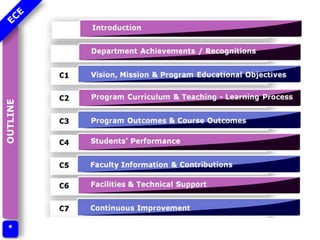
OUTLINE
*
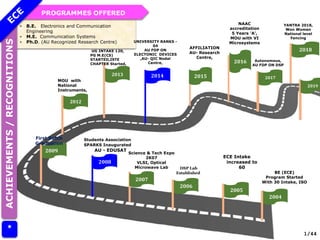
▪ B.E. Electronics and Communication
Engineering
▪ M.E. Communication Systems
▪ Ph.D. (AU Recognized Research Centre)
PROGRAMMES OFFERED
ACHIEVEMENTS
/
RECOGNITIONS
*
2004
BE (ECE)
Program Started
With 30 Intake, ISO
2005
ECE Intake
increased to
60
2006
DSP Lab
Established
2009
First Batch
Graduation
2012
MOU with
National
Instruments,
2015
AFFILIATION
AU- Research
Centre,
2008
Students Association
SPARKS Inaugurated
AU - EDUSAT
2007
Science & Tech Expo
2K07
VLSI, Optical
Microwave Lab
1/44
2014
UNIVERSITY RANKS -
04
AU FDP ON
ELECTONIC DEVICES
,AU- QIC Nodal
Centre, 2016
NAAC
accreditation
5 Years ‘A’,
MOU with VI
Microsystems
2017
Autonomous,
AU FDP ON DSP
2018
2013
UG INTAKE 120,
PG M.E(CS)
STARTED,ISTE
CHAPTER Started,
YANTRA 2018,
Won Women
National level
Fencing
2019
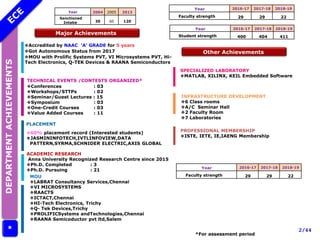
PROFESSIONAL MEMBERSHIP
❖ISTE, IETE, IE,IAENG Membership
ACADEMIC RESEARCH
Anna University Recognized Research Centre since 2015
❖Ph.D. Completed : 3
❖Ph.D. Pursuing : 21
TECHNICAL EVENTS /CONTESTS ORGANIZED*
❖Conferences : 03
❖Workshops/STTPs : 02
❖Seminar/Guest Lectures : 15
❖Symposium : 03
❖One-Credit Courses : 03
❖Value Added Courses : 11
PLACEMENT
❖60% placement record (Interested students)
❖JASMININFOTECH,IVTLINFOVIEW,DATA
PATTERN,SYRMA,SCHNIDER ELECTRIC,AXIS GLOBAL
Year 2004 2005 2013
Sanctioned
Intake 30 60 120
DEPARTMENT
ACHIEVEMENTS
MOU
❖LABRAT Consultancy Services,Chennai
❖VI MICROSYSTEMS
❖RAACTS
❖ICTACT,Chennai
❖HI-Tech Electronics, Trichy
❖Q- Tek Devices,Trichy
❖PROLIFICSystems andTechnologies,Chennai
❖RAANA Semicoductor pvt ltd,Salem
*
SPECIALIZED LABORATORY
❖MATLAB, XILINX, KEIL Embedded Software
INFRASTRUCTURE DEVELOPMENT
❖6 Class rooms
❖A/C Seminar Hall
❖2 Faculty Room
❖7 Laboratories
2/44
*
Year 2016-17 2017-18 2018-19
Student strength 400 404 411
Year 2016-17 2017-18 2018-19
Faculty strength 29 29 22
Major Achievements
Other Achievements
❖Accredited by NAAC ‘A’ GRADE for 5 years
❖Got Autonomous Status from 2017
❖MOU with Prolific Systems PVT, VI Microsystems PVT, Hi-
Tech Electronics, Q-TEK Devices & RAANA Semiconductors
*For assessment period
Year 2016-17 2017-18 2018-19
Faculty strength 29 29 22
Ph.D 03
Ph.D (Pursuing) 21
M.E/M.Tech 05
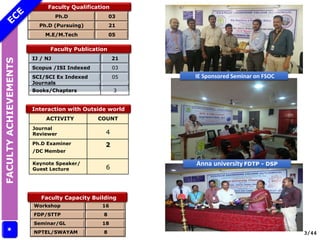
Faculty Qualification
FACULTY
ACHIEVEMENTS
IJ / NJ 21
Scopus /ISI Indexed 03
SCI/SCI Ex Indexed
Journals
05
Books/Chapters 3
ACTIVITY COUNT
Journal
Reviewer 4
Ph.D Examiner
/DC Member
2
Keynote Speaker/
Guest Lecture 6
Workshop 16
FDP/STTP 8
Seminar/GL 18
NPTEL/SWAYAM 8
Awards and Recognition
Faculty Publication
Interaction with Outside world
Faculty Capacity Building
* 3/44
IE Sponsored Seminar on FSOC
Anna university FDTP - DSP
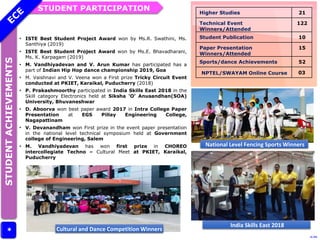
STUDENT PARTICIPATION Higher Studies 21
Technical Event
Winners/Attended
122
Student Publication 10
Paper Presentation
Winners/Attended
15
Sports/dance Achievements 52
NPTEL/SWAYAM Online Course 03
STUDENT
ACHIEVEMENTS
*
4/45
• ISTE Best Student Project Award won by Ms.R. Swathini, Ms.
Santhiya (2019)
• ISTE Best Student Project Award won by Ms.E. Bhavadharani,
Ms. K. Karpagam (2019)
• M. Vandhiyadevan and V. Arun Kumar has participated has a
part of Indian Hip Hop dance championship 2019, Goa
• M. Vaishnavi and V. Veena won a First prize Tricky Circuit Event
conducted at PKIET, Karaikal, Puducherry (2018)
• P. Prakashmoorthy participated in India Skills East 2018 in the
Skill category Electronics held at Siksha ‘O’ Anusandhan(SOA)
University, Bhuvaneshwar
• D. Aboorva won best paper award 2017 in Intra College Paper
Presentation at EGS Pillay Engineering College,
Nagapattinam
• V. Devanandham won First prize in the event paper presentation
in the national level technical symposium held at Government
college of Engineering, Salem
• M. Vandhiyadevan has won first prize in CHOREO
intercollegiate Techno – Cultural Meet at PKIET, Karaikal,
Puducherry
4/44
National Level Fencing Sports Winners
Cultural and Dance Competition Winners
India Skills East 2018
VISION
VISION,
MISSION
&
PEOs
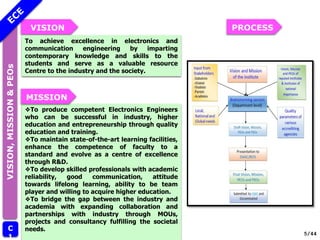
❖To produce competent Electronics Engineers
who can be successful in industry, higher
education and entrepreneurship through quality
education and training.
❖To maintain state-of-the-art learning facilities,
enhance the competence of faculty to a
standard and evolve as a centre of excellence
through R&D.
❖To develop skilled professionals with academic
reliability, good communication, attitude
towards lifelong learning, ability to be team
player and willing to acquire higher education.
❖To bridge the gap between the industry and
academia with expanding collaboration and
partnerships with industry through MOUs,
projects and consultancy fulfilling the societal
needs.
To achieve excellence in electronics and
communication engineering by imparting
contemporary knowledge and skills to the
students and serve as a valuable resource
Centre to the industry and the society.
C
1
MISSION
PROCESS
5/44
VISION,
MISSION
&
PEOs
C
1
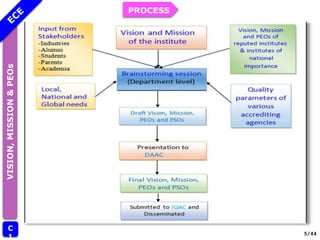
PROCESS
5/44
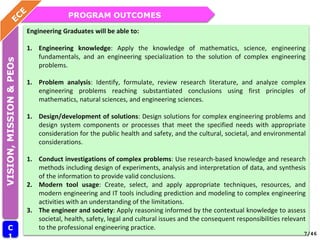
PROGRAM OUTCOMES
VISION,
MISSION
&
PEOs
Engineering Graduates will be able to:
1. Engineering knowledge: Apply the knowledge of mathematics, science, engineering
fundamentals, and an engineering specialization to the solution of complex engineering
problems.
1. Problem analysis: Identify, formulate, review research literature, and analyze complex
engineering problems reaching substantiated conclusions using first principles of
mathematics, natural sciences, and engineering sciences.
1. Design/development of solutions: Design solutions for complex engineering problems and
design system components or processes that meet the specified needs with appropriate
consideration for the public health and safety, and the cultural, societal, and environmental
considerations.
1. Conduct investigations of complex problems: Use research-based knowledge and research
methods including design of experiments, analysis and interpretation of data, and synthesis
of the information to provide valid conclusions.
2. Modern tool usage: Create, select, and apply appropriate techniques, resources, and
modern engineering and IT tools including prediction and modeling to complex engineering
activities with an understanding of the limitations.
3. The engineer and society: Apply reasoning informed by the contextual knowledge to assess
societal, health, safety, legal and cultural issues and the consequent responsibilities relevant
to the professional engineering practice.
C
1 7/46
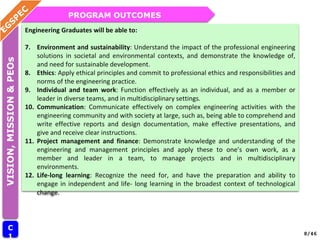
PROGRAM OUTCOMES
VISION,
MISSION
&
PEOs
Engineering Graduates will be able to:
7. Environment and sustainability: Understand the impact of the professional engineering
solutions in societal and environmental contexts, and demonstrate the knowledge of,
and need for sustainable development.
8. Ethics: Apply ethical principles and commit to professional ethics and responsibilities and
norms of the engineering practice.
9. Individual and team work: Function effectively as an individual, and as a member or
leader in diverse teams, and in multidisciplinary settings.
10. Communication: Communicate effectively on complex engineering activities with the
engineering community and with society at large, such as, being able to comprehend and
write effective reports and design documentation, make effective presentations, and
give and receive clear instructions.
11. Project management and finance: Demonstrate knowledge and understanding of the
engineering and management principles and apply these to one’s own work, as a
member and leader in a team, to manage projects and in multidisciplinary
environments.
12. Life-long learning: Recognize the need for, and have the preparation and ability to
engage in independent and life- long learning in the broadest context of technological
change.
C
1 8/46
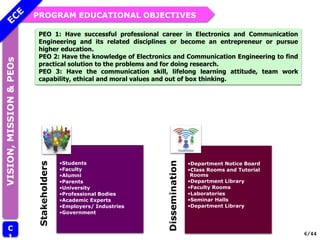
PROGRAM EDUCATIONAL OBJECTIVES
VISION,
MISSION
&
PEOs
PEO 1: Have successful professional career in Electronics and Communication
Engineering and its related disciplines or become an entrepreneur or pursue
higher education.
PEO 2: Have the knowledge of Electronics and Communication Engineering to find
practical solution to the problems and for doing research.
PEO 3: Have the communication skill, lifelong learning attitude, team work
capability, ethical and moral values and out of box thinking.
C
1
Stakeholders
•Students
•Faculty
•Alumni
•Parents
•University
•Professional Bodies
•Academic Experts
•Employers/ Industries
•Government
Dissemination
•Department Notice Board
•Class Rooms and Tutorial
Rooms
•Department Library
•Faculty Rooms
•Laboratories
•Seminar Halls
•Department Library
6/44
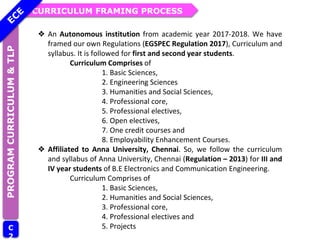
CURRICULUM FRAMING PROCESS
PROGRAM
CURRICULUM
&
TLP
C
2
❖ An Autonomous institution from academic year 2017-2018. We have
framed our own Regulations (EGSPEC Regulation 2017), Curriculum and
syllabus. It is followed for first and second year students.
Curriculum Comprises of
1. Basic Sciences,
2. Engineering Sciences
3. Humanities and Social Sciences,
4. Professional core,
5. Professional electives,
6. Open electives,
7. One credit courses and
8. Employability Enhancement Courses.
❖ Affiliated to Anna University, Chennai. So, we follow the curriculum
and syllabus of Anna University, Chennai (Regulation – 2013) for III and
IV year students of B.E Electronics and Communication Engineering.
Curriculum Comprises of
1. Basic Sciences,
2. Humanities and Social Sciences,
3. Professional core,
4. Professional electives and
5. Projects
Curriculum Gap Identification Process
PROGRAM
CURRICULUM
&
TLP
C
2
Following is the process used to identify extent of compliance of Anna
University curriculum (R-2013) for the attainment of POs and PSOs:
✔ Identification of Course Outcomes for each course
✔ Map each Course Outcome with POs and PSOs
✔ Based on All COs-POs/PSOs mappings, Map courses with POs and PSOs
✔ Categorize entire Anna University Curriculum into Core Courses, Science
& Humanities, Programming, Inter Disciplinary, Projects / Lab Practices
✔ Identify gap from Courses COs Vs POs and PSOs mappings.
✔ Identified gaps are fulfilled by Seminars, value added courses, Industrial
visits, workshops and assignments, etc. We provide additional experiments
in labs, content beyond syllabus, group discussion, guest lectures, etc. Also,
we are organizing Association and Professional societies’ activities, In-
plant trainings, co-curricular and extracurricular activities.
✔ For achieving Course Outcomes, we are using appropriate content delivery
methods and evaluation methods.
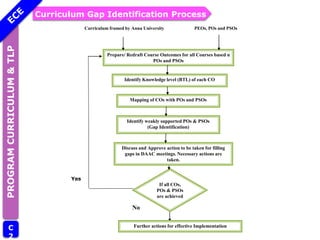
Curriculum Gap Identification Process
PROGRAM
CURRICULUM
&
TLP
C
2
Mapping of COs with POs and PSOs
Identify Knowledge level (BTL) of each CO
Prepare/ Redraft Course Outcomes for all Courses based n
POs and PSOs
If all COs,
POs & PSOs
are achieved
Further actions for effective Implementation
Identify weakly supported POs & PSOs
(Gap Identification)
Discuss and Approve action to be taken for filling
gaps in DAAC meetings. Necessary actions are
taken.
Yes
Curriculum framed by Anna University PEOs, POs and PSOs
No
PROGRAM
CURRICULUM
&
TLP
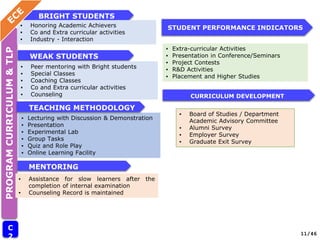
BRIGHT STUDENTS
▪ Honoring Academic Achievers
▪ Co and Extra curricular activities
▪ Industry - Interaction
▪ Assistance for slow learners after the
completion of internal examination
▪ Counseling Record is maintained
MENTORING
▪ Lecturing with Discussion & Demonstration
▪ Presentation
▪ Experimental Lab
▪ Group Tasks
▪ Quiz and Role Play
▪ Online Learning Facility
WEAK STUDENTS
▪ Peer mentoring with Bright students
▪ Special Classes
▪ Coaching Classes
▪ Co and Extra curricular activities
▪ Counseling
TEACHING METHODOLOGY
C
2
CURRICULUM DEVELOPMENT
STUDENT PERFORMANCE INDICATORS
11/46
▪ Extra-curricular Activities
▪ Presentation in Conference/Seminars
▪ Project Contests
▪ R&D Activities
▪ Placement and Higher Studies
▪ Board of Studies / Department
Academic Advisory Committee
▪ Alumni Survey
▪ Employer Survey
▪ Graduate Exit Survey
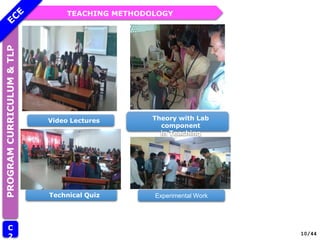
TEACHING METHODOLOGY
PROGRAM
CURRICULUM
&
TLP
Video Lectures
C
2 10/44
Technical Quiz
Theory with Lab
component
in Teaching
Experimental Work
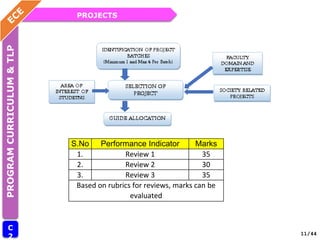
PROJECTS
PROGRAM
CURRICULUM
&
TLP
C
2 11/44
S.No Performance Indicator Marks
1. Review 1 35
2. Review 2 30
3. Review 3 35
Based on rubrics for reviews, marks can be
evaluated
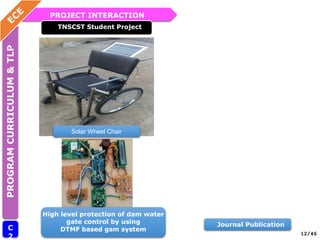
PROJECT INTERACTION
PROGRAM
CURRICULUM
&
TLP
C
2 12/46
TNSCST Student Project
Solar Wheel Chair
High level protection of dam water
gate control by using
DTMF based gsm system
Journal Publication
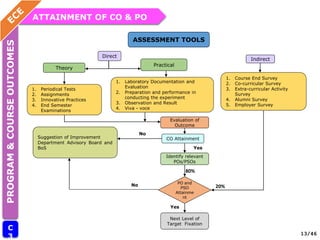
ATTAINMENT OF CO & PO
PROGRAM
&
COURSE
OUTCOMES
C
3 13/46
ASSESSMENT TOOLS
Direct
Indirect
Theory
Practical
1. Periodical Tests
2. Assignments
3. Innovative Practices
4. End Semester
Examinations
1. Laboratory Documentation and
Evaluation
2. Preparation and performance in
conducting the experiment
3. Observation and Result
4. Viva - voce
1. Course End Survey
2. Co-curricular Survey
3. Extra-curricular Activity
Survey
4. Alumni Survey
5. Employer Survey
Evaluation of
Outcome
CO Attainment
Yes
Suggestion of Improvement
Department Advisory Board and
BoS
No
PO and
PSO
Attainme
nt
Identify relevant
POs/PSOs
Next Level of
Target Fixation
Yes
No
80%
20%
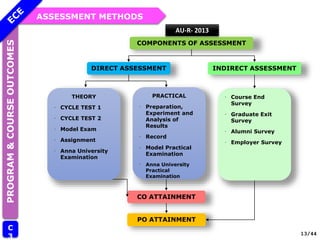
ASSESSMENT METHODS
PROGRAM
&
COURSE
OUTCOMES
C
3
COMPONENTS OF ASSESSMENT
DIRECT ASSESSMENT INDIRECT ASSESSMENT
∙ Course End
Survey
∙ Graduate Exit
Survey
∙ Alumni Survey
∙ Employer Survey
CO ATTAINMENT
PO ATTAINMENT
13/44
THEORY
∙ CYCLE TEST 1
∙ CYCLE TEST 2
∙ Model Exam
∙ Assignment
∙ Anna University
Examination
PRACTICAL
∙ Preparation,
Experiment and
Analysis of
Results
∙ Record
∙ Model Practical
Examination
∙ Anna University
Practical
Examination
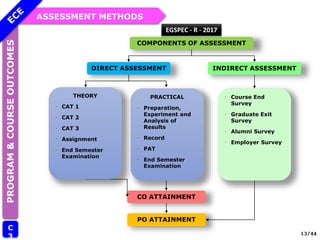
AU-R- 2013
ASSESSMENT METHODS
PROGRAM
&
COURSE
OUTCOMES
C
3
COMPONENTS OF ASSESSMENT
DIRECT ASSESSMENT INDIRECT ASSESSMENT
∙ Course End
Survey
∙ Graduate Exit
Survey
∙ Alumni Survey
∙ Employer Survey
CO ATTAINMENT
PO ATTAINMENT
13/44
THEORY
∙ CAT 1
∙ CAT 2
∙ CAT 3
∙ Assignment
∙ End Semester
Examination
PRACTICAL
∙ Preparation,
Experiment and
Analysis of
Results
∙ Record
∙ PAT
∙ End Semester
Examination
EGSPEC - R - 2017
ATTAINMENT OF CO
PROGRAM
&
COURSE
OUTCOMES
C
3 13/46
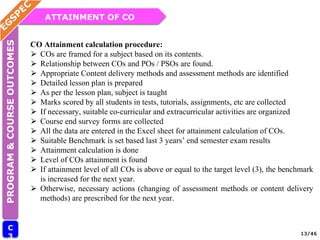
CO Attainment calculation procedure:
⮚ COs are framed for a subject based on its contents.
⮚ Relationship between COs and POs / PSOs are found.
⮚ Appropriate Content delivery methods and assessment methods are identified
⮚ Detailed lesson plan is prepared
⮚ As per the lesson plan, subject is taught
⮚ Marks scored by all students in tests, tutorials, assignments, etc are collected
⮚ If necessary, suitable co-curricular and extracurricular activities are organized
⮚ Course end survey forms are collected
⮚ All the data are entered in the Excel sheet for attainment calculation of COs.
⮚ Suitable Benchmark is set based last 3 years’ end semester exam results
⮚ Attainment calculation is done
⮚ Level of COs attainment is found
⮚ If attainment level of all COs is above or equal to the target level (3), the benchmark
is increased for the next year.
⮚ Otherwise, necessary actions (changing of assessment methods or content delivery
methods) are prescribed for the next year.
SAMPLE ASSESSMENT
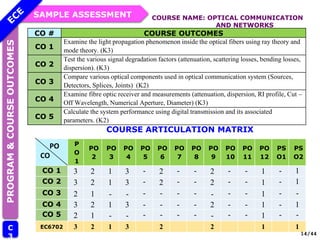
CO # COURSE OUTCOMES
CO 1
Examine the light propagation phenomenon inside the optical fibers using ray theory and
mode theory. (K3)
CO 2
Test the various signal degradation factors (attenuation, scattering losses, bending losses,
dispersion). (K3)
CO 3
Compare various optical components used in optical communication system (Sources,
Detectors, Splices, Joints) (K2)
CO 4
Examine fibre optic receiver and measurements (attenuation, dispersion, RI profile, Cut –
Off Wavelength, Numerical Aperture, Diameter) (K3)
CO 5
Calculate the system performance using digital transmission and its associated
parameters. (K2)
P
O
1
PO
2
PO
3
PO
4
PO
5
PO
6
PO
7
PO
8
PO
9
PO
10
PO
11
PO
12
PS
O1
PS
O2
CO 1 3 2 1 3 - 2 - - 2 - - 1 - 1
CO 2 3 2 1 3 - 2 - - 2 - - 1 - 1
CO 3 2 1 - - - - - - - - - 1 - -
CO 4 3 2 1 3 - - - - 2 - - 1 - 1
CO 5 2 1 - - - - - - - - - 1 - -
EC6702 3 2 1 3 2 2 1 1
COURSE ARTICULATION MATRIX
PROGRAM
&
COURSE
OUTCOMES
C
3
COURSE NAME: OPTICAL COMMUNICATION
AND NETWORKS
CO
PO
14/44
SAMPLE ASSESSMENT
PROGRAM
&
COURSE
OUTCOMES
I
T
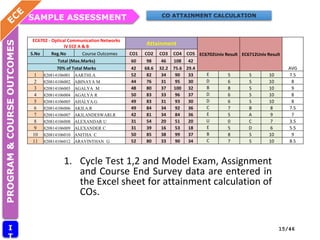
CO ATTAINMENT CALCULATION
1. Cycle Test 1,2 and Model Exam, Assignment
and Course End Survey data are entered in
the Excel sheet for attainment calculation of
COs.
15/46
EC6702 - Optical Communication Networks
IV ECE A & B
Attainment
EC6702Univ Result EC6712Univ Result
AVG
S.No Reg.No Course Outcomes CO1 CO2 CO3 CO4 CO5
Total (Max.Marks) 60 98 46 108 42
70% of Total Marks 42 68.6 32.2 75.6 29.4
1 820814106001 AARTHI.A 52 82 34 90 33 E 5 S 10 7.5
2 820814106002 ABINAYA M 44 76 31 95 30 D 6 S 10 8
3 820814106003 AGALYA M 48 80 37 100 32 B 8 S 10 9
4 820814106004 AGALYA R 50 83 33 96 37 D 6 S 10 8
5 820814106005 AHALYA.G 49 83 31 93 30 D 6 S 10 8
6 820814106006 AKILA.R 49 84 34 92 36 C 7 B 8 7.5
7 820814106007 AKILANDESWARI.R 42 81 34 84 36 E 5 A 9 7
8 820814106008 ALEXANDAR U 31 54 20 51 20 U 0 C 7 3.5
9 820814106009 ALEXANDER C 31 39 16 53 18 E 5 D 6 5.5
10 820814106010 ANITHA C 50 85 38 99 37 B 8 S 10 9
11 820814106012 ARAVINTHAN G 52 80 33 90 34 C 7 S 10 8.5
SAMPLE ASSESSMENT
PROGRAM
&
COURSE
OUTCOMES
I
T
CO ATTAINMENT CALCULATION
15/46
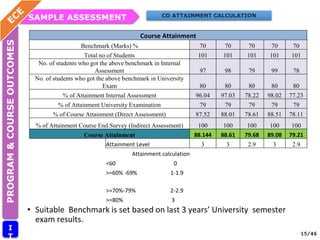
• Suitable Benchmark is set based on last 3 years’ University semester
exam results.
Course Attainment
Benchmark (Marks) % 70 70 70 70 70
Total no of Students 101 101 101 101 101
No. of students who got the above benchmark in Internal
Assessment 97 98 79 99 78
No. of students who got the above benchmark in University
Exam 80 80 80 80 80
% of Attainment Internal Assessment 96.04 97.03 78.22 98.02 77.23
% of Attainment University Examination 79 79 79 79 79
% of Course Attainment (Direct Assessment) 87.52 88.01 78.61 88.51 78.11
% of Attainment Course End Survey (Indirect Assessment) 100 100 100 100 100
Course Attainment 88.144 88.61 79.68 89.08 79.21
Attainment Level 3 3 2.9 3 2.9
Attainment calculation
<60 0
>=60% -69% 1-1.9
>=70%-79% 2-2.9
>=80% 3
PO ATTAINMENT
PROGRAM
&
COURSE
OUTCOMES
C
3 17/46
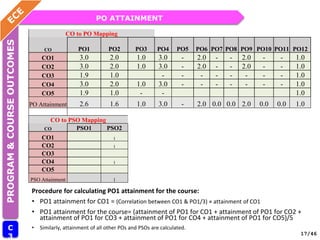
Procedure for calculating PO1 attainment for the course:
• PO1 attainment for CO1 = (Correlation between CO1 & PO1/3) × attainment of CO1
• PO1 attainment for the course= (attainment of PO1 for CO1 + attainment of PO1 for CO2 +
attainment of PO1 for CO3 + attainment of PO1 for CO4 + attainment of PO1 for CO5)/5
• Similarly, attainment of all other POs and PSOs are calculated.
CO to PO Mapping
CO PO1 PO2 PO3 PO4 PO5 PO6 PO7 PO8 PO9 PO10 PO11 PO12
CO1 3.0 2.0 1.0 3.0 - 2.0 - - 2.0 - - 1.0
CO2 3.0 2.0 1.0 3.0 - 2.0 - - 2.0 - - 1.0
CO3 1.9 1.0 - - - - - - - - 1.0
CO4 3.0 2.0 1.0 3.0 - - - - - - - 1.0
CO5 1.9 1.0 - - 1.0
PO Attainment 2.6 1.6 1.0 3.0 - 2.0 0.0 0.0 2.0 0.0 0.0 1.0
CO to PSO Mapping
CO PSO1 PSO2
CO1 1
CO2 1
CO3
CO4 1
CO5
PSO Attainment 1
PO & PSO ATTAINMENT
PROGRAM
&
COURSE
OUTCOMES
C
3 18/46
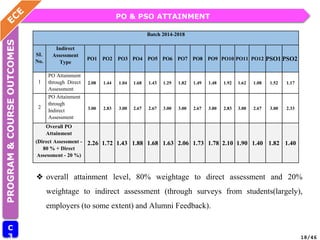
Batch 2014-2018
SI.
No.
Indirect
Assessment
Type
PO1 PO2 PO3 PO4 PO5 PO6 PO7 PO8 PO9 PO10 PO11 PO12 PSO1 PSO2
1
PO Attainment
through Direct
Assessment
2.08 1.44 1.04 1.68 1.43 1.29 1.82 1.49 1.48 1.92 1.62 1.08 1.52 1.17
2
PO Attainment
through
Indirect
Assessment
3.00 2.83 3.00 2.67 2.67 3.00 3.00 2.67 3.00 2.83 3.00 2.67 3.00 2.33
Overall PO
Attainment
(Direct Assessment -
80 % + Direct
Assessment - 20 %)
2.26 1.72 1.43 1.88 1.68 1.63 2.06 1.73 1.78 2.10 1.90 1.40 1.82 1.40
❖ overall attainment level, 80% weightage to direct assessment and 20%
weightage to indirect assessment (through surveys from students(largely),
employers (to some extent) and Alumni Feedback).
ENROLLMENT RATIO
STUDENTS’
PERFORMANCE
C
4
SUCCESS RATE WITHOUT BACKLOG
19/44
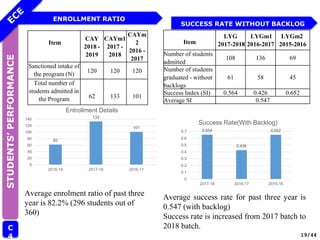
Average enrolment ratio of past three
year is 82.2% (296 students out of
360)
Average success rate for past three year is
0.547 (with backlog)
Success rate is increased from 2017 batch to
2018 batch.
0.654
0.426
0.652
0
0.1
0.2
0.3
0.4
0.5
0.6
0.7
2017-18 2016-17 2015-16
Success Rate(With Backlog)
62
133
101
0
20
40
60
80
100
120
140
2018-19 2017-18 2016-17
Entrollment Details
Item
CAY
2018 -
2019
CAYm1
2017 -
2018
CAYm
2
2016 -
2017
Sanctioned intake of
the program (N)
120 120 120
Total number of
students admitted in
the Program 62 133 101
Item
LYG
2017-2018
LYGm1
2016-2017
LYGm2
2015-2016
Number of students
admitted
108 136 69
Number of students
graduated - without
backlogs
61 58 45
Success Index (SI) 0.564 0.426 0.652
Average SI 0.547
STUDENTS’
PERFORMANCE
C
4
SUCCESS RATE WITH BACKLOGS ACADEMIC PERFORMANCE IN III YEAR
19/44
Average success rate for past three year
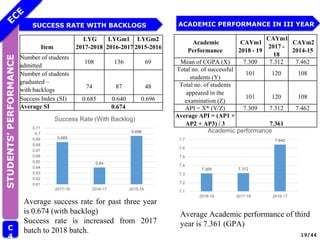
is 0.674 (with backlog)
Success rate is increased from 2017
batch to 2018 batch.
0.685
0.64
0.696
0.61
0.62
0.63
0.64
0.65
0.66
0.67
0.68
0.69
0.7
0.71
2017-18 2016-17 2015-16
Success Rate (With Backlog)
7.309 7.312
7.642
7.1
7.2
7.3
7.4
7.5
7.6
7.7
2018-19 2017-18 2016-17
Academic performance
Average Academic performance of third
year is 7.361 (GPA)
Item
LYG
2017-2018
LYGm1
2016-2017
LYGm2
2015-2016
Number of students
admitted
108 136 69
Number of students
graduated –
with backlogs
74 87 48
Success Index (SI) 0.685 0.640 0.696
Average SI 0.674
Academic
Performance
CAYm1
2018 - 19
CAYm1
2017 -
18
CAYm2
2014-15
Mean of CGPA (X) 7.309 7.312 7.462
Total no. of successful
students (Y)
101 120 108
Total no. of students
appeared in the
examination (Z)
101 120 108
API = X* (Y/Z) 7.309 7.312 7.462
Average API = (AP1 +
AP2 + AP3) / 3 7.361
PLACEMENT, HIGHER STUDIES AND ENTREPRENEURSHIP
STUDENTS’
PERFORMANCE
C
4 20/44
MAJOR RECRUITERS
HIGHER STUDIES
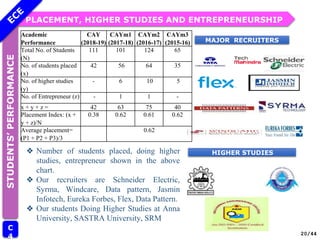
❖ Number of students placed, doing higher
studies, entrepreneur shown in the above
chart.
❖ Our recruiters are Schneider Electric,
Syrma, Windcare, Data pattern, Jasmin
Infotech, Eureka Forbes, Flex, Data Pattern.
❖ Our students Doing Higher Studies at Anna
University, SASTRA University, SRM
Academic
Performance
CAY
(2018-19)
CAYm1
(2017-18)
CAYm2
(2016-17)
CAYm3
(2015-16)
Total No. of Students
(N)
111 101 124 65
No. of students placed
(x)
42 56 64 35
No. of higher studies
(y)
- 6 10 5
No. of Entrepreneur (z) - 1 1 -
x + y + z = 42 63 75 40
Placement Index: (x +
y + z)/N
0.38 0.62 0.61 0.62
Average placement=
(P1 + P2 + P3)/3
0.62
PROFESSIONAL ACTIVITIES
STUDENTS’
PERFORMANCE
C
4
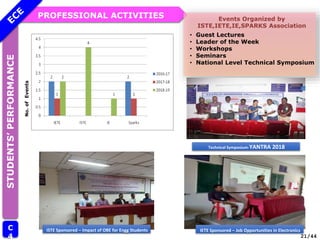
Events Organized by
ISTE,IETE,IE,SPARKS Association
• Guest Lectures
• Leader of the Week
• Workshops
• Seminars
• National Level Technical Symposium
No
.
of
Events
21/44
Technical Symposium-YANTRA 2018
IETE Sponsored – Job Opportunities in Electronics
ISTE Sponsored – Impact of OBE for Engg Students
PROFESSIONAL ACTIVITIES
STUDENTS’
PERFORMANCE
C
4
Events Organized by
ISTE,IETE,IE,SPARKS
• Guest Lectures
• Leader of the Week
• Workshops
• Seminars
• National Level Technical Symposium
21/44
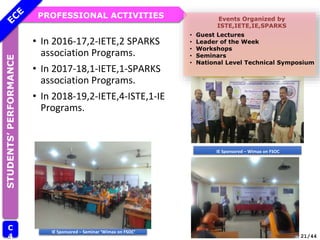
• In 2016-17,2-IETE,2 SPARKS
association Programs.
• In 2017-18,1-IETE,1-SPARKS
association Programs.
• In 2018-19,2-IETE,4-ISTE,1-IE
Programs.
IE Sponsored – Wimax on FSOC
IE Sponsored – Seminar ‘Wimax on FSOC’
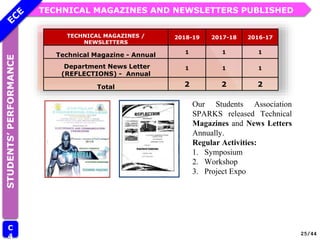
TECHNICAL MAGAZINES AND NEWSLETTERS PUBLISHED
STUDENTS’
PERFORMANCE
C
4 25/44
TECHNICAL MAGAZINES /
NEWSLETTERS
2018-19 2017-18 2016-17
Technical Magazine - Annual 1 1 1
Department News Letter
(REFLECTIONS) - Annual
1 1 1
Total 2 2 2
Our Students Association
SPARKS released Technical
Magazines and News Letters
Annually.
Regular Activities:
1. Symposium
2. Workshop
3. Project Expo
Ph.D: 21 M.E/M.Tech: 49
FACULTY
INFORMATION
&
CONTRIBUTION
C5
Faculty Cadre
Faculty Retention
Faculty Qualification Ph.D : 04 M.E/M.Tech: 18 26/44
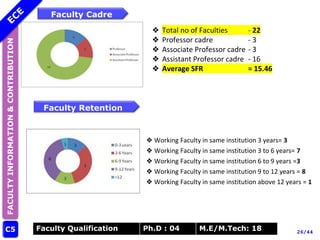
❖ Total no of Faculties - 22
❖ Professor cadre - 3
❖ Associate Professor cadre - 3
❖ Assistant Professor cadre - 16
❖ Average SFR = 15.46
❖ Working Faculty in same institution 3 years= 3
❖ Working Faculty in same institution 3 to 6 years= 7
❖ Working Faculty in same institution 6 to 9 years =3
❖ Working Faculty in same institution 9 to 12 years = 8
❖ Working Faculty in same institution above 12 years = 1
Ph.D: 21 M.E/M.Tech: 49
FACULTY
INFORMATION
&
CONTRIBUTION
C5
Faculty Experience
Domain wise faculty
Faculty Qualification Ph.D : 04 M.E/M.Tech: 18 26/44
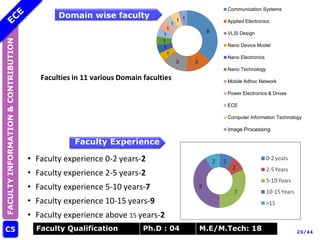
• Faculty experience 0-2 years-2
• Faculty experience 2-5 years-2
• Faculty experience 5-10 years-7
• Faculty experience 10-15 years-9
• Faculty experience above 15 years-2
Faculties in 11 various Domain faculties
8
3
3
1
1
1
1
1
1
1 1
Communication Systems
Applied Electronics
VLSI Design
Nano Device Model
Nano Electronics
Nano Technology
Mobile Adhoc Network
Power Electronics & Drives
ECE
Computer Information Technology
Image Processing
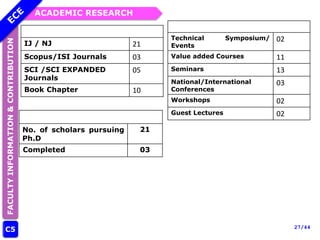
ACADEMIC RESEARCH
FACULTY
INFORMATION
&
CONTRIBUTION
C5
Programs Organized
Faculty Publications
27/44
Faculty Publications
IJ / NJ 21
Scopus/ISI Journals 03
SCI /SCI EXPANDED
Journals
05
Book Chapter 10
Ph.D Details
No. of scholars pursuing
Ph.D
21
Completed 03
Program Organized
Technical Symposium/
Events
02
Value added Courses 11
Seminars 13
National/International
Conferences
03
Workshops 02
Guest Lectures 02
FACULTY
INFORMATION
&
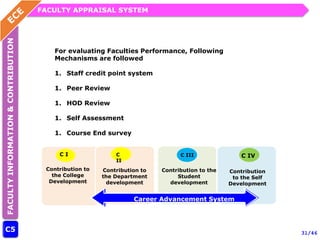
CONTRIBUTION FACULTY APPRAISAL SYSTEM
C5 31/46
C I
Contribution to
the College
Development
Career Advancement System
C
II
C III C IV
Contribution to
the Department
development
Contribution
to the Self
Development
Contribution to the
Student
development
For evaluating Faculties Performance, Following
Mechanisms are followed
1. Staff credit point system
1. Peer Review
1. HOD Review
1. Self Assessment
1. Course End survey
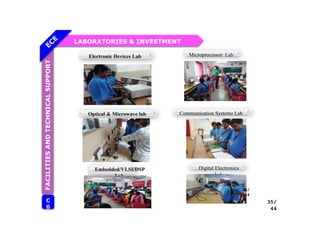
LABORATORIES & INVESTMENT
FACILITIES
AND
TECHNICAL
SUPPORT
C
6
35/
44
:
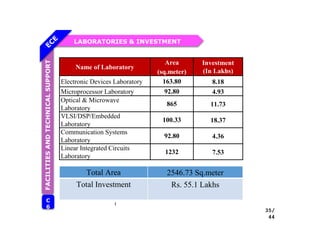
Name of Laboratory
Area
(sq.meter)
Investment
(In Lakhs)
Electronic Devices Laboratory 163.80 8.18
Microprocessor Laboratory 92.80 4.93
Optical & Microwave
Laboratory
865 11.73
VLSI/DSP/Embedded
Laboratory
100.33 18.37
Communication Systems
Laboratory
92.80 4.36
Linear Integrated Circuits
Laboratory
1232 7.53
Total Area 2546.73 Sq.meter
Total Investment Rs. 55.1 Lakhs
LABORATORIES & INVESTMENT
FACILITIES
AND
TECHNICAL
SUPPORT
C
6
35/
44
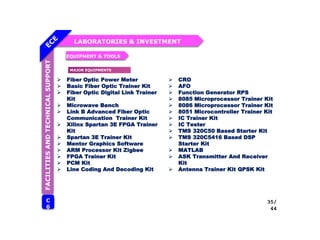
EQUIPMENT & TOOLS
MAJOR EQUIPMENTS
36/
44
⮚ Fiber Optic Power Meter
⮚ Basic Fiber Optic Trainer Kit
⮚ Fiber Optic Digital Link Trainer
Kit
⮚ Microwave Bench
⮚ Link B Advanced Fiber Optic
Communication Trainer Kit
⮚ Xilinx Spartan 3E FPGA Trainer
Kit
⮚ Spartan 3E Trainer Kit
⮚ Mentor Graphics Software
⮚ ARM Processor Kit Zigbee
⮚ FPGA Trainer Kit
⮚ PCM Kit
⮚ Line Coding And Decoding Kit
⮚ CRO
⮚ AFO
⮚ Function Generator RPS
⮚ 8085 Microprocessor Trainer Kit
⮚ 8086 Microprocessor Trainer Kit
⮚ 8051 Microcontroller Trainer Kit
⮚ IC Trainer Kit
⮚ IC Tester
⮚ TMS 320C50 Based Starter Kit
⮚ TMS 320C5416 Based DSP
Starter Kit
⮚ MATLAB
⮚ ASK Transmitter And Receiver
Kit
⮚ Antenna Trainer Kit QPSK Kit
LABORATORIES & INVESTMENT
FACILITIES
AND
TECHNICAL
SUPPORT
C
6
35/
44
36/
44
Communication Systems Lab
Digital Electronics
Lab
Embedded/VLSI/DSP
Lab
Electronic Devices Lab
Optical & Microwave lab
Microprocessor Lab
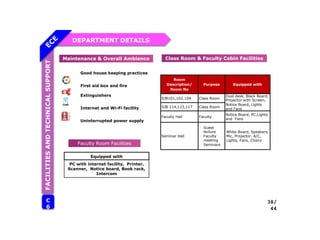
DEPARTMENT DETAILS
FACILITIES
AND
TECHNICAL
SUPPORT
C
6
38/
44
Good house keeping practices
First aid box and fire
Extinguishers
Internet and Wi-Fi facility
Uninterrupted power supply
Maintenance & Overall Ambience
Equipped with
PC with internet facility, Printer,
Scanner, Notice board, Book rack,
Intercom
Faculty Room Facilities
Room
Description/
Room No
Purpose Equipped with
SJB101,102,104 Class Room
Dual desk, Black Board,
Projector with Screen,
Notice Board, Lights
and Fans
SJB 114,115,117 Class Room
Faculty Hall Faculty
Notice Board, PC,Lights
and Fans
Seminar Hall
∙ Guest
lecture
∙ Faculty
meeting
∙ Seminars
White Board, Speakers,
Mic, Projector, A/C,
Lights, Fans, Chairs
Class Room & Faculty Cabin Facilities
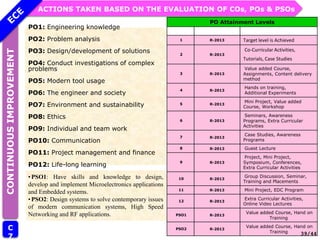
PO Attainment Levels
POs Curriculum Attainment/Action Taken
1 R-2013 Target level is Achieved
2 R-2013
Co-Curricular Activities,
Tutorials, Case Studies
3 R-2013
Value added Course,
Assignments, Content delivery
method
4 R-2013
Hands on training,
Additional Experiments
5 R-2013
Mini Project, Value added
Course, Workshop
6 R-2013
Seminars, Awareness
Programs, Extra Curricular
Activities
7 R-2013
Case Studies, Awareness
Programs
8 R-2013 Guest Lecture
9 R-2013
Project, Mini Project,
Symposium, Conferences,
Extra Curricular Activities
10 R-2013
Group Discussion, Seminar,
Training and Placements
11 R-2013 Mini Project, EDC Program
12 R-2013
Extra Curricular Activities,
Online Video Lectures
PSO1 R-2013
Value added Course, Hand on
Training
PSO2 R-2013
Value added Course, Hand on
Training
ACTIONS TAKEN BASED ON THE EVALUATION OF COs, POs & PSOs
CONTINUOUS
IMPROVEMENT
C
7
PO1: Engineering knowledge
PO2: Problem analysis
PO3: Design/development of solutions
PO4: Conduct investigations of complex
problems
PO5: Modern tool usage
PO6: The engineer and society
PO7: Environment and sustainability
PO8: Ethics
PO9: Individual and team work
PO10: Communication
PO11: Project management and finance
PO12: Life-long learning
39/44
•PSO1: Have skills and knowledge to design,
develop and implement Microelectronics applications
and Embedded systems.
•PSO2: Design systems to solve contemporary issues
of modern communication systems, High Speed
Networking and RF applications.
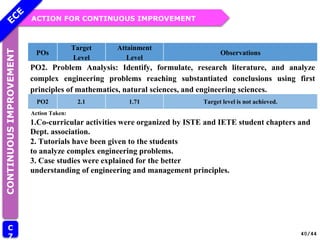
ACTION FOR CONTINUOUS IMPROVEMENT
POs
Target
Level
Attainment
Level
Observations
PO2. Problem Analysis: Identify, formulate, research literature, and analyze
complex engineering problems reaching substantiated conclusions using first
principles of mathematics, natural sciences, and engineering sciences.
PO2 2.1 1.71 Target level is not achieved.
Action Taken:
1.Co-curricular activities were organized by ISTE and IETE student chapters and
Dept. association.
2. Tutorials have been given to the students
to analyze complex engineering problems.
3. Case studies were explained for the better
understanding of engineering and management principles.
CONTINUOUS
IMPROVEMENT
C
7 40/44
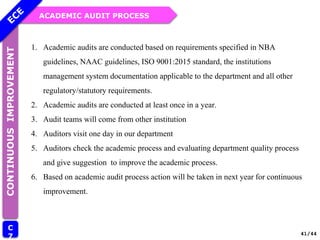
ACADEMIC AUDIT PROCESS
CONTINUOUS
IMPROVEMENT
C
7 41/44
1. Academic audits are conducted based on requirements specified in NBA
guidelines, NAAC guidelines, ISO 9001:2015 standard, the institutions
management system documentation applicable to the department and all other
regulatory/statutory requirements.
2. Academic audits are conducted at least once in a year.
3. Audit teams will come from other institution
4. Auditors visit one day in our department
5. Auditors check the academic process and evaluating department quality process
and give suggestion to improve the academic process.
6. Based on academic audit process action will be taken in next year for continuous
improvement.
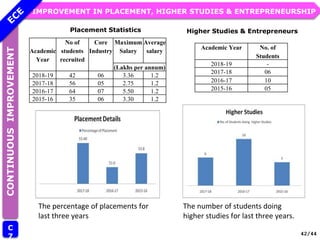
IMPROVEMENT IN PLACEMENT, HIGHER STUDIES & ENTREPRENEURSHIP
CONTINUOUS
IMPROVEMENT
C
7
Placement Statistics Higher Studies & Entrepreneurs
42/44
The percentage of placements for
last three years
The number of students doing
higher studies for last three years.
Academic
Year
No of
students
recruited
Core
Industry
Maximum
Salary
Average
salary
(Lakhs per annum)
2018-19 42 06 3.36 1.2
2017-18 56 05 2.75 1.2
2016-17 64 07 5.50 1.2
2015-16 35 06 3.30 1.2
Academic Year No. of
Students
2018-19 -
2017-18 06
2016-17 10
2015-16 05
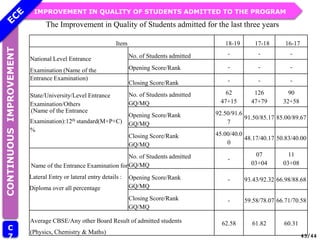
IMPROVEMENT IN QUALITY OF STUDENTS ADMITTED TO THE PROGRAM
CONTINUOUS
IMPROVEMENT
C
7 43/44
The Improvement in Quality of Students admitted for the last three years
Item 18-19 17-18 16-17
National Level Entrance
Examination (Name of the
No. of Students admitted - - -
Opening Score/Rank - - -
Entrance Examination)
Closing Score/Rank - - -
State/University/Level Entrance
Examination/Others
(Name of the Entrance
Examination):12th standard(M+P+C)
%
No. of Students admitted
GQ/MQ
62
47+15
126
47+79
90
32+58
Opening Score/Rank
GQ/MQ
92.50/91.6
7
91.50/85.17 85.00/89.67
Closing Score/Rank
GQ/MQ
45.00/40.0
0
48.17/40.17 50.83/40.00
Name of the Entrance Examination for
Lateral Entry or lateral entry details :
Diploma over all percentage
No. of Students admitted
GQ/MQ
-
07
03+04
11
03+08
Opening Score/Rank
GQ/MQ
- 93.43/92.32 66.98/88.68
Closing Score/Rank
GQ/MQ
- 59.58/78.07 66.71/70.58
Average CBSE/Any other Board Result of admitted students
(Physics, Chemistry & Maths)
62.58 61.82 60.31
Thank
You

ECE NBA presentation for NBA Visit 2021.pptx

  • 1.
    Hearty Welcome toExpert Members of DEPARTMENT OF ELECTRONICS AND COMMUNICATION ENGINEERING E.G.S. PILLAY ENGINEERING COLLEGE (An Autonomous Institution, Affiliated to Anna University, Chennai) Nagore Post, Nagapattinam – 611 002, Tamilnadu. Department of Electronics and Communication Engineering 12 - 14 JULY 2019 National Board of Accreditation Committee Presented by Dr. B. Padmanaban Professor & Head/ECE
  • 2.
  • 3.
    ▪ B.E. Electronicsand Communication Engineering ▪ M.E. Communication Systems ▪ Ph.D. (AU Recognized Research Centre) PROGRAMMES OFFERED ACHIEVEMENTS / RECOGNITIONS * 2004 BE (ECE) Program Started With 30 Intake, ISO 2005 ECE Intake increased to 60 2006 DSP Lab Established 2009 First Batch Graduation 2012 MOU with National Instruments, 2015 AFFILIATION AU- Research Centre, 2008 Students Association SPARKS Inaugurated AU - EDUSAT 2007 Science & Tech Expo 2K07 VLSI, Optical Microwave Lab 1/44 2014 UNIVERSITY RANKS - 04 AU FDP ON ELECTONIC DEVICES ,AU- QIC Nodal Centre, 2016 NAAC accreditation 5 Years ‘A’, MOU with VI Microsystems 2017 Autonomous, AU FDP ON DSP 2018 2013 UG INTAKE 120, PG M.E(CS) STARTED,ISTE CHAPTER Started, YANTRA 2018, Won Women National level Fencing 2019
  • 4.
    PROFESSIONAL MEMBERSHIP ❖ISTE, IETE,IE,IAENG Membership ACADEMIC RESEARCH Anna University Recognized Research Centre since 2015 ❖Ph.D. Completed : 3 ❖Ph.D. Pursuing : 21 TECHNICAL EVENTS /CONTESTS ORGANIZED* ❖Conferences : 03 ❖Workshops/STTPs : 02 ❖Seminar/Guest Lectures : 15 ❖Symposium : 03 ❖One-Credit Courses : 03 ❖Value Added Courses : 11 PLACEMENT ❖60% placement record (Interested students) ❖JASMININFOTECH,IVTLINFOVIEW,DATA PATTERN,SYRMA,SCHNIDER ELECTRIC,AXIS GLOBAL Year 2004 2005 2013 Sanctioned Intake 30 60 120 DEPARTMENT ACHIEVEMENTS MOU ❖LABRAT Consultancy Services,Chennai ❖VI MICROSYSTEMS ❖RAACTS ❖ICTACT,Chennai ❖HI-Tech Electronics, Trichy ❖Q- Tek Devices,Trichy ❖PROLIFICSystems andTechnologies,Chennai ❖RAANA Semicoductor pvt ltd,Salem * SPECIALIZED LABORATORY ❖MATLAB, XILINX, KEIL Embedded Software INFRASTRUCTURE DEVELOPMENT ❖6 Class rooms ❖A/C Seminar Hall ❖2 Faculty Room ❖7 Laboratories 2/44 * Year 2016-17 2017-18 2018-19 Student strength 400 404 411 Year 2016-17 2017-18 2018-19 Faculty strength 29 29 22 Major Achievements Other Achievements ❖Accredited by NAAC ‘A’ GRADE for 5 years ❖Got Autonomous Status from 2017 ❖MOU with Prolific Systems PVT, VI Microsystems PVT, Hi- Tech Electronics, Q-TEK Devices & RAANA Semiconductors *For assessment period Year 2016-17 2017-18 2018-19 Faculty strength 29 29 22
  • 5.
    Ph.D 03 Ph.D (Pursuing)21 M.E/M.Tech 05 Faculty Qualification FACULTY ACHIEVEMENTS IJ / NJ 21 Scopus /ISI Indexed 03 SCI/SCI Ex Indexed Journals 05 Books/Chapters 3 ACTIVITY COUNT Journal Reviewer 4 Ph.D Examiner /DC Member 2 Keynote Speaker/ Guest Lecture 6 Workshop 16 FDP/STTP 8 Seminar/GL 18 NPTEL/SWAYAM 8 Awards and Recognition Faculty Publication Interaction with Outside world Faculty Capacity Building * 3/44 IE Sponsored Seminar on FSOC Anna university FDTP - DSP
  • 6.
    STUDENT PARTICIPATION HigherStudies 21 Technical Event Winners/Attended 122 Student Publication 10 Paper Presentation Winners/Attended 15 Sports/dance Achievements 52 NPTEL/SWAYAM Online Course 03 STUDENT ACHIEVEMENTS * 4/45 • ISTE Best Student Project Award won by Ms.R. Swathini, Ms. Santhiya (2019) • ISTE Best Student Project Award won by Ms.E. Bhavadharani, Ms. K. Karpagam (2019) • M. Vandhiyadevan and V. Arun Kumar has participated has a part of Indian Hip Hop dance championship 2019, Goa • M. Vaishnavi and V. Veena won a First prize Tricky Circuit Event conducted at PKIET, Karaikal, Puducherry (2018) • P. Prakashmoorthy participated in India Skills East 2018 in the Skill category Electronics held at Siksha ‘O’ Anusandhan(SOA) University, Bhuvaneshwar • D. Aboorva won best paper award 2017 in Intra College Paper Presentation at EGS Pillay Engineering College, Nagapattinam • V. Devanandham won First prize in the event paper presentation in the national level technical symposium held at Government college of Engineering, Salem • M. Vandhiyadevan has won first prize in CHOREO intercollegiate Techno – Cultural Meet at PKIET, Karaikal, Puducherry 4/44 National Level Fencing Sports Winners Cultural and Dance Competition Winners India Skills East 2018
  • 7.
    VISION VISION, MISSION & PEOs ❖To produce competentElectronics Engineers who can be successful in industry, higher education and entrepreneurship through quality education and training. ❖To maintain state-of-the-art learning facilities, enhance the competence of faculty to a standard and evolve as a centre of excellence through R&D. ❖To develop skilled professionals with academic reliability, good communication, attitude towards lifelong learning, ability to be team player and willing to acquire higher education. ❖To bridge the gap between the industry and academia with expanding collaboration and partnerships with industry through MOUs, projects and consultancy fulfilling the societal needs. To achieve excellence in electronics and communication engineering by imparting contemporary knowledge and skills to the students and serve as a valuable resource Centre to the industry and the society. C 1 MISSION PROCESS 5/44
  • 8.
  • 9.
    PROGRAM OUTCOMES VISION, MISSION & PEOs Engineering Graduateswill be able to: 1. Engineering knowledge: Apply the knowledge of mathematics, science, engineering fundamentals, and an engineering specialization to the solution of complex engineering problems. 1. Problem analysis: Identify, formulate, review research literature, and analyze complex engineering problems reaching substantiated conclusions using first principles of mathematics, natural sciences, and engineering sciences. 1. Design/development of solutions: Design solutions for complex engineering problems and design system components or processes that meet the specified needs with appropriate consideration for the public health and safety, and the cultural, societal, and environmental considerations. 1. Conduct investigations of complex problems: Use research-based knowledge and research methods including design of experiments, analysis and interpretation of data, and synthesis of the information to provide valid conclusions. 2. Modern tool usage: Create, select, and apply appropriate techniques, resources, and modern engineering and IT tools including prediction and modeling to complex engineering activities with an understanding of the limitations. 3. The engineer and society: Apply reasoning informed by the contextual knowledge to assess societal, health, safety, legal and cultural issues and the consequent responsibilities relevant to the professional engineering practice. C 1 7/46
  • 10.
    PROGRAM OUTCOMES VISION, MISSION & PEOs Engineering Graduateswill be able to: 7. Environment and sustainability: Understand the impact of the professional engineering solutions in societal and environmental contexts, and demonstrate the knowledge of, and need for sustainable development. 8. Ethics: Apply ethical principles and commit to professional ethics and responsibilities and norms of the engineering practice. 9. Individual and team work: Function effectively as an individual, and as a member or leader in diverse teams, and in multidisciplinary settings. 10. Communication: Communicate effectively on complex engineering activities with the engineering community and with society at large, such as, being able to comprehend and write effective reports and design documentation, make effective presentations, and give and receive clear instructions. 11. Project management and finance: Demonstrate knowledge and understanding of the engineering and management principles and apply these to one’s own work, as a member and leader in a team, to manage projects and in multidisciplinary environments. 12. Life-long learning: Recognize the need for, and have the preparation and ability to engage in independent and life- long learning in the broadest context of technological change. C 1 8/46
  • 11.
    PROGRAM EDUCATIONAL OBJECTIVES VISION, MISSION & PEOs PEO1: Have successful professional career in Electronics and Communication Engineering and its related disciplines or become an entrepreneur or pursue higher education. PEO 2: Have the knowledge of Electronics and Communication Engineering to find practical solution to the problems and for doing research. PEO 3: Have the communication skill, lifelong learning attitude, team work capability, ethical and moral values and out of box thinking. C 1 Stakeholders •Students •Faculty •Alumni •Parents •University •Professional Bodies •Academic Experts •Employers/ Industries •Government Dissemination •Department Notice Board •Class Rooms and Tutorial Rooms •Department Library •Faculty Rooms •Laboratories •Seminar Halls •Department Library 6/44
  • 12.
    CURRICULUM FRAMING PROCESS PROGRAM CURRICULUM & TLP C 2 ❖An Autonomous institution from academic year 2017-2018. We have framed our own Regulations (EGSPEC Regulation 2017), Curriculum and syllabus. It is followed for first and second year students. Curriculum Comprises of 1. Basic Sciences, 2. Engineering Sciences 3. Humanities and Social Sciences, 4. Professional core, 5. Professional electives, 6. Open electives, 7. One credit courses and 8. Employability Enhancement Courses. ❖ Affiliated to Anna University, Chennai. So, we follow the curriculum and syllabus of Anna University, Chennai (Regulation – 2013) for III and IV year students of B.E Electronics and Communication Engineering. Curriculum Comprises of 1. Basic Sciences, 2. Humanities and Social Sciences, 3. Professional core, 4. Professional electives and 5. Projects
  • 13.
    Curriculum Gap IdentificationProcess PROGRAM CURRICULUM & TLP C 2 Following is the process used to identify extent of compliance of Anna University curriculum (R-2013) for the attainment of POs and PSOs: ✔ Identification of Course Outcomes for each course ✔ Map each Course Outcome with POs and PSOs ✔ Based on All COs-POs/PSOs mappings, Map courses with POs and PSOs ✔ Categorize entire Anna University Curriculum into Core Courses, Science & Humanities, Programming, Inter Disciplinary, Projects / Lab Practices ✔ Identify gap from Courses COs Vs POs and PSOs mappings. ✔ Identified gaps are fulfilled by Seminars, value added courses, Industrial visits, workshops and assignments, etc. We provide additional experiments in labs, content beyond syllabus, group discussion, guest lectures, etc. Also, we are organizing Association and Professional societies’ activities, In- plant trainings, co-curricular and extracurricular activities. ✔ For achieving Course Outcomes, we are using appropriate content delivery methods and evaluation methods.
  • 14.
    Curriculum Gap IdentificationProcess PROGRAM CURRICULUM & TLP C 2 Mapping of COs with POs and PSOs Identify Knowledge level (BTL) of each CO Prepare/ Redraft Course Outcomes for all Courses based n POs and PSOs If all COs, POs & PSOs are achieved Further actions for effective Implementation Identify weakly supported POs & PSOs (Gap Identification) Discuss and Approve action to be taken for filling gaps in DAAC meetings. Necessary actions are taken. Yes Curriculum framed by Anna University PEOs, POs and PSOs No
  • 15.
    PROGRAM CURRICULUM & TLP BRIGHT STUDENTS ▪ HonoringAcademic Achievers ▪ Co and Extra curricular activities ▪ Industry - Interaction ▪ Assistance for slow learners after the completion of internal examination ▪ Counseling Record is maintained MENTORING ▪ Lecturing with Discussion & Demonstration ▪ Presentation ▪ Experimental Lab ▪ Group Tasks ▪ Quiz and Role Play ▪ Online Learning Facility WEAK STUDENTS ▪ Peer mentoring with Bright students ▪ Special Classes ▪ Coaching Classes ▪ Co and Extra curricular activities ▪ Counseling TEACHING METHODOLOGY C 2 CURRICULUM DEVELOPMENT STUDENT PERFORMANCE INDICATORS 11/46 ▪ Extra-curricular Activities ▪ Presentation in Conference/Seminars ▪ Project Contests ▪ R&D Activities ▪ Placement and Higher Studies ▪ Board of Studies / Department Academic Advisory Committee ▪ Alumni Survey ▪ Employer Survey ▪ Graduate Exit Survey
  • 16.
    TEACHING METHODOLOGY PROGRAM CURRICULUM & TLP Video Lectures C 210/44 Technical Quiz Theory with Lab component in Teaching Experimental Work
  • 17.
    PROJECTS PROGRAM CURRICULUM & TLP C 2 11/44 S.No PerformanceIndicator Marks 1. Review 1 35 2. Review 2 30 3. Review 3 35 Based on rubrics for reviews, marks can be evaluated
  • 18.
    PROJECT INTERACTION PROGRAM CURRICULUM & TLP C 2 12/46 TNSCSTStudent Project Solar Wheel Chair High level protection of dam water gate control by using DTMF based gsm system Journal Publication
  • 19.
    ATTAINMENT OF CO& PO PROGRAM & COURSE OUTCOMES C 3 13/46 ASSESSMENT TOOLS Direct Indirect Theory Practical 1. Periodical Tests 2. Assignments 3. Innovative Practices 4. End Semester Examinations 1. Laboratory Documentation and Evaluation 2. Preparation and performance in conducting the experiment 3. Observation and Result 4. Viva - voce 1. Course End Survey 2. Co-curricular Survey 3. Extra-curricular Activity Survey 4. Alumni Survey 5. Employer Survey Evaluation of Outcome CO Attainment Yes Suggestion of Improvement Department Advisory Board and BoS No PO and PSO Attainme nt Identify relevant POs/PSOs Next Level of Target Fixation Yes No 80% 20%
  • 20.
    ASSESSMENT METHODS PROGRAM & COURSE OUTCOMES C 3 COMPONENTS OFASSESSMENT DIRECT ASSESSMENT INDIRECT ASSESSMENT ∙ Course End Survey ∙ Graduate Exit Survey ∙ Alumni Survey ∙ Employer Survey CO ATTAINMENT PO ATTAINMENT 13/44 THEORY ∙ CYCLE TEST 1 ∙ CYCLE TEST 2 ∙ Model Exam ∙ Assignment ∙ Anna University Examination PRACTICAL ∙ Preparation, Experiment and Analysis of Results ∙ Record ∙ Model Practical Examination ∙ Anna University Practical Examination AU-R- 2013
  • 21.
    ASSESSMENT METHODS PROGRAM & COURSE OUTCOMES C 3 COMPONENTS OFASSESSMENT DIRECT ASSESSMENT INDIRECT ASSESSMENT ∙ Course End Survey ∙ Graduate Exit Survey ∙ Alumni Survey ∙ Employer Survey CO ATTAINMENT PO ATTAINMENT 13/44 THEORY ∙ CAT 1 ∙ CAT 2 ∙ CAT 3 ∙ Assignment ∙ End Semester Examination PRACTICAL ∙ Preparation, Experiment and Analysis of Results ∙ Record ∙ PAT ∙ End Semester Examination EGSPEC - R - 2017
  • 22.
    ATTAINMENT OF CO PROGRAM & COURSE OUTCOMES C 313/46 CO Attainment calculation procedure: ⮚ COs are framed for a subject based on its contents. ⮚ Relationship between COs and POs / PSOs are found. ⮚ Appropriate Content delivery methods and assessment methods are identified ⮚ Detailed lesson plan is prepared ⮚ As per the lesson plan, subject is taught ⮚ Marks scored by all students in tests, tutorials, assignments, etc are collected ⮚ If necessary, suitable co-curricular and extracurricular activities are organized ⮚ Course end survey forms are collected ⮚ All the data are entered in the Excel sheet for attainment calculation of COs. ⮚ Suitable Benchmark is set based last 3 years’ end semester exam results ⮚ Attainment calculation is done ⮚ Level of COs attainment is found ⮚ If attainment level of all COs is above or equal to the target level (3), the benchmark is increased for the next year. ⮚ Otherwise, necessary actions (changing of assessment methods or content delivery methods) are prescribed for the next year.
  • 23.
    SAMPLE ASSESSMENT CO #COURSE OUTCOMES CO 1 Examine the light propagation phenomenon inside the optical fibers using ray theory and mode theory. (K3) CO 2 Test the various signal degradation factors (attenuation, scattering losses, bending losses, dispersion). (K3) CO 3 Compare various optical components used in optical communication system (Sources, Detectors, Splices, Joints) (K2) CO 4 Examine fibre optic receiver and measurements (attenuation, dispersion, RI profile, Cut – Off Wavelength, Numerical Aperture, Diameter) (K3) CO 5 Calculate the system performance using digital transmission and its associated parameters. (K2) P O 1 PO 2 PO 3 PO 4 PO 5 PO 6 PO 7 PO 8 PO 9 PO 10 PO 11 PO 12 PS O1 PS O2 CO 1 3 2 1 3 - 2 - - 2 - - 1 - 1 CO 2 3 2 1 3 - 2 - - 2 - - 1 - 1 CO 3 2 1 - - - - - - - - - 1 - - CO 4 3 2 1 3 - - - - 2 - - 1 - 1 CO 5 2 1 - - - - - - - - - 1 - - EC6702 3 2 1 3 2 2 1 1 COURSE ARTICULATION MATRIX PROGRAM & COURSE OUTCOMES C 3 COURSE NAME: OPTICAL COMMUNICATION AND NETWORKS CO PO 14/44
  • 24.
    SAMPLE ASSESSMENT PROGRAM & COURSE OUTCOMES I T CO ATTAINMENTCALCULATION 1. Cycle Test 1,2 and Model Exam, Assignment and Course End Survey data are entered in the Excel sheet for attainment calculation of COs. 15/46 EC6702 - Optical Communication Networks IV ECE A & B Attainment EC6702Univ Result EC6712Univ Result AVG S.No Reg.No Course Outcomes CO1 CO2 CO3 CO4 CO5 Total (Max.Marks) 60 98 46 108 42 70% of Total Marks 42 68.6 32.2 75.6 29.4 1 820814106001 AARTHI.A 52 82 34 90 33 E 5 S 10 7.5 2 820814106002 ABINAYA M 44 76 31 95 30 D 6 S 10 8 3 820814106003 AGALYA M 48 80 37 100 32 B 8 S 10 9 4 820814106004 AGALYA R 50 83 33 96 37 D 6 S 10 8 5 820814106005 AHALYA.G 49 83 31 93 30 D 6 S 10 8 6 820814106006 AKILA.R 49 84 34 92 36 C 7 B 8 7.5 7 820814106007 AKILANDESWARI.R 42 81 34 84 36 E 5 A 9 7 8 820814106008 ALEXANDAR U 31 54 20 51 20 U 0 C 7 3.5 9 820814106009 ALEXANDER C 31 39 16 53 18 E 5 D 6 5.5 10 820814106010 ANITHA C 50 85 38 99 37 B 8 S 10 9 11 820814106012 ARAVINTHAN G 52 80 33 90 34 C 7 S 10 8.5
  • 25.
    SAMPLE ASSESSMENT PROGRAM & COURSE OUTCOMES I T CO ATTAINMENTCALCULATION 15/46 • Suitable Benchmark is set based on last 3 years’ University semester exam results. Course Attainment Benchmark (Marks) % 70 70 70 70 70 Total no of Students 101 101 101 101 101 No. of students who got the above benchmark in Internal Assessment 97 98 79 99 78 No. of students who got the above benchmark in University Exam 80 80 80 80 80 % of Attainment Internal Assessment 96.04 97.03 78.22 98.02 77.23 % of Attainment University Examination 79 79 79 79 79 % of Course Attainment (Direct Assessment) 87.52 88.01 78.61 88.51 78.11 % of Attainment Course End Survey (Indirect Assessment) 100 100 100 100 100 Course Attainment 88.144 88.61 79.68 89.08 79.21 Attainment Level 3 3 2.9 3 2.9 Attainment calculation <60 0 >=60% -69% 1-1.9 >=70%-79% 2-2.9 >=80% 3
  • 26.
    PO ATTAINMENT PROGRAM & COURSE OUTCOMES C 3 17/46 Procedurefor calculating PO1 attainment for the course: • PO1 attainment for CO1 = (Correlation between CO1 & PO1/3) × attainment of CO1 • PO1 attainment for the course= (attainment of PO1 for CO1 + attainment of PO1 for CO2 + attainment of PO1 for CO3 + attainment of PO1 for CO4 + attainment of PO1 for CO5)/5 • Similarly, attainment of all other POs and PSOs are calculated. CO to PO Mapping CO PO1 PO2 PO3 PO4 PO5 PO6 PO7 PO8 PO9 PO10 PO11 PO12 CO1 3.0 2.0 1.0 3.0 - 2.0 - - 2.0 - - 1.0 CO2 3.0 2.0 1.0 3.0 - 2.0 - - 2.0 - - 1.0 CO3 1.9 1.0 - - - - - - - - 1.0 CO4 3.0 2.0 1.0 3.0 - - - - - - - 1.0 CO5 1.9 1.0 - - 1.0 PO Attainment 2.6 1.6 1.0 3.0 - 2.0 0.0 0.0 2.0 0.0 0.0 1.0 CO to PSO Mapping CO PSO1 PSO2 CO1 1 CO2 1 CO3 CO4 1 CO5 PSO Attainment 1
  • 27.
    PO & PSOATTAINMENT PROGRAM & COURSE OUTCOMES C 3 18/46 Batch 2014-2018 SI. No. Indirect Assessment Type PO1 PO2 PO3 PO4 PO5 PO6 PO7 PO8 PO9 PO10 PO11 PO12 PSO1 PSO2 1 PO Attainment through Direct Assessment 2.08 1.44 1.04 1.68 1.43 1.29 1.82 1.49 1.48 1.92 1.62 1.08 1.52 1.17 2 PO Attainment through Indirect Assessment 3.00 2.83 3.00 2.67 2.67 3.00 3.00 2.67 3.00 2.83 3.00 2.67 3.00 2.33 Overall PO Attainment (Direct Assessment - 80 % + Direct Assessment - 20 %) 2.26 1.72 1.43 1.88 1.68 1.63 2.06 1.73 1.78 2.10 1.90 1.40 1.82 1.40 ❖ overall attainment level, 80% weightage to direct assessment and 20% weightage to indirect assessment (through surveys from students(largely), employers (to some extent) and Alumni Feedback).
  • 28.
    ENROLLMENT RATIO STUDENTS’ PERFORMANCE C 4 SUCCESS RATEWITHOUT BACKLOG 19/44 Average enrolment ratio of past three year is 82.2% (296 students out of 360) Average success rate for past three year is 0.547 (with backlog) Success rate is increased from 2017 batch to 2018 batch. 0.654 0.426 0.652 0 0.1 0.2 0.3 0.4 0.5 0.6 0.7 2017-18 2016-17 2015-16 Success Rate(With Backlog) 62 133 101 0 20 40 60 80 100 120 140 2018-19 2017-18 2016-17 Entrollment Details Item CAY 2018 - 2019 CAYm1 2017 - 2018 CAYm 2 2016 - 2017 Sanctioned intake of the program (N) 120 120 120 Total number of students admitted in the Program 62 133 101 Item LYG 2017-2018 LYGm1 2016-2017 LYGm2 2015-2016 Number of students admitted 108 136 69 Number of students graduated - without backlogs 61 58 45 Success Index (SI) 0.564 0.426 0.652 Average SI 0.547
  • 29.
    STUDENTS’ PERFORMANCE C 4 SUCCESS RATE WITHBACKLOGS ACADEMIC PERFORMANCE IN III YEAR 19/44 Average success rate for past three year is 0.674 (with backlog) Success rate is increased from 2017 batch to 2018 batch. 0.685 0.64 0.696 0.61 0.62 0.63 0.64 0.65 0.66 0.67 0.68 0.69 0.7 0.71 2017-18 2016-17 2015-16 Success Rate (With Backlog) 7.309 7.312 7.642 7.1 7.2 7.3 7.4 7.5 7.6 7.7 2018-19 2017-18 2016-17 Academic performance Average Academic performance of third year is 7.361 (GPA) Item LYG 2017-2018 LYGm1 2016-2017 LYGm2 2015-2016 Number of students admitted 108 136 69 Number of students graduated – with backlogs 74 87 48 Success Index (SI) 0.685 0.640 0.696 Average SI 0.674 Academic Performance CAYm1 2018 - 19 CAYm1 2017 - 18 CAYm2 2014-15 Mean of CGPA (X) 7.309 7.312 7.462 Total no. of successful students (Y) 101 120 108 Total no. of students appeared in the examination (Z) 101 120 108 API = X* (Y/Z) 7.309 7.312 7.462 Average API = (AP1 + AP2 + AP3) / 3 7.361
  • 30.
    PLACEMENT, HIGHER STUDIESAND ENTREPRENEURSHIP STUDENTS’ PERFORMANCE C 4 20/44 MAJOR RECRUITERS HIGHER STUDIES ❖ Number of students placed, doing higher studies, entrepreneur shown in the above chart. ❖ Our recruiters are Schneider Electric, Syrma, Windcare, Data pattern, Jasmin Infotech, Eureka Forbes, Flex, Data Pattern. ❖ Our students Doing Higher Studies at Anna University, SASTRA University, SRM Academic Performance CAY (2018-19) CAYm1 (2017-18) CAYm2 (2016-17) CAYm3 (2015-16) Total No. of Students (N) 111 101 124 65 No. of students placed (x) 42 56 64 35 No. of higher studies (y) - 6 10 5 No. of Entrepreneur (z) - 1 1 - x + y + z = 42 63 75 40 Placement Index: (x + y + z)/N 0.38 0.62 0.61 0.62 Average placement= (P1 + P2 + P3)/3 0.62
  • 31.
    PROFESSIONAL ACTIVITIES STUDENTS’ PERFORMANCE C 4 Events Organizedby ISTE,IETE,IE,SPARKS Association • Guest Lectures • Leader of the Week • Workshops • Seminars • National Level Technical Symposium No . of Events 21/44 Technical Symposium-YANTRA 2018 IETE Sponsored – Job Opportunities in Electronics ISTE Sponsored – Impact of OBE for Engg Students
  • 32.
    PROFESSIONAL ACTIVITIES STUDENTS’ PERFORMANCE C 4 Events Organizedby ISTE,IETE,IE,SPARKS • Guest Lectures • Leader of the Week • Workshops • Seminars • National Level Technical Symposium 21/44 • In 2016-17,2-IETE,2 SPARKS association Programs. • In 2017-18,1-IETE,1-SPARKS association Programs. • In 2018-19,2-IETE,4-ISTE,1-IE Programs. IE Sponsored – Wimax on FSOC IE Sponsored – Seminar ‘Wimax on FSOC’
  • 33.
    TECHNICAL MAGAZINES ANDNEWSLETTERS PUBLISHED STUDENTS’ PERFORMANCE C 4 25/44 TECHNICAL MAGAZINES / NEWSLETTERS 2018-19 2017-18 2016-17 Technical Magazine - Annual 1 1 1 Department News Letter (REFLECTIONS) - Annual 1 1 1 Total 2 2 2 Our Students Association SPARKS released Technical Magazines and News Letters Annually. Regular Activities: 1. Symposium 2. Workshop 3. Project Expo
  • 34.
    Ph.D: 21 M.E/M.Tech:49 FACULTY INFORMATION & CONTRIBUTION C5 Faculty Cadre Faculty Retention Faculty Qualification Ph.D : 04 M.E/M.Tech: 18 26/44 ❖ Total no of Faculties - 22 ❖ Professor cadre - 3 ❖ Associate Professor cadre - 3 ❖ Assistant Professor cadre - 16 ❖ Average SFR = 15.46 ❖ Working Faculty in same institution 3 years= 3 ❖ Working Faculty in same institution 3 to 6 years= 7 ❖ Working Faculty in same institution 6 to 9 years =3 ❖ Working Faculty in same institution 9 to 12 years = 8 ❖ Working Faculty in same institution above 12 years = 1
  • 35.
    Ph.D: 21 M.E/M.Tech:49 FACULTY INFORMATION & CONTRIBUTION C5 Faculty Experience Domain wise faculty Faculty Qualification Ph.D : 04 M.E/M.Tech: 18 26/44 • Faculty experience 0-2 years-2 • Faculty experience 2-5 years-2 • Faculty experience 5-10 years-7 • Faculty experience 10-15 years-9 • Faculty experience above 15 years-2 Faculties in 11 various Domain faculties 8 3 3 1 1 1 1 1 1 1 1 Communication Systems Applied Electronics VLSI Design Nano Device Model Nano Electronics Nano Technology Mobile Adhoc Network Power Electronics & Drives ECE Computer Information Technology Image Processing
  • 36.
    ACADEMIC RESEARCH FACULTY INFORMATION & CONTRIBUTION C5 Programs Organized FacultyPublications 27/44 Faculty Publications IJ / NJ 21 Scopus/ISI Journals 03 SCI /SCI EXPANDED Journals 05 Book Chapter 10 Ph.D Details No. of scholars pursuing Ph.D 21 Completed 03 Program Organized Technical Symposium/ Events 02 Value added Courses 11 Seminars 13 National/International Conferences 03 Workshops 02 Guest Lectures 02
  • 37.
    FACULTY INFORMATION & CONTRIBUTION FACULTY APPRAISALSYSTEM C5 31/46 C I Contribution to the College Development Career Advancement System C II C III C IV Contribution to the Department development Contribution to the Self Development Contribution to the Student development For evaluating Faculties Performance, Following Mechanisms are followed 1. Staff credit point system 1. Peer Review 1. HOD Review 1. Self Assessment 1. Course End survey
  • 38.
    LABORATORIES & INVESTMENT FACILITIES AND TECHNICAL SUPPORT C 6 35/ 44 : Nameof Laboratory Area (sq.meter) Investment (In Lakhs) Electronic Devices Laboratory 163.80 8.18 Microprocessor Laboratory 92.80 4.93 Optical & Microwave Laboratory 865 11.73 VLSI/DSP/Embedded Laboratory 100.33 18.37 Communication Systems Laboratory 92.80 4.36 Linear Integrated Circuits Laboratory 1232 7.53 Total Area 2546.73 Sq.meter Total Investment Rs. 55.1 Lakhs
  • 39.
    LABORATORIES & INVESTMENT FACILITIES AND TECHNICAL SUPPORT C 6 35/ 44 EQUIPMENT& TOOLS MAJOR EQUIPMENTS 36/ 44 ⮚ Fiber Optic Power Meter ⮚ Basic Fiber Optic Trainer Kit ⮚ Fiber Optic Digital Link Trainer Kit ⮚ Microwave Bench ⮚ Link B Advanced Fiber Optic Communication Trainer Kit ⮚ Xilinx Spartan 3E FPGA Trainer Kit ⮚ Spartan 3E Trainer Kit ⮚ Mentor Graphics Software ⮚ ARM Processor Kit Zigbee ⮚ FPGA Trainer Kit ⮚ PCM Kit ⮚ Line Coding And Decoding Kit ⮚ CRO ⮚ AFO ⮚ Function Generator RPS ⮚ 8085 Microprocessor Trainer Kit ⮚ 8086 Microprocessor Trainer Kit ⮚ 8051 Microcontroller Trainer Kit ⮚ IC Trainer Kit ⮚ IC Tester ⮚ TMS 320C50 Based Starter Kit ⮚ TMS 320C5416 Based DSP Starter Kit ⮚ MATLAB ⮚ ASK Transmitter And Receiver Kit ⮚ Antenna Trainer Kit QPSK Kit
  • 40.
    LABORATORIES & INVESTMENT FACILITIES AND TECHNICAL SUPPORT C 6 35/ 44 36/ 44 CommunicationSystems Lab Digital Electronics Lab Embedded/VLSI/DSP Lab Electronic Devices Lab Optical & Microwave lab Microprocessor Lab
  • 41.
    DEPARTMENT DETAILS FACILITIES AND TECHNICAL SUPPORT C 6 38/ 44 Good housekeeping practices First aid box and fire Extinguishers Internet and Wi-Fi facility Uninterrupted power supply Maintenance & Overall Ambience Equipped with PC with internet facility, Printer, Scanner, Notice board, Book rack, Intercom Faculty Room Facilities Room Description/ Room No Purpose Equipped with SJB101,102,104 Class Room Dual desk, Black Board, Projector with Screen, Notice Board, Lights and Fans SJB 114,115,117 Class Room Faculty Hall Faculty Notice Board, PC,Lights and Fans Seminar Hall ∙ Guest lecture ∙ Faculty meeting ∙ Seminars White Board, Speakers, Mic, Projector, A/C, Lights, Fans, Chairs Class Room & Faculty Cabin Facilities
  • 42.
    PO Attainment Levels POsCurriculum Attainment/Action Taken 1 R-2013 Target level is Achieved 2 R-2013 Co-Curricular Activities, Tutorials, Case Studies 3 R-2013 Value added Course, Assignments, Content delivery method 4 R-2013 Hands on training, Additional Experiments 5 R-2013 Mini Project, Value added Course, Workshop 6 R-2013 Seminars, Awareness Programs, Extra Curricular Activities 7 R-2013 Case Studies, Awareness Programs 8 R-2013 Guest Lecture 9 R-2013 Project, Mini Project, Symposium, Conferences, Extra Curricular Activities 10 R-2013 Group Discussion, Seminar, Training and Placements 11 R-2013 Mini Project, EDC Program 12 R-2013 Extra Curricular Activities, Online Video Lectures PSO1 R-2013 Value added Course, Hand on Training PSO2 R-2013 Value added Course, Hand on Training ACTIONS TAKEN BASED ON THE EVALUATION OF COs, POs & PSOs CONTINUOUS IMPROVEMENT C 7 PO1: Engineering knowledge PO2: Problem analysis PO3: Design/development of solutions PO4: Conduct investigations of complex problems PO5: Modern tool usage PO6: The engineer and society PO7: Environment and sustainability PO8: Ethics PO9: Individual and team work PO10: Communication PO11: Project management and finance PO12: Life-long learning 39/44 •PSO1: Have skills and knowledge to design, develop and implement Microelectronics applications and Embedded systems. •PSO2: Design systems to solve contemporary issues of modern communication systems, High Speed Networking and RF applications.
  • 43.
    ACTION FOR CONTINUOUSIMPROVEMENT POs Target Level Attainment Level Observations PO2. Problem Analysis: Identify, formulate, research literature, and analyze complex engineering problems reaching substantiated conclusions using first principles of mathematics, natural sciences, and engineering sciences. PO2 2.1 1.71 Target level is not achieved. Action Taken: 1.Co-curricular activities were organized by ISTE and IETE student chapters and Dept. association. 2. Tutorials have been given to the students to analyze complex engineering problems. 3. Case studies were explained for the better understanding of engineering and management principles. CONTINUOUS IMPROVEMENT C 7 40/44
  • 44.
    ACADEMIC AUDIT PROCESS CONTINUOUS IMPROVEMENT C 741/44 1. Academic audits are conducted based on requirements specified in NBA guidelines, NAAC guidelines, ISO 9001:2015 standard, the institutions management system documentation applicable to the department and all other regulatory/statutory requirements. 2. Academic audits are conducted at least once in a year. 3. Audit teams will come from other institution 4. Auditors visit one day in our department 5. Auditors check the academic process and evaluating department quality process and give suggestion to improve the academic process. 6. Based on academic audit process action will be taken in next year for continuous improvement.
  • 45.
    IMPROVEMENT IN PLACEMENT,HIGHER STUDIES & ENTREPRENEURSHIP CONTINUOUS IMPROVEMENT C 7 Placement Statistics Higher Studies & Entrepreneurs 42/44 The percentage of placements for last three years The number of students doing higher studies for last three years. Academic Year No of students recruited Core Industry Maximum Salary Average salary (Lakhs per annum) 2018-19 42 06 3.36 1.2 2017-18 56 05 2.75 1.2 2016-17 64 07 5.50 1.2 2015-16 35 06 3.30 1.2 Academic Year No. of Students 2018-19 - 2017-18 06 2016-17 10 2015-16 05
  • 46.
    IMPROVEMENT IN QUALITYOF STUDENTS ADMITTED TO THE PROGRAM CONTINUOUS IMPROVEMENT C 7 43/44 The Improvement in Quality of Students admitted for the last three years Item 18-19 17-18 16-17 National Level Entrance Examination (Name of the No. of Students admitted - - - Opening Score/Rank - - - Entrance Examination) Closing Score/Rank - - - State/University/Level Entrance Examination/Others (Name of the Entrance Examination):12th standard(M+P+C) % No. of Students admitted GQ/MQ 62 47+15 126 47+79 90 32+58 Opening Score/Rank GQ/MQ 92.50/91.6 7 91.50/85.17 85.00/89.67 Closing Score/Rank GQ/MQ 45.00/40.0 0 48.17/40.17 50.83/40.00 Name of the Entrance Examination for Lateral Entry or lateral entry details : Diploma over all percentage No. of Students admitted GQ/MQ - 07 03+04 11 03+08 Opening Score/Rank GQ/MQ - 93.43/92.32 66.98/88.68 Closing Score/Rank GQ/MQ - 59.58/78.07 66.71/70.58 Average CBSE/Any other Board Result of admitted students (Physics, Chemistry & Maths) 62.58 61.82 60.31
  • 47.