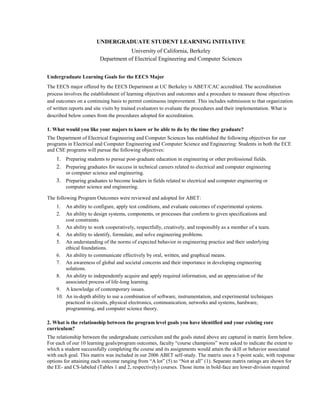
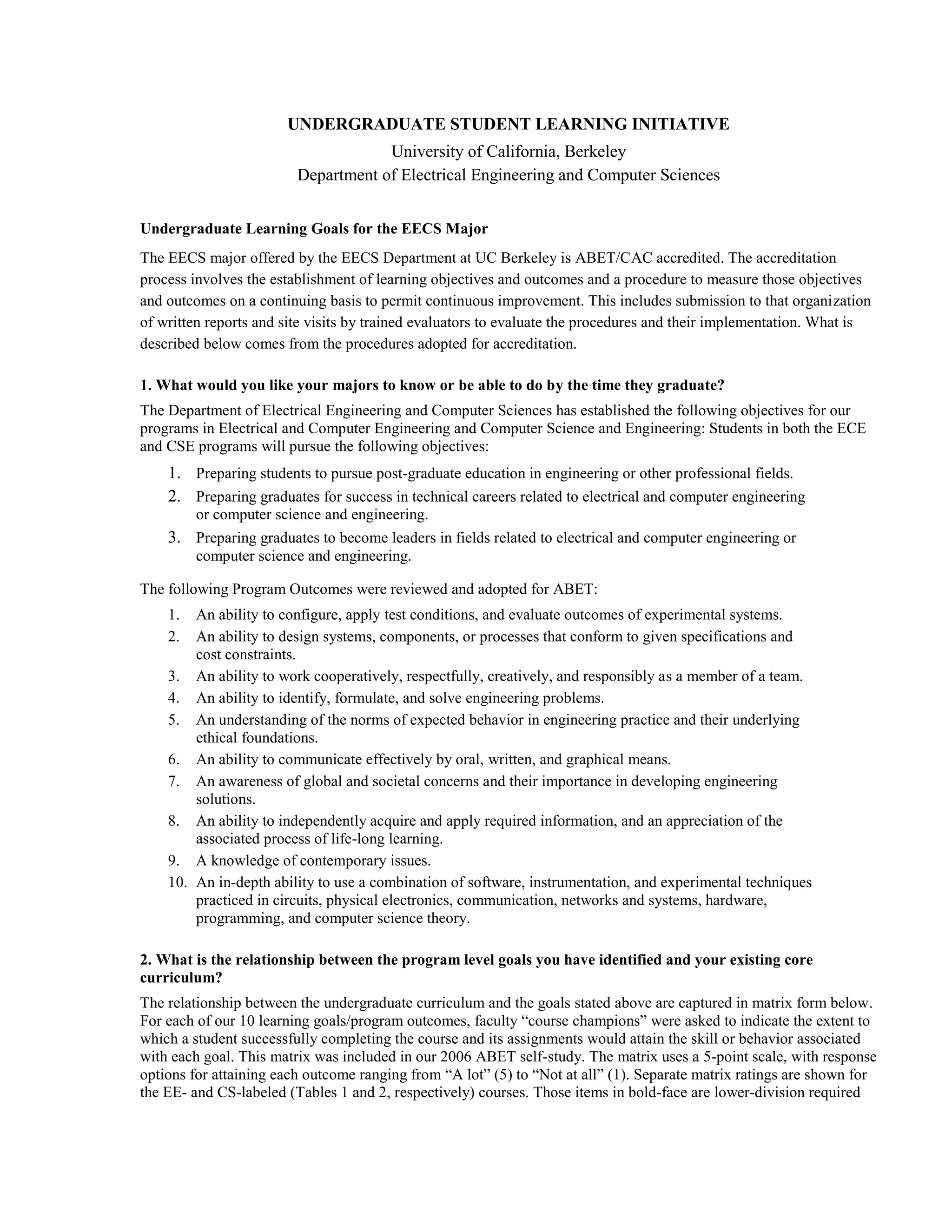
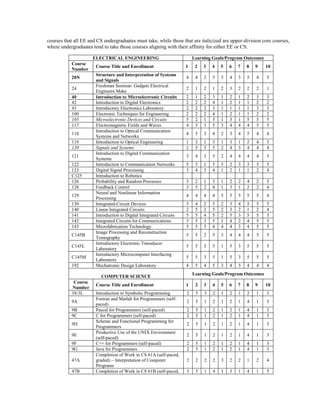
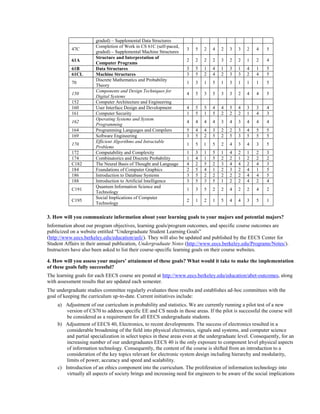
UNDERGRADUATE STUDENT LEARNING INITIATIVE<br />University of California, Berkeley<br />Department of Electrical Engineering and Computer Sciences<br />Undergraduate Learning Goals for the EECS Major <br />The EECS major offered by the EECS Department at UC Berkeley is ABET/CAC accredited. The accreditation process involves the establishment of learning objectives and outcomes and a procedure to measure those objectives and outcomes on a continuing basis to permit continuous improvement. This includes submission to that organization of written reports and site visits by trained evaluators to evaluate the procedures and their implementation. What is described below comes from the procedures adopted for accreditation. <br />1. What would you like your majors to know or be able to do by the time they graduate?<br />The Department of Electrical Engineering and Computer Sciences has established the following objectives for our programs in Electrical and Computer Engineering and Computer Science and Engineering: Students in both the ECE and CSE programs will pursue the following objectives:<br />Preparing students to pursue post-graduate education in engineering or other professional fields.<br />Preparing graduates for success in technical careers related to electrical and computer engineering or computer science and engineering.<br />Preparing graduates to become leaders in fields related to electrical and computer engineering or computer science and engineering.<br />The following Program Outcomes were reviewed and adopted for ABET:An ability to configure, apply test conditions, and evaluate outcomes of experimental systems.<br />An ability to design systems, components, or processes that conform to given specifications and cost constraints.<br />An ability to work cooperatively, respectfully, creatively, and responsibly as a member of a team.<br />An ability to identify, formulate, and solve engineering problems.<br />An understanding of the norms of expected behavior in engineering practice and their underlying ethical foundations.<br />An ability to communicate effectively by oral, written, and graphical means.<br />An awareness of global and societal concerns and their importance in developing engineering solutions.<br />An ability to independently acquire and apply required information, and an appreciation of the associated process of life-long learning.<br />A knowledge of contemporary issues.<br />An in-depth ability to use a combination of software, instrumentation, and experimental techniques practiced in circuits, physical electronics, communication, networks and systems, hardware, programming, and computer science theory.<br />2. What is the relationship between the program level goals you have identified and your existing core curriculum?<br />The relationship between the undergraduate curriculum and the goals stated above are captured in matrix form below. For each of our 10 learning goals/program outcomes, faculty “course champions” were asked to indicate the extent to which a student successfully completing the course and its assignments would attain the skill or behavior associated with each goal. This matrix was included in our 2006 ABET self-study. The matrix uses a 5-point scale, with response options for attaining each outcome ranging from “A lot” (5) to “Not at all” (1). Separate matrix ratings are shown for the EE- and CS-labeled (Tables 1 and 2, respectively) courses. Those items in bold-face are lower-division required courses that all EE and CS undergraduates must take, while those that are italicized are upper-division core courses, where undergraduates tend to take those courses aligning with their affinity for either EE or CS.<br />ELECTRICAL ENGINEERINGLearning Goals/Program OutcomesCourse NumberCourse Title and Enrollment1234567891020NStructure and Interpretation of Systems and Signals442534354524Freshman Seminar: Gadgets Electrical Engineers Make212123222140Introduction to Microelectronic Circuits212312123342Introduction to Digital Electronics222412112243Introductory Electronics Laboratory2223111133100Electronic Techniques for Engineering2224121122105Microelectronic Devices and Circuits5215131535117Electromagnetic Fields and Waves4335344455118Introduction to Optical Communication Systems and Networks4534234544119Introduction to Optical Engineering1313131243120Signals and Systems2535243444121Introduction to Digital Communication Systems3435244445122Introduction to Communication Networks5515323355123Digital Signal Processing3434121124C125Introduction to Robotics126Probability and Random Processes3213122425128Feedback Control3524131224129Neural and Nonlinear Information Processing4444555554130Integrated-Circuit Devices3425234555140Linear Integrated Circuits2525232124141Introduction to Digital Integrated Circuits5545253555142Integrated Circuits for Communications3535142455143Microfabrication Technology5554443455C145BImage Processing and Reconstruction Tomography5525344455C145LIntroductory Electronic Transducer Laboratory5535153555C145MIntroductory Microcomputer Interfacing Laboratory5535153555192Mechatronic Design Laboratory4545343444COMPUTER SCIENCELearning Goals/Program OutcomesCourse NumberCourse Title and Enrollment123456789103S/3LIntroduction to Symbolic Programming25321212139AFortran and Matlab for Programmers (self-paced)25121214139BPascal for Programmers (self-paced)25121214139CC for Programmers (self-paced)25121214139DScheme and Functional Programming for Programmers25121214139EProductive Use of the UNIX Environment (self-paced)25121214139FC++ for Programmers (self-paced)25121214139GJava for Programmers251212141347ACompletion of Work in CS 61A (self-paced, graded) – Interpretation of Computer Programs222232212447BCompletion of Work in CS 61B (self-paced, graded) – Supplemental Data Structures351413141547CCompletion of Work in CS 61C (self-paced, graded) – Supplemental Machine Structures352423324561AStructure and Interpretation of Computer Programs222232212461BData Structures351413141561CLMachine Structures352423324570Discrete Mathematics and Probability Theory1315131115150Components and Design Techniques for Digital Systems4535332445152Computer Architecture and Engineering160User Interface Design and Development4554454334161Computer Security1515222143162Operating Systems and System Programming4444343444164Programming Languages and Compilers5443223455169Software Engineering3525253555170Efficient Algorithms and Intractable Problems1515243435172Computability and Complexity1315142123174Combinatorics and Discrete Probability1415221222C182The Neural Basis of Thought and Language4252344243184Foundations of Computer Graphics2541232415186Introduction to Database Systems3522222445188Introduction to Artificial Intelligence3535122424C191Quantum Information Science and Technology1352242242C195Social Implications of Computer Technology2121544351<br />3. How will you communicate information about your learning goals to your majors and potential majors? <br />Information about our program objectives, learning goals/program outcomes, and specific course outcomes are publicized on a website entitled “Undergraduate Student Learning Goals” (http://www.eecs.berkeley.edu/education/usli/). They will also be updated and published by the EECS Center for Student Affairs in their annual publication, Undergraduate Notes (http://www.eecs.berkeley.edu/Programs/Notes/). Instructors have also been asked to list their course-specific learning goals on their course websites.<br />4. How will you assess your majors’ attainment of these goals? What would it take to make the implementation of these goals fully successful?<br />The learning goals for each EECS course are posted at http://www.eecs.berkeley.edu/education/abet-outcomes, along with assessment results that are updated each semester.<br />The undergraduate studies committee regularly evaluates these results and establishes ad-hoc committees with the goal of keeping the curriculum up-to-date. Current initiatives include:<br />Adjustment of our curriculum in probability and statistics. We are currently running a pilot test of a new version of CS70 to address specific EE and CS needs in those areas. If the pilot is successful the course will be considered as a requirement for all EECS undergraduate students.<br />Adjustment of EECS 40, Electronics, to recent developments. The success of electronics resulted in a considerable broadening of the field into physical electronics, signals and systems, and computer science and partial specialization in select topics in these areas even at the undergraduate level. Consequently, for an increasing number of our undergraduates EECS 40 is the only exposure to component level physical aspects of information technology. Consequently, the content of the course is shifted from an introduction to a consideration of the key topics relevant for electronic system design including hierarchy and modularity, limits of power, accuracy and speed and scalability.<br />Introduction of an ethics component into the curriculum. The proliferation of information technology into virtually all aspects of society brings and increasing need for engineers to be aware of the social implications of their work. The department plans a pilot course for fall 2009 that teaches aspects of ethics for engineers. The course is planned to eventually become a requirement for all EECS undergraduate majors.<br />This curriculum improvement is a continuous process in EECS. The scope and number of these efforts are tailored to match the rate at which innovations can be introduced without undue disruption of the program and meet available resources. <br />Summary<br />The rapid progress and continued fundamental changes have brought about a culture of continual improvement and change of the EECS curriculum. The department has a history of continual revision and improvement of its core courses and of the addition and retirement of courses at the upper division level to adapt to new developments in the discipline.<br />The department has a well established process to select and continually measure overall curriculum goals and the goals of individual courses, a process used by the undergraduate studies committee and the faculty at large to focus resources in the curriculum improvement process. This process is also part of the ABET/CAC accreditation.<br />12 May 2009<br />
Word - May 1, 2009
Word - May 1, 2009
Word - May 1, 2009

Word - May 1, 2009

  • 1.
    UNDERGRADUATE STUDENT LEARNINGINITIATIVE<br />University of California, Berkeley<br />Department of Electrical Engineering and Computer Sciences<br />Undergraduate Learning Goals for the EECS Major <br />The EECS major offered by the EECS Department at UC Berkeley is ABET/CAC accredited. The accreditation process involves the establishment of learning objectives and outcomes and a procedure to measure those objectives and outcomes on a continuing basis to permit continuous improvement. This includes submission to that organization of written reports and site visits by trained evaluators to evaluate the procedures and their implementation. What is described below comes from the procedures adopted for accreditation. <br />1. What would you like your majors to know or be able to do by the time they graduate?<br />The Department of Electrical Engineering and Computer Sciences has established the following objectives for our programs in Electrical and Computer Engineering and Computer Science and Engineering: Students in both the ECE and CSE programs will pursue the following objectives:<br />Preparing students to pursue post-graduate education in engineering or other professional fields.<br />Preparing graduates for success in technical careers related to electrical and computer engineering or computer science and engineering.<br />Preparing graduates to become leaders in fields related to electrical and computer engineering or computer science and engineering.<br />The following Program Outcomes were reviewed and adopted for ABET:An ability to configure, apply test conditions, and evaluate outcomes of experimental systems.<br />An ability to design systems, components, or processes that conform to given specifications and cost constraints.<br />An ability to work cooperatively, respectfully, creatively, and responsibly as a member of a team.<br />An ability to identify, formulate, and solve engineering problems.<br />An understanding of the norms of expected behavior in engineering practice and their underlying ethical foundations.<br />An ability to communicate effectively by oral, written, and graphical means.<br />An awareness of global and societal concerns and their importance in developing engineering solutions.<br />An ability to independently acquire and apply required information, and an appreciation of the associated process of life-long learning.<br />A knowledge of contemporary issues.<br />An in-depth ability to use a combination of software, instrumentation, and experimental techniques practiced in circuits, physical electronics, communication, networks and systems, hardware, programming, and computer science theory.<br />2. What is the relationship between the program level goals you have identified and your existing core curriculum?<br />The relationship between the undergraduate curriculum and the goals stated above are captured in matrix form below. For each of our 10 learning goals/program outcomes, faculty “course champions” were asked to indicate the extent to which a student successfully completing the course and its assignments would attain the skill or behavior associated with each goal. This matrix was included in our 2006 ABET self-study. The matrix uses a 5-point scale, with response options for attaining each outcome ranging from “A lot” (5) to “Not at all” (1). Separate matrix ratings are shown for the EE- and CS-labeled (Tables 1 and 2, respectively) courses. Those items in bold-face are lower-division required courses that all EE and CS undergraduates must take, while those that are italicized are upper-division core courses, where undergraduates tend to take those courses aligning with their affinity for either EE or CS.<br />ELECTRICAL ENGINEERINGLearning Goals/Program OutcomesCourse NumberCourse Title and Enrollment1234567891020NStructure and Interpretation of Systems and Signals442534354524Freshman Seminar: Gadgets Electrical Engineers Make212123222140Introduction to Microelectronic Circuits212312123342Introduction to Digital Electronics222412112243Introductory Electronics Laboratory2223111133100Electronic Techniques for Engineering2224121122105Microelectronic Devices and Circuits5215131535117Electromagnetic Fields and Waves4335344455118Introduction to Optical Communication Systems and Networks4534234544119Introduction to Optical Engineering1313131243120Signals and Systems2535243444121Introduction to Digital Communication Systems3435244445122Introduction to Communication Networks5515323355123Digital Signal Processing3434121124C125Introduction to Robotics126Probability and Random Processes3213122425128Feedback Control3524131224129Neural and Nonlinear Information Processing4444555554130Integrated-Circuit Devices3425234555140Linear Integrated Circuits2525232124141Introduction to Digital Integrated Circuits5545253555142Integrated Circuits for Communications3535142455143Microfabrication Technology5554443455C145BImage Processing and Reconstruction Tomography5525344455C145LIntroductory Electronic Transducer Laboratory5535153555C145MIntroductory Microcomputer Interfacing Laboratory5535153555192Mechatronic Design Laboratory4545343444COMPUTER SCIENCELearning Goals/Program OutcomesCourse NumberCourse Title and Enrollment123456789103S/3LIntroduction to Symbolic Programming25321212139AFortran and Matlab for Programmers (self-paced)25121214139BPascal for Programmers (self-paced)25121214139CC for Programmers (self-paced)25121214139DScheme and Functional Programming for Programmers25121214139EProductive Use of the UNIX Environment (self-paced)25121214139FC++ for Programmers (self-paced)25121214139GJava for Programmers251212141347ACompletion of Work in CS 61A (self-paced, graded) – Interpretation of Computer Programs222232212447BCompletion of Work in CS 61B (self-paced, graded) – Supplemental Data Structures351413141547CCompletion of Work in CS 61C (self-paced, graded) – Supplemental Machine Structures352423324561AStructure and Interpretation of Computer Programs222232212461BData Structures351413141561CLMachine Structures352423324570Discrete Mathematics and Probability Theory1315131115150Components and Design Techniques for Digital Systems4535332445152Computer Architecture and Engineering160User Interface Design and Development4554454334161Computer Security1515222143162Operating Systems and System Programming4444343444164Programming Languages and Compilers5443223455169Software Engineering3525253555170Efficient Algorithms and Intractable Problems1515243435172Computability and Complexity1315142123174Combinatorics and Discrete Probability1415221222C182The Neural Basis of Thought and Language4252344243184Foundations of Computer Graphics2541232415186Introduction to Database Systems3522222445188Introduction to Artificial Intelligence3535122424C191Quantum Information Science and Technology1352242242C195Social Implications of Computer Technology2121544351<br />3. How will you communicate information about your learning goals to your majors and potential majors? <br />Information about our program objectives, learning goals/program outcomes, and specific course outcomes are publicized on a website entitled “Undergraduate Student Learning Goals” (http://www.eecs.berkeley.edu/education/usli/). They will also be updated and published by the EECS Center for Student Affairs in their annual publication, Undergraduate Notes (http://www.eecs.berkeley.edu/Programs/Notes/). Instructors have also been asked to list their course-specific learning goals on their course websites.<br />4. How will you assess your majors’ attainment of these goals? What would it take to make the implementation of these goals fully successful?<br />The learning goals for each EECS course are posted at http://www.eecs.berkeley.edu/education/abet-outcomes, along with assessment results that are updated each semester.<br />The undergraduate studies committee regularly evaluates these results and establishes ad-hoc committees with the goal of keeping the curriculum up-to-date. Current initiatives include:<br />Adjustment of our curriculum in probability and statistics. We are currently running a pilot test of a new version of CS70 to address specific EE and CS needs in those areas. If the pilot is successful the course will be considered as a requirement for all EECS undergraduate students.<br />Adjustment of EECS 40, Electronics, to recent developments. The success of electronics resulted in a considerable broadening of the field into physical electronics, signals and systems, and computer science and partial specialization in select topics in these areas even at the undergraduate level. Consequently, for an increasing number of our undergraduates EECS 40 is the only exposure to component level physical aspects of information technology. Consequently, the content of the course is shifted from an introduction to a consideration of the key topics relevant for electronic system design including hierarchy and modularity, limits of power, accuracy and speed and scalability.<br />Introduction of an ethics component into the curriculum. The proliferation of information technology into virtually all aspects of society brings and increasing need for engineers to be aware of the social implications of their work. The department plans a pilot course for fall 2009 that teaches aspects of ethics for engineers. The course is planned to eventually become a requirement for all EECS undergraduate majors.<br />This curriculum improvement is a continuous process in EECS. The scope and number of these efforts are tailored to match the rate at which innovations can be introduced without undue disruption of the program and meet available resources. <br />Summary<br />The rapid progress and continued fundamental changes have brought about a culture of continual improvement and change of the EECS curriculum. The department has a history of continual revision and improvement of its core courses and of the addition and retirement of courses at the upper division level to adapt to new developments in the discipline.<br />The department has a well established process to select and continually measure overall curriculum goals and the goals of individual courses, a process used by the undergraduate studies committee and the faculty at large to focus resources in the curriculum improvement process. This process is also part of the ABET/CAC accreditation.<br />12 May 2009<br />