High School Chemistry - Core Concept Cheat Sheet

14: The Periodic Table
Key Chemistry Terms















Periodicity, Atomic Mass & Atomic Radii

Periodic Table: Tool for organizing the elements.
Periods: Rows on the periodic table.
Groups: Columns on the periodic table.
Periodicity: Predictable patterns and trends on the
periodic table.
Atomic Number: Number of protons in an atom. Defines
the element. Periodic table is organized in increasing order
of atomic number.
Atomic Mass: Mass in grams of 1 mole of atoms (6.02 x
1023 atoms).
Atomic Radius: Half the distance between two nuclei of
the same element when bonded together.
Electronegativity: Pull an atom has on the shared
electrons in a bond with another atom.
Ionization Energy: Energy required to remove the
outermost electron from an atom.
Electron Affinity: Energy released when another electron
is added to an atom.
Ion: Atom or ployatoms with a charge.
Cation: Positively charged ion. Results from loss of
electrons.
Anion: Negatively charged ion. Results from gain of
electrons.
Mnemonic: Cation = Ca+ion (letter “t” appears like “+”,
hence a positive ion; ANION = A Negative ION.

Reading the Periodic Table
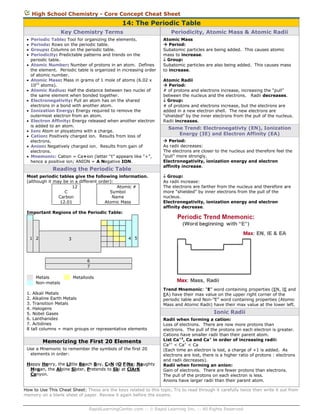
Most periodic tables give the following information.
(although it may be in a different order):
12
Atomic #
C
Symbol
Carbon
Name
12.01
Atomic Mass

Atomic Mass
 Period:
Subatomic particles are being added. This causes atomic
mass to increase.
 Group:
Subatomic particles are also being added. This causes mass
to increase.
Atomic Radii
 Period:
# of protons and electrons increase, increasing the “pull”
between the nucleus and the electrons. Radii decreases.
 Group:
# of protons and electrons increase, but the electrons are
added in a new electron shell. The new electrons are
“shielded” by the inner electrons from the pull of the nucleus.
Radii increases.

Same Trend: Electronegativty (EN), Ionization
Energy (IE) and Electron Affinity (EA)
 Period:
As radii decreases:
The electrons are closer to the nucleus and therefore feel the
“pull” more strongly.
Electronegativity, ionization energy and electron
affinity increase.
 Group:
As radii increase:
The electrons are farther from the nucleus and therefore are
more “shielded” by inner electrons from the pull of the
nucleus.
Electronegativity, ionization energy and electron
affinity decrease.

Important Regions of the Periodic Table:

1 2

4 5

3

6
7
Metals
Non-metals

Metalloids

1. Alkali Metals
2. Alkaline Earth Metals
3. Transition Metals
4. Halogens
5. Nobel Gases
6. Lanthanides
7. Actidines
8 tall columns = main groups or representative elements

Memorizing the First 20 Elements
Use a Mnemonic to remember the symbols of the first 20
elements in order:
Happy Henry, the Little Beach Boy, CaN dO FiNe; Naughty
Megan, the Alpine Sister, Pretends to Ski at ClArK
Canyon.

Trend Mnemonic: “E” word containing properties (EN, IE and
EA) have their max value on the upper right corner of the
periodic table and Non-”E” word containing properties (Atomic
Mass and Atomic Radii) have their max value at the lower left.

Ionic Radii
Radii when forming a cation:
Loss of electrons. There are now more protons than
electrons. The pull of the protons on each electron is greater.
Cations have smaller radii than their parent atom.
List Ca+2, Ca and Ca+ in order of increasing radii:
Ca2+ < Ca+ < Ca
(Each time an electron is lost, a charge of +1 is added. As
electrons are lost, there is a higher ratio of protons : electrons
and radii decreases).
Radii when forming an anion:
Gain of electrons. There are fewer protons than electrons.
The pull of the protons on each electron is less.
Anions have larger radii than their parent atom.

How to Use This Cheat Sheet: These are the keys related to this topic. Try to read through it carefully twice then write it out from
memory on a blank sheet of paper. Review it again before the exams.
RapidLearningCenter.com ::  Rapid Learning Inc. :: All Rights Reserved

Periodic table cheat sheet

  • 1.
    High School Chemistry- Core Concept Cheat Sheet 14: The Periodic Table Key Chemistry Terms               Periodicity, Atomic Mass & Atomic Radii Periodic Table: Tool for organizing the elements. Periods: Rows on the periodic table. Groups: Columns on the periodic table. Periodicity: Predictable patterns and trends on the periodic table. Atomic Number: Number of protons in an atom. Defines the element. Periodic table is organized in increasing order of atomic number. Atomic Mass: Mass in grams of 1 mole of atoms (6.02 x 10²³ atoms). Atomic Radius: Half the distance between two nuclei of the same element when bonded together. Electronegativity: Pull an atom has on the shared electrons in a bond with another atom. Ionization Energy: Energy required to remove the outermost electron from an atom. Electron Affinity: Energy released when another electron is added to an atom. Ion: Atom or ployatoms with a charge. Cation: Positively charged ion. Results from loss of electrons. Anion: Negatively charged ion. Results from gain of electrons. Mnemonic: Cation = Ca+ion (letter “t” appears like “+”, hence a positive ion; ANION = A Negative ION. Reading the Periodic Table Most periodic tables give the following information. (although it may be in a different order): 12 Atomic # C Symbol Carbon Name 12.01 Atomic Mass Atomic Mass  Period: Subatomic particles are being added. This causes atomic mass to increase.  Group: Subatomic particles are also being added. This causes mass to increase. Atomic Radii  Period: # of protons and electrons increase, increasing the “pull” between the nucleus and the electrons. Radii decreases.  Group: # of protons and electrons increase, but the electrons are added in a new electron shell. The new electrons are “shielded” by the inner electrons from the pull of the nucleus. Radii increases. Same Trend: Electronegativty (EN), Ionization Energy (IE) and Electron Affinity (EA)  Period: As radii decreases: The electrons are closer to the nucleus and therefore feel the “pull” more strongly. Electronegativity, ionization energy and electron affinity increase.  Group: As radii increase: The electrons are farther from the nucleus and therefore are more “shielded” by inner electrons from the pull of the nucleus. Electronegativity, ionization energy and electron affinity decrease. Important Regions of the Periodic Table: 1 2 4 5 3 6 7 Metals Non-metals Metalloids 1. Alkali Metals 2. Alkaline Earth Metals 3. Transition Metals 4. Halogens 5. Nobel Gases 6. Lanthanides 7. Actidines 8 tall columns = main groups or representative elements Memorizing the First 20 Elements Use a Mnemonic to remember the symbols of the first 20 elements in order: Happy Henry, the Little Beach Boy, CaN dO FiNe; Naughty Megan, the Alpine Sister, Pretends to Ski at ClArK Canyon. Trend Mnemonic: “E” word containing properties (EN, IE and EA) have their max value on the upper right corner of the periodic table and Non-”E” word containing properties (Atomic Mass and Atomic Radii) have their max value at the lower left. Ionic Radii Radii when forming a cation: Loss of electrons. There are now more protons than electrons. The pull of the protons on each electron is greater. Cations have smaller radii than their parent atom. List Ca+2, Ca and Ca+ in order of increasing radii: Ca2+ < Ca+ < Ca (Each time an electron is lost, a charge of +1 is added. As electrons are lost, there is a higher ratio of protons : electrons and radii decreases). Radii when forming an anion: Gain of electrons. There are fewer protons than electrons. The pull of the protons on each electron is less. Anions have larger radii than their parent atom. How to Use This Cheat Sheet: These are the keys related to this topic. Try to read through it carefully twice then write it out from memory on a blank sheet of paper. Review it again before the exams. RapidLearningCenter.com ::  Rapid Learning Inc. :: All Rights Reserved