Ch. 2: Force Systems
2.0 Outline 27
 Overview of Forces 28
2-D Force Systems
 Rectangular Coordinate Systems 33
 Force, Moment, and Couple 45
 Resultants 61
3-D Force Systems
 Rectangular Coordinate Systems 85
 Force, Moment, and Couple 95
 Resultants 109
2.0 Outline
27
Ch. 2: Force Systems
2.1 Overview of Forces
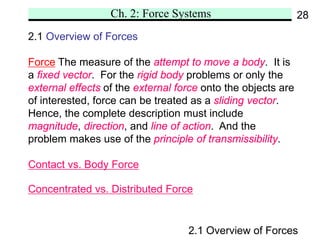
Force The measure of the attempt to move a body. It is
a fixed vector. For the rigid body problems or only the
external effects of the external force onto the objects are
of interested, force can be treated as a sliding vector.
Hence, the complete description must include
magnitude, direction, and line of action. And the
problem makes use of the principle of transmissibility.
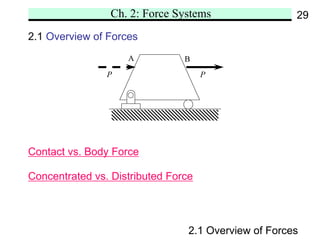
Contact vs. Body Force
Concentrated vs. Distributed Force
2.1 Overview of Forces
28
Ch. 2: Force Systems
2.1 Overview of Forces
Contact vs. Body Force
Concentrated vs. Distributed Force
2.1 Overview of Forces
A
P P
B
29
Ch. 2: Force Systems
2.1 Overview of Forces
Force Measurement by comparison or by deformation of
an elastic element (force sensor)
Action vs. Reaction Force Isolate the object and the
force exerted on that body is represented  FBD
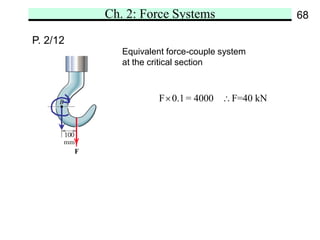
Combining Force by parallelogram law and principle of
moment
Force Components along the specified coordinate
system to satisfy the parallelogram law (reverse step)
2.1 Overview of Forces
30
Ch. 2: Force Systems
2.1 Overview of Forces
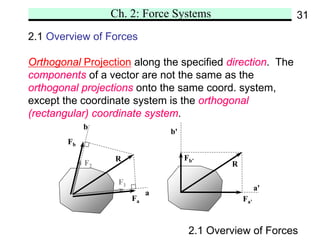
Orthogonal Projection along the specified direction. The
components of a vector are not the same as the
orthogonal projections onto the same coord. system,
except the coordinate system is the orthogonal
(rectangular) coordinate system.
2.1 Overview of Forces
R
F1
F2
Fa
Fb
a
b
R
Fa’
Fb’
a'
b'
31
Ch. 2: Force Systems
2.1 Overview of Forces
Addition of Parallel Forces by graphic or algebraic
(principle of moment) approach
2.1 Overview of Forces
F2
F1
(1)
F2
F1
F -F
R1 R2
(2)
R1
R2
R
(3)
32
Ch. 2: Force Systems
2.2 2-D Simple Rectangular Coordinate Systems
2.2 2-D Rectangular Coord. Systems
y
x
Fx
Fy
F
θ
( )
x y
2 2
x y
x y
y x
ˆˆ
F F
F = F F
F Fcos F Fsin
arctan 2 F ,F
θ θ
θ
+
+
= =
=
x y
F = F F
F = i + j
Magnitude is always positive
Scalar component includes sign information too!
33
Ch. 2: Force Systems
2.2 2-D Rectangular Coord. Systems
2.2 2-D Arbitrary Rectangular Coordinate Systems
by convenience, right-handed, geometry of the problem
β
x
y
F
Fx = Fsinβ
Fy = Fcosβ
β
x
y
F
Fx = Fsin(π−β)
Fy = -Fcos(π−β)
x
Fx = Fcos(α−β)
Fy = Fsin(α−β)
β
y F
α
34
Ch. 2: Force Systems
P. 2/1 If the two equal tension T in the pulley cable
together produce a force of 5 kN on the
pulley bearing, calculate T.
5 kN
35
Ch. 2: Force Systems
P. 2/1
60゜
T
T 5 kN
5 kN
By cosine law: 2 2 2
5 T T 2T Tcos60
= + + ⋅ °
T = 2.89 kN
36
Ch. 2: Force Systems
P. 2/2 While steadily pushing the machine up
an incline, a person exerts a 180 N force P
as shown. Determine the components of P
which are parallel and perpendicular to the
incline.
37
Ch. 2: Force Systems
P. 2/2
t
n
180 N
10゜
15゜
15゜
( )
( )
t
n
P 180cos 10 15 163.1 N
P 180sin 10 15 76.1 N
= +
=
=
− + =
−
38
Ch. 2: Force Systems
P. 2/3 Determine the resultant R of the two forces
applied to the bracket. Write R in terms of
unit vectors along the x- and y-axes shown.
39
Ch. 2: Force Systems
P. 2/3
clearly and carefully draw the picture!
10゜
20゜
15゜
20゜
150 N
200 N
y’ y
x
x’
( ) ( )
( ) ( )
'
'
x
y
x
y
R 200cos 15+ 20 150sin 10 20 88.8 N
R 200sin 15 20 150cos 10 20 244.6 N
R 200cos15 150sin10 167.1 N
R 200sin15 150cos10 199.5 N
88.8 244.6 N 167.1 199.5 N
Non-Orthogonal Coordinate System x'-y
by l
− + =
= + + +
=
= − =
= + =
= +
=
R = i + j i' j'
( ) ( )
aw of sine and cosine
200 N --> 174.34 55.1 N
150 N --> -79.8 157.2 N
174.34-79.8 55.1+157.2 94.54 212.3 N
i'+ j
i'+ j
R = i'+ j = i'+ j
200 N
110゜
15゜
30゜
70゜
80゜
150 N
40
Ch. 2: Force Systems
P. 2/4 It is desired to remove the spike from the
timber by applying force along its horizontal
axis. An obstruction A prevents direct access,
so that two forces, one 1.6 kN and the other P,
are applied by cables as shown. Compute
the magnitude of P necessary to ensure
axial tension T along the spike. Also find T.
41
Ch. 2: Force Systems
P. 2/4
x
y
No net force in y-direction
y
x
100 150
R Psin atan 1.6sin atan 0
200 200
P = 2.15 kN
100 150
T = R Pcos atan 1.6cos atan
200 200
= 3.20 kN
   
   
= − =
   
   
   
   
∴
   
   
= +
   
   
   
   
42
Ch. 2: Force Systems
P. 2/5 As it inserts the small cylindrical part into
a close fitting circular hole, the robot arm
exerts a 90 N force P on the part parallel to
the axis of the hole as shown. Determine
the components of the force which the part
exerts on the robot along axes (a) parallel
and perpendicular to the arm AB, and (b)
parallel and perpendicular to the arm BC.
43
Ch. 2: Force Systems
P. 2/5
Quasi-Equilibrium
P is the force done by the robot on the part
-P is the force done by the part on the robot
may be part of strength analysis
of the robot arm
15゜
45゜
60゜
90 N
n1
t1
n2
t2
-90cos45 90sin 45 63.6 63.6 N
90cos60 90sin 60 45 77.9 N
− + =
− +
− + =+
1 1 1 1
2 2 2 2
P = n t n t
P = n t n t
44
Ch. 2: Force Systems
2.3 2-D Moment and Couple
Moment The measure of the attempt to rotate a body. It
is induced by force. The moment vector’s direction is
perpendicular to the plane established by the point and
the line of action of the force. It is a fixed vector. For
the rigid body problems or only the external effects of
the external moment onto the objects are of interested,
moment can be treated as a sliding vector. Hence, the
complete description must include magnitude, direction,
and line of action. And the problem makes use of the
principle of transmissibility.
45
Ch. 2: Force Systems
A
M F
2.3 2-D Moment and Couple
α
F
A r
d
MA
For 2-D (in-plane rotation) problem, moment vector always
points perpendicular to the plane. So it can be indicated by
the magnitude and the sense of rotation (CCW +, CW -)
about the point.
Moment of about point A
( )
A
M F r sin Fd
α
= ×
=
⋅ =
A
M r F
*** Sign’s consistency throughout the problem ***
46
Ch. 2: Force Systems
2.3 2-D Moment and Couple
Varignon’s theorem The moment of a force about any
point is equal to the sum of the moments of the
components of the force about the same point
F
A
r
(MA )F
P
Q
(MA )Q
(MA )P ( )
( )
( ) ( )
if
= ×
×
+
A F
A A
P Q
M r F
= r P +Q
= M M
F = P +Q
Usage Calculate the moment of the force from
its components. Moments of some components
may be trivial to calculate.
47
Ch. 2: Force Systems
2.3 2-D Moment and Couple
Couple The measure of the attempt to purely rotate a
body. It is produced by two equal, opposite, and non-
collinear force. The couple vector’s direction is
perpendicular to the plane established by those two
lines of action of the force. It is a free vector and so no
moment center. Only the magnitude and direction are
enough to describe the couple.
α
-F
r
M
d
F
rA
rB
( )
( )
M = F r sin Fd
α
× ×
= ×
⋅ =
A B
M = r F +r -F
r F
arbitrary chosen
48
Ch. 2: Force Systems
2.3 2-D Moment and Couple
M
d
F
-
F
M
d
-F -F
M
d
F
-2F
M
d/2
2F
For rigid body, several pairs of equal & opposite forces
can determine the same couple. It is unique to
calculate the couple from the given pair of forces but
it is non-unique to determine the pair of forces which
produce that value of couple.
Usage Effect of the couple can be determined from
the equivalent pair of forces. Effect from some specific
pairs of forces may be trivial to calculate.
-F
F
49
Ch. 2: Force Systems
P. 2/6 Calculate the moment of the 250 N force on
the handle of the monkey wrench about the
center of the bolt.
50
Ch. 2: Force Systems
P. 2/6
x
y
Varignon’s Theorem
O
M 250cos15 0.2 250sin15 0.03
46.4 Nm CW
=
− × + ×
=
51
Ch. 2: Force Systems
P. 2/7
x
y
Vector approach
0.03 0.35 m
240cos10 - 240sin10 N
84.0 Nm
= ×
O
r = i + j
F = i j
M r F = - k
52
Ch. 2: Force Systems
P. 2/8 The force exerted by the plunger of cylinder
AB on the door is 40 N directed along the line
AB, and this force tends to keep the door
closed. Compute the moment of this force
about the hinge O. What force Fc normal to
the plane of the door must the door stop at C
exert on the door so that the combined moment
about O of the two forces is zero?
53
Ch. 2: Force Systems
P. 2/8
( )
O
C O
= atan 100/400 0.245 rad
M 40cos 0.075 40sin 0.425 7.03 Nm CW
F M / 0.825 8.53 N
θ
θ θ
=
=
− × − × =
= =
40 N
FC
MO
54
Ch. 2: Force Systems
P. 2/9 While inserting a cylindrical part into the
circular hole, the robot exerts the 90 N force
on the part as shown. Determine the moment
about points A, B, and C of the force which
the part exerts on the robot.
55
Ch. 2: Force Systems
P. 2/9
( ) ( )
at about
at about
0.55cos60 + 0.45cos45 0.55sin60-0.45sin45 0.593 0.158 m
-90sin15 90cos15 23.29 86.93 N
90 0.15 13.5 Nm CCW
55.23 Nm CCW
68.7 Nm CCW
= × =
= ×
=
+ =
AC
C
-P C A AC
A C -P C A
r = i + j = i + j
F = -P = i + j = - i + j
M
M r F =
M M M
-P
MC
56
Ch. 2: Force Systems
P. 2/10 As part of a test, the two aircraft engines are
revved up and the propeller pitches are
adjusted so as to result in the fore and aft
thrusts shown. What force F must be exerted
by the ground on each of the main braked
wheels at A and B to counteract the turning
effect of the two propeller thrusts? Necglect
any effects of the nose wheel C, which is
turned 90°and unbraked.
57
Ch. 2: Force Systems
P. 2/10
C
M 2 5 F 3 = 0
F = 3.33 kN
= × − ×
no rotation  resultant couple = 0
F
58
Ch. 2: Force Systems
P. 2/11 A lug wrench is used to tighten a square-head
bolt. If 250 N forces are applied to the wrench
as shown, determine the magnitude F of the
equal forces exerted on the four contact points
on the 25 mm bolt head so that their external
effect on the bolt is equivalent to that of the
two 250 N forces. Assume that the forces are
perpendicular to the flats of the bolt head.
59
Ch. 2: Force Systems
P. 2/11
( )
250 0.7 2 F 0.025
F = 3500 N
× = ×
Equivalent couple system at bolt head
F
60
Ch. 2: Force Systems
2.4 2-D Resultants
2.4 2-D Resultants
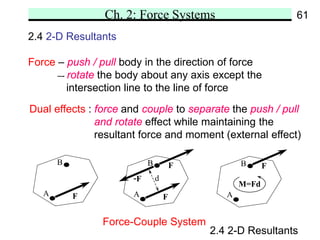
Force – push / pull body in the direction of force
–- rotate the body about any axis except the
intersection line to the line of force
Dual effects : force and couple to separate the push / pull
and rotate effect while maintaining the
resultant force and moment (external effect)
F
A
B
-F d
F
A
B F
M=Fd
A
B F
Force-Couple System
61
Ch. 2: Force Systems
2.4 2-D Resultants
Resultant is the simplest force combination which can
replace the original system of forces, moments, and
couples without altering the external effect of the system
on the rigid body. The resultant force determination will
be used in the Newton’s 2nd law :
m
=
∑F a
62
Ch. 2: Force Systems
2.4 2-D Resultants
Resultant Determination
• Force Polygon : head to tail of force vectors
Note: only magnitude and direction are ensured
i.e., line of action may be incorrect!
For the specified rectangular coordinate system,
( ) ( )
( )
2
2
x x y y x y
y x
R F R F R= F F
arctan 2 R ,R
θ
+ + =
= = +
=
∑
∑ ∑ ∑ ∑
1 2 3
R = F F F F
63
Ch. 2: Force Systems
2.4 2-D Resultants
Resultant Determination
• Prin. Transmissibility & Parallelogram Law :
graphical method  quick and easy visualizable but
low accuracy
Note: magnitude, direction, and line of action are correct
64
Ch. 2: Force Systems
2.4 2-D Resultants
Resultant Determination
• Force-Couple Equivalent Method:
algebraic method  high accuracy
Note: magnitude, direction, and line of action are correct
1. Specify a convenient reference point
2. Move all forces so the new lines of action
pass through point O  Force-Couple Equivalence
65
Ch. 2: Force Systems
2.4 2-D Resultants
Resultant Determination
• Force-Couple Equivalent Method:
algebraic method  high accuracy
Note: magnitude, direction, and line of action are correct
3. Sum forces and couples to
4. Locate the correct line of action of
 Force-Couple Equivalence
and O
R M
R
( )
O i i i
i i
M M Fd Rd Principle of Moment
= = =
∑
∑ ∑
R = F
66
Ch. 2: Force Systems
P. 2/12 In the design of the lifting hook the action of
the applied force F at the critical section of
the hook is a direct pull at B and a couple.
If the magnitude of the couple is 4000 Nm,
determine the magnitude of F.
67
Ch. 2: Force Systems
P. 2/12
Equivalent force-couple system
at the critical section
F 0.1= 4000 F=40 kN
× ∴
68
Ch. 2: Force Systems
P. 2/13 Calculate the moment of the 1200 N force
about pin A of the bracket. Begin by replacing
the 1200 N force by a force couple system
at point C. Calculate the moment of the
1200 N force about the pin at B.
69
Ch. 2: Force Systems
P. 2/13
C
A C
B A
M 1200 0.2 240 Nm CCW
1
M M 1200 0.6 562 Nm CCW
5
2
M M 1200 0.5 1099 Nm CCW
5
= × =
= + × × =
= + × × =
Force-Couple equivalent system
makes the moment calculation intuitive
70
Ch. 2: Force Systems
P. 2/14 The combined drive wheels of a front-wheel-
drive automobile are acted on by a 7000 N
normal reaction force and a friction force F,
both of which are exerted by the road surface.
If it is known that the resultant of these two
forces makes a 15°angle with the vertical,
determine the equivalent force-couple system
at the car mass center G. Treat this as a
2D problem.
71
Ch. 2: Force Systems
P. 2/14
G
Rcos15 = 7000 R = 7246.9 N
M 7000 1 7246.9sin15 0.5 7937.8 Nm CW
∴
= × + × =
R
72
Ch. 2: Force Systems
P. 2/15 Determine and locate the resultant R of the
two forces and one couple acting on the I-beam.
73
Ch. 2: Force Systems
O
R = 8-5 = 3 kN downward
M 25 5 2 8 2 1kNm CW
= − × − × =
P. 2/15 typical step in strength analysis
First, find the equivalent force-couple at point O
Then, locate the correct line of action by prin. of moment
1
3d =1 d =1/3 m & x = 4 m
3
∴
O
74
Ch. 2: Force Systems
P. 2/16 If the resultant of the two forces and couple M
passes through point O, determine M.
75
Ch. 2: Force Systems
P. 2/16 Resultant passes through point O
means there is no moment at point O
O
M M - 400 0.15cos30-320 0.3 = 0
M =148 Nm CCW
= × ×
76
Ch. 2: Force Systems
P. 2/17 The directions of the two thrust vectors of an
experimental aircraft can be independently
changed from the conventional forward direction
within limits. For the thrust configuration shown,
determine the equivalent force-couple system
at point O. Then replace this force-couple
system by a single force and specify the point
on the x-axis through which the line of action
of this resultant passes.
77
Ch. 2: Force Systems
( ) ( )
O
T + Tcos15 Tsin15 1.966T 0.259T N
M Tcos15 3-T 3-Tsin15 10 = 2.69T Nm CW
= × × ×
R = i + j = i + j
P. 2/17
0.259T x = -2.69T x = -10.4 m
× ∴
R
MO
Rx
Ry
Since Rx of the new force system
does not contribute moment about O,
only Ry can be used in calculation.
MO
78
Ch. 2: Force Systems
P. 2/18 Two integral pulleys are subjected to the belt
tensions shown. If the resultant R of these
forces passes through the center O, determine
T and the magnitude of R and the CCW angle
θit makes with the x-axis.
79
Ch. 2: Force Systems
P. 2/18 Resultant force passes O  MO = 0
( ) ( )
( ) ( )
160 T 100 150 200 200 0 T = 60 N
200 +150-160cos30-60cos30 160sin30 + 60sin30
159.5 110 N
R =193.7 N = 34.6
θ °
− × + − × = ∴
R = i + j
= i + j
80
Ch. 2: Force Systems
P. 2/19 A rear-wheel-drive car is stuck in the snow between other
parked cars as shown. In an attempt to free the car, three
students exert forces on the car at points A, B, and C
while the driver’s actions result in a forward thrust of 200 N
acting parallel to the plane of rotation of each rear wheel.
Treating the problem as 2D, determine the equivalent
force-couple system at the car center of mass G and locate
the position x of the point on the car centerline through
which the resultant passes. Neglect all forces not shown.
81
Ch. 2: Force Systems
( ) ( )
G
200 + 400 + 200 + 250sin30 250cos30 350
925 +566.5 N
M 350 1.65 250sin30 0.9 690 Nm CCW
+
= × + × =
R = i + j
= i j
P. 2/19
• 400 N and y-direction of 250 N
cause no moment about O.
• Moments by thrust force 200 N
cancel each other.
566.5 x = 690 x =1.218 m
× ∴
Rx
Ry
Since Rx of the new force system
does not contribute moment about G,
only Ry can be used in calculation.
MO
82
Ch. 2: Force Systems
P. 2/20 An exhaust system for a pickup truck is shown in the figure.
The weights Wh, Wm, and Wt of the headpipe, muffler, and
tailpipe are 10, 100, and 50 N, respectively, and act at the
indicated points. If the exhaust pipe hanger at point A is
adjusted so that its tension FA is 50 N, determine the required
forces in the hangers at points B, C, and D so that the
force-couple system at point O is zero. Why is a zero
force-couple system at O desirable.
83
Ch. 2: Force Systems
P. 2/20
So the pipe is in equilibrium w/ no external reaction force at support O.
Therefore stress at O is zero  no breakage
Force-couple at point O is zero  force-couple at any point is zero too!
At point E,
E
( ) ( ) ( )
h m t A B
B
W 0.2 1.3 0.9 W 0.65 0.9 W 0.4 F 1.3 0.9 F 0.9 0
F 98.9 N
× + + + × + + × − × + − × =
=
A B C D h m t
D C
C D
F F F cos30 F cos30 W W W 0
F sin30 F sin30 0
F F 6.415 N
+ + + − − − =
− =
= =
Force components in horizontal and vertical direction = 0
84
Ch. 2: Force Systems
2 2 2
x y z x y z
x x y y z z
F x y z
F
F F F F = F F F
F Fcos F Fcos F Fcos
directional unit vector cos cos cos
F
θ θ θ
θ θ θ
+ +
= = =
=
F = i + j+ k
n i + j+ k
F = n
2.5 3-D Rectangular Coord. Systems
2.5 3-D Rectangular Coordinate Systems
Force Vector description : directional unit vector
and magnitude
xz y xy z yz x
F Fsin F Fsin F Fsin
θ θ θ
= = =
85
Ch. 2: Force Systems
2.5 3-D Rectangular Coord. Systems
Direction of Force Vector by Two Points
( ) ( ) ( )
( ) ( ) ( )
2 1 2 1 2 1
F 2 2 2
2 1 2 1 2 1
F
F
x x y y z z
AB
AB x x y y z z
− − −
= =
− + − + −
i + j+ k
n
F = n




86
Ch. 2: Force Systems
2.5 3-D Rectangular Coord. Systems
Direction of Force Vector by Two Angles
( ) ( ) ( )
F
F
F
cos cos cos sin sin
1
F
φ θ φ θ φ
=
=
n i + j+ k
n
F = n
87
Ch. 2: Force Systems
F n
2.5 3-D Rectangular Coord. Systems
Orthogonal Projection of the Force Vector may not be
equal to its component. They are equal when the
rectangular coordinate system is used.
Orthogonal Projection of in the - direction
θ
F
n
( )
F
n F
n n F
F
F F cos
F
F F
θ
=
= =
=
F n
F n
F n = n n
F n = n n n

 

magnitude = dot product of with
F n
88
Ch. 2: Force Systems
P. 2/21 In opening a door which is equipped with
a heavy duty return mechanism, a person
exerts a force P of magnitude 32 N as shown.
Force P and the normal n to the face of
the door lie in a vertical plane. Express P as
a vector and determine the angles θx θy θz
which the line of action P makes with the
positive x-, y-, and z-axes.
89
Ch. 2: Force Systems
P. 2/21
x
y
z
Pcos30cos20 Pcos30sin20 Psin30
26.0 +9.48 +16 N
acos 35.5
P
acos 72.8
P
acos 60
P
θ
θ
θ
°
°
°
= =
= =
= =
P = i + j+ k
= i j k
P i
P j
P k



top view
20゜
Pxy=Pcos30
angle description
90
Ch. 2: Force Systems
P. 2/22 The rectangular plate is supported by hinges
along its side BC and by the cable AE. If the
cable tension is 300 N, determine the projection
onto line BC of the force exerted on the plate
by the cable. Note that E is the midpoint of the
horizontal upper edge of the structural support.
91
Ch. 2: Force Systems
P. 2/22 ( )
( )
( )
( )
( )
BC
BC BC
0.4,0,1.2sin 25
0,0,1.2sin 25
0,1.2cos25,0
0.4,1.2cos25,0
0,0.6cos25,0
T 142.1 193.2 180.2
0.9063 0.4226
T 251.2 N
A
B
C
D
E
AE
AE
BC
BC
= −
=
=
= −
=
= + −
= = −
= =
T = i j k
n j k
T n





Orthogonal projection in a direction: magnitude = dot product
2-point description
92
Ch. 2: Force Systems
P. 2/23 The power line is strung from the power-pole
arm at A to point B on the same horizontal
plane. Because of the sag of the cable in the
vertical plane, the cable makes an angle of 15°
with the horizontal where it attaches to A.
If the cable tension at A is 800 N, write T as
a vector and determine the magnitude of its
projection onto the x-z plane.
93
Ch. 2: Force Systems
2 2
xz x z
y
xz y
1.5
atan 8.53
10
Tcos15cos + Tcos15sin Tsin15
764.2 +114.6 207
T T T 792 N
or acos 81.76
T
T Tsin 792 N
θ
θ θ
θ
θ
°
°
 
=
 
 
−
−
= + =
 
= =
 
 
= =
=
T = i j k
= i j k
T j

θ
P. 2/23
94
Ch. 2: Force Systems
2.6 3-D Moment and Couple
Scalar approach in 3-D is more difficult than vector approach
Moment of about point
and
normal to the plane and through
= ×
⊥ ⊥
O
O
O O
O
M F O
M r F
M r M F
M O
95
Ch. 2: Force Systems
2.6 3-D Moment and Couple
Vector Cross Product
( ) ( ) ( )
y z z y z x x z x y y x
x y z
x y z
r F r F r F r F r F r F
r r r for remembrance
F F F
× − − −
r F = i + j+ k
i j k

Proof check & Visualization
by Prin. of Moment
x y z z y
y z x x z
z x y y x
M r F r F
M r F r F
M r F r F
= −
= −
= −
96
Ch. 2: Force Systems
2.6 3-D Moment and Couple
Moment of about axis through point
F λ
O
M
λ
M
1. Find moment of about point
F O
= ×
O
M r F
O
M
λ
2. Orthogonally project in the
-direction along axis
n
( ) ( )
λ
= ×
O
M M n n = r F n n
 
x y z
x y z
x y z
r r r
M F F F
n n n
λ =
* Point O can be any point on axis λ
97
Ch. 2: Force Systems
2.6 3-D Moment and Couple
3-D Couple
Couple as free vector
98
Ch. 2: Force Systems
2.6 3-D Moment and Couple
3-D Equivalent Force-Couple System
99
Ch. 2: Force Systems
P. 2/24 The helicopter is drawn here with certain
3-D geometry given. During a ground test,
a 400 N aerodynamic force is applied to
the tail rotor at P as shown. Determine the
moment of this force about point O of
the airframe.
100
Ch. 2: Force Systems
P. 2/24
Force P does not cause moment in y-direction
( ) ( )
O 400 1.2 400 6 480 + 2400 N
=
× ×
M i + k = i k
For this simple force P, we can determine
the moment component-wise
101
Ch. 2: Force Systems
P. 2/25 In picking up a load from position A, a cable
tension T of magnitude 21 kN is developed.
Calculate the moment that T produces about
the base O of the construction crane.
102
Ch. 2: Force Systems
P. 2/25
Vectorial approach
( ) ( )
0,18,30 6,13,0
T 4.06 3.39 20.32 kN
18 30 m
-264.2 +121.9 -73.2 kNm
A B =
AB
AB
OA
=
= − −
=
= ×
O
T = i j k
r = j+ k
M r T = i j k




103
Ch. 2: Force Systems
P. 2/25
Algebraic approach
( ) ( )
( )
( )
( )
x
y
z
x
T
y
T
z
T
0,18,30 6,13,0
T 4.06 3.39 20.32 kN
translate force to , moment at O by T
4.06 13
moment at O by T
3.39 6
moment at O by T
20.32 13 20.32 6
264.16 121.92 7
A B =
AB
AB
B
=
= − −
=
− ×
=
− ×
=
− × + ×
∴ =
− + −
O
O
O
O
T = i j k
M k
M k
M i j
M i j


3.12 kNm
k
104
Ch. 2: Force Systems
P. 2/26 The special-purpose milling cutter is subjected
to the force of 1200 N and a couple of 240 Nm
as shown. Determine the moment of this
system about point O.
105
Ch. 2: Force Systems
P. 2/26
MO = moment induced by force + free vector couple
1200cos30 -1200sin30 1039 -600 N
0.2 + 0.25 m
240cos30 - 240sin30 -259.8 +327.8 +87.8 Nm
= ×
O
R = j k = j k
r = i k
M r R + j k = i j k
106
Ch. 2: Force Systems
P. 2/27 A 5 N vertical force is applied to the knob
of the window-opener mechanism when the
crank BC is horizontal. Determine the moment
of the force about point A and about line AB.
107
Ch. 2: Force Systems
P. 2/27
( )
( )
75cos30 + 75 + 75sin30 mm
-5 375 325 Nmm
cos30 sin30
281 162.4 Nmm
=
× =
− +
= +
= =
− −
A
AB
AB A AB AB
r = i j k
M r k i j
n i k
M M n n i k

108
Ch. 2: Force Systems
and
R M
R
2.7 3-D Resultants
2.7 3-D Resultants
Resultant is the simplest force combination which can
replace the original system of forces, moments, and
couples without altering the external effect of the
system on the rigid body.
Vectorial approach is more suitable in 3-D problems.
1. Define the suitable rectangular coord. System and
specify a convenient point O
2. Move all forces so the new lines of action pass
through point O  force-couple equivalence
3. Sum forces and couples to
4. Locate the correct line of action of
 force-couple equivalence solving piercing point
(2 unknowns: )
rank-2 degenerated
×
r R = M
109
Ch. 2: Force Systems
( )
go together to determine the resultant
Principle of Moment



×


∑
∑
R = F
M = r F
M
2.7 3-D Resultants
The selected point O specifies the couple
Dynamics:  calculate the resultants
at C.M.
G
m
I θ
=
=
∑
∑
G
G
F x
M


Statics:  calculate the resultants at any point
0
0
=
=
∑
∑
F
M
110
Ch. 2: Force Systems
( ) 0
× =
∑ ∑
R = F M = r F
= F = = ×
∑ ∑
O
R M M r R
R
2.7 3-D Resultants
Resultants of Special Force Systems
Concurrent Forces No moment about the point
of concurrency
Parallel Forces Magnitude of = magnitude of
algebraic sum of the given forces
Wrench Resultant as the resultant
of screwdriver
R M

111
Ch. 2: Force Systems
2.7 3-D Resultants
Wrench Resultant – Force-Couple Equivalence
a) Determine the force-couple resultant
at convenient point O
b) Orthogonally project along and perp. to
c) Transform couple into equiv. pair of
with applied at O to cancel
d) Resultant with correct line of action and
remains  wrench resultant
and
R M
M R
n
R
and -
R R
( )
= = =
R 1 R R 2 1
R
n M M n n M M - M
R

2
M
-R R
1
M R

Wrench resultant is the simplest form to visualize
the effect of general force system on to the object :
translate and rotate about the unique axis – screw axis
112
Ch. 2: Force Systems
2.7 3-D Resultants
axis of the wrench, which is , lies in a plane
through O and plane defined by
⊥
R

and
R M
113
Ch. 2: Force Systems
P. 2/28 The pulley and gear are subjected to the loads
shown. For these forces, determine the
equivalent force-couple system at point O.
114
Ch. 2: Force Systems
P. 2/28
( )
800 + 200-1200sin10 1200cos10
792 +1182 N
800 N : 800 0.55 -800 0.1
200 N : 200 0.55 200 0.1
1200 N : 1200sin10 0.22 1200cos10 0.075 1200cos10 0.22
260 504 28.6 Nm
+
=
− × ×
=
− × ×
= × × ×
= + = − +
1
2
3
O 1 2 3
R = i j
= i j
M j k
M j+ k
M j+ k + i
M M + M M i j k
typical problem in shaft analysis
115
Ch. 2: Force Systems
P. 2/29 Two upward loads are exerted on the small 3D
truss. Reduce these two loads to a single
force-couple system at point O. Show that R
is perpendicular to Mo. Then determine the
point in the x-z plane through which the
resultant passes.
116
Ch. 2: Force Systems
P. 2/29
2400 N
800 2.4 1600 2.4 1600 0.9
1440 +5760 Nm
determine line of action of
must be x m far from yz plane to produce 5760 Nm
5760 = 2400 x x = 2.4 m
must be - z m far from xy plane to
=
× × ×
× ∴
O
R = j
M k + k + i
= i k
R
R k
R
( )
produce1440 Nm
1440 = 2400 -z z = -0.6 m
× ∴
i
117
Ch. 2: Force Systems
P. 2/30 Replace the two forces acting on the block
by a wrench. Write the moment M associated
with the wrench as a vector and specify the
coordinates of the point P in the x-y plane
through which the line of action of the wrench
passes.
118
Ch. 2: Force Systems
( )
F F
F a + c Fb
=
O
R = i - k
M j- k
P. 2/30 a) Determine force-couple resultant at O
b) Project MO || and ┴ nR
( )
( )
1 1
2 2
Fb Fb
2 2
Fb Fb
F a + c
2 2
⊥
=
= = −
= − =
− −
R
O R R
O
n i - k
M M n n i k
M M M i + j k



119
Ch. 2: Force Systems
x y
b
x=a+c, y=
2
⊥ = ×
r = i + j
M r R
P. 2/30
c) Transform couple M┴ into pair of force R and –R
If r points to the piercing point of the xy plane,
d) Wrench consisting of and acts
b
through xy plane at x = a+c, y =
2
R M
120
Ch. 2: Force Systems
P. 2/31 The resultant of the two forces and couple
may be represented by a wrench. Determine
the vector expression for the moment M of
the wrench and find the coordinates of the point
P in the x-z plane through which the resultant
force of the wrench passes.
121
Ch. 2: Force Systems
P. 2/31
( )
( ) ( )
( ) ( )
100 100 N
Let point P in xz plane, where the wrench passes, has the coordinate x, 0, z .
Moment about point P = 100 z 100 0.4 x 100 0.4 z 100 0.3 20
100z 20-100z 10-100x Nm
This moment at po
× × − × − ×
=
P
R = i + j
i + k + j- k - j
M i + j+ k
int P must equal to the couple of the wrench passing through point P.
And since it is the wrench, .
x = 0.1 m, z = 0.1 m
10 10 Nm
∴
= +
P
P
M R
M i j

122

Force system two and three dimensional concepts

  • 1.
    Ch. 2: ForceSystems 2.0 Outline 27  Overview of Forces 28 2-D Force Systems  Rectangular Coordinate Systems 33  Force, Moment, and Couple 45  Resultants 61 3-D Force Systems  Rectangular Coordinate Systems 85  Force, Moment, and Couple 95  Resultants 109 2.0 Outline 27
  • 2.
    Ch. 2: ForceSystems 2.1 Overview of Forces Force The measure of the attempt to move a body. It is a fixed vector. For the rigid body problems or only the external effects of the external force onto the objects are of interested, force can be treated as a sliding vector. Hence, the complete description must include magnitude, direction, and line of action. And the problem makes use of the principle of transmissibility. Contact vs. Body Force Concentrated vs. Distributed Force 2.1 Overview of Forces 28
  • 3.
    Ch. 2: ForceSystems 2.1 Overview of Forces Contact vs. Body Force Concentrated vs. Distributed Force 2.1 Overview of Forces A P P B 29
  • 4.
    Ch. 2: ForceSystems 2.1 Overview of Forces Force Measurement by comparison or by deformation of an elastic element (force sensor) Action vs. Reaction Force Isolate the object and the force exerted on that body is represented  FBD Combining Force by parallelogram law and principle of moment Force Components along the specified coordinate system to satisfy the parallelogram law (reverse step) 2.1 Overview of Forces 30
  • 5.
    Ch. 2: ForceSystems 2.1 Overview of Forces Orthogonal Projection along the specified direction. The components of a vector are not the same as the orthogonal projections onto the same coord. system, except the coordinate system is the orthogonal (rectangular) coordinate system. 2.1 Overview of Forces R F1 F2 Fa Fb a b R Fa’ Fb’ a' b' 31
  • 6.
    Ch. 2: ForceSystems 2.1 Overview of Forces Addition of Parallel Forces by graphic or algebraic (principle of moment) approach 2.1 Overview of Forces F2 F1 (1) F2 F1 F -F R1 R2 (2) R1 R2 R (3) 32
  • 7.
    Ch. 2: ForceSystems 2.2 2-D Simple Rectangular Coordinate Systems 2.2 2-D Rectangular Coord. Systems y x Fx Fy F θ ( ) x y 2 2 x y x y y x ˆˆ F F F = F F F Fcos F Fsin arctan 2 F ,F θ θ θ + + = = = x y F = F F F = i + j Magnitude is always positive Scalar component includes sign information too! 33
  • 8.
    Ch. 2: ForceSystems 2.2 2-D Rectangular Coord. Systems 2.2 2-D Arbitrary Rectangular Coordinate Systems by convenience, right-handed, geometry of the problem β x y F Fx = Fsinβ Fy = Fcosβ β x y F Fx = Fsin(π−β) Fy = -Fcos(π−β) x Fx = Fcos(α−β) Fy = Fsin(α−β) β y F α 34
  • 9.
    Ch. 2: ForceSystems P. 2/1 If the two equal tension T in the pulley cable together produce a force of 5 kN on the pulley bearing, calculate T. 5 kN 35
  • 10.
    Ch. 2: ForceSystems P. 2/1 60゜ T T 5 kN 5 kN By cosine law: 2 2 2 5 T T 2T Tcos60 = + + ⋅ ° T = 2.89 kN 36
  • 11.
    Ch. 2: ForceSystems P. 2/2 While steadily pushing the machine up an incline, a person exerts a 180 N force P as shown. Determine the components of P which are parallel and perpendicular to the incline. 37
  • 12.
    Ch. 2: ForceSystems P. 2/2 t n 180 N 10゜ 15゜ 15゜ ( ) ( ) t n P 180cos 10 15 163.1 N P 180sin 10 15 76.1 N = + = = − + = − 38
  • 13.
    Ch. 2: ForceSystems P. 2/3 Determine the resultant R of the two forces applied to the bracket. Write R in terms of unit vectors along the x- and y-axes shown. 39
  • 14.
    Ch. 2: ForceSystems P. 2/3 clearly and carefully draw the picture! 10゜ 20゜ 15゜ 20゜ 150 N 200 N y’ y x x’ ( ) ( ) ( ) ( ) ' ' x y x y R 200cos 15+ 20 150sin 10 20 88.8 N R 200sin 15 20 150cos 10 20 244.6 N R 200cos15 150sin10 167.1 N R 200sin15 150cos10 199.5 N 88.8 244.6 N 167.1 199.5 N Non-Orthogonal Coordinate System x'-y by l − + = = + + + = = − = = + = = + = R = i + j i' j' ( ) ( ) aw of sine and cosine 200 N --> 174.34 55.1 N 150 N --> -79.8 157.2 N 174.34-79.8 55.1+157.2 94.54 212.3 N i'+ j i'+ j R = i'+ j = i'+ j 200 N 110゜ 15゜ 30゜ 70゜ 80゜ 150 N 40
  • 15.
    Ch. 2: ForceSystems P. 2/4 It is desired to remove the spike from the timber by applying force along its horizontal axis. An obstruction A prevents direct access, so that two forces, one 1.6 kN and the other P, are applied by cables as shown. Compute the magnitude of P necessary to ensure axial tension T along the spike. Also find T. 41
  • 16.
    Ch. 2: ForceSystems P. 2/4 x y No net force in y-direction y x 100 150 R Psin atan 1.6sin atan 0 200 200 P = 2.15 kN 100 150 T = R Pcos atan 1.6cos atan 200 200 = 3.20 kN         = − =                 ∴         = +                 42
  • 17.
    Ch. 2: ForceSystems P. 2/5 As it inserts the small cylindrical part into a close fitting circular hole, the robot arm exerts a 90 N force P on the part parallel to the axis of the hole as shown. Determine the components of the force which the part exerts on the robot along axes (a) parallel and perpendicular to the arm AB, and (b) parallel and perpendicular to the arm BC. 43
  • 18.
    Ch. 2: ForceSystems P. 2/5 Quasi-Equilibrium P is the force done by the robot on the part -P is the force done by the part on the robot may be part of strength analysis of the robot arm 15゜ 45゜ 60゜ 90 N n1 t1 n2 t2 -90cos45 90sin 45 63.6 63.6 N 90cos60 90sin 60 45 77.9 N − + = − + − + =+ 1 1 1 1 2 2 2 2 P = n t n t P = n t n t 44
  • 19.
    Ch. 2: ForceSystems 2.3 2-D Moment and Couple 2.3 2-D Moment and Couple Moment The measure of the attempt to rotate a body. It is induced by force. The moment vector’s direction is perpendicular to the plane established by the point and the line of action of the force. It is a fixed vector. For the rigid body problems or only the external effects of the external moment onto the objects are of interested, moment can be treated as a sliding vector. Hence, the complete description must include magnitude, direction, and line of action. And the problem makes use of the principle of transmissibility. 45
  • 20.
    Ch. 2: ForceSystems A M F 2.3 2-D Moment and Couple α F A r d MA For 2-D (in-plane rotation) problem, moment vector always points perpendicular to the plane. So it can be indicated by the magnitude and the sense of rotation (CCW +, CW -) about the point. Moment of about point A ( ) A M F r sin Fd α = × = ⋅ = A M r F *** Sign’s consistency throughout the problem *** 46
  • 21.
    Ch. 2: ForceSystems 2.3 2-D Moment and Couple Varignon’s theorem The moment of a force about any point is equal to the sum of the moments of the components of the force about the same point F A r (MA )F P Q (MA )Q (MA )P ( ) ( ) ( ) ( ) if = × × + A F A A P Q M r F = r P +Q = M M F = P +Q Usage Calculate the moment of the force from its components. Moments of some components may be trivial to calculate. 47
  • 22.
    Ch. 2: ForceSystems 2.3 2-D Moment and Couple Couple The measure of the attempt to purely rotate a body. It is produced by two equal, opposite, and non- collinear force. The couple vector’s direction is perpendicular to the plane established by those two lines of action of the force. It is a free vector and so no moment center. Only the magnitude and direction are enough to describe the couple. α -F r M d F rA rB ( ) ( ) M = F r sin Fd α × × = × ⋅ = A B M = r F +r -F r F arbitrary chosen 48
  • 23.
    Ch. 2: ForceSystems 2.3 2-D Moment and Couple M d F - F M d -F -F M d F -2F M d/2 2F For rigid body, several pairs of equal & opposite forces can determine the same couple. It is unique to calculate the couple from the given pair of forces but it is non-unique to determine the pair of forces which produce that value of couple. Usage Effect of the couple can be determined from the equivalent pair of forces. Effect from some specific pairs of forces may be trivial to calculate. -F F 49
  • 24.
    Ch. 2: ForceSystems P. 2/6 Calculate the moment of the 250 N force on the handle of the monkey wrench about the center of the bolt. 50
  • 25.
    Ch. 2: ForceSystems P. 2/6 x y Varignon’s Theorem O M 250cos15 0.2 250sin15 0.03 46.4 Nm CW = − × + × = 51
  • 26.
    Ch. 2: ForceSystems P. 2/7 x y Vector approach 0.03 0.35 m 240cos10 - 240sin10 N 84.0 Nm = × O r = i + j F = i j M r F = - k 52
  • 27.
    Ch. 2: ForceSystems P. 2/8 The force exerted by the plunger of cylinder AB on the door is 40 N directed along the line AB, and this force tends to keep the door closed. Compute the moment of this force about the hinge O. What force Fc normal to the plane of the door must the door stop at C exert on the door so that the combined moment about O of the two forces is zero? 53
  • 28.
    Ch. 2: ForceSystems P. 2/8 ( ) O C O = atan 100/400 0.245 rad M 40cos 0.075 40sin 0.425 7.03 Nm CW F M / 0.825 8.53 N θ θ θ = = − × − × = = = 40 N FC MO 54
  • 29.
    Ch. 2: ForceSystems P. 2/9 While inserting a cylindrical part into the circular hole, the robot exerts the 90 N force on the part as shown. Determine the moment about points A, B, and C of the force which the part exerts on the robot. 55
  • 30.
    Ch. 2: ForceSystems P. 2/9 ( ) ( ) at about at about 0.55cos60 + 0.45cos45 0.55sin60-0.45sin45 0.593 0.158 m -90sin15 90cos15 23.29 86.93 N 90 0.15 13.5 Nm CCW 55.23 Nm CCW 68.7 Nm CCW = × = = × = + = AC C -P C A AC A C -P C A r = i + j = i + j F = -P = i + j = - i + j M M r F = M M M -P MC 56
  • 31.
    Ch. 2: ForceSystems P. 2/10 As part of a test, the two aircraft engines are revved up and the propeller pitches are adjusted so as to result in the fore and aft thrusts shown. What force F must be exerted by the ground on each of the main braked wheels at A and B to counteract the turning effect of the two propeller thrusts? Necglect any effects of the nose wheel C, which is turned 90°and unbraked. 57
  • 32.
    Ch. 2: ForceSystems P. 2/10 C M 2 5 F 3 = 0 F = 3.33 kN = × − × no rotation  resultant couple = 0 F 58
  • 33.
    Ch. 2: ForceSystems P. 2/11 A lug wrench is used to tighten a square-head bolt. If 250 N forces are applied to the wrench as shown, determine the magnitude F of the equal forces exerted on the four contact points on the 25 mm bolt head so that their external effect on the bolt is equivalent to that of the two 250 N forces. Assume that the forces are perpendicular to the flats of the bolt head. 59
  • 34.
    Ch. 2: ForceSystems P. 2/11 ( ) 250 0.7 2 F 0.025 F = 3500 N × = × Equivalent couple system at bolt head F 60
  • 35.
    Ch. 2: ForceSystems 2.4 2-D Resultants 2.4 2-D Resultants Force – push / pull body in the direction of force –- rotate the body about any axis except the intersection line to the line of force Dual effects : force and couple to separate the push / pull and rotate effect while maintaining the resultant force and moment (external effect) F A B -F d F A B F M=Fd A B F Force-Couple System 61
  • 36.
    Ch. 2: ForceSystems 2.4 2-D Resultants Resultant is the simplest force combination which can replace the original system of forces, moments, and couples without altering the external effect of the system on the rigid body. The resultant force determination will be used in the Newton’s 2nd law : m = ∑F a 62
  • 37.
    Ch. 2: ForceSystems 2.4 2-D Resultants Resultant Determination • Force Polygon : head to tail of force vectors Note: only magnitude and direction are ensured i.e., line of action may be incorrect! For the specified rectangular coordinate system, ( ) ( ) ( ) 2 2 x x y y x y y x R F R F R= F F arctan 2 R ,R θ + + = = = + = ∑ ∑ ∑ ∑ ∑ 1 2 3 R = F F F F 63
  • 38.
    Ch. 2: ForceSystems 2.4 2-D Resultants Resultant Determination • Prin. Transmissibility & Parallelogram Law : graphical method  quick and easy visualizable but low accuracy Note: magnitude, direction, and line of action are correct 64
  • 39.
    Ch. 2: ForceSystems 2.4 2-D Resultants Resultant Determination • Force-Couple Equivalent Method: algebraic method  high accuracy Note: magnitude, direction, and line of action are correct 1. Specify a convenient reference point 2. Move all forces so the new lines of action pass through point O  Force-Couple Equivalence 65
  • 40.
    Ch. 2: ForceSystems 2.4 2-D Resultants Resultant Determination • Force-Couple Equivalent Method: algebraic method  high accuracy Note: magnitude, direction, and line of action are correct 3. Sum forces and couples to 4. Locate the correct line of action of  Force-Couple Equivalence and O R M R ( ) O i i i i i M M Fd Rd Principle of Moment = = = ∑ ∑ ∑ R = F 66
  • 41.
    Ch. 2: ForceSystems P. 2/12 In the design of the lifting hook the action of the applied force F at the critical section of the hook is a direct pull at B and a couple. If the magnitude of the couple is 4000 Nm, determine the magnitude of F. 67
  • 42.
    Ch. 2: ForceSystems P. 2/12 Equivalent force-couple system at the critical section F 0.1= 4000 F=40 kN × ∴ 68
  • 43.
    Ch. 2: ForceSystems P. 2/13 Calculate the moment of the 1200 N force about pin A of the bracket. Begin by replacing the 1200 N force by a force couple system at point C. Calculate the moment of the 1200 N force about the pin at B. 69
  • 44.
    Ch. 2: ForceSystems P. 2/13 C A C B A M 1200 0.2 240 Nm CCW 1 M M 1200 0.6 562 Nm CCW 5 2 M M 1200 0.5 1099 Nm CCW 5 = × = = + × × = = + × × = Force-Couple equivalent system makes the moment calculation intuitive 70
  • 45.
    Ch. 2: ForceSystems P. 2/14 The combined drive wheels of a front-wheel- drive automobile are acted on by a 7000 N normal reaction force and a friction force F, both of which are exerted by the road surface. If it is known that the resultant of these two forces makes a 15°angle with the vertical, determine the equivalent force-couple system at the car mass center G. Treat this as a 2D problem. 71
  • 46.
    Ch. 2: ForceSystems P. 2/14 G Rcos15 = 7000 R = 7246.9 N M 7000 1 7246.9sin15 0.5 7937.8 Nm CW ∴ = × + × = R 72
  • 47.
    Ch. 2: ForceSystems P. 2/15 Determine and locate the resultant R of the two forces and one couple acting on the I-beam. 73
  • 48.
    Ch. 2: ForceSystems O R = 8-5 = 3 kN downward M 25 5 2 8 2 1kNm CW = − × − × = P. 2/15 typical step in strength analysis First, find the equivalent force-couple at point O Then, locate the correct line of action by prin. of moment 1 3d =1 d =1/3 m & x = 4 m 3 ∴ O 74
  • 49.
    Ch. 2: ForceSystems P. 2/16 If the resultant of the two forces and couple M passes through point O, determine M. 75
  • 50.
    Ch. 2: ForceSystems P. 2/16 Resultant passes through point O means there is no moment at point O O M M - 400 0.15cos30-320 0.3 = 0 M =148 Nm CCW = × × 76
  • 51.
    Ch. 2: ForceSystems P. 2/17 The directions of the two thrust vectors of an experimental aircraft can be independently changed from the conventional forward direction within limits. For the thrust configuration shown, determine the equivalent force-couple system at point O. Then replace this force-couple system by a single force and specify the point on the x-axis through which the line of action of this resultant passes. 77
  • 52.
    Ch. 2: ForceSystems ( ) ( ) O T + Tcos15 Tsin15 1.966T 0.259T N M Tcos15 3-T 3-Tsin15 10 = 2.69T Nm CW = × × × R = i + j = i + j P. 2/17 0.259T x = -2.69T x = -10.4 m × ∴ R MO Rx Ry Since Rx of the new force system does not contribute moment about O, only Ry can be used in calculation. MO 78
  • 53.
    Ch. 2: ForceSystems P. 2/18 Two integral pulleys are subjected to the belt tensions shown. If the resultant R of these forces passes through the center O, determine T and the magnitude of R and the CCW angle θit makes with the x-axis. 79
  • 54.
    Ch. 2: ForceSystems P. 2/18 Resultant force passes O  MO = 0 ( ) ( ) ( ) ( ) 160 T 100 150 200 200 0 T = 60 N 200 +150-160cos30-60cos30 160sin30 + 60sin30 159.5 110 N R =193.7 N = 34.6 θ ° − × + − × = ∴ R = i + j = i + j 80
  • 55.
    Ch. 2: ForceSystems P. 2/19 A rear-wheel-drive car is stuck in the snow between other parked cars as shown. In an attempt to free the car, three students exert forces on the car at points A, B, and C while the driver’s actions result in a forward thrust of 200 N acting parallel to the plane of rotation of each rear wheel. Treating the problem as 2D, determine the equivalent force-couple system at the car center of mass G and locate the position x of the point on the car centerline through which the resultant passes. Neglect all forces not shown. 81
  • 56.
    Ch. 2: ForceSystems ( ) ( ) G 200 + 400 + 200 + 250sin30 250cos30 350 925 +566.5 N M 350 1.65 250sin30 0.9 690 Nm CCW + = × + × = R = i + j = i j P. 2/19 • 400 N and y-direction of 250 N cause no moment about O. • Moments by thrust force 200 N cancel each other. 566.5 x = 690 x =1.218 m × ∴ Rx Ry Since Rx of the new force system does not contribute moment about G, only Ry can be used in calculation. MO 82
  • 57.
    Ch. 2: ForceSystems P. 2/20 An exhaust system for a pickup truck is shown in the figure. The weights Wh, Wm, and Wt of the headpipe, muffler, and tailpipe are 10, 100, and 50 N, respectively, and act at the indicated points. If the exhaust pipe hanger at point A is adjusted so that its tension FA is 50 N, determine the required forces in the hangers at points B, C, and D so that the force-couple system at point O is zero. Why is a zero force-couple system at O desirable. 83
  • 58.
    Ch. 2: ForceSystems P. 2/20 So the pipe is in equilibrium w/ no external reaction force at support O. Therefore stress at O is zero  no breakage Force-couple at point O is zero  force-couple at any point is zero too! At point E, E ( ) ( ) ( ) h m t A B B W 0.2 1.3 0.9 W 0.65 0.9 W 0.4 F 1.3 0.9 F 0.9 0 F 98.9 N × + + + × + + × − × + − × = = A B C D h m t D C C D F F F cos30 F cos30 W W W 0 F sin30 F sin30 0 F F 6.415 N + + + − − − = − = = = Force components in horizontal and vertical direction = 0 84
  • 59.
    Ch. 2: ForceSystems 2 2 2 x y z x y z x x y y z z F x y z F F F F F = F F F F Fcos F Fcos F Fcos directional unit vector cos cos cos F θ θ θ θ θ θ + + = = = = F = i + j+ k n i + j+ k F = n 2.5 3-D Rectangular Coord. Systems 2.5 3-D Rectangular Coordinate Systems Force Vector description : directional unit vector and magnitude xz y xy z yz x F Fsin F Fsin F Fsin θ θ θ = = = 85
  • 60.
    Ch. 2: ForceSystems 2.5 3-D Rectangular Coord. Systems Direction of Force Vector by Two Points ( ) ( ) ( ) ( ) ( ) ( ) 2 1 2 1 2 1 F 2 2 2 2 1 2 1 2 1 F F x x y y z z AB AB x x y y z z − − − = = − + − + − i + j+ k n F = n     86
  • 61.
    Ch. 2: ForceSystems 2.5 3-D Rectangular Coord. Systems Direction of Force Vector by Two Angles ( ) ( ) ( ) F F F cos cos cos sin sin 1 F φ θ φ θ φ = = n i + j+ k n F = n 87
  • 62.
    Ch. 2: ForceSystems F n 2.5 3-D Rectangular Coord. Systems Orthogonal Projection of the Force Vector may not be equal to its component. They are equal when the rectangular coordinate system is used. Orthogonal Projection of in the - direction θ F n ( ) F n F n n F F F F cos F F F θ = = = = F n F n F n = n n F n = n n n     magnitude = dot product of with F n 88
  • 63.
    Ch. 2: ForceSystems P. 2/21 In opening a door which is equipped with a heavy duty return mechanism, a person exerts a force P of magnitude 32 N as shown. Force P and the normal n to the face of the door lie in a vertical plane. Express P as a vector and determine the angles θx θy θz which the line of action P makes with the positive x-, y-, and z-axes. 89
  • 64.
    Ch. 2: ForceSystems P. 2/21 x y z Pcos30cos20 Pcos30sin20 Psin30 26.0 +9.48 +16 N acos 35.5 P acos 72.8 P acos 60 P θ θ θ ° ° ° = = = = = = P = i + j+ k = i j k P i P j P k    top view 20゜ Pxy=Pcos30 angle description 90
  • 65.
    Ch. 2: ForceSystems P. 2/22 The rectangular plate is supported by hinges along its side BC and by the cable AE. If the cable tension is 300 N, determine the projection onto line BC of the force exerted on the plate by the cable. Note that E is the midpoint of the horizontal upper edge of the structural support. 91
  • 66.
    Ch. 2: ForceSystems P. 2/22 ( ) ( ) ( ) ( ) ( ) BC BC BC 0.4,0,1.2sin 25 0,0,1.2sin 25 0,1.2cos25,0 0.4,1.2cos25,0 0,0.6cos25,0 T 142.1 193.2 180.2 0.9063 0.4226 T 251.2 N A B C D E AE AE BC BC = − = = = − = = + − = = − = = T = i j k n j k T n      Orthogonal projection in a direction: magnitude = dot product 2-point description 92
  • 67.
    Ch. 2: ForceSystems P. 2/23 The power line is strung from the power-pole arm at A to point B on the same horizontal plane. Because of the sag of the cable in the vertical plane, the cable makes an angle of 15° with the horizontal where it attaches to A. If the cable tension at A is 800 N, write T as a vector and determine the magnitude of its projection onto the x-z plane. 93
  • 68.
    Ch. 2: ForceSystems 2 2 xz x z y xz y 1.5 atan 8.53 10 Tcos15cos + Tcos15sin Tsin15 764.2 +114.6 207 T T T 792 N or acos 81.76 T T Tsin 792 N θ θ θ θ θ ° °   =     − − = + =   = =     = = = T = i j k = i j k T j  θ P. 2/23 94
  • 69.
    Ch. 2: ForceSystems 2.6 3-D Moment and Couple 2.6 3-D Moment and Couple Scalar approach in 3-D is more difficult than vector approach Moment of about point and normal to the plane and through = × ⊥ ⊥ O O O O O M F O M r F M r M F M O 95
  • 70.
    Ch. 2: ForceSystems 2.6 3-D Moment and Couple Vector Cross Product ( ) ( ) ( ) y z z y z x x z x y y x x y z x y z r F r F r F r F r F r F r r r for remembrance F F F × − − − r F = i + j+ k i j k  Proof check & Visualization by Prin. of Moment x y z z y y z x x z z x y y x M r F r F M r F r F M r F r F = − = − = − 96
  • 71.
    Ch. 2: ForceSystems 2.6 3-D Moment and Couple Moment of about axis through point F λ O M λ M 1. Find moment of about point F O = × O M r F O M λ 2. Orthogonally project in the -direction along axis n ( ) ( ) λ = × O M M n n = r F n n   x y z x y z x y z r r r M F F F n n n λ = * Point O can be any point on axis λ 97
  • 72.
    Ch. 2: ForceSystems 2.6 3-D Moment and Couple 3-D Couple Couple as free vector 98
  • 73.
    Ch. 2: ForceSystems 2.6 3-D Moment and Couple 3-D Equivalent Force-Couple System 99
  • 74.
    Ch. 2: ForceSystems P. 2/24 The helicopter is drawn here with certain 3-D geometry given. During a ground test, a 400 N aerodynamic force is applied to the tail rotor at P as shown. Determine the moment of this force about point O of the airframe. 100
  • 75.
    Ch. 2: ForceSystems P. 2/24 Force P does not cause moment in y-direction ( ) ( ) O 400 1.2 400 6 480 + 2400 N = × × M i + k = i k For this simple force P, we can determine the moment component-wise 101
  • 76.
    Ch. 2: ForceSystems P. 2/25 In picking up a load from position A, a cable tension T of magnitude 21 kN is developed. Calculate the moment that T produces about the base O of the construction crane. 102
  • 77.
    Ch. 2: ForceSystems P. 2/25 Vectorial approach ( ) ( ) 0,18,30 6,13,0 T 4.06 3.39 20.32 kN 18 30 m -264.2 +121.9 -73.2 kNm A B = AB AB OA = = − − = = × O T = i j k r = j+ k M r T = i j k     103
  • 78.
    Ch. 2: ForceSystems P. 2/25 Algebraic approach ( ) ( ) ( ) ( ) ( ) x y z x T y T z T 0,18,30 6,13,0 T 4.06 3.39 20.32 kN translate force to , moment at O by T 4.06 13 moment at O by T 3.39 6 moment at O by T 20.32 13 20.32 6 264.16 121.92 7 A B = AB AB B = = − − = − × = − × = − × + × ∴ = − + − O O O O T = i j k M k M k M i j M i j   3.12 kNm k 104
  • 79.
    Ch. 2: ForceSystems P. 2/26 The special-purpose milling cutter is subjected to the force of 1200 N and a couple of 240 Nm as shown. Determine the moment of this system about point O. 105
  • 80.
    Ch. 2: ForceSystems P. 2/26 MO = moment induced by force + free vector couple 1200cos30 -1200sin30 1039 -600 N 0.2 + 0.25 m 240cos30 - 240sin30 -259.8 +327.8 +87.8 Nm = × O R = j k = j k r = i k M r R + j k = i j k 106
  • 81.
    Ch. 2: ForceSystems P. 2/27 A 5 N vertical force is applied to the knob of the window-opener mechanism when the crank BC is horizontal. Determine the moment of the force about point A and about line AB. 107
  • 82.
    Ch. 2: ForceSystems P. 2/27 ( ) ( ) 75cos30 + 75 + 75sin30 mm -5 375 325 Nmm cos30 sin30 281 162.4 Nmm = × = − + = + = = − − A AB AB A AB AB r = i j k M r k i j n i k M M n n i k  108
  • 83.
    Ch. 2: ForceSystems and R M R 2.7 3-D Resultants 2.7 3-D Resultants Resultant is the simplest force combination which can replace the original system of forces, moments, and couples without altering the external effect of the system on the rigid body. Vectorial approach is more suitable in 3-D problems. 1. Define the suitable rectangular coord. System and specify a convenient point O 2. Move all forces so the new lines of action pass through point O  force-couple equivalence 3. Sum forces and couples to 4. Locate the correct line of action of  force-couple equivalence solving piercing point (2 unknowns: ) rank-2 degenerated × r R = M 109
  • 84.
    Ch. 2: ForceSystems ( ) go together to determine the resultant Principle of Moment    ×   ∑ ∑ R = F M = r F M 2.7 3-D Resultants The selected point O specifies the couple Dynamics:  calculate the resultants at C.M. G m I θ = = ∑ ∑ G G F x M   Statics:  calculate the resultants at any point 0 0 = = ∑ ∑ F M 110
  • 85.
    Ch. 2: ForceSystems ( ) 0 × = ∑ ∑ R = F M = r F = F = = × ∑ ∑ O R M M r R R 2.7 3-D Resultants Resultants of Special Force Systems Concurrent Forces No moment about the point of concurrency Parallel Forces Magnitude of = magnitude of algebraic sum of the given forces Wrench Resultant as the resultant of screwdriver R M  111
  • 86.
    Ch. 2: ForceSystems 2.7 3-D Resultants Wrench Resultant – Force-Couple Equivalence a) Determine the force-couple resultant at convenient point O b) Orthogonally project along and perp. to c) Transform couple into equiv. pair of with applied at O to cancel d) Resultant with correct line of action and remains  wrench resultant and R M M R n R and - R R ( ) = = = R 1 R R 2 1 R n M M n n M M - M R  2 M -R R 1 M R  Wrench resultant is the simplest form to visualize the effect of general force system on to the object : translate and rotate about the unique axis – screw axis 112
  • 87.
    Ch. 2: ForceSystems 2.7 3-D Resultants axis of the wrench, which is , lies in a plane through O and plane defined by ⊥ R  and R M 113
  • 88.
    Ch. 2: ForceSystems P. 2/28 The pulley and gear are subjected to the loads shown. For these forces, determine the equivalent force-couple system at point O. 114
  • 89.
    Ch. 2: ForceSystems P. 2/28 ( ) 800 + 200-1200sin10 1200cos10 792 +1182 N 800 N : 800 0.55 -800 0.1 200 N : 200 0.55 200 0.1 1200 N : 1200sin10 0.22 1200cos10 0.075 1200cos10 0.22 260 504 28.6 Nm + = − × × = − × × = × × × = + = − + 1 2 3 O 1 2 3 R = i j = i j M j k M j+ k M j+ k + i M M + M M i j k typical problem in shaft analysis 115
  • 90.
    Ch. 2: ForceSystems P. 2/29 Two upward loads are exerted on the small 3D truss. Reduce these two loads to a single force-couple system at point O. Show that R is perpendicular to Mo. Then determine the point in the x-z plane through which the resultant passes. 116
  • 91.
    Ch. 2: ForceSystems P. 2/29 2400 N 800 2.4 1600 2.4 1600 0.9 1440 +5760 Nm determine line of action of must be x m far from yz plane to produce 5760 Nm 5760 = 2400 x x = 2.4 m must be - z m far from xy plane to = × × × × ∴ O R = j M k + k + i = i k R R k R ( ) produce1440 Nm 1440 = 2400 -z z = -0.6 m × ∴ i 117
  • 92.
    Ch. 2: ForceSystems P. 2/30 Replace the two forces acting on the block by a wrench. Write the moment M associated with the wrench as a vector and specify the coordinates of the point P in the x-y plane through which the line of action of the wrench passes. 118
  • 93.
    Ch. 2: ForceSystems ( ) F F F a + c Fb = O R = i - k M j- k P. 2/30 a) Determine force-couple resultant at O b) Project MO || and ┴ nR ( ) ( ) 1 1 2 2 Fb Fb 2 2 Fb Fb F a + c 2 2 ⊥ = = = − = − = − − R O R R O n i - k M M n n i k M M M i + j k    119
  • 94.
    Ch. 2: ForceSystems x y b x=a+c, y= 2 ⊥ = × r = i + j M r R P. 2/30 c) Transform couple M┴ into pair of force R and –R If r points to the piercing point of the xy plane, d) Wrench consisting of and acts b through xy plane at x = a+c, y = 2 R M 120
  • 95.
    Ch. 2: ForceSystems P. 2/31 The resultant of the two forces and couple may be represented by a wrench. Determine the vector expression for the moment M of the wrench and find the coordinates of the point P in the x-z plane through which the resultant force of the wrench passes. 121
  • 96.
    Ch. 2: ForceSystems P. 2/31 ( ) ( ) ( ) ( ) ( ) 100 100 N Let point P in xz plane, where the wrench passes, has the coordinate x, 0, z . Moment about point P = 100 z 100 0.4 x 100 0.4 z 100 0.3 20 100z 20-100z 10-100x Nm This moment at po × × − × − × = P R = i + j i + k + j- k - j M i + j+ k int P must equal to the couple of the wrench passing through point P. And since it is the wrench, . x = 0.1 m, z = 0.1 m 10 10 Nm ∴ = + P P M R M i j  122