STATIC
ELECTRICITY
By
Chaithra S
Kottarathil
Physical Science
18214357004
BNVCTE
What is Static Electricity?
A Stationary electrical charge
that is build up on the surface of
a material.
It is called Static Electricity
because charges does not move.
The electricity we use everyday
involves moving charges.
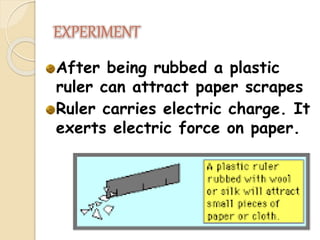
EXPERIMENT
After being rubbed a plastic
ruler can attract paper scrapes
Ruler carries electric charge. It
exerts electric force on paper.
Where do charges come from ?
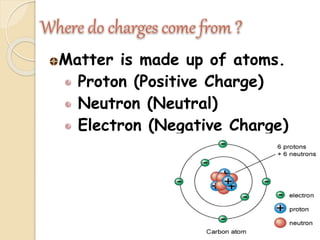
Matter is made up of atoms.
Proton (Positive Charge)
Neutron (Neutral)
Electron (Negative Charge)
Where do charges come from ?
If electrons = protons then
its neutral
If electrons > protons then
negative charge (gaining
electrons)
If electrons< protons the
positive charge(losing
electrons)
Where do charges come from ?
Rubbing materials doesnot
create electric charges.
It just transfers electrons
from one material to the
other.
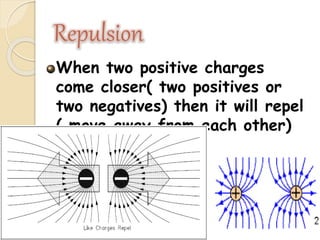
Repulsion
When two positive charges
come closer( two positives or
two negatives) then it will repel
( move away from each other)
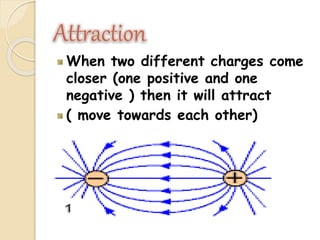
Attraction
When two different charges come
closer (one positive and one
negative ) then it will attract
( move towards each other)
What actually happened in the case
of paper pieces ?
When scale was rubbed with a
woolen cloth, it got charged and
as the paper pieces were
negatively charged. They
attracted to each other.
Electrons can be rubbed off from
one material to another.
What actually happened in the case
of paper pieces ?
 The material that has got
extra electrons are now
negatively charged.
 The material which has lost
electrons is positively charged
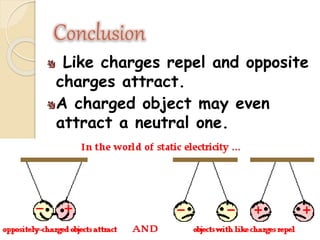
Conclusion
Like charges repel and opposite
charges attract.
A charged object may even
attract a neutral one.
Charge

Charge

  • 1.
  • 2.
    What is StaticElectricity? A Stationary electrical charge that is build up on the surface of a material. It is called Static Electricity because charges does not move. The electricity we use everyday involves moving charges.
  • 3.
    EXPERIMENT After being rubbeda plastic ruler can attract paper scrapes Ruler carries electric charge. It exerts electric force on paper.
  • 4.
    Where do chargescome from ? Matter is made up of atoms. Proton (Positive Charge) Neutron (Neutral) Electron (Negative Charge)
  • 5.
    Where do chargescome from ? If electrons = protons then its neutral If electrons > protons then negative charge (gaining electrons) If electrons< protons the positive charge(losing electrons)
  • 6.
    Where do chargescome from ? Rubbing materials doesnot create electric charges. It just transfers electrons from one material to the other.
  • 7.
    Repulsion When two positivecharges come closer( two positives or two negatives) then it will repel ( move away from each other)
  • 8.
    Attraction When two differentcharges come closer (one positive and one negative ) then it will attract ( move towards each other)
  • 9.
    What actually happenedin the case of paper pieces ? When scale was rubbed with a woolen cloth, it got charged and as the paper pieces were negatively charged. They attracted to each other. Electrons can be rubbed off from one material to another.
  • 10.
    What actually happenedin the case of paper pieces ?  The material that has got extra electrons are now negatively charged.  The material which has lost electrons is positively charged
  • 11.
    Conclusion Like charges repeland opposite charges attract. A charged object may even attract a neutral one.