Electric Potential Energy
&
Electric Potential
LESSON GOALS
• Understanding the concept of electric potential;
• Differentiate electric potential energy from electric potential; and
• Solving problems involving electric potential.
Gravitational Potential Energy
10m
20m
30m
40m
50m
60m
(10m)(9.8m/s2)(2kg) = 196J
(20m)(9.8m/s2)(2kg) = 392 J
(30m)(9.8m/s2)(2kg) = 588 J
(40m)(9.8m/s2)(2kg) = 784 J
(50m)(9.8m/s2)(2kg) = 980 J
(60m)(9.8m/s2)(2kg) = 1176 J
Gravitational Potential Energy
(10m)(9.8m/s2) = 98 J/kg
(20m)(9.8m/s2) = 196 J/kg
(30m)(9.8m/s2) = 294 J/kg
(40m)(9.8m/s2) = 392 J/kg
(50m)(9.8m/s2) = 490 J/kg
(60m)(9.8m/s2= 588 J/kg
Gravitational Potential
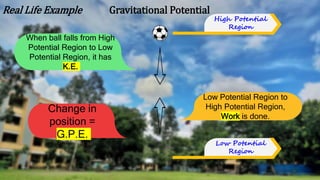
Real Life Example
Low Potential Region to
High Potential Region,
Work is done.
Gravitational Potential
High Potential
Region
Low Potential
Region
When ball falls from High
Potential Region to Low
Potential Region, it has
K.E.
Change in
position =
G.P.E.
High Potential
Region
low Potential
Region
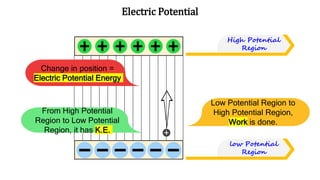
Electric Potential
Low Potential Region to
High Potential Region,
Work is done.
Change in position =
Electric Potential Energy
From High Potential
Region to Low Potential
Region, it has K.E.
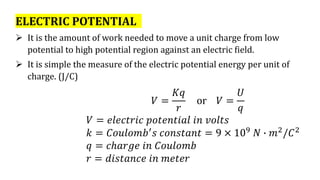
ELECTRIC POTENTIAL
 It is the amount of work needed to move a unit charge from low
potential to high potential region against an electric field.
 It is simple the measure of the electric potential energy per unit of
charge. (J/C)
𝑉 =
𝐾𝑞
𝑟
or 𝑉 =
𝑈
𝑞
𝑉 = 𝑒𝑙𝑒𝑐𝑡𝑟𝑖𝑐 𝑝𝑜𝑡𝑒𝑛𝑡𝑖𝑎𝑙 𝑖𝑛 𝑣𝑜𝑙𝑡𝑠
𝑘 = 𝐶𝑜𝑢𝑙𝑜𝑚𝑏′
𝑠 𝑐𝑜𝑛𝑠𝑡𝑎𝑛𝑡 = 9 × 10⁹
𝑁 ∙ 𝑚2
/𝐶2
𝑞 = 𝑐ℎ𝑎𝑟𝑔𝑒 𝑖𝑛 𝐶𝑜𝑢𝑙𝑜𝑚𝑏
𝑟 = 𝑑𝑖𝑠𝑡𝑎𝑛𝑐𝑒 𝑖𝑛 𝑚𝑒𝑡𝑒𝑟
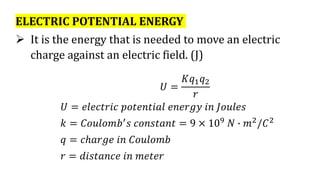
ELECTRIC POTENTIAL ENERGY
 It is the energy that is needed to move an electric
charge against an electric field. (J)
𝑈 =
𝐾𝑞1𝑞2
𝑟
𝑈 = 𝑒𝑙𝑒𝑐𝑡𝑟𝑖𝑐 𝑝𝑜𝑡𝑒𝑛𝑡𝑖𝑎𝑙 𝑒𝑛𝑒𝑟𝑔𝑦 𝑖𝑛 𝐽𝑜𝑢𝑙𝑒𝑠
𝑘 = 𝐶𝑜𝑢𝑙𝑜𝑚𝑏′
𝑠 𝑐𝑜𝑛𝑠𝑡𝑎𝑛𝑡 = 9 × 10⁹
𝑁 ∙ 𝑚2
/𝐶2
𝑞 = 𝑐ℎ𝑎𝑟𝑔𝑒 𝑖𝑛 𝐶𝑜𝑢𝑙𝑜𝑚𝑏
𝑟 = 𝑑𝑖𝑠𝑡𝑎𝑛𝑐𝑒 𝑖𝑛 𝑚𝑒𝑡𝑒𝑟
1. If a charge of magnitude 6.5x10⁻¹⁷C is being
held in place 2x10⁻⁸m from a charge of -8x10-19C
which is also being held in place, what is the
electric potential energy of the system?
Given:
Unknown:
Soln:
Final Answer:
Formula:
2. Find the electric potential at a distance of 8cm
from a 7.58pC charge.
Given:
Unknown:
Soln:
Final Answer:
Formula:
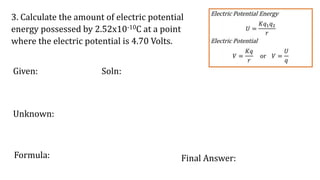
3. Calculate the amount of electric potential
energy possessed by 2.52x10⁻¹⁰C at a point
where the electric potential is 4.70 Volts.
Given:
Unknown:
Soln:
Final Answer:
Formula:
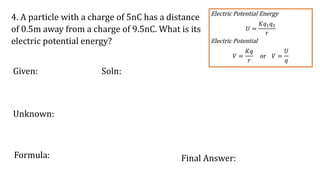
4. A particle with a charge of 5nC has a distance
of 0.5m away from a charge of 9.5nC. What is its
electric potential energy?
Given:
Unknown:
Soln:
Final Answer:
Formula:
5. What is the electric potential given 0.58m
away from an 18uC charge?
Given:
Unknown:
Soln:
Final Answer:
Formula:

Electric Potential.pptx

  • 1.
  • 2.
    LESSON GOALS • Understandingthe concept of electric potential; • Differentiate electric potential energy from electric potential; and • Solving problems involving electric potential.
  • 3.
  • 4.
    10m 20m 30m 40m 50m 60m (10m)(9.8m/s2)(2kg) = 196J (20m)(9.8m/s2)(2kg)= 392 J (30m)(9.8m/s2)(2kg) = 588 J (40m)(9.8m/s2)(2kg) = 784 J (50m)(9.8m/s2)(2kg) = 980 J (60m)(9.8m/s2)(2kg) = 1176 J Gravitational Potential Energy (10m)(9.8m/s2) = 98 J/kg (20m)(9.8m/s2) = 196 J/kg (30m)(9.8m/s2) = 294 J/kg (40m)(9.8m/s2) = 392 J/kg (50m)(9.8m/s2) = 490 J/kg (60m)(9.8m/s2= 588 J/kg Gravitational Potential
  • 5.
    Real Life Example LowPotential Region to High Potential Region, Work is done. Gravitational Potential High Potential Region Low Potential Region When ball falls from High Potential Region to Low Potential Region, it has K.E. Change in position = G.P.E.
  • 6.
    High Potential Region low Potential Region ElectricPotential Low Potential Region to High Potential Region, Work is done. Change in position = Electric Potential Energy From High Potential Region to Low Potential Region, it has K.E.
  • 7.
    ELECTRIC POTENTIAL  Itis the amount of work needed to move a unit charge from low potential to high potential region against an electric field.  It is simple the measure of the electric potential energy per unit of charge. (J/C) 𝑉 = 𝐾𝑞 𝑟 or 𝑉 = 𝑈 𝑞 𝑉 = 𝑒𝑙𝑒𝑐𝑡𝑟𝑖𝑐 𝑝𝑜𝑡𝑒𝑛𝑡𝑖𝑎𝑙 𝑖𝑛 𝑣𝑜𝑙𝑡𝑠 𝑘 = 𝐶𝑜𝑢𝑙𝑜𝑚𝑏′ 𝑠 𝑐𝑜𝑛𝑠𝑡𝑎𝑛𝑡 = 9 × 10⁹ 𝑁 ∙ 𝑚2 /𝐶2 𝑞 = 𝑐ℎ𝑎𝑟𝑔𝑒 𝑖𝑛 𝐶𝑜𝑢𝑙𝑜𝑚𝑏 𝑟 = 𝑑𝑖𝑠𝑡𝑎𝑛𝑐𝑒 𝑖𝑛 𝑚𝑒𝑡𝑒𝑟
  • 8.
    ELECTRIC POTENTIAL ENERGY It is the energy that is needed to move an electric charge against an electric field. (J) 𝑈 = 𝐾𝑞1𝑞2 𝑟 𝑈 = 𝑒𝑙𝑒𝑐𝑡𝑟𝑖𝑐 𝑝𝑜𝑡𝑒𝑛𝑡𝑖𝑎𝑙 𝑒𝑛𝑒𝑟𝑔𝑦 𝑖𝑛 𝐽𝑜𝑢𝑙𝑒𝑠 𝑘 = 𝐶𝑜𝑢𝑙𝑜𝑚𝑏′ 𝑠 𝑐𝑜𝑛𝑠𝑡𝑎𝑛𝑡 = 9 × 10⁹ 𝑁 ∙ 𝑚2 /𝐶2 𝑞 = 𝑐ℎ𝑎𝑟𝑔𝑒 𝑖𝑛 𝐶𝑜𝑢𝑙𝑜𝑚𝑏 𝑟 = 𝑑𝑖𝑠𝑡𝑎𝑛𝑐𝑒 𝑖𝑛 𝑚𝑒𝑡𝑒𝑟
  • 9.
    1. If acharge of magnitude 6.5x10⁻¹⁷C is being held in place 2x10⁻⁸m from a charge of -8x10-19C which is also being held in place, what is the electric potential energy of the system? Given: Unknown: Soln: Final Answer: Formula:
  • 10.
    2. Find theelectric potential at a distance of 8cm from a 7.58pC charge. Given: Unknown: Soln: Final Answer: Formula:
  • 11.
    3. Calculate theamount of electric potential energy possessed by 2.52x10⁻¹⁰C at a point where the electric potential is 4.70 Volts. Given: Unknown: Soln: Final Answer: Formula:
  • 12.
    4. A particlewith a charge of 5nC has a distance of 0.5m away from a charge of 9.5nC. What is its electric potential energy? Given: Unknown: Soln: Final Answer: Formula:
  • 13.
    5. What isthe electric potential given 0.58m away from an 18uC charge? Given: Unknown: Soln: Final Answer: Formula: