PHYSICS
WORK AND ELECTRIC POTENTIAL
ENERGY
Teacher: Telman Askeraliyev, MSc, Italy
ELECTRIC POTENTIAL ENERGY
When a test charge is placed in an electric field, it experiences a
force.
𝑭 = 𝒒𝑬 (𝒕𝒉𝒆 𝒇𝒐𝒓𝒄𝒆 𝒊𝒔 𝒄𝒐𝒏𝒔𝒆𝒓𝒗𝒂𝒕𝒊𝒗𝒆).
If the test charge is moved in the field by some external agent,
the work done by the field is the negative of the work done by
the external agent.
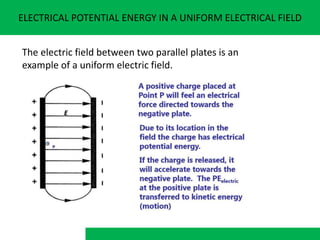
ELECTRICAL POTENTIAL ENERGY IN A UNIFORM ELECTRICAL FIELD
The electric field between two parallel plates is an
example of a uniform electric field.
ELECTRICAL POTENTIAL ENERGY
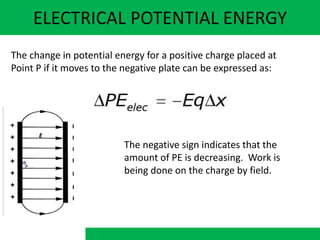
The change in potential energy for a positive charge placed at
Point P if it moves to the negative plate can be expressed as:
The negative sign indicates that the
amount of PE is decreasing. Work is
being done on the charge by field.
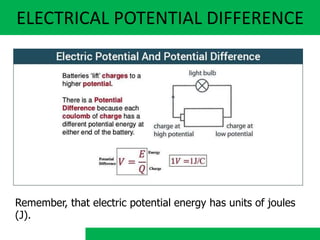
ELECTRICAL POTENTIAL DIFFERENCE
Remember, that electric potential energy has units of joules
(J).
UNITS
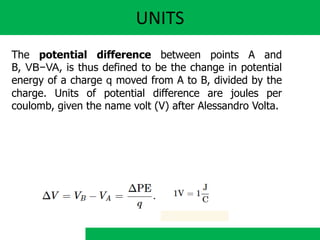
The potential difference between points A and
B, VB−VA, is thus defined to be the change in potential
energy of a charge q moved from A to B, divided by the
charge. Units of potential difference are joules per
coulomb, given the name volt (V) after Alessandro Volta.
UNITS
One joule is the work done to move an electric charge of
one coulomb through an electrical potential difference of
one volt, or one "coulomb-volt" (C-V).
Note: Joule is both the unit of work and energy. Even
though the unit is same for both, the two quantities are
not.
ELECTRICAL POTENTIAL DIFFERENCE
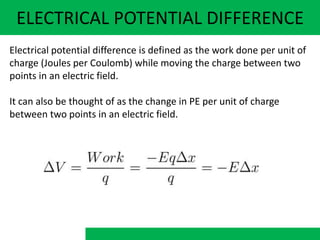
Electrical potential difference is defined as the work done per unit of
charge (Joules per Coulomb) while moving the charge between two
points in an electric field.
It can also be thought of as the change in PE per unit of charge
between two points in an electric field.
ELECTRICAL POTENTIAL DIFFERENCE
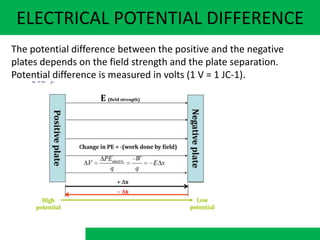
The potential difference between the positive and the negative
plates depends on the field strength and the plate separation.
Potential difference is measured in volts (1 V = 1 JC-1).
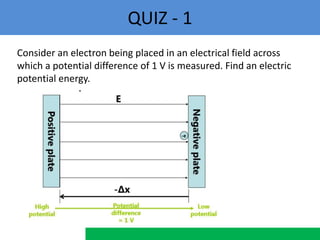
QUIZ - 1
Consider an electron being placed in an electrical field across
which a potential difference of 1 V is measured. Find an electric
potential energy.
QUIZ - 2
Suppose you have a 12.0 V motorcycle battery that can
move 5000 C of charge, and a 12.0 V car battery that can
move 60,000 C of charge. How much energy does each
deliver? (Assume that the numerical value of each charge
is accurate to three significant figures.)
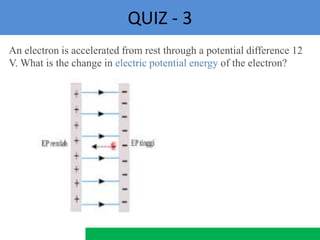
QUIZ - 3
An electron is accelerated from rest through a potential difference 12
V. What is the change in electric potential energy of the electron?
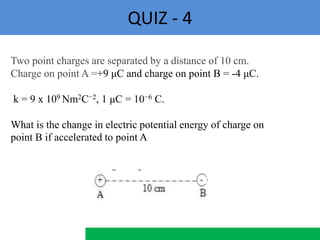
QUIZ - 4
Two point charges are separated by a distance of 10 cm.
Charge on point A =+9 μC and charge on point B = -4 μC.
k = 9 x 10⁹ Nm2C−2, 1 μC = 10−6 C.
What is the change in electric potential energy of charge on
point B if accelerated to point A
REAL LIFE EXAMPLE
Voltage is not the same as energy. Voltage is the energy per unit charge.
Thus a motorcycle battery and a car battery can both have the same
voltage (more precisely, the same potential difference between battery
terminals), yet one stores much more energy than the other since
ΔU = =qΔV.
The car battery can move more charge than the motorcycle battery,
although both are 12 V batteries.
WORK OF ELECTRICITY
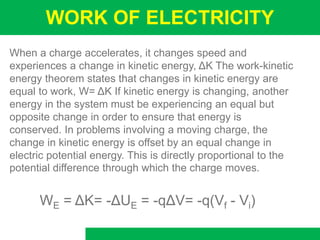
When a charge accelerates, it changes speed and
experiences a change in kinetic energy, ΔK The work-kinetic
energy theorem states that changes in kinetic energy are
equal to work, W= ΔK If kinetic energy is changing, another
energy in the system must be experiencing an equal but
opposite change in order to ensure that energy is
conserved. In problems involving a moving charge, the
change in kinetic energy is offset by an equal change in
electric potential energy. This is directly proportional to the
potential difference through which the charge moves.
WE = ΔK= -ΔUE = -qΔV= -q(Vf - Vi)
QUIZ - 5
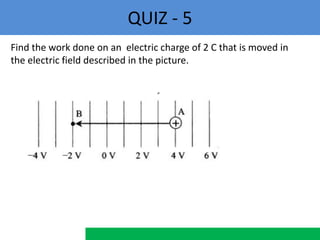
Find the work done on an electric charge of 2 C that is moved in
the electric field described in the picture.
QUIZ - ASNWER
Work is equal to a change in energy. This problem involves
equipotential lines. The energy that is changing is electric potential
energy, A This is related to the potential difference ΔUE, This is
related to the potential difference,ΔV,through which the 2-coulomb
charge moves.
W = -ΔUE = -q ΔV = -q(Vf - Vi)
W = -ΔUE =-q ΔV = -(2 C)[(-2 V) - (+4 V)]
W = +12 J
QUIZ - 6
Two parallel plates are charged. The separation between the
plates is 2 cm and the magnitude of the electric field between the
plates is 500 Volt/meter. What is the change in potential energy
of the proton when accelerated from the positively charged plate
to the negatively charged plate.
The eV
1eV is defined as the amount of energy required to move an
electron through a potential difference of 1Volt
An electron that accelerates through a potential difference
of 100V will lose 100eV of electric potential energy and gain
100eV of kinetic energy.
The eV is not a proper SI unit so we must convert to Joules
when performing calculations involving SI units.
1.0eV = 1.6x10⁻¹⁹J
ELECTRIC POTENTIAL
When an object moves in a gravitational field, it usually
experiences a change in kinetic energy and in gravitational
potential energy because there is work done on the object by
gravity. Similarly, when a charge moves in an electric field, it
generally experiences a change in kinetic energy and in
electrical potential energy because of the work done on it by
the electric field. In this chapter we will discuss electric
potentials.
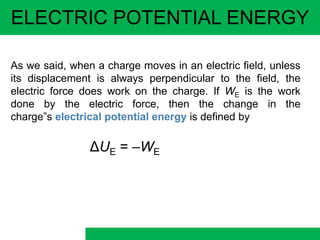
ELECTRIC POTENTIAL ENERGY
As we said, when a charge moves in an electric field, unless
its displacement is always perpendicular to the field, the
electric force does work on the charge. If WE is the work
done by the electric force, then the change in the
charge”s electrical potential energy is defined by
ΔUE = –WE
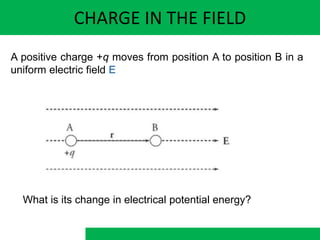
CHARGE IN THE FIELD
A positive charge +q moves from position A to position B in a
uniform electric field E
What is its change in electrical potential energy?
CHARGE IN THE FIELD
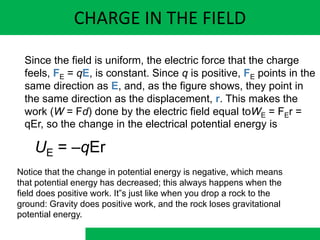
Since the field is uniform, the electric force that the charge
feels, FE = qE, is constant. Since q is positive, FE points in the
same direction as E, and, as the figure shows, they point in
the same direction as the displacement, r. This makes the
work (W = Fd) done by the electric field equal toWE = FEr =
qEr, so the change in the electrical potential energy is
UE = –qEr
Notice that the change in potential energy is negative, which means
that potential energy has decreased; this always happens when the
field does positive work. It”s just like when you drop a rock to the
ground: Gravity does positive work, and the rock loses gravitational
potential energy.
QUIZ - 7
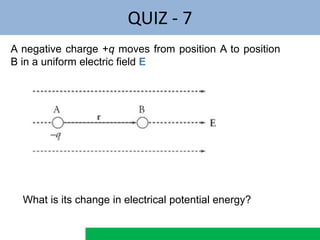
A negative charge +q moves from position A to position
B in a uniform electric field E
What is its change in electrical potential energy?
RELAX???
THANK YOU!

Physics potential energy=work w10-l21

  • 1.
    PHYSICS WORK AND ELECTRICPOTENTIAL ENERGY Teacher: Telman Askeraliyev, MSc, Italy
  • 2.
    ELECTRIC POTENTIAL ENERGY Whena test charge is placed in an electric field, it experiences a force. 𝑭 = 𝒒𝑬 (𝒕𝒉𝒆 𝒇𝒐𝒓𝒄𝒆 𝒊𝒔 𝒄𝒐𝒏𝒔𝒆𝒓𝒗𝒂𝒕𝒊𝒗𝒆). If the test charge is moved in the field by some external agent, the work done by the field is the negative of the work done by the external agent.
  • 3.
    ELECTRICAL POTENTIAL ENERGYIN A UNIFORM ELECTRICAL FIELD The electric field between two parallel plates is an example of a uniform electric field.
  • 4.
    ELECTRICAL POTENTIAL ENERGY Thechange in potential energy for a positive charge placed at Point P if it moves to the negative plate can be expressed as: The negative sign indicates that the amount of PE is decreasing. Work is being done on the charge by field.
  • 5.
    ELECTRICAL POTENTIAL DIFFERENCE Remember,that electric potential energy has units of joules (J).
  • 6.
    UNITS The potential differencebetween points A and B, VB−VA, is thus defined to be the change in potential energy of a charge q moved from A to B, divided by the charge. Units of potential difference are joules per coulomb, given the name volt (V) after Alessandro Volta.
  • 7.
    UNITS One joule isthe work done to move an electric charge of one coulomb through an electrical potential difference of one volt, or one "coulomb-volt" (C-V). Note: Joule is both the unit of work and energy. Even though the unit is same for both, the two quantities are not.
  • 8.
    ELECTRICAL POTENTIAL DIFFERENCE Electricalpotential difference is defined as the work done per unit of charge (Joules per Coulomb) while moving the charge between two points in an electric field. It can also be thought of as the change in PE per unit of charge between two points in an electric field.
  • 9.
    ELECTRICAL POTENTIAL DIFFERENCE Thepotential difference between the positive and the negative plates depends on the field strength and the plate separation. Potential difference is measured in volts (1 V = 1 JC-1).
  • 10.
    QUIZ - 1 Consideran electron being placed in an electrical field across which a potential difference of 1 V is measured. Find an electric potential energy.
  • 11.
    QUIZ - 2 Supposeyou have a 12.0 V motorcycle battery that can move 5000 C of charge, and a 12.0 V car battery that can move 60,000 C of charge. How much energy does each deliver? (Assume that the numerical value of each charge is accurate to three significant figures.)
  • 12.
    QUIZ - 3 Anelectron is accelerated from rest through a potential difference 12 V. What is the change in electric potential energy of the electron?
  • 13.
    QUIZ - 4 Twopoint charges are separated by a distance of 10 cm. Charge on point A =+9 μC and charge on point B = -4 μC. k = 9 x 10⁹ Nm2C−2, 1 μC = 10−6 C. What is the change in electric potential energy of charge on point B if accelerated to point A
  • 14.
    REAL LIFE EXAMPLE Voltageis not the same as energy. Voltage is the energy per unit charge. Thus a motorcycle battery and a car battery can both have the same voltage (more precisely, the same potential difference between battery terminals), yet one stores much more energy than the other since ΔU = =qΔV. The car battery can move more charge than the motorcycle battery, although both are 12 V batteries.
  • 15.
    WORK OF ELECTRICITY Whena charge accelerates, it changes speed and experiences a change in kinetic energy, ΔK The work-kinetic energy theorem states that changes in kinetic energy are equal to work, W= ΔK If kinetic energy is changing, another energy in the system must be experiencing an equal but opposite change in order to ensure that energy is conserved. In problems involving a moving charge, the change in kinetic energy is offset by an equal change in electric potential energy. This is directly proportional to the potential difference through which the charge moves. WE = ΔK= -ΔUE = -qΔV= -q(Vf - Vi)
  • 16.
    QUIZ - 5 Findthe work done on an electric charge of 2 C that is moved in the electric field described in the picture.
  • 17.
    QUIZ - ASNWER Workis equal to a change in energy. This problem involves equipotential lines. The energy that is changing is electric potential energy, A This is related to the potential difference ΔUE, This is related to the potential difference,ΔV,through which the 2-coulomb charge moves. W = -ΔUE = -q ΔV = -q(Vf - Vi) W = -ΔUE =-q ΔV = -(2 C)[(-2 V) - (+4 V)] W = +12 J
  • 18.
    QUIZ - 6 Twoparallel plates are charged. The separation between the plates is 2 cm and the magnitude of the electric field between the plates is 500 Volt/meter. What is the change in potential energy of the proton when accelerated from the positively charged plate to the negatively charged plate.
  • 19.
    The eV 1eV isdefined as the amount of energy required to move an electron through a potential difference of 1Volt An electron that accelerates through a potential difference of 100V will lose 100eV of electric potential energy and gain 100eV of kinetic energy. The eV is not a proper SI unit so we must convert to Joules when performing calculations involving SI units. 1.0eV = 1.6x10⁻¹⁹J
  • 20.
    ELECTRIC POTENTIAL When anobject moves in a gravitational field, it usually experiences a change in kinetic energy and in gravitational potential energy because there is work done on the object by gravity. Similarly, when a charge moves in an electric field, it generally experiences a change in kinetic energy and in electrical potential energy because of the work done on it by the electric field. In this chapter we will discuss electric potentials.
  • 21.
    ELECTRIC POTENTIAL ENERGY Aswe said, when a charge moves in an electric field, unless its displacement is always perpendicular to the field, the electric force does work on the charge. If WE is the work done by the electric force, then the change in the charge”s electrical potential energy is defined by ΔUE = –WE
  • 22.
    CHARGE IN THEFIELD A positive charge +q moves from position A to position B in a uniform electric field E What is its change in electrical potential energy?
  • 23.
    CHARGE IN THEFIELD Since the field is uniform, the electric force that the charge feels, FE = qE, is constant. Since q is positive, FE points in the same direction as E, and, as the figure shows, they point in the same direction as the displacement, r. This makes the work (W = Fd) done by the electric field equal toWE = FEr = qEr, so the change in the electrical potential energy is UE = –qEr Notice that the change in potential energy is negative, which means that potential energy has decreased; this always happens when the field does positive work. It”s just like when you drop a rock to the ground: Gravity does positive work, and the rock loses gravitational potential energy.
  • 24.
    QUIZ - 7 Anegative charge +q moves from position A to position B in a uniform electric field E What is its change in electrical potential energy?
  • 25.
  • 26.