MAGM 225

Electric Motor Basics


       Mr. Conrado
Why use electric motors?
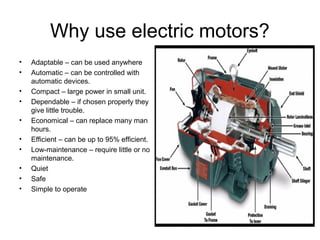
•   Adaptable – can be used anywhere
•   Automatic – can be controlled with
    automatic devices.
•   Compact – large power in small unit.
•   Dependable – if chosen properly they
    give little trouble.
•   Economical – can replace many man
    hours.
•   Efficient – can be up to 95% efficient.
•   Low-maintenance – require little or no
    maintenance.
•   Quiet
•   Safe
•   Simple to operate
Selecting the proper motor
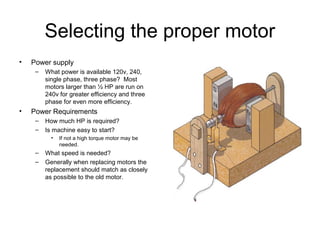
•   Power supply
     –   What power is available 120v, 240,
         single phase, three phase? Most
         motors larger than ½ HP are run on
         240v for greater efficiency and three
         phase for even more efficiency.
•   Power Requirements
     –   How much HP is required?
     –   Is machine easy to start?
           •   If not a high torque motor may be
               needed.
     –   What speed is needed?
     –   Generally when replacing motors the
         replacement should match as closely
         as possible to the old motor.
Selecting the proper motor
•   Base, Bearings, & Frame
     –   Generally the motor base or the
         mounting frame are slotted to
         accommodate bolts for mounting.
     –   Often rubber mounts are used to
         reduce vibration.
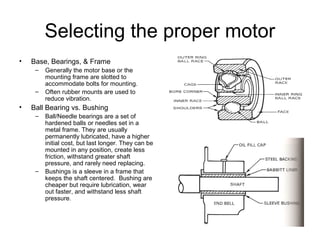
•   Ball Bearing vs. Bushing
     –   Ball/Needle bearings are a set of
         hardened balls or needles set in a
         metal frame. They are usually
         permanently lubricated, have a higher
         initial cost, but last longer. They can be
         mounted in any position, create less
         friction, withstand greater shaft
         pressure, and rarely need replacing.
     –   Bushings is a sleeve in a frame that
         keeps the shaft centered. Bushing are
         cheaper but require lubrication, wear
         out faster, and withstand less shaft
         pressure.
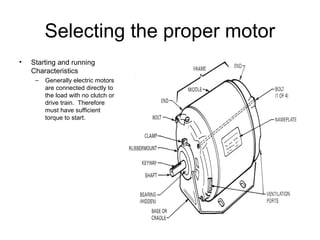
Selecting the proper motor
•   Starting and running
    Characteristics
     –   Generally electric motors
         are connected directly to
         the load with no clutch or
         drive train. Therefore
         must have sufficient
         torque to start.
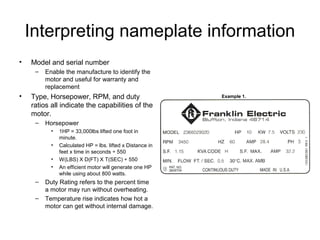
Interpreting nameplate information
•   Model and serial number
     –   Enable the manufacture to identify the
         motor and useful for warranty and
         replacement
•   Type, Horsepower, RPM, and duty
    ratios all indicate the capabilities of the
    motor.
     –   Horsepower
           •   1HP = 33,000lbs lifted one foot in
               minute.
           •   Calculated HP = lbs. lifted x Distance in
               feet x time in seconds ÷ 550
           •   W(LBS) X D(FT) X T(SEC) ÷ 550
           •   An efficient motor will generate one HP
               while using about 800 watts.
     –   Duty Rating refers to the percent time
         a motor may run without overheating.
     –   Temperature rise indicates how hot a
         motor can get without internal damage.
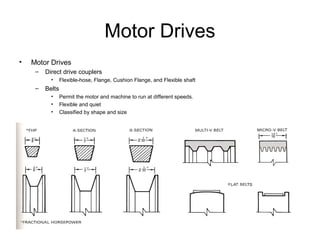
Motor Drives
•   Motor Drives
     –   Direct drive couplers
           •     Flexible-hose, Flange, Cushion Flange, and Flexible shaft
     –   Belts
           •     Permit the motor and machine to run at different speeds.
           •     Flexible and quiet
           •     Classified by shape and size
Motor Drives
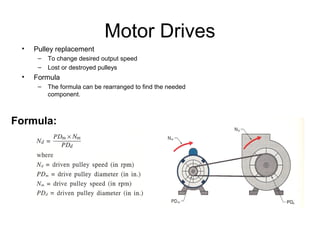
 •   Pulley replacement
      –   To change desired output speed
      –   Lost or destroyed pulleys
 •   Formula
      –   The formula can be rearranged to find the needed
          component.


Formula:
Example 1
                          Find Driven Pulley Speed
•   Example
     –   What is the speed of an 8” driven
         pulley if the diameter of the drive pulley
         is 12” and a speed of 150 RPM?


                                                                ?
                                                      150 rpm


                                                       12”          8”
Example 2
                                Find Drive Pulley Diameter
•   Calculating drive pulley diameter is based on
    knowing the speed of the driven pulley and the
    diameter of the drive pulley. The formula:

•   Example
     –   What is the diameter of a driven pulley rotating at 225
         rpm if the diameter of the drive is 12” and its speed is
         150 rpm?


                                                                              225 rpm
                                                                    150 rpm


                                                                     12”           ?
Example 3
                                        Find Drive Pulley Speed
•   Calculating drive pulley speed is based on knowing the
    diameters of the drive and driven pulleys and the driven
    pulley speed. The formula:

•   Example
     –   What is the speed of a 12” drive pulley if the diameter of the
         driven pulley is 8” and its speed is 225 RPM?


                                                                                    225 rpm
                                                                          ?


                                                                              12”
                                                                                              8”
Example 4
                                Find Drive Pulley Diameter
•   Calculating drive pulley diameter is based on
    knowing the speed of the drive pulley and the speed
    and diameter of the driven pulley.
     –   The formula:


•   Example
     –   What is the speed of a 12” drive pulley if the diameter of
         the driven pulley is 8” and its speed is 225 RPM?


                                                                                225 rpm

                                                                      150 rpm


                                                     12”
                                                                      ?                   8”
Belt Length
•     Belt length can be determined by using
      the pulley diameters and the proper
      formula.

    •Example:
        •What is the belt length for two
        pulleys 5” and 10” in diameter and
        30” apart at center?


                                               5”
                                                    30”   10”
Step Pulley Determination
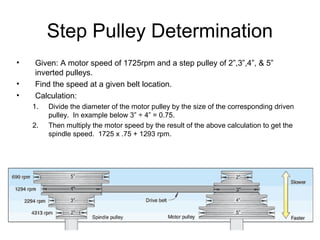
•   Given: A motor speed of 1725rpm and a step pulley of 2”,3”,4”, & 5”
    inverted pulleys.
•   Find the speed at a given belt location.
•   Calculation:
    1.   Divide the diameter of the motor pulley by the size of the corresponding driven
         pulley. In example below 3” ÷ 4” = 0.75.
    2.   Then multiply the motor speed by the result of the above calculation to get the
         spindle speed. 1725 x .75 + 1293 rpm.
Motor Switches
•   Types of switches
     –   Toggle, rotary, Push-button, trigger, or magnetic.
     –   Magnetic switches are recommended for motors 1hp or more.
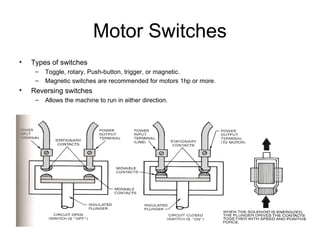
•   Reversing switches
     –   Allows the machine to run in either direction.

Electric motor basics

  • 1.
    MAGM 225 Electric MotorBasics Mr. Conrado
  • 2.
    Why use electricmotors? • Adaptable – can be used anywhere • Automatic – can be controlled with automatic devices. • Compact – large power in small unit. • Dependable – if chosen properly they give little trouble. • Economical – can replace many man hours. • Efficient – can be up to 95% efficient. • Low-maintenance – require little or no maintenance. • Quiet • Safe • Simple to operate
  • 3.
    Selecting the propermotor • Power supply – What power is available 120v, 240, single phase, three phase? Most motors larger than ½ HP are run on 240v for greater efficiency and three phase for even more efficiency. • Power Requirements – How much HP is required? – Is machine easy to start? • If not a high torque motor may be needed. – What speed is needed? – Generally when replacing motors the replacement should match as closely as possible to the old motor.
  • 4.
    Selecting the propermotor • Base, Bearings, & Frame – Generally the motor base or the mounting frame are slotted to accommodate bolts for mounting. – Often rubber mounts are used to reduce vibration. • Ball Bearing vs. Bushing – Ball/Needle bearings are a set of hardened balls or needles set in a metal frame. They are usually permanently lubricated, have a higher initial cost, but last longer. They can be mounted in any position, create less friction, withstand greater shaft pressure, and rarely need replacing. – Bushings is a sleeve in a frame that keeps the shaft centered. Bushing are cheaper but require lubrication, wear out faster, and withstand less shaft pressure.
  • 5.
    Selecting the propermotor • Starting and running Characteristics – Generally electric motors are connected directly to the load with no clutch or drive train. Therefore must have sufficient torque to start.
  • 6.
    Interpreting nameplate information • Model and serial number – Enable the manufacture to identify the motor and useful for warranty and replacement • Type, Horsepower, RPM, and duty ratios all indicate the capabilities of the motor. – Horsepower • 1HP = 33,000lbs lifted one foot in minute. • Calculated HP = lbs. lifted x Distance in feet x time in seconds ÷ 550 • W(LBS) X D(FT) X T(SEC) ÷ 550 • An efficient motor will generate one HP while using about 800 watts. – Duty Rating refers to the percent time a motor may run without overheating. – Temperature rise indicates how hot a motor can get without internal damage.
  • 7.
    Motor Drives • Motor Drives – Direct drive couplers • Flexible-hose, Flange, Cushion Flange, and Flexible shaft – Belts • Permit the motor and machine to run at different speeds. • Flexible and quiet • Classified by shape and size
  • 8.
    Motor Drives • Pulley replacement – To change desired output speed – Lost or destroyed pulleys • Formula – The formula can be rearranged to find the needed component. Formula:
  • 9.
    Example 1 Find Driven Pulley Speed • Example – What is the speed of an 8” driven pulley if the diameter of the drive pulley is 12” and a speed of 150 RPM? ? 150 rpm 12” 8”
  • 10.
    Example 2 Find Drive Pulley Diameter • Calculating drive pulley diameter is based on knowing the speed of the driven pulley and the diameter of the drive pulley. The formula: • Example – What is the diameter of a driven pulley rotating at 225 rpm if the diameter of the drive is 12” and its speed is 150 rpm? 225 rpm 150 rpm 12” ?
  • 11.
    Example 3 Find Drive Pulley Speed • Calculating drive pulley speed is based on knowing the diameters of the drive and driven pulleys and the driven pulley speed. The formula: • Example – What is the speed of a 12” drive pulley if the diameter of the driven pulley is 8” and its speed is 225 RPM? 225 rpm ? 12” 8”
  • 12.
    Example 4 Find Drive Pulley Diameter • Calculating drive pulley diameter is based on knowing the speed of the drive pulley and the speed and diameter of the driven pulley. – The formula: • Example – What is the speed of a 12” drive pulley if the diameter of the driven pulley is 8” and its speed is 225 RPM? 225 rpm 150 rpm 12” ? 8”
  • 13.
    Belt Length • Belt length can be determined by using the pulley diameters and the proper formula. •Example: •What is the belt length for two pulleys 5” and 10” in diameter and 30” apart at center? 5” 30” 10”
  • 14.
    Step Pulley Determination • Given: A motor speed of 1725rpm and a step pulley of 2”,3”,4”, & 5” inverted pulleys. • Find the speed at a given belt location. • Calculation: 1. Divide the diameter of the motor pulley by the size of the corresponding driven pulley. In example below 3” ÷ 4” = 0.75. 2. Then multiply the motor speed by the result of the above calculation to get the spindle speed. 1725 x .75 + 1293 rpm.
  • 15.
    Motor Switches • Types of switches – Toggle, rotary, Push-button, trigger, or magnetic. – Magnetic switches are recommended for motors 1hp or more. • Reversing switches – Allows the machine to run in either direction.