FUNDAMENTAL UNDERSTANDING OF
PULLEYS AND BELTDRIVES
ELEMENTS OF TECHNOLOGY
C.DINESHBABU,AP/MECH
WHAT ARE BELT DRIVES
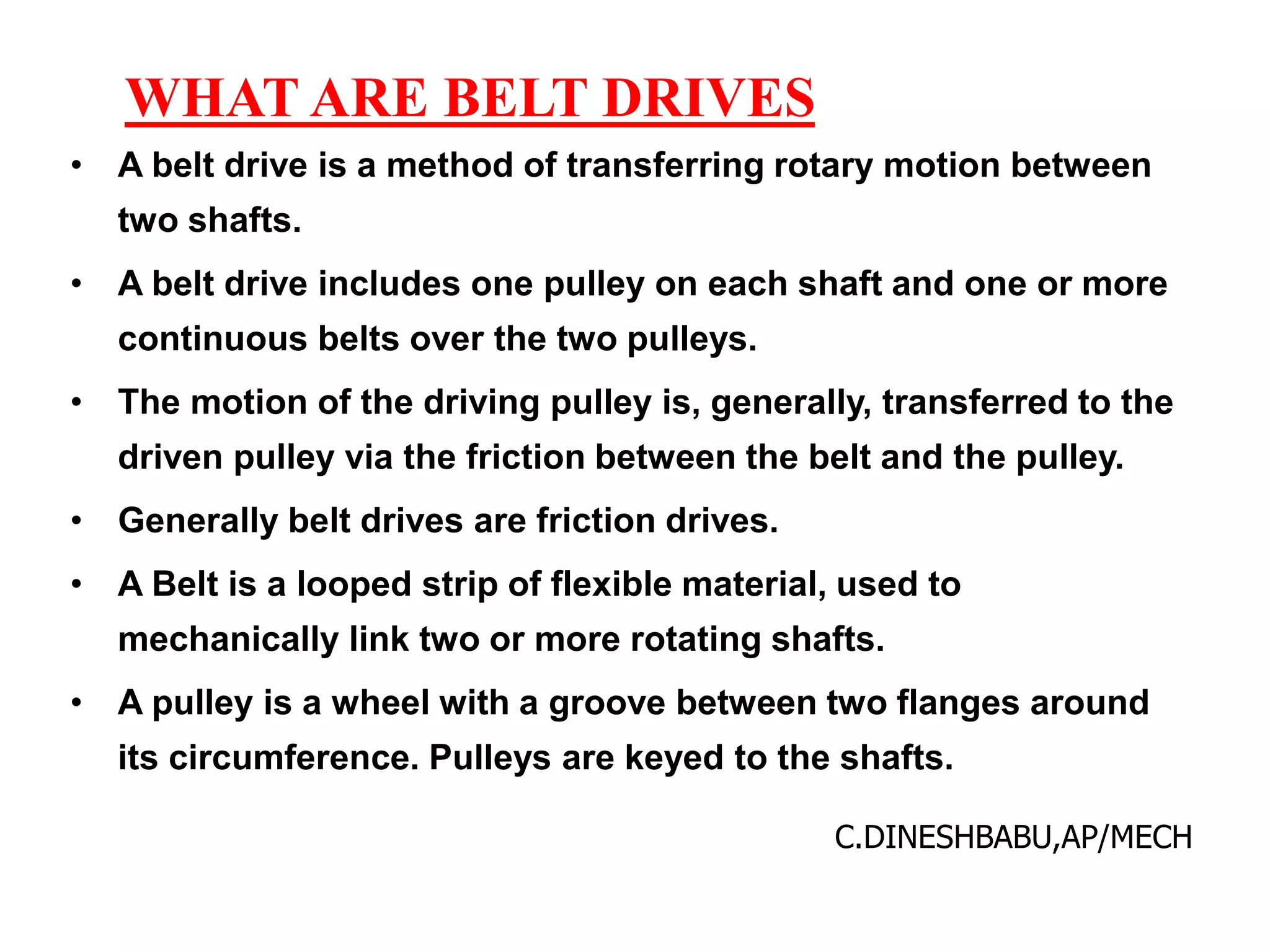
• A belt drive is a method of transferring rotary motion between
two shafts.
• A belt drive includes one pulley on each shaft and one or more
continuous belts over the two pulleys.
• The motion of the driving pulley is, generally, transferred to the
driven pulley via the friction between the belt and the pulley.
• Generally belt drives are friction drives.
• A Belt is a looped strip of flexible material, used to
mechanically link two or more rotating shafts.
• A pulley is a wheel with a groove between two flanges around
its circumference. Pulleys are keyed to the shafts.
C.DINESHBABU,AP/MECH
TYPES OF BELTS
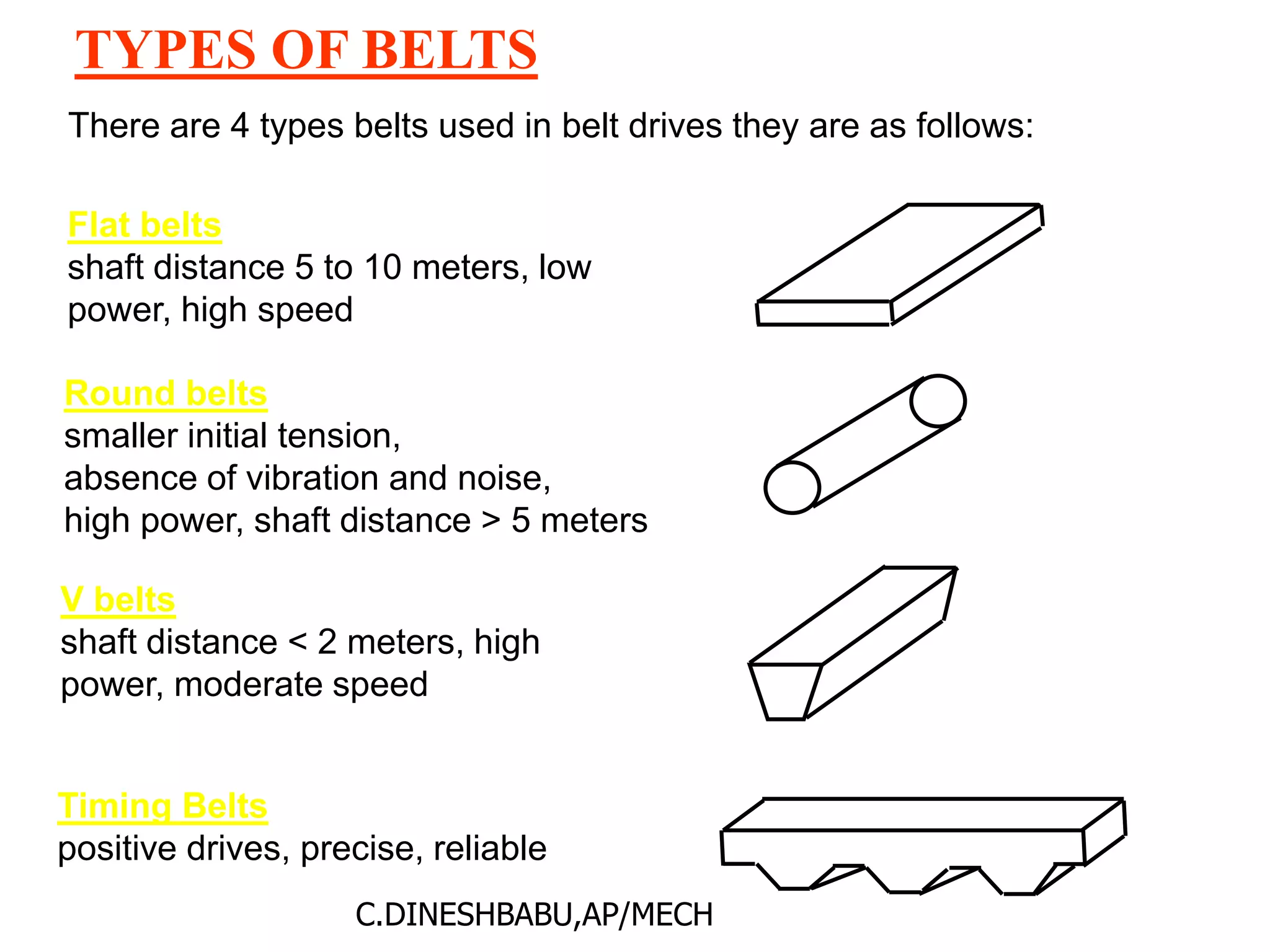
There are 4 types belts used in belt drives they are as follows:
Flat belts
shaft distance 5 to 10 meters, low
power, high speed
Round belts
smaller initial tension,
absence of vibration and noise,
high power, shaft distance > 5 meters
V belts
shaft distance < 2 meters, high
power, moderate speed
Timing Belts
positive drives, precise, reliable
C.DINESHBABU,AP/MECH
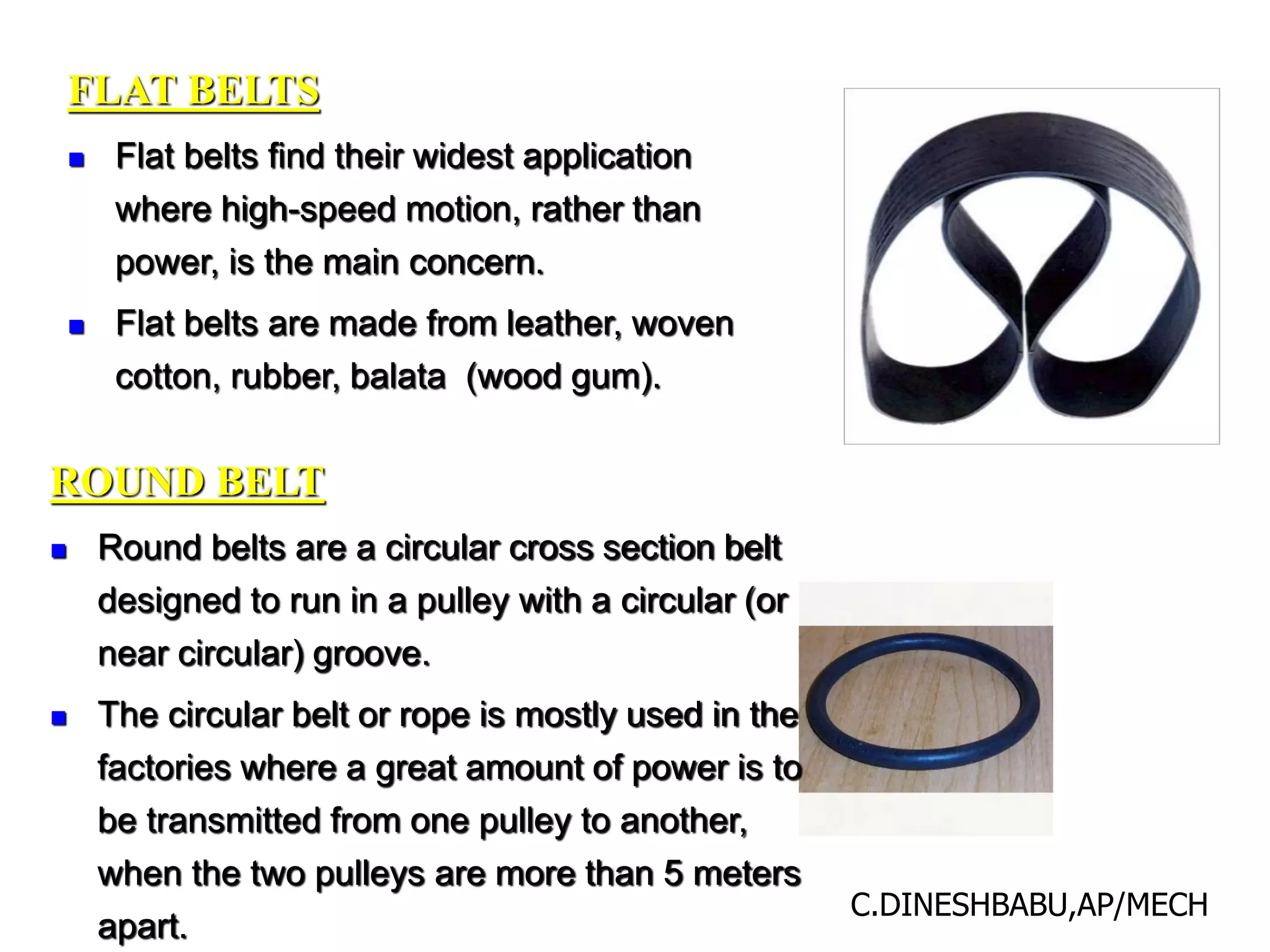
ROUND BELT
 Round belts are a circular cross section belt
designed to run in a pulley with a circular (or
near circular) groove.
 The circular belt or rope is mostly used in the
factories where a great amount of power is to
be transmitted from one pulley to another,
when the two pulleys are more than 5 meters
apart.
FLAT BELTS
 Flat belts find their widest application
where high-speed motion, rather than
power, is the main concern.
 Flat belts are made from leather, woven
cotton, rubber, balata (wood gum).
C.DINESHBABU,AP/MECH
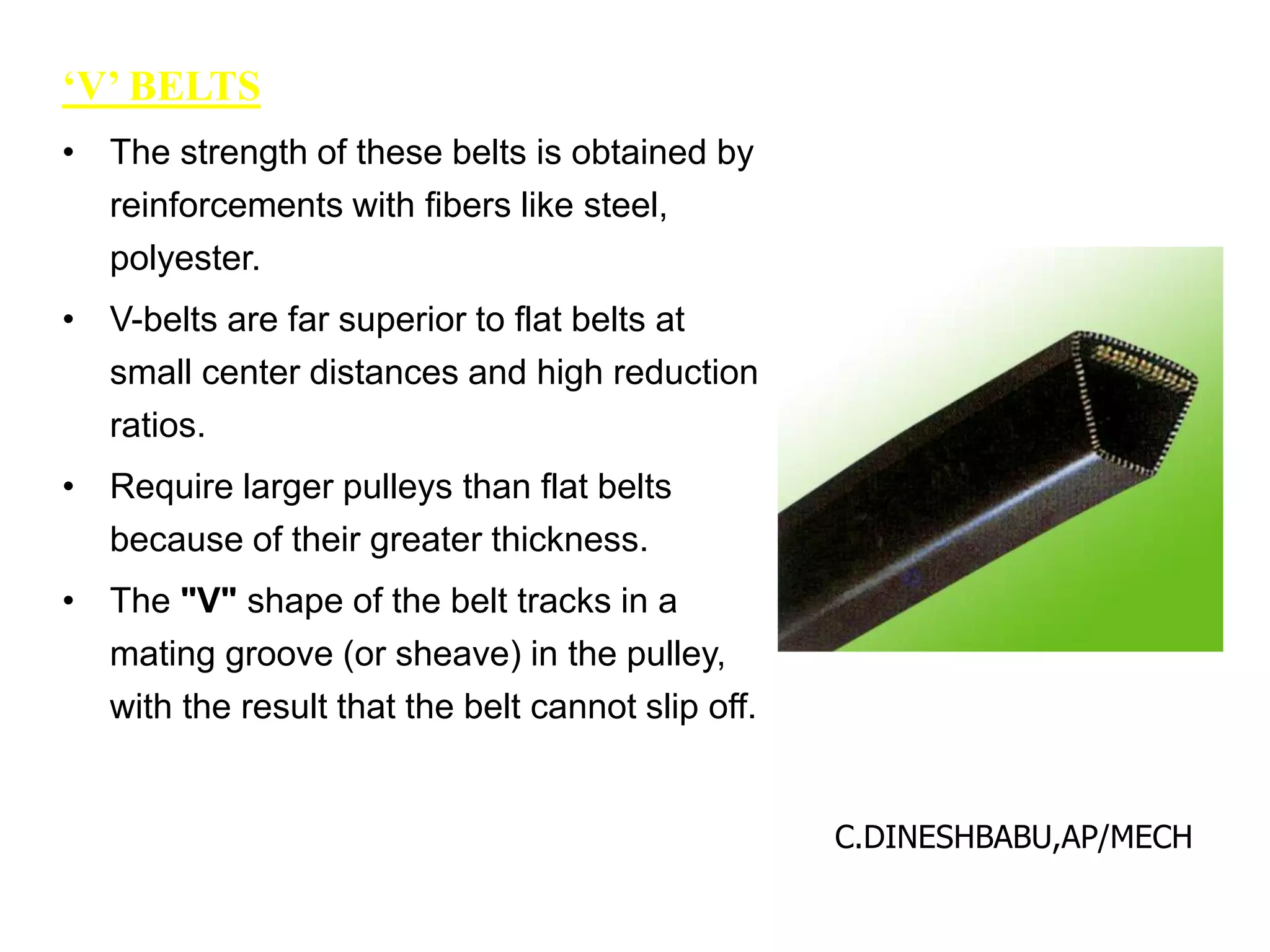
‘V’ BELTS
• The strength of these belts is obtained by
reinforcements with fibers like steel,
polyester.
• V-belts are far superior to flat belts at
small center distances and high reduction
ratios.
• Require larger pulleys than flat belts
because of their greater thickness.
• The "V" shape of the belt tracks in a
mating groove (or sheave) in the pulley,
with the result that the belt cannot slip off.
C.DINESHBABU,AP/MECH
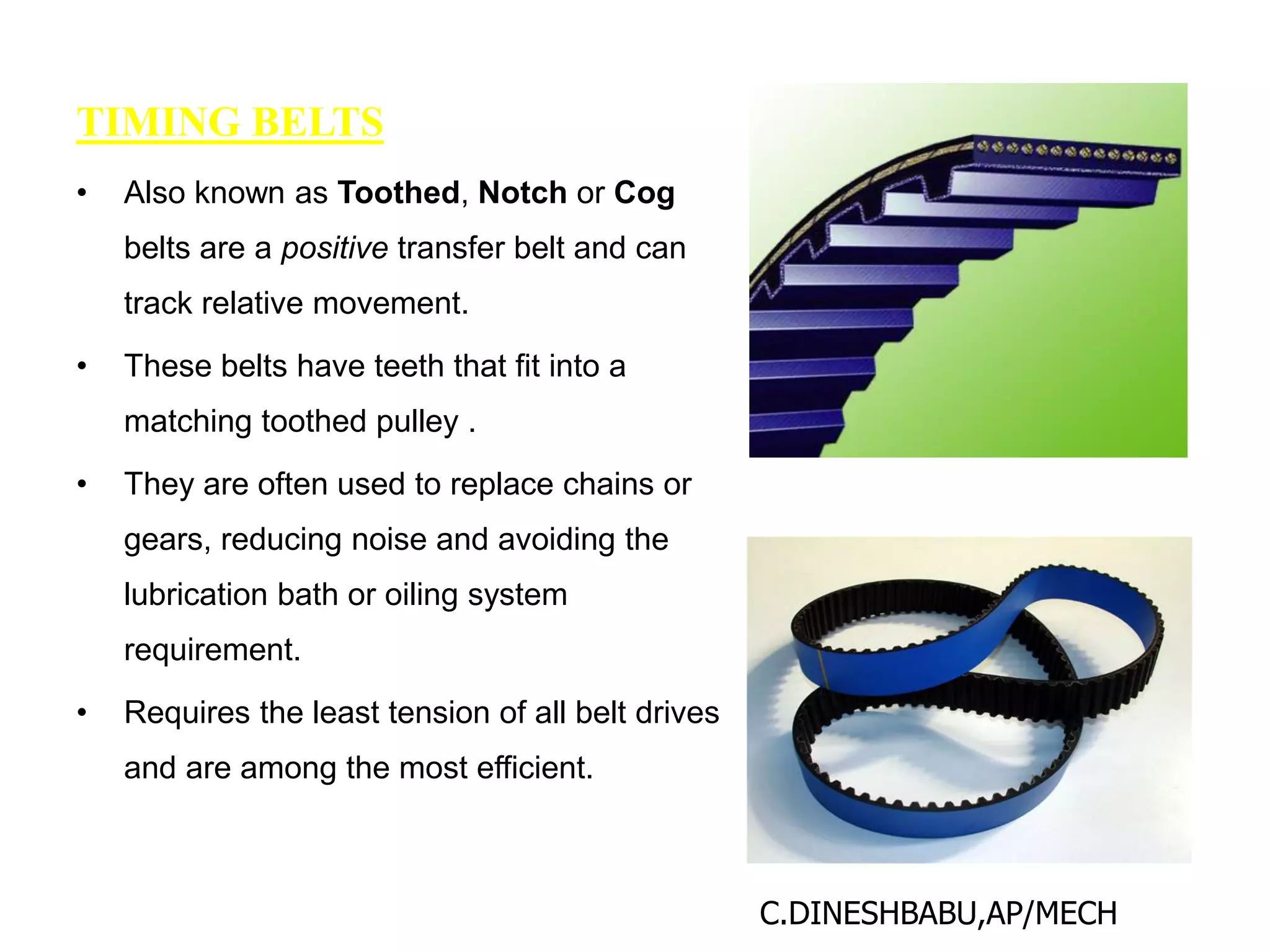
TIMING BELTS
• Also known as Toothed, Notch or Cog
belts are a positive transfer belt and can
track relative movement.
• These belts have teeth that fit into a
matching toothed pulley .
• They are often used to replace chains or
gears, reducing noise and avoiding the
lubrication bath or oiling system
requirement.
• Requires the least tension of all belt drives
and are among the most efficient.
C.DINESHBABU,AP/MECH
Types of Belt drives based on the arrangement are as follows
• OPEN BELT DRIVES
• CROSSED OR TWIST BELT DRIVES
• BELT DRIVE WITH IDLER PULLEYS
• COMPOUND BELT DRIVE
TYPES OF BELT DRIVES
BASED ON
ARRANGEMENT
C.DINESHBABU,AP/MECH
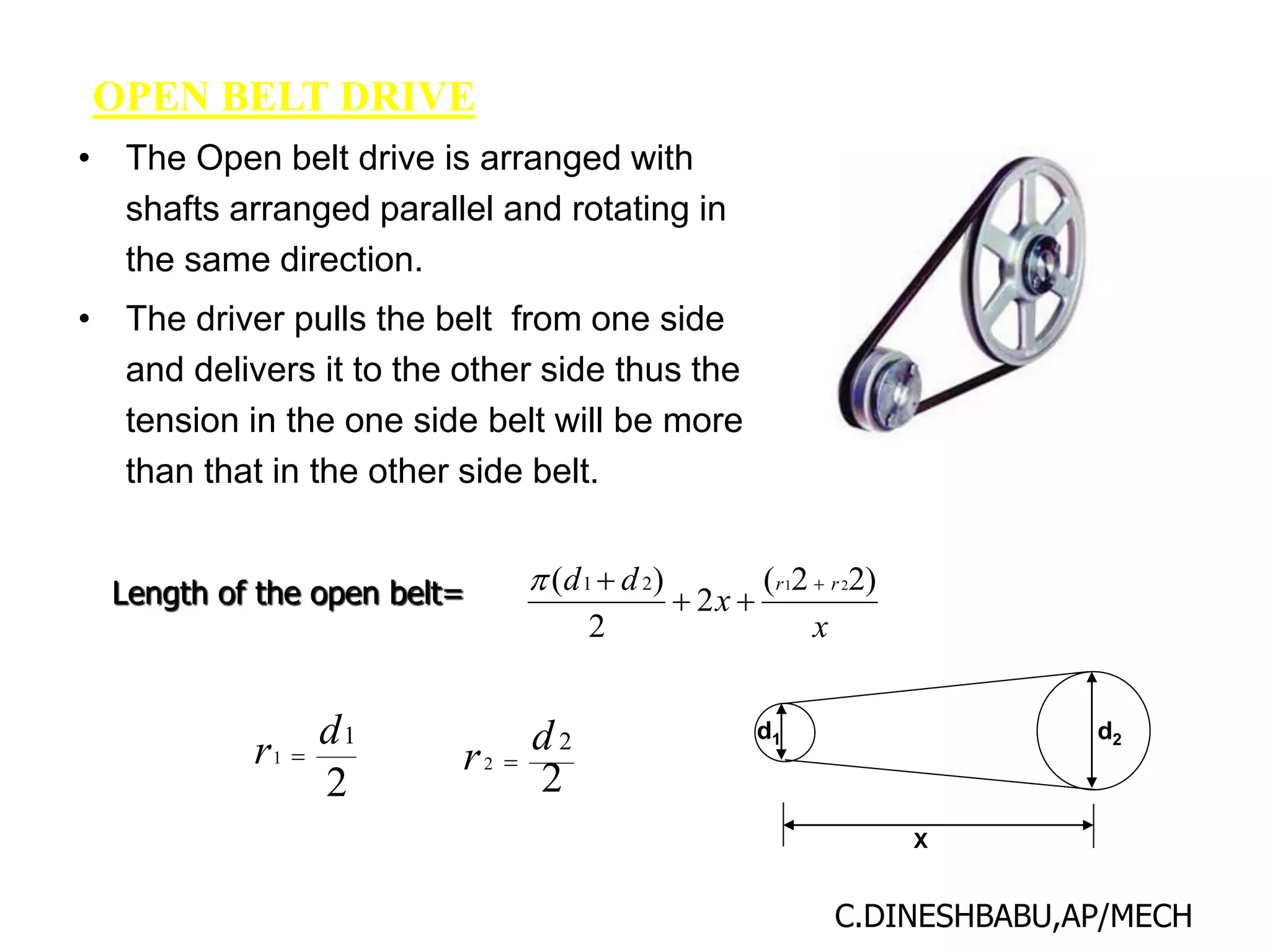
OPEN BELT DRIVE
• The Open belt drive is arranged with
shafts arranged parallel and rotating in
the same direction.
• The driver pulls the belt from one side
and delivers it to the other side thus the
tension in the one side belt will be more
than that in the other side belt.
x
x
d
d r
r )
2
2
(
2
2
)
( 2
1
2
1 




X
d1 d2
2
1
1
d
r 
2
2
2
d
r 
Length of the open belt=
C.DINESHBABU,AP/MECH
CROSSED OR TWIST BELT DRIVE
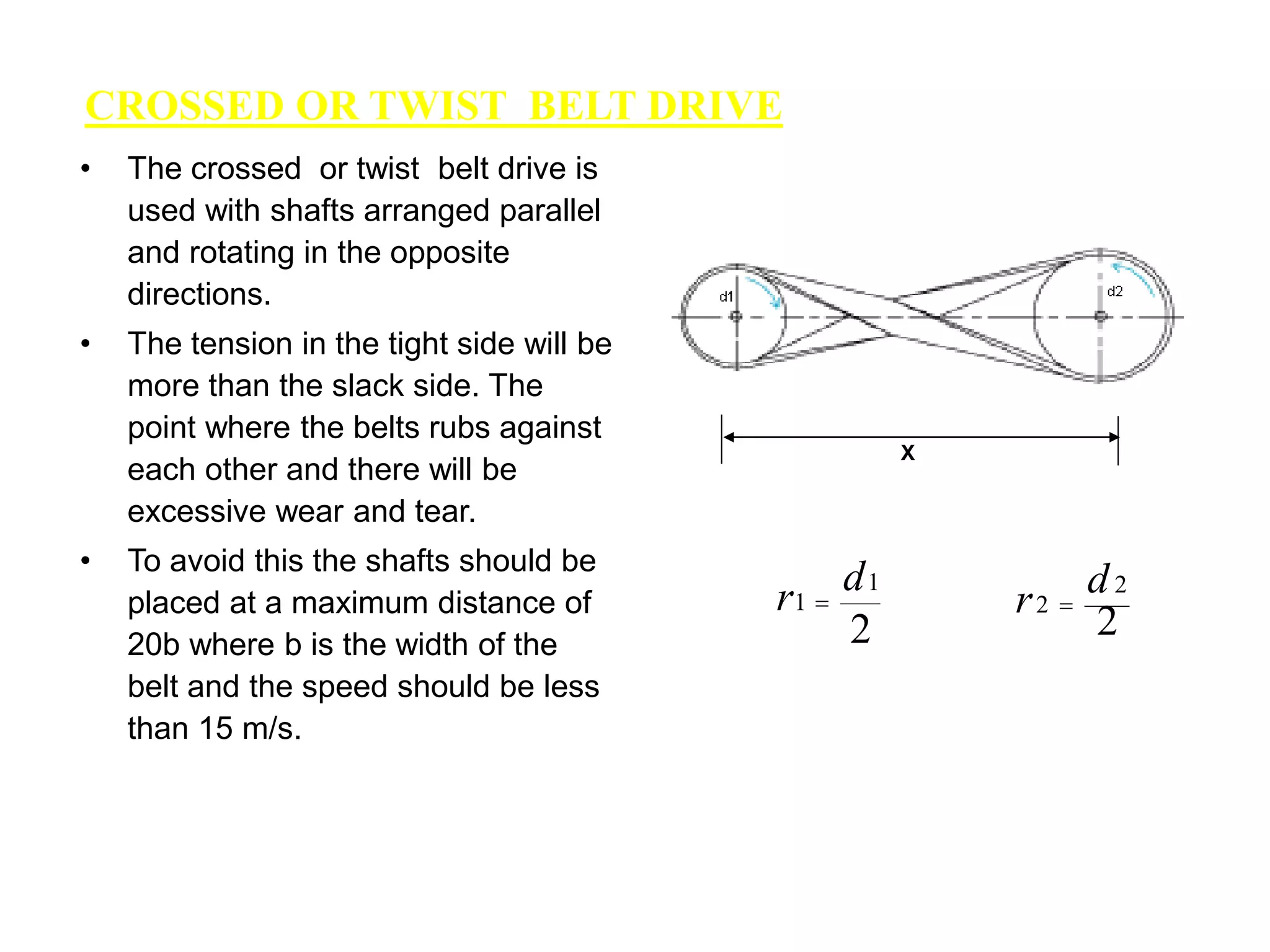
• The crossed or twist belt drive is
used with shafts arranged parallel
and rotating in the opposite
directions.
• The tension in the tight side will be
more than the slack side. The
point where the belts rubs against
each other and there will be
excessive wear and tear.
• To avoid this the shafts should be
placed at a maximum distance of
20b where b is the width of the
belt and the speed should be less
than 15 m/s.
X
2
1
1
d
r 
2
2
2
d
r 
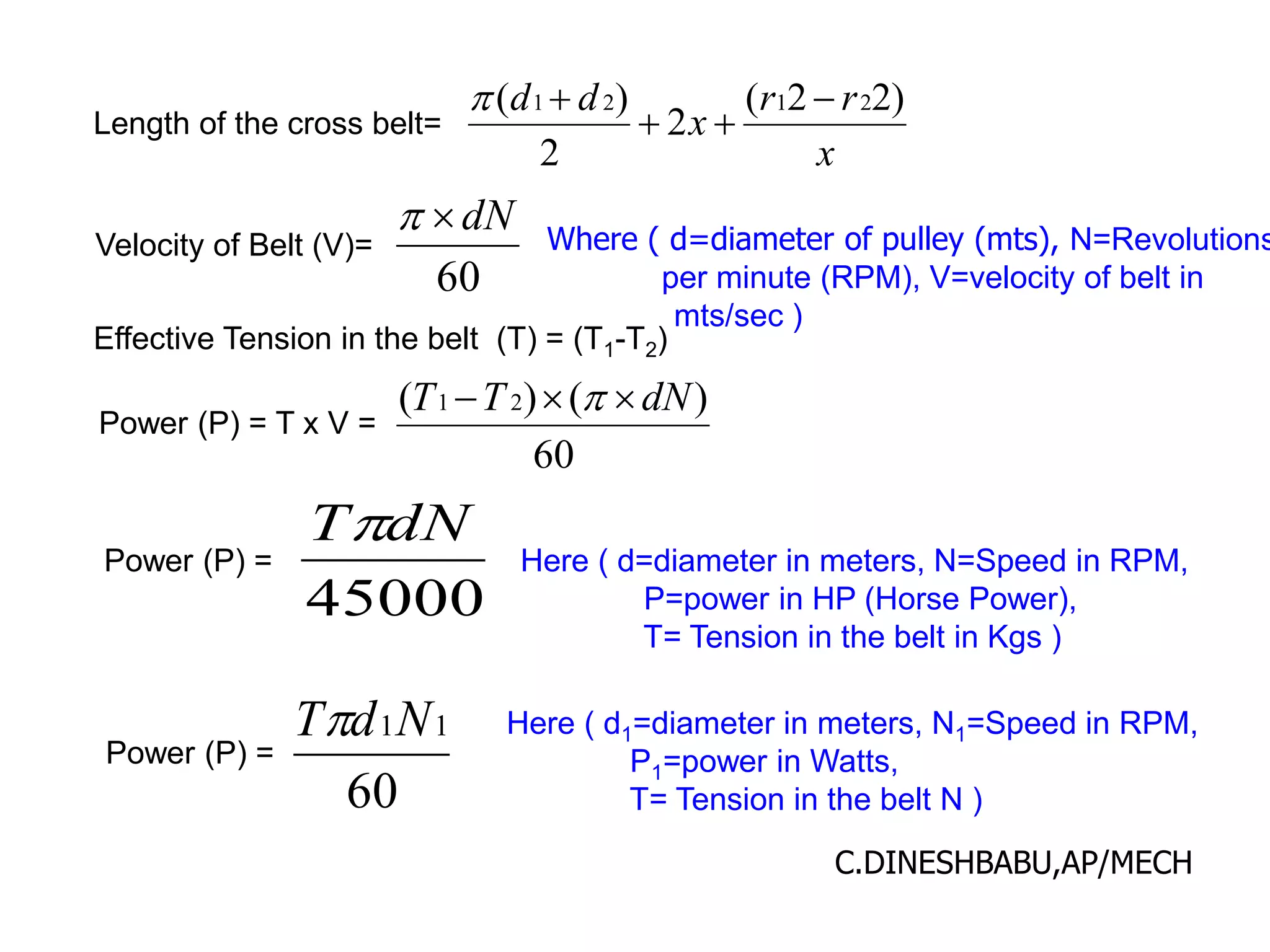
Length of the cross belt=
x
r
r
x
d
d )
2
2
(
2
2
)
( 2
1
2
1 




Velocity of Belt (V)=
60
dN

 Where ( d=diameter of pulley (mts), N=Revolutions
per minute (RPM), V=velocity of belt in
mts/sec )
Effective Tension in the belt (T) = (T1-T2)
Power (P) = T x V =
60
)
(
)
( 2
1 dN
T
T 

 
Power (P) =
45000
dN
T
Here ( d=diameter in meters, N=Speed in RPM,
P=power in HP (Horse Power),
T= Tension in the belt in Kgs )
Power (P) =
60
1
1N
d
T Here ( d1=diameter in meters, N1=Speed in RPM,
P1=power in Watts,
T= Tension in the belt N )
C.DINESHBABU,AP/MECH
COMPOUND BELT DRIVE
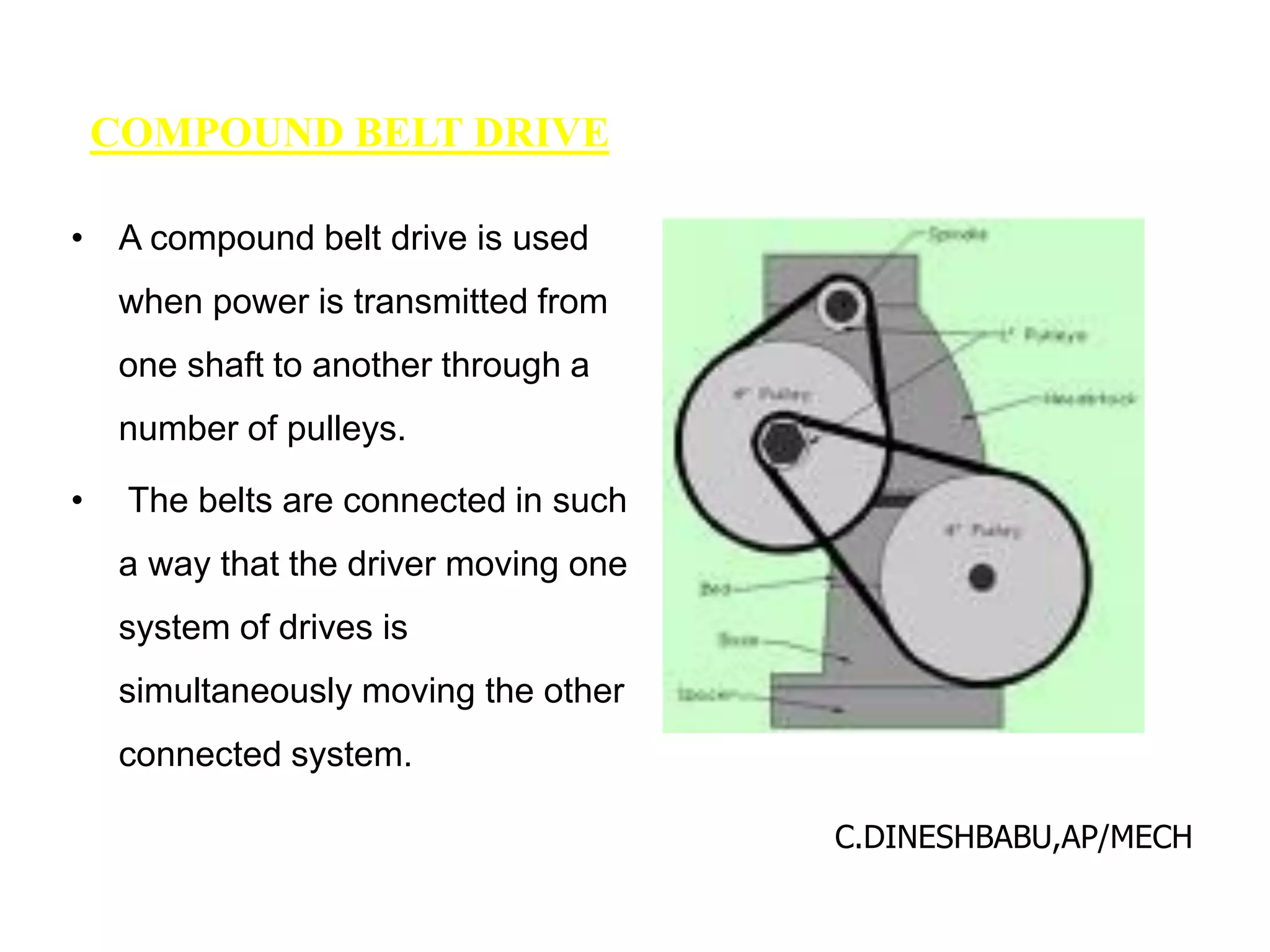
• A compound belt drive is used
when power is transmitted from
one shaft to another through a
number of pulleys.
• The belts are connected in such
a way that the driver moving one
system of drives is
simultaneously moving the other
connected system.
C.DINESHBABU,AP/MECH
IDLER PULLEY
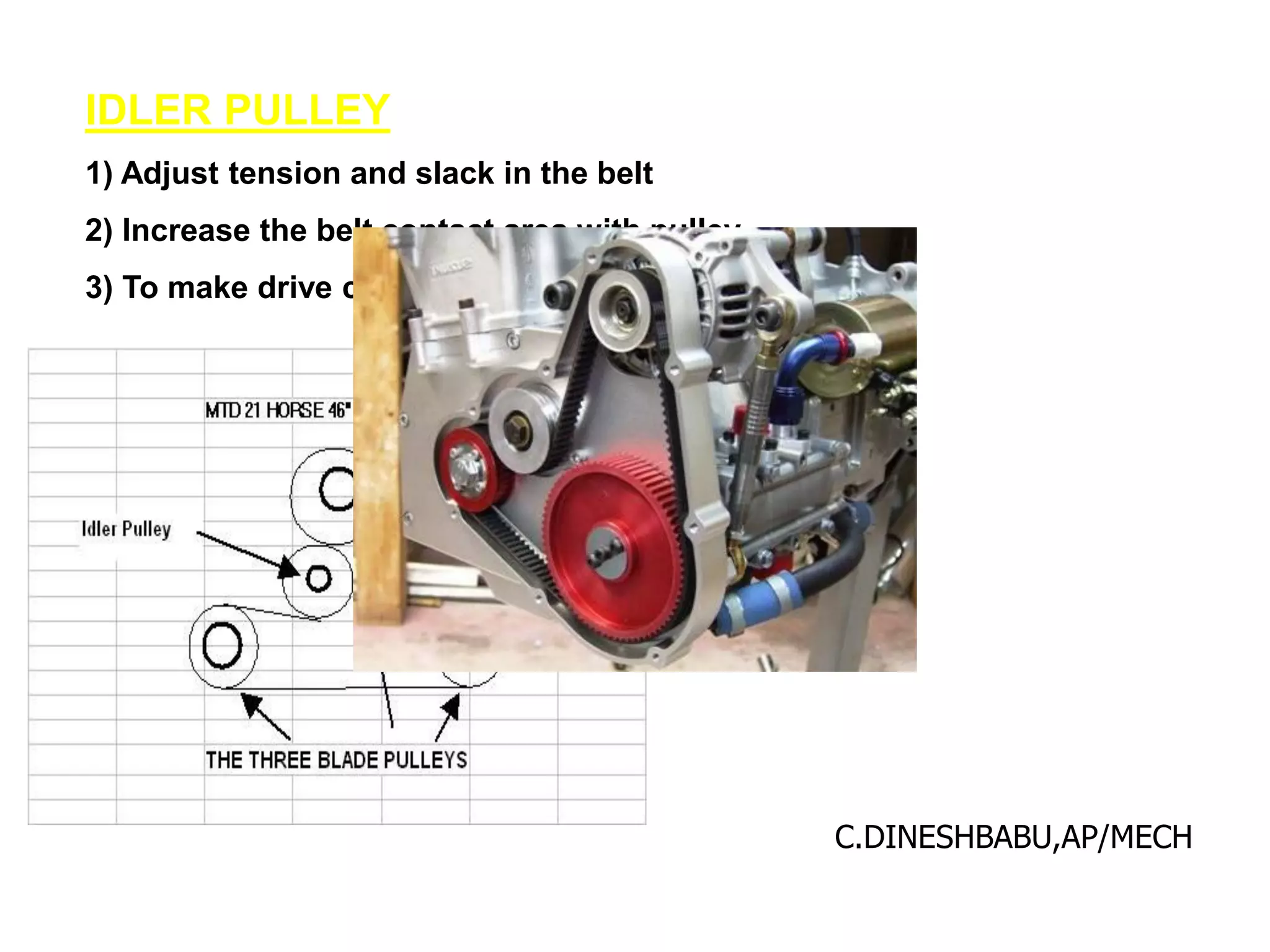
1) Adjust tension and slack in the belt
2) Increase the belt contact area with pulley
3) To make drive compact
C.DINESHBABU,AP/MECH
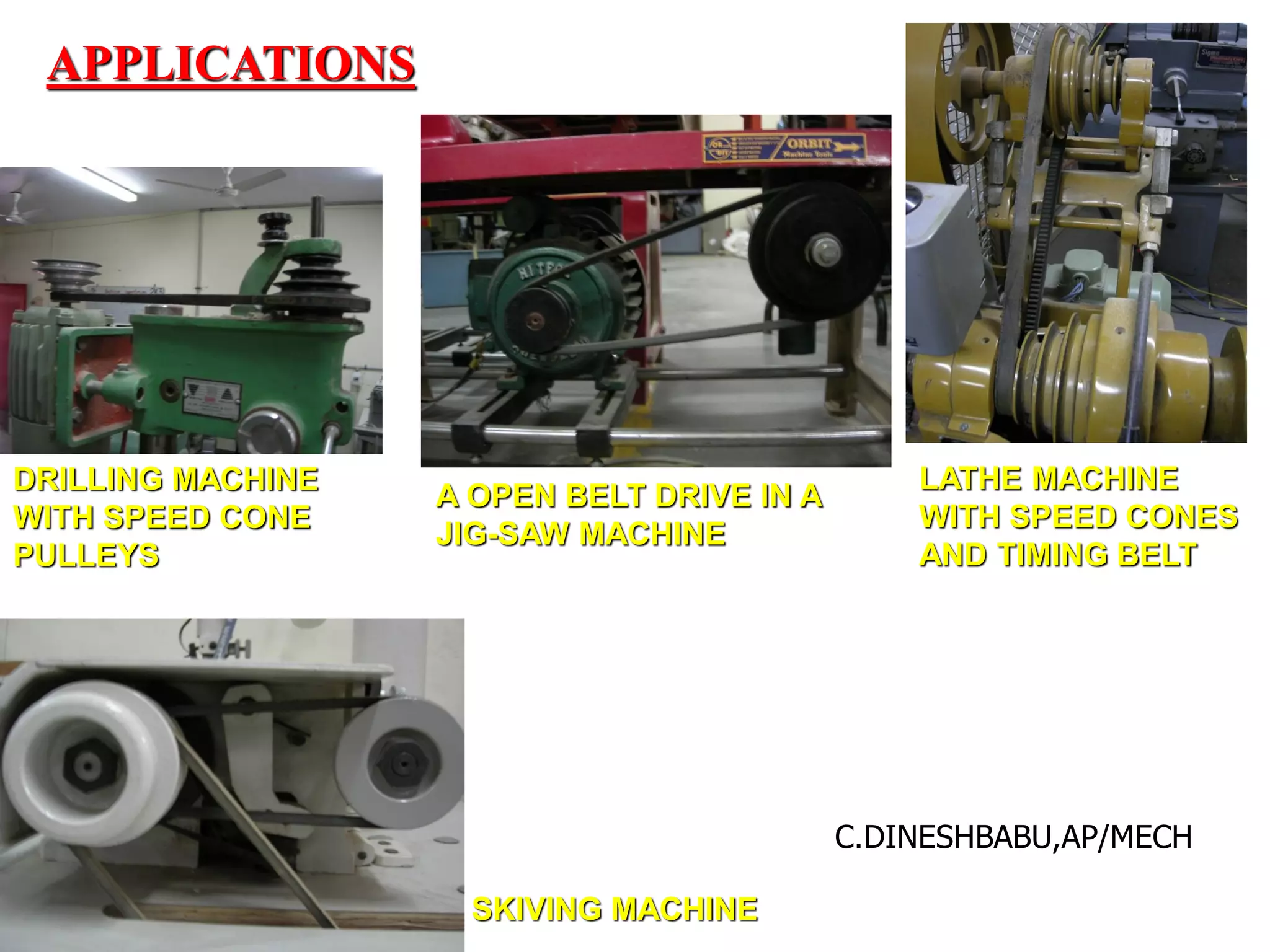
APPLICATIONS
DRILLING MACHINE
WITH SPEED CONE
PULLEYS
A OPEN BELT DRIVE IN A
JIG-SAW MACHINE
LATHE MACHINE
WITH SPEED CONES
AND TIMING BELT
SKIVING MACHINE
C.DINESHBABU,AP/MECH
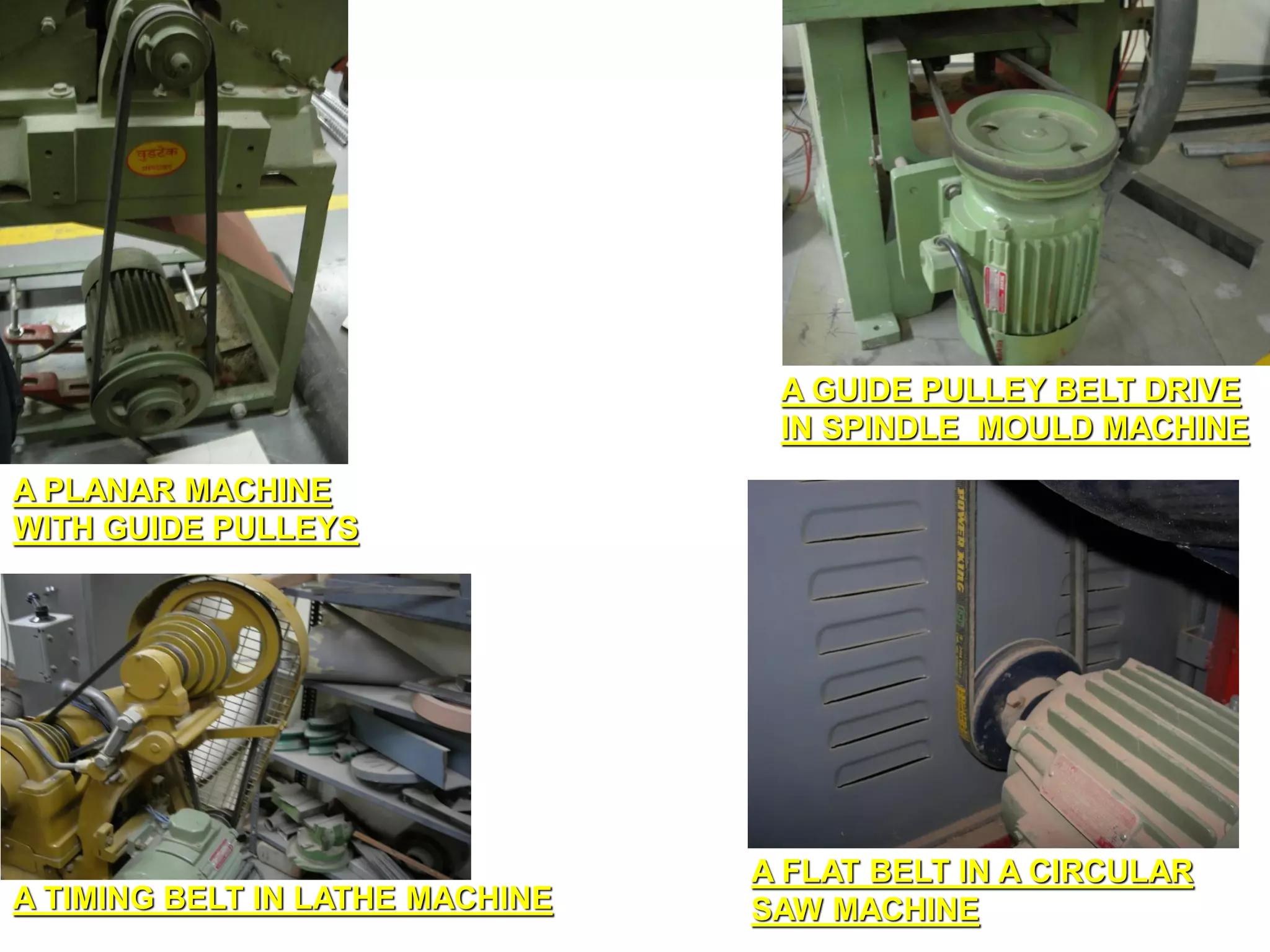
A PLANAR MACHINE
WITH GUIDE PULLEYS
A GUIDE PULLEY BELT DRIVE
IN SPINDLE MOULD MACHINE
A FLAT BELT IN A CIRCULAR
SAW MACHINE
A TIMING BELT IN LATHE MACHINE
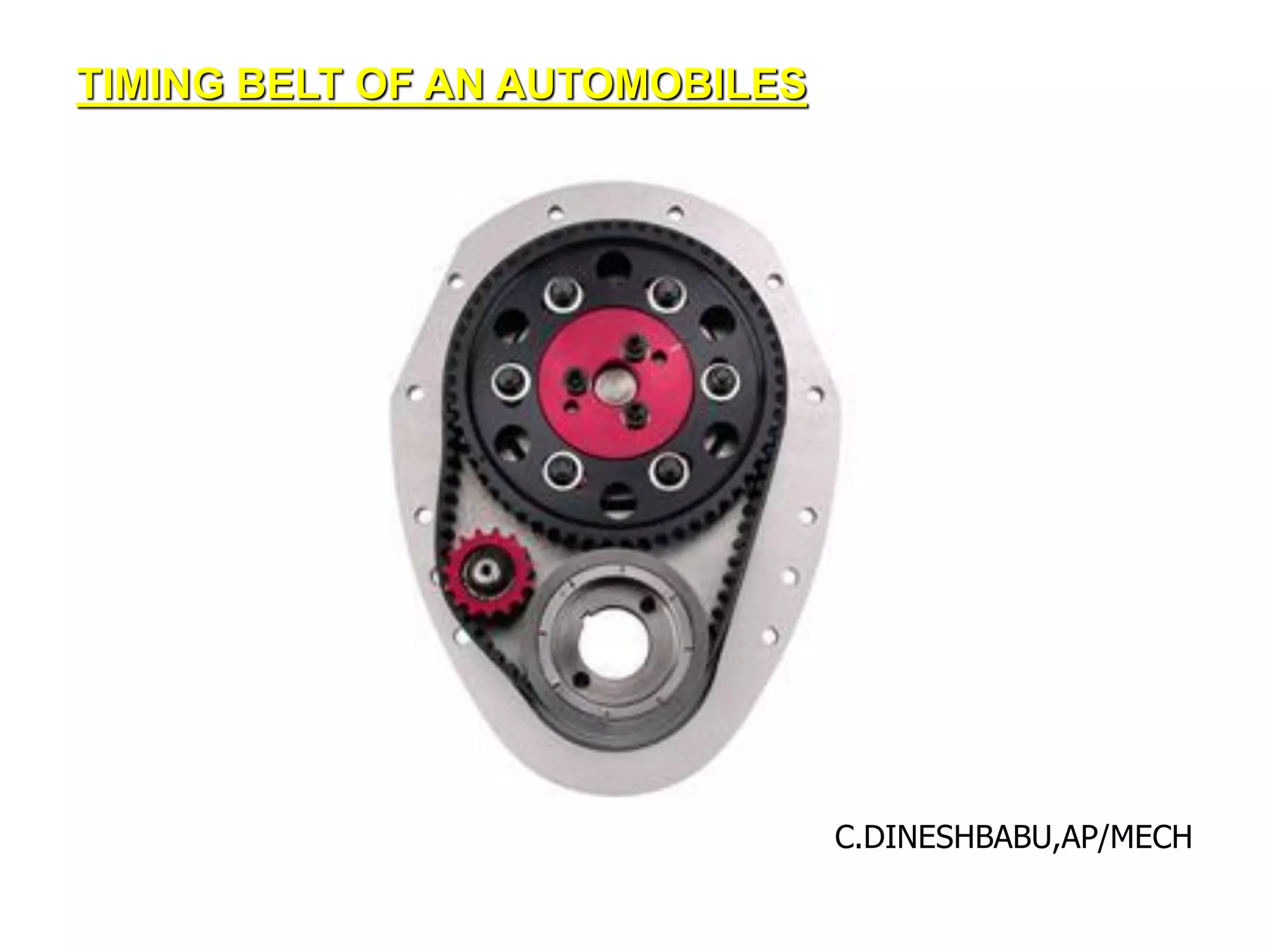
TIMING BELT OF AN AUTOMOBILES
C.DINESHBABU,AP/MECH
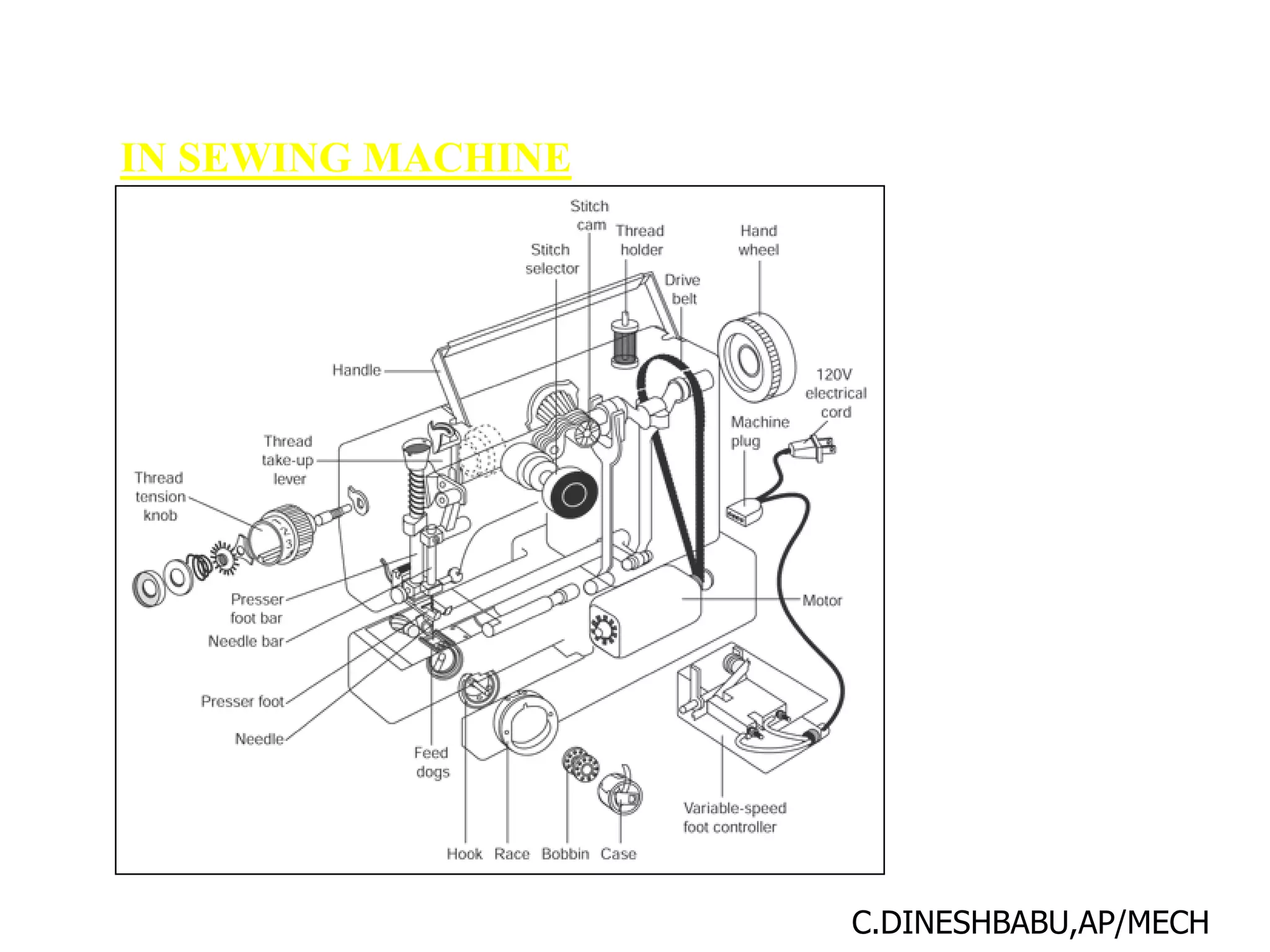
IN SEWING MACHINE
C.DINESHBABU,AP/MECH
IN TREADMILLS
C.DINESHBABU,AP/MECH
THANK YOU
ANY QUESTIONS?
C.DINESHBABU,AP/MECH

ELEMENTS OF TECHNOLOGY.pdf

  • 1.
    FUNDAMENTAL UNDERSTANDING OF PULLEYSAND BELTDRIVES ELEMENTS OF TECHNOLOGY C.DINESHBABU,AP/MECH
  • 2.
    WHAT ARE BELTDRIVES • A belt drive is a method of transferring rotary motion between two shafts. • A belt drive includes one pulley on each shaft and one or more continuous belts over the two pulleys. • The motion of the driving pulley is, generally, transferred to the driven pulley via the friction between the belt and the pulley. • Generally belt drives are friction drives. • A Belt is a looped strip of flexible material, used to mechanically link two or more rotating shafts. • A pulley is a wheel with a groove between two flanges around its circumference. Pulleys are keyed to the shafts. C.DINESHBABU,AP/MECH
  • 3.
    TYPES OF BELTS Thereare 4 types belts used in belt drives they are as follows: Flat belts shaft distance 5 to 10 meters, low power, high speed Round belts smaller initial tension, absence of vibration and noise, high power, shaft distance > 5 meters V belts shaft distance < 2 meters, high power, moderate speed Timing Belts positive drives, precise, reliable C.DINESHBABU,AP/MECH
  • 4.
    ROUND BELT  Roundbelts are a circular cross section belt designed to run in a pulley with a circular (or near circular) groove.  The circular belt or rope is mostly used in the factories where a great amount of power is to be transmitted from one pulley to another, when the two pulleys are more than 5 meters apart. FLAT BELTS  Flat belts find their widest application where high-speed motion, rather than power, is the main concern.  Flat belts are made from leather, woven cotton, rubber, balata (wood gum). C.DINESHBABU,AP/MECH
  • 5.
    ‘V’ BELTS • Thestrength of these belts is obtained by reinforcements with fibers like steel, polyester. • V-belts are far superior to flat belts at small center distances and high reduction ratios. • Require larger pulleys than flat belts because of their greater thickness. • The "V" shape of the belt tracks in a mating groove (or sheave) in the pulley, with the result that the belt cannot slip off. C.DINESHBABU,AP/MECH
  • 6.
    TIMING BELTS • Alsoknown as Toothed, Notch or Cog belts are a positive transfer belt and can track relative movement. • These belts have teeth that fit into a matching toothed pulley . • They are often used to replace chains or gears, reducing noise and avoiding the lubrication bath or oiling system requirement. • Requires the least tension of all belt drives and are among the most efficient. C.DINESHBABU,AP/MECH
  • 7.
    Types of Beltdrives based on the arrangement are as follows • OPEN BELT DRIVES • CROSSED OR TWIST BELT DRIVES • BELT DRIVE WITH IDLER PULLEYS • COMPOUND BELT DRIVE TYPES OF BELT DRIVES BASED ON ARRANGEMENT C.DINESHBABU,AP/MECH
  • 8.
    OPEN BELT DRIVE •The Open belt drive is arranged with shafts arranged parallel and rotating in the same direction. • The driver pulls the belt from one side and delivers it to the other side thus the tension in the one side belt will be more than that in the other side belt. x x d d r r ) 2 2 ( 2 2 ) ( 2 1 2 1      X d1 d2 2 1 1 d r  2 2 2 d r  Length of the open belt= C.DINESHBABU,AP/MECH
  • 9.
    CROSSED OR TWISTBELT DRIVE • The crossed or twist belt drive is used with shafts arranged parallel and rotating in the opposite directions. • The tension in the tight side will be more than the slack side. The point where the belts rubs against each other and there will be excessive wear and tear. • To avoid this the shafts should be placed at a maximum distance of 20b where b is the width of the belt and the speed should be less than 15 m/s. X 2 1 1 d r  2 2 2 d r 
  • 10.
    Length of thecross belt= x r r x d d ) 2 2 ( 2 2 ) ( 2 1 2 1      Velocity of Belt (V)= 60 dN   Where ( d=diameter of pulley (mts), N=Revolutions per minute (RPM), V=velocity of belt in mts/sec ) Effective Tension in the belt (T) = (T1-T2) Power (P) = T x V = 60 ) ( ) ( 2 1 dN T T     Power (P) = 45000 dN T Here ( d=diameter in meters, N=Speed in RPM, P=power in HP (Horse Power), T= Tension in the belt in Kgs ) Power (P) = 60 1 1N d T Here ( d1=diameter in meters, N1=Speed in RPM, P1=power in Watts, T= Tension in the belt N ) C.DINESHBABU,AP/MECH
  • 11.
    COMPOUND BELT DRIVE •A compound belt drive is used when power is transmitted from one shaft to another through a number of pulleys. • The belts are connected in such a way that the driver moving one system of drives is simultaneously moving the other connected system. C.DINESHBABU,AP/MECH
  • 12.
    IDLER PULLEY 1) Adjusttension and slack in the belt 2) Increase the belt contact area with pulley 3) To make drive compact C.DINESHBABU,AP/MECH
  • 13.
    APPLICATIONS DRILLING MACHINE WITH SPEEDCONE PULLEYS A OPEN BELT DRIVE IN A JIG-SAW MACHINE LATHE MACHINE WITH SPEED CONES AND TIMING BELT SKIVING MACHINE C.DINESHBABU,AP/MECH
  • 14.
    A PLANAR MACHINE WITHGUIDE PULLEYS A GUIDE PULLEY BELT DRIVE IN SPINDLE MOULD MACHINE A FLAT BELT IN A CIRCULAR SAW MACHINE A TIMING BELT IN LATHE MACHINE
  • 15.
    TIMING BELT OFAN AUTOMOBILES C.DINESHBABU,AP/MECH
  • 16.
  • 17.
  • 18.