
Potential Difference 
 Charges can “lose” potential energy by 
moving from a location at high potential 
(voltage) to a location at low potential. 
 Charges will continue to move as long 
as the potential difference (voltage) is 
maintained.
Current 
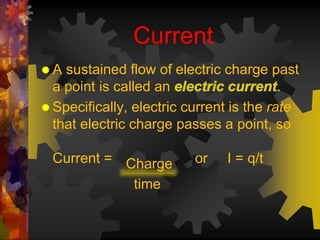
 A sustained flow of electric charge past 
a point is called an 
Specifically, electric current is the rate 
that electric charge passes a point, so 
Current = C h a r g e or I = q/t 
time
Measuring Current 
 If 1 Coulomb of charge (6.25 x 10¹⁸ 
electrons) passes a point each second, 
the current is 
 So, 1 Ampere = 1 Coulomb/sec
Voltage Source 
 A battery or electrical outlet is a source 
of electric potential or voltage - 
charge. 
The electrons that move in a conductor 
are 
the voltage source. 
The net charge on a current-carrying 
conductor is
Electromotive Force 
 An old-fashioned term for electric 
potential or voltage is “
Electrical Resistance 
Most materials offer some resistance to 
the flow of electric charges through 
them. This is called 
.
Resistance 
Resistance of a conductor depends on: 
- Gold is best 
- longer conductors have more 
resistance. 
- thick wires have less 
resistance than thin wires 
- higher temperature means 
more resistance for most conductors
Ohm’s Law 
For many conductors, current depends 
on: 
 Voltage - more voltage, more current 
 Current is proportional to voltage 
 Resistance - more resistance, less 
current 
 Current is inversely proportional to 
resistance
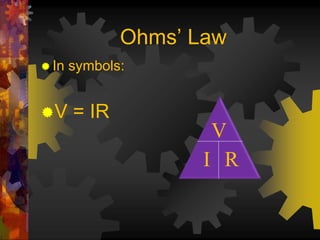
Ohms’ Law 
 In symbols: 
V = IR 
V 
I R
Direct Current 
 If the voltage is maintained between 
two points in a circuit, 
- from high to low 
potential. This is called 
 Battery-powered circuits are dc circuits.
Alternating Current 
 If the high & low voltage terminals 
switch locations periodically, the 
in 
the circuit. This is called 
 Circuits powered by electrical outlets 
are AC circuits.
AC in the US 
 In the US, current changes direction 
120 times per second, for a frequency 
of 60 cycles per second or 60 Hertz. 
Normal outlet voltage in the US is 110- 
120 volts, although some large 
household appliances run on 220-240 
volts.
Converting AC to DC 
 AC is converted to DC using devices 
called which allow charges to 
move in only 1 direction.
Speed of Electrons 
 Electrons in a circuit do move 
quickly - they actually “drift” at about 1 
mm/s. 
 It is the 
- at about the speed of light - 
through the circuit and carries the 
energy.
Electric Power 
Power = energy/time = current x voltage 
 P = IV = I2R 
 1 Watt = (1 Amp)(1 Volt) 
 1 kilowatt = 1000 Watts 
 A kilowatt-hour is a unit of energy
Electric current

Electric current

  • 2.
    Potential Difference Charges can “lose” potential energy by moving from a location at high potential (voltage) to a location at low potential.  Charges will continue to move as long as the potential difference (voltage) is maintained.
  • 3.
    Current  Asustained flow of electric charge past a point is called an Specifically, electric current is the rate that electric charge passes a point, so Current = C h a r g e or I = q/t time
  • 4.
    Measuring Current If 1 Coulomb of charge (6.25 x 10¹⁸ electrons) passes a point each second, the current is  So, 1 Ampere = 1 Coulomb/sec
  • 5.
    Voltage Source A battery or electrical outlet is a source of electric potential or voltage - charge. The electrons that move in a conductor are the voltage source. The net charge on a current-carrying conductor is
  • 6.
    Electromotive Force An old-fashioned term for electric potential or voltage is “
  • 7.
    Electrical Resistance Mostmaterials offer some resistance to the flow of electric charges through them. This is called .
  • 8.
    Resistance Resistance ofa conductor depends on: - Gold is best - longer conductors have more resistance. - thick wires have less resistance than thin wires - higher temperature means more resistance for most conductors
  • 9.
    Ohm’s Law Formany conductors, current depends on:  Voltage - more voltage, more current  Current is proportional to voltage  Resistance - more resistance, less current  Current is inversely proportional to resistance
  • 10.
    Ohms’ Law In symbols: V = IR V I R
  • 11.
    Direct Current If the voltage is maintained between two points in a circuit, - from high to low potential. This is called  Battery-powered circuits are dc circuits.
  • 12.
    Alternating Current If the high & low voltage terminals switch locations periodically, the in the circuit. This is called  Circuits powered by electrical outlets are AC circuits.
  • 13.
    AC in theUS  In the US, current changes direction 120 times per second, for a frequency of 60 cycles per second or 60 Hertz. Normal outlet voltage in the US is 110- 120 volts, although some large household appliances run on 220-240 volts.
  • 14.
    Converting AC toDC  AC is converted to DC using devices called which allow charges to move in only 1 direction.
  • 15.
    Speed of Electrons  Electrons in a circuit do move quickly - they actually “drift” at about 1 mm/s.  It is the - at about the speed of light - through the circuit and carries the energy.
  • 16.
    Electric Power Power= energy/time = current x voltage  P = IV = I2R  1 Watt = (1 Amp)(1 Volt)  1 kilowatt = 1000 Watts  A kilowatt-hour is a unit of energy

Editor's Notes