Collaborative Knowledge Creation Practices Tools Concepts Sami Paavola
1.
Collaborative Knowledge CreationPractices Tools
Concepts Sami Paavola download
https://ebookbell.com/product/collaborative-knowledge-creation-
practices-tools-concepts-sami-paavola-4412624
Explore and download more ebooks at ebookbell.com
2.
Here are somerecommended products that we believe you will be
interested in. You can click the link to download.
Managing Collaborative Rd Projects Leveraging Open Innovation
Knowledgeflows For Cocreation Gabriela Fernandes
https://ebookbell.com/product/managing-collaborative-rd-projects-
leveraging-open-innovation-knowledgeflows-for-cocreation-gabriela-
fernandes-43023976
Collaborative Research In Fisheries Cocreating Knowledge For Fisheries
Governance In Europe Petter Holm
https://ebookbell.com/product/collaborative-research-in-fisheries-
cocreating-knowledge-for-fisheries-governance-in-europe-petter-
holm-11106356
Creating Collaborative Advantage Through Knowledge And Innovation
Series On Innovation And Knowledge Management Series On Innovation And
Knowledge Management Suliman Hawamdeh
https://ebookbell.com/product/creating-collaborative-advantage-
through-knowledge-and-innovation-series-on-innovation-and-knowledge-
management-series-on-innovation-and-knowledge-management-suliman-
hawamdeh-1690872
Knowledge At Work Creative Collaboration In The Global Economy 1st
Edition Robert Defillippi
https://ebookbell.com/product/knowledge-at-work-creative-
collaboration-in-the-global-economy-1st-edition-robert-
defillippi-1913144
3.
Collaborative Knowledge ManagementThrough Product Lifecycle A
Computational Perspective 1st Edition Hongwei Wang
https://ebookbell.com/product/collaborative-knowledge-management-
through-product-lifecycle-a-computational-perspective-1st-edition-
hongwei-wang-49180014
Facilitative Collaborative Knowledge Coconstruction New Directions For
Teaching And Learning Number 143 1st Edition Gertina J Van Schalkwyk
Rik Carl Damato
https://ebookbell.com/product/facilitative-collaborative-knowledge-
coconstruction-new-directions-for-teaching-and-learning-
number-143-1st-edition-gertina-j-van-schalkwyk-rik-carl-
damato-51432376
Towards Modern Collaborative Knowledge Sharing Systems 1st Edition
Piotr Lipiski
https://ebookbell.com/product/towards-modern-collaborative-knowledge-
sharing-systems-1st-edition-piotr-lipiski-4195472
Networks Of Knowledge Collaborative Innovation In International
Learning 1st Edition Joy Fitzgibbon Janice Gross Stein Richard Stren
https://ebookbell.com/product/networks-of-knowledge-collaborative-
innovation-in-international-learning-1st-edition-joy-fitzgibbon-
janice-gross-stein-richard-stren-51588976
Leveraging Knowledge For Innovation In Collaborative Networks 10th
Ifip Wg 55 Working Conference On Virtual Enterprises Prove 2009
Thessaloniki Greece October 79 2009 Proceedings 1st Edition Luis
Berasategi
https://ebookbell.com/product/leveraging-knowledge-for-innovation-in-
collaborative-networks-10th-ifip-wg-55-working-conference-on-virtual-
enterprises-prove-2009-thessaloniki-greece-
october-79-2009-proceedings-1st-edition-luis-berasategi-4201440
TECHNOLOGY ENHANCED LEARNING
Volume7
Series Editors
Richard Noss, London Knowledge Lab, IOE, UK
Mike Sharples, Learning Sciences Research Institute, University of Nottingham,
UK
Editorial Board
Nicolas Balacheff, CNRS, France
R.M. Bottino, Consiglio Nazionale delle Ricerche, Istituto Tecnologie Didattiche,
Genova, Italy
Tak-Wai Chan,Graduate Institute of Network Learning Technology at the National
Central University of Taiwan
Peter Goodyear, CoCo, Faculty of Education & Social Work, University of Sydney
Miguel Nussbaum, Escuela de Ingeniería, Pontificia Universidad Católica de
Chile
Jeremy Roschelle, SRI International, USA
Barbara Wasson, University of Bergen, Norway
Scope
The rapid co-evolution of technology and learning is offering new ways to
represent knowledge, new educational practices, and new global communities of
learners. Yet the contribution of these changes to formal education is largely
unexplored, along with possibilities for deepening our understanding of what and
how to learn. Similarly, the convergence of personal technologies offers new
opportunities for informal, conversational and situated learning. But this is
widening the gulf between everyday learning and formal education, which is
struggling to adapt pedagogies and curricula that were established in a pre-digital
age.
This series, Technology Enhanced Learning, will explore learning futures that
incorporate digital technologies in innovative and transformative ways. It will
elaborate issues including the design of learning experiences that connect formal
and informal contexts; the evolution of learning and technology; new social and
cultural contexts for learning with technology; novel questions of design,
computational expression, collaboration and intelligence; social exclusion and
inclusion in an age of personal and mobile technology; and attempts to broaden
practical and theoretical perspectives on cognition, community and epistemology.
The series will be of interest to researchers and students in education and
computing, to educational policy makers, and to the general public with an interest
in the future of learning with technology.
v
TABLE OF CONTENTS
Prefacevii
Collaborative Knowledge Creation: Introduction ix
Anne Moen, Anders I. Mørch, Sami Paavola
1. The Trialogical Approach as a new Form of Mediation 1
Sami Paavola, Ritva Engeström, Kai Hakkarainen
2. Tacit Knowledge and Trialogical Learning:
Towards a Conceptual Framework for Designing Innovative Tools 15
Hadj Batatia, Kai Hakkarainen, Anders I. Mørch
3. Reference Ontology for Knowledge Creation Processes 31
Martin Doerr, Athina Kritsotaki, Vassilis Christophides, Dimitris Kotzinos
4. KPE (Knowledge Practices Environment) Supporting
Knowledge Creation Practices in Education 53
Merja Bauters, Minna Lakkala, Sami Paavola,
Kari Kosonen and Hannu Markkanen
5. A Pragmatic Approach to Collaborative Semantic Modelling:
The Visual Modelling (Language) Editor 75
Christoph Richter, Heidrun Allert, Vassiliy P. Tchoumatchenko,
Ivan H. Furnadziev, Tania K. Vasileva, Dimitris Kotzinos,
Giorgos Flouris, Vassilis Christophides and Juha Löytöläinen
6. Analysing Expansive Learning in a Multi-Layered Design Project 93
Hanna Toiviainen, Seppo Toikka and Jiri Lallimo
7. Mirroring Tools for Collaborative Analysis and Reflection 117
Christoph Richter, Ekaterina Simonenko, Tsuyoshi Sugibuchi,
Nicolas Spyratos, Frantisek Babic, Jozef Wagner, Jan Paralic,
Michal Racek, Crina Damşa and Vassilis Christophides
8. Using Trialogical Design Principles to Assess Pedagogical
Practices in two Higher Education Courses 141
Minna Lakkala, Liisa Ilomäki, Sami Paavola, Kari Kosonen and
Hanni Muukkonen
9. Trialogical Design Principles as Inspiration for Designing
Knowledge Practices for Medical Simulation Training 163
Klas Karlgren
10. A Product Development Course as a Pedagogical Setting for
Multidisciplinary Professional Learning 185
Kari Kosonen, Hanni Muukkonen, Minna Lakkala and Sami Paavola
11.
TABLE OF CONTENTS
vi
11.Shared Epistemic Agency for Knowledge Creation:
An Explorative case Study 203
Crina Damşa and Jerry Andriessen
12. Developing Epistemic Agencies of Teacher Trainees – Using the
Mentored Innovation Model 219
Andrea Kárpáti and Helga Dorner
13. Working Within Knowledge Communities as a
Context for Developing Knowledge Practices 233
Patrick Sins and Jerry Andriessen
14. Consolidating work Descriptions: Creating Shared Knowledge Objects 249
Anne Moen and Sturle Nes
About the Authors 261
Subject Index 269
12.
vii
PREFACE
The book isabout collaborative knowledge creation, and more specifically about
the trialogical approach to learning. Throughout the book, the authors explore
collaborative work with shared knowledge artefacts and objects, and relate their
contributions to tool development for and practices of technology-mediated
learning. The contributions are concrete examples to explain how people create
knowledge that is materialized in concrete objects, and transforms their knowledge
practices by cross-fertilizing new and existing practices in educational and
professional environments.
The book presents results from the Knowledge Practices Laboratory (KP-Lab)
project (http://www.knowledgepractices.info), an EU-funded integrated project
(2006–2011), to a broader audience. 22 partners from 14 countries joined to
explore higher education courses, workplace learning and teacher training
situations to help bridge practices in educational and professional institutions.
The book is aimed at readers interested in collaborative knowledge creation
processes and technology-mediated learning. Compared to other contemporary
European perspectives on technology-enhanced learning, the chapters in this book
are framed within one overarching theoretical perspective, the trialogical approach,
to explore knowledge creation processes.
As editors of this book, we are grateful to the authors’ commitment to contribute
and present their work here. It has been a long journey, starting as a workshop in
Oslo in 2007, followed by several iterations from initial conception to completion.
Thank you all for persistence in a long process.
In addition to the authors of the chapters, we would like to express our great
appreciations for the contributions by the KP-Lab senior researchers, and the KP-
Lab expert panel members Carl Bereiter, Yrjö Engeström, Erno Lehtinen, Sten
Ludvigsen, and Gerry Stahl. Without your participation, feedback and advice this
book would not have been possible. Thank you very much!
We acknowledge the financial support to the KP-Lab project, (project no 27490,
Priority 2, Information Society Technologies, FP6-2004-IST-4), by the European
Commission’s IST programme under the 6th Framework (FP6). We are also
grateful to our editorial assistant Shazia Mushtaq for invaluable help throughout
the process of compiling this volume.
Oslo/Helsinki, March, 1st
2012,
Anne Moen, Anders I. Mørch, Sami Paavola (editors)
14.
ix
ANNE MOEN, ANDERSI. MØRCH AND SAMI PAAVOLA
COLLABORATIVE KNOWLEDGE CREATION:
INTRODUCTION
Understanding transformations of knowledge practices, both educational and
professional, has been an overall goal in the explorations presented in this book.
There is a need for new approaches to learning, especially for understanding and
supporting practices where people are creating or developing useful and reusable
things in collaboration. This assertion challenges several existing perspectives on
learning: theoretically, pedagogically, when it comes to technology support, and
when it comes to location (at school, at work, etc). Initial questions motivating our
work included: What kind of knowledge practices, i.e. ways of working with
knowledge, is needed in modern working life? How to teach and learn them? And
what is the role of digital technology in these practices?
Collaborative knowledge creation seen in technology-mediated work with
knowledge artefacts for practice transformations, and the trialogical approach to
learning binds the chapters of this book together. The specific contribution of the
trialogical approach is a combination of the conceptual aspects of the inquiry
processes and idea-centred work with features adopted from the pragmatically- and
‘materially’ oriented approaches (Paavola & Hakkarainen, 2009).
Current approaches to learning emphasize issues like participation (Sfard,
1998), joint meaning making (Stahl et al., 2006), discourse and dialogue (Wegerif,
2006) as starting points for collaborative learning. As such, they also challenge
individualistically oriented conceptualisations of learning. The same concerns
technology and technology-mediated learning. ‘Information media’ has been
challenged and supplemented with ‘communication media’, which are interfaces
extending from human computer interaction to social interaction (or ‘dialogues’)
(Enyedy & Hoadley, 2006). Furthermore, computer-supported collaborative
learning environments complement and extend individual-oriented learning
systems (Ludvigsen & Mørch, 2010). Notions like ‘Web 2.0’ are often used to
point out new technology for harnessing participation, social networking and
collective intelligence. We maintain that these perspectives’ suggestions to extend
single user environments to collaborative interaction are not by themselves
sufficient to understand and support modern knowledge work. Supplementary
approaches are needed to take into account collaborative, long-term, iterative work
with concrete things and issues.
The ‘objects’ and ‘artefacts’ play a crucial role throughout this book. This is one
key to understanding the trialogical approach to learning. The practical and
theoretical importance of ‘objects’ and ‘artefacts’, and their characterization as
collaboratively developed becomes central. Although these directions in the
15.
A. MOEN ETAL.
x
evolution of technology have existed for some time (Engelbart, 1962), the current
opportunities are that the technology can try to ‘catch up’ with the early visions
and conceptual frameworks. New kinds of object-oriented, or artefact-mediated
approach carries a lot of unused potentiality, and should be further developed,
harnessed, and applied, especially when it comes to technology mediated
collaborative learning.
On one hand, and according to the cultural-historical approach, human
activities are mediated by artefacts, used and modified by succeeding generations
of humans and grounded in practical, everyday activities (Cole 1996; Miettinen &
Virkkunen, 2005). Artefacts are seen more generally as the central means for
cultural evolution (Wartofsky, 1979). On the other hand, the knowledge building
approach maintains that collaboratively developed conceptual artefacts are the
central epistemological means, contrasted to individualistically oriented learning
(Bereiter, 2002). The object of activity is emphasized especially in activity theory
as the starting point for understanding human activities (e.g. Engeström, 1987).
The notion of ‘object’ is seen as increasingly important in other approaches as well
(Engeström & Blacker, 2005 for various approaches related to objects).
Conceptually, elaborations of collaborative knowledge creation and the
trialogical approach have been influenced by Knorr Cetina (2001) distinctions of
epistemic objects and epistemic practices. According to Knorr Cetina, modern
knowledge work cannot be described with the traditional notions of practices
interpreted as recurrent routines or fixed commodities, but requires more dynamic
notions of epistemic practices. Also other authors have combined ‘artefact-
oriented’ or ‘object-oriented’ approaches to propose various forms of knowledge
practices (Ewenstein & Whyte, 2009; Hakkarainen, 2009). The ‘Practice turn’
(Schatzki et al., 2001) in the social sciences and organizational learning carries
implications for learning theories. Schön’s (1983) notions of reflective practice as
reflection-in-action and reflection-on-action are relevant when studying learning
integrated with other activities. However, Schön’s focus was on understanding
human reflection during design activity contrasting the plan-based approach, in
terms of how people modify their activity as they interact with the materials of a
situation and in the dialogue with others. In this book, the authors address
reflection in terms of collaborative processes, reflecting on practice transformation,
and collaborative reflection aided by computer support.
‘Knowledge Practices Environment’ (KPE) is the technology platform investi-
gated in many chapters of this book. KPE supports reflective and ‘object-centred’
knowledge creation practices. KPE provides virtual working spaces, called shared
spaces, for the collaborative work. Working in a shared space enables viewing the
knowledge artefacts and their relations from different perspectives and supports
object-oriented development of all items. Basic tools and functionalities include, in
addition to the common upload etc. functions, the following: note editor,
commenting, context-based chat, semantic tagging, linking of items allowing also
spatial organisation, and alternative process view for structuring the process,
among others. Optional tools include Activity System Design Tool (ASDT), Visual
Model Editor (VME), and mirroring tools (or analytic tools).
16.
COLLABORATIVE KNOWLEDGE CREATION
xi
Tounderstand the resources and processes involved when people transform
their knowledge practices requires an integrative approach, since open-ended
problem-solving processes cannot be completely planned in advance. This involves
sensitive, flexible regulation, trying to tease out details of on-going activities and
link them to the main goals and objectives, and openness to modifying plans and
structures when a process asks for it. The unit of analysis in the knowledge
creation in particular contexts require a multi-level methodology, which consists of
interrelated levels of abstraction: micro, meso and macro, each of different
temporal and spatial qualities. Micro-level data are data that represent actual, ‘in-
situ’ interactions in knowledge-creation processes of what people actually do and
contribute within the process. Meso-level data are data representing a series of
interactions and productions as parts of evolving trajectories of participation in
knowledge creation processes. Finally, macro-level data are data that record
transformations, which involves broader historical and/or institutional perspectives.
The three-tiered structure allows for in-depth analysis of moment-to-moment
interaction to be combined with a perspective on evolving, object-oriented, open-
ended inquiry.
Organization of the Book
The book seeks to integrate theoretical development, tool design and
development, and empirical studies of the use and deployment of technological
tools. Compared to other, contemporary European perspectives on technology-
enhanced learning (e.g., Balacheff et al., 2009), the contributions in this book are
framed within one, overarching theoretical perspective. Throughout the KP-Lab
project, the trialogical approach to knowledge creation has been refined and
operationalized through processes of technology design and empirical case studies
of knowledge practices in higher education and professional practices. The first
chapters in this book start by reflections on theoretical foundations and conceptual
resources, followed by tools and design processes, and a selection of empirical
studies on knowledge practices in higher education and professional practices
including teacher training.
The Chapters
Paavola and colleagues (Chapter 1) introduce and explain the background for the
trialogical approach to learning. It builds on classical approaches to mediation but
aims at understanding novel practical and theoretical challenges of the knowledge
society. The main theoretical development of the trialogical approach and different
interpretations of the object-oriented knowledge work in the KP-Lab project are
analysed in this contribution.
In Chapter 2, Batatia and colleagues consider tacit knowledge in knowledge
creation activities. A variety of theories and models are surveyed in this chapter.
This contribution attempts to elucidate relationships between trialogical learning
and tacit knowledge for the purpose of theory-informed design of knowledge
17.
A. MOEN ETAL.
xii
creation tools. Examples are given from three of the KP-Lab tools. The chapter
points out implications for further development of tools.
The chapter by Doerr and colleagues (Chapter 3) introduces the KP-Lab
Reference Ontology as an extensible conceptual model useful to analyse
knowledge creation processes when different types of actors, things, and events
come into play. The aim of the Reference Ontology is to serve as common ground
for interoperability of the tools, and to support data analysis across cases. It is
proposed to meet the needs of the heterogeneous KP-Lab ecosystem, re-presenting
and interpreting data produced in multiple knowledge practices. Special attention is
given to the dynamics that occur during knowledge creation processes and
transformation practices.
Bauters and colleagues (Chapter 4) introduce the web-based application system
Knowledge Practices Environment (KPE). KPE aims to support continual
processes and development of products through collaborative interaction.
It provides affordances for work with shared objects, e.g., artefacts, processes or
practices, and a database for persistent storage of these objects. The main design
ideas and features of KPE are elaborated, and results from a user study with KPE
are presented.
In Chapter 5, Richter and colleagues present the Visual Modelling Editor
(VME) for computer-supported modelling of conceptual artefacts. This tool
allows users to create, compare and update different visual models, and to design
and revise the underlying modelling language. VME has been introduced in
several courses at two technical universities and the first user experiences showed
that it can be used to create, reflect on and develop visual models as shared
knowledge objects, and how modelling could be understood as an epistemic
activity.
Toiviainen and colleagues (Chapter 6) explain in depth the co-design process
leading to the Activity System Design Tool (ASDT). ASDT is integrated in the
KPE, and specifically supports activities in distributed, highly specialized teams of
expert workers. The authors argue that work processes of this kind are best
understood as co-production of material objects while being organized in different
teams. Collaborative work is analysed as inter-layered communication and design
actions. Different perspectives shape the collective learning process materialized in
creation and maturation of a shared, material object: the ASDT.
In Chapter 7, Richter and co-authors describe two mirroring tools for
collaborative analysis and reflection (Visual Analyser and Time Line Based
Analyser). These tools allow users to depict, explore, and interpret the digital
traces of collaborative knowledge creation activities. The contribution shows how
heterogeneous user groups (students, teachers, and knowledge workers) can
interactively visualize tasks and activities over time. Mirroring tools can provide
the users with tools and methods to enable reflection on their knowledge practices
as they are engaged in project work over longer periods of time.
In their chapter, Lakkala and colleagues (Chapter 8) report on the use of
specially developed design principles for trialogical learning in two higher
education courses. They claim that efforts to operationalize the rather abstract
18.
COLLABORATIVE KNOWLEDGE CREATION
xiii
designprinciples are useful because it helps to develop heuristic guidelines for
educational practitioners and related tools. This requires that design principles are
adapted to realities and challenges of each setting.
Karlgren (Chapter 9) introduces the trialogical approach to enrich medical
simulation training in critical care. To portray the collaborative features, the cases’
were modified based on trialogical design principles. Analysing the empirical
material, typical recurrent patterns are discerned, and a development trajectory is
suggested. The contribution contributes to contextualizing and extending the KP-
Lab design principles by comparing the design patterns in the unfolding trajectory
of solving educational problems.
Kosonen and colleagues (Chapter 10) explore activities of students in a
multidisciplinary course in which business ideas and media technology solutions
were developed for customers. The contribution discusses how a course based on
the cross-fertilization between educational institutions and professional contexts
was used in training new product-development professionals. The analysis of
instructors’ guidance and the subsequent changes made to students’ working
documents was conducted.
Damşa and Andriessen (Chapter 11) present an empirical foundation for the
notion of shared epistemic agency. Within the knowledge creation perspective of
learning the capacity for shared epistemic agency is enabled by groups’
deliberate collaborative efforts to create shared knowledge objects. Epistemic
and regulatory dimensions of the created knowledge object are elaborated and
illustrated by actions during the collaborative creation of shared knowledge
objects.
In Chapter 12, Kárpáti and Dorner apply knowledge building theory and the
notion of epistemic agency to analyse teachers’ satisfaction during transition to a
new teaching practice in Hungary aimed at educating reflective practitioners, and
employing a model referred to as mentored innovation. A large-scale study using
an instrument to collect satisfaction and communication preferences is conducted.
The authors report on the teachers’ satisfaction, but also suggest an analysis to
explore further strategies in teacher training that make knowledge creation
processes more visible and accountable.
Sins and Andriessen (Chapter 13) report on a new kind of teacher-researcher
collaboration at a secondary school where the goal was to collaboratively design a
new learning module. The tensions among project team members became an
object of analysis. The results are recommendations for a redesign of teaching
practices, where the teachers themselves become targets for change. The authors
propose a generic pattern of managing and resolving tensions for teachers as they
reflect upon and constructively use tensions to transform practices. Aspects of
activity theory are used in the conceptual framework for analysis and
transformation.
Moen and Nes (Chapter 14) illustrate collaborative knowledge creation among
professionals, where knowledge objects are (re)created based on interactions
of persons and their material objects. The empirical example is a knowledge
creation process where nurses’ negotiate and consolidate versions of local and
19.
A. MOEN ETAL.
xiv
standardized procedures to co-create their knowledge object; a consolidated work
description. This is discussed as a question-generating knowledge object, open to
modification, change and evolution by the health care workers.
REFERENCES
Balacheff, N., Ludvigsen, S., Jong, T. de, Lazonder, A., & Barnes, S. (Eds.) (2009). Technology-
Enhanced Learning: Principles and Products. Springer: Berlin-Heidelberg.
Bereiter, C. (2002). Education and Mind in the Knowledge Age. Hillsdale, NJ: Erlbaum.
Cole, M. (1996). Cultural Psychology. A Once and Future Discipline. Cambridge, MA: The Belknap
Press of Harvard University Press.
Engelbart, D.C. (1962). Augmenting Human Intellect: A Conceptual Framework, Summary Report
AFOSR-3233, Stanford Research Institute, Menlo Park, CA, Oct 1962.
Engeström, Y. (1987). Learning by expanding. Helsinki: Orienta-Konsultit.
Engeström, Y. & Blackler, F. (2005). On the Life of the Object. Organization 12(3), 307–330.
Enyedy, N., & Hoadley, C. M. (2006). From dialogue to monologue and back: Middle spaces in
computer-mediated learning. Computer-Supported Collaborative Learning 1(4), 413–439.
Ewenstein, B. & Whyte, J. (2009). Knowledge Practices in Design: The Role of Visual Representations
as ‘Epistemic Objects’. Organization Studies 30(1), 7–30.
Hakkarainen, K. (2009). A knowledge-practice perspective on technology-mediated learning.
Computer-Supported Collaborative Learning 4, 213–231.
Knorr Cetina, K. (2001). Objectual Practice. In T. R. Schatzki, K. Knorr Cetina, & E. von Savigny
(eds.). The Practice Turn in Contemporary Theory (pp. 175–188). London and NY: Routledge.
Ludvigsen, S., & Mørch, A. (2010). Computer-Supported Collaborative Learning: Basic Concepts,
Multiple Perspectives, and Emerging Trends, in B. McGaw, P. Peterson & E. Baker (Eds.) The
International Encyclopedia of Education, Volume 5. Oxford, UK: Elsevier, pp. 290–296.
Miettinen, R. & Virkkunen, J. (2005). Epistemic Objects, Artefacts and Organizational Change.
Organization 12(3), 437–456.
Paavola, S. & Hakkarainen, K. (2009). From meaning making to joint construction of knowledge
practices and artefacts: A trialogical approach to CSCL. In C. O’Malley, D. Suthers, P. Reimann, &
A. Dimitracopoulou (Eds.), Computer Supported Collaborative Learning Practices: CSCL2009
Conference Proceedings. (pp. 83–92). Rhodes, Creek: International Society of the Learning
Sciences (ISLS).
Schatzki, T.R., Knorr Cetina, K. & von Savigny, E. (Eds) (2001) The practice turn in contemporary
theory. New York: Routledge.
Schön, D.A. (1983). The Reflective Practitioner, How professionals think in action. New York: Basic
Books.
Sfard, A. (1998). On two metaphors for learning and the dangers of choosing just one. Educational
Researcher, 27, 4–13.
Stahl, G., Koschmann, T., & Suthers, D. (2006). Computer-supported collaborative learning: An
historical perspective. In R. K. Sawyer (Ed.) Cambridge handbook of the learning sciences
(pp. 409–426). New York: Cambridge University Press.
Wartofsky, M. (1979). Models: Representation and Scientific Understanding. Dordrecht: Reidel.
Wegerif, R. (2006). A dialogic understanding of the relationship between CSCL and teaching thinking
skills. Computer-Supported Collaborative Learning 1(1), 143–157.
20.
COLLABORATIVE KNOWLEDGE CREATION
xv
AFFILIATIONS
AnneMoen
InterMedia & Institute of Health and Society
University of Oslo
email: anne.moen@medisin.uio.no
Anders I. Mørch
InterMedia
University of Oslo
email: anders.morch@intermedia.uio.no
Sami Paavola
Institute of Behavioral Sciences
University of Helsinki
email: sami.paavola@helsinki.fi
S. PAAVOLA ETAL.
2
teacher training, and the workplace. The knowledge-creation metaphor of learning
appeared to provide an apt theoretical background for this kind of project when it
included partners with somewhat different theoretical starting points. Instead of
starting from some specific theoretical outlook concerning learning or educational
technology, it functioned more like an “umbrella” framework emphasizing
commonalities between different forms of expertise and theoretical approaches
which all seek to understand phenomena central to the project’s aims and research.
As a co-design and integrated project, KP-Lab itself represented a knowledge-
creation process in which objects are hard to specify or predict in advance because
they shift and may emerge only towards the end of the process. Nowotny et al.
(2001, 145) take the view that the process (in “Mode-2 objects”) is more one of
groping towards an “object of negotiation”, which has yet to assume its scientific
or technological “gestalt”, than of knowing from the beginning what its contours
and content are likely to be.
To embody the knowledge creation metaphor in practice in relation to
technology-enhanced learning and through a particular research approach, a
trialogical approach was elaborated. One of the original aims of the KP-Lab
project has been to apply the trialogical approach to learning by developing
pedagogical practices, models and tools to support learning activity based on
collaborative knowledge creation. In this paper, we elaborate how the trialogical
approach has been determined. First we delineate the main starting points of the
approach, taking influences from other approaches to mediated activities. We then
elaborate how the trialogical approach has been developed in the KP-Lab project
by framing tools and knowledge practices investigated there. Finally, we look
briefly at the challenges of developing object-oriented knowledge practices further.
DEVELOPING FORMS OF MEDIATION
The trialogical approach builds on classic approaches emphasizing mediation as a
basis for understanding human activities. Humans can control their behaviour from
the outside, that is, culturally and socially, using signs and tools (Vygotsky, 1978).
Signs, tools, and artefacts bring in “thirdnesses”, that is, mediated processes which
are interpreted and developed in iterative, social processes (Peirce, CP 1.363; CP
5.138). To serve the knowledge creation metaphor, the focus on various forms of
mediation has been used to overcome such dichotomies as the structural/
processual, and individual/collective in studying human activities. In addition,
mediation opens up new potentialities in technologically supported activities.
Modern knowledge work supported by digital technology both requires new means
for working with epistemic objects and knowledge artefacts and highlights their
role for understanding learning differently. The trialogical approach emphasizes
(knowledge) artefacts as things which mediate activities but are also taken
themselves as objects to be created and developed by the actors. We argue that this
triple nature (tool/concrete object/object to be developed) of situated artefacts
forms the essence of novel knowledge practices, and puts the emphasis on how to
organise actual processes of learning and working where mediating artefacts are
24.
TRIALOGICAL APPROACH ASA NEW FORM OF MEDIATION
3
partly pre-existent, partly created, and partly modified in the activity whose
constituents they ultimately are.
There are also other approaches which underline the new role and search for
redefinition of epistemic objects and their artefacts. Karin Knorr Cetina (2001) has
emphasized that the emergent phenomena of the modern knowledge society
challenge traditional ways of understanding the meaning and nature of practices
and objects as a part of human activities. Practices are often seen as recurrent
processes and rule-based routines, but modern “epistemic practices” redefine this
notion. Knowledge-centered work requires a more dynamic, creative, and
reflective notion of practice. Knorr Cetina has also emphasised that the notions of
object and especially epistemic object take on a new meaning in this situation.
Epistemic objects or “epistemic things” (Rheinberger, 1997) are knowledge objects
which are in the process of being defined, and more open-ended than traditional
“objects”. Epistemic objects “appear to have the capacity to unfold indefinitely”
(Knorr Cetina 2001, 181). The trialogical approach comes close to these ideas of
epistemic practices and epistemic objects, especially when combined with the use
and development of collaborative technology (the latter has not been the focus of
Knorr Cetina’s concept of “epistemic objects”). The aim has been to develop
technology to support work with “epistemic objects” and to organize this kind of
work.
Within the KP-Lab project, various tools were developed intended to support
collaboration on shared objects, and transforming and reflecting on knowledge
practices, something which goes beyond “information genre” and “communication
genre” (cf. Enyedy & Hoadley, 2006). A basic platform, the ‘Knowledge Practices
Environment’, (KPE) was especially developed for supporting “object-centered”
knowledge practices (planning, versioning, commenting, annotating, etc.) (more
detail on KPE: Bauters et al., this volume; Lakkala et al., 2009; Markkanen et al.,
2008). For developing the trialogical approach, important intermediate abstractions
were the types of mediation (Rabardel & Bourmaud, 2003; see also Beguin &
Rabardel, 2000) which emphasized new forms of mediated activity provided by
technology. The KP-Lab project developed an interpretation of these types
(Hakkarainen, 2008) in order to use them as guidelines for technology
requirements. The result was a list of four main types of mediation that the
technology was aimed at supporting:
− epistemic mediation is related to creating, organizing, linking and working with
knowledge artefacts,
− pragmatic mediation is related to organizing, planning and coordinating
knowledge-creation processes, and means for updating and revising the plans
and coordinating them with other activities,
− social (or collaborative) mediation concerns building and managing networked
communities and the social relations required for carrying out knowledge-
advancement efforts, as well as cross-fertilization across different groups and
communities, and
− reflective mediation is understood in terms of making knowledge practices
visible, reflecting on, and transforming them.
25.
S. PAAVOLA ETAL.
4
The basic notion in the KP-Lab project was to support creating, drafting,
versioning and organizing the work with knowledge artefacts, as well as support
negotiation, commenting and reflecting on them. The aim was to enable
participants to reflect on their ways of working and performing tasks, and take
their own knowledge practices and processes as shared objects to be analysed and
developed collaboratively. The KP-Lab technology was designed then to support
multimediation (cf. Bodker & Andersen, 2005) by providing a shared knowledge
space that facilitates all four types of mediation mentioned above and the flexible
use of them together. There are, for example, technology-enhanced views in KPE
which are in line with the types, that is, the Content View (cf. epistemic
mediation), the Process View (as well as an Alternative Process View, cf.
pragmatic mediation), and the Community View (cf. social mediation) (for more
detail see Bauters et al., this volume). There are also special analytic tools
developed to support reflective mediation (Richter et al., this volume). Technology
then provided new applied ways of interpreting what it means that the activity is
organized around shared objects in knowledge-intensive work. Nevertheless, the
main understanding of multimediation required integrated tools for constructing
epistemic, pragmatic, social, and reflective activities in any context of professional
practices.
The trialogical approach comes close to many existing approaches to
collaborative learning focusing on open-ended problem solving, like knowledge
building, inquiry learning, project-based learning, the situated-interaction
approach, or problem-based learning. In each of these learning approaches, there
are many varieties and interpretations. The most distinctive feature of the
trialogical approach is, however, that it emphasizes open-ended and challenging
work on shared objects meant for subsequent use from a variety of perspectives.
The trialogical approach combines features from approaches highlighting
conceptual aspects of inquiry processes and idea-centered work (like knowledge
building or inquiry learning) with features highlighted in pragmatically oriented
approaches (like project-based learning). In modern knowledge work, epistemic
issues are embedded in practical concerns, and are not alternatives. The trialogical
approach aims to promote the work with knowledge artefacts by examining what
these artefacts are, how they are created and modified for specific uses and how
these processes are supported in practice. The outcome is constructed not only by
the ideas that they inhere or by versions that are produced but how the artifacts are
used and developed for maintaining new knowledge practices, which are both
elements of and contextualized by a more long-standing object-oriented activity.
THE TRIALOGICAL APPROACH DEVELOPED WITHIN THE KP-LAB PROJECT
The technology developed in the KP-Lab project was originally defined as a virtual
shared space with a set of tools enabling collaborative knowledge creation
practices. According to the vision formulated early on in the project, the KP-lab
project:
26.
TRIALOGICAL APPROACH ASA NEW FORM OF MEDIATION
5
… aim[s] at understanding how people collaboratively, in long-term
processes, develop novel epistemic things and transform their knowledge
practices, and how students in higher education do the same by cross-
fertilizing professional and educational practices and solve complex,
authentic problems with the help of innovative knowledge practices and
educational technology. The modern information and communication
technology not only facilitates knowledge creation around shared objects but
also puts forward the need to develop this kind of an approach about
trialogical learning. (KP-Lab, 2007).
The focus was on collaborative processes for developing “epistemic things” and on
transforming knowledge practices with the help of technology developed in the
project. A specific focus was on higher education courses in which there is a close
link to professional practice. Workplace research cases were also investigated
where collaboration on “virtually constructed objects” was at the heart of new
learning challenges.
DESIGN PRINCIPLES AS A FRAMEWORK FOR EMERGING KNOWLEDGE
PRACTICES
Early on (in the first year of the project), new knowledge practices were defined by
means of a set of design principles elaborated for complex learning settings (Bell
et al., 2004; Kali, 2006). The trialogical design principles were meant to serve
several purposes in the project, especially to function as a middle ground between
theoretical ideas and practical aims, and to give broad guidelines and principles for
the technology development and pedagogical emphases. There was a clear need to
identify such basic characteristics of the trialogical approach in a project where
there were several educational and technological partners involved with a variety
of backgrounds with a new pedagogical emphasis. These design principles were
not meant as a fixed set of normative rules but as providing outlines for evolving
knowledge practices, supposed to be investigated and revised during the project.
The design principles had a background in analyses, done by the participants of
the project, of theories representing the knowledge creation metaphor of learning.
We had previously (before the KP-Lab project) analysed similarities in otherwise
quite different theories representing the knowledge creation metaphor, and ended
up with the following common characteristics (Paavola et al., 2004, 562) that may
feed ICT-mediated knowledge creation and its tools and practices:
1. The pursuit of newness
2. Mediating elements to avoid Cartesian dualisms
3. Viewing knowledge creation as a social process
4. Emphasis on the role of individual subjects in knowledge creation
5. Going beyond propositional and conceptual knowledge
6. Recognizing conceptualizations and conceptual artefacts as important
7. Interaction around and through shared objects
27.
S. PAAVOLA ETAL.
6
The characteristics of the trialogical learning were discussed at the kick-off
meeting of the KP-Lab project. The scientific coordinator of the project also
drafted a paper listing first 12 and then 31 characteristics of trialogical learning and
technology design (Hakkarainen, 2006). These characteristics were explicitly
linked to knowledge building principles by Scardamalia (2002), but were also
influenced by the activity theoretical research. Additional sources for defining the
design principles were previous experiences of the KP-Lab partners in developing
learning technology, and an explicit goal of the project was to develop courses in
which students would be in close contact with real customers solving complex
problems and developing specific end products for those customers.
The design principles of the trialogical approach were then formulated by the
project partners on the basis of these various sources. The aim was to make a
relatively short list of design principles which would cover the basic characteristics
of the approach. At the end of the project, the trialogical design principles (DPs)
were formulated as follows:
DP1 - Organising Activities Around Shared Objects.
The first DP explicates the central idea of the trialogical approach, emphasising
practices through which participants organise their collaboration for developing
shared “objects”. These shared objects are both various kinds of knowledge
artefacts (documents, plans, models, prototypes, design artefacts, etc.) but also
practices and processes (i.e., ways of working or organising the collaboration) that
are developed together. One vital feature of the trialogical approach is that the
work and versioning of external knowledge artefacts (made for some later use) are
seen to structure human interaction essentially. These shared objects, and
versioned knowledge artefacts provide a concrete common ground and mediating
element. At the same time, participants are encouraged and supported in
developing and reflecting their processes of organising their collaboration.
DP2 - Supporting Integration of Personal and Collective Agency and Work
(Through Developing Shared Objects).
One point of the knowledge creation metaphor is that in order to understand and
support knowledge creation processes properly the dichotomy between
individualistic approaches to learning (often associated with the acquisition
metaphor of learning) and purely social interaction (here associated with the
participation metaphor of learning) must be transcended. This means that when
people are involved in creative processes, the role of individual expertise is merged
with fertile social and cultural processes (and vice versa). Participants are
encouraged to take the agency of their own work, collaborative processes, and
those objects that they are developing.
28.
TRIALOGICAL APPROACH ASA NEW FORM OF MEDIATION
7
DP3 - Fostering Long-term Processes of Knowledge Advancement with Shared
Objects (Artefacts and Practices).
Processes of developing something new together or developing knowledge
practices usually takes a lot of time (from individuals, groups and social
institutions). The focus is on practices and tools that support work with a longer
time frame than is usually done in educational settings (within one course). This
includes various aspects like doing things that are meant for some subsequent use,
encouraging links between different courses, creative re-use of previous practices
and knowledge artefacts, and providing enough time for the iterative cycles needed
in knowledge creation processes.
DP4 - Emphasising Development and Creativity on Shared Objects Through
Transformations and Reflection.
Theories and models belonging to the knowledge creation metaphor of learning
emphasise development and knowledge creation through interaction between
various forms of knowledge and between practices and conceptualizations.
Interaction and transformation between such things as explicit knowledge, under-
articulated (tacit) knowledge, knowledge practices, and conceptualizations are seen
as driving forces in knowledge-creation processes. The processes of developing
and formulating shared objects together provide mediating elements of knowledge
creation.
DP5 - Promoting Cross-fertilization of Various Knowledge Practices and Artefacts
Across Communities and Institutions.
One focus of the KP-Lab project courses was on learning settings in which
students solve complex, “authentic” problems (meaning problems that have a
relevance outside the educational setting in question) and were also producing
objects for purposes outside educational institutions. This kind of “cross-
fertilization” between different institutions and practices is an important motivation
for students and teaches the competence needed in modern knowledge work.
DP6 - Providing Flexible Tools for Developing Artefacts and Practices.
Beside the first DP, this one is central to the trialogical approach. Trialogical
processes can be undertaken without any special technology; people have
developed knowledge artefacts and practices collaboratively for specific purposes
without digital technology, but new digital technology provides clearly new means
and affordances for these processes (for collaboration, sharing, reuse, reflection,
modification, etc.). In the KP-Lab project, KPE was developed to support working
with shared objects and artefacts by taking different forms of mediation defined in
the project (epistemic, pragmatic, social, and reflective) into account.
29.
S. PAAVO
8
As ca
provide
forcolla
idea is t
mediate
Figure 1
The desi
Lab pro
characte
develope
project),
project,
practices
developm
The m
several t
Not all
original
knowled
to a larg
cases inv
investiga
mainly a
interacti
OLA ET AL.
an be seen, the
a perspective
aborative work
that collaborat
the participant
1.1. A figure on t
ign principles t
oject (Paavola
eristics and feat
ers (that is, to
, 2) helped to
3) afford sugg
s in line wit
ment.
meaning and
times during t
knowledge pr
aim, for exam
dge practices w
ge extent becau
vestigated. Fro
ate transforma
around quite s
on between pe
ese formulatio
on knowledge
k with shared
tively develop
ts’ activities in
the trialogical ap
with a foc
themselves ser
a et al., 201
tures of the the
o give outlines
select, focus,
gestions for pr
th the approa
interpretation
the project, wa
ractices were e
mple, was to in
within some sp
use of the revi
om the point o
ations across
separate course
ersonal and co
ons of design p
practices cent
objects meant
ped shared obj
n several dimen
pproach depictin
us on shared obj
rved different,
11). They: 1)
eoretical appro
s for an approa
and report res
actitioners for
ach, 4) provid
of the design
as specified in
emphasised as
nvestigate and p
pecific contexts
isions suggeste
of view of rese
courses when
es. Similarly, t
ollaborative wo
principles are
tral to trialogic
for subsequen
jects are put i
nsions (see Figu
ng various dimen
jects.
overlapping pu
) helped to
oach which wa
ach to be dev
search cases in
developing ex
ded guideline
n principles, u
n relation to th
s much during
promote longe
s, but this was
ed by the proje
earch, it was a
higher educa
there were pla
orking areas (s
quite general
cal processes (
nt use). The b
in the centre,
ure 1.1).
nsions of mediat
urposes in the
explicate cen
as also new for
veloped during
nvestigated in
xisting knowle
s for technol
used and revis
he KP-lab proj
g the project.
er-term change
s not implemen
ect reviews of
also a challeng
ation is organ
ans to support
see DP2) with
and
(i.e.,
basic
and
tion
KP-
ntral
r the
the
the
edge
logy
sited
ject.
The
es in
nted
f the
ge to
ised
the
h the
30.
TRIALOGICAL APPROACH ASA NEW FORM OF MEDIATION
9
help of the specific functions of the tools, but the functions were not actualized to
the extent planned. Not all plans could be implemented fully in one project and
choices needed to be made. What was somewhat surprising was that the design
principles themselves did not change much from their outer form during the project
(Paavola et al., 2011). They were re-evaluated and revised several times during the
project (on the basis of research cases). Beside various specifications, there were
not any major changes in them.
The design principles also provided guidelines for selecting research cases in the
project and reporting results from them, although their use was not unproblematic.
Especially at the start of the project, there was a tendency to interpret these design
principles so loosely that almost any kind of knowledge practice, or technology
supported projects could be included. This was problematic when the aim was to
find courses with trialogical elements which could be further supported by novel
tools designed in the KP-Lab project. Specifications were needed for formulations
of the design principles accompanied by discussions on trialogicality itself.
The design principles were also used as practical guidelines and hints for
developing and analysing courses (Lakkala et al., this volume; Karlgren, this
volume). The trialogical design principles are very challenging if they are all
implemented in a strong sense. Often in courses in higher education there are just
not enough resources or time for taking all the aspects into account, which is why
they were used as “vehicles of innovation”, that is, providing ideas and directions
which can be implemented or used in various forms and with differing strength in
specific cases. The design principles were then used as tools for intervention,
although this interventionist way of using them was not as prominent as was the
framework for observing knowledge practices emphasised in research cases.
The influence of DPs on technology development turned out to be more indirect
than was originally planned. Early on in the project it became clear that DPs were
accounted by technology design as too abstract for directing the actual co-design of
the tools alone. They provided, however, a general theoretical and pedagogical
outline which was checked from time to time in the project in relation to the means
of collecting requirements for the technological development. The types of
mediation (see above) provided a basic framework for technology development
(Bauters et al., this volume). Technology was developed to support work with
shared objects from these different mediation perspectives.
As a summary of research with and on the design principles, we can delineate at
least three perspectives for further design of technology-enhanced learning:
1. Multimediation as a source of learning, in terms of deliberately creating,
sharing, and advancing knowledge, implies a complex combination of
qualitatively different processes, such as creating artefacts related to epistemic
objects and working with them, organizing interaction, linking and coordinating
knowledge-creation processes, managing and reflecting ongoing processes, etc.
The practices themselves have a complicated architecture in which they are
becoming more flexible and contextualized entities. They themselves start to
resemble an activity where “symbolic activity penetrates the process of tool
31.
S. PAAVOLA ETAL.
10
use” (Vygostky, 1978, 24). This penetration creates entirely new opportunities
enabled by digital technology.
2. Novel knowledge practices can be identified with iterative processes in which
the artefacts are produced for promoting and mediating object-oriented
activities. As we have argued, the triple nature (tool/concrete object/object to be
developed) of situated artefacts forms the essence of novel knowledge practices,
and puts the emphasis on how to organise actual processes in which mediating
artefacts are partly pre-existing, partly created, and partly modified in the
activity whose constituents they ultimately are. The participants do not
necessarily share the same meanings with regard to the ongoing activities, but
they share the process of engagement and subjectively unique understandings
on their participation (Engeström, 2009).
3. In creating technology-enhanced knowledge practices, co-design processes are
uneasy, partly because the different disciplinary approaches and terminologies.
On the other hand, “crossing boundaries involves encountering difference,
entering onto territory in which we are unfamiliar and, to some significant
extent therefore, unqualified” (Suchman, 1994, 25). To overcome such a
deficiency, boundary crossing calls for a process-oriented theory of organising,
such as a “dialogical mediated inquiry” (Lorino, Tricard & Clot, 2011) or
trialogical learning which is collaborative and accommodated to the beginning
and ending of co-design circumstances.
FUTURE CHALLENGES OF THE TRIALOGICAL APPROACH
One of the basic ideas of trialogical learning is that modern knowledge work
should be seen more through unfolding and dynamic objects, or knowledge
artefacts. In the trialogical approach, this “objectualization” builds on an
epistemology where subjective, intersubjective, and objectual aspects are
inseparably linked, not a stark opposite to individualistic or interactionist
approaches to learning (cf. Davidson, 2001). In the KP-Lab project the focus on
shared objects was a crucial challenge and a driving force theoretically. This
challenge produced many discussions on the nature of “shared objects”. This
reflects somewhat different theoretical outlooks which formed the background of
the project. “Object” is a central theoretical concept in activity theory whereas in
knowledge building the work on conceptual artefacts is emphasized. There are
influences on both of these in the “shared objects” of the trialogical approach.
On the other hand, this also reflects the complicated nature of knowledge work
which includes working with various kinds of objects and artefacts, and there are
different, partially overlapping conceptualizations aiming at understanding
related knowledge processes and practices (e.g., Schmidt & Wagner, 2002;
Ewenstein & Whyte, 2009).
In reviewing cases conducted in the KP-Lab project we can find three ways in
which shared objects were constructed:
1. One emphasis was on collaborative and systematic work with knowledge
artefacts, and how to organise the activities of participants for versioning and
32.
TRIALOGICAL APPROACH ASA NEW FORM OF MEDIATION
11
working iteratively on them. Alternatively, the focus could be on knowledge
practices if the aim was to develop them concretely. This kind of iterative work
on actual knowledge artefacts and their role in guiding the interaction was
important, especially in theoretically oriented papers on trialogical learning.
It has been emphasised that this kind of approach is an alternative to
the “meaning-making” tradition often espoused in computer-supported
collaborative learning (Paavola & Hakkarainen 2009). KP-Lab tools provided
some support for this kind of versioning with knowledge artefacts. Additionally,
not all tools were provided by the project but were loosely integrated into the
environment (like the Google Docs, or a wiki). The KP-Lab courses showed
that students are not used to working like this (versioning shared artefacts with
many iterations) and short-term courses do not provide much time for learning
these kinds of knowledge practices. Clearly such activities need more sustained
practice.
2. In many pedagogical cases investigated in the project, a broader approach to
“shared objects” was emphasised, however. These were mainly relatively short
term projects (usually one semester) where the aim was to develop different
kinds of project outcomes. The focus was then on organising the collaborative
efforts around shared topics or project assignments. From the students’ point of
view, the “shared object” might remain as a more abstract aim or phenomenon
with which the group in question was working than just the knowledge artefacts
which they were using. On the other hand, various kinds of activities and
knowledge creation processes helped participants to work with these shared
objects. KPE was supposed to provide a means of organising these knowledge
creation processes (strengths and challenges of KPE are summarised in Bauters
et al., this volume).
3. A third construction of shared object emphasised “object-bound” activities with
an interplay of dialogical (with meaning-making, communication, and exchange
of ideas) and trialogical (iteration of knowledge artefacts) activities. Different
varieties of these object-bound activities were found, that is, activities in which
commenting, chatting, or discussions referred to some specific artefacts or parts
of artefacts instead of more general discussions. Varieties of object-bound
activities were found to be especially important in workplace cases. KPE was
used so that during face-to-face meetings (or sometimes in video meetings) the
shared working area of KPE (a particular “shared space”) was projected onto
the screen, and knowledge artefacts produced and modified as well as tasks and
plans were discussed collaboratively. The aim was often to modify the
knowledge artefacts, but the activity concentrated on discussions, and
modifications were done later on by some of the participants.
These three constructions of shared objects are clearly overlapping in nature but
with a different emphasis. The first one (“trialogues”) emphasises collaborative
drafting and versioning of knowledge artefacts (or practices), the second one
(broader knowledge creation processes) emphasises focused and targeted project
work on common phenomena, and the third one (a variety of object-bound
33.
S. PAAVOLA ETAL.
12
activities) emphasises the combinations of working with knowledge artefacts and
dialogical activities.
In the trialogical approach, objects alone are not so important, but rather form
the driving force of the collaborative knowledge work as a part of those processes
in which they are developed (Knorr Cetina 1997, 2001). However, as we have
pointed out, knowledge creation processes with new technology challenge the
notions of ‘object’ and ‘tool’ in a fundamental way. Knowledge-laden objects are
worked on in the situated processes and produced as artefacts in order to use them
iteratively as tools in the further ongoing processes. These intermediate processes
provide knowledge practices with an epistemic frame of activity rather than narrow
skills, competences, or contents (Brockmeier & Olson, 2009). The trialogical
approach has shown its relevance for investigating these intermediate processes
and their integrated, technology-enhanced tools. Pedagogically, the set of design
principles (DPs) delineated knowledge practices employed in the project. DPs
provided a horizon of potential ways of developing the trialogical processes
further, and KP-Lab focused on certain aspects of them. One obvious challenge is
to find ways of supporting and investigating longer-term changes in knowledge
practices by individuals, groups and institutions embedded in practical concerns.
REFERENCES
Béguin, P. & Rabardel, P. (2000). Designing for instrument-mediated activity. Scandinavian Journal of
Information Systems, 12, 173–190.
Bell, P., Hoadley, C. M., & Linn, M. C. (2004). Design-based research in education. In M. C. Linn, E.
A. Davis & P. Bell (Eds.), Internet environments for science education (pp. 73–85). Mahwah, NJ:
Erlbaum.
Bereiter, C. (2002). Education and mind in the knowledge age. Hillsdale, NJ: Erlbaum.
Bodker, S. & Andersen, P. B. (2005). Complex mediation. Human-Computer Interaction, 20, 353–402.
Brockmeier, J. & Olson, D. R. (2009). The literacy episteme: From Innis to Derrida. In D. R. Olson &
N. Torrance (Eds.), The Cambridge handbook of literacy (pp. 3–21). Cambridge, MA: Cambridge
University Press.
Davidson, D. (2001). Subjective, Intersubjective, Objective. Oxford: Clarendon Press.
Engeström, R (2009). Who is acting in an Activity System? In A. Sannino, H. Daniels & K. Gutiérrez
(Eds.) Learning and Expanding with Activity Theory. Cambridge: Cambridge University Press.
Engeström, Y. (1987). Learning by expanding. An activity–theoretical approach to developmental
research. Helsinki: Orienta-Konsultit.
Enyedy, N. & Hoadley, C. M. (2006). From dialogue to monologue and back: Middle spaces in
computer-mediated learning. Computer-Supported Collaborative Learning 1(4), 413–439.
Ewenstein, B. & Whyte, J. (2009). Knowledge practices in design: The role of visual representations as
‘epistemic objects’. Organization Studies 30(01), 7–30.
Hakkarainen, K. (2006). Scientific challenges of KP-Lab. Working papers of the KP-Lab.
Hakkarainen, K. (2008). Features of trialogical learning: An introduction of research and development
of Knowledge-Practices Laboratory. Working papers of the KP-Lab.
Hakkarainen, K., Palonen, T., Paavola, S. & Lehtinen, E. (2004). Communities of networked expertise:
Professional and educational perspectives. Advances in Learning and Instruction Series.
Amsterdam: Elsevier.
Kali, Y. (2006). Collaborative knowledge building using a design principles database. International
Journal of Computer-Supported Collaborative Learning 1(2), 187–201.
34.
TRIALOGICAL APPROACH ASA NEW FORM OF MEDIATION
13
Knorr Cetina, K. (1997). Sociality with objects. Social relations in postsocial knowledge societies.
Theory, Culture & Society 14(4), 1–30.
Knorr Cetina, K. (2001). Objectual practice. In Schatzki T.R., Knorr Cetina, K. & von Savigny E.
(eds.). The Practice Turn in Contemporary Theory. pp. 175–188. London and NY: Routledge.
KP-Lab (2007). Description of Work 2.1 Months 13 – 30, Part A. A project report, Developing
Knowledge Practices Laboratory (project no.: KP-Lab; 027490)
Lakkala, M., Paavola, S., Kosonen, K., Muukkonen, H., Bauters, M., & Markkanen, H. (2009). Main
functionalities of the Knowledge Practices Environment (KPE) affording knowledge creation
practices in education. In C. O’Malley, D. Suthers, P. Reimann, & A. Dimitracopoulou (Eds.),
Computer Supported Collaborative Learning Practices: CSCL2009 Conference Proceedings (pp.
297–306). Rhodes, Creek: International Society of the Learning Sciences (ISLS).
Lorino, P., Tricard, B. & Clot, Y. (2011). Research Methods for Non-Representational Approaches to
Organizational Complexity: The Dialogical Mediated Inquiry. Organization Studies, 32(6), 769–
801.
Markkanen, H., Holi, M., Benmergui, L., Bauters, M., & Richter, C. (2008). The Knowledge Practices
Environment: a Virtual Environment for Collaborative Knowledge Creation and Work around
Shared Artefacts. In Proceedings of World Conference on Educational Multimedia, Hypermedia
and Telecommunications 2008 (pp. 5035–5040). Chesapeake, VA: AACE.
McLoughlin, C. & Lee, M. J. W. (2008). The Three P’s of Pedagogy for the Networked Society:
Personalization, Participation, and Productivity. International Journal of Teaching and Learning in
Higher Education 20(1), 10–27.
Nonaka, I. & Takeuchi, H. (1995). The Knowledge-Creating Company: How Japanese Companies
Create the Dynamics of Innovation. New York: Oxford University Press.
Nowotny, H., Scott, P. & Gibbons, M. (2001). Re-Thinking Science. Cambridge, UK: Polity.
Paavola, S. & Hakkarainen, K. (2009). From meaning making to joint construction of knowledge
practices and artefacts: A trialogical approach to CSCL. In C. O’Malley, D. Suthers, P. Reimann, &
A. Dimitracopoulou (Eds.), Computer Supported Collaborative Learning Practices: CSCL2009
Conference Proceedings (pp. 83–92). Rhodes, Creek: International Society of the Learning Sciences
(ISLS).
Paavola, S., Lakkala, M., Muukkonen, H., Kosonen, K. & Karlgren, K. (2011). The roles and uses of
design principles for developing the trialogical approach on learning. Research in Learning
Technology 19(3), 233–246.
Paavola, S., Lipponen, L., & Hakkarainen, K. (2002). Epistemological Foundations for CSCL: A
Comparison of Three Models of Innovative Knowledge Communities. In G. Stahl (Ed.), Computer
Support for Collaborative Learning: Foundations for a CSCL community. Proceedings of the
Computer-supported Collaborative Learning 2002 Conference (pp. 24–32). Hillsdale, NJ: Erlbaum.
Paavola, S., Lipponen, L., & Hakkarainen, K. (2004). Models of Innovative Knowledge Communities
and Three Metaphors of Learning. Review of Educational Research 74(4), 557–576.
Peirce, C. S. (1931–1958). Collected Papers of Charles Sanders Peirce, vols. 1–6, Hartshorne, C. and
Weiss, P., eds.; vols. 7–8, Burks, A. W., ed. Cambridge, Mass: Harvard University Press. [marked
as: CP volume.paragraph]
Rabardel, P., & Bourmaud, G. (2003). From computer to instrument system: A developmental
perspective. Interacting with Computers, 15(5), 665–691.
Rheinberger, H.J. (1997) Toward a history of epistemic things: Synthesizing proteins in the test tube.
Stanford, CA: Stanford University Press.
Scardamalia, M. (2002) Collective Cognitive Responsibility for the Advancement of Knowledge. In B.
Smith (ed.). Liberal Education in a Knowledge Society (pp. 67–98). Open Court, Chicago.
Schmidt, K. & Wagner, I. (2002). Coordinative Artifacts in Architectural Practice. In Blay-Fornarino
et al. (Eds.): Cooperative Systems Design: A Challenge of the Mobility Age (pp. 257–274).
[Proceedings of the Fifth International Conference on the Design of Cooperative Systems (COOP
2002), Saint Raphaël, France, 4–7 June 2002], IOS Press, Amsterdam etc., 2002.
35.
S. PAAVOLA ETAL.
14
Sfard, A. (1998). On two metaphors for learning and the dangers of choosing just one. Educational
Researcher 27, 4–13.
Stahl, G., Koschmann, T., & Suthers, D. (2006). Computer-supported collaborative learning: An
historical perspective. In R. K. Sawyer (Ed.), Cambridge handbook of the learning sciences (pp.
409–426). New York: Cambridge University Press.
Suchman, L. (1994). Working relations of technology production and use. Computer-Supported
Cooperation Work 2, 21–39.
Tynjälä, P. & Häkkinen, P. (2005). E-learning at work: Theoretical underpinnings and pedagogical
challenges. The Journal of Workplace Learning 17(5/6), 318–336.
Van Aalst, J. (2009). Distinguishing knowledge-sharing, knowledge-construction, and knowledge-
creation discourses. Computer-Supported Collaborative Learning 4, 259–287.
Vygotsky, L. S. (1978). Mind in Society. The Development of Higher Psychological Processes.
Cambridge, MA: Harvard University Press.
AFFILIATIONS
Sami Paavola
Institute of Behavioural Sciences
University of Helsinki, Finland
email: sami.paavola@helsinki.fi
Ritva Engeström
Institute of Behavioural Sciences
University of Helsinki, Finland
email: ritva.engestrom@helsinki.fi
Kai Hakkarainen
Department of Education
University of Turku, Finland
email: kai.hakkarainen@utu.fi
H. BATATIA ETAL.
16
traditional understanding of knowledge as a noun) it also has a strong “tacit
dimension” (e.g. Polanyi 1958; 1966). Things like personal experiences, taste, and
involvement are central aspects of human knowledge, especially when something
new is created. According to Polanyi’s famous dictum “we can know more than we
can tell” (Polanyi 1966, p. 4) which means that discovery is not followed by
articulated rules or algorithms, but is aided by tacit elements of which we are not
aware. Tacit knowledge is not supposed to be something that could not in principle
be made “focal” or explicit, but the idea is that tacit knowledge is an atomic
element of all processes of knowing.
To Polanyi, knowledge is formulated/formal or unformulated/informal. The first
kind of knowledge is called explicit or articulated knowledge, whereas the second
is called unarticulated or tacit knowledge. To Polanyi, articulation means verbal
articulation even if he proposes a wide understanding of language, which includes
various symbolic forms like mathematical formulae, maps, and diagrams. The first
meaning of Polanyi’s concept of TK is that human beings have certain cognitive
powers, which in principle cannot be exhausted by linguistic means alone. Polanyi
claims that TK is the foundation of all explicit knowledge and concludes: “While
tacit knowledge can be possessed by itself, explicit knowledge must rely on being
tacitly understood and applied. The second meaning of Polanyi’s concept of TK is
that tacit knowledge is an activity that is better described as knowing, i.e. the
process or pre-logical phase of knowledge.
Tacit Knowledge and Collaborative Knowledge-Creation Processes
One central basis for the KP-Lab project has been the knowledge-creation
metaphor of learning, that is, such models and theories of learning and knowledge
advancement that emphasize dynamic and collaborative processes of transforming
prevailing knowledge artifacts and practices (Paavola, et al., 2004; Hakkarainen,
et al., 2004). Central representatives of this approach are Nonaka & Takeuchi’s
(1995) model of organizational knowledge creation, Engeström’s (1999a) model of
expansive learning, and Bereiter’s (2002) model of knowledge building. Tacit
knowledge can be seen as an important aspect of each of these three models
although its interpretation varies. Furthermore, it should be noted that both
Engeström and Bereiter are quite critical towards the concept itself, and are prone
to use related models and concepts.
In their book, The Knowledge-Creating Company, Ikujiro Nonaka and Hirotaka
Takeuchi (1995) presented a model of innovation processes, central to which is an
epistemological distinction between two sorts of knowledge, tacit and explicit1
.
Explicit knowledge is knowledge that is easy to articulate and express formally and in
clear terms. Tacit knowledge, which is more important in creating innovations, is
“personal knowledge embedded in individual experience and involves intangible
factors such as personal belief, perspective, and the value system” (viii). Another
starting point in their model is an “ontological” distinction between different levels of
“entities” that operate in knowledge creation; the individual, group, organizational,
and inter-organizational levels. According to Nonaka and Takeuchi, knowledge is
38.
TACIT KNOWLEDGE ANDTRIALOGICAL LEARNING
17
created and transformed spirally from the individual level to the organizational level,
and finally between organizations. The dynamics of this model arise from the
interaction between tacit knowledge and explicit knowledge. The knowledge creation
spiral starts from socialization, sharing tacit knowledge and experiences at the group
level. The next phase, externalization, is central in knowledge creation. In this phase,
tacit knowledge is made explicit and conceptualized using metaphors, analogies, and
concepts. In Nonaka and Takeuchi’s model, the basic source of innovation is tacit
knowledge, which needs to be explicated in order to be transformed into knowledge
that is useful at the levels of the group and of the whole organization. Combination
holds that already existing explicit knowledge is combined and exchanged. Finally, in
order to have real effects in organization, the explicit knowledge of the group or
organization must be internalized by individuals and transformed into tacit knowledge
and into action through “learning by doing”. After internalization, a new round of the
knowledge spiral will start again.
Yrjö Engeström (1999b) studied and developed innovative learning cycles in
work teams using Cultural-Historical Activity Theory (CHAT). Engeström’s model
of expansive learning in work teams is based on a learning cycle with seven stages
in its ideal form (Engeström 1999b, p. 383–384; cf. Engeström, 1987, p. 188–191,
p. 321–336). The cycle starts with individual subjects questioning and criticizing
some existing practices. This is followed by an analysis of the historical causes and
empirical inner relations of the activity system in question. After that, participants
engage in modelling a new solution to the problematic situation. Then, they
examine the new model by experimenting and seeing whether it works and what
potentialities and limitations it has. Next, the new model is implemented in order to
explore practical actions and applications, and the process is evaluated during an
activity of reflection. Finally, participants engage in consolidating this practice in its
new form. Through this expansive cycle, in which the actors focus on
reconceptualizing their own activity system in relation to their shared objects of
activity, both the objects and the existing scripts are reconceptualized; the activity
system transformed and new motives and objects for the activity system created.
The model should be understood as an ideal or heuristic tool for analyzing elements
of expansive learning, as the cycles of expansive learning do not necessarily follow
any fixed order. The same cycle can be seen as a background for the change
laboratory method (Engeström, Engeström, & Kärkkäinen 1995; Ahonen,
Engeström, & Virkkunen 2000). Tacit knowledge is not explicitly emphasized in
expansive learning, and more stress is placed on knowledge embedded in practices.
Engeström has, however, given credit to Nonaka and Takeuchi’s circle for
identifying various modes of knowledge, and discussing transitions between tacit
knowledge and explicit knowledge (Engeström, 1999, p. 401). Engeström has also
criticized Nonaka and Takeuchi for not taking into account the first two phases of
the expansive cycle -- questioning and analyzing the situation -- and in doing so,
neglecting the importance of controversies and conflicts in knowledge creation
(Engeström, 1999b, p. 380).
Carl Bereiter (2002) argued that the emergence of a knowledge society has
given rise to dealing with knowledge as a thing that can systematically be produced
39.
H. BATATIA ETAL.
18
and shared between members of a community. Scardamalia and Bereiter (1994)
have proposed the concept of knowledge building, which refers to collective work
for the advancement and elaboration of conceptual artefacts, the entities of the
world of man-made, non-physical things (product plans, business strategies,
marketing plans, theories, ideas, models, etc.). An important aspect of Bereiter’s
theory is to make a conceptual distinction between learning, which operates in the
realm of mental states (in Karl Popper’s World 2), and knowledge building, which
is generated by human minds whilst operating in a socially shared realm (Popper’s
World 3), which again makes use of material (World 1) objects for realization (e.g.
paper, computer screens, ink). According to Bereiter, Nonaka and Takeuchi’s
model of tacit knowledge (and explicit knowledge) is still rooted in a mentalistic
“folk epistemology”: It is based on the externalization of tacit knowledge and
appears to rely on a mentalistic assumption that knowledge resides and is created
in an individual’s head. Bereiter feels that what is missing from this model is
knowledge “in the world” considered as “conceptual artefacts,” and the idea of
knowledge building. Tacit knowledge as such is, however, important in Bereiter’s
model of expertise. Skills and know-how manifest themselves in performance, but
tacit knowledge is much harder to recognize directly. Bereiter and Scardamalia
1993, p. 133–152; see also Bereiter, 2002) argue, for example, that knowledge of
“promisingness,” which is for them one form of tacit knowledge, is an essential
resource of creative experts. Having continuously solved problems in their own
area of expertise, creative experts have some sort of sense about what is promising,
and how to make progress in their field. They deal with uncertainty, and make
ventures and risky efforts part of their innovative processes.
On the basis of the above three models concerning collaborative knowledge
creation, it can be said that an important aspect of the knowledge creation
metaphor of learning concerns mechanisms where non-explicit knowledge is
conceptualized in collaborative processes. Different theories emphasize different
kinds of non-explicit knowledge, often by using other concepts than “tacit
knowledge”, or interpreting it slightly differently. Nonaka & Takeuchi emphasize
personal hunches and insights that are rendered explicit for the use of the
community, Engeström emphasizes practices and activities, which are reflected
and transformed into collective processes, and Bereiter conceptual artefacts and
ideas that are collaboratively developed. All of them come close to that aspect of
Polanyi’s original idea that knowledge creation and discovery is not rule-governed
or an algorithmic process based solely on explicit knowledge but involves non-
explicit and iterative processes. In relation to Polanyi’s original ideas, they all
seem to emphasize more communal and collaborative elements in making tacit
knowledge more explicit than Polanyi did. In addition, Nonaka & Takeuchi’s
model is the most individualistically centred.
TECHNOLOGIES FOR TACIT KNOWLEDGE
Technologically speaking, two disciplines have addressed knowledge processing:
artificial intelligence (AI) and information systems. In their quest to capture, store,
40.
TACIT KNOWLEDGE ANDTRIALOGICAL LEARNING
19
and make use of knowledge, both approaches have faced difficulties related to the
specific nature of tacit knowledge (Harlow & Inam, 2006; Holthouse, 1998). Two
contradictory directions evolved from AI research. The “mainstream” AI
researchers developed expert and knowledge based systems as attempts to solve
the problem. They have been criticized for ineffectiveness due to their systematic
attempts to articulate all forms of knowledge into rules, procedures, frames,
schemata, etc. The rigid aspect of these systems fails to fulfil the aim of
knowledge-based systems (modelling the application of human knowledge).
Despite related philosophical debates, limitations to knowledge codification have
been misunderstood or ignored in the AI community (Grant & Oureshi, 2006; Luo
et al., 2006). The other discipline is design research. Donald Schön became one of
the main proponents. His critique of Simon’s notion of design as modelled by rule-
based production systems drew on Polanyi (1966) and Wittgenstein. Schön (1992)
suggested that computer support for tacit knowing in design should be about
design assistance rather than design automation, and provided by computer based
design environments rather than expert systems. Following on from this, Fischer
(1999) developed prototypes of domain-oriented design environments to
operationalize Schön’s notion of reflection-in-action (Schön, 1992). Knowledge
management systems have been the approach adopted by Information systems to
tackle the issue. Mainly based on Nonaka’s model, knowledge management
systems proposed tools and techniques for socialisation, externalisation,
combination, and internalisation.
Forsythe (1993), drawing on ethnographic material, explored epistemological
perspectives of knowledge engineering, and showed that neglecting the complexity
of social interactions leads to incomplete or irrelevant technology. She states that
knowledge is social in nature and suggests that it can still be represented correctly
by composing the set of agents’ knowledge representations. To Grant and Qureshi
(2006), the failure of knowledge management systems is due to the attempt to
represent and store tacit knowledge, overlooking the limitations of knowledge
codification. The authors claim that implementation approaches must take into
account the personal nature of knowledge and the importance of groups and
communities. Along this line, emphasis has been placed more on practice-based
theories of knowing and learning (Blackler et al., 2000), and the importance of
taking into account context when designing and implementing knowledge
management initiatives (Thompson & Walsham, 2004), including those involving
information and communication technologies (Walsham, 2001). Tacit knowledge
is revealed through personal interaction. Information and communication
technologies can be used to foster interaction and provide a lateral medium
enabling non-intrusive measure of tacit knowledge (Ritchie et al., 1999). The
underlying principle is that although tacit knowledge cannot be codified, it is
nevertheless a measurable phenomenon that enables the development of
relationships and study effects (Harlow & Imam, 2006).
Abidi et al. (2005) presented a knowledge management methodology and its
computational implementation. The described system allows the acquisition and
representation of tacit knowledge in the form of clinical scenarios. The acquired
41.
H. BATATIA ETAL.
20
knowledge is used in health-care decision-support and medical education systems.
Other studies have focused on knowledge management and learning in intensively
knowledge-driven activities (French et al., 2007; Frade, 2004; Mansell & Curry,
2002; Masuzawa, 2001). Hagengruber & Riss (2005) argue that there exists no
universal static knowledge valid for all contexts. Knowledge is described by means
of relations between entities within specific contexts. The authors suggest that tacit
knowledge can be expressed as shifts in context. Similarly, Cheah et al., (2003) use
scenarios for the description of a healthcare situation. Instead of static knowledge
representation, a collection of knowledge for different situations is preferred.
CONCEPTUAL FRAMEWORK
The role of tacit knowledge in trialogical learning is examined according to three
KP-Lab background metaphors of learning, i.e., knowledge acquisition,
participation, and knowledge-creation metaphors.
The knowledge acquisition perspective addresses individual knowledge
structures and processes essential in learning to become expert. Tacit
knowledge refers to forms of personal knowledge that are difficult to express
linguistically.
The participation perspective considers tacit knowledge as a fundamental
aspect of human activity. From this viewpoint, tacit knowledge relates to
interactive processes involved in social participation as well as habitus
transformation (Bourdieu, 1990, p. 24–5), a pre-requisite for transformative
learning.
The knowledge-creation perspective, in turn, addresses tacit knowledge
from the perspective of systematic, focused pursuit of novelty and
innovation, and trans-formation of social practices. Here an important role is
given to the tacit knowledge one develops in the pursuit of trialogical
objects, while trying to go beyond the prevailing epistemic horizon. A
significant tacit dimension is also indicated when producers with practical
concerns seek deliberately to transform their knowledge practices toward
more innovative ones.
All three levels of tacit knowledge have an important role in trialogical learning,
and innovative knowledge practices must be based on deliberate capitalization on
tacit knowledge. Various technologies may be used to assist participants in
handling tacit knowledge in their educational and professional activities. The
above three metaphors of learning structure KP-Lab’s approach to tacit knowledge.
While the metaphors provide a useful way of examining various technologies for
extracting and working with tacit knowledge, it is essential to bear in mind that
boundaries between the metaphors are permeable and a given type of technology
may be used for multiple purposes.
The knowledge acquisition perspective addresses tacit knowledge in terms of
individual knowledge representations.
42.
TACIT KNOWLEDGE ANDTRIALOGICAL LEARNING
21
A1: Externalize ones’ ideas, thought, and fuzzy intuitions
A2: Identify, analyze, and model patterns of activity
A3: Record knowledge practices, reflect on activities, and follow experiences
across contexts
The participation perspective addresses tacit knowledge embedded in interactive
processes taking place within social communities as well as the transformation of
the participants’ habitus.
P1: Constantly being aware of fellow inquirers’ activities
P2: Elicit interaction between users, and enable reflection on interactive episodes
P3: Become reflectively aware of own prevailing practices and habitus
The knowledge-creation perspective addresses sustained processes of working with
shared artifacts and developing trialogical objects across long periods of time
(product plans, business strategies, marketing plans, theories, ideas, models, etc.)
C1: Create, modify, structure, visually organize, and manage versions of
knowledge artefacts
C2: Collaboratively map ideas, and make own ideas objects of collective reflection
C3: Facilitate the transformation of collective practices
C4: Capture disturbances and tensions in prevailing practices, collectively reflect
on observed critical incidents and crucial episodes
C5: Facilitate the evolution of epistemic artefacts by eliciting collective
conceptualization of past, present, and future activity around trialogical
objects
KP-LAB TOOLS FOR TACIT KNOWLEDGE
Based on the previous framework, KP-Lab designed a set of software tools to
support operationalizing tacit knowledge in trialogical learning, tools and practices.
We briefly describe here three such tools: the so-called “knowledge practices
environment”, the collaborative semantic modeler, the semantic annotation tool.
Knowledge Practices Environment – KPE
KPE is a virtual collaboration space that supports personalisation, temporal and
faceted views to describe and visualise knowledge artefacts, their associations and
state in different arrangements. KPE manages personal and collective spaces of
knowledge artefacts allowing users to view knowledge artefacts in different ways
and work according to different practices. A collective space is created for the
knowledge community involved in a trialogical process. Users can browse and
access content of a shared space through various views. A view is a graphical way
of looking at the structure of information contained in a space. Three different
views are possible: content view, process view and community view. The user is
provided functionalities to handle the views and their contents, e.g., Fig. 2.1.
43.
H. BATAT
22
− Work
comm
−Mana
descr
− Mana
− Modi
Through
knowled
− Seque
− Natur
− Conc
− Ways
− Tags
− Usage
To sum
knowled
external
knowled
participa
reflectiv
working
perspect
to know
creation
TIA ET AL.
king with kn
menting, annota
aging knowled
riptions)
aging shared sp
ifying the view
h these activit
dge, especially
ences of comm
re of commente
epts used when
s of positioning
used for partic
e of knowledge
up, KPE has
dge. In the
ization of idea
dge practices
ation perspecti
ve awareness o
g with episte
tive. Therefore
wledge acquis
.
nowledge arte
ating semantica
dge processes
paces (configur
ws of informatio
Figure 2.1. K
ties, the tool
by:
ments, authors o
ed content item
n linking items
g knowledge ar
cular content ite
e views
been designe
knowledge a
as, the work o
and their
ive, it support
on ones’ own
emic artefact
e KPE provide
sition, social
efacts (creatin
ally)
(creating, ch
ring access righ
on
KPE shared spac
provides wa
of comments, t
ms
s
rtefacts
ems
ed on the basi
acquisition pe
on patterns of
monitoring in
ts awareness,
practices. In a
s, according
es means for b
participation
ng, editing,
hanging and e
hts)
ces view.
ays to capture
timing of comm
is of certain p
erspective, K
activities, and
n different c
reflection on
addition, KPE
to the kno
acking up taci
and collabor
storing, shar
executing proc
e and share t
ments
principles of t
KPE enables
d the recording
contexts. In
interactions,
E is well suited
owledge crea
it knowing rela
rative knowle
ring,
cess
tacit
tacit
the
g of
the
and
d to
ation
ated
edge
44.
TACIT KNOWLEDGE ANDTRIALOGICAL LEARNING
23
Collaborative Semantic Modelling
The collaborative semantic modelling tool permits the collaborative development
and exploration of visual models as well as that of visual modelling languages
(Richter, Allert et.al, this volume). The tool allows for a controlled evolution of a
modelling language, preserving consistency in time. With this tool, the users,
individually or collaboratively, can choose between different modelling languages
and work with multiple models simultaneously. This makes it possible to approach
a shared-object from different angles and create multiple representations for a
given phenomenon. Furthermore, the tool assists users in creating a common
ground by enabling the specification of visual models and the semantics of the
modelling elements.
Typical scenarios include settings where users aim at describing their
understanding of an object in the form of graph-like visual representations. As
such, the modelling activity is rarely an end in itself, but instead embedded in more
overarching activities like collaborative planning, design, inquiry or evaluation (i.e.
trialogical activities). Accordingly, objects of interest might include, for example,
diverse kind of processes, logical and causal relationships or organizational
structures which can be represented for example as flow-charts, argument-graphs,
organigrams, decision trees, or program logic models (Busch et al., 2003; 2001).
Even though collaborative semantic modelling provides first and foremost a
means for the externalization and materialization of explicit knowledge, several
authors have argued that the materialization of mental models (for example as texts
or diagrams) is itself a productive process and goes beyond the mere replication of
the mental model (cp. Hanke, 2006; Engeström, 1999b). For example Stylianou
(2002) discusses the role of external representations in problem solving activities
and conceptualizes model creation as a continuous process of visualization and
analysis. Similarly, Hacker (2002) discussed the importance of external
representations for constructive engineering tasks, pointing out that multiple
representations, as well as failures in the attempt to externalize mental models,
might trigger reflection and help to elicit otherwise tacit knowledge.
Against this background it seems plausible that collaborative semantic
modelling can contribute to the discovery and collaborative materialization of
otherwise tacit knowledge in various ways:
− The externalization and materialization of mental models allows the individual
or group to inspect and scrutinize these models from the “outside” and hence
might foster the detection of blind spots or hidden premises.
− The externalization of mental models requires the individual to translate his/her
ideas into a more or less well-specified visual-language and thereby might open
up new perspectives for the object of activity.
− Furthermore, the use of multiple visual models as well as different visual
languages might foster the detection of otherwise unrealized interconnections or
contradictions and might help to understand the different perspectives implied
by different languages better.
45.
H. BATATIA ETAL.
24
− The use of multiple visual modelling languages and related ontologies opens up
an opportunity to explore various forms of tacit knowledge when used in the
collaborative analysis of features and processes of videotaped activities which
are otherwise beyond the reach of the analyzers’ conscious reflection
In summary, this tool implements principles of externalization and awareness at
the first two levels of learning, whilst providing interesting means to support the
tacit dimension at the level of knowledge creation. It particularly emphasizes work
on epistemic artefacts and reflection on ideas considered as collaborative objects.
Multimedia Annotation
Various domains are characterized by knowledge intensive collaborative activities
such as research, technological innovation, and medical diagnosis, among others.
The analysis of such processes for the purpose of modelling or transformation is a
difficult task. Video recording of collaborative activities provides a means to
capture individual and group behaviour and simplifies the analysis of work
activities (Suchman & Trigg, 1992). The resulting video records are rich media
that incorporate various facets of knowledge. Among these, practices and
dialogues (Tsoukas, 2009) are the most salient forms of tacit knowledge.
Analyzing videos to extract knowledge has traditionally been reserved for highly
specialized people. Providing agents with means to analyze video records of their
own activity or others has a number of potential applications.
The semantic multimedia annotation tool has been designed according to the
principles of our conceptual framework. A group of users is provided with a video
record of a given activity. The latter might be the users’ own past activity, or that
of others. The tool makes the use of free comments, formal domain discourse
models, or other artefacts possible. Users can anchor comments or model items
(concepts, events…) to specific fragments (or hot spots) of the video. The tool
provides functionalities to manage media, participants, models and annotations.
Technically, it is designed to import, store and export models and annotations
using OWL (Ontology Web Language), RDF (Resource Description Framework)
or plain XML formats. Processing tools implement various semantic inference
methods to support activity analysis.
Two possible scenarios can be implemented. The first consists in asking the
group to observe the video and to comment events, practices, singularities, or other
aspects of interest. Users make use of annotations individually to share their
findings. Group members are brought together to share their annotations and
negotiate a common understanding. They are provided with annotation processing
tools such as search, mining, comparing, and classifying. They create sets of
agreed, disagreed and undecided annotations. This process is repeated to iteratively
build a model of the underlying activity or design a knowledge artefact (e.g. a
solution to a problem). This iterative and incremental cycle is a way of
implementing a group dialogue where individuals become aware of their practices,
by means of reflection, whilst working on a shared object. The knowledge artefact
46.
(e.g. a m
andreus
The s
underlyi
would b
The mem
The gro
processi
discover
transform
evolving
Exam
aware o
experts)
uncoveri
collectiv
such, th
creation
collabor
tensions
Figu
model) created
sed for the anal
second scenario
ing activity. T
be asked to ma
mbers relate th
oup shares th
ng tools to neg
r discrepancie
mations of the
g shared artefac
mple applicatio
f their practice
; learners int
ing knowledge
vely reflecting
he tool has be
perspective o
rative objects
and disturbanc
ure 2.2. The Sem
TA
from an initia
lysis of future a
o consists in pr
The model can
ap the model o
he concepts of
he individual
gotiate a comm
es between t
practices and t
ct.
ons of these t
es (Fig. 2.2), c
ternalizing kn
e practices pre
on their pract
en designed to
of learning. I
of reflection,
ces.
mantic Multimed
ACIT KNOWLED
al episode can
activities.
roviding the gr
n be the result
onto the actual
f the model to
productions a
mon understan
the activity
the model. The
two processes
comparing own
owledge emb
evailing in a
tices and beco
o support taci
t enables wor
transformation
dia Annotation To
DGE AND TRIAL
n be refined thr
roup with a fo
t of the previo
l activity depic
the video con
and makes u
nding of the vid
and the mod
e result would
include: indiv
n practices to
bedded in the
community of
oming aware o
it knowledge
rking with ep
n of practices
Tool’s (SMAT) an
OGICAL LEARN
roughout episo
ormal model of
ous process. T
cted by the vid
ntent, individua
use of annota
deo content. T
del and sug
be a continuou
viduals becom
those of peers
e media; anal
f practice; gro
of their habits.
in the knowle
pistemic artefa
s, and analysis
nnotation view.
NING
25
odes
f the
They
deo.
ally.
ation
They
gest
usly
ming
s (or
lysts
oups
. As
edge
acts,
s of
47.
H. BATATIA ETAL.
26
To conclude on the analysis of these three KP-Lab tools, i.e., KPE, visual
modelling and SMAT, the trialogical approach is based partially on the
assumption that tacit knowledge plays an essential role in learning according to
different perspectives. Various knowledge acquisition processes rely on
personal knowledge that is difficult to make explicit without specific tools,
instruments, and practices. Moreover, diverse processes of social participation
involve a tacit dimension, the explication of which makes the interactive
processes visible and subject to deliberate reflection. In addition, deliberate
collaborative efforts of knowledge creation capitalize on tacit knowing that
guide the construction of trialogical objects and assist in selecting productive
lines of inquiry. The present investigators and their colleagues have developed
technology-mediated tools and instruments that assist learners in utilizing their
tacit knowing and facilitate their reflection-in-action. We consider the above
tools merely as the first steps toward developing technologies for utilizing tacit
knowing in collaborative learning processes. The KP-Lab project has also
created other tools, such as the “Activity-System Design Tool” (ASDT), which
are not addressed here, but open up interesting novel opportunities (Toiviainen
et.al., this volume). While evaluating the above instruments, it is essential to
remember that the tools do not work without supporting knowledge practices
(i.e., social practices related to tool usage), which significantly transform
learning processes. In order to take full advantage of tacit knowledge, it is
essential to make active utilization of the present tools as an integrated aspect of
participants’ everyday activity.
CONCLUSIONS
The aim of this chapter has been to position tacit knowledge within the KP-Lab
learning paradigm. A short review of the origins of the concept and its
interpretations focused on the seminal works by Polanyi and Nonaka. A link was
then established from tacit knowledge as a concept, to collaborative knowledge
creation processes, using Bereiter’s notion of conceptual artifacts.
The chapter has also provided a review of technologies for supporting aspects of
tacit knowledge. Artificial intelligence and information systems approaches were
analyzed. Emphasis was placed on recent approaches based on forms of knowledge
other than traditional formal explicit knowledge.
The proposed conceptual framework for relating tacit knowledge to trialogical
learning was then presented. This is based on tacit knowledge dimensions in the
three perspectives of trialogical learning, namely knowledge acquisition,
participation, and knowledge creation. Based on these principles, we described the
capabilities of three KP-Lab tools to support tacit knowledge.
Further investigations will focus on the operational aspects of the proposed
framework by more thorough analysis of KP-Lab tools. Taking into consideration
the various forms of TK would be a way of improving the framework.
Furthermore, it would also be interesting to study the feasibility of defining a
lifecycle for tacit knowledge within trialogical learning.
48.
TACIT KNOWLEDGE ANDTRIALOGICAL LEARNING
27
NOTE
1
The presentation of models of ”innovative knowledge communities” are from Paavola et.al.,2004.
REFERENCES
Abidi, S.S.R., Cheah, Y.N., & Curran, J. (2005). A knowledge creation info-structure to acquire and
crystallize the tacit knowledge of health-care experts. IEEE Transactions on Information
Technology in Biomedicine. 9(2), pp. 193–204.
Ahonen, H., Engeström, Y. & Virkkunen, J. (2000). Knowledge management – the second generation:
Creating competencies within and between work communities in the Competence Laboratory. In Y.
Malhotra (Ed.), Knowledge management and virtual organizations. Hershey: Idea Group.
Bereiter, C. (2002). Education and mind in the knowledge age. Hillsdale, NJ: Erlbaum
Bereiter, C. & Scardamalia, M. (1993). Surpassing ourselves. An Inquiry into the Nature and
Implications of Expertise. Chicago: Open Court.
Blackler, F. H. M., Crump N., & McDonald S. (2000). Organizing processes in complex activity
networks, Organization, 7(2), 277–300.
Bourdieu, P. (1990). In Other Words: Essays Towards a Reflexive Sociology. Stanford: Stanford
University Press.
Busch, P.A. Richards, D. & Dampney, C. N. (2001). Visual mapping of articulable tacit knowledge.
Proceedings of Asia-Pacific symposium on Information visualisation (APVis ‘01), Vol. 9, Australian
Computer Society.
Busch, P.A., Richards, D. & Dampney, C. N. (2003). The graphical interpretation of plausible tacit
knowledge flows. Proceedings of Asia-Pacific symposium on Information visualisation (APVis ‘03),
Vol. 24, Australian Computer Society.
Cheah, Y. N., Rashid, F. A. & Abidi, S. S. R. (2003). An Approach to Enrich Online Medical Problem-
Based Learning with Tacit Healthcare Knowledge. In proceedings for MIE’2003, St. Malo (France).
Engeström, Y. (1987). Learning by expanding. Helsinki: Orienta-Konsultit.
Engeström, Y. (1999a). Activity theory and individual and social transformation. In Y. Engeström, R.
Miettinen, & R.-L. Punamäki (Eds.), Perspectives on activity theory (pp. 19–38). Cambridge, MA:
Cambridge University Press.
Engeström, Y. (1999b). Innovative learning in work teams: Analyzing cycles of knowledge creation in
practice. In Y. Engeström, R. Miettinen & R.-L-. Punamäki (Eds.) Perspectives on activity theory,
(pp. 377- 404). Cambridge: Cambridge University Press.
Engeström, Y., Engeström, R. & Kärkkäinen, M. (1995). Polycontextuality and boundary crossing in
expert cognition: learning and problem solving in complex work activities. Learning and
Instruction, 5, 319–336.
Fischer, G. (1999). Domain-Oriented Design Environments: Supporting Individual and Social
Creativity, in J. Gero and M.L. Maher (Eds.) Computational Models of Creative Design IV, Key
Centre of Design Computing and Cognition, Sydney, Australia, pp. 83–111.
Frade, C. (2004). The tacit-explicit dynamic in learning processes. Proceedings of International
Conference of the International Group for the Psychology of Mathematics Education (PME28),
Bergen, Norway, 2004.
Forsythe, D.E. (1993) Engineering Knowledge: The Construction of Knowledge in Artificial
Intelligence. Social Studies of Science, 23, 445–477.
French, S., Carter, E. & Niculae, C. (2007) Decision support in nuclear and radiological emergency
situations: Are we too focused on models and technology? International Journal of Risk Assessment
and Management. 4(3), pp. 421–441.
Grant, K. A., & Qureshi, U. (2006). Knowledge Management Systems -- Why So Many Failures? In
Innovations in Information Technology; pp. 1–5; Nov. 2006.
Hacker, W. (2002). Konstruktive Entwickeln: Psychologische Grundlagen. In: W. Hacker (Hrsg.).
Denken in der Produktentiwcklung (S. 11–25). Zürich: vdf.
49.
H. BATATIA ETAL.
28
Hagengruber, R. & Riss, U.V. (2005). Action Dependent Knowledge Representation. Philisophy and
Artificial Intelligence, SIG Philosophy and Informatics. http://philosophyandinformatics.org/cms/
images/AutumnMeeting2005/hagengruberriss.pdf
Hakkarainen, K., Palonen, T., Paavola, S. & Lehtinen, E. (2004). Communities of Networked Expertise:
Professional and Educational Perspectives. Amsterdam: Elsevier.
Hanke, U. (2006). Externale Modellbildung als Hilfe bei der Informationsverarbeitung und beim
Lernen. Doctoral dissertation, Albert-Ludwigs-Universität Freiburg i.Br., Germany.
Harlow, H.D. & Imam, S (2006). The Effect of Tacit Knowledge Management on Innovation: Matching
Technology to Strategies; Technology Management for the Global Future, 2006 – PICMET 2006. 3,
1236–1250.
Holthouse, D. (1998). Knowledge research issues. In California Management Review: Special Issue on
Knowledge and the Firm, 40(3), 277–280.
Kaptelinin, V.; Nardi, B. A. (2006). Acting with Technology, activity theory and interaction design.
The MIT press, 2006.
Luo, S. J., Tang, Y. K. & Li, Z. F (2006). Research on users’ tacit knowledge representation based on
image scale. Proceedings 7th
Int’l conf. on Computer-aided industrial design and conceptual design
(CAIDCD’06), IEEE Press: Washington, DC, pp. 1–5.
Mansell, R. & Curry, R. (2002). Emergency Healthcare: An Emergent Knowledge-driven System. An
interim report for the OECD/CERI project on ‘Public Dimensions of the Knowledge-driven
Economy’. http://www.oecd.org/dataoecd/47/35/2074446.pdf
Masuzawa, A. 2001. Bridging Japanese and American Business Procedures using SMAD (Structured
Manuals Analysis and Design) and its Effect on Knowledge Management and Enterprise Education.
In Proceedings of the 34th Annual Hawaii International Conference on System Sciences (HICSS-
34)-Volume 1 – Volume 1 (HICSS ‘01), Vol. 1. IEEE Computer Society, Washington, DC, USA, pp.
1073–1080.
Nonaka, I., & Takeuchi, H. (1995). The Knowledge-Creating Company. How Japanese Companies
Create the Dynamics of Innovation. Oxford: Oxford University Press.
Paavola, S., Lipponen, L., & Hakkarainen, K. (2004). Models of Innovative Knowledge Communities
and Three Metaphors of Learning. Review of Educational Research, 74(4), 557–576.
Polanyi, M. (1958). Personal knowledge: Towards a post-critical philosophy. Chicago: University of
Chicago Press.
Polanyi, M. (1966 ). The tacit dimension. (reprinted 1983. ed.). Gloucester, MA: Peter Smith.
Ritchie, J., Simmons, J., Dewar, R. & Carpenter, I. (1999). A methodology for eliciting expert
knowledge in virtual engineering environments. International Conference on Management of
Engineering and Technology, Technology and Innovation Management (PICMET’99). Vol. 1, pp.
25–29.
Scardamalia, M., & Bereiter, C. (1994). Computer support for knowledge-building communities. The
Journal of the Learning Sciences, 3, 265–283.
Schön, D.A. (1992). Designing as reflective conversation with the materials of a design situation.
Knowledge-Based Systems, 5(1), 1–14.
Stylianou, D. (2002). On the interaction of visualization and analysis: the negotiation of a visual
representation in expert problem solving. Journal of Mathematical Behavior, 21, 303–317.
Suchman, L. A. & Trigg, R.H. (1992). Understanding practice: Video as a medium for reflection and
design. In Greenbaum, J. and Kyng, M. (Eds.). Design at work: Cooperative design of computer
systems. Lawrence Erlbaum, Mahwah, NJ, 1992.
Tsoukas, H. (2009). A dialogical approach to the creation of new knowledge in organizations.
Organization Science. Vol. 20(6), 941–957.
Zhenhua, Y. (2004). Tacit Knowledge/Knowing and the Problem of Articulation. Tradition & Discovery,
The Polanyi Society Periodical, Missouri Western State College, 30(2), 2003–2004 11–23.
Walsham, G. (2001). Making a World of Difference: IT in a Global Context. Wiley, Chichester, UK.
50.
TACIT KNOWLEDGE ANDTRIALOGICAL LEARNING
29
AFFILIATIONS
Hadj Batatia,
INPT,
University of Toulouse,
France
email: hadj.batatia@inp-toulouse.fr
Kai Hakkarainen,
Department of Education,
University of Turku,
Finland
email: kai.hakkarainen@utu.fi
Anders I. Mørch
InterMedia,
University of Oslo,
Norway
email: anders.morch@intermedia.uio.no
M. DOERR ETAL.
32
started with particular IT demonstrators and pedagogical observations from
controlled experiments, the consortium has collected an impressive body of
empirical material that allows for objectifying the ontology engineering process
and verifying claims of genericity in real settings. As usual in more general forms
of requirements engineering, first a ‘business model’ of the domain is established
in the form of a formal ontology. It comprises an understanding of the roles of
people interacting in the respective business areas (see also the notion of ‘niches’
(Berman & Semwayo, 2007)), of the kinds of objects and products they deal with,
and, finally, of the processes involving these roles and things. This model will also
serve to identify the things that need to be implemented with digital equivalents in
order to support the various knowledge creation-related services of the KP-Lab
platform. Because the core of the platform is a knowledge repository1
(Masolo
et al., 2004), a quite direct translation is possible from an ontology pertaining to
things and facts of the described reality to an information system model pertaining
to the respective digital equivalents and additional management functions for the
latter (Kotzinos, Flouris, Tzitzikas, Andreou & Christophides, 2008).
We use a sort of bottom-up/top-down methodology, where we first induce from
a sufficiently diverse sample of specific models more and more generic concepts,
and then back-propagate the generic concepts by re-engineering all information
models of the various collaboration and communication tools available in the KP-
lab Environment (KPE), which were initially conceived in a more intuitive way.
The resulting ontology is not a product of intellectual invention, but the result of a
controlled knowledge engineering process from a well-defined empirical base –
i.e., the data structures that emerged in the KP-Lab tools developments, which in
turn are based on relevant good practice in the domain. In particular, a certain lack
of specificity and constraints compared to other models is the result of positively
observing a relevant variability of the respective concepts from application to
application and blurring boundaries between theoretically discrete steps in
pedagogical processes. Further, we exploit the experience from other empirically-
based ontologies and try out to what degree they fit the KP-Lab empirical base,
reusing existing concepts to the degree that does not compromise the logical
consistency and ontological commitments of the empirical level. In particular, we
refer to the CIDOC CRM (ISO21127) (Crofts, Doerr, Gill, Stead & Stiff, 2009) for
some very general concepts that we reuse as appropriate.
The back-propagation step in the ontology development serves as verification of
the initial generalizations, and consequently leads again to refinements and
adaptation of the whole reference model up to the top. This iterative process of
ontology development has been repeatedly described and questioned in literature
(Dellschaft et al., 2008; Gomez-Perez, Fernandez-Lopez & Corcho, 2004; Kishore,
Zhang & Ramesh, 2004; Pinto & Martins, 2004). There are other approaches that
use automatic building processes and are not based on iterative methodology,
(Shamsfard & Barforoush, 2004). We maintain that the iterative one is the only
ontology-development process that stands real-life validation.
53.
At th
back-ver
ontology
informat
objectiv
tacit kn
created
justifyi
accessib
of the o
positivis
intellectu
on the m
Pedag
further e
as fairly
Figure 3
to the ac
KP-Lab
whom, o
Figur
The maj
of know
well as
performa
the plan
we pres
RE
he time this ch
rification proc
y in the sense
tion systems d
e to ‘design in
owledge theor
to allow the c
in a positivist
ble to the empir
ontology to re
st attitude but a
ual realm and
material forms o
gogical proces
elaborated onto
y stable and is,
3.53
). In the seq
ctual process o
Reference On
or wants to do w
re 3.1. The high-
or tasks of the
wledge creation
the subsequen
ances, leading
nned actions (P
ent a first phe
EFERENCE ONT
apter was writ
cess of the K
e of computer
design and ope
nnovative tools
ries themselve
creation of eff
way the theo
rical ontology
elatively ‘mat
an inevitable co
digital inform
of evidence and
sses as observ
ologically, but
as such, innov
quel, we descr
of its developm
ntology allows
what’.
-level of the KP-L
KP-LAB ONT
KPE is to sup
n and knowled
t analysis and
to revision of
Paavola & Muu
enomenologica
OLOGY FOR KN
tten, we had fi
KP-Lab Refere
r science (Gua
ration. This is
s to support tac
es. In other te
ffective knowle
ory behind it.
engineering m
terial’ concept
onsequence of
mation systems,
d externalizatio
vable activities
the upper leve
vative enough
ribe the model
ment. As we se
s us to reason
Lab Reference O
OLOGY AT A G
pport the planni
dge mediation
d self-reflection
f settings and m
ukkonen, 2009
al core view o
NOWLEDGE CRE
finished the fir
ence Ontology
arino, 1998),
in accordance
cit knowledge’
erms, the form
edge creation
The latter w
methods we app
ts, hence, is n
f the task to me
, which can on
ons of mental p
s and phenom
el of the mode
to be subject o
in a top-down
ee in Figure 3
about ‘who d
Ontology: Thing
GLANCE
ing, supervisio
activities and
n of knowledg
materials, desig
9). Consequen
of our univers
EATION PROCES
rst abstraction
y2
. It is a for
meant to supp
e with our gen
’ and not to mo
mal ontology
tools, and no
would also not
ply. The restric
not a result o
ediate between
nly be done ba
processes.
mena may be
el can be regar
of publication
n fashion, oppo
.1, the core of
did what and w
g, Activity, Actor
on, and monitor
their products
e workers on p
gn and redesign
ntly, in Figure
se of discourse
SSES
33
and
rmal
port
neral
odel
was
ot to
t be
ction
of a
n the
ased
still
rded
(see
osite
f the
with
.
ring
s, as
past
n of
3.1,
e as
54.
M. DOERR ETAL.
34
consisting of anthropocentric processes rather than of static analysis and
classification of human products out of the human and spatiotemporal context.
In the KP-Lab reference ontology, we distinguish classes and properties in the
sense of the knowledge representation languages proposed for the Semantic Web
such as RDFS or OWL. Throughout this chapter we use, in our figures, boxes to
denote classes, double arrows to denote relations of type ‘subclass of’ (a.k.a. ‘IsA’,
or ‘specialization of’), dashed double arrows to denote indirect relations of this
type, and simple labelled arrows to denote a ‘property’ (a.k.a. ‘attribute’ or ‘link’)
with a name as indicated by the label. We use ‘strict inheritance’ of properties
along IsA relations, i.e. a property, such as ‘was present at’ does not only hold
between ‘Thing’ and ‘Activity’ but also between all pairs of subclasses of the latter
concepts. These ‘inherited’ properties are not represented in our figures because
their number makes the respective graphs unreadable.
Any particular individual item in the scope of the reference model is regarded as
an instance of an abstract class Entity, and therefore all other classes are subclasses
of Entity. As in Crofts et al. (2009), any instance of Entity may be further classified
by suitable terms – instances of Type – via the property ‘has type’. The distinction
between the classes of the model and instances of Type is purely practical: the
classes are the individual concepts carrying the relevant relationships that an
application relies on, whereas instances of Types are used for taxonomic
distinctions, frequently appearing as application data, as in the SKOS Schema
(now recommended by W3C for terminologies or so-called Knowledge
Organisation Systems, see Miles & Brickley, 2005). If appropriate, sufficiently
stable, well defined and commonly accepted instances of Type may also be
configured as ordinary subclasses of a suitable class pre-existing in the KP-Lab
reference ontology. The advantage of this approach is that instances of Type can be
more informal than model classes, and even fuzzy, without causing malfunctions in
the KP-Lab system, since it does not functionally depend on their existence and
definition. This is particularly necessary when knowledge work implies the
intuitive conception and experimentation with new ideas and concepts, before or
without understanding their formal properties.
The next level in the model can be described as ‘people do things’. More
formally, we distinguish three entities:
− Actors, i.e. people, with the capacity to actively or passively participate in
activities. Machines are not Actors. Machines are neither responsible nor
creative. Like all other tools, tools can only react on behalf of human intention
and configuration. Collaborating people can form collective Actors, when they
‘act as one’.
− Activities are real processes carried out by people of any scale – be it a lifetime
of teaching or just pressing a button, comprising the processes induced by
people such as running software on a computer or the snapping of a trap.
Activities lay in the immediate or remote past.
− Things may be material or immaterial. Material things can be created, modified
and destroyed, such as pens, desks, computers, houses. Immaterial things can be
created or conceived, such as an electronic image, a poem or a meeting agenda,
These matters Icite not with the idea of deprecating the French
General Staff—there were presumably as many instances in which
their view was right and ours was wrong—but to show that it is not
fair to our G.H.Q. to assume, as many do assume, that the British
High Command had little or nothing to do with the planning of the
great victory. Marshal Foch is prompt to resent that view when it is
obtruded. He would, without a doubt, agree that the British were
most loyal in service, and also very independent and stubborn (and
often prevailing) in council. Probably looking back upon the great
victory which was won under his bâton he is profoundly grateful that
the British were so forthright in helping to keep the Allied operations
on the best track.
The other question, asked at the beginning of this chapter, needs to
be explained. Was it inevitable that Marshal Foch should be chosen
as Generalissimo? It is quite certain that no other choice was
possible in view of all the circumstances. There is no need to come
to the question of who was the more renowned soldier, or to argue
that if Lord Haig had been given the same chance he would probably
have achieved the same result. Personally I think that the British
Army in 1918 was in respect of Generalship as in other respects
equal to any in the Field. But that was not the issue. We were
fighting on French soil and had to demand great sacrifices from the
French civilian population, which a French Generalissimo could best
get. It was quite certain that the British Army would fight with
exactly the same enthusiasm under a French Generalissimo; it was
not possible to be so certain that the French Army would under a
British Generalissimo.
There was no contested election for the post. Lord Haig as well as
General Pershing supported Marshal Foch's claims. It was the work
and not the glory of the work which was the first consideration.
CHAPTER XX.
THE COMINGOF VICTORY.
The June Position—German attempts to pinch out our lines
of supplies—The attacks on hospitals—The glorious last 14
weeks—G.H.Q.'s share.
By June, 1918, it was fairly evident that the German attack to drive
the British to the sea had exhausted itself. The enemy had
attempted to push through along the Somme line, separating the
British and the French Armies. Foiled in that by the stubborn defence
in front of Amiens, he tried a push towards the Channel ports, which
really gave more anxiety at G.H.Q. than the earlier move, for there
we were working on such a very narrow margin of safety that every
yard lost was a grave peril.
The final effort of the enemy was to pinch us out of territory which
he could not push us out of, and this effort, though it led to no great
battles, was a very serious menace. During the month of June there
was not a day's respite from the pertinacious efforts of the enemy to
strangle our arteries of supply. Having arrived, at some places,
within range of our front lateral railway line, the enemy sought by
continuous bombardments to stop or at least hamper traffic, at the
same time constantly attacking with aircraft our rear lateral railway
line at its most sensitive points, the Somme and the Canche
crossings. The ports of entry and the supply depôts were also
repeatedly attacked. Inconvenience—serious at times—and loss
followed from these attacks, but there was never an actual stoppage
of essential traffic. Provision had been made to prevent any blows
that the enemy was able to deliver being really effective Alternative
avoiding lines took up promptly the task of broken channels of
traffic, and strenuous work in repair and good emergency
59.
organisation prevented congestionever reaching the stage of
paralysis. At one time during this month it was necessary to stop for
a few days all but absolutely essential traffic from North to South.
That was the limit of the enemy's success, though he was aided in
some degree by an influenza epidemic (which sadly reduced the
supply of labour for railway and dock work).
One line of German tactics at this time was rather "over the edge" as
Tommy put it. That was to attack the Base hospitals by aircraft. One
at Etaples was set on fire and destroyed. There is, I admit, some
room for a shadow of a doubt as to whether the German deliberately
attacked the hospitals or only accidentally. That shadow of a doubt
must be granted, because it was a fact that several of our hospitals
were near to large railway junctions and camps, though always
clearly marked and separated from other military installations. I am
not prepared to question the good faith of those who give the
Germans the benefit of the doubt, though I cannot agree with them.
The attacks on the hospitals came in June, just when the Germans
concentrated their strategy on trying to cripple our means of supply.
They inflicted grave embarrassment on our resources, for, at a time
when material was very short and lines of transport fearfully
congested, we had to construct new hospitals and move patients
and staffs. A note made in July on the point reads:
"Good progress is being made with the transfer to other areas of
hospitals which were rendered necessary by enemy aircraft attacks.
Though there is very little doubt possible that the enemy does not
intend to respect hospitals, wherever they may be sited, in his
bombing raids, the precaution is being taken of choosing new
hospital sites well away from any point of military importance. No
hospital will be established near military camps, important railway
junctions, or bridges."
If it was by a series of accidents that the Germans succeeded in
hitting a number of hospitals in June, 1918, they were singularly
fruitful accidents for him. The difference, from a "results" point of
view, in bombing a camp and a hospital is this: if you bomb a camp
60.
you kill afew men but the camp does not move; if you bomb a
hospital you kill a few patients, nurses, and doctors, and you force
the hospital to move, if it can move, to an apparently safer place.
In June there was cause for anxiety in the whole supply position.
Seeing that the existence of the armies depended on maintaining to
the full the huge rate of supply which modern war demands, and
that the enemy was obviously trying immediately behind our lines
the policy (which was exactly the same as the policy of his
submarine campaign) of pinching out lines of supply, it was judicious
to try to extend the margin of safety. One way of effecting this which
was explored was to extend "Lines of Communication" to England,
and to keep in England at places handy for shipment to France one
half the reserve stores of the Army. In most items the Army worked
on a month's reserve margin. The storing of this month's reserve in
the comparatively narrow strip of France which we held, subject to
constant bombing, was becoming a matter of extreme difficulty. The
retreat of the Germans began, however, before any definite steps in
the direction of setting up reserve stores on the coast of England
were taken.
There was no idea that the enemy was going to collapse so
suddenly. G.H.Q. expected to drive him back to the Hindenburg line
in 1918 and to finish him off in 1919. In the middle of July, 1918, the
matter was before the General Staff with the discussion of plans
founded on the postulate that the Germans might withdraw to the
Hindenburg line, and that a prompt following up in full force was
intended. An instruction to the Director General of Transportation
asked for facts as to new railway material that would be needed in
such a contingency. The problem of effective pursuit, it was
recognised, would be largely one of Supplies and Transport. If our
Army could be brought up to the new German line promptly, and
maintained there with all the means of vigorous attack, all kinds of
pleasant results might be hoped for. But nobody really was so
61.
optimistic as tothink that the enemy would throw in his hand before
the winter. But we prepared for the best as well as for the worst.
The task of getting ready to put Pas de Calais in ruins in case of a
German advance was pleasantly interrupted by the now more urgent
task of getting ready to follow up the enemy with horse, foot,
artillery, and with some scores of thousand of tons of supplies daily.
The fruits of this were reaped in August, when all agreed that the
troops had been well followed up. Cases of real hardships were very
rare. Some admirably prompt work was done in railway construction,
road restoration, and canal clearing. One great main road was
opened to traffic two hours after its capture. Traffic on the Albert line
was restored to Corbie and Heilly the day after capture. The water
supply difficulty was great, and in many cases water for both men
and horses had to be sent up by motor and pack transport. But on
the territory won our old water bores were found in most cases
intact, and were promptly restored to usefulness by the R.E. Baths
and laundries followed in close contact with our advancing troops,
and with them in some cases harvesting machinery to win from
waste the crops.
But that, whilst preparing for all possibilities, we were not such
optimists as to believe in an Autumn victory, is shown by the fact
that arrangements were well in hand to secure suitable training
areas for the British troops during the Winter, 1918-1919. For the
previous two years, circumstances had not allowed the British Forces
adequate opportunities for re-training. But, with the character of the
war changing radically, it was thought necessary that they should
have opportunities to carry out extensive training programmes in
offensive operations of quick movement during the Winter. Adequate
manœuvre areas for each Army close behind its Front were sought.
It is a coincidence that just after this matter was put in hand military
experts on the enemy side were comforting their newspapers with
arguments that the new style of Tank attack evolved by the British
required very special training of the infantry, and that it could not be
expected that any large proportion of the British Army had, or could
have, the necessary training.
62.
G.H.Q., when thecritical history of the war comes to be written, will
surely win high praise for its 1918 work. It took a hard knock in the
early Spring and was faced simultaneously with the tasks of holding
on, of re-organising a shattered railway system, of training and
equipping reinforcements from America and from our own distant
Fronts, of preparing for the effective destruction of Pas de Calais,
and of organising new lines of supply in case a further retreat was
inevitable. From these tasks it had to switch off suddenly to prepare
for a great pursuit instead of a great retreat, and did so with such
skill and care as the result showed.
How wonderfully, too, the successive blows of the British Army were
timed and driven home! As Marshal Foch recognised, it needed
supremely good staff work on the part of the British to control that
deadly rhythm. Beginning on August 8th, 1918, in four days the
British Army cleared the enemy from the Amiens Front. That
restored our old lateral line Boulogne-Amiens-Paris and added
enormously to our transport strength. We could now hit towards the
north, and from the 21st to 31st August we fought the last and most
happy battle of the Somme, driving the enemy to the east of the
river. His position then was attacked concurrently from the north,
and by September 3rd he was back on the Hindenburg line, and our
Army, flushed with victory and its supply lines working admirably,
simply could not be stopped. The bustled enemy did his best to
make a stand on the Hindenburg line, and shortened his front so as
to allow of a stronger holding there, leaving to us without a battle all
of Belgium that he had won in the Spring offensive. But that gave us
a new railway advantage, and on September 18th, 1918, the Battle
of Epéhy carried the advanced posts of the Hindenburg line.
Quickly the home thrust followed. Between September 27th and
October 10th the German centre was shattered and the rest of the
campaign on our Front was merely a matter of "mopping up." From
August 8th to November 11th the British Army took 188,700
prisoners and 2,840 guns. (The French, American and Belgian
armies combined took 196,800 prisoners and 3,775 guns during the
same period). When the Armistice was signed on November 11th,
63.
the British Armywas still full of fight and it had still the means for a
further advance, though its horse transport was very weary and the
men were having a really hard time in regard to rations and water.
But it is safe to say that it was in better plight than any of the other
armies.
How different November, 1918, from November, 1914! In 1914 so far
as the British nation at large was concerned it was a time of
desperate shifts and expedients. The lame and the halt and the blind
who had fallen out of the Regular ranks in olden days had come
back to train recruits for the New Armies. A great new industry of
munition-making was being founded. It had to make its machines
and its tools before it could make guns and shell. So far as the Army
in the Field was concerned it held on against heavy odds and with
the scantiest supply of shell to answer the well-supplied German
Artillery. Whilst the Germans could send a deluge of shells over we
could reply with a bare sprinkle. And we had our cooks and batmen
fighting in the trenches whilst the Germans were confidently
calculating that the plan of training a new British Army had been
irretrievably compromised by the heavy losses which the British
Regular Army had suffered, and that a descent on the English coast
with a very small force would be sufficient to occupy London and
end the war.
There is a legend that the German military plan from the Battle of
Mons to the Battle of the Marne in 1914 was prejudiced by the
"political" consideration of a desire to crush the British Army out of
existence; that to the attack upon the British detachment were
devoted forces and energies out of proportion to its military
importance. A part, though not an essential part, of this legend is
the story of the Kaiser's reference to the "contemptible little army" of
Britain. Perhaps the truth or otherwise of this legend will be
established when there is a full disclosure of events from the
German side. It is not unreasonable in itself, for the presence of the
Kaiser with the German Army, and the presence of his sons, without
a doubt interfered often with the military dispositions of his generals.
In an earlier campaign (that of Napoleon against Russia in 1812) a
64.
condition precedent tothe ultimate Russian success was that the
Czar Alexander should leave his army to its commanders, because
he could not act as General-in-Chief himself, and whilst he was with
the Army no one else could. The German Kaiser's emotional hatred
of the British might well have led to an unbalanced effort against the
British Force.
In 1918 it was not the vanguard of a "contemptible little Army" that
heard the "cease fire" at Mons. It was an Army 64 Divisions strong,
and in all the fighting from August 8th, 1918, to November 11th,
1918, those Divisions had been winning great battles from superior
numbers of German Divisions. At the Battle of Amiens we had 16
Divisions to the German's 20 Divisions; at the Battle of Bapaume our
23 Divisions faced 35 German Divisions; at the decisive Battle of
Cambrai-St. Quentin our 38 Divisions, with two American Divisions,
drove 45 German Divisions out of the Hindenburg line.
November 11th, 1918, saw the culmination of a great military
achievement. Of the glory of this achievement the chief share must
go to the British soldier, whose cheerful and imperturbable courage
and individual intelligence made him a perfect instrument of warfare;
but a large share remains for the guiding brain of British generalship
in the Field, with its centre at G.H.Q.
THE END.
Printed by Whitehead Bros., Wolverhampton.
65.
APPENDIX.
M. Henri Potez,in a farewell article in Le Journal de Montreuil (30th
March, 1919), paid the following eloquent tribute to G.H.Q.:—
"We know indeed that quite a host of painters, coming from beyond
the Channel, have sung the praises of our familiar surroundings, of
our clear and happy countryside, of our changing light. Montreuil,
little by little, was becoming a kind of English Barbizon.
"Then the War broke out. The presence of the General Headquarters
of our Allies made of Montreuil, so to speak, the brain of the British
Army. What with telegraphic and telephonic lines, and wireless
telegraphy installations, a whole collection of nervous threads
radiated from Montreuil, carrying incessantly news and orders. For
some months we have been one of the mysterious centres of the
great epic. And the silhouette of the Supreme Chief has often been
marked on our vast horizons. Our heroes have appreciated the
loyalty and the bravery of our Allies on the fields of battle. Side by
side the two nations have withstood the most terrible trials in
defence of the same ideal. The two great liberal peoples of the West
have been the martyrs of Right and of Civilization. At the time of the
heavy offensives in Artois, we have seen the splendid troops, who,
having set out full of animation and enthusiasm, returned to their
camps reduced to mere handfuls of men. These are the memories
that can never be forgotten.
"Behind the front, the civilian populations have, on many occasions,
praised the affability of our friends, their courtesy and their liberality.
War has its exigencies; but it must be recognised that they have
shown the best of goodwill to mitigate them. Their kindness on
several occasions towards the old people and the children, who had
flocked here before the tempest of war, has often been manifested.
66.
"Let us notforget, either, in our farewell compliments, and our
wishes for a safe return, those of our Allies who have been
represented here by the Missions—Americans, Italians, and Belgians.
It is more than desirable, it is necessary, that the great union of the
West should outlast the war. It is necessary that the differences and
divergencies which may be brought about by the settlement of this
crisis should not be allowed to embitter or envenom; but that they
should be treated, governed, and regulated with moderation,
kindness, and a reciprocal generosity. In that lies the future of
humanity.
"'You live at Montreuil,' a University man who was employed as an
Officer Interpreter at Lille, recently remarked to me; 'the English
speak of it as if it were a kind of magnificent country, a dream city ...
they like its peace, its originality, its memories.' Many of those who
have lived amongst us propose to pay us a return visit. We shall
receive them cordially. We also hope to see again, in closed up
ranks, the pacific Army of the olden days, that Army which carried
easels as its bucklers, and pencils and brushes as its lances and
halberds."
Henri Potez.
67.
Philip Allan &Co., Publishers,
To be Published shortly.
AN INVALUABLE REFERENCE BOOK.
68.
A CONCISE CHRONICLE
OFEVENTS OF THE
GREAT WAR
BY
R. P. P. ROWE,
M.A. (Oxon), Captain, late of the Royal West Kent Regt., and of the
Military Intelligence Directorate.
This is a STANDARD WORK, which will find a place on every desk
and every shelf of reference books. The compiler has had access to
official records, both naval and military, and to sources not
available to the general public. A feature is the very complete
INDEX, and the APPENDICES contain the VERBATIM TEXTS of the
most important documents of the War.
Large Post 8vo. (8¼ × 5½), 12s. 6d. net.
Quality Court, Chancery Lane, W.C. 2.
The Barber ofPutney
BY
J. B. MORTON.
"A faithful image of certain enduring human characteristics,
affection, comradeship, simple endeavour.... Mr. Morton has written
with a refreshing simplicity."—The Times.
"A direct tale, grim, humorous, shrewd by turns, instinct with right
feeling throughout ... art is also brought to it by Mr. Morton, whose
hand is almost unfailingly sure and sincere."—The Morning Post.
"It is one of the best novels which has been written about the
war."—The Globe.
"There is a simple directness of observation and description and a
quiet breath of feeling about this story ... that give it a distinction
of its own."—The Westminster Gazette.
"I own that I began The Barber of Putney with much doubt and
misgiving. But before I had gone far I found myself held by a
description ... as good as anything of the kind I have ever seen.
Curly, the 'old sweat,' the Mons man, is an excellent portrait. Tim's
adventure with the German sniper, whom he bayonets, is admirably
described.... The retreat is given in a very vivid and credible way;
and the scenes out of the line and in billets are equally good.... Mr.
Morton has written an excellent and readable book."—Land and
Water.
"A fine piece of work."—The Birmingham Post.
Quality Court, Chancery Lane, W.C. 2.
72.
TRANSCRIBER'S NOTE
Apparent printer'serrors have been retained, unless stated below.
Punctuation, capitalization and accents have largely been made
consistent.
Page 18, "Montrueil" changed to "Montreuil" for consistency. (In later
years of Anglo-French enmity Montreuil was Montreuil-sur-mer only in
name)
Page 44, ditto marks changed to text.
Page 75, "gun" changed to "guns". (The 18-pounder field guns would
shoot 100,000 rounds on a normal day, and on a heavy day would use
200,000 rounds.)
Page 83, "cilicifuge" changed to "cimicifuge". (they are on the track of
the perfect cimicifuge which will keep lice off the body)
Page 205 "humourous" changed to "humorous" (annuals of a
humorous kind)
Page 218 "suzerainity" changed to "suzerainty" (of admitting a German
suzerainty)
Page 240 "Barrés" changed to "Barès" ( Colonel Barès, Chief of the)
Return to top
73.
*** END OFTHE PROJECT GUTENBERG EBOOK G. H. Q.
(MONTREUIL-SUR-MER) BY "G.S.O." ***
Updated editions will replace the previous one—the old editions
will be renamed.
Creating the works from print editions not protected by U.S.
copyright law means that no one owns a United States
copyright in these works, so the Foundation (and you!) can copy
and distribute it in the United States without permission and
without paying copyright royalties. Special rules, set forth in the
General Terms of Use part of this license, apply to copying and
distributing Project Gutenberg™ electronic works to protect the
PROJECT GUTENBERG™ concept and trademark. Project
Gutenberg is a registered trademark, and may not be used if
you charge for an eBook, except by following the terms of the
trademark license, including paying royalties for use of the
Project Gutenberg trademark. If you do not charge anything for
copies of this eBook, complying with the trademark license is
very easy. You may use this eBook for nearly any purpose such
as creation of derivative works, reports, performances and
research. Project Gutenberg eBooks may be modified and
printed and given away—you may do practically ANYTHING in
the United States with eBooks not protected by U.S. copyright
law. Redistribution is subject to the trademark license, especially
commercial redistribution.
START: FULL LICENSE
PLEASE READ THISBEFORE YOU DISTRIBUTE OR USE THIS WORK
To protect the Project Gutenberg™ mission of promoting the
free distribution of electronic works, by using or distributing this
work (or any other work associated in any way with the phrase
“Project Gutenberg”), you agree to comply with all the terms of
the Full Project Gutenberg™ License available with this file or
online at www.gutenberg.org/license.
Section 1. General Terms of Use and
Redistributing Project Gutenberg™
electronic works
1.A. By reading or using any part of this Project Gutenberg™
electronic work, you indicate that you have read, understand,
agree to and accept all the terms of this license and intellectual
property (trademark/copyright) agreement. If you do not agree
to abide by all the terms of this agreement, you must cease
using and return or destroy all copies of Project Gutenberg™
electronic works in your possession. If you paid a fee for
obtaining a copy of or access to a Project Gutenberg™
electronic work and you do not agree to be bound by the terms
of this agreement, you may obtain a refund from the person or
entity to whom you paid the fee as set forth in paragraph 1.E.8.
1.B. “Project Gutenberg” is a registered trademark. It may only
be used on or associated in any way with an electronic work by
people who agree to be bound by the terms of this agreement.
There are a few things that you can do with most Project
Gutenberg™ electronic works even without complying with the
full terms of this agreement. See paragraph 1.C below. There
are a lot of things you can do with Project Gutenberg™
electronic works if you follow the terms of this agreement and
help preserve free future access to Project Gutenberg™
electronic works. See paragraph 1.E below.
76.
1.C. The ProjectGutenberg Literary Archive Foundation (“the
Foundation” or PGLAF), owns a compilation copyright in the
collection of Project Gutenberg™ electronic works. Nearly all the
individual works in the collection are in the public domain in the
United States. If an individual work is unprotected by copyright
law in the United States and you are located in the United
States, we do not claim a right to prevent you from copying,
distributing, performing, displaying or creating derivative works
based on the work as long as all references to Project
Gutenberg are removed. Of course, we hope that you will
support the Project Gutenberg™ mission of promoting free
access to electronic works by freely sharing Project Gutenberg™
works in compliance with the terms of this agreement for
keeping the Project Gutenberg™ name associated with the
work. You can easily comply with the terms of this agreement
by keeping this work in the same format with its attached full
Project Gutenberg™ License when you share it without charge
with others.
1.D. The copyright laws of the place where you are located also
govern what you can do with this work. Copyright laws in most
countries are in a constant state of change. If you are outside
the United States, check the laws of your country in addition to
the terms of this agreement before downloading, copying,
displaying, performing, distributing or creating derivative works
based on this work or any other Project Gutenberg™ work. The
Foundation makes no representations concerning the copyright
status of any work in any country other than the United States.
1.E. Unless you have removed all references to Project
Gutenberg:
1.E.1. The following sentence, with active links to, or other
immediate access to, the full Project Gutenberg™ License must
appear prominently whenever any copy of a Project
Gutenberg™ work (any work on which the phrase “Project
77.
Gutenberg” appears, orwith which the phrase “Project
Gutenberg” is associated) is accessed, displayed, performed,
viewed, copied or distributed:
This eBook is for the use of anyone anywhere in
the United States and most other parts of the
world at no cost and with almost no restrictions
whatsoever. You may copy it, give it away or re-
use it under the terms of the Project Gutenberg
License included with this eBook or online at
www.gutenberg.org. If you are not located in the
United States, you will have to check the laws of
the country where you are located before using
this eBook.
1.E.2. If an individual Project Gutenberg™ electronic work is
derived from texts not protected by U.S. copyright law (does not
contain a notice indicating that it is posted with permission of
the copyright holder), the work can be copied and distributed to
anyone in the United States without paying any fees or charges.
If you are redistributing or providing access to a work with the
phrase “Project Gutenberg” associated with or appearing on the
work, you must comply either with the requirements of
paragraphs 1.E.1 through 1.E.7 or obtain permission for the use
of the work and the Project Gutenberg™ trademark as set forth
in paragraphs 1.E.8 or 1.E.9.
1.E.3. If an individual Project Gutenberg™ electronic work is
posted with the permission of the copyright holder, your use and
distribution must comply with both paragraphs 1.E.1 through
1.E.7 and any additional terms imposed by the copyright holder.
Additional terms will be linked to the Project Gutenberg™
License for all works posted with the permission of the copyright
holder found at the beginning of this work.
78.
1.E.4. Do notunlink or detach or remove the full Project
Gutenberg™ License terms from this work, or any files
containing a part of this work or any other work associated with
Project Gutenberg™.
1.E.5. Do not copy, display, perform, distribute or redistribute
this electronic work, or any part of this electronic work, without
prominently displaying the sentence set forth in paragraph 1.E.1
with active links or immediate access to the full terms of the
Project Gutenberg™ License.
1.E.6. You may convert to and distribute this work in any binary,
compressed, marked up, nonproprietary or proprietary form,
including any word processing or hypertext form. However, if
you provide access to or distribute copies of a Project
Gutenberg™ work in a format other than “Plain Vanilla ASCII” or
other format used in the official version posted on the official
Project Gutenberg™ website (www.gutenberg.org), you must,
at no additional cost, fee or expense to the user, provide a copy,
a means of exporting a copy, or a means of obtaining a copy
upon request, of the work in its original “Plain Vanilla ASCII” or
other form. Any alternate format must include the full Project
Gutenberg™ License as specified in paragraph 1.E.1.
1.E.7. Do not charge a fee for access to, viewing, displaying,
performing, copying or distributing any Project Gutenberg™
works unless you comply with paragraph 1.E.8 or 1.E.9.
1.E.8. You may charge a reasonable fee for copies of or
providing access to or distributing Project Gutenberg™
electronic works provided that:
• You pay a royalty fee of 20% of the gross profits you derive
from the use of Project Gutenberg™ works calculated using the
method you already use to calculate your applicable taxes. The
fee is owed to the owner of the Project Gutenberg™ trademark,
79.
but he hasagreed to donate royalties under this paragraph to
the Project Gutenberg Literary Archive Foundation. Royalty
payments must be paid within 60 days following each date on
which you prepare (or are legally required to prepare) your
periodic tax returns. Royalty payments should be clearly marked
as such and sent to the Project Gutenberg Literary Archive
Foundation at the address specified in Section 4, “Information
about donations to the Project Gutenberg Literary Archive
Foundation.”
• You provide a full refund of any money paid by a user who
notifies you in writing (or by e-mail) within 30 days of receipt
that s/he does not agree to the terms of the full Project
Gutenberg™ License. You must require such a user to return or
destroy all copies of the works possessed in a physical medium
and discontinue all use of and all access to other copies of
Project Gutenberg™ works.
• You provide, in accordance with paragraph 1.F.3, a full refund of
any money paid for a work or a replacement copy, if a defect in
the electronic work is discovered and reported to you within 90
days of receipt of the work.
• You comply with all other terms of this agreement for free
distribution of Project Gutenberg™ works.
1.E.9. If you wish to charge a fee or distribute a Project
Gutenberg™ electronic work or group of works on different
terms than are set forth in this agreement, you must obtain
permission in writing from the Project Gutenberg Literary
Archive Foundation, the manager of the Project Gutenberg™
trademark. Contact the Foundation as set forth in Section 3
below.
1.F.
80.
1.F.1. Project Gutenbergvolunteers and employees expend
considerable effort to identify, do copyright research on,
transcribe and proofread works not protected by U.S. copyright
law in creating the Project Gutenberg™ collection. Despite these
efforts, Project Gutenberg™ electronic works, and the medium
on which they may be stored, may contain “Defects,” such as,
but not limited to, incomplete, inaccurate or corrupt data,
transcription errors, a copyright or other intellectual property
infringement, a defective or damaged disk or other medium, a
computer virus, or computer codes that damage or cannot be
read by your equipment.
1.F.2. LIMITED WARRANTY, DISCLAIMER OF DAMAGES - Except
for the “Right of Replacement or Refund” described in
paragraph 1.F.3, the Project Gutenberg Literary Archive
Foundation, the owner of the Project Gutenberg™ trademark,
and any other party distributing a Project Gutenberg™ electronic
work under this agreement, disclaim all liability to you for
damages, costs and expenses, including legal fees. YOU AGREE
THAT YOU HAVE NO REMEDIES FOR NEGLIGENCE, STRICT
LIABILITY, BREACH OF WARRANTY OR BREACH OF CONTRACT
EXCEPT THOSE PROVIDED IN PARAGRAPH 1.F.3. YOU AGREE
THAT THE FOUNDATION, THE TRADEMARK OWNER, AND ANY
DISTRIBUTOR UNDER THIS AGREEMENT WILL NOT BE LIABLE
TO YOU FOR ACTUAL, DIRECT, INDIRECT, CONSEQUENTIAL,
PUNITIVE OR INCIDENTAL DAMAGES EVEN IF YOU GIVE
NOTICE OF THE POSSIBILITY OF SUCH DAMAGE.
1.F.3. LIMITED RIGHT OF REPLACEMENT OR REFUND - If you
discover a defect in this electronic work within 90 days of
receiving it, you can receive a refund of the money (if any) you
paid for it by sending a written explanation to the person you
received the work from. If you received the work on a physical
medium, you must return the medium with your written
explanation. The person or entity that provided you with the
defective work may elect to provide a replacement copy in lieu
81.
Welcome to ourwebsite – the perfect destination for book lovers and
knowledge seekers. We believe that every book holds a new world,
offering opportunities for learning, discovery, and personal growth.
That’s why we are dedicated to bringing you a diverse collection of
books, ranging from classic literature and specialized publications to
self-development guides and children's books.
More than just a book-buying platform, we strive to be a bridge
connecting you with timeless cultural and intellectual values. With an
elegant, user-friendly interface and a smart search system, you can
quickly find the books that best suit your interests. Additionally,
our special promotions and home delivery services help you save time
and fully enjoy the joy of reading.
Join us on a journey of knowledge exploration, passion nurturing, and
personal growth every day!
ebookbell.com

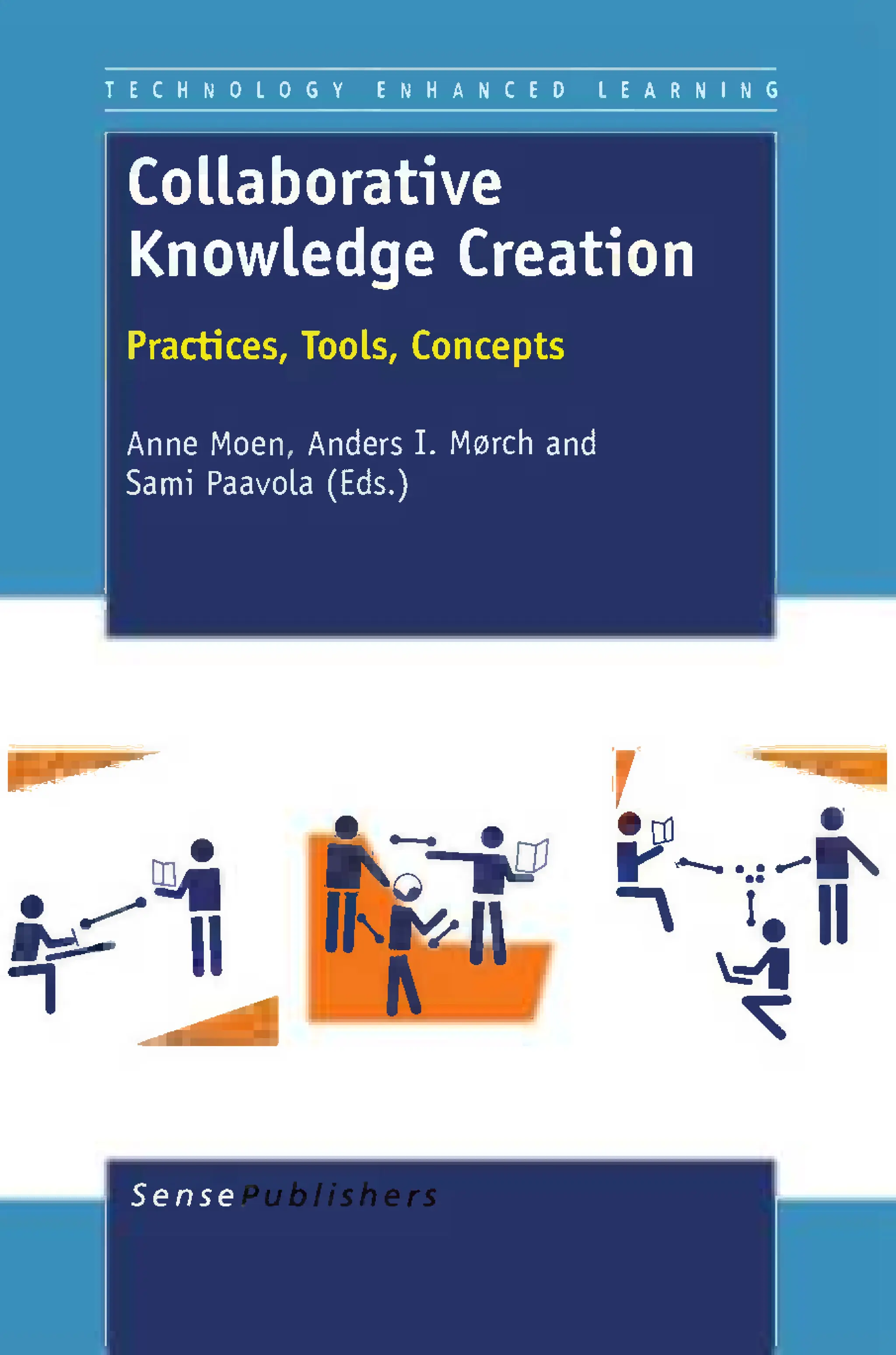

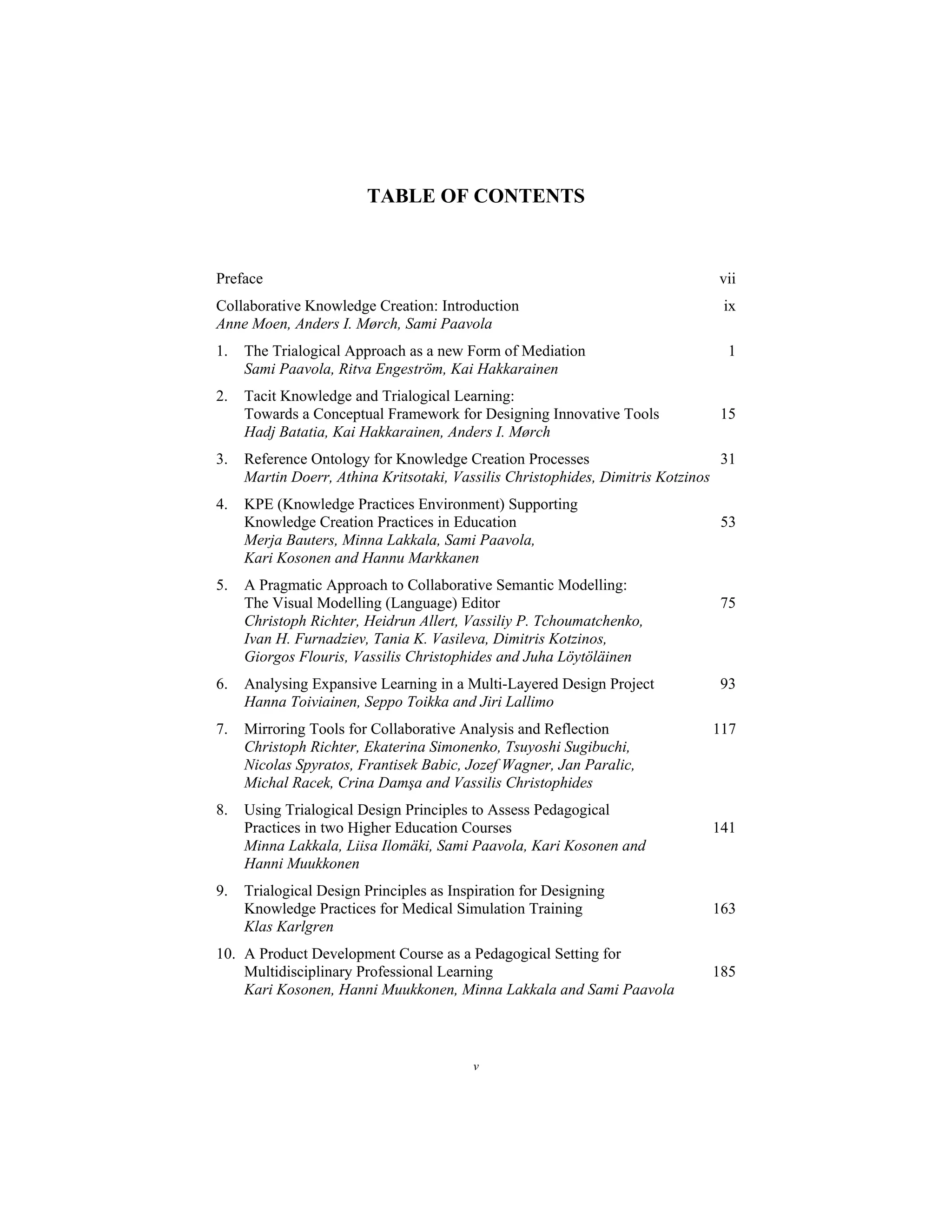



![TRIALOGICAL APPROACH AS A NEW FORM OF MEDIATION
5
… aim[s] at understanding how people collaboratively, in long-term
processes, develop novel epistemic things and transform their knowledge
practices, and how students in higher education do the same by cross-
fertilizing professional and educational practices and solve complex,
authentic problems with the help of innovative knowledge practices and
educational technology. The modern information and communication
technology not only facilitates knowledge creation around shared objects but
also puts forward the need to develop this kind of an approach about
trialogical learning. (KP-Lab, 2007).
The focus was on collaborative processes for developing “epistemic things” and on
transforming knowledge practices with the help of technology developed in the
project. A specific focus was on higher education courses in which there is a close
link to professional practice. Workplace research cases were also investigated
where collaboration on “virtually constructed objects” was at the heart of new
learning challenges.
DESIGN PRINCIPLES AS A FRAMEWORK FOR EMERGING KNOWLEDGE
PRACTICES
Early on (in the first year of the project), new knowledge practices were defined by
means of a set of design principles elaborated for complex learning settings (Bell
et al., 2004; Kali, 2006). The trialogical design principles were meant to serve
several purposes in the project, especially to function as a middle ground between
theoretical ideas and practical aims, and to give broad guidelines and principles for
the technology development and pedagogical emphases. There was a clear need to
identify such basic characteristics of the trialogical approach in a project where
there were several educational and technological partners involved with a variety
of backgrounds with a new pedagogical emphasis. These design principles were
not meant as a fixed set of normative rules but as providing outlines for evolving
knowledge practices, supposed to be investigated and revised during the project.
The design principles had a background in analyses, done by the participants of
the project, of theories representing the knowledge creation metaphor of learning.
We had previously (before the KP-Lab project) analysed similarities in otherwise
quite different theories representing the knowledge creation metaphor, and ended
up with the following common characteristics (Paavola et al., 2004, 562) that may
feed ICT-mediated knowledge creation and its tools and practices:
1. The pursuit of newness
2. Mediating elements to avoid Cartesian dualisms
3. Viewing knowledge creation as a social process
4. Emphasis on the role of individual subjects in knowledge creation
5. Going beyond propositional and conceptual knowledge
6. Recognizing conceptualizations and conceptual artefacts as important
7. Interaction around and through shared objects](https://image.slidesharecdn.com/2206312-250605011543-c587e250/75/Collaborative-Knowledge-Creation-Practices-Tools-Concepts-Sami-Paavola-26-2048.jpg)
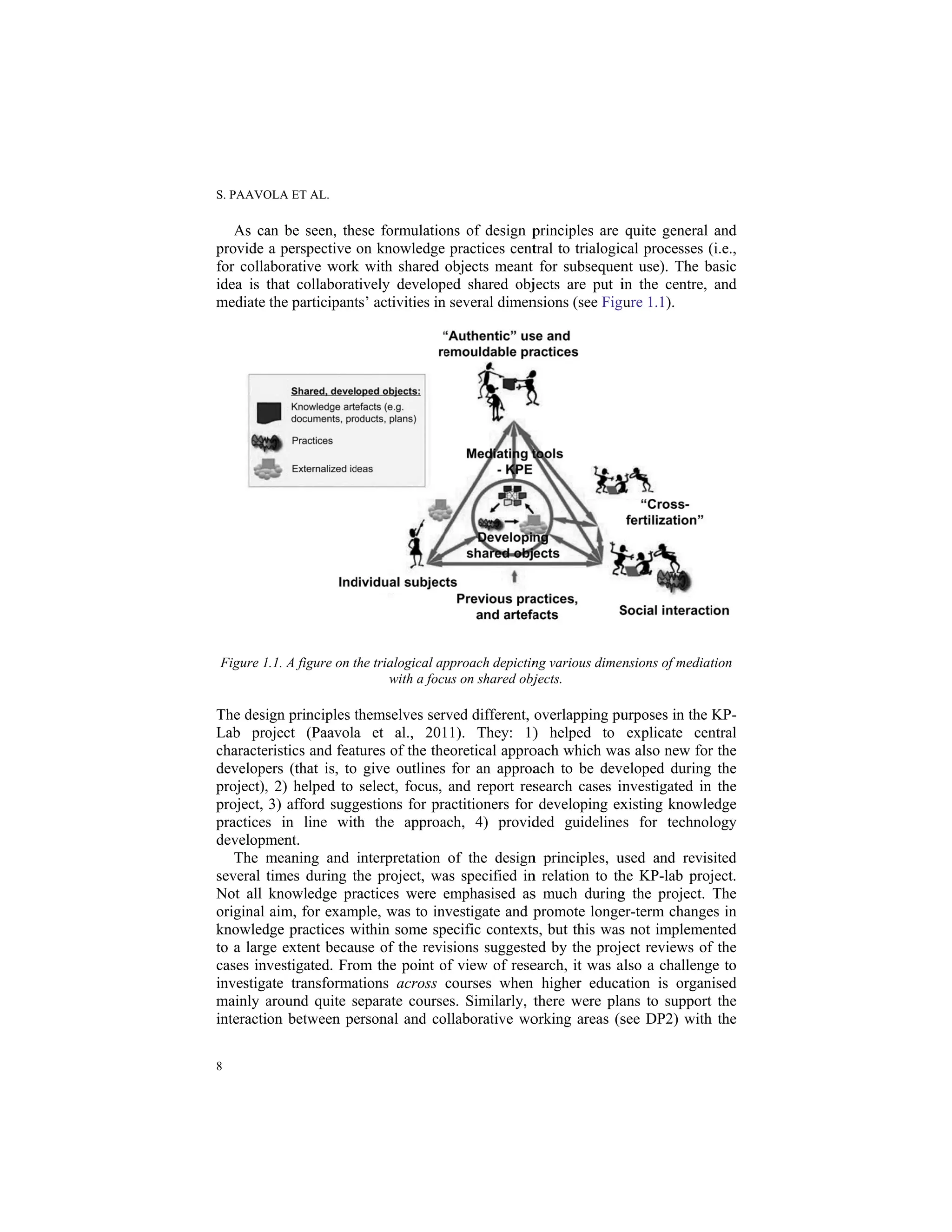
![TRIALOGICAL APPROACH AS A NEW FORM OF MEDIATION
13
Knorr Cetina, K. (1997). Sociality with objects. Social relations in postsocial knowledge societies.
Theory, Culture & Society 14(4), 1–30.
Knorr Cetina, K. (2001). Objectual practice. In Schatzki T.R., Knorr Cetina, K. & von Savigny E.
(eds.). The Practice Turn in Contemporary Theory. pp. 175–188. London and NY: Routledge.
KP-Lab (2007). Description of Work 2.1 Months 13 – 30, Part A. A project report, Developing
Knowledge Practices Laboratory (project no.: KP-Lab; 027490)
Lakkala, M., Paavola, S., Kosonen, K., Muukkonen, H., Bauters, M., & Markkanen, H. (2009). Main
functionalities of the Knowledge Practices Environment (KPE) affording knowledge creation
practices in education. In C. O’Malley, D. Suthers, P. Reimann, & A. Dimitracopoulou (Eds.),
Computer Supported Collaborative Learning Practices: CSCL2009 Conference Proceedings (pp.
297–306). Rhodes, Creek: International Society of the Learning Sciences (ISLS).
Lorino, P., Tricard, B. & Clot, Y. (2011). Research Methods for Non-Representational Approaches to
Organizational Complexity: The Dialogical Mediated Inquiry. Organization Studies, 32(6), 769–
801.
Markkanen, H., Holi, M., Benmergui, L., Bauters, M., & Richter, C. (2008). The Knowledge Practices
Environment: a Virtual Environment for Collaborative Knowledge Creation and Work around
Shared Artefacts. In Proceedings of World Conference on Educational Multimedia, Hypermedia
and Telecommunications 2008 (pp. 5035–5040). Chesapeake, VA: AACE.
McLoughlin, C. & Lee, M. J. W. (2008). The Three P’s of Pedagogy for the Networked Society:
Personalization, Participation, and Productivity. International Journal of Teaching and Learning in
Higher Education 20(1), 10–27.
Nonaka, I. & Takeuchi, H. (1995). The Knowledge-Creating Company: How Japanese Companies
Create the Dynamics of Innovation. New York: Oxford University Press.
Nowotny, H., Scott, P. & Gibbons, M. (2001). Re-Thinking Science. Cambridge, UK: Polity.
Paavola, S. & Hakkarainen, K. (2009). From meaning making to joint construction of knowledge
practices and artefacts: A trialogical approach to CSCL. In C. O’Malley, D. Suthers, P. Reimann, &
A. Dimitracopoulou (Eds.), Computer Supported Collaborative Learning Practices: CSCL2009
Conference Proceedings (pp. 83–92). Rhodes, Creek: International Society of the Learning Sciences
(ISLS).
Paavola, S., Lakkala, M., Muukkonen, H., Kosonen, K. & Karlgren, K. (2011). The roles and uses of
design principles for developing the trialogical approach on learning. Research in Learning
Technology 19(3), 233–246.
Paavola, S., Lipponen, L., & Hakkarainen, K. (2002). Epistemological Foundations for CSCL: A
Comparison of Three Models of Innovative Knowledge Communities. In G. Stahl (Ed.), Computer
Support for Collaborative Learning: Foundations for a CSCL community. Proceedings of the
Computer-supported Collaborative Learning 2002 Conference (pp. 24–32). Hillsdale, NJ: Erlbaum.
Paavola, S., Lipponen, L., & Hakkarainen, K. (2004). Models of Innovative Knowledge Communities
and Three Metaphors of Learning. Review of Educational Research 74(4), 557–576.
Peirce, C. S. (1931–1958). Collected Papers of Charles Sanders Peirce, vols. 1–6, Hartshorne, C. and
Weiss, P., eds.; vols. 7–8, Burks, A. W., ed. Cambridge, Mass: Harvard University Press. [marked
as: CP volume.paragraph]
Rabardel, P., & Bourmaud, G. (2003). From computer to instrument system: A developmental
perspective. Interacting with Computers, 15(5), 665–691.
Rheinberger, H.J. (1997) Toward a history of epistemic things: Synthesizing proteins in the test tube.
Stanford, CA: Stanford University Press.
Scardamalia, M. (2002) Collective Cognitive Responsibility for the Advancement of Knowledge. In B.
Smith (ed.). Liberal Education in a Knowledge Society (pp. 67–98). Open Court, Chicago.
Schmidt, K. & Wagner, I. (2002). Coordinative Artifacts in Architectural Practice. In Blay-Fornarino
et al. (Eds.): Cooperative Systems Design: A Challenge of the Mobility Age (pp. 257–274).
[Proceedings of the Fifth International Conference on the Design of Cooperative Systems (COOP
2002), Saint Raphaël, France, 4–7 June 2002], IOS Press, Amsterdam etc., 2002.](https://image.slidesharecdn.com/2206312-250605011543-c587e250/75/Collaborative-Knowledge-Creation-Practices-Tools-Concepts-Sami-Paavola-34-2048.jpg)