LANGUAGE EDUCATION AND
MULTILITERACIES
BY MA RY K A L A N T Z I S
A N D B I L L C O P E
Presented by Imran Hasan
GRADEDUC9535A 650 GF14
Initial Development
• One of the main concerns of the New London
Group, before formulating their concept of
Multilitercies, was how language meets with
cultural and linguistic diversity
• What is appropriate education for women, for
indigenous peoples, for immigrants who do not
speak the national language for speakers of
non-standard dialects? What is appropriate for
all in the context of the ever more critical factors
of local diversity and global connectedness?
Emergence of "Multi-literacies"
• Multilitercies was coined to describe:
– growing significance of cultural and linguistic
diversity in which we have to negotiate
differences every day, in our local
communities and in our increasingly globally
interconnected working and community lives
– influence of new communications
technologies. Meaning was increasingly being
made in ways that were multimodal—in which
written-linguistic modes of meaning are part
and parcel of visual, audio and spatial
patterns of meaning
Old Basics vs. New Basics
• People learnt rules and
obeyed them
• people who would take
answers to the world
rather than regard the
world as many problems-
to-be-solved
• People who carried
‘correct’ things in their
heads rather than
"flexible and collaborative
learners.
• passive receptors of
mass culture
• Shape new ‘kinds of
persons’
• Persons better adapted to
the kind of world we live in
now and the world of the
near future.
• People need to
multiskilled, flexible, more
able to undertake a range
of tasks
• Active creators of
information leading to new
kinds of self expression
and community building
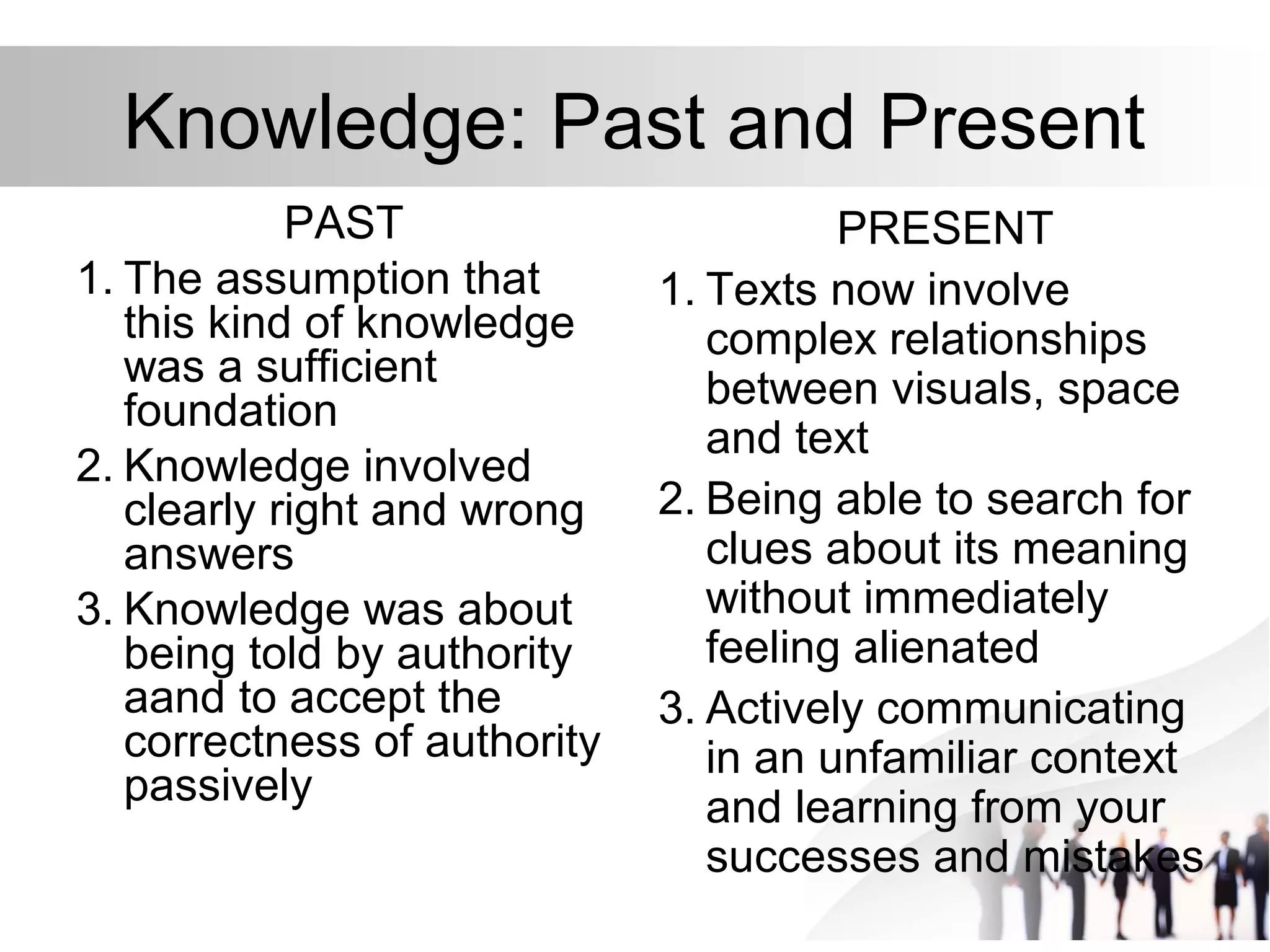
Knowledge: Past and Present
PAST
1. The assumption that
this kind of knowledge
was a sufficient
foundation
2. Knowledge involved
clearly right and wrong
answers
3. Knowledge was about
being told by authority
aand to accept the
correctness of authority
passively
PRESENT
1. Texts now involve
complex relationships
between visuals, space
and text
2. Being able to search for
clues about its meaning
without immediately
feeling alienated
3. Actively communicating
in an unfamiliar context
and learning from your
successes and mistakes
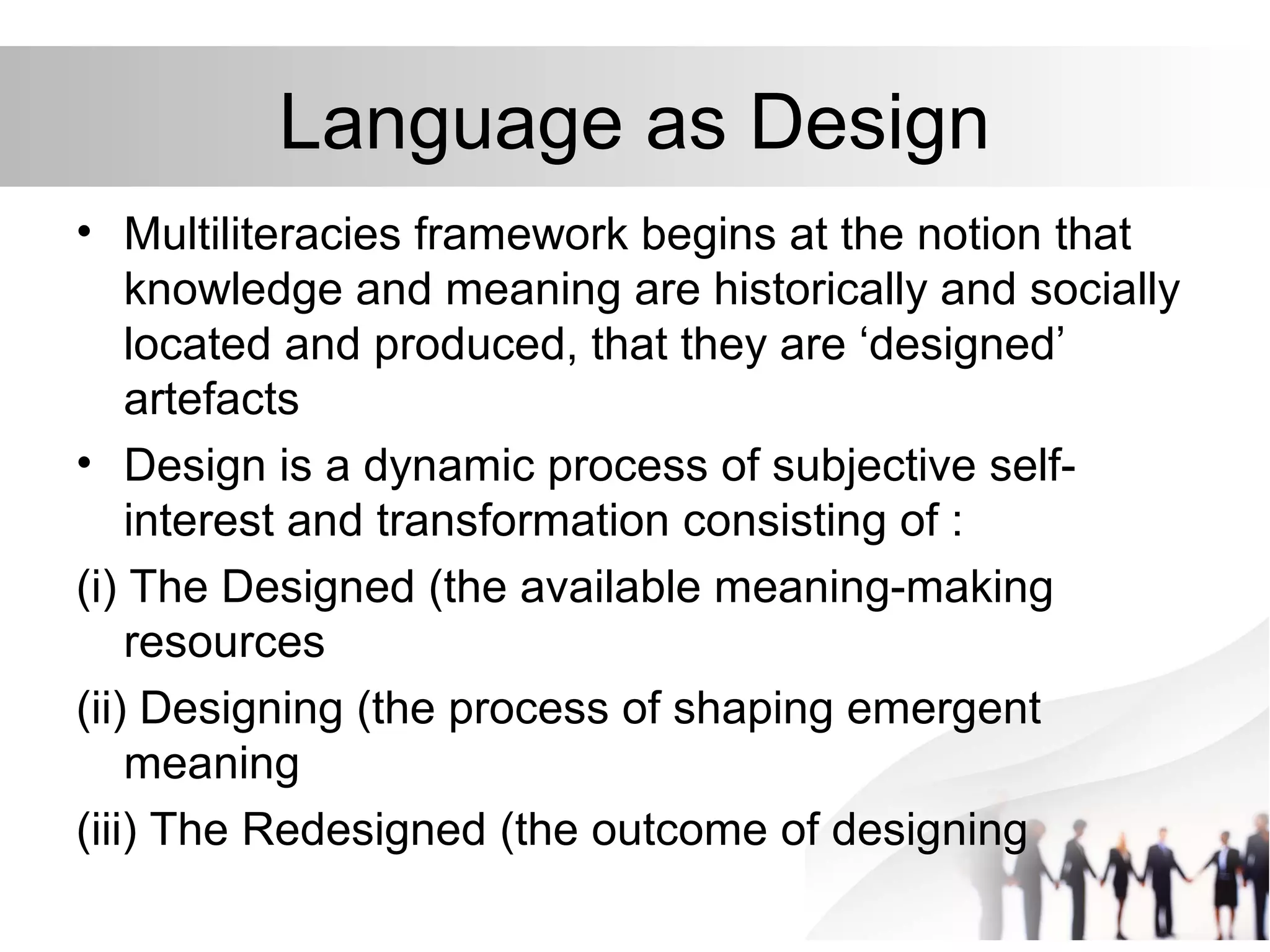
Language as Design
• Multiliteracies framework begins at the notion that
knowledge and meaning are historically and socially
located and produced, that they are ‘designed’
artefacts
• Design is a dynamic process of subjective self-
interest and transformation consisting of :
(i) The Designed (the available meaning-making
resources
(ii) Designing (the process of shaping emergent
meaning
(iii) The Redesigned (the outcome of designing
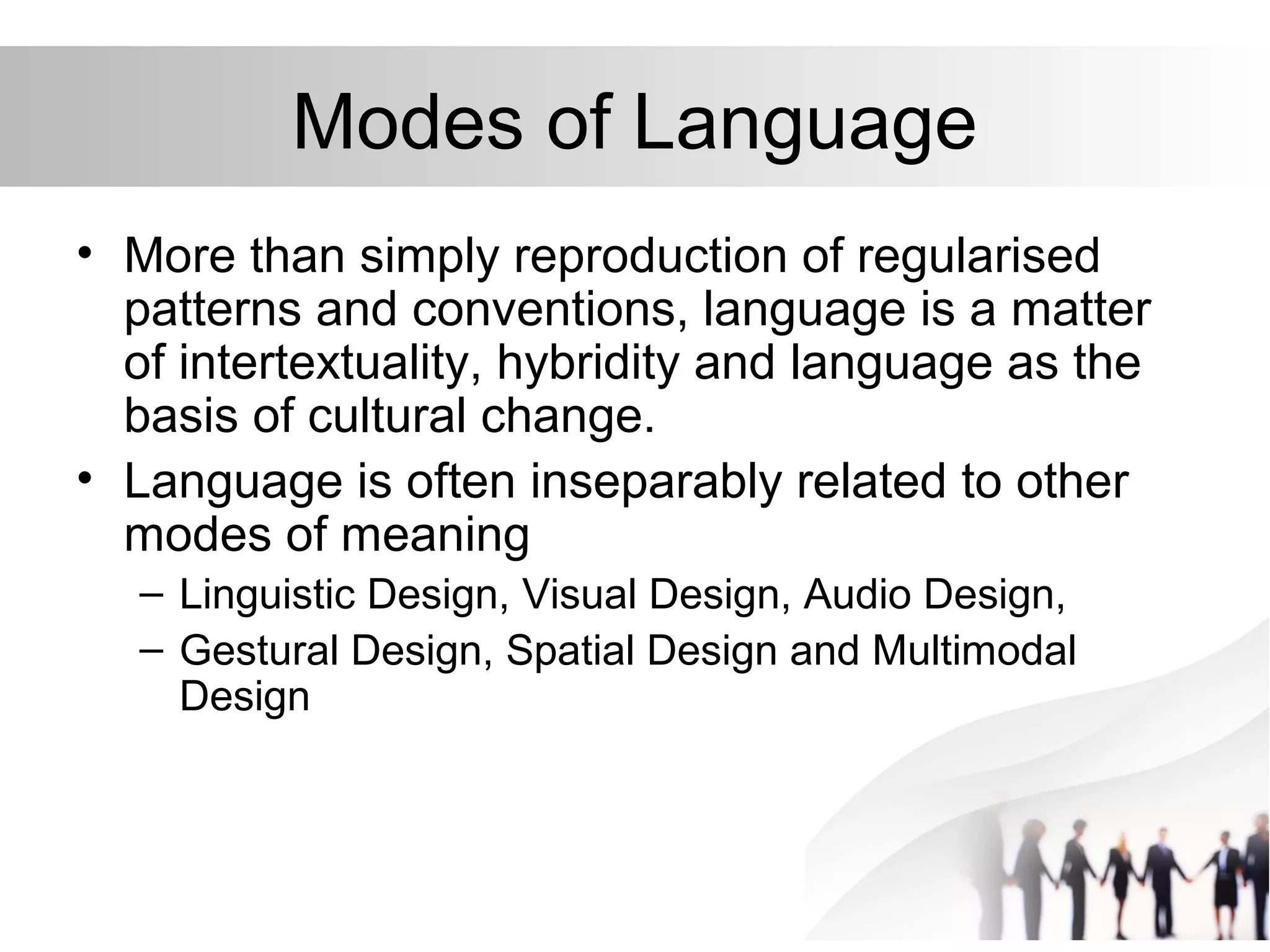
Modes of Language
• More than simply reproduction of regularised
patterns and conventions, language is a matter
of intertextuality, hybridity and language as the
basis of cultural change.
• Language is often inseparably related to other
modes of meaning
– Linguistic Design, Visual Design, Audio Design,
– Gestural Design, Spatial Design and Multimodal
Design
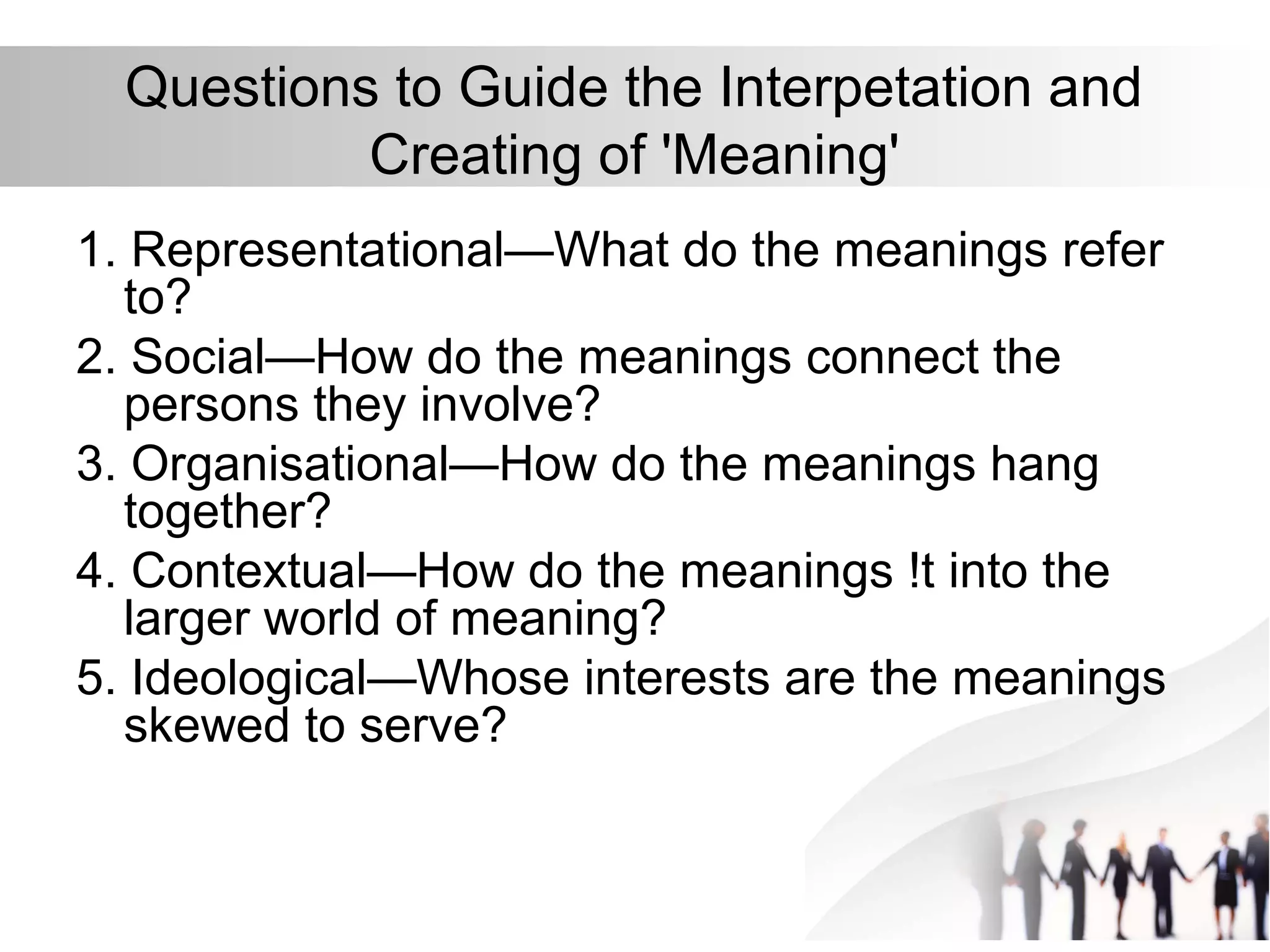
Questions to Guide the Interpetation and
Creating of 'Meaning'
1. Representational—What do the meanings refer
to?
2. Social—How do the meanings connect the
persons they involve?
3. Organisational—How do the meanings hang
together?
4. Contextual—How do the meanings !t into the
larger world of meaning?
5. Ideological—Whose interests are the meanings
skewed to serve?
The 4 Pedagogical Universals
1.Situated Practice involves immersion in
experience and the utilisation of available
Designs
2.Overt Instruction involves systematic,
analytical, and conscious understanding.
3.Critical Framing means interpreting the
social and cultural context of particular
Designs of meaning.
4.Transformed Practice entails transfer in
meaning-making practice, to work in other
contexts or cultural sites
Conclusions
• We need to measure our reading of the
phenomena of culture against the deep
structures of everyday life and meaning
• Crosscultural comparison; how does our
lifeworld measure up against alternative
ways of being human, of doing culture?
• We need to learn by constantly crossing
cultural boundaries, of shunting between
one lifeworld context and another.

Language education and multiliteracies

  • 1.
    LANGUAGE EDUCATION AND MULTILITERACIES BYMA RY K A L A N T Z I S A N D B I L L C O P E Presented by Imran Hasan GRADEDUC9535A 650 GF14
  • 2.
    Initial Development • Oneof the main concerns of the New London Group, before formulating their concept of Multilitercies, was how language meets with cultural and linguistic diversity • What is appropriate education for women, for indigenous peoples, for immigrants who do not speak the national language for speakers of non-standard dialects? What is appropriate for all in the context of the ever more critical factors of local diversity and global connectedness?
  • 3.
    Emergence of "Multi-literacies" •Multilitercies was coined to describe: – growing significance of cultural and linguistic diversity in which we have to negotiate differences every day, in our local communities and in our increasingly globally interconnected working and community lives – influence of new communications technologies. Meaning was increasingly being made in ways that were multimodal—in which written-linguistic modes of meaning are part and parcel of visual, audio and spatial patterns of meaning
  • 4.
    Old Basics vs.New Basics • People learnt rules and obeyed them • people who would take answers to the world rather than regard the world as many problems- to-be-solved • People who carried ‘correct’ things in their heads rather than "flexible and collaborative learners. • passive receptors of mass culture • Shape new ‘kinds of persons’ • Persons better adapted to the kind of world we live in now and the world of the near future. • People need to multiskilled, flexible, more able to undertake a range of tasks • Active creators of information leading to new kinds of self expression and community building
  • 5.
    Knowledge: Past andPresent PAST 1. The assumption that this kind of knowledge was a sufficient foundation 2. Knowledge involved clearly right and wrong answers 3. Knowledge was about being told by authority aand to accept the correctness of authority passively PRESENT 1. Texts now involve complex relationships between visuals, space and text 2. Being able to search for clues about its meaning without immediately feeling alienated 3. Actively communicating in an unfamiliar context and learning from your successes and mistakes
  • 6.
    Language as Design •Multiliteracies framework begins at the notion that knowledge and meaning are historically and socially located and produced, that they are ‘designed’ artefacts • Design is a dynamic process of subjective self- interest and transformation consisting of : (i) The Designed (the available meaning-making resources (ii) Designing (the process of shaping emergent meaning (iii) The Redesigned (the outcome of designing
  • 7.
    Modes of Language •More than simply reproduction of regularised patterns and conventions, language is a matter of intertextuality, hybridity and language as the basis of cultural change. • Language is often inseparably related to other modes of meaning – Linguistic Design, Visual Design, Audio Design, – Gestural Design, Spatial Design and Multimodal Design
  • 8.
    Questions to Guidethe Interpetation and Creating of 'Meaning' 1. Representational—What do the meanings refer to? 2. Social—How do the meanings connect the persons they involve? 3. Organisational—How do the meanings hang together? 4. Contextual—How do the meanings !t into the larger world of meaning? 5. Ideological—Whose interests are the meanings skewed to serve?
  • 9.
    The 4 PedagogicalUniversals 1.Situated Practice involves immersion in experience and the utilisation of available Designs 2.Overt Instruction involves systematic, analytical, and conscious understanding. 3.Critical Framing means interpreting the social and cultural context of particular Designs of meaning. 4.Transformed Practice entails transfer in meaning-making practice, to work in other contexts or cultural sites
  • 10.
    Conclusions • We needto measure our reading of the phenomena of culture against the deep structures of everyday life and meaning • Crosscultural comparison; how does our lifeworld measure up against alternative ways of being human, of doing culture? • We need to learn by constantly crossing cultural boundaries, of shunting between one lifeworld context and another.