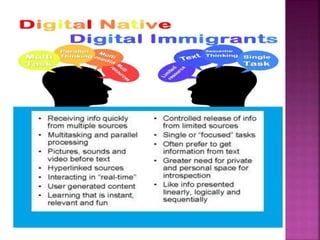
Demand immediate and parallel processing
of information’
Multi tasking of activities
Visuals as the mode of communication
Hyperlinks and random access to textual
information
Instant recognition and reward
Education perceived as fun rather than work
Want freedom in everything they do, from
freedom of choice to freedom of expression
Love to personalize, customize and are the
new scrutinizers
Want entertainment and play in their work,
education and social life
They are the collaboration and relationship
generation
They have a need for speed, not only in
video games
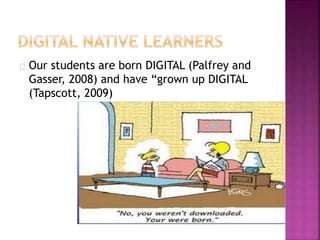
Our students are born DIGITAL (Palfrey and
Gasser, 2008) and have “grown up DIGITAL
(Tapscott, 2009)
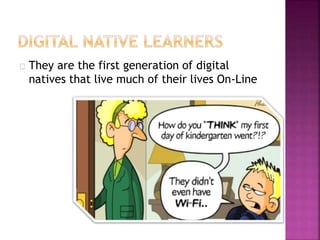
They are the first generation of digital
natives that live much of their lives On-Line
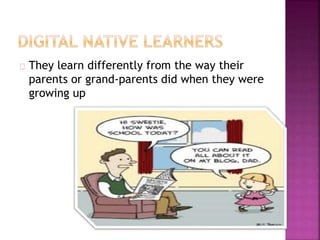
They learn differently from the way their
parents or grand-parents did when they were
growing up
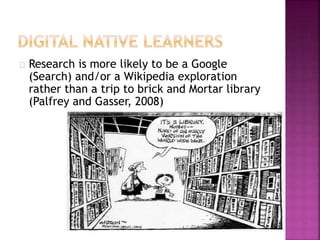
Research is more likely to be a Google
(Search) and/or a Wikipedia exploration
rather than a trip to brick and Mortar library
(Palfrey and Gasser, 2008)
Valid question
“does education need to cater fully to
the learning styles of digital natives,
or should the digital natives learn
the habits of formal structures and
culture of education that has been
successfully constructed by the
digital immigrants
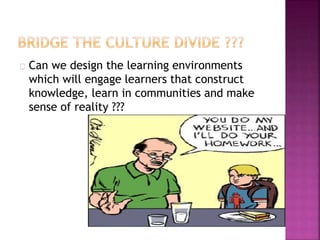
Can we design the learning environments
which will engage learners that construct
knowledge, learn in communities and make
sense of reality ???
Digital technology alters the things people
think about, think with and the domain in
which thoughts develop
Information and Communications Technology
(ICT) are- Transforming Teaching and
Learning Pedagogy; Impacting on the entire
Education Delivery and Support Processes
On-line learning is marked by “juxtaposition
of new technology and old pedagogy”
Students learn when they exploit technology as
cognitive tools while leveraging on machines for
information access and data storage, and
computation and retrieval purposes.
New media platforms-Wikipedia, Blackboard,
Sakai, YouTube, Facebook; the mind tools of MS
Office, Prezi and the virtual world of Second Life
are additional scaffolds that stimulate human
cognition to make sense of reality.
Thinking with teaching machines brings about a
qualitative shift in the mental activity of
students because it provides a dynamic scaffold
for influencing and activating the thought
processes.
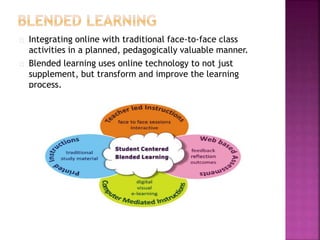
Integrating online with traditional face-to-face class
activities in a planned, pedagogically valuable manner.
Blended learning uses online technology to not just
supplement, but transform and improve the learning
process.
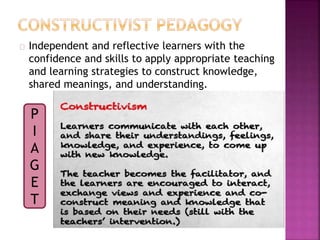
Independent and reflective learners with the
confidence and skills to apply appropriate teaching
and learning strategies to construct knowledge,
shared meanings, and understanding.
P
I
A
G
E
T
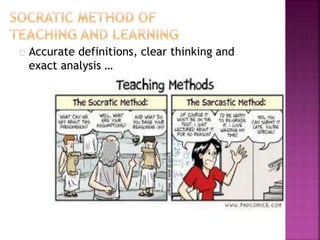
Accurate definitions, clear thinking and
exact analysis …
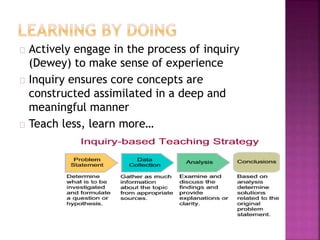
Actively engage in the process of inquiry
(Dewey) to make sense of experience
Inquiry ensures core concepts are
constructed assimilated in a deep and
meaningful manner
Teach less, learn more…
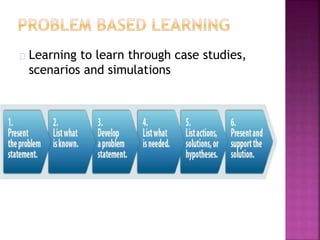
Learning to learn through case studies,
scenarios and simulations
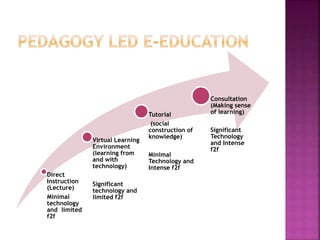
Direct
Instruction
(Lecture)
Minimal
technology
and limited
f2f
Virtual Learning
Environment
(learning from
and with
technology)
Significant
technology and
limited f2f
Tutorial
(social
construction of
knowledge)
Minimal
Technology and
Intense f2f
Consultation
(Making sense
of learning)
Significant
Technology
and Intense
f2f
https://www.youtube.com/watch?v=O35n_tv
OK74
rashmib@nexteducation.in
+919826231561

Educating digital natives

  • 3.
    Demand immediate andparallel processing of information’ Multi tasking of activities Visuals as the mode of communication Hyperlinks and random access to textual information Instant recognition and reward Education perceived as fun rather than work
  • 4.
    Want freedom ineverything they do, from freedom of choice to freedom of expression Love to personalize, customize and are the new scrutinizers Want entertainment and play in their work, education and social life They are the collaboration and relationship generation They have a need for speed, not only in video games
  • 5.
    Our students areborn DIGITAL (Palfrey and Gasser, 2008) and have “grown up DIGITAL (Tapscott, 2009)
  • 6.
    They are thefirst generation of digital natives that live much of their lives On-Line
  • 7.
    They learn differentlyfrom the way their parents or grand-parents did when they were growing up
  • 8.
    Research is morelikely to be a Google (Search) and/or a Wikipedia exploration rather than a trip to brick and Mortar library (Palfrey and Gasser, 2008)
  • 10.
    Valid question “does educationneed to cater fully to the learning styles of digital natives, or should the digital natives learn the habits of formal structures and culture of education that has been successfully constructed by the digital immigrants
  • 11.
    Can we designthe learning environments which will engage learners that construct knowledge, learn in communities and make sense of reality ???
  • 12.
    Digital technology altersthe things people think about, think with and the domain in which thoughts develop Information and Communications Technology (ICT) are- Transforming Teaching and Learning Pedagogy; Impacting on the entire Education Delivery and Support Processes On-line learning is marked by “juxtaposition of new technology and old pedagogy”
  • 13.
    Students learn whenthey exploit technology as cognitive tools while leveraging on machines for information access and data storage, and computation and retrieval purposes. New media platforms-Wikipedia, Blackboard, Sakai, YouTube, Facebook; the mind tools of MS Office, Prezi and the virtual world of Second Life are additional scaffolds that stimulate human cognition to make sense of reality. Thinking with teaching machines brings about a qualitative shift in the mental activity of students because it provides a dynamic scaffold for influencing and activating the thought processes.
  • 14.
    Integrating online withtraditional face-to-face class activities in a planned, pedagogically valuable manner. Blended learning uses online technology to not just supplement, but transform and improve the learning process.
  • 15.
    Independent and reflectivelearners with the confidence and skills to apply appropriate teaching and learning strategies to construct knowledge, shared meanings, and understanding. P I A G E T
  • 16.
    Accurate definitions, clearthinking and exact analysis …
  • 18.
    Actively engage inthe process of inquiry (Dewey) to make sense of experience Inquiry ensures core concepts are constructed assimilated in a deep and meaningful manner Teach less, learn more…
  • 19.
    Learning to learnthrough case studies, scenarios and simulations
  • 21.
    Direct Instruction (Lecture) Minimal technology and limited f2f Virtual Learning Environment (learningfrom and with technology) Significant technology and limited f2f Tutorial (social construction of knowledge) Minimal Technology and Intense f2f Consultation (Making sense of learning) Significant Technology and Intense f2f
  • 24.
  • 25.