Presentation   On ELASTICITY  OF DEMAND
Prepared By   Vyas Harshal
Definition Of Price Elasticity Of Demand The change in the quantity demanded of a product due to a change in its price is known as Price elasticity of demand. Thus, the sensitiveness or responsiveness of demand to change in price is as called elasticity of demand
Kinds Of Price Elasticity Of Demand Perfectly elastic demand Relatively elastic demand Elasticity of demand equal to utility Relatively inelastic demand Perfectly inelastic demand Let Us See Some Views On Them
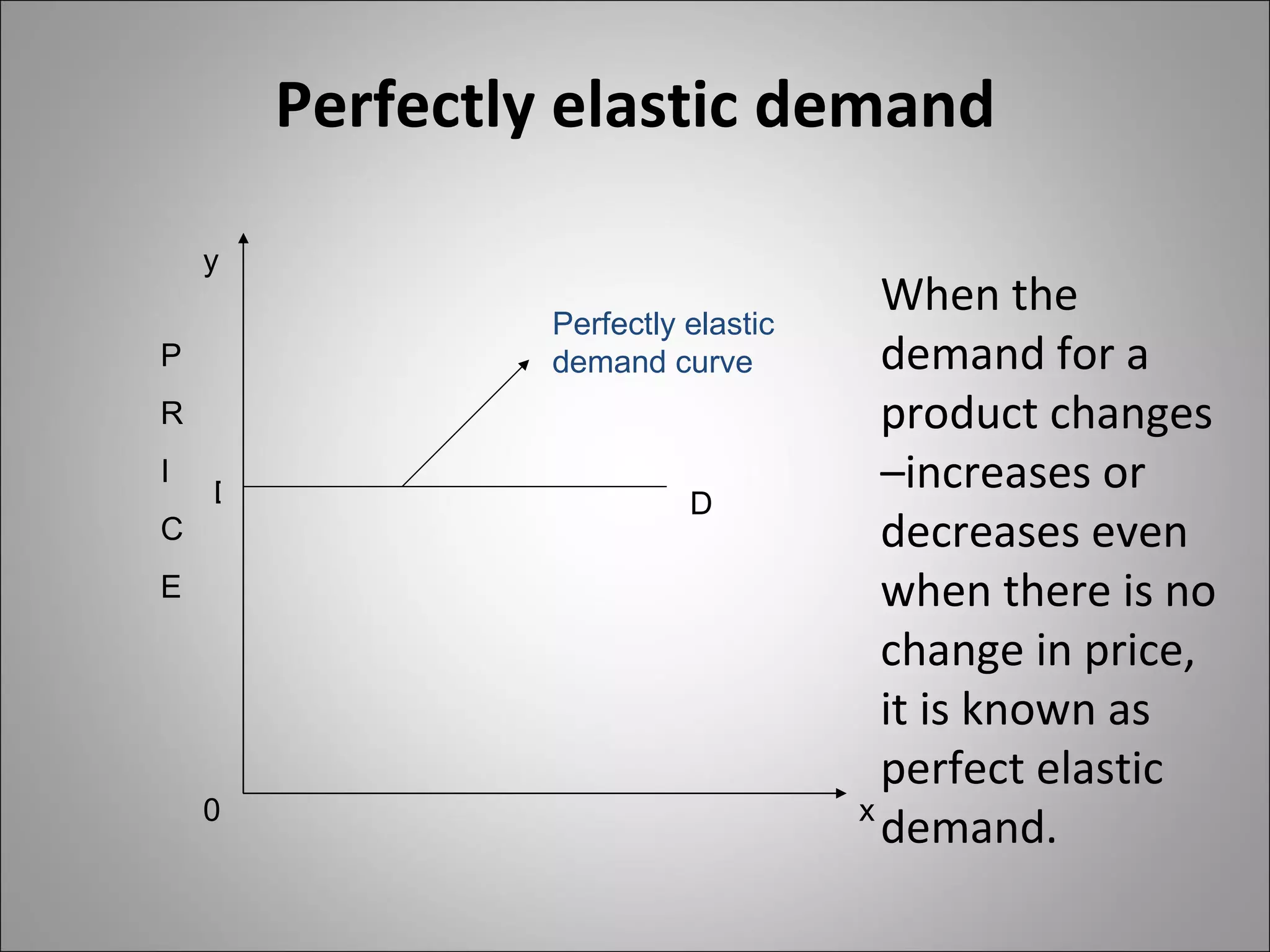
Perfectly elastic demand P R I C E y 0 x Perfectly elastic demand curve D D When the demand for a product changes –increases or decreases even when there is no change in price, it is known as perfect elastic demand.
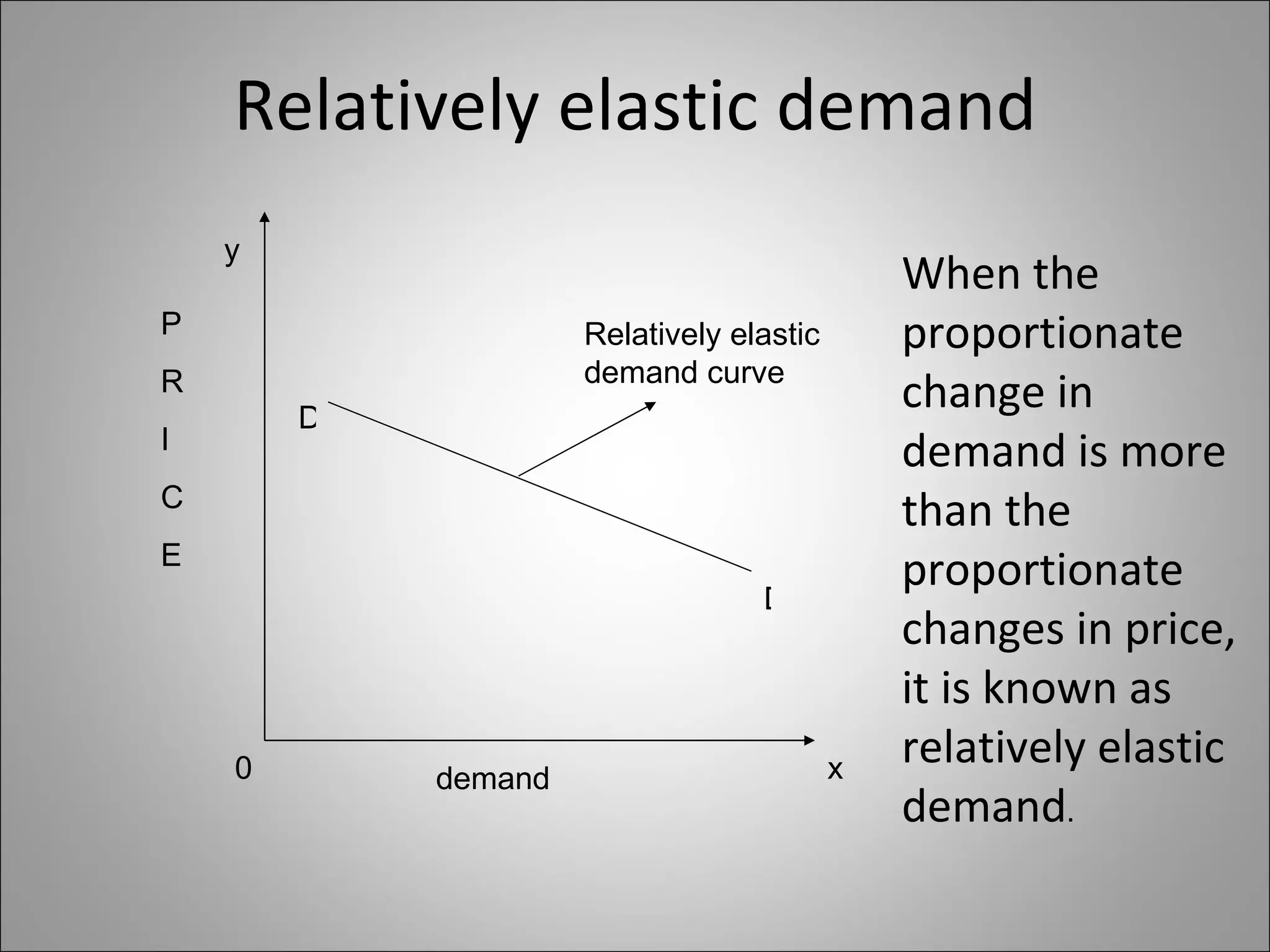
Relatively elastic demand Relatively elastic demand curve P R I C E demand 0 x y D D When the proportionate change in demand is more than the proportionate  changes in price, it is known as relatively elastic demand .
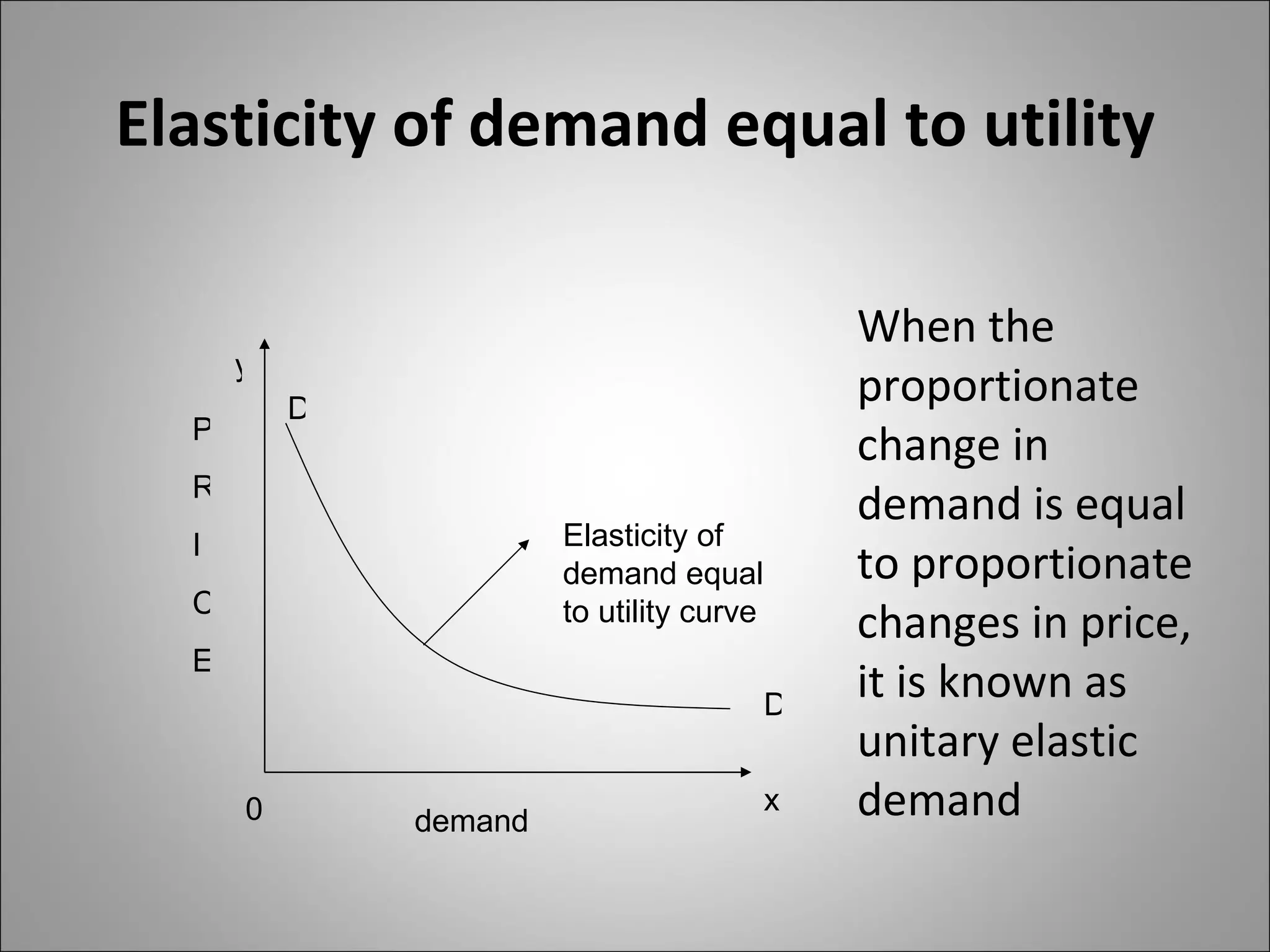
Elasticity of demand equal to utility Elasticity of demand equal to utility curve y x 0 demand P R I C E D D When the proportionate change in demand is equal to proportionate  changes in price, it is known as unitary elastic demand
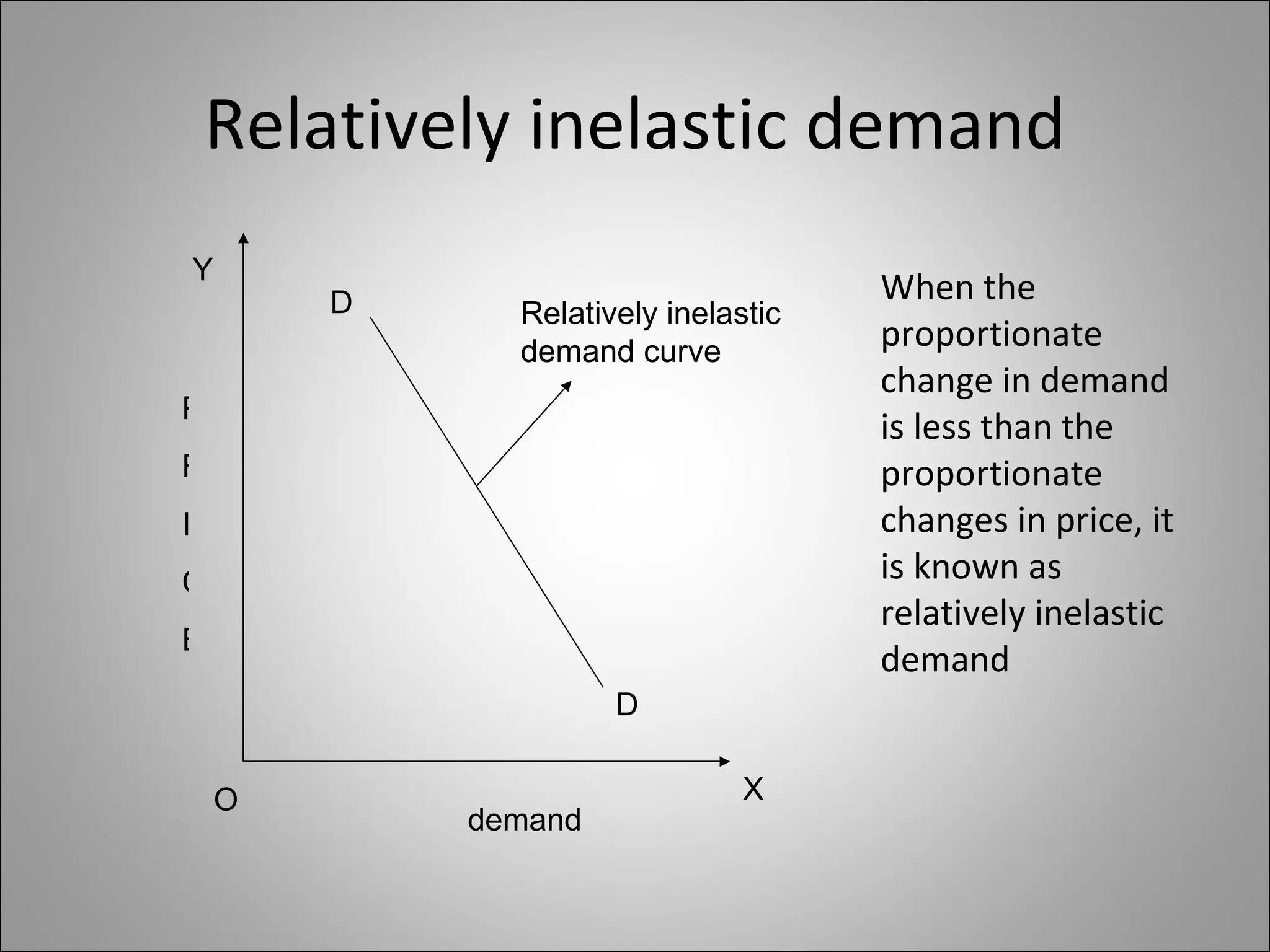
Relatively inelastic demand Relatively inelastic demand curve X O Y demand D D P R I C E When the proportionate change in demand is less than the proportionate  changes in price, it is known as relatively inelastic demand
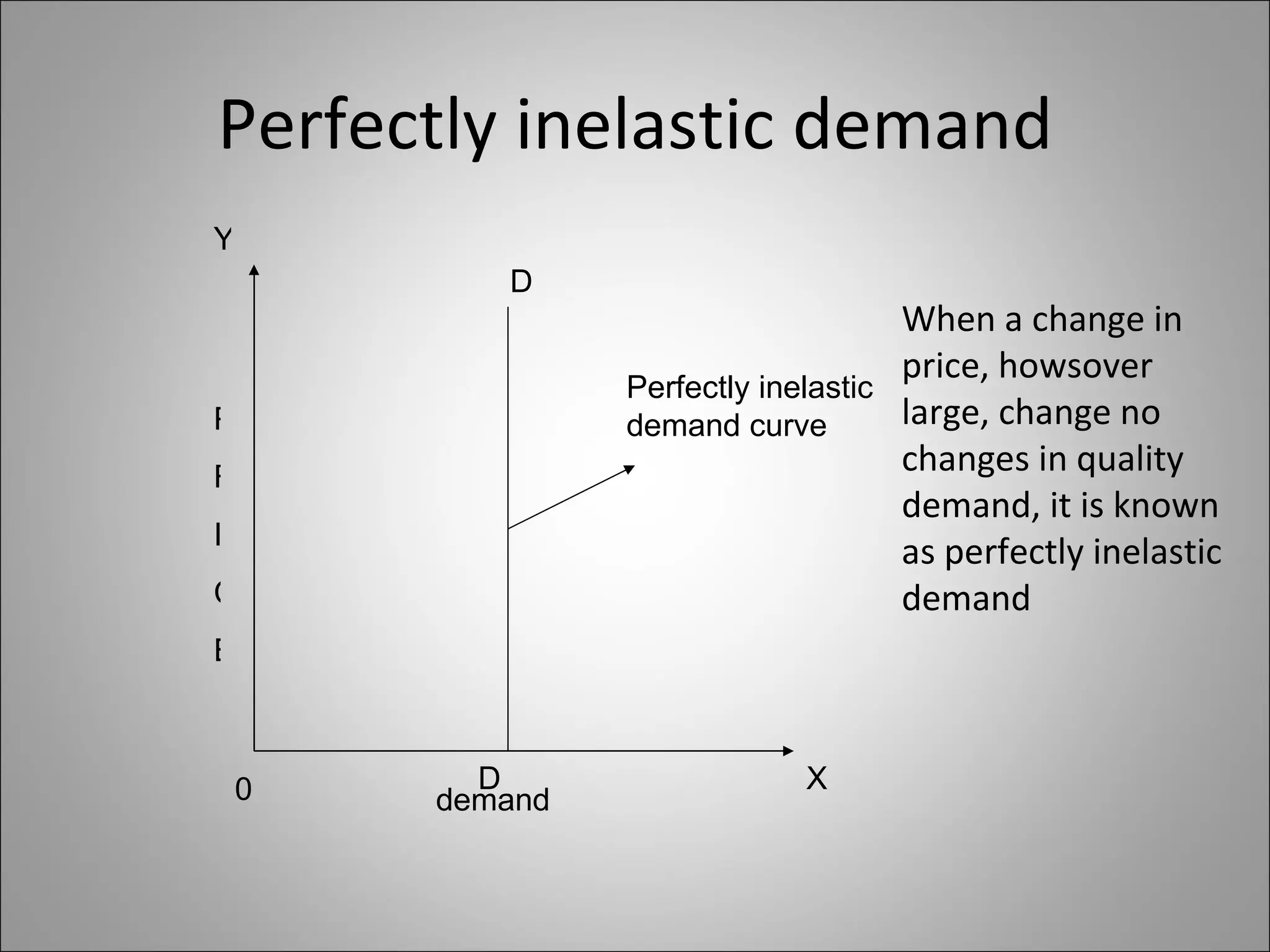
Perfectly inelastic demand demand D D Perfectly inelastic demand curve 0 Y X P R I C E When a change in price, howsover large, change no changes in quality demand, it is known as perfectly inelastic demand
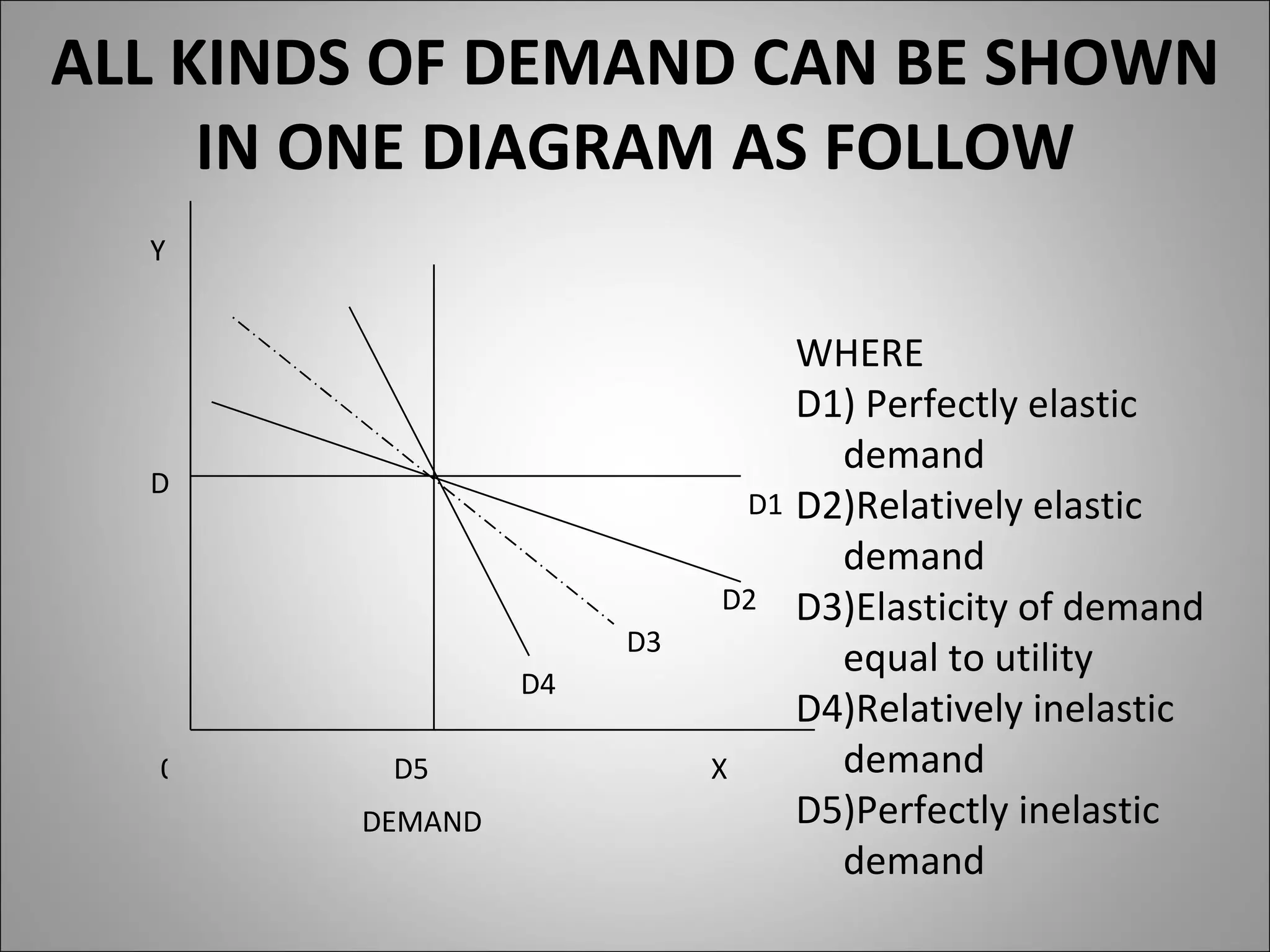
ALL KINDS OF DEMAND CAN BE SHOWN IN ONE DIAGRAM AS FOLLOW D D1 D2 D3 D4 D5 Y X 0 DEMAND P R I C E WHERE D1) Perfectly elastic demand D2)Relatively elastic demand D3)Elasticity of demand equal to utility D4)Relatively inelastic demand D5)Perfectly inelastic demand
Measurement Of Price Elasticity Of Demand There are main methods like Percentage method or proportionate method Total outlay method or total revenue method Geometric method or point method  Arc elasticity of demand
1 Percentage method or proportionate method Price elasticity of demand is measured by a ratio between the proportionate change in the quantity of a product demanded as a result of a proportionate change in its price Formula for calculate this is given further as following
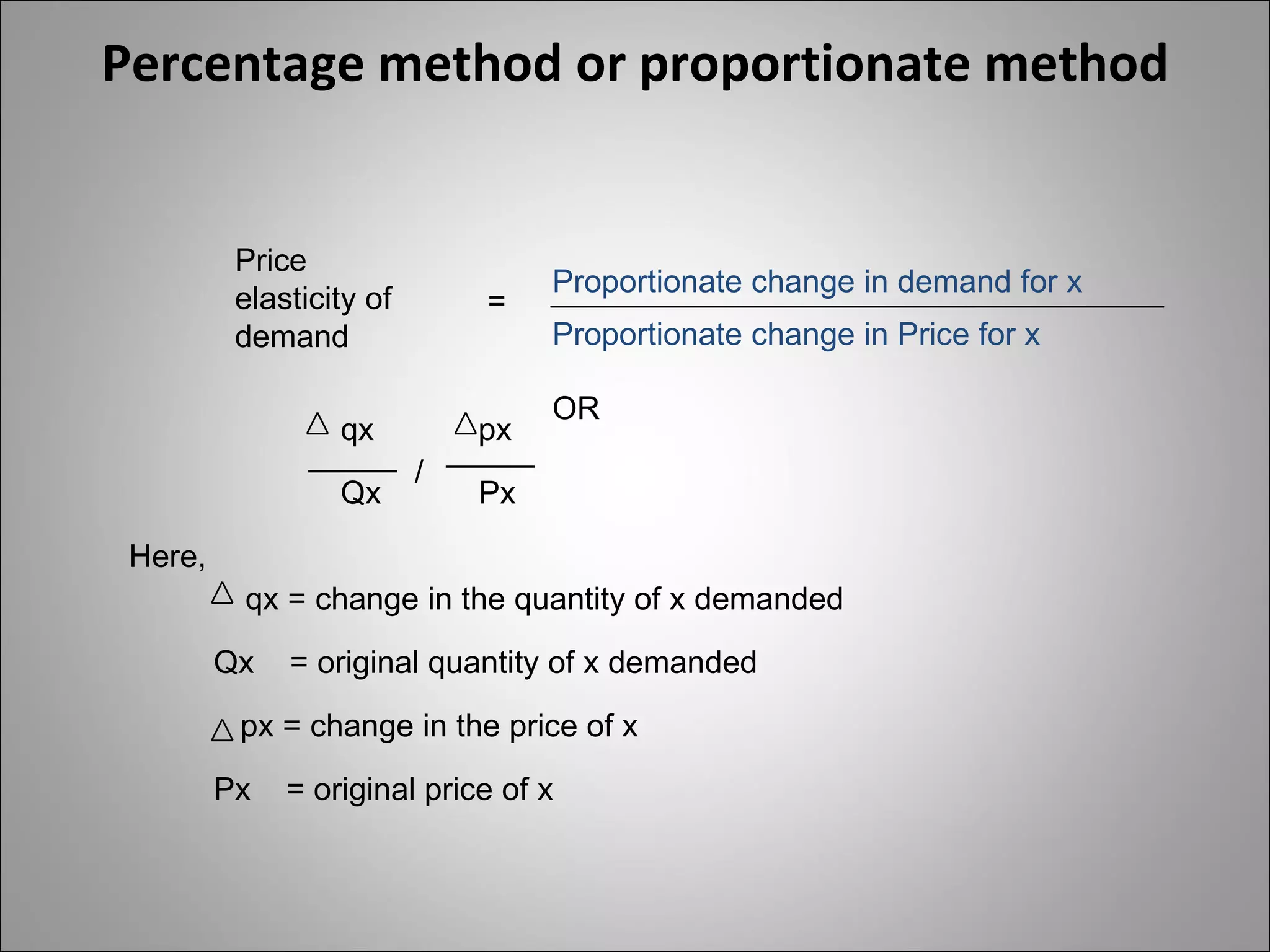
Percentage method or proportionate method Price elasticity of demand = Proportionate change in demand for x Proportionate change in Price for x OR _____ qx Qx / _____ px Px Here, qx = change in the quantity of x demanded Qx  = original quantity of x demanded px = change in the price of x Px  = original price of x
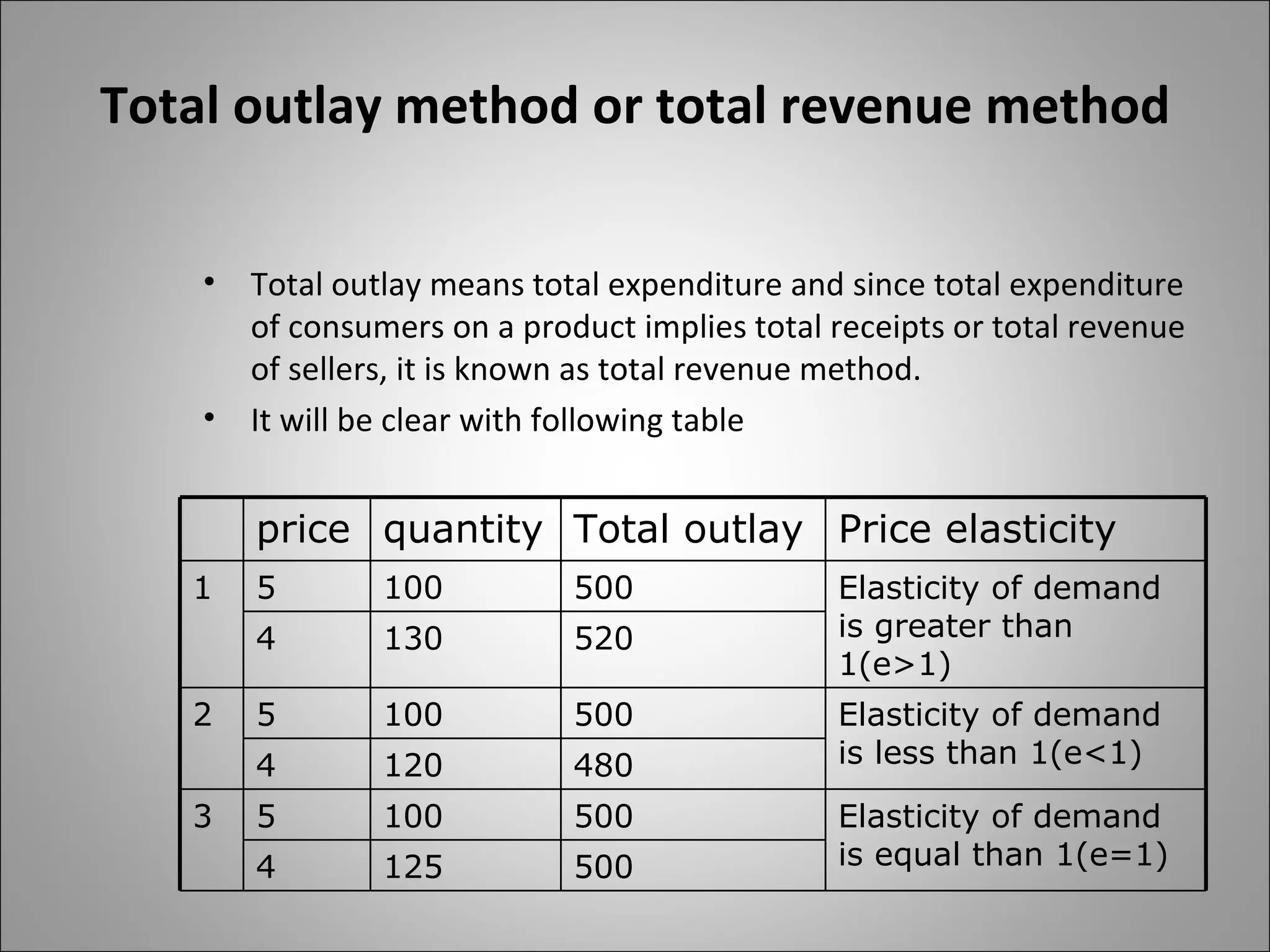
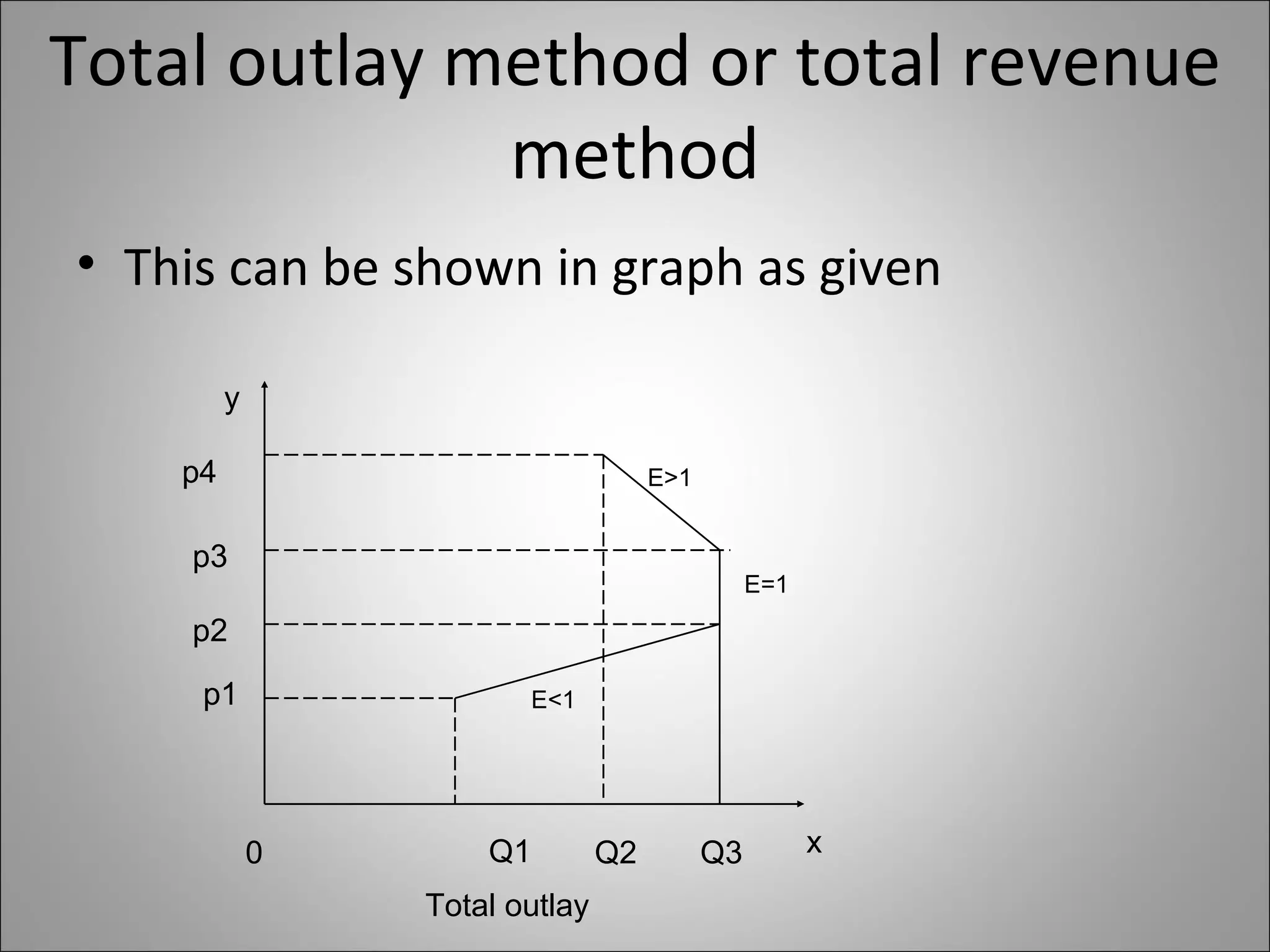
Total outlay method or total revenue method Total outlay means total expenditure and since total expenditure of consumers on a product implies total receipts or total revenue of sellers, it is known as total revenue method. It will be clear with following table price quantity Total outlay Price elasticity 1 5 100 500 Elasticity of demand is greater than 1(e>1) 4 130 520 2 5 100 500 Elasticity of demand is less than 1(e<1) 4 120 480 3 5 100 500 Elasticity of demand is equal than 1(e=1) 4 125 500
Total outlay method or total revenue method This can be shown in graph as given 0 y x Total outlay Q1  Q2  Q3  p1 p2 p3 p4 P R I C e E<1 E=1 E>1
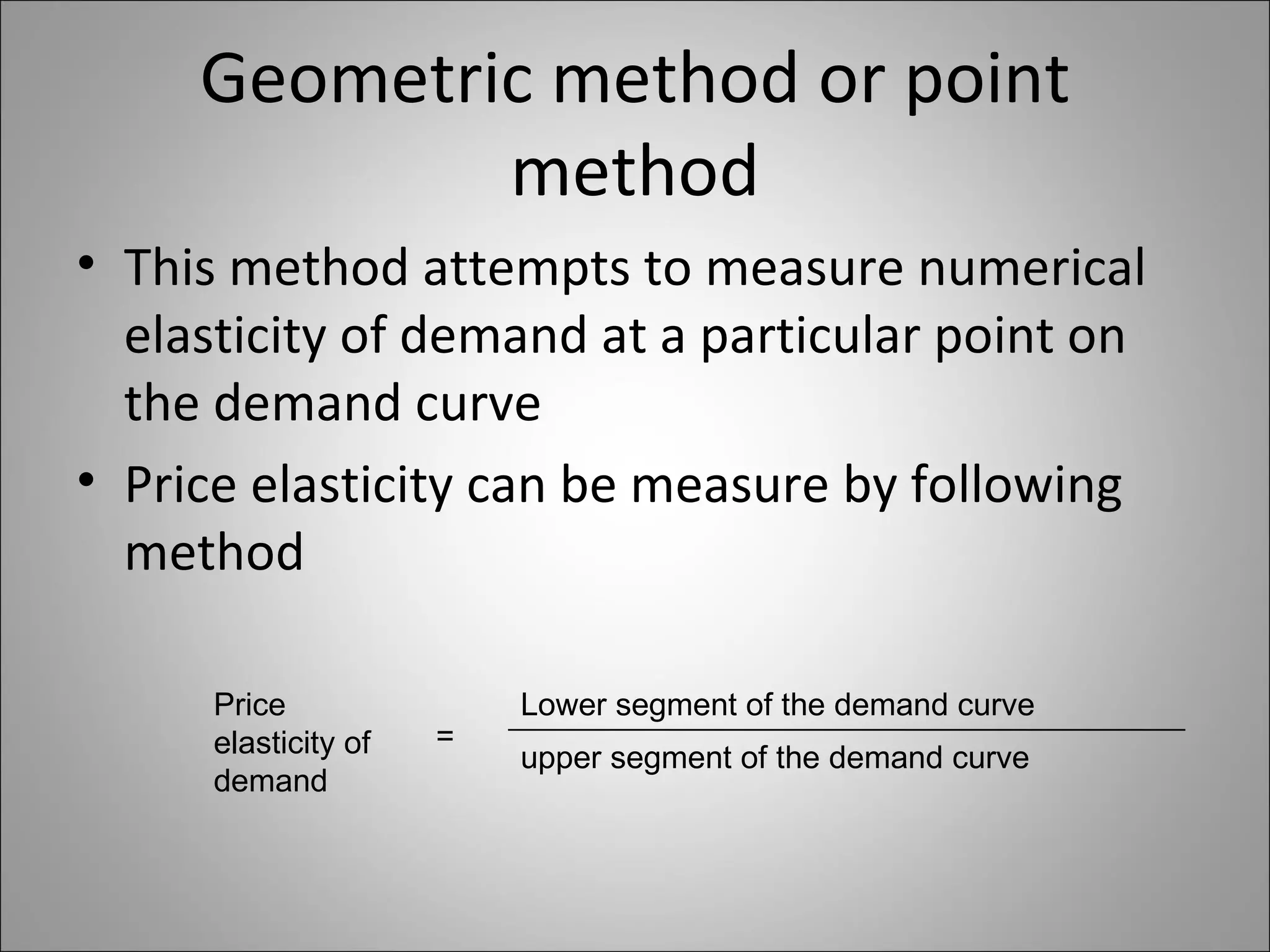
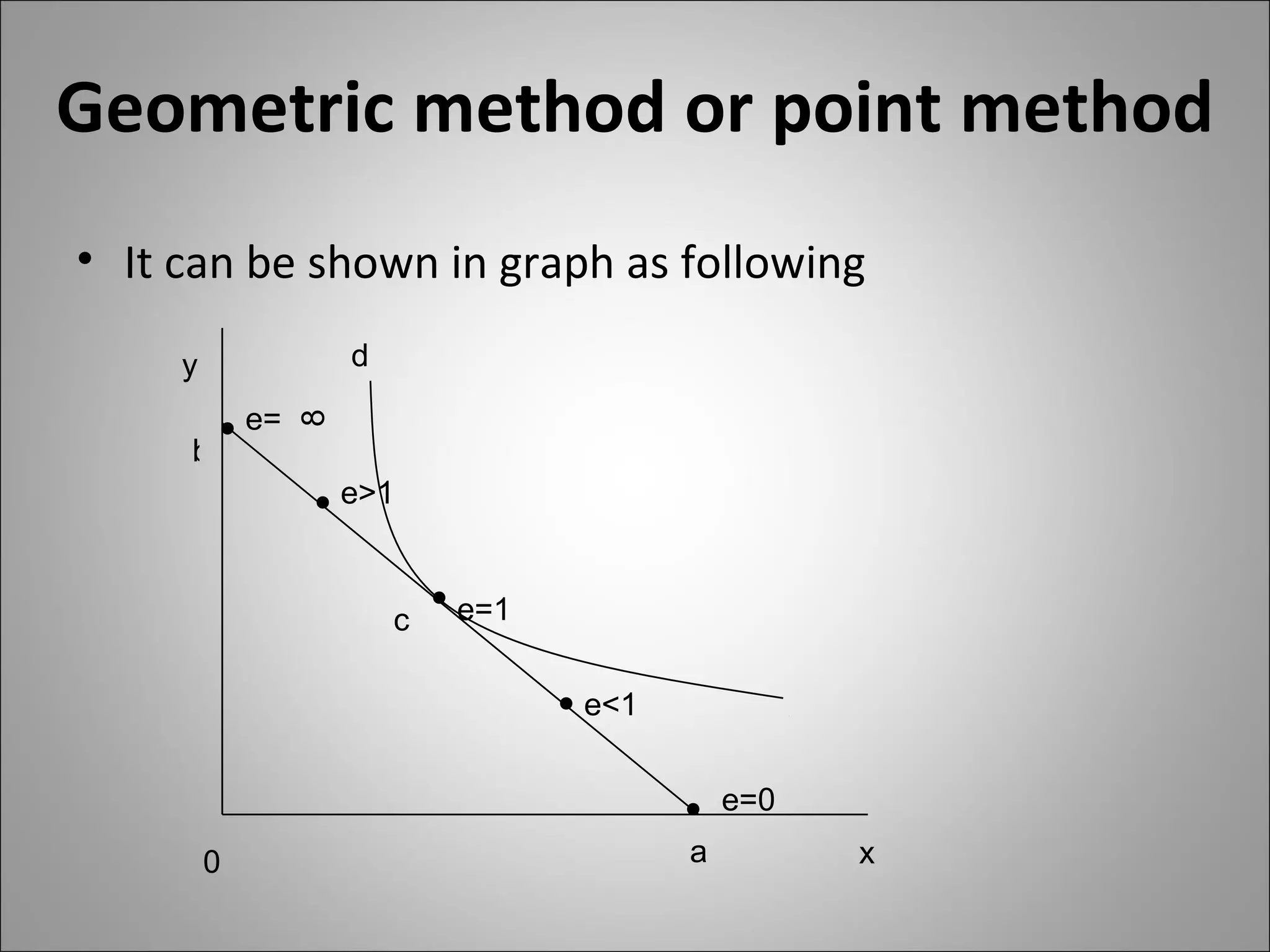
Geometric method or point method This method attempts to measure numerical elasticity of demand at a particular point on the demand curve Price elasticity can be measure by following method Price elasticity of demand = Lower segment of the demand curve upper segment of the demand curve
Geometric method or point method It can be shown in graph as following a b c d d 0 x y e=1 e= 8 e>1 e<1 e=0
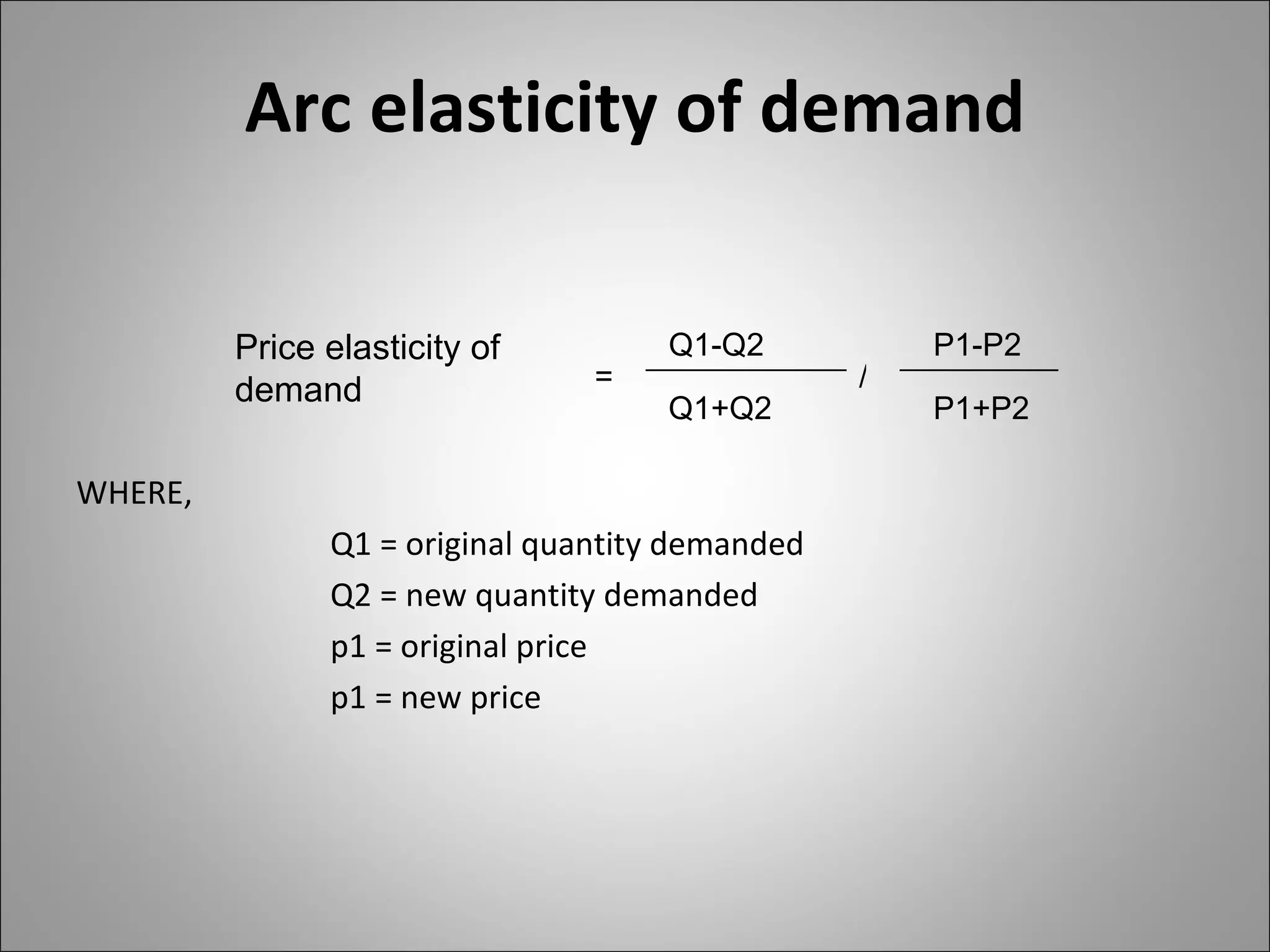
Arc elasticity of demand It is the use of middle points between old and new figures in the case of both price and quantity. This method is known as arc elasticity method We can measure it with formula as given
Arc elasticity of demand WHERE,  Q1 = original quantity demanded Q2 = new quantity demanded p1 = original price p1 = new price Price elasticity of demand = / Q1-Q2 Q1+Q2 P1-P2 P1+P2
(5) Factors Affecting Price Elasticity Of Demand
Factors Affecting Price Elasticity Of Demand Nature of the Commodity Availability of Substitutes Variety of uses of commodity Postponement Influence of habits  Proportion of Income spent on a commodity Range of prices
Factors Affecting Price Elasticity Of Demand Income Groups Elements of time  Pattern of income distribu tion
(6) Practical Importance of the Concept of Price Elasticity Of Demand
Practical Importance of the Concept of Price Elasticity Of Demand The concept is helpful in taking Business Decisions Importance of the concept in formatting Tax Policy of the government For determining the rewards of the Factors of Production To determine the Terms of Trades Between the Two Countries
Practical Importance of the Concept of Price Elasticity Of Demand Determination of Rates of Foreign Exchange For Nationalization of Certain Industries  In economic Analysis ,the concept of price elasticity of demand helps in explaining the irony of poverty in the midst of plenty.
(7) Income Elasticity Of Demand
Types Of Income Elasticity Of Demand Positive Income elasticity of demand Negative Income elasticity of demand Zero Income elasticity of demand
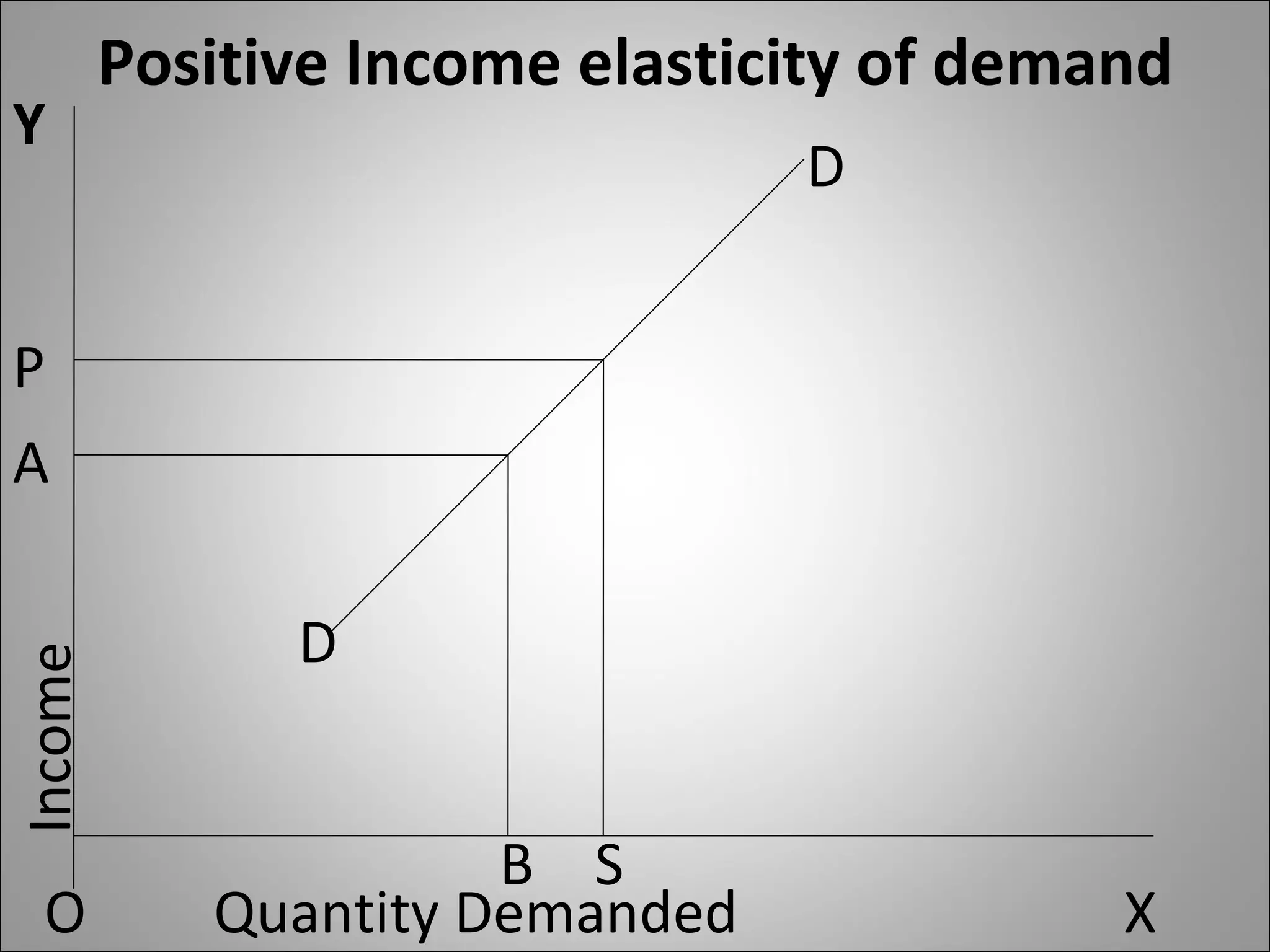
Positive Income elasticity of demand Y P A D D B S O X Quantity Demanded Income
Positive Income elasticity of demand Income Elasticity Equal to Unity or One Income Elasticity Greater Than Unity Or One  Income Elasticity Less Than Unity or One
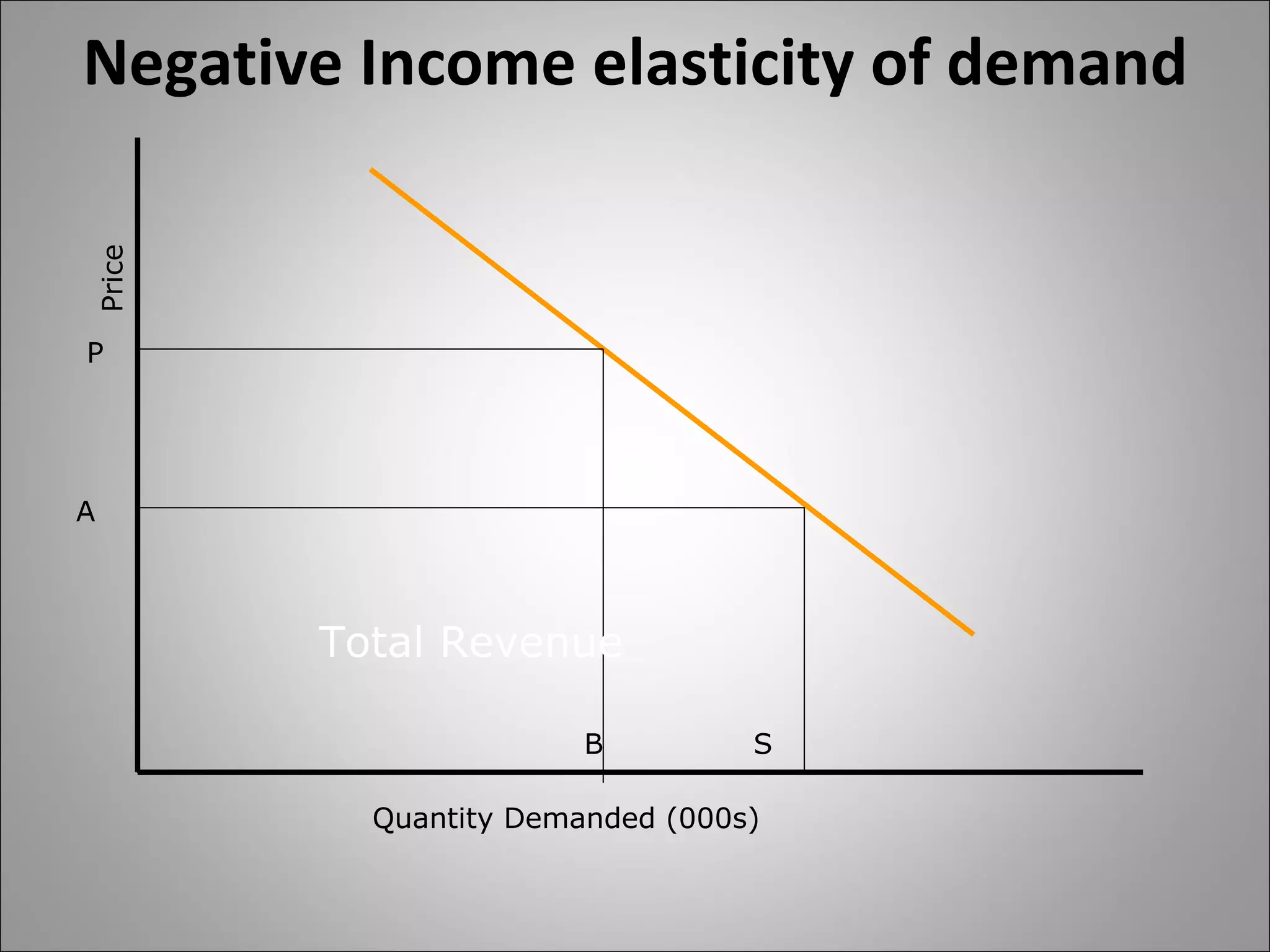
Negative Income elasticity of demand Price P B A S Total   Revenue Quantity Demanded (000s)
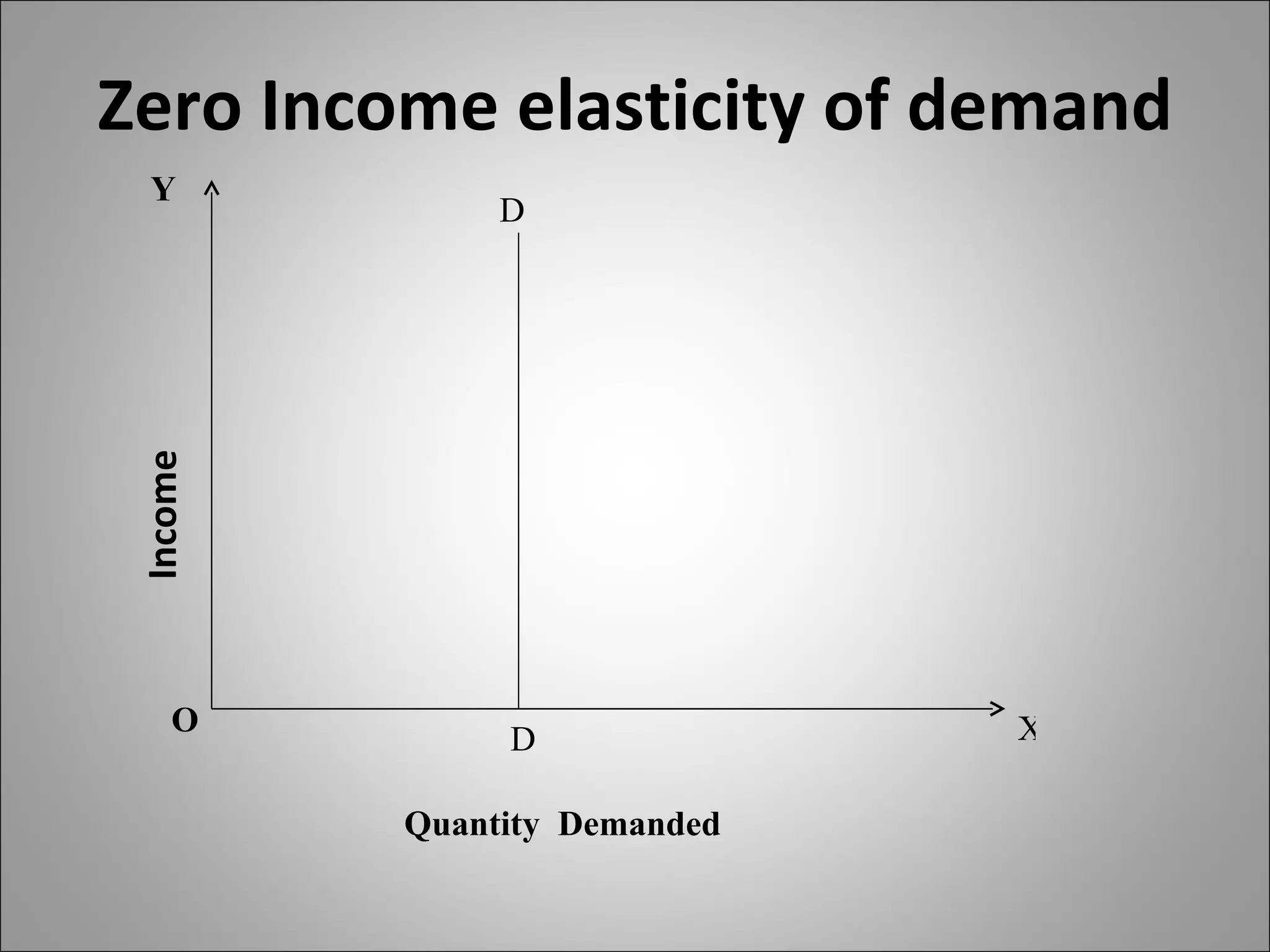
Zero Income elasticity of demand Y X O D D Quantity  Demanded  Income
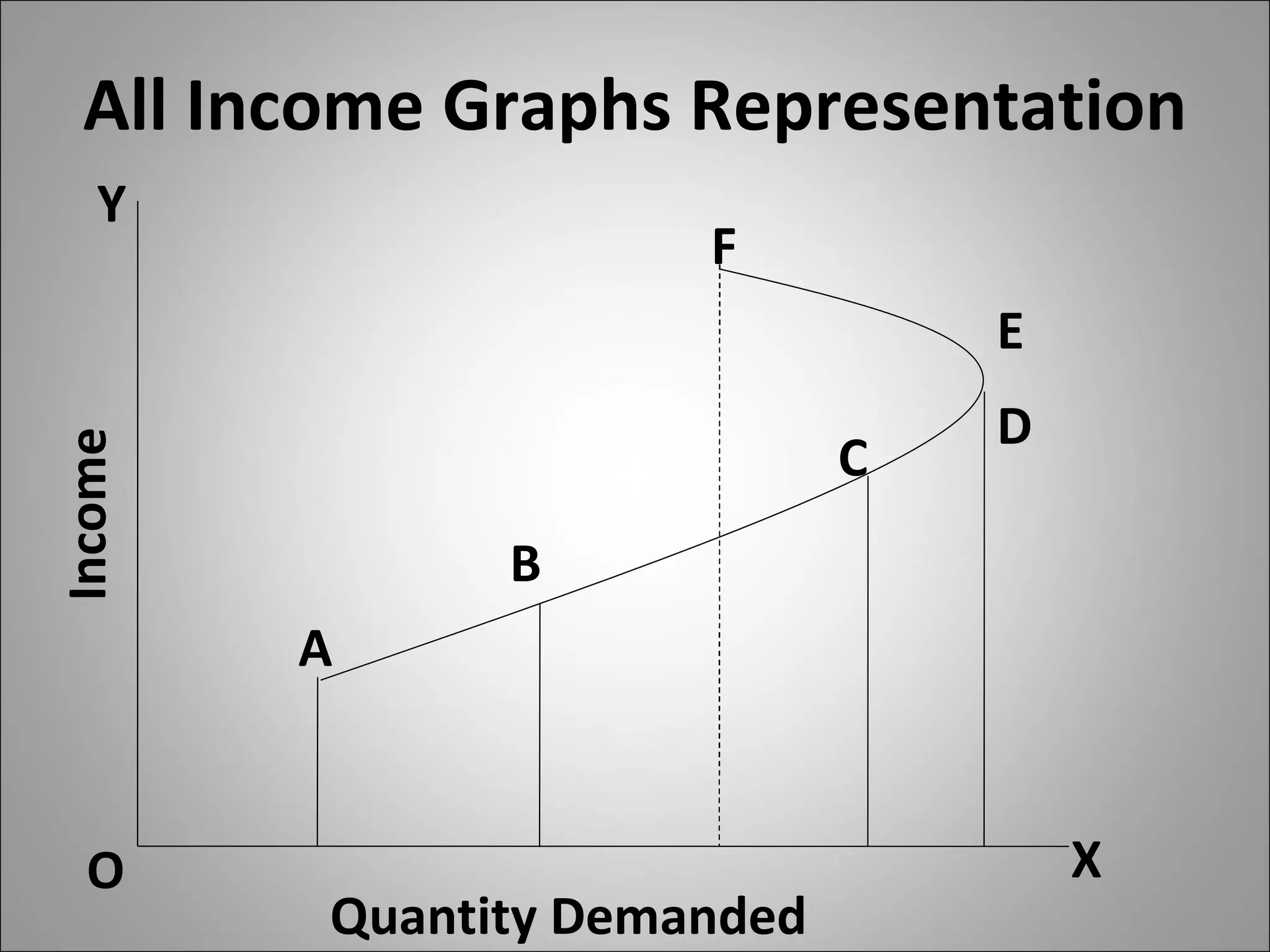
All Income Graphs Representation O Y Income A B C D E F X Quantity Demanded
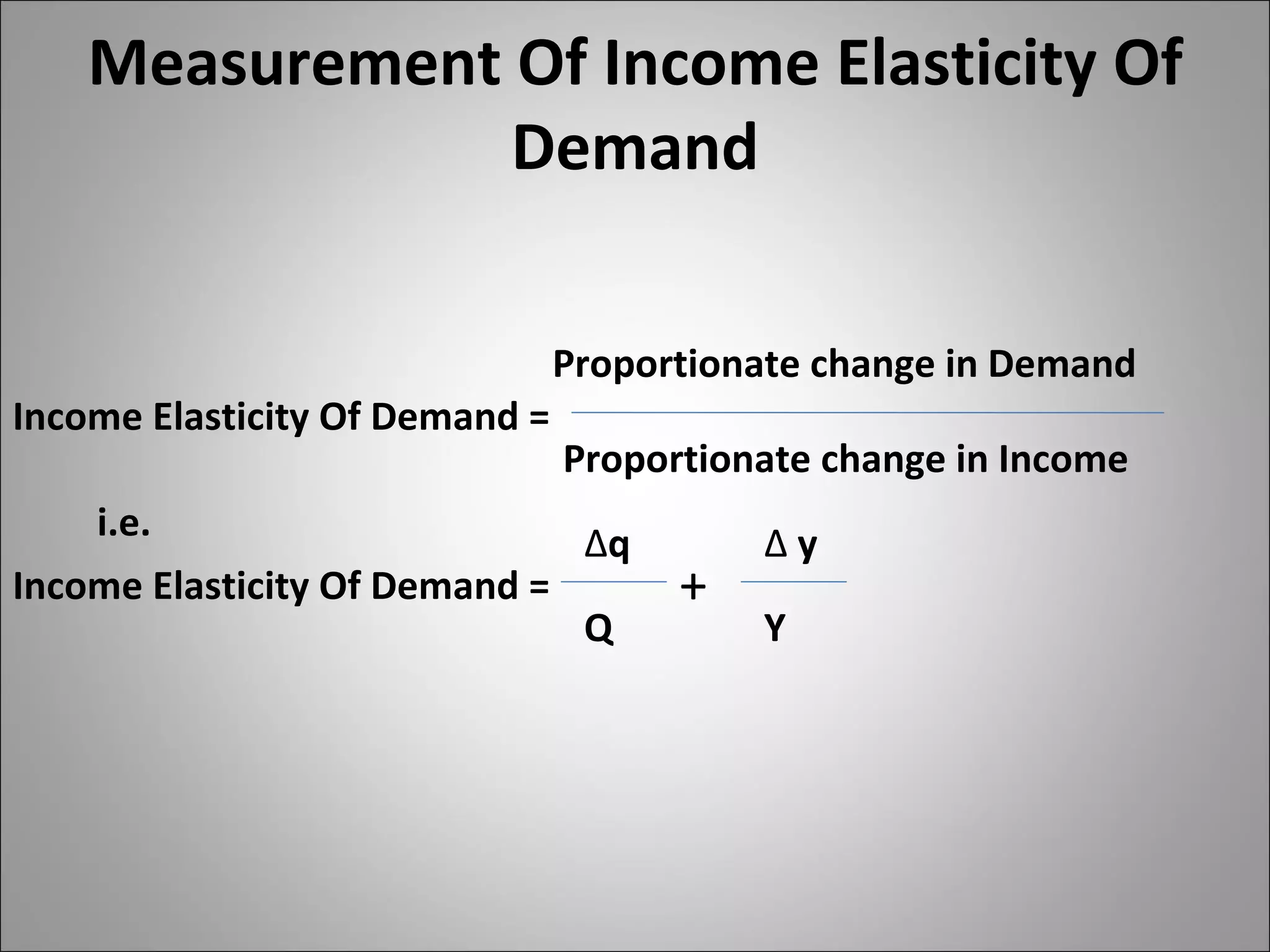
Measurement Of Income Elasticity Of Demand Income Elasticity Of Demand = Proportionate change in Demand Proportionate change in Income i.e. Income Elasticity Of Demand = ∆ q Q Y ∆  y +
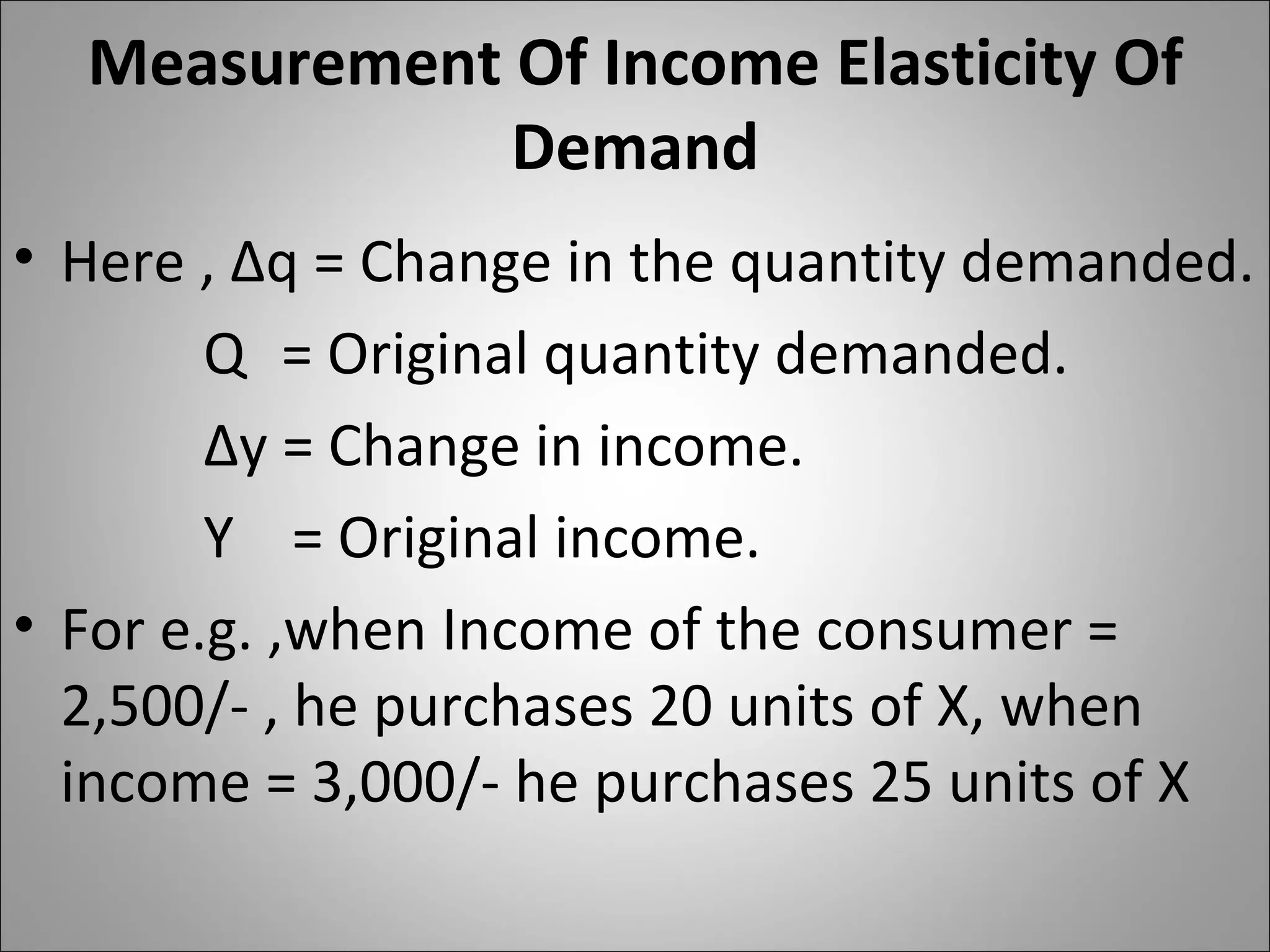
Measurement Of Income Elasticity Of Demand Here , ∆q = Change in the quantity demanded. Q  = Original quantity demanded. ∆ y = Change in income. Y  = Original income. For e.g. ,when Income of the consumer = 2,500/- , he purchases 20 units of X, when income = 3,000/- he purchases 25 units of X
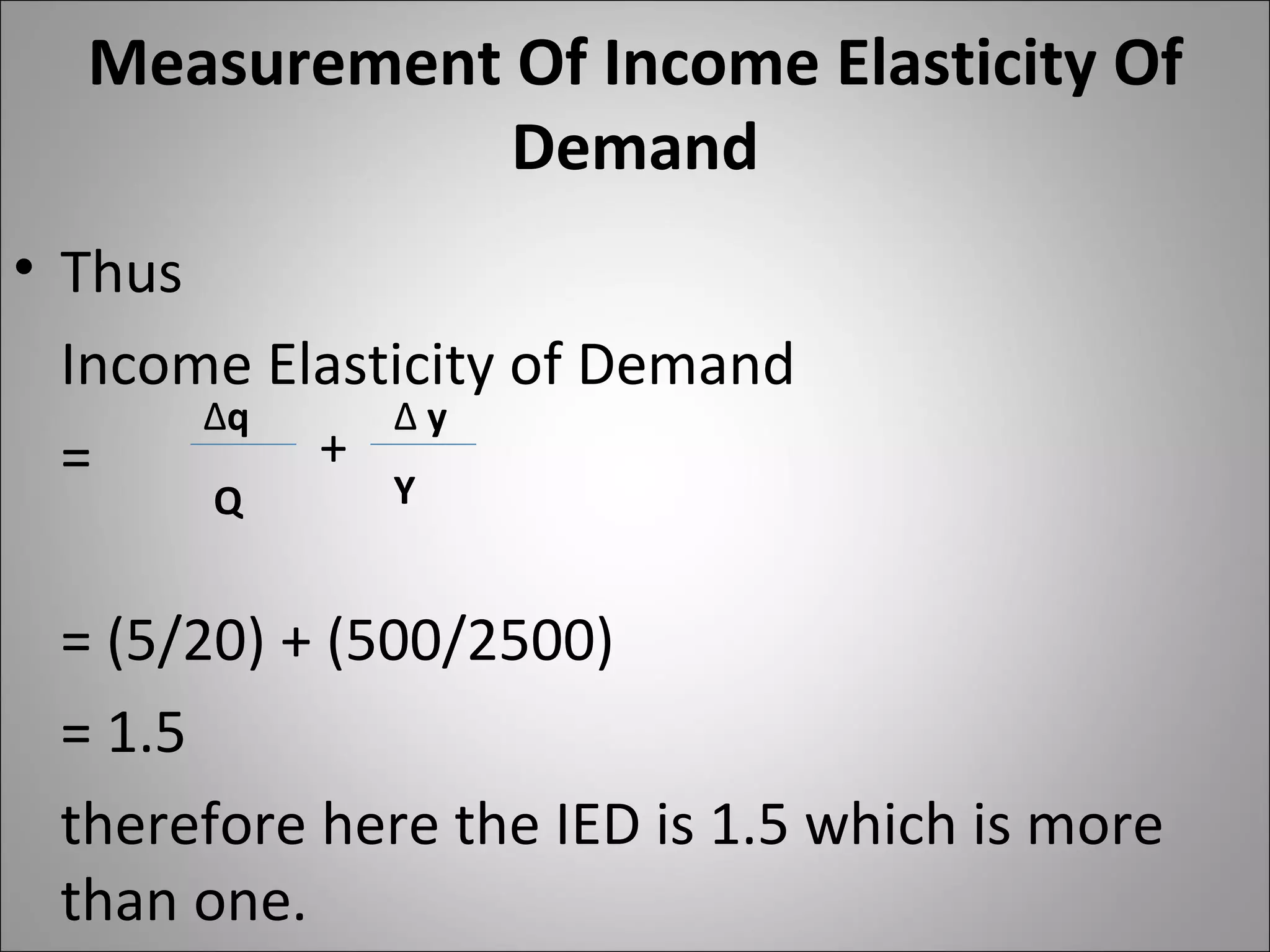
Measurement Of Income Elasticity Of Demand Thus  Income Elasticity of Demand  =  = (5/20) + (500/2500) = 1.5 therefore here the IED is 1.5 which is more than one.  ∆ q Q Y ∆  y +
Factors Affecting Income Of Demand Income Itself Only. Price Of the Commodity
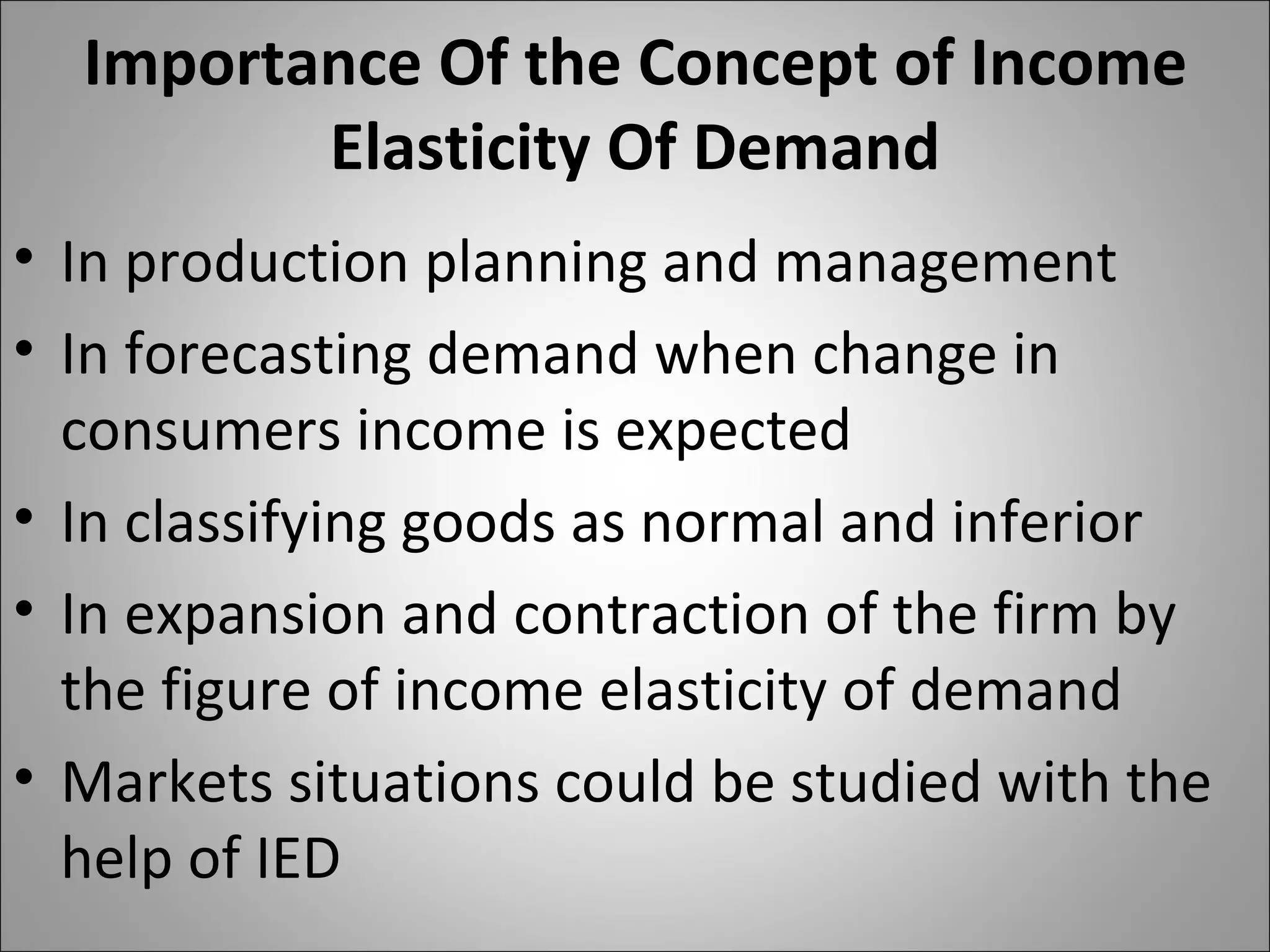
Importance Of the Concept of Income Elasticity Of Demand In production planning and management In forecasting demand when change in consumers income is expected In classifying goods as normal and inferior In expansion and contraction of the firm by the figure of income elasticity of demand Markets situations could be studied with the help of IED
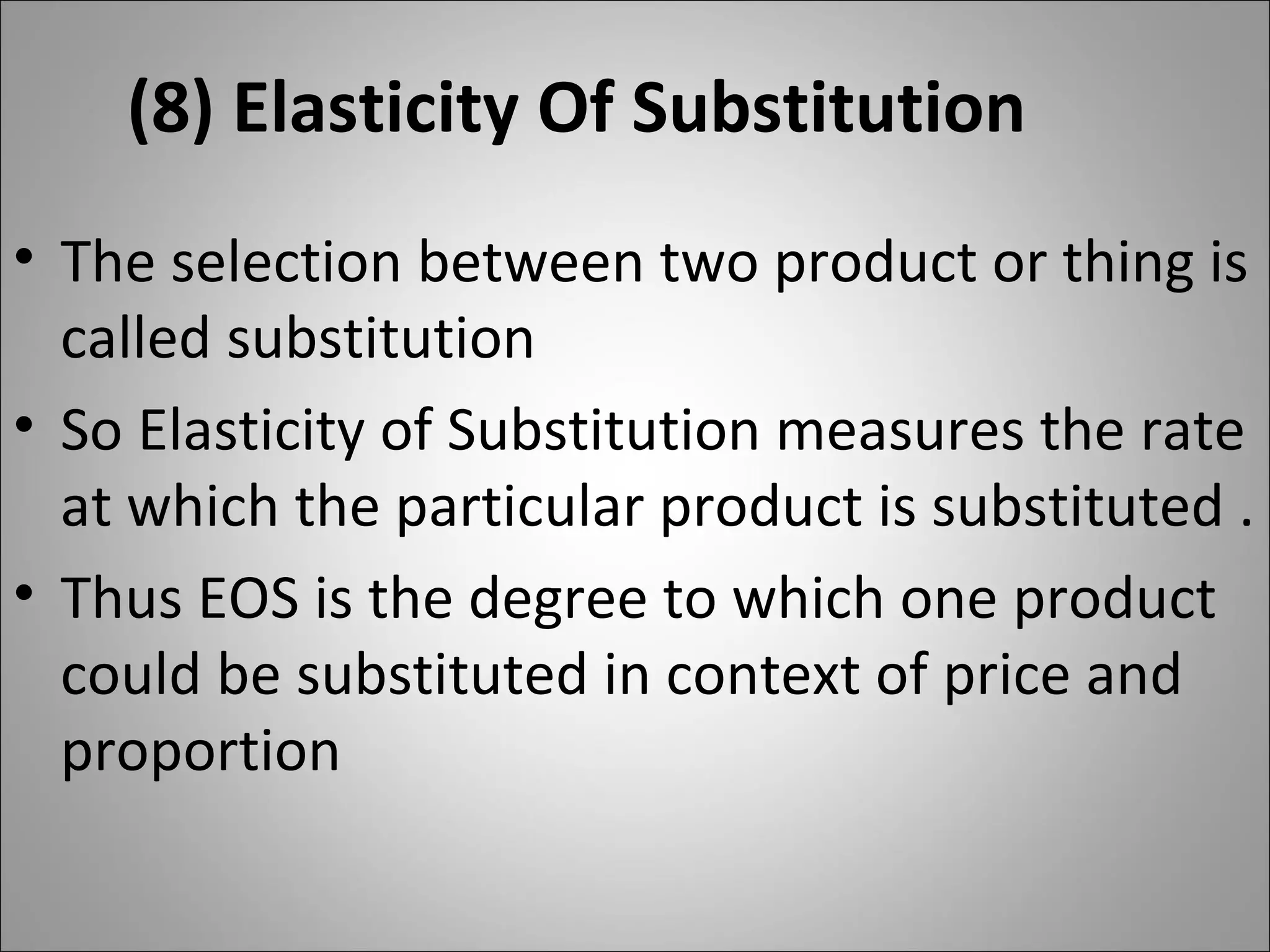
(8) Elasticity Of Substitution The selection between two product or thing is called substitution  So Elasticity of Substitution measures the rate at which the particular product is substituted . Thus EOS is the degree to which one product could be substituted in context of price and proportion

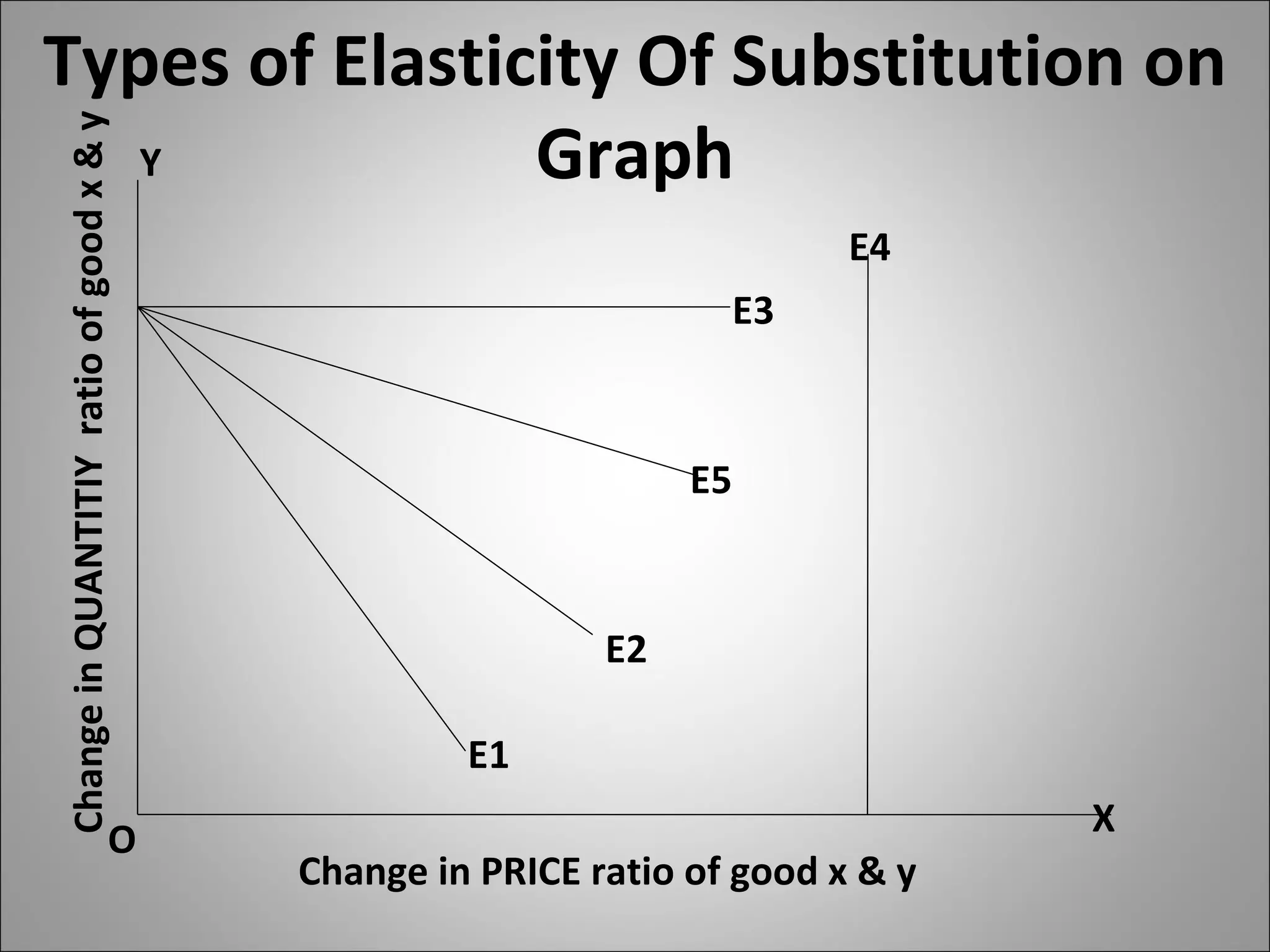
Elasticity Of Substitution Elasticity of Substitution = Proportionate change in the quantity ratios of goods x & y  DIVIDED BY  Proportionate change in the price ratios of goods x & y.
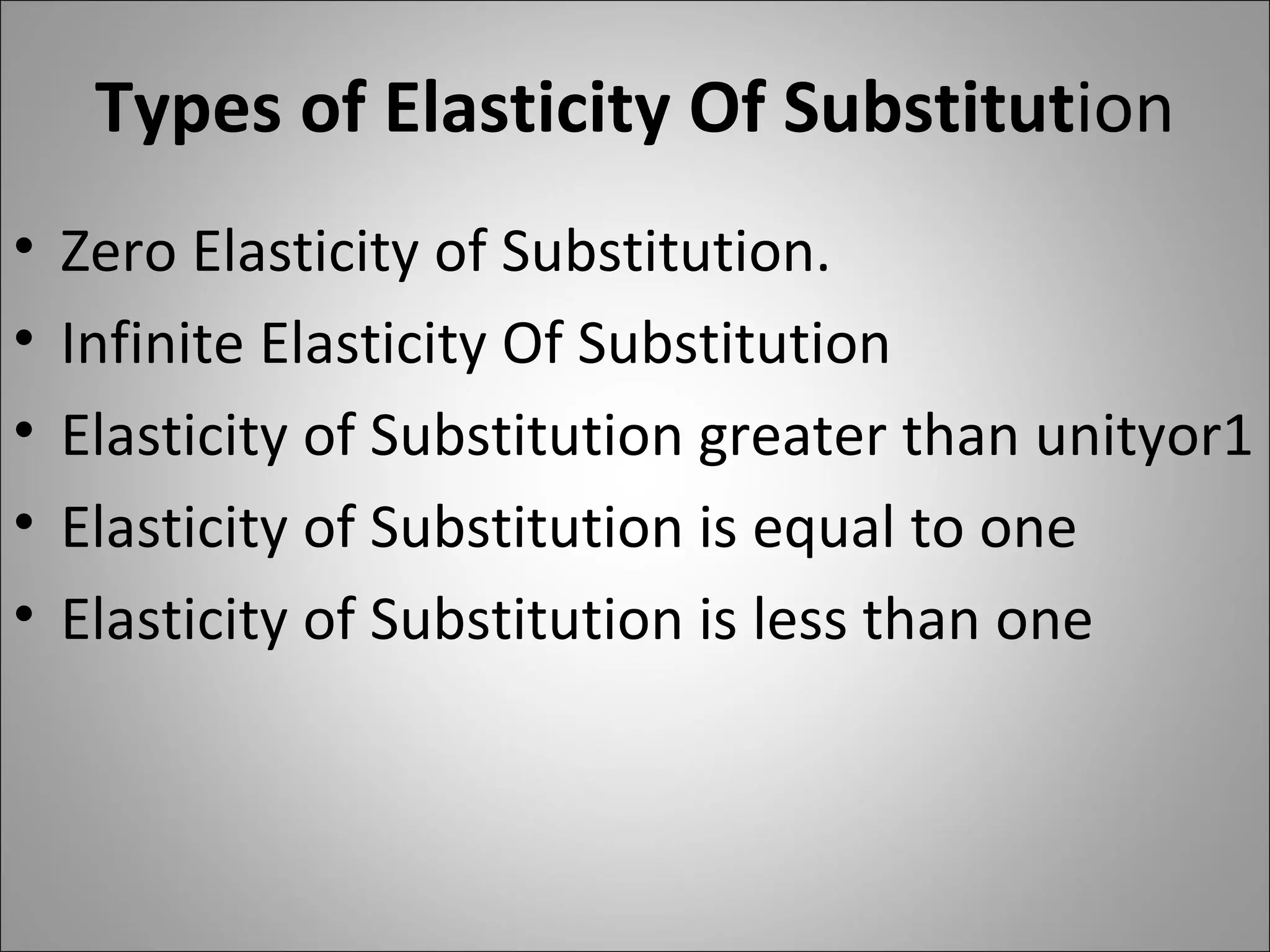
Types of Elasticity Of Substitut ion Zero Elasticity of Substitution. Infinite Elasticity Of Substitution Elasticity of Substitution greater than unityor1 Elasticity of Substitution is equal to one Elasticity of Substitution is less than one
Types of Elasticity Of Substitution on Graph Change in QUANTITIY  ratio of good x & y Change in PRICE ratio of good x & y O X Y E4 E1 E2 E3 E5
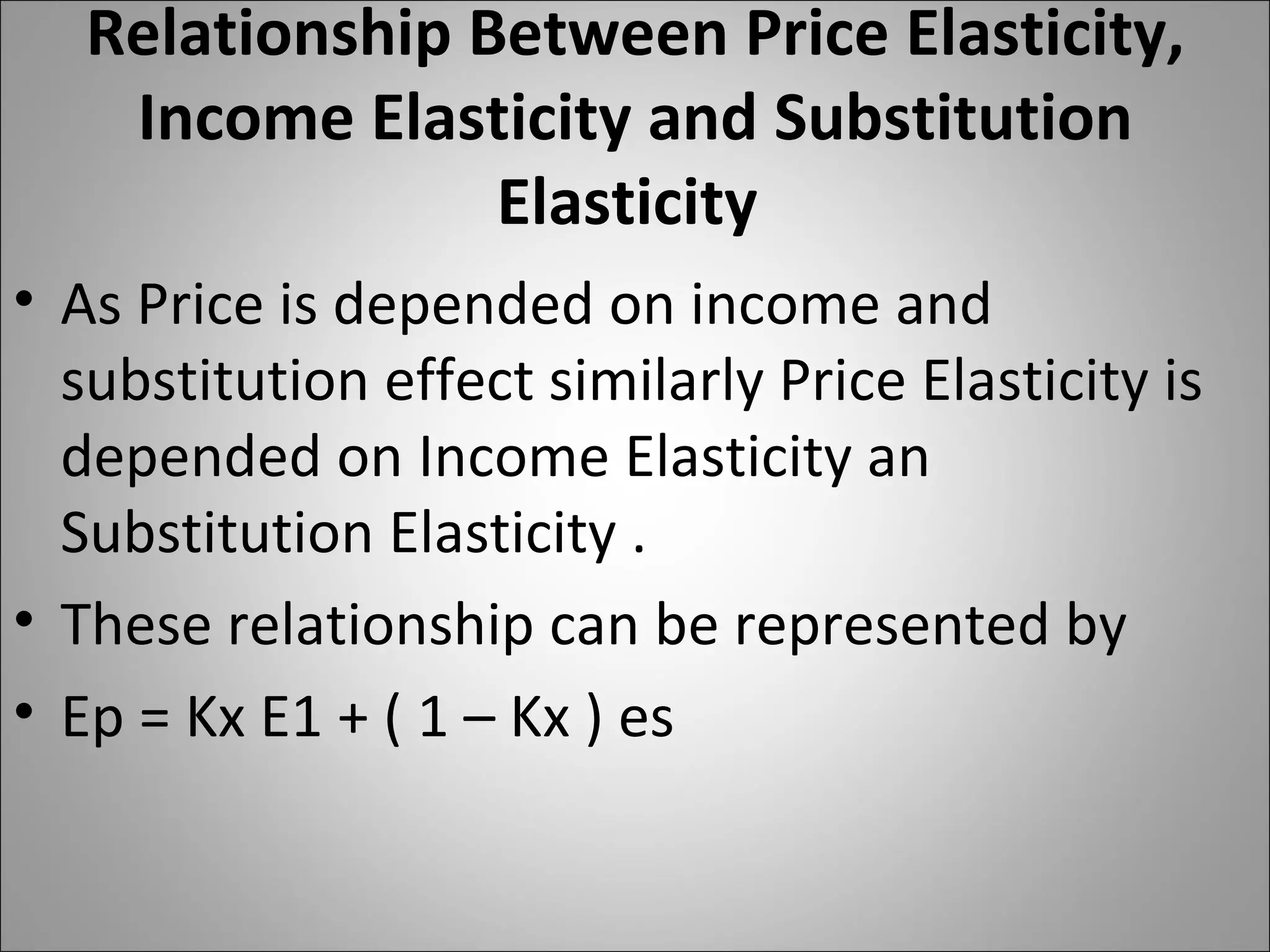
Relationship Between Price Elasticity, Income Elasticity and Substitution Elasticity  As Price is depended on income and substitution effect similarly Price Elasticity is depended on Income Elasticity an Substitution Elasticity . These relationship can be represented by Ep = Kx E1 + ( 1 – Kx ) es
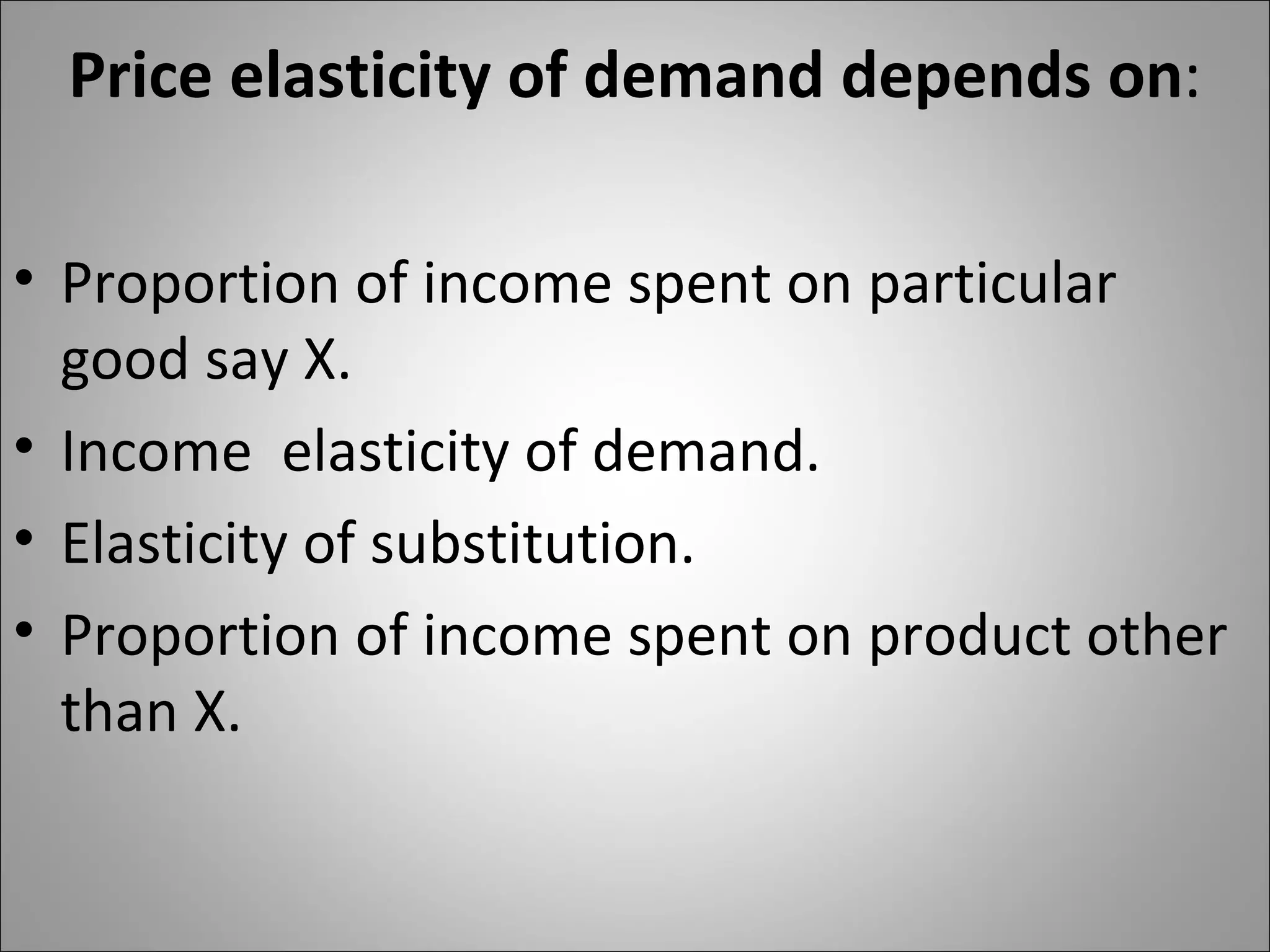
Price elasticity of demand depends on : Proportion of income spent on particular good say X. Income  elasticity of demand. Elasticity of substitution. Proportion of income spent on product other than X.
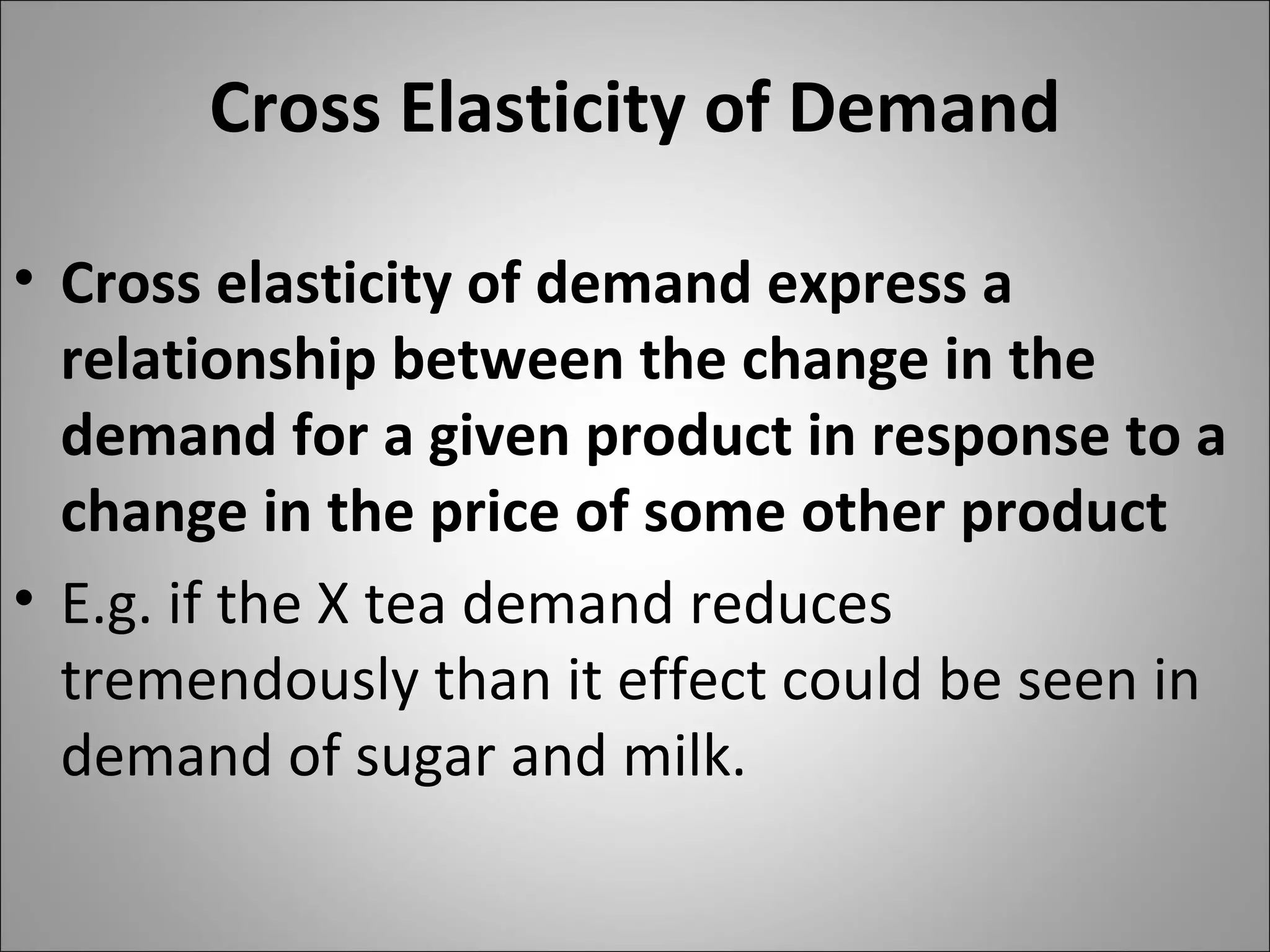
Cross Elasticity of Demand Cross elasticity of demand express a relationship between the change in the demand for a given product in response to a change in the price of some other product E.g. if the X tea demand reduces tremendously than it effect could be seen in demand of sugar and milk.
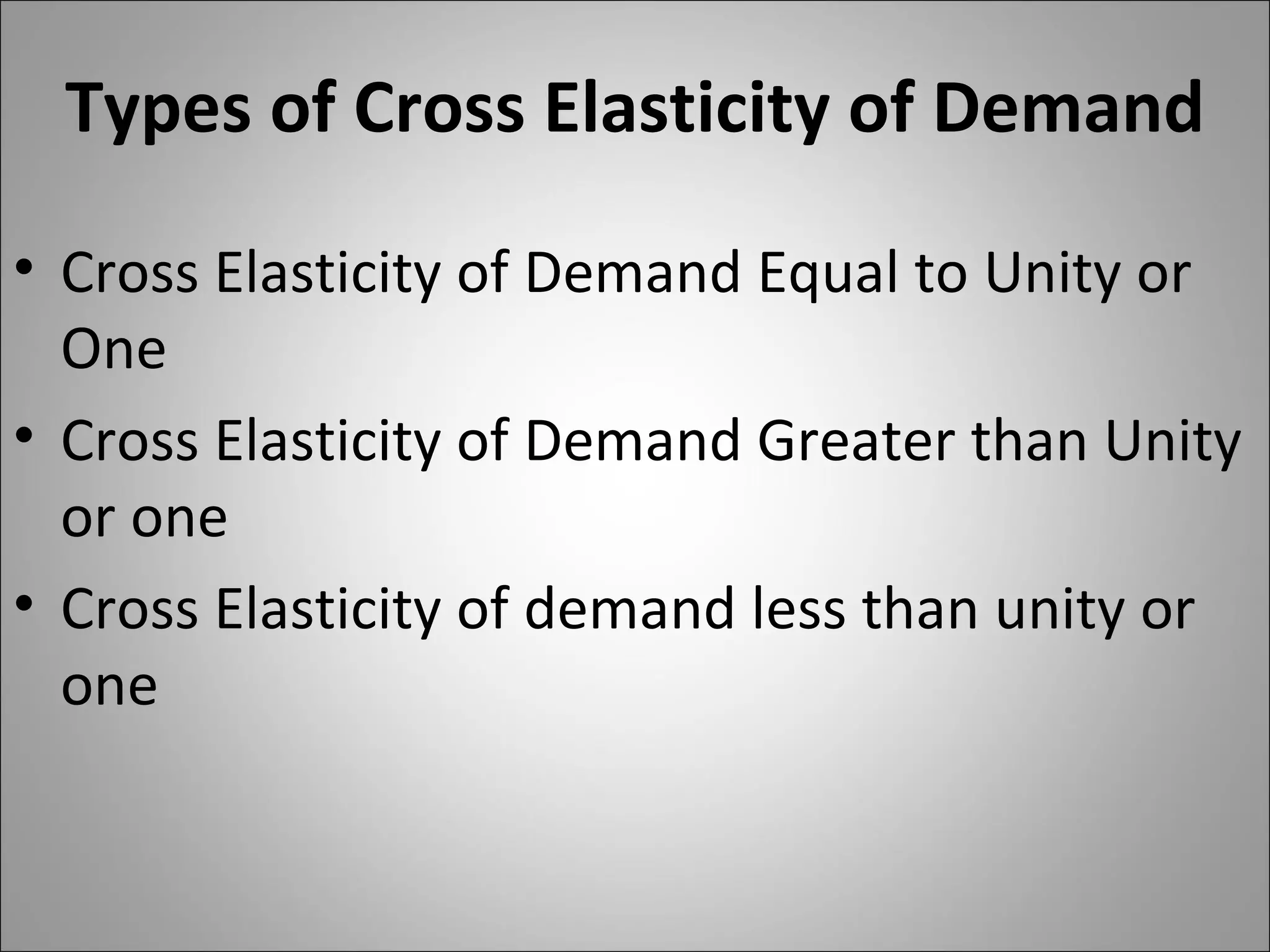
Types of Cross Elasticity of Demand Cross Elasticity of Demand Equal to Unity or One  Cross Elasticity of Demand Greater than Unity or one Cross Elasticity of demand less than unity or one
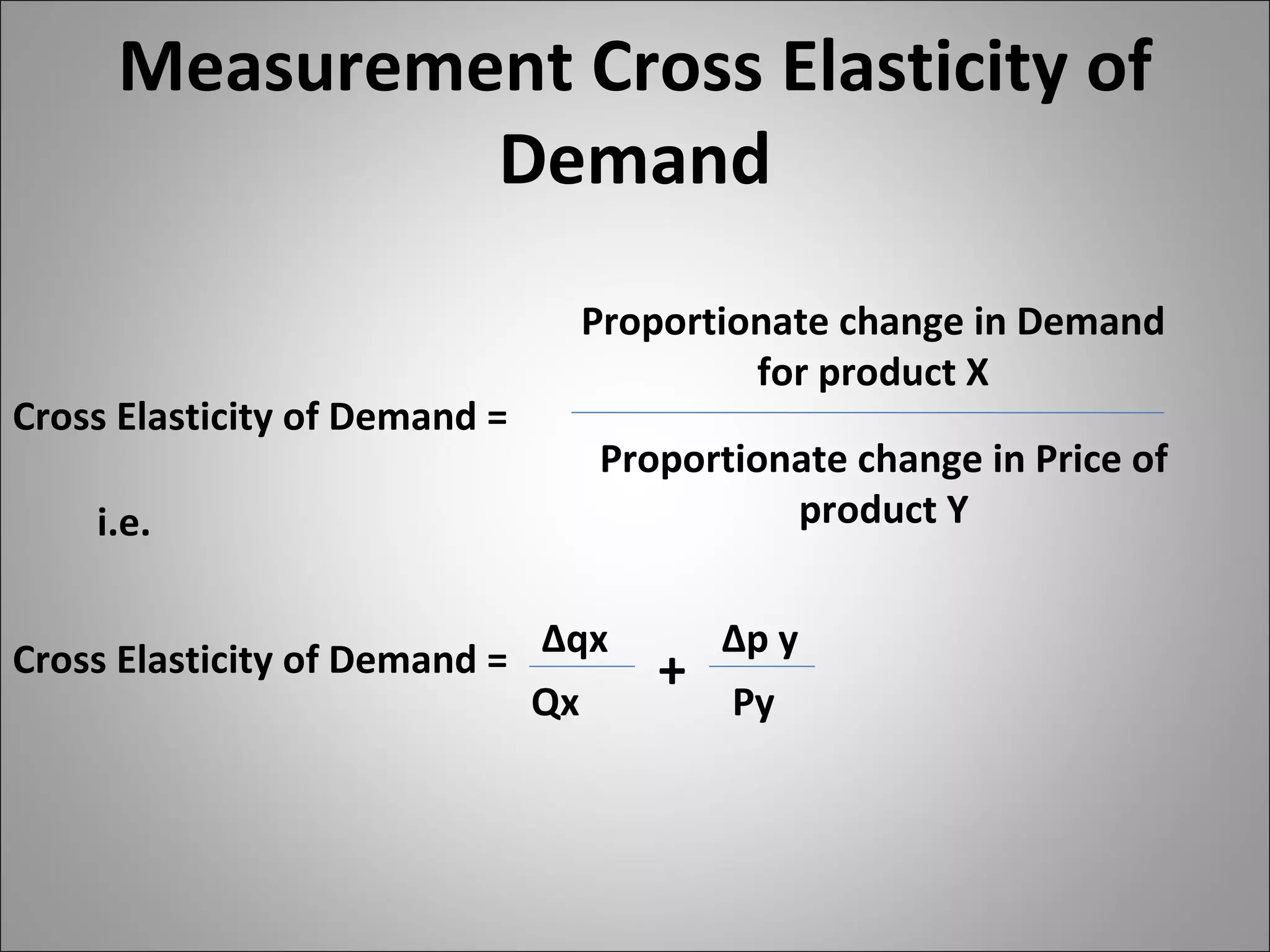
Measurement Cross Elasticity of Demand Proportionate change in Demand for product X Proportionate change in Price of product Y i.e. ∆ qx Qx Py ∆ p y + Cross Elasticity of Demand = Cross Elasticity of Demand =
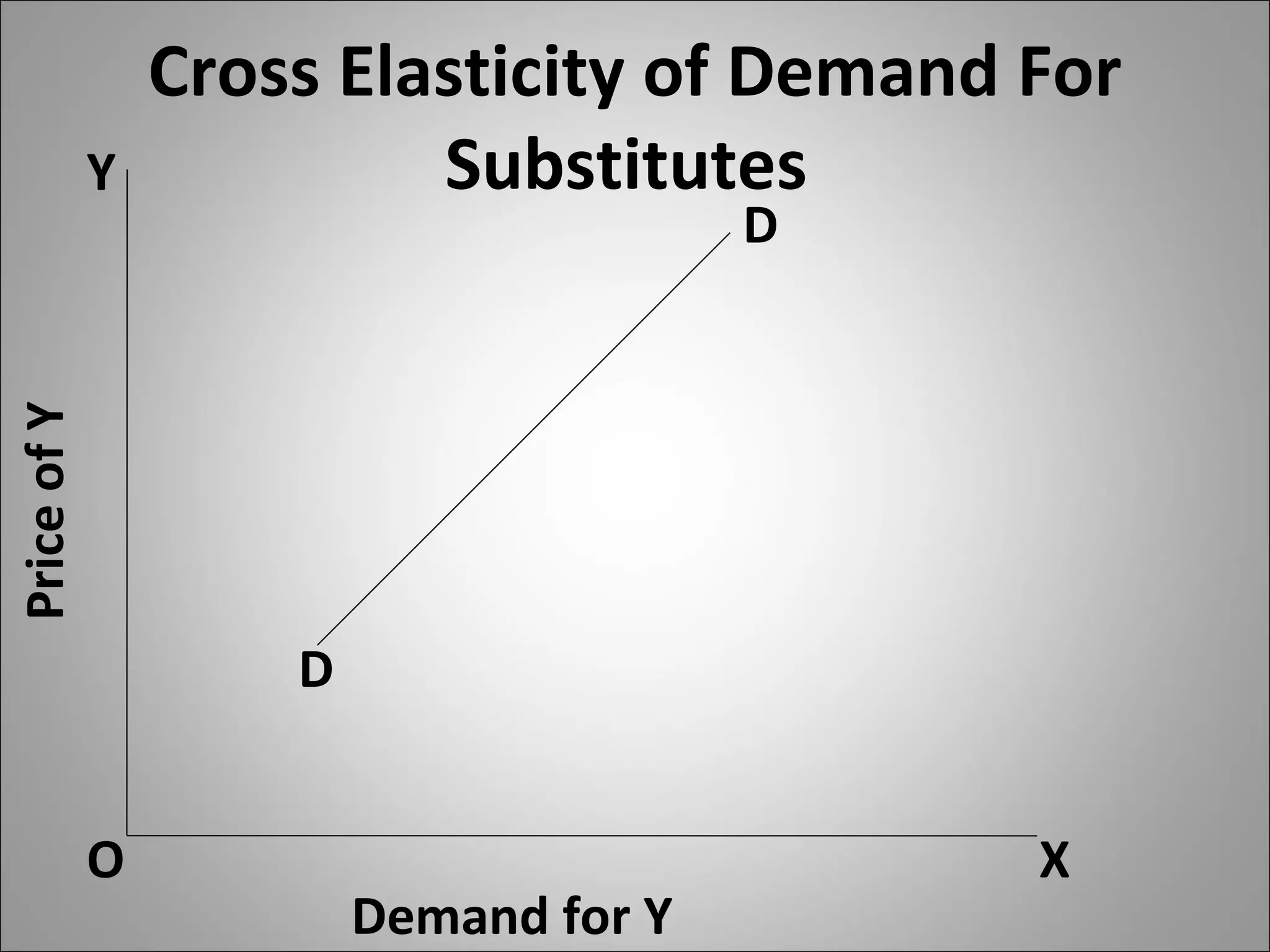
Cross Elasticity of Demand For Substitutes  Price of Y Demand for Y O Y X D D
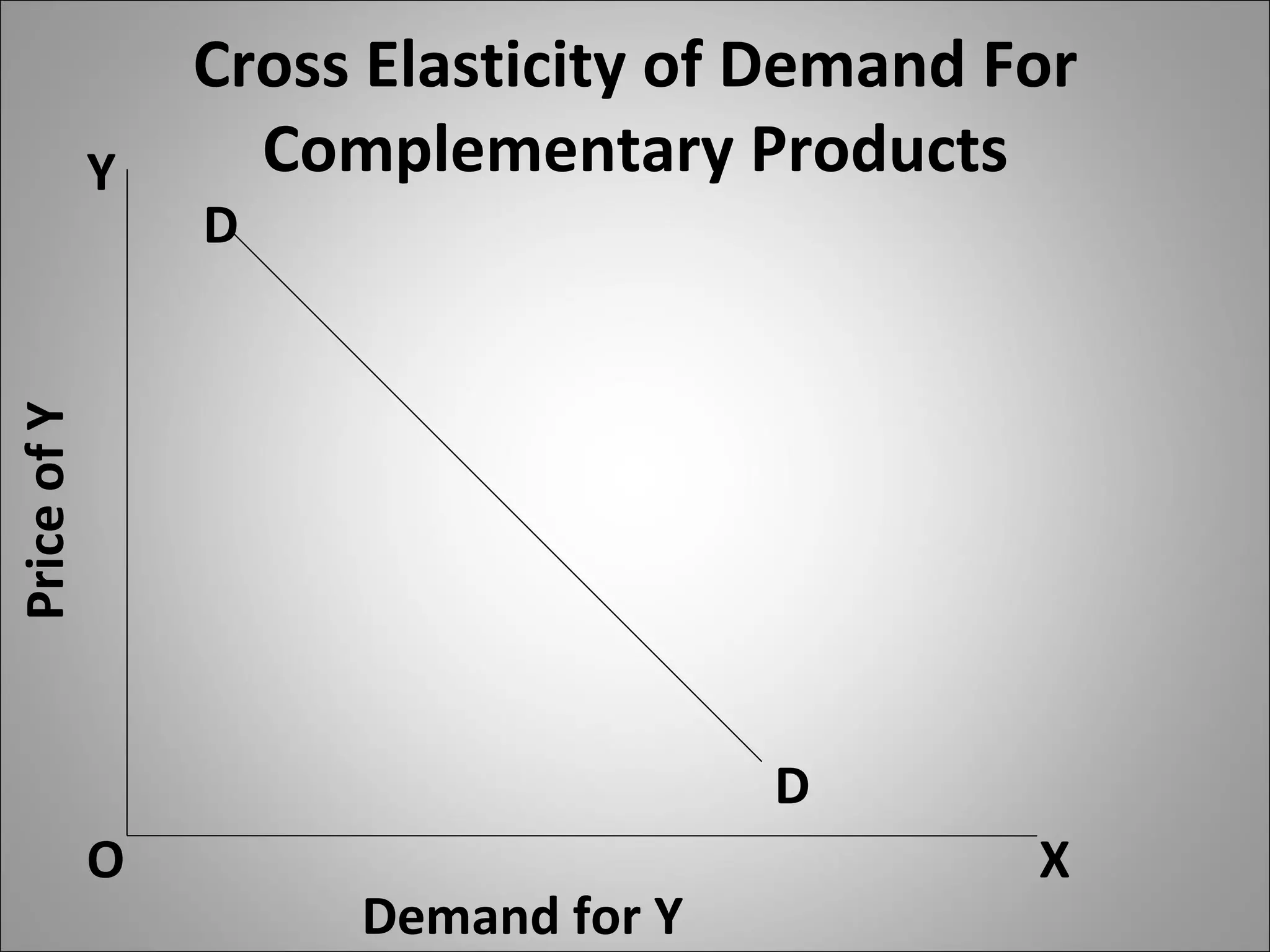
Cross Elasticity of Demand For Complementary Products Price of Y O Y X D D Demand for Y
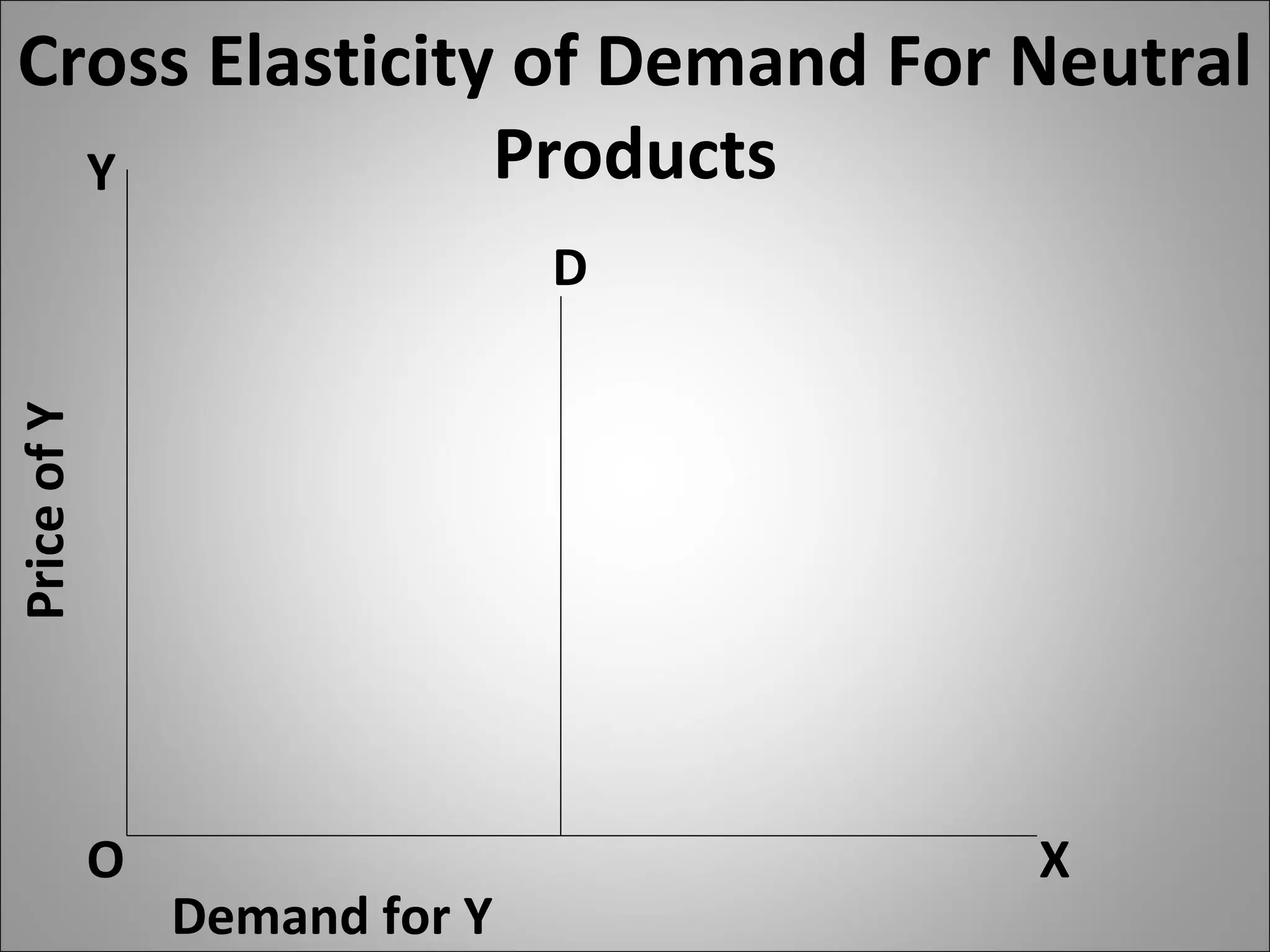
Cross Elasticity of Demand For Neutral Products Price of Y O Y X D Demand for Y
Importance of Cross Elasticity Of Demand The concept is of very great importance in changing the price of the products having substitutes and complementary goods . In demand forecasting Helps in measuring interdependence of price of commodity . Multiproduct firms use these concept to measure the effect of change in price of one product on the demand of their other product
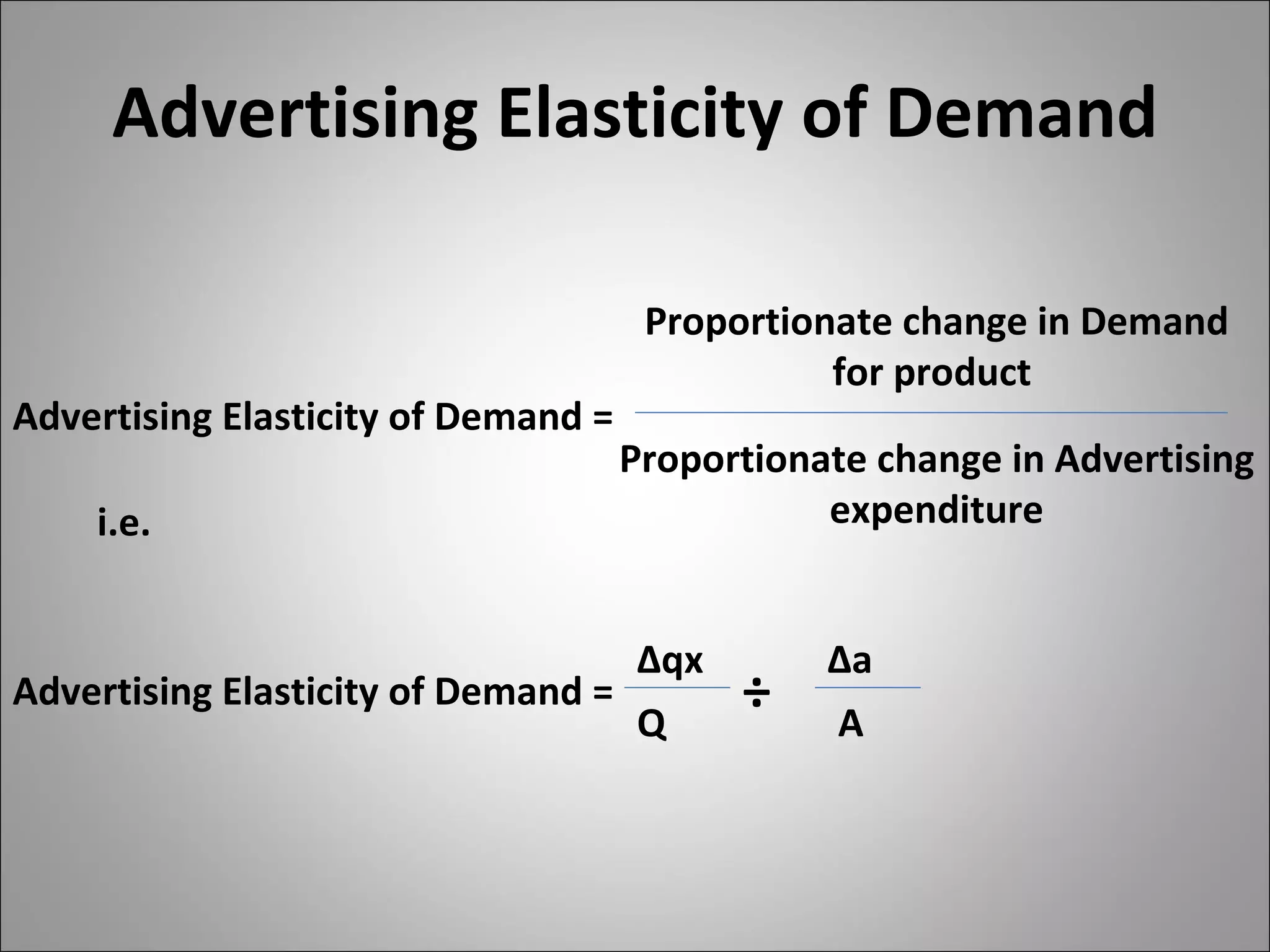
Advertising Elasticity of Deman d Advertising elasticity of demand is the measure of the rate of change in demand due to change in advertising expenditure The amount of change in demand of goods due to advertisement is known as Advertisement Elasticity of Demand .
Advertising Elasticity of Demand Proportionate change in Demand for product  Proportionate change in Advertising expenditure i.e. ∆ qx Q A ∆ a ÷ Advertising Elasticity of Demand = Advertising Elasticity of Demand =
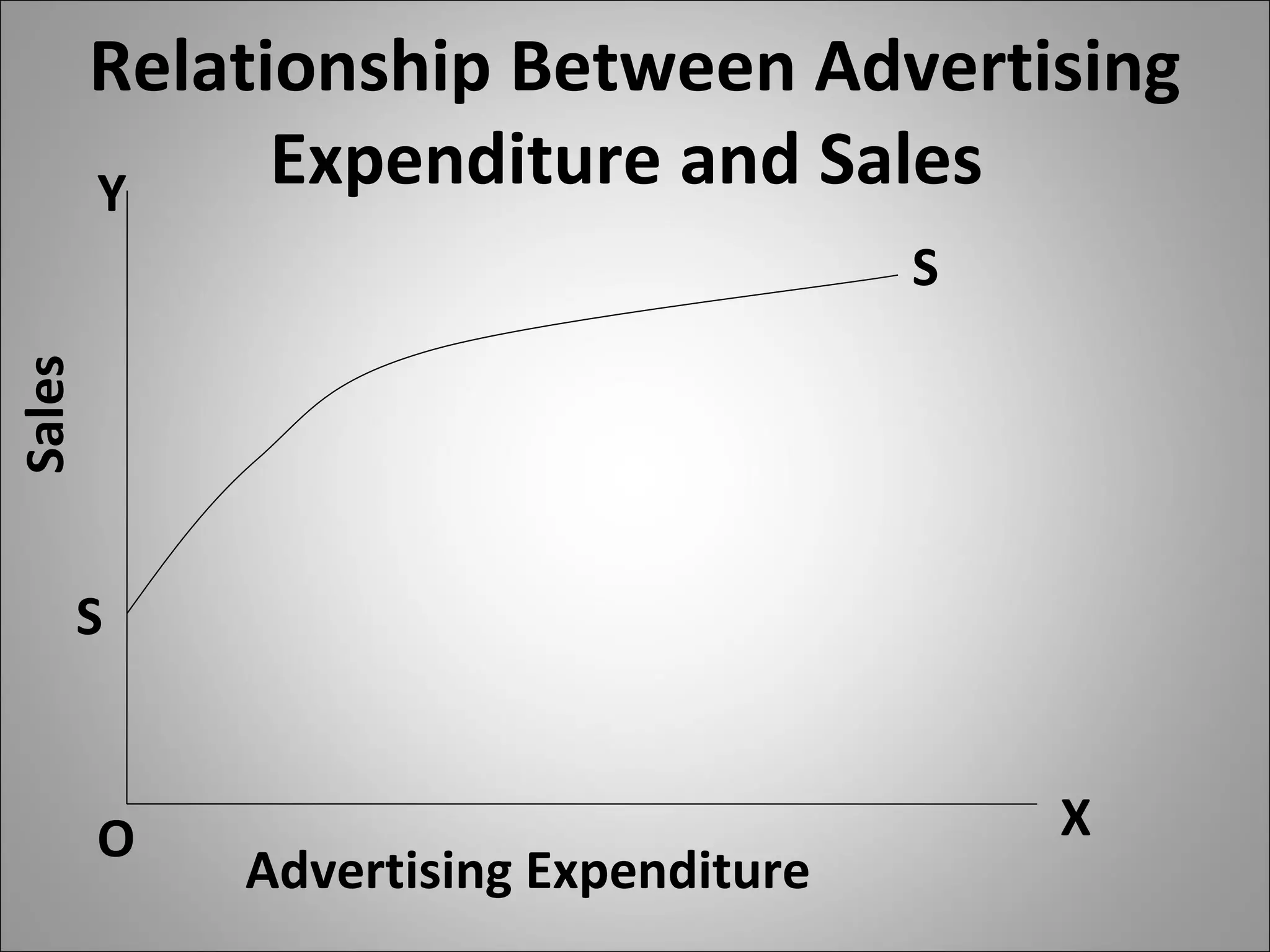
Relationship Between Advertising Expenditure and Sales  O X Y S S Sales Advertising Expenditure
Factors Affecting Advertising Elasticity Of Demand The stage of the Product’s Market Development . Reaction of market Rival Firms. Cumulative Effect of Past Advertisement. Influence of Other Factors.
Importance of the Advertising Elasticity Of Demand in Business Decisions It is useful in competitive industries. Though advertisement shifts the demand curve to right path but it also increases the fixed cost of the firm.
Limitation of Advertising Elasticity of the Demand The impact of advertising on sales is different under different conditions, even if other demand determinants are constant. Like wise, it is difficult to establish any co-relationship between advertising expenditure and volume of sales when there counter advertisements by rival firm in the market . The effect on sales depend on what the rivals are doing.
Thanking You All
******THE END******

Demand Elasticity 97 2003

  • 1.
    Presentation On ELASTICITY OF DEMAND
  • 2.
    Prepared By Vyas Harshal
  • 3.
    Definition Of PriceElasticity Of Demand The change in the quantity demanded of a product due to a change in its price is known as Price elasticity of demand. Thus, the sensitiveness or responsiveness of demand to change in price is as called elasticity of demand
  • 4.
    Kinds Of PriceElasticity Of Demand Perfectly elastic demand Relatively elastic demand Elasticity of demand equal to utility Relatively inelastic demand Perfectly inelastic demand Let Us See Some Views On Them
  • 5.
    Perfectly elastic demandP R I C E y 0 x Perfectly elastic demand curve D D When the demand for a product changes –increases or decreases even when there is no change in price, it is known as perfect elastic demand.
  • 6.
    Relatively elastic demandRelatively elastic demand curve P R I C E demand 0 x y D D When the proportionate change in demand is more than the proportionate changes in price, it is known as relatively elastic demand .
  • 7.
    Elasticity of demandequal to utility Elasticity of demand equal to utility curve y x 0 demand P R I C E D D When the proportionate change in demand is equal to proportionate changes in price, it is known as unitary elastic demand
  • 8.
    Relatively inelastic demandRelatively inelastic demand curve X O Y demand D D P R I C E When the proportionate change in demand is less than the proportionate changes in price, it is known as relatively inelastic demand
  • 9.
    Perfectly inelastic demanddemand D D Perfectly inelastic demand curve 0 Y X P R I C E When a change in price, howsover large, change no changes in quality demand, it is known as perfectly inelastic demand
  • 10.
    ALL KINDS OFDEMAND CAN BE SHOWN IN ONE DIAGRAM AS FOLLOW D D1 D2 D3 D4 D5 Y X 0 DEMAND P R I C E WHERE D1) Perfectly elastic demand D2)Relatively elastic demand D3)Elasticity of demand equal to utility D4)Relatively inelastic demand D5)Perfectly inelastic demand
  • 11.
    Measurement Of PriceElasticity Of Demand There are main methods like Percentage method or proportionate method Total outlay method or total revenue method Geometric method or point method Arc elasticity of demand
  • 12.
    1 Percentage methodor proportionate method Price elasticity of demand is measured by a ratio between the proportionate change in the quantity of a product demanded as a result of a proportionate change in its price Formula for calculate this is given further as following
  • 13.
    Percentage method orproportionate method Price elasticity of demand = Proportionate change in demand for x Proportionate change in Price for x OR _____ qx Qx / _____ px Px Here, qx = change in the quantity of x demanded Qx = original quantity of x demanded px = change in the price of x Px = original price of x
  • 14.
    Total outlay methodor total revenue method Total outlay means total expenditure and since total expenditure of consumers on a product implies total receipts or total revenue of sellers, it is known as total revenue method. It will be clear with following table price quantity Total outlay Price elasticity 1 5 100 500 Elasticity of demand is greater than 1(e>1) 4 130 520 2 5 100 500 Elasticity of demand is less than 1(e<1) 4 120 480 3 5 100 500 Elasticity of demand is equal than 1(e=1) 4 125 500
  • 15.
    Total outlay methodor total revenue method This can be shown in graph as given 0 y x Total outlay Q1 Q2 Q3 p1 p2 p3 p4 P R I C e E<1 E=1 E>1
  • 16.
    Geometric method orpoint method This method attempts to measure numerical elasticity of demand at a particular point on the demand curve Price elasticity can be measure by following method Price elasticity of demand = Lower segment of the demand curve upper segment of the demand curve
  • 17.
    Geometric method orpoint method It can be shown in graph as following a b c d d 0 x y e=1 e= 8 e>1 e<1 e=0
  • 18.
    Arc elasticity ofdemand It is the use of middle points between old and new figures in the case of both price and quantity. This method is known as arc elasticity method We can measure it with formula as given
  • 19.
    Arc elasticity ofdemand WHERE, Q1 = original quantity demanded Q2 = new quantity demanded p1 = original price p1 = new price Price elasticity of demand = / Q1-Q2 Q1+Q2 P1-P2 P1+P2
  • 20.
    (5) Factors AffectingPrice Elasticity Of Demand
  • 21.
    Factors Affecting PriceElasticity Of Demand Nature of the Commodity Availability of Substitutes Variety of uses of commodity Postponement Influence of habits Proportion of Income spent on a commodity Range of prices
  • 22.
    Factors Affecting PriceElasticity Of Demand Income Groups Elements of time Pattern of income distribu tion
  • 23.
    (6) Practical Importanceof the Concept of Price Elasticity Of Demand
  • 24.
    Practical Importance ofthe Concept of Price Elasticity Of Demand The concept is helpful in taking Business Decisions Importance of the concept in formatting Tax Policy of the government For determining the rewards of the Factors of Production To determine the Terms of Trades Between the Two Countries
  • 25.
    Practical Importance ofthe Concept of Price Elasticity Of Demand Determination of Rates of Foreign Exchange For Nationalization of Certain Industries In economic Analysis ,the concept of price elasticity of demand helps in explaining the irony of poverty in the midst of plenty.
  • 26.
  • 27.
    Types Of IncomeElasticity Of Demand Positive Income elasticity of demand Negative Income elasticity of demand Zero Income elasticity of demand
  • 28.
    Positive Income elasticityof demand Y P A D D B S O X Quantity Demanded Income
  • 29.
    Positive Income elasticityof demand Income Elasticity Equal to Unity or One Income Elasticity Greater Than Unity Or One Income Elasticity Less Than Unity or One
  • 30.
    Negative Income elasticityof demand Price P B A S Total Revenue Quantity Demanded (000s)
  • 31.
    Zero Income elasticityof demand Y X O D D Quantity Demanded Income
  • 32.
    All Income GraphsRepresentation O Y Income A B C D E F X Quantity Demanded
  • 33.
    Measurement Of IncomeElasticity Of Demand Income Elasticity Of Demand = Proportionate change in Demand Proportionate change in Income i.e. Income Elasticity Of Demand = ∆ q Q Y ∆ y +
  • 34.
    Measurement Of IncomeElasticity Of Demand Here , ∆q = Change in the quantity demanded. Q = Original quantity demanded. ∆ y = Change in income. Y = Original income. For e.g. ,when Income of the consumer = 2,500/- , he purchases 20 units of X, when income = 3,000/- he purchases 25 units of X
  • 35.
    Measurement Of IncomeElasticity Of Demand Thus Income Elasticity of Demand = = (5/20) + (500/2500) = 1.5 therefore here the IED is 1.5 which is more than one. ∆ q Q Y ∆ y +
  • 36.
    Factors Affecting IncomeOf Demand Income Itself Only. Price Of the Commodity
  • 37.
    Importance Of theConcept of Income Elasticity Of Demand In production planning and management In forecasting demand when change in consumers income is expected In classifying goods as normal and inferior In expansion and contraction of the firm by the figure of income elasticity of demand Markets situations could be studied with the help of IED
  • 38.
    (8) Elasticity OfSubstitution The selection between two product or thing is called substitution So Elasticity of Substitution measures the rate at which the particular product is substituted . Thus EOS is the degree to which one product could be substituted in context of price and proportion
  • 39.
    Elasticity Of SubstitutionElasticity of Substitution = Proportionate change in the quantity ratios of goods x & y DIVIDED BY Proportionate change in the price ratios of goods x & y.
  • 40.
    Types of ElasticityOf Substitut ion Zero Elasticity of Substitution. Infinite Elasticity Of Substitution Elasticity of Substitution greater than unityor1 Elasticity of Substitution is equal to one Elasticity of Substitution is less than one
  • 41.
    Types of ElasticityOf Substitution on Graph Change in QUANTITIY ratio of good x & y Change in PRICE ratio of good x & y O X Y E4 E1 E2 E3 E5
  • 42.
    Relationship Between PriceElasticity, Income Elasticity and Substitution Elasticity As Price is depended on income and substitution effect similarly Price Elasticity is depended on Income Elasticity an Substitution Elasticity . These relationship can be represented by Ep = Kx E1 + ( 1 – Kx ) es
  • 43.
    Price elasticity ofdemand depends on : Proportion of income spent on particular good say X. Income elasticity of demand. Elasticity of substitution. Proportion of income spent on product other than X.
  • 44.
    Cross Elasticity ofDemand Cross elasticity of demand express a relationship between the change in the demand for a given product in response to a change in the price of some other product E.g. if the X tea demand reduces tremendously than it effect could be seen in demand of sugar and milk.
  • 45.
    Types of CrossElasticity of Demand Cross Elasticity of Demand Equal to Unity or One Cross Elasticity of Demand Greater than Unity or one Cross Elasticity of demand less than unity or one
  • 46.
    Measurement Cross Elasticityof Demand Proportionate change in Demand for product X Proportionate change in Price of product Y i.e. ∆ qx Qx Py ∆ p y + Cross Elasticity of Demand = Cross Elasticity of Demand =
  • 47.
    Cross Elasticity ofDemand For Substitutes Price of Y Demand for Y O Y X D D
  • 48.
    Cross Elasticity ofDemand For Complementary Products Price of Y O Y X D D Demand for Y
  • 49.
    Cross Elasticity ofDemand For Neutral Products Price of Y O Y X D Demand for Y
  • 50.
    Importance of CrossElasticity Of Demand The concept is of very great importance in changing the price of the products having substitutes and complementary goods . In demand forecasting Helps in measuring interdependence of price of commodity . Multiproduct firms use these concept to measure the effect of change in price of one product on the demand of their other product
  • 51.
    Advertising Elasticity ofDeman d Advertising elasticity of demand is the measure of the rate of change in demand due to change in advertising expenditure The amount of change in demand of goods due to advertisement is known as Advertisement Elasticity of Demand .
  • 52.
    Advertising Elasticity ofDemand Proportionate change in Demand for product Proportionate change in Advertising expenditure i.e. ∆ qx Q A ∆ a ÷ Advertising Elasticity of Demand = Advertising Elasticity of Demand =
  • 53.
    Relationship Between AdvertisingExpenditure and Sales O X Y S S Sales Advertising Expenditure
  • 54.
    Factors Affecting AdvertisingElasticity Of Demand The stage of the Product’s Market Development . Reaction of market Rival Firms. Cumulative Effect of Past Advertisement. Influence of Other Factors.
  • 55.
    Importance of theAdvertising Elasticity Of Demand in Business Decisions It is useful in competitive industries. Though advertisement shifts the demand curve to right path but it also increases the fixed cost of the firm.
  • 56.
    Limitation of AdvertisingElasticity of the Demand The impact of advertising on sales is different under different conditions, even if other demand determinants are constant. Like wise, it is difficult to establish any co-relationship between advertising expenditure and volume of sales when there counter advertisements by rival firm in the market . The effect on sales depend on what the rivals are doing.
  • 57.
  • 58.