Jennifer Evans
Assistant Director ELA
St. Clair County RESA
Evans.jennifer@sccresa.org
http://www.protopage.com/evans.jennifer#Untitled/Home
 What Effective Instructional Leaders Do:
Supporting School Improvement and
Instructional Quality
 This is what we do well; these are our
challenges; and this is what we are doing to
address our challenges.
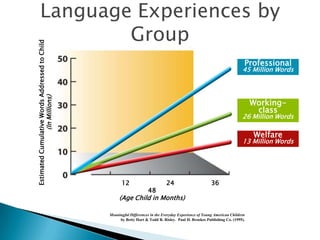
Meaningful Differences in the Everyday Experience of Young American Children
by Betty Hart & Todd R. Risley. Paul H. Brookes Publishing Co. (1995).
12 24 36
48
(Age Child in Months)
EstimatedCumulativeWordsAddressedtoChild
(InMillions)
Working-
class
26 Million Words
Welfare
13 Million Words
Professional
45 Million Words
Language Experiences by
Group
 Only 4% of the school day is spent engaging
in student talk.
 Only 2% of is spent discussing focal lesson
content (but not necessarily using relevant
academic language).
◦ Arreaga-Mayer & Perdomo-Rivera, 1996
Introduce ELA Look-
Fors
Using Observations
and Walk-Throughs
to Change the Face
of Instruction
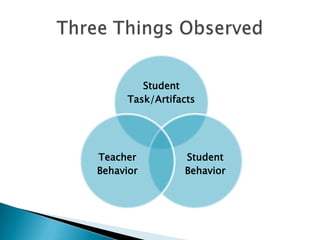
Student
Task/Artifacts
Student
Behavior
Teacher
Behavior
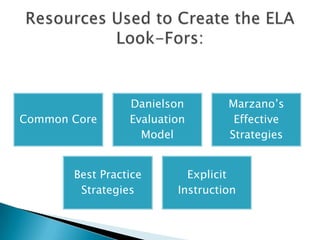
Common Core
Danielson
Evaluation
Model
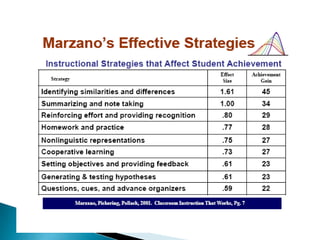
Marzano’s
Effective
Strategies
Best Practice
Strategies
Explicit
Instruction
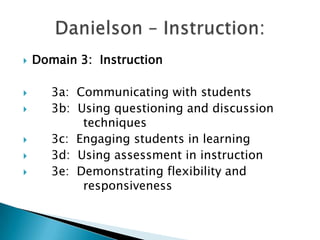
 Domain 3: Instruction
 3a: Communicating with students
 3b: Using questioning and discussion
techniques
 3c: Engaging students in learning
 3d: Using assessment in instruction
 3e: Demonstrating flexibility and
responsiveness
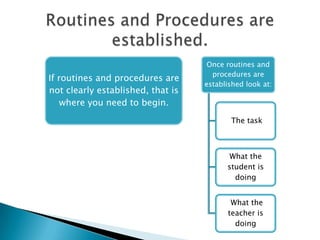
If routines and procedures are
not clearly established, that is
where you need to begin.
Once routines and
procedures are
established look at:
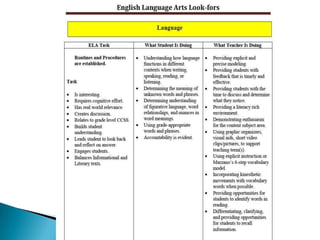
The task
What the
student is
doing
What the
teacher is
doing
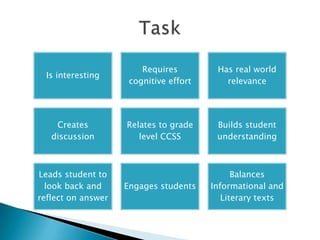
Is interesting
Requires
cognitive effort
Has real world
relevance
Creates
discussion
Relates to grade
level CCSS
Builds student
understanding
Leads student to
look back and
reflect on answer
Engages students
Balances
Informational and
Literary texts
Understanding how language functions in different contexts
when writing, speaking, reading, or listening.
Determining the meaning of unknown words and phrases.
Determining understanding of figurative language, word
relationships, and nuances in word meanings.
Using grade-appropriate words and phrases.
Accountability is evident.
1. During the discussion, teammates place their chip in the
center each time they talk. They cannot talk again until all
team members have placed a chip in the middle.
2. All teammates pick up their chip and begin again.
 Round 1: How do you engage your students?
 Round 2: How do you define rigor?
 Round 3: What does engaging instruction look like?
 1st Grade Talking Chips Video:
http://vimeo.com/65843184
 With Talking Chips, where was the individual
accountability?
 Where was the equal participation?
 How would the teacher set up the lesson to
make sure of engagement and
accountability?
 What ideas of engagement will you take
away?
 Turn and Talk
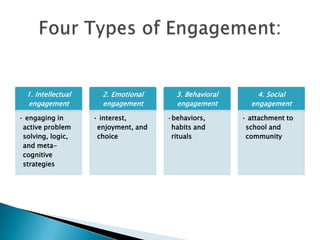
1. Intellectual
engagement
• engaging in
active problem
solving, logic,
and meta-
cognitive
strategies
2. Emotional
engagement
• interest,
enjoyment, and
choice
3. Behavioral
engagement
•behaviors,
habits and
rituals
4. Social
engagement
• attachment to
school and
community
Providing explicit
and precise
modeling.
Providing
students with
feedback that is
timely and
effective.
Providing
students with the
time to discuss
and determine
what they notice.
Providing a rich
literacy
environment.
Demonstrating
enthusiasm for
the content
subject area.
Using graphic
organizers, visual
aids, short video
clips/pictures, to
support teaching
term(s).
Using explicit
instruction or
Marzano’s 6-step
vocabulary model.
Incorporating
kinesthetic
movements with
vocabulary words
when possible.
Providing
opportunities for
students to
identify words in
reading.
Differentiating,
clarifying, and
providing
opportunities for
students to recall
information.
Pronounce the word – terrible -- kids repeat the word with you several times
Explain the meaning: Terrible means something unpleasant or very bad. For example, a
bad storm that destroys many trees and homes is terrible. A rotten fish smells terrible.
When we have a lot of snow and cold weather during the winter, some people say that the
winter was terrible.
Students fill in the statement using the term: When something smells bad, we might say
that it smells ____ (terrible). When we watch a very bad movie, we might say that the
movie was ______ (terrible). When our parents make us eat broccoli, some of us might say
that it tastes _______ (terrible). When a storm is very strong and destroys trees and
homes, we say that the storm was ______ (terrible).
Students act out the term: Make a face that shows me what you would look like if we
smelled something terrible, like rotten food. Kids make a face. Show me how you would
look if you hurt your arm and it felt terrible.
Engage students in a read aloud where students identify the vocabulary words as they are
read.
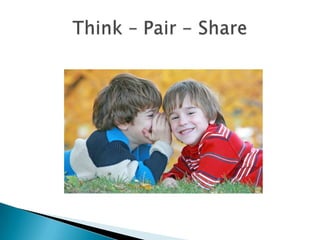
Ask a question using the word and have students share their responses: What is an
example of something that is terrible? Turn and tell a partner or share out loud.
Be sure to include pictures, video, text, a graphic organizer, sharing, and an exit ticket.
Use
illustrations or
videos to
visualize the
word
1. Choose word (tier II)
2. Explain Meaning
3. Repeat word several times
 Students fill in the statement using the
term: When something smells bad, we
might say that it smells ____ (terrible).
When we watch a very bad movie, we might
say that the movie was ______ (terrible).
When our parents make us eat broccoli,
some of us might say that it tastes _______
(terrible). When a storm is very strong and
destroys trees and homes, we say that the
storm was ______ (terrible).
Students act out the term: Make a face that
shows me what you would look like if we
smelled something terrible, like rotten
food. Kids make a face. Show me how you
would look if you hurt your arm and it felt
terrible.
 Engage students in a read aloud where
students identify the vocabulary words
as they are read.
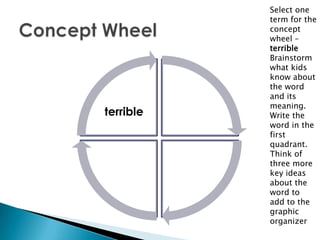
terrible
Select one
term for the
concept
wheel –
terrible
Brainstorm
what kids
know about
the word
and its
meaning.
Write the
word in the
first
quadrant.
Think of
three more
key ideas
about the
word to
add to the
graphic
organizer
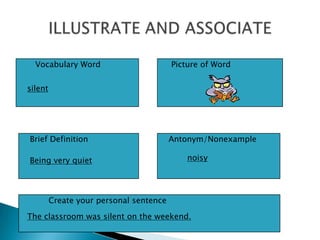
Vocabulary Word Picture of Word
Brief Definition Antonym/Nonexample
Create your personal sentence
silent
Being very quiet noisy
The classroom was silent on the weekend.
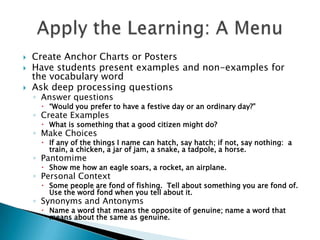
 Create Anchor Charts or Posters
 Have students present examples and non-examples for
the vocabulary word
 Ask deep processing questions
◦ Answer questions
 ―Would you prefer to have a festive day or an ordinary day?‖
◦ Create Examples
 What is something that a good citizen might do?
◦ Make Choices
 If any of the things I name can hatch, say hatch; if not, say nothing: a
train, a chicken, a jar of jam, a snake, a tadpole, a horse.
◦ Pantomime
 Show me how an eagle soars, a rocket, an airplane.
◦ Personal Context
 Some people are fond of fishing. Tell about something you are fond of.
Use the word fond when you tell about it.
◦ Synonyms and Antonyms
 Name a word that means the opposite of genuine; name a word that
means about the same as genuine.
Something new that I learned
today is…
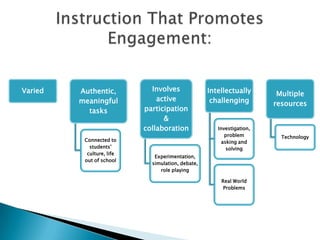
Varied Authentic,
meaningful
tasks
Connected to
students’
culture, life
out of school
Involves
active
participation
&
collaboration
Experimentation,
simulation, debate,
role playing
Intellectually
challenging
Investigation,
problem
asking and
solving
Real World
Problems
Multiple
resources
Technology
 Ask:
◦ What is the purpose of the task?
◦ What is the purpose of a grade?
◦ What is the purpose for assessment?
Grade 2 Vocabulary Video
 https://www.teachingchannel.org/videos/imp
roving-student-vocabulary?fd=1
 Dr. Anita Archer Podcasts
 http://www.scoe.org/pub/htdocs/archer-
videos.html
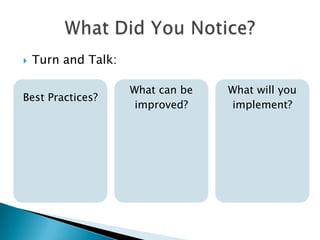
 Turn and Talk:
Best Practices?
What can be
improved?
What will you
implement?
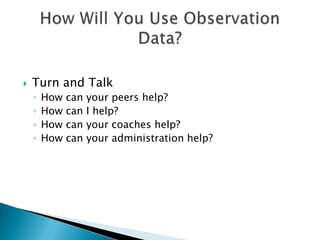
 Turn and Talk
◦ How can your peers help?
◦ How can I help?
◦ How can your coaches help?
◦ How can your administration help?
 When I walk into a classroom, of course I care about what the
teacher is doing, but in some ways I care even more about what
the students are doing. What's the nature of the task? Are
students being invited, or even required, to think? Naturally,
that has implications for what the teacher is doing and what the
teacher has already done. That is, has the teacher designed
learning experiences for kids that engage them in thinking or
formulating and testing hypothesizes or challenging one
another respectfully or developing an understanding of a
concept? You really only know what a teacher is doing when you
look at what the students are doing. I also listen carefully to
how teachers question students—if they ask kids to explain
their thinking, for instance. That's very different from just
saying that's the right or wrong answer. It's a very different
mindset about wanting to understand the students' thinking
and their degree and level of understanding.
 Today: Introduce ELA Look-Fors
 Next Time: Model Vocabulary Lesson
 Day 3: Classroom Walk-Throughs and
Support
 Day 4: Classroom Walk-Throughs and
Support
Ela look fors

Ela look fors

  • 1.
    Jennifer Evans Assistant DirectorELA St. Clair County RESA Evans.jennifer@sccresa.org http://www.protopage.com/evans.jennifer#Untitled/Home
  • 2.
     What EffectiveInstructional Leaders Do: Supporting School Improvement and Instructional Quality  This is what we do well; these are our challenges; and this is what we are doing to address our challenges.
  • 3.
    Meaningful Differences inthe Everyday Experience of Young American Children by Betty Hart & Todd R. Risley. Paul H. Brookes Publishing Co. (1995). 12 24 36 48 (Age Child in Months) EstimatedCumulativeWordsAddressedtoChild (InMillions) Working- class 26 Million Words Welfare 13 Million Words Professional 45 Million Words Language Experiences by Group
  • 4.
     Only 4%of the school day is spent engaging in student talk.  Only 2% of is spent discussing focal lesson content (but not necessarily using relevant academic language). ◦ Arreaga-Mayer & Perdomo-Rivera, 1996
  • 5.
    Introduce ELA Look- Fors UsingObservations and Walk-Throughs to Change the Face of Instruction
  • 6.
  • 8.
  • 10.
     Domain 3:Instruction  3a: Communicating with students  3b: Using questioning and discussion techniques  3c: Engaging students in learning  3d: Using assessment in instruction  3e: Demonstrating flexibility and responsiveness
  • 12.
    If routines andprocedures are not clearly established, that is where you need to begin. Once routines and procedures are established look at: The task What the student is doing What the teacher is doing
  • 13.
    Is interesting Requires cognitive effort Hasreal world relevance Creates discussion Relates to grade level CCSS Builds student understanding Leads student to look back and reflect on answer Engages students Balances Informational and Literary texts
  • 16.
    Understanding how languagefunctions in different contexts when writing, speaking, reading, or listening. Determining the meaning of unknown words and phrases. Determining understanding of figurative language, word relationships, and nuances in word meanings. Using grade-appropriate words and phrases. Accountability is evident.
  • 18.
    1. During thediscussion, teammates place their chip in the center each time they talk. They cannot talk again until all team members have placed a chip in the middle. 2. All teammates pick up their chip and begin again.  Round 1: How do you engage your students?  Round 2: How do you define rigor?  Round 3: What does engaging instruction look like?  1st Grade Talking Chips Video: http://vimeo.com/65843184
  • 19.
     With TalkingChips, where was the individual accountability?  Where was the equal participation?  How would the teacher set up the lesson to make sure of engagement and accountability?  What ideas of engagement will you take away?  Turn and Talk
  • 20.
    1. Intellectual engagement • engagingin active problem solving, logic, and meta- cognitive strategies 2. Emotional engagement • interest, enjoyment, and choice 3. Behavioral engagement •behaviors, habits and rituals 4. Social engagement • attachment to school and community
  • 21.
    Providing explicit and precise modeling. Providing studentswith feedback that is timely and effective. Providing students with the time to discuss and determine what they notice. Providing a rich literacy environment. Demonstrating enthusiasm for the content subject area. Using graphic organizers, visual aids, short video clips/pictures, to support teaching term(s). Using explicit instruction or Marzano’s 6-step vocabulary model. Incorporating kinesthetic movements with vocabulary words when possible. Providing opportunities for students to identify words in reading. Differentiating, clarifying, and providing opportunities for students to recall information.
  • 22.
    Pronounce the word– terrible -- kids repeat the word with you several times Explain the meaning: Terrible means something unpleasant or very bad. For example, a bad storm that destroys many trees and homes is terrible. A rotten fish smells terrible. When we have a lot of snow and cold weather during the winter, some people say that the winter was terrible. Students fill in the statement using the term: When something smells bad, we might say that it smells ____ (terrible). When we watch a very bad movie, we might say that the movie was ______ (terrible). When our parents make us eat broccoli, some of us might say that it tastes _______ (terrible). When a storm is very strong and destroys trees and homes, we say that the storm was ______ (terrible). Students act out the term: Make a face that shows me what you would look like if we smelled something terrible, like rotten food. Kids make a face. Show me how you would look if you hurt your arm and it felt terrible. Engage students in a read aloud where students identify the vocabulary words as they are read. Ask a question using the word and have students share their responses: What is an example of something that is terrible? Turn and tell a partner or share out loud. Be sure to include pictures, video, text, a graphic organizer, sharing, and an exit ticket.
  • 23.
    Use illustrations or videos to visualizethe word 1. Choose word (tier II) 2. Explain Meaning 3. Repeat word several times
  • 24.
     Students fillin the statement using the term: When something smells bad, we might say that it smells ____ (terrible). When we watch a very bad movie, we might say that the movie was ______ (terrible). When our parents make us eat broccoli, some of us might say that it tastes _______ (terrible). When a storm is very strong and destroys trees and homes, we say that the storm was ______ (terrible).
  • 25.
    Students act outthe term: Make a face that shows me what you would look like if we smelled something terrible, like rotten food. Kids make a face. Show me how you would look if you hurt your arm and it felt terrible.
  • 27.
     Engage studentsin a read aloud where students identify the vocabulary words as they are read.
  • 28.
    terrible Select one term forthe concept wheel – terrible Brainstorm what kids know about the word and its meaning. Write the word in the first quadrant. Think of three more key ideas about the word to add to the graphic organizer
  • 29.
    Vocabulary Word Pictureof Word Brief Definition Antonym/Nonexample Create your personal sentence silent Being very quiet noisy The classroom was silent on the weekend.
  • 30.
     Create AnchorCharts or Posters  Have students present examples and non-examples for the vocabulary word  Ask deep processing questions ◦ Answer questions  ―Would you prefer to have a festive day or an ordinary day?‖ ◦ Create Examples  What is something that a good citizen might do? ◦ Make Choices  If any of the things I name can hatch, say hatch; if not, say nothing: a train, a chicken, a jar of jam, a snake, a tadpole, a horse. ◦ Pantomime  Show me how an eagle soars, a rocket, an airplane. ◦ Personal Context  Some people are fond of fishing. Tell about something you are fond of. Use the word fond when you tell about it. ◦ Synonyms and Antonyms  Name a word that means the opposite of genuine; name a word that means about the same as genuine.
  • 31.
    Something new thatI learned today is…
  • 32.
    Varied Authentic, meaningful tasks Connected to students’ culture,life out of school Involves active participation & collaboration Experimentation, simulation, debate, role playing Intellectually challenging Investigation, problem asking and solving Real World Problems Multiple resources Technology
  • 34.
     Ask: ◦ Whatis the purpose of the task? ◦ What is the purpose of a grade? ◦ What is the purpose for assessment?
  • 35.
    Grade 2 VocabularyVideo  https://www.teachingchannel.org/videos/imp roving-student-vocabulary?fd=1  Dr. Anita Archer Podcasts  http://www.scoe.org/pub/htdocs/archer- videos.html
  • 36.
     Turn andTalk: Best Practices? What can be improved? What will you implement?
  • 37.
     Turn andTalk ◦ How can your peers help? ◦ How can I help? ◦ How can your coaches help? ◦ How can your administration help?
  • 38.
     When Iwalk into a classroom, of course I care about what the teacher is doing, but in some ways I care even more about what the students are doing. What's the nature of the task? Are students being invited, or even required, to think? Naturally, that has implications for what the teacher is doing and what the teacher has already done. That is, has the teacher designed learning experiences for kids that engage them in thinking or formulating and testing hypothesizes or challenging one another respectfully or developing an understanding of a concept? You really only know what a teacher is doing when you look at what the students are doing. I also listen carefully to how teachers question students—if they ask kids to explain their thinking, for instance. That's very different from just saying that's the right or wrong answer. It's a very different mindset about wanting to understand the students' thinking and their degree and level of understanding.
  • 39.
     Today: IntroduceELA Look-Fors  Next Time: Model Vocabulary Lesson  Day 3: Classroom Walk-Throughs and Support  Day 4: Classroom Walk-Throughs and Support

Editor's Notes

  • #4 2 vs. 8 words a day between professional homes and welfare
  • #5 These are the students who need the most practice using vocabulary in order to make those gains, but are being the least engaged. We can engage ELL and other low language students and scaffold their learning in non-threatening ways. The point is, they need to be engaged, not just have a partner that will do all the talking for them.
  • #24 Pronounce the word – terrible -- kids repeat the word with you several timesExplain the meaning: Terrible means something unpleasant or very bad. For example, a bad storm that destroys many trees and homes is terrible. A rotten fish smells terrible. When we have a lot of snow and cold weather during the winter, some people say that the winter was terrible. Students fill in the statement using the term: When something smells bad, we might say that it smells ____ (terrible). When we watch a very bad movie, we might say that the movie was ______ (terrible). When our parents make us eat broccoli, some of us might say that it tastes _______ (terrible). When a storm is very strong and destroys trees and homes, we say that the storm was ______ (terrible). Students act out the term: Make a face that shows me what you would look like if we smelled something terrible, like rotten food. Kids make a face. Show me how you would look if you hurt your arm and it felt terrible. Ask a question using the word and have students share their responses: What is an example of something that is terrible? Turn and tell a partner or share out loud.
  • #29 Select one term for the concept wheel – disasterBrainstorm what kids know about the word and its meaning (cart on paper)Write the word in the first quadrant – disasterThink of three more key ideas about the word to add to the graphic organizer
  • #30 Switch to document camera and do an example together.
  • #32 Kids write one thing they learned today.Additional Resources: http://www.weatherwizkids.com/