NOTES FROM
DISCUSSIONS IN
LEARNING UNIT 2
Vocabulary “programs” not present or “programs”
implemented but not effective!
◦ There were a number of comments about schools that have no vocabulary focus; little collaboration
about how vocabulary is taught in each grade level.
◦ There are many benefits for schools to encourage the use of consistent, research-based practices in
vocabulary instruction. This does not mean scripted instruction nor does it mean teachers will all
teach vocabulary identically. Instead it leads to solid vocabulary instruction that is built on
throughout the grades.
◦ These programs are effective in many school districts: Words Their Way and Marzano
◦ Why?
◦ There is a “buy-in” from the district in terms of training and teacher collaboration.
◦ Teachers feel the program is worthwhile and does not add to the curriculum but becomes a part
of the curriculum.
◦ Word Their Way uses a developmental approach.
◦ Both of these programs contain elements that are found in many vocabulary strategies!
◦ Both programs benefit ALL children, including ELLs.
What can you do?
◦ Use research-based strategies and programs that benefit your students,
especially in content areas.
◦ Start with your grade level and make a “grade level” plan of how vocabulary will
be taught.
◦ If you have ELLs, be sure to provide strategies that benefit ELLs (they will end up
benefitting all students!).
◦ Perhaps start ”school conversation” on how to best teach vocabulary and have
continuity between grade levels.
◦ Make word learning fun and not a chore. (Yes, it can be fun!) See resources in
learning unit 6!
◦ Provide engaging instruction!
◦ See resources in the next few slides!
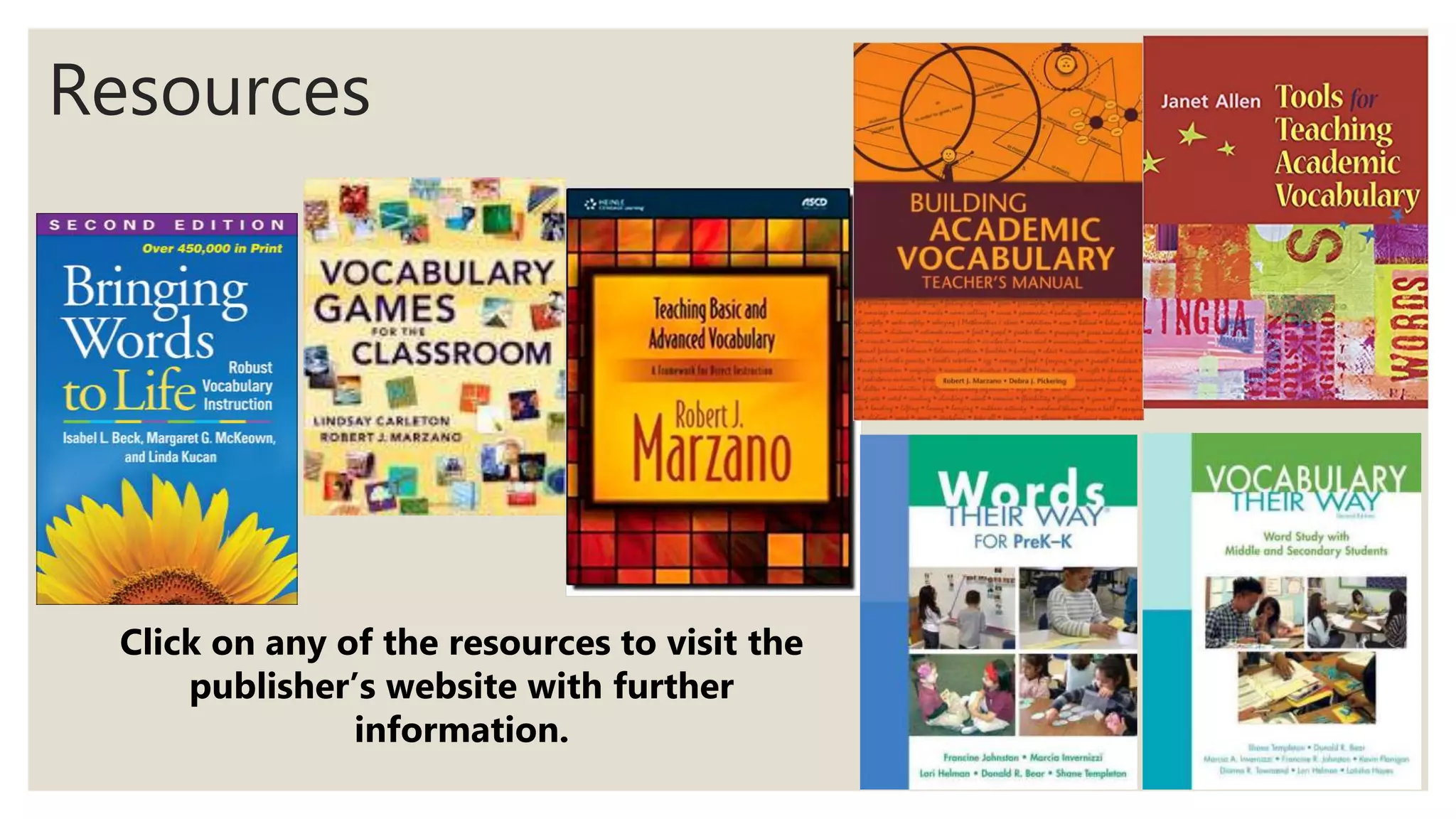
Resources
Click on any of the resources to visit the
publisher’s website with further
information.
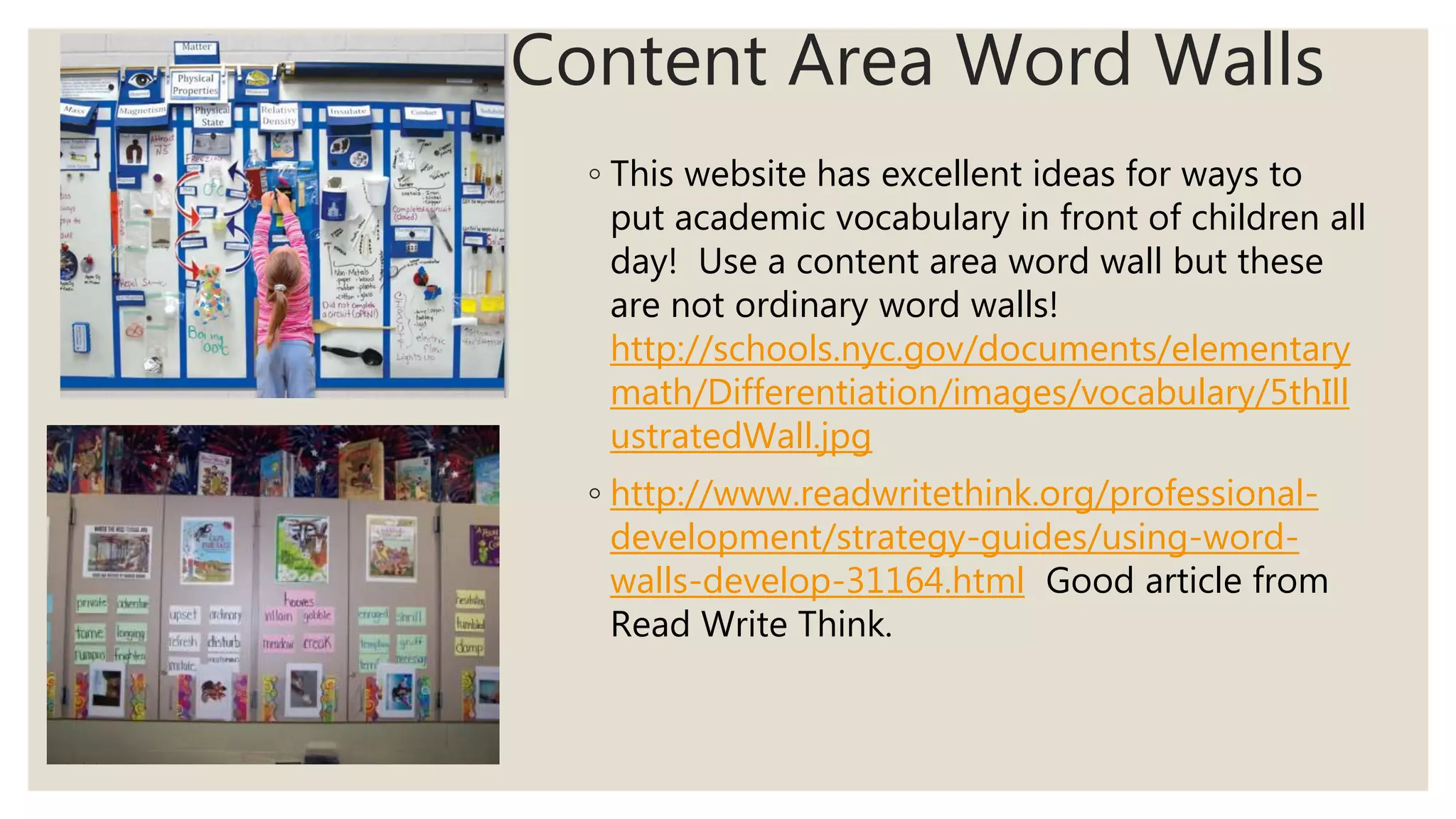
Content Area Word Walls
◦ This website has excellent ideas for ways to
put academic vocabulary in front of children all
day! Use a content area word wall but these
are not ordinary word walls!
http://schools.nyc.gov/documents/elementary
math/Differentiation/images/vocabulary/5thIll
ustratedWall.jpg
◦ http://www.readwritethink.org/professional-
development/strategy-guides/using-word-
walls-develop-31164.html Good article from
Read Write Think.
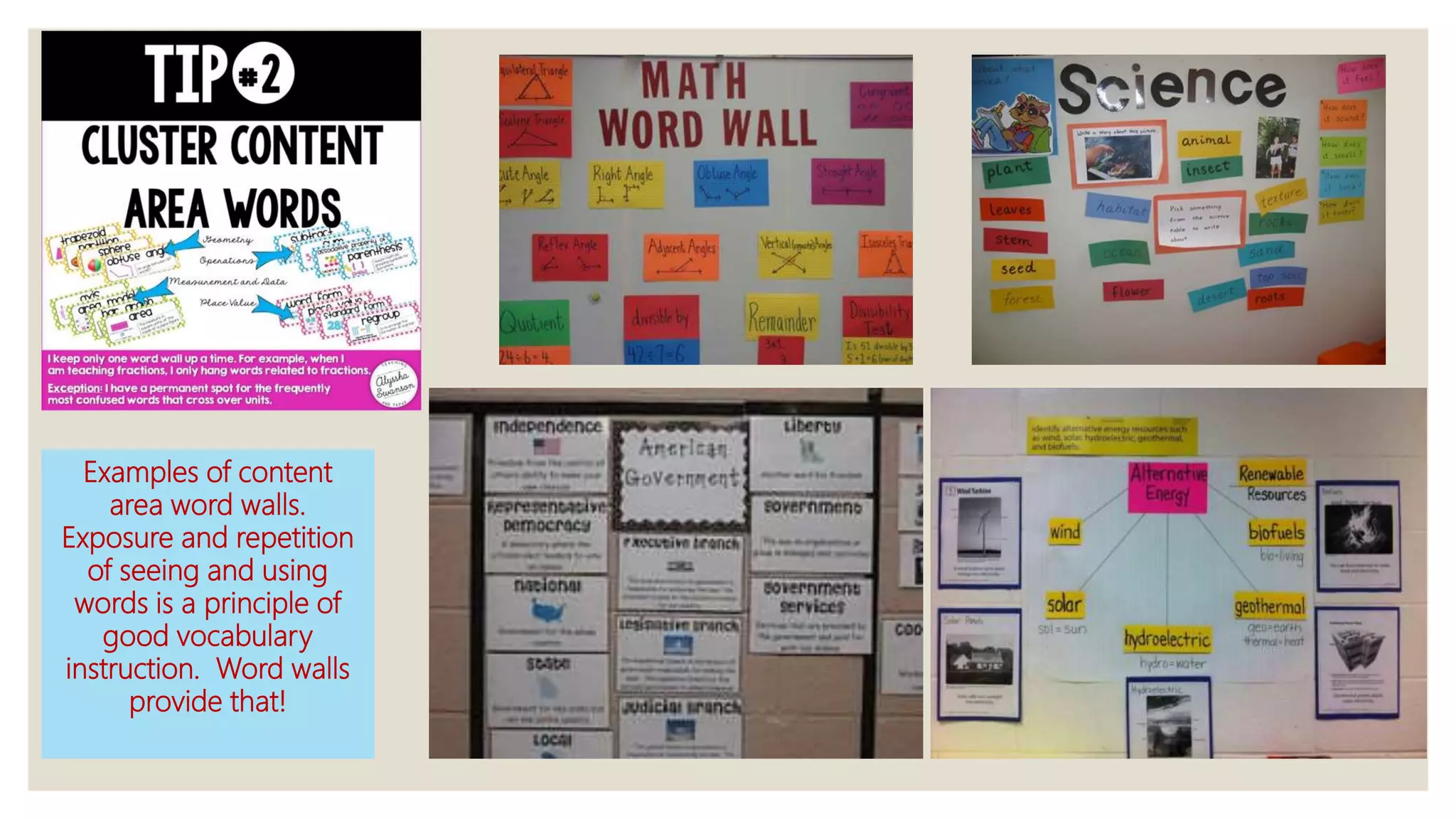
Examples of content
area word walls.
Exposure and repetition
of seeing and using
words is a principle of
good vocabulary
instruction. Word walls
provide that!
Use technology! These two websites
were shared in discussions.
◦Quizlet: create flashcards, quizzes. (There is a free
version)
◦Kahoot: Game-based learning. Visit their website for
many ideas. Free
Thoughts on dictionaries…
◦ Consider the role of a traditional dictionary. Is your district updating these or
are you using older editions?
◦ Use children’s dictionaries! Even in the upper elementary grades, a children’s
dictionary is best for helping children really learn to use a dictionary.
◦ Teach students HOW to use a dictionary! Examples: how to distinguish between
definitions, why we go to a dictionary, how the parts of speech can help us, how
to use guide words, entry words, etc.
◦ Can an online dictionary benefit students?
◦ Features of online dictionaries: can hear the word spoken, finding the word
takes little time putting the focus on learning the word, this is the way students
will likely use a dictionary in the future,
Make vocabulary fun! Simple ideas!
◦ http://freerice.com/#/english-vocabulary/1421
◦ http://www.smartcrossword.com/
◦ http://www.pogo.com/games/scrabble
◦ Play games! (ie: Scrabble Junior, Boggle, Taboo, Pictionary, Concentration, Charades,
Scattegories). These are great “indoor recess” games for winter!
◦ Apps for teaching vocabulary: https://appydazeblog.com/2014/08/10/12-vocabulary-apps-for-
kids/
◦ Word of the Day: Great way to build word awareness & curiosity! Resources for Word of the
Day: http://www.wordcentral.com/buzzword/buzzword.php , http://www.wordcentral.com ,
http://www.ascd.org/publications/educational-leadership/mar11/vol68/num06/A-Word-for-the-
Words.aspx (nice article with a checklist for whole school vocabulary learning!).
Variations described for
Word of the Day
◦ “What is it?” (“It’s a song that I use in transitions to draw my kids from one activity to the rug for
meeting time. I sing, “what is it, what is it, what is it do you know?” I have a big decorated box with
a question mark on it, which is hiding something new each day”)
◦ Made a template for Word of the Day to use next year (“We could sort the words based on
characteristics, create a class dictionary, use them for charades, and add them to our writing. In
fact, I think this vocabulary practice could become a great way to add another dimension to
Daniels’ (2017) suggestion of developing a greeting ritual in my classroom communities.”)
◦ Amazing Word Signal: …”we use whenever we hear the amazing words throughout the year.
Students love this because it is usual a silly signal that we come up with at the beginning of the
year. I also like to do activities with students where they can act out the Amazing Words.
How you talk matters! Check out this article! (Log into GVSU to access)
Lane, H.B., & Allen, S. (2010, February). The Vocabulary-Rich Classroom: Modeling Sophisticated Word Use to Promote Word
Consciousness and Vocabulary Growth. The Reading Teacher, 63(5), 362–370.
Examples:
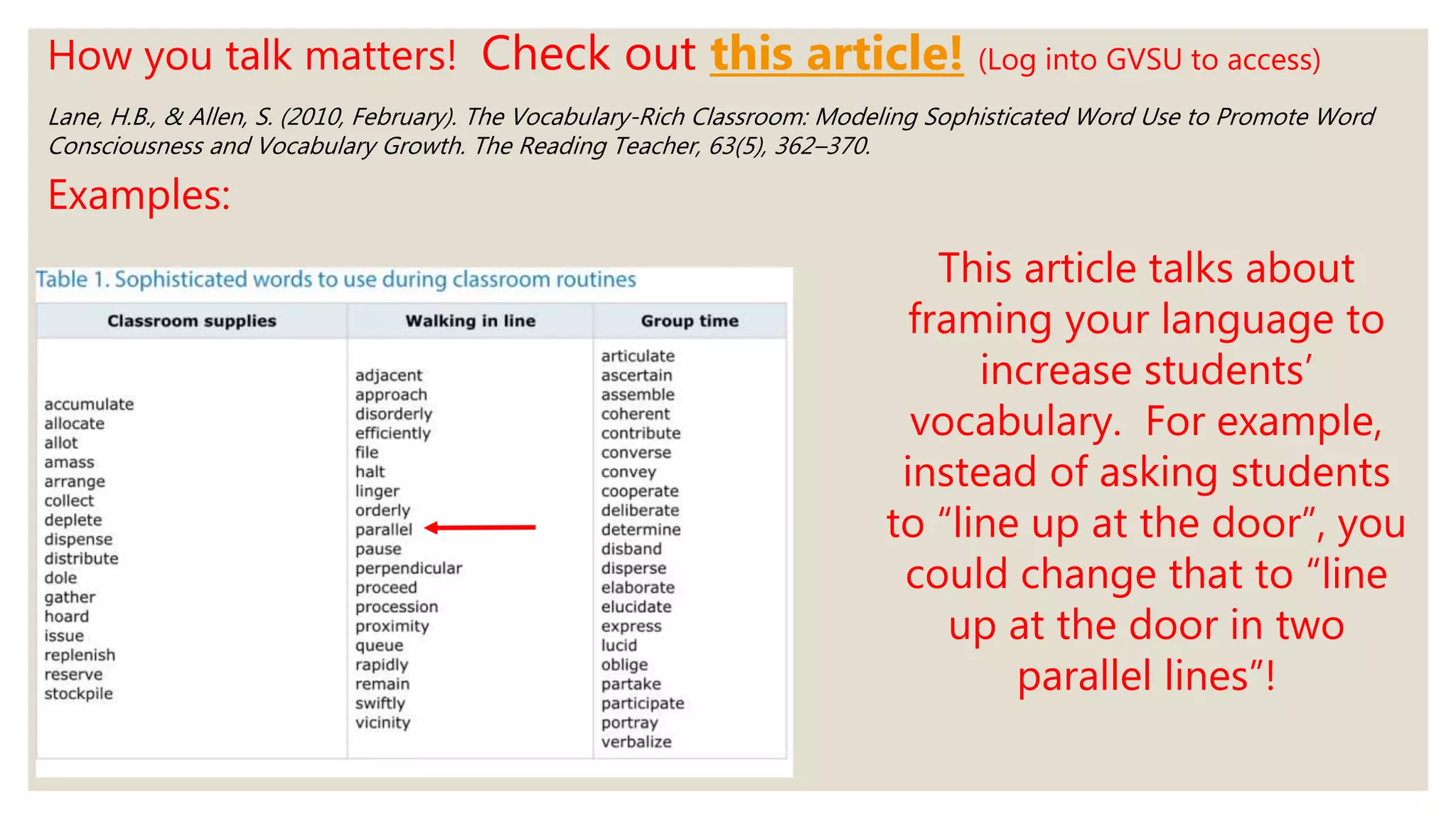
This article talks about
framing your language to
increase students’
vocabulary. For example,
instead of asking students
to “line up at the door”, you
could change that to “line
up at the door in two
parallel lines”!
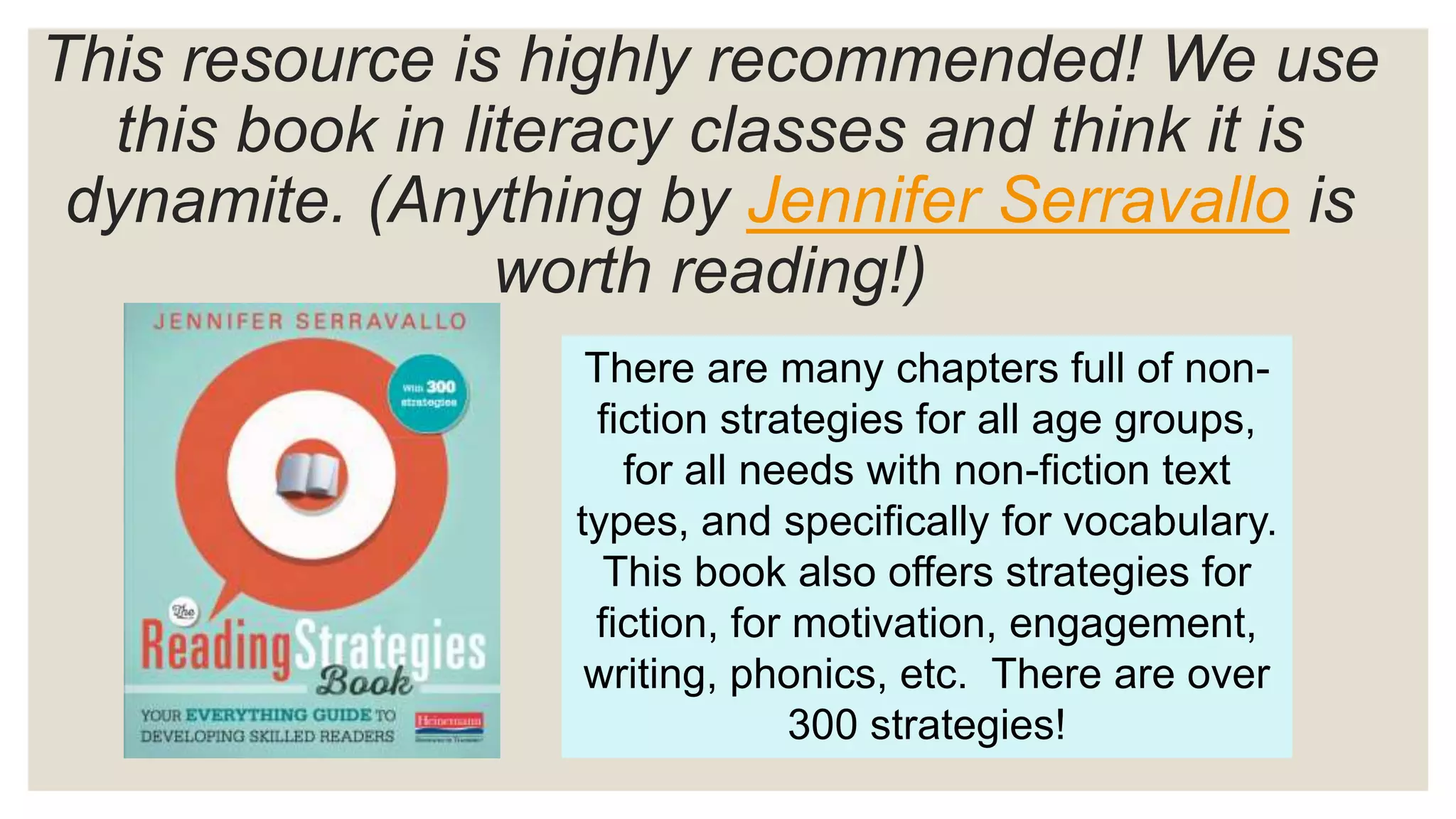
This resource is highly recommended! We use
this book in literacy classes and think it is
dynamite. (Anything by Jennifer Serravallo is
worth reading!)
There are many chapters full of non-
fiction strategies for all age groups,
for all needs with non-fiction text
types, and specifically for vocabulary.
This book also offers strategies for
fiction, for motivation, engagement,
writing, phonics, etc. There are over
300 strategies!

Learning unit 2 notes

  • 1.
  • 2.
    Vocabulary “programs” notpresent or “programs” implemented but not effective! ◦ There were a number of comments about schools that have no vocabulary focus; little collaboration about how vocabulary is taught in each grade level. ◦ There are many benefits for schools to encourage the use of consistent, research-based practices in vocabulary instruction. This does not mean scripted instruction nor does it mean teachers will all teach vocabulary identically. Instead it leads to solid vocabulary instruction that is built on throughout the grades. ◦ These programs are effective in many school districts: Words Their Way and Marzano ◦ Why? ◦ There is a “buy-in” from the district in terms of training and teacher collaboration. ◦ Teachers feel the program is worthwhile and does not add to the curriculum but becomes a part of the curriculum. ◦ Word Their Way uses a developmental approach. ◦ Both of these programs contain elements that are found in many vocabulary strategies! ◦ Both programs benefit ALL children, including ELLs.
  • 3.
    What can youdo? ◦ Use research-based strategies and programs that benefit your students, especially in content areas. ◦ Start with your grade level and make a “grade level” plan of how vocabulary will be taught. ◦ If you have ELLs, be sure to provide strategies that benefit ELLs (they will end up benefitting all students!). ◦ Perhaps start ”school conversation” on how to best teach vocabulary and have continuity between grade levels. ◦ Make word learning fun and not a chore. (Yes, it can be fun!) See resources in learning unit 6! ◦ Provide engaging instruction! ◦ See resources in the next few slides!
  • 4.
    Resources Click on anyof the resources to visit the publisher’s website with further information.
  • 5.
    Content Area WordWalls ◦ This website has excellent ideas for ways to put academic vocabulary in front of children all day! Use a content area word wall but these are not ordinary word walls! http://schools.nyc.gov/documents/elementary math/Differentiation/images/vocabulary/5thIll ustratedWall.jpg ◦ http://www.readwritethink.org/professional- development/strategy-guides/using-word- walls-develop-31164.html Good article from Read Write Think.
  • 6.
    Examples of content areaword walls. Exposure and repetition of seeing and using words is a principle of good vocabulary instruction. Word walls provide that!
  • 7.
    Use technology! Thesetwo websites were shared in discussions. ◦Quizlet: create flashcards, quizzes. (There is a free version) ◦Kahoot: Game-based learning. Visit their website for many ideas. Free
  • 8.
    Thoughts on dictionaries… ◦Consider the role of a traditional dictionary. Is your district updating these or are you using older editions? ◦ Use children’s dictionaries! Even in the upper elementary grades, a children’s dictionary is best for helping children really learn to use a dictionary. ◦ Teach students HOW to use a dictionary! Examples: how to distinguish between definitions, why we go to a dictionary, how the parts of speech can help us, how to use guide words, entry words, etc. ◦ Can an online dictionary benefit students? ◦ Features of online dictionaries: can hear the word spoken, finding the word takes little time putting the focus on learning the word, this is the way students will likely use a dictionary in the future,
  • 9.
    Make vocabulary fun!Simple ideas! ◦ http://freerice.com/#/english-vocabulary/1421 ◦ http://www.smartcrossword.com/ ◦ http://www.pogo.com/games/scrabble ◦ Play games! (ie: Scrabble Junior, Boggle, Taboo, Pictionary, Concentration, Charades, Scattegories). These are great “indoor recess” games for winter! ◦ Apps for teaching vocabulary: https://appydazeblog.com/2014/08/10/12-vocabulary-apps-for- kids/ ◦ Word of the Day: Great way to build word awareness & curiosity! Resources for Word of the Day: http://www.wordcentral.com/buzzword/buzzword.php , http://www.wordcentral.com , http://www.ascd.org/publications/educational-leadership/mar11/vol68/num06/A-Word-for-the- Words.aspx (nice article with a checklist for whole school vocabulary learning!).
  • 10.
    Variations described for Wordof the Day ◦ “What is it?” (“It’s a song that I use in transitions to draw my kids from one activity to the rug for meeting time. I sing, “what is it, what is it, what is it do you know?” I have a big decorated box with a question mark on it, which is hiding something new each day”) ◦ Made a template for Word of the Day to use next year (“We could sort the words based on characteristics, create a class dictionary, use them for charades, and add them to our writing. In fact, I think this vocabulary practice could become a great way to add another dimension to Daniels’ (2017) suggestion of developing a greeting ritual in my classroom communities.”) ◦ Amazing Word Signal: …”we use whenever we hear the amazing words throughout the year. Students love this because it is usual a silly signal that we come up with at the beginning of the year. I also like to do activities with students where they can act out the Amazing Words.
  • 11.
    How you talkmatters! Check out this article! (Log into GVSU to access) Lane, H.B., & Allen, S. (2010, February). The Vocabulary-Rich Classroom: Modeling Sophisticated Word Use to Promote Word Consciousness and Vocabulary Growth. The Reading Teacher, 63(5), 362–370. Examples: This article talks about framing your language to increase students’ vocabulary. For example, instead of asking students to “line up at the door”, you could change that to “line up at the door in two parallel lines”!
  • 12.
    This resource ishighly recommended! We use this book in literacy classes and think it is dynamite. (Anything by Jennifer Serravallo is worth reading!) There are many chapters full of non- fiction strategies for all age groups, for all needs with non-fiction text types, and specifically for vocabulary. This book also offers strategies for fiction, for motivation, engagement, writing, phonics, etc. There are over 300 strategies!