I-Instructional Objectives:
At the end of the discussion students will be able to:
1. Discuss Egyptian mythology,
2. Identify the Ancient Egyptian gods and goddesses and their roles in Egyptian
myth,
3. Explain an example of Egyptian creation myth using symbolisms and
archetypes,
4. Appreciate the values and knowledge learned.
II- Materials:
Hand-Outs, Laptop Computer, Visual Aids, PPT, Projector, Video Clips,
Marker and White Board.
III-Review: The teacher will ask for the previous lesson to check retention and
understanding.
IV-Lesson Proper:
Lesson 1
Introduction to Egyptian Mythology
Unification around 3100 B.C. to its conquest by Alexander the Great in
332 B.C.—ancient Egypt was the preeminent civilization in the Mediterranean
world. From the great pyramids of the Old Kingdom through the military
conquests of the New Kingdom, Egypt's majesty has long entranced
archaeologists and historians and created a vibrant field of study all its own:
Egyptology. The main sources of information about ancient Egypt are the many
monuments, objects and artifacts that have been recovered from archaeological
sites, covered with hieroglyphs that have only recently been deciphered. The
picture that emerges is of a culture with few equals in the beauty of its art, the
accomplishment of its architecture or the richness of its religious traditions.
Egyptian Mythology: Background
Ancient Egypt's gods and goddesses looked at least partly like humans
and behaved a bit like us, too. Some deities had animal features, like heads, on
top of humanoid bodies. Since they were gods, people were supposed to worship
them. There wasn't one right way to do this throughout all of Egyptian history and
in all places. Different cities and different pharaohs favored one set of gods over
another
A Short Glimpse to Egyptian Mythology: Gods and Goddesses
Anubis. The god of funerals. He is depicted as half man, half jackal.
Bastet. The goddess of protection. She was seen as half human, half cat.
Horus was the son of Isis and Osiris. The protector of pharaohs. Viewed as half
falcon, half human.
Isis. Osiris’s wife and sister. She was the goddess of life. Shown as a beautiful
woman
Nut. The goddess of the sky. She is depicted as blue with stars covering her
body and the sky on her back.
Osiris. The god of death. Osiris is depicted a s a pharaoh. He is brother of Set
and Isis (also her husband). He is the son of Nut and the father of Horus.
Re/Ra. The god of the sun. He was the ruler of everything.
Set. Brother of Osiris, he is the god of chaos, evil, and storms. He is depicted as
composite animals.
Egyptian Mythology: Worship
The ancient Egyptians believed that temples were the homes of the gods
and goddesses. Every temple was dedicated to a god or goddess and he or
she was worshipped there by the temple priests and the pharaoh.
The large temple buildings were made of stone so that they would last
“forever”. Their walls were covered with scenes that were carved onto the
stone then brightly painted. These scenes showed the pharaoh fighting in
battles and performing rituals with the gods and goddesses.
Egyptian Mythology: Mysteries
The Sphinx
Buried for most of its life in the desert sand, an air of mystery has always
surrounded the Great Sphinx, causing speculation about its age and purpose,
method of construction, concealed chambers, role in prophesy, and relationship
to the equally mysterious pyramids.
The monument is the largest surviving sculpture from the ancient world,
measuring 73.5m in length and in parts 20m in height. Part of the uraeus (sacred
cobra which protected from evil forces), the nose and the ritual beard are
missing; the beard is now displayed in the British Museum. The extensions at the
side of the head are part of the royal head cloth. Although the head of the Sphinx
has been badly affected by thousands of years of erosion, traces of the original
paint can still be seen near one ear.
It is thought that originally the Sphinx’s face was painted dark red. A small
temple between its paws contained dozens of inscribed steal placed by the
Pharaohs in honor of the Sun god.
The Rosetta Stone
The Rosetta Stone, which is housed in the British Museum, is a black,
possibly basalt slab with three languages on it (Greek, demotic and hieroglyphs)
each saying the same thing. Because the words are translated into the other
languages, it provided Jean-Francois Champollion the key to the mystery of
Egyptian hieroglyphs.
Discovered at Rosette in 1799, by Napoleon's army, the Rosetta Stone
proved the key to deciphering Egyptian hieroglyphs. The person who found it
was Pierre Francois-Xavier Bouchards, a French officer of engineers. It was sent
to the Institut d'Egypte in Cairo and then taken to London in 1802.
Reported by: Mr. Angelito T. Pera
Lesson 2 Egyptian Creation Story
Discussion
.In the beginning there was only the swirling watery chaos, called Nu. Out
of these chaotic waters rose Atum, the sun god of the city of Heliopolis. It is
believed that he created himself, using his thoughts and will. In the watery chaos,
Atum found no place on which to stand. In the place where he first appeared, he
created a hill. This hill was said to be the spot on which the temple of Heliopolis
was built. Other interpretations find that Atum was the hill. In this interpretation
Atum may represent the fertile, life giving hills left behind by the receding waters
of the Nile's annual flood. As early as the Fifth-Dynasty, we find Atum identified
with the sun god Ra. By this time his emergence on the primeval hill can be
interpreted as the coming of light into the darkness of Nu. As the god of the rising
sun, his name is Khepri.
. . . . .His next act was to create more gods. Because he was all alone in the
world, without a mate, he made a union with his shadow. This unusual way of
procreating offspring was not considered strange to the Egyptians. We find Atum
regarded as a bisexual god and was sometimes called the 'Great He-She'. The
Egyptians were thus able to present Atum as the one and only creative force in
the universe.
. . . . .According to some texts the birth of Atum's children took place on
the primeval hill. In other texts, Atum stayed in the waters of Nu to create his son
and daughter. He gave birth to his son by spitting him out. His daughter he
vomited. Shu represented the air and Tefnut was a goddess of moisture. Shu
and Tefnut continued the act of creation by establishing a social order. To this
order Shu contributed the 'principles of Life' while Tefnut contributed the
'principles of order'.
. . . . .After some time Shu and Tefnut became separated from their father and
lost in the watery chaos of Nu. Atum, who had only one eye, which was
removable. This was called the Udjat eye. Atum removed the eye and sent it in
search of his children. In time they returned with the eye. At this reunion Atum
wept tears joy, where these tears hit the ground, men grew. Now Atum was
ready to create the world. So Shu and Tefnut became the parents of Geb, the
earth and Nut, the sky. Geb and Nut gave birth toOsiris and Isis, Seth, Nephthys.
Themes:
Creation of man, death and the afterlife as opposed to creation are the
themes emphasized. As evidenced by the extensive time and effort spent to
make tombs and in burial. In fact, Egyptian funerary customs were as elaborate
and extensive as any known civilizations, and much of what we know about their
culture has been deciphered from these remnants.
Symbols:
 Water/river: beginning and chaos (nun)
 Hill: fertility (atum)
 Sun: beginning, youthful, great, strong (Re)
 Egg: life, light
Metaphorical Language:
 The existence represented the emergence of an empty space amid the
waters. To explain how Atum did this, the myth uses the metaphor
of masturbation, with the hand he used in this act representing the female
principle inherent within him.[18] He is also said to have "sneezed"
and"spat" to produce Shu and Tefnut, a metaphor that arose from puns on
their names.[19] Next, Shu and Tefnut coupled to produce the earth
god Geb and the sky goddess Nut, who defined the limits of the world.
Issues:
Gender Inequality
Peace and order
Values:
Reported by: Mr. Clinton D. Sequihod
Ms. Renalyn Escabusa
Lesson 3
Topic: Lesser gods and goddesses Of Egyptian Mythology
Discussion
Nu / Nun – chaos of burning, bubbling water; out of which everything
began.the sun (Atum) created himself, by his own thoughts and will. He is known
by many names: Khepri - the great scarab beetle (the rising sun) Ra-Harakhte -
winged solar-disk (the youthful sun of the eastern horizon) Ra – midday sun
Atum – setting sun in the west (old man) Horus - sun on the horizon Aten – the
solar disk . A hill rose (Temple of Heliopolis) CREATION MYTH.
Without a mate, he made a union with his shadow.He gave birth to his
son by spitting him out. Shu represented the air. He vomited his daughter,
Tefnut. Shu and Tefnut became separated from their father. Atum remved his
Udjat eye (removable, only eye) to search for his children. Upon their return,
Atum cried. His tears of joy became the first men. Shu and Tefnut became the
parents of Geb, the earth and Nut, the sky. Geb and Nut gave birth to Osiris
and Isis, Seth, Nephthys.
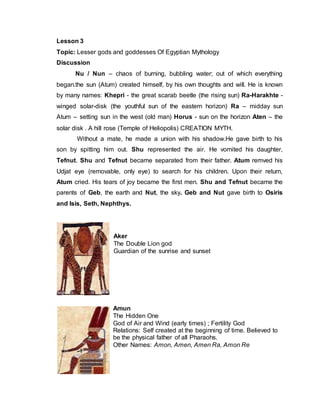
Aker
The Double Lion god
Guardian of the sunrise and sunset
Amun
The Hidden One
God of Air and Wind (early times) ; Fertility God
Relations: Self created at the beginning of time. Believed to
be the physical father of all Pharaohs.
Other Names: Amon, Amen, Amen Ra, Amon Re
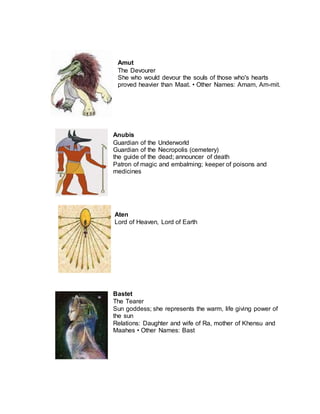
Amut
The Devourer
She who would devour the souls of those who's hearts
proved heavier than Maat. • Other Names: Amam, Am-mit.
Anubis
Guardian of the Underworld
Guardian of the Necropolis (cemetery)
the guide of the dead; announcer of death
Patron of magic and embalming; keeper of poisons and
medicines
Aten
Lord of Heaven, Lord of Earth
Bastet
The Tearer
Sun goddess; she represents the warm, life giving power of
the sun
Relations: Daughter and wife of Ra, mother of Khensu and
Maahes • Other Names: Bast
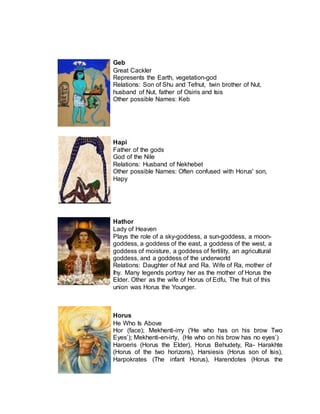
Geb
Great Cackler
Represents the Earth, vegetation-god
Relations: Son of Shu and Tefnut, twin brother of Nut,
husband of Nut, father of Osiris and Isis
Other possible Names: Keb
Hapi
Father of the gods
God of the Nile
Relations: Husband of Nekhebet
Other possible Names: Often confused with Horus' son,
Hapy
Hathor
Lady of Heaven
Plays the role of a sky-goddess, a sun-goddess, a moon-
goddess, a goddess of the east, a goddess of the west, a
goddess of moisture, a goddess of fertility, an agricultural
goddess, and a goddess of the underworld
Relations: Daughter of Nut and Ra. Wife of Ra, mother of
Ihy. Many legends portray her as the mother of Horus the
Elder. Other as the wife of Horus of Edfu, The fruit of this
union was Horus the Younger.
Horus
He Who Is Above
Hor (face); Mekhenti-irry ('He who has on his brow Two
Eyes’); Mekhenti-en-irty, (He who on his brow has no eyes’)
Haroeris (Horus the Elder), Horus Behudety, Ra- Harakhte
(Horus of the two horizons), Harsiesis (Horus son of Isis),
Harpokrates (The infant Horus), Harendotes (Horus the
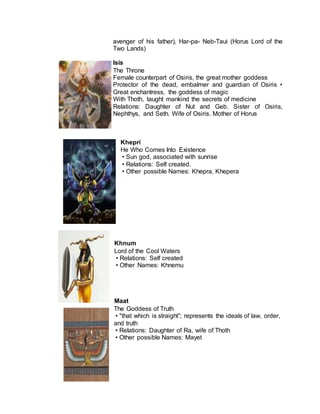
avenger of his father), Har-pa- Neb-Taui (Horus Lord of the
Two Lands)
Isis
The Throne
Female counterpart of Osiris, the great mother goddess
Protector of the dead, embalmer and guardian of Osiris •
Great enchantress, the goddess of magic
With Thoth, taught mankind the secrets of medicine
Relations: Daughter of Nut and Geb. Sister of Osiris,
Nephthys, and Seth. Wife of Osiris. Mother of Horus
Khepri
He Who Comes Into Existence
• Sun god, associated with sunrise
• Relations: Self created.
• Other possible Names: Khepra, Khepera
Khnum
Lord of the Cool Waters
• Relations: Self created
• Other Names: Khnemu
Maat
The Goddess of Truth
• "that which is straight”; represents the ideals of law, order,
and truth
• Relations: Daughter of Ra, wife of Thoth
• Other possible Names: Mayet
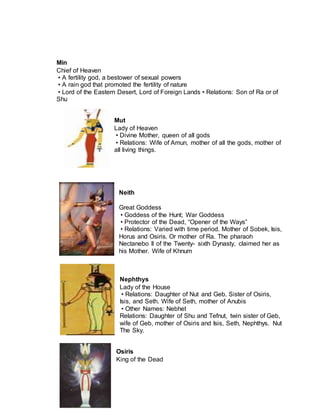
Min
Chief of Heaven
• A fertility god, a bestower of sexual powers
• A rain god that promoted the fertility of nature
• Lord of the Eastern Desert, Lord of Foreign Lands • Relations: Son of Ra or of
Shu
Mut
Lady of Heaven
• Divine Mother, queen of all gods
• Relations: Wife of Amun, mother of all the gods, mother of
all living things.
Neith
Great Goddess
• Goddess of the Hunt; War Goddess
• Protector of the Dead, “Opener of the Ways”
• Relations: Varied with time period. Mother of Sobek, Isis,
Horus and Osiris. Or mother of Ra. The pharaoh
Nectanebo II of the Twenty- sixth Dynasty, claimed her as
his Mother. Wife of Khnum
Nephthys
Lady of the House
• Relations: Daughter of Nut and Geb. Sister of Osiris,
Isis, and Seth. Wife of Seth, mother of Anubis
• Other Names: Nebhet
Relations: Daughter of Shu and Tefnut, twin sister of Geb,
wife of Geb, mother of Osiris and Isis, Seth, Nephthys. Nut
The Sky.
Osiris
King of the Dead
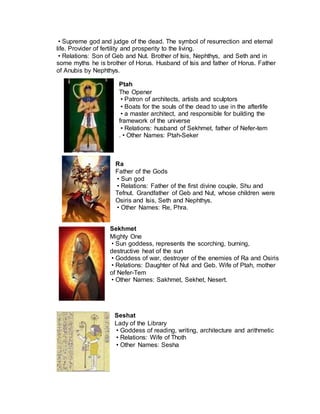
• Supreme god and judge of the dead. The symbol of resurrection and eternal
life. Provider of fertility and prosperity to the living.
• Relations: Son of Geb and Nut. Brother of Isis, Nephthys, and Seth and in
some myths he is brother of Horus. Husband of Isis and father of Horus. Father
of Anubis by Nephthys.
Ptah
The Opener
• Patron of architects, artists and sculptors
• Boats for the souls of the dead to use in the afterlife
• a master architect, and responsible for building the
framework of the universe
• Relations: husband of Sekhmet, father of Nefer-tem
. • Other Names: Ptah-Seker
Ra
Father of the Gods
• Sun god
• Relations: Father of the first divine couple, Shu and
Tefnut. Grandfather of Geb and Nut, whose children were
Osiris and Isis, Seth and Nephthys.
• Other Names: Re, Phra.
Sekhmet
Mighty One
• Sun goddess, represents the scorching, burning,
destructive heat of the sun
• Goddess of war, destroyer of the enemies of Ra and Osiris
• Relations: Daughter of Nut and Geb. Wife of Ptah, mother
of Nefer-Tem
• Other Names: Sakhmet, Sekhet, Nesert.
Seshat
Lady of the Library
• Goddess of reading, writing, architecture and arithmetic
• Relations: Wife of Thoth
• Other Names: Sesha
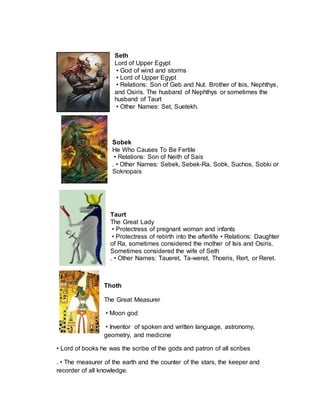
Seth
Lord of Upper Egypt
• God of wind and storms
• Lord of Upper Egypt
• Relations: Son of Geb and Nut. Brother of Isis, Nephthys,
and Osiris. The husband of Nephthys or sometimes the
husband of Taurt
• Other Names: Set, Suetekh.
Sobek
He Who Causes To Be Fertile
• Relations: Son of Neith of Sais
. • Other Names: Sebek, Sebek-Ra, Sobk, Suchos, Sobki or
Soknopais
Taurt
The Great Lady
• Protectress of pregnant woman and infants
• Protectress of rebirth into the afterlife • Relations: Daughter
of Ra, sometimes considered the mother of Isis and Osiris.
Sometimes considered the wife of Seth
. • Other Names: Taueret, Ta-weret, Thoeris, Rert, or Reret.
Thoth
The Great Measurer
• Moon god
• Inventor of spoken and written language, astronomy,
geometry, and medicine
• Lord of books he was the scribe of the gods and patron of all scribes
. • The measurer of the earth and the counter of the stars, the keeper and
recorder of all knowledge.
• written important religious texts such as The Book of the Dead • Relations: Self
conceived at the beginning of time. Husband of Maat. Brother and some times
husband of Seshat.
• Other Names: Tehuti.
IV-References:
Ezr acelar http://www.slideshare.net/ezr001/egyptian-myth-and-folklore-
52460654?qid=509b66fd-0238-4fcd-a671-
5f9c59191fc8&v=default&b=&from_search=11
History Channel. Egyptian pyramids. Retrieved from
http://www.history.com/topics/the-egyptian-pyramids/videos
Gill, N. S. Retrieved from
http://ancienthistory.about.com/cs/egypt/p/rosettastone.htm
N.S., G. Retrieved from
http://ancienthistory.about.com/od/egyptmyth/tp/071507egyptiandeities.htm
Kidder, B. Retrieved from
http://www.ancientegypt.co.uk/temples/home.html
Schiff (n.d.). Retrieved from http://www.ancient.eu.com/article/236/

Instructional plan in english 22

  • 1.
    I-Instructional Objectives: At theend of the discussion students will be able to: 1. Discuss Egyptian mythology, 2. Identify the Ancient Egyptian gods and goddesses and their roles in Egyptian myth, 3. Explain an example of Egyptian creation myth using symbolisms and archetypes, 4. Appreciate the values and knowledge learned. II- Materials: Hand-Outs, Laptop Computer, Visual Aids, PPT, Projector, Video Clips, Marker and White Board. III-Review: The teacher will ask for the previous lesson to check retention and understanding. IV-Lesson Proper: Lesson 1 Introduction to Egyptian Mythology Unification around 3100 B.C. to its conquest by Alexander the Great in 332 B.C.—ancient Egypt was the preeminent civilization in the Mediterranean world. From the great pyramids of the Old Kingdom through the military conquests of the New Kingdom, Egypt's majesty has long entranced archaeologists and historians and created a vibrant field of study all its own: Egyptology. The main sources of information about ancient Egypt are the many monuments, objects and artifacts that have been recovered from archaeological sites, covered with hieroglyphs that have only recently been deciphered. The picture that emerges is of a culture with few equals in the beauty of its art, the accomplishment of its architecture or the richness of its religious traditions. Egyptian Mythology: Background Ancient Egypt's gods and goddesses looked at least partly like humans and behaved a bit like us, too. Some deities had animal features, like heads, on top of humanoid bodies. Since they were gods, people were supposed to worship them. There wasn't one right way to do this throughout all of Egyptian history and
  • 2.
    in all places.Different cities and different pharaohs favored one set of gods over another A Short Glimpse to Egyptian Mythology: Gods and Goddesses Anubis. The god of funerals. He is depicted as half man, half jackal. Bastet. The goddess of protection. She was seen as half human, half cat. Horus was the son of Isis and Osiris. The protector of pharaohs. Viewed as half falcon, half human. Isis. Osiris’s wife and sister. She was the goddess of life. Shown as a beautiful woman Nut. The goddess of the sky. She is depicted as blue with stars covering her body and the sky on her back. Osiris. The god of death. Osiris is depicted a s a pharaoh. He is brother of Set and Isis (also her husband). He is the son of Nut and the father of Horus. Re/Ra. The god of the sun. He was the ruler of everything. Set. Brother of Osiris, he is the god of chaos, evil, and storms. He is depicted as composite animals. Egyptian Mythology: Worship The ancient Egyptians believed that temples were the homes of the gods and goddesses. Every temple was dedicated to a god or goddess and he or she was worshipped there by the temple priests and the pharaoh. The large temple buildings were made of stone so that they would last “forever”. Their walls were covered with scenes that were carved onto the stone then brightly painted. These scenes showed the pharaoh fighting in battles and performing rituals with the gods and goddesses. Egyptian Mythology: Mysteries The Sphinx Buried for most of its life in the desert sand, an air of mystery has always surrounded the Great Sphinx, causing speculation about its age and purpose, method of construction, concealed chambers, role in prophesy, and relationship to the equally mysterious pyramids.
  • 3.
    The monument isthe largest surviving sculpture from the ancient world, measuring 73.5m in length and in parts 20m in height. Part of the uraeus (sacred cobra which protected from evil forces), the nose and the ritual beard are missing; the beard is now displayed in the British Museum. The extensions at the side of the head are part of the royal head cloth. Although the head of the Sphinx has been badly affected by thousands of years of erosion, traces of the original paint can still be seen near one ear. It is thought that originally the Sphinx’s face was painted dark red. A small temple between its paws contained dozens of inscribed steal placed by the Pharaohs in honor of the Sun god. The Rosetta Stone The Rosetta Stone, which is housed in the British Museum, is a black, possibly basalt slab with three languages on it (Greek, demotic and hieroglyphs) each saying the same thing. Because the words are translated into the other languages, it provided Jean-Francois Champollion the key to the mystery of Egyptian hieroglyphs. Discovered at Rosette in 1799, by Napoleon's army, the Rosetta Stone proved the key to deciphering Egyptian hieroglyphs. The person who found it was Pierre Francois-Xavier Bouchards, a French officer of engineers. It was sent to the Institut d'Egypte in Cairo and then taken to London in 1802. Reported by: Mr. Angelito T. Pera
  • 4.
    Lesson 2 EgyptianCreation Story Discussion .In the beginning there was only the swirling watery chaos, called Nu. Out of these chaotic waters rose Atum, the sun god of the city of Heliopolis. It is believed that he created himself, using his thoughts and will. In the watery chaos, Atum found no place on which to stand. In the place where he first appeared, he created a hill. This hill was said to be the spot on which the temple of Heliopolis was built. Other interpretations find that Atum was the hill. In this interpretation Atum may represent the fertile, life giving hills left behind by the receding waters of the Nile's annual flood. As early as the Fifth-Dynasty, we find Atum identified with the sun god Ra. By this time his emergence on the primeval hill can be interpreted as the coming of light into the darkness of Nu. As the god of the rising sun, his name is Khepri. . . . . .His next act was to create more gods. Because he was all alone in the world, without a mate, he made a union with his shadow. This unusual way of procreating offspring was not considered strange to the Egyptians. We find Atum regarded as a bisexual god and was sometimes called the 'Great He-She'. The Egyptians were thus able to present Atum as the one and only creative force in the universe. . . . . .According to some texts the birth of Atum's children took place on the primeval hill. In other texts, Atum stayed in the waters of Nu to create his son and daughter. He gave birth to his son by spitting him out. His daughter he vomited. Shu represented the air and Tefnut was a goddess of moisture. Shu and Tefnut continued the act of creation by establishing a social order. To this order Shu contributed the 'principles of Life' while Tefnut contributed the 'principles of order'. . . . . .After some time Shu and Tefnut became separated from their father and lost in the watery chaos of Nu. Atum, who had only one eye, which was removable. This was called the Udjat eye. Atum removed the eye and sent it in search of his children. In time they returned with the eye. At this reunion Atum
  • 5.
    wept tears joy,where these tears hit the ground, men grew. Now Atum was ready to create the world. So Shu and Tefnut became the parents of Geb, the earth and Nut, the sky. Geb and Nut gave birth toOsiris and Isis, Seth, Nephthys. Themes: Creation of man, death and the afterlife as opposed to creation are the themes emphasized. As evidenced by the extensive time and effort spent to make tombs and in burial. In fact, Egyptian funerary customs were as elaborate and extensive as any known civilizations, and much of what we know about their culture has been deciphered from these remnants. Symbols:  Water/river: beginning and chaos (nun)  Hill: fertility (atum)  Sun: beginning, youthful, great, strong (Re)  Egg: life, light Metaphorical Language:  The existence represented the emergence of an empty space amid the waters. To explain how Atum did this, the myth uses the metaphor of masturbation, with the hand he used in this act representing the female principle inherent within him.[18] He is also said to have "sneezed" and"spat" to produce Shu and Tefnut, a metaphor that arose from puns on their names.[19] Next, Shu and Tefnut coupled to produce the earth god Geb and the sky goddess Nut, who defined the limits of the world. Issues: Gender Inequality Peace and order Values: Reported by: Mr. Clinton D. Sequihod Ms. Renalyn Escabusa
  • 6.
    Lesson 3 Topic: Lessergods and goddesses Of Egyptian Mythology Discussion Nu / Nun – chaos of burning, bubbling water; out of which everything began.the sun (Atum) created himself, by his own thoughts and will. He is known by many names: Khepri - the great scarab beetle (the rising sun) Ra-Harakhte - winged solar-disk (the youthful sun of the eastern horizon) Ra – midday sun Atum – setting sun in the west (old man) Horus - sun on the horizon Aten – the solar disk . A hill rose (Temple of Heliopolis) CREATION MYTH. Without a mate, he made a union with his shadow.He gave birth to his son by spitting him out. Shu represented the air. He vomited his daughter, Tefnut. Shu and Tefnut became separated from their father. Atum remved his Udjat eye (removable, only eye) to search for his children. Upon their return, Atum cried. His tears of joy became the first men. Shu and Tefnut became the parents of Geb, the earth and Nut, the sky. Geb and Nut gave birth to Osiris and Isis, Seth, Nephthys. Aker The Double Lion god Guardian of the sunrise and sunset Amun The Hidden One God of Air and Wind (early times) ; Fertility God Relations: Self created at the beginning of time. Believed to be the physical father of all Pharaohs. Other Names: Amon, Amen, Amen Ra, Amon Re
  • 7.
    Amut The Devourer She whowould devour the souls of those who's hearts proved heavier than Maat. • Other Names: Amam, Am-mit. Anubis Guardian of the Underworld Guardian of the Necropolis (cemetery) the guide of the dead; announcer of death Patron of magic and embalming; keeper of poisons and medicines Aten Lord of Heaven, Lord of Earth Bastet The Tearer Sun goddess; she represents the warm, life giving power of the sun Relations: Daughter and wife of Ra, mother of Khensu and Maahes • Other Names: Bast
  • 8.
    Geb Great Cackler Represents theEarth, vegetation-god Relations: Son of Shu and Tefnut, twin brother of Nut, husband of Nut, father of Osiris and Isis Other possible Names: Keb Hapi Father of the gods God of the Nile Relations: Husband of Nekhebet Other possible Names: Often confused with Horus' son, Hapy Hathor Lady of Heaven Plays the role of a sky-goddess, a sun-goddess, a moon- goddess, a goddess of the east, a goddess of the west, a goddess of moisture, a goddess of fertility, an agricultural goddess, and a goddess of the underworld Relations: Daughter of Nut and Ra. Wife of Ra, mother of Ihy. Many legends portray her as the mother of Horus the Elder. Other as the wife of Horus of Edfu, The fruit of this union was Horus the Younger. Horus He Who Is Above Hor (face); Mekhenti-irry ('He who has on his brow Two Eyes’); Mekhenti-en-irty, (He who on his brow has no eyes’) Haroeris (Horus the Elder), Horus Behudety, Ra- Harakhte (Horus of the two horizons), Harsiesis (Horus son of Isis), Harpokrates (The infant Horus), Harendotes (Horus the
  • 9.
    avenger of hisfather), Har-pa- Neb-Taui (Horus Lord of the Two Lands) Isis The Throne Female counterpart of Osiris, the great mother goddess Protector of the dead, embalmer and guardian of Osiris • Great enchantress, the goddess of magic With Thoth, taught mankind the secrets of medicine Relations: Daughter of Nut and Geb. Sister of Osiris, Nephthys, and Seth. Wife of Osiris. Mother of Horus Khepri He Who Comes Into Existence • Sun god, associated with sunrise • Relations: Self created. • Other possible Names: Khepra, Khepera Khnum Lord of the Cool Waters • Relations: Self created • Other Names: Khnemu Maat The Goddess of Truth • "that which is straight”; represents the ideals of law, order, and truth • Relations: Daughter of Ra, wife of Thoth • Other possible Names: Mayet
  • 10.
    Min Chief of Heaven •A fertility god, a bestower of sexual powers • A rain god that promoted the fertility of nature • Lord of the Eastern Desert, Lord of Foreign Lands • Relations: Son of Ra or of Shu Mut Lady of Heaven • Divine Mother, queen of all gods • Relations: Wife of Amun, mother of all the gods, mother of all living things. Neith Great Goddess • Goddess of the Hunt; War Goddess • Protector of the Dead, “Opener of the Ways” • Relations: Varied with time period. Mother of Sobek, Isis, Horus and Osiris. Or mother of Ra. The pharaoh Nectanebo II of the Twenty- sixth Dynasty, claimed her as his Mother. Wife of Khnum Nephthys Lady of the House • Relations: Daughter of Nut and Geb. Sister of Osiris, Isis, and Seth. Wife of Seth, mother of Anubis • Other Names: Nebhet Relations: Daughter of Shu and Tefnut, twin sister of Geb, wife of Geb, mother of Osiris and Isis, Seth, Nephthys. Nut The Sky. Osiris King of the Dead
  • 11.
    • Supreme godand judge of the dead. The symbol of resurrection and eternal life. Provider of fertility and prosperity to the living. • Relations: Son of Geb and Nut. Brother of Isis, Nephthys, and Seth and in some myths he is brother of Horus. Husband of Isis and father of Horus. Father of Anubis by Nephthys. Ptah The Opener • Patron of architects, artists and sculptors • Boats for the souls of the dead to use in the afterlife • a master architect, and responsible for building the framework of the universe • Relations: husband of Sekhmet, father of Nefer-tem . • Other Names: Ptah-Seker Ra Father of the Gods • Sun god • Relations: Father of the first divine couple, Shu and Tefnut. Grandfather of Geb and Nut, whose children were Osiris and Isis, Seth and Nephthys. • Other Names: Re, Phra. Sekhmet Mighty One • Sun goddess, represents the scorching, burning, destructive heat of the sun • Goddess of war, destroyer of the enemies of Ra and Osiris • Relations: Daughter of Nut and Geb. Wife of Ptah, mother of Nefer-Tem • Other Names: Sakhmet, Sekhet, Nesert. Seshat Lady of the Library • Goddess of reading, writing, architecture and arithmetic • Relations: Wife of Thoth • Other Names: Sesha
  • 12.
    Seth Lord of UpperEgypt • God of wind and storms • Lord of Upper Egypt • Relations: Son of Geb and Nut. Brother of Isis, Nephthys, and Osiris. The husband of Nephthys or sometimes the husband of Taurt • Other Names: Set, Suetekh. Sobek He Who Causes To Be Fertile • Relations: Son of Neith of Sais . • Other Names: Sebek, Sebek-Ra, Sobk, Suchos, Sobki or Soknopais Taurt The Great Lady • Protectress of pregnant woman and infants • Protectress of rebirth into the afterlife • Relations: Daughter of Ra, sometimes considered the mother of Isis and Osiris. Sometimes considered the wife of Seth . • Other Names: Taueret, Ta-weret, Thoeris, Rert, or Reret. Thoth The Great Measurer • Moon god • Inventor of spoken and written language, astronomy, geometry, and medicine • Lord of books he was the scribe of the gods and patron of all scribes . • The measurer of the earth and the counter of the stars, the keeper and recorder of all knowledge.
  • 13.
    • written importantreligious texts such as The Book of the Dead • Relations: Self conceived at the beginning of time. Husband of Maat. Brother and some times husband of Seshat. • Other Names: Tehuti. IV-References: Ezr acelar http://www.slideshare.net/ezr001/egyptian-myth-and-folklore- 52460654?qid=509b66fd-0238-4fcd-a671- 5f9c59191fc8&v=default&b=&from_search=11 History Channel. Egyptian pyramids. Retrieved from http://www.history.com/topics/the-egyptian-pyramids/videos Gill, N. S. Retrieved from http://ancienthistory.about.com/cs/egypt/p/rosettastone.htm N.S., G. Retrieved from http://ancienthistory.about.com/od/egyptmyth/tp/071507egyptiandeities.htm Kidder, B. Retrieved from http://www.ancientegypt.co.uk/temples/home.html Schiff (n.d.). Retrieved from http://www.ancient.eu.com/article/236/