Egypt and Sumer Presentation by Mindy McAdams MMC 2265 / Week 3.2
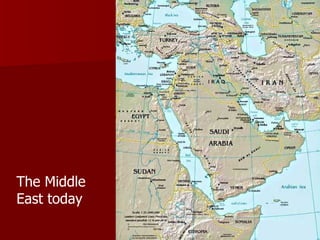
The Middle East today
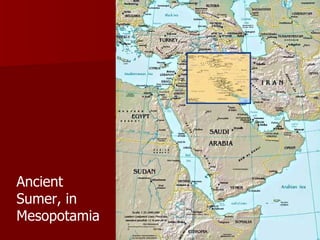
Ancient Sumer, in Mesopotamia
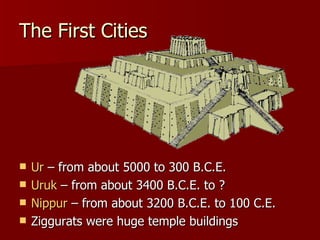
The First Cities Ur  – from about 5000 to 300 B.C.E. Uruk  – from about 3400 B.C.E. to ? Nippur  – from about 3200 B.C.E. to 100 C.E. Ziggurats were huge temple buildings
Sumer / Mesopotamia
Stylus and Tablet Written signs were pressed into soft clay tablets  Writing device: A stylus with a wedge-shaped tip  Content: Records related to accounting, agriculture, trade and taxes
Early Cuneiform Writing
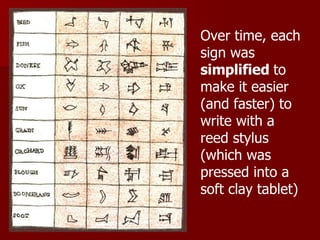
Over time, each sign was  simplified  to make it easier (and faster) to write with a reed stylus (which was pressed into a soft clay tablet)
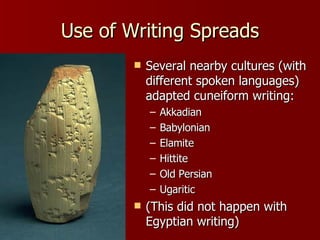
Use of Writing Spreads Several nearby cultures (with different spoken languages) adapted cuneiform writing: Akkadian  Babylonian Elamite Hittite  Old Persian Ugaritic  (This did not happen with Egyptian writing)
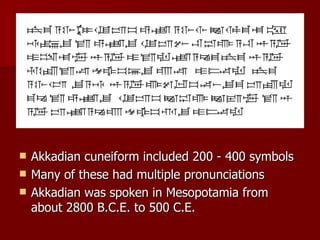
Akkadian cuneiform included 200 - 400 symbols Many of these had multiple pronunciations Akkadian was spoken in Mesopotamia from about 2800 B.C.E. to 500 C.E.
Spoken vs. Written Sumerian  is the  oldest  known  written  human language No modern languages have descended from Sumerian Cuneiform  writing system was later used to write  other  languages Did  Egyptian  writing evolve from cuneiform? Does  Chinese  writing owe anything to cuneiform?
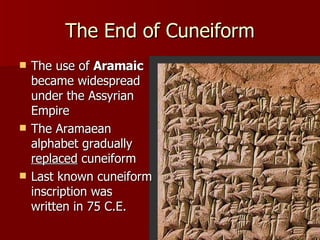
The End of Cuneiform The use of  Aramaic  became widespread under the Assyrian Empire  The Aramaean alphabet gradually  replaced  cuneiform Last known cuneiform inscription was written in 75 C.E.
Ancient Egypt   Cairo is 800 miles from Baghdad (Miami is 860 miles from New Orleans)
Abbreviated Egyptian Timeline Pre-Dynastic Period:  c. 5000–3100 B.C.E. Old Kingdom:  2686–2181 B.C.E.  (Dynasties III–VI, or 3 rd –6 th ) 3 rd  Dynasty: The  first major stone building  in the world, the Step Pyramid, was constructed 4 th  Dynasty: Many large  pyramids  built, including the Great Pyramid at Giza New Kingdom:  1570–1070 B.C.E.  (Dynasties XVIII–XX, or 18 th –20 th  ) Upper and Lower Egypt  reunified
The Decline of Egypt Power of the pharaohs had  declined  by the 20 th  Dynasty (about 1200–1070 B.C.E.) Battles with invaders called the Sea Peoples  weakened  the kingdom Ramesses III (died 1151 B.C.E.) was  the last significant pharaoh  of the New Kingdom Egypt would  never again  dominate the region with such wealth and power
End of Ancient Egypt’s Glory Peace ended in Egypt with the  Persian  invasion of 525 B.C.E. Egypt repeatedly struggled with  invasions  from Persia – for almost two centuries The last Persian invasion was in 343 B.C.E. – during the reign of  the last Egyptian pharaoh Alexander the Great  arrived in 332 B.C.E. Egypt would not be  ruled  by an Egyptian again until  1952
Writing on Stone (1)
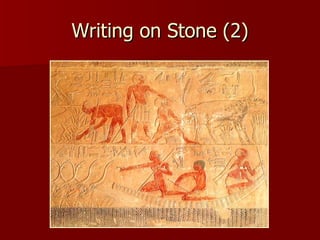
Writing on Stone (2)
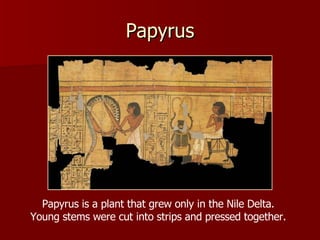
Writing on Papyrus Book of the Dead, c. 1300 B.C.E. (Papyrus of Ani: Scroll, 78 feet long)
Papyrus Papyrus is a plant that grew only in the Nile Delta. Young stems were cut into strips and pressed together.
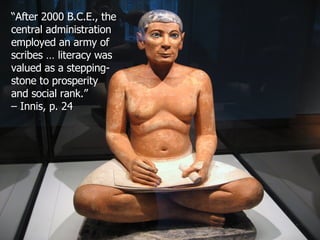
“ After 2000 B.C.E., the central administration employed an army of scribes … literacy was valued as a stepping-stone to prosperity  and social rank.”  –  Innis, p. 24
The Egyptian god Thoth was a scribe and, in some accounts, the inventor of writing.
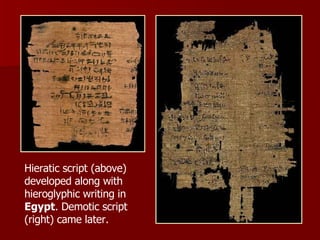
Hieratic script (above) developed along with  hieroglyphic writing in  Egypt . Demotic script (right) came later.
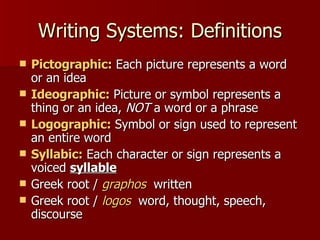
Writing Systems: Definitions Pictographic:  Each picture represents a word or an idea Ideographic:  Picture or symbol represents a thing or an idea,  NOT  a word or a phrase  Logographic:  Symbol or sign used to represent an entire word   Syllabic:  Each character or sign represents a voiced  syllable   Greek root /  graphos   written  Greek root /  logos   word, thought, speech, discourse
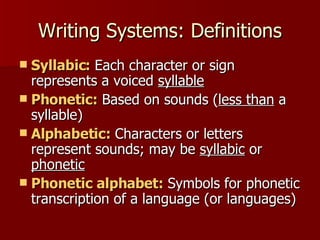
Writing Systems: Definitions Syllabic:  Each character or sign represents a voiced  syllable   Phonetic:  Based on sounds ( less than  a syllable)  Alphabetic:  Characters or letters represent sounds; may be  syllabic  or  phonetic Phonetic alphabet:  Symbols for phonetic transcription of a language (or languages) 
Bias of Communication Innis says that  each  medium  embodies  a bias  in terms of the  organization  and  control  of information  Duration (survival, perpetuation) over  time Extension (conquest) in  space
Time = Stone Time-biased media (stone, clay) are  durable  and  heavy Difficult to move; do not encourage territorial expansion Do encourage extension of empire  over time  (durability) Facilitate the development of  social hierarchies  (ancient Egypt) Religious dynasties, eternal life, king as deity (conquest of  time )
Space = Papyrus   Space-biased media are  light  and  portable Can be transported over large distances Associated with  secular  and  territorial  societies Facilitate the expansion of empire  over space Paper is an example: readily transported, but also has a short lifespan Military expansion; de-emphasis on religion (conquest of  space )
The longevity of an empire  depends on its ability  to extend itself  over both time and space.
Power Structures How is significant information  stored  in a society? How is it  transmitted ? Who  has access? Who  has the ability to read and write? Does a new  medium   disrupt  the power structure?
Egypt and Sumer Presentation by Mindy McAdams University of Florida

Egypt and Sumer

  • 1.
    Egypt and SumerPresentation by Mindy McAdams MMC 2265 / Week 3.2
  • 2.
  • 3.
    Ancient Sumer, inMesopotamia
  • 4.
    The First CitiesUr – from about 5000 to 300 B.C.E. Uruk – from about 3400 B.C.E. to ? Nippur – from about 3200 B.C.E. to 100 C.E. Ziggurats were huge temple buildings
  • 5.
  • 6.
    Stylus and TabletWritten signs were pressed into soft clay tablets Writing device: A stylus with a wedge-shaped tip Content: Records related to accounting, agriculture, trade and taxes
  • 7.
  • 8.
    Over time, eachsign was simplified to make it easier (and faster) to write with a reed stylus (which was pressed into a soft clay tablet)
  • 9.
    Use of WritingSpreads Several nearby cultures (with different spoken languages) adapted cuneiform writing: Akkadian Babylonian Elamite Hittite Old Persian Ugaritic (This did not happen with Egyptian writing)
  • 10.
    Akkadian cuneiform included200 - 400 symbols Many of these had multiple pronunciations Akkadian was spoken in Mesopotamia from about 2800 B.C.E. to 500 C.E.
  • 11.
    Spoken vs. WrittenSumerian is the oldest known written human language No modern languages have descended from Sumerian Cuneiform writing system was later used to write other languages Did Egyptian writing evolve from cuneiform? Does Chinese writing owe anything to cuneiform?
  • 12.
    The End ofCuneiform The use of Aramaic became widespread under the Assyrian Empire The Aramaean alphabet gradually replaced cuneiform Last known cuneiform inscription was written in 75 C.E.
  • 13.
    Ancient Egypt Cairo is 800 miles from Baghdad (Miami is 860 miles from New Orleans)
  • 14.
    Abbreviated Egyptian TimelinePre-Dynastic Period: c. 5000–3100 B.C.E. Old Kingdom: 2686–2181 B.C.E. (Dynasties III–VI, or 3 rd –6 th ) 3 rd Dynasty: The first major stone building in the world, the Step Pyramid, was constructed 4 th Dynasty: Many large pyramids built, including the Great Pyramid at Giza New Kingdom: 1570–1070 B.C.E. (Dynasties XVIII–XX, or 18 th –20 th ) Upper and Lower Egypt reunified
  • 15.
    The Decline ofEgypt Power of the pharaohs had declined by the 20 th Dynasty (about 1200–1070 B.C.E.) Battles with invaders called the Sea Peoples weakened the kingdom Ramesses III (died 1151 B.C.E.) was the last significant pharaoh of the New Kingdom Egypt would never again dominate the region with such wealth and power
  • 16.
    End of AncientEgypt’s Glory Peace ended in Egypt with the Persian invasion of 525 B.C.E. Egypt repeatedly struggled with invasions from Persia – for almost two centuries The last Persian invasion was in 343 B.C.E. – during the reign of the last Egyptian pharaoh Alexander the Great arrived in 332 B.C.E. Egypt would not be ruled by an Egyptian again until 1952
  • 17.
  • 18.
  • 19.
    Writing on PapyrusBook of the Dead, c. 1300 B.C.E. (Papyrus of Ani: Scroll, 78 feet long)
  • 20.
    Papyrus Papyrus isa plant that grew only in the Nile Delta. Young stems were cut into strips and pressed together.
  • 21.
    “ After 2000B.C.E., the central administration employed an army of scribes … literacy was valued as a stepping-stone to prosperity and social rank.” – Innis, p. 24
  • 22.
    The Egyptian godThoth was a scribe and, in some accounts, the inventor of writing.
  • 23.
    Hieratic script (above)developed along with hieroglyphic writing in Egypt . Demotic script (right) came later.
  • 24.
    Writing Systems: DefinitionsPictographic: Each picture represents a word or an idea Ideographic: Picture or symbol represents a thing or an idea, NOT a word or a phrase  Logographic: Symbol or sign used to represent an entire word   Syllabic: Each character or sign represents a voiced syllable   Greek root / graphos written Greek root / logos word, thought, speech, discourse
  • 25.
    Writing Systems: DefinitionsSyllabic: Each character or sign represents a voiced syllable   Phonetic: Based on sounds ( less than a syllable) Alphabetic: Characters or letters represent sounds; may be syllabic or phonetic Phonetic alphabet: Symbols for phonetic transcription of a language (or languages) 
  • 26.
    Bias of CommunicationInnis says that each medium embodies a bias in terms of the organization and control of information Duration (survival, perpetuation) over time Extension (conquest) in space
  • 27.
    Time = StoneTime-biased media (stone, clay) are durable and heavy Difficult to move; do not encourage territorial expansion Do encourage extension of empire over time (durability) Facilitate the development of social hierarchies (ancient Egypt) Religious dynasties, eternal life, king as deity (conquest of time )
  • 28.
    Space = Papyrus Space-biased media are light and portable Can be transported over large distances Associated with secular and territorial societies Facilitate the expansion of empire over space Paper is an example: readily transported, but also has a short lifespan Military expansion; de-emphasis on religion (conquest of space )
  • 29.
    The longevity ofan empire depends on its ability to extend itself over both time and space.
  • 30.
    Power Structures Howis significant information stored in a society? How is it transmitted ? Who has access? Who has the ability to read and write? Does a new medium disrupt the power structure?
  • 31.
    Egypt and SumerPresentation by Mindy McAdams University of Florida