Crowdsourcing
(and maps)
Mindy McAdams
Professor, Journalism
University of Florida
Gainesville, Florida USA
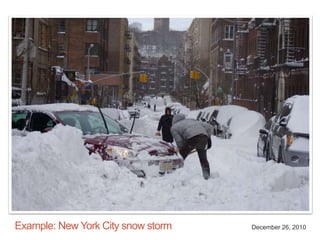
Example: New York City snow storm December 26, 2010
WNYC Radio:
Google Map
December 29, 2010 (3 days after storm):
White = snow not cleared
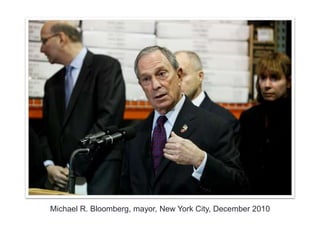
Michael R. Bloomberg, mayor, New York City, December 2010
WNYC Radio:
Google Map
December 30, 2010 (4 days after storm):
Purple = snow cleared
WNYC Radio: Snow Crisis
• Over the radio, listeners were asked to text PLOW to
30644, the station’s mobile shortcode
• The location of each text was added to a Google Map
• The map was posted on the radio station’s website
• Each person who texted was asked to also leave an audio
report as voicemail
• The audio reports were played on the radio
“It really encourages
other people to send in
their story and contribute,
when they hear people
just like them.”
—Jim Colgan, former WNYC news producer
Lessons Learned
1. The audience can help journalists
2. Journalists need to think creatively so they
can use this resource well (resource: the
audience)
3. Social media can be very useful in crisis
reporting
New York City snow storm
Minnesota Public Radio
uses this map to show
where members of the
audience have reported
holes in the street
(“potholes”).
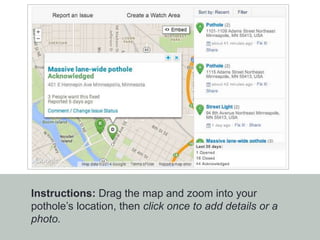
Instructions: Drag the map and zoom into your
pothole’s location, then click once to add details or a
photo.
Minnesota Public Radio (MPR) partnered with SeeClickFix to
produce the pothole map.
Note the number of issues (open, closed) at the top.
Lessons Learned
1. Sometimes you can find the technology
needed to produce a project (you don’t need
to create it)
2. A project started in 2010 continued being
used in 2014
3. Citizens used the map itself to report the
location of potholes (instead of sending
location in email, by SMS, etc.)
MPR potholes map
Example: Mumbai attacks November 2008
“The Mumbaiattacks haveunleasheda storm
of live updatesfromresidents, swellingtraffic
and contenton sites suchas Twitterand
Yahoo Inc.’s photoWeb siteFlickr.A
Google mapon the attack sites was swiftly
putup. A lengthy entry about the attackson
user-generatedonline encyclopedia
Wikipediasurfacedin less than an hour.”
—The Wall Street Journal, November 28, 2008
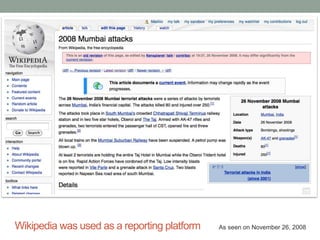
Wikipedia was used as a reporting platform Current page
Wikipedia was used as a reporting platform As seen on November 26, 2008
Updates were made every 2–3 minutes Wikipedia history: 2008 Mumbai attacks
Google map: Mumbai attacks 2008 Mumbai attacks
Google map: Mumbai attacks
“Al Jazeera English tracked the points
of the attack with the help of users
from Google and Twitter.”
Google map: Mumbai attacks
“Al Jazeera English tracked the points
of the attack with the help of users
from Google and Twitter.”
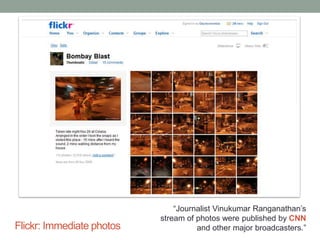
Flickr: Immediate photos
“Journalist Vinukumar Ranganathan’s
stream of photos were published by CNN
and other major broadcasters.”
Flickr: Immediate photos
“Journalist Vinukumar Ranganathan’s
stream of photos were published by CNN
and other major broadcasters.”
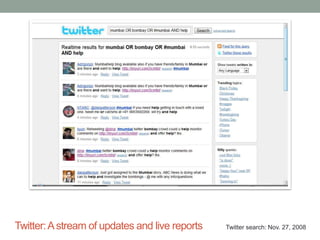
Twitter:Astream of updates and live reports Twitter search: Nov. 27, 2008
Lessons Learned
1. Using all kinds of Web sites (Wikipedia,
Twitter, Flickr), the audience can report on an
event without help from journalists
2. Journalists from Al Jazeera English used
Google Maps to aggregate citizen reports
from Twitter and other sites
3. Again, social media can assist journalists in
gathering information during a crisis
Mumbai attacks
Crowdsourcing
Crowdsourcing is the act of
taking a task traditionally performed by
a designated agent (usually an employee)
and outsourcing it
to an undefined, generally large group of people
in the form of an open call.
Definition
—Jeff Howe, author of Crowdsourcing: Why the Power of
the Crowd Is Driving the Future of Business (2008)
Example: Investigating MPs’ expenses 2008–2009
A crowd of
snoops
What:
All expense claims
Who:
646 Members of
Parliament (MPs)
Time span:
Five years
(2004–2008)
Total
documents:
2 million
Question:
How do the reporters
at one newspaper sort through
2 million electronic documents?
Answer:
They don’t.
The Guardian: “Investigate your MP’s expenses” 2009
Simon Willison, a
28-year-old
programmer who
works for the
newspaper,
worked hard to
make it easy for
people to join in
and evaluate the
documents quickly.
Result: 170,000
documents were
reviewed in the
first 80 hours after
the site went
online.
Making it fun
Result: For many famous MPs, all of their
documents were analyzed.
2009
Lessons Learned
1. People will contribute their time and their
intelligence without any reward if each task is
small and not difficult.
2. Journalists can ask the audience to help
even in a case where no crisis exists.
3. The journalists (and programmers) must do
some work to make the task seem interesting
and fun.
Investigating MPs’ expenses
Crowdsourcing
(and maps)
Mindy McAdams
mmcadams@jou.ufl.edu
@macloo

Crowdsourcing

  • 1.
    Crowdsourcing (and maps) Mindy McAdams Professor,Journalism University of Florida Gainesville, Florida USA
  • 2.
    Example: New YorkCity snow storm December 26, 2010
  • 3.
    WNYC Radio: Google Map December29, 2010 (3 days after storm): White = snow not cleared
  • 4.
    Michael R. Bloomberg,mayor, New York City, December 2010
  • 5.
    WNYC Radio: Google Map December30, 2010 (4 days after storm): Purple = snow cleared
  • 6.
    WNYC Radio: SnowCrisis • Over the radio, listeners were asked to text PLOW to 30644, the station’s mobile shortcode • The location of each text was added to a Google Map • The map was posted on the radio station’s website • Each person who texted was asked to also leave an audio report as voicemail • The audio reports were played on the radio
  • 7.
    “It really encourages otherpeople to send in their story and contribute, when they hear people just like them.” —Jim Colgan, former WNYC news producer
  • 8.
    Lessons Learned 1. Theaudience can help journalists 2. Journalists need to think creatively so they can use this resource well (resource: the audience) 3. Social media can be very useful in crisis reporting New York City snow storm
  • 9.
    Minnesota Public Radio usesthis map to show where members of the audience have reported holes in the street (“potholes”).
  • 10.
    Instructions: Drag themap and zoom into your pothole’s location, then click once to add details or a photo.
  • 11.
    Minnesota Public Radio(MPR) partnered with SeeClickFix to produce the pothole map.
  • 12.
    Note the numberof issues (open, closed) at the top.
  • 13.
    Lessons Learned 1. Sometimesyou can find the technology needed to produce a project (you don’t need to create it) 2. A project started in 2010 continued being used in 2014 3. Citizens used the map itself to report the location of potholes (instead of sending location in email, by SMS, etc.) MPR potholes map
  • 14.
  • 15.
    “The Mumbaiattacks haveunleashedastorm of live updatesfromresidents, swellingtraffic and contenton sites suchas Twitterand Yahoo Inc.’s photoWeb siteFlickr.A Google mapon the attack sites was swiftly putup. A lengthy entry about the attackson user-generatedonline encyclopedia Wikipediasurfacedin less than an hour.” —The Wall Street Journal, November 28, 2008
  • 16.
    Wikipedia was usedas a reporting platform Current page
  • 17.
    Wikipedia was usedas a reporting platform As seen on November 26, 2008
  • 18.
    Updates were madeevery 2–3 minutes Wikipedia history: 2008 Mumbai attacks
  • 19.
    Google map: Mumbaiattacks 2008 Mumbai attacks
  • 20.
    Google map: Mumbaiattacks “Al Jazeera English tracked the points of the attack with the help of users from Google and Twitter.”
  • 21.
    Google map: Mumbaiattacks “Al Jazeera English tracked the points of the attack with the help of users from Google and Twitter.”
  • 22.
    Flickr: Immediate photos “JournalistVinukumar Ranganathan’s stream of photos were published by CNN and other major broadcasters.”
  • 23.
    Flickr: Immediate photos “JournalistVinukumar Ranganathan’s stream of photos were published by CNN and other major broadcasters.”
  • 24.
    Twitter:Astream of updatesand live reports Twitter search: Nov. 27, 2008
  • 25.
    Lessons Learned 1. Usingall kinds of Web sites (Wikipedia, Twitter, Flickr), the audience can report on an event without help from journalists 2. Journalists from Al Jazeera English used Google Maps to aggregate citizen reports from Twitter and other sites 3. Again, social media can assist journalists in gathering information during a crisis Mumbai attacks
  • 26.
    Crowdsourcing Crowdsourcing is theact of taking a task traditionally performed by a designated agent (usually an employee) and outsourcing it to an undefined, generally large group of people in the form of an open call. Definition —Jeff Howe, author of Crowdsourcing: Why the Power of the Crowd Is Driving the Future of Business (2008)
  • 27.
    Example: Investigating MPs’expenses 2008–2009
  • 28.
    A crowd of snoops What: Allexpense claims Who: 646 Members of Parliament (MPs) Time span: Five years (2004–2008) Total documents: 2 million
  • 29.
    Question: How do thereporters at one newspaper sort through 2 million electronic documents?
  • 30.
  • 31.
    The Guardian: “Investigateyour MP’s expenses” 2009
  • 32.
    Simon Willison, a 28-year-old programmerwho works for the newspaper, worked hard to make it easy for people to join in and evaluate the documents quickly. Result: 170,000 documents were reviewed in the first 80 hours after the site went online. Making it fun
  • 33.
    Result: For manyfamous MPs, all of their documents were analyzed. 2009
  • 34.
    Lessons Learned 1. Peoplewill contribute their time and their intelligence without any reward if each task is small and not difficult. 2. Journalists can ask the audience to help even in a case where no crisis exists. 3. The journalists (and programmers) must do some work to make the task seem interesting and fun. Investigating MPs’ expenses
  • 35.

Editor's Notes

  • #2 Mindy McAdams CONTACT http://mindymcadams.com/
  • #3 A blizzard on Dec. 26, 2010, paralyzed the New York metropolitan area. The three major airports shut down, along with trains and even some of the subway lines. Emergency vehicles, such as ambulances and fire trucks, could not get through. WNYC Radio (2010). Winter Storm Photos. Retrieved from http://www.wnyc.org/crowdsourcing/winter-storm-photos/report/
  • #4 The mayor of New York City had announced that all streets had been plowed, but the map from the radio station showed that streets were still buried in snow (Mobile Commons, 2011). Local radio station WNYC invited listeners to report where streets had been left uncleared of snow, trapping cars and preventing buses and emergency vehicles from reaching residents. To submit a report, a person simply sent a text message from any mobile phone. Each report was added to a Google Map, which was published on the website of the radio station (WNYC Radio, 2010a). WNYC Radio (2010a). Mapping the Storm Clean-up. Retrieved from http://www.wnyc.org/articles/wnyc-news-2/2010/dec/30/mapping-storm-clean/
  • #5 Michael R. Bloomberg, mayor, New York City, December 2010 http://www.nytimes.com/2010/12/30/nyregion/30snow.html
  • #6 Because of the published map and the audio reports from the listeners, WNYC Radio was able to show that the local authorities had not done what they promised, and the voices of the people were heard. Plows were sent out, and the streets were cleared of snow. WNYC Radio (2010a). Mapping the Storm Clean-up. Retrieved from http://www.wnyc.org/articles/wnyc-news-2/2010/dec/30/mapping-storm-clean/
  • #8 Source: Mobile Commons (2011). How WNYC used mobile mapping to fact check Mayor Bloomberg. Retrieved from http://www.mobilecommons.com/blog/2011/01/how-wnyc-used-mobile-mapping-to-fact-check-mayor-bloomberg/
  • #10 SITE http://minnesota.publicradio.org/projects/ongoing/potholes/
  • #11 SITE http://minnesota.publicradio.org/projects/ongoing/potholes/
  • #12 Minnesota Public Radio (MPR) partnered with SeeClickFix to produce the pothole map. SITE http://www.seeclickfix.com/
  • #13 Minnesota Public Radio (MPR) partnered with SeeClickFix to produce the pothole map. SITE http://www.seeclickfix.com/
  • #15 In a series of coordinated terrorist attacks, 164 people died. More than 300 people were injured. Mumbai, India. November 2008.
  • #16 Source: http://online.wsj.com/article/SB122778233204561595.html (November 28, 2008)
  • #17 Source: http://en.wikipedia.org/wiki/2008_Mumbai_attacks
  • #20 http://maps.google.com/maps/ms?ie=UTF8&hl=en&msa=0&ll=18.922445,72.832242&spn=0.007054,0.007864&z=17&msid=105055855763538009401.00045c9d8b16af3ad1008
  • #21 http://maps.google.com/maps/ms?ie=UTF8&hl=en&msa=0&ll=18.922445,72.832242&spn=0.007054,0.007864&z=17&msid=105055855763538009401.00045c9d8b16af3ad1008
  • #22 http://maps.google.com/maps/ms?ie=UTF8&hl=en&msa=0&ll=18.922445,72.832242&spn=0.007054,0.007864&z=17&msid=105055855763538009401.00045c9d8b16af3ad1008
  • #23 Source: http://www.flickr.com/photos/gauravonomics/3061984669/
  • #24 Source: http://www.flickr.com/photos/vinu/3062182214/in/pool-965592@N23/
  • #25 Source: http://www.flickr.com/photos/gauravonomics/3061307395
  • #26 What about using the audience to help with something that is NOT a crisis?
  • #27 Source: http://www.crowdsourcing.com/ - The website of Jeff Howe, who wrote an article about crowdsourcing in 2006 ("The Rise of Crowdsourcing”) and a book (2008) titled Crowdsourcing: Why the Power of the Crowd Is Driving the Future of Business. Wired article: http://www.wired.com/wired/archive/14.06/crowds.html Of the 3 examples we have seen, the last one (MP expenses) is the one most clearly meeting this definition. But all 3 included participation from the public.
  • #28 In one of the greatest examples of crowdsourcing, The Guardian asked the public to help sort through millions of scanned files that showed expenses claimed for reimbursement by Members of Parliament.
  • #29 Source: http://www.guardian.co.uk/media/2009/may/18/mps-expenses-how-scoop-came-light Home page: http://mps-expenses.guardian.co.uk/ Other source: http://www.niemanlab.org/2009/06/four-crowdsourcing-lessons-from-the-guardians-spectacular-expenses-scandal-experiment/
  • #30 The journalists knew they could never sort through 2 million scanned files – basically these are IMAGE files that show text and numbers, and you need human beings to read them.
  • #31 They don’t. … They crowdsource the work.
  • #32 The data team put all the scanned files online. They asked the public to help them find the ones that seemed to warrant further investigation. That is, find the files that seem questionable or dishonest. Source: http://mps-expenses.guardian.co.uk/page/18679/
  • #33 Regular people reviewed 170,000 documents in the first 80 hours after the site went online. Make It EASY and make it FUN. Then people will help. All a person had to do was open a document, read it, and click one of these four buttons. Basically, the people were sorting the files and flagging the interesting ones. Source: http://www.niemanlab.org/2009/06/four-crowdsourcing-lessons-from-the-guardians-spectacular-expenses-scandal-experiment/
  • #34 People tended to pick out the most famous MPs – like the former Prime Minister, Tony Blair – and checked all of their documents. Source: http://mps-expenses.guardian.co.uk/labour/tony-blair/
  • #35 There’s been a lot of research about cases like this – many cases do not involve journalists. One key to success is that the tasks should seem a little bit like a game, or a detective story … people seem to like contributing to solving a mystery or finding something that is hard to find.
  • #36 Mindy McAdams CONTACT http://mindymcadams.com/