EGT and economics: I.  Optimality principles and models of behaviour dynamics Alexander A. Vasin
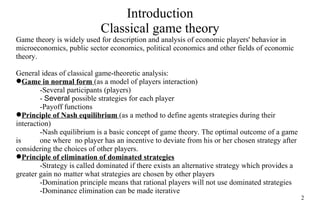
Introduction Classical game theory Game theory is widely used for description and analysis of economic players' behavior in microeconomics, public sector economics, political economics and other  fields  of economic theory. General ideas of classical game-theoretic analysis: Game in normal form  (as a model of players interaction) - Several  participants (players) -  Several   possible strategies for each player -Payoff function s Principle of Nash equilibrium  (as a method to define agents strategies during their interaction) -Nash equilibrium is  a basic  concept of game theory .   T he optimal outcome of a game is  one where  no player has an incentive to deviate from his or her chosen strategy after  considering  the  choice s of other players . Principle of elimination of dominated strategies -Strategy is called dominated if there exists  an  alternative strategy which provides a  greater gain no  matter what strategies are chosen by other players -Domination principle means that rational players will not use dominated strategies -Dominance elimination can be made iterative
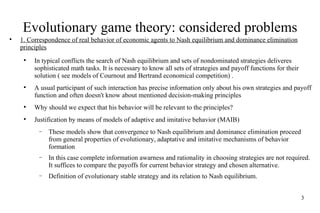
Evolution ary  game theory: considered problems 1.   Correspondence  of real behavior of economic agents  to  Nash equilibrium and domina nce  elimination principles In typical  conflicts the  search of Nash equilibrium and sets of nondominated strategies deliveres  sophisticated  math tasks. It is necessary to know all sets of strategies and payoff functions for their solution   (  see  models of Cournout and Bertrand economical competition) . A u sual participant of such interaction has precise information only about his own strategies and payoff function and often doesn't know about mentioned decision-making principles Why  should we  expect that his behavior will be relevant  to the principles ? Justification by means  of models of adaptive and imitative behavior (MAIB) These models show that convergence to Nash equilibrium and domina nce  elimination  proceed  from general  properties  of evolution ary , adaptative and imitative mechanisms of behavior formation In this case  complete  information awarness and rationality in choosing strategies are not required. It  suffices  to  compare the  payoff s  for  current  behavior strategy and chosen alternative. Definition of evolutionary stable strategy and its  relation to  Nash equilibrium .
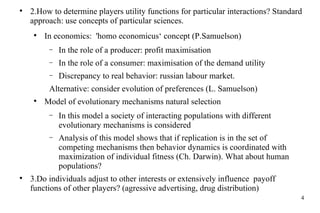
2. How to de termine  players utility functions for  particular  interaction s ?  Standard approach: use concepts of particular sciences. In economics :   'homo economicus‘   concept  (P.Samuelson) In the role of  a  produce r:  profit maximisation In the role of  a  consumer :  maximisation of  the  demand  utility Discrepancy to real behavior: russian labour market . Alternative: consider evolution of preferences (L. Samuelson) Model of evolution ary  mechanisms natural selection In this model  a society  of interacting populations with different  evolutionary  mechanisms is considered Analysis of this model shows that if replication is in  the  set of competing  mechanisms  then behavior dynamics is coordinated with  maximization of  individual  fitness (Ch. Darwin). What about human populations? 3. Do individuals  adjust to other interests  or extensively influence  payoff function s  of other  player s? (agressive advertising, drug distribution)
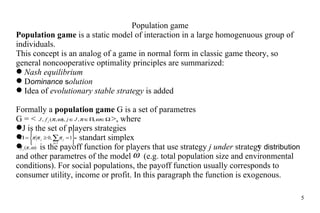
Population game Population game  is a static model of interaction in  a large  homogenuous group of individuals. This  concept  is an analog of a game in normal form in classic game theory, so general noncooperative optimality principles are summarized: Nash equilibrium D ominance   s olution Idea of  evolutionary stable strategy  is added Formally a  population game  G is  a set  of parametres G = <     >, where J  is the  set of players strategies    - standart simplex i s the payoff function for players that use strategy  j  under   strategy  distribution   and other parametres of the model  (e.g.  t otal population size and environmental conditions). For social populations, the payoff function usually corresponds to consumer utility, income or profit. In this paragraph  the  function is exogenous.
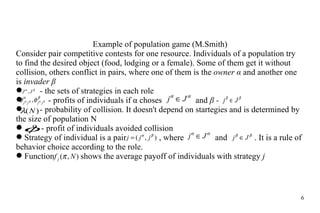
Example of population game (M.Smith) C onsider pair competitive  contes ts for one resource. Individuals of  a  population try to find the desired object (food, lodging or a female). Some of them get it without collision, others conflict in pairs, where one of them is the  owner   α  and another one is  invader   β -  the  set s  of strategies in each role   - profits of individuals if  α   choses     and  β  -  -  p robability of collision.  It  doesn't depend on startegies and  is  de termin ed by  the size  of population N - profit of individuals avoided collision Strategy of individual is a pair  , where    and  . It  is a rule of behavior choice according to the role . Function    shows the average  payoff  of individuals with strategy  j
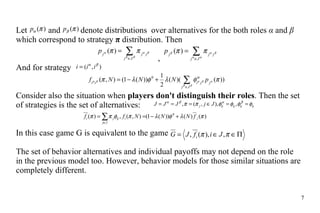
Let    and    denote distribution s   over alternatives for the both  roles  α  and  β  which correspond to strategy   π  distribution. Then ,  And for strategy   C onsider  also  the situation when  players don't  distinguish their roles . Then the set of strategies  is  the set of alternatives:  In this case game G is equivalent to the game   T he set of behavior  alternatives  and individual  payoffs may  not depend on  the  role  in  the  previous model too. However ,  behavior models for those similar situations are completely different.
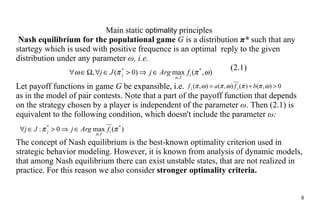
Main static  optimality   principles  Nash equilibrium for the populational game   G  is a distribution  π *  such that any startegy which is used with positive frequence is an optimal  reply to the  given distribution  under  any parameter   ω , i.e. (2.1) Let payoff functions in game  G  be expansible, i.e.  as in  the  model  of pair contests .  Note  that a part of  the  payoff function that depends on  the  strategy chosen by a player is independent of the parameter  ω . Then (2.1) is equivalent to the following condition, which doesn't include the parameter   ω : The concept of Nash equilibrium is the best-known optimality criterion used in strategic behavior modeling. However, it is known from analysis of dynamic models, that among Nash equilibrium there can exist unstable states, that  are not  realized in practice. For this reason we also  consider  strong er  optimality criteria.
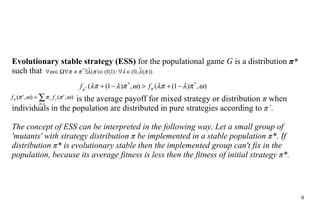
Evolutionary stable strategy (ESS)  for the populational game   G  is a distribution   π *   such that      is  the  average  payoff  for mixed strategy or distribution  π   when individuals in  the  population are distributed in pure strategies according to   π ’ . The concept of ESS can be interpreted in the following way. Let a small group of 'mutants' with strategy distribution π be implemented in a stable population   π * . If distribution  π *  is evolutionary stable then the implemented group can't fix in  the  population, because its average fitness is less then  the  fitness of initial strategy   π *.
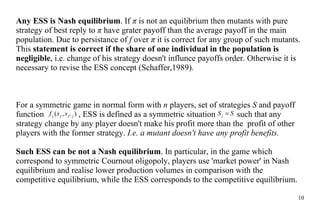
Any ES S  is Nash equilibri um . If  π  is not  an  equilibrium then mutants with pure strategy of best  reply to   π  have  grater payoff  than  the  average  payoff  in  the  main population. Due to persistance of  f  o ver   π  it is correct for any group of such mutants. This  statement is correct if the  share  of  one  individual in  the  population is negligible , i.e. change of his strategy doesn't influnce payoff s order .  Otherwise it is necessary to  revise  the  ESS concept  (Schaffer,1989). For  a  symmetric game in normal form with  n  players, set of strategies  S  and payoff function    , ESS is defined as a symmetric situation     such  that  any strategy change  by  any player do es n't make his profit  more  than  the  profit of other players with  the  former strategy.  I.e.  a  mutant doesn't have any profit benefits.  S uch  ESS can be not a Nash equilibrium . In particular, in the game which correspond to symmetric Cournout oligopoly, players use 'market power' in Nash equilibrium and  realise  lower  production volumes  in comparison with  the  competitive equilibrium, while  the  ESS corresponds to  the  competitive equilibrium.
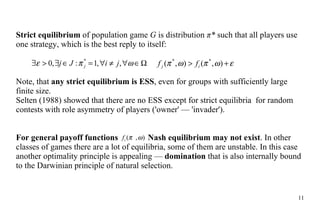
Strict equilibrium  of population game  G  is distribution  π *   such that  all players use one str a tegy, which is the best  reply to itself : Note, that  any strict equilibrium is ESS , even for groups with  sufficiently large finite size. Selten  (1988) showed that there are no ESS except  for  strict equilibri a   for  random contest s with role  a symmetry of players ('owner' — 'invader'). For general payoff functions    Nash equilibrium  may not exist . In other classes  of games  there are a lot of equilibri a , some of them are unstable. In this case another optimality principle is appealing —  domination  that is  also  internally bound to the Darwinian principle of natural selection.
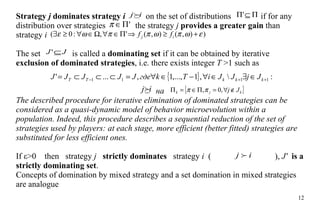
Strategy  j  dominates strategy  i     on the set of distributions    if for any distribution  over strategies    the strategy  j  provides a greater gain  than strategy  i  The set   is called a  dominating set  if it can be obtained by iterative  exclusion  of dominated strategies , i.e. there exists integer  T   >1  such as  на The described procedure for iterative elimination of dominated strategies can be considered as a quasi-dynamic model of behavior microevolution   within a population.  Indeed, this procedure describes a sequential reduction of the set of strategies used by players: at each stage, more efficient (better fitted) strategies are substituted for less efficient ones. If ε>0  then  strategy  j  strictly dominates  strategy  i   (   ),  J'  is a strictly dominating set . Concepts of domination by mixed strategy and a set domination in mixed strategies are analogue
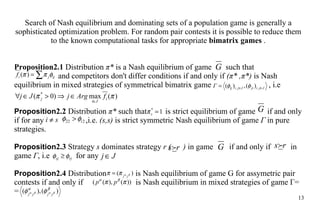
Search of Nash equilibrium and dominating sets of  a  population game is generally a  sophisticated optimization problem .  For random pair contests   i t is possible to  reduce  them to the known computational tasks  for  appropriate  bimatrix games  . Proposition 2.1  Distribution  π *  is a Nash equilibrium of game  such that    and competitors don't differ conditions if and only if  ( π *   , π *)   is  Nash equilibrium in mixed strategies of symmetrical bimatrix game    , i.e Proposition 2.2  Distribution  π *  such that   is strict equilibrium of game  if and only if for any     ,i.e.  (s,s)  is strict symmetric Nash equilibrium of game  Г  in  pure  strategies. Proposition 2.3  Str a tegy  s  dominates strategy  r  (  )  in game  if and only if  in game  Г , i.e    for any  Proposition 2.4  Distribution      is Nas h  equilibrium of game G for assymetric pair  contests  if and only if    is Nash equilibrium in mixed strategies of game Г =   =
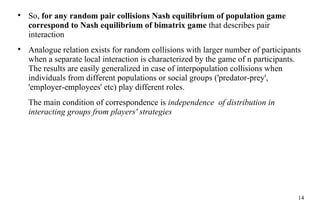
So,  for any random pair collisions Nash equilibrium of population game correspond to Na sh  equilibrium of bimatrix game  that describes pair interaction Analogue  rela tion exists for random collisions with  larger number  of participants when  a  separate local interaction is characterized  by  the game of n participants.  The  results are easily  general ized   in case of interpopulation collisions when individuals from  different  populations or social groups ('predator-prey', 'employer-employees' etc) play different roles . The main condition of correspondence is  independence  of distribution  in interacting groups from players' strategies
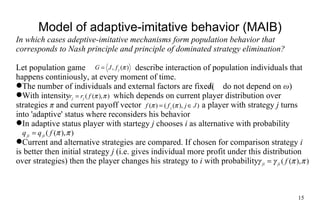
Model of adaptive- imit ative behavior (MA I B) In which cases adeptive- imit ative mechanisms form population behavior that corresponds to Nash principle and principle of  dominated  strategy elimination? Let population game  describe interaction of population individuals that happens continiously, at every moment of time. The number  of individuals and external factors are  fixed (   do not depend on  ω ) With intensity   which depends on current player distribution  over  st ra tegies   π  and current payoff vector    a player with strategy  j  turns into 'adaptive' status where  rec onsiders his behavior In adaptive status player with startegy  j  chooses  i  as alternative with probabilit y Current and alternative strategies are compared. If chosen for comparison strategy  i  is better then initial strategy  j  (i.e. gives individual more profit  under  this  distribution over strategies)  then the player changes his strategy to  i  with probability
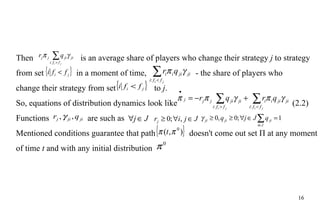
Then      is an average  share  of players who change their strategy  j  to strategy from set    in a moment of time,    -  the share  of players   who   change their strategy from set    to  j . So, equations of distribution dynamics look like    (2.2) Functions  are such as  Mentioned conditions guarantee that path    doesn't come out set П at any moment of time  t  and with any initial distribution
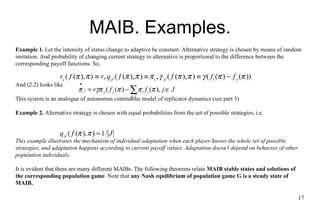
MA I B. Examples. Example 1.  Let the intensity of status change to adaptive be constant. Alternative strategy is chosen by  means  of random imitation. And probability of changing current strategy to alternative is  proportional to the difference between the  corresponding payoff functions. So,  And (2.2) looks like This system is an analogue of autonomus continuous model of replicator dynamics (see part 3) Example 2.  Alternative strategy is chosen with equal probabilities from  the  set of possible strategies, i.e.  This example illustrates the mechanism of individual adaptation when each player knows  the whole  set of possible strategies, and adaptation happens according to current payoff  values . Adaptation doesn't depend on behavior of other population individuals. It is evident that there are many different MA I Bs.  The f ollowing theorems  relate  MA I B stable  state s and solution s  of  the  corresponding population game . Note that  any Nash equilibrium of population game G is  a steady state  of MA I B.
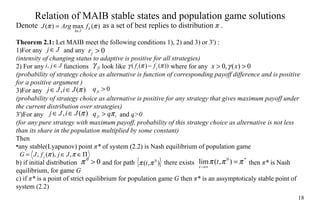
Relation of MA I B stable  states  and population game solutions Denote    as a set of  best replies to  distribution  π  . Theorem 2.1:  Let MA I B  meet the following  conditions 1), 2) and 3) or 3') : 1)For any  and any (intensity of changing status to adaptive is positive for all strategies) 2) For any  functions  look like    where for any (probability of strategy choice as alternative is function of corresponding payoff  difference  and  is  positive  for a  positive argument ) 3)For any  (probability of strategy choice as alternative is positive for any strategy that gives maximum payoff  under the  current distribution  over  strategies) 3')For any   and  q>0   (for any pure strategy with maximum payoff, probability of this strategy choice as alternative is not less than  its share  in  the  population   multiplied  by  some constant) Then  any stable(Lyapunov)  point   π *  of system (2.2) is Nash equilibrium of population game  b) if initial distribution    and for path    there exists    then  π *  is Nas h  equilibriu m ,  f or game  G c) if  π *  is a point of strict equilibrium for population game  G  then  π *  is an assymptoticaly stable  point  of system  (2.2)
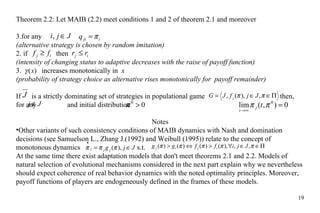
Theorem 2.2: Let MA I B (2.2)  meet  conditions 1 and 2 of theorem  2.1  and moreover for any     (alternative strategy is  chosen by  random imitation) 2. if    then  (intensity of changing status to adaptive  decreases  with the raise of pa y off function) 3.   increase s  monotonically  in   x   (probability of strategy choice as alternative rises monotonically for  payoff remainder) If  is  a  strictly dominating set of strategies in populational game      then ,  for any    and initial  distribution Notes Other variants of such consistency conditions of MA I B dynamics with Nash and domination decisions (see Samuelson L., Zhang J.(1992) and Weibull (1995))  relate to the  concept of monotonous dynamics    s.t.  At the same time there  exist  adaptation models that don't  meet  theorem s  2.1 and 2.2. Models of natural selection of evolutional mechanisms considered in the next part explain why  we nevertheless should expect  coherence of real behavior dynamics with  the  noted optimality principles. Moreover,  payoff  functions of players are endogeneously defined in the frames of these models.
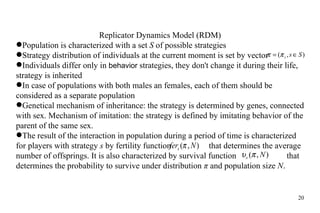
Replicator Dynamics Model (RDM) Population is characterized with a set  S  of possible strategies  Strategy distribution of individuals at the current moment is set by vector  Individuals differ only in  behavior   strateg ies , they don't change it during their life, strategy is inherited In case of populations with both males an females, each of them should be considered as  a  separate population Genetical mechanism of inheritance :   the  strategy is  determined  by genes, connected with  sex . Mechanism of imitation :   the  strategy is defined by imitating behavior of  the  parent of  the same  sex. The r esult of  the  interaction in population during a period of time is characterized for players with strategy  s   by  fertility function    that  determines   the average number of  offsprings. It is also characterized  by  survival function    that  determines the probability to  surviv e   under  distribution  π  and population  size   N .
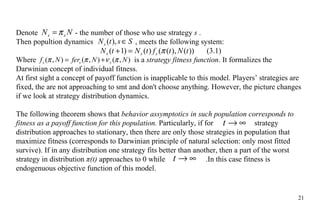
Denote    - the number  of those who use strategy  s  . Then popultion dynamics  , meets  the following system: (3.1) Where       is a  strategy fitness function . It formalizes the Darwinian concept of individual fitness. At first sight a concept of payoff function is inapplicable to this model. Players ’  strategies are fixed, the are not approaching to smt and don't choose anything. However,  the  picture changes  if we  look at strategy distribution dynamics. The following theorem shows that  behavior assymptotics in such population correspond s  to fitness as  a  payoff function  for this population .  Particularly, if for    strategy distribution approaches to stationary, then there are only those strategies in population that maximize fitness (corresponds to Darwinian principle of natural selection: only most fitted survive). If in any distribution one strategy fits better than another, then a part of  the  worst strategy in distribution  π (t)  approaches to 0 while    . In this case fitness is endogenuous objective function of this model.
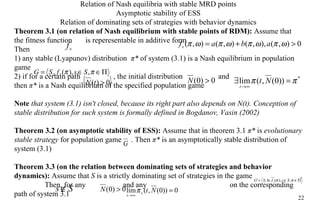
Relation of Nash equilibr ia   with  stable MRD points Asymptotic stability of ES S Relation of dominating sets of strateg ies  with behavior dynamics Theorem 3.1 (on relation of Nash equilibrium  with  stable points of RDM):  Assume that the fitness function  is reperesentable in additive form  Then  1) any stable (Lyapunov) distribution  π *   of system (3.1) is a Nash equilibrium in population game  2) if for a certain path    , the initial di s tribution    and      then  π *  is a Nash equilibrium of the specified population game Note   that system (3.1) isn't closed, because its right part also depends on N(t). Conception of stable distribution for such system is formally defined in Bogdanov, Vasin (2002) Theorem 3.2 (on asymptotic stability of ESS):  Assume that in theorem 3.1  π *  is   evolutionary stable strategy  for population game  . Then  π *  is an asymptotically stable distribution of system (3.1) Theorem 3.3 (on the relation between dominating sets of strategies and behavior  dynamics ):  Assume that  S  is a strictly dominating set of strategies in the game  .  Then, for any    and any    on the corresponding path of system 3.1
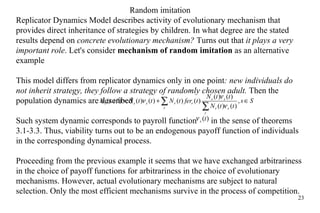
Random imitation Replicator Dynamics Model  describes  activity of evolution ary  mechanism that provides direct inheritance of strategies by children. In what degree are the  stated  results depend on  concrete evolution ary  mechanism ?  Turns out that  it plays a very important role . Let's consider  mechanism of random imitation  as  an  alternative example  This model differs from replicator dynamics only in one point : new individuals do not inherit strategy, they follow a strategy of randomly chosen adult.  Then the population dynamics are described  Such system dynamic corresponds to  payroll  function    in the sense of theorems 3.1-3.3. Thus, viability turns out to be an endogenous payoff function of individuals in the corresponding dynamical process. Proceeding from the previous example it seems that we have exchanged arbitrariness in the choice of payoff functions for arbitrariness in the choice of evolutionary mechanisms. However, actual evolutionary mechanisms are subject to natural selection. Only the most efficient mechanisms survive in the process of competition.
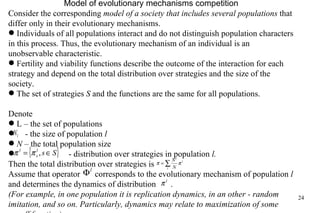
Model of evolutionary mechanism s  competition Consider the corresponding  model of a society that includes several populations  that differ only in their evolutionary mechanisms. Individuals of all populations interact and do not distinguish population characters in this process. Thus, the evolutionary mechanism of an individual is an unobservable characteristic. Fertility and viability functions describe the outcome of the interaction for each strategy and depend on the total distribution over strategies and the size of the society. The set of strategies  S  and the functions are the same for all populations. Denote L – the set of populations - the size of population  l N –  the total population size   - distribution over strategies in population  l. Then the total distribution over strategies is  Assume that operator  corresponds to the evolutionary mechanism of population  l  and determines the dynamics of distribution  . (For example, in one population it is replication dynamics, in an other - random imitation, and so on. Particularly, dynamics may relate to maximization of some payoff function)
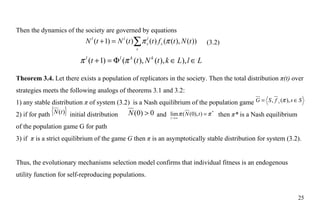
Then the dynamics of the society are governed by equations (3.2) Theorem 3.4.  Let there exists a population of replicators in the society. Then the total distribution  π(t)  over strategies meets the following analogs of theorems 3.1 and 3.2: 1) any stable distribution  π  of system (3.2)  is a Nash equilibrium of the population game  2) if for path  initial distribution    and    then  π *  is a Nash equilibrium of the population game G for path  3) if  π  is a strict equilibrium of the game  G  then  π  is an asymptotically stable distribution for system (3.2). Thus, the evolutionary mechanisms selection model confirms that individual fitness is an endogenous utility function for self-reproducing populations.
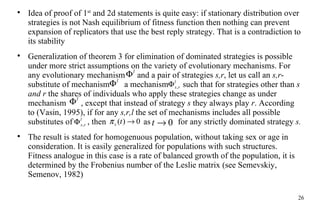
Idea of proof of 1 st  and 2d statements is quite easy: if stationary distribution over strategies is not Nash equilibrium of fitness function then nothing can prevent expansion of replicators that use  the best reply  strategy. That is a contradiction to its stability G eneralization of theorem 3 for elimination of dominated strategies is possible under more strict assumptions on the variety of evolutionary mechanisms. For any evolutionary mechanism    and a pair of strategies  s,r , let us call an  s,r -substitute of mechanism  a mechanism   such that for strategies other than  s and r  the shares of individuals who apply these strategies change as under mechanism  , except that instead of strategy  s  they always play  r . According to (Vasin, 1995), if for any  s,r,l  the set of mechanisms includes all possible substitutes of    , then    a s   for any strictly dominated strategy  s. The r esult is stated for homogenuous population, without taking sex or age in consideration. It is easily generalized for populations with such structures. Fitness analogue in this case is  a rate  of balanced growth of  the  population, it is  determined by the  Frobenius number of  the  Leslie matrix (see Semevskiy, Semenov, 1982)
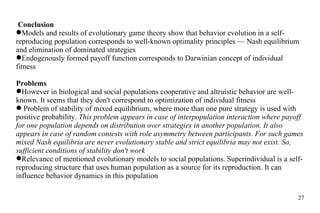
Conclusion Models and results of evolutionary game theory show that behavior evolution in  a self-reproducing  population corresponds to well-known optimality principles — Nash equilibrium and elimination of dominated strategies Endogenously formed payoff function corresponds to Darwinian concept of individual fitness Problems However in biological and social populations cooperative and altruistic behavior are well-know n . It seems that they don't correspond to optimization of individual fitness Problem of stability of mixed equilibrium, where more than one pure strategy is used with positive probability.  This problem appears in case of interpopulation interaction where payoff for one population depends on distribution over strategies in another population. It also appears in case of random  contests  with role asymmetry between participants. For such games mixed Nash equilibr ia  are never evolutionary stable and strict equilibr ia   may not  exist. So, sufficient conditions of stability don't work Relevance  of mentioned evolutiona ry  models to social populations. Superindividual is a self-rep roducing  structure that uses human population as a source for  its reproduction . It can influence behavior dynamics in this population
II . Stability of equilibrium. Pecularities of social behavior evolution.
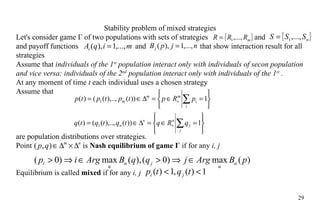
Stability problem of mixed strategies Let's consider game Г of two populations with sets of strategies   and   and payoff functions  and   that show interaction result for all strategies Assume that  individuals of the 1 st  population interact only with individuals of secon population and vice versa: individuals of the 2 nd  population interact only with individuals of the 1 st  .  At any moment of time  t  each individual uses a chosen strategy Assume that are  population distribution s  over strategies. Point    is  Nash equilibrium   of game Г  if for any  i, j  Equilibrium is called  mixed  if for any  i, j
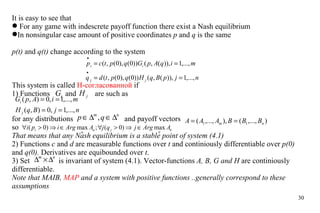
It is easy to see that For any game with indescrete payoff function there exist a Nash equilibrium In nonsingular case amount of positive coordinates  p  and  q  is the same p(t)  and  q(t)  change according to the system This system is called  Н-согласованной  if 1) Functions    and    are such as  f or any distributions    and payoff vectors    so   That means that any Nash equilibrium is a stable point of system (4.1) 2) Functions  c  and  d  are measurable functions over  t  and continiously differentiable over  p(0)  and  q(0).  Derivatives are equibounded over  t . 3) Set    is invariant of system (4.1). Vector-functions  A, B, G and H  are continiously differentiable. Note that MAIB,  МАР  and a system with positive functions ..generally correspond to these assumptions
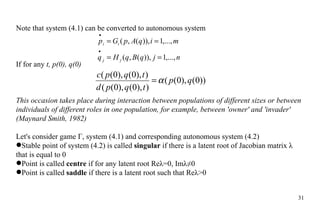
Note that system (4.1) can be converted to autonomous system If for any  t, p(0), q(0)  This occasion takes place during interaction between populations of different sizes or between individuals of different roles in one population, for example, between 'owner' and 'invader' (Maynard Smith, 1982) Let's consider game Г, system (4.1) and corresponding autonomous system (4.2) Stable point of system (4.2) is called  singular  if there is a latent root of Jacobian matrix   λ  that  is  equal to 0 Point is called  centre  if for any latent root  Re λ =0, Im λ≠ 0 Point is called  saddle  if there is a latent root such that  Re λ >0
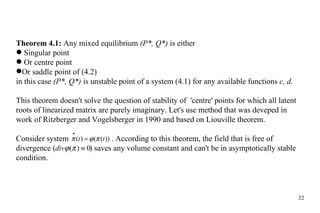
Theorem 4.1:  Any mixed equilibrium  (P*, Q*)  is either Singular point Or centre point Or saddle point of (4.2) in this case  (P*, Q*)  is unstable point of a system (4.1) for any available functions  c, d. This theorem doesn't solve the question of stability of  'centre' points for which all latent roots of linearized matrix are purely imaginary. Let's use method that was deveped in work of Ritzberger and Vogelsberger in 1990 and based on Liouville theorem. Consider system  .  According to this theorem, the field that is free of divergence (   ) saves any volume constant and can't be in asymptotically stable condition.
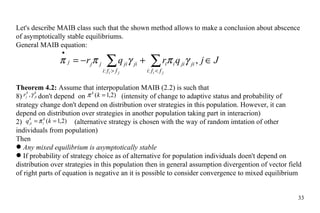
Let's describe MAIB class such that the shown method allows to make a conclusion about abscence of asymptotically stable equilibriums.  General MAIB equation:  Theorem 4.2:  Assume that interpopulation MAIB (2.2) is such that don't depend  on  (intensity of change to adaptive status and probability of strategy change don't depend on   distribution over strategies in this population. However, it can depend on distribution over strategies in another population taking part in interacrion) 2)    (alternative strategy is chosen with the way of random imtation of other individuals from population) Then Any mixed equilibrium is asymptotically stable If probability of strategy choice as of alternative for population individuals doen't depend on distribution over strategies in this population then in general assumption divergention of vector field of right parts of equation is negative an it is possible to consider convergence to mixed equilibrium
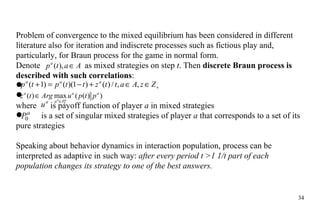
Problem of convergence to the mixed equilibrium has been considered in different literature also for iteration and indiscrete processes such as fictious play and, particularly, for Braun process for the game in normal form. Denote    as mixed strategies on step  t . Then  discrete Braun process is described with such correlations : where    is payoff function of player  a  in mixed strategies is a set of singular mixed strategies of player  a  that corresponds to a set of its pure strategies Speaking about behavior dynamics in interaction population, process can be interpreted as adaptive in such way:  after every period t  >1  1/t part of each population changes its strategy to one of the best answers.
Braun offered and Robinson proved convergence of discrete process for antagonistiv bimatrix games  Danskin showed convergence of this process for antagonistic games with indescrete payoffs over multiplications of compact spaces Fudenberg and Kreps showed convergence of adaptive play model for nonantagonistic bimatrix game 2x2 with one pure mixed Nash equilibrium Бенайм  and Hirsch developed result for 2x2 games with several nash equilibrium (can be both mixed or not) In Bogdanov's work that was done on the basis of Belenkiy and others results general rules for convergence of such processes for bimatrix games are shown. It is proved that convergence can be guaranteed for all bimatrix games that are converted to antagonistic with the following development: a) adding constant to the column of payoff matrix of 1 st  player b)adding constant to the line of payoff matrix of 2 nd  player c)multiplication of payoff matrix and positive constant It is known that those transformations set a game class with the same sets of Nash equilibrium However thes results can't be widespread for nonantagonistic games of bif dimension
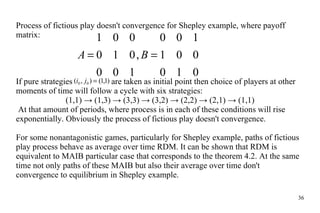
Process of fictious play doesn't convergence for Shepley example, where payoff matrix: If pure strategies    are taken as initial point then choice of players at other moments of time will follow a cycle with six strategies: (1,1) -> (1,3) -> (3,3) -> (3,2) -> (2,2) -> (2,1) -> (1,1) At that amount of periods, where process is in each of these conditions will rise exponentially. Obviously the process of fictious play doesn't convergence. For some nonantagonistic games, particularly for Shepley example, paths of fictious play process behave as average over time RDM. It can be shown that RDM is equivalent to MAIB particular case that corresponds to the theorem 4.2. At the same time not only paths of these MAIB but also their average over time don't convergence to equilibrium in Shepley example.
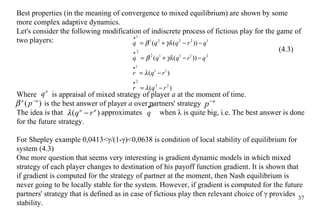
Best properties (in the meaning of convergence to mixed equilibrium) are shown by some more complex adaptive dynamics. Let's consider the following modification of indiscrete process of fictious play for the game of two players: (4.3) Where  is appraisal of mixed strategy of player  a  at the moment of time.   is the best answer of player  a  over partners' strategy  The idea is that    approximates  when  λ  is quite big, i.e. The best answer is done for the future strategy. For Shepley example  0,0413< γ /(1- γ )<0,0638  is condition of local stability of equilibrium for system (4.3) One more question that seems very interesting is gradient dynamic models in which mixed strategy of each player changes to destination of his payoff function gradient. It is shown that if gradient is computed for the strategy of partner at the moment, then Nash equilibrium is never going to be locally stable for the system. However, if gradient is computed for the future partners' strategy that is defined as in case of fictious play then relevant choice of γ provides stability.
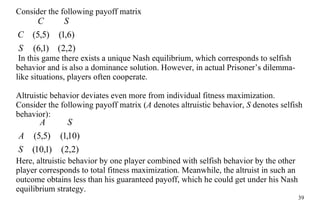
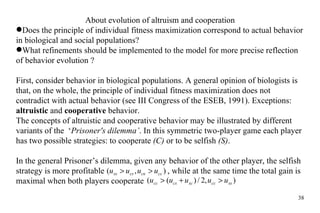
About  evolution  of altruism and cooperation Does the  principle of individual fitness   maximization correspond  to actual  behavior in biological and social populations? What refinements  should be implemented to the model for more precise reflection of behavior   evolution ? First, consider behavior in biological populations. A general opinion of biologists is that, on the whole, the principle of individual fitness maximization does not contradict with actual behavior (see III Congress of the ESEB, 1991). Exceptions:  altruistic  and  cooperative  behavior.  The concepts of altruistic and cooperative behavior may be illustrated by different variants of the  ‘ Prisoner's dilemma’ . In this symmetric two-player game each player has two possible strategies: to cooperate  (C)  or to be selfish  (S) .  In the general Prisoner’s dilemma, given any behavior of the other player, the selfish strategy is more profitable    , while at the same time the total gain is maximal when both players cooperate
C on s ider the following payoff matrix In this game there exists a unique Nash equilibrium, which corresponds to selfish behavior and is also a dominance solution. However, in actual Prisoner’s dilemma-like situations, players often cooperate. Altruistic behavior deviates even more from individual fitness maximization. Consider the following payoff matrix ( A  denotes altruistic behavior,  S  denotes selfish behavior): Here, altruistic behavior by one player combined with selfish behavior by the other player corresponds to total fitness maximization. Meanwhile, the altruist in such an outcome obtains less than his guaranteed payoff, which he could get under his Nash equilibrium strategy.
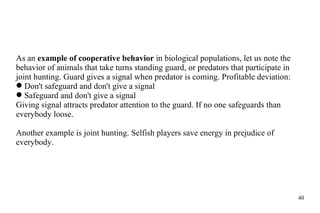
As an  example of cooperative behavior  in biological populations, let us note the behavior of animals that take turns standing guard, or predators that participate in joint hunting. Guard gives a signal when predator is coming. Profitable deviation: Don't safeguard and don't give a signal Safeguard and don't give a signal Giving signal attracts predator attention to the guard. If no one safeguards than everybody loose.  Another example is joint hunting. Selfish players save energy in prejudice of everybody.
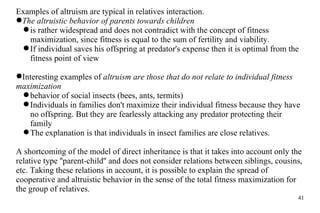
Examples of altruism are  typical  in relatives interaction. The altruistic behavior of parents towards children  is rather widespread and does not contradict with the concept of fitness maximization, since fitness is equal to the sum of fertility and viability.  If individual saves his offspring at predator's expense then it is optimal from the fitness point of view Interesting examples of  altruism are those that do not relate to individual fitness maximization behavior of social insects (bees, ants, termits)  Individuals in families don't maximize their individual fitness because they have no offspring. But they are fearlessly attacking any predator protecting their family The explanation is that individuals in insect families are close relatives.  A shortcoming of the model of direct inheritance is that it takes into account only the relative type ''parent-child'' and does not consider relations between siblings, cousins, etc. Taking these relations in account, it is possible to explain the spread of cooperative and altruistic behavior in the sense of the total fitness maximization for the group of relatives.
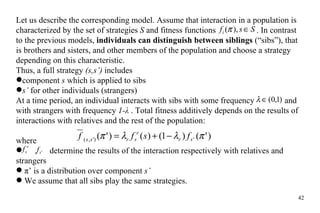
Let us describe the corresponding model. Assume that interaction in a population is characterized by the set of strategies  S  and fitness functions   . In contrast to the previous models,  individuals can distinguish between siblings  (“sibs”), that is brothers and sisters, and other members of the population and choose a strategy depending on this characteristic.  Thus, a full strategy  (s,s’)  includes  component  s  which is applied to sibs  s’  for other individuals (strangers) At a time period, an individual interacts with sibs with some frequency    and with strangers with frequency  1- λ  . Total fitness additively depends on the results of interactions with relatives and the rest of the population: where  ,  determine the results of the interaction respectively with relatives and strangers  π’ is a distribution over component  s’ We assume that all sibs play the same strategies.
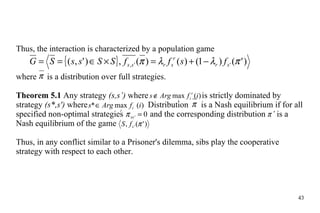
Thus, the interaction is characterized by a population game where  is a distribution over full strategies. Theorem 5.1  Any strategy  (s,s’)  where    is strictly dominated by strategy  (s*,s')  where    Distribution  is a Nash equilibrium if for all specified non-optimal strategies   and the corresponding distribution  π’  is a Nash equilibrium of the game  Thus, in any conflict similar to a Prisoner's dilemma, sibs play the cooperative strategy with respect to each other.
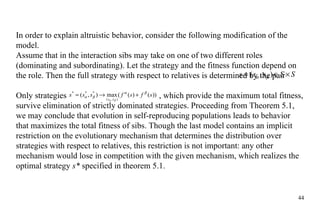
In order to explain altruistic behavior, consider the following modification of the model.  Assume that in the interaction sibs may take on one of two different roles (dominating and subordinating). Let the strategy and the fitness function depend on the role. Then the full strategy with respect to relatives is determined by the pair  Only strategies  , which provide the maximum total fitness, survive elimination of strictly dominated strategies. Proceeding from Theorem 5.1, we may conclude that evolution in self-reproducing populations leads to behavior that maximizes the total fitness of sibs. Though the last model contains an implicit restriction on the evolutionary mechanism that determines the distribution over strategies with respect to relatives, this restriction is not important: any other mechanism would lose in competition with the given mechanism, which realizes the optimal strategy  s*  specified in theorem 5.1.
Note that these results may be generalized for relations between cousins, second cousins, etc. Full strategy includes variants of behavior  s1, ..., sk  with respect to relatives of different degrees  1,...,k  and  s’  with respect to strangers.  The fitness function is of the form    ,   ,  λ  characterizes the frequency of interaction with relatives of degree  i .  As above, we assume that all relatives apply the same strategy with respect to each other. This assumption corresponds to the model of direct inheritance and does not restrict generality within the context of the proposed model of evolutionary mechanism selection. Then, elimination of strictly dominated strategies leads to optimization of relations between relatives: surviving strategies are those  s*  such that
As in biological, in social populations with low migration level interacting individuals usually have common ancestors  at least in 7 th  generation C onsider two random individuals from population with  individuals Assume  that they don't have common ancestors in 7 generations Then, 7 generations ago each of them had 64 ancestors of different sex Let's take 104  as   the size  of  the  population (that means at average 4 children in a family) Condition that no one ancestor female of one individual married male ancestor of another individual is necessary condition for having no common ancestors Probability of this event: (1-64/5900)129 < 0,1 Proceeding from  those results , we should expect widespread  cooperative and altruistic behavior for total fitness maximization. However real behavior doesn't usually correspond to friendship principles. And in biological populations such beha v ior forms are  n ot dom i nating. Examples of tough competition between relatives are well-known. Sometimes they even eat children of each other. One of reasons  for limited  spreading  of   cooperative behavior is its  insecurity in case of implemention of selfish mutants.
Relating to social populations, there exists one more problem. Density of relationship inside a family is specific for different nations. So, it seems interesting to define  degrees of altruism and cooperation in Nash equilibrium depending on these parametres and mutation intensity. Note that the problem of cooperative and altruistic behavior prevalence is studied in different settings.  For instance, the theory of repeated games explains the prevalence of cooperation in repeated conflict situations proceeding from individual fitness optimization. Repetition provides the possibility to punish those individuals who fail to behave cooperatively. Taking into account such future  punishments, cooperative behavior turns out to be individually profitable. While the equivalence between individual fitness and total fitness does not hold in the evolutionary models considered above,  cooperative behavior nevertheless can spread broadly due to the selection of evolutionary mechanisms.
Peculiarities of behavior evolution in social populations. Superindividuals. Their impact on  utility  function s  and processes of nation reproduction Actual behavior in modern social populations maximizes neither individual nor group fitness.  Let us take social-welfare states such as Sweden or Germany. Favorable conditions for survival and normal biological development are guaranteed there to any newborn citizen regardless of his or her social origin. However, demographic statistics indicate that most people ignore the advantages in reproductive opportunities. At the end of the twentieth century GNP per head of population in Germany and Sweden was 10 times biger then in Russia. The fertility rate in those countries was identically low: 9-10 per 1000. For instance, the pool of Stockholm inhabitants in 1995 showed that 70% of the adult population had no children and did not plan to have them. («World population prospects», 1996)
Why do the evolutionary models examined above not seem to apply directly for current social populations? Let us note factors that explain this discrepancy. a)the impossibility for children to reliably inherit parental strategies within social populations.  The behavior strategies are so complicated and the environment is so variable that an individual could spend most of his life trying to teach his descendants. The division of labor and differential access to educational institutions appeared at an early stage of mankind’s development. These institutions play a crucial role in forming the behavior of new generations. Later governments, churches and other organizations realized the importance of educational institutions and effectively used them to form desirable behavior. b)The problem of payoff evaluation for different behavior strategies is rather complicated even for theoretical analysis.  In practice, decision-makers are usually unable to carry out a complete evaluation in a reasonable time. Biological evolution has formed various mechanisms that facilitate fast decisions that generally are close to though not completely optimal in the sense of fitness.
One such mechanism is the  feeling of pleasure or satisfaction  related to food and comfort.  In nature, actions that are pleasant or conducive to achieving pleasure are usually rational in the sense of individual reproduction. In particular, provision and consumption of food and some other resources are necessary for reproduction.  However, devotion to this objective function may impede reproduction in some instances. One  example of fitness-impeding commitment to food consumption within an ecological system is the interaction between a lamehuza beetle and ants who feed on secretions produced by the beetle. Sometimes the secretions have a drug-like effect on ants: they throw the queen out of the ant-hill, put the lamehuza beetle in the queen’s place and take care of it in order to get more secretions. In time this ant family perishes. This example is exceptional for ecosystems. The situation in modern human society is different. A lot of people consume large amounts of alcohol, tobacco, excessive food and other goods that are harmful or at least unnecessary for reproduction. There are many families and single individuals spending the whole of their lives to earn money for such consumption and finally having at most one child.
Another auxiliary mechanism of strategy determination is  leader imitation .  In natural populations it promotes learning and permits the coordination of actions of individuals within groups and thus increases their fitness.  In social populations imitation creates an additional possibility for behavior manipulation by choosing an appropriate leader. The  methods of behavior manipulation described above (control over the educational process, usage of pleasure incentives and the imitation mechanism) have been practiced since ancient times. But the situation has dramatically changed with the development of mass media in the 20th century. Currently, television provides the possibility to influence billions of people by playing the role of a teacher and creating models for imitation.
Now consider who or what changes the objective functions in order to form certain behavior in social populations. In our previous examples for ecosystems, we identified two different variants. In the case of the ants and the lamehuza beetle, the manipulator is an individual belonging to another population. The interaction between the populations is of the &quot;predator-prey&quot; type. In the case of social insects, individual behavior is formed by a self-reproducing superindividual – the family of ants, bees or other social insects. While suppressing individual reproduction of some part of the population, the evolutionary mechanism provides efficient reproduction of these superindividuals and the population as a whole.
In general a superindividual related to a given biological or human population is a self-reproducing structure that includes some individuals of this population among its elements. Besides the individual organisms, the superindividual may comprise other material or immaterial components. In social populations we meet similar and more complicated variants of behavior regulation. In addition to  superindividuals of a biological nature (families), there exist self-reproducing superindividuals of a social-economic nature (corporations, art and scientific schools, public and religious organizations, and government institutions). Instead of replication, superindividuals may either grow, involving new human and material resources, or collapse. Thus, superindividuals use the population as a resource for their own reproduction and growth, and influence population behavior for this purpose. The more intensive is the specific activity of involved individuals, the faster is growth and development of the superindividual. Since the time and energy of each person is limited, the superindividual often suppresses other kinds of activity, in particular, individual reproduction.
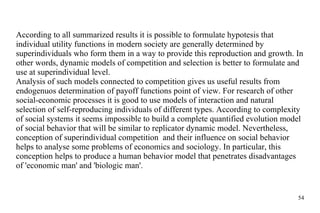
According to all summarized results it is possible to formulate hypotesis that individual  utility  functions in modern society are generally  determined  by superindividuals who form the m  in a way to provide  this  reproduction and growth. In other words, dynamic models of competition and selection is better to formulate and use at superindividual level.  Analysis of such models connected to competition gives us useful results from endogenuos  determination  of payoff functions point of view. For research of other social-economic processes it is good to use models of interaction and natural selection of  self-reproducing  individuals of different types. According to complexity of social systems it seems impossible to build  a complete  quantified evolution model of social behavior that will be similar to replicator dynamic model. Nevertheless, conception of superindividual competition  and their influence on social behavior helps to analyse some problems of economics and sociology. In particular, this conception helps to produce a human  behavior  model that penetrates disadvantages of 'economic man' and 'biologic man'.
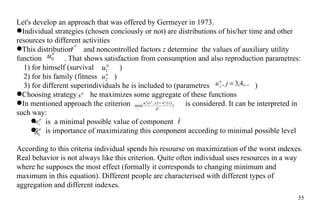
Let's develop an approach that was offered by Germeyer in 1973. Individual strategies (chosen conciously or not) are distributions  of his/her  time and other resources to different activities This  distribution  and noncontrolle d  fac t ors  z   determine  the v alues of auxiliary utility function  .  That  shows satisfaction from  consumption  and  also  reproduction parametres: 1)  for  himself (survival    ) 2)  for  his family (fitness  ) 3)  for  different superindividuals he is included to (parametres  ) Choosing strategy  he maximizes  some aggregate  of these functions In mentioned approach  the criterion    is considered. It can be interpreted in such way: is  a  minimal possible value of  component   is importance of maximizating this  component  according to minimal possible level According to this criteria individual spends his resourse on maximization of  the  worst indexes. Real behavior is not always like this  criterion . Quite often individual uses resources in a way where he supposes the most effect (formally it corresponds to changin g  minimum and maximum in this equation ) . Different people are characterised with different types  of aggregation  and different indexes.
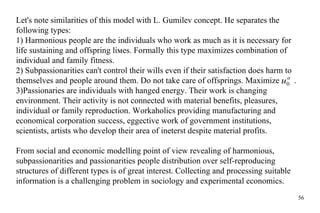
Let's note similarities of this model with L. Gumilev concept. He separates the following types: 1) Harmonious people are the individuals who work as much as it is necessary for life sustaining and offspring liмes. Formally this type maximizes combination of individual and family fitness. 2) Subpassionarities can't control their wills even if their satisfaction does harm to themselves and people around them. Do not take care of offsprings. Maximize  . 3)Passionaries are individuals with hanged energy. Their work is changing environment. Their activity is not connected with material benefits, pleasures, individual or family reproduction. Workaholics providing manufacturing and economical corporation success, eggective work of government institutions, scientists, artists who develop their area of ineterst despite material profits. From social and economic modelling point of view  revealing of  harmonious, subpassionarities and passionarities people distribution  over self-reproducing  structures of different types  is of great interest . Collecting and processing suitable information is  a   challenging  problem in sociology and experimental economics.
References 1. Vasin A. ''Evolutionary game theory. Part 1. Optimality principles and models of behavior dynamics.''  New  Economic Assosiation magazine, 3-4, M.:2009 2.Vasin A. (2005) ''Noncooperative game in nature and society.'' M.:Maks Press 3.  Maynard Smith, J. (1982)  Evolution and the Theory of Games  (Cambridge: Cambridge. University Press)

EGT and economics

  • 1.
    EGT and economics:I. Optimality principles and models of behaviour dynamics Alexander A. Vasin
  • 2.
    Introduction Classical gametheory Game theory is widely used for description and analysis of economic players' behavior in microeconomics, public sector economics, political economics and other fields of economic theory. General ideas of classical game-theoretic analysis: Game in normal form (as a model of players interaction) - Several participants (players) - Several possible strategies for each player -Payoff function s Principle of Nash equilibrium (as a method to define agents strategies during their interaction) -Nash equilibrium is a basic concept of game theory . T he optimal outcome of a game is one where no player has an incentive to deviate from his or her chosen strategy after considering  the choice s of other players . Principle of elimination of dominated strategies -Strategy is called dominated if there exists an alternative strategy which provides a greater gain no matter what strategies are chosen by other players -Domination principle means that rational players will not use dominated strategies -Dominance elimination can be made iterative
  • 3.
    Evolution ary game theory: considered problems 1. Correspondence of real behavior of economic agents to Nash equilibrium and domina nce elimination principles In typical conflicts the search of Nash equilibrium and sets of nondominated strategies deliveres sophisticated math tasks. It is necessary to know all sets of strategies and payoff functions for their solution ( see models of Cournout and Bertrand economical competition) . A u sual participant of such interaction has precise information only about his own strategies and payoff function and often doesn't know about mentioned decision-making principles Why should we expect that his behavior will be relevant to the principles ? Justification by means of models of adaptive and imitative behavior (MAIB) These models show that convergence to Nash equilibrium and domina nce elimination proceed from general properties of evolution ary , adaptative and imitative mechanisms of behavior formation In this case complete information awarness and rationality in choosing strategies are not required. It suffices to compare the payoff s for current behavior strategy and chosen alternative. Definition of evolutionary stable strategy and its relation to Nash equilibrium .
  • 4.
    2. How tode termine players utility functions for particular interaction s ? Standard approach: use concepts of particular sciences. In economics : 'homo economicus‘ concept (P.Samuelson) In the role of a produce r: profit maximisation In the role of a consumer : maximisation of the demand utility Discrepancy to real behavior: russian labour market . Alternative: consider evolution of preferences (L. Samuelson) Model of evolution ary mechanisms natural selection In this model a society of interacting populations with different evolutionary mechanisms is considered Analysis of this model shows that if replication is in the set of competing mechanisms then behavior dynamics is coordinated with maximization of individual fitness (Ch. Darwin). What about human populations? 3. Do individuals adjust to other interests or extensively influence payoff function s of other player s? (agressive advertising, drug distribution)
  • 5.
    Population game Populationgame is a static model of interaction in a large homogenuous group of individuals. This concept is an analog of a game in normal form in classic game theory, so general noncooperative optimality principles are summarized: Nash equilibrium D ominance s olution Idea of evolutionary stable strategy is added Formally a population game G is a set of parametres G = < >, where J is the set of players strategies - standart simplex i s the payoff function for players that use strategy j under strategy distribution and other parametres of the model (e.g. t otal population size and environmental conditions). For social populations, the payoff function usually corresponds to consumer utility, income or profit. In this paragraph the function is exogenous.
  • 6.
    Example of populationgame (M.Smith) C onsider pair competitive contes ts for one resource. Individuals of a population try to find the desired object (food, lodging or a female). Some of them get it without collision, others conflict in pairs, where one of them is the owner α and another one is invader β - the set s of strategies in each role - profits of individuals if α choses and β - - p robability of collision. It doesn't depend on startegies and is de termin ed by the size of population N - profit of individuals avoided collision Strategy of individual is a pair , where and . It is a rule of behavior choice according to the role . Function shows the average payoff of individuals with strategy j
  • 7.
    Let and denote distribution s over alternatives for the both roles α and β which correspond to strategy π distribution. Then , And for strategy C onsider also the situation when players don't distinguish their roles . Then the set of strategies is the set of alternatives: In this case game G is equivalent to the game T he set of behavior alternatives and individual payoffs may not depend on the role in the previous model too. However , behavior models for those similar situations are completely different.
  • 8.
    Main static optimality principles Nash equilibrium for the populational game G is a distribution π * such that any startegy which is used with positive frequence is an optimal reply to the given distribution under any parameter ω , i.e. (2.1) Let payoff functions in game G be expansible, i.e. as in the model of pair contests . Note that a part of the payoff function that depends on the strategy chosen by a player is independent of the parameter ω . Then (2.1) is equivalent to the following condition, which doesn't include the parameter ω : The concept of Nash equilibrium is the best-known optimality criterion used in strategic behavior modeling. However, it is known from analysis of dynamic models, that among Nash equilibrium there can exist unstable states, that are not realized in practice. For this reason we also consider strong er optimality criteria.
  • 9.
    Evolutionary stable strategy(ESS) for the populational game G is a distribution π * such that is the average payoff for mixed strategy or distribution π when individuals in the population are distributed in pure strategies according to π ’ . The concept of ESS can be interpreted in the following way. Let a small group of 'mutants' with strategy distribution π be implemented in a stable population π * . If distribution π * is evolutionary stable then the implemented group can't fix in the population, because its average fitness is less then the fitness of initial strategy π *.
  • 10.
    Any ES S is Nash equilibri um . If π is not an equilibrium then mutants with pure strategy of best reply to π have grater payoff than the average payoff in the main population. Due to persistance of f o ver π it is correct for any group of such mutants. This statement is correct if the share of one individual in the population is negligible , i.e. change of his strategy doesn't influnce payoff s order . Otherwise it is necessary to revise the ESS concept (Schaffer,1989). For a symmetric game in normal form with n players, set of strategies S and payoff function , ESS is defined as a symmetric situation such that any strategy change by any player do es n't make his profit more than the profit of other players with the former strategy. I.e. a mutant doesn't have any profit benefits. S uch ESS can be not a Nash equilibrium . In particular, in the game which correspond to symmetric Cournout oligopoly, players use 'market power' in Nash equilibrium and realise lower production volumes in comparison with the competitive equilibrium, while the ESS corresponds to the competitive equilibrium.
  • 11.
    Strict equilibrium of population game G is distribution π * such that all players use one str a tegy, which is the best reply to itself : Note, that any strict equilibrium is ESS , even for groups with sufficiently large finite size. Selten (1988) showed that there are no ESS except for strict equilibri a for random contest s with role a symmetry of players ('owner' — 'invader'). For general payoff functions Nash equilibrium may not exist . In other classes of games there are a lot of equilibri a , some of them are unstable. In this case another optimality principle is appealing — domination that is also internally bound to the Darwinian principle of natural selection.
  • 12.
    Strategy j dominates strategy i on the set of distributions if for any distribution over strategies the strategy j provides a greater gain than strategy i The set is called a dominating set if it can be obtained by iterative exclusion of dominated strategies , i.e. there exists integer T >1 such as на The described procedure for iterative elimination of dominated strategies can be considered as a quasi-dynamic model of behavior microevolution within a population. Indeed, this procedure describes a sequential reduction of the set of strategies used by players: at each stage, more efficient (better fitted) strategies are substituted for less efficient ones. If ε>0 then strategy j strictly dominates strategy i ( ), J' is a strictly dominating set . Concepts of domination by mixed strategy and a set domination in mixed strategies are analogue
  • 13.
    Search of Nashequilibrium and dominating sets of a population game is generally a sophisticated optimization problem . For random pair contests i t is possible to reduce them to the known computational tasks for appropriate bimatrix games . Proposition 2.1 Distribution π * is a Nash equilibrium of game such that and competitors don't differ conditions if and only if ( π * , π *) is Nash equilibrium in mixed strategies of symmetrical bimatrix game , i.e Proposition 2.2 Distribution π * such that is strict equilibrium of game if and only if for any ,i.e. (s,s) is strict symmetric Nash equilibrium of game Г in pure strategies. Proposition 2.3 Str a tegy s dominates strategy r ( ) in game if and only if in game Г , i.e for any Proposition 2.4 Distribution is Nas h equilibrium of game G for assymetric pair contests if and only if is Nash equilibrium in mixed strategies of game Г = =
  • 14.
    So, forany random pair collisions Nash equilibrium of population game correspond to Na sh equilibrium of bimatrix game that describes pair interaction Analogue rela tion exists for random collisions with larger number of participants when a separate local interaction is characterized by the game of n participants. The results are easily general ized in case of interpopulation collisions when individuals from different populations or social groups ('predator-prey', 'employer-employees' etc) play different roles . The main condition of correspondence is independence of distribution in interacting groups from players' strategies
  • 15.
    Model of adaptive-imit ative behavior (MA I B) In which cases adeptive- imit ative mechanisms form population behavior that corresponds to Nash principle and principle of dominated strategy elimination? Let population game describe interaction of population individuals that happens continiously, at every moment of time. The number of individuals and external factors are fixed ( do not depend on ω ) With intensity which depends on current player distribution over st ra tegies π and current payoff vector a player with strategy j turns into 'adaptive' status where rec onsiders his behavior In adaptive status player with startegy j chooses i as alternative with probabilit y Current and alternative strategies are compared. If chosen for comparison strategy i is better then initial strategy j (i.e. gives individual more profit under this distribution over strategies) then the player changes his strategy to i with probability
  • 16.
    Then is an average share of players who change their strategy j to strategy from set in a moment of time, - the share of players who change their strategy from set to j . So, equations of distribution dynamics look like (2.2) Functions are such as Mentioned conditions guarantee that path doesn't come out set П at any moment of time t and with any initial distribution
  • 17.
    MA I B.Examples. Example 1. Let the intensity of status change to adaptive be constant. Alternative strategy is chosen by means of random imitation. And probability of changing current strategy to alternative is proportional to the difference between the corresponding payoff functions. So, And (2.2) looks like This system is an analogue of autonomus continuous model of replicator dynamics (see part 3) Example 2. Alternative strategy is chosen with equal probabilities from the set of possible strategies, i.e. This example illustrates the mechanism of individual adaptation when each player knows the whole set of possible strategies, and adaptation happens according to current payoff values . Adaptation doesn't depend on behavior of other population individuals. It is evident that there are many different MA I Bs. The f ollowing theorems relate MA I B stable state s and solution s of the corresponding population game . Note that any Nash equilibrium of population game G is a steady state of MA I B.
  • 18.
    Relation of MAI B stable states and population game solutions Denote as a set of best replies to distribution π . Theorem 2.1: Let MA I B meet the following conditions 1), 2) and 3) or 3') : 1)For any and any (intensity of changing status to adaptive is positive for all strategies) 2) For any functions look like where for any (probability of strategy choice as alternative is function of corresponding payoff difference and is positive for a positive argument ) 3)For any (probability of strategy choice as alternative is positive for any strategy that gives maximum payoff under the current distribution over strategies) 3')For any and q>0 (for any pure strategy with maximum payoff, probability of this strategy choice as alternative is not less than its share in the population multiplied by some constant) Then any stable(Lyapunov) point π * of system (2.2) is Nash equilibrium of population game b) if initial distribution and for path there exists then π * is Nas h equilibriu m , f or game G c) if π * is a point of strict equilibrium for population game G then π * is an assymptoticaly stable point of system (2.2)
  • 19.
    Theorem 2.2: LetMA I B (2.2) meet conditions 1 and 2 of theorem 2.1 and moreover for any (alternative strategy is chosen by random imitation) 2. if then (intensity of changing status to adaptive decreases with the raise of pa y off function) 3. increase s monotonically in x (probability of strategy choice as alternative rises monotonically for payoff remainder) If is a strictly dominating set of strategies in populational game then , for any and initial distribution Notes Other variants of such consistency conditions of MA I B dynamics with Nash and domination decisions (see Samuelson L., Zhang J.(1992) and Weibull (1995)) relate to the concept of monotonous dynamics s.t. At the same time there exist adaptation models that don't meet theorem s 2.1 and 2.2. Models of natural selection of evolutional mechanisms considered in the next part explain why we nevertheless should expect coherence of real behavior dynamics with the noted optimality principles. Moreover, payoff functions of players are endogeneously defined in the frames of these models.
  • 20.
    Replicator Dynamics Model(RDM) Population is characterized with a set S of possible strategies Strategy distribution of individuals at the current moment is set by vector Individuals differ only in behavior strateg ies , they don't change it during their life, strategy is inherited In case of populations with both males an females, each of them should be considered as a separate population Genetical mechanism of inheritance : the strategy is determined by genes, connected with sex . Mechanism of imitation : the strategy is defined by imitating behavior of the parent of the same sex. The r esult of the interaction in population during a period of time is characterized for players with strategy s by fertility function that determines the average number of offsprings. It is also characterized by survival function that determines the probability to surviv e under distribution π and population size N .
  • 21.
    Denote - the number of those who use strategy s . Then popultion dynamics , meets the following system: (3.1) Where is a strategy fitness function . It formalizes the Darwinian concept of individual fitness. At first sight a concept of payoff function is inapplicable to this model. Players ’ strategies are fixed, the are not approaching to smt and don't choose anything. However, the picture changes if we look at strategy distribution dynamics. The following theorem shows that behavior assymptotics in such population correspond s to fitness as a payoff function for this population . Particularly, if for strategy distribution approaches to stationary, then there are only those strategies in population that maximize fitness (corresponds to Darwinian principle of natural selection: only most fitted survive). If in any distribution one strategy fits better than another, then a part of the worst strategy in distribution π (t) approaches to 0 while . In this case fitness is endogenuous objective function of this model.
  • 22.
    Relation of Nashequilibr ia with stable MRD points Asymptotic stability of ES S Relation of dominating sets of strateg ies with behavior dynamics Theorem 3.1 (on relation of Nash equilibrium with stable points of RDM): Assume that the fitness function is reperesentable in additive form Then 1) any stable (Lyapunov) distribution π * of system (3.1) is a Nash equilibrium in population game 2) if for a certain path , the initial di s tribution and then π * is a Nash equilibrium of the specified population game Note that system (3.1) isn't closed, because its right part also depends on N(t). Conception of stable distribution for such system is formally defined in Bogdanov, Vasin (2002) Theorem 3.2 (on asymptotic stability of ESS): Assume that in theorem 3.1 π * is evolutionary stable strategy for population game . Then π * is an asymptotically stable distribution of system (3.1) Theorem 3.3 (on the relation between dominating sets of strategies and behavior dynamics ): Assume that S is a strictly dominating set of strategies in the game . Then, for any and any on the corresponding path of system 3.1
  • 23.
    Random imitation ReplicatorDynamics Model describes activity of evolution ary mechanism that provides direct inheritance of strategies by children. In what degree are the stated results depend on concrete evolution ary mechanism ? Turns out that it plays a very important role . Let's consider mechanism of random imitation as an alternative example This model differs from replicator dynamics only in one point : new individuals do not inherit strategy, they follow a strategy of randomly chosen adult. Then the population dynamics are described Such system dynamic corresponds to payroll function in the sense of theorems 3.1-3.3. Thus, viability turns out to be an endogenous payoff function of individuals in the corresponding dynamical process. Proceeding from the previous example it seems that we have exchanged arbitrariness in the choice of payoff functions for arbitrariness in the choice of evolutionary mechanisms. However, actual evolutionary mechanisms are subject to natural selection. Only the most efficient mechanisms survive in the process of competition.
  • 24.
    Model of evolutionarymechanism s competition Consider the corresponding model of a society that includes several populations that differ only in their evolutionary mechanisms. Individuals of all populations interact and do not distinguish population characters in this process. Thus, the evolutionary mechanism of an individual is an unobservable characteristic. Fertility and viability functions describe the outcome of the interaction for each strategy and depend on the total distribution over strategies and the size of the society. The set of strategies S and the functions are the same for all populations. Denote L – the set of populations - the size of population l N – the total population size - distribution over strategies in population l. Then the total distribution over strategies is Assume that operator corresponds to the evolutionary mechanism of population l and determines the dynamics of distribution . (For example, in one population it is replication dynamics, in an other - random imitation, and so on. Particularly, dynamics may relate to maximization of some payoff function)
  • 25.
    Then the dynamicsof the society are governed by equations (3.2) Theorem 3.4. Let there exists a population of replicators in the society. Then the total distribution π(t) over strategies meets the following analogs of theorems 3.1 and 3.2: 1) any stable distribution π of system (3.2) is a Nash equilibrium of the population game 2) if for path initial distribution and then π * is a Nash equilibrium of the population game G for path 3) if π is a strict equilibrium of the game G then π is an asymptotically stable distribution for system (3.2). Thus, the evolutionary mechanisms selection model confirms that individual fitness is an endogenous utility function for self-reproducing populations.
  • 26.
    Idea of proofof 1 st and 2d statements is quite easy: if stationary distribution over strategies is not Nash equilibrium of fitness function then nothing can prevent expansion of replicators that use the best reply strategy. That is a contradiction to its stability G eneralization of theorem 3 for elimination of dominated strategies is possible under more strict assumptions on the variety of evolutionary mechanisms. For any evolutionary mechanism and a pair of strategies s,r , let us call an s,r -substitute of mechanism a mechanism such that for strategies other than s and r the shares of individuals who apply these strategies change as under mechanism , except that instead of strategy s they always play r . According to (Vasin, 1995), if for any s,r,l the set of mechanisms includes all possible substitutes of , then a s for any strictly dominated strategy s. The r esult is stated for homogenuous population, without taking sex or age in consideration. It is easily generalized for populations with such structures. Fitness analogue in this case is a rate of balanced growth of the population, it is determined by the Frobenius number of the Leslie matrix (see Semevskiy, Semenov, 1982)
  • 27.
    Conclusion Models andresults of evolutionary game theory show that behavior evolution in a self-reproducing population corresponds to well-known optimality principles — Nash equilibrium and elimination of dominated strategies Endogenously formed payoff function corresponds to Darwinian concept of individual fitness Problems However in biological and social populations cooperative and altruistic behavior are well-know n . It seems that they don't correspond to optimization of individual fitness Problem of stability of mixed equilibrium, where more than one pure strategy is used with positive probability. This problem appears in case of interpopulation interaction where payoff for one population depends on distribution over strategies in another population. It also appears in case of random contests with role asymmetry between participants. For such games mixed Nash equilibr ia are never evolutionary stable and strict equilibr ia may not exist. So, sufficient conditions of stability don't work Relevance of mentioned evolutiona ry models to social populations. Superindividual is a self-rep roducing structure that uses human population as a source for its reproduction . It can influence behavior dynamics in this population
  • 28.
    II . Stabilityof equilibrium. Pecularities of social behavior evolution.
  • 29.
    Stability problem ofmixed strategies Let's consider game Г of two populations with sets of strategies and and payoff functions and that show interaction result for all strategies Assume that individuals of the 1 st population interact only with individuals of secon population and vice versa: individuals of the 2 nd population interact only with individuals of the 1 st . At any moment of time t each individual uses a chosen strategy Assume that are population distribution s over strategies. Point is Nash equilibrium of game Г if for any i, j Equilibrium is called mixed if for any i, j
  • 30.
    It is easyto see that For any game with indescrete payoff function there exist a Nash equilibrium In nonsingular case amount of positive coordinates p and q is the same p(t) and q(t) change according to the system This system is called Н-согласованной if 1) Functions and are such as f or any distributions and payoff vectors so That means that any Nash equilibrium is a stable point of system (4.1) 2) Functions c and d are measurable functions over t and continiously differentiable over p(0) and q(0). Derivatives are equibounded over t . 3) Set is invariant of system (4.1). Vector-functions A, B, G and H are continiously differentiable. Note that MAIB, МАР and a system with positive functions ..generally correspond to these assumptions
  • 31.
    Note that system(4.1) can be converted to autonomous system If for any t, p(0), q(0) This occasion takes place during interaction between populations of different sizes or between individuals of different roles in one population, for example, between 'owner' and 'invader' (Maynard Smith, 1982) Let's consider game Г, system (4.1) and corresponding autonomous system (4.2) Stable point of system (4.2) is called singular if there is a latent root of Jacobian matrix λ that is equal to 0 Point is called centre if for any latent root Re λ =0, Im λ≠ 0 Point is called saddle if there is a latent root such that Re λ >0
  • 32.
    Theorem 4.1: Any mixed equilibrium (P*, Q*) is either Singular point Or centre point Or saddle point of (4.2) in this case (P*, Q*) is unstable point of a system (4.1) for any available functions c, d. This theorem doesn't solve the question of stability of 'centre' points for which all latent roots of linearized matrix are purely imaginary. Let's use method that was deveped in work of Ritzberger and Vogelsberger in 1990 and based on Liouville theorem. Consider system . According to this theorem, the field that is free of divergence ( ) saves any volume constant and can't be in asymptotically stable condition.
  • 33.
    Let's describe MAIBclass such that the shown method allows to make a conclusion about abscence of asymptotically stable equilibriums. General MAIB equation: Theorem 4.2: Assume that interpopulation MAIB (2.2) is such that don't depend on (intensity of change to adaptive status and probability of strategy change don't depend on distribution over strategies in this population. However, it can depend on distribution over strategies in another population taking part in interacrion) 2) (alternative strategy is chosen with the way of random imtation of other individuals from population) Then Any mixed equilibrium is asymptotically stable If probability of strategy choice as of alternative for population individuals doen't depend on distribution over strategies in this population then in general assumption divergention of vector field of right parts of equation is negative an it is possible to consider convergence to mixed equilibrium
  • 34.
    Problem of convergenceto the mixed equilibrium has been considered in different literature also for iteration and indiscrete processes such as fictious play and, particularly, for Braun process for the game in normal form. Denote as mixed strategies on step t . Then discrete Braun process is described with such correlations : where is payoff function of player a in mixed strategies is a set of singular mixed strategies of player a that corresponds to a set of its pure strategies Speaking about behavior dynamics in interaction population, process can be interpreted as adaptive in such way: after every period t >1 1/t part of each population changes its strategy to one of the best answers.
  • 35.
    Braun offered andRobinson proved convergence of discrete process for antagonistiv bimatrix games Danskin showed convergence of this process for antagonistic games with indescrete payoffs over multiplications of compact spaces Fudenberg and Kreps showed convergence of adaptive play model for nonantagonistic bimatrix game 2x2 with one pure mixed Nash equilibrium Бенайм and Hirsch developed result for 2x2 games with several nash equilibrium (can be both mixed or not) In Bogdanov's work that was done on the basis of Belenkiy and others results general rules for convergence of such processes for bimatrix games are shown. It is proved that convergence can be guaranteed for all bimatrix games that are converted to antagonistic with the following development: a) adding constant to the column of payoff matrix of 1 st player b)adding constant to the line of payoff matrix of 2 nd player c)multiplication of payoff matrix and positive constant It is known that those transformations set a game class with the same sets of Nash equilibrium However thes results can't be widespread for nonantagonistic games of bif dimension
  • 36.
    Process of fictiousplay doesn't convergence for Shepley example, where payoff matrix: If pure strategies are taken as initial point then choice of players at other moments of time will follow a cycle with six strategies: (1,1) -> (1,3) -> (3,3) -> (3,2) -> (2,2) -> (2,1) -> (1,1) At that amount of periods, where process is in each of these conditions will rise exponentially. Obviously the process of fictious play doesn't convergence. For some nonantagonistic games, particularly for Shepley example, paths of fictious play process behave as average over time RDM. It can be shown that RDM is equivalent to MAIB particular case that corresponds to the theorem 4.2. At the same time not only paths of these MAIB but also their average over time don't convergence to equilibrium in Shepley example.
  • 37.
    Best properties (inthe meaning of convergence to mixed equilibrium) are shown by some more complex adaptive dynamics. Let's consider the following modification of indiscrete process of fictious play for the game of two players: (4.3) Where is appraisal of mixed strategy of player a at the moment of time. is the best answer of player a over partners' strategy The idea is that approximates when λ is quite big, i.e. The best answer is done for the future strategy. For Shepley example 0,0413< γ /(1- γ )<0,0638 is condition of local stability of equilibrium for system (4.3) One more question that seems very interesting is gradient dynamic models in which mixed strategy of each player changes to destination of his payoff function gradient. It is shown that if gradient is computed for the strategy of partner at the moment, then Nash equilibrium is never going to be locally stable for the system. However, if gradient is computed for the future partners' strategy that is defined as in case of fictious play then relevant choice of γ provides stability.
  • 38.
    About evolution of altruism and cooperation Does the principle of individual fitness maximization correspond to actual behavior in biological and social populations? What refinements should be implemented to the model for more precise reflection of behavior evolution ? First, consider behavior in biological populations. A general opinion of biologists is that, on the whole, the principle of individual fitness maximization does not contradict with actual behavior (see III Congress of the ESEB, 1991). Exceptions: altruistic and cooperative behavior. The concepts of altruistic and cooperative behavior may be illustrated by different variants of the ‘ Prisoner's dilemma’ . In this symmetric two-player game each player has two possible strategies: to cooperate (C) or to be selfish (S) . In the general Prisoner’s dilemma, given any behavior of the other player, the selfish strategy is more profitable , while at the same time the total gain is maximal when both players cooperate
  • 39.
    C on sider the following payoff matrix In this game there exists a unique Nash equilibrium, which corresponds to selfish behavior and is also a dominance solution. However, in actual Prisoner’s dilemma-like situations, players often cooperate. Altruistic behavior deviates even more from individual fitness maximization. Consider the following payoff matrix ( A denotes altruistic behavior, S denotes selfish behavior): Here, altruistic behavior by one player combined with selfish behavior by the other player corresponds to total fitness maximization. Meanwhile, the altruist in such an outcome obtains less than his guaranteed payoff, which he could get under his Nash equilibrium strategy.
  • 40.
    As an example of cooperative behavior in biological populations, let us note the behavior of animals that take turns standing guard, or predators that participate in joint hunting. Guard gives a signal when predator is coming. Profitable deviation: Don't safeguard and don't give a signal Safeguard and don't give a signal Giving signal attracts predator attention to the guard. If no one safeguards than everybody loose. Another example is joint hunting. Selfish players save energy in prejudice of everybody.
  • 41.
    Examples of altruismare typical in relatives interaction. The altruistic behavior of parents towards children is rather widespread and does not contradict with the concept of fitness maximization, since fitness is equal to the sum of fertility and viability. If individual saves his offspring at predator's expense then it is optimal from the fitness point of view Interesting examples of altruism are those that do not relate to individual fitness maximization behavior of social insects (bees, ants, termits) Individuals in families don't maximize their individual fitness because they have no offspring. But they are fearlessly attacking any predator protecting their family The explanation is that individuals in insect families are close relatives. A shortcoming of the model of direct inheritance is that it takes into account only the relative type ''parent-child'' and does not consider relations between siblings, cousins, etc. Taking these relations in account, it is possible to explain the spread of cooperative and altruistic behavior in the sense of the total fitness maximization for the group of relatives.
  • 42.
    Let us describethe corresponding model. Assume that interaction in a population is characterized by the set of strategies S and fitness functions . In contrast to the previous models, individuals can distinguish between siblings (“sibs”), that is brothers and sisters, and other members of the population and choose a strategy depending on this characteristic. Thus, a full strategy (s,s’) includes component s which is applied to sibs s’ for other individuals (strangers) At a time period, an individual interacts with sibs with some frequency and with strangers with frequency 1- λ . Total fitness additively depends on the results of interactions with relatives and the rest of the population: where , determine the results of the interaction respectively with relatives and strangers π’ is a distribution over component s’ We assume that all sibs play the same strategies.
  • 43.
    Thus, the interactionis characterized by a population game where is a distribution over full strategies. Theorem 5.1 Any strategy (s,s’) where is strictly dominated by strategy (s*,s') where Distribution is a Nash equilibrium if for all specified non-optimal strategies and the corresponding distribution π’ is a Nash equilibrium of the game Thus, in any conflict similar to a Prisoner's dilemma, sibs play the cooperative strategy with respect to each other.
  • 44.
    In order toexplain altruistic behavior, consider the following modification of the model. Assume that in the interaction sibs may take on one of two different roles (dominating and subordinating). Let the strategy and the fitness function depend on the role. Then the full strategy with respect to relatives is determined by the pair Only strategies , which provide the maximum total fitness, survive elimination of strictly dominated strategies. Proceeding from Theorem 5.1, we may conclude that evolution in self-reproducing populations leads to behavior that maximizes the total fitness of sibs. Though the last model contains an implicit restriction on the evolutionary mechanism that determines the distribution over strategies with respect to relatives, this restriction is not important: any other mechanism would lose in competition with the given mechanism, which realizes the optimal strategy s* specified in theorem 5.1.
  • 45.
    Note that theseresults may be generalized for relations between cousins, second cousins, etc. Full strategy includes variants of behavior s1, ..., sk with respect to relatives of different degrees 1,...,k and s’ with respect to strangers. The fitness function is of the form , , λ characterizes the frequency of interaction with relatives of degree i . As above, we assume that all relatives apply the same strategy with respect to each other. This assumption corresponds to the model of direct inheritance and does not restrict generality within the context of the proposed model of evolutionary mechanism selection. Then, elimination of strictly dominated strategies leads to optimization of relations between relatives: surviving strategies are those s* such that
  • 46.
    As in biological,in social populations with low migration level interacting individuals usually have common ancestors at least in 7 th generation C onsider two random individuals from population with individuals Assume that they don't have common ancestors in 7 generations Then, 7 generations ago each of them had 64 ancestors of different sex Let's take 104 as the size of the population (that means at average 4 children in a family) Condition that no one ancestor female of one individual married male ancestor of another individual is necessary condition for having no common ancestors Probability of this event: (1-64/5900)129 < 0,1 Proceeding from those results , we should expect widespread cooperative and altruistic behavior for total fitness maximization. However real behavior doesn't usually correspond to friendship principles. And in biological populations such beha v ior forms are n ot dom i nating. Examples of tough competition between relatives are well-known. Sometimes they even eat children of each other. One of reasons for limited spreading of cooperative behavior is its insecurity in case of implemention of selfish mutants.
  • 47.
    Relating to socialpopulations, there exists one more problem. Density of relationship inside a family is specific for different nations. So, it seems interesting to define degrees of altruism and cooperation in Nash equilibrium depending on these parametres and mutation intensity. Note that the problem of cooperative and altruistic behavior prevalence is studied in different settings. For instance, the theory of repeated games explains the prevalence of cooperation in repeated conflict situations proceeding from individual fitness optimization. Repetition provides the possibility to punish those individuals who fail to behave cooperatively. Taking into account such future punishments, cooperative behavior turns out to be individually profitable. While the equivalence between individual fitness and total fitness does not hold in the evolutionary models considered above, cooperative behavior nevertheless can spread broadly due to the selection of evolutionary mechanisms.
  • 48.
    Peculiarities of behaviorevolution in social populations. Superindividuals. Their impact on utility function s and processes of nation reproduction Actual behavior in modern social populations maximizes neither individual nor group fitness. Let us take social-welfare states such as Sweden or Germany. Favorable conditions for survival and normal biological development are guaranteed there to any newborn citizen regardless of his or her social origin. However, demographic statistics indicate that most people ignore the advantages in reproductive opportunities. At the end of the twentieth century GNP per head of population in Germany and Sweden was 10 times biger then in Russia. The fertility rate in those countries was identically low: 9-10 per 1000. For instance, the pool of Stockholm inhabitants in 1995 showed that 70% of the adult population had no children and did not plan to have them. («World population prospects», 1996)
  • 49.
    Why do theevolutionary models examined above not seem to apply directly for current social populations? Let us note factors that explain this discrepancy. a)the impossibility for children to reliably inherit parental strategies within social populations. The behavior strategies are so complicated and the environment is so variable that an individual could spend most of his life trying to teach his descendants. The division of labor and differential access to educational institutions appeared at an early stage of mankind’s development. These institutions play a crucial role in forming the behavior of new generations. Later governments, churches and other organizations realized the importance of educational institutions and effectively used them to form desirable behavior. b)The problem of payoff evaluation for different behavior strategies is rather complicated even for theoretical analysis. In practice, decision-makers are usually unable to carry out a complete evaluation in a reasonable time. Biological evolution has formed various mechanisms that facilitate fast decisions that generally are close to though not completely optimal in the sense of fitness.
  • 50.
    One such mechanismis the feeling of pleasure or satisfaction related to food and comfort. In nature, actions that are pleasant or conducive to achieving pleasure are usually rational in the sense of individual reproduction. In particular, provision and consumption of food and some other resources are necessary for reproduction. However, devotion to this objective function may impede reproduction in some instances. One example of fitness-impeding commitment to food consumption within an ecological system is the interaction between a lamehuza beetle and ants who feed on secretions produced by the beetle. Sometimes the secretions have a drug-like effect on ants: they throw the queen out of the ant-hill, put the lamehuza beetle in the queen’s place and take care of it in order to get more secretions. In time this ant family perishes. This example is exceptional for ecosystems. The situation in modern human society is different. A lot of people consume large amounts of alcohol, tobacco, excessive food and other goods that are harmful or at least unnecessary for reproduction. There are many families and single individuals spending the whole of their lives to earn money for such consumption and finally having at most one child.
  • 51.
    Another auxiliary mechanismof strategy determination is leader imitation . In natural populations it promotes learning and permits the coordination of actions of individuals within groups and thus increases their fitness. In social populations imitation creates an additional possibility for behavior manipulation by choosing an appropriate leader. The methods of behavior manipulation described above (control over the educational process, usage of pleasure incentives and the imitation mechanism) have been practiced since ancient times. But the situation has dramatically changed with the development of mass media in the 20th century. Currently, television provides the possibility to influence billions of people by playing the role of a teacher and creating models for imitation.
  • 52.
    Now consider whoor what changes the objective functions in order to form certain behavior in social populations. In our previous examples for ecosystems, we identified two different variants. In the case of the ants and the lamehuza beetle, the manipulator is an individual belonging to another population. The interaction between the populations is of the &quot;predator-prey&quot; type. In the case of social insects, individual behavior is formed by a self-reproducing superindividual – the family of ants, bees or other social insects. While suppressing individual reproduction of some part of the population, the evolutionary mechanism provides efficient reproduction of these superindividuals and the population as a whole.
  • 53.
    In general asuperindividual related to a given biological or human population is a self-reproducing structure that includes some individuals of this population among its elements. Besides the individual organisms, the superindividual may comprise other material or immaterial components. In social populations we meet similar and more complicated variants of behavior regulation. In addition to superindividuals of a biological nature (families), there exist self-reproducing superindividuals of a social-economic nature (corporations, art and scientific schools, public and religious organizations, and government institutions). Instead of replication, superindividuals may either grow, involving new human and material resources, or collapse. Thus, superindividuals use the population as a resource for their own reproduction and growth, and influence population behavior for this purpose. The more intensive is the specific activity of involved individuals, the faster is growth and development of the superindividual. Since the time and energy of each person is limited, the superindividual often suppresses other kinds of activity, in particular, individual reproduction.
  • 54.
    According to allsummarized results it is possible to formulate hypotesis that individual utility functions in modern society are generally determined by superindividuals who form the m in a way to provide this reproduction and growth. In other words, dynamic models of competition and selection is better to formulate and use at superindividual level. Analysis of such models connected to competition gives us useful results from endogenuos determination of payoff functions point of view. For research of other social-economic processes it is good to use models of interaction and natural selection of self-reproducing individuals of different types. According to complexity of social systems it seems impossible to build a complete quantified evolution model of social behavior that will be similar to replicator dynamic model. Nevertheless, conception of superindividual competition and their influence on social behavior helps to analyse some problems of economics and sociology. In particular, this conception helps to produce a human behavior model that penetrates disadvantages of 'economic man' and 'biologic man'.
  • 55.
    Let's develop anapproach that was offered by Germeyer in 1973. Individual strategies (chosen conciously or not) are distributions of his/her time and other resources to different activities This distribution and noncontrolle d fac t ors z determine the v alues of auxiliary utility function . That shows satisfaction from consumption and also reproduction parametres: 1) for himself (survival ) 2) for his family (fitness ) 3) for different superindividuals he is included to (parametres ) Choosing strategy he maximizes some aggregate of these functions In mentioned approach the criterion is considered. It can be interpreted in such way: is a minimal possible value of component is importance of maximizating this component according to minimal possible level According to this criteria individual spends his resourse on maximization of the worst indexes. Real behavior is not always like this criterion . Quite often individual uses resources in a way where he supposes the most effect (formally it corresponds to changin g minimum and maximum in this equation ) . Different people are characterised with different types of aggregation and different indexes.
  • 56.
    Let's note similaritiesof this model with L. Gumilev concept. He separates the following types: 1) Harmonious people are the individuals who work as much as it is necessary for life sustaining and offspring liмes. Formally this type maximizes combination of individual and family fitness. 2) Subpassionarities can't control their wills even if their satisfaction does harm to themselves and people around them. Do not take care of offsprings. Maximize . 3)Passionaries are individuals with hanged energy. Their work is changing environment. Their activity is not connected with material benefits, pleasures, individual or family reproduction. Workaholics providing manufacturing and economical corporation success, eggective work of government institutions, scientists, artists who develop their area of ineterst despite material profits. From social and economic modelling point of view revealing of harmonious, subpassionarities and passionarities people distribution over self-reproducing structures of different types is of great interest . Collecting and processing suitable information is a challenging problem in sociology and experimental economics.
  • 57.
    References 1. VasinA. ''Evolutionary game theory. Part 1. Optimality principles and models of behavior dynamics.'' New Economic Assosiation magazine, 3-4, M.:2009 2.Vasin A. (2005) ''Noncooperative game in nature and society.'' M.:Maks Press 3. Maynard Smith, J. (1982) Evolution and the Theory of Games (Cambridge: Cambridge. University Press)