Insect Migration And Displacement
AligarhMuslim
university
Department of zoology
Section: Entomology
Presentedby: AhteshamulHaq
Class: M.Sc.Zoology (IVsemester)
Enrolmentno.: GL6155
Facultyno.: 22ZYMLA129
• Introduction to Insect migration
• What is Migration ?
• Movement of Population of insect from one
habitat to another, usually based on
seasonality.
• There are several factors behind these
insect migrations and have implications in
the world of zoology.
• Why Insects Migrate?
• Environment influences.
• migration response to changing seasons, ensuring favorable conditions for survival,
reproduction, and feeding.
• Reproductive Success
• To find optimal breeding grounds. Increasing the chances of reproductive success.
• Change in climate
• Includes the migration of insects respond to changing climate. Eg seasonal migration
• Population Dynamics and Evolutionary significance
• Helps in regulating insect population densities, preventing overpopulation in
specific areas.
• Act as an evolutionary strategy that balances short-term benefits with longer-
term advantages.
• Types of Insect
Migration
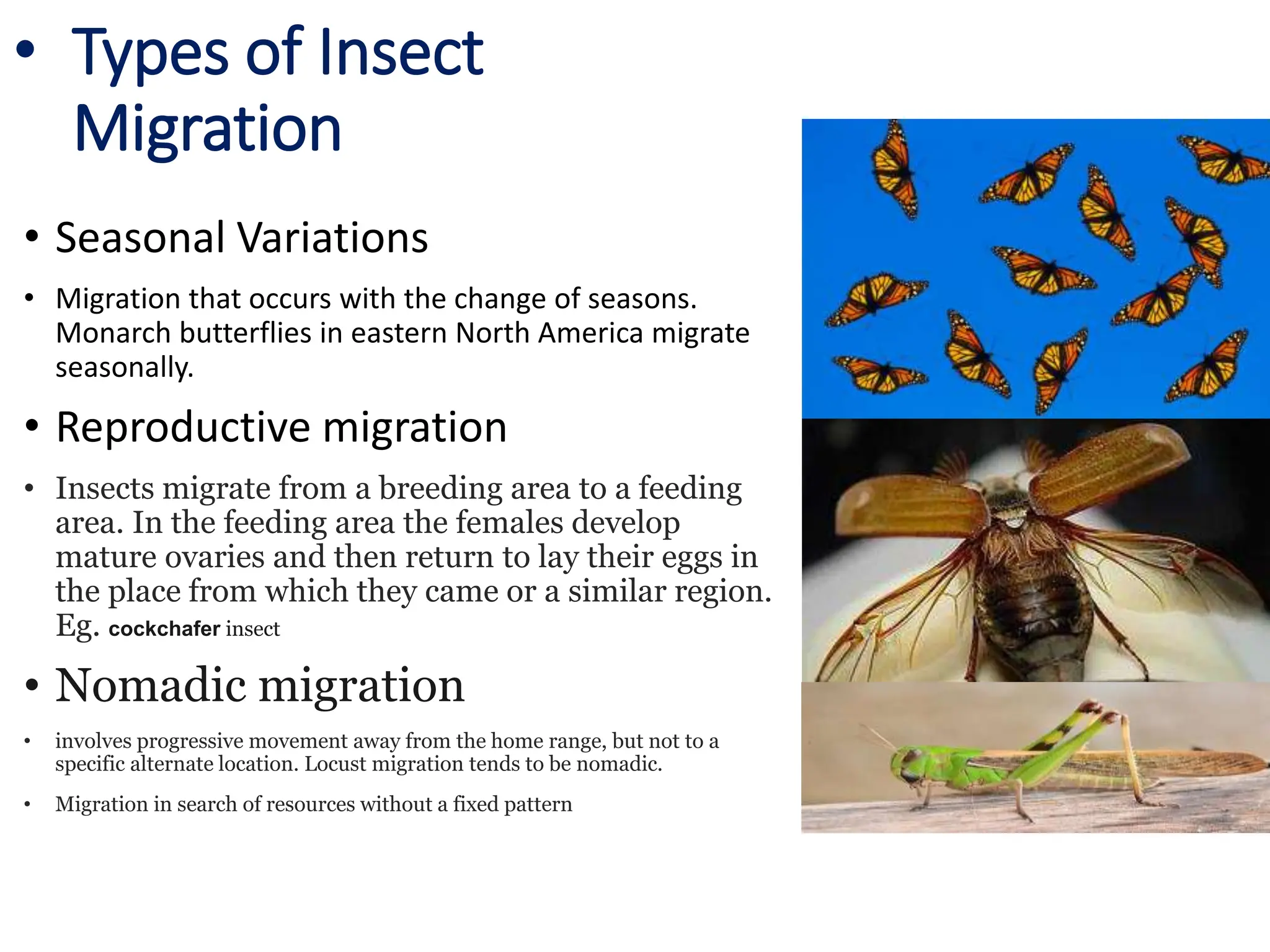
• Seasonal Variations
• Migration that occurs with the change of seasons.
Monarch butterflies in eastern North America migrate
seasonally.
• Reproductive migration
• Insects migrate from a breeding area to a feeding
area. In the feeding area the females develop
mature ovaries and then return to lay their eggs in
the place from which they came or a similar region.
Eg. cockchafer insect
• Nomadic migration
• involves progressive movement away from the home range, but not to a
specific alternate location. Locust migration tends to be nomadic.
• Migration in search of resources without a fixed pattern
• Control of Migratory Behaviour
• In Oncopeltus flight behaviour is stimulated by intermediate level of
JH
• JH increases more quickly in insects exposed to long day lengths than
short day.
• At low JH concentration flight behaviour increases
• At high JH concentration oogenesis occurs and flight behavior come
to end
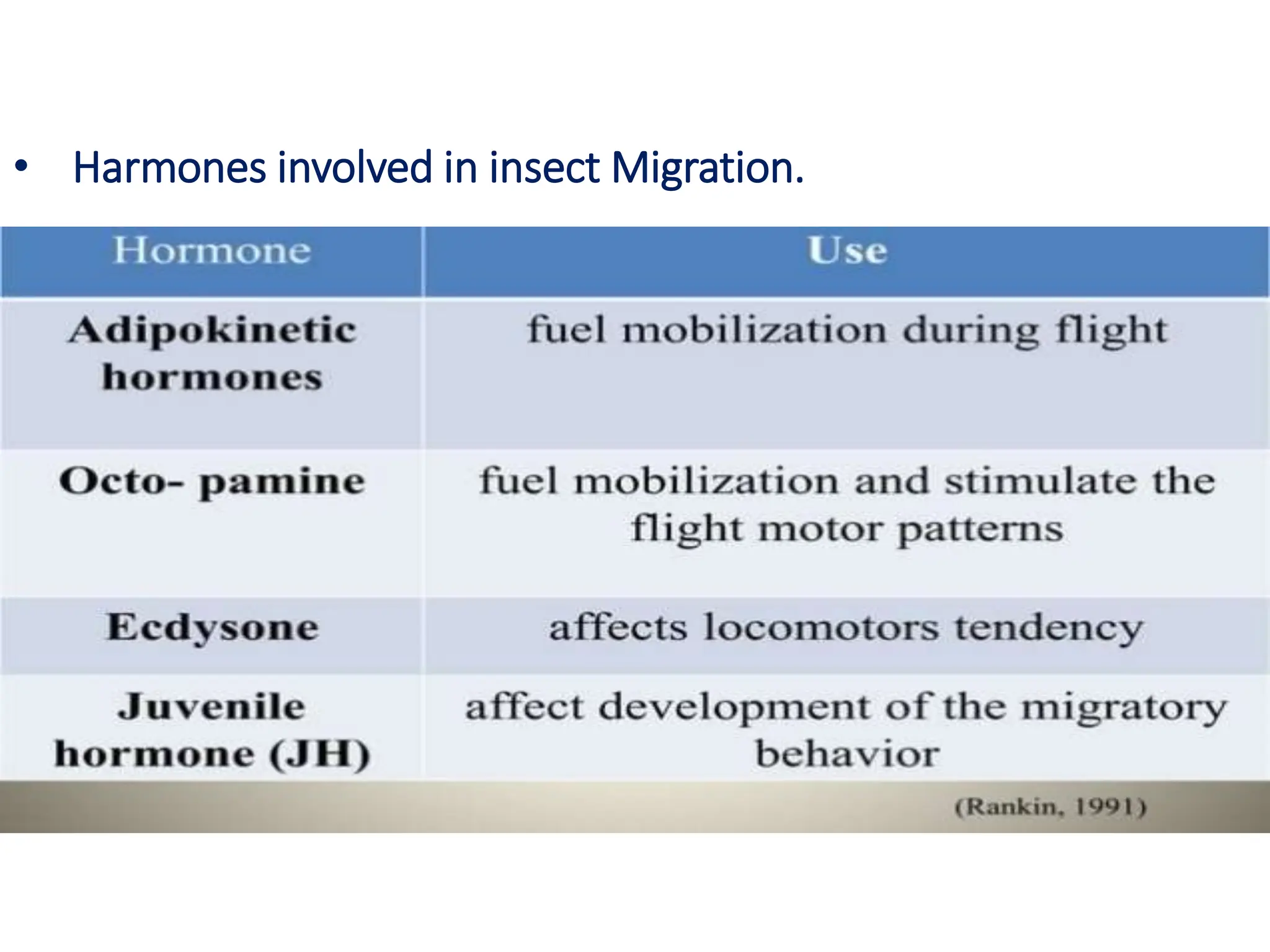
• Harmones involved in insect Migration.
• The Phenomenon of Butterfly Migration
• Monarch Butterfly Migration
• Every year as it gets colder, North American monarch butterflies
migrate south between August and October.
• Monarchs that spend the summer breeding west of the
Rocky Mountains tend to migrate to California coasts,
while monarchs breeding further east migrate to Mexico.
• They Cover up to 3,000 miles from North America to
central Mexico.
• Once spring begins, these butterflies migrate north to
start the breeding season all over again.
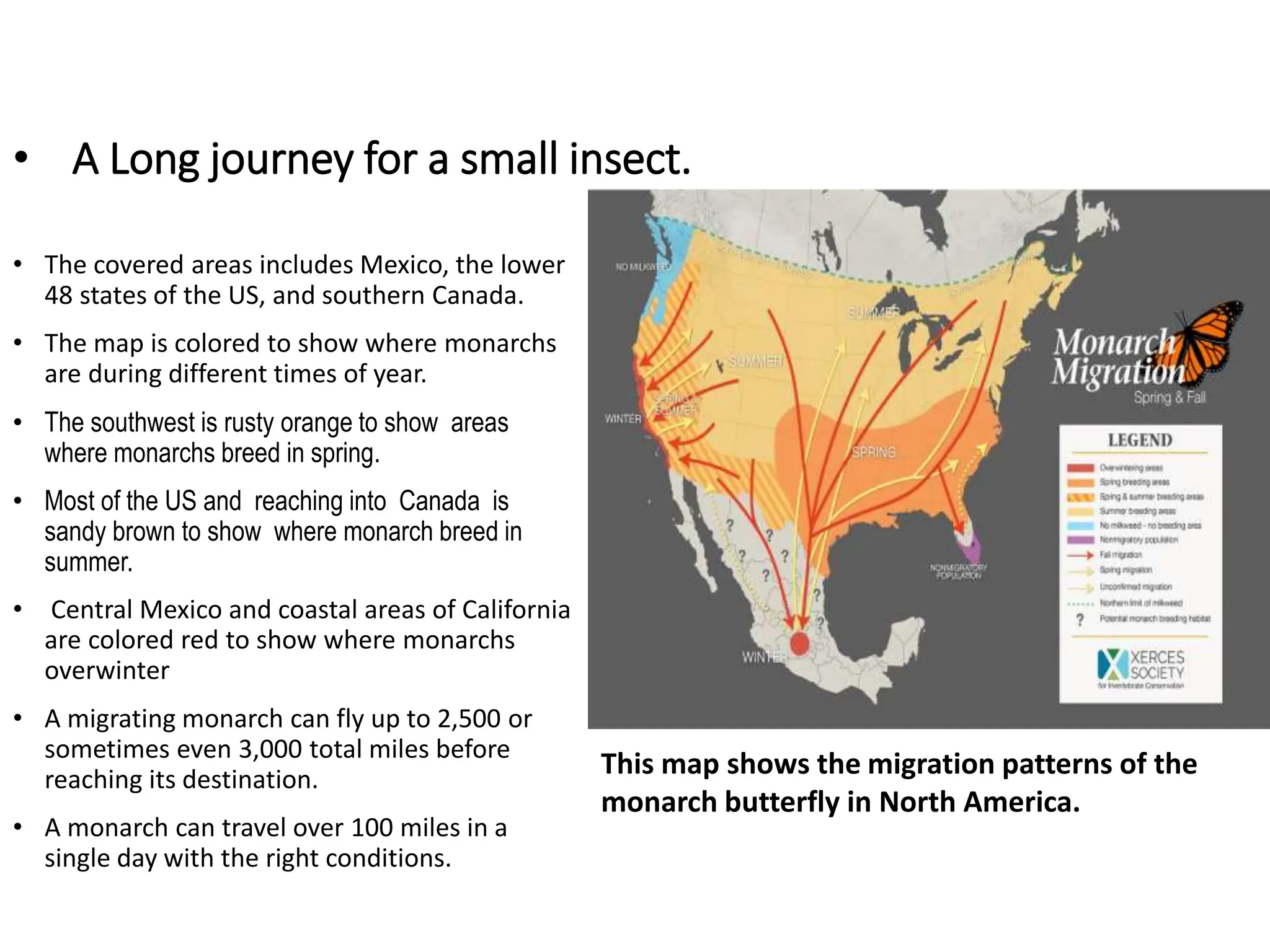
• A Long journey for a small insect.
• The covered areas includes Mexico, the lower
48 states of the US, and southern Canada.
• The map is colored to show where monarchs
are during different times of year.
• The southwest is rusty orange to show areas
where monarchs breed in spring.
• Most of the US and reaching into Canada is
sandy brown to show where monarch breed in
summer.
• Central Mexico and coastal areas of California
are colored red to show where monarchs
overwinter
• A migrating monarch can fly up to 2,500 or
sometimes even 3,000 total miles before
reaching its destination.
• A monarch can travel over 100 miles in a
single day with the right conditions.
This map shows the migration patterns of the
monarch butterfly in North America.
• The locust inhabit the dry areas of North Central
Africa to midlle East Arabia and India
• Desert locusts form enormous swarms that can
consist of millions of individuals
• Swarms cover extensive distances, moving
across continents in search of suitable breeding
grounds and food sources.
• Desert locusts can consume the approximate
equivalent of their body mass each day (2g) in
green vegetation: leaves, flowers, bark, stems,
fruit, and seeds.
• Migration occur for breeding and food.
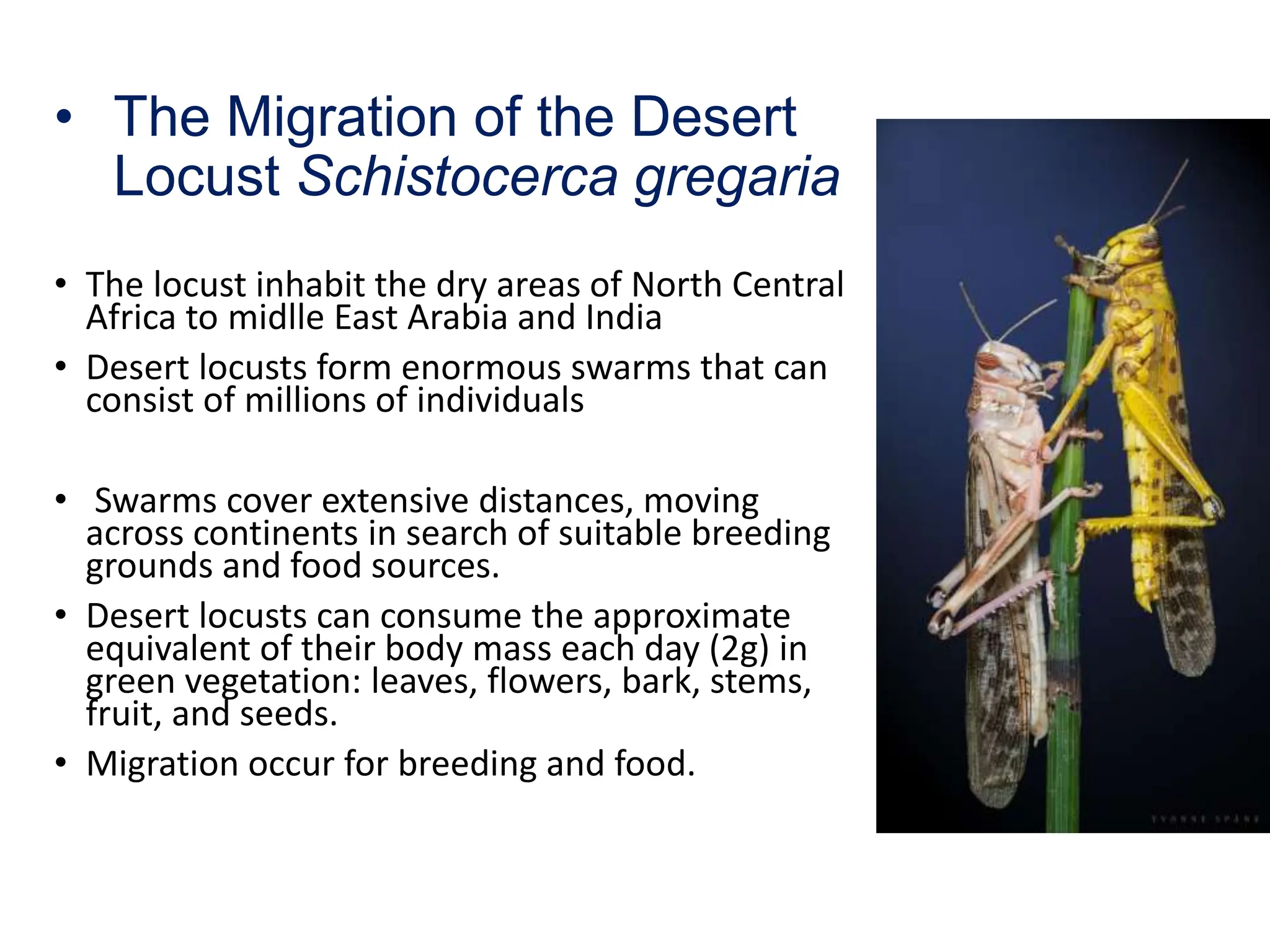
• The Migration of the Desert
Locust Schistocerca gregaria
• Impacts of Desert locust migration
• In km² Swarm Around 1 billion Locusts present.
• In India Rajasthan, Madhya Pradesh, Punjab, Gujarat, Uttar
Pradesh, Maharashtra, Chhattisgarh, Bihar, Haryana and
Uttarakhand, are the major States where locust swarns are
found.
• Agricultural Devastation
• Locust swarms destroy crops, they eat up the plants of crops
which affects the agricultural production.
• Economic Losses
• Massive crop damage leads to substantial economic losses for
farmers, ultimately impacting economy of the particular area.
• Control Challenges
• Controlling locust swarms is challenging, requiring coordinated
efforts Pesticide use,
• Navigation and Orientation
• Visual Landmarks
• Insects use visual cues like mountains, rivers, or distinctive features to navigate
during migration.
• Celestial Guidance
• They rely on the sun, moon, or stars to maintain direction, making use of celestial
cues for orientation.
• Magnetic Sensitivity
• Certain insects possess the ability to sense Earth’s magnetic field, acting like an
internal compass for navigation.
• Challenges During Migration
• Predator Threats
• Migrating insects face risks from predators, such as birds and other insects, which can impact
their journey.
• Weather Hazards
• Adverse weather conditions, including storms and strong winds, pose challenges during
migration.
• Human-Induced Obstacles
• Urbanization, deforestation, and other human activities disrupt traditional migration routes,
affecting insect populations.
• Climate Change Impact
• Changes in climate patterns can disrupt established migration routines, affecting the timing
and success of journeys.
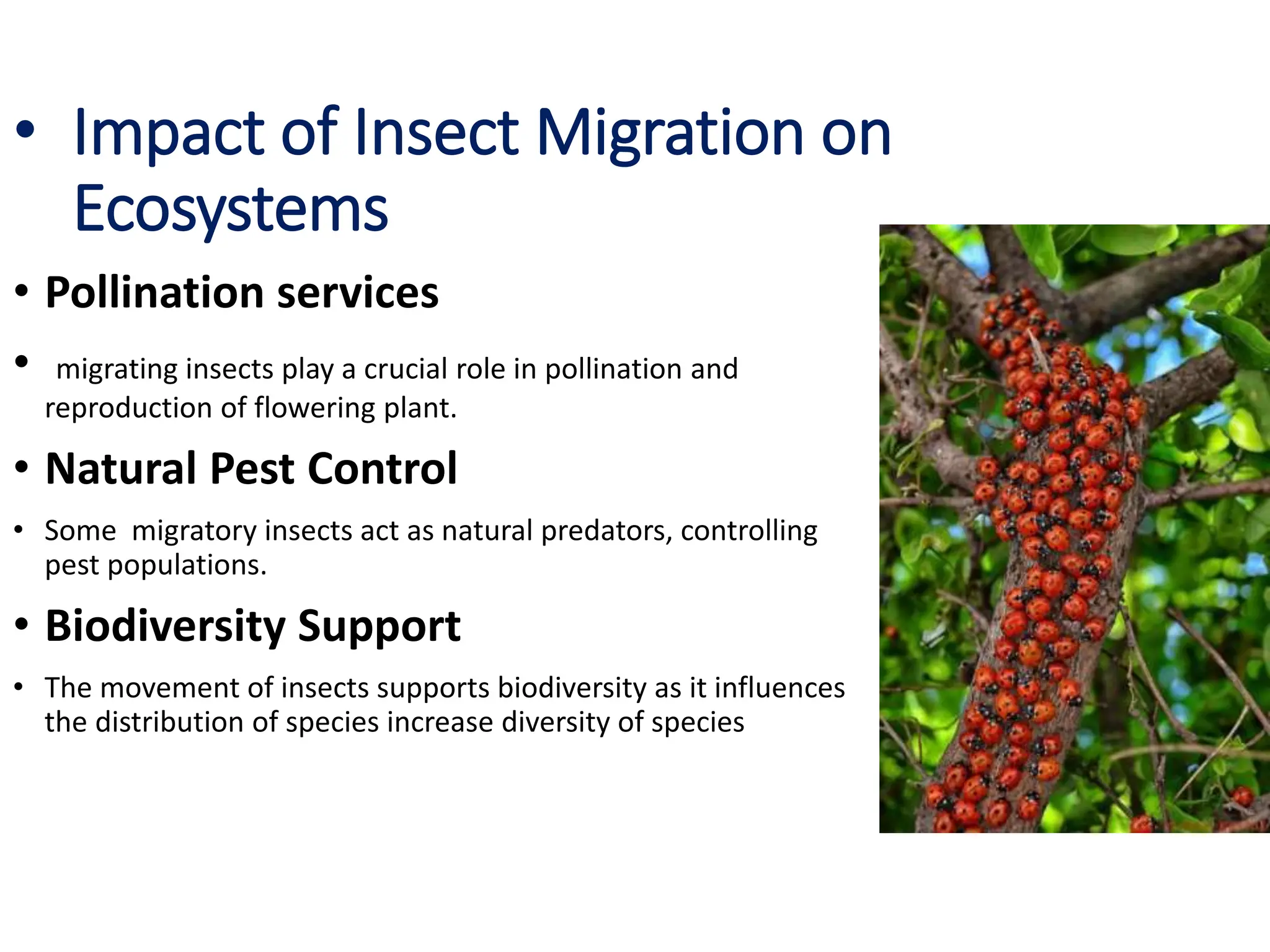
• Impact of Insect Migration on
Ecosystems
• Pollination services
• migrating insects play a crucial role in pollination and
reproduction of flowering plant.
• Natural Pest Control
• Some migratory insects act as natural predators, controlling
pest populations.
• Biodiversity Support
• The movement of insects supports biodiversity as it influences
the distribution of species increase diversity of species
• Some well known Migratory
insects with pictures
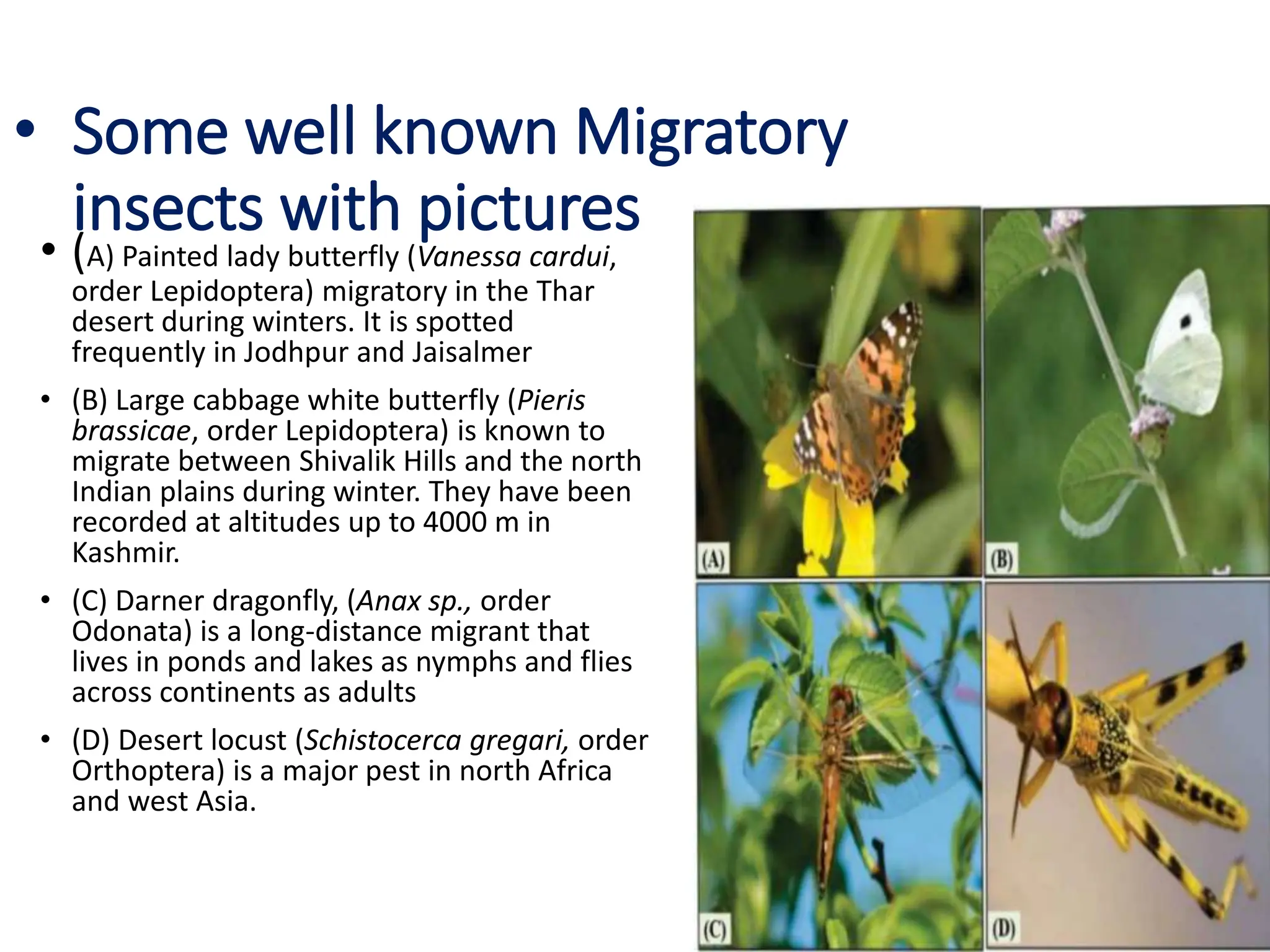
• (A) Painted lady butterfly (Vanessa cardui,
order Lepidoptera) migratory in the Thar
desert during winters. It is spotted
frequently in Jodhpur and Jaisalmer
• (B) Large cabbage white butterfly (Pieris
brassicae, order Lepidoptera) is known to
migrate between Shivalik Hills and the north
Indian plains during winter. They have been
recorded at altitudes up to 4000 m in
Kashmir.
• (C) Darner dragonfly, (Anax sp., order
Odonata) is a long-distance migrant that
lives in ponds and lakes as nymphs and flies
across continents as adults
• (D) Desert locust (Schistocerca gregari, order
Orthoptera) is a major pest in north Africa
and west Asia.
• Methods of studying insect
Migration 🦋
• Tagging
• Monarch butterfly migration can be studied by using
tagging called monarch tag (shown in fig A)
• This tag is used to discover monarch routes and
speed.
• Tracking
• Movement paths are usually characterized by video.
Insect positions at different intervals can be recorded
digitally.
• Vertical Looking Radar (VLR)
• Insects those reach heights can be monitored by VLR.
(Shown in fig B)
• Conclusion.
• Migration is of primary remarkable feature of insects to
overcome adverse climatic conditions.
• Migration also occurs due to unavailability of food sources.
• Insect migration is regulated by hormones.
• Detailed Observation is required to clearly understand the
cause of migration in insects.
• Insect migration have it’s positive as well as Negative
impacts on ecosystem.
• References
• C. Kremen, R. S. Ostfeld, Front. Ecol. Environ. 3, 540 (2005).
• Evolution of insect migration And Diapause by Haugh Dingle
• Insect Migration by C B Williams.
• . E. G. Oliveira, R. B. Srygley, R. Dudley, J. Exp. Biol. 203317 (1998).
• W. W. Cochran, H. Mouritsen, M. Wikelski, Science 304,405 (2004).
• Insect migrations. Pdf by Suluguri Ramesh
(https://www.researchgate.net/publication/326224328_insect_migrations)
• Ramesh , T., Jahir Hussain, K., Satpathy,K.K and Selvanayagam M. 2012. A Note on
Annual Bidirectional Movement of Butterflies of southeastern plains of India Research in
zoology. 2.(2):1-6
• Holland, R.A., Wikelski, M., and Wilcove, D.S. 2006. How and why do insects
migrate?Science. 313: 794–96.Howard,E. and Davis, A.K. 200.
• Migratory Insects of North America, by Mike Quinn, Texas A&M University, accessed May
7, 2012.
• For pictures Pinterest
THANK YOU

Insect Migration and displacement .pptx

  • 1.
    Insect Migration AndDisplacement AligarhMuslim university Department of zoology Section: Entomology Presentedby: AhteshamulHaq Class: M.Sc.Zoology (IVsemester) Enrolmentno.: GL6155 Facultyno.: 22ZYMLA129
  • 2.
    • Introduction toInsect migration • What is Migration ? • Movement of Population of insect from one habitat to another, usually based on seasonality. • There are several factors behind these insect migrations and have implications in the world of zoology.
  • 3.
    • Why InsectsMigrate? • Environment influences. • migration response to changing seasons, ensuring favorable conditions for survival, reproduction, and feeding. • Reproductive Success • To find optimal breeding grounds. Increasing the chances of reproductive success. • Change in climate • Includes the migration of insects respond to changing climate. Eg seasonal migration • Population Dynamics and Evolutionary significance • Helps in regulating insect population densities, preventing overpopulation in specific areas. • Act as an evolutionary strategy that balances short-term benefits with longer- term advantages.
  • 4.
    • Types ofInsect Migration • Seasonal Variations • Migration that occurs with the change of seasons. Monarch butterflies in eastern North America migrate seasonally. • Reproductive migration • Insects migrate from a breeding area to a feeding area. In the feeding area the females develop mature ovaries and then return to lay their eggs in the place from which they came or a similar region. Eg. cockchafer insect • Nomadic migration • involves progressive movement away from the home range, but not to a specific alternate location. Locust migration tends to be nomadic. • Migration in search of resources without a fixed pattern
  • 5.
    • Control ofMigratory Behaviour • In Oncopeltus flight behaviour is stimulated by intermediate level of JH • JH increases more quickly in insects exposed to long day lengths than short day. • At low JH concentration flight behaviour increases • At high JH concentration oogenesis occurs and flight behavior come to end
  • 6.
    • Harmones involvedin insect Migration.
  • 7.
    • The Phenomenonof Butterfly Migration • Monarch Butterfly Migration • Every year as it gets colder, North American monarch butterflies migrate south between August and October. • Monarchs that spend the summer breeding west of the Rocky Mountains tend to migrate to California coasts, while monarchs breeding further east migrate to Mexico. • They Cover up to 3,000 miles from North America to central Mexico. • Once spring begins, these butterflies migrate north to start the breeding season all over again.
  • 8.
    • A Longjourney for a small insect. • The covered areas includes Mexico, the lower 48 states of the US, and southern Canada. • The map is colored to show where monarchs are during different times of year. • The southwest is rusty orange to show areas where monarchs breed in spring. • Most of the US and reaching into Canada is sandy brown to show where monarch breed in summer. • Central Mexico and coastal areas of California are colored red to show where monarchs overwinter • A migrating monarch can fly up to 2,500 or sometimes even 3,000 total miles before reaching its destination. • A monarch can travel over 100 miles in a single day with the right conditions. This map shows the migration patterns of the monarch butterfly in North America.
  • 9.
    • The locustinhabit the dry areas of North Central Africa to midlle East Arabia and India • Desert locusts form enormous swarms that can consist of millions of individuals • Swarms cover extensive distances, moving across continents in search of suitable breeding grounds and food sources. • Desert locusts can consume the approximate equivalent of their body mass each day (2g) in green vegetation: leaves, flowers, bark, stems, fruit, and seeds. • Migration occur for breeding and food. • The Migration of the Desert Locust Schistocerca gregaria
  • 10.
    • Impacts ofDesert locust migration • In km² Swarm Around 1 billion Locusts present. • In India Rajasthan, Madhya Pradesh, Punjab, Gujarat, Uttar Pradesh, Maharashtra, Chhattisgarh, Bihar, Haryana and Uttarakhand, are the major States where locust swarns are found. • Agricultural Devastation • Locust swarms destroy crops, they eat up the plants of crops which affects the agricultural production. • Economic Losses • Massive crop damage leads to substantial economic losses for farmers, ultimately impacting economy of the particular area. • Control Challenges • Controlling locust swarms is challenging, requiring coordinated efforts Pesticide use,
  • 11.
    • Navigation andOrientation • Visual Landmarks • Insects use visual cues like mountains, rivers, or distinctive features to navigate during migration. • Celestial Guidance • They rely on the sun, moon, or stars to maintain direction, making use of celestial cues for orientation. • Magnetic Sensitivity • Certain insects possess the ability to sense Earth’s magnetic field, acting like an internal compass for navigation.
  • 12.
    • Challenges DuringMigration • Predator Threats • Migrating insects face risks from predators, such as birds and other insects, which can impact their journey. • Weather Hazards • Adverse weather conditions, including storms and strong winds, pose challenges during migration. • Human-Induced Obstacles • Urbanization, deforestation, and other human activities disrupt traditional migration routes, affecting insect populations. • Climate Change Impact • Changes in climate patterns can disrupt established migration routines, affecting the timing and success of journeys.
  • 13.
    • Impact ofInsect Migration on Ecosystems • Pollination services • migrating insects play a crucial role in pollination and reproduction of flowering plant. • Natural Pest Control • Some migratory insects act as natural predators, controlling pest populations. • Biodiversity Support • The movement of insects supports biodiversity as it influences the distribution of species increase diversity of species
  • 14.
    • Some wellknown Migratory insects with pictures • (A) Painted lady butterfly (Vanessa cardui, order Lepidoptera) migratory in the Thar desert during winters. It is spotted frequently in Jodhpur and Jaisalmer • (B) Large cabbage white butterfly (Pieris brassicae, order Lepidoptera) is known to migrate between Shivalik Hills and the north Indian plains during winter. They have been recorded at altitudes up to 4000 m in Kashmir. • (C) Darner dragonfly, (Anax sp., order Odonata) is a long-distance migrant that lives in ponds and lakes as nymphs and flies across continents as adults • (D) Desert locust (Schistocerca gregari, order Orthoptera) is a major pest in north Africa and west Asia.
  • 15.
    • Methods ofstudying insect Migration 🦋 • Tagging • Monarch butterfly migration can be studied by using tagging called monarch tag (shown in fig A) • This tag is used to discover monarch routes and speed. • Tracking • Movement paths are usually characterized by video. Insect positions at different intervals can be recorded digitally. • Vertical Looking Radar (VLR) • Insects those reach heights can be monitored by VLR. (Shown in fig B)
  • 16.
    • Conclusion. • Migrationis of primary remarkable feature of insects to overcome adverse climatic conditions. • Migration also occurs due to unavailability of food sources. • Insect migration is regulated by hormones. • Detailed Observation is required to clearly understand the cause of migration in insects. • Insect migration have it’s positive as well as Negative impacts on ecosystem.
  • 17.
    • References • C.Kremen, R. S. Ostfeld, Front. Ecol. Environ. 3, 540 (2005). • Evolution of insect migration And Diapause by Haugh Dingle • Insect Migration by C B Williams. • . E. G. Oliveira, R. B. Srygley, R. Dudley, J. Exp. Biol. 203317 (1998). • W. W. Cochran, H. Mouritsen, M. Wikelski, Science 304,405 (2004). • Insect migrations. Pdf by Suluguri Ramesh (https://www.researchgate.net/publication/326224328_insect_migrations) • Ramesh , T., Jahir Hussain, K., Satpathy,K.K and Selvanayagam M. 2012. A Note on Annual Bidirectional Movement of Butterflies of southeastern plains of India Research in zoology. 2.(2):1-6 • Holland, R.A., Wikelski, M., and Wilcove, D.S. 2006. How and why do insects migrate?Science. 313: 794–96.Howard,E. and Davis, A.K. 200. • Migratory Insects of North America, by Mike Quinn, Texas A&M University, accessed May 7, 2012. • For pictures Pinterest
  • 18.