Poultry Cookery
Poultry Basics
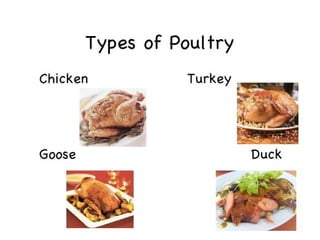
What is Poultry
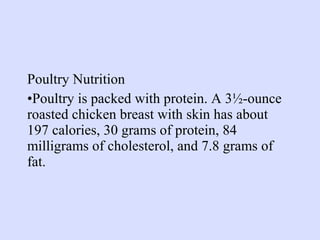
• Chicken
• Duck
• Goose
• Turkey
• Pigeon
• There are different classes of poultry
• These are usually based on the birds
age and gender.
•Poultry is similar to meat in
structure. Both poultry and
meat are made up of
muscle, connective tissue,
fat, and bone. Poultry flesh
is made up of protein, water,
and fat. The fat in all types
of poultry is found just
underneath the skin.
Poultry Nutrition
•Poultry is packed with protein. A 3½-ounce
roasted chicken breast with skin has about
197 calories, 30 grams of protein, 84
milligrams of cholesterol, and 7.8 grams of
fat.
The United States Department of Agriculture
(USDA) categorizes poultry according to
species, or kind. The kinds of poultry include
chicken, turkey, goose, duck, pigeon, and
guinea. Each kind of poultry is divided into
different classes based on the age and gender
of the bird. (See Figure 22.1.)
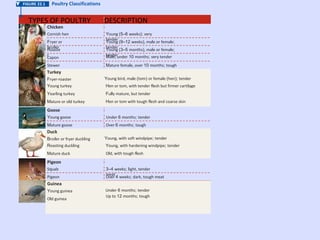
TYPES OF POULTRY DESCRIPTION
Chicken
Cornish hen Young (5–6 weeks); very
tender
Fryer or
broiler
Young (9–12 weeks), male or female;
tender
Roaste
r
Young (3–5 months), male or female;
tender
Capon Male, under 10 months; very tender
Stewer Mature female, over 10 months; tough
Turkey
Fryer-roaster Young bird, male (tom) or female (hen); tender
Young turkey
Yearling turkey
Mature or old turkey
Hen or tom, with tender flesh but firmer cartilage
Fully mature, but tender
Hen or tom with tough flesh and coarse skin
Goose
Young goose Under 6 months; tender
Mature goose Over 6 months; tough
Duck
Broiler or fryer duckling Young, with soft windpipe; tender
Roasting duckling
Mature duck
Young, with hardening windpipe; tender
Old, with tough flesh
Pigeon
Squab 3–4 weeks; light, tender
meat
Pigeon Over 4 weeks; dark, tough meat
Guinea
Young guinea
Old guinea
Under 6 months; tender
Up to 12 months; tough
FIGURE 22.1 Poultry Classifications
Maturity and Tenderness
The older the bird the
tougher the meat
We want to select birds that
are younger and less mature.
The older the bird the more
muscle they will have built.
This causes the meat to be
tough.
Dark vs. Light Meat
• Birds that rarely fly have light colored
wing and breast meat. (Chickens and
Turkey)
• Light meat has less fat and cooks faster
than dark meat.
• Parts of the bird that has more muscle
(connective tissue) are darker in color.
• The thighs and legs have more muscle.
(Dark Meat)
• These parts take longer to cook.
• Duck and Goose are composed mostly of
dark meat.
Purchasing Poultry
• Poultry can be purchased in
different forms.
• You can buy fresh, frozen, or fully
cooked.
• When poultry is prepared and
ready to cook it is called ready to
cook or RTC.
• Class depends on age and gender.
• Male birds have tougher meat
than female birds.
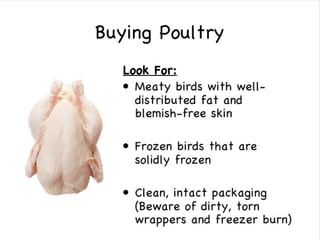
• Judging Quality:
• Check color: should be cream to
yellow, Avoid birds with purple
or green bruising, dark wing
tips, these are indications of
spoilage.
• Check odor: Uncooked poultry
should not have a strong odor or
feel sticky.
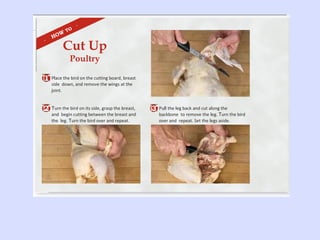
Place the bird on the cutting board, breast
side down, and remove the wings at the
joint.
1
Turn the bird on its side, grasp the breast,
and begin cutting between the breast and
the leg. Turn the bird over and repeat.
2 Pull the leg back and cut along the
backbone to remove the leg. Turn the bird
over and repeat. Set the legs aside.
3
Cut Up
Poultry
·
HOW
TO
·
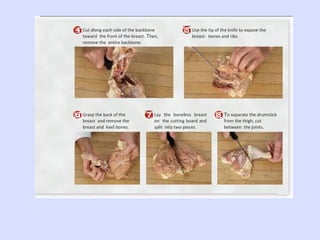
Cut along each side of the backbone
toward the front of the breast. Then,
remove the entire backbone.
4 Use the tip of the knife to expose the
breast- bones and ribs.
5
Grasp the back of the
breast and remove the
breast and keel bones.
6 Lay the boneless breast
on the cutting board and
split into two pieces.
7 To separate the drumstick
from the thigh, cut
between the joints.
8
1
2
3
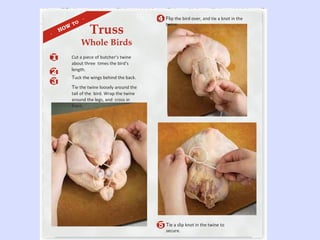
Tie a slip knot in the twine to
secure.
5
Truss
Whole Birds
Cut a piece of butcher’s twine
about three times the bird’s
length.
Tuck the wings behind the back.
Tie the twine loosely around the
tail of the bird. Wrap the twine
around the legs, and cross in
front.
Flip the bird over, and tie a knot in the
twine.
4
·
HOW
TO
·
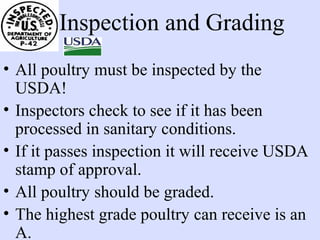
Inspection and Grading
• All poultry must be inspected by the
USDA!
• Inspectors check to see if it has been
processed in sanitary conditions.
• If it passes inspection it will receive USDA
stamp of approval.
• All poultry should be graded.
• The highest grade poultry can receive is an
A.
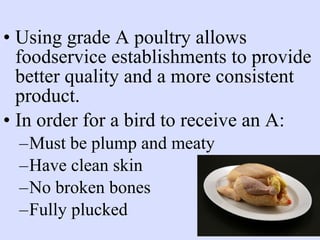
• Using grade A poultry allows
foodservice establishments to provide
better quality and a more consistent
product.
• In order for a bird to receive an A:
–Must be plump and meaty
–Have clean skin
–No broken bones
–Fully plucked
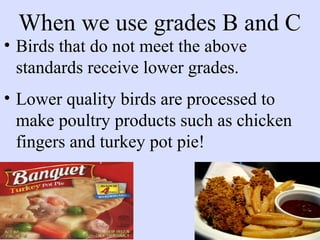
When we use grades B and C
• Birds that do not meet the above
standards receive lower grades.
• Lower quality birds are processed to
make poultry products such as chicken
fingers and turkey pot pie!
Handling and Storage
• Fresh and Frozen poultry must be handled
very carefully.
• Poultry should be frozen immediately if it
is not going to be used right away.
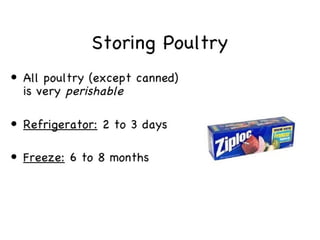
• Fresh poultry should be used within 2-3
days.
• Store frozen poultry below 0 degrees F
• Thawing poultry should be done in the
refrigerator.
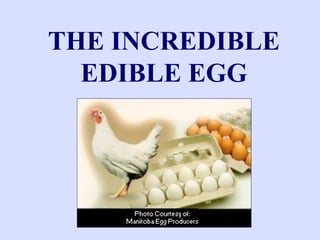
THE INCREDIBLE
EDIBLE EGG
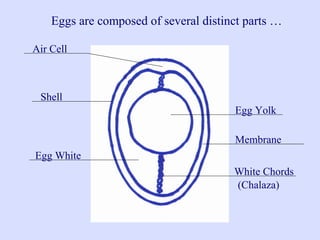
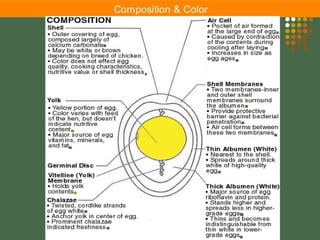
Shell
Membrane
Egg White
Egg Yolk
White Chords
Air Cell
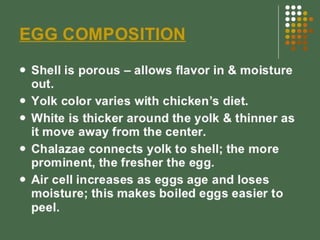
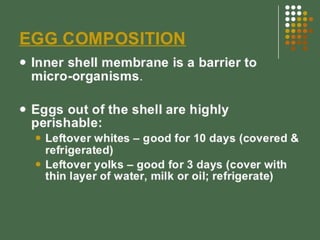
Eggs are composed of several distinct parts …
(Chalaza)
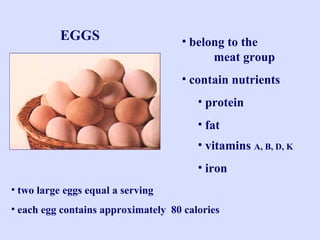
• belong to the
meat group
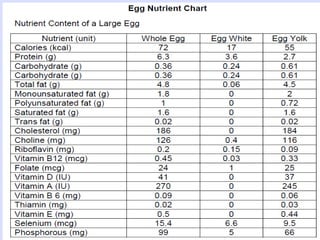
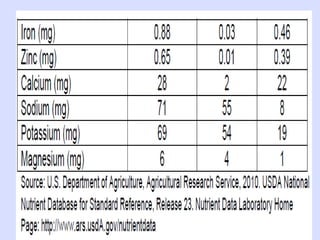
• contain nutrients
• protein
• fat
• vitamins A, B, D, K
• iron
EGGS
• two large eggs equal a serving
• each egg contains approximately 80 calories
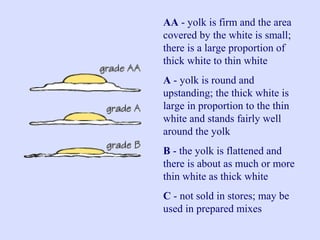
AA - yolk is firm and the area
covered by the white is small;
there is a large proportion of
thick white to thin white
A - yolk is round and
upstanding; the thick white is
large in proportion to the thin
white and stands fairly well
around the yolk
B - the yolk is flattened and
there is about as much or more
thin white as thick white
C - not sold in stores; may be
used in prepared mixes
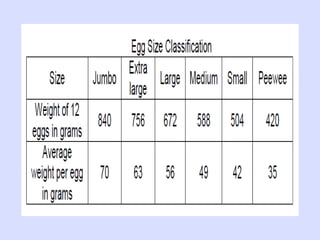
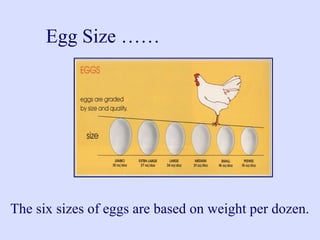
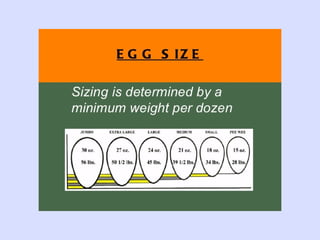
The six sizes of eggs are based on weight per dozen.
Egg Size ……
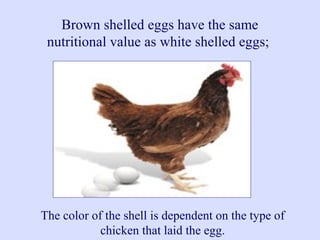
Brown shelled eggs have the same
nutritional value as white shelled eggs;
The color of the shell is dependent on the type of
chicken that laid the egg.
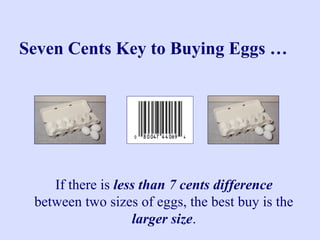
Seven Cents Key to Buying Eggs …
If there is less than 7 cents difference
between two sizes of eggs, the best buy is the
larger size.
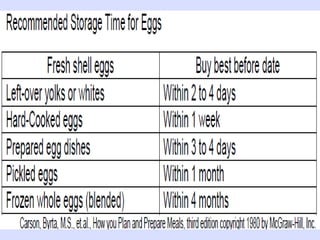
Egg Storage
• Store in the refrigerator for 4 to 5 weeks
• Store in the original carton with the blunt
side up
• Do not wash until ready to use
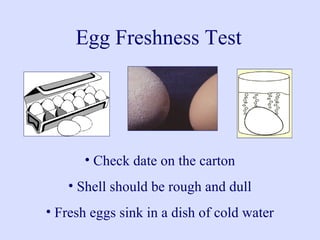
Egg Freshness Test
• Check date on the carton
• Shell should be rough and dull
• Fresh eggs sink in a dish of cold water
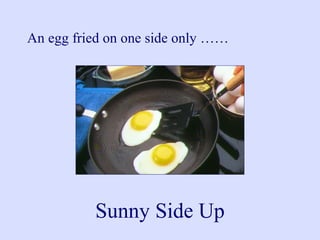
An egg fried on one side only ……
Sunny Side Up
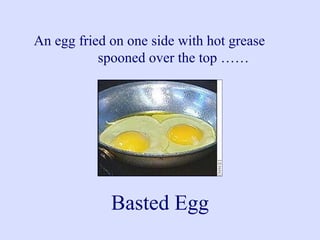
An egg fried on one side with hot grease
spooned over the top ……
Basted Egg
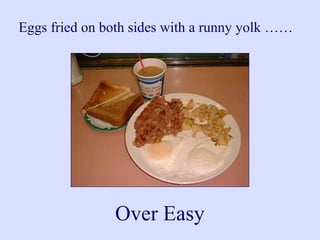
Eggs fried on both sides with a runny yolk ……
Over Easy
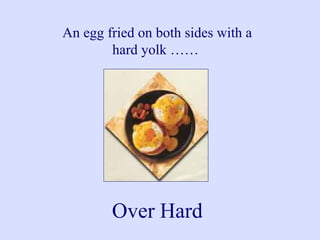
Over Hard
An egg fried on both sides with a
hard yolk ……
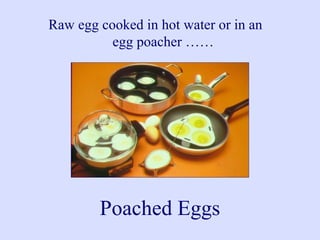
Raw egg cooked in hot water or in an
egg poacher ……
Poached Eggs
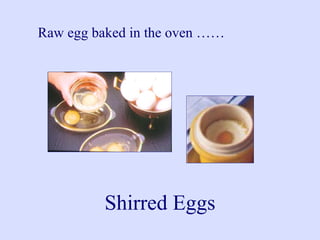
Shirred Eggs
Raw egg baked in the oven ……
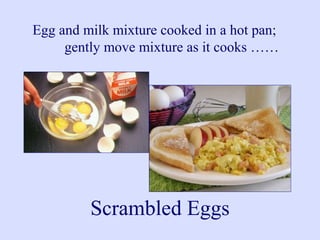
Egg and milk mixture cooked in a hot pan;
gently move mixture as it cooks ……
Scrambled Eggs
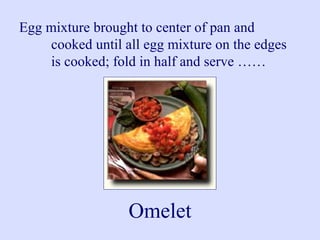
Egg mixture brought to center of pan and
cooked until all egg mixture on the edges
is cooked; fold in half and serve ……
Omelet
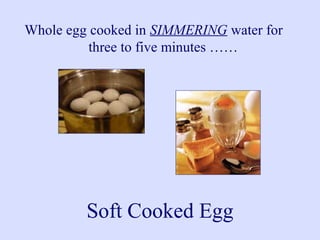
Whole egg cooked in SIMMERING water for
three to five minutes ……
Soft Cooked Egg
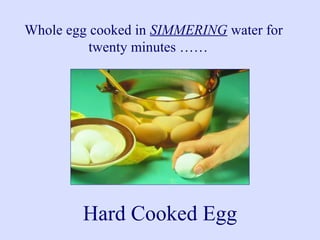
Whole egg cooked in SIMMERING water for
twenty minutes ……
Hard Cooked Egg
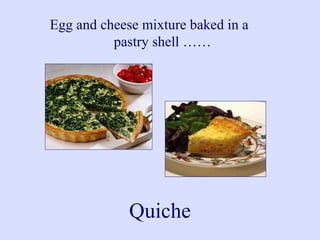
Egg and cheese mixture baked in a
pastry shell ……
Quiche
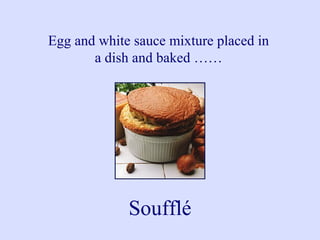
Egg and white sauce mixture placed in
a dish and baked ……
Soufflé
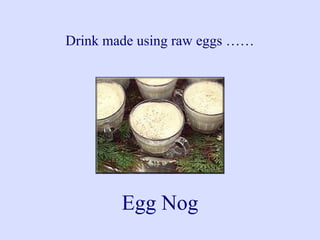
Drink made using raw eggs ……
Egg Nog
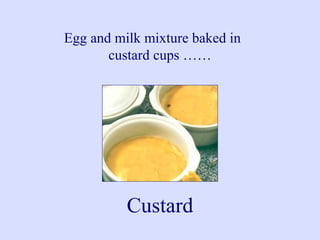
Egg and milk mixture baked in
custard cups ……
Custard
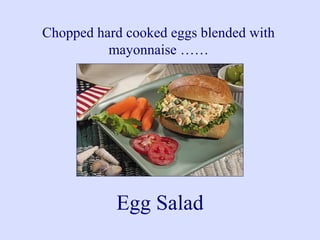
Chopped hard cooked eggs blended with
mayonnaise ……
Egg Salad
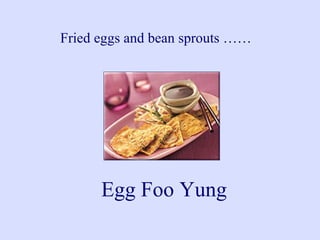
Fried eggs and bean sprouts ……
Egg Foo Yung
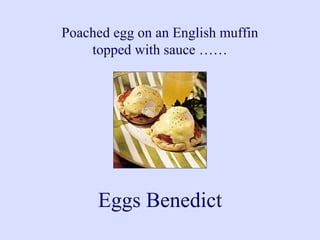
Poached egg on an English muffin
topped with sauce ……
Eggs Benedict
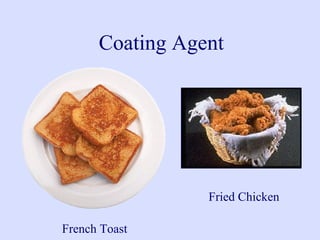
Coating Agent
French Toast
Fried Chicken
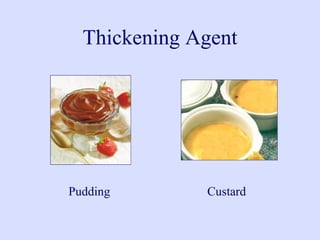
Thickening Agent
Pudding Custard
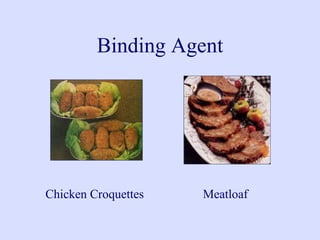
Binding Agent
Chicken Croquettes Meatloaf
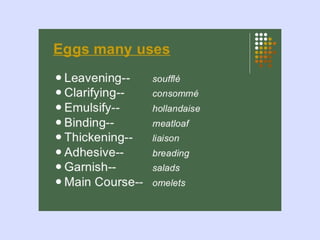
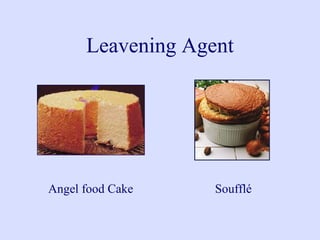
Leavening Agent
Angel food Cake Soufflé
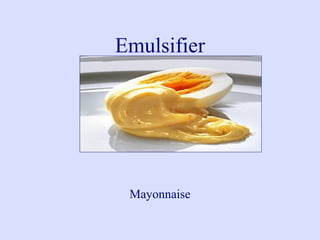
Emulsifier
Mayonnaise
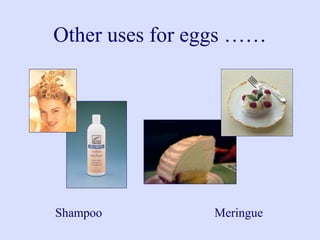
Other uses for eggs ……
Shampoo Meringue

Egg cookery ppt

  • 1.
  • 2.
    What is Poultry •Chicken • Duck • Goose • Turkey • Pigeon • There are different classes of poultry • These are usually based on the birds age and gender.
  • 3.
    •Poultry is similarto meat in structure. Both poultry and meat are made up of muscle, connective tissue, fat, and bone. Poultry flesh is made up of protein, water, and fat. The fat in all types of poultry is found just underneath the skin.
  • 4.
    Poultry Nutrition •Poultry ispacked with protein. A 3½-ounce roasted chicken breast with skin has about 197 calories, 30 grams of protein, 84 milligrams of cholesterol, and 7.8 grams of fat.
  • 6.
    The United StatesDepartment of Agriculture (USDA) categorizes poultry according to species, or kind. The kinds of poultry include chicken, turkey, goose, duck, pigeon, and guinea. Each kind of poultry is divided into different classes based on the age and gender of the bird. (See Figure 22.1.)
  • 7.
    TYPES OF POULTRYDESCRIPTION Chicken Cornish hen Young (5–6 weeks); very tender Fryer or broiler Young (9–12 weeks), male or female; tender Roaste r Young (3–5 months), male or female; tender Capon Male, under 10 months; very tender Stewer Mature female, over 10 months; tough Turkey Fryer-roaster Young bird, male (tom) or female (hen); tender Young turkey Yearling turkey Mature or old turkey Hen or tom, with tender flesh but firmer cartilage Fully mature, but tender Hen or tom with tough flesh and coarse skin Goose Young goose Under 6 months; tender Mature goose Over 6 months; tough Duck Broiler or fryer duckling Young, with soft windpipe; tender Roasting duckling Mature duck Young, with hardening windpipe; tender Old, with tough flesh Pigeon Squab 3–4 weeks; light, tender meat Pigeon Over 4 weeks; dark, tough meat Guinea Young guinea Old guinea Under 6 months; tender Up to 12 months; tough FIGURE 22.1 Poultry Classifications
  • 8.
    Maturity and Tenderness Theolder the bird the tougher the meat We want to select birds that are younger and less mature. The older the bird the more muscle they will have built. This causes the meat to be tough.
  • 9.
    Dark vs. LightMeat • Birds that rarely fly have light colored wing and breast meat. (Chickens and Turkey) • Light meat has less fat and cooks faster than dark meat. • Parts of the bird that has more muscle (connective tissue) are darker in color. • The thighs and legs have more muscle. (Dark Meat) • These parts take longer to cook. • Duck and Goose are composed mostly of dark meat.
  • 10.
    Purchasing Poultry • Poultrycan be purchased in different forms. • You can buy fresh, frozen, or fully cooked. • When poultry is prepared and ready to cook it is called ready to cook or RTC. • Class depends on age and gender.
  • 11.
    • Male birdshave tougher meat than female birds. • Judging Quality: • Check color: should be cream to yellow, Avoid birds with purple or green bruising, dark wing tips, these are indications of spoilage. • Check odor: Uncooked poultry should not have a strong odor or feel sticky.
  • 12.
    Place the birdon the cutting board, breast side down, and remove the wings at the joint. 1 Turn the bird on its side, grasp the breast, and begin cutting between the breast and the leg. Turn the bird over and repeat. 2 Pull the leg back and cut along the backbone to remove the leg. Turn the bird over and repeat. Set the legs aside. 3 Cut Up Poultry · HOW TO ·
  • 13.
    Cut along eachside of the backbone toward the front of the breast. Then, remove the entire backbone. 4 Use the tip of the knife to expose the breast- bones and ribs. 5 Grasp the back of the breast and remove the breast and keel bones. 6 Lay the boneless breast on the cutting board and split into two pieces. 7 To separate the drumstick from the thigh, cut between the joints. 8
  • 14.
    1 2 3 Tie a slipknot in the twine to secure. 5 Truss Whole Birds Cut a piece of butcher’s twine about three times the bird’s length. Tuck the wings behind the back. Tie the twine loosely around the tail of the bird. Wrap the twine around the legs, and cross in front. Flip the bird over, and tie a knot in the twine. 4 · HOW TO ·
  • 15.
    Inspection and Grading •All poultry must be inspected by the USDA! • Inspectors check to see if it has been processed in sanitary conditions. • If it passes inspection it will receive USDA stamp of approval. • All poultry should be graded. • The highest grade poultry can receive is an A.
  • 16.
    • Using gradeA poultry allows foodservice establishments to provide better quality and a more consistent product. • In order for a bird to receive an A: –Must be plump and meaty –Have clean skin –No broken bones –Fully plucked
  • 17.
    When we usegrades B and C • Birds that do not meet the above standards receive lower grades. • Lower quality birds are processed to make poultry products such as chicken fingers and turkey pot pie!
  • 18.
    Handling and Storage •Fresh and Frozen poultry must be handled very carefully. • Poultry should be frozen immediately if it is not going to be used right away. • Fresh poultry should be used within 2-3 days. • Store frozen poultry below 0 degrees F • Thawing poultry should be done in the refrigerator.
  • 25.
  • 26.
    Shell Membrane Egg White Egg Yolk WhiteChords Air Cell Eggs are composed of several distinct parts … (Chalaza)
  • 27.
    • belong tothe meat group • contain nutrients • protein • fat • vitamins A, B, D, K • iron EGGS • two large eggs equal a serving • each egg contains approximately 80 calories
  • 34.
    AA - yolkis firm and the area covered by the white is small; there is a large proportion of thick white to thin white A - yolk is round and upstanding; the thick white is large in proportion to the thin white and stands fairly well around the yolk B - the yolk is flattened and there is about as much or more thin white as thick white C - not sold in stores; may be used in prepared mixes
  • 35.
    The six sizesof eggs are based on weight per dozen. Egg Size ……
  • 36.
    Brown shelled eggshave the same nutritional value as white shelled eggs; The color of the shell is dependent on the type of chicken that laid the egg.
  • 37.
    Seven Cents Keyto Buying Eggs … If there is less than 7 cents difference between two sizes of eggs, the best buy is the larger size.
  • 38.
    Egg Storage • Storein the refrigerator for 4 to 5 weeks • Store in the original carton with the blunt side up • Do not wash until ready to use
  • 39.
    Egg Freshness Test •Check date on the carton • Shell should be rough and dull • Fresh eggs sink in a dish of cold water
  • 47.
    An egg friedon one side only …… Sunny Side Up
  • 48.
    An egg friedon one side with hot grease spooned over the top …… Basted Egg
  • 49.
    Eggs fried onboth sides with a runny yolk …… Over Easy
  • 50.
    Over Hard An eggfried on both sides with a hard yolk ……
  • 51.
    Raw egg cookedin hot water or in an egg poacher …… Poached Eggs
  • 52.
    Shirred Eggs Raw eggbaked in the oven ……
  • 53.
    Egg and milkmixture cooked in a hot pan; gently move mixture as it cooks …… Scrambled Eggs
  • 54.
    Egg mixture broughtto center of pan and cooked until all egg mixture on the edges is cooked; fold in half and serve …… Omelet
  • 55.
    Whole egg cookedin SIMMERING water for three to five minutes …… Soft Cooked Egg
  • 56.
    Whole egg cookedin SIMMERING water for twenty minutes …… Hard Cooked Egg
  • 57.
    Egg and cheesemixture baked in a pastry shell …… Quiche
  • 58.
    Egg and whitesauce mixture placed in a dish and baked …… Soufflé
  • 59.
    Drink made usingraw eggs …… Egg Nog
  • 60.
    Egg and milkmixture baked in custard cups …… Custard
  • 61.
    Chopped hard cookedeggs blended with mayonnaise …… Egg Salad
  • 62.
    Fried eggs andbean sprouts …… Egg Foo Yung
  • 63.
    Poached egg onan English muffin topped with sauce …… Eggs Benedict
  • 65.
  • 66.
  • 67.
  • 68.
  • 69.
  • 70.
    Other uses foreggs …… Shampoo Meringue