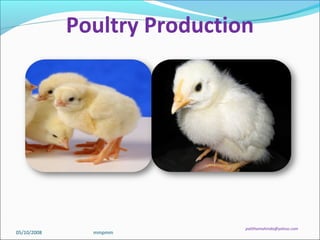
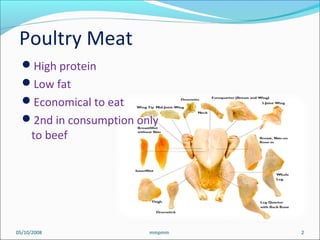
Poultry Production
palithamahinda@yahoo.com
05/10/2008 mmpmm
05/10/2008 2mmpmm
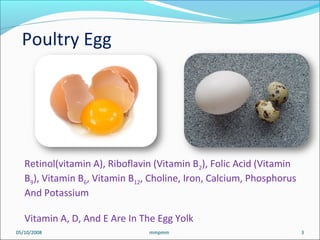
Poultry Meat
High protein
Low fat
Economical to eat
2nd in consumption only
to beef
05/10/2008 mmpmm
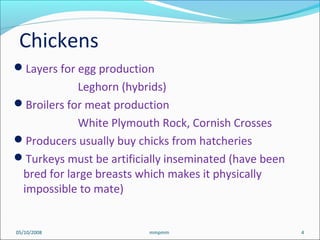
Retinol(vitamin A), Riboflavin (Vitamin B2), Folic Acid (Vitamin
B9), Vitamin B6, Vitamin B12, Choline, Iron, Calcium, Phosphorus
And Potassium
Vitamin A, D, And E Are In The Egg Yolk
Poultry Egg
05/10/2008 3mmpmm
05/10/2008 4mmpmm
Layers for egg production
Leghorn (hybrids)
Broilers for meat production
White Plymouth Rock, Cornish Crosses
Producers usually buy chicks from hatcheries
Turkeys must be artificially inseminated (have been
bred for large breasts which makes it physically
impossible to mate)
Chickens
Cook Hen
05/10/2008 5mmpmm
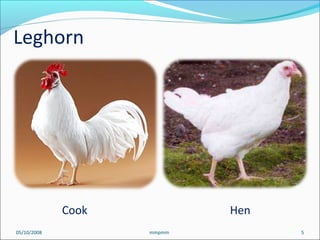
Leghorn
05/10/2008 mmpmm 6
The Leghorn is a breed of chicken with origins in Tuscany,
central Italy
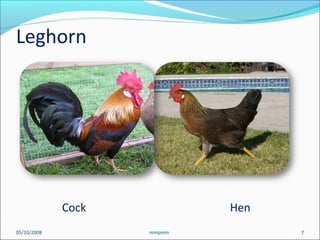
Leghorn varieties including white, red, black tailed red, light
brown, dark brown, black, blue, buff, Columbian, buff
Columbian, barred, exchequer and silver
Most have single combs but there are several color varieties
that have rose combs
Excellent layers of white eggs (around 280 per year)
Rarely exhibit broodiness and are thus well suited for
uninterrupted egg laying
It is a light breed that matures quickly to only 3 or 4 lbs
Leghorns are noisy bird
Cock Hen
05/10/2008 7mmpmm
Leghorn
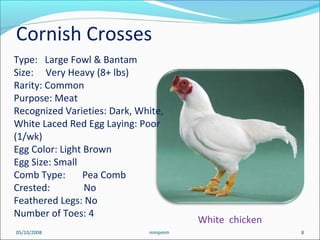
White chicken
05/10/2008 8mmpmm
Cornish Crosses
Type: Large Fowl & Bantam
Size: Very Heavy (8+ lbs)
Rarity: Common
Purpose: Meat
Recognized Varieties: Dark, White,
White Laced Red Egg Laying: Poor
(1/wk)
Egg Color: Light Brown
Egg Size: Small
Comb Type: Pea Comb
Crested: No
Feathered Legs: No
Number of Toes: 4
05/10/2008 mmpmm 9
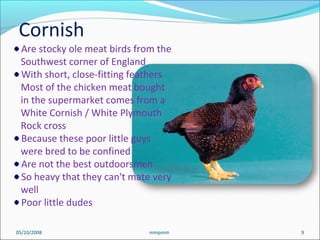
Are stocky ole meat birds from the
Southwest corner of England
With short, close-fitting feathers
Most of the chicken meat bought
in the supermarket comes from a
White Cornish / White Plymouth
Rock cross
Because these poor little guys
were bred to be confined
Are not the best outdoorsmen
So heavy that they can't mate very
well
Poor little dudes
Cornish
Rock Rooster Hen
05/10/2008 10mmpmm
Plymouth
Cock Hen
05/10/2008 11mmpmm
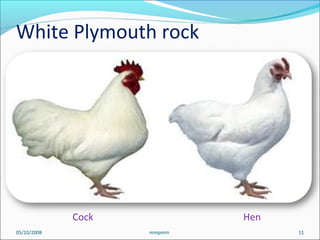
White Plymouth rock
05/10/2008 mmpmm 12
Standard Weights: Cock- 4.3kg , hen-3.4kg , cockerel-3.6kg,
pullet-2.7kg
Skin Color: Yellow
Egg Shell Color: Brown
Use: Meat and eggs
Origin: America in the middle of the 19th century and was first
exhibited as a breed in 1869
Crosses of Dominique, Java, Cochin, and perhaps Malay and
Dorking
Its The first Plymouth Rock was barred and other varieties
developed later
qualities as an outstanding farm chicken: hardiness, docility,
broodiness, and excellent production of both eggs and meat
White Plymouth rock
Cock Hen
05/10/2008 13mmpmm
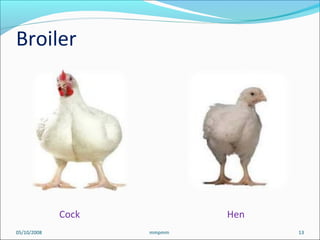
Broiler
05/10/2008 mmpmm 14
 Modern commercial broilers : Cornish crosses or
Cornish-Rocks
 Specially bred for large scale, efficient meat production
Grow much faster than egg laying hens or traditional
dual purpose breeds
 A high feed conversion ratio, and low levels of activity
 Weight Male 5.4kg & Female 3.6kg
 Skin color yellow
 Egg color Light brown
 Comb type Single
Broiler
05/10/2008 15mmpmm
Order chicks early
Only order what you can house
Space requirements:
10 square inches / chick under light
25 square inches / chick house space
Chicks shouldn’t be allowed to get more
than 3 ft away from light
Getting Started
05/10/2008 16mmpmm
When they arrive
Temperature = 92-95 degrees under light, 70-75 deg in
house
Decrease temp. 5 degrees / week until 60 degrees
Teach how to drink right away
If chicks are huddled together under light = too cold
If none are under light = too hot
Should be scattered
05/10/2008 17mmpmm
Debeaking : remove 1/3 of the top beak and a
small part of the bottom (prevent cannibolism) at
6-8 days old
Vaccinate (hatchery can do this)
Lighting: birds naturally reproduce in spring,
simulate spring, chickens molt (shed feathers)
production increases
Management
05/10/2008 18mmpmm
Layer Care
Collect eggs 2-3 times per day (if hot)
Wash eggs immediately in warm water
Refrigerate & keep away from onions &
mold
Production Goal: 4 lbs feed / dozen
eggs
Hens produce 7 eggs / 10 days
05/10/2008 19mmpmm
Broilers Care
Don’t keep in cages (weak bones & bruise easily)
Keep light on at night (prevent cannibalism)
Market at 4 1/2 lbs for males, 3 1/2 lbs for females
(about 8 weeks)
2.1 lbs feed / lb of gain
05/10/2008 20mmpmm
Terms We Use
How do you call a mature male?
Rooster
How do you call a mature female?
Hen
How do you call a young female?
Pullet
What do you call a castrated male?
Capon
How long is the incubation period?
21 days

Poultry production

  • 1.
  • 2.
    05/10/2008 2mmpmm Poultry Meat Highprotein Low fat Economical to eat 2nd in consumption only to beef
  • 3.
    05/10/2008 mmpmm Retinol(vitamin A),Riboflavin (Vitamin B2), Folic Acid (Vitamin B9), Vitamin B6, Vitamin B12, Choline, Iron, Calcium, Phosphorus And Potassium Vitamin A, D, And E Are In The Egg Yolk Poultry Egg 05/10/2008 3mmpmm
  • 4.
    05/10/2008 4mmpmm Layers foregg production Leghorn (hybrids) Broilers for meat production White Plymouth Rock, Cornish Crosses Producers usually buy chicks from hatcheries Turkeys must be artificially inseminated (have been bred for large breasts which makes it physically impossible to mate) Chickens
  • 5.
  • 6.
    05/10/2008 mmpmm 6 TheLeghorn is a breed of chicken with origins in Tuscany, central Italy Leghorn varieties including white, red, black tailed red, light brown, dark brown, black, blue, buff, Columbian, buff Columbian, barred, exchequer and silver Most have single combs but there are several color varieties that have rose combs Excellent layers of white eggs (around 280 per year) Rarely exhibit broodiness and are thus well suited for uninterrupted egg laying It is a light breed that matures quickly to only 3 or 4 lbs Leghorns are noisy bird
  • 7.
  • 8.
    White chicken 05/10/2008 8mmpmm CornishCrosses Type: Large Fowl & Bantam Size: Very Heavy (8+ lbs) Rarity: Common Purpose: Meat Recognized Varieties: Dark, White, White Laced Red Egg Laying: Poor (1/wk) Egg Color: Light Brown Egg Size: Small Comb Type: Pea Comb Crested: No Feathered Legs: No Number of Toes: 4
  • 9.
    05/10/2008 mmpmm 9 Arestocky ole meat birds from the Southwest corner of England With short, close-fitting feathers Most of the chicken meat bought in the supermarket comes from a White Cornish / White Plymouth Rock cross Because these poor little guys were bred to be confined Are not the best outdoorsmen So heavy that they can't mate very well Poor little dudes Cornish
  • 10.
  • 11.
  • 12.
    05/10/2008 mmpmm 12 StandardWeights: Cock- 4.3kg , hen-3.4kg , cockerel-3.6kg, pullet-2.7kg Skin Color: Yellow Egg Shell Color: Brown Use: Meat and eggs Origin: America in the middle of the 19th century and was first exhibited as a breed in 1869 Crosses of Dominique, Java, Cochin, and perhaps Malay and Dorking Its The first Plymouth Rock was barred and other varieties developed later qualities as an outstanding farm chicken: hardiness, docility, broodiness, and excellent production of both eggs and meat White Plymouth rock
  • 13.
  • 14.
    05/10/2008 mmpmm 14 Modern commercial broilers : Cornish crosses or Cornish-Rocks  Specially bred for large scale, efficient meat production Grow much faster than egg laying hens or traditional dual purpose breeds  A high feed conversion ratio, and low levels of activity  Weight Male 5.4kg & Female 3.6kg  Skin color yellow  Egg color Light brown  Comb type Single Broiler
  • 15.
    05/10/2008 15mmpmm Order chicksearly Only order what you can house Space requirements: 10 square inches / chick under light 25 square inches / chick house space Chicks shouldn’t be allowed to get more than 3 ft away from light Getting Started
  • 16.
    05/10/2008 16mmpmm When theyarrive Temperature = 92-95 degrees under light, 70-75 deg in house Decrease temp. 5 degrees / week until 60 degrees Teach how to drink right away If chicks are huddled together under light = too cold If none are under light = too hot Should be scattered
  • 17.
    05/10/2008 17mmpmm Debeaking :remove 1/3 of the top beak and a small part of the bottom (prevent cannibolism) at 6-8 days old Vaccinate (hatchery can do this) Lighting: birds naturally reproduce in spring, simulate spring, chickens molt (shed feathers) production increases Management
  • 18.
    05/10/2008 18mmpmm Layer Care Collecteggs 2-3 times per day (if hot) Wash eggs immediately in warm water Refrigerate & keep away from onions & mold Production Goal: 4 lbs feed / dozen eggs Hens produce 7 eggs / 10 days
  • 19.
    05/10/2008 19mmpmm Broilers Care Don’tkeep in cages (weak bones & bruise easily) Keep light on at night (prevent cannibalism) Market at 4 1/2 lbs for males, 3 1/2 lbs for females (about 8 weeks) 2.1 lbs feed / lb of gain
  • 20.
    05/10/2008 20mmpmm Terms WeUse How do you call a mature male? Rooster How do you call a mature female? Hen How do you call a young female? Pullet What do you call a castrated male? Capon How long is the incubation period? 21 days