Republic of thePhilippines
Department of Education
LEARNING ACTIVITY SHEET
Quarter 2 – Week 2
9
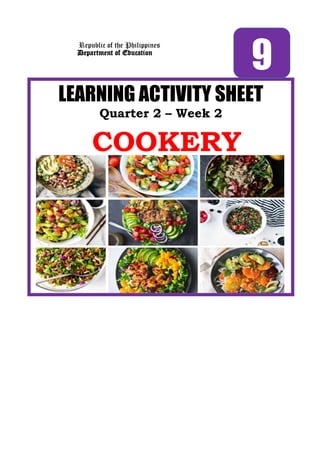
COOKERY
2.
INGREDIENTS OF SALAD
Lesson1: PREPARE SALAD AND DRESSING
LO1: Perform mise-en-place
1.3 Identify ingredients according to the given recipe
1.4 Prepare ingredients based on the required form and time frame
(TLE__HECK9-12SD-IIa-7)
Name of Learner : DANNY B. ELAGO
Grade Level & Section : GRADE 9
Subject Teacher :
Contact No. : FB Account:
Salad is a combination of vegetables, fruits and other ingredients served with
a dressing.
.
The freshness and variety of ingredients are essential for high quality salads.
LESSON 1
1.3
IDENTIFY INGREDIENTS ACCORDING TO
THE GIVEN RECIPE
3.
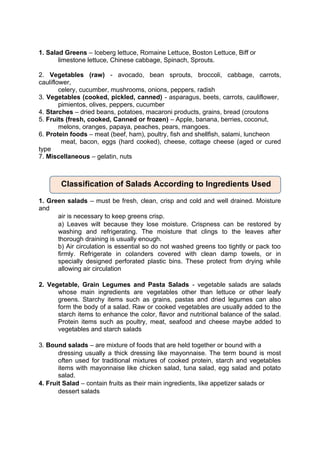
1. Salad Greens– Iceberg lettuce, Romaine Lettuce, Boston Lettuce, Biff or
limestone lettuce, Chinese cabbage, Spinach, Sprouts.
2. Vegetables (raw) - avocado, bean sprouts, broccoli, cabbage, carrots,
cauliflower,
celery, cucumber, mushrooms, onions, peppers, radish
3. Vegetables (cooked, pickled, canned) - asparagus, beets, carrots, cauliflower,
pimientos, olives, peppers, cucumber
4. Starches – dried beans, potatoes, macaroni products, grains, bread (croutons
5. Fruits (fresh, cooked, Canned or frozen) – Apple, banana, berries, coconut,
melons, oranges, papaya, peaches, pears, mangoes.
6. Protein foods – meat (beef, ham), poultry, fish and shellfish, salami, luncheon
meat, bacon, eggs (hard cooked), cheese, cottage cheese (aged or cured
type
7. Miscellaneous – gelatin, nuts
1. Green salads – must be fresh, clean, crisp and cold and well drained. Moisture
and
air is necessary to keep greens crisp.
a) Leaves wilt because they lose moisture. Crispness can be restored by
washing and refrigerating. The moisture that clings to the leaves after
thorough draining is usually enough.
b) Air circulation is essential so do not washed greens too tightly or pack too
firmly. Refrigerate in colanders covered with clean damp towels, or in
specially designed perforated plastic bins. These protect from drying while
allowing air circulation
2. Vegetable, Grain Legumes and Pasta Salads - vegetable salads are salads
whose main ingredients are vegetables other than lettuce or other leafy
greens. Starchy items such as grains, pastas and dried legumes can also
form the body of a salad. Raw or cooked vegetables are usually added to the
starch items to enhance the color, flavor and nutritional balance of the salad.
Protein items such as poultry, meat, seafood and cheese maybe added to
vegetables and starch salads
3. Bound salads – are mixture of foods that are held together or bound with a
dressing usually a thick dressing like mayonnaise. The term bound is most
often used for traditional mixtures of cooked protein, starch and vegetables
items with mayonnaise like chicken salad, tuna salad, egg salad and potato
salad.
4. Fruit Salad – contain fruits as their main ingredients, like appetizer salads or
dessert salads
Classification of Salads According to Ingredients Used
4.
5. Composed Salads– made by arranging two or more elements attractively on a
plate. They are called composed because the components are arranged on
the plate rather than being mixed together. They are elaborate and can be
substantial in size, usually served as main courses or fruit courses rather than
accompaniments or side dishes.
6. Gelatin Salads – most gelatin products are made with sweetened prepared mixes
with artificial color and flavor. But some professional cook used to prepare
salads using unflavored gelatin relying on fruit juices and other ingredients for
flavor
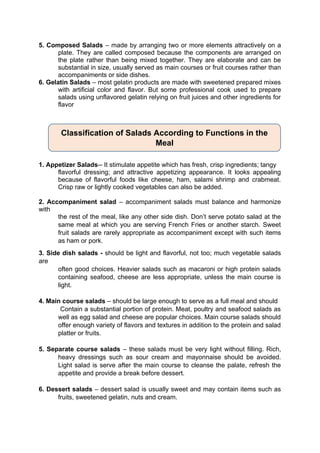
1. Appetizer Salads-- It stimulate appetite which has fresh, crisp ingredients; tangy
flavorful dressing; and attractive appetizing appearance. It looks appealing
because of flavorful foods like cheese, ham, salami shrimp and crabmeat.
Crisp raw or lightly cooked vegetables can also be added.
2. Accompaniment salad – accompaniment salads must balance and harmonize
with
the rest of the meal, like any other side dish. Don’t serve potato salad at the
same meal at which you are serving French Fries or another starch. Sweet
fruit salads are rarely appropriate as accompaniment except with such items
as ham or pork.
3. Side dish salads - should be light and flavorful, not too; much vegetable salads
are
often good choices. Heavier salads such as macaroni or high protein salads
containing seafood, cheese are less appropriate, unless the main course is
light.
4. Main course salads – should be large enough to serve as a full meal and should
Contain a substantial portion of protein. Meat, poultry and seafood salads as
well as egg salad and cheese are popular choices. Main course salads should
offer enough variety of flavors and textures in addition to the protein and salad
platter or fruits.
5. Separate course salads – these salads must be very light without filling. Rich,
heavy dressings such as sour cream and mayonnaise should be avoided.
Light salad is serve after the main course to cleanse the palate, refresh the
appetite and provide a break before dessert.
6. Dessert salads – dessert salad is usually sweet and may contain items such as
fruits, sweetened gelatin, nuts and cream.
Classification of Salads According to Functions in the
Meal
5.
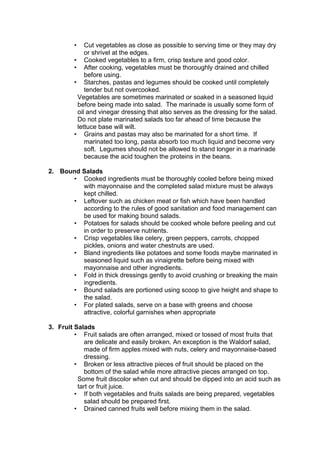
Prepare ingredients basedon the required form and time
Frame
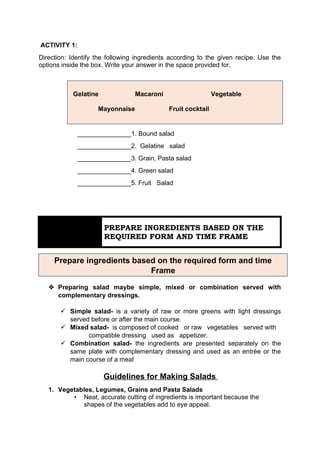
ACTIVITY 1:
Direction: Identify the following ingredients according to the given recipe. Use the
options inside the box. Write your answer in the space provided for.
_______________1. Bound salad
_______________2. Gelatine salad
_______________3. Grain, Pasta salad
_______________4. Green salad
_______________5. Fruit Salad
Preparing salad maybe simple, mixed or combination served with
complementary dressings.
Simple salad- is a variety of raw or more greens with light dressings
served before or after the main course.
Mixed salad- is composed of cooked or raw vegetables served with
compatible dressing used as appetizer.
Combination salad- the ingredients are presented separately on the
same plate with complementary dressing and used as an entrée or the
main course of a meal
Guidelines for Making Salads
1. Vegetables, Legumes, Grains and Pasta Salads
• Neat, accurate cutting of ingredients is important because the
shapes of the vegetables add to eye appeal.
Gelatine Macaroni Vegetable
Mayonnaise Fruit cocktail
LESSON 1
1.4
PREPARE INGREDIENTS BASED ON THE
REQUIRED FORM AND TIME FRAME
6.
• Cut vegetablesas close as possible to serving time or they may dry
or shrivel at the edges.
• Cooked vegetables to a firm, crisp texture and good color.
• After cooking, vegetables must be thoroughly drained and chilled
before using.
• Starches, pastas and legumes should be cooked until completely
tender but not overcooked.
Vegetables are sometimes marinated or soaked in a seasoned liquid
before being made into salad. The marinade is usually some form of
oil and vinegar dressing that also serves as the dressing for the salad.
Do not plate marinated salads too far ahead of time because the
lettuce base will wilt.
• Grains and pastas may also be marinated for a short time. If
marinated too long, pasta absorb too much liquid and become very
soft. Legumes should not be allowed to stand longer in a marinade
because the acid toughen the proteins in the beans.
2. Bound Salads
• Cooked ingredients must be thoroughly cooled before being mixed
with mayonnaise and the completed salad mixture must be always
kept chilled.
• Leftover such as chicken meat or fish which have been handled
according to the rules of good sanitation and food management can
be used for making bound salads.
• Potatoes for salads should be cooked whole before peeling and cut
in order to preserve nutrients.
• Crisp vegetables like celery, green peppers, carrots, chopped
pickles, onions and water chestnuts are used.
• Bland ingredients like potatoes and some foods maybe marinated in
seasoned liquid such as vinaigrette before being mixed with
mayonnaise and other ingredients.
• Fold in thick dressings gently to avoid crushing or breaking the main
ingredients.
• Bound salads are portioned using scoop to give height and shape to
the salad.
• For plated salads, serve on a base with greens and choose
attractive, colorful garnishes when appropriate
3. Fruit Salads
• Fruit salads are often arranged, mixed or tossed of most fruits that
are delicate and easily broken. An exception is the Waldorf salad,
made of firm apples mixed with nuts, celery and mayonnaise-based
dressing.
• Broken or less attractive pieces of fruit should be placed on the
bottom of the salad while more attractive pieces arranged on top.
Some fruit discolor when cut and should be dipped into an acid such as
tart or fruit juice.
• If both vegetables and fruits salads are being prepared, vegetables
salad should be prepared first.
• Drained canned fruits well before mixing them in the salad.
7.
• Dressings forfruit salad are usually sweet, but fruit juices are used to
add tartness.
4. Composed Salads
• Prepare and season each ingredient separately and evaluate the
flavor and quality.
• Arrangements maybe plated ahead of time and add delicate
ingredients just before serving.
• Flavors and textures of all ingredients should provide pleasing
contrast
• Observe general concepts of plating and presentations of output.
5. Gelatin Salads
• Observe the correct proportion of gelatin and liquid. Too much
gelatin makes a stiff, rubbery product while too little makes a soft
product that will not form the desired shape.
• To dissolve unflavored gelatin, stir it in cold liquid to avoid lumping
and let it stand for 5 minutes to absorb water. Then heat it until
dissolves or add hot liquid and stir until dissolved.
• To dissolve sweetened, flavored gelatin, stir it into boiling water. It
will not lump because the gelatin granules are held apart by sugar
granules.
• For quick setting, dissolve the gelatin to half of the volume of liquid
and the other half is cold water to lower the temperature. For even
faster setting, add crushed ice in an equal volume of cold water, stir
until the ice is melted
• Do not add raw pineapple and papaya to gelatin salads because
these fruits contain enzymes which dissolves gelatin.
• Canned fruits and other juicy items must be well drained before
adding because they will have watered down the gelatin.
To unmold gelatin if it is firm
- Loosen it by dipping a small pointed knife in warm water and
running the tip of it around the top edge of the molded
gelatin.
- Dip the mold into hot water for 1 – 2 seconds
- Quickly moisten tips of the fingers and gently pull gelatin
away from edge
• Refrigerate gelatin salads.
Procedure for Quantity Salad Production
1. Prepare all ingredients. Wash and cut greens, fruits, vegetables, and
garnishes. Prepare cooked vegetables and mix bound and marinated salads.
Have all ingredients chilled.
2. Arrange salad plates on worktables. Line them up on trays for easy transfer
to refrigerator.
3. Place bases on all plates.
4. Arrange body of salad on all plates.
8.
5. Garnish allsalads.
6. Refrigerate until serving.
7. Do not add dressing to green salads until serving
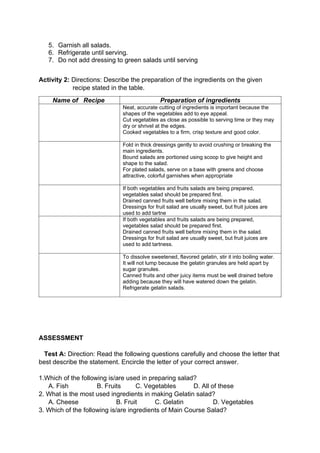
Activity 2: Directions: Describe the preparation of the ingredients on the given
recipe stated in the table.
Name of Recipe Preparation of ingredients
Neat, accurate cutting of ingredients is important because the
shapes of the vegetables add to eye appeal.
Cut vegetables as close as possible to serving time or they may
dry or shrivel at the edges.
Cooked vegetables to a firm, crisp texture and good color.
Fold in thick dressings gently to avoid crushing or breaking the
main ingredients.
Bound salads are portioned using scoop to give height and
shape to the salad.
For plated salads, serve on a base with greens and choose
attractive, colorful garnishes when appropriate
If both vegetables and fruits salads are being prepared,
vegetables salad should be prepared first.
Drained canned fruits well before mixing them in the salad.
Dressings for fruit salad are usually sweet, but fruit juices are
used to add tartne
If both vegetables and fruits salads are being prepared,
vegetables salad should be prepared first.
Drained canned fruits well before mixing them in the salad.
Dressings for fruit salad are usually sweet, but fruit juices are
used to add tartness.
To dissolve sweetened, flavored gelatin, stir it into boiling water.
It will not lump because the gelatin granules are held apart by
sugar granules.
Canned fruits and other juicy items must be well drained before
adding because they will have watered down the gelatin.
Refrigerate gelatin salads.
ASSESSMENT
Test A: Direction: Read the following questions carefully and choose the letter that
best describe the statement. Encircle the letter of your correct answer.
1.Which of the following is/are used in preparing salad?
A. Fish B. Fruits C. Vegetables D. All of these
2. What is the most used ingredients in making Gelatin salad?
A. Cheese B. Fruit C. Gelatin D. Vegetables
3. Which of the following is/are ingredients of Main Course Salad?
9.
A. Meat, Poultryand Seafood C. Fruit, Egg and Vegetables
B. Gelatin, Pasta and Green D. Cheese, Fruit & Pasta
4. Vegetables salad are salad whose main ingredients are_______ other than lettuce
or other leafy greens?
A. Cheese B. Fruit C. Gelatin D. Vegetables
5.What ingredients of bound salad are mixed that make the salad thick?
A. Cream B. Mayonnaise C. Milk D. All of these
Test B: Match the specific salad in column A on the type of preparation of salad in
Column B. Write only the letter on the space provided for before the number.
Column A Column B
_______6. Fruit Salad A. Observe the correct proportion of gelatin
and liquid
_______7. Composed Salads B. Crisp vegetables like celery, green
peppers, carrots, chopped pickles
_______8. Gelatin Salads C. Fruit salads are often arranged, mixed or
tossed of most fruits that are delicate
and easily broken.
_______9. Bound Salads D. Prepare and season each ingredient
separately and evaluate the flavor and
quality
______10. Vegetables, Legumes, E. Neat, accurate cutting of ingredients is
Grains, Pasta salad important because the shapes of the
vegetables add to eye appeal.
ANSWERS KEY
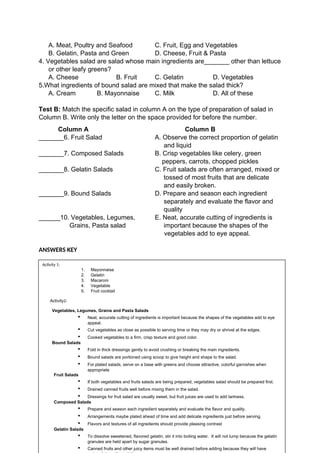
Activity 1:
1. Mayonnaise
2. Gelatin
3. Macaroni
4. Vegetable
5. Fruit cocktail
Activity2:
Vegetables, Legumes, Grains and Pasta Salads
• Neat, accurate cutting of ingredients is important because the shapes of the vegetables add to eye
appeal.
• Cut vegetables as close as possible to serving time or they may dry or shrivel at the edges.
• Cooked vegetables to a firm, crisp texture and good color.
Bound Salads
• Fold in thick dressings gently to avoid crushing or breaking the main ingredients.
• Bound salads are portioned using scoop to give height and shape to the salad.
• For plated salads, serve on a base with greens and choose attractive, colorful garnishes when
appropriate
Fruit Salads
• If both vegetables and fruits salads are being prepared, vegetables salad should be prepared first.
• Drained canned fruits well before mixing them in the salad.
• Dressings for fruit salad are usually sweet, but fruit juices are used to add tartness.
Composed Salads
• Prepare and season each ingredient separately and evaluate the flavor and quality.
• Arrangements maybe plated ahead of time and add delicate ingredients just before serving.
• Flavors and textures of all ingredients should provide pleasing contrast
Gelatin Salads
• To dissolve sweetened, flavored gelatin, stir it into boiling water. It will not lump because the gelatin
granules are held apart by sugar granules.
• Canned fruits and other juicy items must be well drained before adding because they will have
10.
Writer:
ANTONIA E. PAA
MasterTeacher I
QUALITY ASSURANCE TEAM
Chairman:
MEDARLOU A. GENOGUIN
Division EPP/TLE Supervisor
FLORIDA G. BUNANI EdD
PSDS – Caibiran District I
DEXTER D. ENAGE ME, EdD
MT-I/Vocational Dept. Head – des.
RITCHELLE P. BALONDO
Master Teacher I