PREPARE
APPETIZERS
TLE_HECK9-12PA-Ic-3
Prepared by: LOUISE MAE S. ZAPANTA
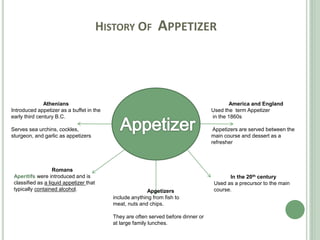
HISTORY OF APPETIZER
Athenians
Introduced appetizer as a buffet in the
early third century B.C.
Serves sea urchins, cockles,
sturgeon, and garlic as appetizers
America and England
Used the term Appetizer
in the 1860s
Appetizers are served between the
main course and dessert as a
refresher
In the 20th century
Used as a precursor to the main
course.
Romans
Aperitifs were introduced and is
classified as a liquid appetizer that
typically contained alcohol. Appetizers
include anything from fish to
meat, nuts and chips.
They are often served before dinner or
at large family lunches.
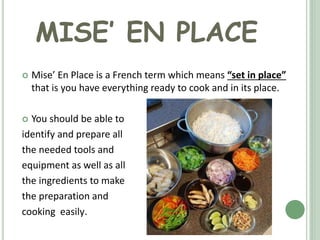
MISE’ EN PLACE
 Mise’ En Place is a French term which means “set in place”
that is you have everything ready to cook and in its place.
 You should be able to
identify and prepare all
the needed tools and
equipment as well as all
the ingredients to make
the preparation and
cooking easily.
KITCHEN TOOLS AND
EQUIPMENT
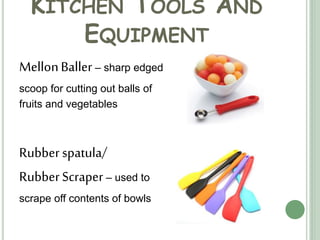
MellonBaller – sharp edged
scoop for cutting out balls of
fruits and vegetables
Rubberspatula/
RubberScraper – used to
scrape off contents of bowls
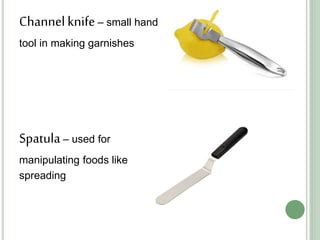
Channelknife – small hand
tool in making garnishes
Spatula – used for
manipulating foods like
spreading
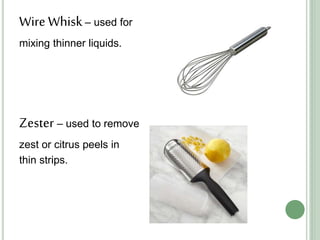
Wire Whisk– used for
mixing thinner liquids.
Zester – used to remove
zest or citrus peels in
thin strips.
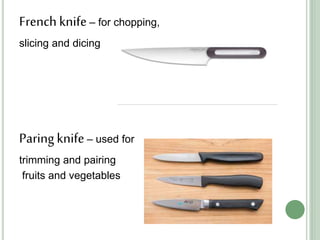
French knife – for chopping,
slicing and dicing
Paring knife – used for
trimming and pairing
fruits and vegetables
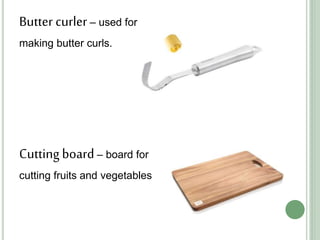
Butter curler – used for
making butter curls.
Cuttingboard – board for
cutting fruits and vegetables
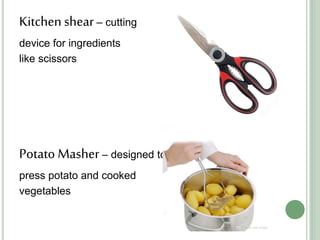
Kitchen shear – cutting
device for ingredients
like scissors
Potato Masher – designed to
press potato and cooked
vegetables
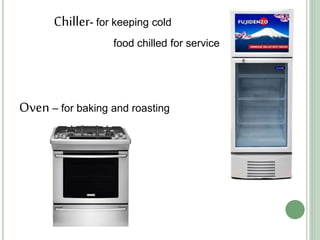
Chiller- for keeping cold
food chilled for service
Oven – for baking and roasting
OTHER TOOLS AND
EQUIPMENT USED IN
PREPARING APPETIZERS
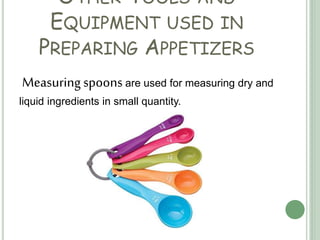
Measuring spoons are used for measuring dry and
liquid ingredients in small quantity.
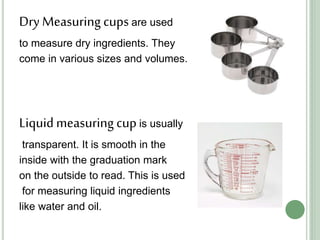
Dry Measuring cups are used
to measure dry ingredients. They
come in various sizes and volumes.
Liquidmeasuring cupis usually
transparent. It is smooth in the
inside with the graduation mark
on the outside to read. This is used
for measuring liquid ingredients
like water and oil.
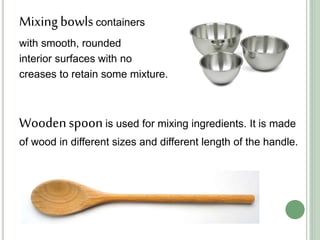
Mixingbowlscontainers
with smooth, rounded
interior surfaces with no
creases to retain some mixture.
Woodenspoonis used for mixing ingredients. It is made
of wood in different sizes and different length of the handle.
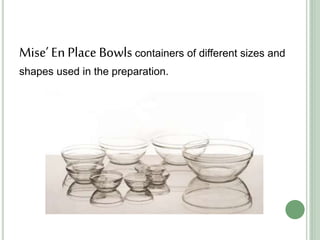
Mise’ En Place Bowls containers of different sizes and
shapes used in the preparation.
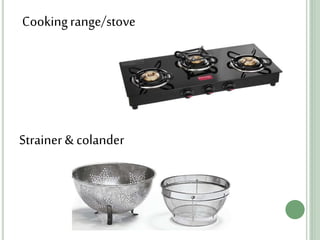
Cookingrange/stove
Strainer & colander
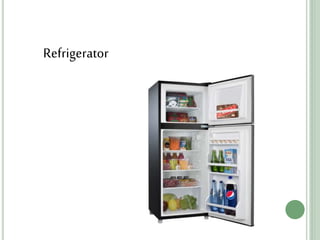
Refrigerator
ACTIVITY: ORAL RECITATION
PICK AND TELL
Each student will be asked to pick one paper strip
and explain the use/s of the tool being asked in the
strip.
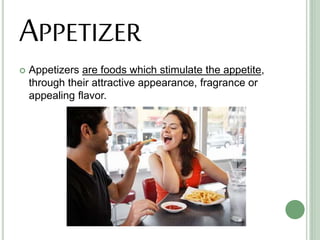
APPETIZER
 Appetizers are foods which stimulate the appetite,
through their attractive appearance, fragrance or
appealing flavor.
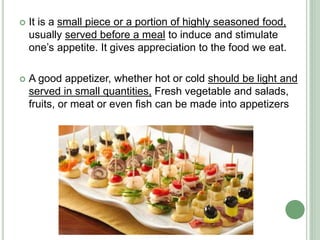
 It is a small piece or a portion of highly seasoned food,
usually served before a meal to induce and stimulate
one’s appetite. It gives appreciation to the food we eat.
 A good appetizer, whether hot or cold should be light and
served in small quantities, Fresh vegetable and salads,
fruits, or meat or even fish can be made into appetizers
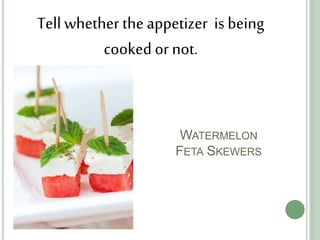
WATERMELON
FETA SKEWERS
Tell whether the appetizer is being
cooked or not.
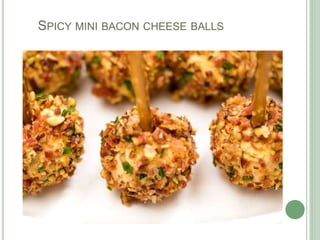
SPICY MINI BACON CHEESE BALLS
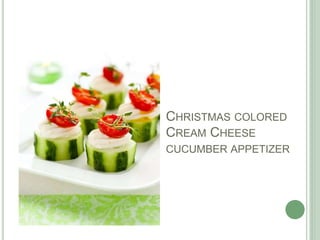
CHRISTMAS COLORED
CREAM CHEESE
CUCUMBER APPETIZER
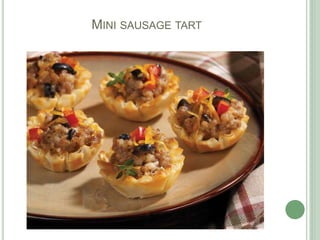
MINI SAUSAGE TART
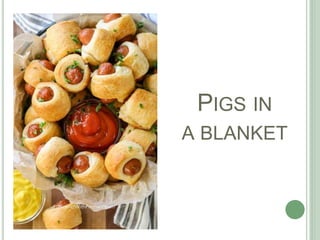
PIGS IN
A BLANKET
WHAT IS THE DIFFERENCE BETWEEN
HOT AND COLD APPETIZER?
 The literal difference between cold and hot
appetizers is their temperature.
 Cold appetizers are served in lower temperatures
while hot appetizers are literally served in higher
temperatures. As such, hot appetizers are most of
the time soup-based, made from bread, fried
meats, and other sizzling foods.
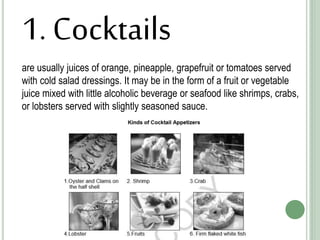
1. Cocktails
are usually juices of orange, pineapple, grapefruit or tomatoes served
with cold salad dressings. It may be in the form of a fruit or vegetable
juice mixed with little alcoholic beverage or seafood like shrimps, crabs,
or lobsters served with slightly seasoned sauce.
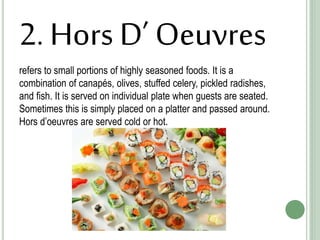
2. Hors D’ Oeuvres
refers to small portions of highly seasoned foods. It is a
combination of canapés, olives, stuffed celery, pickled radishes,
and fish. It is served on individual plate when guests are seated.
Sometimes this is simply placed on a platter and passed around.
Hors d’oeuvres are served cold or hot.
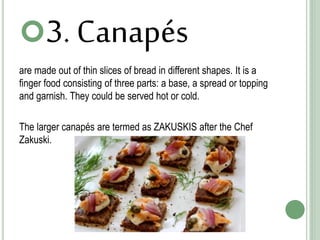
3. Canapés
are made out of thin slices of bread in different shapes. It is a
finger food consisting of three parts: a base, a spread or topping
and garnish. They could be served hot or cold.
The larger canapés are termed as ZAKUSKIS after the Chef
Zakuski.
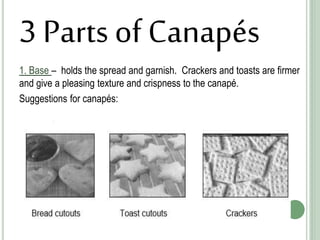
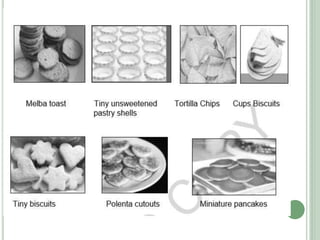
3 Parts of Canapés
1. Base – holds the spread and garnish. Crackers and toasts are firmer
and give a pleasing texture and crispness to the canapé.
Suggestions for canapés:
2. Spread - placed on top of the base so the garnish sticks to it
without falling off.
Three types of spreads
a) Flavored butter – made from softened butters with flavorings.
b) Flavored Cream Cheese -made from flavored butters, except
cream cheese is substituted for the butter. Mixture of cream and
butter can be used.
c) Meat or Fish salad spreads – made from finely chopped meat
or fish that are spreadable. Seasons should be checked
carefully to make the spread more stimulating to the appetite.
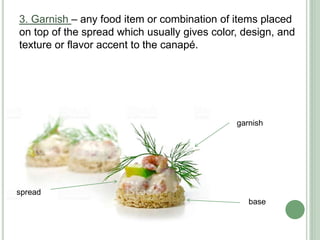
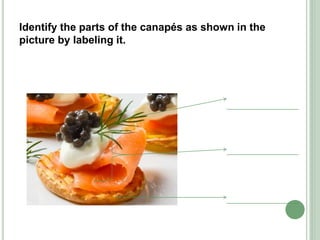
3. Garnish – any food item or combination of items placed
on top of the spread which usually gives color, design, and
texture or flavor accent to the canapé.
base
spread
garnish
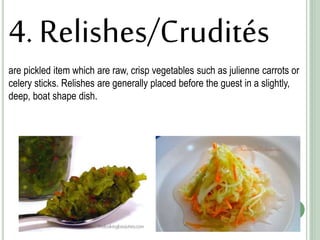
4. Relishes/Crudités
are pickled item which are raw, crisp vegetables such as julienne carrots or
celery sticks. Relishes are generally placed before the guest in a slightly,
deep, boat shape dish.
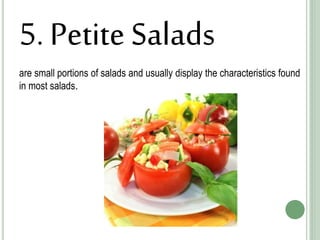
5. Petite Salads
are small portions of salads and usually display the characteristics found
in most salads.
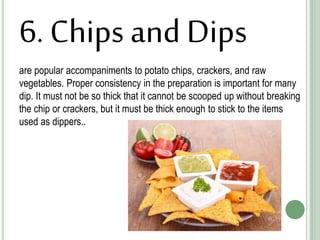
6. Chips and Dips
are popular accompaniments to potato chips, crackers, and raw
vegetables. Proper consistency in the preparation is important for many
dip. It must not be so thick that it cannot be scooped up without breaking
the chip or crackers, but it must be thick enough to stick to the items
used as dippers..
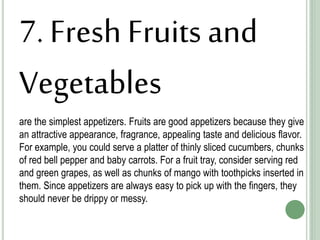
7. Fresh Fruits and
Vegetables
are the simplest appetizers. Fruits are good appetizers because they give
an attractive appearance, fragrance, appealing taste and delicious flavor.
For example, you could serve a platter of thinly sliced cucumbers, chunks
of red bell pepper and baby carrots. For a fruit tray, consider serving red
and green grapes, as well as chunks of mango with toothpicks inserted in
them. Since appetizers are always easy to pick up with the fingers, they
should never be drippy or messy.
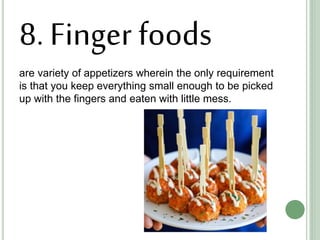
8. Finger foods
are variety of appetizers wherein the only requirement
is that you keep everything small enough to be picked
up with the fingers and eaten with little mess.
FoodItems Usedto Decorate Canapés
A. Vegetables, pickles and relishes
Radish Slices, Pickled Onions, Chutney, Parley Tomatoes, Olives,
Pickles, Asparagus Tips, Cucumber Slices, Pimiento
B. Fish
Smoked Fish Smoked Salmon Shrimp Caviar Shrimp Tuna Flakes
Sardines Lobster / Chunks or slices
C. Meats
Turkey Ham Salami Roast Beef Chicken
D. Cheese, hard cooked egg slices
Cheddar, Parmesan, blue cheese,
Guidelines for Assembling Canapés
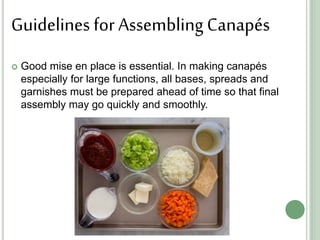
 Good mise en place is essential. In making canapés
especially for large functions, all bases, spreads and
garnishes must be prepared ahead of time so that final
assembly may go quickly and smoothly.
 Assemble as close as possible to serving time. Bases
quickly become soggy, and spreads and garnishes dry
out easily. After placing them in a tray, cover them lightly
with plastic and held for a short time under refrigeration.
Safe food handling and storage must be observed.
 Select harmonious flavor combinations in spreads and
garnish such as:
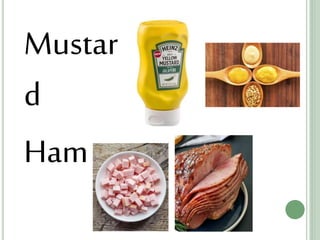
A. Mustard and ham
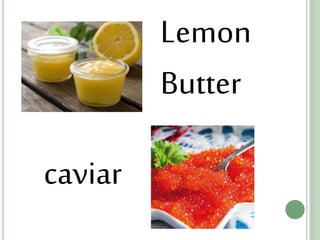
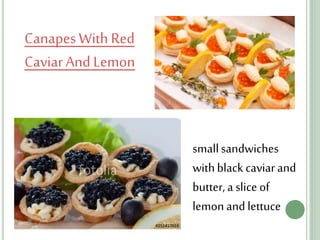
B. Lemon butter and caviar
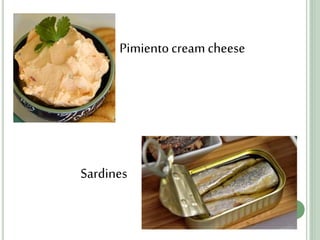
C. Pimiento cream cheese and sardines
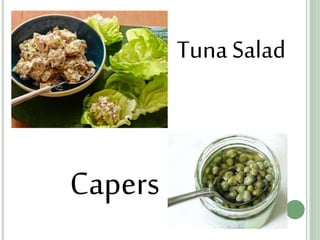
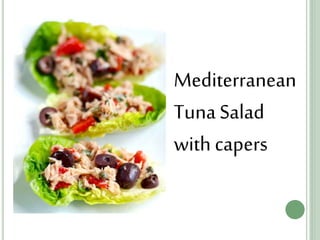
D. Tuna salad and capers
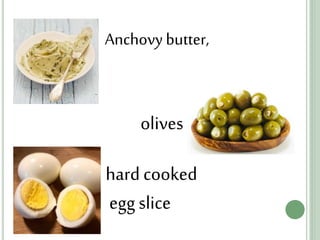
E. Anchovy butter, hard cooked egg slice and olive
Mustar
d
Ham
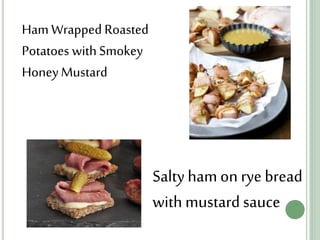
Ham Wrapped Roasted
Potatoes with Smokey
HoneyMustard
Salty ham on rye bread
with mustard sauce
Lemon
Butter
caviar
CanapesWith Red
CaviarAnd Lemon
smallsandwiches
withblack caviarand
butter, a slice of
lemon and lettuce
Pimientocream cheese
Sardines
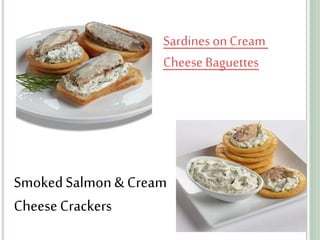
SmokedSalmon& Cream
CheeseCrackers
Sardines onCream
Cheese Baguettes
Tuna Salad
Capers
Mediterranean
Tuna Salad
with capers
Anchovy butter,
hardcooked
eggslice
olives
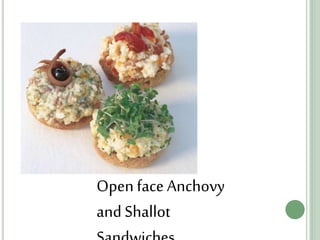
Open face Anchovy
and Shallot
 Make sure that at least one of the ingredients is spicy in
flavor. A bland canapé has little value as an appetizer.
 Use high quality ingredients. Leftovers can be used for
canapés, but they must be carefully handled and stored
to retain freshness.
 Keep it simple. Simple meat arrangements are more
attractive than extravagant one. Be sure that canapés
hold together and do not fall apart in the customers
hands.
 Arrange canapés carefully and attractively on trays. Each
tray should carry an assortment of flavor and textures, so
there is something for every taste.
MISCELLANEOUS
HORS D ‘OEUVRES
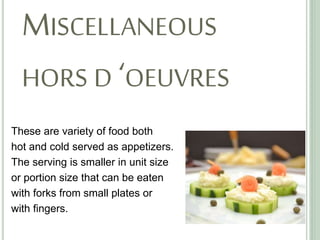
These are variety of food both
hot and cold served as appetizers.
The serving is smaller in unit size
or portion size that can be eaten
with forks from small plates or
with fingers.
1. Antipasto - Italian Appetizer. This
includes the following:
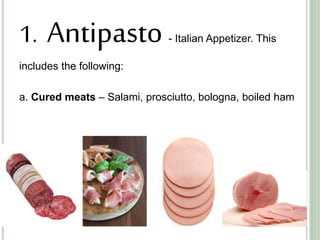
a. Cured meats – Salami, prosciutto, bologna, boiled ham
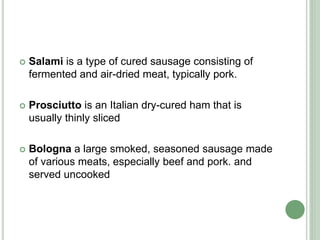
 Salami is a type of cured sausage consisting of
fermented and air-dried meat, typically pork.
 Prosciutto is an Italian dry-cured ham that is
usually thinly sliced
 Bologna a large smoked, seasoned sausage made
of various meats, especially beef and pork. and
served uncooked
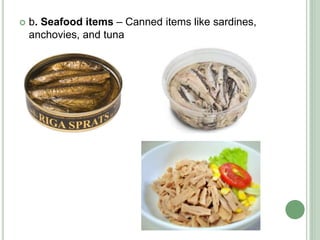
 b. Seafood items – Canned items like sardines,
anchovies, and tuna
c. Cheeses – provolone, mozzarella
d. Hard cooked egg and stuffed eggs
e. Relishes – raw vegetables
f. Mushrooms and other vegetables
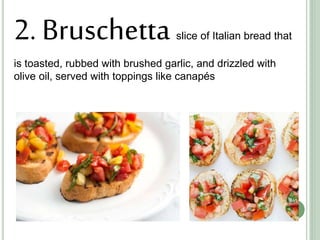
2. Bruschetta slice of Italian bread that
is toasted, rubbed with brushed garlic, and drizzled with
olive oil, served with toppings like canapés
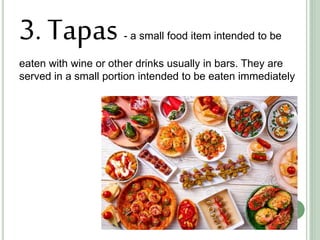
3. Tapas - a small food item intended to be
eaten with wine or other drinks usually in bars. They are
served in a small portion intended to be eaten immediately
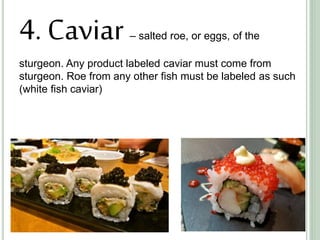
4. Caviar – salted roe, or eggs, of the
sturgeon. Any product labeled caviar must come from
sturgeon. Roe from any other fish must be labeled as such
(white fish caviar)
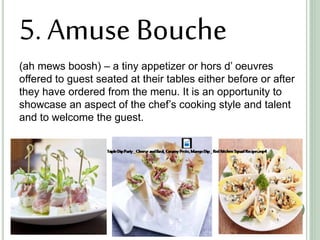
5. Amuse Bouche
(ah mews boosh) – a tiny appetizer or hors d’ oeuvres
offered to guest seated at their tables either before or after
they have ordered from the menu. It is an opportunity to
showcase an aspect of the chef’s cooking style and talent
and to welcome the guest.
Detect and Write
Instruction: Read the statement
carefully and write the correct word that
describes the statement..
_______________1. Italian bread that is toasted, rubbed with brushed
garlic, and drizzled with olive oil, served with toppings like canapés
________________2. salted roe, or eggs, of the sturgeon
________________3. a small food item intended to be eaten with wine
or other drinks usually in bars.
________________4. a tiny appetizer or hors d’ oeuvres offered to
guest seated at their tables either before or after they have ordered
from the menu
_________________5. Italian Appetizer that includes cured meats,
seafood items, cheese, hardboiled egg, relish and mushrooms.
________________6. term which means “set in place” that is
you have everything ready to cook and in its place.
________________7. are used for measuring dry and liquid
ingredients in small quantity.
________________8. is an Italian dry-cured ham that is
usually thinly sliced
________________9. made from softened butters with
flavorings.
________________10. used for making butter curls.
________________11. containers of different sizes and
shapes used in the preparation.
________________12. a part of canape that holds the
spread and garnish. Crackers and toasts are firmer and
give a pleasing texture and crispness to the canapé.
Identify the parts of the canapés as shown in the
picture by labeling it.

Prepare appetizers

  • 1.
  • 2.
    HISTORY OF APPETIZER Athenians Introducedappetizer as a buffet in the early third century B.C. Serves sea urchins, cockles, sturgeon, and garlic as appetizers America and England Used the term Appetizer in the 1860s Appetizers are served between the main course and dessert as a refresher In the 20th century Used as a precursor to the main course. Romans Aperitifs were introduced and is classified as a liquid appetizer that typically contained alcohol. Appetizers include anything from fish to meat, nuts and chips. They are often served before dinner or at large family lunches.
  • 3.
    MISE’ EN PLACE Mise’ En Place is a French term which means “set in place” that is you have everything ready to cook and in its place.  You should be able to identify and prepare all the needed tools and equipment as well as all the ingredients to make the preparation and cooking easily.
  • 4.
    KITCHEN TOOLS AND EQUIPMENT MellonBaller– sharp edged scoop for cutting out balls of fruits and vegetables Rubberspatula/ RubberScraper – used to scrape off contents of bowls
  • 5.
    Channelknife – smallhand tool in making garnishes Spatula – used for manipulating foods like spreading
  • 6.
    Wire Whisk– usedfor mixing thinner liquids. Zester – used to remove zest or citrus peels in thin strips.
  • 7.
    French knife –for chopping, slicing and dicing Paring knife – used for trimming and pairing fruits and vegetables
  • 8.
    Butter curler –used for making butter curls. Cuttingboard – board for cutting fruits and vegetables
  • 9.
    Kitchen shear –cutting device for ingredients like scissors Potato Masher – designed to press potato and cooked vegetables
  • 10.
    Chiller- for keepingcold food chilled for service Oven – for baking and roasting
  • 11.
    OTHER TOOLS AND EQUIPMENTUSED IN PREPARING APPETIZERS Measuring spoons are used for measuring dry and liquid ingredients in small quantity.
  • 12.
    Dry Measuring cupsare used to measure dry ingredients. They come in various sizes and volumes. Liquidmeasuring cupis usually transparent. It is smooth in the inside with the graduation mark on the outside to read. This is used for measuring liquid ingredients like water and oil.
  • 13.
    Mixingbowlscontainers with smooth, rounded interiorsurfaces with no creases to retain some mixture. Woodenspoonis used for mixing ingredients. It is made of wood in different sizes and different length of the handle.
  • 14.
    Mise’ En PlaceBowls containers of different sizes and shapes used in the preparation.
  • 15.
  • 16.
  • 17.
    ACTIVITY: ORAL RECITATION PICKAND TELL Each student will be asked to pick one paper strip and explain the use/s of the tool being asked in the strip.
  • 18.
    APPETIZER  Appetizers arefoods which stimulate the appetite, through their attractive appearance, fragrance or appealing flavor.
  • 19.
     It isa small piece or a portion of highly seasoned food, usually served before a meal to induce and stimulate one’s appetite. It gives appreciation to the food we eat.  A good appetizer, whether hot or cold should be light and served in small quantities, Fresh vegetable and salads, fruits, or meat or even fish can be made into appetizers
  • 20.
    WATERMELON FETA SKEWERS Tell whetherthe appetizer is being cooked or not.
  • 21.
    SPICY MINI BACONCHEESE BALLS
  • 22.
  • 23.
  • 24.
  • 26.
    WHAT IS THEDIFFERENCE BETWEEN HOT AND COLD APPETIZER?  The literal difference between cold and hot appetizers is their temperature.  Cold appetizers are served in lower temperatures while hot appetizers are literally served in higher temperatures. As such, hot appetizers are most of the time soup-based, made from bread, fried meats, and other sizzling foods.
  • 27.
    1. Cocktails are usuallyjuices of orange, pineapple, grapefruit or tomatoes served with cold salad dressings. It may be in the form of a fruit or vegetable juice mixed with little alcoholic beverage or seafood like shrimps, crabs, or lobsters served with slightly seasoned sauce.
  • 28.
    2. Hors D’Oeuvres refers to small portions of highly seasoned foods. It is a combination of canapés, olives, stuffed celery, pickled radishes, and fish. It is served on individual plate when guests are seated. Sometimes this is simply placed on a platter and passed around. Hors d’oeuvres are served cold or hot.
  • 29.
    3. Canapés are madeout of thin slices of bread in different shapes. It is a finger food consisting of three parts: a base, a spread or topping and garnish. They could be served hot or cold. The larger canapés are termed as ZAKUSKIS after the Chef Zakuski.
  • 30.
    3 Parts ofCanapés 1. Base – holds the spread and garnish. Crackers and toasts are firmer and give a pleasing texture and crispness to the canapé. Suggestions for canapés:
  • 32.
    2. Spread -placed on top of the base so the garnish sticks to it without falling off. Three types of spreads a) Flavored butter – made from softened butters with flavorings. b) Flavored Cream Cheese -made from flavored butters, except cream cheese is substituted for the butter. Mixture of cream and butter can be used. c) Meat or Fish salad spreads – made from finely chopped meat or fish that are spreadable. Seasons should be checked carefully to make the spread more stimulating to the appetite.
  • 33.
    3. Garnish –any food item or combination of items placed on top of the spread which usually gives color, design, and texture or flavor accent to the canapé. base spread garnish
  • 34.
    4. Relishes/Crudités are pickleditem which are raw, crisp vegetables such as julienne carrots or celery sticks. Relishes are generally placed before the guest in a slightly, deep, boat shape dish.
  • 35.
    5. Petite Salads aresmall portions of salads and usually display the characteristics found in most salads.
  • 36.
    6. Chips andDips are popular accompaniments to potato chips, crackers, and raw vegetables. Proper consistency in the preparation is important for many dip. It must not be so thick that it cannot be scooped up without breaking the chip or crackers, but it must be thick enough to stick to the items used as dippers..
  • 37.
    7. Fresh Fruitsand Vegetables are the simplest appetizers. Fruits are good appetizers because they give an attractive appearance, fragrance, appealing taste and delicious flavor. For example, you could serve a platter of thinly sliced cucumbers, chunks of red bell pepper and baby carrots. For a fruit tray, consider serving red and green grapes, as well as chunks of mango with toothpicks inserted in them. Since appetizers are always easy to pick up with the fingers, they should never be drippy or messy.
  • 38.
    8. Finger foods arevariety of appetizers wherein the only requirement is that you keep everything small enough to be picked up with the fingers and eaten with little mess.
  • 39.
    FoodItems Usedto DecorateCanapés A. Vegetables, pickles and relishes Radish Slices, Pickled Onions, Chutney, Parley Tomatoes, Olives, Pickles, Asparagus Tips, Cucumber Slices, Pimiento B. Fish Smoked Fish Smoked Salmon Shrimp Caviar Shrimp Tuna Flakes Sardines Lobster / Chunks or slices C. Meats Turkey Ham Salami Roast Beef Chicken D. Cheese, hard cooked egg slices Cheddar, Parmesan, blue cheese,
  • 40.
    Guidelines for AssemblingCanapés  Good mise en place is essential. In making canapés especially for large functions, all bases, spreads and garnishes must be prepared ahead of time so that final assembly may go quickly and smoothly.
  • 41.
     Assemble asclose as possible to serving time. Bases quickly become soggy, and spreads and garnishes dry out easily. After placing them in a tray, cover them lightly with plastic and held for a short time under refrigeration. Safe food handling and storage must be observed.  Select harmonious flavor combinations in spreads and garnish such as: A. Mustard and ham B. Lemon butter and caviar C. Pimiento cream cheese and sardines D. Tuna salad and capers E. Anchovy butter, hard cooked egg slice and olive
  • 42.
  • 43.
    Ham Wrapped Roasted Potatoeswith Smokey HoneyMustard Salty ham on rye bread with mustard sauce
  • 44.
  • 45.
    CanapesWith Red CaviarAnd Lemon smallsandwiches withblackcaviarand butter, a slice of lemon and lettuce
  • 46.
  • 47.
  • 48.
  • 49.
  • 50.
  • 51.
  • 52.
     Make surethat at least one of the ingredients is spicy in flavor. A bland canapé has little value as an appetizer.  Use high quality ingredients. Leftovers can be used for canapés, but they must be carefully handled and stored to retain freshness.  Keep it simple. Simple meat arrangements are more attractive than extravagant one. Be sure that canapés hold together and do not fall apart in the customers hands.  Arrange canapés carefully and attractively on trays. Each tray should carry an assortment of flavor and textures, so there is something for every taste.
  • 53.
    MISCELLANEOUS HORS D ‘OEUVRES Theseare variety of food both hot and cold served as appetizers. The serving is smaller in unit size or portion size that can be eaten with forks from small plates or with fingers.
  • 54.
    1. Antipasto -Italian Appetizer. This includes the following: a. Cured meats – Salami, prosciutto, bologna, boiled ham
  • 55.
     Salami isa type of cured sausage consisting of fermented and air-dried meat, typically pork.  Prosciutto is an Italian dry-cured ham that is usually thinly sliced  Bologna a large smoked, seasoned sausage made of various meats, especially beef and pork. and served uncooked
  • 56.
     b. Seafooditems – Canned items like sardines, anchovies, and tuna
  • 57.
    c. Cheeses –provolone, mozzarella d. Hard cooked egg and stuffed eggs e. Relishes – raw vegetables f. Mushrooms and other vegetables
  • 58.
    2. Bruschetta sliceof Italian bread that is toasted, rubbed with brushed garlic, and drizzled with olive oil, served with toppings like canapés
  • 59.
    3. Tapas -a small food item intended to be eaten with wine or other drinks usually in bars. They are served in a small portion intended to be eaten immediately
  • 60.
    4. Caviar –salted roe, or eggs, of the sturgeon. Any product labeled caviar must come from sturgeon. Roe from any other fish must be labeled as such (white fish caviar)
  • 61.
    5. Amuse Bouche (ahmews boosh) – a tiny appetizer or hors d’ oeuvres offered to guest seated at their tables either before or after they have ordered from the menu. It is an opportunity to showcase an aspect of the chef’s cooking style and talent and to welcome the guest.
  • 62.
    Detect and Write Instruction:Read the statement carefully and write the correct word that describes the statement.. _______________1. Italian bread that is toasted, rubbed with brushed garlic, and drizzled with olive oil, served with toppings like canapés ________________2. salted roe, or eggs, of the sturgeon ________________3. a small food item intended to be eaten with wine or other drinks usually in bars. ________________4. a tiny appetizer or hors d’ oeuvres offered to guest seated at their tables either before or after they have ordered from the menu _________________5. Italian Appetizer that includes cured meats, seafood items, cheese, hardboiled egg, relish and mushrooms.
  • 63.
    ________________6. term whichmeans “set in place” that is you have everything ready to cook and in its place. ________________7. are used for measuring dry and liquid ingredients in small quantity. ________________8. is an Italian dry-cured ham that is usually thinly sliced ________________9. made from softened butters with flavorings. ________________10. used for making butter curls. ________________11. containers of different sizes and shapes used in the preparation. ________________12. a part of canape that holds the spread and garnish. Crackers and toasts are firmer and give a pleasing texture and crispness to the canapé.
  • 64.
    Identify the partsof the canapés as shown in the picture by labeling it.