FTECH 2110 – Basic Food Preparation
Source: BROWN, A. (2011) Understanding Food: Principles and Preparation, 4th ed. Cengage Learning Inc., USA.
5 - Poultry
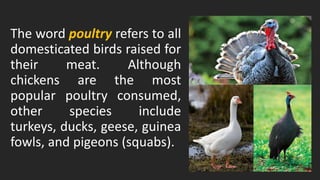
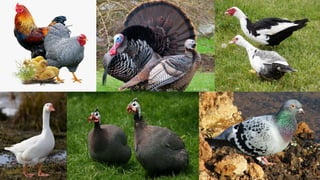
The word poultry refers to all
domesticated birds raised for
their meat. Although
chickens are the most
popular poultry consumed,
other species include
turkeys, ducks, geese, guinea
fowls, and pigeons (squabs).
Classification of Poultry
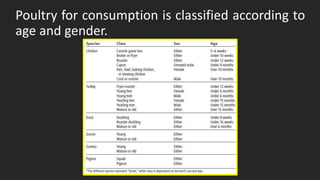
Poultry for consumption is classified according to
age and gender.
https://i.pinimg.com/originals/82/ff/41/82ff41ae4ab5bdf1d1fb6745c8c043d2.jpg
Composition of Poultry
The composition of poultry (muscle tissue, connective
tissue, etc.) is similar to that of other meat.
https://strongerrr.com/wp-content/uploads/2017/12/Meat-nutrition-facts-infographic2.png
Pigments
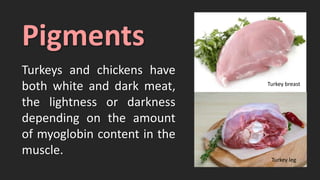
Turkeys and chickens have
both white and dark meat,
the lightness or darkness
depending on the amount
of myoglobin content in the
muscle.
Turkey breast
Turkey leg
Chicken and turkey breasts are more white because
both these types of birds do almost no flying, and
their meat (muscles) in these areas thus contains
much less myoglobin. Wild birds such as ducks have
darker breast meat because they actually use the
muscles for flying.
Duck breast
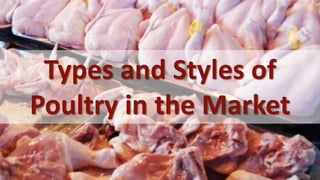
Types and Styles of
Poultry in the Market
Type refers to whether it is fresh, frozen, cooked,
sliced, canned, or dehydrated.
Style describes the degree to which it has been
cleaned or processed, that is, live, dressed,
ready-to-cook, or convenience categories.
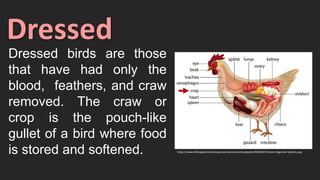
Dressed
Dressed birds are those
that have had only the
blood, feathers, and craw
removed. The craw or
crop is the pouch-like
gullet of a bird where food
is stored and softened. https://www.thehappychickencoop.com/wp-content/uploads/2018/04/Chicken-Digestive-System.png
Ready-to-cook
Ready-to-cook poultry is
eviscerated, free of blood,
feathers, head, and feet; it
is what is typically found in
the supermarket.
Convenience
3-joint wing
Forequarter
Drumette
Neck
Mid-joint wing
Wing tip
Breast, Skin-
on, Bone in
Whole
leg
Leg quarter with
backbone
Breast fillet without skin
Innerfillet
Thigh
Drumstick
https://as-selectmeats.com.au/
Preparation of Poultry
Poultry can be prepared in many ways:
•Dry heat methods (roasting, baking, broiling,
grilling, and frying)
•Moist heat methods (braising, stewing,
poaching)
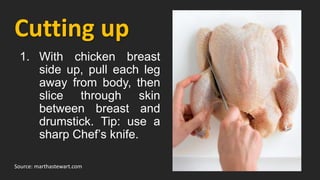
Cutting up
Source: marthastewart.com
1. With chicken breast
side up, pull each leg
away from body, then
slice through skin
between breast and
drumstick. Tip: use a
sharp Chef’s knife.
Source: marthastewart.com
2. Turn chicken on its
side. Bend each leg
back until thighbone
pops out of its socket.
Cut through joint and
skin to detach leg
completely.
Source: marthastewart.com
3. With chicken on its
side, pull each wing
away from body. Cut
through joint and
remove wing.
Source: marthastewart.com
4. Lift up chicken and
cut downward through
rib cage and then
shoulder joints to
separate breast from
back.
Source: marthastewart.com
5. Place breast skin side
down. Split center
bone using a
chopping motion, then
slice through meat
and skin to separate
into 2 pieces.
Source: marthastewart.com
6. To cut breast halves
into quarters, turn
each skin side up and
cut in half diagonally
through bone.
Source: marthastewart.com
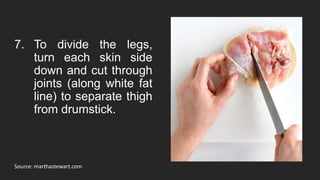
7. To divide the legs,
turn each skin side
down and cut through
joints (along white fat
line) to separate thigh
from drumstick.
Preparation safety tips
Freezing will largely protect against bacterial
growth while the poultry is frozen, but
precautions should be taken during and after
thawing, when any bacteria that are present
may begin to grow.
The refrigerator is the best place to thaw frozen
birds, and its use requires planning ahead. It
takes about a day for a 3½-pound chicken and
1 to 5 days for a turkey to defrost, depending on
its weight.
Stuffing
For food safety reasons, the USDA
recommends that stuffing be prepared and
cooked separately.
Pre-stuffed frozen poultry should never be
thawed, but should be prepared, according to
package directions, directly from the frozen
state.
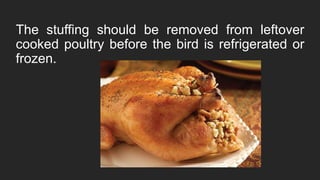
The stuffing should be removed from leftover
cooked poultry before the bird is refrigerated or
frozen.
Changes during preparation
Properly prepared poultry is tender and juicy,
but overcooking causes the flesh to become
dry, tough, and stringy.
The skin of any poultry, which is primarily fat,
can be removed before or after preparation, but
if it is left on, it does contribute to flavor and
juiciness.
Fat that naturally melts off the bird during
heating can be used to baste the poultry or to
create sauces.
Reheated poultry, especially turkey, has a
characteristic warmed-over flavor caused by the
breakdown of fat.
Microwave reheating results in less of this
warmed-over flavor than reheating using
conventional methods.
Determining doneness
Poultry should always be heated until well done
to enhance flavor and to minimize the risk of
foodborne bacterial illnesses. Doneness may be
determined by internal temperature, color
changes, and/or touch and time/weight tables.
Internal Temperature
The best way to check poultry for doneness is
to use a meat thermometer. It should be
inserted into the thickest part of the breast,
although it can also be inserted into the inner
thigh. In either case it should not touch bone or
fat. Poultry is sufficiently cooked when the
internal temperature reaches a minimum of
165°F (74°C) for at least 15 seconds.
Color change
When the skin on oven-roasted chicken or
turkey reaches a golden brown color, it is time
to test for doneness. The juices coming out of
the bird should have turned from pink to clear,
and a bit of bone should be showing on the tip
of the legs.
When a turkey is roasted
breast side up, the breast
should be covered with
metal foil or a bit of
cooking oil to keep the
breast from over-browning
or burning. The foil should
be removed 45 minutes to
an hour before the end of
heating to allow for final
browning.
Touch
When pressed firmly with one or two fingers,
the well-done bird’s flesh will feel firm, not soft.
White meat may be firmer than dark meat, in
part because certain proteins have a higher gel-
forming ability in white muscle than they do in
the dark muscles.
https://imagesvc.meredithcorp.io/
Storage of poultry
Fresh poultry will keep in the refrigerator for up
to 3 days, while frozen poultry will keep in the
freezer for 6 to 12 months. All prepared foods
should be refrigerated in covered containers
and guarded against Salmonella.

5 _ Poultry.pptx

  • 1.
    FTECH 2110 –Basic Food Preparation Source: BROWN, A. (2011) Understanding Food: Principles and Preparation, 4th ed. Cengage Learning Inc., USA. 5 - Poultry
  • 2.
    The word poultryrefers to all domesticated birds raised for their meat. Although chickens are the most popular poultry consumed, other species include turkeys, ducks, geese, guinea fowls, and pigeons (squabs).
  • 3.
  • 4.
    Poultry for consumptionis classified according to age and gender.
  • 6.
  • 7.
  • 8.
    The composition ofpoultry (muscle tissue, connective tissue, etc.) is similar to that of other meat. https://strongerrr.com/wp-content/uploads/2017/12/Meat-nutrition-facts-infographic2.png
  • 9.
    Pigments Turkeys and chickenshave both white and dark meat, the lightness or darkness depending on the amount of myoglobin content in the muscle. Turkey breast Turkey leg
  • 10.
    Chicken and turkeybreasts are more white because both these types of birds do almost no flying, and their meat (muscles) in these areas thus contains much less myoglobin. Wild birds such as ducks have darker breast meat because they actually use the muscles for flying. Duck breast
  • 11.
    Types and Stylesof Poultry in the Market
  • 12.
    Type refers towhether it is fresh, frozen, cooked, sliced, canned, or dehydrated. Style describes the degree to which it has been cleaned or processed, that is, live, dressed, ready-to-cook, or convenience categories.
  • 13.
    Dressed Dressed birds arethose that have had only the blood, feathers, and craw removed. The craw or crop is the pouch-like gullet of a bird where food is stored and softened. https://www.thehappychickencoop.com/wp-content/uploads/2018/04/Chicken-Digestive-System.png
  • 14.
    Ready-to-cook Ready-to-cook poultry is eviscerated,free of blood, feathers, head, and feet; it is what is typically found in the supermarket.
  • 15.
    Convenience 3-joint wing Forequarter Drumette Neck Mid-joint wing Wingtip Breast, Skin- on, Bone in Whole leg Leg quarter with backbone Breast fillet without skin Innerfillet Thigh Drumstick https://as-selectmeats.com.au/
  • 16.
  • 17.
    Poultry can beprepared in many ways: •Dry heat methods (roasting, baking, broiling, grilling, and frying) •Moist heat methods (braising, stewing, poaching)
  • 18.
    Cutting up Source: marthastewart.com 1.With chicken breast side up, pull each leg away from body, then slice through skin between breast and drumstick. Tip: use a sharp Chef’s knife.
  • 19.
    Source: marthastewart.com 2. Turnchicken on its side. Bend each leg back until thighbone pops out of its socket. Cut through joint and skin to detach leg completely.
  • 20.
    Source: marthastewart.com 3. Withchicken on its side, pull each wing away from body. Cut through joint and remove wing.
  • 21.
    Source: marthastewart.com 4. Liftup chicken and cut downward through rib cage and then shoulder joints to separate breast from back.
  • 22.
    Source: marthastewart.com 5. Placebreast skin side down. Split center bone using a chopping motion, then slice through meat and skin to separate into 2 pieces.
  • 23.
    Source: marthastewart.com 6. Tocut breast halves into quarters, turn each skin side up and cut in half diagonally through bone.
  • 24.
    Source: marthastewart.com 7. Todivide the legs, turn each skin side down and cut through joints (along white fat line) to separate thigh from drumstick.
  • 25.
    Preparation safety tips Freezingwill largely protect against bacterial growth while the poultry is frozen, but precautions should be taken during and after thawing, when any bacteria that are present may begin to grow.
  • 26.
    The refrigerator isthe best place to thaw frozen birds, and its use requires planning ahead. It takes about a day for a 3½-pound chicken and 1 to 5 days for a turkey to defrost, depending on its weight.
  • 27.
    Stuffing For food safetyreasons, the USDA recommends that stuffing be prepared and cooked separately. Pre-stuffed frozen poultry should never be thawed, but should be prepared, according to package directions, directly from the frozen state.
  • 28.
    The stuffing shouldbe removed from leftover cooked poultry before the bird is refrigerated or frozen.
  • 29.
    Changes during preparation Properlyprepared poultry is tender and juicy, but overcooking causes the flesh to become dry, tough, and stringy.
  • 30.
    The skin ofany poultry, which is primarily fat, can be removed before or after preparation, but if it is left on, it does contribute to flavor and juiciness. Fat that naturally melts off the bird during heating can be used to baste the poultry or to create sauces.
  • 31.
    Reheated poultry, especiallyturkey, has a characteristic warmed-over flavor caused by the breakdown of fat. Microwave reheating results in less of this warmed-over flavor than reheating using conventional methods.
  • 32.
    Determining doneness Poultry shouldalways be heated until well done to enhance flavor and to minimize the risk of foodborne bacterial illnesses. Doneness may be determined by internal temperature, color changes, and/or touch and time/weight tables.
  • 33.
    Internal Temperature The bestway to check poultry for doneness is to use a meat thermometer. It should be inserted into the thickest part of the breast, although it can also be inserted into the inner thigh. In either case it should not touch bone or fat. Poultry is sufficiently cooked when the internal temperature reaches a minimum of 165°F (74°C) for at least 15 seconds.
  • 34.
    Color change When theskin on oven-roasted chicken or turkey reaches a golden brown color, it is time to test for doneness. The juices coming out of the bird should have turned from pink to clear, and a bit of bone should be showing on the tip of the legs.
  • 35.
    When a turkeyis roasted breast side up, the breast should be covered with metal foil or a bit of cooking oil to keep the breast from over-browning or burning. The foil should be removed 45 minutes to an hour before the end of heating to allow for final browning.
  • 36.
    Touch When pressed firmlywith one or two fingers, the well-done bird’s flesh will feel firm, not soft. White meat may be firmer than dark meat, in part because certain proteins have a higher gel- forming ability in white muscle than they do in the dark muscles.
  • 37.
  • 38.
    Storage of poultry Freshpoultry will keep in the refrigerator for up to 3 days, while frozen poultry will keep in the freezer for 6 to 12 months. All prepared foods should be refrigerated in covered containers and guarded against Salmonella.