Prepared By
Bhanupraksh Jaiswal
Asst. Professor
COMPOSITION AND STRUCTURE
Muscle tissue consist of three major
components:
Water – 75%
Protein – 20%
Fat – up to 5%
Carbohydrates – small quantities.
MUSCLE FIBERS – are bound together in bundles
by connective tissue.
Light Meat and Dark Meat - chicken and turkey Are divided into two
parts;
Light meat – breast and wings: less fat, less connective tissue, cooks faster.
Dark meat – legs (drumsticks and thighs) : more fat, more connective tissue, takes
longer to cook.
INSPECTION –
 A guarantee of wholesomeness
 Indicated by a round stamp
 Required by law
GRADING
 Based on quality
 Indicated by a shield stamp and letter grade
 Not required by law.
*U.S. grades are A,B, and C ( a being the best ), they are based on:
 Shape of carcass
 Amount of flesh
 Amount of fat
 Pinfeathers
 Skin tears, cut broken bones
 Blemishes and bruises
CHICKEN:
Rock Cornish game hen: 5-6 weeks, young chicken, very tender and
delicate.
Broiler or fryer: 9- 12 weeks, young chicken of either sex, tender
flesh and flexible cartilage, smooth skin.
Roaster: 3-5 months, young chicken of either sex, tender flesh and
smooth skin, but less flexible cartilage.
Capon: under 8 months, castrated male chicken, flesh very tender
and well flavored. Large breast expensive.
Hen or Fowl: over 10 months, mature female, tough flesh and
coarse skin, hardened breastbone cartilage.
Cock or Rooster: over 10 months Mature male, coarse skin, tough
dark meat
 DUCK:
Broiler or fryer: under 8weeks, young and tender with sof bill and
windpipe.
Roaster duckling: under 16 weeks with bill and wind pipe that are just
starting to harden.
Mature duck: over 6 months, old duck w/ tough flesh and hard bill and
windpipe.
TURKEY:
Fryer-roaster: Young bird of either sex, tender flesh, smooth skin and
flexible cartillage. Under 16 weeks
Young turkey (hen or tom): Young turkey with tender flesh but firmer
cartillage. 5-7mos.
Yearling turkey: Fully matured, that is reasonably tender. Under
15mos.
Mature turkey or old turkey (hen or tom): old turkey with tough flesh
and coarse skin. Over 15mos.
 GOOSE
: Young goose: young bird with either tender flesh. Under
6mos.
Mature goose: Tough old bird. Over 6mos.
PIGEONS:
Squab: Very young pigeons, with light, tender meat. 3-4
weeks.
Pigeon: Older pigeons with tough, dark meat. 3-4 weeks
CLASSIFICATION AND MARKET FORMS
Kind – species, such as chicken, turkey or duck.
Class – the subdivision of kind depending on age and
sex.
Style – the amount of cleaning and processing.



live: almost never purchased on food service.
Dressed: killed, bled and plucked, also rarely seen in
food service.
Ready to cook: dressed and eviscerated, w/ head,
feet removed. Cut up, or parts
State of refrigeration – chilled or frozen.
CLASSIFICATION AND MARKET
FORMS
Fresh - poultry that is to be cooked within 24 hours
Frozen - poultry that can be kept up to 6 months;
Fully-cooked - poultry that is purchased frozen or
canned.
Giblets - include the neck, heart, liver, and gizzards
of poultry. They are used for appetizers, gravies, and
stocks.
HANDLING AND STORAGE
FRESH
Fresh poultry is extremely perishable. It should arrive packed in
ice and be kept in ice until used.
Ideally, use it within 24hrs of receiving, never more than 4 days.
Poultry often carries salmonella bacteria. Wash all equipment
and cutting surfaces after handling the poultry to avoid food
contamination of other foods.
FROZEN
STORE FROZEN POULTRY AT 0F _(-18C) or lower until readyto
thaw.
Thaw in original wrapper in refrigerator, allowing 1-2 for
chickens, 2-4 days for larger birds. If pressed for time, thaw it in
running water in original wrapper.
 D o not refreeze thawed poultry.
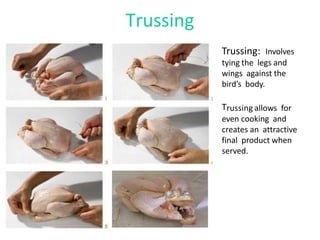
Trussing
Trussing: Involves
tying the legs and
wings against the
bird’s body.
Trussing allows for
even cooking and
creates an attractive
final product when
served.
Cooking Poultry
When roasting, you should start at a high temperature to
render the fat , for browning and to complete the
cooking at a lower temperature to promote even
cooking, and seal in juices helping to keep the meat
moist.
Bone-in poultry affect cooking procedures as compared
to boneless, Bone-in poultry takes longer to cook than
boneless poultry, and the bone helps retain moisture in
the meat.
Poaching is used for tender whole birds; Simmering is
used for tougher, older birds cut into pieces.
Cooking Poultry
• Federal mandate that poultry dishes sold in a foodservice
establishment cannot be stuffed, because bacteria can
reproduce rapidly in the stuffing within the bird’s cavity.
• Even if the flesh of the bird cooks to above the proper
temperature, the temperature of the stuffing may not
reach a safe, adequate temperature in an adequate
amount of time.
• To check the core temperature, the thermometershould be
inserted into the thickest muscle or part of the inner
part of the thigh, away from the bone.
• Minimum Internal Temperature 165F for 15 sec.
That’s All

Chapter No 2 Poultry

  • 1.
  • 2.
    COMPOSITION AND STRUCTURE Muscletissue consist of three major components: Water – 75% Protein – 20% Fat – up to 5% Carbohydrates – small quantities. MUSCLE FIBERS – are bound together in bundles by connective tissue.
  • 3.
    Light Meat andDark Meat - chicken and turkey Are divided into two parts; Light meat – breast and wings: less fat, less connective tissue, cooks faster. Dark meat – legs (drumsticks and thighs) : more fat, more connective tissue, takes longer to cook. INSPECTION –  A guarantee of wholesomeness  Indicated by a round stamp  Required by law GRADING  Based on quality  Indicated by a shield stamp and letter grade  Not required by law. *U.S. grades are A,B, and C ( a being the best ), they are based on:  Shape of carcass  Amount of flesh  Amount of fat  Pinfeathers  Skin tears, cut broken bones  Blemishes and bruises
  • 4.
    CHICKEN: Rock Cornish gamehen: 5-6 weeks, young chicken, very tender and delicate. Broiler or fryer: 9- 12 weeks, young chicken of either sex, tender flesh and flexible cartilage, smooth skin. Roaster: 3-5 months, young chicken of either sex, tender flesh and smooth skin, but less flexible cartilage. Capon: under 8 months, castrated male chicken, flesh very tender and well flavored. Large breast expensive. Hen or Fowl: over 10 months, mature female, tough flesh and coarse skin, hardened breastbone cartilage. Cock or Rooster: over 10 months Mature male, coarse skin, tough dark meat
  • 5.
     DUCK: Broiler orfryer: under 8weeks, young and tender with sof bill and windpipe. Roaster duckling: under 16 weeks with bill and wind pipe that are just starting to harden. Mature duck: over 6 months, old duck w/ tough flesh and hard bill and windpipe. TURKEY: Fryer-roaster: Young bird of either sex, tender flesh, smooth skin and flexible cartillage. Under 16 weeks Young turkey (hen or tom): Young turkey with tender flesh but firmer cartillage. 5-7mos. Yearling turkey: Fully matured, that is reasonably tender. Under 15mos. Mature turkey or old turkey (hen or tom): old turkey with tough flesh and coarse skin. Over 15mos.
  • 6.
     GOOSE : Younggoose: young bird with either tender flesh. Under 6mos. Mature goose: Tough old bird. Over 6mos. PIGEONS: Squab: Very young pigeons, with light, tender meat. 3-4 weeks. Pigeon: Older pigeons with tough, dark meat. 3-4 weeks
  • 7.
    CLASSIFICATION AND MARKETFORMS Kind – species, such as chicken, turkey or duck. Class – the subdivision of kind depending on age and sex. Style – the amount of cleaning and processing.    live: almost never purchased on food service. Dressed: killed, bled and plucked, also rarely seen in food service. Ready to cook: dressed and eviscerated, w/ head, feet removed. Cut up, or parts State of refrigeration – chilled or frozen.
  • 8.
    CLASSIFICATION AND MARKET FORMS Fresh- poultry that is to be cooked within 24 hours Frozen - poultry that can be kept up to 6 months; Fully-cooked - poultry that is purchased frozen or canned. Giblets - include the neck, heart, liver, and gizzards of poultry. They are used for appetizers, gravies, and stocks.
  • 9.
    HANDLING AND STORAGE FRESH Freshpoultry is extremely perishable. It should arrive packed in ice and be kept in ice until used. Ideally, use it within 24hrs of receiving, never more than 4 days. Poultry often carries salmonella bacteria. Wash all equipment and cutting surfaces after handling the poultry to avoid food contamination of other foods. FROZEN STORE FROZEN POULTRY AT 0F _(-18C) or lower until readyto thaw. Thaw in original wrapper in refrigerator, allowing 1-2 for chickens, 2-4 days for larger birds. If pressed for time, thaw it in running water in original wrapper.  D o not refreeze thawed poultry.
  • 10.
    Trussing Trussing: Involves tying thelegs and wings against the bird’s body. Trussing allows for even cooking and creates an attractive final product when served.
  • 11.
    Cooking Poultry When roasting,you should start at a high temperature to render the fat , for browning and to complete the cooking at a lower temperature to promote even cooking, and seal in juices helping to keep the meat moist. Bone-in poultry affect cooking procedures as compared to boneless, Bone-in poultry takes longer to cook than boneless poultry, and the bone helps retain moisture in the meat. Poaching is used for tender whole birds; Simmering is used for tougher, older birds cut into pieces.
  • 12.
    Cooking Poultry • Federalmandate that poultry dishes sold in a foodservice establishment cannot be stuffed, because bacteria can reproduce rapidly in the stuffing within the bird’s cavity. • Even if the flesh of the bird cooks to above the proper temperature, the temperature of the stuffing may not reach a safe, adequate temperature in an adequate amount of time. • To check the core temperature, the thermometershould be inserted into the thickest muscle or part of the inner part of the thigh, away from the bone. • Minimum Internal Temperature 165F for 15 sec.
  • 13.