CHAPTER 5: REPORTING AND 
MANAGING BUDGETS 
• Explain at least three reasons why an operating 
budget is important in nursing care settings 
• Differentiate between the management 
functions 
of budget monitoring, investigation and control 
• Specify the important features of an operating 
expense budget 
• Compare applications of fixed and flexible 
budgeting in nursing care settings 
Copyright © Springer Publishing Company, LLC. All Rights Reserved. 
1
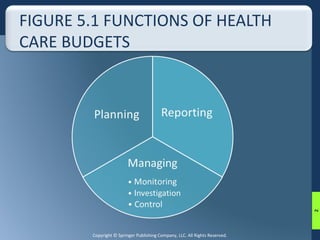
FIGURE 5.1 FUNCTIONS OF HEALTH 
CARE BUDGETS 
Copyright © Springer Publishing Company, LLC. All Rights Reserved. 
2
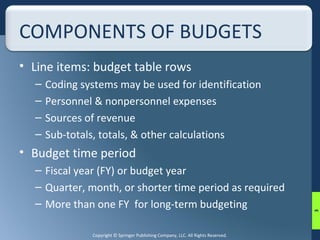
COMPONENTS OF BUDGETS 
• Line items: budget table rows 
– Coding systems may be used for identification 
– Personnel & nonpersonnel expenses 
– Sources of revenue 
– Sub-totals, totals, & other calculations 
• Budget time period 
– Fiscal year (FY) or budget year 
– Quarter, month, or shorter time period as required 
– More than one FY for long-term budgeting 
Copyright © Springer Publishing Company, LLC. All Rights Reserved. 
3
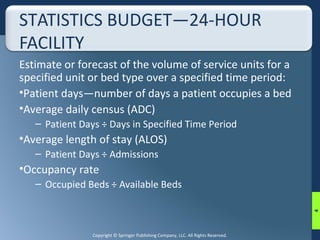
STATISTICS BUDGET—24-HOUR 
FACILITY 
Estimate or forecast of the volume of service units for a 
specified unit or bed type over a specified time period: 
•Patient days—number of days a patient occupies a bed 
•Average daily census (ADC) 
– Patient Days ÷ Days in Specified Time Period 
•Average length of stay (ALOS) 
– Patient Days ÷ Admissions 
•Occupancy rate 
– Occupied Beds ÷ Available Beds 
Copyright © Springer Publishing Company, LLC. All Rights Reserved. 
4
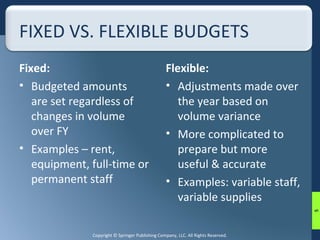
FIXED VS. FLEXIBLE BUDGETS 
Fixed: 
• Budgeted amounts 
are set regardless of 
changes in volume 
over FY 
• Examples – rent, 
equipment, full-time or 
permanent staff 
Flexible: 
• Adjustments made over 
the year based on 
volume variance 
• More complicated to 
prepare but more 
useful & accurate 
• Examples: variable staff, 
variable supplies 
Copyright © Springer Publishing Company, LLC. All Rights Reserved. 
5
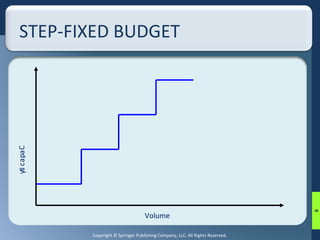
STEP-FIXED BUDGET 
C a p a c i t y Volume 
Copyright © Springer Publishing Company, LLC. All Rights Reserved. 
6
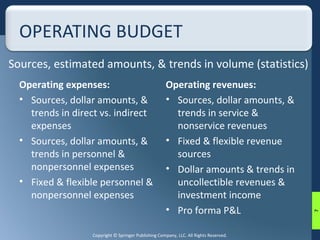
OPERATING BUDGET 
Operating expenses: 
• Sources, dollar amounts, & 
trends in direct vs. indirect 
expenses 
• Sources, dollar amounts, & 
trends in personnel & 
nonpersonnel expenses 
• Fixed & flexible personnel & 
nonpersonnel expenses 
Operating revenues: 
• Sources, dollar amounts, & 
trends in service & 
nonservice revenues 
• Fixed & flexible revenue 
sources 
• Dollar amounts & trends in 
uncollectible revenues & 
investment income 
• Pro forma P&L 
Copyright © Springer Publishing Company, LLC. All Rights Reserved. 
7 
Sources, estimated amounts, & trends in volume (statistics)
OPERATING EXPENSE BUDGET: 
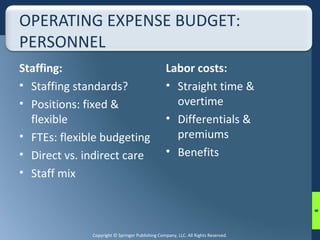
PERSONNEL 
Staffing: 
• Staffing standards? 
• Positions: fixed & 
flexible 
• FTEs: flexible budgeting 
• Direct vs. indirect care 
• Staff mix 
Labor costs: 
• Straight time & 
overtime 
• Differentials & 
premiums 
• Benefits 
Copyright © Springer Publishing Company, LLC. All Rights Reserved. 
8
OPERATING EXPENSE BUDGET: 
NONPERSONNEL 
Examples: 
•Clinical & office supplies 
•Noncapital budget equipment 
•Seminars & books 
Copyright © Springer Publishing Company, LLC. All Rights Reserved. 
9 
May be a fixed or flexible budget
COST MEASURES 
• Operating costs: expenses 
related to the generation of 
goods or services (operations) 
• Salaries & wages: nonhourly & 
hourly employees 
• Benefits: health insurance & 
other 
• Supply costs 
• Medication costs 
• Charity care is treated as an 
expense 
• Other relevant sources of 
Copyright © Springer Publishing Company, LLC. All Rights Reserved. 
costs 
Interpretation: 
•Change in costs 
•Unexpected costs or cost 
behavior 
•Cost management 
•Related to volume & revenue 
•Other events affecting costs 
10
REVENUE BUDGET 
• Service revenue (operating revenue) 
• Nonservice revenue (nonoperating revenue) 
• Fixed vs. flexible revenue 
• Total revenue: operating + nonoperating revenue 
• Gross revenue: total amount charged before 
reductions are applied 
• Net revenue: gross revenue less reductions 
• Pro forma P&L statement 
Copyright © Springer Publishing Company, LLC. All Rights Reserved. 
11
REASONS TO INVESTIGATE BUDGET 
VARIANCE 
• Identify data entry or calculation error 
– Amount of unfavorable variance 
• Policies, guidelines, or thresholds 
• Net loss: total expenses exceed total revenues 
• Percent unfavorable variance 
– Pattern of unfavorable variance 
• Continual increase (trend) in unfavorable variance 
• Duration of unfavorable variance 
• Impact if unfavorable variance continues the entire 
fiscal year 
Copyright © Springer Publishing Company, LLC. All Rights Reserved. 
12
REASONS TO INVESTIGATE BUDGET 
VARIANCE (CONT’D) 
• Unexpected or unusual variance 
• Unbudgeted expense 
• Variable expense increases when volume decreases 
• Determine if variance is controllable 
• Expense variance: prices or wages, efficiency 
• Revenue variance: reimbursement, charges, 
collections 
• Personal knowledge and experience 
Copyright © Springer Publishing Company, LLC. All Rights Reserved. 
13
HOW IMPORTANT IS THE 
VARIANCE? 
• Continued increase in variance 
• Duration of variance: “three data points are a 
trend” 
• Institutional policies or guidelines, such as dollar 
limits 
• Extent of concern if the variance were to 
continue the entire fiscal year 
• Personal knowledge & experience 
• Favorable variance: could funds be transferred? 
Copyright © Springer Publishing Company, LLC. All Rights Reserved. 
14
BUDGET VARIANCE 
• Variance: difference between the budgeted target and 
actual performance 
• Favorable budget variance is a desirable difference 
between budgeted and actual amounts 
– Actual expenses that are similar or less than budgeted indicate 
a favorable variance 
– Revenues that are similar or greater than budgeted also show 
a favorable variance 
• Unfavorable budget variance is an undesirable difference 
between budgeted and actual values 
– Actual revenues that are less than budgeted 
– Actual expenses that are higher than budgeted 
Copyright © Springer Publishing Company, LLC. All Rights Reserved. 
15
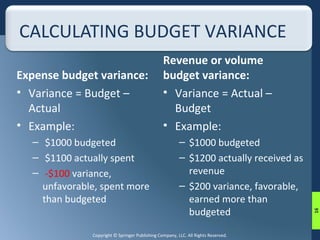
CALCULATING BUDGET VARIANCE 
Expense budget variance: 
• Variance = Budget – 
Actual 
• Example: 
– $1000 budgeted 
– $1100 actually spent 
– -$100 variance, 
unfavorable, spent more 
than budgeted 
Revenue or volume 
budget variance: 
• Variance = Actual – 
Budget 
• Example: 
– $1000 budgeted 
– $1200 actually received as 
revenue 
– $200 variance, favorable, 
earned more than 
budgeted 
Copyright © Springer Publishing Company, LLC. All Rights Reserved. 
16
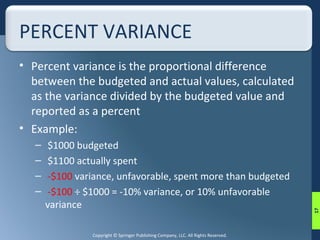
PERCENT VARIANCE 
• Percent variance is the proportional difference 
between the budgeted and actual values, calculated 
as the variance divided by the budgeted value and 
reported as a percent 
• Example: 
– $1000 budgeted 
– $1100 actually spent 
– -$100 variance, unfavorable, spent more than budgeted 
– -$100 ÷ $1000 = -10% variance, or 10% unfavorable 
variance 
Copyright © Springer Publishing Company, LLC. All Rights Reserved. 
17
BUDGET CONTROL 
• Control uses management strategies to 
correct performance problems & meet 
budget targets 
• Medical Unit RN overtime example 
– Unit assistant to manage phone & provide non-clinical 
support 
– Policies to reduce shift change overtime 
– Direct supervision & individual feedback 
– Involve staff in solving the problem 
Copyright © Springer Publishing Company, LLC. All Rights Reserved. 
18
BALANCE THE BUDGET 
• Applying budget control to adjust budget 
values to better fit the actual values, or 
• Adjust the budget so that revenues equal or 
exceed expenses 
• Methods include line item flexibility & 
adjustment authority 
• No single formula or approach for all 
situations 
Copyright © Springer Publishing Company, LLC. All Rights Reserved. 
19
BUDGET BALANCING: LINE ITEM 
FLEXIBILITY 
• Authority to transfer funds in one line item to 
another line item 
– Within specified policy limits 
– Typically line items must be within the same 
category of personnel or nonpersonnel expenses 
– May require additional budget justification or 
approval 
Copyright © Springer Publishing Company, LLC. All Rights Reserved. 
20
BUDGET BALANCING: ADJUSTMENT 
AUTHORITY 
• Authority to revise the budget over the FY 
– Corrects for the difference between budget & 
actual in price or quantity variance 
– Variance is expected to continue for the 
remaining FY 
Copyright © Springer Publishing Company, LLC. All Rights Reserved. 
21
COMPONENTS OF A BUDGET 
JUSTIFICATION 
• Budget line item(s) requiring justification 
• Category & type of line item 
• Variance amounts, averages, & percents 
• Adjusted variance, if applicable 
• Frequency, duration, & trend of variance 
• Variance source or sources 
• Source identified as controllable or uncontrollable 
• Control steps taken & results, if applicable 
• Potential impact on revenue 
• Effect on profits (if revenues are generated) 
• Revised budget table with explanatory notes 
Copyright © Springer Publishing Company, LLC. All Rights Reserved. 
22
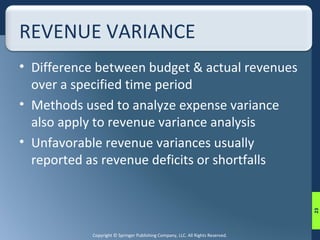
REVENUE VARIANCE 
• Difference between budget & actual revenues 
over a specified time period 
• Methods used to analyze expense variance 
also apply to revenue variance analysis 
• Unfavorable revenue variances usually 
reported as revenue deficits or shortfalls 
Copyright © Springer Publishing Company, LLC. All Rights Reserved. 
23
Jan Feb Mar Apr May Jun 
Copyright © Springer Publishing Company, LLC. All Rights Reserved. 
24 
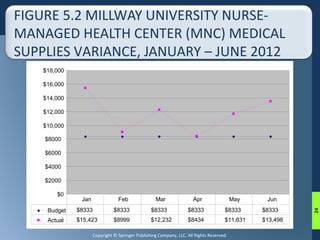
FIGURE 5.2 MILLWAY UNIVERSITY NURSE-MANAGED 
HEALTH CENTER (MNC) MEDICAL 
SUPPLIES VARIANCE, JANUARY – JUNE 2012 
$18,000 
$16,000 
$14,000 
$12,000 
$10,000 
$8000 
$6000 
$4000 
$2000 
$0 
Budget $8333 $8333 $8333 $8333 $8333 $8333 
Actual $15,423 $8999 $12,232 $8434 $11,631 $13,498
Nonproductive hours RN Overtime Hours 
Copyright © Springer Publishing Company, LLC. All Rights Reserved. 
25 
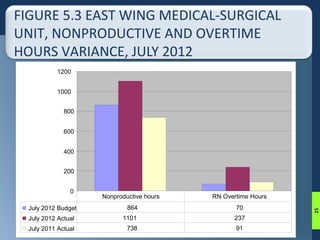
FIGURE 5.3 EAST WING MEDICAL-SURGICAL 
UNIT, NONPRODUCTIVE AND OVERTIME 
HOURS VARIANCE, JULY 2012 
1200 
1000 
800 
600 
400 
200 
0 
July 2012 Budget 864 70 
July 2012 Actual 1101 237 
July 2011 Actual 738 91

Efr ch5 budgetmanagement_sr2.11

  • 1.
    CHAPTER 5: REPORTINGAND MANAGING BUDGETS • Explain at least three reasons why an operating budget is important in nursing care settings • Differentiate between the management functions of budget monitoring, investigation and control • Specify the important features of an operating expense budget • Compare applications of fixed and flexible budgeting in nursing care settings Copyright © Springer Publishing Company, LLC. All Rights Reserved. 1
  • 2.
    FIGURE 5.1 FUNCTIONSOF HEALTH CARE BUDGETS Copyright © Springer Publishing Company, LLC. All Rights Reserved. 2
  • 3.
    COMPONENTS OF BUDGETS • Line items: budget table rows – Coding systems may be used for identification – Personnel & nonpersonnel expenses – Sources of revenue – Sub-totals, totals, & other calculations • Budget time period – Fiscal year (FY) or budget year – Quarter, month, or shorter time period as required – More than one FY for long-term budgeting Copyright © Springer Publishing Company, LLC. All Rights Reserved. 3
  • 4.
    STATISTICS BUDGET—24-HOUR FACILITY Estimate or forecast of the volume of service units for a specified unit or bed type over a specified time period: •Patient days—number of days a patient occupies a bed •Average daily census (ADC) – Patient Days ÷ Days in Specified Time Period •Average length of stay (ALOS) – Patient Days ÷ Admissions •Occupancy rate – Occupied Beds ÷ Available Beds Copyright © Springer Publishing Company, LLC. All Rights Reserved. 4
  • 5.
    FIXED VS. FLEXIBLEBUDGETS Fixed: • Budgeted amounts are set regardless of changes in volume over FY • Examples – rent, equipment, full-time or permanent staff Flexible: • Adjustments made over the year based on volume variance • More complicated to prepare but more useful & accurate • Examples: variable staff, variable supplies Copyright © Springer Publishing Company, LLC. All Rights Reserved. 5
  • 6.
    STEP-FIXED BUDGET Ca p a c i t y Volume Copyright © Springer Publishing Company, LLC. All Rights Reserved. 6
  • 7.
    OPERATING BUDGET Operatingexpenses: • Sources, dollar amounts, & trends in direct vs. indirect expenses • Sources, dollar amounts, & trends in personnel & nonpersonnel expenses • Fixed & flexible personnel & nonpersonnel expenses Operating revenues: • Sources, dollar amounts, & trends in service & nonservice revenues • Fixed & flexible revenue sources • Dollar amounts & trends in uncollectible revenues & investment income • Pro forma P&L Copyright © Springer Publishing Company, LLC. All Rights Reserved. 7 Sources, estimated amounts, & trends in volume (statistics)
  • 8.
    OPERATING EXPENSE BUDGET: PERSONNEL Staffing: • Staffing standards? • Positions: fixed & flexible • FTEs: flexible budgeting • Direct vs. indirect care • Staff mix Labor costs: • Straight time & overtime • Differentials & premiums • Benefits Copyright © Springer Publishing Company, LLC. All Rights Reserved. 8
  • 9.
    OPERATING EXPENSE BUDGET: NONPERSONNEL Examples: •Clinical & office supplies •Noncapital budget equipment •Seminars & books Copyright © Springer Publishing Company, LLC. All Rights Reserved. 9 May be a fixed or flexible budget
  • 10.
    COST MEASURES •Operating costs: expenses related to the generation of goods or services (operations) • Salaries & wages: nonhourly & hourly employees • Benefits: health insurance & other • Supply costs • Medication costs • Charity care is treated as an expense • Other relevant sources of Copyright © Springer Publishing Company, LLC. All Rights Reserved. costs Interpretation: •Change in costs •Unexpected costs or cost behavior •Cost management •Related to volume & revenue •Other events affecting costs 10
  • 11.
    REVENUE BUDGET •Service revenue (operating revenue) • Nonservice revenue (nonoperating revenue) • Fixed vs. flexible revenue • Total revenue: operating + nonoperating revenue • Gross revenue: total amount charged before reductions are applied • Net revenue: gross revenue less reductions • Pro forma P&L statement Copyright © Springer Publishing Company, LLC. All Rights Reserved. 11
  • 12.
    REASONS TO INVESTIGATEBUDGET VARIANCE • Identify data entry or calculation error – Amount of unfavorable variance • Policies, guidelines, or thresholds • Net loss: total expenses exceed total revenues • Percent unfavorable variance – Pattern of unfavorable variance • Continual increase (trend) in unfavorable variance • Duration of unfavorable variance • Impact if unfavorable variance continues the entire fiscal year Copyright © Springer Publishing Company, LLC. All Rights Reserved. 12
  • 13.
    REASONS TO INVESTIGATEBUDGET VARIANCE (CONT’D) • Unexpected or unusual variance • Unbudgeted expense • Variable expense increases when volume decreases • Determine if variance is controllable • Expense variance: prices or wages, efficiency • Revenue variance: reimbursement, charges, collections • Personal knowledge and experience Copyright © Springer Publishing Company, LLC. All Rights Reserved. 13
  • 14.
    HOW IMPORTANT ISTHE VARIANCE? • Continued increase in variance • Duration of variance: “three data points are a trend” • Institutional policies or guidelines, such as dollar limits • Extent of concern if the variance were to continue the entire fiscal year • Personal knowledge & experience • Favorable variance: could funds be transferred? Copyright © Springer Publishing Company, LLC. All Rights Reserved. 14
  • 15.
    BUDGET VARIANCE •Variance: difference between the budgeted target and actual performance • Favorable budget variance is a desirable difference between budgeted and actual amounts – Actual expenses that are similar or less than budgeted indicate a favorable variance – Revenues that are similar or greater than budgeted also show a favorable variance • Unfavorable budget variance is an undesirable difference between budgeted and actual values – Actual revenues that are less than budgeted – Actual expenses that are higher than budgeted Copyright © Springer Publishing Company, LLC. All Rights Reserved. 15
  • 16.
    CALCULATING BUDGET VARIANCE Expense budget variance: • Variance = Budget – Actual • Example: – $1000 budgeted – $1100 actually spent – -$100 variance, unfavorable, spent more than budgeted Revenue or volume budget variance: • Variance = Actual – Budget • Example: – $1000 budgeted – $1200 actually received as revenue – $200 variance, favorable, earned more than budgeted Copyright © Springer Publishing Company, LLC. All Rights Reserved. 16
  • 17.
    PERCENT VARIANCE •Percent variance is the proportional difference between the budgeted and actual values, calculated as the variance divided by the budgeted value and reported as a percent • Example: – $1000 budgeted – $1100 actually spent – -$100 variance, unfavorable, spent more than budgeted – -$100 ÷ $1000 = -10% variance, or 10% unfavorable variance Copyright © Springer Publishing Company, LLC. All Rights Reserved. 17
  • 18.
    BUDGET CONTROL •Control uses management strategies to correct performance problems & meet budget targets • Medical Unit RN overtime example – Unit assistant to manage phone & provide non-clinical support – Policies to reduce shift change overtime – Direct supervision & individual feedback – Involve staff in solving the problem Copyright © Springer Publishing Company, LLC. All Rights Reserved. 18
  • 19.
    BALANCE THE BUDGET • Applying budget control to adjust budget values to better fit the actual values, or • Adjust the budget so that revenues equal or exceed expenses • Methods include line item flexibility & adjustment authority • No single formula or approach for all situations Copyright © Springer Publishing Company, LLC. All Rights Reserved. 19
  • 20.
    BUDGET BALANCING: LINEITEM FLEXIBILITY • Authority to transfer funds in one line item to another line item – Within specified policy limits – Typically line items must be within the same category of personnel or nonpersonnel expenses – May require additional budget justification or approval Copyright © Springer Publishing Company, LLC. All Rights Reserved. 20
  • 21.
    BUDGET BALANCING: ADJUSTMENT AUTHORITY • Authority to revise the budget over the FY – Corrects for the difference between budget & actual in price or quantity variance – Variance is expected to continue for the remaining FY Copyright © Springer Publishing Company, LLC. All Rights Reserved. 21
  • 22.
    COMPONENTS OF ABUDGET JUSTIFICATION • Budget line item(s) requiring justification • Category & type of line item • Variance amounts, averages, & percents • Adjusted variance, if applicable • Frequency, duration, & trend of variance • Variance source or sources • Source identified as controllable or uncontrollable • Control steps taken & results, if applicable • Potential impact on revenue • Effect on profits (if revenues are generated) • Revised budget table with explanatory notes Copyright © Springer Publishing Company, LLC. All Rights Reserved. 22
  • 23.
    REVENUE VARIANCE •Difference between budget & actual revenues over a specified time period • Methods used to analyze expense variance also apply to revenue variance analysis • Unfavorable revenue variances usually reported as revenue deficits or shortfalls Copyright © Springer Publishing Company, LLC. All Rights Reserved. 23
  • 24.
    Jan Feb MarApr May Jun Copyright © Springer Publishing Company, LLC. All Rights Reserved. 24 FIGURE 5.2 MILLWAY UNIVERSITY NURSE-MANAGED HEALTH CENTER (MNC) MEDICAL SUPPLIES VARIANCE, JANUARY – JUNE 2012 $18,000 $16,000 $14,000 $12,000 $10,000 $8000 $6000 $4000 $2000 $0 Budget $8333 $8333 $8333 $8333 $8333 $8333 Actual $15,423 $8999 $12,232 $8434 $11,631 $13,498
  • 25.
    Nonproductive hours RNOvertime Hours Copyright © Springer Publishing Company, LLC. All Rights Reserved. 25 FIGURE 5.3 EAST WING MEDICAL-SURGICAL UNIT, NONPRODUCTIVE AND OVERTIME HOURS VARIANCE, JULY 2012 1200 1000 800 600 400 200 0 July 2012 Budget 864 70 July 2012 Actual 1101 237 July 2011 Actual 738 91

Editor's Notes

  • #11 Charity care is treated as an expense—assumed unable to pay