
7a. Perceptions7.People ResultsIB Student Raluca-Maria Angelescu
Outline1.What`s behind the topic?2. Perception measures3. Approches4. Linkages5. ConclusionIB Student Raluca-Maria Angelescu
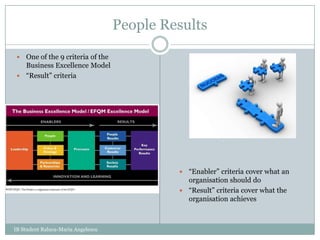
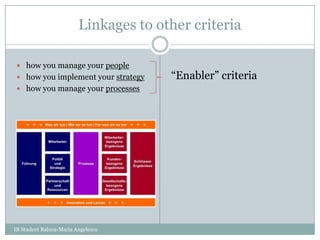
People ResultsOne of the 9 criteria of the Business Excellence Model“Result” criteria“Enabler” criteria cover what an organisation should do“Result” criteria cover what the organisation achievesIB Student Raluca-Maria Angelescu
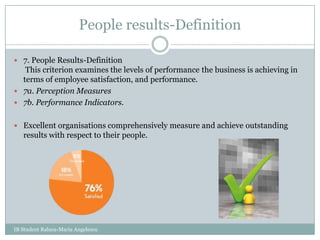
People results-Definition7. People Results-Definition This criterion examines the levels of performance the business is achieving in terms of employee satisfaction, and performance.7a. Perception Measures7b. Performance Indicators.Excellent organisations comprehensively measure and achieve outstanding results with respect to their people.IB Student Raluca-Maria Angelescu
Categories of measuresWithin the EFQM Excellence Model, two categories of measures are identified: Perception Measures: People’s perception of the organisation.Performance Measures: the internal ones used by the organisation to monitor, understand, predict and improve the performance of the organisation’speople and to predict their perceptions. IB Student Raluca-Maria Angelescu
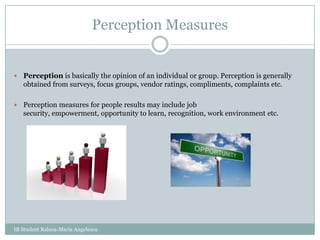
Perception MeasuresPerception is basically the opinion of an individual or group. Perception is generally obtained from surveys, focus groups, vendor ratings, compliments, complaints etc. Perception measures for people results may include job security, empowerment, opportunity to learn, recognition, work environment etc.IB Student Raluca-Maria Angelescu
People perceptions2 main factors:MOTIVATIONSATISFACTIONAlthough inter-relateddifferent consequencesIB Student Raluca-Maria Angelescu
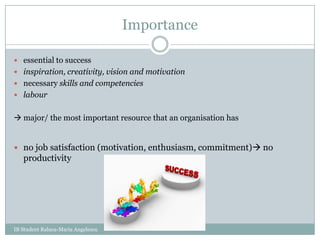
Importanceessential to successinspiration, creativity, vision and motivationnecessary skills and competencieslabour major/ the most important resource that an organisation hasno job satisfaction (motivation, enthusiasm, commitment) no productivityIB Student Raluca-Maria Angelescu
How do we know what people think?Many sources:Rating scales
Surveys
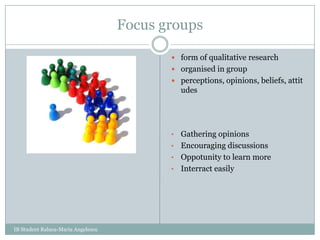
Focus groups
Interviews
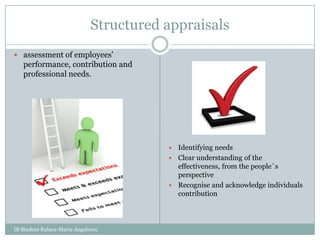
Structured appraisalsIB Student Raluca-Maria Angelescu
Rating scalesMost commonly usedRefer to:Rate of pay
Responsibilities
Variety of tasks
Oppotunities
Co-workersIB Student Raluca-Maria Angelescu

Efqm 7a raluca maria angelescu

  • 1.
    7a. Perceptions7.People ResultsIBStudent Raluca-Maria Angelescu
  • 2.
    Outline1.What`s behind thetopic?2. Perception measures3. Approches4. Linkages5. ConclusionIB Student Raluca-Maria Angelescu
  • 3.
    People ResultsOne ofthe 9 criteria of the Business Excellence Model“Result” criteria“Enabler” criteria cover what an organisation should do“Result” criteria cover what the organisation achievesIB Student Raluca-Maria Angelescu
  • 4.
    People results-Definition7. PeopleResults-Definition This criterion examines the levels of performance the business is achieving in terms of employee satisfaction, and performance.7a. Perception Measures7b. Performance Indicators.Excellent organisations comprehensively measure and achieve outstanding results with respect to their people.IB Student Raluca-Maria Angelescu
  • 5.
    Categories of measuresWithinthe EFQM Excellence Model, two categories of measures are identified: Perception Measures: People’s perception of the organisation.Performance Measures: the internal ones used by the organisation to monitor, understand, predict and improve the performance of the organisation’speople and to predict their perceptions. IB Student Raluca-Maria Angelescu
  • 6.
    Perception MeasuresPerception isbasically the opinion of an individual or group. Perception is generally obtained from surveys, focus groups, vendor ratings, compliments, complaints etc. Perception measures for people results may include job security, empowerment, opportunity to learn, recognition, work environment etc.IB Student Raluca-Maria Angelescu
  • 7.
    People perceptions2 mainfactors:MOTIVATIONSATISFACTIONAlthough inter-relateddifferent consequencesIB Student Raluca-Maria Angelescu
  • 8.
    Importanceessential to successinspiration,creativity, vision and motivationnecessary skills and competencieslabour major/ the most important resource that an organisation hasno job satisfaction (motivation, enthusiasm, commitment) no productivityIB Student Raluca-Maria Angelescu
  • 9.
    How do weknow what people think?Many sources:Rating scales
  • 10.
  • 11.
  • 12.
  • 13.
    Structured appraisalsIB StudentRaluca-Maria Angelescu
  • 14.
    Rating scalesMost commonlyusedRefer to:Rate of pay
  • 15.
  • 16.
  • 17.
  • 18.