Pharmaceutical aerosols
Reference:
Pharmaceutical dosage forms and drug delivery systems, P. 384 – 396.
• Are pressurized dosage forms containing one or
more active ingredients which upon actuation emit
a fine dispersion of liquid and/or solid materials in
a gaseous medium.
• Pharmaceutical aerosols are similar to other
dosage forms in that:
They require the same considerations with respect to
formulation, product stability, and therapeutic efficacy.
They differ from most other dosage forms in:
Their dependence upon the function of the container,
the valve assembly, and the propellant for the
physical delivery of the medication in proper form.
•The term pressurized package is commonly used
when referring to the aerosol container.
•The pressure is applied to aerosol system through:
The use of one or more liquefied or gaseous
propellants.
the propellant is responsible for developing the
pressure within the container and expels the product
when the valve is opened.
Upon activation of the valve assembly of the
aerosol, the propellant exerts a pressure that forces the
contents of the package out through the opening of the
valve.
The physical form in which the contents are
emitted is dependent upon:
a. The product formulation.
b. The type of valve.
• Possible aerosol physical forms:
1. a fine mist, a coarse,
2. wet or a dry spray,
3. a steady (continuous) stream, or a fast-breaking
foam.
The physical form selected for a given aerosol is
based on the intended use of that product.
Eg. Inhalation aerosols used in the treatment of
asthma, must present particles as a fine liquid mist or
as finely divided solid particles.
• What is Asthma?
1. asthma attack vary from person to person, but common
ones include cold air; exercise; allergens such as dust
mites, mold, pollen, animal dander, cockroach debris; and
some types of viral infections.
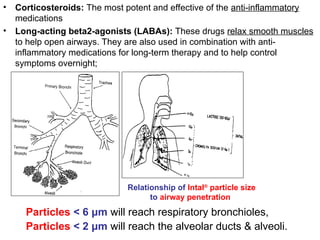
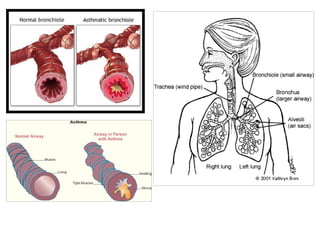
2. When you breathe in, air travels through your nose and/or
mouth through a tube called the trachea .The trachea
divides into bronchi, and these in turn subdivide 16-21
times into a series of smaller tubes (called bronchioles)
that lead to the alveoli (air sacs). During an asthma
attack, the bronchi and bronchioles become
narrowed. Here is how an asthma attack occurs.
When the airways come into contact with an asthma
trigger, the walls of the bronchi and bronchioles become
inflamed. Fluid and cellular debris accumulate in and
around the walls making them thicker. At the same time,
the muscles around the airways contract
(bronchoconstriction), causing the lumen of the airways
to become narrower. Narrowing of the airways makes
breathing more difficult.
• Corticosteroids: The most potent and effective of the anti-inflammatory
medications
• Long-acting beta2-agonists (LABAs): These drugs relax smooth muscles
to help open airways. They are also used in combination with anti-
inflammatory medications for long-term therapy and to help control
symptoms overnight;
Relationship of Intal®
particle size
to airway penetration
Particles < 6 μm will reach respiratory bronchioles,
Particles < 2 μm will reach the alveolar ducts & alveoli.
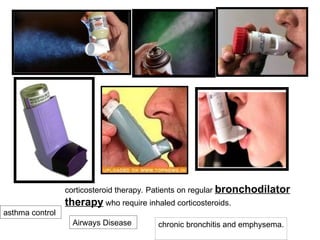
corticosteroid therapy. Patients on regular bronchodilator
therapy who require inhaled corticosteroids.
Airways Disease chronic bronchitis and emphysema.
asthma control
Dermatologic aerosols present medication
in the form of:
1. a powder,
2. a wet spray,
3. a stream of liquid (usually a local anesthetic),
an ointment-like product.
Other pharmaceutical aerosols include:
vaginal and rectal foams.
Space sprays:
• Are aerosols that are used to provide an airborne mist.
Ex.Room disinfectants, deodorizers, space insecticides.
The particle size of the released product:
1. Is generally quite small, usually < 50 μm.
2. Must be carefully controlled so that the dispersed
droplets or particles remain airborne for a prolonged
period of time.
One-second burst from a typical aerosol space
spray will produce 120 million particles, a substantial
number of which will remain suspended in the air for an
hour.
Surface sprays or surface coatings:
• Are aerosols intended to carry the active ingredient to
a surface.
Examples:
1. Dermatologic aerosols,
2. Non-pharmaceutical aerosols;
Personal deodorant sprays, cosmetic hair lacquers,
perfume and cologne sprays, shaving lathers, tooth­
paste, surface pesticide sprays, paint sprays,
3. Household aerosols as spray starch, waxes,
polishes, cleaners, and lubricants.
4. Veterinary and pet aerosols.
5. Food aerosols as dessert toppings and spreads.
Advantages of the Aerosol Dosage Form
1. A portion of medication could be easily
withdrawn from the package without contamination
or exposure to the remaining material.
2. By virtue of its hermetic character,
The aerosol container protects medicinal agents
adversely affected by atmospheric oxygen and
moisture.
3. Being opaque,
The usual aerosol container protects drugs adversely
affected by light.
This protection persists during the use and the shelf-
life of the product.
4. If the product is packaged under sterile
conditions, sterility may be maintained during the
shelf-life of the product.
5. Topical medication is applied without touching
the affected area in a uniform, thin layer to the skin.
a. This may reduce the irritation that sometimes
accompanies the mechanical (fingertip) application of
topical preparations.
b. The rapid volatilization of the propellant also
provides a cooling refreshing effect.
6. By proper formulation and valve control,
the physical form and the particle size of the
emitted product may be controlled.
Through the use of metered valves, dosage may
be controlled.
7. Aerosol application is a "clean" process,
requiring little or no "wash-up" by the user.
The Aerosol Principle
• An aerosol formulation consists of 2 components;
the product concentrate and the propellant.
• The product concentrate:
Is the active ingredient of the aerosol combined with the
required adjuncts, as antioxidants, surface-active agents, and
solvents, to prepare a stable and efficacious product.
The propellant may be:
1. A liquefied gas or a mixture of liquefied gases that serves the
dual role of propellant and vehicle for the product concentrate.
2. Non liquefied compressed gases, as carbon dioxide,
nitrogen, and nitrous oxide.
• For many years,
The chlorofluorocarbons (CFCs) were the most
commonly used liquefied gas propellants.
Nowadays,
These propellants are phased out and will be
prohibited for nonessential use under federal
regulations.. WHY?
They reduce the amount of ozone in the
stratosphere, resulting in an increase in the
amount of UV radiation reaching the earth.
This causes an increase in the incidence of skin
cancer, and other adverse environmental effects.
• The FDA has the authority to exempt from the
prohibition specific products when there is
sufficient evidence showing that:
1) There are no technically feasible alternatives to the
use of a CFC propellant in the product;
2) The product provides a substantial health or other
public benefit unobtainable without the use of CFC;
3) The use does not involve a significant release of
CFC into the atmosphere or, if it does, the release is
warranted by the benefit conveyed.
• Examples of CFCs:
dichloro-difluoro-methane,
dichloro-tetrafluoro-ethane,
trichloro-monofluoro-methane.
• They are gases at room temperature and may
be liquefied by:
a. cooling below their boiling point or
b. compressing the gas at room temperature.
Ex. dichlorodifluoromethane (Freon) gas will be
liquefied when: cooled to -22°F
or compressed to 70 psig at 70°F.
• What happens when a liquefied gas propellant or
propellant mixture is sealed with the product
concentrate within an aerosol container?
1. An equilibrium is quickly established between
that portion of propellant which remains liquefied and
that which vaporizes and occupies the upper portion of
the aerosol container.
2. The vapor phase exerts pressure in all
directions against the walls of the container, the valve
assembly, and the surface of the liquid phase
composed of the liquefied gas and the product
concentrate.
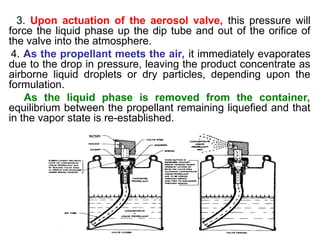
3. Upon actuation of the aerosol valve, this pressure will
force the liquid phase up the dip tube and out of the orifice of
the valve into the atmosphere.
4. As the propellant meets the air, it immediately evaporates
due to the drop in pressure, leaving the product concentrate as
airborne liquid droplets or dry particles, depending upon the
formulation.
As the liquid phase is removed from the container,
equilibrium between the propellant remaining liquefied and that
in the vapor state is re-established.
• During product expulsion from aerosol
package,
1. The pressure within remains constant,
2. The product may be continuously released at
an even rate and with the same propulsion.
• When the liquid reservoir is depleted,
1. The pressure may not be maintained,
2. The gas may be expelled from the container
with diminishing pressure until it is exhausted.
Aerosol Systems
• The pressure of an aerosol can be controlled by:
1) The type and amount of propellant.
2) The nature and amount of material comprising the
product concentrate.
Thus, each formulation is unique…
A specific amount of propellant that is usually
employed in aerosols cannot be firmly stated.
However, some general statements may be made..
• Space aerosols contain a greater proportion of
propellant than surface coating aerosols, Therefore:
1. They are released with greater pressure,
2. The resultant particles are projected more violently
from the valve.
Space aerosols usually operate at pressures between
30 - 40 psig at 70°F and may contain as much as 85%
propellant.
Surface aerosols usually operate at pressures
between 25 - 55 psig at 70°F and may contain 30 to
70% propellant.
Foam aerosols usually operate at pressures between
35 - 55 psig at 70°F and may contain only 6 to 10%
propellant.
• Foam aerosols are emulsions;
The liquefied propellant is partially emulsified
with the aqueous product concentrate rather
than being dissolved in it.. WHY?
• Because the fluorinated HCs are non polar
organic solvents having no affinity for water.
• The utilization of surfactants or emulsifiers in
the formulation encourages the mixing of the
two components to enhance the emulsion.
• Shaking of the package prior to use further
mixes the propellant throughout the product
concentrate.
• When the aerosol valve is activated,
The mixture is expelled to the atmosphere where the
propellant globules vaporize rapidly, leaving the active
ingredient in the form of a foam.
• Blends of the various liquefied gas propellants are
generally used in pharmaceutical aerosols.. WHY?
1. To achieve the desired vapor pressure.
2. To provide the proper solvent features for a given
product.
• Some propellants are eliminated from use in
certain products.. WHY?
Because of their reactivity with:
a. Other formulative materials,
b. The container
c. The valve components.
• For instance,
Trichloro-monofluoro-methane tends to form
free HCl when formulated with systems
containing water or ethyl alcohol (a commonly
used cosolvent in aerosol systems).
The free HCl..
1. Adversely affects the efficacy of the product,
2. Exerts a corrosive action on some container
components.
• The physiologic effect of the propellant must
also be considered to assure safety of the
product in its intended use.
• An individual propellant or propellant blend and
the active ingredient of a formulation may be
non-toxic when tested individually..
• However, the use of the combination in aerosol
form may have undesirable features.
When an active ingredient used in a nasal or
oral spray is placed in a fine aerosol mist, it
may reach deeper into the respiratory tract than
desired and may result in irritation.
• As with new dermatologic, vaginal, and
rectal aerosols,
The influence of the aerosol form of the drug on
the recipient tissue membranes must be
evaluated for:
1. Irritating effects and
2. Changes in drug absorption from the site of
application.
The absorption pattern of a drug may change
due to an increased rate of solubility of the fine
particles usually produced in aerosol products.
• The fluorinated hydrocarbons have a relatively
low toxicity and are generally non-irritating..
However, following rapid and repeated use of
the aerosol product, certain individuals may be
sensitive to the propellant and have cardio-toxic
effects.
• Two-phase System:
1. The liquid phase; containing the liquefied
propellant and product concentrate.
2. The vapor phase.
• Three-phase Systems:
1. A layer of water-immiscible liquid propellant,
2. A layer of highly aqueous product
concentrate,
3. The vapor phase.
The liquefied propellant generally resides
at the bottom of the container with the
aqueous phase floating above it.. WHY?
Because the liquefied propellant usually has a
greater density than the aqueous layer.
As with the two-phase system,
upon activation of the valve, the pressure of the
vapor phase causes the liquid phase to rise in
the dip tube and be expelled from the container.
To avoid expulsion of the reservoir of liquefied
propellant,
The dip tube must extend only within the
aqueous phase (product concentrate) and not
down into the layer of liquefied propellant.
• The aqueous product is broken up into a spray
by the mechanical action of the valve.
• If the container is shaken immediately prior to
use,
some liquefied propellant may be mixed with
the aqueous phase and be expelled through the
valve to facilitate the dispersion of the exited
product or the production of foam, depending
upon the formulation.
• The vapor phase within the container is
replenished from the liquid propellant phase.
Compressed Gas Systems
• Compressed rather than liquefied gases may
be used to prepare aerosols.
• The pressure of the compressed gas contained
in the headspace of the aerosol container
forces the product concentrate up the dip tube
and out of the valve.
• The use of gases (nitrogen) that are
insoluble in the product concentrate will
result in..
The emission of a product in essentially the
same form as it was placed in the container.
Advantages of nitrogen as a propellant:
1. Its inert behavior toward other formulative
components.
2. Its protective influence on products subject to
oxidation.
3. It does not contribute adversely to the smell or taste
of a product.
Gases as carbon dioxide and nitrous oxide, which are
slightly soluble in the liquid phase of aerosol products,
may be employed in instances in which their expulsion
with the product concentrate is desired to achieve
spraying or foaming.
• Unlike aerosols prepared with liquefied gas
propellants, there is no reservoir of propellant
in compressed gas filled aerosols.. Thus;
1. Higher gas pressures are required in these
systems,
2. The pressure in these aerosols
progressively diminishes as the product is
used.
Aerosol Container and Valve Assembly
• The effectiveness of a pharmaceutical aerosol depends
on achieving the proper combination of formulation, container,
and valve assembly.
• The formulation:
must not chemically interact with the container or valve
components so as to interfere with:
a. The stability of the formulation.
b. The integrity & operation of the container & valve assembly.
The container and valve:
1. must be capable of withstanding the pressure required by
the product,
2. must be corrosive-resistant,
3. The valve must contribute to the form of the product to be
emitted.
Containers
• Various materials are used in the manufacture of aerosol
containers, including:
1) Glass, un-coated or plastic coated;
2) Metal, including tin-plated steel, aluminum, stainless steel;
3) Plastics.
The selection of the container for an aerosol product is
based on:
1. Its adaptability to production methods,
2. Compatibility with formulation components,
3. Ability to sustain the pressure intended for the product,
4. The interest in design and aesthetic appeal,
5. The cost.
• Glass containers:
Would be preferred for most aerosols.. WHY?
1. It presents fewer problems with respect to chemical
compatibility with the formula than do metal
containers.
2. It is not subject to corrosion.
3. It is more adaptive to creativity in design.
However,
1. It is brittle and breakable.
2. It must be precisely engineered to provide the
maximum in pressure safety and impact resistance.
• The outer surface of glass containers may be
coated with plastic coatings.. Why?
1. To render them more resistant to accidental
breakage,
2. In the event of breaking, the plastic coating prevents
the scattering of glass fragments.
Glass containers are considered quite safe when..
a. The total pressure of an aerosol system is < 25 psig,
b. No more than 50% propellant is used,
The inner surface of glass containers may be
coated.. Why?
To render them more chemically resistant to
formulation materials.
• Tin-plated steel containers are the most widely
used metal containers for aerosols.. WHY?
Because the starting material used is in the form of
sheets, the completed aerosol cylinders are seamed
and soldered to provide a sealed unit.
• When required, special protective coatings are
employed within the container to prevent corrosion
and interaction between the container and formulation.
• The containers must be carefully examined prior
to filling.. WHY?
To ensure that there are no flaws in the seam or in the
protective coating that would render the container
weak or subject to corrosion.
• Aluminum containers:
1. Are manufactured by extrusion or by other methods
that make them seamless.
2. They have greater safety against leakage,
incompatibility and corrosion.
Stainless steel containers:
Are used for certain small volume aerosols having a
great chemical resistance.
Disadvantage: high cost.
Plastic containers:
1. Are permeated by the vapor within the container.
2. Certain drug-plastic interactions can occur which
affect the release of drug from the container and
reduce the product efficacy.
Valve Assembly
•Should be capable of being easily opened and closed and in addition, be
capable of delivering the content or permits the expulsion (forcing out or
bringing out) of the contents of the can.
a. In the desired form,
b. At the desired rate,
c. In the proper dose (metered valves).
•The materials used in the valve manufacture must be:
1. Inert toward the formulations.
2. Approved by the Food & Drug Administration (FDA).
Ex. plastic, rubber, aluminum, and stainless steel.
Depending on the particular use of valves whether spray, foam ,or solid
stream, the majority fall into the following:
1- Continuous spray valves. 2- Metering valves.
3- Standard valves. 4- Foam valves.
5- Powder valves. 6- Compressed gas valves.
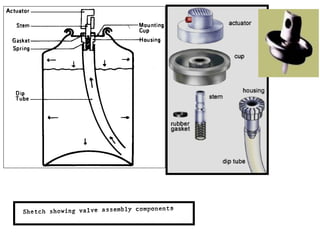
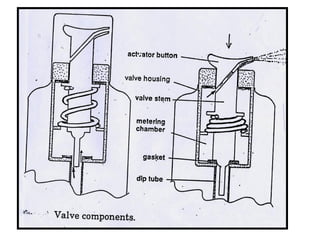
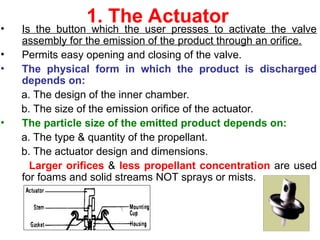
1. The Actuator
• Is the button which the user presses to activate the valve
assembly for the emission of the product through an orifice.
• Permits easy opening and closing of the valve.
• The physical form in which the product is discharged
depends on:
a. The design of the inner chamber.
b. The size of the emission orifice of the actuator.
• The particle size of the emitted product depends on:
a. The type & quantity of the propellant.
b. The actuator design and dimensions.
Larger orifices & less propellant concentration are used
for foams and solid streams NOT sprays or mists.
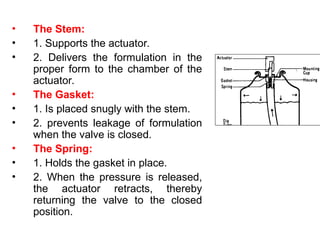
• The Stem:
• 1. Supports the actuator.
• 2. Delivers the formulation in the
proper form to the chamber of the
actuator.
• The Gasket:
• 1. Is placed snugly with the stem.
• 2. prevents leakage of formulation
when the valve is closed.
• The Spring:
• 1. Holds the gasket in place.
• 2. When the pressure is released,
the actuator retracts, thereby
returning the valve to the closed
position.
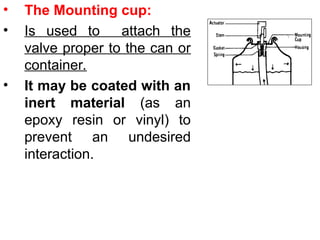
• The Mounting cup:
• Is used to attach the
valve proper to the can or
container.
• It may be coated with an
inert material (as an
epoxy resin or vinyl) to
prevent an undesired
interaction.
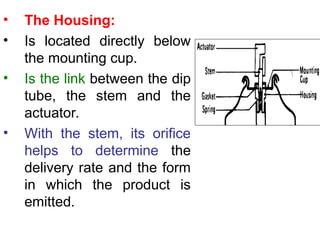
• The Housing:
• Is located directly below
the mounting cup.
• Is the link between the dip
tube, the stem and the
actuator.
• With the stem, its orifice
helps to determine the
delivery rate and the form
in which the product is
emitted.
• Dip tube:
• Extends from the housing down
into the product.
• Bring the formulation from the
container to the valve.
• The viscosity of the product and its
intended delivery rate dictate to a
large extent the inner dimensions
of the dip tube and housing for a
particular product.
• The actuator, stem, housing, and dip tube are made of plastic,
• The mounting cup and spring are made of metal,
• The gasket is made of rubber or plastic resistant to the
formulation.
Metered Dose Inhalers (MDIs)
• Metering valves are employed when the
formulation is a potent medication, as in
inhalation therapy.
• In these metered valve systems, the amount
of material discharged is regulated by an
auxiliary valve chamber by virtue of its capacity
or dimensions.
• A single depression of the actuator causes
the evacuation of this chamber and the delivery
of its contents.
• The integrity of the chamber is controlled by a
dual valving mechanism.
• When the actuator valve is in the closed position,
a seal is effected between the chamber and the
atmosphere.
• However, in this position the chamber is permitted to
fill with the contents of the container to which it is
open.
• Depression of the actuator causes a simultaneous
reversal of positions sealed;
• The chamber becomes open to the atmosphere
releasing its contents, and at the same time
becomes sealed from the contents of the container.
• Upon release of the actuator, the system is
restored for the next dose.
• The effectiveness in delivering medication
to the lower parts of the lungs depends
on:
1. The particle size of the inhaled drug.
2. Breathing patterns of the patient.
3. The depth of patient respiration.
Areas of current research in aerosols
include analysis of:
1. Dose uniformity
2. Particle size distrib­
ution patterns
3. The "respirable" fractions of aerosol-
delivered particles.
Nitrolingual Spray
• Is a unique translingual aerosol formulation of
nitroglycerin that permits the patient to spray
droplets of nitroglycerin onto or under the tongue
for acute relief or prophylaxis of an attack of angina
pectoris.
• At the onset of an attack, 2 metered spray
emissions, each containing 0.4 mg of nitroglycerin,
are administered.
The product contains 200 doses of nitroglycerin in a
propellant mixture of dichloro-difluoro-methane and
dichloro-tetrafluoro-ethane.
Filling Operations
• Fluorinated hydrocarbon gases may be
liquefied by:
a. cooling below their boiling points or
b. compressing the gas at room temperature.
These two features are utilized in the filling of
aerosol containers with propellant.
Cold Filling
1. The product concentrate and the propellant must be
cooled to temperatures of -30° to -40°F.. WHY? HOW?
This temp is necessary to liquefy the propellant gas.
The cooling system may be a mixture of dry ice and
acetone.
2. The chilled product concentrate is quantitatively
metered into an equally cold aerosol container.
3. The liquefied gas is added.
3. The heavy vapors of the cold liquid propellant
generally displace the air present in the container.
However, some of the propellant vapors are also lost.
• When sufficient propellant has been added,
the valve assembly is immediately inserted
and crimped into place.
• Disadvantages:
1. Aqueous systems cannot be filled by this
process.. WHY?
Because the water turns to ice at these low
temperatures.
2. For non aqueous systems,
some moisture usually appears in the final
product due to the condensation of
atmospheric moisture within cold containers.
Pressure Filling
1. The product concentrate is quantitatively placed
in the aerosol container.
2. The valve assembly is inserted and crimped into
place.
3. The liquefied propellant under pressure is
metered into the valve stem from a pressure burette.
4. The desired amount of propellant is allowed to
enter the container under its own vapor
pressure.. HOW?
When the pressure in the container equals that in the
burette, the propellant stops flowing.
Notes:
1. Additional propellant may be added.. HOW?
By increasing the pressure in the filling apparatus
through the use of compressed air or nitrogen gas.
2. The trapped air in the package may be:
a. Ignored if it does not interfere with the quality or
stability of the product,
b. Evacuated prior to filling or during filling, using
special apparatus.
5. After filling the container with sufficient
propellant, the valve actuator is tested for proper
function. This also rids the dip tube of pure propellant
prior to consumer use.
• Pressure filling is used for most pharmaceutical
aerosols.. WHY?
1. Lower danger of moisture contamination of
the product,
2. Less propellant is lost in the process.
For gases which are slightly soluble in the
product concentrate like carbon dioxide and
nitrous oxide, the container is manually or
mechanically shaken during the filling operation
to achieve the desired pressure in the
headspace of the aerosol container.
Testing the Filled Containers
• After filling, the aerosol container is tested under various
environmental conditions for:
a. Leaks / weakness in valve assembly or container.
b. The proper function of the valve.
c. Spray patterns,
d. Particle size distribution of the spray,
e. Accuracy and reproducibility of dosage when using metered
valves.
“The valve discharge rate”
1. Discharge a portion of the contents of a previously weighed
aerosol during a given period of time.
2. Calculate by the difference in weight, the grams of contents
discharged per unit of time.
Packaging, Labeling, and Storage
• The aerosol is packaged as part of manufacturing
process.
• With other dosage forms, the product is completely
manufactured and then placed in the container.
• Most aerosol products have a protective cap that
fits snugly over valve and mounting cup.. WHY?
1. Protects the valve against contamination.
2. Serves a decorative function.
• For safety, labels must warn users:
1. Not to puncture pressurized containers,
2. Not to use or store them near heat or open flame,
3. Not to incinerate.. WHY?
Exposure to temperatures > 120°F may cause the
aerosol container to burst.
4. Most medications in aerosol containers are intended
for use at ambient room temp (15 - 30°C) (36 - 86°F).
5. Shake before use.
6. Hold at the proper angle and/or distance from the
target.
7. Should be maintained with the protective caps in
place to prevent accidental activation of the valve
assembly or its contamination.
Proper Use of Aerosols
• Using the metered aerosols as a model, the
pharmacist should demonstrate:
1. How the inhaler is assembled, stored and cleaned.
2. Whether the inhaler requires shaking before use.
3. How to hold it so that the aerosol canister is up
side down.
4. The coordination between inhalation (after
exhaling as completely as possible) and pressing
down the inhaler to release one dose.
5. Holding patient breath for several seconds to gain
the maximum benefit from the medication.

Pharmaceutical Aerosols ppسمير للشرح.ppt

  • 1.
    Pharmaceutical aerosols Reference: Pharmaceutical dosageforms and drug delivery systems, P. 384 – 396. • Are pressurized dosage forms containing one or more active ingredients which upon actuation emit a fine dispersion of liquid and/or solid materials in a gaseous medium. • Pharmaceutical aerosols are similar to other dosage forms in that: They require the same considerations with respect to formulation, product stability, and therapeutic efficacy. They differ from most other dosage forms in: Their dependence upon the function of the container, the valve assembly, and the propellant for the physical delivery of the medication in proper form.
  • 4.
    •The term pressurizedpackage is commonly used when referring to the aerosol container. •The pressure is applied to aerosol system through: The use of one or more liquefied or gaseous propellants. the propellant is responsible for developing the pressure within the container and expels the product when the valve is opened. Upon activation of the valve assembly of the aerosol, the propellant exerts a pressure that forces the contents of the package out through the opening of the valve.
  • 5.
    The physical formin which the contents are emitted is dependent upon: a. The product formulation. b. The type of valve. • Possible aerosol physical forms: 1. a fine mist, a coarse, 2. wet or a dry spray, 3. a steady (continuous) stream, or a fast-breaking foam. The physical form selected for a given aerosol is based on the intended use of that product. Eg. Inhalation aerosols used in the treatment of asthma, must present particles as a fine liquid mist or as finely divided solid particles.
  • 6.
    • What isAsthma? 1. asthma attack vary from person to person, but common ones include cold air; exercise; allergens such as dust mites, mold, pollen, animal dander, cockroach debris; and some types of viral infections. 2. When you breathe in, air travels through your nose and/or mouth through a tube called the trachea .The trachea divides into bronchi, and these in turn subdivide 16-21 times into a series of smaller tubes (called bronchioles) that lead to the alveoli (air sacs). During an asthma attack, the bronchi and bronchioles become narrowed. Here is how an asthma attack occurs. When the airways come into contact with an asthma trigger, the walls of the bronchi and bronchioles become inflamed. Fluid and cellular debris accumulate in and around the walls making them thicker. At the same time, the muscles around the airways contract (bronchoconstriction), causing the lumen of the airways to become narrower. Narrowing of the airways makes breathing more difficult.
  • 7.
    • Corticosteroids: Themost potent and effective of the anti-inflammatory medications • Long-acting beta2-agonists (LABAs): These drugs relax smooth muscles to help open airways. They are also used in combination with anti- inflammatory medications for long-term therapy and to help control symptoms overnight; Relationship of Intal® particle size to airway penetration Particles < 6 μm will reach respiratory bronchioles, Particles < 2 μm will reach the alveolar ducts & alveoli.
  • 9.
    corticosteroid therapy. Patientson regular bronchodilator therapy who require inhaled corticosteroids. Airways Disease chronic bronchitis and emphysema. asthma control
  • 11.
    Dermatologic aerosols presentmedication in the form of: 1. a powder, 2. a wet spray, 3. a stream of liquid (usually a local anesthetic), an ointment-like product. Other pharmaceutical aerosols include: vaginal and rectal foams.
  • 12.
    Space sprays: • Areaerosols that are used to provide an airborne mist. Ex.Room disinfectants, deodorizers, space insecticides. The particle size of the released product: 1. Is generally quite small, usually < 50 μm. 2. Must be carefully controlled so that the dispersed droplets or particles remain airborne for a prolonged period of time. One-second burst from a typical aerosol space spray will produce 120 million particles, a substantial number of which will remain suspended in the air for an hour.
  • 13.
    Surface sprays orsurface coatings: • Are aerosols intended to carry the active ingredient to a surface. Examples: 1. Dermatologic aerosols, 2. Non-pharmaceutical aerosols; Personal deodorant sprays, cosmetic hair lacquers, perfume and cologne sprays, shaving lathers, tooth­ paste, surface pesticide sprays, paint sprays, 3. Household aerosols as spray starch, waxes, polishes, cleaners, and lubricants. 4. Veterinary and pet aerosols. 5. Food aerosols as dessert toppings and spreads.
  • 14.
    Advantages of theAerosol Dosage Form 1. A portion of medication could be easily withdrawn from the package without contamination or exposure to the remaining material. 2. By virtue of its hermetic character, The aerosol container protects medicinal agents adversely affected by atmospheric oxygen and moisture. 3. Being opaque, The usual aerosol container protects drugs adversely affected by light. This protection persists during the use and the shelf- life of the product.
  • 15.
    4. If theproduct is packaged under sterile conditions, sterility may be maintained during the shelf-life of the product. 5. Topical medication is applied without touching the affected area in a uniform, thin layer to the skin. a. This may reduce the irritation that sometimes accompanies the mechanical (fingertip) application of topical preparations. b. The rapid volatilization of the propellant also provides a cooling refreshing effect.
  • 16.
    6. By properformulation and valve control, the physical form and the particle size of the emitted product may be controlled. Through the use of metered valves, dosage may be controlled. 7. Aerosol application is a "clean" process, requiring little or no "wash-up" by the user.
  • 17.
    The Aerosol Principle •An aerosol formulation consists of 2 components; the product concentrate and the propellant. • The product concentrate: Is the active ingredient of the aerosol combined with the required adjuncts, as antioxidants, surface-active agents, and solvents, to prepare a stable and efficacious product. The propellant may be: 1. A liquefied gas or a mixture of liquefied gases that serves the dual role of propellant and vehicle for the product concentrate. 2. Non liquefied compressed gases, as carbon dioxide, nitrogen, and nitrous oxide.
  • 18.
    • For manyyears, The chlorofluorocarbons (CFCs) were the most commonly used liquefied gas propellants. Nowadays, These propellants are phased out and will be prohibited for nonessential use under federal regulations.. WHY? They reduce the amount of ozone in the stratosphere, resulting in an increase in the amount of UV radiation reaching the earth. This causes an increase in the incidence of skin cancer, and other adverse environmental effects.
  • 19.
    • The FDAhas the authority to exempt from the prohibition specific products when there is sufficient evidence showing that: 1) There are no technically feasible alternatives to the use of a CFC propellant in the product; 2) The product provides a substantial health or other public benefit unobtainable without the use of CFC; 3) The use does not involve a significant release of CFC into the atmosphere or, if it does, the release is warranted by the benefit conveyed.
  • 20.
    • Examples ofCFCs: dichloro-difluoro-methane, dichloro-tetrafluoro-ethane, trichloro-monofluoro-methane. • They are gases at room temperature and may be liquefied by: a. cooling below their boiling point or b. compressing the gas at room temperature. Ex. dichlorodifluoromethane (Freon) gas will be liquefied when: cooled to -22°F or compressed to 70 psig at 70°F.
  • 21.
    • What happenswhen a liquefied gas propellant or propellant mixture is sealed with the product concentrate within an aerosol container? 1. An equilibrium is quickly established between that portion of propellant which remains liquefied and that which vaporizes and occupies the upper portion of the aerosol container. 2. The vapor phase exerts pressure in all directions against the walls of the container, the valve assembly, and the surface of the liquid phase composed of the liquefied gas and the product concentrate.
  • 22.
    3. Upon actuationof the aerosol valve, this pressure will force the liquid phase up the dip tube and out of the orifice of the valve into the atmosphere. 4. As the propellant meets the air, it immediately evaporates due to the drop in pressure, leaving the product concentrate as airborne liquid droplets or dry particles, depending upon the formulation. As the liquid phase is removed from the container, equilibrium between the propellant remaining liquefied and that in the vapor state is re-established.
  • 23.
    • During productexpulsion from aerosol package, 1. The pressure within remains constant, 2. The product may be continuously released at an even rate and with the same propulsion. • When the liquid reservoir is depleted, 1. The pressure may not be maintained, 2. The gas may be expelled from the container with diminishing pressure until it is exhausted.
  • 24.
    Aerosol Systems • Thepressure of an aerosol can be controlled by: 1) The type and amount of propellant. 2) The nature and amount of material comprising the product concentrate. Thus, each formulation is unique… A specific amount of propellant that is usually employed in aerosols cannot be firmly stated. However, some general statements may be made..
  • 25.
    • Space aerosolscontain a greater proportion of propellant than surface coating aerosols, Therefore: 1. They are released with greater pressure, 2. The resultant particles are projected more violently from the valve. Space aerosols usually operate at pressures between 30 - 40 psig at 70°F and may contain as much as 85% propellant. Surface aerosols usually operate at pressures between 25 - 55 psig at 70°F and may contain 30 to 70% propellant. Foam aerosols usually operate at pressures between 35 - 55 psig at 70°F and may contain only 6 to 10% propellant.
  • 26.
    • Foam aerosolsare emulsions; The liquefied propellant is partially emulsified with the aqueous product concentrate rather than being dissolved in it.. WHY? • Because the fluorinated HCs are non polar organic solvents having no affinity for water. • The utilization of surfactants or emulsifiers in the formulation encourages the mixing of the two components to enhance the emulsion. • Shaking of the package prior to use further mixes the propellant throughout the product concentrate.
  • 27.
    • When theaerosol valve is activated, The mixture is expelled to the atmosphere where the propellant globules vaporize rapidly, leaving the active ingredient in the form of a foam. • Blends of the various liquefied gas propellants are generally used in pharmaceutical aerosols.. WHY? 1. To achieve the desired vapor pressure. 2. To provide the proper solvent features for a given product. • Some propellants are eliminated from use in certain products.. WHY? Because of their reactivity with: a. Other formulative materials, b. The container c. The valve components.
  • 28.
    • For instance, Trichloro-monofluoro-methanetends to form free HCl when formulated with systems containing water or ethyl alcohol (a commonly used cosolvent in aerosol systems). The free HCl.. 1. Adversely affects the efficacy of the product, 2. Exerts a corrosive action on some container components.
  • 29.
    • The physiologiceffect of the propellant must also be considered to assure safety of the product in its intended use. • An individual propellant or propellant blend and the active ingredient of a formulation may be non-toxic when tested individually.. • However, the use of the combination in aerosol form may have undesirable features. When an active ingredient used in a nasal or oral spray is placed in a fine aerosol mist, it may reach deeper into the respiratory tract than desired and may result in irritation.
  • 30.
    • As withnew dermatologic, vaginal, and rectal aerosols, The influence of the aerosol form of the drug on the recipient tissue membranes must be evaluated for: 1. Irritating effects and 2. Changes in drug absorption from the site of application. The absorption pattern of a drug may change due to an increased rate of solubility of the fine particles usually produced in aerosol products.
  • 31.
    • The fluorinatedhydrocarbons have a relatively low toxicity and are generally non-irritating.. However, following rapid and repeated use of the aerosol product, certain individuals may be sensitive to the propellant and have cardio-toxic effects. • Two-phase System: 1. The liquid phase; containing the liquefied propellant and product concentrate. 2. The vapor phase.
  • 32.
    • Three-phase Systems: 1.A layer of water-immiscible liquid propellant, 2. A layer of highly aqueous product concentrate, 3. The vapor phase. The liquefied propellant generally resides at the bottom of the container with the aqueous phase floating above it.. WHY? Because the liquefied propellant usually has a greater density than the aqueous layer.
  • 33.
    As with thetwo-phase system, upon activation of the valve, the pressure of the vapor phase causes the liquid phase to rise in the dip tube and be expelled from the container. To avoid expulsion of the reservoir of liquefied propellant, The dip tube must extend only within the aqueous phase (product concentrate) and not down into the layer of liquefied propellant. • The aqueous product is broken up into a spray by the mechanical action of the valve.
  • 34.
    • If thecontainer is shaken immediately prior to use, some liquefied propellant may be mixed with the aqueous phase and be expelled through the valve to facilitate the dispersion of the exited product or the production of foam, depending upon the formulation. • The vapor phase within the container is replenished from the liquid propellant phase.
  • 35.
    Compressed Gas Systems •Compressed rather than liquefied gases may be used to prepare aerosols. • The pressure of the compressed gas contained in the headspace of the aerosol container forces the product concentrate up the dip tube and out of the valve. • The use of gases (nitrogen) that are insoluble in the product concentrate will result in.. The emission of a product in essentially the same form as it was placed in the container.
  • 36.
    Advantages of nitrogenas a propellant: 1. Its inert behavior toward other formulative components. 2. Its protective influence on products subject to oxidation. 3. It does not contribute adversely to the smell or taste of a product. Gases as carbon dioxide and nitrous oxide, which are slightly soluble in the liquid phase of aerosol products, may be employed in instances in which their expulsion with the product concentrate is desired to achieve spraying or foaming.
  • 37.
    • Unlike aerosolsprepared with liquefied gas propellants, there is no reservoir of propellant in compressed gas filled aerosols.. Thus; 1. Higher gas pressures are required in these systems, 2. The pressure in these aerosols progressively diminishes as the product is used.
  • 38.
    Aerosol Container andValve Assembly • The effectiveness of a pharmaceutical aerosol depends on achieving the proper combination of formulation, container, and valve assembly. • The formulation: must not chemically interact with the container or valve components so as to interfere with: a. The stability of the formulation. b. The integrity & operation of the container & valve assembly. The container and valve: 1. must be capable of withstanding the pressure required by the product, 2. must be corrosive-resistant, 3. The valve must contribute to the form of the product to be emitted.
  • 39.
    Containers • Various materialsare used in the manufacture of aerosol containers, including: 1) Glass, un-coated or plastic coated; 2) Metal, including tin-plated steel, aluminum, stainless steel; 3) Plastics. The selection of the container for an aerosol product is based on: 1. Its adaptability to production methods, 2. Compatibility with formulation components, 3. Ability to sustain the pressure intended for the product, 4. The interest in design and aesthetic appeal, 5. The cost.
  • 40.
    • Glass containers: Wouldbe preferred for most aerosols.. WHY? 1. It presents fewer problems with respect to chemical compatibility with the formula than do metal containers. 2. It is not subject to corrosion. 3. It is more adaptive to creativity in design. However, 1. It is brittle and breakable. 2. It must be precisely engineered to provide the maximum in pressure safety and impact resistance.
  • 41.
    • The outersurface of glass containers may be coated with plastic coatings.. Why? 1. To render them more resistant to accidental breakage, 2. In the event of breaking, the plastic coating prevents the scattering of glass fragments. Glass containers are considered quite safe when.. a. The total pressure of an aerosol system is < 25 psig, b. No more than 50% propellant is used, The inner surface of glass containers may be coated.. Why? To render them more chemically resistant to formulation materials.
  • 42.
    • Tin-plated steelcontainers are the most widely used metal containers for aerosols.. WHY? Because the starting material used is in the form of sheets, the completed aerosol cylinders are seamed and soldered to provide a sealed unit. • When required, special protective coatings are employed within the container to prevent corrosion and interaction between the container and formulation. • The containers must be carefully examined prior to filling.. WHY? To ensure that there are no flaws in the seam or in the protective coating that would render the container weak or subject to corrosion.
  • 43.
    • Aluminum containers: 1.Are manufactured by extrusion or by other methods that make them seamless. 2. They have greater safety against leakage, incompatibility and corrosion. Stainless steel containers: Are used for certain small volume aerosols having a great chemical resistance. Disadvantage: high cost. Plastic containers: 1. Are permeated by the vapor within the container. 2. Certain drug-plastic interactions can occur which affect the release of drug from the container and reduce the product efficacy.
  • 44.
    Valve Assembly •Should becapable of being easily opened and closed and in addition, be capable of delivering the content or permits the expulsion (forcing out or bringing out) of the contents of the can. a. In the desired form, b. At the desired rate, c. In the proper dose (metered valves). •The materials used in the valve manufacture must be: 1. Inert toward the formulations. 2. Approved by the Food & Drug Administration (FDA). Ex. plastic, rubber, aluminum, and stainless steel. Depending on the particular use of valves whether spray, foam ,or solid stream, the majority fall into the following: 1- Continuous spray valves. 2- Metering valves. 3- Standard valves. 4- Foam valves. 5- Powder valves. 6- Compressed gas valves.
  • 45.
    1. The Actuator •Is the button which the user presses to activate the valve assembly for the emission of the product through an orifice. • Permits easy opening and closing of the valve. • The physical form in which the product is discharged depends on: a. The design of the inner chamber. b. The size of the emission orifice of the actuator. • The particle size of the emitted product depends on: a. The type & quantity of the propellant. b. The actuator design and dimensions. Larger orifices & less propellant concentration are used for foams and solid streams NOT sprays or mists.
  • 46.
    • The Stem: •1. Supports the actuator. • 2. Delivers the formulation in the proper form to the chamber of the actuator. • The Gasket: • 1. Is placed snugly with the stem. • 2. prevents leakage of formulation when the valve is closed. • The Spring: • 1. Holds the gasket in place. • 2. When the pressure is released, the actuator retracts, thereby returning the valve to the closed position.
  • 47.
    • The Mountingcup: • Is used to attach the valve proper to the can or container. • It may be coated with an inert material (as an epoxy resin or vinyl) to prevent an undesired interaction.
  • 48.
    • The Housing: •Is located directly below the mounting cup. • Is the link between the dip tube, the stem and the actuator. • With the stem, its orifice helps to determine the delivery rate and the form in which the product is emitted.
  • 49.
    • Dip tube: •Extends from the housing down into the product. • Bring the formulation from the container to the valve. • The viscosity of the product and its intended delivery rate dictate to a large extent the inner dimensions of the dip tube and housing for a particular product. • The actuator, stem, housing, and dip tube are made of plastic, • The mounting cup and spring are made of metal, • The gasket is made of rubber or plastic resistant to the formulation.
  • 50.
    Metered Dose Inhalers(MDIs) • Metering valves are employed when the formulation is a potent medication, as in inhalation therapy. • In these metered valve systems, the amount of material discharged is regulated by an auxiliary valve chamber by virtue of its capacity or dimensions. • A single depression of the actuator causes the evacuation of this chamber and the delivery of its contents.
  • 51.
    • The integrityof the chamber is controlled by a dual valving mechanism. • When the actuator valve is in the closed position, a seal is effected between the chamber and the atmosphere. • However, in this position the chamber is permitted to fill with the contents of the container to which it is open. • Depression of the actuator causes a simultaneous reversal of positions sealed; • The chamber becomes open to the atmosphere releasing its contents, and at the same time becomes sealed from the contents of the container. • Upon release of the actuator, the system is restored for the next dose.
  • 52.
    • The effectivenessin delivering medication to the lower parts of the lungs depends on: 1. The particle size of the inhaled drug. 2. Breathing patterns of the patient. 3. The depth of patient respiration. Areas of current research in aerosols include analysis of: 1. Dose uniformity 2. Particle size distrib­ ution patterns 3. The "respirable" fractions of aerosol- delivered particles.
  • 53.
    Nitrolingual Spray • Isa unique translingual aerosol formulation of nitroglycerin that permits the patient to spray droplets of nitroglycerin onto or under the tongue for acute relief or prophylaxis of an attack of angina pectoris. • At the onset of an attack, 2 metered spray emissions, each containing 0.4 mg of nitroglycerin, are administered. The product contains 200 doses of nitroglycerin in a propellant mixture of dichloro-difluoro-methane and dichloro-tetrafluoro-ethane.
  • 54.
    Filling Operations • Fluorinatedhydrocarbon gases may be liquefied by: a. cooling below their boiling points or b. compressing the gas at room temperature. These two features are utilized in the filling of aerosol containers with propellant.
  • 55.
    Cold Filling 1. Theproduct concentrate and the propellant must be cooled to temperatures of -30° to -40°F.. WHY? HOW? This temp is necessary to liquefy the propellant gas. The cooling system may be a mixture of dry ice and acetone. 2. The chilled product concentrate is quantitatively metered into an equally cold aerosol container. 3. The liquefied gas is added. 3. The heavy vapors of the cold liquid propellant generally displace the air present in the container. However, some of the propellant vapors are also lost.
  • 56.
    • When sufficientpropellant has been added, the valve assembly is immediately inserted and crimped into place. • Disadvantages: 1. Aqueous systems cannot be filled by this process.. WHY? Because the water turns to ice at these low temperatures. 2. For non aqueous systems, some moisture usually appears in the final product due to the condensation of atmospheric moisture within cold containers.
  • 57.
    Pressure Filling 1. Theproduct concentrate is quantitatively placed in the aerosol container. 2. The valve assembly is inserted and crimped into place. 3. The liquefied propellant under pressure is metered into the valve stem from a pressure burette. 4. The desired amount of propellant is allowed to enter the container under its own vapor pressure.. HOW? When the pressure in the container equals that in the burette, the propellant stops flowing.
  • 58.
    Notes: 1. Additional propellantmay be added.. HOW? By increasing the pressure in the filling apparatus through the use of compressed air or nitrogen gas. 2. The trapped air in the package may be: a. Ignored if it does not interfere with the quality or stability of the product, b. Evacuated prior to filling or during filling, using special apparatus. 5. After filling the container with sufficient propellant, the valve actuator is tested for proper function. This also rids the dip tube of pure propellant prior to consumer use.
  • 59.
    • Pressure fillingis used for most pharmaceutical aerosols.. WHY? 1. Lower danger of moisture contamination of the product, 2. Less propellant is lost in the process. For gases which are slightly soluble in the product concentrate like carbon dioxide and nitrous oxide, the container is manually or mechanically shaken during the filling operation to achieve the desired pressure in the headspace of the aerosol container.
  • 60.
    Testing the FilledContainers • After filling, the aerosol container is tested under various environmental conditions for: a. Leaks / weakness in valve assembly or container. b. The proper function of the valve. c. Spray patterns, d. Particle size distribution of the spray, e. Accuracy and reproducibility of dosage when using metered valves. “The valve discharge rate” 1. Discharge a portion of the contents of a previously weighed aerosol during a given period of time. 2. Calculate by the difference in weight, the grams of contents discharged per unit of time.
  • 61.
    Packaging, Labeling, andStorage • The aerosol is packaged as part of manufacturing process. • With other dosage forms, the product is completely manufactured and then placed in the container. • Most aerosol products have a protective cap that fits snugly over valve and mounting cup.. WHY? 1. Protects the valve against contamination. 2. Serves a decorative function.
  • 62.
    • For safety,labels must warn users: 1. Not to puncture pressurized containers, 2. Not to use or store them near heat or open flame, 3. Not to incinerate.. WHY? Exposure to temperatures > 120°F may cause the aerosol container to burst. 4. Most medications in aerosol containers are intended for use at ambient room temp (15 - 30°C) (36 - 86°F). 5. Shake before use. 6. Hold at the proper angle and/or distance from the target. 7. Should be maintained with the protective caps in place to prevent accidental activation of the valve assembly or its contamination.
  • 63.
    Proper Use ofAerosols • Using the metered aerosols as a model, the pharmacist should demonstrate: 1. How the inhaler is assembled, stored and cleaned. 2. Whether the inhaler requires shaking before use. 3. How to hold it so that the aerosol canister is up side down. 4. The coordination between inhalation (after exhaling as completely as possible) and pressing down the inhaler to release one dose. 5. Holding patient breath for several seconds to gain the maximum benefit from the medication.