Chapter Five: The professional decision-making process
Chapter contents:
➢ Why have a process for decision-making?
➢ What featuresshouldwe expecttofindina gooddecision-making process?
➢ Decision-making systems, the ‘four-stage approach’
➢ Development of decision-making inpharmacy
➢ References
Why have a process for decision-making?
• • A mechanism to allow you to practice dealing with problems before they arise
• • A method of structured thinking that improves your ability to respond rationally
when urgent problems arise and you are under pressure
• • A means of identifying the values involved in your decision-making
• • A means of identifying areas of certainty and uncertainty
• • A basis for risk management in prospect
• • A basis for your defense in retrospect
• • An aid to reflective practice and improvement of practice
• • It allows inclusion of all aspects of a problem – clinical, legal and ethical.
What features should we expect to find in a
good decision-making process?
• A good decision
• Systematic structure: analytical steps rather than opinions OR
judgments.
• Rational reasoning: reason and rationality.
• Value-based reasoning: patient value.
• Recorded decisions: The final feature of a good system – did you
make a record? Unfortunately, pharmacists have traditionally been
poor at recording their activities.
Identifying issues and resources:
• It is rarely possible to make a good decision without information. The
information needed for a professional decision is likely to be clinical, legal or
ethical – or all three.
• Generally speaking, pharmacists have little difficulty identifying clinical
issues or in knowing where to look to find the information needed to clarify
them.
• While we acknowledge that most problems that pharmacistshave to
address will include clinical issues, we will confine our examples and analyses
to legal and ethical issues. Identification of legal issues may also seem to be a
fairly easy.
Decision-making systems
• The ‘four-stage approach’
We outline some of the alternatives later but concentrate here on
what we will call our ‘four-stage approach’. It is essentially pragmatic
and utilitarian.
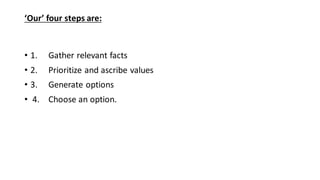
‘Our’ four steps are:
• 1. Gather relevant facts
• 2. Prioritize and ascribe values
• 3. Generate options
• 4. Choose an option.
• To isolate legal and ethical issues from any clinicalconsiderations.
• we use the following true scenario to illustrate application ofour four-step process.
• Two pharmacistswere by the Statutory Committee in 1991 following convictionsfor the supply to a 17-
year-old youth of sodium cyanide in one case and strychnine hydrochloride,potassium permanganateand
glycerol in another (Anon. 1991a,b).
• Why were such supplies considered wrong?
• What thought processes should havebeen gone through in reaching a decision as to whether to supply?
• Pharmacists are permitted to supply all these substances from a pharmacy, so why were convictionsas well
as a reprimand given?
• Would it have been right to supply in other circumstances? If so, on what knowledge would you havebased
your decision?
Stage 1 Gather relevant facts
• 1 What criminal law applies here?
• First, you will want to know what the criminal law says.
• Ask yourself, ‘will I be breaking the law if I supply?’
• In the case of potassium permanganate,you may supply, but there are packagingand labellingregulationsto
consider.
• You may supply glycerol; indeed, you can buy glycerol (or glycerine) from the food shelves of a supermarket.
• Neither of these substances is controlledas a medicine or a poison.
• Sodium cyanide and strychnine are both Part I, Schedule 1 poisons with special conditionsattachingto their
supply.
• Most of the criminal law that appliesto pharmacy practice will be in the Medicines Act, the Misuse of Drugs
Act or the Poisons Act, although there is a whole range of other criminal legislationthat may apply, e.g. the
EnvironmentalProtection Act, the Health and Safety at Work, etc. Act, the Customs and Excise Management
Act.
2 What NHS law applies here?
• In this example, you do not have to consider NHS law because the
supply is a ‘private’ one and not within the terms of the NHS contract.
• There are other aspects of administrative law, such as employment
protection that will apply to pharmacy practice .
3 What civil law applies here?
• In this example, the young man managed to cause an explosion by using glycerol
and potassium permanganate together.
• Would the supplying pharmacist have been partly to blame for any damage that
may have resulted?
• To some extent, yes, because pharmacists are expected, by virtue of their
expertise and training, to exercise a greater duty of care than other retailers over
the supplies they make.
• In the case of strychnine and cyanide, sales are restricted to pharmacies precisely
because pharmacists are expected to know the dangers inherent in their use and
only to supply responsibly after due enquiries have been made.
• The areas of civil law that are most likely to be an issue in pharmacy practice are
negligence, confidentiality and defamation.
4 What guidance does the Code of Ethics give
here?
• As a pharmacist, you have to meet standards that are in excess of the minimum that the
law requires.
• At the time of this case, the Code of Ethics said ‘A pharmacist must take steps to ensure
that all chemicals supplied will be used for a proper purpose and in appropriate
circumstances’.
• The Code went on to give guidance that all oxidising agents, such as potassium
permanganate, may be used for the preparation of explosives.
• (Such requirements are now implicit in the legal requirement to exercise ‘due diligence’
when supplying any chemicals.)
• What enquiries should you make?
• What facts will you need to show that you made reasonable enquiries to satisfy these
requirements?
5 What professional knowledge do I have that
applies here?
• Notwithstanding all the legal and ethical constraints or guidance that you are aware of,
you will also be applying your technical and clinical knowledge to the situation.
• You probably learned in chemistry classes that certain chemicals make explosive
combinations.
• You should also know about any material you sell or supply; this is made explicit in
poisons law for example, where you should only sell to a person to whom a poison ‘may
properly be sold’.
• You would know that cyanide and strychnine are immensely potent poisons.
• Do you think it would be safe to supply these to a 17-year-old? Many of the problems
you encounter in pharmacy practice will require the use of your knowledge of
therapeutics, pharmaceutics, good pharmacy practice, etc., as well as knowledge of law
and ethics.
6 Where can I look or whom can I ask for help?
• Finally, but just as important as any of the above, is whether there is any precedent you
can follow, any policy that covers this situation, any other ‘rule book’ or senior pharmacist
that perhaps you should consult. Many pharmacists are employees who will have
corporate protocols and procedures to follow and, most valuable at the start of a career, a
range of experienced pharmacists who can be asked for advice. Delaying action to take
advice is always an option to consider.
• When you have the answers to these questions or you decide that they do not apply,
then you will have assembled the raw material from which to make your decision.
Increasingly, pharmacists may expect to be challenged on their assembly of facts: what
questions were asked, what was the condition of the patient, what possibilities were
excluded, etc. Good practice usually demands that records should be made at the time to
demonstrate a conscientious and informed approach and justify the ultimate decision
taken.
• Stage 2 Prioritize and ascribe values
• When you have all the information that you can get, you will find that some facts are
going to be more important than others. In this example, the fact that the purchaser in the
above example is male is interesting but not important; his age, however, may influence
your eventual decision. Even if the purchaser were a middle-aged respectable-looking
individual, you might still consider the nature of the substances or combination of
substances to be of overriding importance. You are prioritizing the facts.
• Moreover, you will want to weigh up the consequences for yourself, perhaps for your
employer, for the young man, for his parents and neighbors and for the reputation of
pharmacy of making these supplies or not. The relative importance you attach to these
issues will also depend on your own personal opinions and attitudes. In other words, you
are ascribing values to the facts you have assembled.
• There will be a whole range of individuals and affected parties whose interests you should consider.
• 1. First, you will want to promote the health and welfare, or at least cause no harm, for the patient or, in this case, the purchaser.
• 2. The interests of other players in the example must also be considered. What would be the consequences to the patient’s carer, parents or
relatives? In this case, neighbours, or even perfect strangers, might have suffered serious harm from the sale of potential explosives or poisons to this
young man. Or you may have information about an HIV-positive individual that might raise in your mind questions about the interests of the patient as
compared with those of other people who were sexual contacts.
• 3. You have a duty as a pharmacist to uphold the reputation of the pharmacy profession (a key responsibility of a pharmacist in the Code of
Ethics). This means that you should do nothing to undermine confidence in you as an individual pharmacist and as a representative of the profession to
which you belong.
• 4. You also have a duty to cooperate with healthcare professionals and others for the benefit of patients and the public (another key
responsibility in the Code of Ethics). Some later examples show how you may have to weigh your obligation, or that of your staff, to preserve the patient’s
faith in the doctor against the potential risk of harm to the patient.
• 5. If you are employed, your employer carries liability for what you do in the course of your employment: ‘vicarious liability’. This liability is
not limitless; if you fail to follow your employer’s instructions or the terms of your employment contract then you may be held accountable for your
actions. In most situations, you will also have a duty to maintain other people’s confidence in your employers in the same way as you represent your
profession.
• 6. Finally, you will have your own set of moral and cultural values that create obligations to yourself. Again, some later examples may show
how attitudes and moral convictions may be the overriding consideration for some individuals, although the Code of Ethics (personal responsibilities for
pharmacists providing professional services) makes it clear that such matters must not be allowed to compromise your first priority – the welfare of the
patient.
• So, how can we summaries this stage? Decide what priority and value you attach
to the interestsof the following:
• • The patient or customer
• • Those near to the patient: parents, carers, dependents
• • Those in contact with the patient: neighbors, contacts,the public at large
• • Your own profession and other professionals with whom you work
• • Your employer and work colleagues
• Good pharmacy practice requires that you balance the disparate interests of all
the parties concerned and are prepared to record where necessary and justify the
reasoning that led to your eventual decision. This means that you will move onto
the next stage automatically.
• Stage 3 Generate options
• In other words, ask yourself: ‘What could I do in this situation?’ In this example there will
be at least four options:
• 1. Supply none of the items
• 2. Supply all of the items
• 3. Supply some of the items
• 4. Delay to seek advice.
• You might suggest other variations such as selling some or all of the items, subject to
certain conditions, such as a written request specifying reason for purchase or giving the
authority of someone you know to be responsible. By careful analysis, you will be able to
establish the likely consequences of each course of action and then choose which will have
the best chance of a good outcome or, in some cases, the least likelihood of causing harm.
• Stage 4 Choose an option
• In other words ask yourself: ‘What should I do in this situation?’
• Remember that, when making your choice, you may have to be able to justify
why you made that one. This is not as daunting as it may seem as you will be able
to draw on many sources of help to reach your decision, such as your reference
books and manuals, your colleagues, your employer or your professional and trade
body. Gradually you will add to this your own experience, your knowledge of real
life, perhaps your knowledge of the purchaser (or in other cases patients and their
families) or the local environment in which you are practicing pharmacy. The whole
process develops your professional judgement, which distinguishes the
professional from the technician and indicates an ability to respond to unfamiliar
and unexpected situations that fall outside the rule-book.
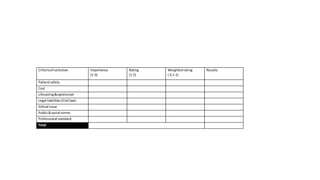
Criteriaof selection Importance
(1-3)
Rating
(1-5)
Weightedrating
( 0.1-1)
Results
Patientsafety
Cost
Lifesaving&rapidonset
Legal liabilities(Civil law)
Ethical issue
Public&social norms
Professional standard
Total
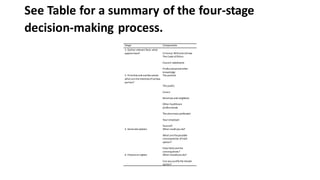
See Table for a summary of the four-stage
decision-making process.
Stage Components
1. Gatherrelevant facts:what
applies here? Criminal, NHSandcivillaw
The Code ofEthics
Council statements
Professionaland other
knowledge
2. Prioritizeand ascribevalues:
what aretheinterests ofvarious
parties?
The patient
The public
Carers
Relatives and neighbors
Other healthcare
professionals
The pharmacy profession
Your employer
Yourself
3. Generateoptions What could you do?
What arethepossible
consequences ofeach
option?
How likely arethe
consequences?
4. Choosean option What shouldyou do?
Can you justify the chosen
option?
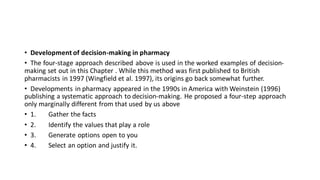
• Development of decision-making in pharmacy
• The four-stage approach described above is used in the worked examples of decision-
making set out in this Chapter . While this method was first published to British
pharmacists in 1997 (Wingfield et al. 1997), its origins go back somewhat further.
• Developments in pharmacy appeared in the 1990s in America with Weinstein (1996)
publishing a systematic approach to decision-making. He proposed a four-step approach
only marginally different from that used by us above
• 1. Gather the facts
• 2. Identify the values that play a role
• 3. Generate options open to you
• 4. Select an option and justify it.
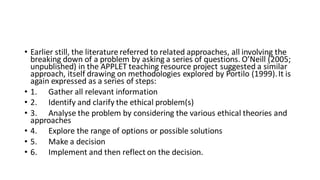
• Earlier still, the literature referred to related approaches, all involving the
breaking down of a problem by asking a series of questions. O’Neill (2005;
unpublished) in the APPLET teaching resource project suggested a similar
approach, itself drawing on methodologies explored by Portilo (1999).It is
again expressed as a series of steps:
• 1. Gather all relevant information
• 2. Identify and clarify the ethical problem(s)
• 3. Analyse the problem by considering the various ethical theories and
approaches
• 4. Explore the range of options or possible solutions
• 5. Make a decision
• 6. Implement and then reflect on the decision.
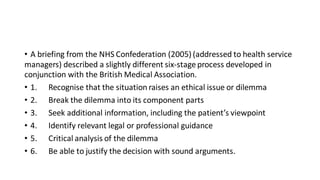
• A briefing from the NHS Confederation (2005) (addressed to health service
managers) described a slightly different six-stage process developed in
conjunction with the British Medical Association.
• 1. Recognise that the situation raises an ethical issue or dilemma
• 2. Break the dilemma into its component parts
• 3. Seek additional information, including the patient’s viewpoint
• 4. Identify relevant legal or professional guidance
• 5. Critical analysis of the dilemma
• 6. Be able to justify the decision with sound arguments.
• Parker (2003) suggested another variation,described as a modified version ofthe Pellegrino method,in material to support the
UK networkof clinical ethics committees.This suggested 11 stages.
• 1. What are the relevant clinical and other facts (e.g. familydynamics,GP support availability)?
• 2. What would constitute an appropriate decision-makingprocess?
• Who is to be held responsible?
• When does the decision haveto be made?
• Who should be involved?
• What are the procedural rules e.g. confidentiality?
• 3. List the available options
• 4. What are the morallysignificant featuresofeach option, e.g.
• What does the patient want to happen?
• Is the patient competent?
• If the patient is not competent,what is in his or her ‘best interests’?
• What are the foreseeable consequences ofeach option?
• 5. What does the law/guidance say about each of these options?
• 6. For each realistic option, identify the moral arguments in favor and against
• 7. Choose an option based on your judgment of the relative merits of these arguments using the following tools:
• How does this case compare with other cases?
• Are there any key terms the meaning of which needs to be agreed, e.g. ‘best interest’, ‘person’?
• Are the arguments ‘valid’?
• Consider the foreseeable consequences (local and broader)
• Do the options ‘respect persons’?
• What would be the implications of this decision applied as a general rule?
• 8. Identify the strongest counter-argument to the option you have chosen
• 9. Can you rebut this argument? What are your reasons?
• 10. Make a decision
• 11. Review this decision in the light of what actually happens, and learn from it.
• The same website makes reference to the framework of Jonsen et al. (1992). This
suggests seeking answers to these questions in the following order.
• 1. Indications for medical intervention: establish a diagnosis, what are the options
for treatment, what are the prognoses for each of the option?
• 2. Preferences of patient: is the patient competent?If so what does he/she want?
If not competent,then what is in the patient’s best interest?
• 3. Quality of life: will the proposed treatment improve the patient’s quality of
life?
• 4. Contextual features: do religious, cultural, legal factors have an impact on the
decision?
• Trevino and Nelson describes a different stepwiseapproach, this time in the
contextof business ethics.
• 1. Gather the facts
• 2. Define the ethical issues
• 3. Identify the affected parties
• 4. Identify the consequences
• 5. Identify the obligations
• 6. Consider your character and integrity
• 7. Think creatively about potential actions
• 8. Check your gut.

4_5947391495676891516.pdf x

  • 1.
    Chapter Five: Theprofessional decision-making process
  • 2.
    Chapter Five: Theprofessional decision-making process Chapter contents: ➢ Why have a process for decision-making? ➢ What featuresshouldwe expecttofindina gooddecision-making process? ➢ Decision-making systems, the ‘four-stage approach’ ➢ Development of decision-making inpharmacy ➢ References
  • 3.
    Why have aprocess for decision-making? • • A mechanism to allow you to practice dealing with problems before they arise • • A method of structured thinking that improves your ability to respond rationally when urgent problems arise and you are under pressure • • A means of identifying the values involved in your decision-making • • A means of identifying areas of certainty and uncertainty • • A basis for risk management in prospect • • A basis for your defense in retrospect • • An aid to reflective practice and improvement of practice • • It allows inclusion of all aspects of a problem – clinical, legal and ethical.
  • 4.
    What features shouldwe expect to find in a good decision-making process? • A good decision • Systematic structure: analytical steps rather than opinions OR judgments. • Rational reasoning: reason and rationality. • Value-based reasoning: patient value. • Recorded decisions: The final feature of a good system – did you make a record? Unfortunately, pharmacists have traditionally been poor at recording their activities.
  • 5.
    Identifying issues andresources: • It is rarely possible to make a good decision without information. The information needed for a professional decision is likely to be clinical, legal or ethical – or all three. • Generally speaking, pharmacists have little difficulty identifying clinical issues or in knowing where to look to find the information needed to clarify them. • While we acknowledge that most problems that pharmacistshave to address will include clinical issues, we will confine our examples and analyses to legal and ethical issues. Identification of legal issues may also seem to be a fairly easy.
  • 6.
    Decision-making systems • The‘four-stage approach’ We outline some of the alternatives later but concentrate here on what we will call our ‘four-stage approach’. It is essentially pragmatic and utilitarian.
  • 7.
    ‘Our’ four stepsare: • 1. Gather relevant facts • 2. Prioritize and ascribe values • 3. Generate options • 4. Choose an option.
  • 8.
    • To isolatelegal and ethical issues from any clinicalconsiderations. • we use the following true scenario to illustrate application ofour four-step process. • Two pharmacistswere by the Statutory Committee in 1991 following convictionsfor the supply to a 17- year-old youth of sodium cyanide in one case and strychnine hydrochloride,potassium permanganateand glycerol in another (Anon. 1991a,b). • Why were such supplies considered wrong? • What thought processes should havebeen gone through in reaching a decision as to whether to supply? • Pharmacists are permitted to supply all these substances from a pharmacy, so why were convictionsas well as a reprimand given? • Would it have been right to supply in other circumstances? If so, on what knowledge would you havebased your decision?
  • 9.
    Stage 1 Gatherrelevant facts • 1 What criminal law applies here? • First, you will want to know what the criminal law says. • Ask yourself, ‘will I be breaking the law if I supply?’ • In the case of potassium permanganate,you may supply, but there are packagingand labellingregulationsto consider. • You may supply glycerol; indeed, you can buy glycerol (or glycerine) from the food shelves of a supermarket. • Neither of these substances is controlledas a medicine or a poison. • Sodium cyanide and strychnine are both Part I, Schedule 1 poisons with special conditionsattachingto their supply. • Most of the criminal law that appliesto pharmacy practice will be in the Medicines Act, the Misuse of Drugs Act or the Poisons Act, although there is a whole range of other criminal legislationthat may apply, e.g. the EnvironmentalProtection Act, the Health and Safety at Work, etc. Act, the Customs and Excise Management Act.
  • 10.
    2 What NHSlaw applies here? • In this example, you do not have to consider NHS law because the supply is a ‘private’ one and not within the terms of the NHS contract. • There are other aspects of administrative law, such as employment protection that will apply to pharmacy practice .
  • 11.
    3 What civillaw applies here? • In this example, the young man managed to cause an explosion by using glycerol and potassium permanganate together. • Would the supplying pharmacist have been partly to blame for any damage that may have resulted? • To some extent, yes, because pharmacists are expected, by virtue of their expertise and training, to exercise a greater duty of care than other retailers over the supplies they make. • In the case of strychnine and cyanide, sales are restricted to pharmacies precisely because pharmacists are expected to know the dangers inherent in their use and only to supply responsibly after due enquiries have been made. • The areas of civil law that are most likely to be an issue in pharmacy practice are negligence, confidentiality and defamation.
  • 12.
    4 What guidancedoes the Code of Ethics give here? • As a pharmacist, you have to meet standards that are in excess of the minimum that the law requires. • At the time of this case, the Code of Ethics said ‘A pharmacist must take steps to ensure that all chemicals supplied will be used for a proper purpose and in appropriate circumstances’. • The Code went on to give guidance that all oxidising agents, such as potassium permanganate, may be used for the preparation of explosives. • (Such requirements are now implicit in the legal requirement to exercise ‘due diligence’ when supplying any chemicals.) • What enquiries should you make? • What facts will you need to show that you made reasonable enquiries to satisfy these requirements?
  • 13.
    5 What professionalknowledge do I have that applies here? • Notwithstanding all the legal and ethical constraints or guidance that you are aware of, you will also be applying your technical and clinical knowledge to the situation. • You probably learned in chemistry classes that certain chemicals make explosive combinations. • You should also know about any material you sell or supply; this is made explicit in poisons law for example, where you should only sell to a person to whom a poison ‘may properly be sold’. • You would know that cyanide and strychnine are immensely potent poisons. • Do you think it would be safe to supply these to a 17-year-old? Many of the problems you encounter in pharmacy practice will require the use of your knowledge of therapeutics, pharmaceutics, good pharmacy practice, etc., as well as knowledge of law and ethics.
  • 14.
    6 Where canI look or whom can I ask for help? • Finally, but just as important as any of the above, is whether there is any precedent you can follow, any policy that covers this situation, any other ‘rule book’ or senior pharmacist that perhaps you should consult. Many pharmacists are employees who will have corporate protocols and procedures to follow and, most valuable at the start of a career, a range of experienced pharmacists who can be asked for advice. Delaying action to take advice is always an option to consider. • When you have the answers to these questions or you decide that they do not apply, then you will have assembled the raw material from which to make your decision. Increasingly, pharmacists may expect to be challenged on their assembly of facts: what questions were asked, what was the condition of the patient, what possibilities were excluded, etc. Good practice usually demands that records should be made at the time to demonstrate a conscientious and informed approach and justify the ultimate decision taken.
  • 15.
    • Stage 2Prioritize and ascribe values • When you have all the information that you can get, you will find that some facts are going to be more important than others. In this example, the fact that the purchaser in the above example is male is interesting but not important; his age, however, may influence your eventual decision. Even if the purchaser were a middle-aged respectable-looking individual, you might still consider the nature of the substances or combination of substances to be of overriding importance. You are prioritizing the facts. • Moreover, you will want to weigh up the consequences for yourself, perhaps for your employer, for the young man, for his parents and neighbors and for the reputation of pharmacy of making these supplies or not. The relative importance you attach to these issues will also depend on your own personal opinions and attitudes. In other words, you are ascribing values to the facts you have assembled.
  • 16.
    • There willbe a whole range of individuals and affected parties whose interests you should consider. • 1. First, you will want to promote the health and welfare, or at least cause no harm, for the patient or, in this case, the purchaser. • 2. The interests of other players in the example must also be considered. What would be the consequences to the patient’s carer, parents or relatives? In this case, neighbours, or even perfect strangers, might have suffered serious harm from the sale of potential explosives or poisons to this young man. Or you may have information about an HIV-positive individual that might raise in your mind questions about the interests of the patient as compared with those of other people who were sexual contacts. • 3. You have a duty as a pharmacist to uphold the reputation of the pharmacy profession (a key responsibility of a pharmacist in the Code of Ethics). This means that you should do nothing to undermine confidence in you as an individual pharmacist and as a representative of the profession to which you belong. • 4. You also have a duty to cooperate with healthcare professionals and others for the benefit of patients and the public (another key responsibility in the Code of Ethics). Some later examples show how you may have to weigh your obligation, or that of your staff, to preserve the patient’s faith in the doctor against the potential risk of harm to the patient. • 5. If you are employed, your employer carries liability for what you do in the course of your employment: ‘vicarious liability’. This liability is not limitless; if you fail to follow your employer’s instructions or the terms of your employment contract then you may be held accountable for your actions. In most situations, you will also have a duty to maintain other people’s confidence in your employers in the same way as you represent your profession. • 6. Finally, you will have your own set of moral and cultural values that create obligations to yourself. Again, some later examples may show how attitudes and moral convictions may be the overriding consideration for some individuals, although the Code of Ethics (personal responsibilities for pharmacists providing professional services) makes it clear that such matters must not be allowed to compromise your first priority – the welfare of the patient.
  • 17.
    • So, howcan we summaries this stage? Decide what priority and value you attach to the interestsof the following: • • The patient or customer • • Those near to the patient: parents, carers, dependents • • Those in contact with the patient: neighbors, contacts,the public at large • • Your own profession and other professionals with whom you work • • Your employer and work colleagues • Good pharmacy practice requires that you balance the disparate interests of all the parties concerned and are prepared to record where necessary and justify the reasoning that led to your eventual decision. This means that you will move onto the next stage automatically.
  • 18.
    • Stage 3Generate options • In other words, ask yourself: ‘What could I do in this situation?’ In this example there will be at least four options: • 1. Supply none of the items • 2. Supply all of the items • 3. Supply some of the items • 4. Delay to seek advice. • You might suggest other variations such as selling some or all of the items, subject to certain conditions, such as a written request specifying reason for purchase or giving the authority of someone you know to be responsible. By careful analysis, you will be able to establish the likely consequences of each course of action and then choose which will have the best chance of a good outcome or, in some cases, the least likelihood of causing harm.
  • 19.
    • Stage 4Choose an option • In other words ask yourself: ‘What should I do in this situation?’ • Remember that, when making your choice, you may have to be able to justify why you made that one. This is not as daunting as it may seem as you will be able to draw on many sources of help to reach your decision, such as your reference books and manuals, your colleagues, your employer or your professional and trade body. Gradually you will add to this your own experience, your knowledge of real life, perhaps your knowledge of the purchaser (or in other cases patients and their families) or the local environment in which you are practicing pharmacy. The whole process develops your professional judgement, which distinguishes the professional from the technician and indicates an ability to respond to unfamiliar and unexpected situations that fall outside the rule-book.
  • 20.
    Criteriaof selection Importance (1-3) Rating (1-5) Weightedrating (0.1-1) Results Patientsafety Cost Lifesaving&rapidonset Legal liabilities(Civil law) Ethical issue Public&social norms Professional standard Total
  • 21.
    See Table fora summary of the four-stage decision-making process. Stage Components 1. Gatherrelevant facts:what applies here? Criminal, NHSandcivillaw The Code ofEthics Council statements Professionaland other knowledge 2. Prioritizeand ascribevalues: what aretheinterests ofvarious parties? The patient The public Carers Relatives and neighbors Other healthcare professionals The pharmacy profession Your employer Yourself 3. Generateoptions What could you do? What arethepossible consequences ofeach option? How likely arethe consequences? 4. Choosean option What shouldyou do? Can you justify the chosen option?
  • 22.
    • Development ofdecision-making in pharmacy • The four-stage approach described above is used in the worked examples of decision- making set out in this Chapter . While this method was first published to British pharmacists in 1997 (Wingfield et al. 1997), its origins go back somewhat further. • Developments in pharmacy appeared in the 1990s in America with Weinstein (1996) publishing a systematic approach to decision-making. He proposed a four-step approach only marginally different from that used by us above • 1. Gather the facts • 2. Identify the values that play a role • 3. Generate options open to you • 4. Select an option and justify it.
  • 23.
    • Earlier still,the literature referred to related approaches, all involving the breaking down of a problem by asking a series of questions. O’Neill (2005; unpublished) in the APPLET teaching resource project suggested a similar approach, itself drawing on methodologies explored by Portilo (1999).It is again expressed as a series of steps: • 1. Gather all relevant information • 2. Identify and clarify the ethical problem(s) • 3. Analyse the problem by considering the various ethical theories and approaches • 4. Explore the range of options or possible solutions • 5. Make a decision • 6. Implement and then reflect on the decision.
  • 24.
    • A briefingfrom the NHS Confederation (2005) (addressed to health service managers) described a slightly different six-stage process developed in conjunction with the British Medical Association. • 1. Recognise that the situation raises an ethical issue or dilemma • 2. Break the dilemma into its component parts • 3. Seek additional information, including the patient’s viewpoint • 4. Identify relevant legal or professional guidance • 5. Critical analysis of the dilemma • 6. Be able to justify the decision with sound arguments.
  • 25.
    • Parker (2003)suggested another variation,described as a modified version ofthe Pellegrino method,in material to support the UK networkof clinical ethics committees.This suggested 11 stages. • 1. What are the relevant clinical and other facts (e.g. familydynamics,GP support availability)? • 2. What would constitute an appropriate decision-makingprocess? • Who is to be held responsible? • When does the decision haveto be made? • Who should be involved? • What are the procedural rules e.g. confidentiality? • 3. List the available options • 4. What are the morallysignificant featuresofeach option, e.g. • What does the patient want to happen? • Is the patient competent? • If the patient is not competent,what is in his or her ‘best interests’? • What are the foreseeable consequences ofeach option?
  • 26.
    • 5. Whatdoes the law/guidance say about each of these options? • 6. For each realistic option, identify the moral arguments in favor and against • 7. Choose an option based on your judgment of the relative merits of these arguments using the following tools: • How does this case compare with other cases? • Are there any key terms the meaning of which needs to be agreed, e.g. ‘best interest’, ‘person’? • Are the arguments ‘valid’? • Consider the foreseeable consequences (local and broader) • Do the options ‘respect persons’? • What would be the implications of this decision applied as a general rule? • 8. Identify the strongest counter-argument to the option you have chosen • 9. Can you rebut this argument? What are your reasons? • 10. Make a decision • 11. Review this decision in the light of what actually happens, and learn from it.
  • 27.
    • The samewebsite makes reference to the framework of Jonsen et al. (1992). This suggests seeking answers to these questions in the following order. • 1. Indications for medical intervention: establish a diagnosis, what are the options for treatment, what are the prognoses for each of the option? • 2. Preferences of patient: is the patient competent?If so what does he/she want? If not competent,then what is in the patient’s best interest? • 3. Quality of life: will the proposed treatment improve the patient’s quality of life? • 4. Contextual features: do religious, cultural, legal factors have an impact on the decision?
  • 28.
    • Trevino andNelson describes a different stepwiseapproach, this time in the contextof business ethics. • 1. Gather the facts • 2. Define the ethical issues • 3. Identify the affected parties • 4. Identify the consequences • 5. Identify the obligations • 6. Consider your character and integrity • 7. Think creatively about potential actions • 8. Check your gut.