
A MODULAR
C2 SPLITTERStan Lam, Koch Modular
Process Systems LLC, USA, describes a
project where the company designed and
supplied a distillation system that enabled
ethylene recovery from purge gas streams.
A
typical olefins plant produces several purge gas streams,
which are usually flared or used as fuel. Some of those
streams contain valuable components such as ethylene
and propylene.
This article describes a project on which Koch Modular Process
Systems designed and supplied a distillation system to recover
ethylene from one of those purge streams, while overcoming some
special challenges with heat integration.
Project objective
The design objective of the ethylene recovery unit (ERU) was to
recover >90% of the ethylene from a 2000 lb/hr purge gas stream.
Challenges
The customer, a major polyethylene producer in Texas, US, had
decided on using distillation as the recovery process. There were
several challenges, including the following:
n	 There was a shortage of cooling water and all cooling duties
had to be provided by air.
n	 The temperature throughout the distillation column was below
the freezing point of water, so steam was not to be used as the
heat source for the reboiler.
n	 Air would be too warm to be used for cooling at the column
condenser.
n	 The low process temperatures required the use of a refrigerant.
After a screening of refrigerants, Koch Modular concluded that
Freon-12 and ammonia were the most economically feasible
refrigerants. After this, Freon-12 was ruled out because its use was
scheduled to be prohibited in 2010, even though it was still permitted
for use with existing equipment at the original time of planning (2008).
Simulation
Process simulations were performed using the PD-Plus simulator,
licensed from Deerhaven Technical Software. The recommended
equation of state for hydrocarbons at high pressure was
Soave Redlich-Kwong (SRK). Koch Modular utilised both
Reprinted from April 2017 HYDROCARBON
ENGINEERING
Peng-Robinson (P-R) and SRK to trial-fit operating data and
found that both models fitted the operating data well. The
SRK method was eventually selected as the process engineer
that was leading the project (and the author of this article)
was more familiar with it.
Feed and product specification
The feed stream composition was as follows:
nn Methane: 7 vol%.
nn Ethylene: 84 vol%.
nn Ethane and other hydrocarbons: balance.
The required product purity was 95 vol% ethylene at
2000 psig. Most of the ethylene loss took place in the
overhead vent gas stream, which consisted mainly of methane.
Process flow diagram
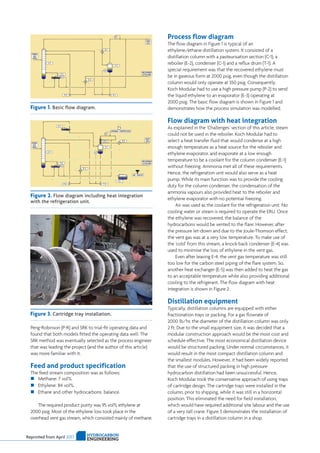
The flow diagram in Figure 1 is typical of an
ethylene/ethane distillation system. It consisted of a
distillation column with a pasteurisation section (C-1), a
reboiler (E-2), condenser (C-1) and a reflux drum (T-1). A
special requirement was that the recovered ethylene must
be in gaseous form at 2000 psig, even though the distillation
column would only operate at 350 psig. Consequently,
Koch Modular had to use a high pressure pump (P-2) to send
the liquid ethylene to an evaporator (E-3) operating at
2000 psig. The basic flow diagram is shown in Figure 1 and
demonstrates how the process simulation was modelled.
Flow diagram with heat integration
As explained in the ‘Challenges’ section of this article, steam
could not be used in the reboiler. Koch Modular had to
select a heat transfer fluid that would condense at a high
enough temperature as a heat source for the reboiler and
ethylene evaporator, and evaporate at a low enough
temperature to be a coolant for the column condenser (E-1)
without freezing. Ammonia met all of these requirements.
Hence, the refrigeration unit would also serve as a heat
pump. While its main function was to provide the cooling
duty for the column condenser, the condensation of the
ammonia vapours also provided heat to the reboiler and
ethylene evaporator with no potential freezing.
Air was used as the coolant for the refrigeration unit. No
cooling water or steam is required to operate the ERU. Once
the ethylene was recovered, the balance of the
hydrocarbons would be vented to the flare. However, after
the pressure let-down and due to the Joule-Thomson effect,
the vent gas was at a very low temperature. To make use of
the ‘cold’ from this stream, a knock-back condenser (E-4) was
used to minimise the loss of ethylene in the vent gas.
Even after leaving E-4, the vent gas temperature was still
too low for the carbon steel piping of the flare system. So,
another heat exchanger (E-5) was then added to heat the gas
to an acceptable temperature while also providing additional
cooling to the refrigerant. The flow diagram with heat
integration is shown in Figure 2.
Distillation equipment
Typically, distillation columns are equipped with either
fractionation trays or packing. For a gas flowrate of
2000 lb/hr, the diameter of the distillation column was only
2 ft. Due to the small equipment size, it was decided that a
modular construction approach would be the most cost and
schedule effective. The most economical distillation device
would be structured packing. Under normal circumstances, it
would result in the most compact distillation column and
the smallest modules. However, it had been widely reported
that the use of structured packing in high pressure
hydrocarbon distillation had been unsuccessful. Hence,
Koch Modular took the conservative approach of using trays
of cartridge design. The cartridge trays were installed in the
column, prior to shipping, while it was still in a horizontal
position. This eliminated the need for field installation,
which would have required additional site labour and the use
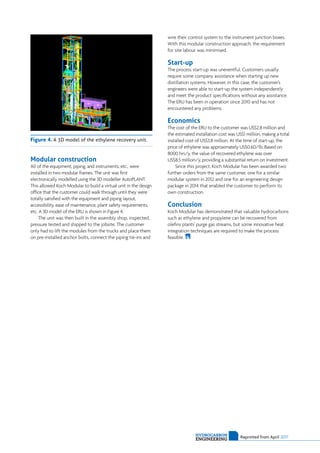
of a very tall crane. Figure 3 demonstrates the installation of
cartridge trays in a distillation column in a shop.
Figure 1. Basic flow diagram.
Figure 2. Flow diagram including heat integration
with the refrigeration unit.
Figure 3. Cartridge tray installation.
Reprinted from April 2017HYDROCARBON
ENGINEERING
Modular construction
All of the equipment, piping, and instruments, etc., were
installed in two modular frames. The unit was first
electronically modelled using the 3D modeller AutoPLANT.
This allowed Koch Modular to build a virtual unit in the design
office that the customer could walk through until they were
totally satisfied with the equipment and piping layout,
accessibility, ease of maintenance, plant safety requirements,
etc. A 3D model of the ERU is shown in Figure 4.
The unit was then built in the assembly shop, inspected,
pressure tested and shipped to the jobsite. The customer
only had to lift the modules from the trucks and place them
on pre-installed anchor bolts, connect the piping tie-ins and
wire their control system to the instrument junction boxes.
With this modular construction approach, the requirement
for site labour was minimised.
Start-up
The process start-up was uneventful. Customers usually
require some company assistance when starting up new
distillation systems. However, in this case, the customer’s
engineers were able to start-up the system independently
and meet the product specifications without any assistance.
The ERU has been in operation since 2010 and has not
encountered any problems.
Economics
The cost of the ERU to the customer was US$2.8 million and
the estimated installation cost was US$1 million, making a total
installed cost of US$3.8 million. At the time of start-up, the
price of ethylene was approximately US$0.60/lb. Based on
8000 hrs/y, the value of recovered ethylene was over
US$8.5 million/y, providing a substantial return on investment.
Since this project, Koch Modular has been awarded two
further orders from the same customer, one for a similar
modular system in 2012 and one for an engineering design
package in 2014 that enabled the customer to perform its
own construction.
Conclusion
Koch Modular has demonstrated that valuable hydrocarbons
such as ethylene and propylene can be recovered from
olefins plants' purge gas streams, but some innovative heat
integration techniques are required to make the process
feasible.
Figure 4. A 3D model of the ethylene recovery unit.

A Modular C2 Splitter - Hydrocarbon Engineering April 2017

  • 1.
    A MODULAR C2 SPLITTERStanLam, Koch Modular Process Systems LLC, USA, describes a project where the company designed and supplied a distillation system that enabled ethylene recovery from purge gas streams. A typical olefins plant produces several purge gas streams, which are usually flared or used as fuel. Some of those streams contain valuable components such as ethylene and propylene. This article describes a project on which Koch Modular Process Systems designed and supplied a distillation system to recover ethylene from one of those purge streams, while overcoming some special challenges with heat integration. Project objective The design objective of the ethylene recovery unit (ERU) was to recover >90% of the ethylene from a 2000 lb/hr purge gas stream. Challenges The customer, a major polyethylene producer in Texas, US, had decided on using distillation as the recovery process. There were several challenges, including the following: n There was a shortage of cooling water and all cooling duties had to be provided by air. n The temperature throughout the distillation column was below the freezing point of water, so steam was not to be used as the heat source for the reboiler. n Air would be too warm to be used for cooling at the column condenser. n The low process temperatures required the use of a refrigerant. After a screening of refrigerants, Koch Modular concluded that Freon-12 and ammonia were the most economically feasible refrigerants. After this, Freon-12 was ruled out because its use was scheduled to be prohibited in 2010, even though it was still permitted for use with existing equipment at the original time of planning (2008). Simulation Process simulations were performed using the PD-Plus simulator, licensed from Deerhaven Technical Software. The recommended equation of state for hydrocarbons at high pressure was Soave Redlich-Kwong (SRK). Koch Modular utilised both
  • 2.
    Reprinted from April2017 HYDROCARBON ENGINEERING Peng-Robinson (P-R) and SRK to trial-fit operating data and found that both models fitted the operating data well. The SRK method was eventually selected as the process engineer that was leading the project (and the author of this article) was more familiar with it. Feed and product specification The feed stream composition was as follows: nn Methane: 7 vol%. nn Ethylene: 84 vol%. nn Ethane and other hydrocarbons: balance. The required product purity was 95 vol% ethylene at 2000 psig. Most of the ethylene loss took place in the overhead vent gas stream, which consisted mainly of methane. Process flow diagram The flow diagram in Figure 1 is typical of an ethylene/ethane distillation system. It consisted of a distillation column with a pasteurisation section (C-1), a reboiler (E-2), condenser (C-1) and a reflux drum (T-1). A special requirement was that the recovered ethylene must be in gaseous form at 2000 psig, even though the distillation column would only operate at 350 psig. Consequently, Koch Modular had to use a high pressure pump (P-2) to send the liquid ethylene to an evaporator (E-3) operating at 2000 psig. The basic flow diagram is shown in Figure 1 and demonstrates how the process simulation was modelled. Flow diagram with heat integration As explained in the ‘Challenges’ section of this article, steam could not be used in the reboiler. Koch Modular had to select a heat transfer fluid that would condense at a high enough temperature as a heat source for the reboiler and ethylene evaporator, and evaporate at a low enough temperature to be a coolant for the column condenser (E-1) without freezing. Ammonia met all of these requirements. Hence, the refrigeration unit would also serve as a heat pump. While its main function was to provide the cooling duty for the column condenser, the condensation of the ammonia vapours also provided heat to the reboiler and ethylene evaporator with no potential freezing. Air was used as the coolant for the refrigeration unit. No cooling water or steam is required to operate the ERU. Once the ethylene was recovered, the balance of the hydrocarbons would be vented to the flare. However, after the pressure let-down and due to the Joule-Thomson effect, the vent gas was at a very low temperature. To make use of the ‘cold’ from this stream, a knock-back condenser (E-4) was used to minimise the loss of ethylene in the vent gas. Even after leaving E-4, the vent gas temperature was still too low for the carbon steel piping of the flare system. So, another heat exchanger (E-5) was then added to heat the gas to an acceptable temperature while also providing additional cooling to the refrigerant. The flow diagram with heat integration is shown in Figure 2. Distillation equipment Typically, distillation columns are equipped with either fractionation trays or packing. For a gas flowrate of 2000 lb/hr, the diameter of the distillation column was only 2 ft. Due to the small equipment size, it was decided that a modular construction approach would be the most cost and schedule effective. The most economical distillation device would be structured packing. Under normal circumstances, it would result in the most compact distillation column and the smallest modules. However, it had been widely reported that the use of structured packing in high pressure hydrocarbon distillation had been unsuccessful. Hence, Koch Modular took the conservative approach of using trays of cartridge design. The cartridge trays were installed in the column, prior to shipping, while it was still in a horizontal position. This eliminated the need for field installation, which would have required additional site labour and the use of a very tall crane. Figure 3 demonstrates the installation of cartridge trays in a distillation column in a shop. Figure 1. Basic flow diagram. Figure 2. Flow diagram including heat integration with the refrigeration unit. Figure 3. Cartridge tray installation.
  • 3.
    Reprinted from April2017HYDROCARBON ENGINEERING Modular construction All of the equipment, piping, and instruments, etc., were installed in two modular frames. The unit was first electronically modelled using the 3D modeller AutoPLANT. This allowed Koch Modular to build a virtual unit in the design office that the customer could walk through until they were totally satisfied with the equipment and piping layout, accessibility, ease of maintenance, plant safety requirements, etc. A 3D model of the ERU is shown in Figure 4. The unit was then built in the assembly shop, inspected, pressure tested and shipped to the jobsite. The customer only had to lift the modules from the trucks and place them on pre-installed anchor bolts, connect the piping tie-ins and wire their control system to the instrument junction boxes. With this modular construction approach, the requirement for site labour was minimised. Start-up The process start-up was uneventful. Customers usually require some company assistance when starting up new distillation systems. However, in this case, the customer’s engineers were able to start-up the system independently and meet the product specifications without any assistance. The ERU has been in operation since 2010 and has not encountered any problems. Economics The cost of the ERU to the customer was US$2.8 million and the estimated installation cost was US$1 million, making a total installed cost of US$3.8 million. At the time of start-up, the price of ethylene was approximately US$0.60/lb. Based on 8000 hrs/y, the value of recovered ethylene was over US$8.5 million/y, providing a substantial return on investment. Since this project, Koch Modular has been awarded two further orders from the same customer, one for a similar modular system in 2012 and one for an engineering design package in 2014 that enabled the customer to perform its own construction. Conclusion Koch Modular has demonstrated that valuable hydrocarbons such as ethylene and propylene can be recovered from olefins plants' purge gas streams, but some innovative heat integration techniques are required to make the process feasible. Figure 4. A 3D model of the ethylene recovery unit.