


Teaching at College Level
By: Muhammad Shahid Iqbal
shahid.tfc@gmail.com, Ph: 0345 840 7083
Staff Development Program
Quality of Teachers
• The quality of a nation depends upon the quality of its
citizens.
• The quality of its citizens depends- not exclusively but in
critical measure-upon the quality of their education.
• The quality of their education depends, more than upon
any other single factor, upon the quality of their teachers.
• These words of The American Commission on Teacher
Education cannot be over-emphasized.
Learning Objectives
1. What is teaching?
2. What is the purpose of teaching?
3. What is the process of teaching?
4. What are the types of teaching?
5. What are the various teaching methods?
6. What are the qualities of good teaching?
7. How best to teach?
8. Worthy points to remember regarding teaching
What is Teaching?
What is Teaching?
• Teaching is a process intended for learning by
inducing a behavioural change in the taught.
• It is an art of communicating a message with
impact on audience.
• Pedagogy is an art or profession of teaching.
Purpose of Teaching
Why Teaching
Teaching creates:
• knowledge,
• awareness and
• feelings, in the taught, and brings about
• behavioral change.
PROCESS OF TEACHING
Teaching Process
• Teacher Message Taught
• Well (CABS)
prepared CLEAR, SENSITIZED
AND RECEPTIVE
ACCURATE
BRIEF
SPECIFIC
• No
Communication
barriers
TYPES OF TEACHING
TYPES OF TEACHING
• Active
• Passive (tape recorder)
• Learner Oriented
• Teacher Oriented
METHODS OF TEACHING
Teaching Methods
1. Lecture
2. Lecture discussion
3. Seminar (scholars meeting to discuss)
4. Symposium (set of articles on one subject)
5. Panel discussion
6. Group discussion
7. Tutorials (work under a tutor)
8. Role play
9. Workshops (discussion and practical work)
10. Conferences (to consult and discuss)
QUALITIES OF GOOD
TEACHING
Criteria of Good Teaching
• Good Concept (thorough preparation)
• Organized Content (lesson planning)
• Good Quality and optimum quantity
• Sequence
• Relevance (to topic and learner)
• Learner oriented
How to Teach?
Set Induction
• Bringing the mood of the audience into the
topic.
• Make sure that your audience is ready to
receive the message you are going to deliver
by any means which will make them
attentive and receptive like:
1. Verbal questioning
2. Handouts
3. Problem/exercises
Introduction to the Topic
• Introduce the topic to the
students by means of:
1.Title
2.Learning objectives
3.Performance objectives
Organizing The Topic
• Prepare lesson plan keeping in mind:
1. Relevance
2. Sequence
3. Editing
4. Time management
Reinforcement
Make the lesson both comprehensive and
interesting by Reinforcing with:
1. Facts and figures
2. Problems/exercises
3. Giving Examples
4. Making it a two way lecture discussion by
asking few questions(particularly the students
who are not attentive)
Stimulation
• Make it more interesting and lively by
1. Repetition of the main points
2. Stressing the important ones
3. Pauses to make something more
effective
4. Relevant personal experiences
5. Purposeful body movements, gestures,
eye contact etc.
Teacher is the main one
•Teacher teaches
( not the black board, OHP or
PPT)
Teaching flows
• Teaching is a flow of thoughts
( stream of thoughts).
• It is a continuous process ,
hence there should be no
unwanted interruptions.
Summarizing
• Summarize your lecture
• By checking whether you have explained all the
learning objectives you have chosen.
• Just repeat your learning objectives giving stress
on main points.
• Please note that summarization is not evaluation or
assessment of impact of your lecture. It completes
just delivery of lecture, but does not measure the
impact of lecture on the audience.
Worthy points to
remember regarding
teaching
Teaching is an art
• Teaching is an art (not just reading
from a book and reproducing in the
class room).
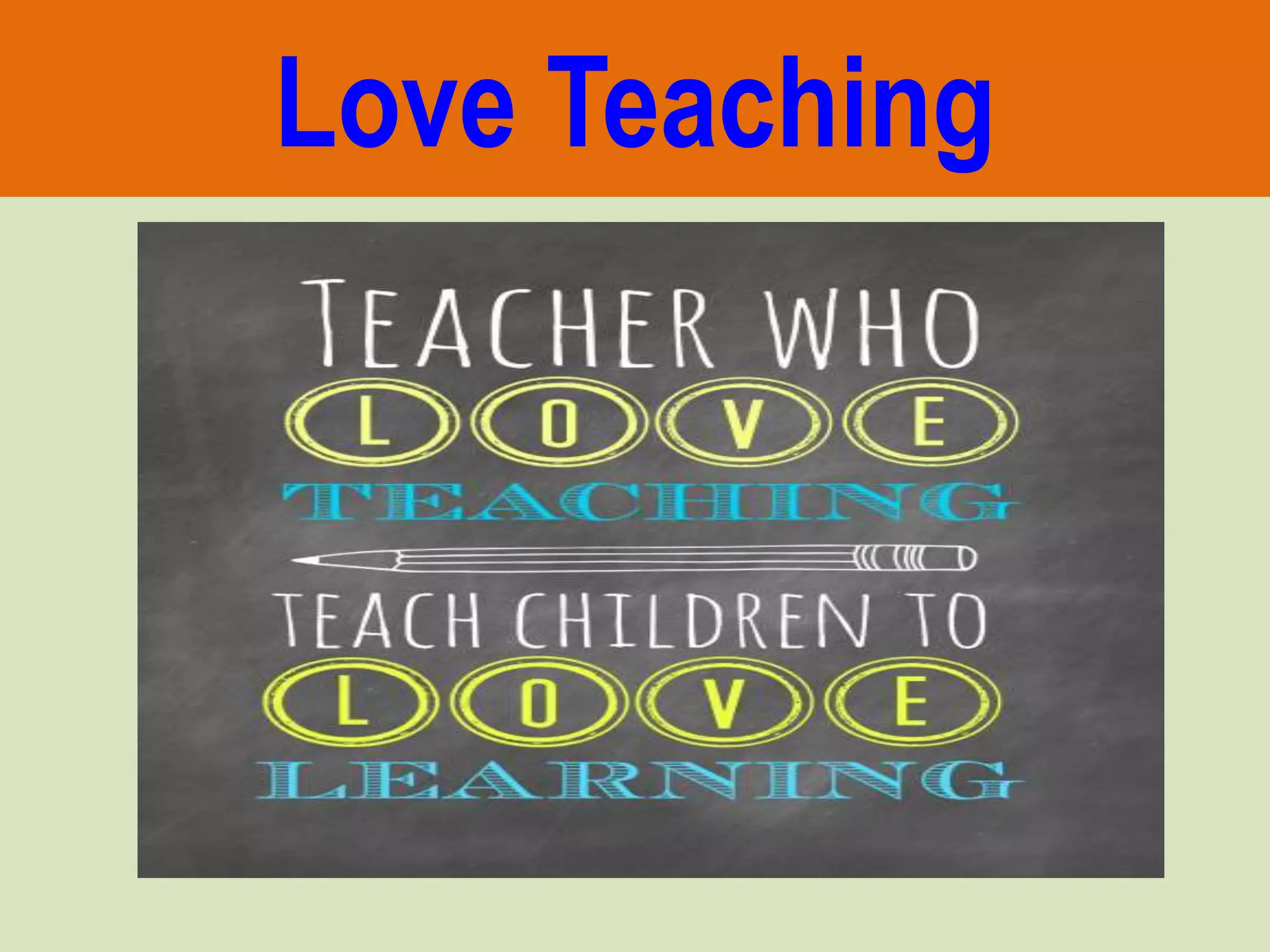
• Learn this art and you will love
teaching
Love Teaching
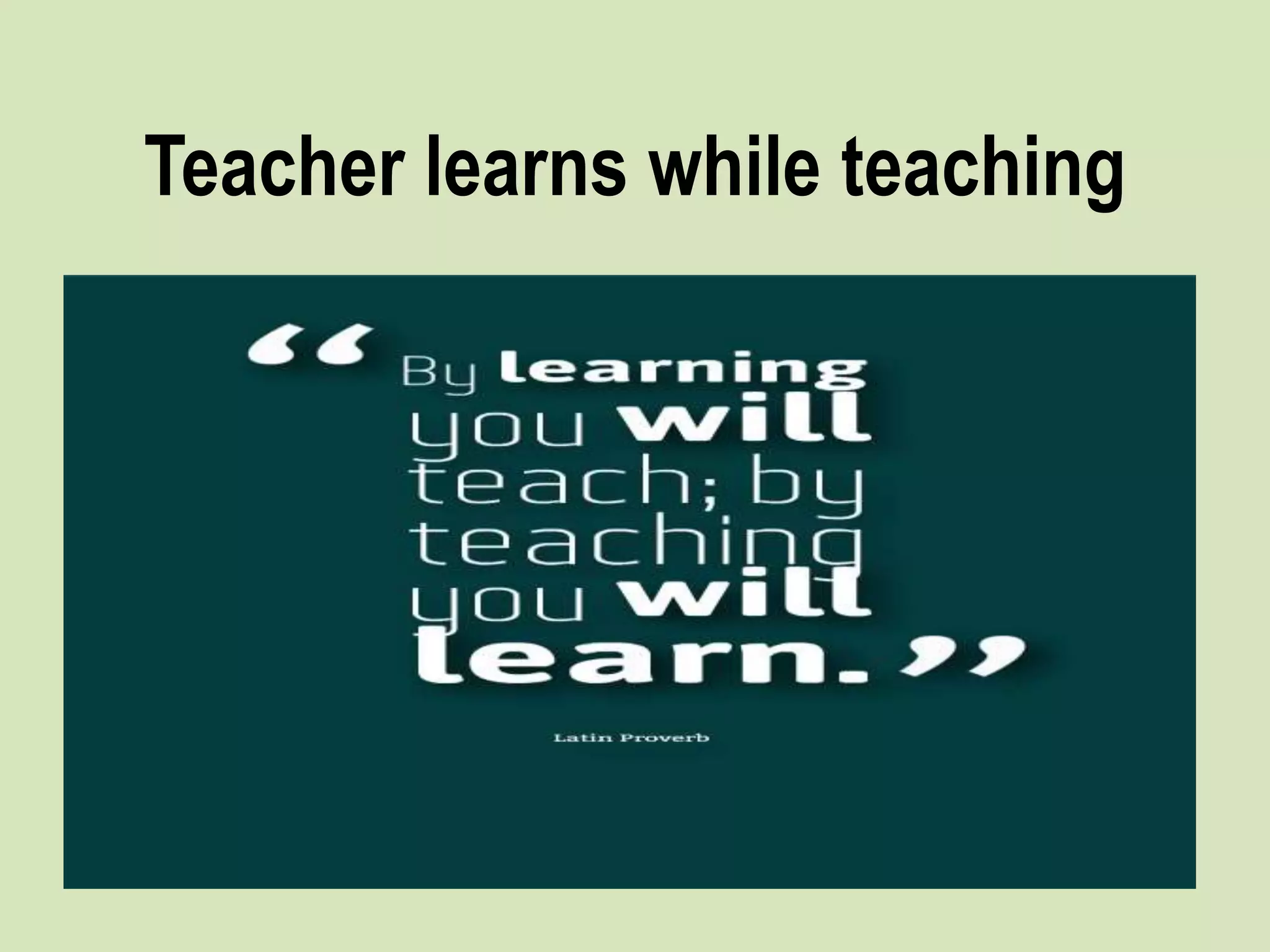
Teacher learns while teaching
• The core quality of a good teacher is
the ability to communicate his
knowledge and expertise to his
students.
Communication
Create Interest
• A good teacher builds knowledge of the subject,
with a clarity and understanding.
• Best teachers make the class interesting and
relevant to the students.
• Good teachers work hard to make their material
relevant.
• Interest is the mother of the attention .
Respect
• Good teachers have a concern and
respect for the students in the
classroom.
• Treat everyone with the equal respect
• Avoid partiality and favoritism.
Learn Classroom Management.
–It’s effective discipline
–It’s being prepared for class
–It’s motivating your students
–It’s providing a safe, comfortable learning
environment
–It’s building your students’ self esteem
–It’s being creative and imaginative in daily
lessons
Techniques for Better Classroom Control
• Focus attention on entire class
• Silence can be effective
• Direct your instruction so that students
know what is going to happen
• Move around the room so students have to
pay attention more readily
• Plan your lessons to ensure you fill the
period with learning activities
• Come to class prepared
• Show confidence in your teaching
• Learn student names as quickly as
possible
• Maintenance of Attendance Register
Techniques for Better Classroom Control
• Impatience
• Quick to anger
• Pessimism
• Moodiness
• Overly sensitive
• Frustrated (Frequent sighs, rolling eyes, red-faced lectures)
6 Teacher Personality Traits That Make
Classroom Management More Difficult
Managing The Students
Don’t throw the blame on the students for
your failure to create an impact with your
lecture.
Students are immature, less skilled,
emotional and You are mature, more skilled
and composed.
Best way to control the students is by giving
them best lectures.
 Text books/prescribed course is the base
(Teacher should have his own book, pen etc)
 Reference books/ helping books
 Paper pattern
 Division of marks
 Break-up of syllabus
 Revision
 Tests: weekly, monthly, scheduled
 Paper checking and mistakes be pointed out and
discussed
Curriculum
• These are the activities through which a learner explores one’s
abilities, develops the strengths and eradicates the shortcoming
through informal guidance, observation and self assessment.
• The activities undertaken to strengthen the classroom learning as
well as other activities both inside and outside the classroom to
develop the personality of the student
CO-CURRICULAR ACTIVITIES
IMPORTANCE:
• This gives them confidence
• Students can learn team spirit
• Bring a positive change in the students
• Students will get a chance to sharpen their talent
• To develop the all-round personality of the students
• Co-curricular activities are to keep the students physically
active
A tree is known by its fruits
• Results
• Attendance
• Transformation (of student)
• Employability Skills
• Campus Culture
• Value based, sensitive human
beings who can respond to
human needs and build up a
better world.
• The mediocre teacher tells,
• The good teacher explains,
• The superior teacher demonstrates,
• The great teacher inspires.
The great teacher inspires
• As a Potter
moulds clay into
a pot,
• So as a teacher
moulds life of a
student.
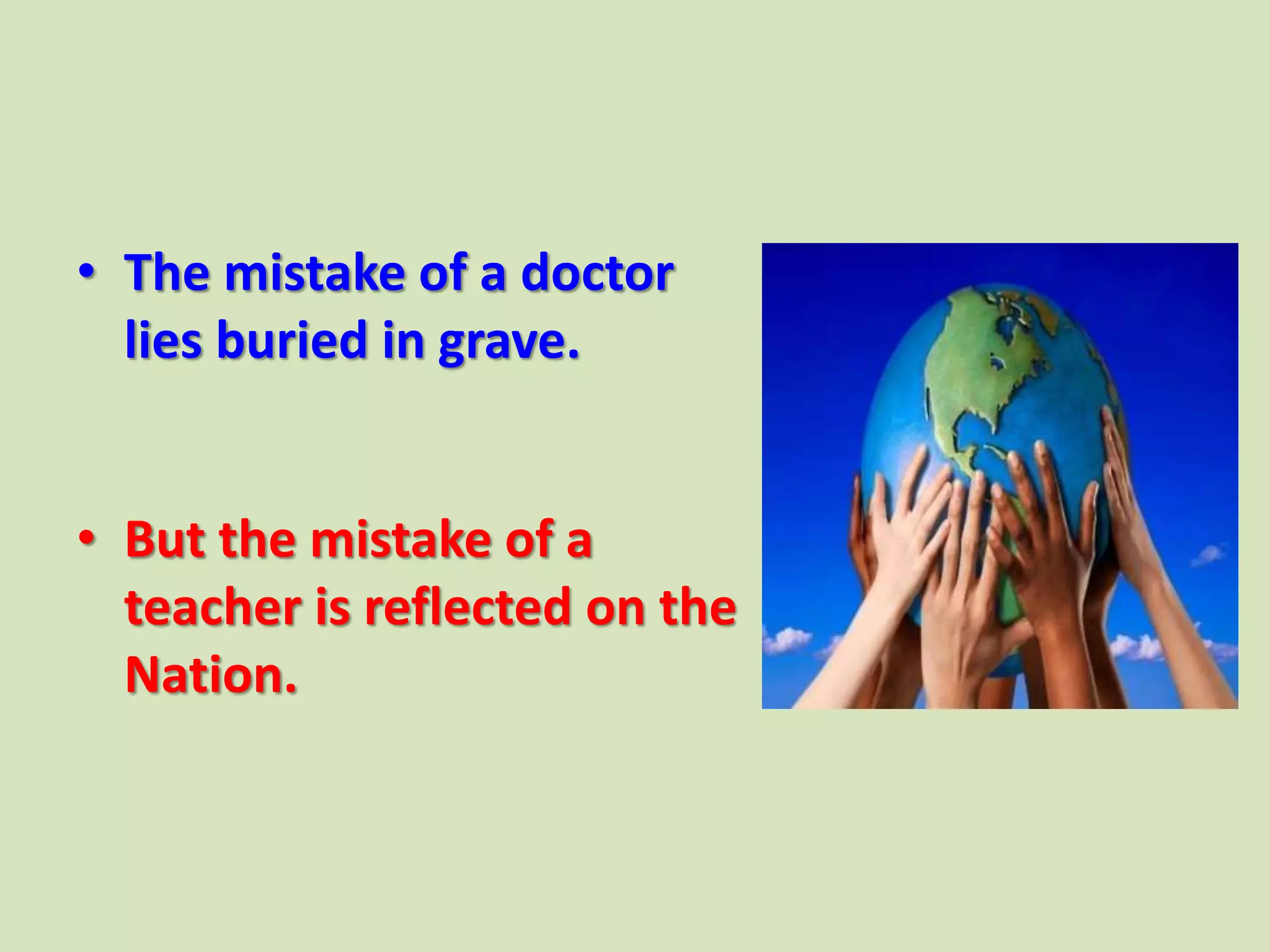
• The mistake of a doctor
lies buried in grave.
• But the mistake of a
teacher is reflected on the
Nation.
THANK YOU
Questions?

Teaching at college level

  • 1.
    Teaching at CollegeLevel By: Muhammad Shahid Iqbal shahid.tfc@gmail.com, Ph: 0345 840 7083 Staff Development Program
  • 4.
    Quality of Teachers •The quality of a nation depends upon the quality of its citizens. • The quality of its citizens depends- not exclusively but in critical measure-upon the quality of their education. • The quality of their education depends, more than upon any other single factor, upon the quality of their teachers. • These words of The American Commission on Teacher Education cannot be over-emphasized.
  • 5.
    Learning Objectives 1. Whatis teaching? 2. What is the purpose of teaching? 3. What is the process of teaching? 4. What are the types of teaching? 5. What are the various teaching methods? 6. What are the qualities of good teaching? 7. How best to teach? 8. Worthy points to remember regarding teaching
  • 6.
  • 7.
    What is Teaching? •Teaching is a process intended for learning by inducing a behavioural change in the taught. • It is an art of communicating a message with impact on audience. • Pedagogy is an art or profession of teaching.
  • 8.
  • 9.
    Why Teaching Teaching creates: •knowledge, • awareness and • feelings, in the taught, and brings about • behavioral change.
  • 10.
  • 11.
    Teaching Process • TeacherMessage Taught • Well (CABS) prepared CLEAR, SENSITIZED AND RECEPTIVE ACCURATE BRIEF SPECIFIC • No Communication barriers
  • 12.
  • 13.
    TYPES OF TEACHING •Active • Passive (tape recorder) • Learner Oriented • Teacher Oriented
  • 14.
  • 15.
    Teaching Methods 1. Lecture 2.Lecture discussion 3. Seminar (scholars meeting to discuss) 4. Symposium (set of articles on one subject) 5. Panel discussion 6. Group discussion 7. Tutorials (work under a tutor) 8. Role play 9. Workshops (discussion and practical work) 10. Conferences (to consult and discuss)
  • 16.
  • 17.
    Criteria of GoodTeaching • Good Concept (thorough preparation) • Organized Content (lesson planning) • Good Quality and optimum quantity • Sequence • Relevance (to topic and learner) • Learner oriented
  • 18.
  • 19.
    Set Induction • Bringingthe mood of the audience into the topic. • Make sure that your audience is ready to receive the message you are going to deliver by any means which will make them attentive and receptive like: 1. Verbal questioning 2. Handouts 3. Problem/exercises
  • 20.
    Introduction to theTopic • Introduce the topic to the students by means of: 1.Title 2.Learning objectives 3.Performance objectives
  • 21.
    Organizing The Topic •Prepare lesson plan keeping in mind: 1. Relevance 2. Sequence 3. Editing 4. Time management
  • 22.
    Reinforcement Make the lessonboth comprehensive and interesting by Reinforcing with: 1. Facts and figures 2. Problems/exercises 3. Giving Examples 4. Making it a two way lecture discussion by asking few questions(particularly the students who are not attentive)
  • 23.
    Stimulation • Make itmore interesting and lively by 1. Repetition of the main points 2. Stressing the important ones 3. Pauses to make something more effective 4. Relevant personal experiences 5. Purposeful body movements, gestures, eye contact etc.
  • 24.
    Teacher is themain one •Teacher teaches ( not the black board, OHP or PPT)
  • 25.
    Teaching flows • Teachingis a flow of thoughts ( stream of thoughts). • It is a continuous process , hence there should be no unwanted interruptions.
  • 26.
    Summarizing • Summarize yourlecture • By checking whether you have explained all the learning objectives you have chosen. • Just repeat your learning objectives giving stress on main points. • Please note that summarization is not evaluation or assessment of impact of your lecture. It completes just delivery of lecture, but does not measure the impact of lecture on the audience.
  • 27.
    Worthy points to rememberregarding teaching
  • 28.
    Teaching is anart • Teaching is an art (not just reading from a book and reproducing in the class room). • Learn this art and you will love teaching
  • 29.
  • 30.
  • 31.
    • The corequality of a good teacher is the ability to communicate his knowledge and expertise to his students. Communication
  • 32.
    Create Interest • Agood teacher builds knowledge of the subject, with a clarity and understanding. • Best teachers make the class interesting and relevant to the students. • Good teachers work hard to make their material relevant. • Interest is the mother of the attention .
  • 33.
    Respect • Good teachershave a concern and respect for the students in the classroom. • Treat everyone with the equal respect • Avoid partiality and favoritism.
  • 34.
    Learn Classroom Management. –It’seffective discipline –It’s being prepared for class –It’s motivating your students –It’s providing a safe, comfortable learning environment –It’s building your students’ self esteem –It’s being creative and imaginative in daily lessons
  • 35.
    Techniques for BetterClassroom Control • Focus attention on entire class • Silence can be effective • Direct your instruction so that students know what is going to happen • Move around the room so students have to pay attention more readily
  • 36.
    • Plan yourlessons to ensure you fill the period with learning activities • Come to class prepared • Show confidence in your teaching • Learn student names as quickly as possible • Maintenance of Attendance Register Techniques for Better Classroom Control
  • 37.
    • Impatience • Quickto anger • Pessimism • Moodiness • Overly sensitive • Frustrated (Frequent sighs, rolling eyes, red-faced lectures) 6 Teacher Personality Traits That Make Classroom Management More Difficult
  • 38.
    Managing The Students Don’tthrow the blame on the students for your failure to create an impact with your lecture. Students are immature, less skilled, emotional and You are mature, more skilled and composed. Best way to control the students is by giving them best lectures.
  • 39.
     Text books/prescribedcourse is the base (Teacher should have his own book, pen etc)  Reference books/ helping books  Paper pattern  Division of marks  Break-up of syllabus  Revision  Tests: weekly, monthly, scheduled  Paper checking and mistakes be pointed out and discussed Curriculum
  • 40.
    • These arethe activities through which a learner explores one’s abilities, develops the strengths and eradicates the shortcoming through informal guidance, observation and self assessment. • The activities undertaken to strengthen the classroom learning as well as other activities both inside and outside the classroom to develop the personality of the student CO-CURRICULAR ACTIVITIES
  • 41.
    CO-CURRICULAR ACTIVITIES IMPORTANCE: • Thisgives them confidence • Students can learn team spirit • Bring a positive change in the students • Students will get a chance to sharpen their talent • To develop the all-round personality of the students • Co-curricular activities are to keep the students physically active
  • 42.
    A tree isknown by its fruits • Results • Attendance • Transformation (of student) • Employability Skills • Campus Culture • Value based, sensitive human beings who can respond to human needs and build up a better world.
  • 43.
    • The mediocreteacher tells, • The good teacher explains, • The superior teacher demonstrates, • The great teacher inspires. The great teacher inspires
  • 44.
    • As aPotter moulds clay into a pot, • So as a teacher moulds life of a student.
  • 45.
    • The mistakeof a doctor lies buried in grave. • But the mistake of a teacher is reflected on the Nation.
  • 46.
  • 47.