ENDLESS JOURNEY
WAPAKELS
Educational
Technology•Alvin Andrade
• Patricia Ayala
• Novie Eclarin
• Roche
Escarza
• Gerladine
Bagui
• Eyra Ingrid
• Ederlyn Merilo
• Vanessa
Roadilla
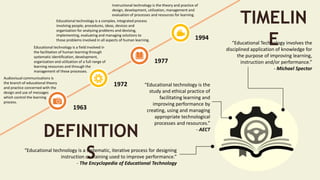
1963
Audiovisual communications is
the branch of educational theory
and practice concerned with the
design and use of messages
which control the learning
process.
1977
Educational technology is a complex, integrated process
involving people, procedures, ideas, devices and
organization for analyzing problems and devising,
implementing, evaluating and managing solutions to
those problems involved in all aspects of human learning.
1972
Educational technology is a field involved in
the facilitation of human learning through
systematic identification, development,
organization and utilization of a full-range of
learning resources and through the
management of these processes.
1994
Instructional technology is the theory and practice of
design, development, utilization, management and
evaluation of processes and resources for learning.
“Educational technology is the
study and ethical practice of
facilitating learning and
improving performance by
creating, using and managing
appropriate technological
processes and resources.”
- AECT
“Educational technology is a systematic, iterative process for designing
instruction or training used to improve performance.”
- The Encyclopedia of Educational Technology
“Educational Technology involves the
disciplined application of knowledge for
the purpose of improving learning,
instruction and/or performance.”
- Michael Spector
TIMELIN
E
DEFINITION
S
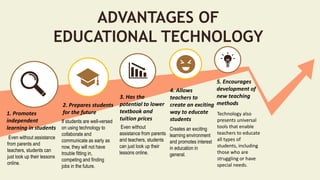
1. Promotes
independent
learning in students
Even without assistance
from parents and
teachers, students can
just look up their lessons
online.
ADVANTAGES OF
EDUCATIONAL TECHNOLOGY
2. Prepares students
for the future
If students are well-versed
on using technology to
collaborate and
communicate as early as
now, they will not have
trouble fitting in,
competing and finding
jobs in the future.
3. Has the
potential to lower
textbook and
tuition prices
Even without
assistance from parents
and teachers, students
can just look up their
lessons online.
4. Allows
teachers to
create an exciting
way to educate
students
Creates an exciting
learning environment
and promotes interest
in education in
general.
5. Encourages
development of
new teaching
methods
Technology also
presents universal
tools that enable
teachers to educate
all types of
students, including
those who are
struggling or have
special needs.
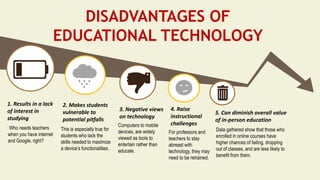
1. Results in a lack
of interest in
studying
Who needs teachers
when you have internet
and Google, right?
DISADVANTAGES OF
EDUCATIONAL TECHNOLOGY
2. Makes students
vulnerable to
potential pitfalls
This is especially true for
students who lack the
skills needed to maximize
a device’s functionalities.
3. Negative views
on technology
Computers to mobile
devices, are widely
viewed as tools to
entertain rather than
educate.
4. Raise
instructional
challenges
For professors and
teachers to stay
abreast with
technology, they may
need to be retrained.
5. Can diminish overall value
of in-person education
Data gathered show that those who
enrolled in online courses have
higher chances of failing, dropping
out of classes, and are less likely to
benefit from them.

Educational Technology definitions, timeline, advantages and disadvantages

  • 1.
  • 2.
    WAPAKELS Educational Technology•Alvin Andrade • PatriciaAyala • Novie Eclarin • Roche Escarza • Gerladine Bagui • Eyra Ingrid • Ederlyn Merilo • Vanessa Roadilla
  • 3.
    1963 Audiovisual communications is thebranch of educational theory and practice concerned with the design and use of messages which control the learning process. 1977 Educational technology is a complex, integrated process involving people, procedures, ideas, devices and organization for analyzing problems and devising, implementing, evaluating and managing solutions to those problems involved in all aspects of human learning. 1972 Educational technology is a field involved in the facilitation of human learning through systematic identification, development, organization and utilization of a full-range of learning resources and through the management of these processes. 1994 Instructional technology is the theory and practice of design, development, utilization, management and evaluation of processes and resources for learning. “Educational technology is the study and ethical practice of facilitating learning and improving performance by creating, using and managing appropriate technological processes and resources.” - AECT “Educational technology is a systematic, iterative process for designing instruction or training used to improve performance.” - The Encyclopedia of Educational Technology “Educational Technology involves the disciplined application of knowledge for the purpose of improving learning, instruction and/or performance.” - Michael Spector TIMELIN E DEFINITION S
  • 4.
    1. Promotes independent learning instudents Even without assistance from parents and teachers, students can just look up their lessons online. ADVANTAGES OF EDUCATIONAL TECHNOLOGY 2. Prepares students for the future If students are well-versed on using technology to collaborate and communicate as early as now, they will not have trouble fitting in, competing and finding jobs in the future. 3. Has the potential to lower textbook and tuition prices Even without assistance from parents and teachers, students can just look up their lessons online. 4. Allows teachers to create an exciting way to educate students Creates an exciting learning environment and promotes interest in education in general. 5. Encourages development of new teaching methods Technology also presents universal tools that enable teachers to educate all types of students, including those who are struggling or have special needs.
  • 5.
    1. Results ina lack of interest in studying Who needs teachers when you have internet and Google, right? DISADVANTAGES OF EDUCATIONAL TECHNOLOGY 2. Makes students vulnerable to potential pitfalls This is especially true for students who lack the skills needed to maximize a device’s functionalities. 3. Negative views on technology Computers to mobile devices, are widely viewed as tools to entertain rather than educate. 4. Raise instructional challenges For professors and teachers to stay abreast with technology, they may need to be retrained. 5. Can diminish overall value of in-person education Data gathered show that those who enrolled in online courses have higher chances of failing, dropping out of classes, and are less likely to benefit from them.