Bicol University
College of Agriculture and Forestry
Guinobatan, Albay
LESSON 7:
EVALUATION OF
TECHNOLOGY
LEARNING
Prepared by:
CARLO O. ORBETA
III-BAT-ATE1
Media FluencyDEFINITION OF TERMS
• Evaluation
• Technology
• Learning
EVALUATION
is a holistic
approach; all the
phases of learning
must be seen because
all of them contribute
the total development
of the child.
TECHNOLOGY
 is the science of
application of knowledge
to practical purposes to a
particular field.
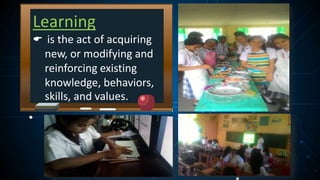
Learning
 is the act of acquiring
new, or modifying and
reinforcing existing
knowledge, behaviors,
skills, and values.
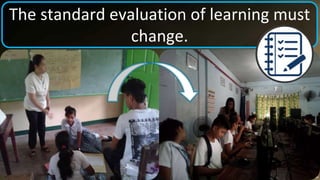
The standard evaluation of learning must
change.
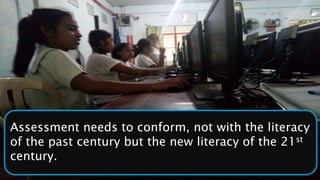
Assessment needs to conform, not with the literacy
of the past century but the new literacy of the 21st
century.
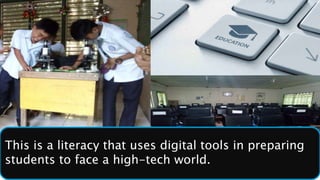
This is a literacy that uses digital tools in preparing
students to face a high-tech world.
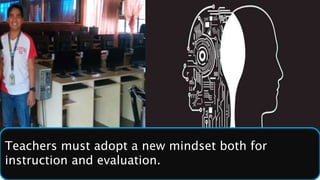
Teachers must adopt a new mindset both for
instruction and evaluation.
• This refers to the capacity and creativity in
problem solving.
SOLUTION FLUENCY
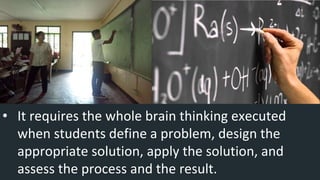
• It requires the whole brain thinking executed
when students define a problem, design the
appropriate solution, apply the solution, and
assess the process and the result.
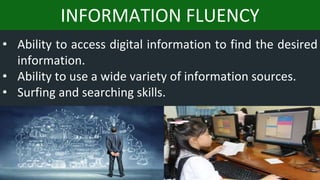
INFORMATION FLUENCY
• Ability to access digital information to find the desired
information.
• Ability to use a wide variety of information sources.
• Surfing and searching skills.
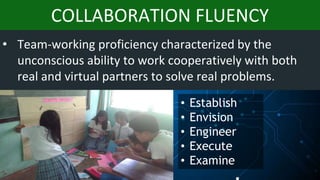
COLLABORATION FLUENCY
• Team-working proficiency characterized by the
unconscious ability to work cooperatively with both
real and virtual partners to solve real problems.
• Establish
• Envision
• Engineer
• Execute
• Examine
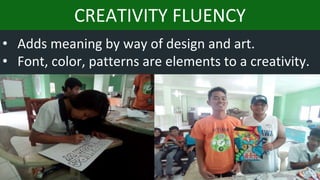
CREATIVITY FLUENCY
• Adds meaning by way of design and art.
• Font, color, patterns are elements to a creativity.
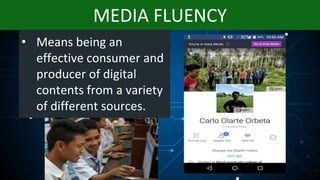
MEDIA FLUENCY
• Means being an
effective consumer and
producer of digital
contents from a variety
of different sources.
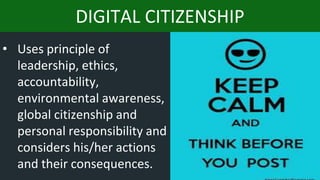
DIGITAL CITIZENSHIP
• Uses principle of
leadership, ethics,
accountability,
environmental awareness,
global citizenship and
personal responsibility and
considers his/her actions
and their consequences.
• The standard paper and pencil tests will prove
inadequate in assessing new learning. Assessment will
also need to focus on the 4 D`s.
THE 4D`S
• DEFINE
• DESIGN
• DO
• DEBRIEF
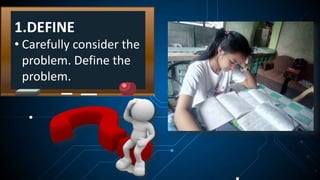
• Carefully consider the
problem. Define the
problem.
1.DEFINE
If you don`t
define the
problem, you`ll
never reach a
painful solution.
-Jacob Lew-
2.DESIGN
• Create carefully a
step by step action
to solve a problem.
Design is not
just what it
looks and feels
like. Design is
how it works.
-Steve Jobs-
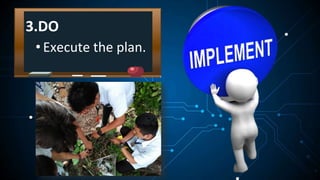
• Execute the plan.
3.DO
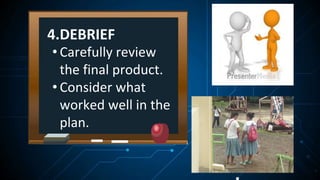
4.DEBRIEF
• Carefully review
the final product.
• Consider what
worked well in the
plan.
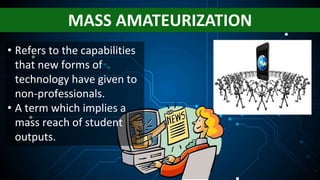
MASS AMATEURIZATION
• Refers to the capabilities
that new forms of
technology have given to
non-professionals.
• A term which implies a
mass reach of student
outputs.
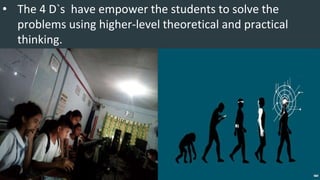
• The 4 D`s have empower the students to solve the
problems using higher-level theoretical and practical
thinking.
REFERENCES:
https://en.m.wikipedia.org
https://www.slideshare.net
Qoutefancy.com
Moziru.com
Epiccollaboration.com
Pictures:
Marcial O. Rañola Memorial School
Malipo National High School
Bicol University College of Agriculture and Forestry
Thank you for
listening!!!

Lesson 7: Evaluation of Technology Learning