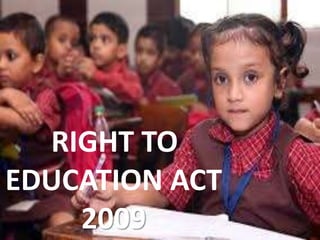
RIGHT TO
EDUCATION ACT
2009
•It is also known as “the right of children
to free and compulsory education act”.
•It is an act enacted by the Indian
parliament and received its assent of the
president on 26th August 2009.
•The law came into effect in the whole of
India from 1 April 2010.
•It describes the importance of free
and compulsory education for
children between 6 and 14 in India
under article of 21A of the Indian
constitution.
•Through this India became the one
of the 135 countries to make
education a fundamental right of
every child.
•It focused on children's, parents and
teachers.
Why ?
•More than 75 million children do
not have access to basic
education
•About 25% peoples are illiterate
•Around one crore children are
involved in child labour and every
year many children fall victim to
trafficking.
Main features of Right
to education act
Free and compulsory
education to all children of
India in the six to 14 age
group
 No child shall be held back,
expelled, or required to
pass a board examination
until completion of
elementary education.
Any time of the
academic year a child
can go to a school and
the demand that this
right be respected.
Proof of age for admission
No child shall be denied
admission in a school for lack
of age proof
Provides 25 % reservation for
economically and physically
disadvantaged students in
admission to class one in all
private schools.
No capitation fee and
screening procedure
for admission
Strict criteria for the
qualification of teachers
A fixed student and teacher
ratio is to be maintained
Examination and
completion certificate
School
infrastructure(where there
is a problem)to be
improved in three years,
else recognition cancelled
It prohibits
 Physical punishment and
mental harassment
 Screening procedures for
admission of children
 Capitation fee
 Private tution by teachers
 Running of schools without
recognition
Rte act 2009

Rte act 2009

  • 2.
  • 3.
    •It is alsoknown as “the right of children to free and compulsory education act”. •It is an act enacted by the Indian parliament and received its assent of the president on 26th August 2009. •The law came into effect in the whole of India from 1 April 2010.
  • 4.
    •It describes theimportance of free and compulsory education for children between 6 and 14 in India under article of 21A of the Indian constitution. •Through this India became the one of the 135 countries to make education a fundamental right of every child. •It focused on children's, parents and teachers.
  • 5.
  • 6.
    •More than 75million children do not have access to basic education •About 25% peoples are illiterate •Around one crore children are involved in child labour and every year many children fall victim to trafficking.
  • 7.
    Main features ofRight to education act Free and compulsory education to all children of India in the six to 14 age group
  • 8.
     No childshall be held back, expelled, or required to pass a board examination until completion of elementary education.
  • 9.
    Any time ofthe academic year a child can go to a school and the demand that this right be respected.
  • 10.
    Proof of agefor admission No child shall be denied admission in a school for lack of age proof
  • 11.
    Provides 25 %reservation for economically and physically disadvantaged students in admission to class one in all private schools.
  • 13.
    No capitation feeand screening procedure for admission
  • 14.
    Strict criteria forthe qualification of teachers A fixed student and teacher ratio is to be maintained
  • 15.
  • 16.
    School infrastructure(where there is aproblem)to be improved in three years, else recognition cancelled
  • 17.
    It prohibits  Physicalpunishment and mental harassment  Screening procedures for admission of children  Capitation fee  Private tution by teachers  Running of schools without recognition