PRESENTED BY
Aditya Majee
Pg. 5th year
Roll no-16MED018
RAVENSHAW UNIVERSITY
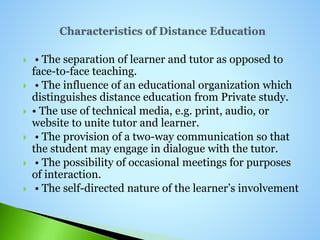
 • The separation of learner and tutor as opposed to
face-to-face teaching.
 • The influence of an educational organization which
distinguishes distance education from Private study.
 • The use of technical media, e.g. print, audio, or
website to unite tutor and learner.
 • The provision of a two-way communication so that
the student may engage in dialogue with the tutor.
 • The possibility of occasional meetings for purposes
of interaction.
 • The self-directed nature of the learner’s involvement
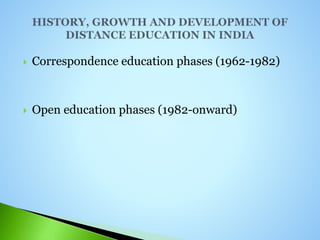
 Correspondence education phases (1962-1982)
 Open education phases (1982-onward)
The CABE Committee’s report (1994) has listed the major objectives
of distance education as:
 To provide an alternate, cost-effective, non-formal channel for tertiary
education.
 To supplement the conventional university system and to reduce the
pressure on it.
 To provide ‘second chance’ education to those who have had to
discontinue their formal education or could not join regular colleges or
universities owing to social, economic and other consideration.
 To democratize higher education by providing access to large segments
of the population, in particular the disadvantaged groups such as those
living in remote and rural areas, including working people like women
and other adults, who wish to acquire and upgrade their knowledge and/
or skills.
 To strengthen and diversity the degree, certificate and diploma courses
related to employment, and necessary for building the economy, on the
basis of its natural and human resources.
 To provide continuing and life-long education to enrich the lives of the
people.
The major cause of distance education in India are –
 Access to education
 Quality of education
 Relevance
 Rapid growth of education
 Population Explosion
 Geographical Limitation
 Qualification Improvement
 Education for all age
 Knowledge Explosion
 Universal Education
 Equivalent Courses
 Need based curriculum
 Courses Status
(a) Higher level courses
(b) School level courses
continue……
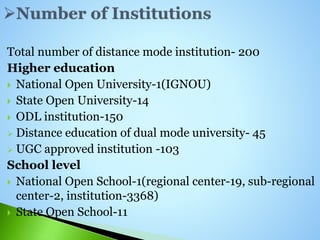
Total number of distance mode institution- 200
Higher education
 National Open University-1(IGNOU)
 State Open University-14
 ODL institution-150
 Distance education of dual mode university- 45
 UGC approved institution -103
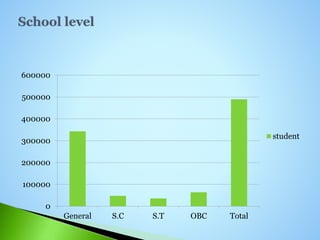
School level
 National Open School-1(regional center-19, sub-regional
center-2, institution-3368)
 State Open School-11
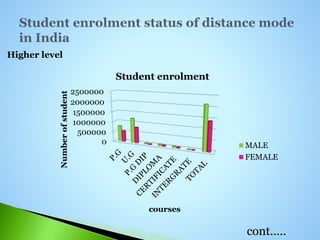
Higher level
cont…..
0
500000
1000000
1500000
2000000
2500000
Numberofstudent
courses
Student enrolment
MALE
FEMALE
0
100000
200000
300000
400000
500000
600000
General S.C S.T OBC Total
student
 Freedom & adaptability
 Self-motivation
 Flexibility of choice
 You can earn as well as learn
 Saves time & money
 Absence of a teacher/instructor
 Absence of a proper learning environment
 Lack of motivation
 Cannot generate as an alternate learning
method
THANK YOU

Distance education

  • 1.
    PRESENTED BY Aditya Majee Pg.5th year Roll no-16MED018 RAVENSHAW UNIVERSITY
  • 3.
     • Theseparation of learner and tutor as opposed to face-to-face teaching.  • The influence of an educational organization which distinguishes distance education from Private study.  • The use of technical media, e.g. print, audio, or website to unite tutor and learner.  • The provision of a two-way communication so that the student may engage in dialogue with the tutor.  • The possibility of occasional meetings for purposes of interaction.  • The self-directed nature of the learner’s involvement
  • 4.
     Correspondence educationphases (1962-1982)  Open education phases (1982-onward)
  • 5.
    The CABE Committee’sreport (1994) has listed the major objectives of distance education as:  To provide an alternate, cost-effective, non-formal channel for tertiary education.  To supplement the conventional university system and to reduce the pressure on it.  To provide ‘second chance’ education to those who have had to discontinue their formal education or could not join regular colleges or universities owing to social, economic and other consideration.  To democratize higher education by providing access to large segments of the population, in particular the disadvantaged groups such as those living in remote and rural areas, including working people like women and other adults, who wish to acquire and upgrade their knowledge and/ or skills.  To strengthen and diversity the degree, certificate and diploma courses related to employment, and necessary for building the economy, on the basis of its natural and human resources.  To provide continuing and life-long education to enrich the lives of the people.
  • 6.
    The major causeof distance education in India are –  Access to education  Quality of education  Relevance  Rapid growth of education  Population Explosion  Geographical Limitation  Qualification Improvement  Education for all age  Knowledge Explosion  Universal Education
  • 7.
     Equivalent Courses Need based curriculum  Courses Status (a) Higher level courses (b) School level courses continue……
  • 8.
    Total number ofdistance mode institution- 200 Higher education  National Open University-1(IGNOU)  State Open University-14  ODL institution-150  Distance education of dual mode university- 45  UGC approved institution -103 School level  National Open School-1(regional center-19, sub-regional center-2, institution-3368)  State Open School-11
  • 9.
  • 10.
  • 11.
     Freedom &adaptability  Self-motivation  Flexibility of choice  You can earn as well as learn  Saves time & money
  • 12.
     Absence ofa teacher/instructor  Absence of a proper learning environment  Lack of motivation  Cannot generate as an alternate learning method
  • 13.