Jamalludin Harun [email_address] BLOG IN TEACHING & LEARNING Something More Than Just Technology
New teaching and learning paradigm Student centred approach Competence/Outcome based New roles of  - Educators - Students - Institutions Introduction
“ Our students have changed radically.Today’s students are no longer the people our educational system was designed to teach ” . Mark Prensky, “Digital Natives, Digital Immigrants” Introduction
Introduction
Introduction w h y  w e b l o g s ?
Educators have picked up on the creative use of this Internet technology and put the blog to work in the classroom.  The education blog can be a powerful and effective technology tool for students and educators alike. Introduction
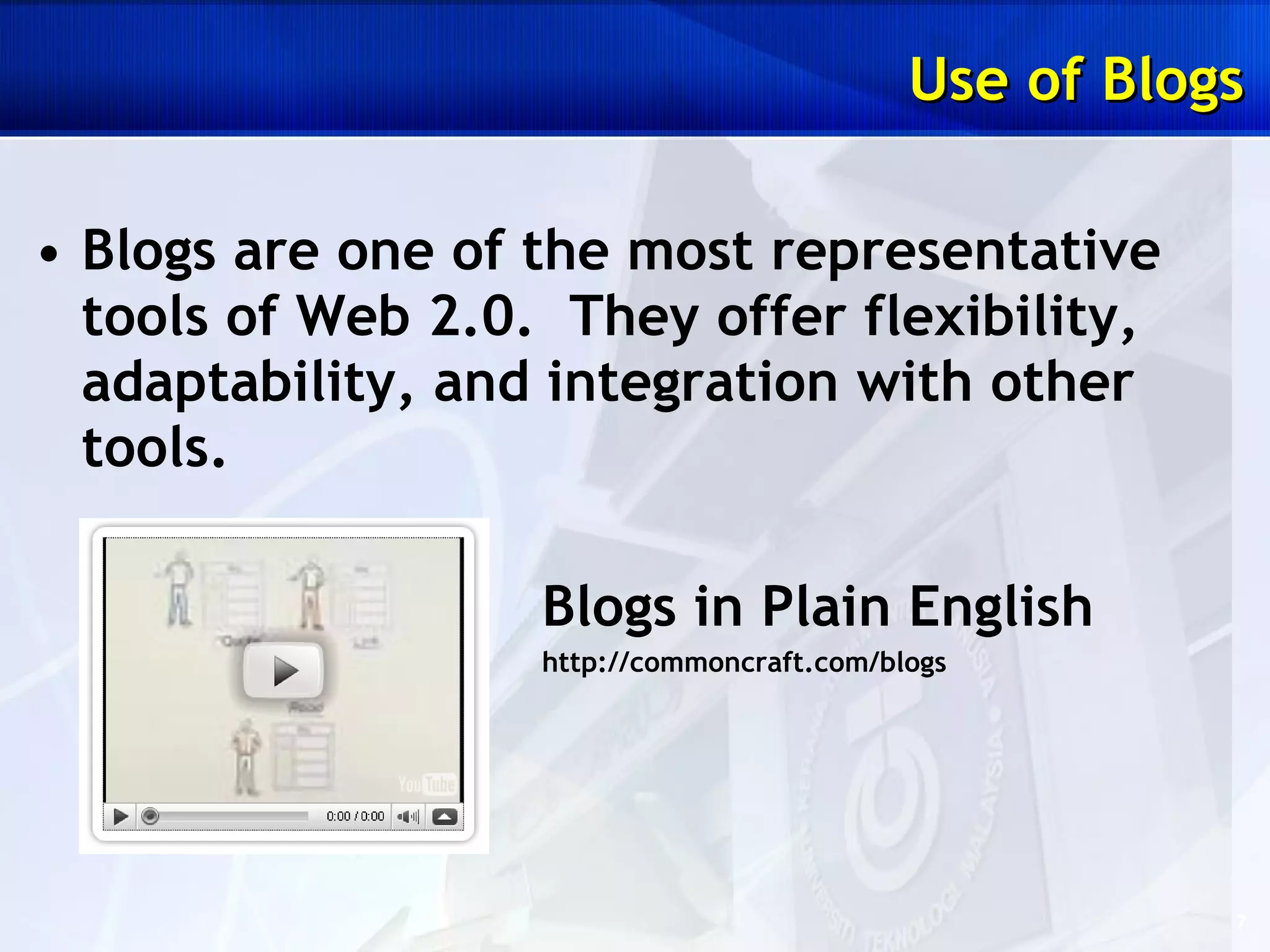
Blogs are one of the most representative tools of Web 2.0.  They offer flexibility, adaptability, and integration with other tools. Blogs in Plain English http://commoncraft.com/blogs Use of Blogs
A blog (sometimes referred to as a weblog) is a Web publishing tool that allows authors to quickly and easily self-publish text, artwork, links to other blogs or Web sites, and a whole array of other content. What is a Blog?
Blogs are set-up like conventional Web sites, with navigation links, and other standard Web site features.  Blogs have one standard characteristic, however: the posting.  Blog postings are text entries, similar to a diary or journal, which include a posting date and may include comments by people other than the author, photos, links, or other digital media. What is a Blog?
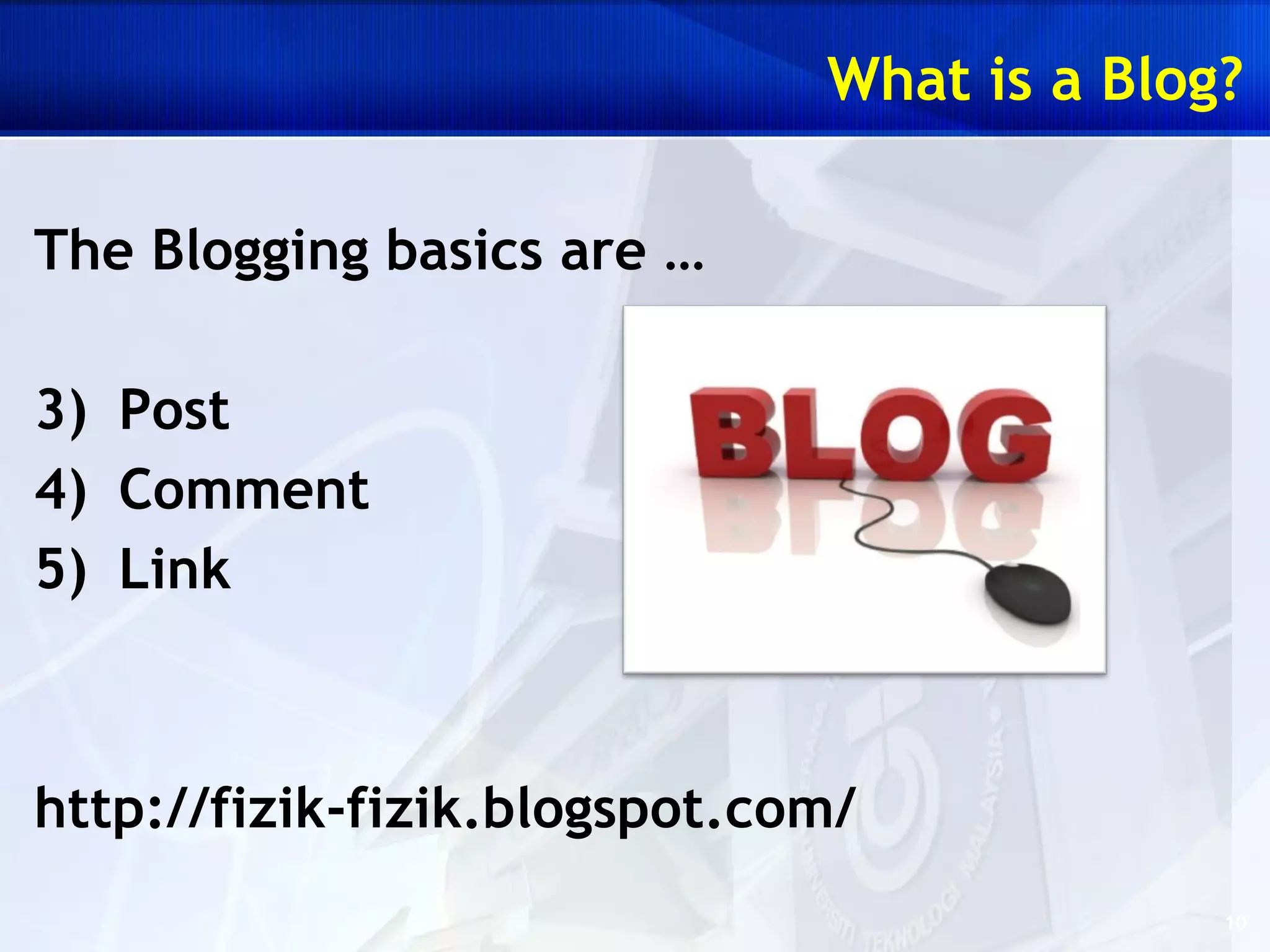
The Blogging basics are … Post Comment Link http://fizik-fizik.blogspot.com/ What is a Blog?
BLOG: EDUCATIONAL USES
Technologies do NOT change teaching & learning, but can help us to introduce new methodologies and learning environments. Blog in Teaching & Learning Blogs support:  knowledge building reflection monitoring sharing archiving Possibilities of Web 2.0 tools
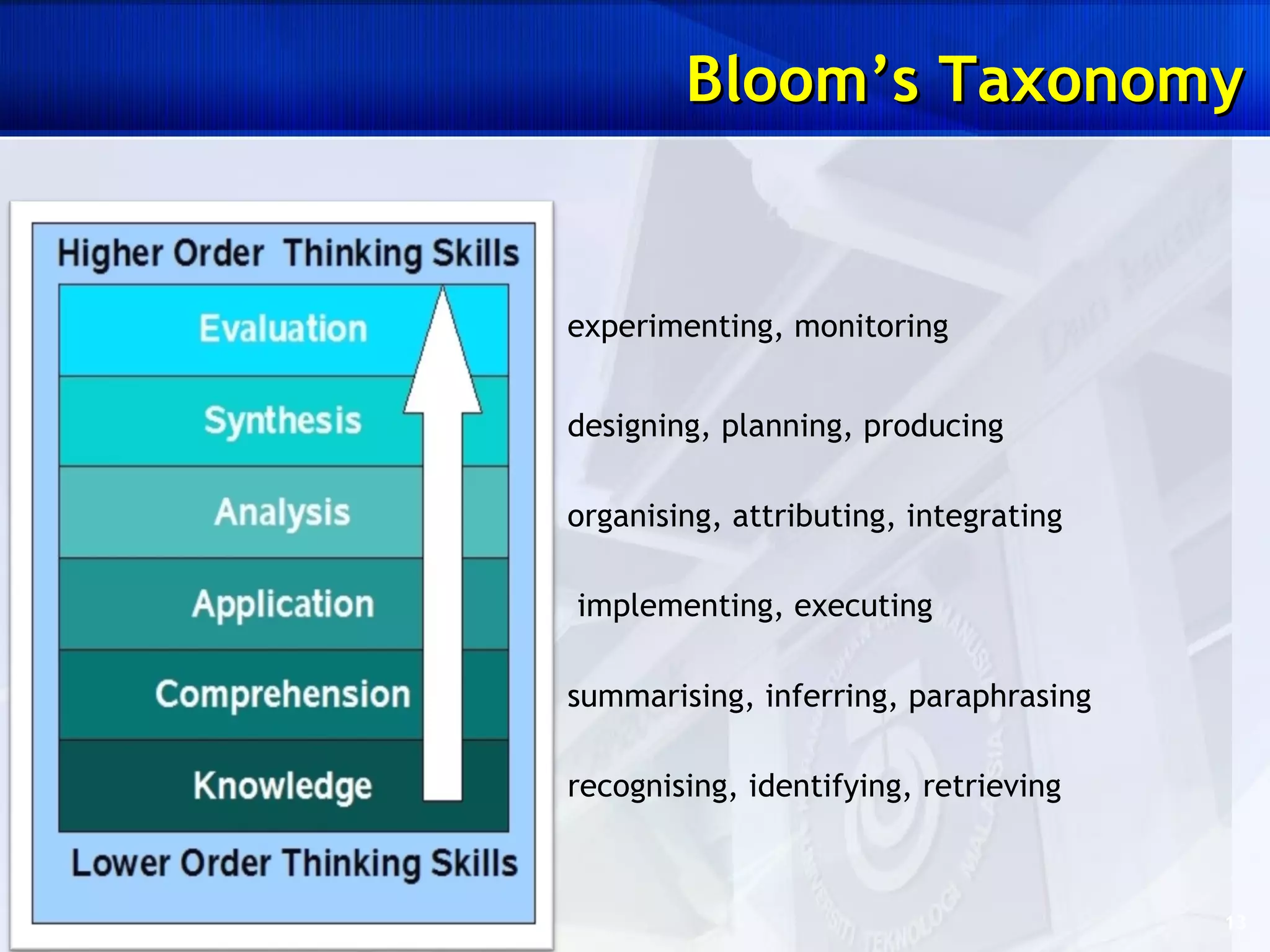
Bloom’s Taxonomy experimenting, monitoring implementing, executing  designing, planning, producing organising, attributing, integrating summarising, inferring, paraphrasing recognising, identifying, retrieving
Like the general blogging community, there are many ways to use blogging in teaching and learning.  You can use an existing blog to provide information and insights.  They can also help you provide examples to increase the quality of your students' blog entries. Or, you can encourage your students to create a blog for others that reflects these ideas. Blog in Teaching & Learning
Blogs work well for students because they can be worked on at virtually any time, in any place with an Internet-enabled computer.  Hence, they can be used by educators to create a classroom that extends beyond the boundaries of the classroom. Educational Blogging…??
Providing teachers with an excellent tool for communicating with students. Highly motivating to students, especially those who otherwise might not become participants in classrooms.  Excellent opportunities for students to read, write and reflect. Effective forums for collaboration and discussion.  Powerful tools to enable scaffolded learning or mentoring to occur. Educational Benefits of Blogs
Provides an additional mode for writing. Engages writing skills. Presents writing as an instructional tool in the content areas. Incorporates technology. Makes learning relevant. Boosts students’ self-confidence. Engages various learning styles. Facilitates critical thinking. Meets district and state learning standards. Educational Benefits of Blogs
teachers to provide feedback  and to monitor students’ performance more effectively self-assessment and continued assessment personal reflection. tracking all the process (by students themselves and by teachers). Blogs Facilitate…
Text Images Videos Audio Files PowerPoint Presentation Link to other blogs and web pages etc… What a Blog Can Have..?
Okay, that’s interesting, but how can I use blogging in my classroom? Educational Blogging…??
As an educational tool, blogs may be integrated in a multi-faceted manner to accommodate all learners.  Blogs can serve at least four basic functions.  Using Blog in the Classroom
Classroom Management Class blogs can serve as a portal to foster a community of learners.  As they are easy to create and update efficiently, they can be used to inform students of class requirements, post handouts, notices, and homework assignments, or act as a question and answer board. Using Blog in the Classroom
Collaboration Blogs provide a space where educators and students can work to further develop writing or other skills with the advantage of an instant audience.  Educators can offer instructional tips, and students can practice and benefit from peer review.  Using Blog in the Classroom
Collaboration They also make online mentoring possible. For example, a class of older students can help a class of younger students develop more confidence in their writing skills.  Students can also participate in cooperative learning activities that require them to relay research findings, ideas, or suggestions. Using Blog in the Classroom
Discussions A class blog opens the opportunity for students to discuss topics outside of the classroom.  With a blog, every person has an equal opportunity to share their thoughts and opinions.  Using Blog in the Classroom
Student Portfolios Blogs present, organize, and protect student work as digital portfolios.  As students realize their efforts will be published, they are typically more motivated to produce better writing. Expert or peer mentoring advice can be easily kept for future reference. Using Blog in the Classroom
BLOG: GETTING STARTED
Start exploring with the tool, what you can do, how does it work, etc. Seek help from colleagues who have tried it. Read other educators’ blogs; how they use categories, how they organize the information, how often they blog, how they give instructions to students, etc. So…Ready to Blog…?
Steps for Getting Started on Blogs Go to one of the available free blogging sites (for example: Blogger or WordPress).  Provide the necessary information requested. (user name, password)  Create a title for your blog.  Accept terms and select a template.  Write and Publish!
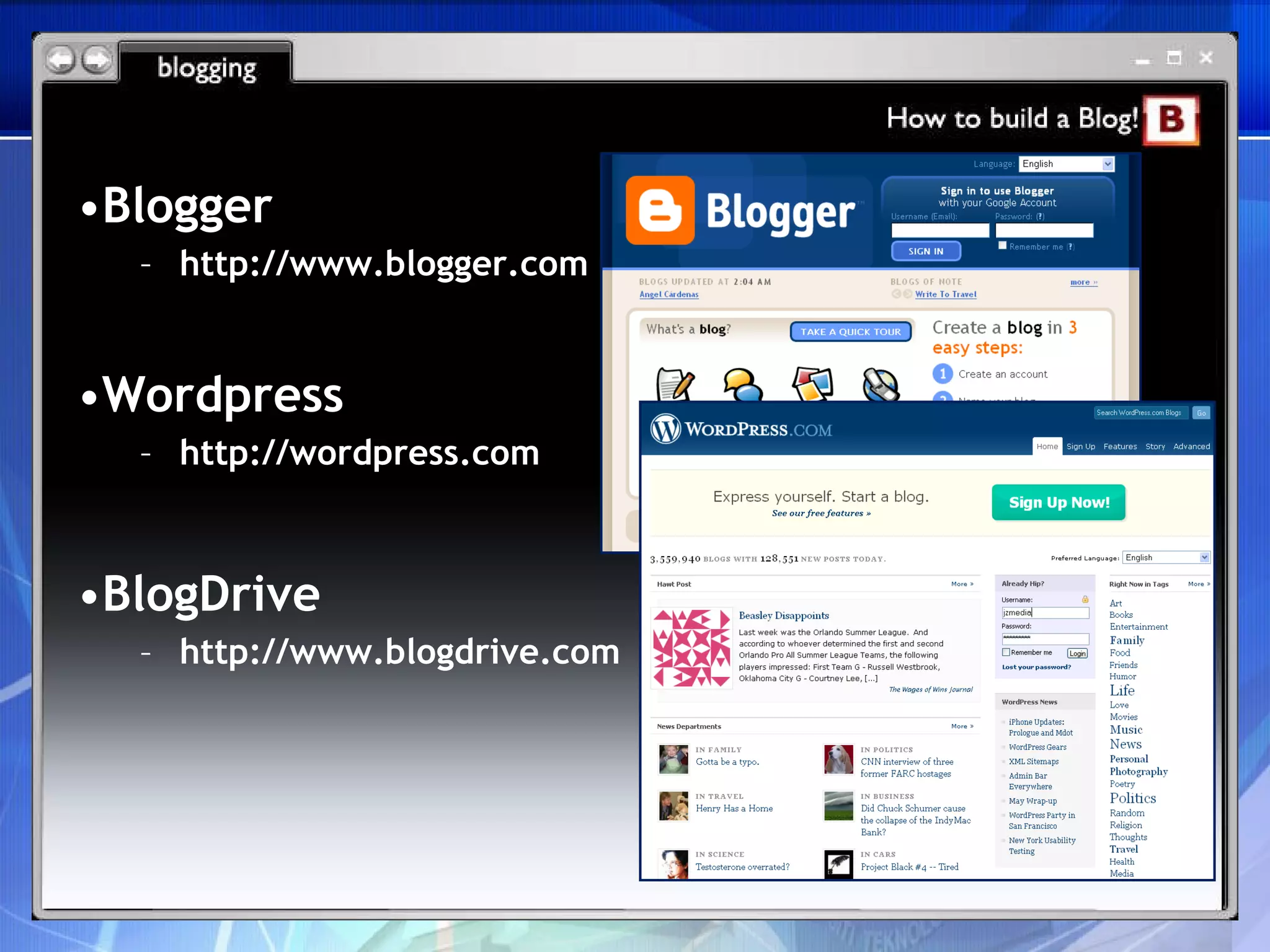
Blogger http://www.blogger.com Wordpress http://wordpress.com BlogDrive http://www.blogdrive.com
Some other Blog Platforms… B2Evolution  http://b2evolution.net/ LiveJournal http://www.livejournal.com/ Edublogs  http://edublogs.org/   Twitter (microblogging)  http://twitter.com
Blogs to Visit and Explore http://authoringsystem.blogspot.com/ http://ainjoe.wordpress.com/ http://fizik-fizik.blogspot.com/ http://stochastix.wordpress.com/ http://osumaterials.wordpress.com/ http://lisahistory.net/wordpress/ http://nobullets.wordpress.com/ http://thereflectiveteacher.wordpress.com http://scyuen.wordpress.com/ http://web2videos.blogspot.com/ http://www.freetech4teachers.com/

Blog in Teaching & Learning

  • 1.
    Jamalludin Harun [email_address]BLOG IN TEACHING & LEARNING Something More Than Just Technology
  • 2.
    New teaching andlearning paradigm Student centred approach Competence/Outcome based New roles of - Educators - Students - Institutions Introduction
  • 3.
    “ Our studentshave changed radically.Today’s students are no longer the people our educational system was designed to teach ” . Mark Prensky, “Digital Natives, Digital Immigrants” Introduction
  • 4.
  • 5.
    Introduction w hy w e b l o g s ?
  • 6.
    Educators have pickedup on the creative use of this Internet technology and put the blog to work in the classroom. The education blog can be a powerful and effective technology tool for students and educators alike. Introduction
  • 7.
    Blogs are oneof the most representative tools of Web 2.0. They offer flexibility, adaptability, and integration with other tools. Blogs in Plain English http://commoncraft.com/blogs Use of Blogs
  • 8.
    A blog (sometimesreferred to as a weblog) is a Web publishing tool that allows authors to quickly and easily self-publish text, artwork, links to other blogs or Web sites, and a whole array of other content. What is a Blog?
  • 9.
    Blogs are set-uplike conventional Web sites, with navigation links, and other standard Web site features. Blogs have one standard characteristic, however: the posting. Blog postings are text entries, similar to a diary or journal, which include a posting date and may include comments by people other than the author, photos, links, or other digital media. What is a Blog?
  • 10.
    The Blogging basicsare … Post Comment Link http://fizik-fizik.blogspot.com/ What is a Blog?
  • 11.
  • 12.
    Technologies do NOTchange teaching & learning, but can help us to introduce new methodologies and learning environments. Blog in Teaching & Learning Blogs support: knowledge building reflection monitoring sharing archiving Possibilities of Web 2.0 tools
  • 13.
    Bloom’s Taxonomy experimenting,monitoring implementing, executing designing, planning, producing organising, attributing, integrating summarising, inferring, paraphrasing recognising, identifying, retrieving
  • 14.
    Like the generalblogging community, there are many ways to use blogging in teaching and learning. You can use an existing blog to provide information and insights. They can also help you provide examples to increase the quality of your students' blog entries. Or, you can encourage your students to create a blog for others that reflects these ideas. Blog in Teaching & Learning
  • 15.
    Blogs work wellfor students because they can be worked on at virtually any time, in any place with an Internet-enabled computer. Hence, they can be used by educators to create a classroom that extends beyond the boundaries of the classroom. Educational Blogging…??
  • 16.
    Providing teachers withan excellent tool for communicating with students. Highly motivating to students, especially those who otherwise might not become participants in classrooms. Excellent opportunities for students to read, write and reflect. Effective forums for collaboration and discussion. Powerful tools to enable scaffolded learning or mentoring to occur. Educational Benefits of Blogs
  • 17.
    Provides an additionalmode for writing. Engages writing skills. Presents writing as an instructional tool in the content areas. Incorporates technology. Makes learning relevant. Boosts students’ self-confidence. Engages various learning styles. Facilitates critical thinking. Meets district and state learning standards. Educational Benefits of Blogs
  • 18.
    teachers to providefeedback and to monitor students’ performance more effectively self-assessment and continued assessment personal reflection. tracking all the process (by students themselves and by teachers). Blogs Facilitate…
  • 19.
    Text Images VideosAudio Files PowerPoint Presentation Link to other blogs and web pages etc… What a Blog Can Have..?
  • 20.
    Okay, that’s interesting,but how can I use blogging in my classroom? Educational Blogging…??
  • 21.
    As an educationaltool, blogs may be integrated in a multi-faceted manner to accommodate all learners. Blogs can serve at least four basic functions. Using Blog in the Classroom
  • 22.
    Classroom Management Classblogs can serve as a portal to foster a community of learners. As they are easy to create and update efficiently, they can be used to inform students of class requirements, post handouts, notices, and homework assignments, or act as a question and answer board. Using Blog in the Classroom
  • 23.
    Collaboration Blogs providea space where educators and students can work to further develop writing or other skills with the advantage of an instant audience. Educators can offer instructional tips, and students can practice and benefit from peer review. Using Blog in the Classroom
  • 24.
    Collaboration They alsomake online mentoring possible. For example, a class of older students can help a class of younger students develop more confidence in their writing skills. Students can also participate in cooperative learning activities that require them to relay research findings, ideas, or suggestions. Using Blog in the Classroom
  • 25.
    Discussions A classblog opens the opportunity for students to discuss topics outside of the classroom. With a blog, every person has an equal opportunity to share their thoughts and opinions. Using Blog in the Classroom
  • 26.
    Student Portfolios Blogspresent, organize, and protect student work as digital portfolios. As students realize their efforts will be published, they are typically more motivated to produce better writing. Expert or peer mentoring advice can be easily kept for future reference. Using Blog in the Classroom
  • 27.
  • 28.
    Start exploring withthe tool, what you can do, how does it work, etc. Seek help from colleagues who have tried it. Read other educators’ blogs; how they use categories, how they organize the information, how often they blog, how they give instructions to students, etc. So…Ready to Blog…?
  • 29.
    Steps for GettingStarted on Blogs Go to one of the available free blogging sites (for example: Blogger or WordPress). Provide the necessary information requested. (user name, password) Create a title for your blog. Accept terms and select a template. Write and Publish!
  • 30.
    Blogger http://www.blogger.com Wordpresshttp://wordpress.com BlogDrive http://www.blogdrive.com
  • 31.
    Some other BlogPlatforms… B2Evolution http://b2evolution.net/ LiveJournal http://www.livejournal.com/ Edublogs http://edublogs.org/ Twitter (microblogging) http://twitter.com
  • 32.
    Blogs to Visitand Explore http://authoringsystem.blogspot.com/ http://ainjoe.wordpress.com/ http://fizik-fizik.blogspot.com/ http://stochastix.wordpress.com/ http://osumaterials.wordpress.com/ http://lisahistory.net/wordpress/ http://nobullets.wordpress.com/ http://thereflectiveteacher.wordpress.com http://scyuen.wordpress.com/ http://web2videos.blogspot.com/ http://www.freetech4teachers.com/